
Life, 1919-05-29 · page 8 of 42
Life — May 29, 1919 — page 8: what you’re looking at
What you’re looking at
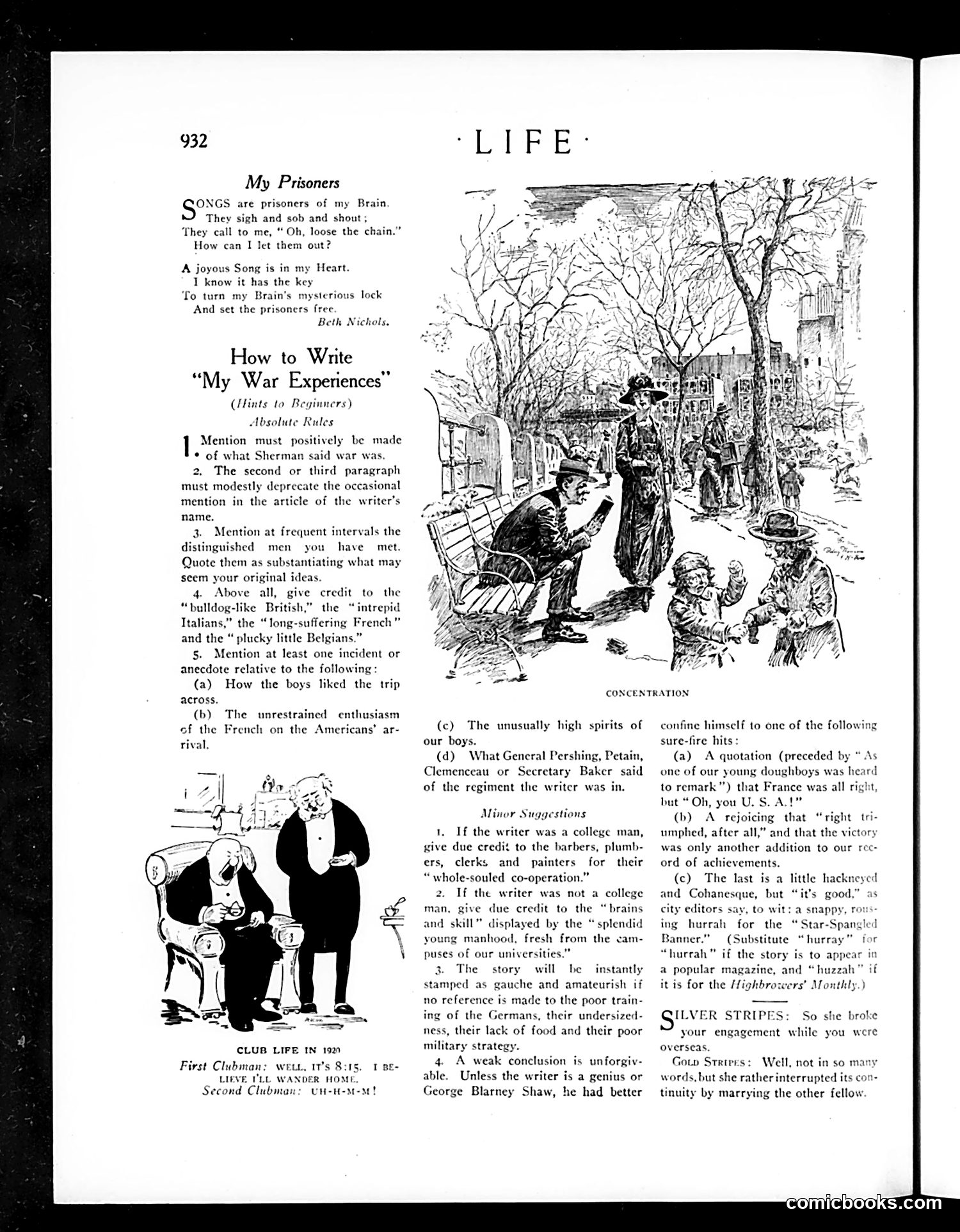
This Life magazine page (page 932) contains two distinct elements: **"My Prisoners" poem** by Beth Nicholls uses metaphor—songs as "prisoners of the brain"—to discuss creative constraint and liberation through a "joyous song." **"Club Life in 1921"** cartoon depicts two well-dressed men in conversation, with humorous dialogue about wandering home and seeking marital permission. This satirizes post-WWI social conventions, specifically poking fun at married men's domestic restrictions and the tension between bachelor freedom and matrimonial obligation—a common Life magazine theme mocking middle-class married life. The accompanying instructional article offers tongue-in-cheek advice for writing war memoirs, mixing genuine historical guidance with satirical jabs at overwrought accounts and name-dropping.
📄 Transcribed text from this page (OCR, searchable)
Machine-transcribed from the original scan — historical spelling and the odd misread are preserved.
932 My Prisoners ONGS are prisoners of my They sigh and sob and shout; ‘They call to me, “ Oh, loose the chain.” How can I let them out? Brain. A joyous Song is in my Heart. 1 know it has the key To turn my Brain's mysterious lock And set the prisoners free Beth Nichols, How to Write “My War Experiences” (Hints to Beginners) elbsolute Rules Mention must positively be made * of what Sherman said war was 2, The second or third paragraph must modestly deprecate the occasional mention in the article of the writer’s name. 3. Mention at frequent intervals the distinguished men you Quote them as substantiating what may seem your original ideas. 4. Above all, give credit to the “bulldog-like British,” the “intrepid Italian the “long-suffering French” and the “ plucky little Belgians.” 5. Mention at least one incident or anecdote relative to the following: (a) How the boys liked the trip across. (b) The unrestrained enthusiasm of the French on the Americans’ ar- rival. have met. CLUB LIFE IN 1920 First Clubman: wet EVE I'LL WAND! ond Clubman It’s 8:15. Home Un-HeMeM! T BE- CONCENTRATION (c) The unusually high spirits of our boys. (d) What General Pershing, Petain, Clemenceau or Secretary Baker said of the regiment the writer was in. bers, plumb- their give due credit to the ers, clerks and painters for “whole-souled co-operation.” 2. If the writer was not a man, give due credit to the and. skill” displayed by the “ splendid young manhood, fresh from the cam- college ins puses of our universities.” 3. The stamped as story will be instantly auche and amateurish if no reference is made to the poor train- ing of the Germans, their undersized- ness, their lack of food and their poor military strategy. 4. A weak conclusion is unforgiv- able. Unless the writer is a genius or George Blarney Shaw, he had better confine himself to one of the following sure-fire hits: (a) A quotation (preceded by “ As one of our young doughboys was heard to remark") that France was all rig but “Oh, you U.S. A!” (b) A rejoicing that “right. tri- umphed, after all,” and that the victory was only another addition to our rec- ord of achievements. (c) The last is a little hackneyed d Cohanesque, but “it's good,” as editors say, to wit: a snappy tS ing hurrah for the Banner.” (Substitute “ hurr: “hurrah” if the story is to ap a popular magazine, and “ huzz: it is for the Highbrowers’ Monthly.) ILVER STRIPES: your engagement while you were overseas. Gotp Strives: So she broke Well, not in so m words, but she rather interrupted its ¢ tinuity by marrying the other fellow.