
A complete issue · 44 pages · 1919
Life — March 20, 1919
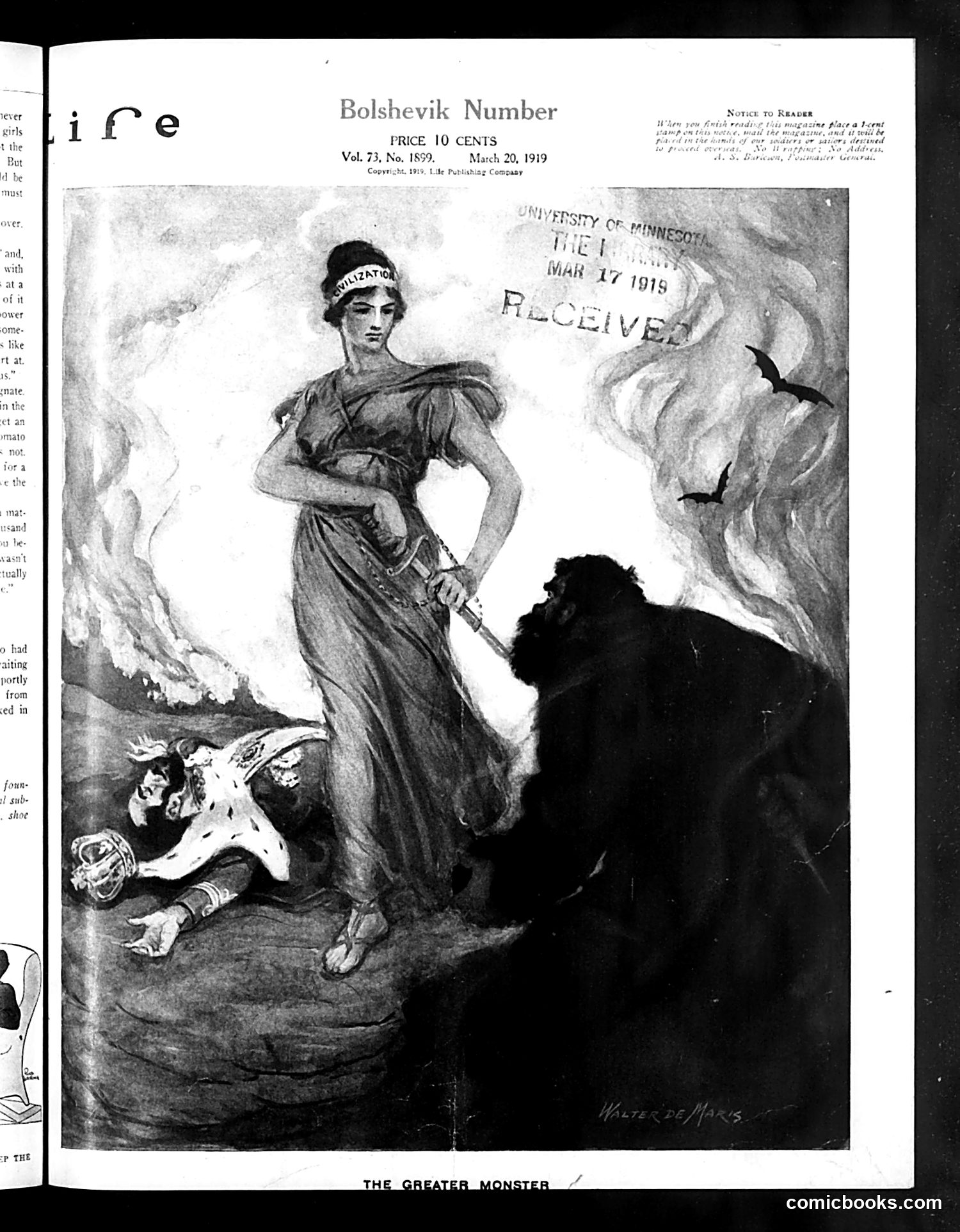
This political cartoon depicts a classical female figure (likely representing Liberty or Western civilization) wielding a bayonet against a dark, ape-like creature labeled "The Greater Monster." The imagery reflects post-WWI American anti-Bolshevik propaganda. The figure wears a headband reading "Civilization" and confronts what appears to represent Bolshevism or communism as a threatening, bestial force. The dead eagle at the figure's feet may symbolize fallen empires or victims of revolution. Published just after the Russian Revolution and during the "Red Scare" period (1918-1920), this cartoon promotes the Western perspective of Bolshevism as a dangerous, uncivilized threat requiring military resistance. The artistic style uses dehumanizing imagery common in propaganda of this era.
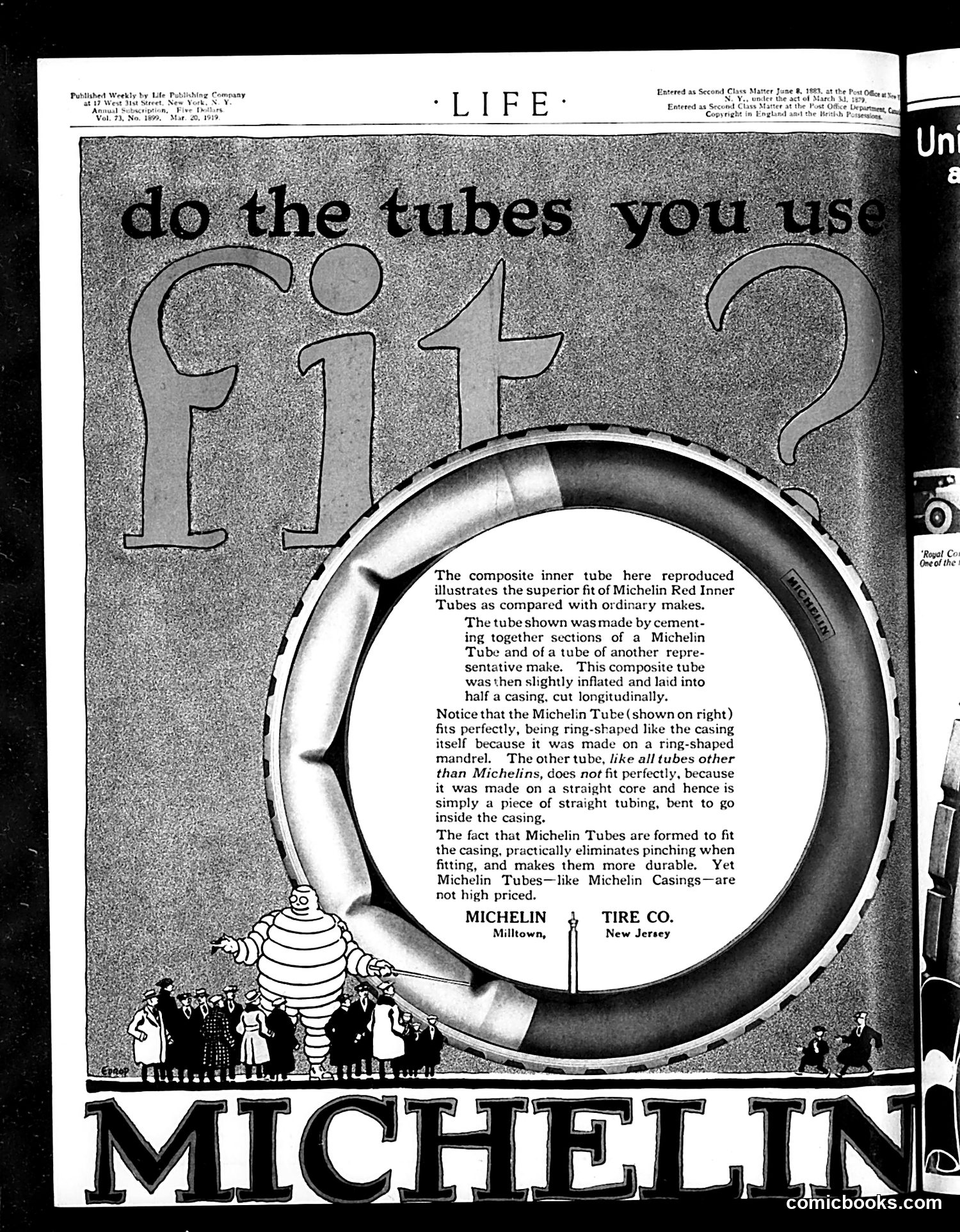
This is primarily **advertising, not political satire**. The page is a Michelin Tire Company advertisement from Life magazine (Vol. 73, No. 1899, dated May 29, 1919). The ad uses visual humor to promote Michelin Red Inner Tubes. The large question mark and giant Bibendum mascot (Michelin's well-known character) frame a cross-section diagram of an inner tube. The ad's central claim is that Michelin tubes fit tire casings better than competitors' tubes because they're manufactured on ring-shaped mandrels, eliminating fitting problems and increasing durability—all without premium pricing. The tiny human figures at the base provide scale and visual interest, typical of 1919 advertising design. This is straightforward product marketing, not social or political commentary.
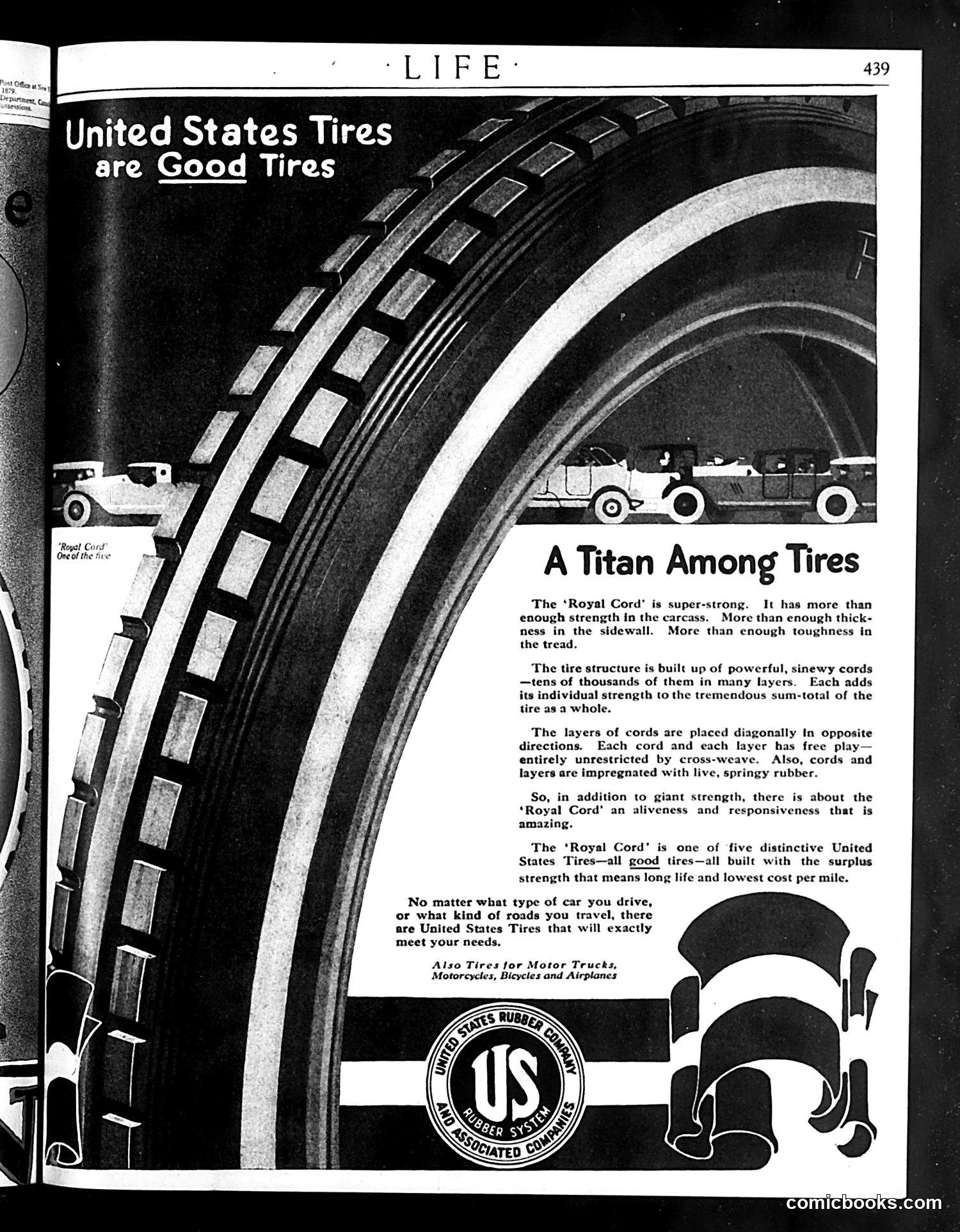
This is **advertising, not satire or political commentary**. It's a United States Rubber Company advertisement for "Royal Cord" tires, appearing in *Life* magazine (page 439). The ad uses dramatic visual design—a close-up cross-section of a tire showing its internal cord structure—to promote product superiority. The accompanying text emphasizes technical features: multiple cord layers placed diagonally for strength, rubber impregnation, and overall durability. Small illustrations of vehicles (a car and truck) appear in the tire's center, suggesting the tire's suitability for various uses. A company seal appears at the bottom. This is straightforward commercial messaging from the automobile tire era, highlighting manufacturing quality rather than delivering political or social satire.
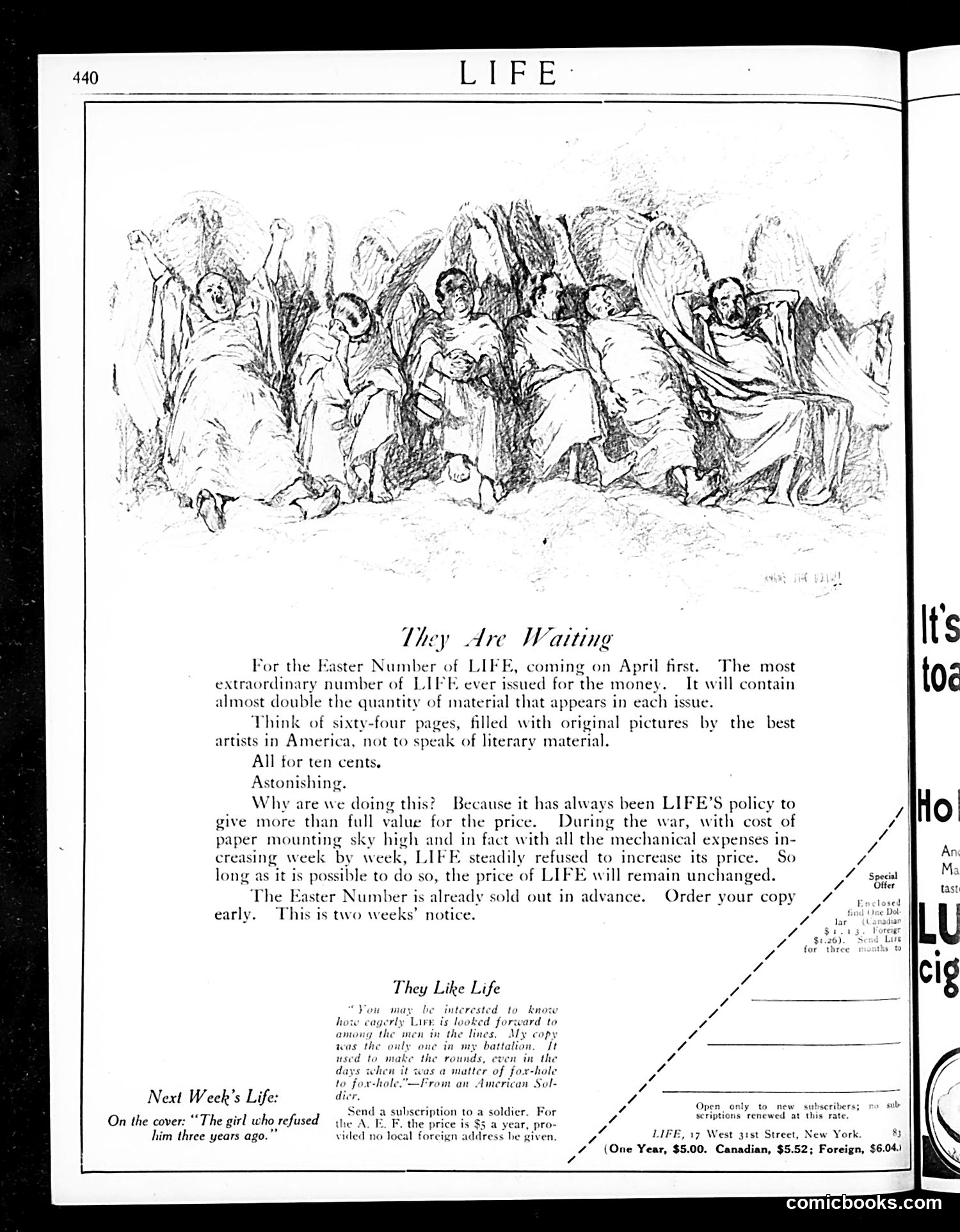
This page is primarily **promotional advertising** for LIFE magazine's Easter issue, not a political cartoon. The sketch at top titled "They Are Waiting" depicts a group of figures (appears to be angels or religious figures based on the Easter context) in an illustrative style. The main text announces an extraordinary Easter Number coming April 1st, promising 64 pages—double the usual content—for 10 cents. LIFE emphasizes its policy of maximizing value despite wartime paper shortages and rising mechanical costs, pledging to keep prices unchanged. A secondary section titled "They Like Life" contains a testimonial from a soldier praising the magazine, with a call to subscribe. The page also previews next week's cover story: "The girl who refused him three years ago."
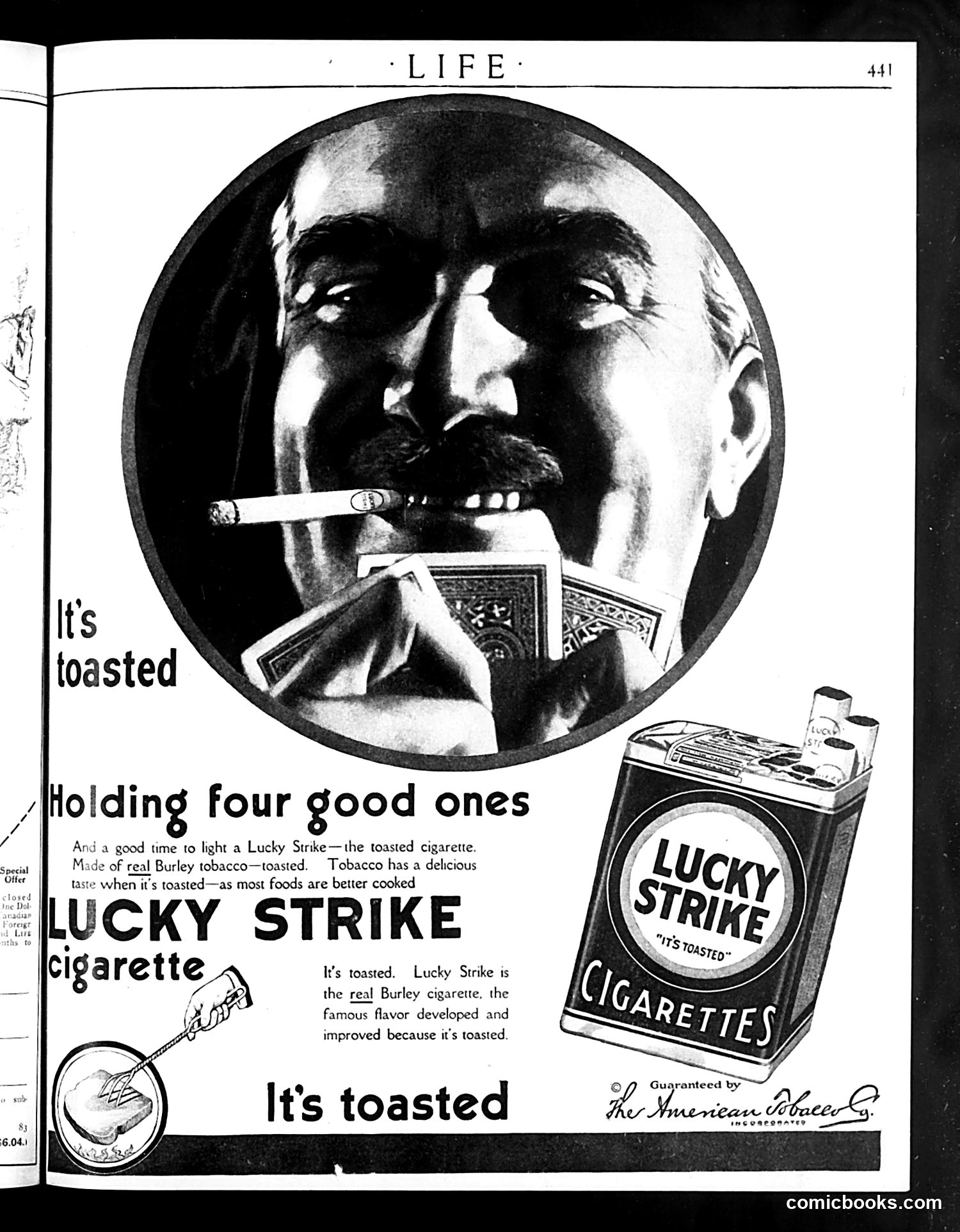
This is a **cigarette advertisement**, not political satire. The page promotes Lucky Strike cigarettes using the slogan "It's toasted" — emphasizing that the tobacco has been toasted to develop flavor. The image shows a man with a prominent mustache smoking a cigarette while holding playing cards. The advertisement claims Lucky Strike is "the real Burley cigarette" with superior taste due to its toasting process. The casual, jovial imagery (the card game, cigar smoking) was typical mid-20th century advertising that associated cigarettes with leisure and good times. The "American Tobacco" company guarantee appears at bottom. By modern standards, this advertisement is striking for openly promoting cigarettes without any health warnings—a common practice before tobacco's dangers were widely acknowledged.
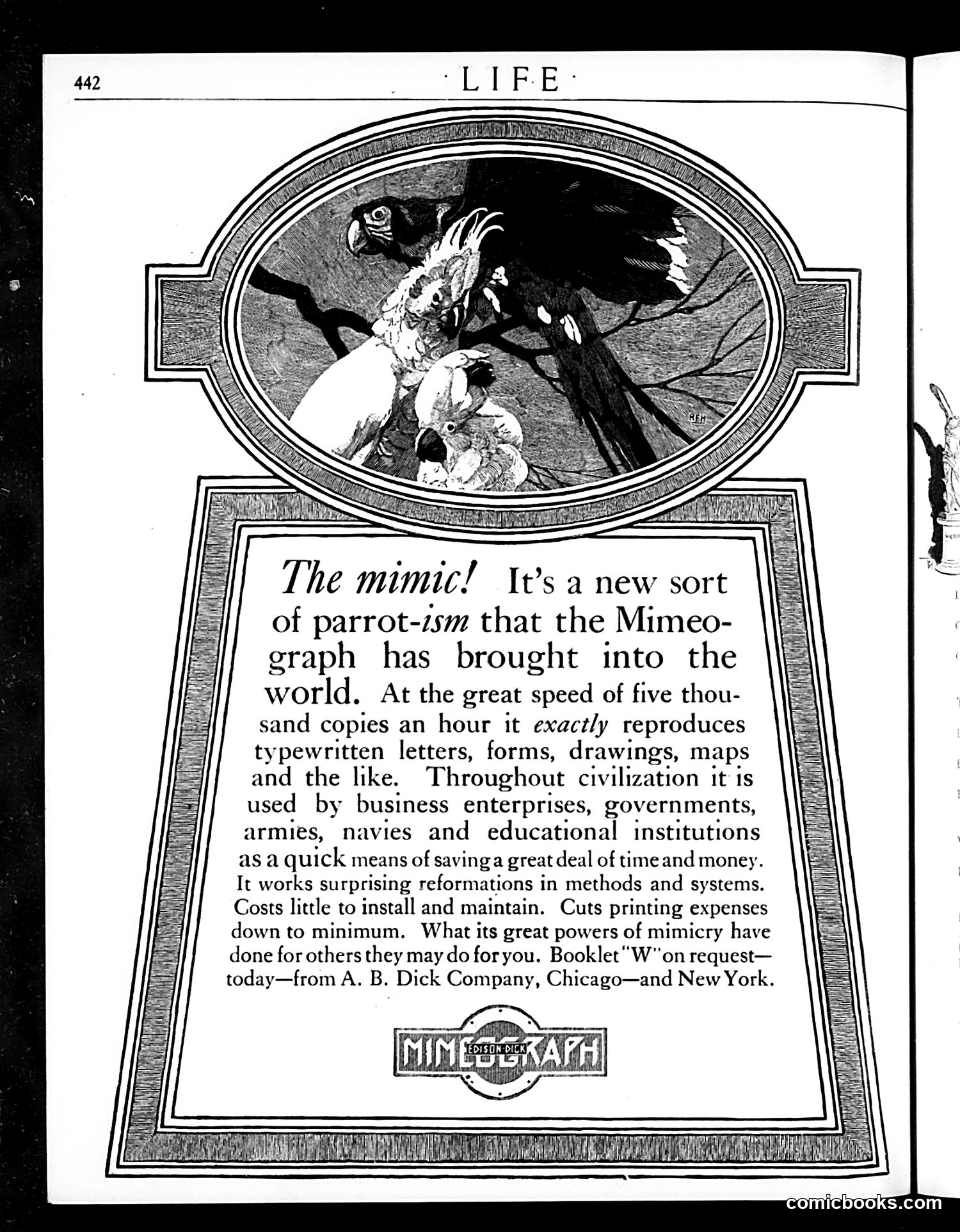
This is primarily an **advertisement for the Mimeograph machine**, not political satire. The page occupies Life magazine's space 442 and promotes the A.B. Dick Company's copying device. The illustration shows a **parrot** mimicking human speech, which serves as a visual pun: the ad cleverly titles itself "The mimic!" to draw a parallel between parrots' imitative abilities and the mimeograph's capacity to reproduce documents. The advertisement emphasizes the machine's practical business value—it could make 5,000 copies per hour of "typewritten letters, forms, drawings, maps." The copy stresses cost savings for "business enterprises, governments, armies, navies and educational institutions." This represents **early 20th-century advertising strategy**: using clever wordplay and illustration to make office equipment seem essential and innovative to potential customers.
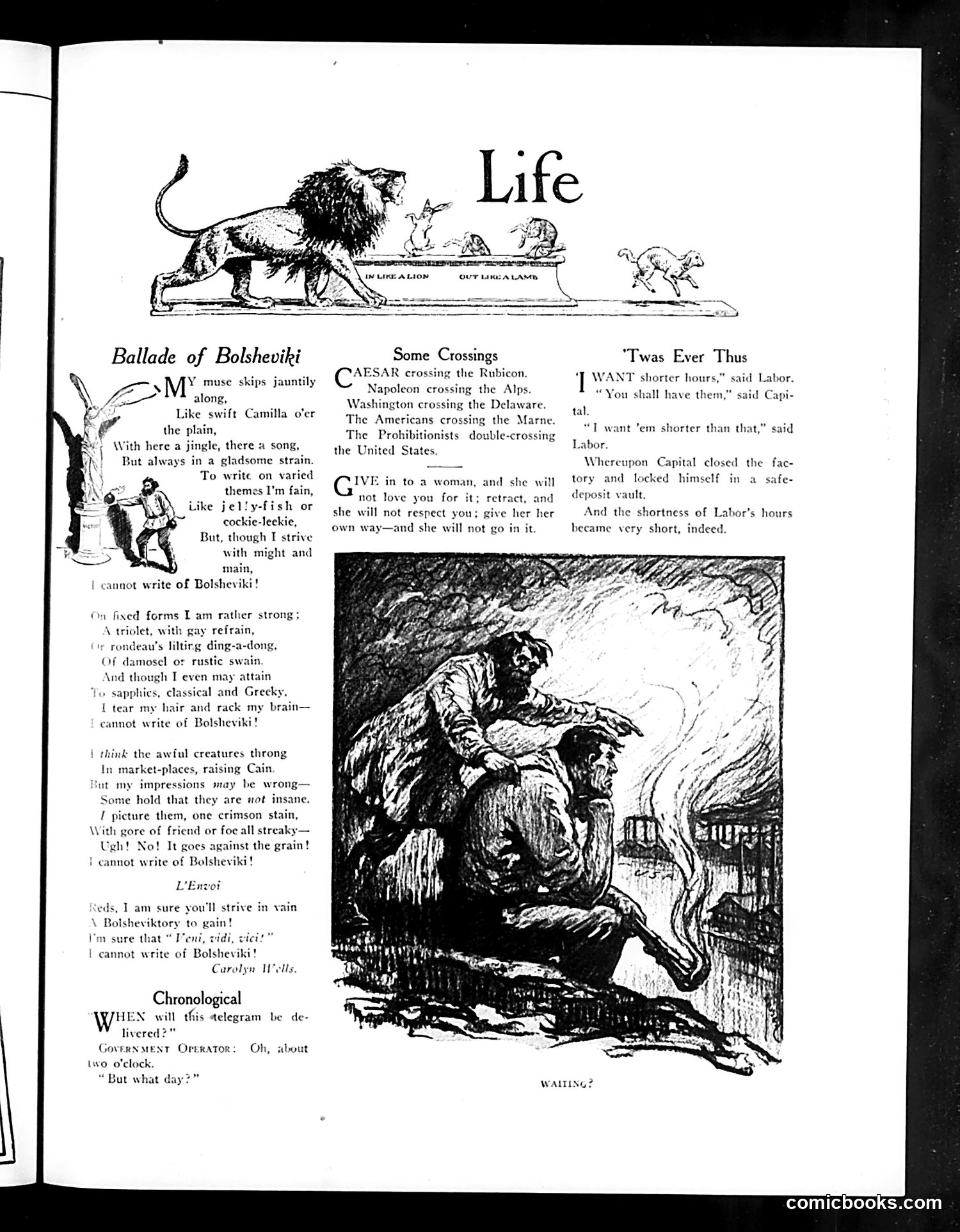
This page contains several satirical pieces about labor and politics during the early Soviet era. **"Ballade of Bolsheviki"** mocks the difficulty of writing poetry about the Russian Bolsheviks—the poet claims the subject is too crude or chaotic to capture in refined verse. **"Some Crossings"** lists famous historical river crossings (Caesar, Napoleon, Washington) alongside "The Prohibitionists double-crossing the United States"—satirizing American Prohibitionists as betrayers of the nation. **"'Twas Ever Thus"** depicts capitalists resisting worker demands for shorter hours, with a factory owner literally locking himself away rather than negotiate. The joke: Labor's hours become absurdly short as a consequence of this stubbornness. The large illustration shows a worker waiting—possibly depicting the labor struggle itself. Overall, the page satirizes both radical Bolshevism and capitalist intransigence regarding worker conditions.
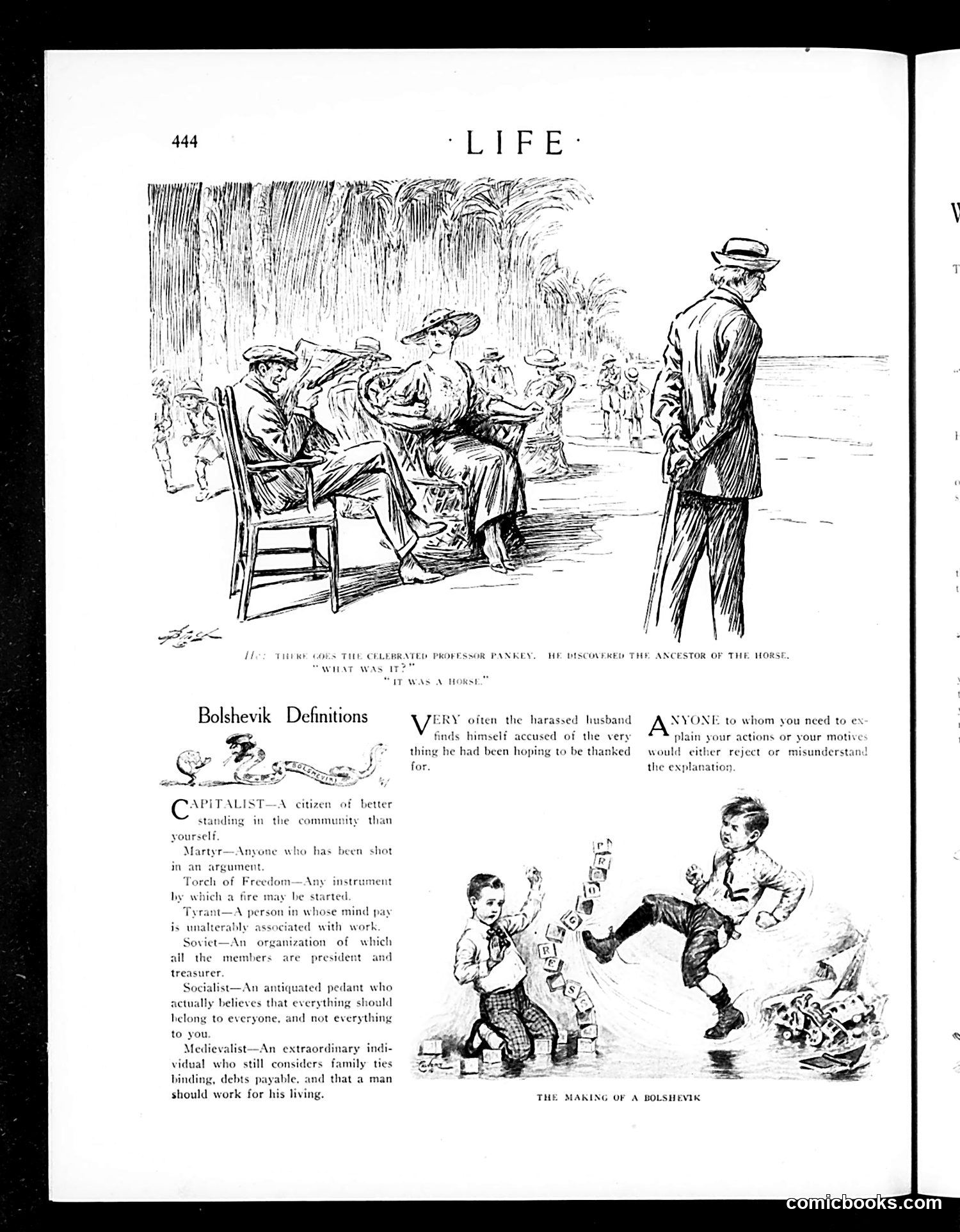
This page satirizes communist ideology through mock dictionary definitions and two cartoon panels. The top illustration shows a man discovering his horse's ancestry—a joke about absurd genealogical claims. The "Bolshevik Definitions" section mocks Soviet communism by redefining familiar terms: a "Capitalist" is someone of better standing than yourself; a "Martyr" is anyone shot in an argument; a "Torch of Freedom" means any tool to start fire (violence); a "Tyrant" exploits workers; a "Soviet" is an organization of presidents and treasurers (ironic); a "Socialist" is an idealistic pedant; a "Medievalist" still believes in family and work. The bottom cartoon, "The Making of a Bolshevik," depicts a child being corrupted by money and chaos—suggesting communist propaganda corrupts youth. This reflects post-WWI American anti-communist sentiment.
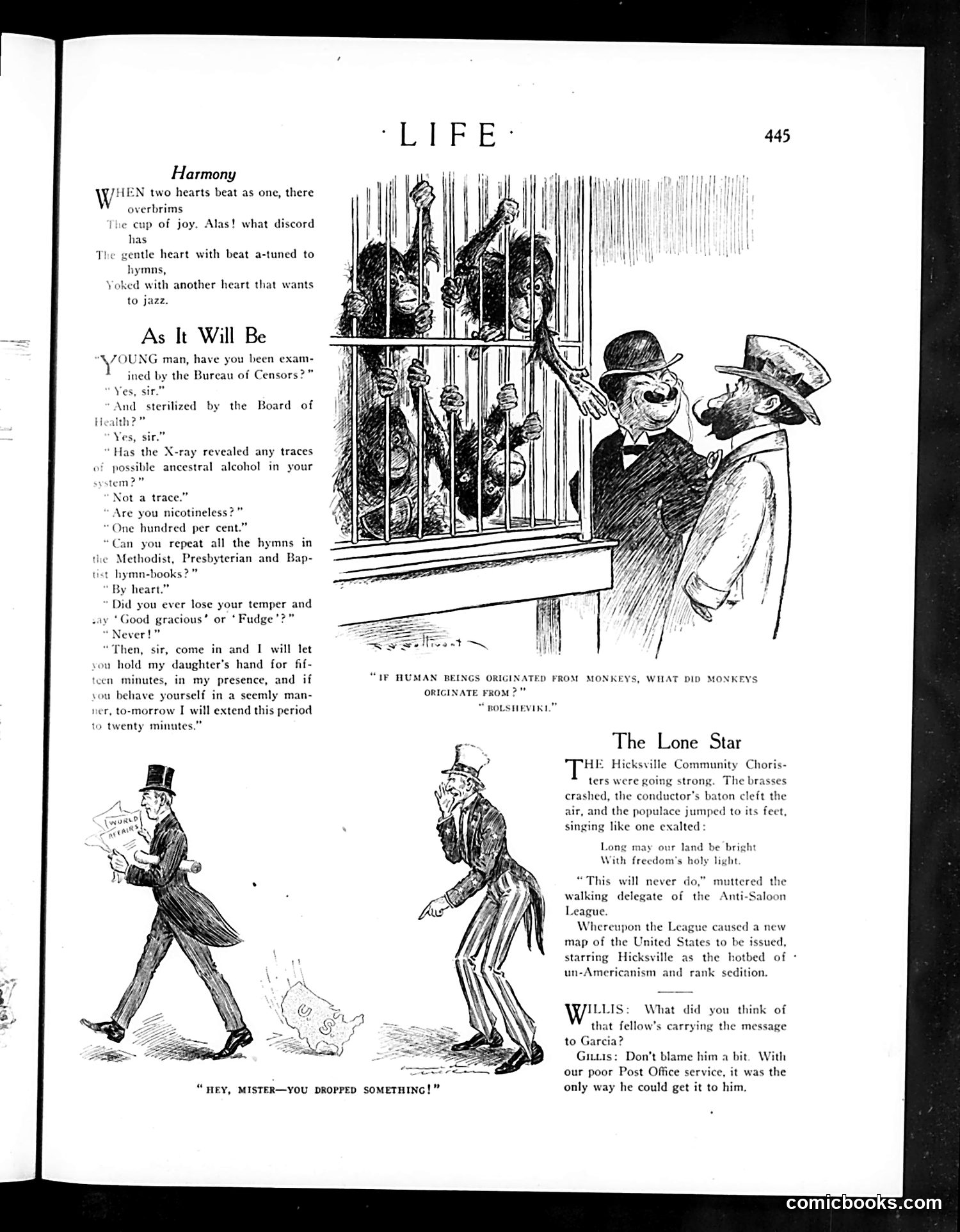
This page contains three separate satirical pieces: 1. **"Harmony"** and **"As It Will Be"**: Mock bureaucratic examinations for citizenship, satirizing excessive government censorship and health regulations of the era. 2. **"Hey, Mister—You Dropped Something!"**: A cartoon showing two well-dressed gentlemen, one dropping what appears to be a document or object. The satire likely critiques carelessness among the elite or political hypocrisy. 3. **"The Lone Star"**: Satirizes the Anti-Saloon League's efforts to enforce Prohibition by redrawing the U.S. map with Hicksville as the nation's center—mocking the League's outsized influence on national policy. The dialogue between Willis and Gillis discusses postal service inefficiency. The overall theme reflects early-20th-century American anxieties about government overreach, Prohibition, and bureaucratic excess.
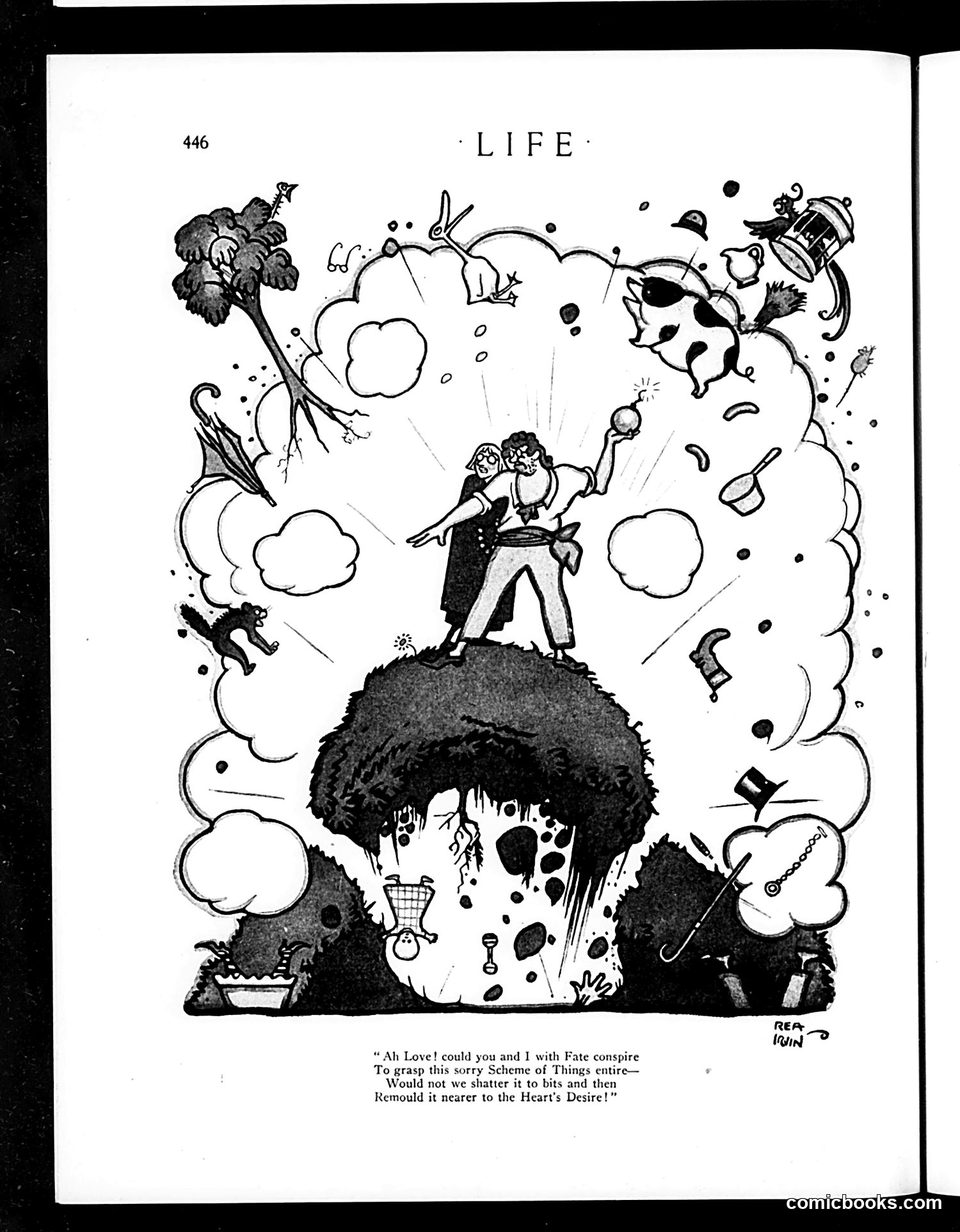
This is a whimsical illustration titled "LIFE" depicting a couple standing atop a dark, surreal landscape filled with thorns, rocks, and debris. They gaze upward at an idealized world of clouds, floating objects, music, plants, and playful figures. The caption quotes a Persian poem (likely Omar Khayyam) expressing a romantic wish to reshape fate and reshape life's circumstances according to "the Heart's Desire." The satire contrasts harsh reality below with an impossible romantic ideal above. The dark, jagged foundation represents life's actual difficulties, while the ethereal clouds symbolize unrealistic hopes. The cartoon mocks the gap between romantic idealism and life's genuine hardships—a commentary on escapism and the futility of wishing away reality's complexities through sentiment alone.
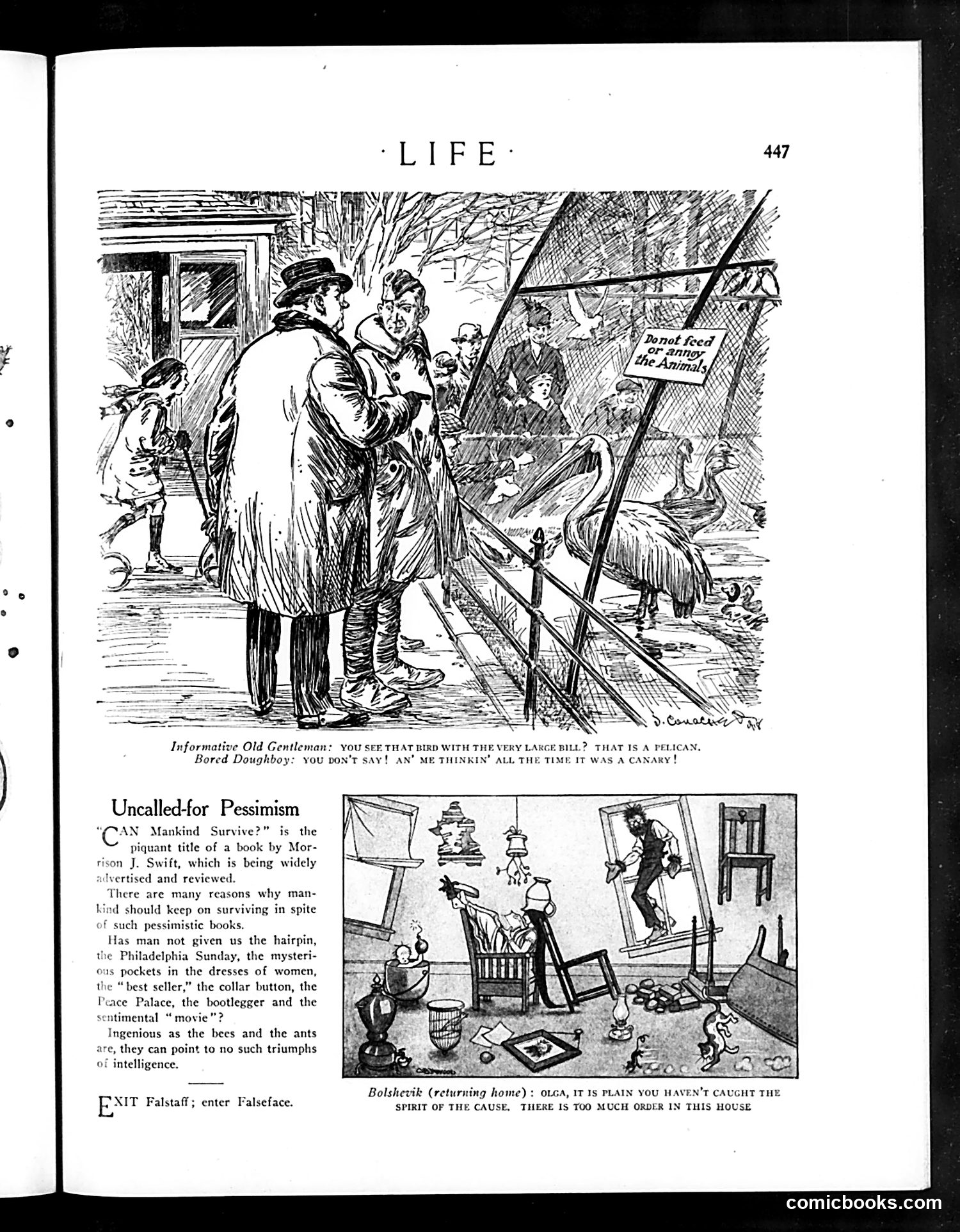
**Top Cartoon:** An informative old gentleman tells a bored doughboy (WWI soldier) that a large bird at the zoo is a pelican. The doughboy replies he thought it was a canary the whole time. This is a simple visual joke about mistidentification—the bird's enormous bill makes it obviously a pelican, not a canary, mocking the doughboy's lack of observation. **"Uncalled-for Pessimism" Article:** Reviews Morrison J. Swift's book "Can Mankind Survive?" The piece humorously catalogs pessimistic bestsellers (Philadelphia Sunday, women's fashion books, etc.), arguing that even ants and bees demonstrate intelligence and survival capability. This mocks contemporary doom-and-gloom literature as overwrought. **Bottom Comic:** Shows domestic chaos—a returning husband observes his wife's housekeeping disorder, complaining there's too much disorder.
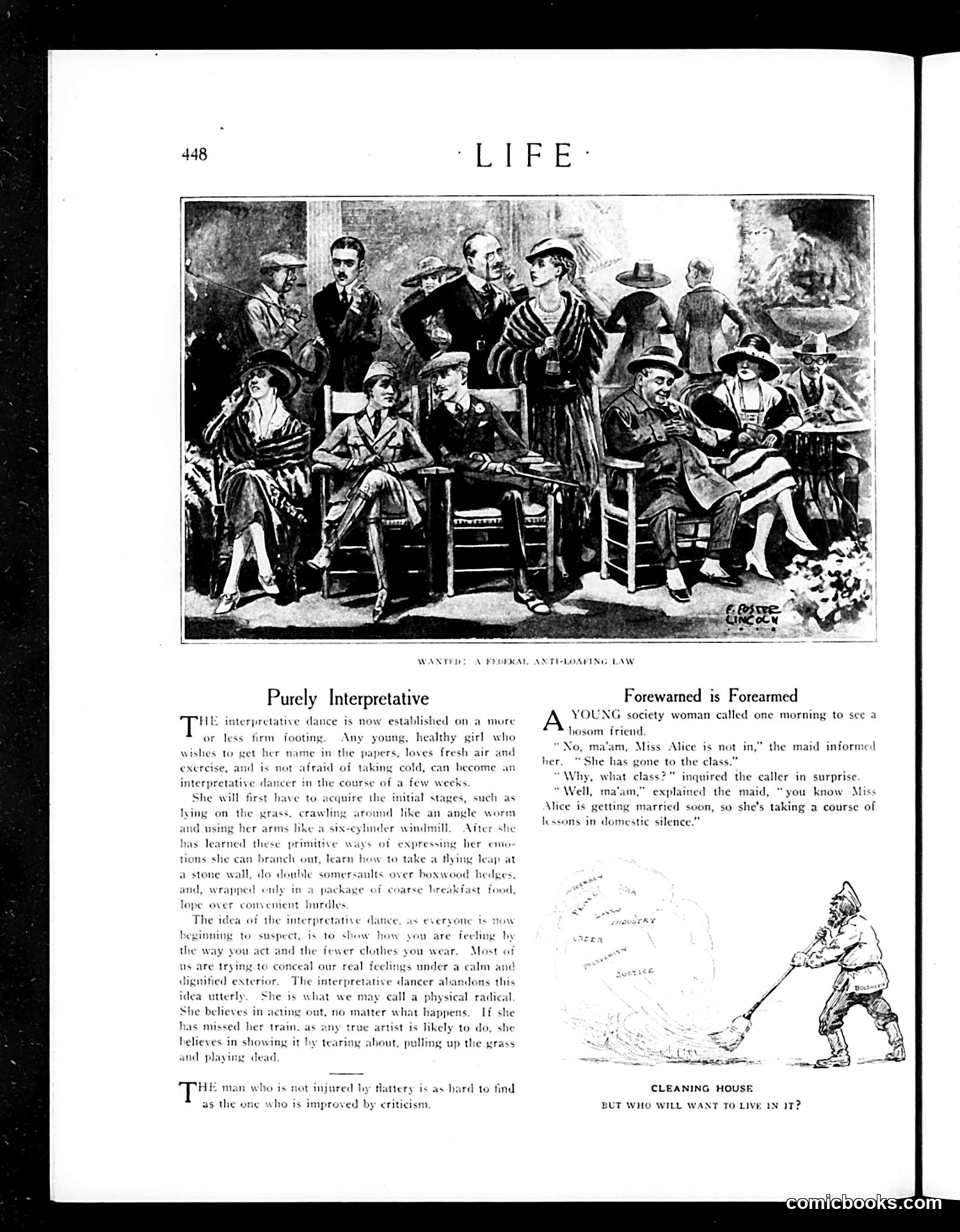
**Main Cartoon:** "Wanted: A Federal Anti-Loafing Law" depicts a group of well-dressed people of various ages and apparent social classes sitting and lounging idly. The satire critiques proposed federal anti-loafing legislation by showing that "loafing" (leisure, idle sitting) is a common activity across all social strata—implying such a law would be impractical or hypocritical to enforce. **Text Articles:** - "Purely Interpretive" mocks interpretive dance as physical expression requiring minimal training - "Forewarned is Forewarned" is a brief domestic humor piece about a woman taking "domestic silence lessons" **Bottom Cartoon:** "Cleaning House—But Who Will Want to Live In It?" appears to comment on post-war social/political upheaval, though context is unclear. The page critiques both social pretensions and impractical legislation through humor.
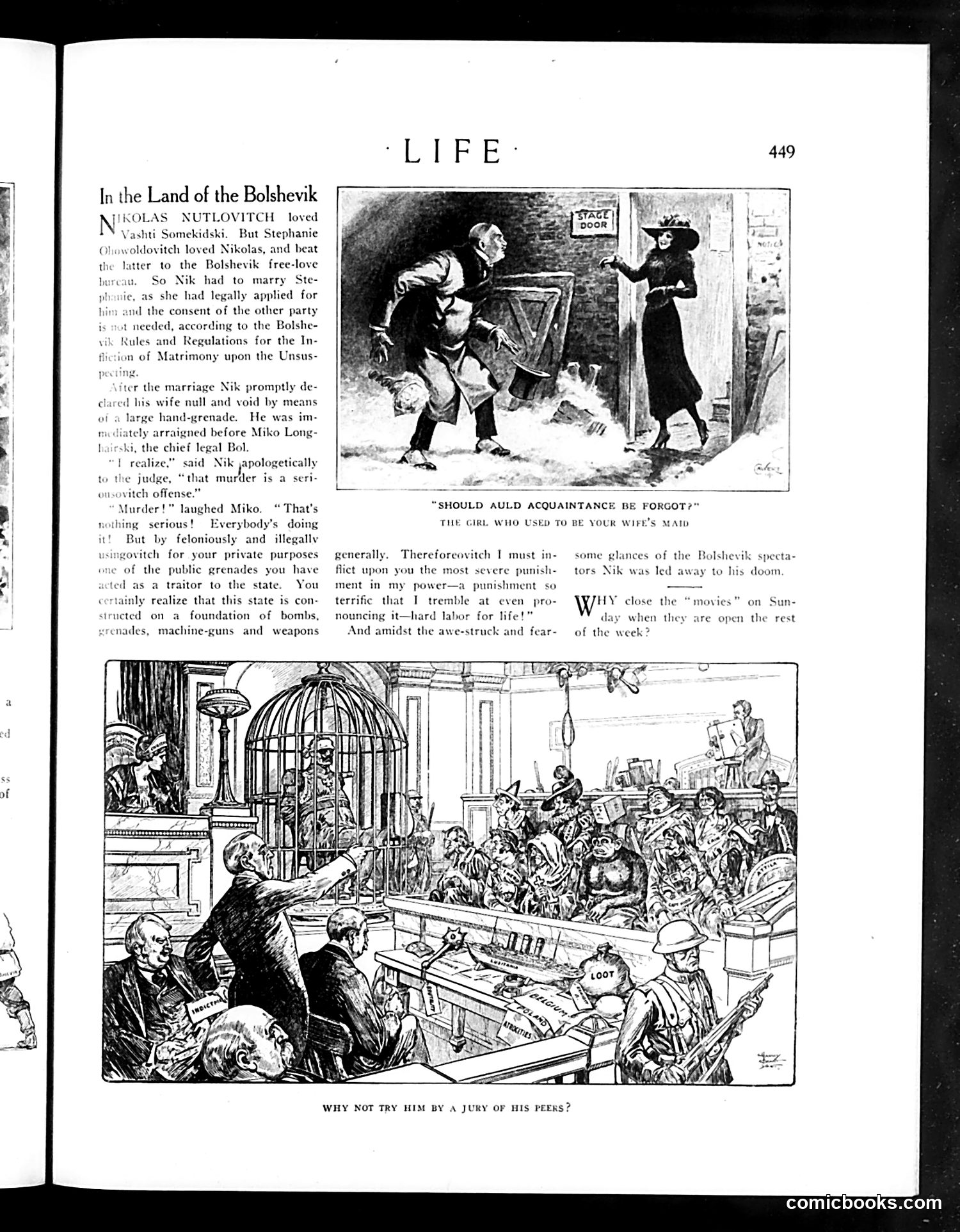
This page satirizes the Bolshevik legal system under Lenin. The story describes a Soviet official (Nik) whose marriage is annulled by decree, then accused of murder for using a grenade—a weapon the Soviet state itself stockpiles. When he apologizes to the judge, he's told murder is a "serious offense," despite the state's hypocrisy about violence. The top cartoon shows Nik being arrested; the bottom depicts a Soviet courtroom trial with masses of spectators, captioned "Why not try him by a jury of his peers?"—sarcastically questioning whether fair trials exist in Bolshevik Russia. The satire targets Soviet legal arbitrariness: how the state weaponizes law against citizens while claiming revolutionary justice, and how trials serve propaganda rather than genuine accountability.
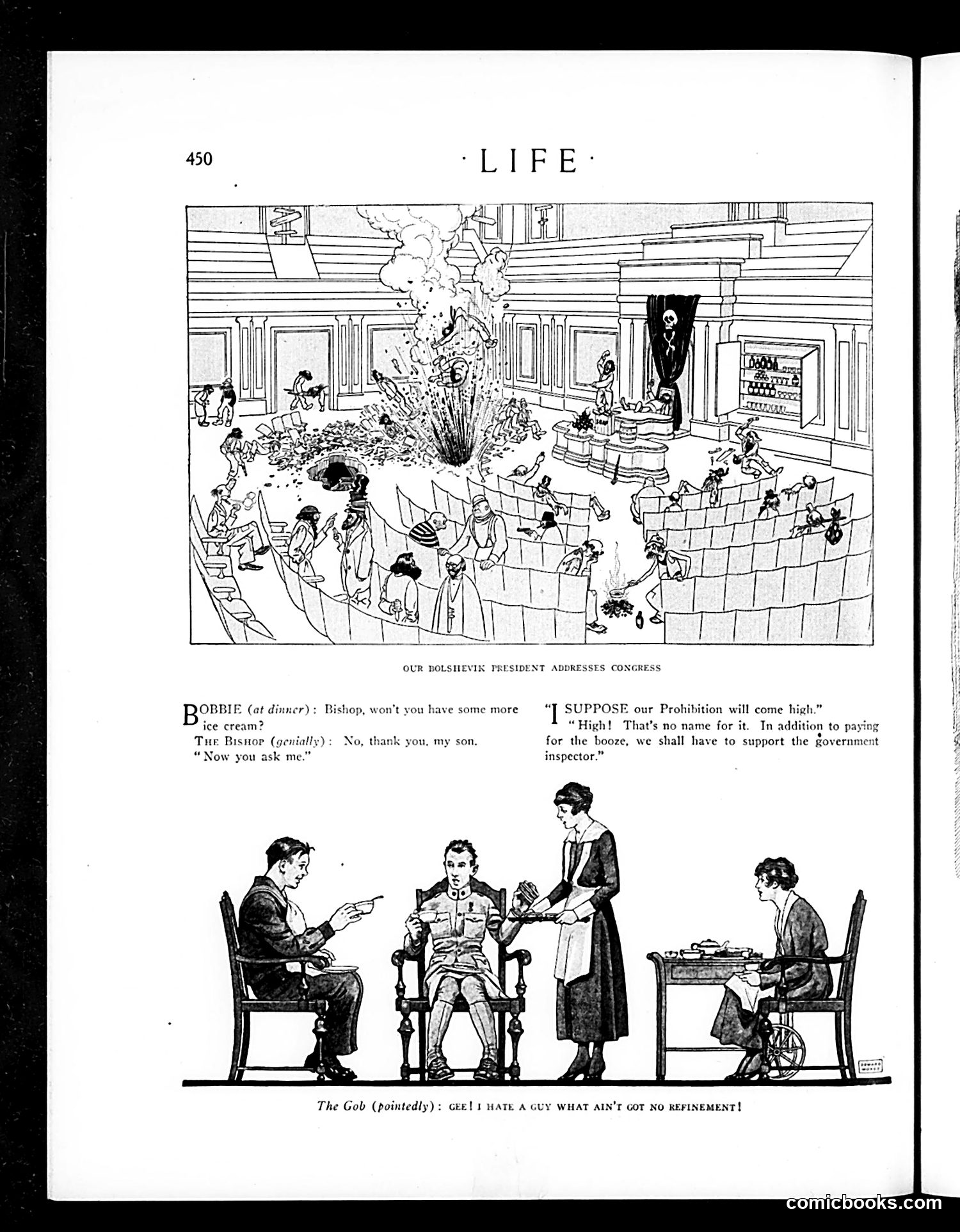
The top cartoon shows a grand government building (likely Congress) with chaos erupting—a fountain exploding with what appears to be alcohol, while officials scatter about in disarray. Below, a domestic scene mocks Prohibition's enforcement. A bishop declines ice cream at dinner, claiming moral refinement ("No, thank you, my son. Now you ask me"). A woman counters that Prohibition will be expensive, requiring payment to support a "Government inspector"—implying officials will be bribed to ignore bootlegging. The final caption, from "The Gob" (sailor slang), expresses contempt: "I HATE A GUY WHAT AIN'T GOT NO REFINEMENT!"—sarcastically suggesting that refined people like the bishop secretly drink while working-class folks face prosecution. The satire targets Prohibition's selective enforcement and class-based hypocrisy.
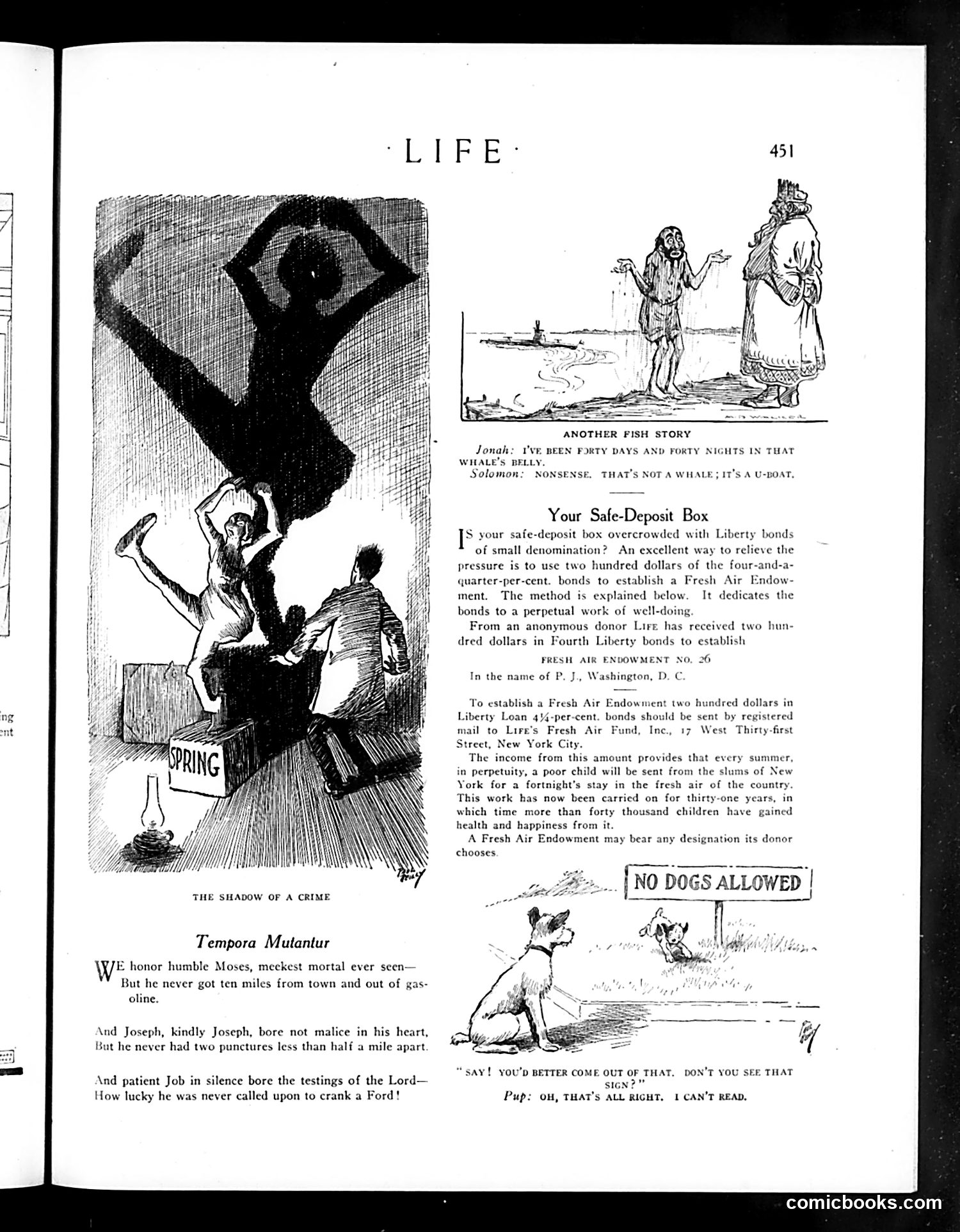
This editorial cartoon depicts a figure casting a large shadow of a noose—symbolizing execution or capital punishment. The scene shows what appears to be a condemned person being held or restrained, with a lamp below suggesting a prison or execution chamber setting. The cartoon likely critiques judicial executions or capital punishment as a systemic "crime" itself. The dramatic shadow effect emphasizes how the state's act of execution casts a dark moral shadow over society. Below, "Tempora Mutantur" (Latin: "times change") presents humorous verse about biblical figures (Moses, Joseph, Job) who endured hardship without modern frustrations—specifically, never having car troubles, a jab at contemporary automotive inconveniences.
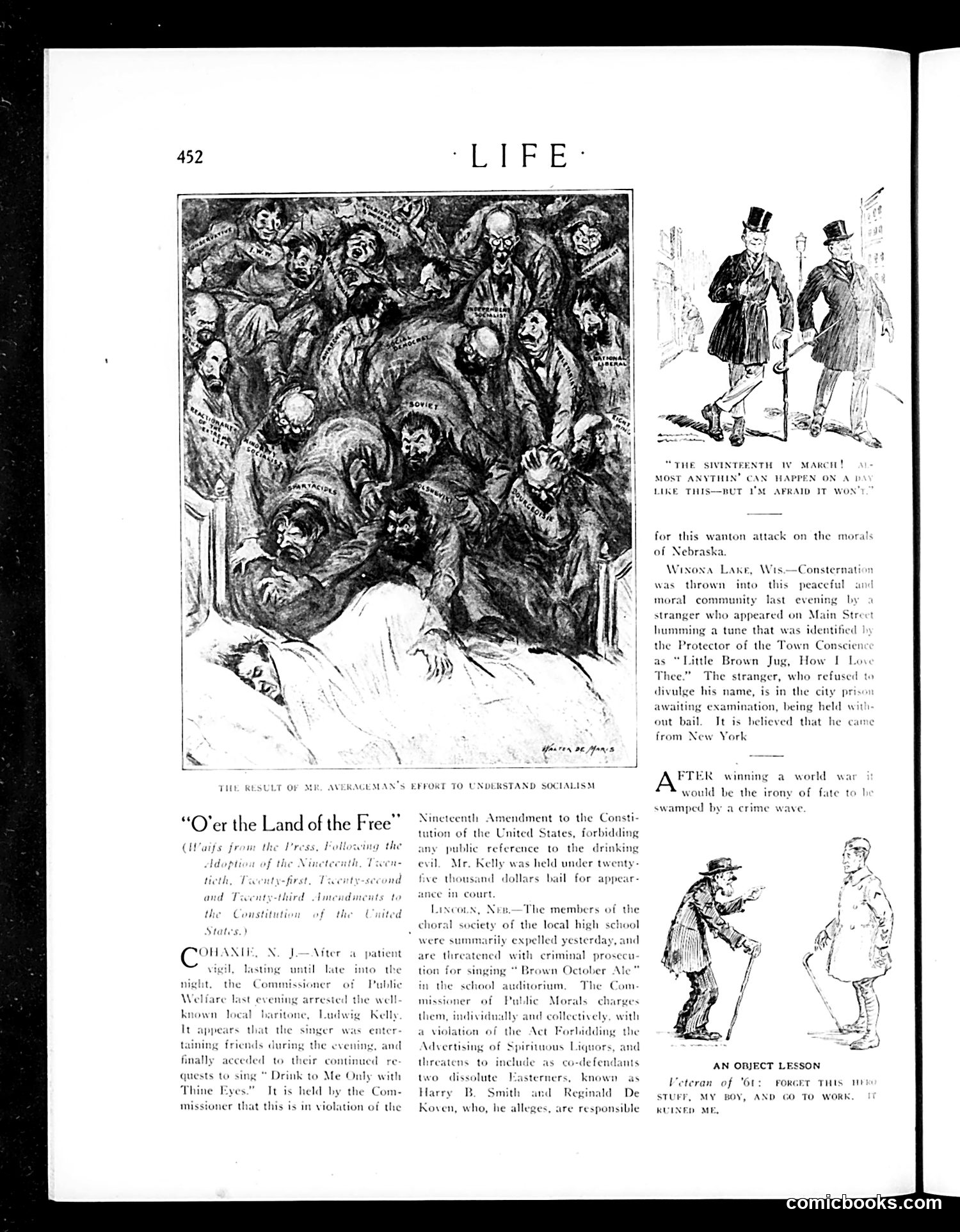
This page satirizes American morality enforcement during Prohibition (the 1919-1933 ban on alcohol). The main cartoon shows a man arrested for singing "Drink to Me Only with Thine Eyes"—a centuries-old song—because authorities interpret any reference to drinking as violating the Nineteenth Amendment's alcohol prohibition. The satire mocks the absurdity of Prohibition enforcement: authorities arrest a singer for an innocent folk song, hold him without bail, and threaten to prosecute others involved. The caption "The Result of Average Man's Effort to Understand Socialism" suggests the overreach results from confused, heavy-handed government control. Secondary items ridicule related moral panics: a town "protecting" its morality by attacking a stranger, and a veteran cautioning against vice. The overall message: Prohibition creates ridiculous, tyrannical enforcement while failing to address actual crime ("swamped by a crime wave").
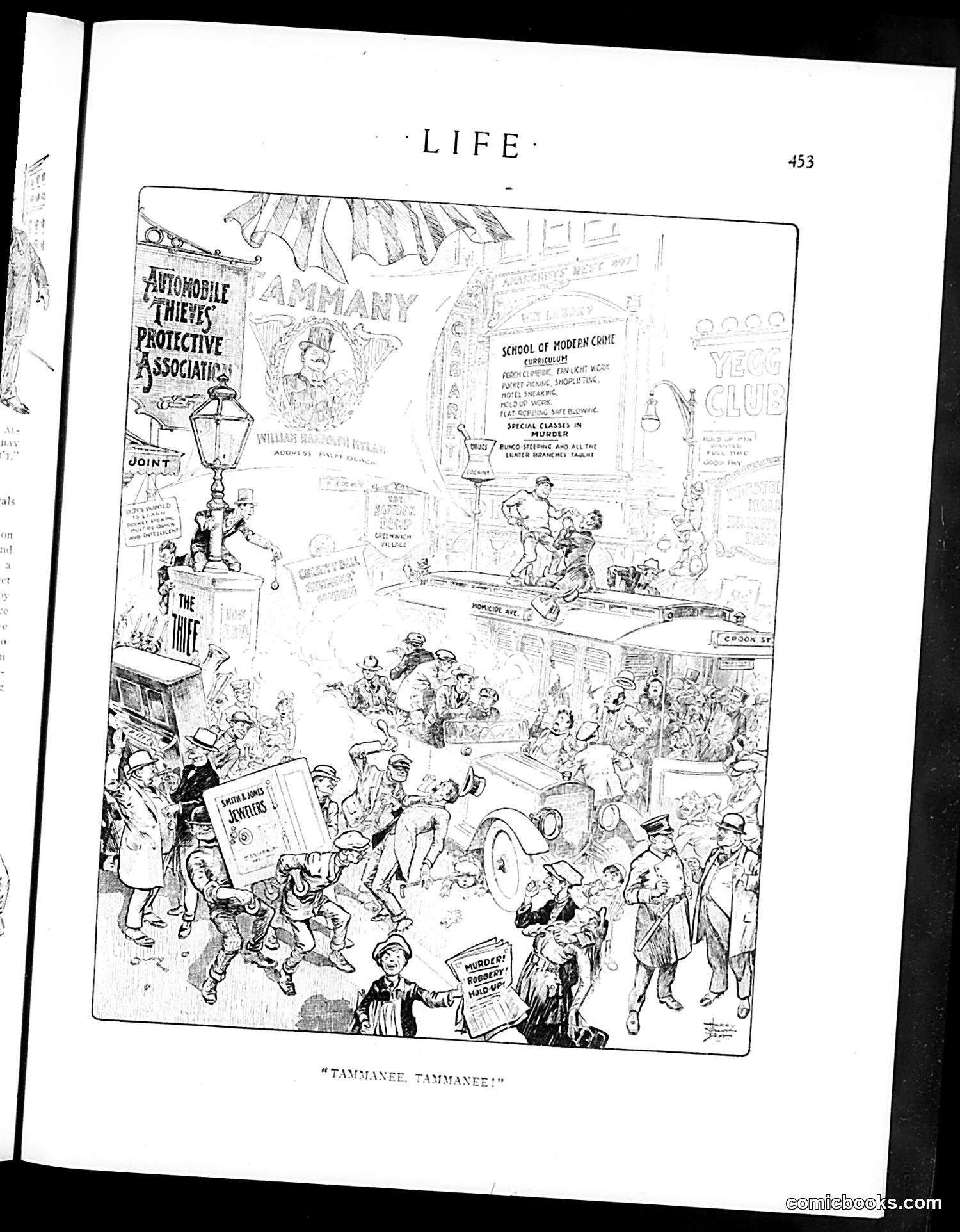
This Life magazine cartoon satirizes **Tammany Hall**, the corrupt Democratic political machine that dominated New York City politics. The chaotic street scene depicts urban life with various contemporary references: an "Automobile Thieves Protective Association," a "School of Modern Crime," and a "Y.M.C.A." club—juxtaposing legitimate institutions with criminal enterprises to suggest Tammany's pervasive corruption. The title's repetition mocks how Tammany politicians invoked their organization's name while allegedly enabling lawlessness. The crowded composition shows thieves, criminals, and ordinary citizens mingling freely, suggesting that under Tammany's influence, criminal activity flourished openly in the city. The cartoon represents Progressive-era criticism of urban political corruption and machine politics' connection to organized crime.
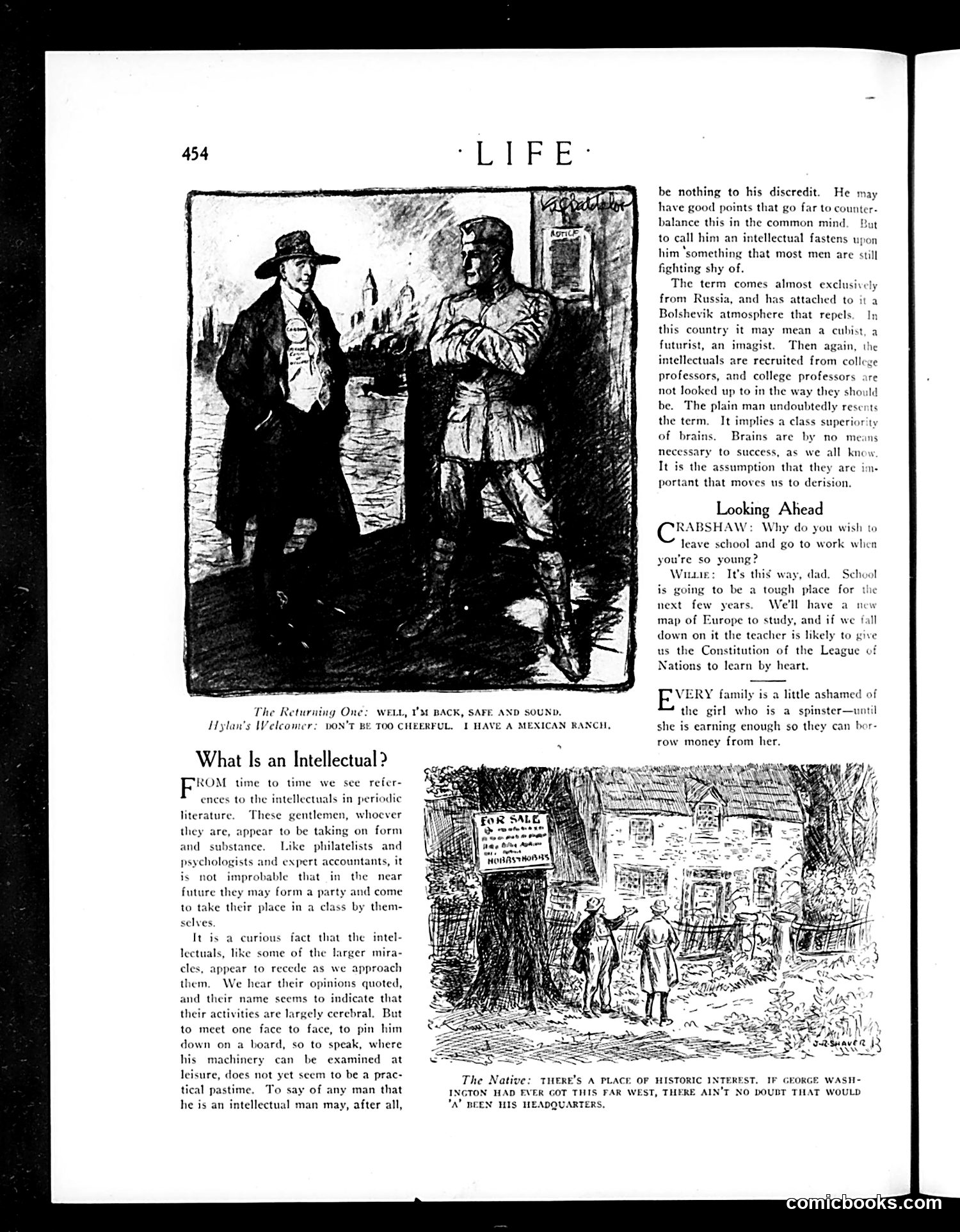
This page contains three satirical cartoons addressing early 1920s American anxieties: **"What Is an Intellectual?"** critiques the term's vague usage and class connotations. The text argues "intellectuals" are largely a Russian/Bolshevik concept that ordinary Americans resent because it implies intellectual superiority—threatening to a culture skeptical of abstract thinking. **"Looking Ahead"** satirizes post-WWI education, where a schoolboy wants to leave because curricula now include European geography and League of Nations study—unfamiliar, burdensome subjects reflecting America's reluctant entry into international affairs. **Top cartoon** ("The Returning One") depicts Mayor Hylan welcoming home a soldier, then dampening enthusiasm by mentioning his Mexican ranch—satirizing how quickly post-war America moved on from soldiers' homecomings. **Bottom cartoon** ("The Native") jokes about Western expansion and George Washington, suggesting even Washington wouldn't have ventured this far—mocking frontier mythology. The overall theme: American skepticism toward intellectualism, international engagement, and rapid social change.
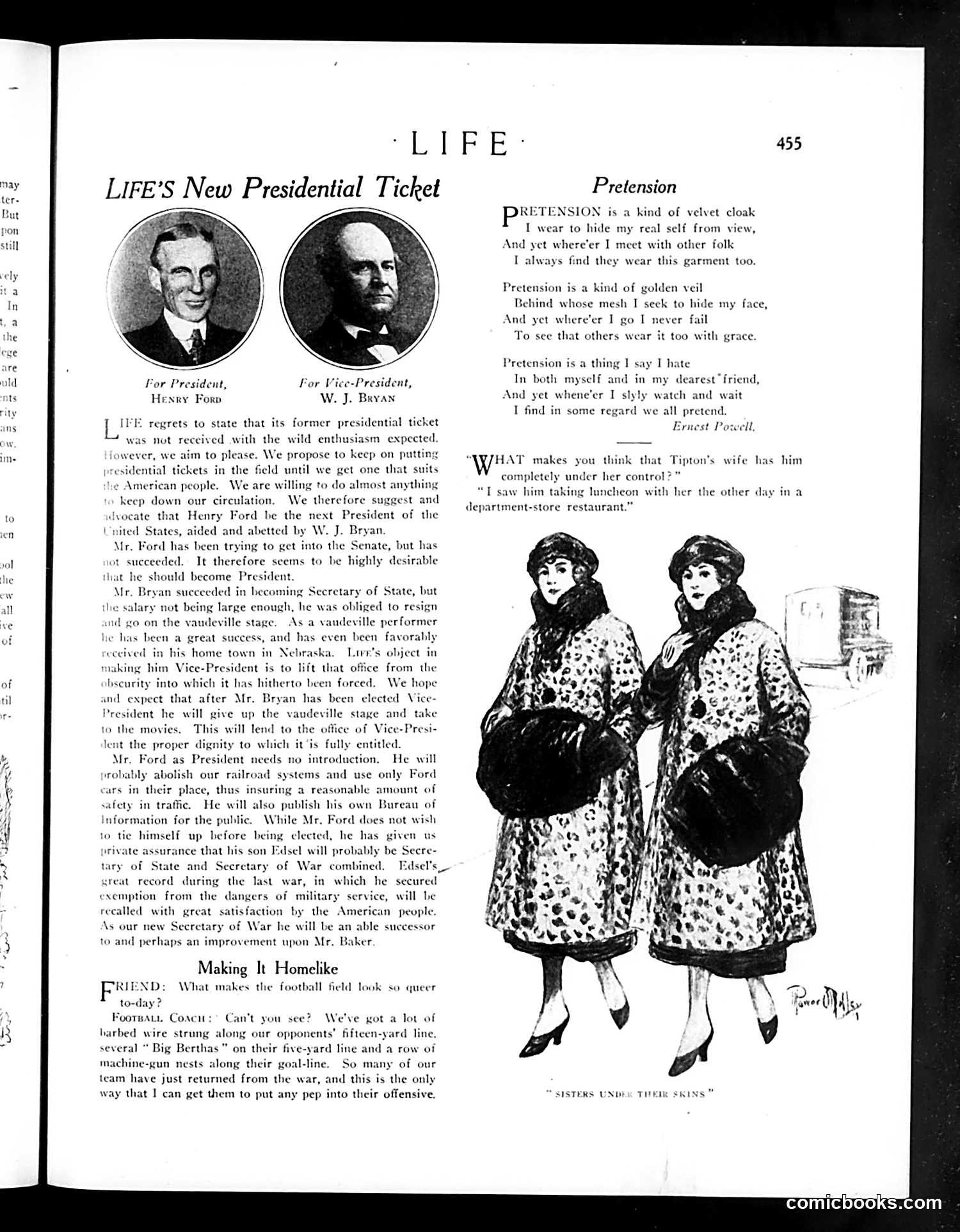
This page satirizes post-WWI American politics through a mock presidential ticket. Life proposes **Henry Ford for President** and **W.J. Bryan for Vice President**—figures who had actually pursued political office unsuccessfully. The satire mocks Ford's industrial ambitions by imagining he'd abolish railroads in favor of Ford cars, and his son Edsel as Secretary of War (ironic, since Edsel apparently avoided military service during WWI). Bryan, a three-time failed presidential candidate who later became Secretary of State, is humorously demoted to vaudeville performer before being offered Vice President. The piece criticizes both men's political aspirations while poking fun at Life's own editorial mission—suggesting they'll keep proposing tickets "until we get one that suits the American people." A separate humor piece jokes about a football coach using wartime equipment (barbed wire, machine guns) to motivate recently-returned soldiers—commentary on how the war's trauma had infiltrated American life.
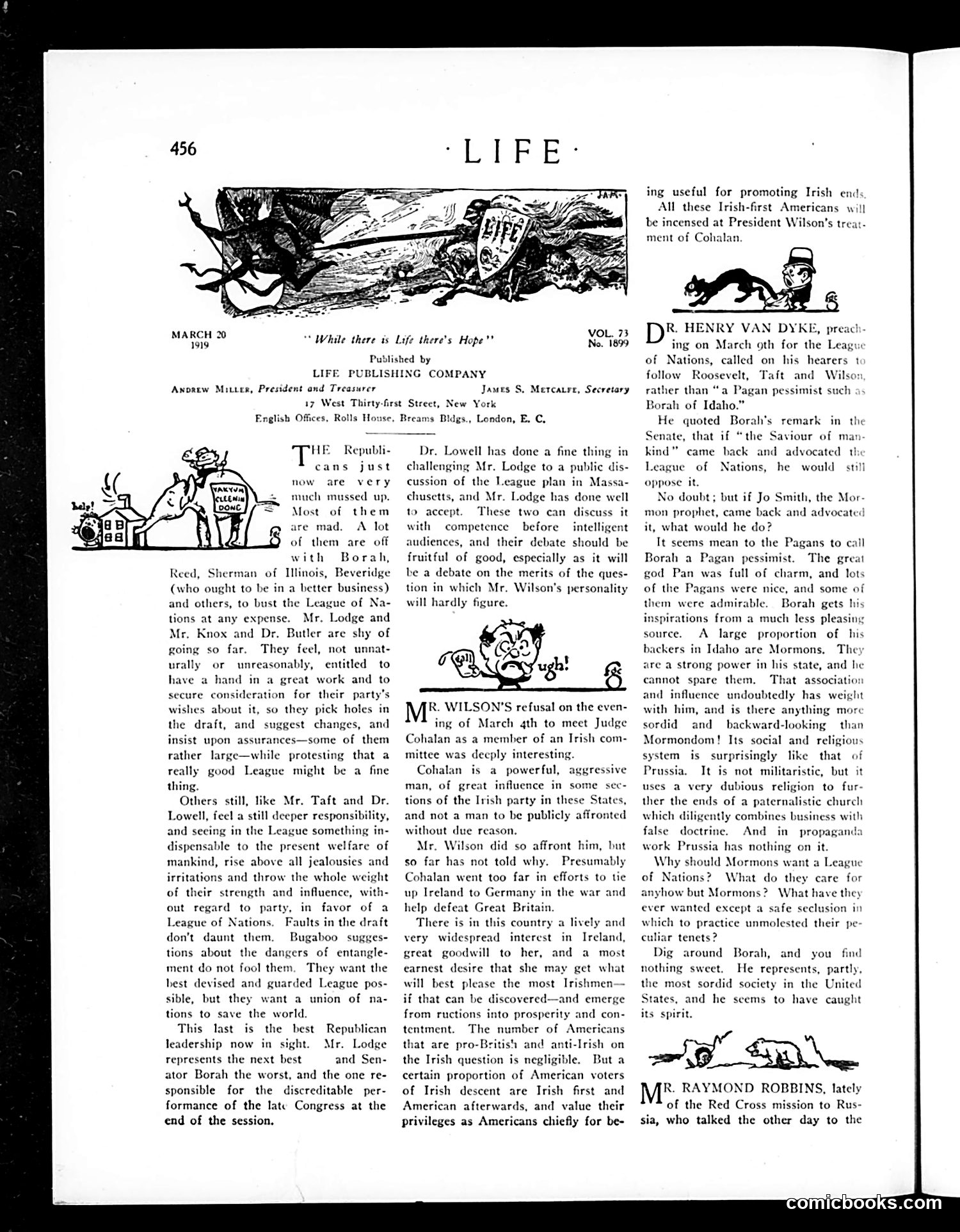
This editorial page debates the emerging League of Nations controversy. The masthead cartoon ("While there is Life there's Hope") depicts the League as a sinking ship, satirizing its troubled prospects. The text identifies three Republican positions: hardliners like Senator Borah and Reed oppose the League entirely; moderates like Lodge and Knox seek amendments; and idealists like Taft and Dr. Lowell support it unconditionally. Life endorses the last group as showing the best leadership. A second section criticizes President Wilson's refusal to meet Judge Cohalan (an Irish-American political figure) on March 4th. The editorial suggests Cohalan had pro-German sympathies during WWI but notes Wilson's snub will anger Irish-American voters who prioritize Irish independence. The piece illustrates the tension between Wilson's internationalism and domestic ethnic politics in post-war America.
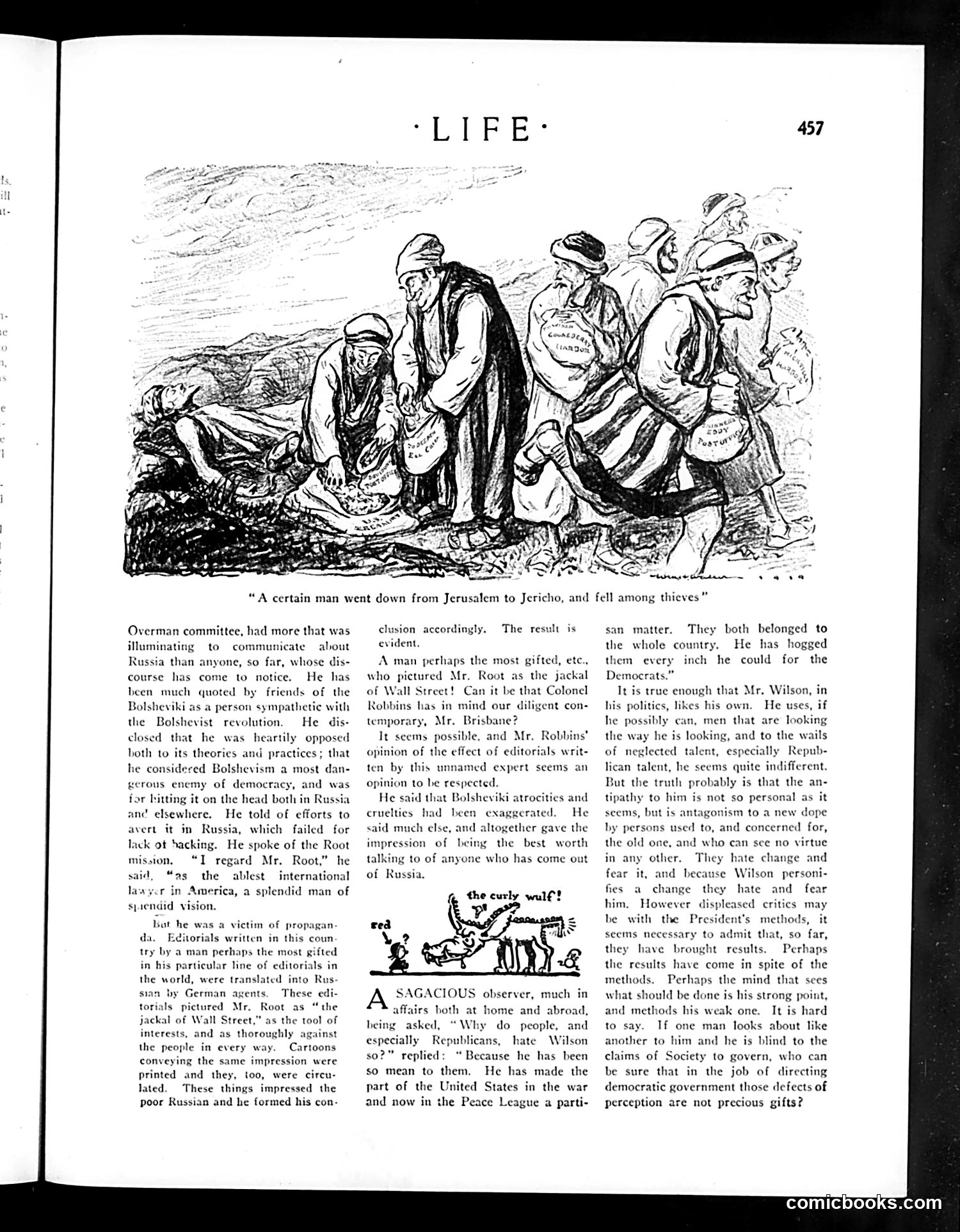
This page contains two distinct satirical pieces about American politics and propaganda. **The Main Cartoon** illustrates the biblical parable of the Good Samaritan ("A certain man went down from Jerusalem to Jericho, and fell among thieves"). The accompanying text discusses how propaganda—specifically editorials and cartoons by German agents translated into Russian—misrepresented Elihu Root (a prominent diplomat and lawyer) as a tool of Wall Street interests. The satire targets an "unnamed expert" (likely Arthur Brisbane, a famous editor) whose writings, though well-intentioned, were weaponized against American interests when translated and distributed in Russia during the Bolshevik period. **The Secondary Piece** critiques President Wilson's political favoritism, particularly his preference for Democratic appointees during wartime and peace negotiations. Republicans resent this, but the author argues their real opposition stems from resisting Wilson's modernizing changes rather than personal animosity. The piece defends Wilson's methods as effective, despite their controversial nature. Both pieces explore how communication—written and visual—shapes public perception, especially during politically volatile periods.
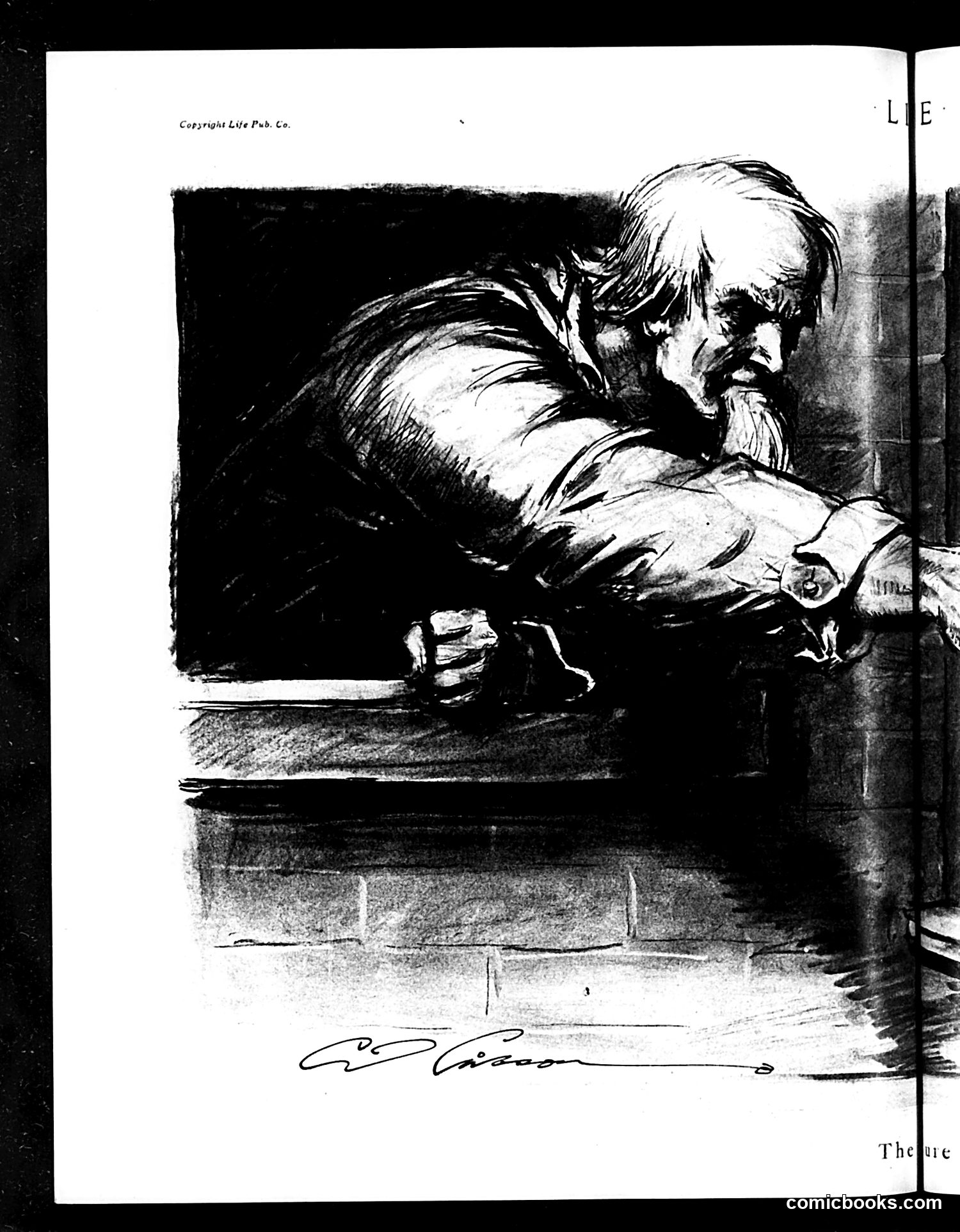
This appears to be a political cartoon from *Life* magazine, though the OCR text provides minimal context. The image shows an older man with a distinctive long beard, drawn in expressive black ink lines, leaning forward in what seems an animated or intense pose. He holds what appears to be a small object (possibly a pen or writing implement) in his hand. Without clearer OCR text or visible caption, I cannot confidently identify the specific figure, historical moment, or satirical point being made. The artistic style and subject suggest commentary on a public figure or political/social issue of the era, but asserting specifics would require additional information beyond what the image alone conveys. The signature at bottom remains unclear to me.
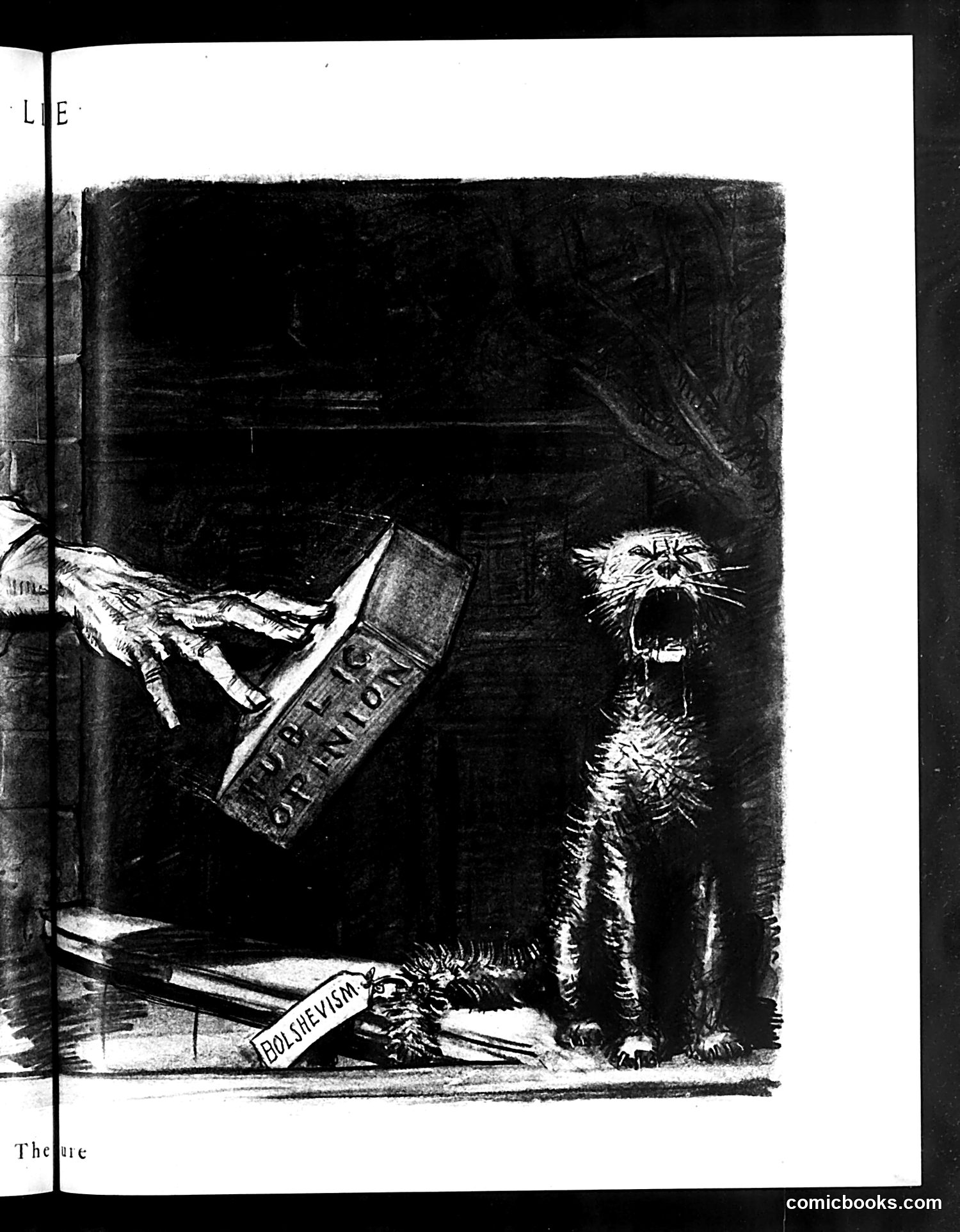
This appears to be a satirical cartoon from *Life* magazine depicting a confrontation between a fierce, snarling cat and a knocked-over paint can or container labeled "BOLSHEVISM." The cat, drawn with aggressive energy and bared teeth, seems to represent anti-communist sentiment or perhaps a nation/leader actively opposing Bolshevism. The spilled paint suggests the destruction or defeat of communist ideology. The dramatic, confrontational pose emphasizes the intensity of opposition to Bolshevism—likely reflecting early 20th-century American anxieties about communist expansion, possibly during the Red Scare period. The cartoon uses animal imagery as satire to critique or mock communist ideology through vivid visual conflict rather than direct political commentary.
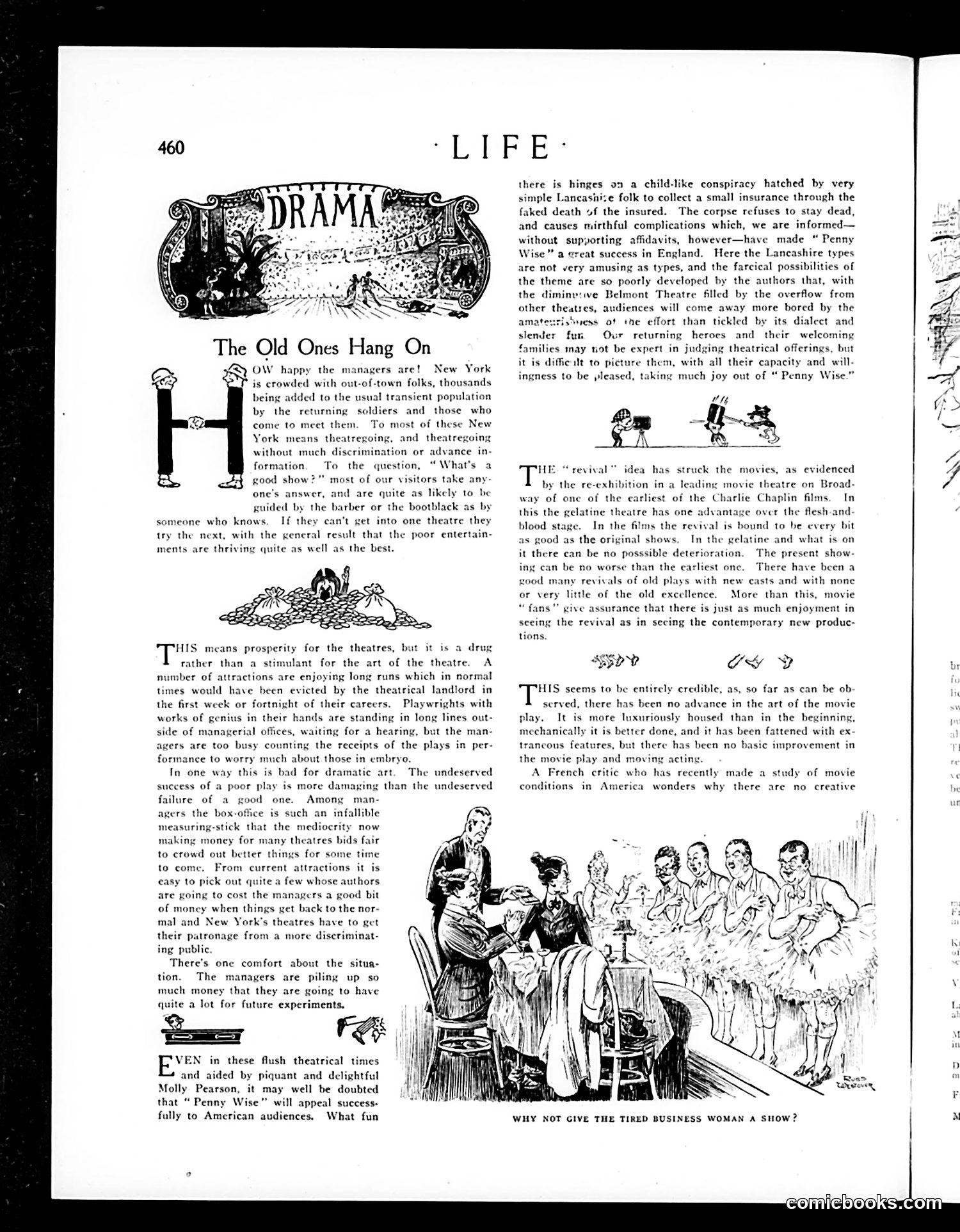
This theater critique addresses post-WWI Broadway conditions. The satire's central point: **returning soldiers and out-of-town tourists, unfamiliar with theater quality, will attend anything**, making poor plays profitable while good ones languish. The article criticizes theater managers for prioritizing box-office receipts over artistic merit. Because audiences lack discrimination—taking recommendations from "barbers or bootblacks" rather than informed critics—mediocre productions thrive while playwrights with genuine talent wait outside managerial offices unheard. The specific example critiques "Penny Wise," a Lancashire-dialect farce about insurance fraud that apparently succeeded in England but the critic finds poorly executed and unfunny. The accompanying illustration shows a tired businesswoman surrounded by chattering theatergoers—visual commentary on the exhausting, artistically-empty entertainment consuming Broadway during this boom period. The title asks why such worn audiences deserve quality theater when they'll accept mediocrity anyway.
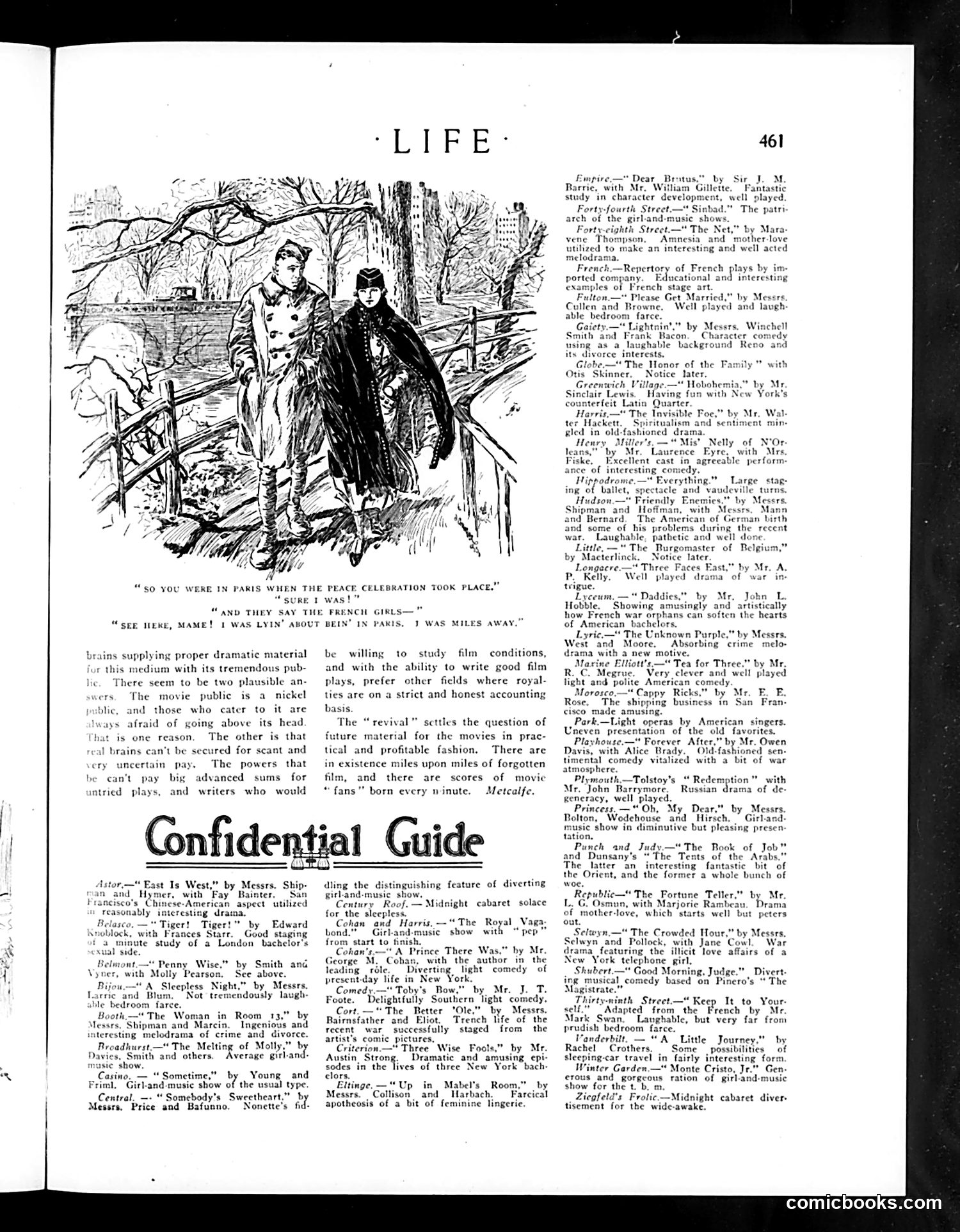
This page is primarily a **theater review section** ("Confidential Guide") listing Broadway productions with brief critical assessments—not a political cartoon. The single illustration at the top depicts two figures in conversation, with dialogue establishing a humorous premise: a man claims he was in Paris during the post-WWI peace celebration, but then admits he was actually "miles away" and was "lyin'" about it. The joke is a simple **working-class humor about bragging**—the character boasts about attending a glamorous, prestigious event (the Paris Peace Celebration following World War I) but is caught in an obvious lie. The illustration's style and the colloquial dialect ("Mame," "bein'") suggest this depicts common soldiers or ordinary men exaggerating their wartime experiences, a relatable post-war theme. The bulk of the page consists of theater listings reviewing current Broadway shows, their plots, and acting quality.
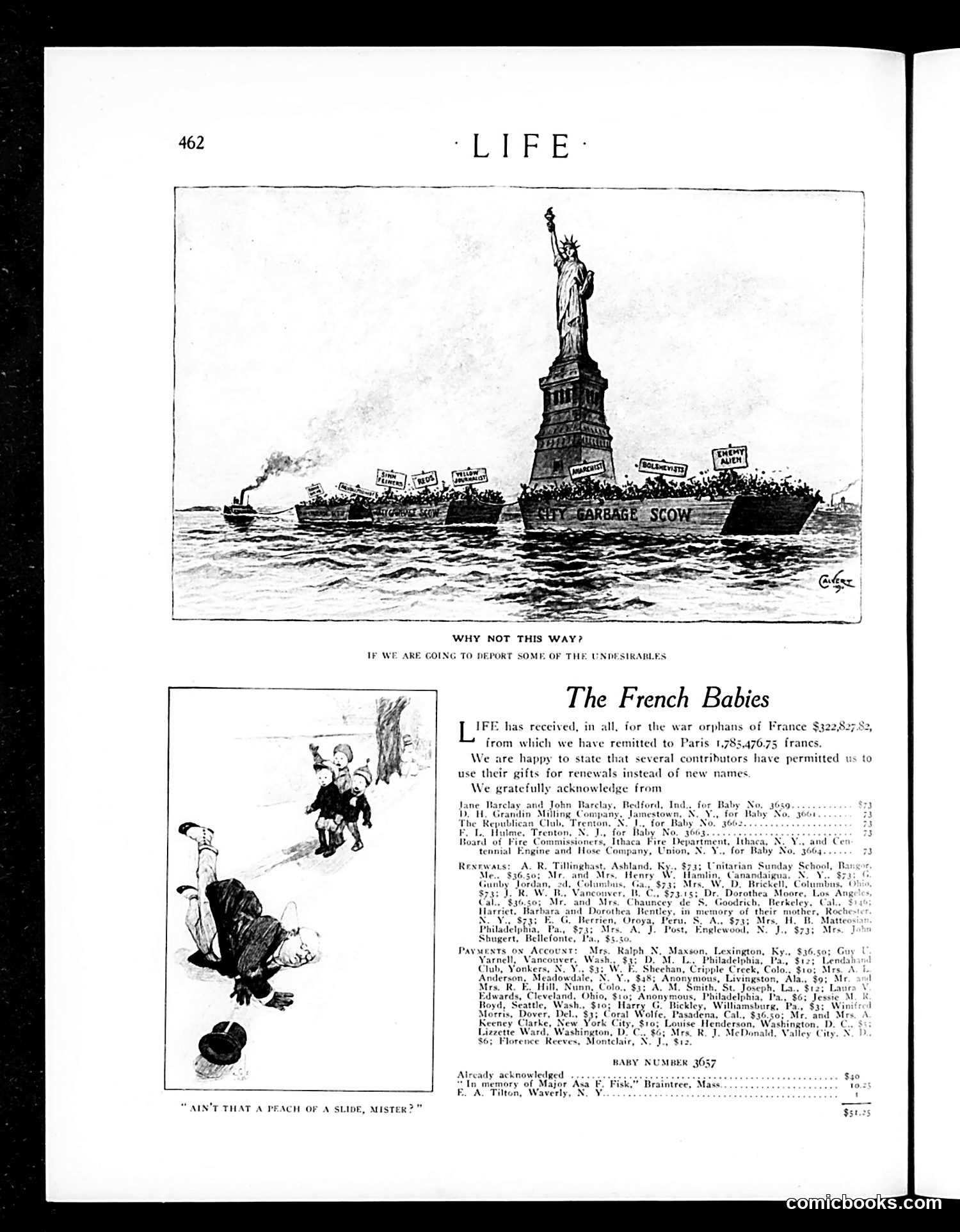
This 1920s satirical cartoon criticizes deportation policy during America's anti-immigrant fervor. The top cartoon depicts the Statue of Liberty surrounded by a barge labeled "DEPORT GARBAGE SCOW," with signs reading "UNDESIRABLES" floating around it. The caption sarcastically proposes an alternative deportation method: literally dumping unwanted immigrants into the sea near the symbol of American liberty itself. The satire mocks the hypocrisy of deporting "undesirables"—likely immigrants, radicals, or "foreign" elements targeted during the Red Scare—by suggesting the cruel absurdity of the policy. By placing this inhumane method literally at Lady Liberty's feet, the cartoonist argues such deportations betray American values. The lower cartoon appears unrelated—a comic about sliding, with accompanying text about donations to French war orphans, suggesting the page mixes editorial commentary with charitable notices.
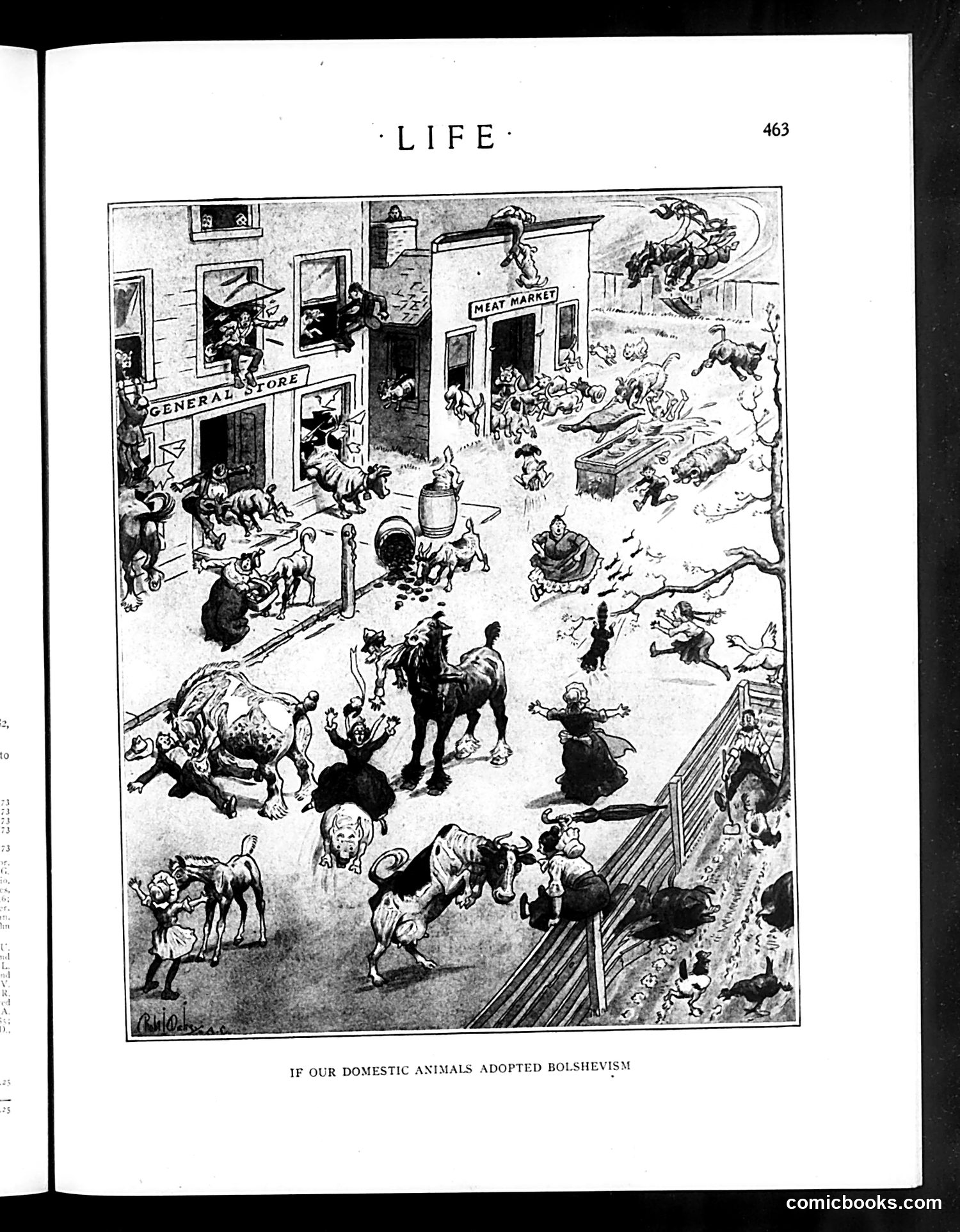
This satirical cartoon depicts a chaotic street scene imagining what would happen if domestic animals adopted Bolshevism—the revolutionary communist ideology associated with the Russian Revolution and Soviet Union. The image shows farm and household animals (dogs, horses, pigs, cattle) running amok through a town, attacking people and destroying property. A general store and meat market are visible, suggesting the animals have turned on their human masters and society's order has collapsed into anarchic violence. The satire targets American anti-communist fears of the 1920s-30s, portraying Bolshevism as a dangerous ideology that would destroy civilization and natural hierarchy. By depicting animals in rebellion, the cartoon ridicules both communism and suggests its supporters are behaving irrationally—acting like wild beasts rather than rational beings.
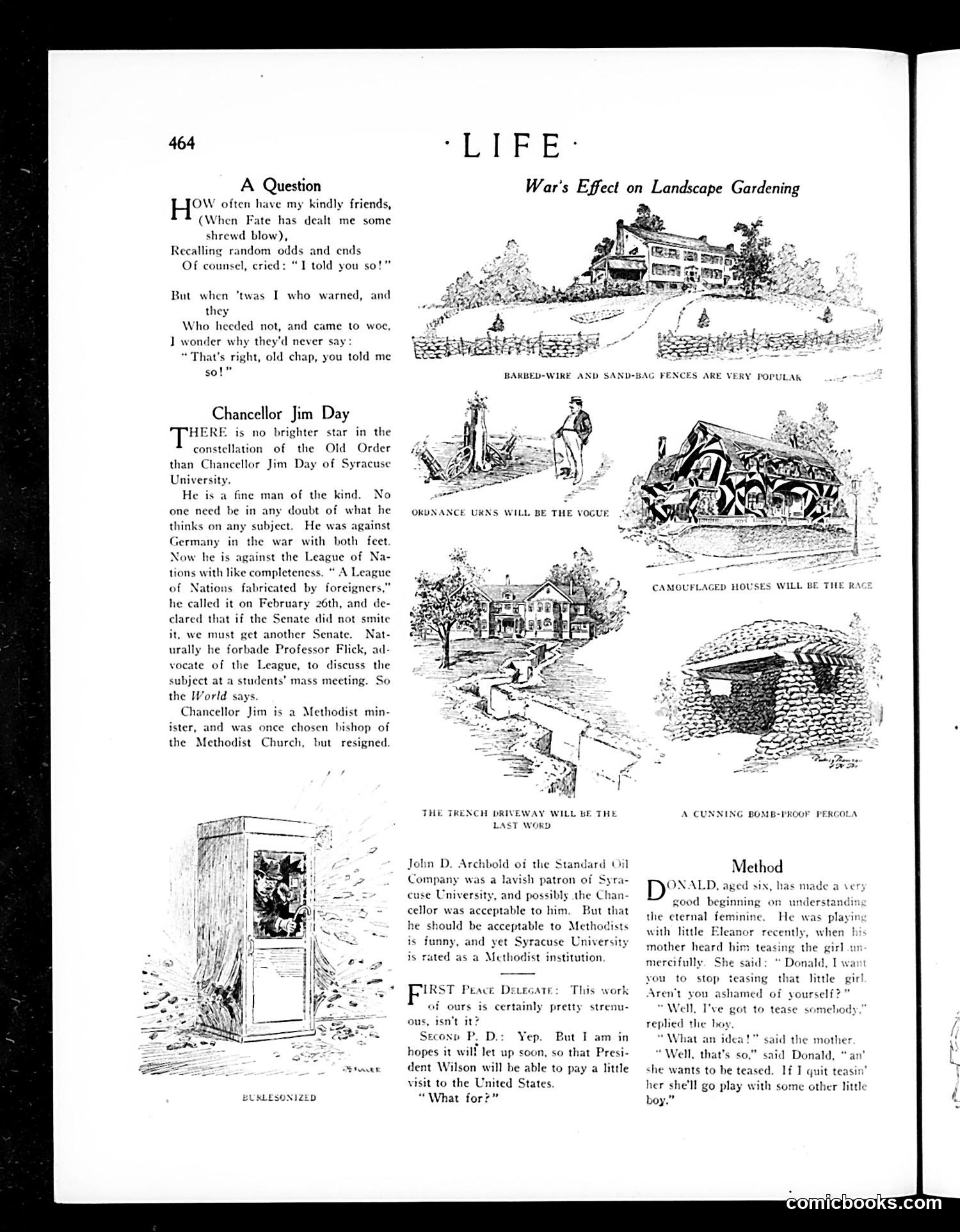
This page contains three distinct satirical pieces: **"A Question"** (left column): A poem about human nature's hypocrisy—how people eagerly remind you of their correct predictions but never acknowledge when *you* were right. **"Chancellor Jim Day"**: An editorial attack on Syracuse University's Chancellor Jim Day, a Methodist minister who opposed the League of Nations post-WWI. The satire highlights the contradiction: Day censored pro-League professor Flick from speaking, yet took money from oil magnate John D. Archbold. The piece mocks his selective principles—he's against "foreign" involvement in American affairs while apparently accepting wealthy donors' influence. **"War's Effect on Landscape Gardening"** (right side): Humorous illustrations showing how wartime fortifications are becoming fashionable home features—"bomb-proof pergolas," camouflaged houses, trench driveways, and sandbag fences. This satirizes how civilians adopted military aesthetics during/after WWI. **"Method"** (bottom): A brief domestic comedy about a six-year-old boy realizing he can manipulate a girl by teasing her, since she'll go elsewhere if he stops. The page reflects post-WWI American anxieties about foreign entanglement and militarization of civilian life.
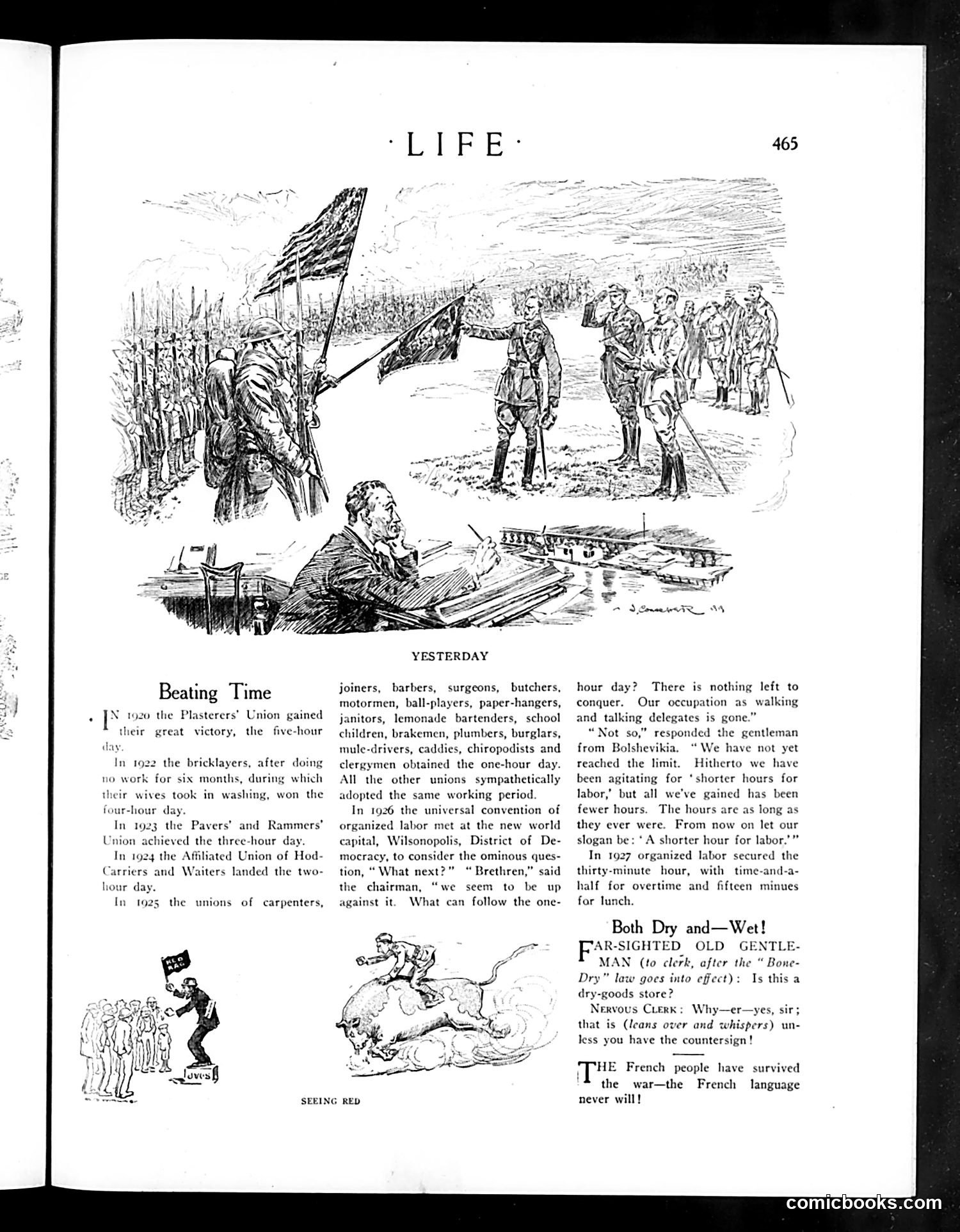
This page satirizes the labor movement's escalating demands for shorter working hours. The main article, "Beating Time," mocks union strategy through absurdist extrapolation: after unions won progressively shorter days (five hours in 1920, down to one hour by 1926), the satire imagines a 1927 convention where labor leaders realize they've achieved the goal but workers' actual time hasn't changed—so they pivot to demanding "shorter hours" conceptually rather than materially. The cartoons below add commentary: "Seeing Red" appears to reference communist/radical sympathies within labor movements. The "Dry and—Wet!" dialogue jokes about Prohibition's enforcement through coded language ("countersign"), suggesting speakeasy-style secrecy around alcohol sales even in legitimate dry-goods stores. The satire's core: Life mocks organized labor as pursuing symbolic victories disconnected from workers' real interests, and implies radical infiltration of union leadership.
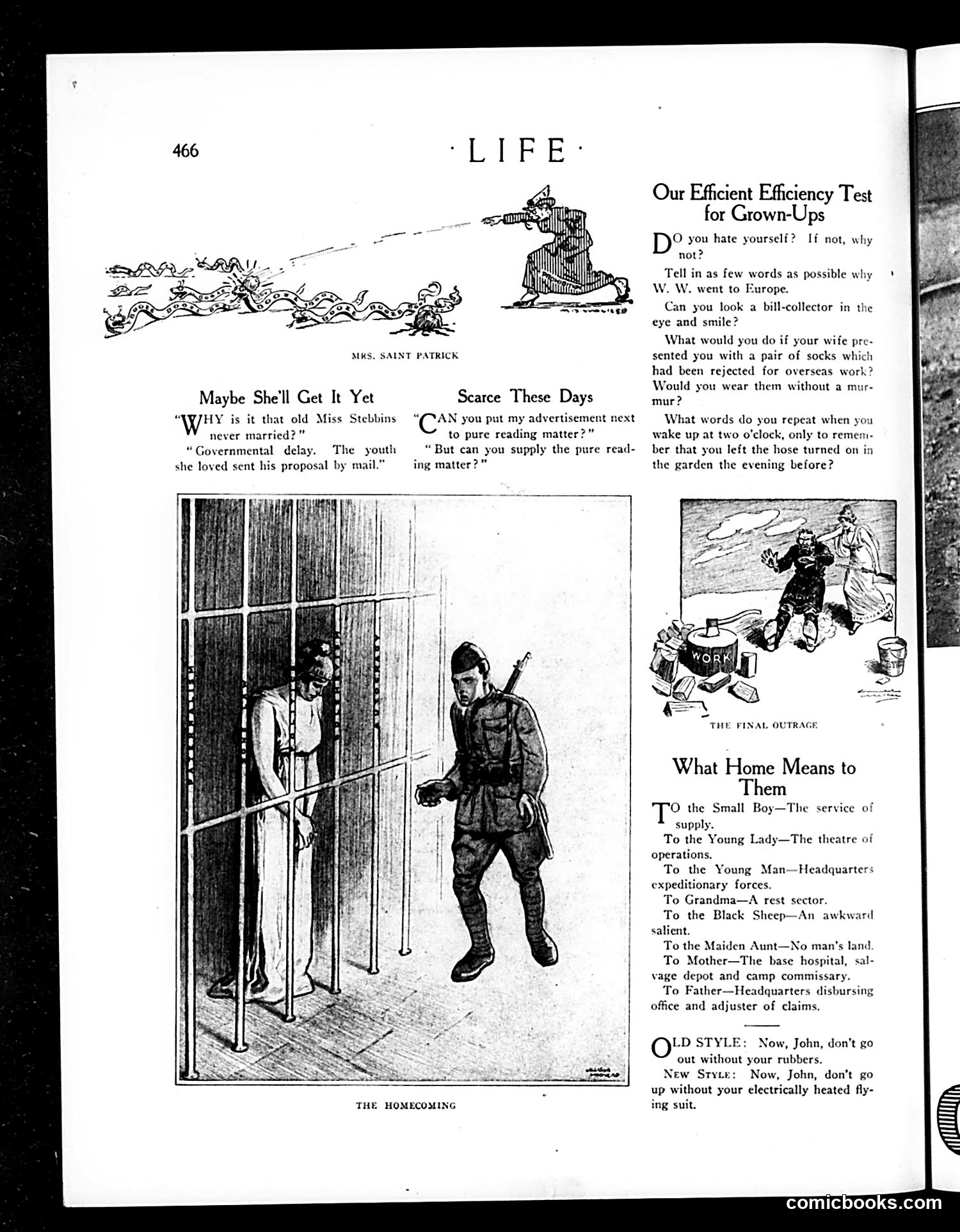
This WWI-era satirical page mocks post-war domestic adjustment. **"The Homecoming"** depicts a soldier returning to find his wife behind bars—suggesting marriage itself has become a prison, a common anxiety about soldiers reintegrating with restrictive home life. The **"Efficiency Test"** humorously lists how different family members now view home through militaristic language: the mother as "base hospital," father as "disbursing office," the maiden aunt as "no man's land." This reflects how wartime vocabulary and military hierarchy had invaded civilian speech and relationships. **"What Home Means to Them"** extends this satirical military framing, suggesting families have adopted expeditionary-force mentality during wartime separation. The other sections joke about bureaucratic delays preventing marriage proposals and outdated parental warnings being replaced by absurd modern ones ("electrically heated flying suit"). The overall point: wartime has fundamentally altered domestic relationships and language, making the homefront itself feel like a military operation.
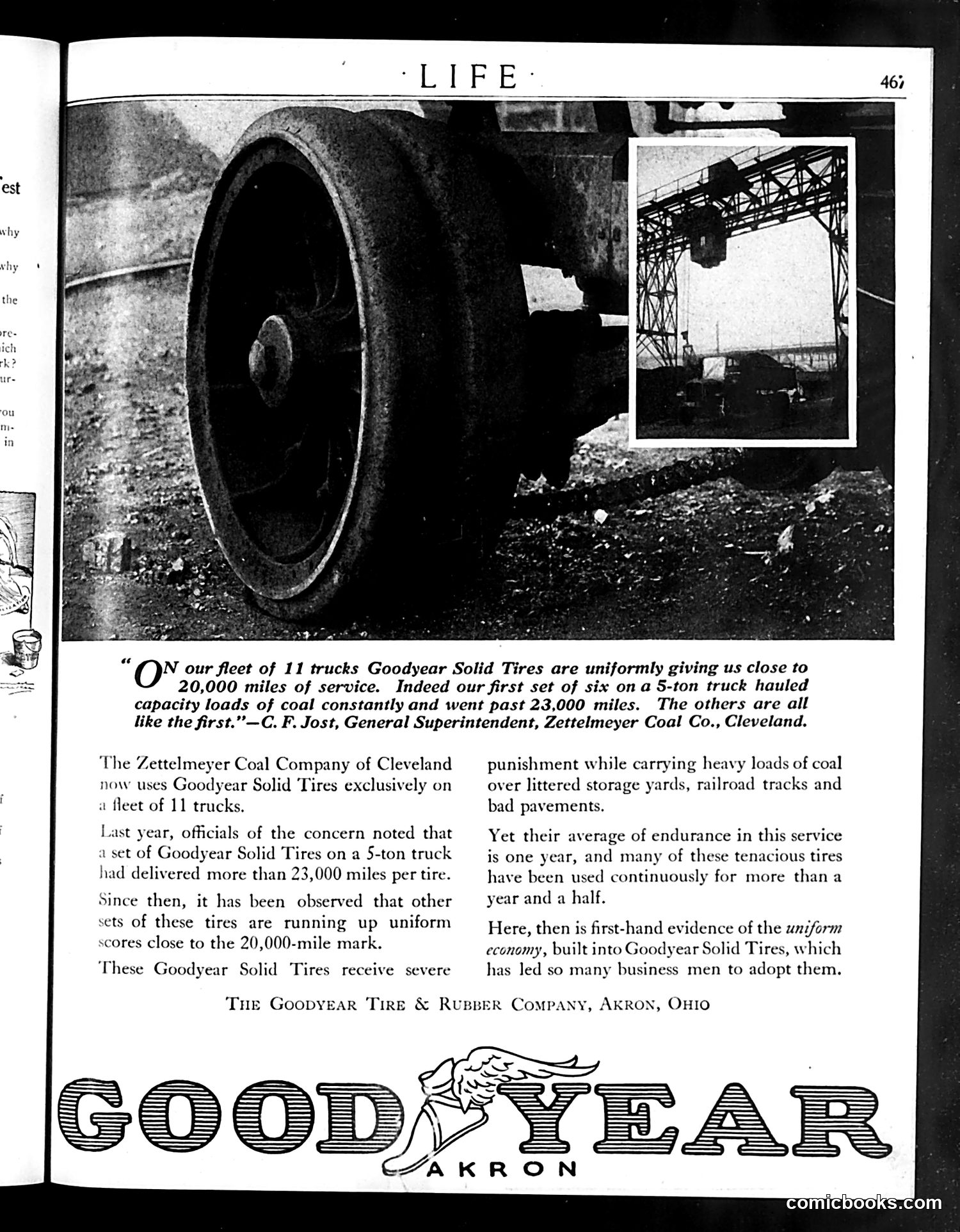
This is a Goodyear Tire advertisement, not a political cartoon. It features a testimonial from C. F. Jost, General Superintendent of the Zettelmeyer Coal Company in Cleveland, praising Goodyear Solid Tires' durability under harsh conditions. The ad emphasizes practical evidence: a fleet of 11 trucks using these tires consistently achieved 20,000+ miles of service, with one set reaching over 23,000 miles while hauling heavy coal loads across rough terrain (storage yards, railroad tracks, bad pavements). The advertisement highlights the tires' "uniform economy" and durability—some tires lasted over a year and a half of continuous use. This is straightforward product advertising leveraging a real business customer's endorsement, typical of early 20th-century trade publications targeting industrial companies and fleet managers.
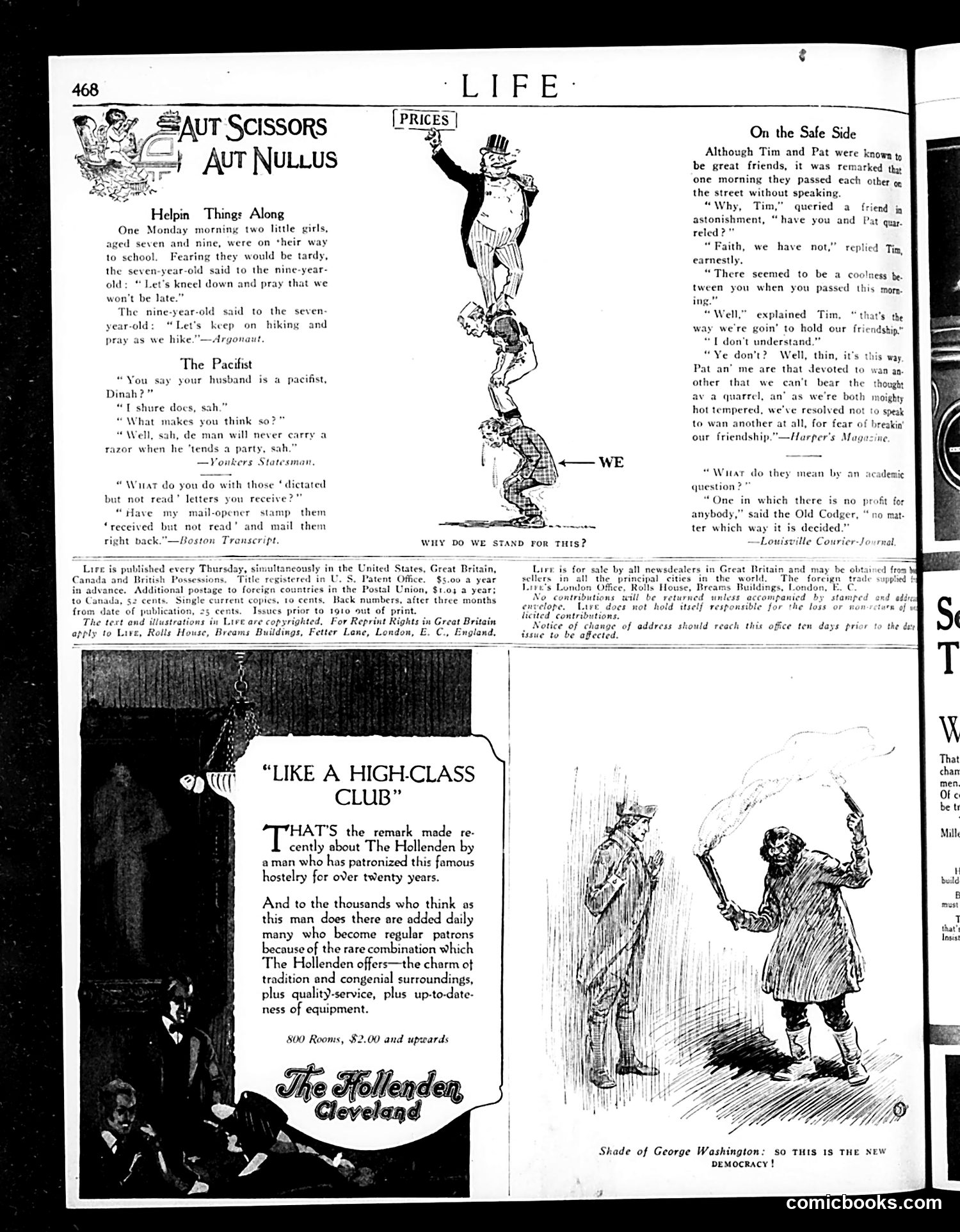
This page contains several humorous short pieces typical of Life's satirical format: **"Helpin Things Along"** depicts two young girls praying before school to avoid tardiness—gentle comedy about childhood. **"The Pacifist"** jokes that a man's "pacifism" merely means he won't carry a razor to parties, a racial stereotype implying African American men and violence. **"On the Safe Side"** features Irish characters (Tim and Pat, indicated by dialect) who deliberately maintain distance to prevent quarrels, satirizing ethnic stereotypes about Irish temper. **The main cartoon** titled "Shade of George Washington: so THIS is the NEW DEMOCRACY!" shows two figures—one appears to be Uncle Sam or a government official, the other a common citizen—in what seems critical commentary on democratic governance or electoral processes, though the specific reference is unclear without more context. The advertisement for The Hollenden hotel occupies significant space, typical of Life's revenue model.
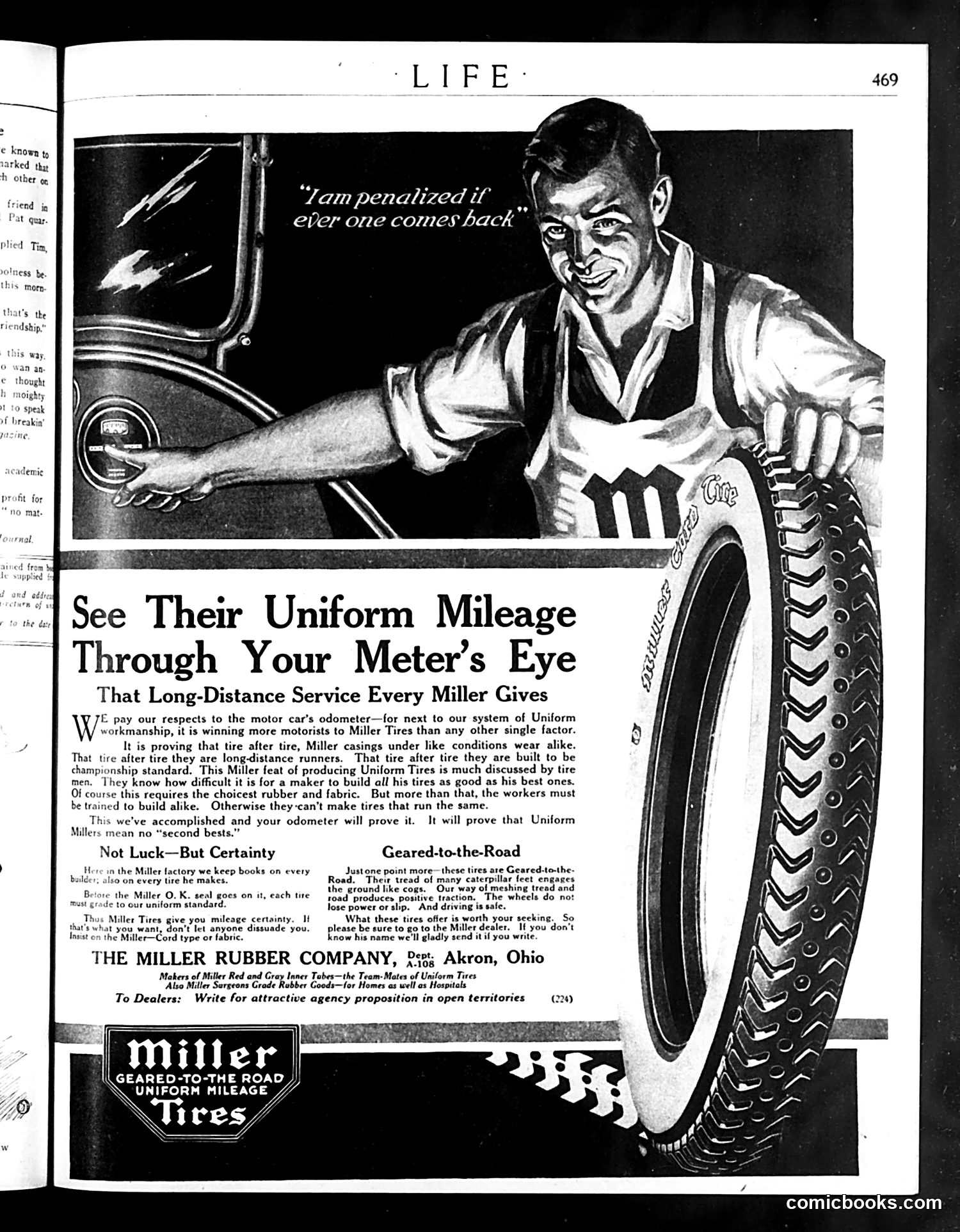
This is a straightforward **tire company advertisement**, not political satire. Published in *Life* magazine (page 469), it promotes Miller Tires' "Uniform Mileage" feature. **The Image:** Shows a smiling deliveryman or mechanic in work clothes next to a large tire, with the quote "I am penalized if ever one comes back"—emphasizing quality control. **The Sales Pitch:** Miller claims their manufacturing process produces consistent tire quality across all units. The ad uses the car's odometer as proof: identical tires should wear uniformly, demonstrating reliability. This was a significant selling point in early automotive culture when tire durability varied widely. **Historical Context:** Early 20th-century tire manufacturing was inconsistent. Promising "uniform" products—same quality tire after tire—was genuinely competitive. The ad appeals to motorists' desire for predictable, long-distance performance. **No satire or political content is present.** This is straightforward commercial advertising typical of *Life* magazine's revenue model.
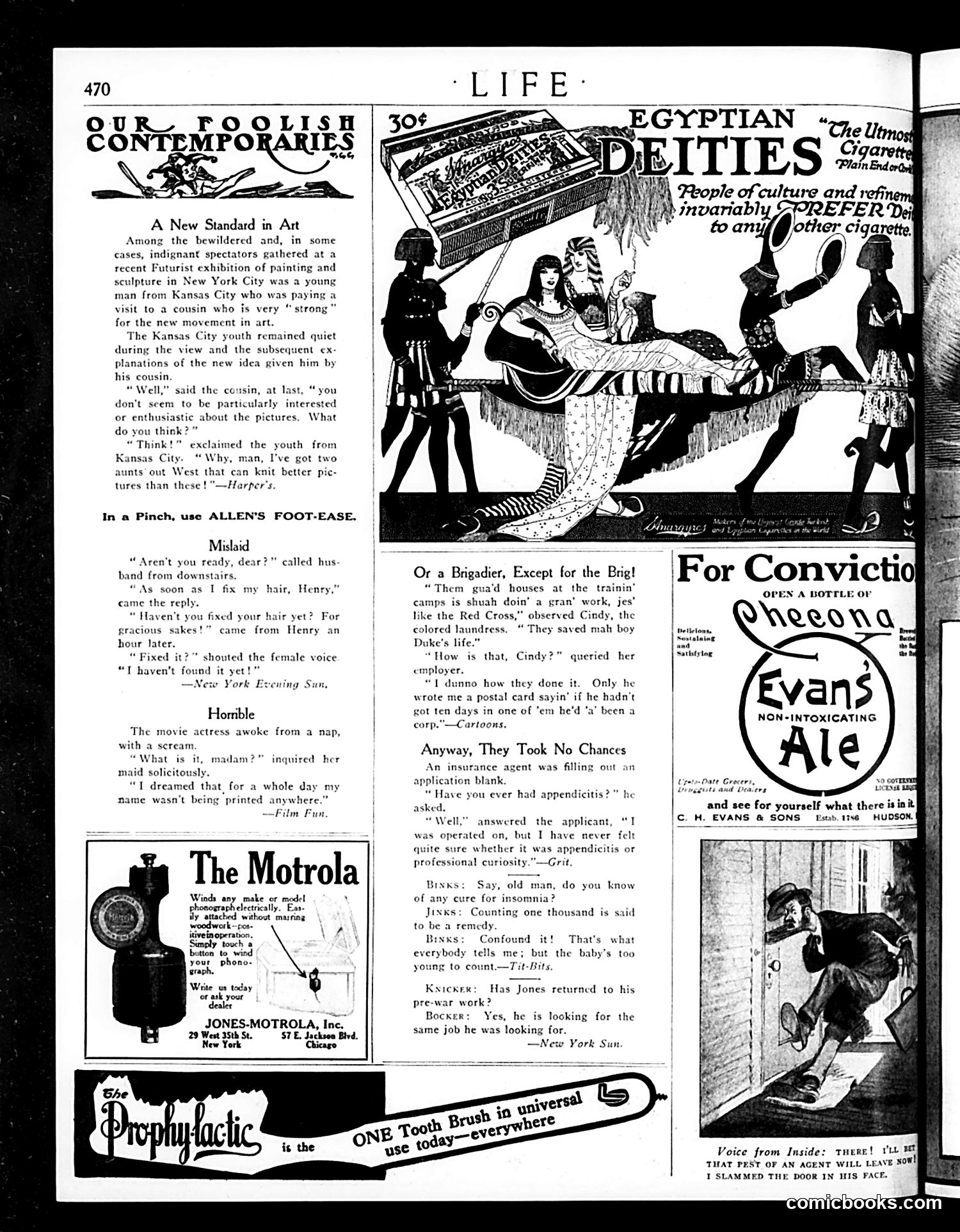
This page from Life magazine (circa 1910s-1920s) contains humor pieces satirizing contemporary American life and attitudes. **"Our Foolish Contemporaries"** mocks Futurist art through a Kansas City visitor's perspective. The joke: a unsophisticated midwesterner dismisses avant-garde painting and sculpture as inferior to traditional crafts ("my aunts can knit better pictures"). This reflects common American skepticism toward European modernist movements, positioning artistic innovation as pretentious nonsense. The other brief humor items—about hair-fixing, movie actress vanity, and insurance applications—are lightweight social observational comedy targeting gender stereotypes and bureaucratic absurdity. The page is primarily **advertising** for products (Egyptian Deities cigarettes, Motrola phonograph devices, Evans ale, Prophylactic toothbrush). The satirical content frames anti-modern, anti-intellectual attitudes as common sense, appealing to readers suspicious of artistic and social change.
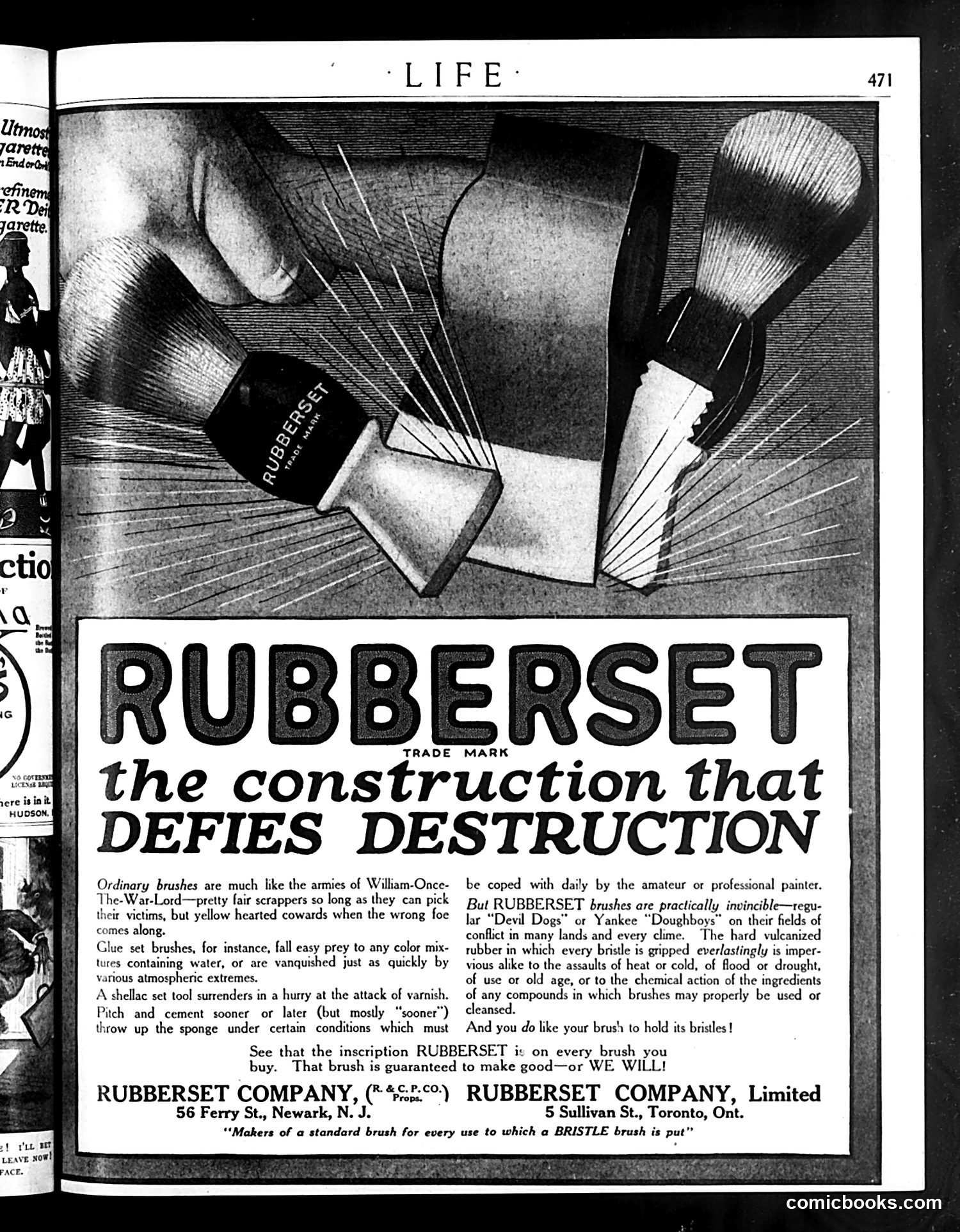
This is **primarily a product advertisement**, not a political cartoon. It appears in *Life* magazine (page 471) promoting Rubberset paint brushes. The page uses **military metaphors** to sell brushes. It compares ordinary brushes to weak armies ("pretty fair scrappers...yellow hearted cowards"), specifically referencing "William-Once-The-War-Lord" (likely Kaiser Wilhelm II, suggesting a post-WWI publication). Rubberset brushes, by contrast, are compared to "Devil Dogs" (U.S. Marines) and "Yankee Doughboys"—elite, indestructible soldiers. The image shows hands demonstrating brushes' durability and bristle-retention. **The satire/joke**: Rather than mocking a political figure, the ad mockingly presents ordinary brushes as cowardly soldiers who fail under pressure, while Rubberset brushes are heroic warriors immune to all conditions (water, heat, varnish, chemicals, age). It's patriotic advertising dressed in martial language, appealing to post-war American confidence and masculinity.
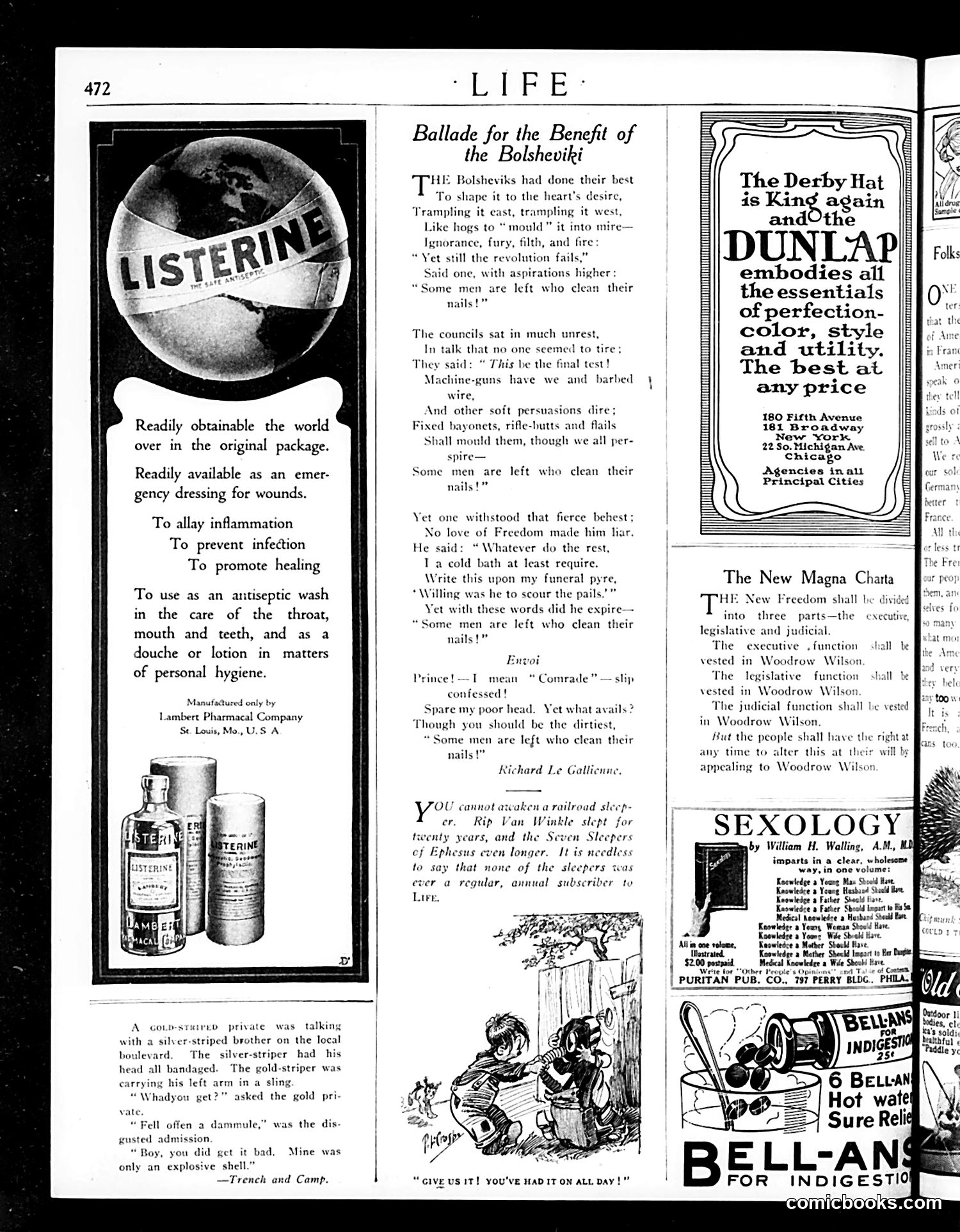
This page mixes advertisements with political satire from the World War I era. **The "Ballade for the Benefit of the Bolsheviki"** is a poem mocking the Russian Revolution. It satirizes the Bolsheviks' violent attempts to reshape society ("trampling it cast, trampling it west") using brutality—"Machine-guns," "barbed wire," "Fixed bayonets." The poem's recurring refrain, "Some men are left who clean their nails," suggests that despite revolutionary terror, personal dignity and hygiene persist—implying the revolution's failure to eliminate basic human standards or free will. The crude joke below depicts two soldiers: one gold-striped (higher rank) and one silver-striped (lower rank) with bandages. When asked his injury, the lower-ranked soldier claims he fell off a donkey, while the higher-ranked soldier was wounded by explosives—a class-based jab at military hierarchy and incompetence. **"The New Magna Charta"** sarcastically attacks President Woodrow Wilson's expanding executive power by claiming all government functions—executive, legislative, and judicial—rest with him alone, with citizens having only the right to "appeal" back to Wilson. It criticizes perceived autocracy disguised as progressive governance. The page is primarily **advertisements** for Listerine, Derby hats, and books on sexual education.
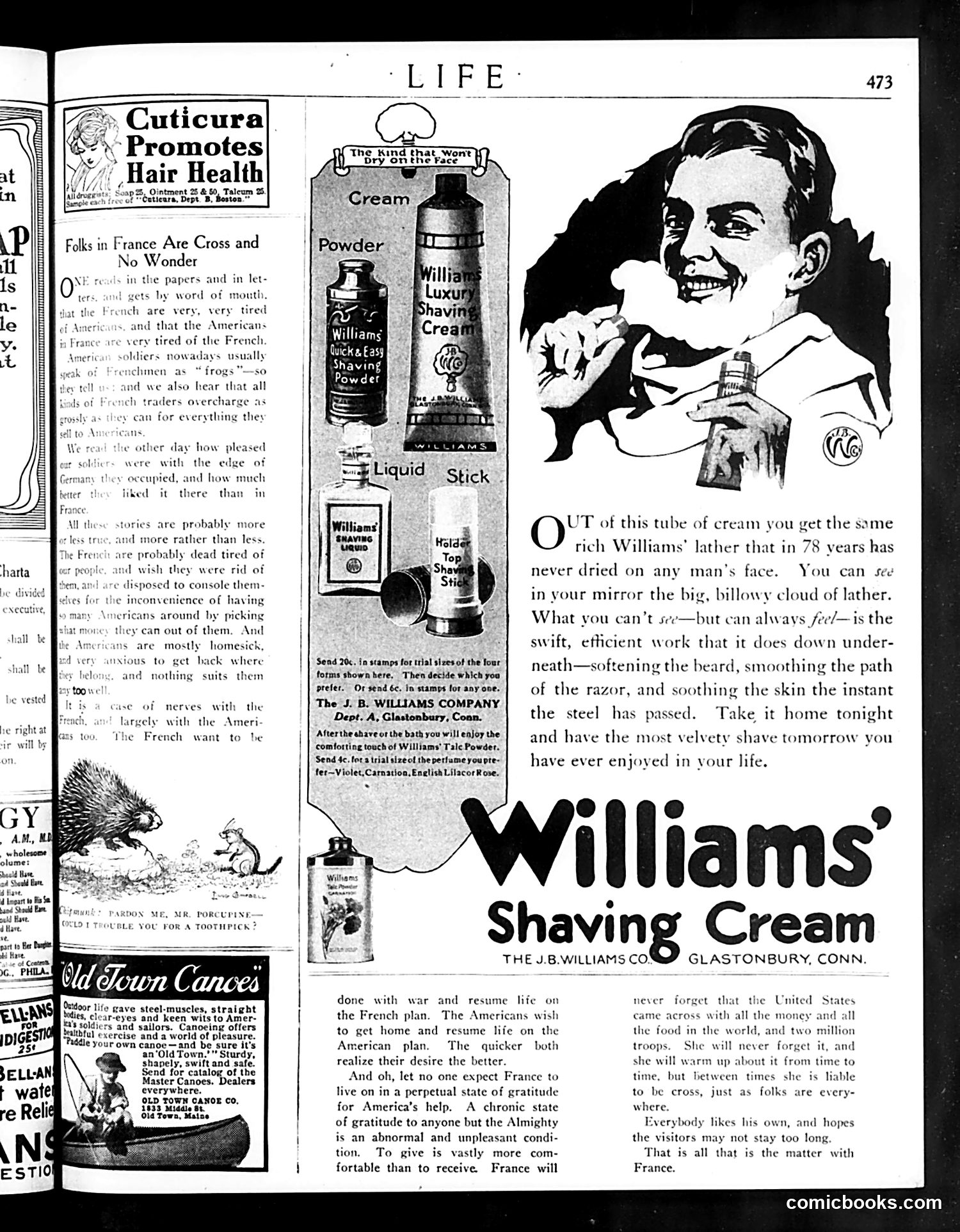
This page is primarily **advertising** (Williams' Shaving Cream dominates the right side), but includes a brief **opinion piece** titled "Folks in France Are Cross and No Wonder." **The Political Context:** The article addresses post-WWI Franco-American relations. It explains French resentment toward Americans, noting that: - French soldiers are exhausted from the war - Americans arrived late but are now occupying French territory - French traders overcharge Americans - Americans are homesick and want to leave **The Satirical Point:** The author defends French irritability as perfectly rational—not ingratitude, but human nature. France shouldn't be expected to remain perpetually grateful to America. The closing line captures the joke: "Everybody likes his own...That is all that is the matter with France"—meaning French crankiness is simply normal homebody behavior, not treachery. **Historical Context:** This reflects genuine post-WWI tensions between allies, when American soldiers occupied France and cultural friction emerged between the nations.
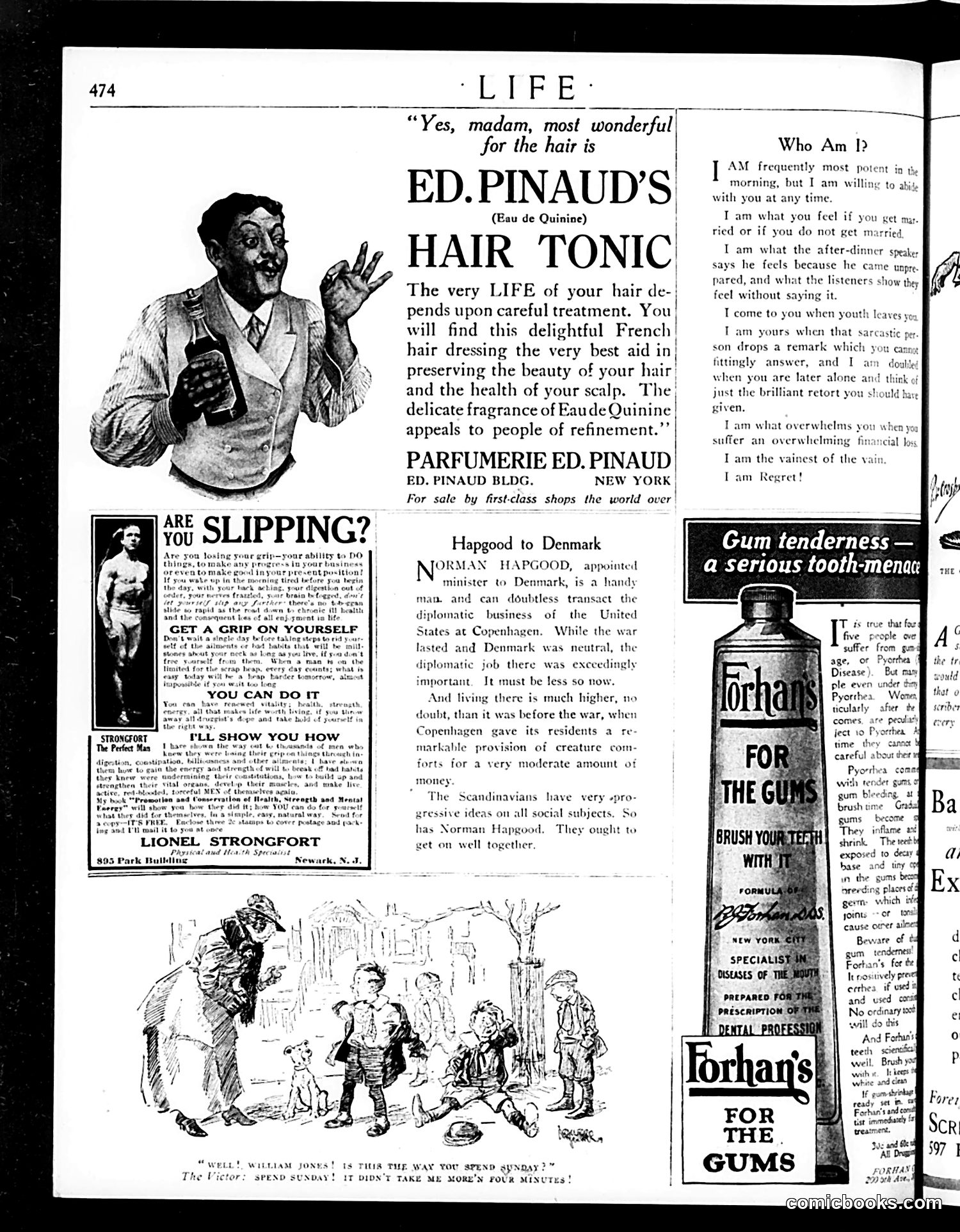
This page from *Life* magazine contains primarily **advertisements and satirical commentary** rather than political cartoons. The main features include: 1. **Ed. Pinaud's Hair Tonic ad**: A French luxury product marketed to refined consumers, featuring a caricatured man's face—typical early-20th-century advertising imagery. 2. **"Hapgood to Denmark" brief**: Commentary on Norman Hapgood's appointment as U.S. minister to Denmark. The piece notes Denmark was neutral during WWI, making the diplomatic post less important than before, while also suggesting Hapgood and Scandinavians share "progressive ideas"—likely gentle satire about his suitability for the role. 3. **"Who Am I?" riddle**: A poetic personification piece that reveals the answer as "Regret"—typical *Life* magazine's whimsical wordplay. 4. **Street scene cartoon**: Shows William Jones spending Sunday, with a caption playing on class/leisure assumptions. The page reflects *Life*'s mix of commercial advertisements, light social commentary, and humorous puzzles rather than hard-hitting political satire.
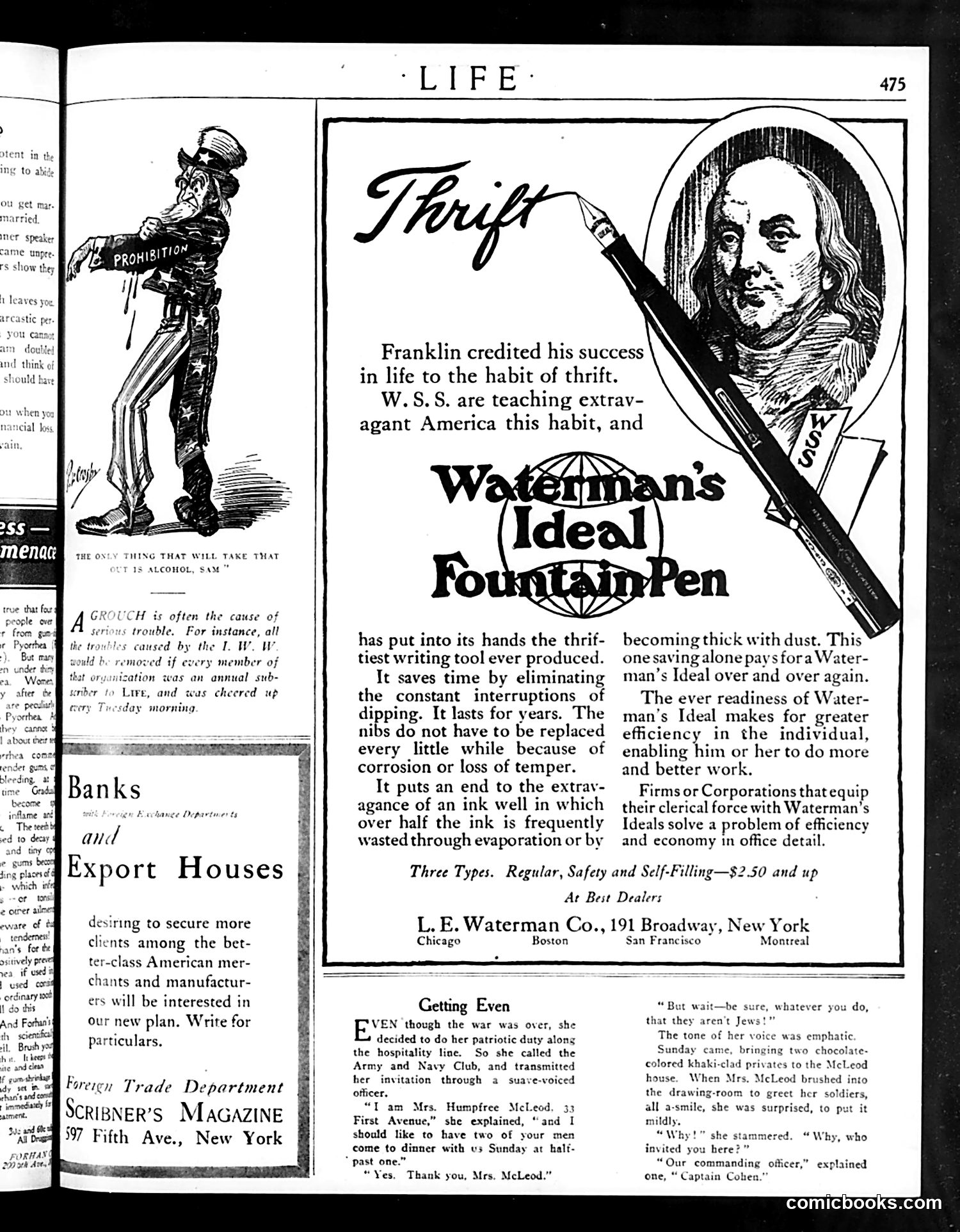
The left cartoon satirizes Prohibition by depicting a skeletal figure labeled "Prohibition" as "the only thing that will take that cut" from troublemakers—a dark joke suggesting the cure is as deadly as the disease. It mocks the temperance movement's claim that banning alcohol solves social problems. The main advertisement promotes Waterman's Ideal Fountain Pen by invoking Benjamin Franklin's famous association with thrift, connecting the pen's efficiency to American productivity and the WWI-era War Savings Stamps (W.S.S.) campaign. The "Getting Even" story satirizes anti-Semitic prejudice. A snobbish woman invites soldiers to dinner but specifies "they aren't Jews." The punchline—that the officer sending them is named Cohen, implying he is Jewish—exposes her bigotry as foolish. The story mocks her hypocrisy in simultaneously performing patriotic duty while harboring discriminatory attitudes, suggesting such prejudice was both common and absurd among certain Americans.
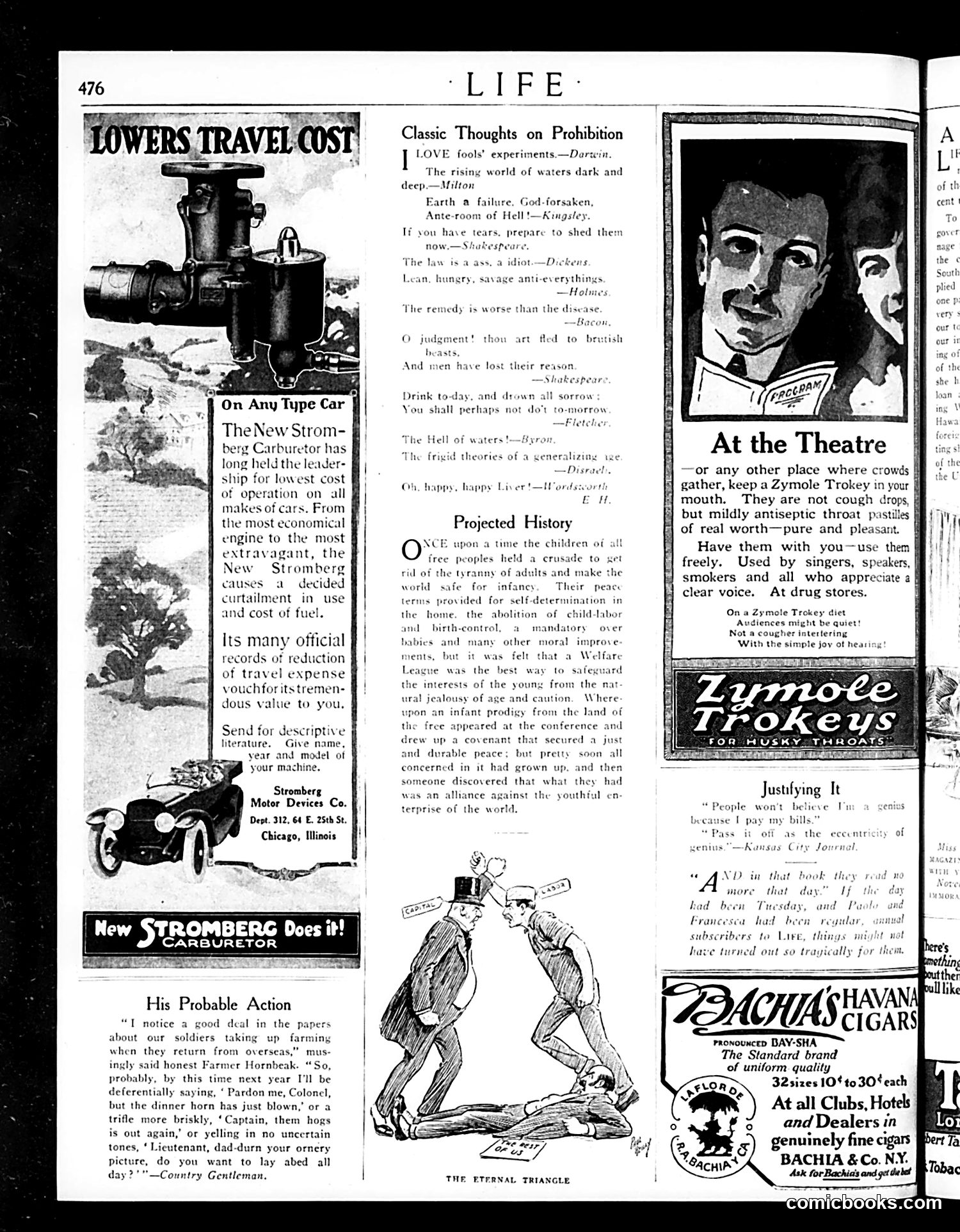
This page contains **primarily advertisements and satirical commentary** rather than a unified political cartoon. The main editorial content is "Projected History," a satirical piece imagining post-WWI idealism. It mocks the League of Nations and progressive reformers who believed a crusade would make "the world safe for infancy" through child-labor abolition and birth control. The satire is that these well-intentioned reformers grew up, discovered their covenant hadn't secured lasting peace, and found themselves opposed by youthful idealists—reversing their own earlier positions. It's a cynical commentary on how wartime idealism fails to produce permanent change. "His Probable Action" humorously imagines returning soldiers becoming farmers and accidentally outranking their former commanders through social awkwardness. The page is otherwise dominated by **product advertisements**: Stromberg carburetors, Zymole Trokey throat lozenges, Bacchus cigars, and others—typical of Life's revenue model.
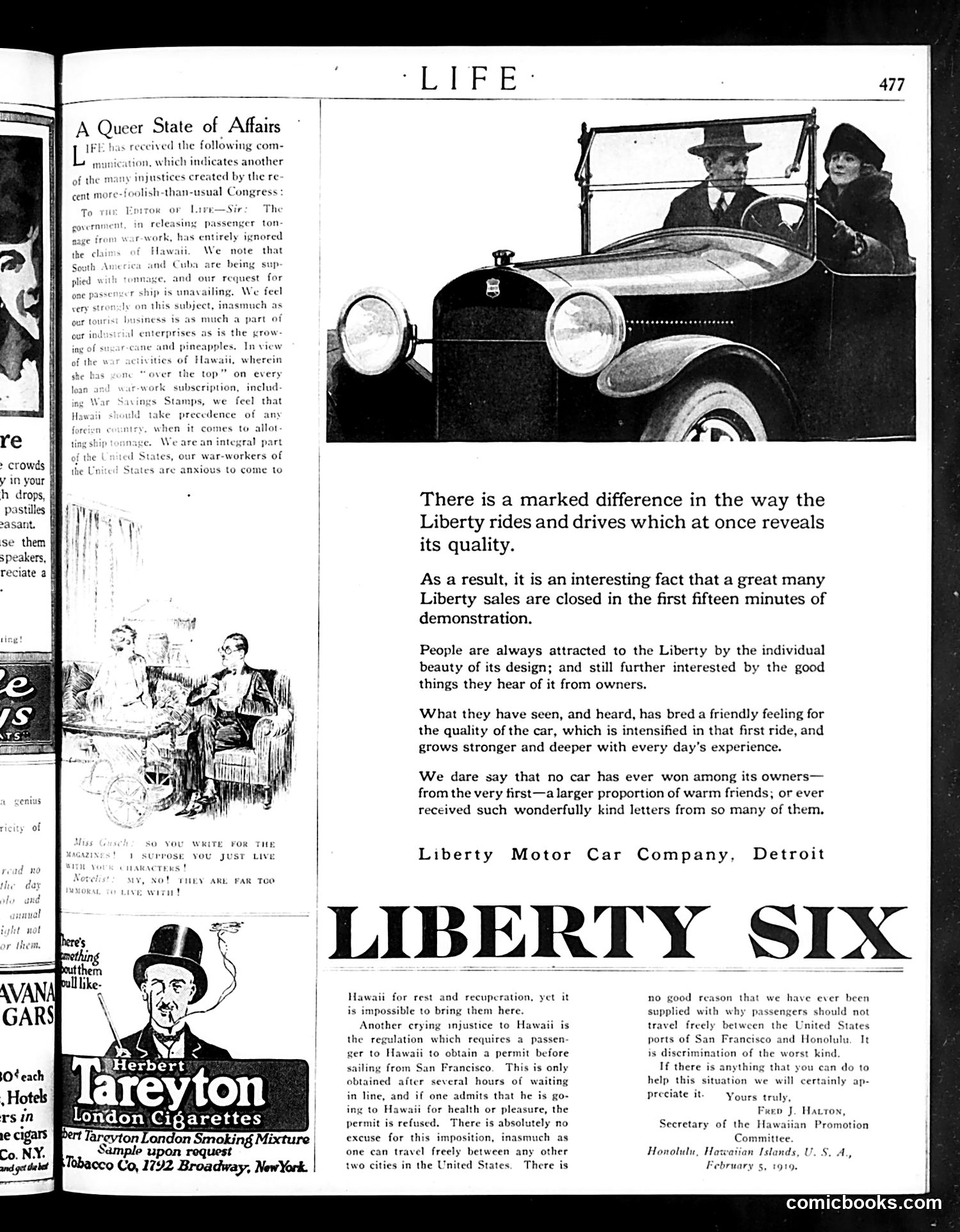
This page combines editorial complaint with automobile advertising. **The Editorial Complaint ("A Queer State of Affairs"):** A letter to Life's editor protests U.S. government restrictions on Hawaiian travel and commerce during the post-WWI period. The writer argues Hawaii—a major source of sugar and pineapples for the war effort—is being unfairly treated compared to Cuba and South America. Specifically, travelers to Hawaii must obtain permits in San Francisco, while travel between other U.S. cities is unrestricted. The letter, from Hawaii's Promotion Committee secretary, frames this as discriminatory and economically damaging. **The Advertisement:** Below runs a full-page Liberty Six automobile ad featuring a photograph of well-dressed passengers in an open car, emphasizing quality and owner satisfaction. **The Satirical Point:** The juxtaposition is the joke—the earnest complaint about government red tape and Hawaiian injustice sits directly above commercialized self-promotion, highlighting the magazine's dual role as both social critic and advertising vehicle. The contrast mocks both bureaucratic absurdity and consumer culture's trivial concerns.
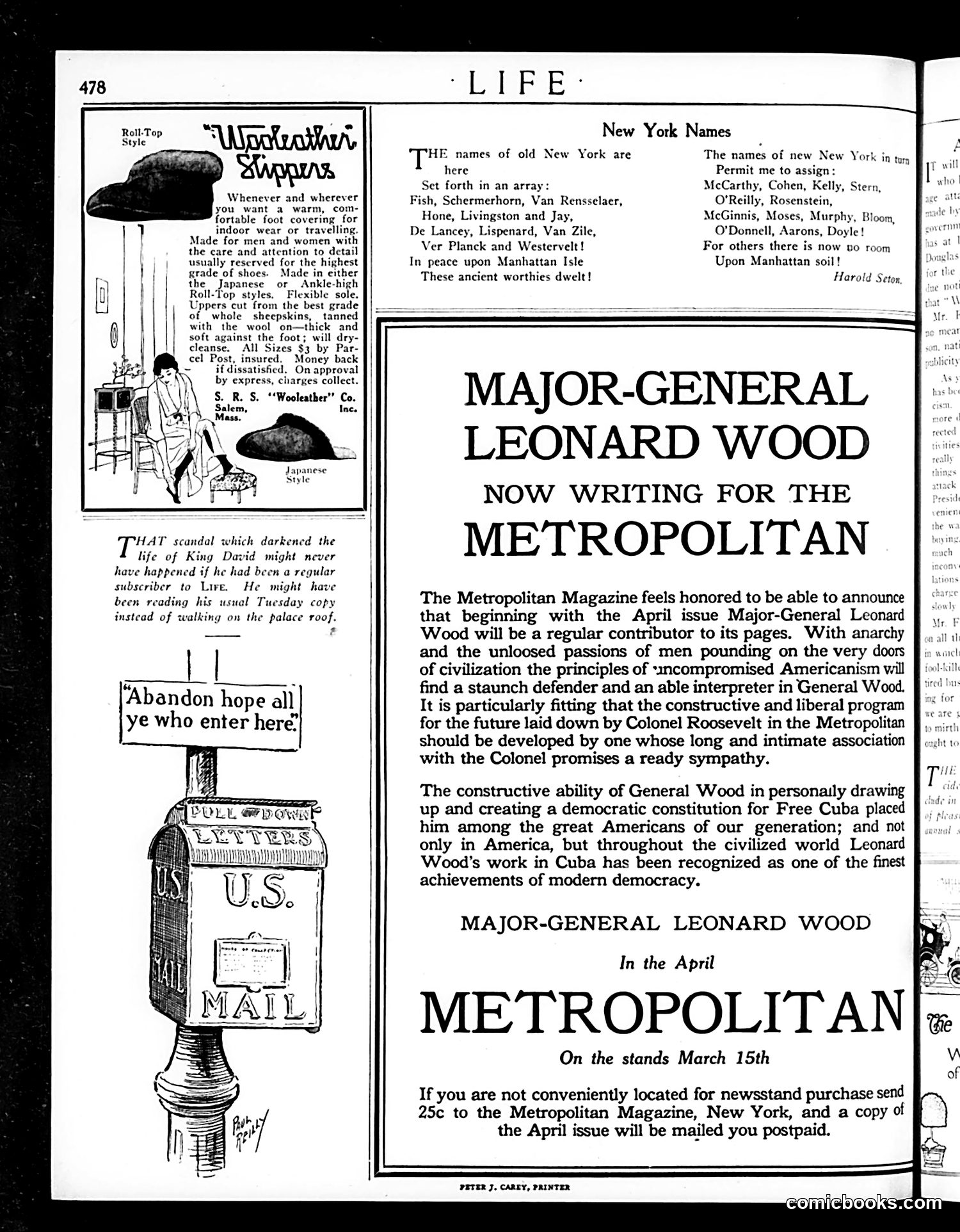
This page mixes advertisements with social commentary and a major announcement. **The "New York Names" poem** is satirical commentary on demographic change. It contrasts old Dutch/Anglo-American colonial surnames (Fish, Schermerhorn, Van Rensselaer) with new immigrant names (McCarthy, Cohen, Kelly, Stern, O'Reilly, Rosenstein, McGinnis, Moses, Murphy, Bloom, O'Donnell, Aarons, Doyle)—predominantly Irish, Jewish, and Italian. The poem's closing couplet expresses nativist anxiety: there's "now no room" for others on Manhattan. This reflects early-20th-century American xenophobia about immigration. **The mailbox cartoon** satirizes King David's biblical adultery, suggesting that regular *Life* magazine readership provides moral instruction. **The major announcement** promotes Major-General Leonard Wood joining *Metropolitan* Magazine as a contributor, positioning him as a defender against "anarchy" and promoting "uncompromised Americanism"—likely coded language supporting conservative/imperialist ideology and opposing progressive immigration or radical politics.
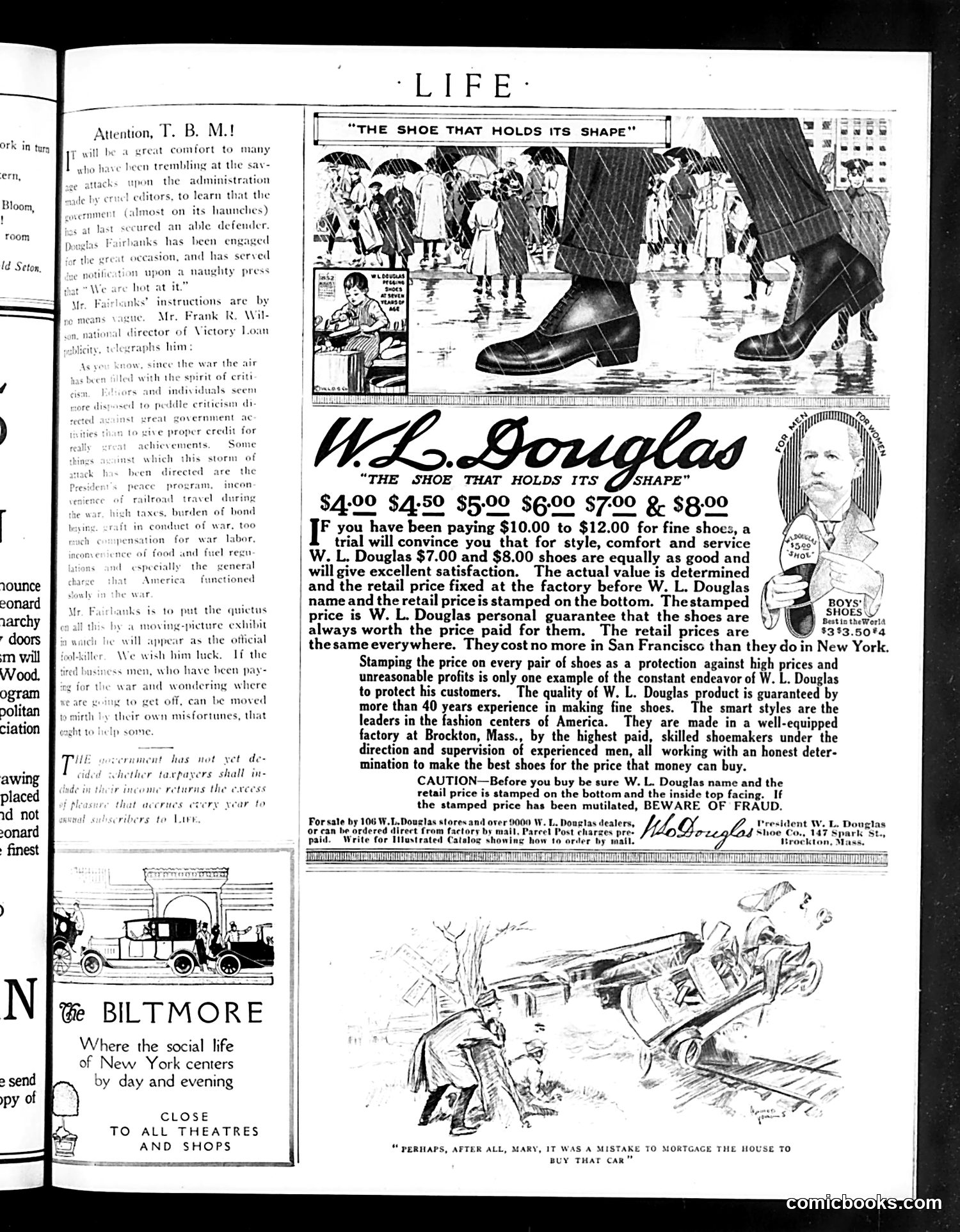
This page is primarily **advertising**, dominated by a large W.L. Douglas shoe ad. The ad emphasizes value and transparency: shoes priced $4-$8 that compete with competitors charging $10-$12. Douglas stamps prices directly on shoes as a guarantee against fraud and "unreasonable profits"—appealing to post-WWI consumer skepticism about inflation and profiteering. The small cartoon at bottom depicts a couple in financial distress, with the wife saying they "mortgaged the house to buy that car." This satirizes the emerging American consumer culture and installment-buying mentality of the 1920s, warning of the dangers of overextending for luxury goods (automobiles were still expensive novelties). The left column discusses Douglas supporting a government aid defender (likely Secretary of War candidate Douglas Fairbanks), positioning the shoe company as patriotic—relevant post-war political messaging. The Biltmore Hotel ad notes it's "close to all theatres and shops," targeting affluent consumers.
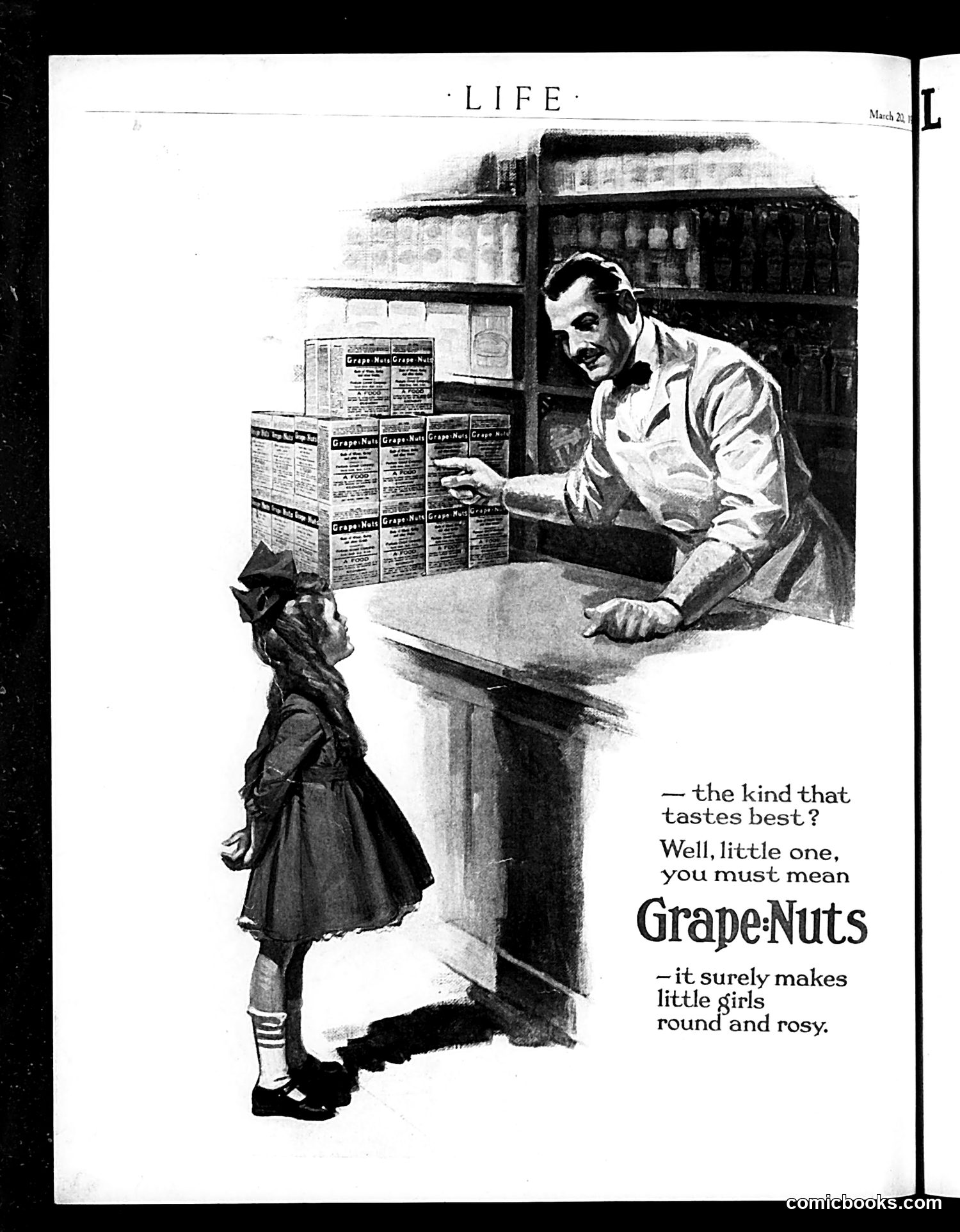
This is a **Grape-Nuts cereal advertisement**, not political satire. A shopkeeper at a counter displays boxes of the product to a young girl. The ad uses a common early 20th-century marketing strategy: implying that eating the cereal will make children healthier and more robust ("round and rosy"). The dialogue presents the cereal as the obvious answer to what tastes best, appealing to both the child and parents reading *Life* magazine. The era's emphasis on nutrition and childhood health made such claims rhetorically effective, even if unsubstantiated by modern standards. This reflects period advertising conventions targeting families, using wholesome imagery and implied health benefits to drive consumer purchases.