
Life, 1919-03-20 · page 20 of 44
Life — March 20, 1919 — page 20: what you’re looking at
What you’re looking at
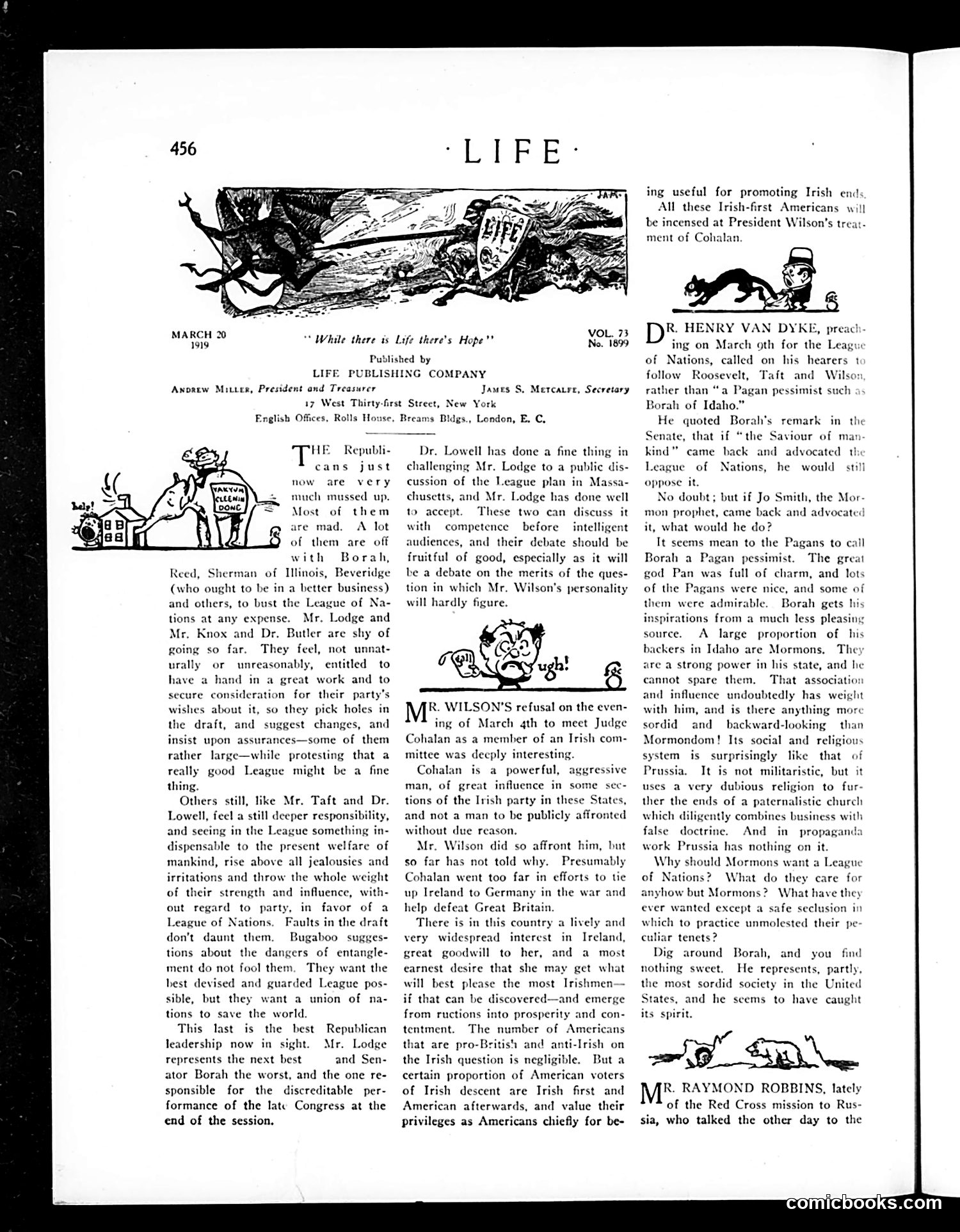
This editorial page debates the emerging League of Nations controversy. The masthead cartoon ("While there is Life there's Hope") depicts the League as a sinking ship, satirizing its troubled prospects. The text identifies three Republican positions: hardliners like Senator Borah and Reed oppose the League entirely; moderates like Lodge and Knox seek amendments; and idealists like Taft and Dr. Lowell support it unconditionally. Life endorses the last group as showing the best leadership. A second section criticizes President Wilson's refusal to meet Judge Cohalan (an Irish-American political figure) on March 4th. The editorial suggests Cohalan had pro-German sympathies during WWI but notes Wilson's snub will anger Irish-American voters who prioritize Irish independence. The piece illustrates the tension between Wilson's internationalism and domestic ethnic politics in post-war America.
📄 Transcribed text from this page (OCR, searchable)
Machine-transcribed from the original scan — historical spelling and the odd misread are preserved.
MARCH 20 1919 “* Whale there is Life there's Hope Published by LIFE Awortw Mitten, President and Treasurer 17 West Thirty-first Street, English Offices, Rolls House, Rreams Bldgs., Republi- just very much mussed up. Most of them Q are mad. A lot of them are off with Borah, Reed, Sherman of Illinois, Beveridge (who ought to be in a better business) and others, to bust the League of Na- tions at any expense. Mr. Lodge and Mr, Knox and Dr, Butler are shy of going so far. They feel, not unnat- urally or unreasonably, entitled to have a hand in a great work and to secure consideration for their party’s wishes about it, so they pick holes in the draft, and suggest changes, and insist upon assurances—some of them rather large—while protesting that a really good League might be a fine thing. Others still, like Mr. Taft and Dr. Lowell, feel a still deeper responsibility, and seeing in the League something in- dispensable to the present welfare of rise above all jealousies and THE cans now are mankind, irritations and throw the whole weight of their strength and influence, with- ty, in favor of a League of Nations. Its in the draft don't daunt them. Bugaboo su; tions about the dangers of entangle- ment do not fool them. They want the best devised and guarded League pos- sible, but they want a union of na- tions to save the world. This last is the best leadership now in sight. Mr. Lodge represents the next best and Sen- ator Borah the worst, and the one re- sponsible for the discreditable per- formance of the late Congress at the end of the session, out regard to pa Republican PUBLISHING COMPANY James S. New York London, E. C, Mercatre, Secretary Dr. Lowell has done a fine thing in challenging Mr. Lodge to a public dis- cussion of the League plan in Massa- chusetts, and Mr. Lodge has done well to accept. These two can discuss it with competence before intelligent audiences, and their debate should be fruitful of good, especially as it will be a debate on the merits of the ques- tion in which Mr. Wilson's personality will hardly figure. refusal on the even- ing of March 4th to meet Judge Cohalan as a member of an Trish com- mittee was deeply interesting. Cohalan is a powerful, aggressive man, of great influence in some sec- tions of the Irish party in these States, and not a man to be publicly affronted without due reason. Mr. Wilson did so affront him, but so far has not told why. Presumably Cohalan went too far in efforts to tie up Ireland to Germany in the war and help defeat Great Britain. There is in this country a lively and very widespread interest in Ireland, great goodwill to her, and a most earnest desire that she may get what will best please the most Irishmen— if that can be discovered—and emerge from ructions into prosperity and con- tentment. The number of Americans that are pro-British and anti-Irish on the Irish question is negligible. But a certain proportion of American voters of Irish descent are Irish first and American afterwards, and value their privileges as Americans chiefly for be- ing useful for promoting Irish ends All these Irish-first Americans will be incensed at President Wilson’s tre ment of Coha ing on March oth for the League of Nations, called on his hearers 1 follow and Wilsor rather than “a Pagan pessimist s Borah of Idaho.” He quoted Borah's remark in Senate, that if “the kind" came back and advocated 1 League of Nations, he would still oppose it. No doubt; but if Jo Smith, the Mc mon prophet, came back and advocat it, what would he do? It seems mean to the Pagans to call Borah a Pagan pessimist. The great god Pan was full of charm, and lots of the Pagans were nice, and some of them were admirable. Borah gets his spirations from a much less pleasing A large proportion of his backers in Idaho are Mormons, The are a strong power in his state, and he cannot spare them, T and influence undoubtedly has wei with him, and is there anything more sordid and backward-looking — than Mormondom! Its social and religious system is surprisingly like that of Prussia. It is not militaristic, but it uses a very dubious religion to fur- ther the ends of a paternalistic church which diligently combines false doctrine. And in work Prussia has nothing on it. Why should Mormons want a League What do they care for anyhow but Mormons? What have they ever wanted except a safe seclusion in which to practice unmolested their pe- culiar tenets? Dig around Borah, you nothing sweet. He represents, partly, the most sordid society in the United States, and he ms to have caught its spirit. ip So R. RAYMOND ROBBINS, lately of the Red Cross mission to Rus- sia, who talked the other day to the Roosevelt, Taft Saviour of ma soure usiness with propagani of Nations? and find Comicbooks.com