
Life, 1919-03-20 · page 21 of 44
Life — March 20, 1919 — page 21: what you’re looking at
What you’re looking at
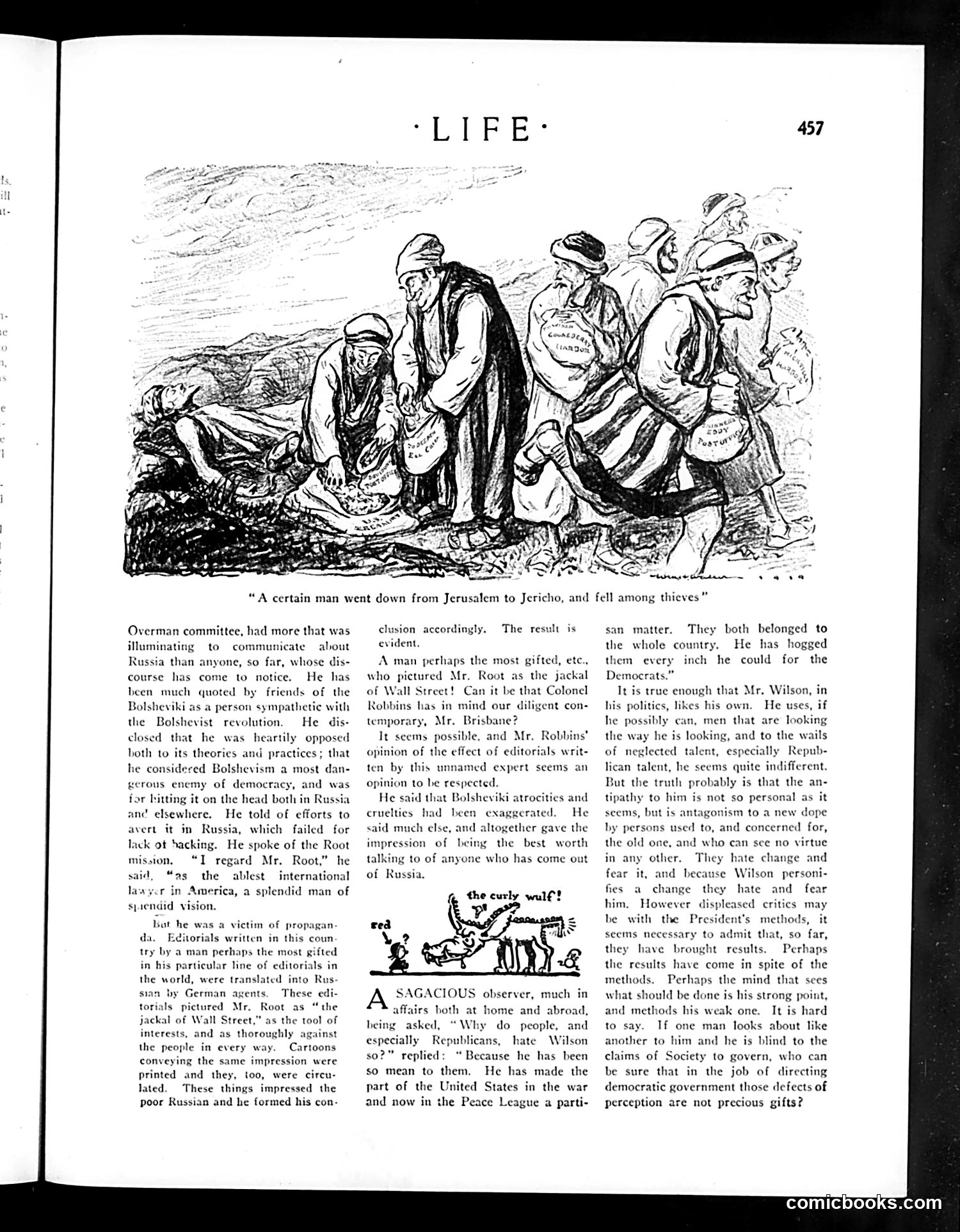
This page contains two distinct satirical pieces about American politics and propaganda. **The Main Cartoon** illustrates the biblical parable of the Good Samaritan ("A certain man went down from Jerusalem to Jericho, and fell among thieves"). The accompanying text discusses how propaganda—specifically editorials and cartoons by German agents translated into Russian—misrepresented Elihu Root (a prominent diplomat and lawyer) as a tool of Wall Street interests. The satire targets an "unnamed expert" (likely Arthur Brisbane, a famous editor) whose writings, though well-intentioned, were weaponized against American interests when translated and distributed in Russia during the Bolshevik period. **The Secondary Piece** critiques President Wilson's political favoritism, particularly his preference for Democratic appointees during wartime and peace negotiations. Republicans resent this, but the author argues their real opposition stems from resisting Wilson's modernizing changes rather than personal animosity. The piece defends Wilson's methods as effective, despite their controversial nature. Both pieces explore how communication—written and visual—shapes public perception, especially during politically volatile periods.
📄 Transcribed text from this page (OCR, searchable)
Machine-transcribed from the original scan — historical spelling and the odd misread are preserved.
457 “A certain man went down from Jerusalem to Jericho, and fell among thieves” Overman committee, had more that was illuminating to communicate about Russia than anyone, so far, whose dis- course has come to notice. He has been much quoted by friends of the Bolsheviki as a person sympathetic with the Bolshevist revolution. He dis- closed that he was heartily opposed both to its theories and practices; that he considered Bolshevism a most dan- gerous enemy of democracy, and was for hitting it on the head both in Russia ane elsewhere. He told of efforts to avert it in Russia, which failed for lack ot hacking. He spoke of the Root mission, “I regard Mr. Root,” he . “as the ablest international lawycr in America, a splendid man of spiendid vision. Lut he was a victim of propa da, Editorials written in this coun try by a man perhaps the most gifted in his particular line of editorials in the world, were translated into Rus- sian by German agents. These edi- torials pictured Mr. Root as “the ji of Wall Street,” as the tool of interests, and as thoroughly against the people in every way. Cartoons conveying the same impression were printed and they, too, were circu- lated. These things impressed the poor Russian and he formed his con- clusion accordingly. The result is evident. A man perhaps the most gifted, ete., who pictured Mr. Root as the jackal of Wall Street! Can it be that Colonel Robbins has in mind our diligent con- temporary, Mr. Brisbane? It seems possible, and Mr. Robbins’ opinion of the effect of editorials writ- ten by this unnamed expert seems an opinion to be respected. He said that Bolsheviki atrocities and cruelties had been exaggerated. He said much else, and altogether gave the ng the best worth impression of talking to of anyone who has come out of Russia, G& the curly wulf! Yo A SAGACIOUS observer, much in tirs hoth at home and abroad, being asked, “Why do people, and especially Republicans, hate Wilson so?” replied: “Because he has been so mean to them. He has made the part of the United States in the war and now in the Peace League a parti- san matter. They both belonged to the whole country, He has hogged them every inch he could for the Democrats.” It is true enough that Mr. Wilson, in his politics, likes his own. He uses, if he possibly can, men that are looking the way he is looking, and to the wails ecially Repub- of neglected talent, es lican talent, he seems quite indifferent. But the truth probably is that the an- tipathy to him is not so personal as it seems, but is antagonism to a new dope by persons used to, and concerned for, the old one, and who can see no virtue in any other. They hate change and fear it, and because Wilson personi- fies change they hate and fear him. However displeased critics may be with the President's methods, it seems necessary to admit that, so far, they have brought results. Perhaps the results have come in spite of the methods. Perhaps the mind that sees what should be done is his strong point, and methods his weak one. It is hard to say. If one man looks about like another to him and he is blind to the claims of Society to govern, who can be sure that in the job of directing democratic government those defects of perception are not precious gifts? comicbooks.com