
Life, 1919-03-20 · page 24 of 44
Life — March 20, 1919 — page 24: what you’re looking at
What you’re looking at
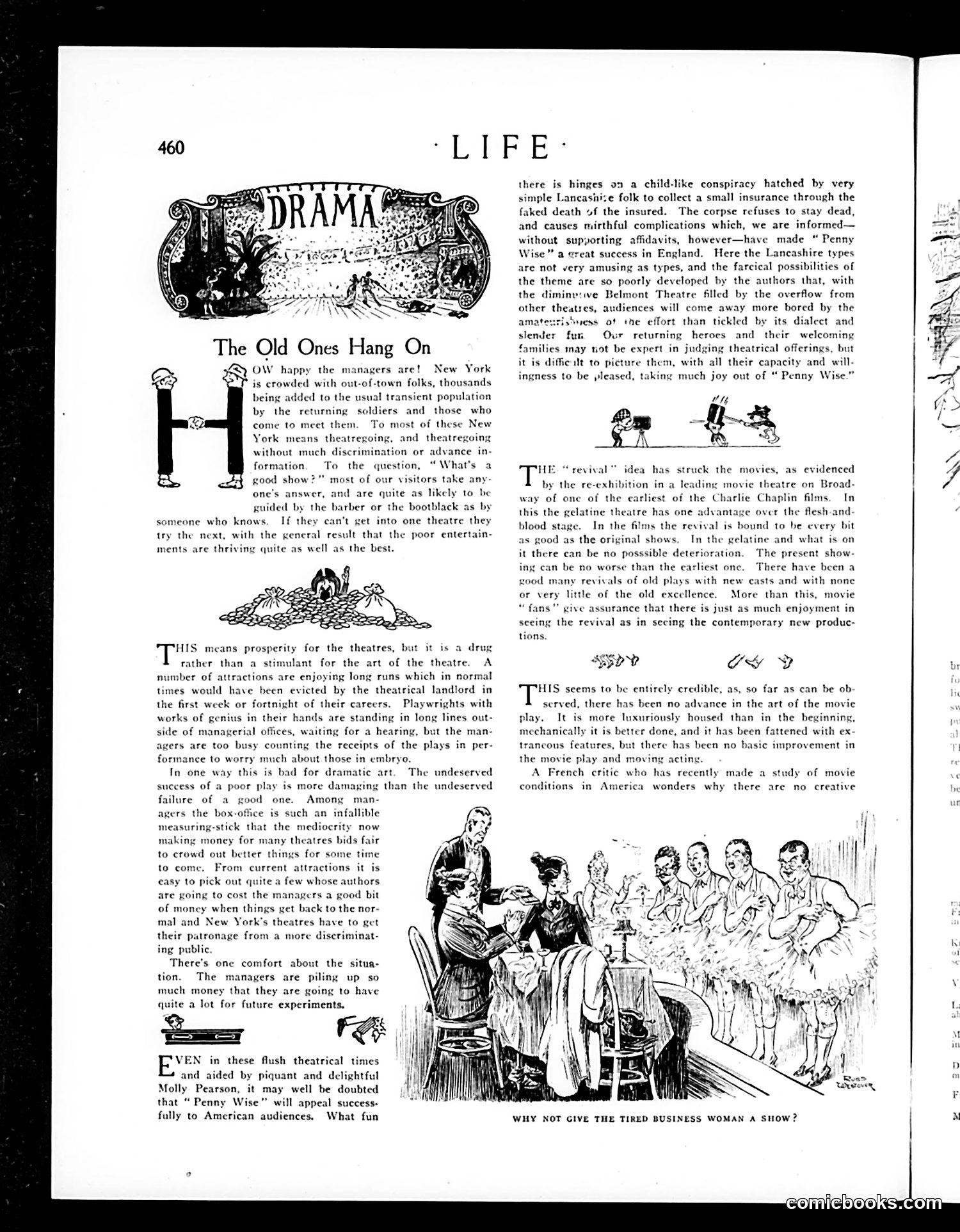
This theater critique addresses post-WWI Broadway conditions. The satire's central point: **returning soldiers and out-of-town tourists, unfamiliar with theater quality, will attend anything**, making poor plays profitable while good ones languish. The article criticizes theater managers for prioritizing box-office receipts over artistic merit. Because audiences lack discrimination—taking recommendations from "barbers or bootblacks" rather than informed critics—mediocre productions thrive while playwrights with genuine talent wait outside managerial offices unheard. The specific example critiques "Penny Wise," a Lancashire-dialect farce about insurance fraud that apparently succeeded in England but the critic finds poorly executed and unfunny. The accompanying illustration shows a tired businesswoman surrounded by chattering theatergoers—visual commentary on the exhausting, artistically-empty entertainment consuming Broadway during this boom period. The title asks why such worn audiences deserve quality theater when they'll accept mediocrity anyway.
📄 Transcribed text from this page (OCR, searchable)
Machine-transcribed from the original scan — historical spelling and the odd misread are preserved.
The Old Ones Hang On KY OW happy the managers are! New York % is crowded with out-of-town folks, thousands being added to the usual transient population by the returning soldiers and those who come to meet them. To most of these New York means theatregoing, and theatregoing without much discrimination or advance in- formation. To the question, “What's a good show?” most of our visitors take any- one’s answer, and are quite as likely to be guided by the barber or the bootblack as by someone who knows. If they can’t get into one theatre they try the next, with the general result that the poor entertain- ments are thriving quite as well as the best. HIS means prosperity for the theatres, but it is a drug rather than a lant for the art of the theatre. A number of attractions are enjoying long runs which in normal times would have been evicted by the theatrical landlord in the first week or fortnight of their careers. Playwrights with works of genius in their hands are standing in long lines out- side of managerial offices, waiting for a hearing, but the man- agers are too busy counting the receipts of the plays in per- formance to worry much about those in embryo. In one way this is bad for dramatic art. The undeserved success of a poor play is more damaging than the undeserved failure of a good one. Among man- s such an infallible measuring-stick that the mediocrity now making money for many theatres bids fair to crowd out better things for some time to come, From current attractions it is easy to pick out quite a few whose authors are going to cost the m when things get back to the nor- nd New York's theatres have to get their patronage from a more discriminat- ing public There's one comfort about the situa- tion. The managers are piling up so much money that they are going to have quite a lot for future experiments. ===! VEN in these flush theatrical times and aided by piquant and delightful Molly Pearson, it may well be doubted that “ Penny Wise” will appeal success: fully to American audiences. What fun agers the box-o ers a good bit of mone; mal *LIPFE® there is hinges on a child-like conspiracy hatched by very simple Lancashize folk to collect a small insurance through the faked death sf the insured. The corpse refuses to stay dead, and causes mirthful complications which, we are informed— hout supporting affidavits, however—have made “ Penny Wise” a creat success in England. Here the Lancashire types are not very amusing as types, and the farcical possibilities of the theme are so poorly developed by the authors that, with the diminvtwe Belmont Theatre filled by the overflow from other theatres, audiences will come away more bored by the amateurishuess of the effort than tickled by its dialect and slender fur Our returning heroes and their welcoming families may tot be expert in judging theatrical offerings, b it is difficilt to picture them, with all their capacity and will- ingness to be pleased, taking much joy out of “ Penny Wise.” idea has struck the movies, as evidenced HE. “ reviv by the re-exhibition in a leading movie theatre on Broad- way of one of the earliest of the Charlie Chaplin films. In this the gelatine theatre has one advantage over the flesh-and In the fil the origina it there can be no posssible deterioration. ing can be no worse than the earliest one. There have bei any revivals of old plays with new casts and with none or very little of the old excellence. More than this, movie “ fans" give assurance that there is just as much enjoym: in seeing the revival as in secing the contemporary new produc- tions. ns the revival is bound to be eve blood stag y bit as good a shows, In the gelatine and what is on The present show- na good ay SPY oy > HIS seems to be entirely credible, as, so far as can be ob: served, there has been no advance in the art of the movie play. It is more luxuriously housed than in the beginning, mechanically it is better done, and it has been fattened with ex- trancous features, but there has been no basic improvement in the movie play and moving acting A French critic who has recently made a study of movie conditions in America wonders why there are no creative i “> WHY NOT GIVE THE TIRED BUSINESS WOMAN A SHOW? TASER