
Life, 1919-03-20 · page 29 of 44
Life — March 20, 1919 — page 29: what you’re looking at
What you’re looking at
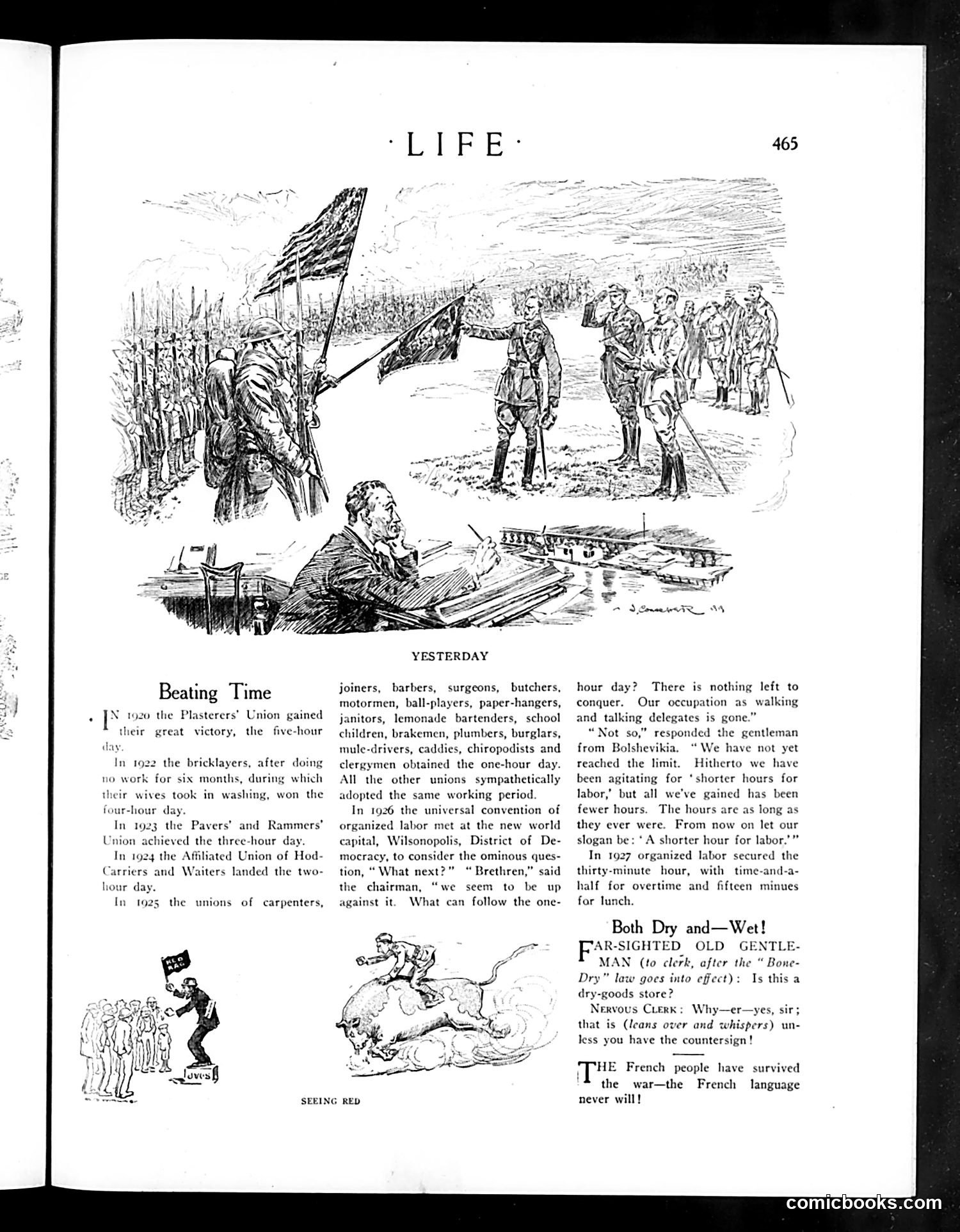
This page satirizes the labor movement's escalating demands for shorter working hours. The main article, "Beating Time," mocks union strategy through absurdist extrapolation: after unions won progressively shorter days (five hours in 1920, down to one hour by 1926), the satire imagines a 1927 convention where labor leaders realize they've achieved the goal but workers' actual time hasn't changed—so they pivot to demanding "shorter hours" conceptually rather than materially. The cartoons below add commentary: "Seeing Red" appears to reference communist/radical sympathies within labor movements. The "Dry and—Wet!" dialogue jokes about Prohibition's enforcement through coded language ("countersign"), suggesting speakeasy-style secrecy around alcohol sales even in legitimate dry-goods stores. The satire's core: Life mocks organized labor as pursuing symbolic victories disconnected from workers' real interests, and implies radical infiltration of union leadership.
📄 Transcribed text from this page (OCR, searchable)
Machine-transcribed from the original scan — historical spelling and the odd misread are preserved.
Beating Time 1920 the Plasterers’ Union gained great victory, the day their five-hour In 1922 the bricklayers, after doing no work for six months, during which their wives took in washing, won the four-hour day. In 1923 the Pavers’ and Rammers’ Union achiev hour day. In 1924 the 4 ied Union of Hod- YESTERDAY joiners, barbers, surgeons, butchers, motormen, ball-players, paper-hangers, janitors, lemonade bartenders, school children, brakemen, plumbers, burglars, mule-drivers, caddies, chiropodists and clergymen obtained the one-hour day. All the other unions sympathetically adopted the same working period. In 1926 the universal convention of organized labor met at the new world capital, Wilsonopolis, District of De- mocracy, to consider the ominous ques- tion, “ What next?” “ Brethren,” said the chairman, seem to be up What can follow the one- “we against it. Bees & aL, SEEING RED hour day? There is nothing left to conquer. Our occupation as walking and talking delegates is gone.” “Not so,” responded the gentleman from Bolshev “We have not yet reached the limit. Hitherto we have been agitating for ‘shorter hours for labor,’ but all we've gained has been fewer hours. The hours are as long as they ever were. From now on let our slogan be: * A shorter hour for labor.’” In 1927 organized labor secured the thirty-minute hour, with time-and-a- half for overtime and fifteen minues for lunch. Both Dry and—Wet! AR-SIGHTED OLD GE MAN (to clerk, after the Dry” law goes into effect): dry-goods store? Nervous Cierk: Why—er—yes, sir; that is (leans over and whispers) un- less you have the countersign! TLE- “ Bone- Is this a ‘THE French people have survived ‘4 the war—the French language never will! comicbooks.com