
Life, 1919-03-20 · page 18 of 44
Life — March 20, 1919 — page 18: what you’re looking at
What you’re looking at
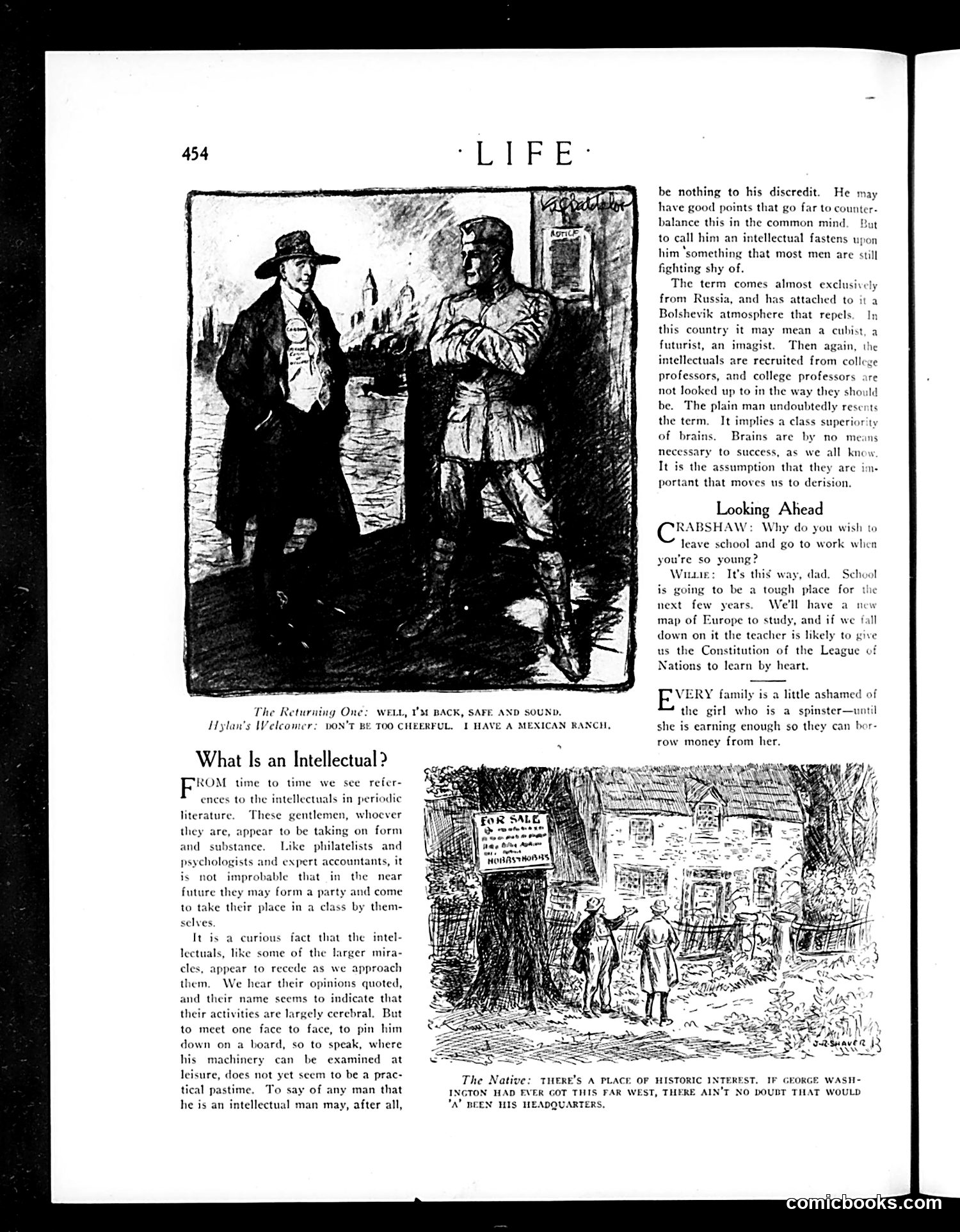
This page contains three satirical cartoons addressing early 1920s American anxieties: **"What Is an Intellectual?"** critiques the term's vague usage and class connotations. The text argues "intellectuals" are largely a Russian/Bolshevik concept that ordinary Americans resent because it implies intellectual superiority—threatening to a culture skeptical of abstract thinking. **"Looking Ahead"** satirizes post-WWI education, where a schoolboy wants to leave because curricula now include European geography and League of Nations study—unfamiliar, burdensome subjects reflecting America's reluctant entry into international affairs. **Top cartoon** ("The Returning One") depicts Mayor Hylan welcoming home a soldier, then dampening enthusiasm by mentioning his Mexican ranch—satirizing how quickly post-war America moved on from soldiers' homecomings. **Bottom cartoon** ("The Native") jokes about Western expansion and George Washington, suggesting even Washington wouldn't have ventured this far—mocking frontier mythology. The overall theme: American skepticism toward intellectualism, international engagement, and rapid social change.
📄 Transcribed text from this page (OCR, searchable)
Machine-transcribed from the original scan — historical spelling and the odd misread are preserved.
be nothing to his discredit. He may have good points that go far to counter. balance this in the common mind. But to call him an intellectual fastens upon him ‘something that most men are still fighting shy of. The term comes almost exclusi from Russia, and has attached to Bolshevik atmosphere that repels. this country it may mean a cubis futurist, an imagist. Then again, the intellectuals are recruited from college professors, and college professors are not looked up to in the way they should be. The plain man undoubtedly resents the term. It implies a class superiority of brains. Brains are by no means necessary to success, as we all know It is the assumption that they are im- portant that moves us to derision. Looking Ahead RABSHAW: Why do you wish to leave school and go to work whicn you're so young? Wut: It's this w dad. School is going to be a tough place for ¢ next few years. We'll ha map of Europe to study, and if we fall down on it the teacher is likely to give us the Constitution of the League of Nations to learn by heart. VERY family is a little ashamed of The Returning One: WELL, 31 BACK, SAFE AND SOUND. the girl who is a spinster—until Hylan’s Welcomer: von't BE TOO CHEERFUL, I HAVE A MEXICAN RANCH, she is earning enough so they can bor- Wh l | i] | row money from her. at Is an Intellectual > Fro time to time we see refer- ences to the intellectuals in periodic literature. These gentlemen, whoever : FoR SALE. they are, appear to be taking on form q anpeppe and substance. Like philatelists and i psychologists and expert accountants, it is not improbable that in the near future they may form a party and come to take their place in a class by them- selves. It is a curious fact that the intel- lectuals, like some of the larger mira cles, appear to recede as we approach them. We hear their opinions quoted, id their name scems to indicate that their activities are largely cerebral, But to meet one face to face, to pin him down on a board, so to speak, where his machinery can be examined at letsure; doesnot yet:seemi:to beia prac: The Native: THERE'S A PLACE OF HISTORIC INTEREST, IF GEORGE WASH- tical pastime. To say of any man that INGTON HAD EVER GOT THIS FAR WEST, THERE AIN'T NO DOUBT THAT WOULD he is an intellectual man may, after all, "A’ BEEN HIS HEADQUARTERS. icbooks.com