
A complete issue · 42 pages · 1919
Life — March 13, 1919
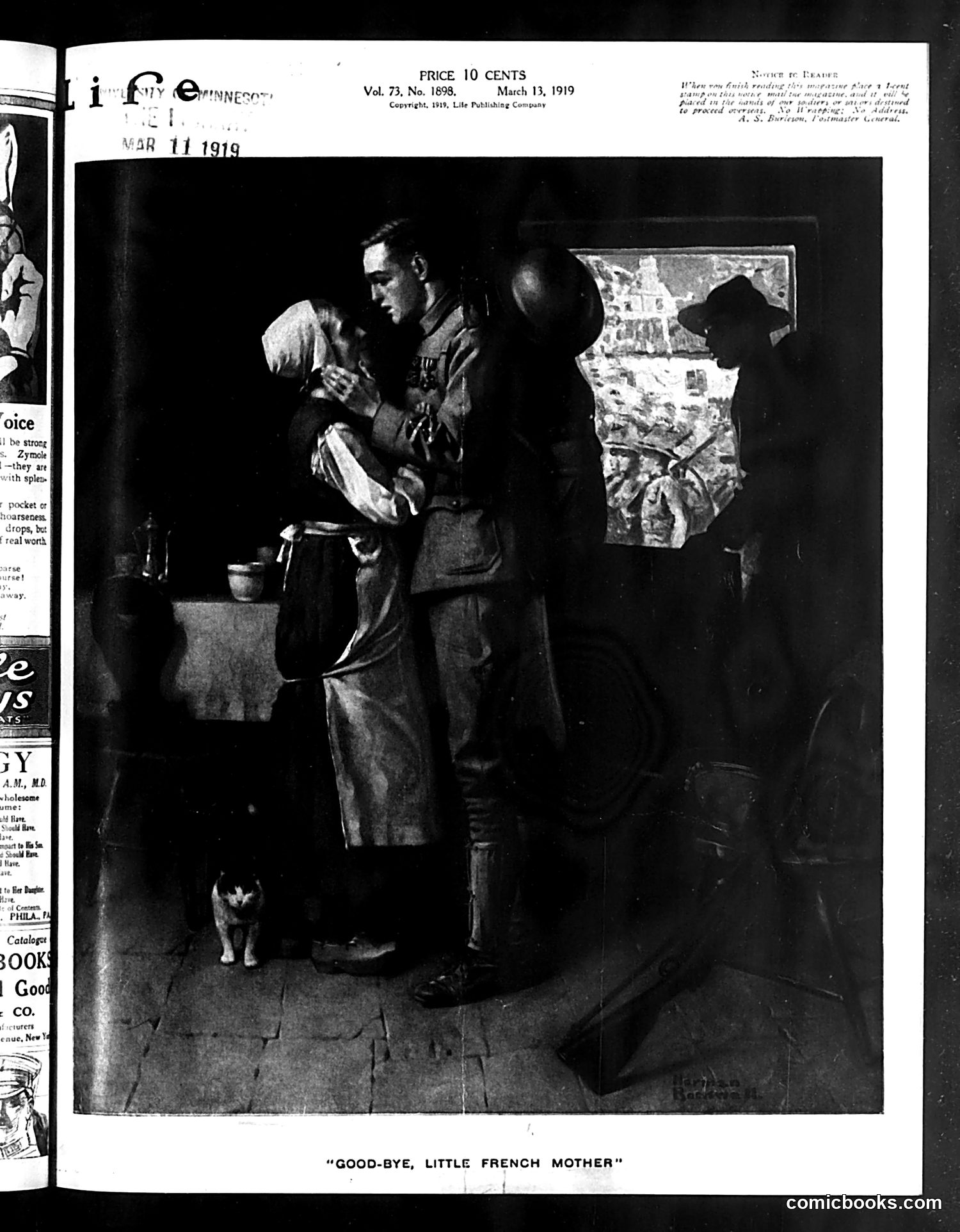
This *Life* magazine page from March 13, 1919, appears to depict a World War I farewell scene. The photograph shows a soldier in military uniform saying goodbye to an older woman (the "Little French Mother" of the caption), likely representing a French civilian or the personified French nation. A small dog is present, and there's a framed image of a damaged building on the wall behind them, presumably referencing war destruction in France. Published shortly after the November 1918 armistice, this sentimental image likely comments on American soldiers departing Europe after the war's end, or reflects on the gratitude and emotional bonds between American forces and French civilians. The caption's tone suggests nostalgia or poignancy about saying farewell to allies and the European theater.
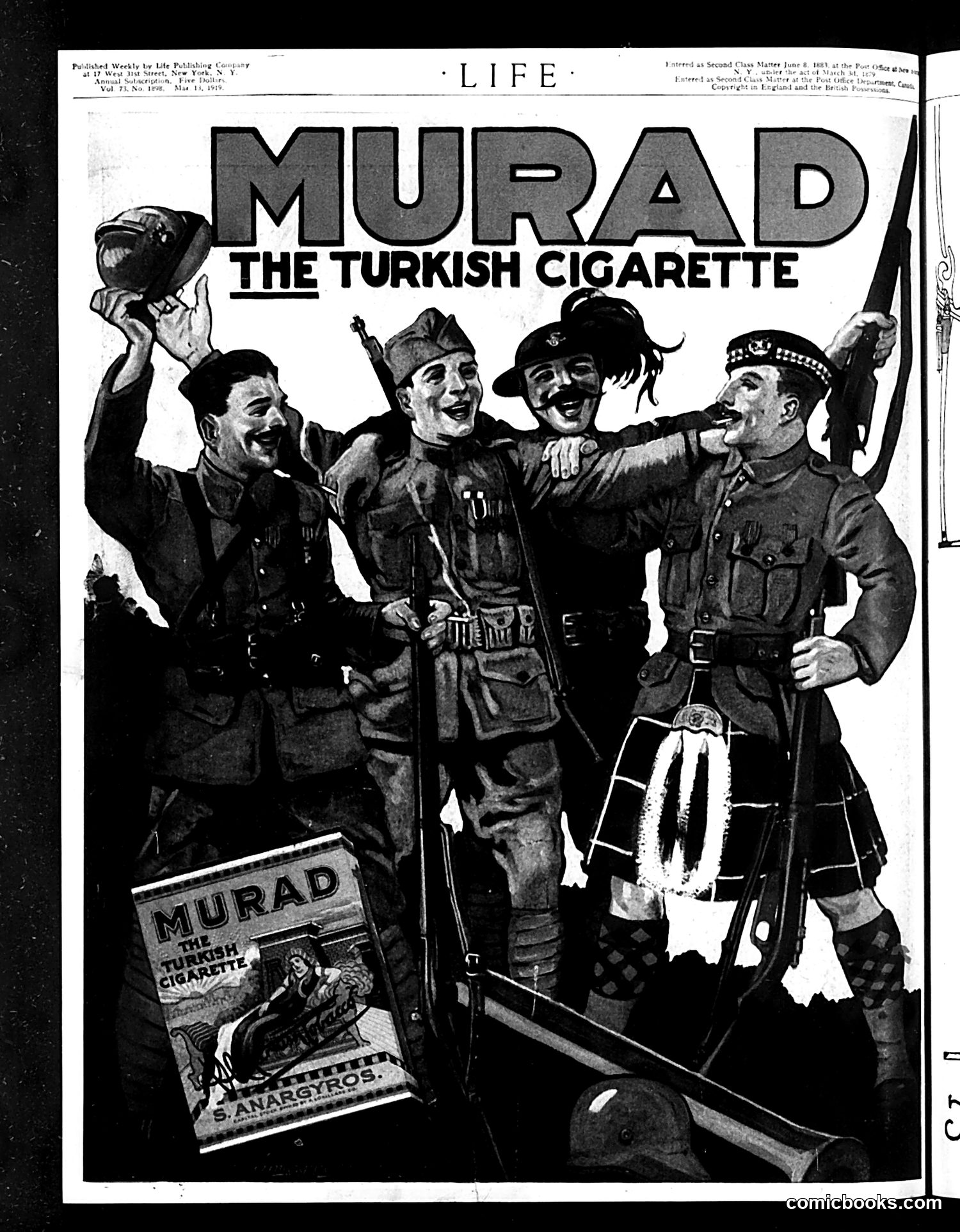
This is a Murad Turkish Cigarette advertisement disguised as a political cartoon. The image shows four soldiers in WWI-era military uniforms (appearing to represent Allied forces—notice the Scottish kilts on the right figure) celebrating victory, holding weapons aloft and a Murad cigarette package. The satire is straightforward: the ad conflates cigarette smoking with military triumph and masculine camaraderie. By associating Murad cigarettes with victorious soldiers, the advertisement suggests smoking the brand represents patriotic strength and success. The "joke" is that soldiers would naturally choose Murad cigarettes—the implication being that quality Turkish tobacco appeals to brave, successful men. This was typical early-20th-century advertising that linked consumer products to nationalism and military prowess.
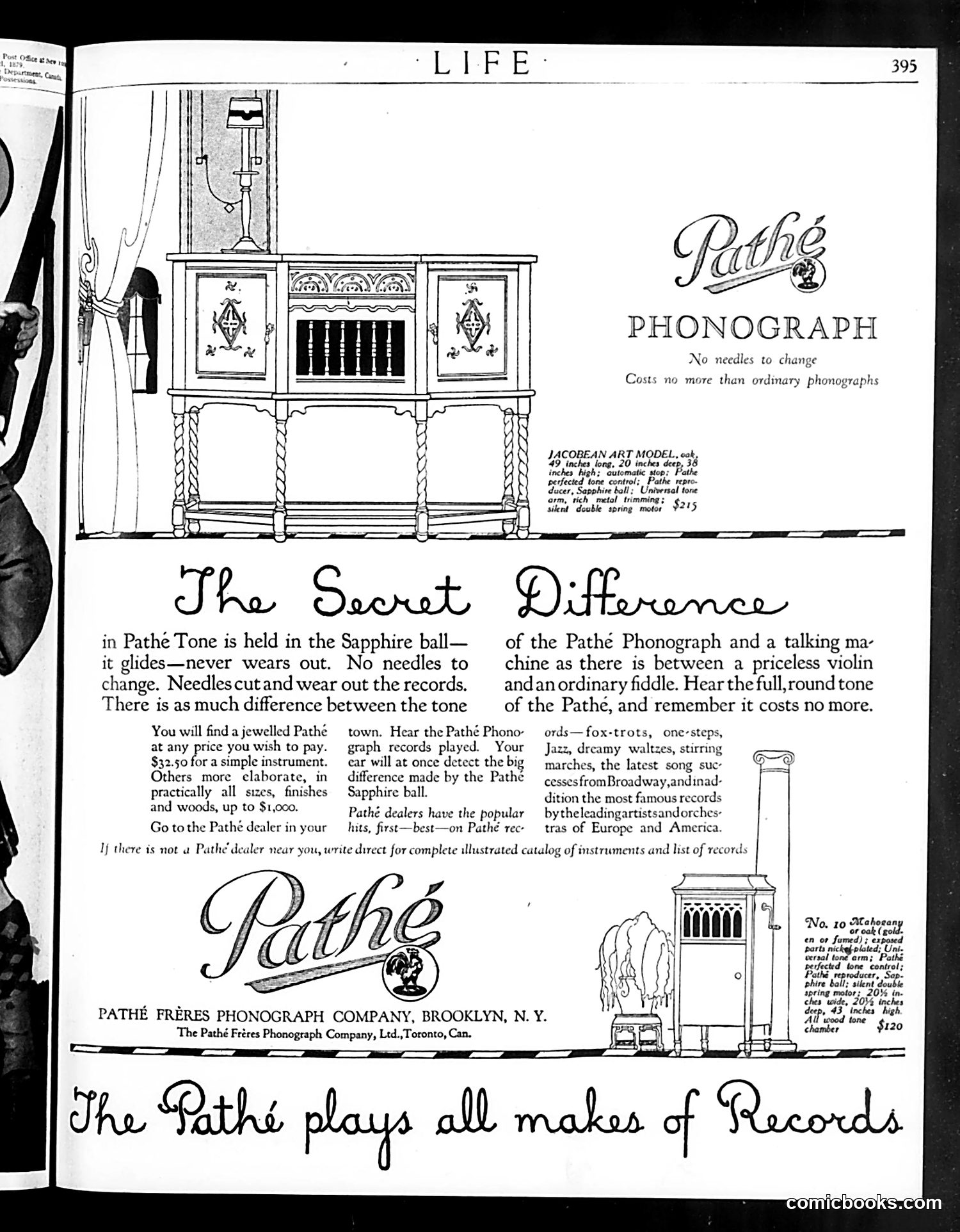
This is **not a political cartoon or satirical content**—it's a **Pathé phonograph advertisement** from Life magazine (page 395). The page promotes Pathé brand phonographs, highlighting their "Sapphire ball" needle technology as superior to competitors. The ad claims Pathé needles don't wear out records like ordinary needles do, and emphasizes the superior sound quality—describing a "jeweled" tone that distinguishes Pathé from "a priceless violin and an ordinary fiddle." Two phonograph models are illustrated with specifications and prices ($215 and $120). The bottom tagline states "The Pathé plays all makes of Records." This is straightforward product marketing, not satire. Pathé Frères was a legitimate French phonograph manufacturer competing in the early 20th-century audio equipment market.
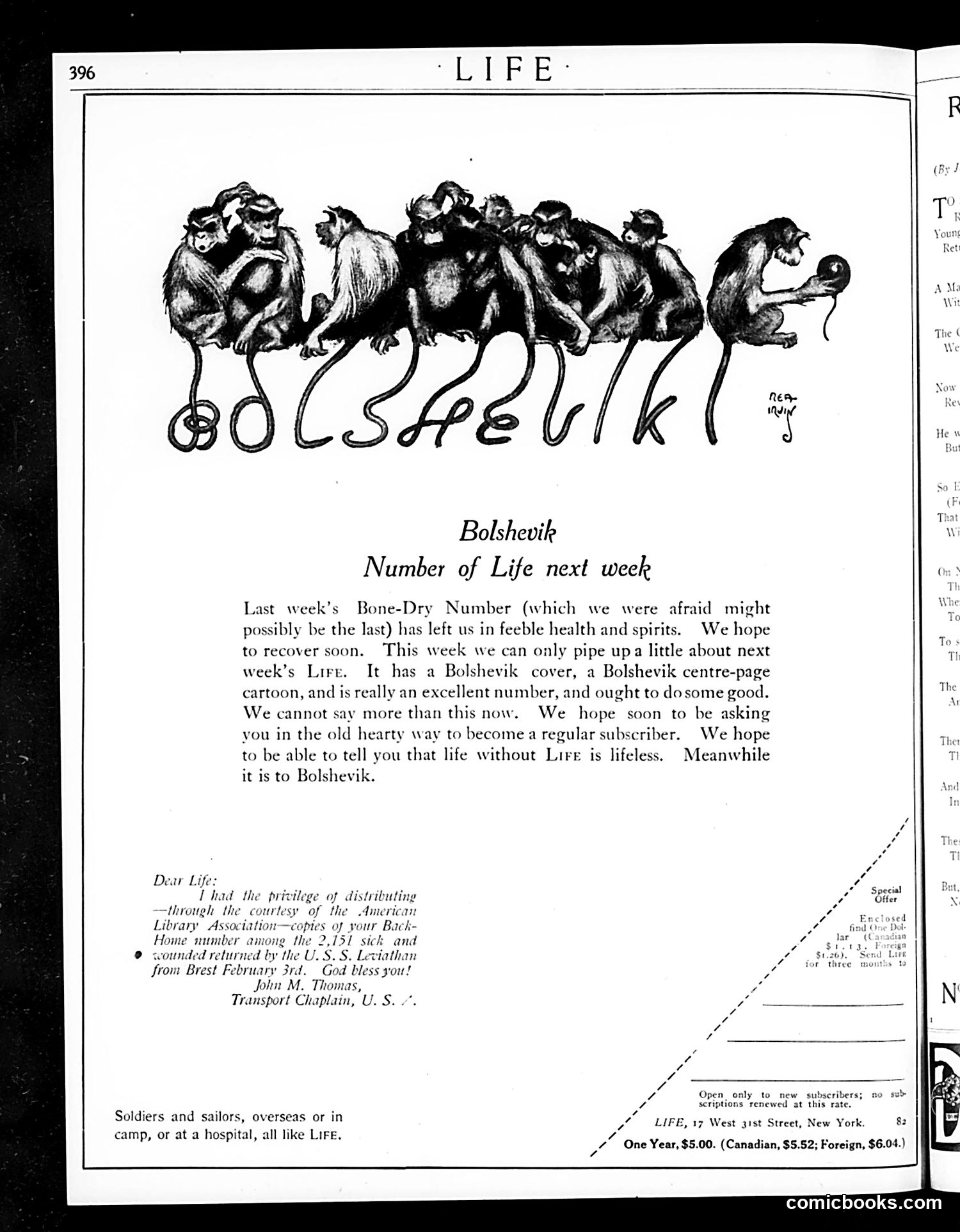
This page features a political cartoon titled "Bolshevik" showing rats arranged in a line, their tails forming the word "BOLSHEVIK." The text references last week's "Bone-Dry Number" (likely referring to Prohibition content) and announces next week's issue will have a Bolshevik cover and center-page cartoon. The satire equates Bolsheviks (Russian communists) with rats—a common dehumanizing cartoon trope of the era. This reflects post-1917 anti-communist sentiment in America, when Bolshevism was widely portrayed as a plague or infestation threatening society. The accompanying letter from a U.S. Army chaplain discusses distributing *Life* magazines to soldiers, normalizing the publication's satirical messaging to military audiences during this politically charged period.
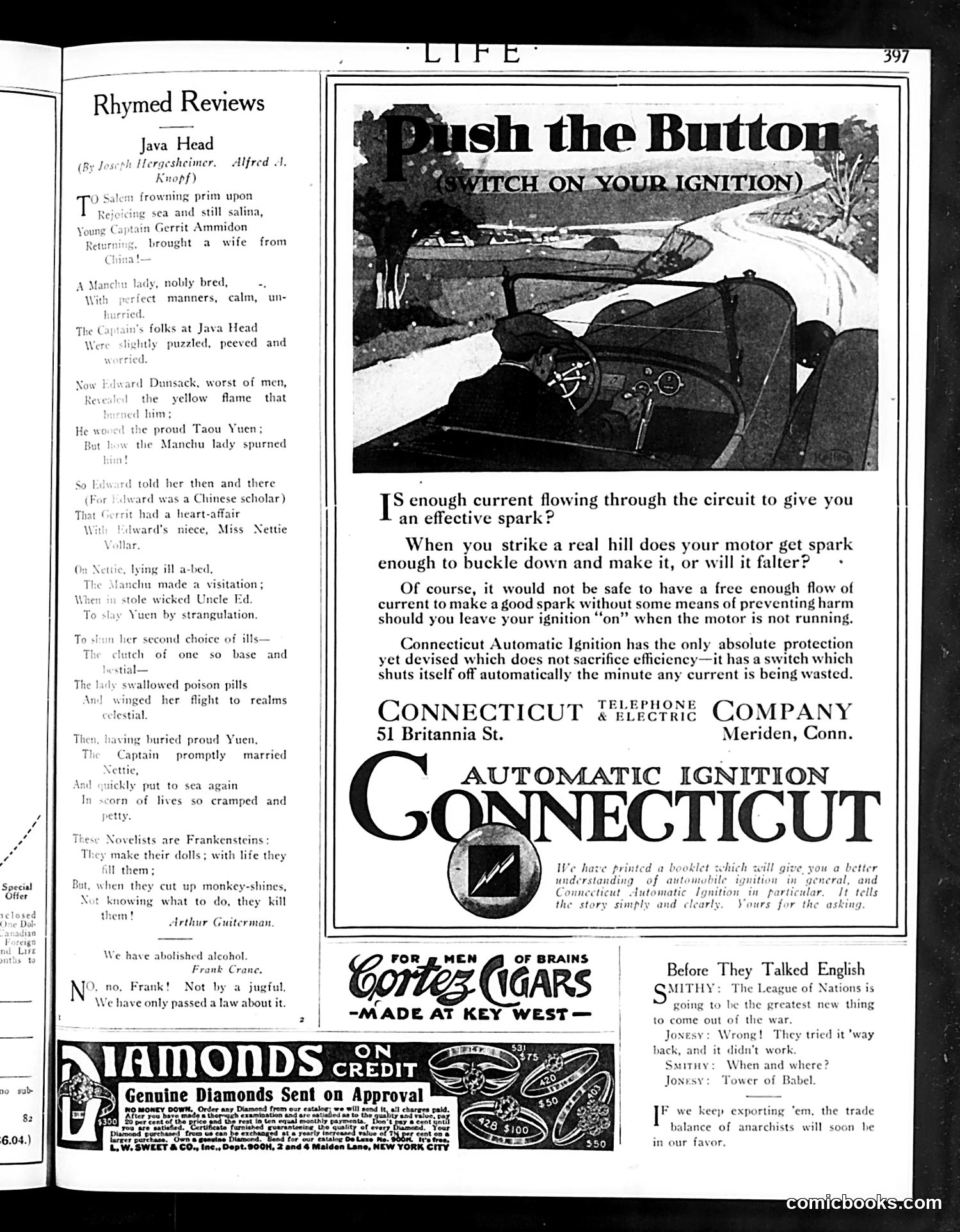
This page is primarily **advertising and light humor**, not political satire. **Main Content:** - "Java Head" is a rhymed book review (likely of a novel by Joseph Hergesheimer) - A humorous "Before They Talked English" dialogue section mocks the League of Nations, suggesting its efforts at peace are ineffective **Advertisements:** The page is dominated by commercial ads: - **Connecticut Automatic Ignition** (car ignition system) — the largest ad, featuring a car interior - **Cortez Cigars** ("For Men of Brains") - **Diamonds on Credit** (E.W. Sweet & Co.) The League of Nations joke is the only satirical element, suggesting contemporary skepticism about international diplomacy's ability to prevent conflict. The rest reflects 1920s consumer culture and product marketing typical of Life magazine's revenue model.
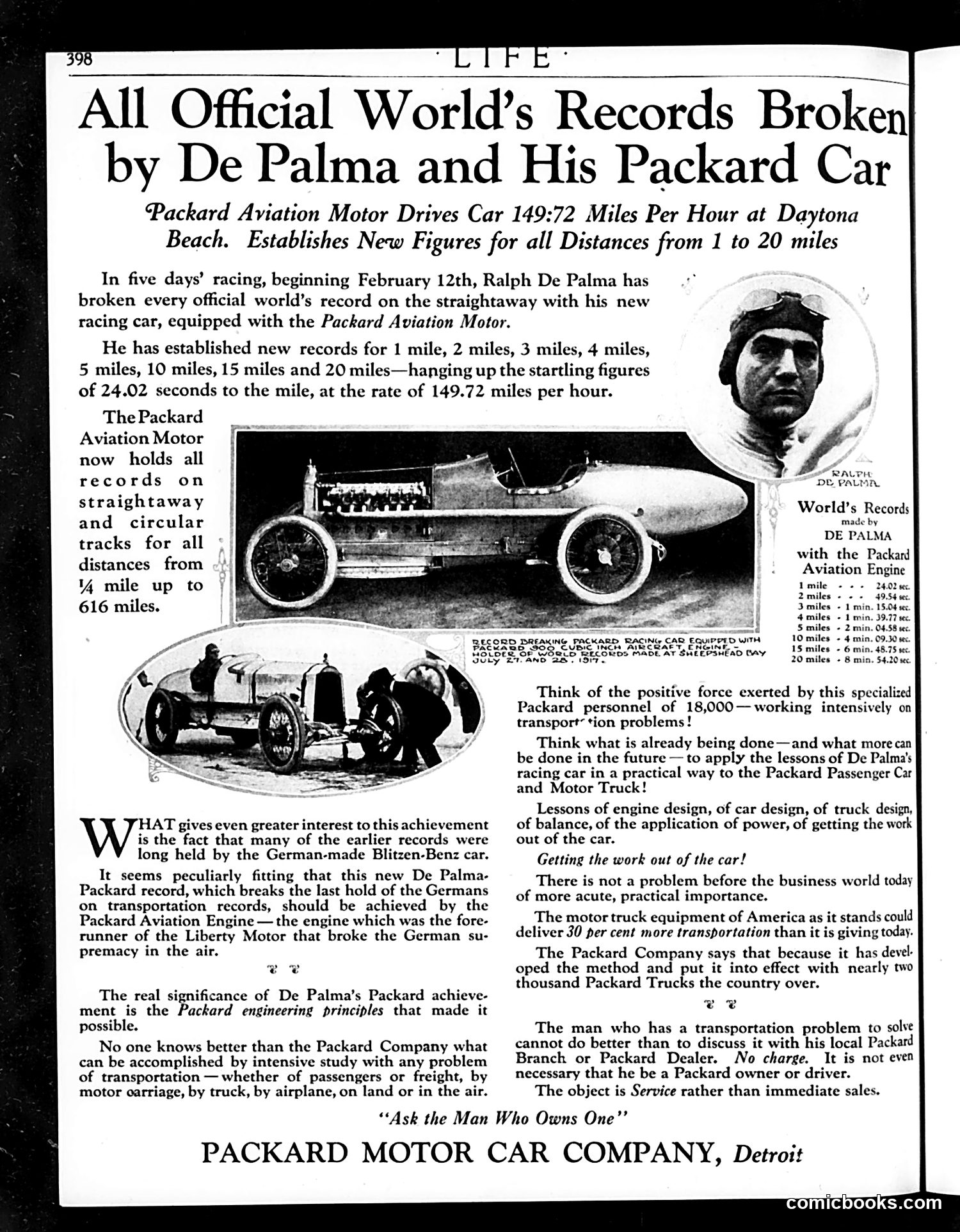
This is primarily **advertising content**, not satire or political commentary. The page celebrates Ralph De Palma's land-speed records set at Daytona Beach using a Packard Aviation Motor car, achieving 149.72 mph across multiple distances (1-20 miles). The "cartoon" elements are modest: a portrait medallion of De Palma and a photograph showing mechanics working on the racing vehicle. These serve as visual documentation rather than satirical commentary. The text emphasizes Packard engineering excellence and pivots to promoting Packard trucks for commercial transportation, arguing they could improve American business efficiency. The closing tagline "Ask the Man Who Owns One" was Packard's actual advertising slogan. This represents **early automotive marketing**: leveraging racing achievements to build brand prestige and credibility for commercial vehicles.
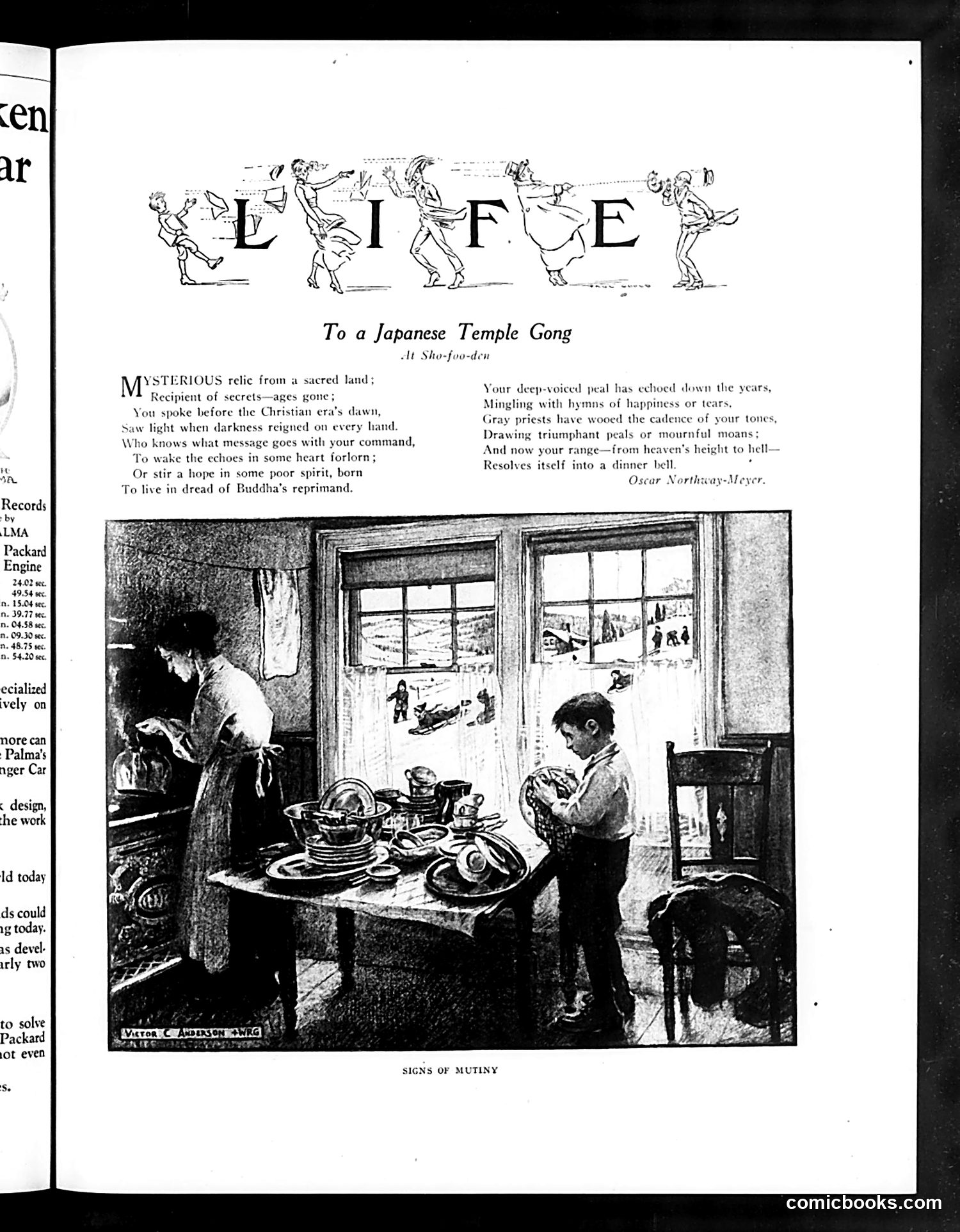
This page features a poem by Oscar Northway-Meyer addressed to a Japanese temple gong, treating it as a mysterious sacred object that has witnessed ages of Buddhist ritual and spiritual practice. The accompanying illustration titled "Signs of Mutiny" shows a domestic scene with two people in what appears to be modest circumstances, with Asian decorative items visible on a table and snowy landscape visible through windows. The juxtaposition suggests satire about Western fascination with Japanese exotica and spiritual traditions during the early 20th century. The contrast between the romanticized poem about sacred Eastern mysticism and the mundane domestic "mutiny" scene likely mocks the incongruity between idealized notions of Japan and actual lived experience—whether of Japanese people or Western consumers of "Oriental" goods and aesthetics.
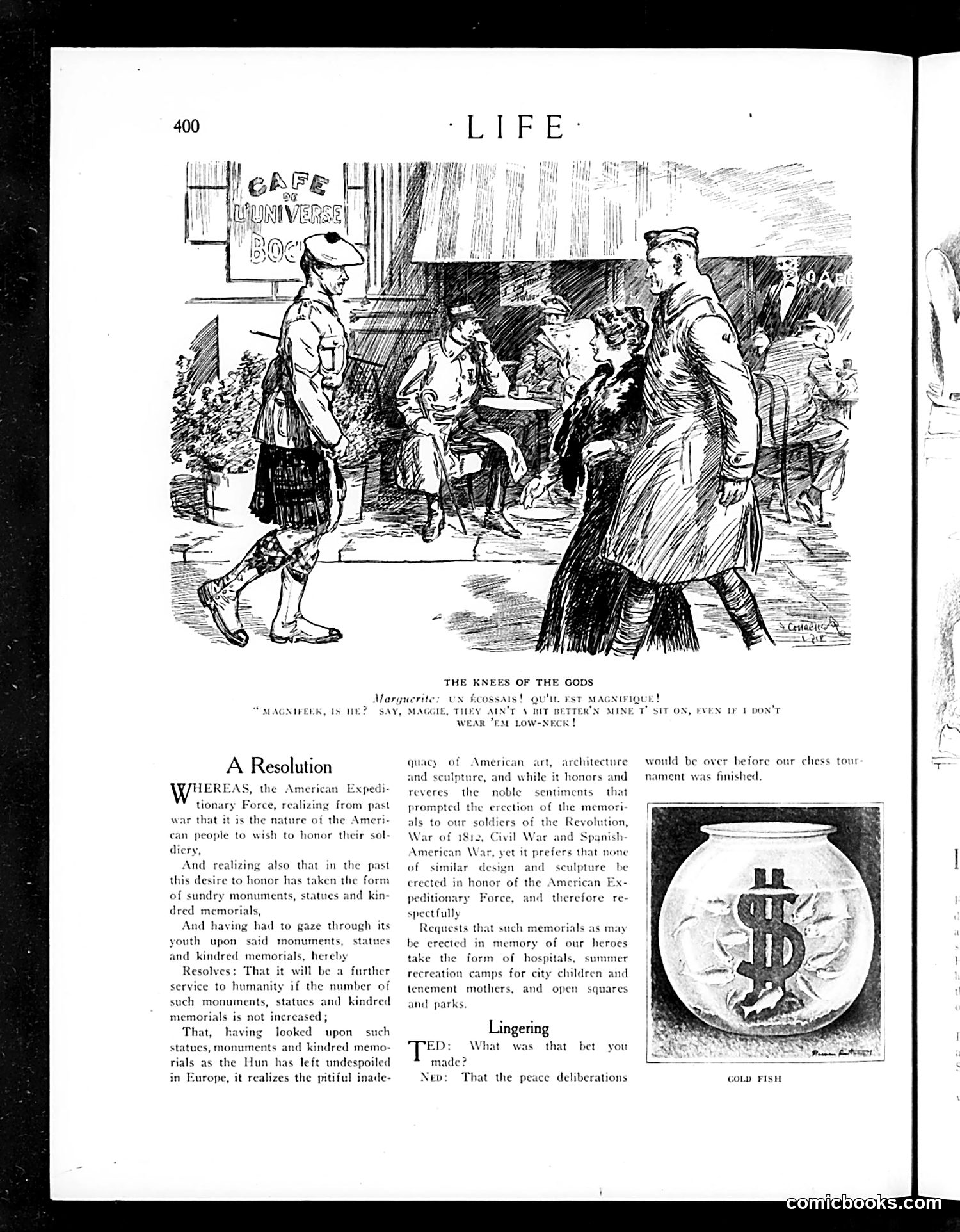
This cartoon depicts a street scene outside a "Cafe Universe" establishment. A woman in a short skirt is the central figure, with sailors and other figures surrounding her. The caption reads: "Marguerite: Is he? Say, Maggie! If he's as magnificent as they ain't a bit better'n mine if sit on, even if I don't wear 'em low-sicked!" The satire targets women's fashion—specifically the contemporary trend of wearing shorter skirts that exposed the knees, considered quite scandalous at the time. The "gods" reference humorously suggests that women's knees have become objects of attention and debate. The crude dialogue implies lower-class commentary on this fashion shift, mocking both the fashion itself and the public's obsessive focus on women's legs during this modernizing era.
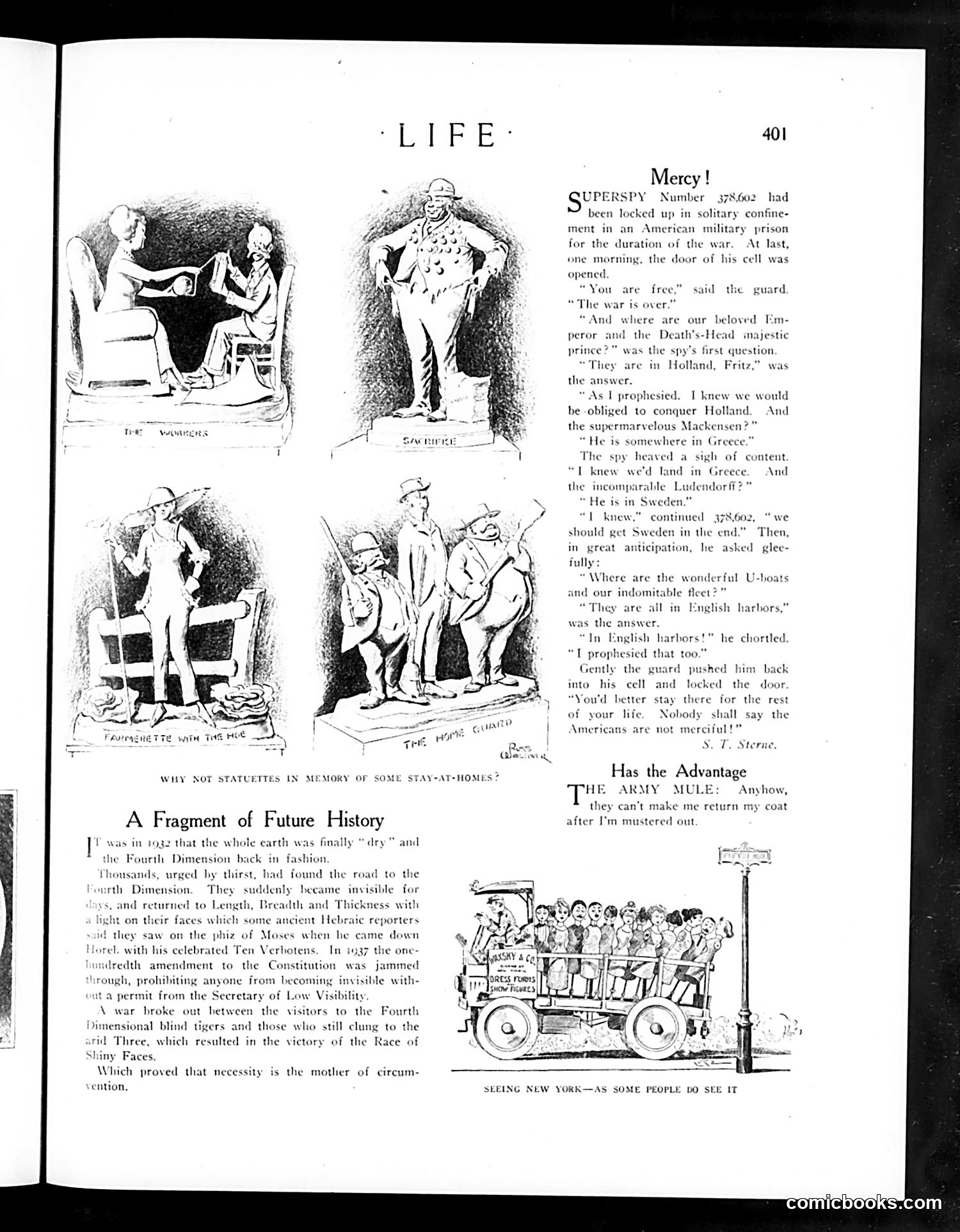
The page contains two distinct pieces of satire: **"Mercy!"** depicts a spy (labeled Superspy Number 378602) being released from an American military prison. The humor centers on the spy's gleeful questions about enemy leaders—the Emperor, Death's Head prince, Mackensen, Ludendorff, and U-boats. The guard's frustrated responses reveal these figures are scattered across Europe or already defeated, with the punchline that "Americans are not merciful" for releasing him to discover his side has lost. **"A Fragment of Future History"** imagines 1942 as a turning point where Earth became "dry" and the Fourth Dimension became habitable. It's absurdist speculative fiction about dimensional travel and invisible visitors. **"Has the Advantage"** shows an army mule that can't be court-martialed after discharge—a joke about military discipline and animal exemptions. These appear designed for American wartime audiences familiar with WWI enemy figures.
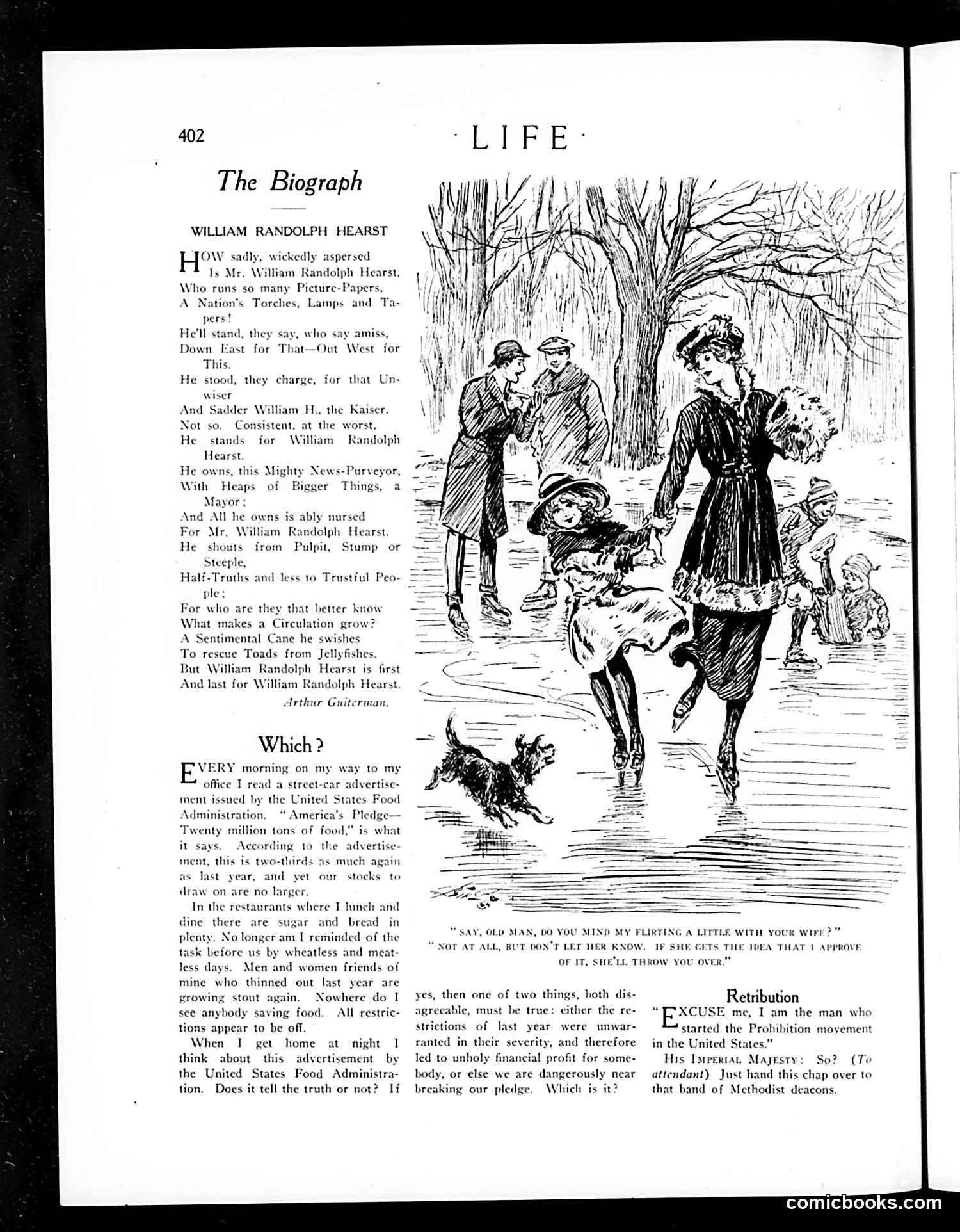
This page contains three distinct pieces: 1. **"The Biograph"** — A satirical poem by Arthur Guiterman mocking William Randolph Hearst as a sensationalist newspaper magnate who runs "Picture-Papers" and pursues "bigger things" while being inconsistent and self-serving. 2. **"Which?"** — A commentary on a Food Administration advertisement claiming America produces "twenty million tons of food," questioning whether food stocks are genuinely abundant or whether restrictions remain necessary despite the claims. 3. **"Retribution"** — A brief piece (appears incomplete on this page) apparently about someone connected to Prohibition movement, referencing Methodist deacons. The cartoon illustration shows a woman in period dress wading through water with children and a dog, with men in background—its exact satirical target is unclear without full context.
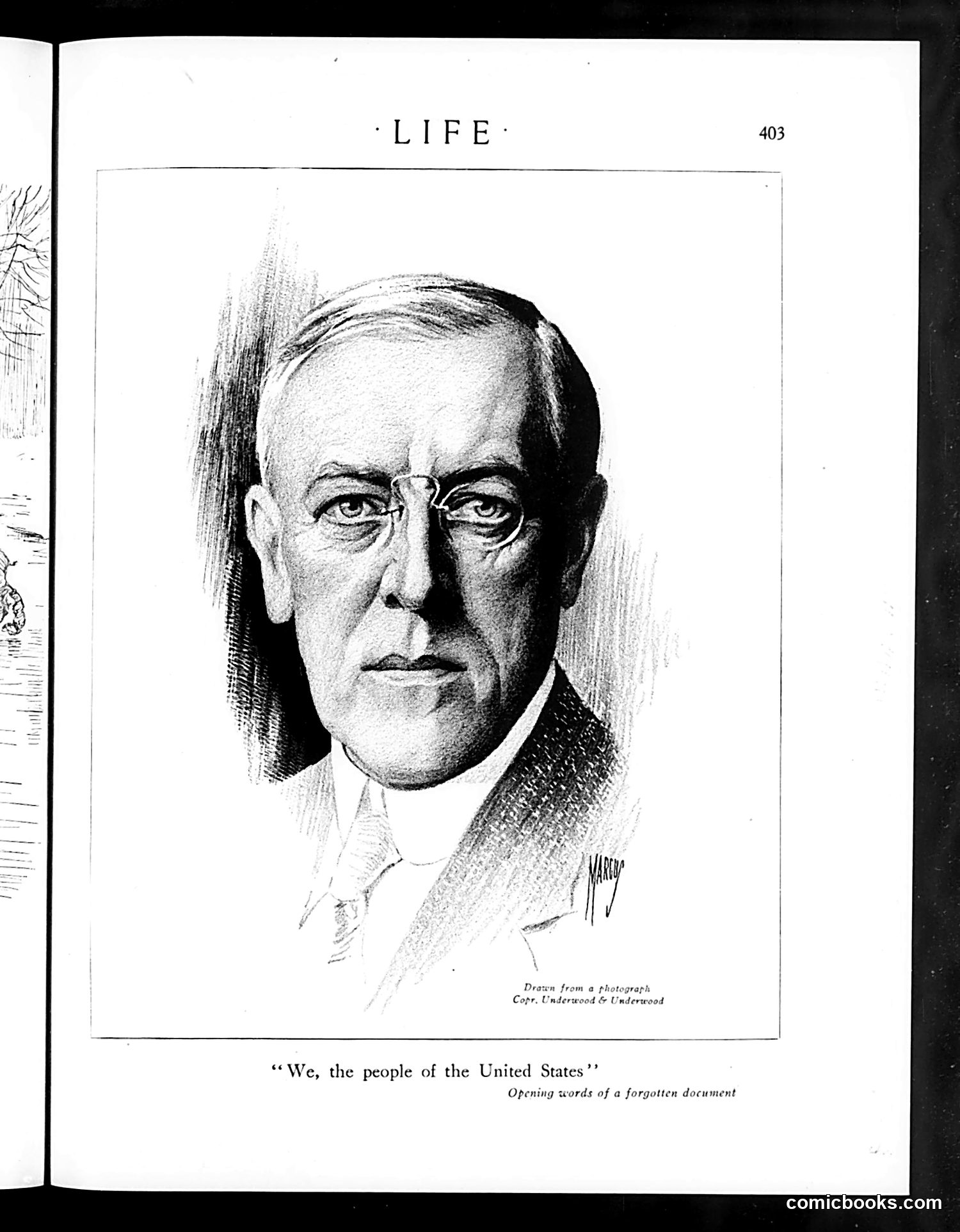
This appears to be a portrait page from *Life* magazine (page 403) featuring a sketch of an unidentified man wearing glasses and formal attire. The caption reads "We, the people of the United States" with a subtitle noting "Opening words of a forgotten document." The satire's point is clear: the sketch illustrates someone who has forgotten or disregarded the Constitution's preamble—"We, the people of the United States." The artist's signature reads "Cesare" (or similar). Without additional context or identification of the subject, the exact political figure or situation being critiqued remains unclear, though the implication is that this person has abandoned democratic principles or constitutional governance. The "forgotten document" suggests criticism of ignoring constitutional authority.
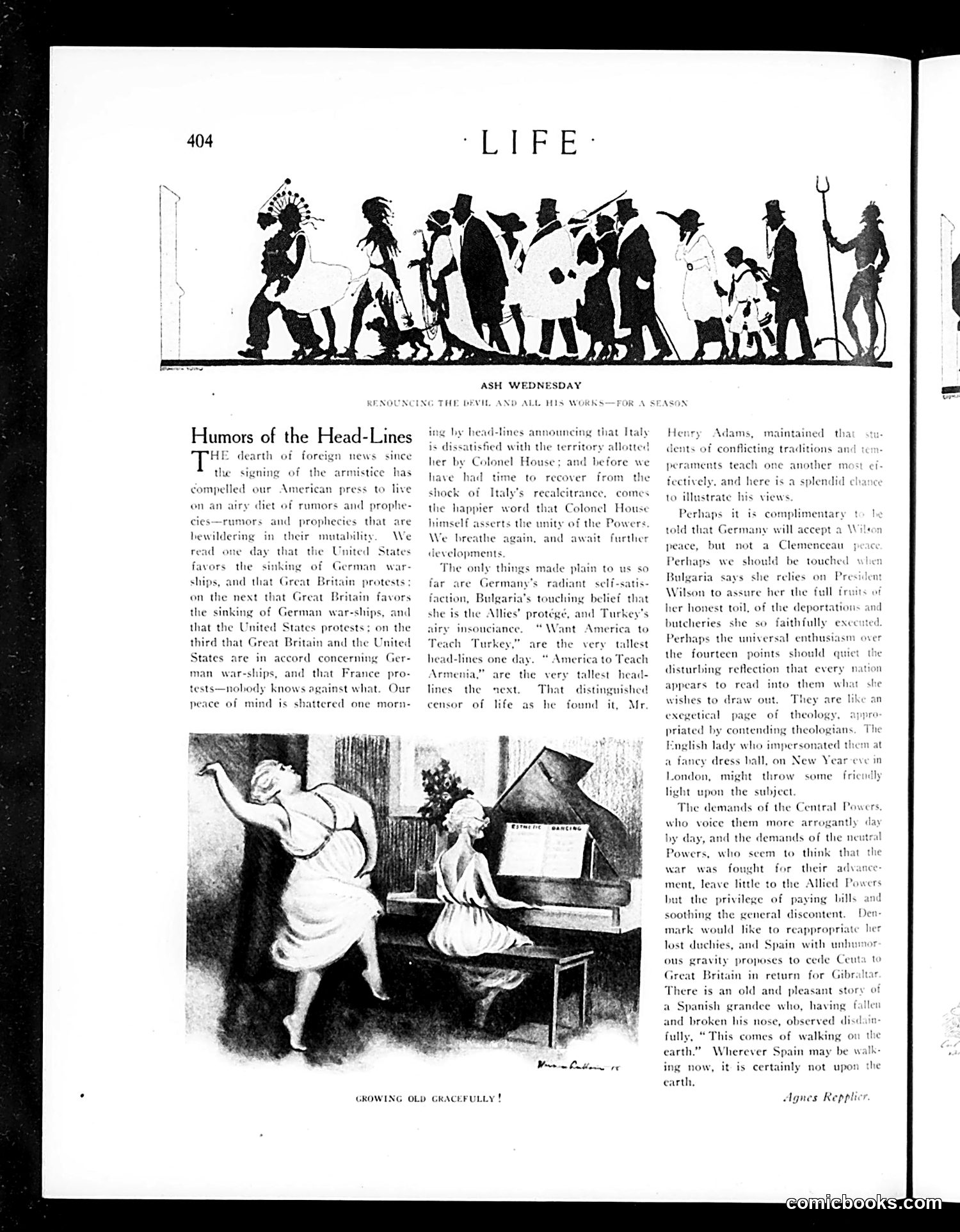
This page satirizes post-WWI peace negotiations and territorial disputes. The top silhouette depicts various national figures and representatives at what appears to be peace talks—a visual metaphor for the chaos of competing demands. The article critiques how different nations' newspapers celebrate their own victories while protesting others' gains. It mocks Germany's "radiant self-satisfaction," Bulgaria's belief it deserves Allied protection, and Turkey's claims to teach Armenia and Armenia's counter-claims. The lower cartoon, "Growing Old Gracefully," shows two figures at a piano—likely satirizing aging European powers (possibly Spain and another nation) dealing with diminished global influence post-war. The humor derives from their pretense of dignity despite reduced circumstances and bargaining power in the new international order.
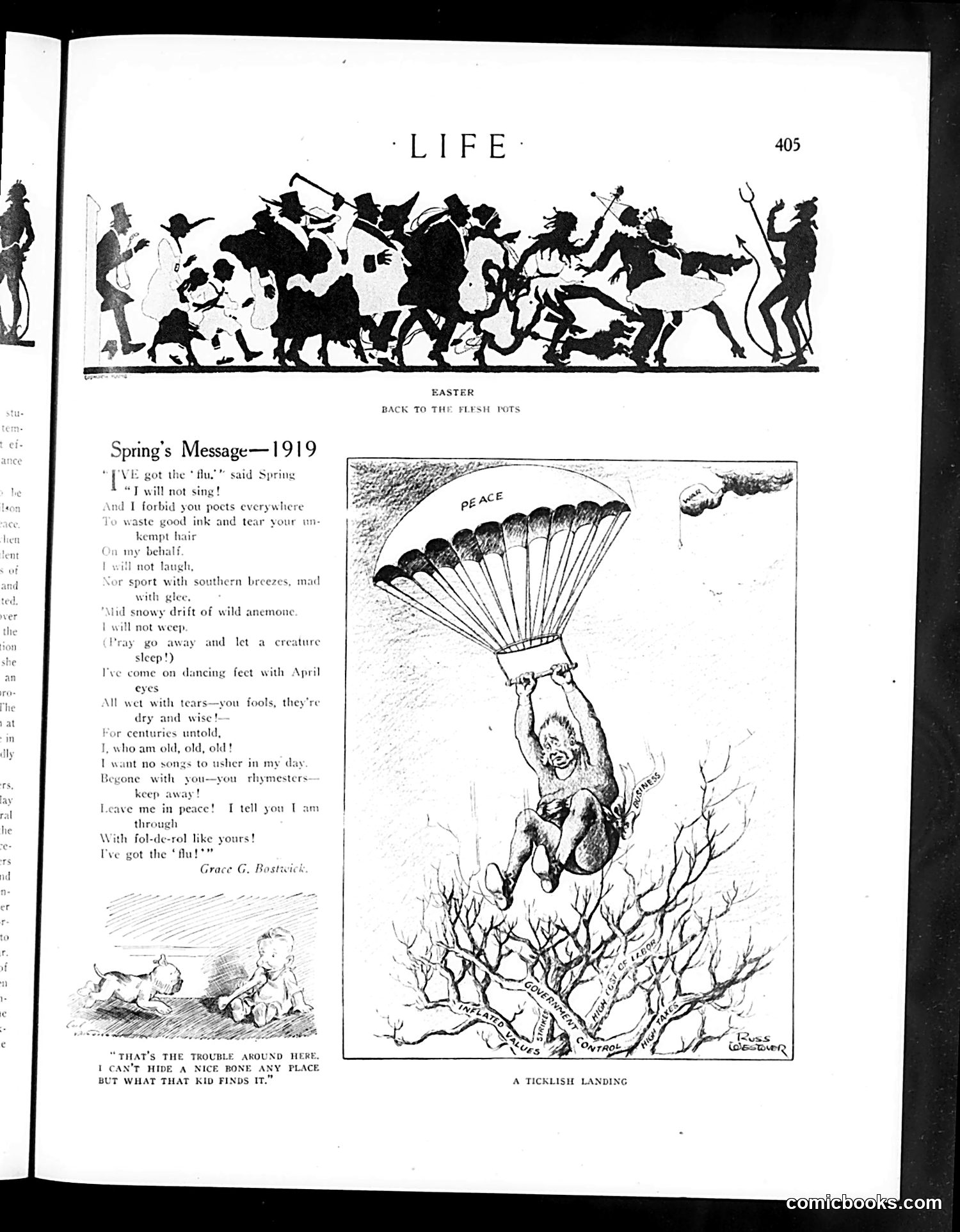
**"Spring's Message—1919"** is a post-WWI poem by Grace G. Boatwick expressing optimism about peace returning after the war's devastation. The accompanying cartoons reinforce this theme. **"Easter: Back to the Flesh Pots"** (top silhouette) depicts a chaotic procession of figures—likely representing post-war society indulging in material pleasures and excess after wartime deprivation. **"A Ticklish Landing"** (right) shows a figure descending via parachute labeled "Peace" toward thorny, barren ground labeled with economic/social problems. The satire suggests that achieving actual peace from warfare is complicated by underlying domestic challenges—the "ticklish" complications of transitioning from war to peacetime stability. Both images express cautious skepticism about whether peace truly solves society's deeper problems.
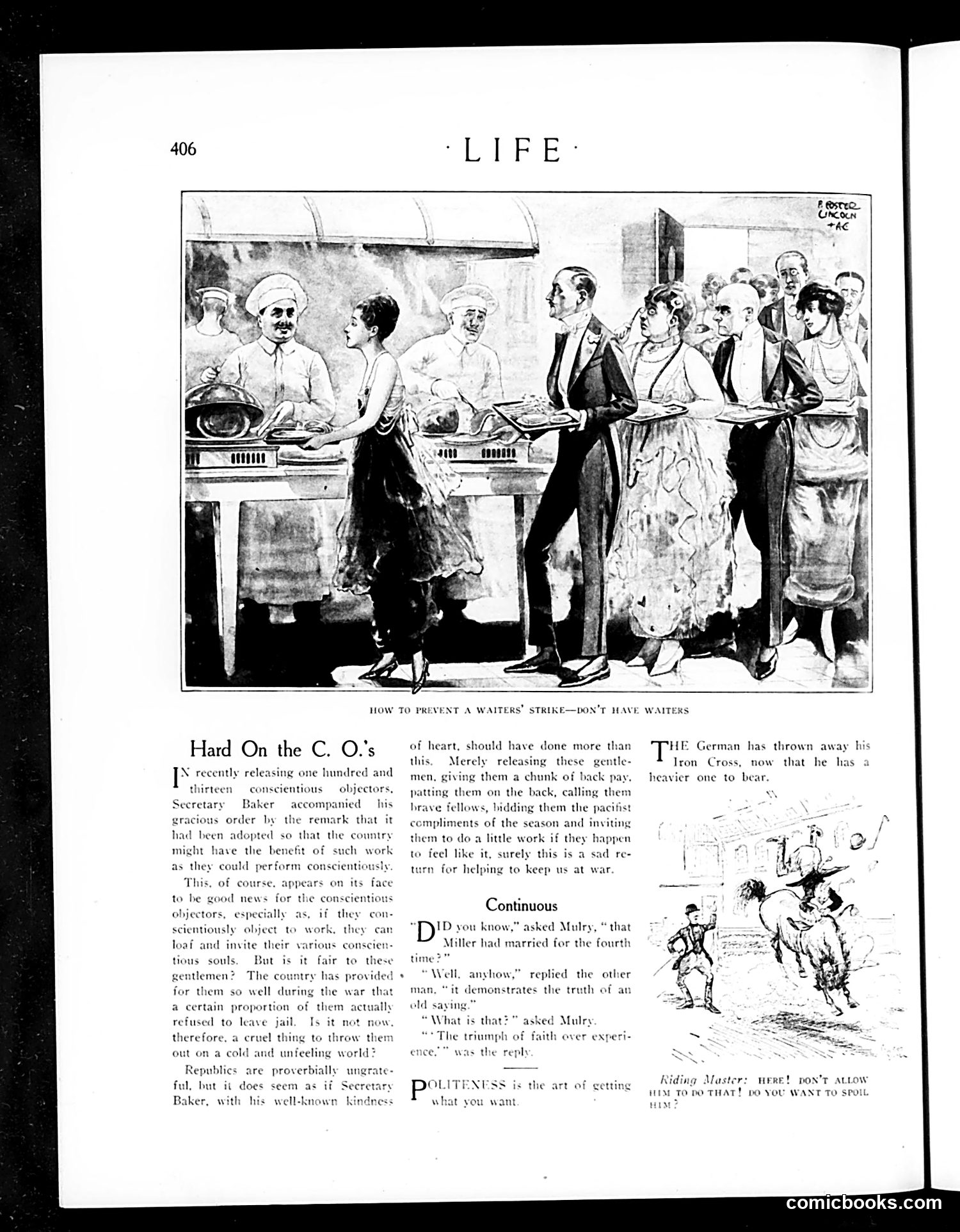
**Main Cartoon (top):** Titled "How to Prevent a Waiters' Strike—Don't Have Waiters," this depicts a formal dinner where wealthy guests are served by what appear to be conscientious objectors wearing chef hats. The satire criticizes Secretary Baker's recent decision to release 113 conscientious objectors from military service, arguing they should have been forced to work instead. The cartoon suggests these pacifists should be exploited for labor rather than released—transforming them into servants at high society dinners. **Side Content:** Includes brief humorous pieces about German military decorations and marital longevity, plus a small equestrian cartoon about a riding master preventing spoiled behavior. The page reflects WWI-era tensions regarding conscientious objection and public resentment toward those refusing military service.
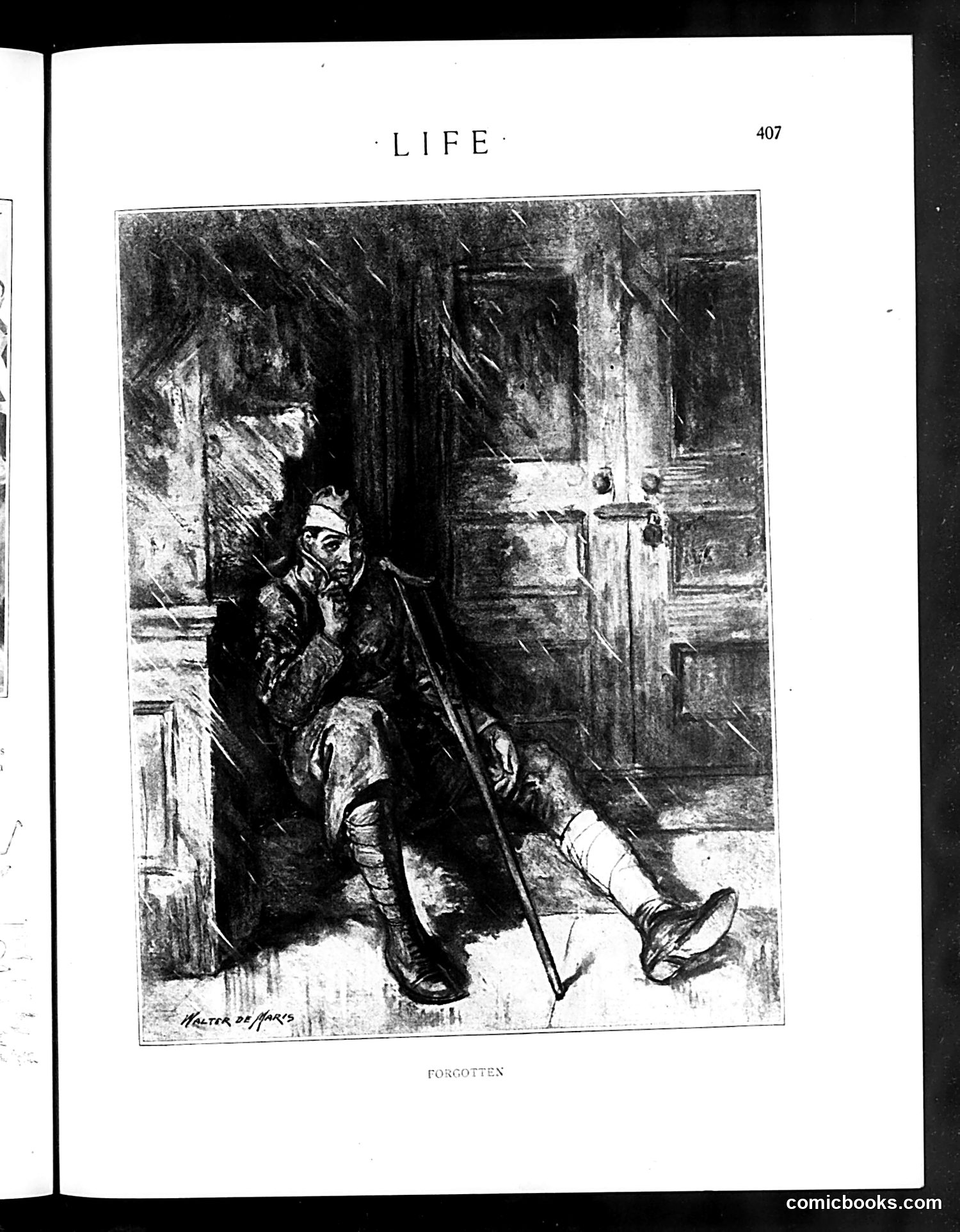
This illustration by Walter de Maris depicts a disabled soldier—identifiable by his crutch and bandaged leg—sitting alone in what appears to be a dark, deteriorating urban alley or doorway. The title "Forgotten" suggests social commentary on the treatment of war veterans. The satire criticizes how society neglects wounded servicemen after they return from combat. The soldier's isolation, poor surroundings, and physical disability contrast sharply with the grandeur presumably given to wartime efforts. This reflects post-World War I anxieties about veteran welfare—a recurring theme in 1920s American satire, when many disabled soldiers struggled with inadequate pensions and public indifference despite their sacrifices.
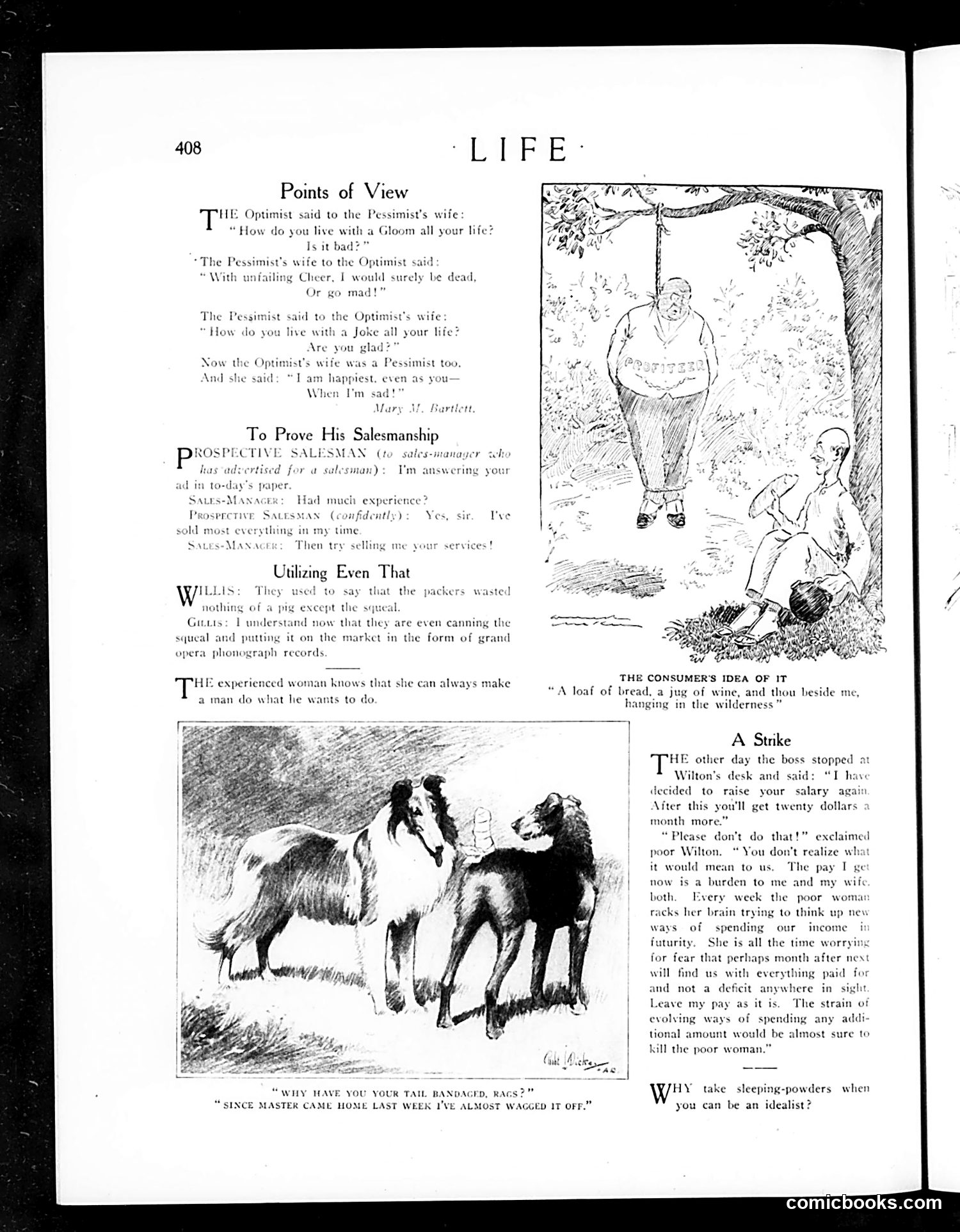
This page contains several satirical pieces reflecting early 20th-century American attitudes: **"Points of View"** presents a debate between an Optimist and Pessimist about happiness—a common philosophical joke format of the era, ending with the moral that attitude determines contentment. **"To Prove His Salesmanship"** mocks a job applicant who claims universal sales experience, suggesting exaggerated confidence in poorly qualified workers. **"Utilizing Even That"** jokes about meat-packing efficiency (likely referencing Upton Sinclair's *The Jungle* era concerns), now supposedly canning pig squeals as phonograph records—absurdist humor about waste reduction. **"A Strike"** satirizes a worker named Wilton who refuses a raise, claiming his wife spends all their money and would be stressed by having nothing left to budget—dark humor about financial anxiety and marital dynamics among the working poor. The accompanying dog cartoon humorously depicts wagging as injury, playing on the phrase "wagged it off." The overall tone reflects pre-WWI American humor: satirizing class anxiety, marriage, salesmanship, and industrial capitalism.
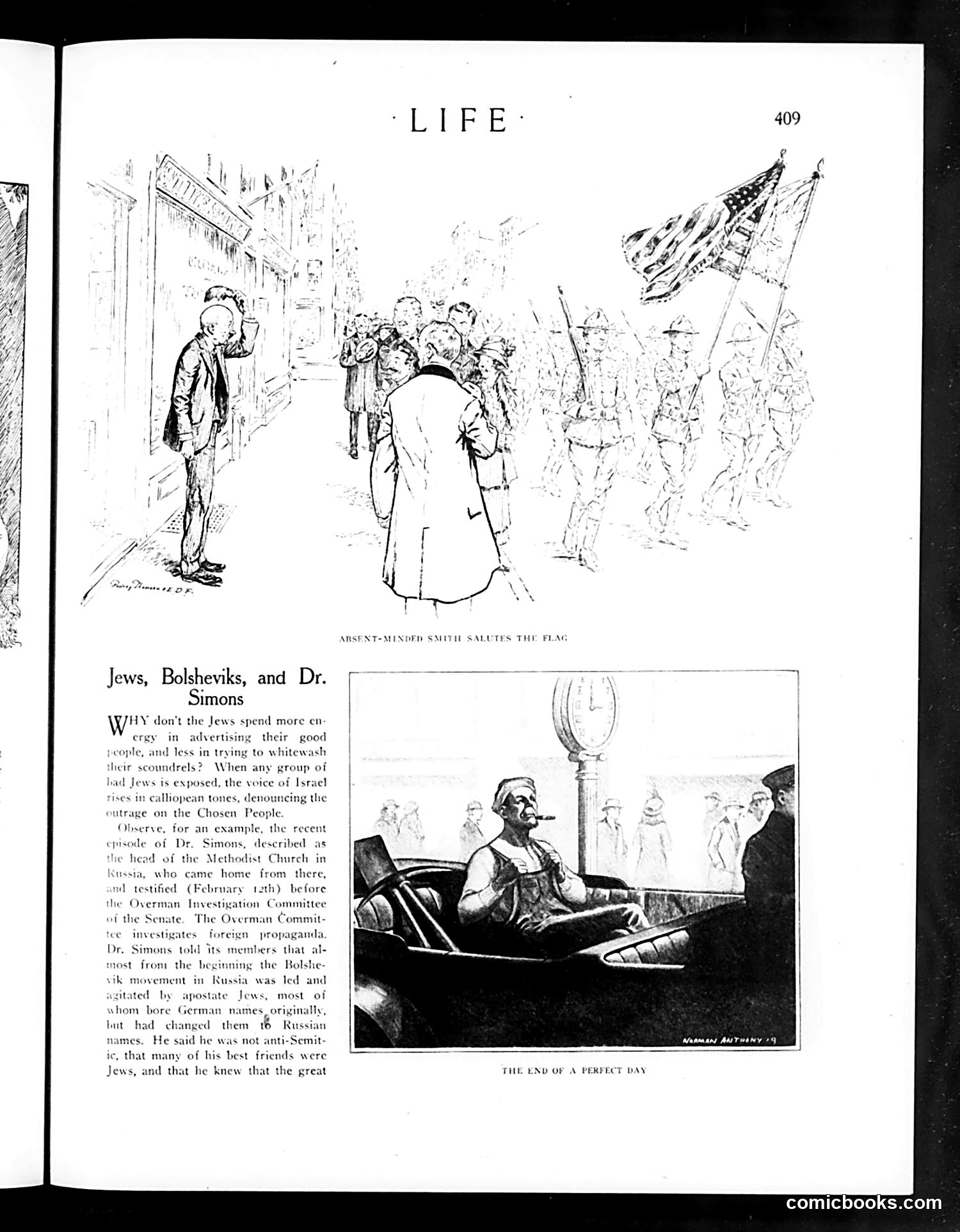
This page contains antisemitic propaganda from the post-WWI era. The text attacks Jews for allegedly defending Jewish figures accused of wrongdoing, using Dr. Simons—described as a Methodist Church leader who testified before the Senate's Overman Committee—as an example. Simons claimed Bolsheviks were led by "apostate Jews" who changed their names from German to Russian origins. The article sarcastically notes his disclaimer about not being "anti-Semitic" while making exactly such accusations. The top cartoon shows a figure saluting flags, likely depicting patriotic display. The lower illustration titled "The End of a Perfect Day" appears to show a figure reclining triumphantly. **Context**: This reflects 1920s American anxiety about Bolshevism and Jewish immigrants, conflating communism with Judaism through conspiracy theory. The "Overman Committee" investigated alleged foreign propaganda. This material exemplifies how mainstream publications spread harmful stereotypes linking Jews to revolutionary movements.
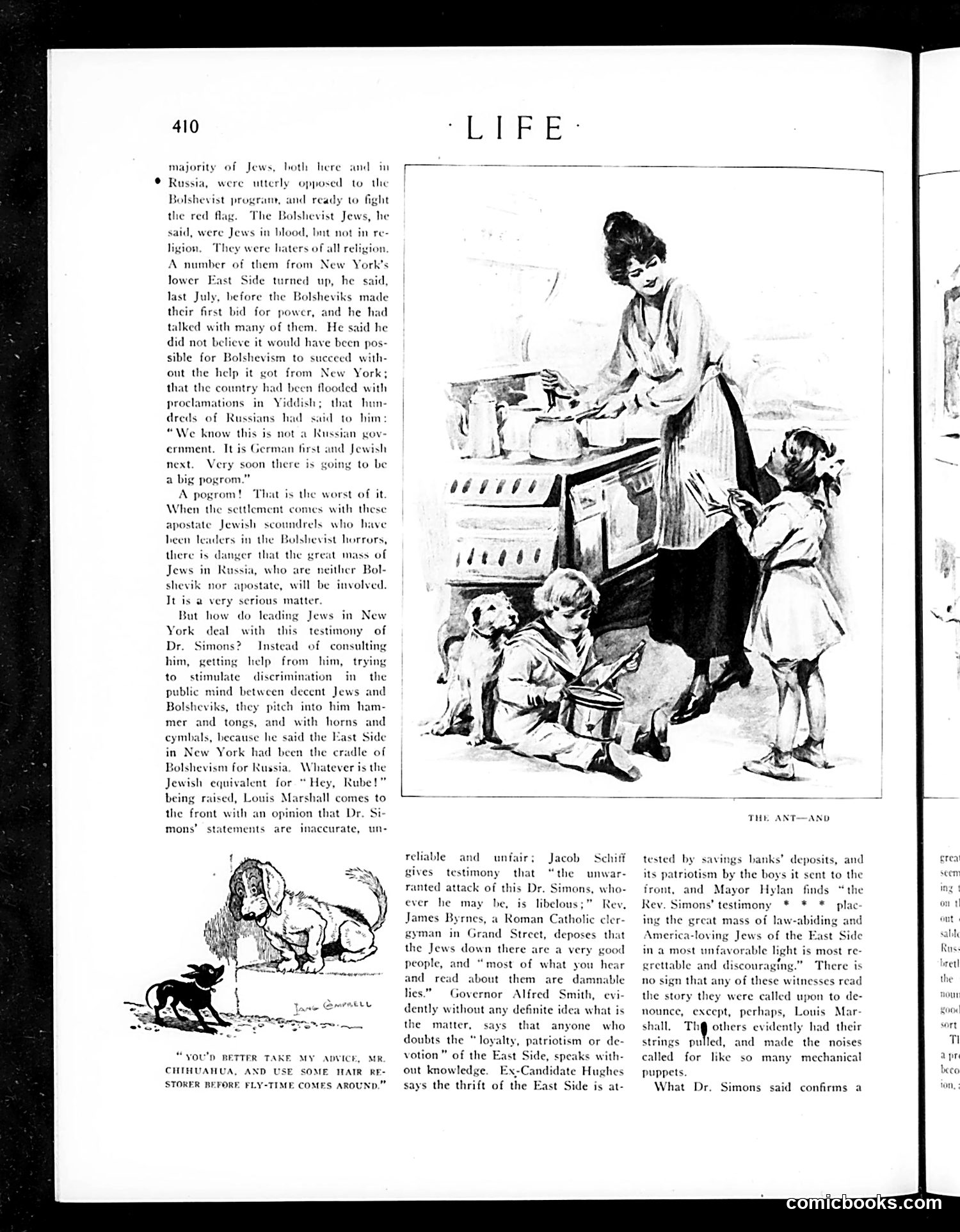
This page satirizes Jewish community leaders' response to Dr. Simons's testimony about Bolshevik influence on New York's Lower East Side. Simons claimed Soviet communism had roots in Jewish immigrant neighborhoods and warned of potential pogroms against Russian Jews if this association persisted. The text criticizes prominent Jewish figures—Louis Marshall, Jacob Schiff, Mayor Hylan, Governor Alfred Smith, and others—for attacking Simons rather than engaging with his argument. Life's editors argue these leaders are either defending the indefensible or responding to pressure, calling them "mechanical puppets" with "strings pulled." The cartoon (bottom left) shows a small, scraggly dog lecturing a larger dog about grooming before "fly-time," likely comparing this misdirected focus to the Jewish leaders' supposed evasion of Simons's core concerns. The page reflects 1920s antisemitic conspiracy narratives linking Jews to communism—a dangerous stereotype that Life amplifies by framing Jewish defense as suspicious rather than reasonable.
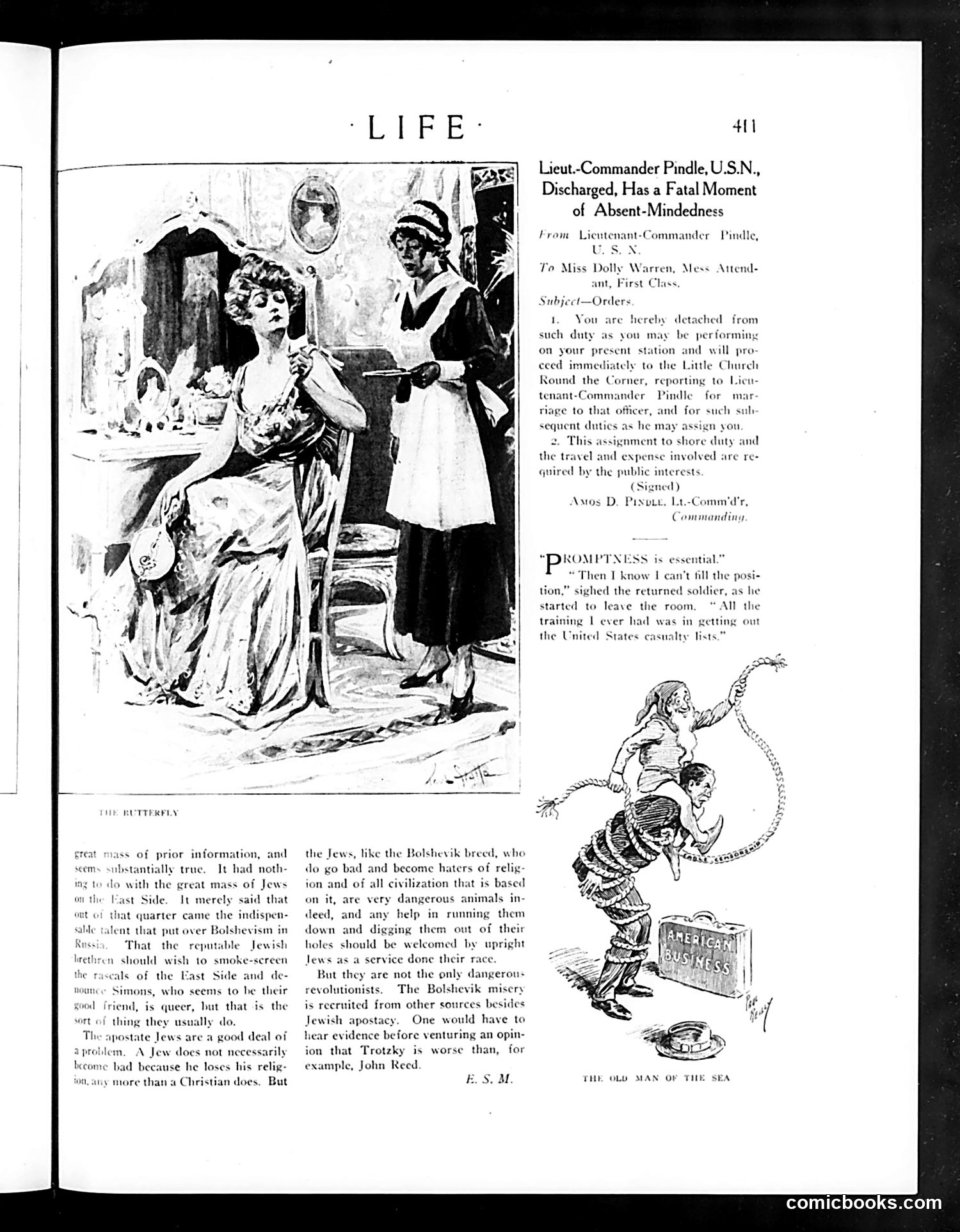
**Top cartoon ("The Butterfly"):** This section discusses dangerous revolutionists, particularly focusing on apostate Jews and Bolsheviks. The text argues that Jews who abandon their religion and embrace revolutionary ideology pose serious threats. It mentions Trotsky and John Reed as examples of dangerous revolutionists. This reflects 1920s anti-communist and antisemitic anxieties in America, scapegoating Jewish immigrants for Bolshevik revolution fears. **Bottom cartoon ("The Old Man of the Sea"):** A comedic military scenario where Lieutenant-Commander Pindle accidentally issues orders detaching Miss Dolly Warren to "the Little Church Round the Corner" for marriage to him—a humorous mix-up of military and personal business. The returned soldier's quip about training in "getting out...casualty lists" jokes about post-WWI adjustment and bureaucratic absurdity. The page juxtaposes serious political commentary (with disturbing antisemitic stereotyping) alongside light military humor.
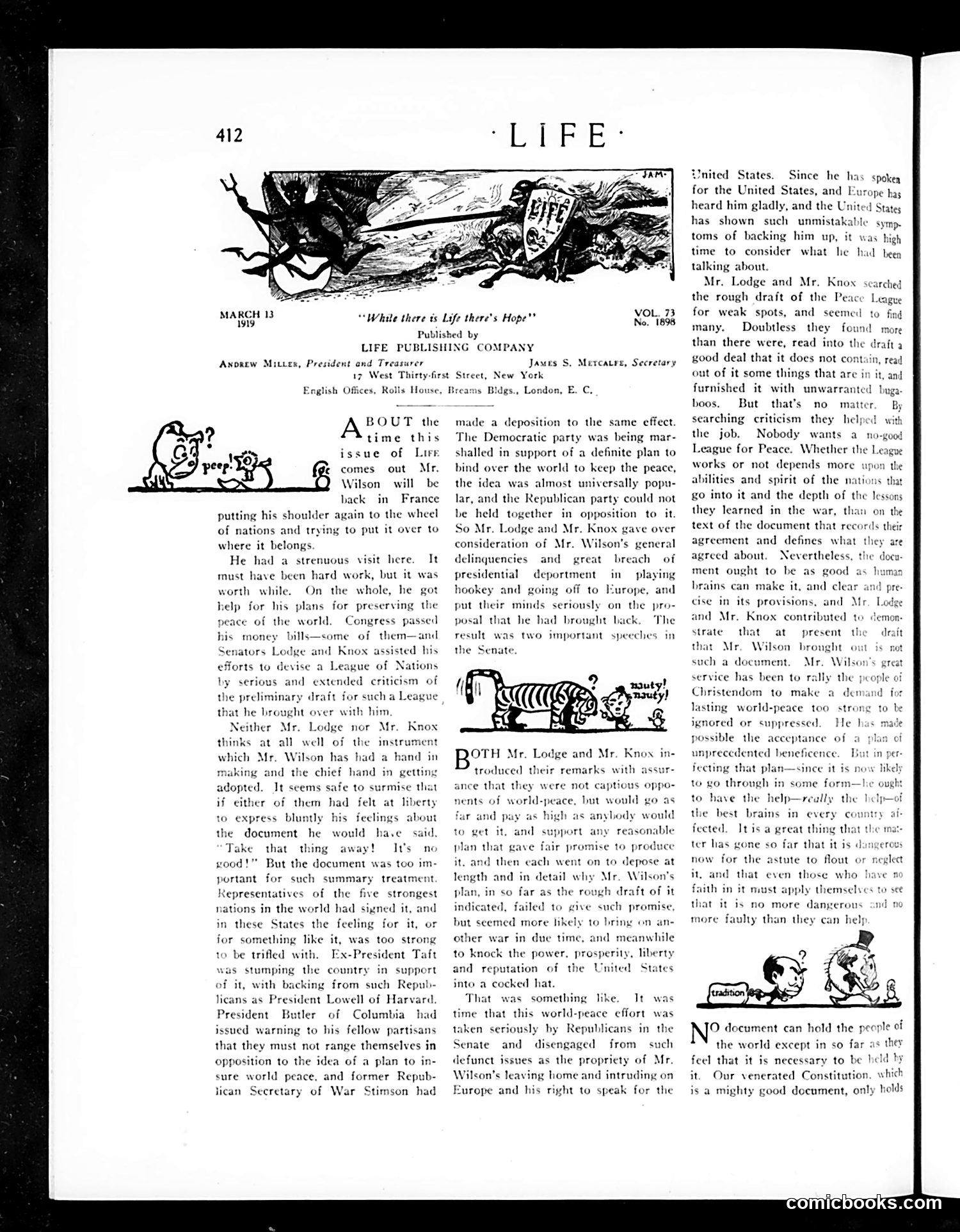
This page discusses President Wilson's return from Europe with a draft League of Nations covenant. The cartoons satirize Republican opposition to Wilson's peace plan. **Key figures:** Wilson (the Democratic president), Senators Lodge and Knox (prominent Republicans), and various Republican leaders (Taft, Lowell, Butler, Stimson) who either supported or hedged on the League idea. **The satire:** Lodge and Knox initially criticized Wilson for leaving America to negotiate in Europe—a breach of presidential propriety. However, once Wilson returned with broad public and even cross-party support for world peace, they abandoned that complaint as inadequate. Instead, they scrutinized the League draft for flaws, likely reading in more weaknesses than existed. **The point:** The cartoons mock Republicans for shifting their criticisms based on political convenience rather than principle. When one attack fails, they simply invent new ones to obstruct Wilson's peace initiative.
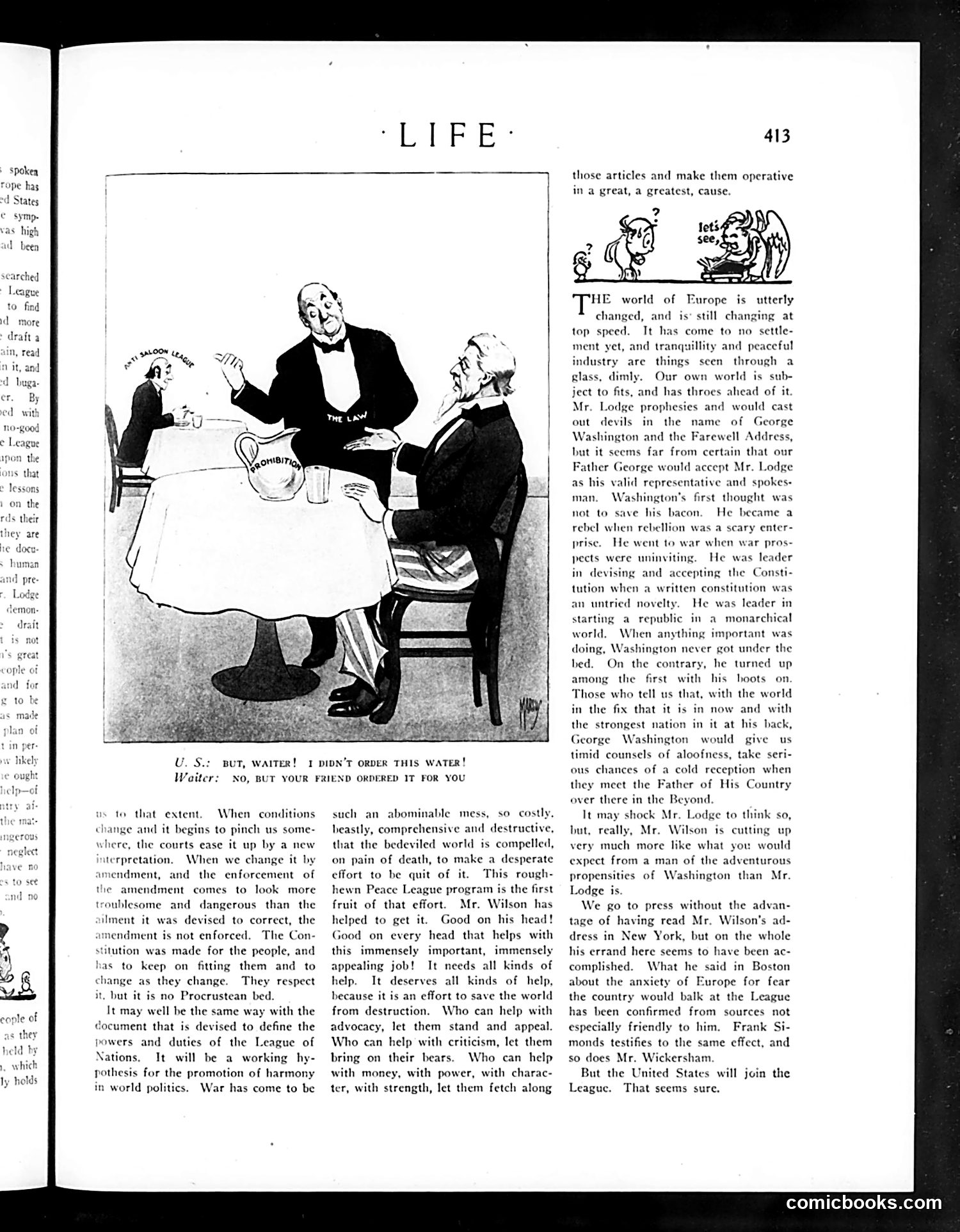
**The Cartoon:** A waiter serves water to an American diner while a European figure sits nearby. The American protests he didn't order it; the waiter responds the European "friend" ordered it for him. **The Meaning:** This satirizes American reluctance about the League of Nations. The water represents League membership—something European powers want America to accept, though Americans didn't ask for it. The cartoon mocks the idea that America is being pressured into international commitments against its will. **Context:** The surrounding text attacks Senator Henry Cabot **Lodge**, who opposed League membership, by comparing him unfavorably to George Washington. The article argues Washington was bold and internationalist, implying Lodge's isolationism betrays that legacy. The cartoon supports Wilson's pro-League position against Lodge's skeptical faction, depicting American reluctance as childish resistance to obligations friends are imposing.
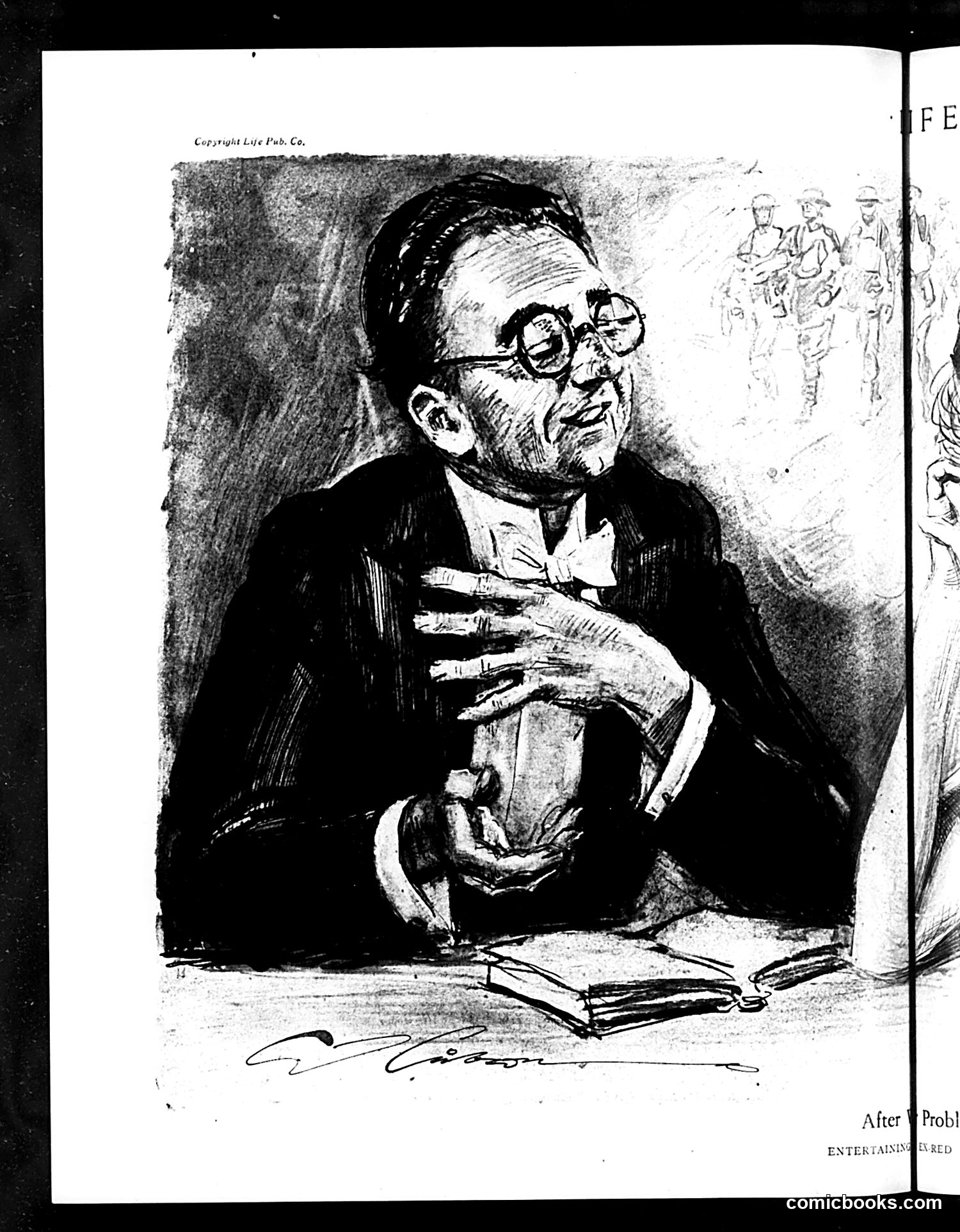
This is a satirical sketch from Life magazine showing a portly man in formal attire (suit, glasses, bow tie) hunched over an open book or ledger, smoking cigars. His exaggerated facial features and posture suggest caricature typical of early-20th-century political cartooning. The figure appears to represent a wealthy businessman or financier—suggested by his formal dress, the ledger before him, and his self-satisfied expression. The multiple cigars in his hand likely satirize excess and greed. The sketched soldiers visible in the background suggest military or wartime context. Without clearer text or date visible, I cannot definitively identify the specific figure or historical event referenced. The overall message appears to critique wealth concentration or profiteering, possibly during wartime, though the exact satirical target remains unclear from this page alone.
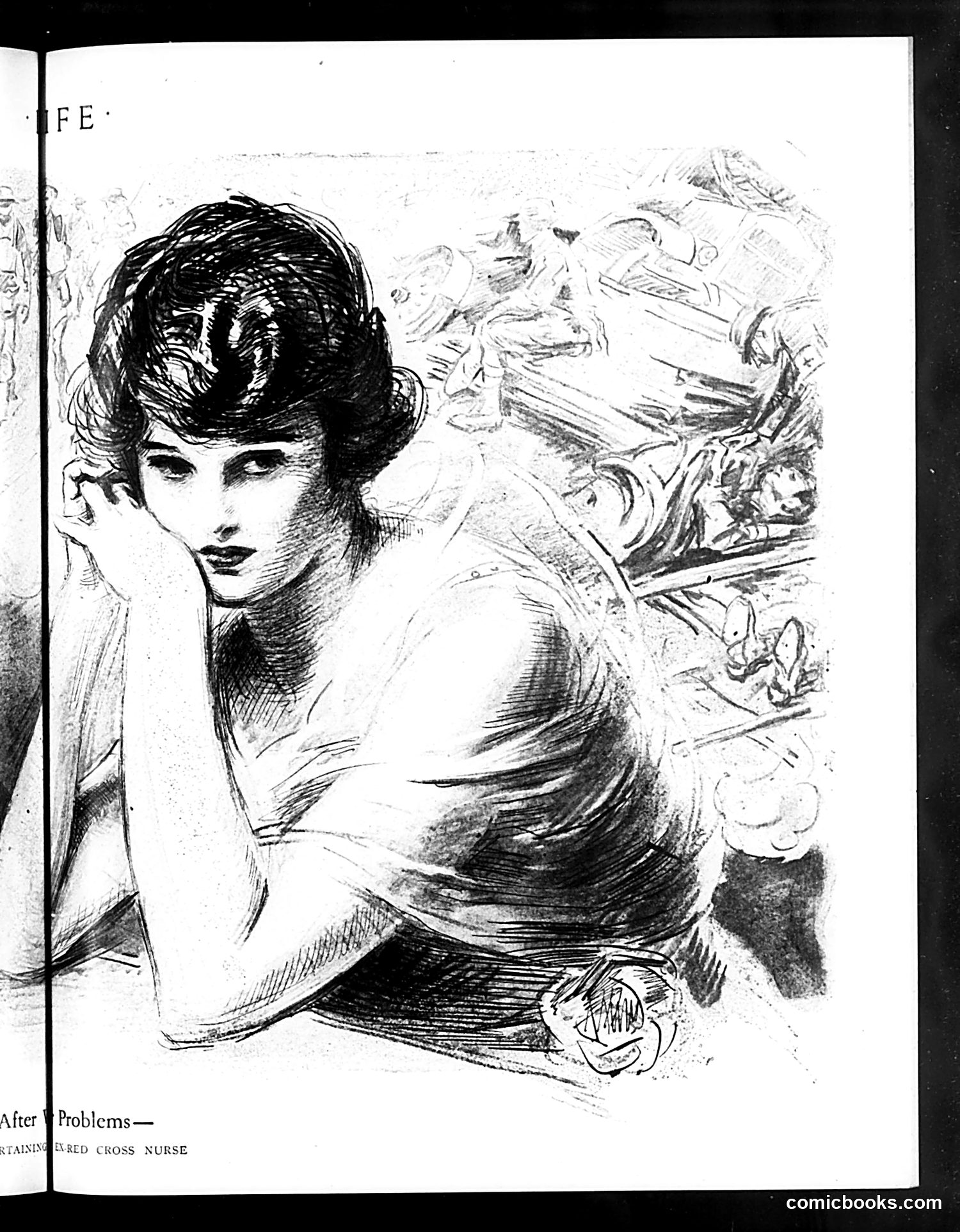
This page appears to be from *Life* magazine and shows a sketch titled "After Problems—" with a subtitle mentioning "RED CROSS NURSE." The illustration depicts a woman in profile with short, dark 1920s-style hair, drawn in a loose ink style. She appears to be looking back over her shoulder with a subtle expression. The cartoon likely comments on post-World War I experiences, given the Red Cross nurse reference. The "After Problems" title suggests this addresses the aftermath of wartime service. The sketch's style and the woman's fashionable appearance reflect 1920s aesthetics, possibly satirizing how nurses or women who served during the war were perceived or treated upon returning to civilian life. However, without additional context or clearer text, the specific satirical point remains somewhat unclear.
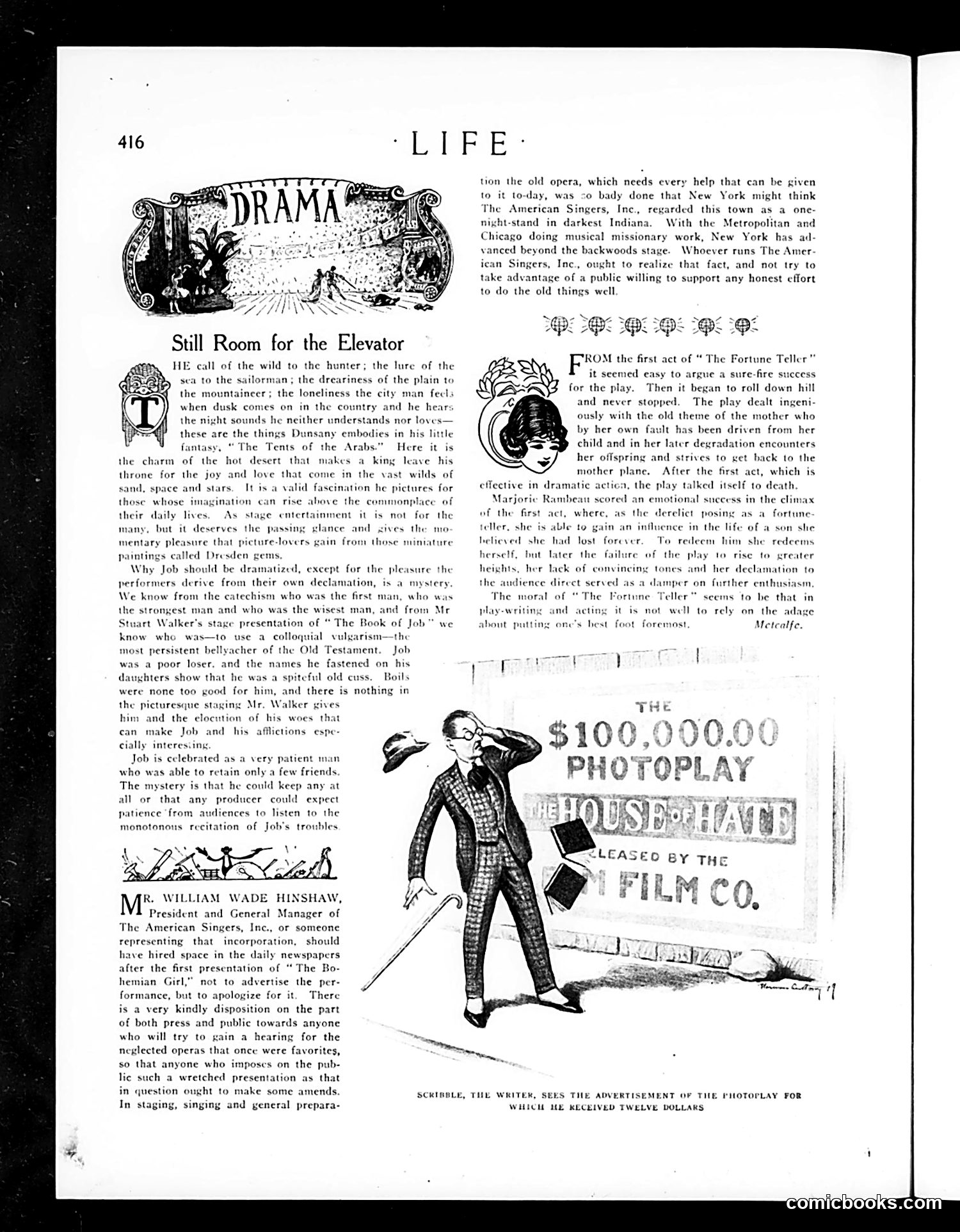
This page from *Life* magazine contains drama criticism and advertising rather than political cartoons. The main content critiques three theatrical productions: **"The Tents of the Arabs"** — praised as imaginative fantasy, though acknowledged as niche entertainment. **"The Book of Job"** — mocked for its tedious, self-indulgent staging. The critic sarcastically notes Job is celebrated as "patient" and a "poor loser," suggesting the play's lengthy recitation of complaints tests audience endurance. **"The Bohemian Girl" by The American Singers, Inc.** — harshly criticized for poor production quality. The critic suggests the company treated New York like "darkest Indiana," implying the performance was unacceptably provincial for a sophisticated city already served by the Metropolitan Opera and Chicago's musical efforts. **The advertisement** for a $100,000 photoplay ("House of Hate") shows a mustachioed man discovering advertisements—a self-referential joke about advertising itself. The satire targets theatrical mediocrity and companies exploiting audiences' goodwill toward neglected art forms.
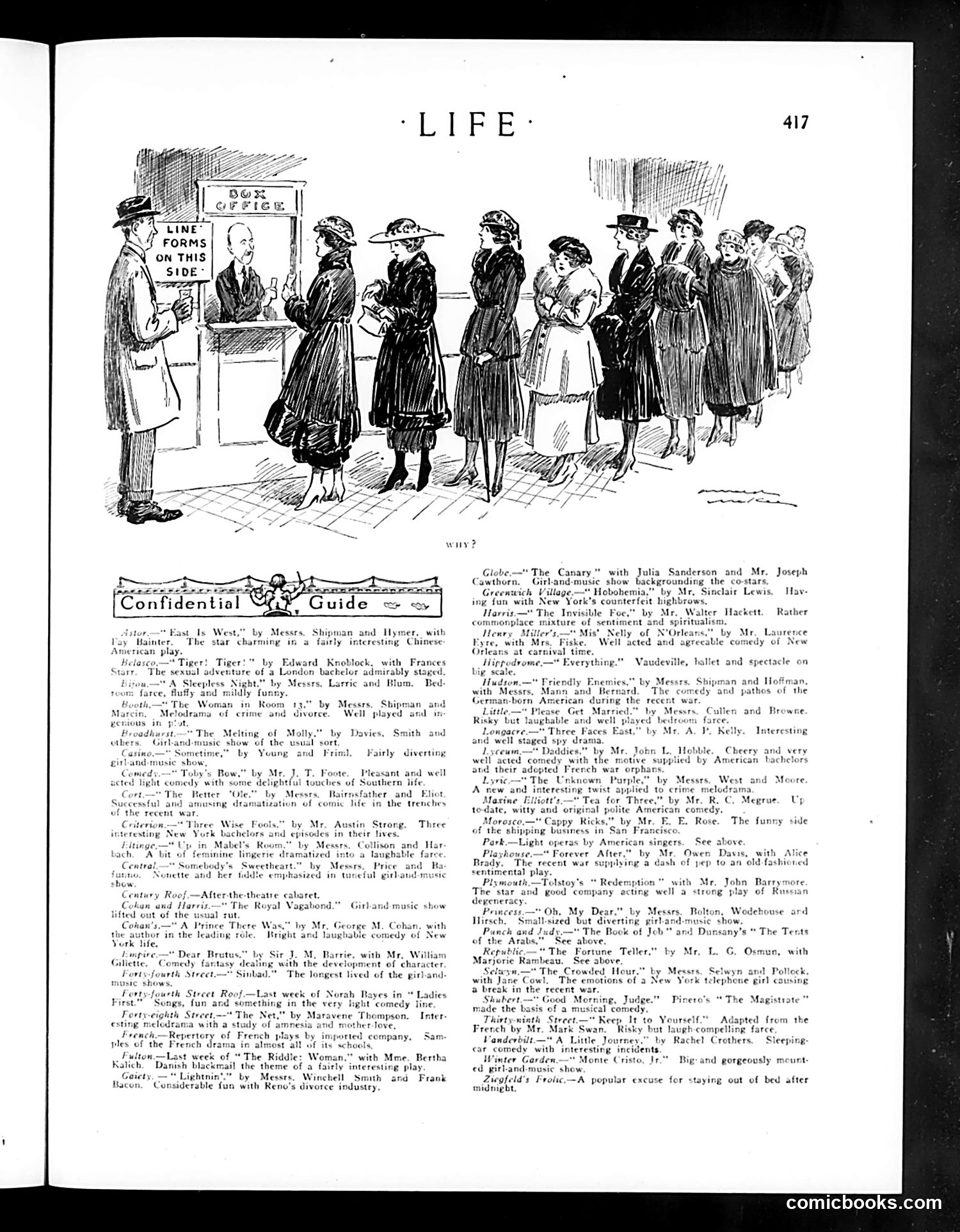
This page is primarily a **theater review column**, not a political cartoon. The illustration at the top shows a humorous scene of women queuing at a box office marked "LINE FORMS ON THIS SIDE"—a satirical commentary on the popularity of theater during this era (appears to be early 1920s based on clothing and references to "the recent war"). The joke: women patiently waiting in line to buy tickets, suggesting either extreme popularity of shows or the tedious experience of theater-going itself. The remainder of the page lists current Broadway productions with brief critical commentary—shows like "Tiger! Tiger!", "The Woman in Room 17," and "Lightnin'" (noted for comedic treatment of "Reno's divorce industry"). References to "the recent war" suggest this is post-WWI content. This is **entertainment journalism**, not political satire—reflecting American popular culture and theater-going habits of the period.
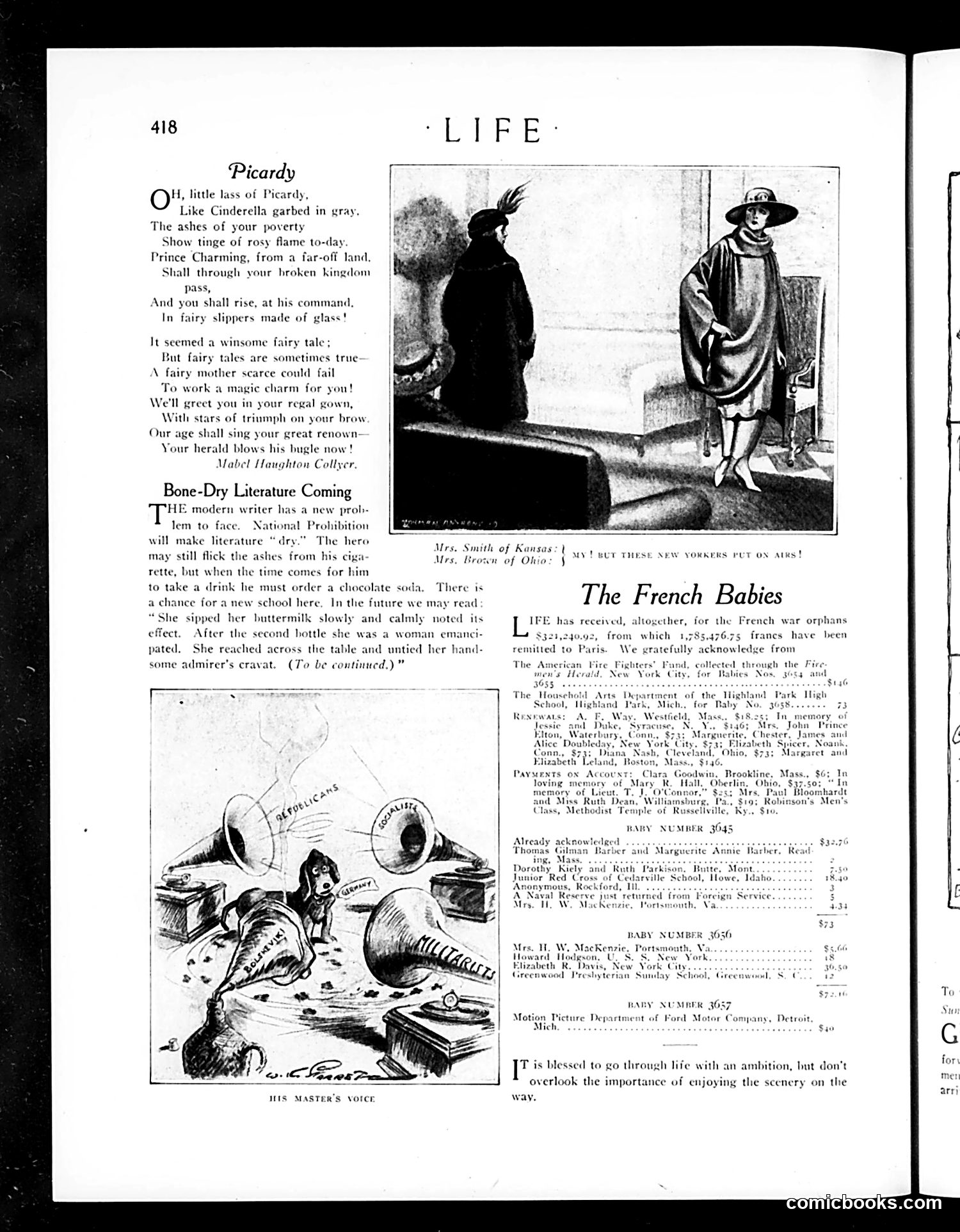
This page contains three distinct items: **"Picardy" poem**: A sentimental verse about a poor girl from the French region of Picardy, comparing her to Cinderella. It celebrates how "Prince Charming, from a far-off land" (appearing to reference American aid/intervention in WWI) will restore her to prosperity through magical transformation—likely satirizing American optimism about postwar European recovery. **"Bone-Dry Literature Coming"**: A satirical commentary on Prohibition's impending effects on American literature. The joke suggests that without alcohol, writers will struggle; the sample passage humorously shows a woman becoming "emancipated" from buttermilk instead of alcohol—mocking how absurd Prohibition-era fiction might become. **"The French Babies"**: A fundraising acknowledgment listing donors who contributed to aid French war orphans, with a caption showing two women discussing New York fashion pretensions. The cartoon "His Master's Voice" (bottom left) appears to reference the famous gramophone trademark, though its specific satirical point is unclear from this image alone.
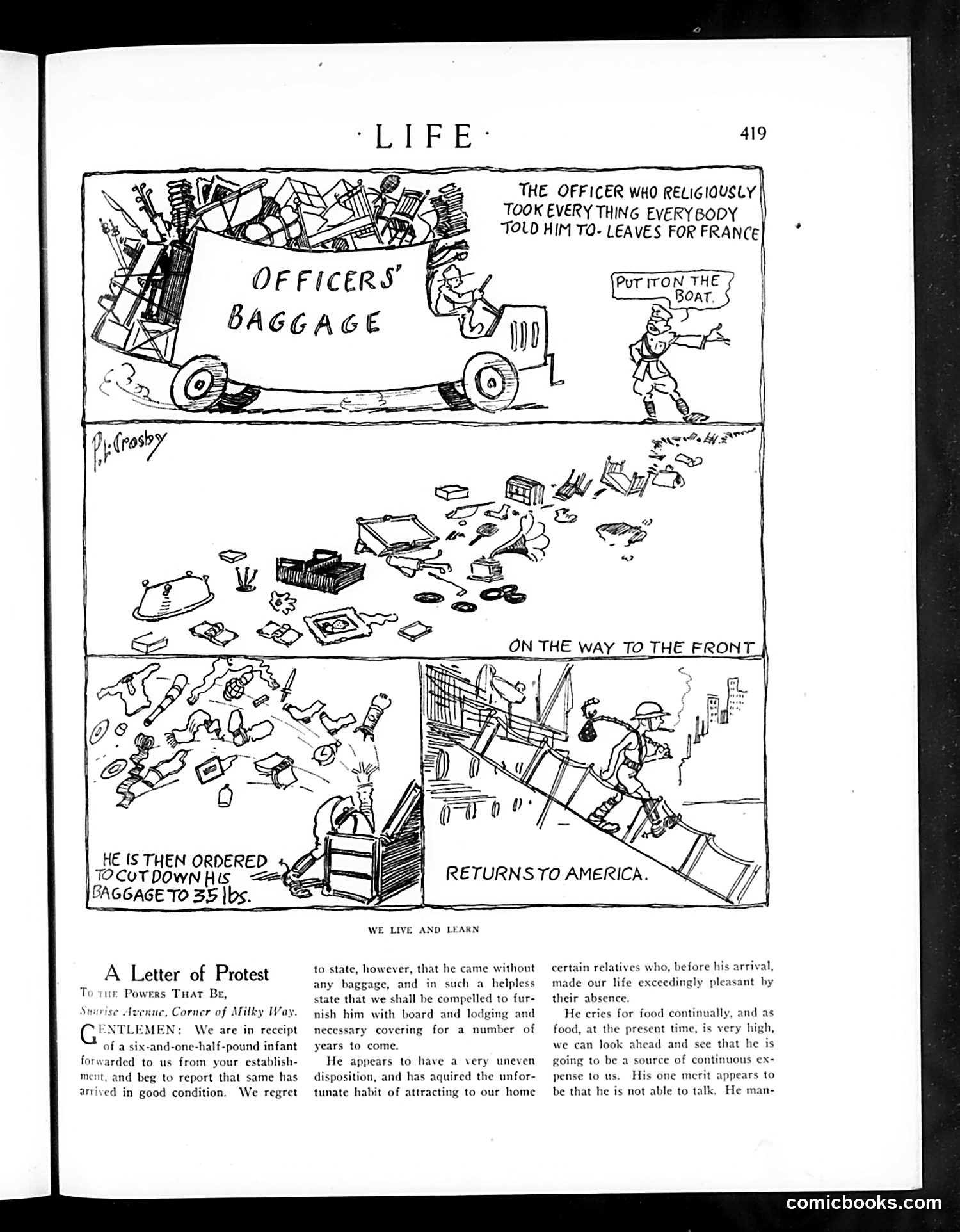
This is a satirical cartoon about military officers' excessive baggage during WWI deployment to France. The top comic strip shows an officer who greedily collects personal items ("religiously took everything everybody told him to"), loads them into an enormous cart, loses items en route, and is finally ordered to reduce his baggage to 35 pounds for return to America—a humorous comment on military inefficiency and overconsumption. The letter below parodies this theme, presenting a complaint from "the Powers That Be" about receiving a six-and-a-half-pound infant with no baggage. The joke uses the baby as a metaphor—likely referring to how soldiers or dependents arrived unprepared, requiring resources and causing unexpected expense to their hosts. It satirizes how military personnel were often underprepared despite taking excessive personal belongings, and the financial burden they placed on society.
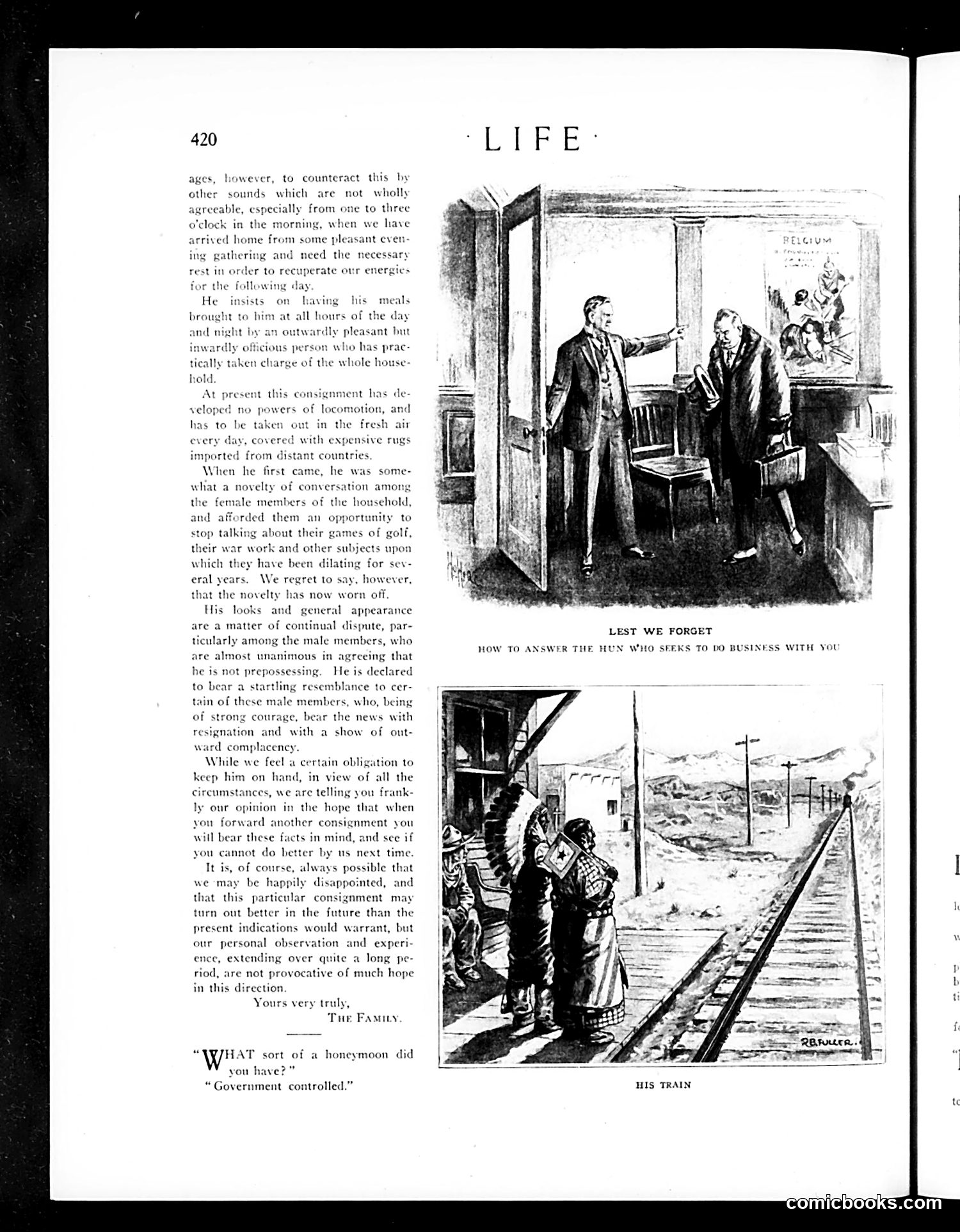
This page satirizes two distinct topics: **Upper cartoon ("Lest We Forget")**: Shows a businessman greeting another man at an office doorway while a woman works in the background. The caption warns against doing business with "the Hun"—a dehumanizing WWI-era term for Germans. This reflects anti-German sentiment during or after World War I, cautioning readers against commercial dealings with German nationals or firms. **Lower cartoon ("His Train")**: Depicts a woman with a baby carriage at a railway platform, titled "His Train." The accompanying text (a letter from "The Family") humorously complains about a newborn—described as a "consignment" lacking "powers of locomotion" requiring expensive care and daily outings. The joke plays on post-WWI exhaustion; the closing joke about "Government controlled" honeymoons likely references wartime restrictions or rationing affecting domestic life. Both pieces reflect immediate post-WWI anxieties: anti-German sentiment and weariness with government control and sacrifice during the conflict.
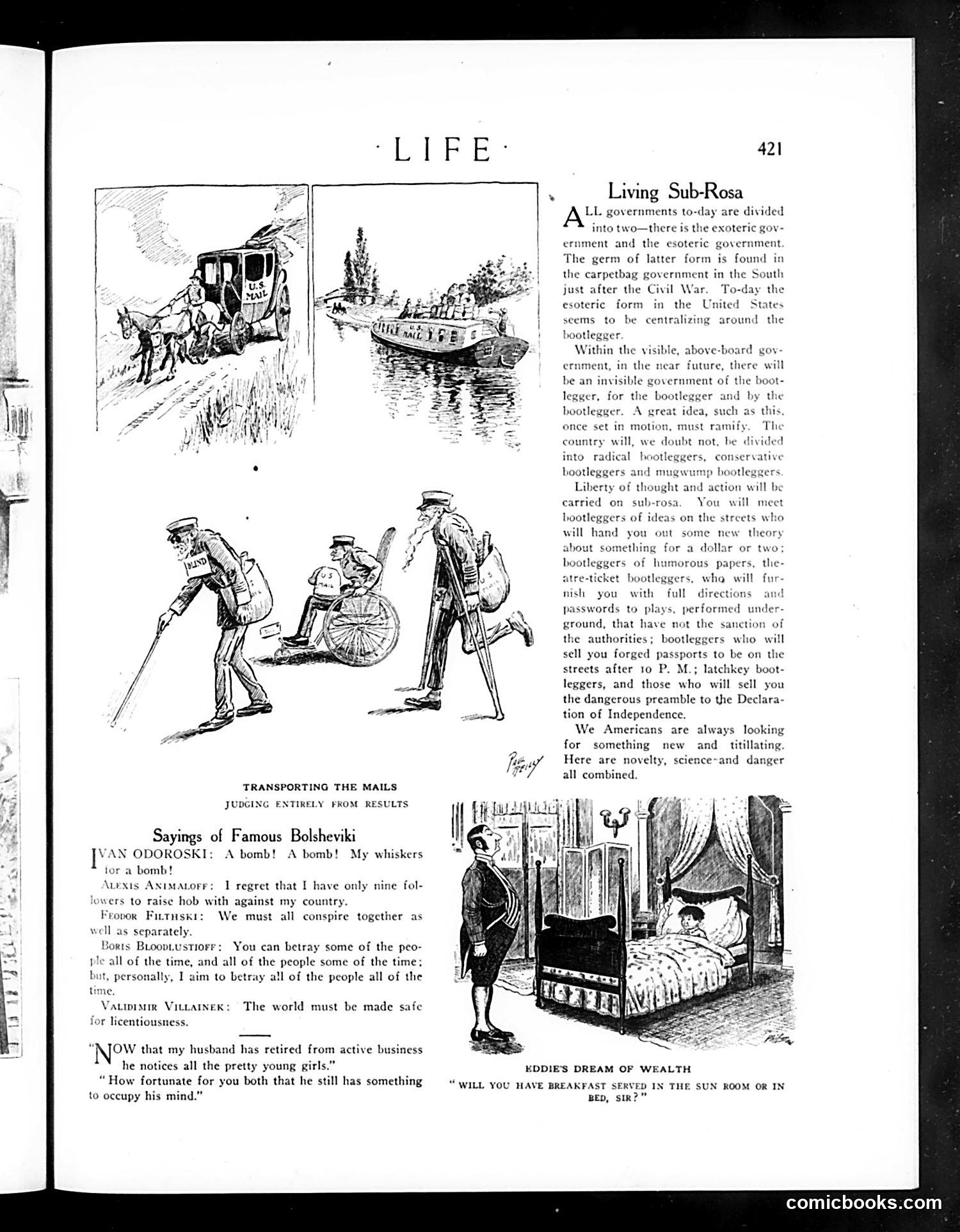
This page satirizes Prohibition-era bootlegging and anti-Bolshevik sentiment (circa early 1920s). **Upper section:** Fake "Famous Bolsheviki" quotes mock Russian revolutionaries with absurd, threatening statements about bombs and betrayal—reflecting American anxiety about communist infiltration post-Russian Revolution. **"Living Sub-Rosa":** The main article imagines an "invisible government" run by bootleggers (illegal alcohol smugglers), playing on 1920s fears that Prohibition had created an underground criminal power structure. It predicts bootleggers will splinter into ideological factions and offer illicit services (forged documents, theater tickets, passwords to speakeasies). The satire suggests Americans embrace danger and novelty despite (or because of) Prohibition's restrictions. **"Transporting the Mails":** Four comic illustrations show creative schemes for moving contraband during Prohibition. **"Eddie's Dream of Wealth":** A brief joke about wealth and leisure—a servant asking about breakfast service. The overall message critiques how Prohibition has paradoxically created organized criminal enterprise while Americans eagerly participate.
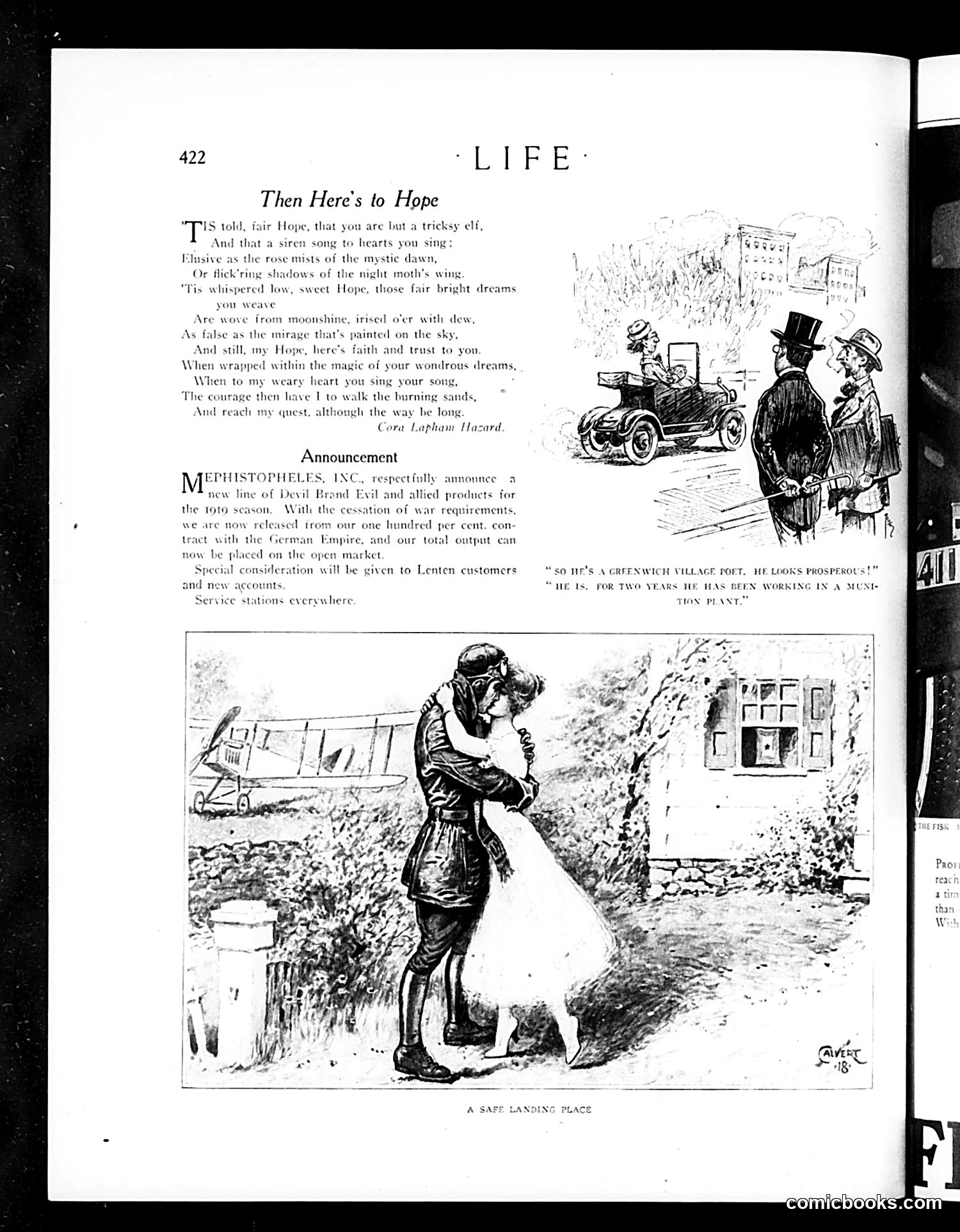
This page from *Life* magazine (likely 1919, given the reference to "war requirements" ending) contains three distinct elements: **"Then Here's to Hope"** is a sentimental poem by Cora Lapham Hazard about hope sustaining us through hardship—typical of post-WWI optimism literature. **The "Mephistopheles, Inc." announcement** is dark satire mocking Germany's defeat. It presents "Devil Brand Evil" as a company now freed from its "one hundred per cent contract with the German Empire." This sardonically suggests Germany was literally in service to evil during the war—a pointed jab at German wartime conduct. **The cartoon captioned "A Safe Landing Place"** shows a soldier embracing a woman while an airplane wreckage burns in the background. The dialogue mocks Greenwich Village bohemians: the woman assumes the man is a successful poet, but he's actually just returned from war work in a munitions plant. The satire targets pretentious artistic types who mistake working-class respectability for artistic success. Together, these pieces reflect post-WWI American attitudes: relief at Germany's defeat, sentimentality about soldiers returning home, and mockery of urban intellectual pretension.
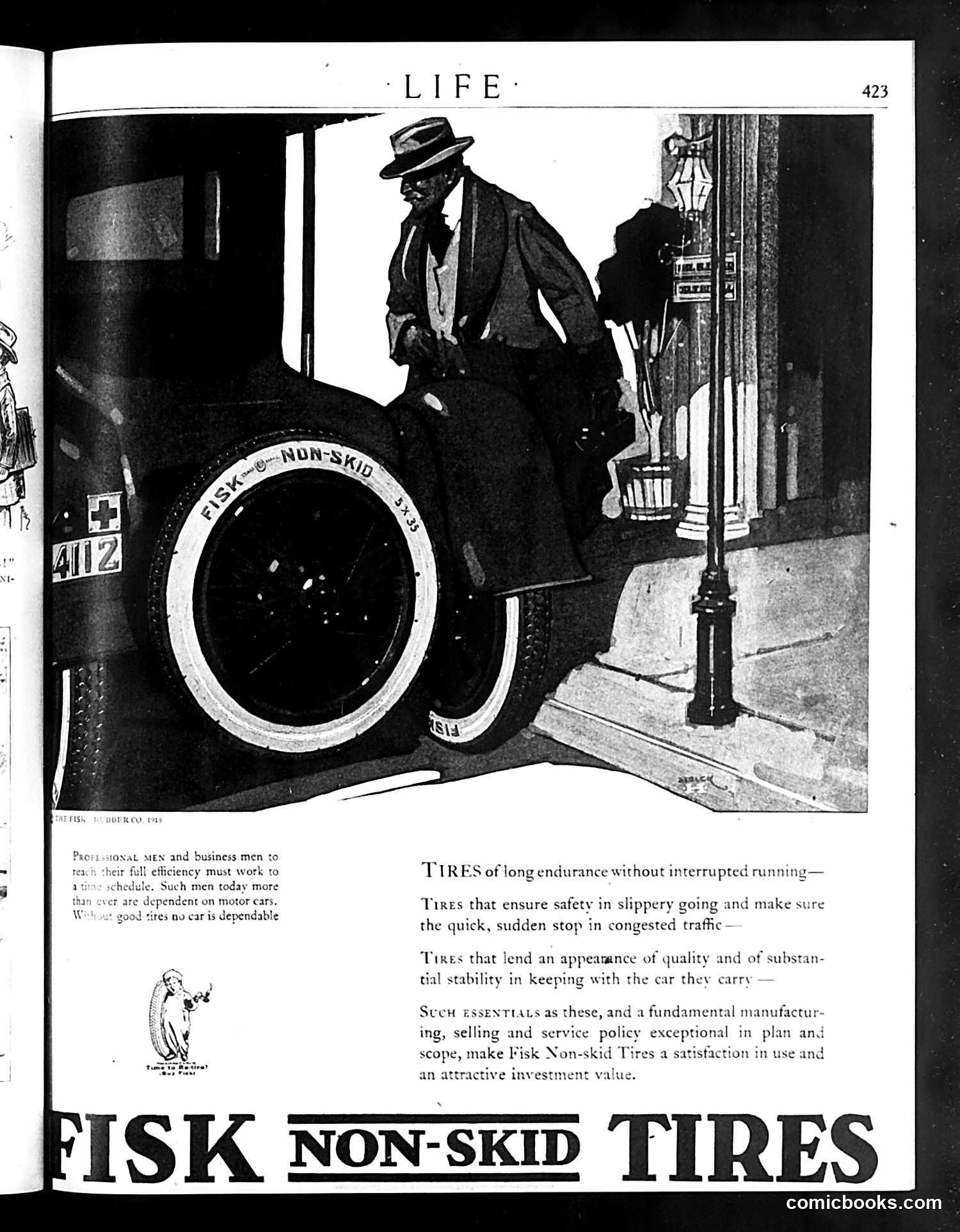
This is primarily a **tire advertisement**, not political satire. The page features a photograph of a businessman in a suit and fedora examining a Fisk Non-Skid tire on an early automobile. The ad targets professional and business men, arguing that reliable tires are essential for maintaining work schedules. It emphasizes practical benefits: long-lasting performance, safety on slippery roads, and reliable braking for city traffic congestion. The accompanying text positions quality tires as markers of professional competence and respectability—suggesting that the tires one chooses reflect the stability and quality of one's business. This is a straightforward early-automotive sales pitch appealing to the businessman's practical needs and social status concerns.
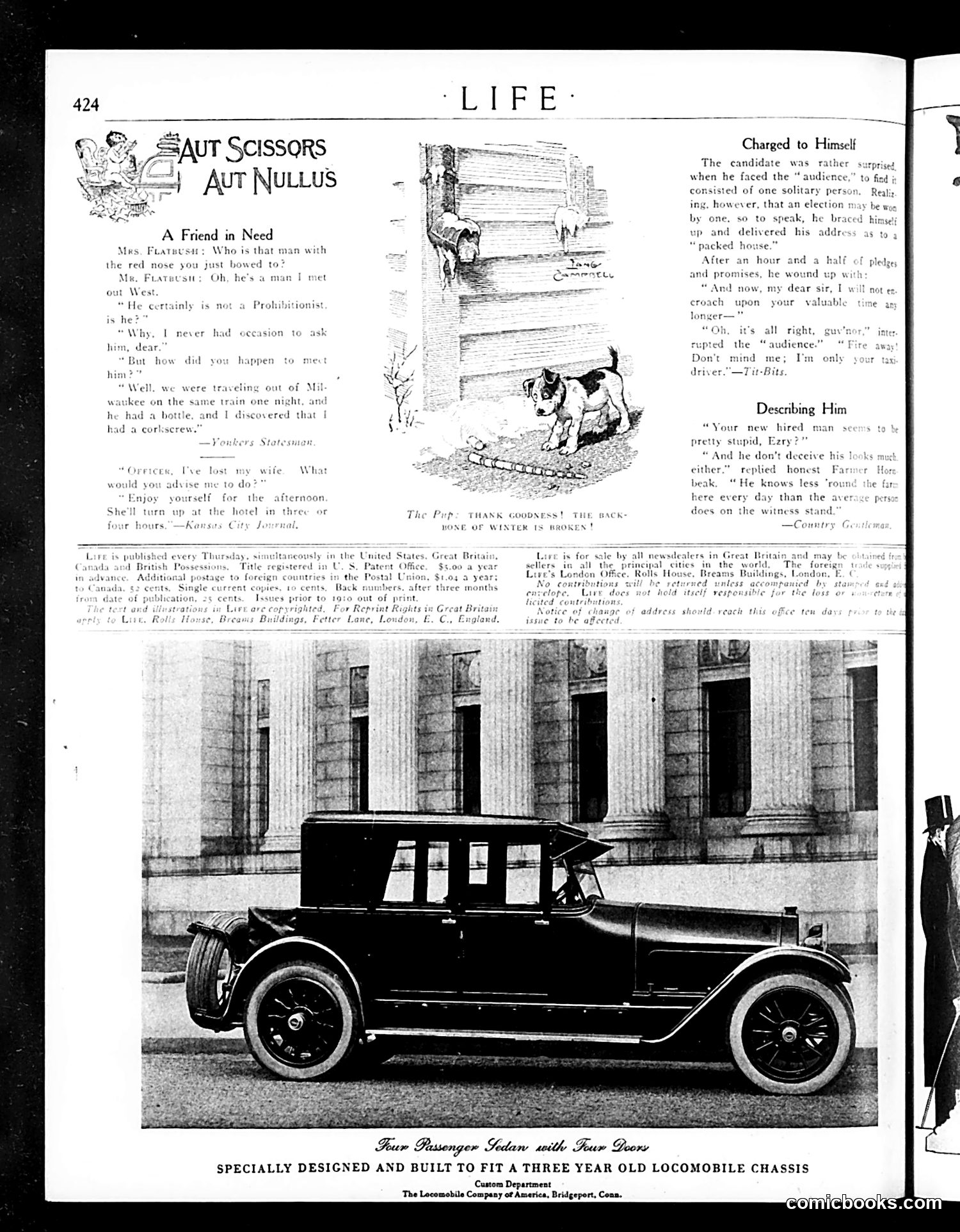
**"Aut Scissors / Aut Nullus" Section:** This appears to be a humor column featuring short anecdotes. The visible jokes include a domestic exchange about a man with a red nose (likely a drunk), and a workplace dialogue about a new hired hand who is "pretty stupid" but honest. These are gentle, period social satire about everyday characters—the drunk and the simple laborer—common subjects in early 20th-century humor. **Main Content:** The page is dominated by an automobile advertisement for a Locomobile four-door sedan, positioned as a luxury vehicle. The car imagery suggests this is primarily a commercial publication page mixed with satirical content. The cartoon imagery (a dog near what appears to be a house or structure) is difficult to interpret without its caption being fully legible, but appears unrelated to the automotive advertisement below it. **Overall Context:** This is a hybrid editorial/advertising page typical of Life magazine's era, mixing humor columns with product promotion.
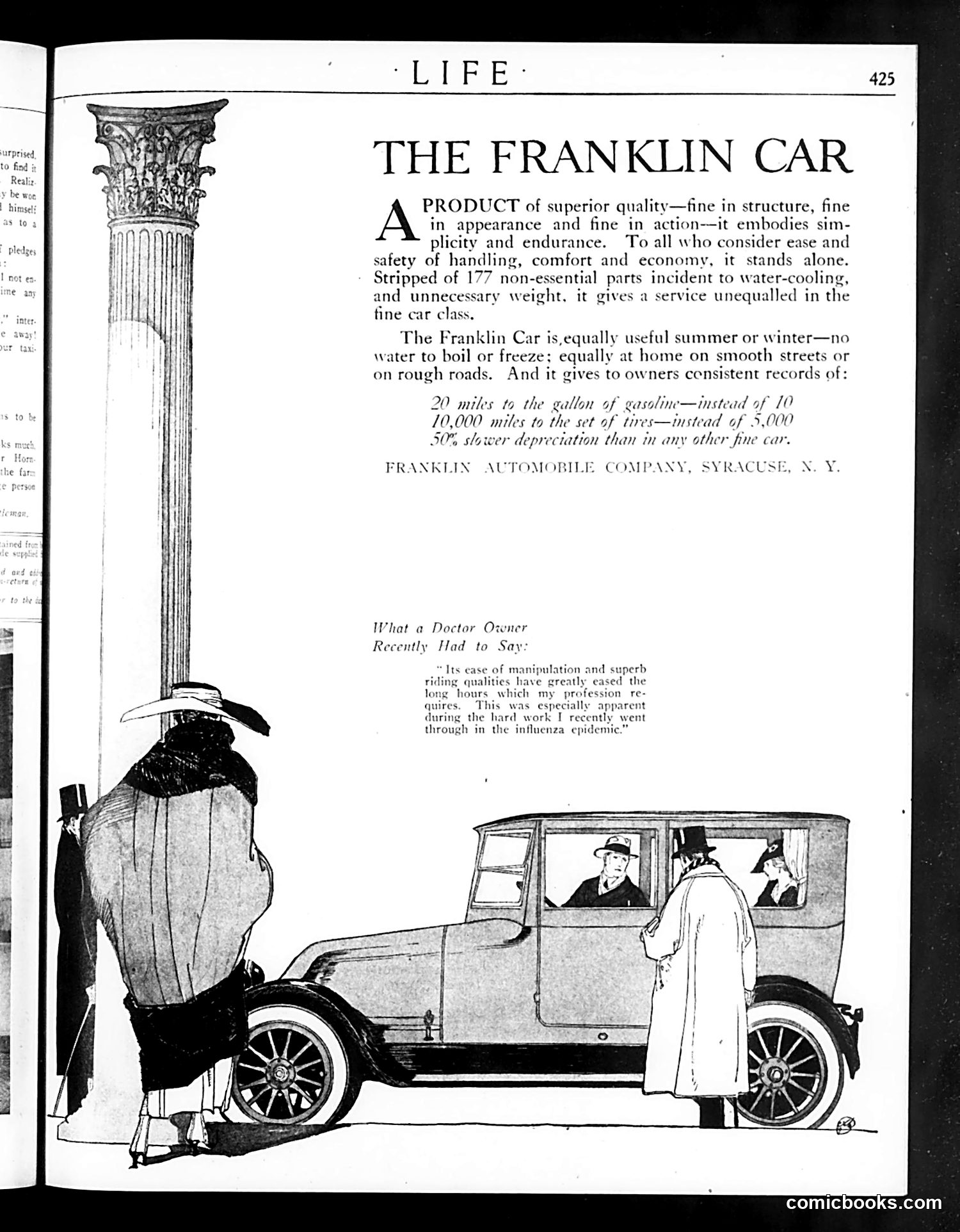
This is primarily a **product advertisement** for the Franklin Automobile Company, not political satire. The page promotes the Franklin car's mechanical superiority—particularly its air-cooled engine (stripped of 177 water-cooling parts), fuel efficiency (20 miles per gallon), and tire longevity (10,000 miles per set). The cartoon illustrates the car's practical appeal: a well-dressed woman and men in formal attire examine or ride in the vehicle, suggesting it's suitable for professional and genteel uses. The testimonial from "a doctor owner" references the 1918 influenza epidemic, positioning the car as reliable transportation during demanding circumstances. This grounds the advertisement in contemporary reality—the pandemic was current when this appeared—making reliability claims feel authentic rather than merely promotional. The satire, if any, is subtle: the ad subtly mocks competitors' cars by implication rather than direct attack.
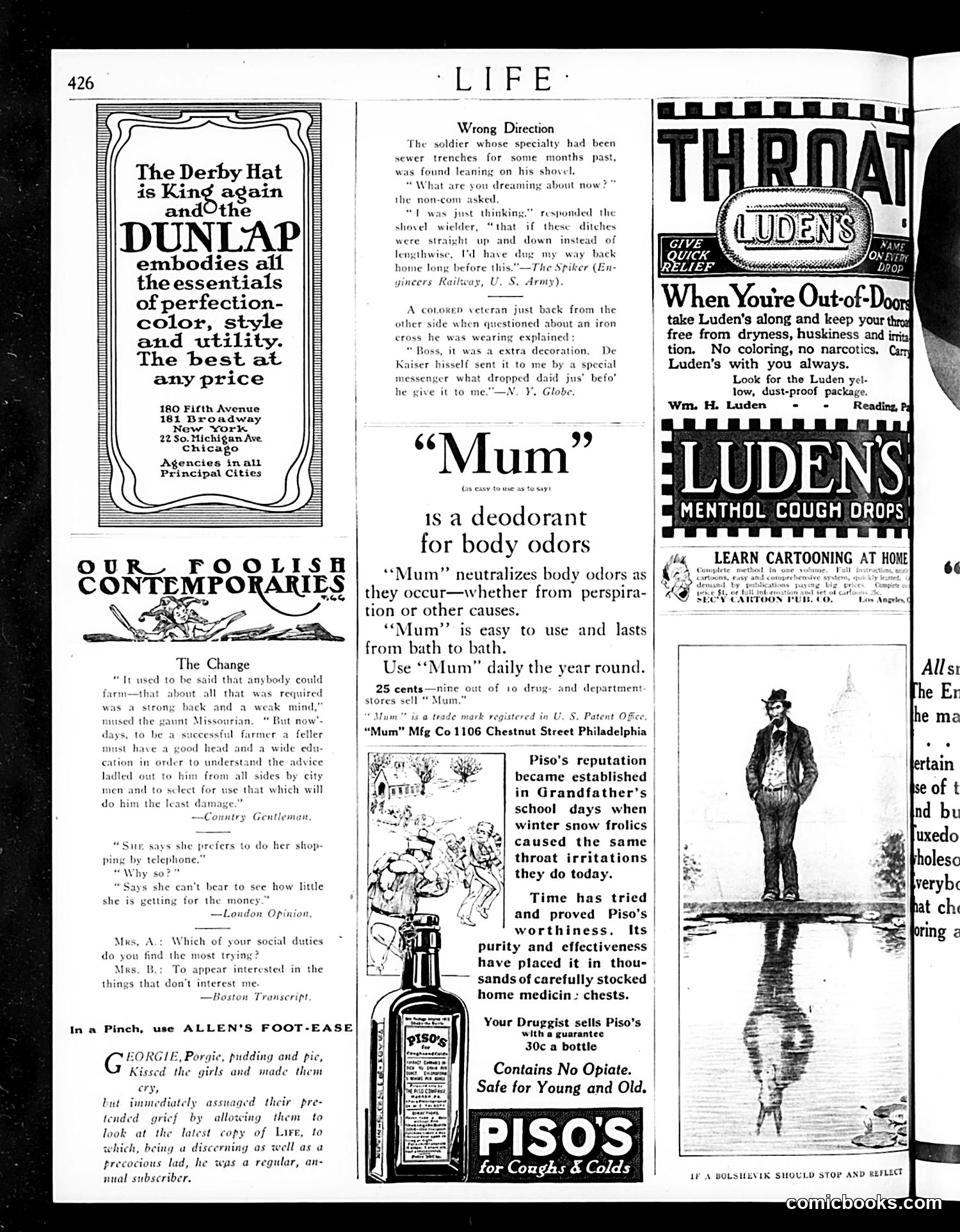
This page is primarily **advertising** for various consumer products (Dunlap hats, Mum deodorant, Piso's cough drops, Luden's throat lozenges, Allen's Foot-Ease), interspersed with brief humorous columns typical of Life's satirical format. The cartoon content includes: **"Wrong Direction"** — Two military anecdotes satirizing soldiers' naïveté. A trench-digger dreams of inverting ditches vertically (impractical), and a returning soldier misunderstands a German soldier's iron cross as a "decoration" sent by the Kaiser, suggesting comic misinterpretation of wartime experiences. **"The Change"** — A short column mocking farmers' evolving education and women's telephone shopping habits, typical period social satire about changing gender roles and consumerism. The page reflects WWI-era Life: mixing consumer advertising with gentle military humor and social commentary on modernization and gender dynamics.
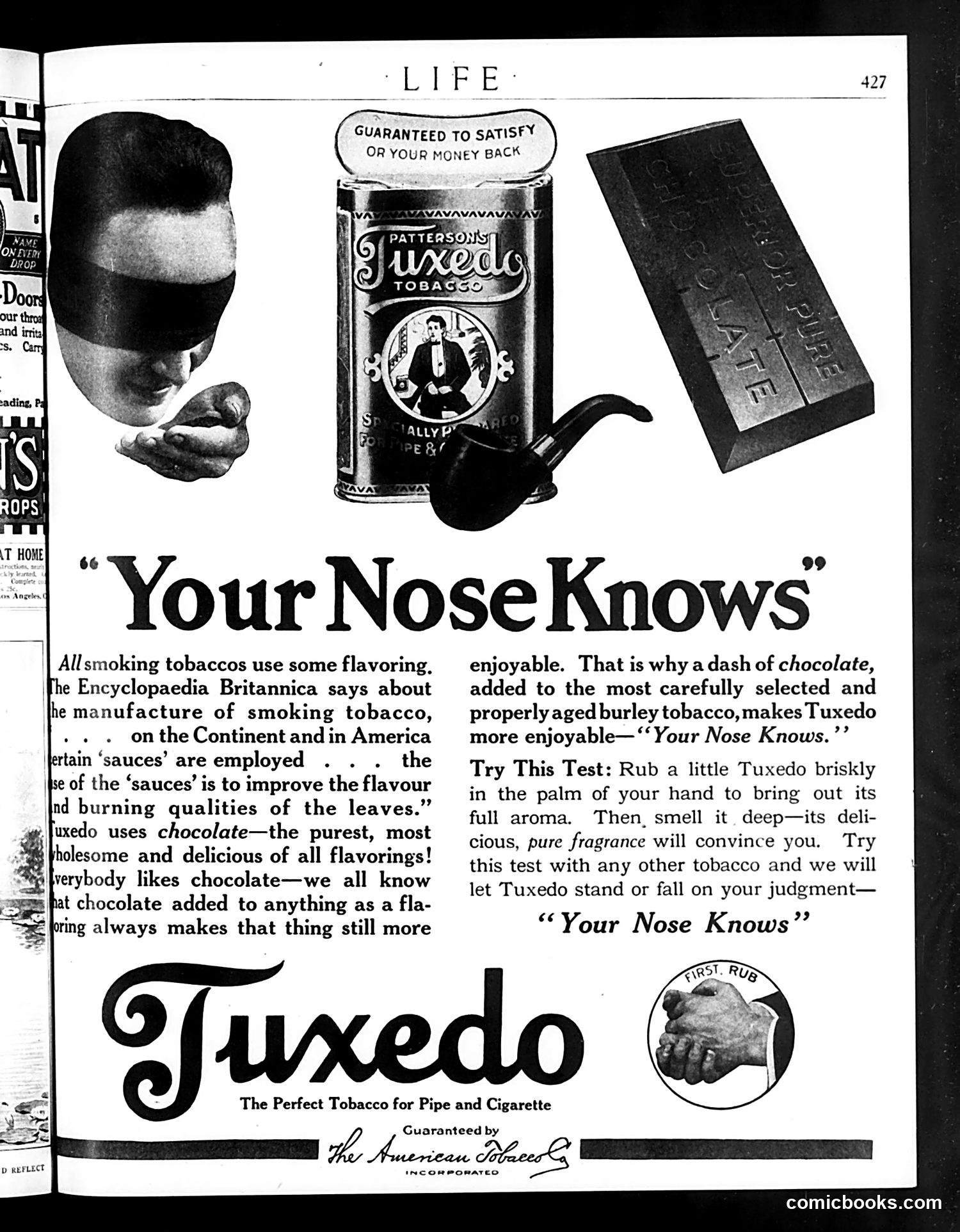
This is a full-page **tobacco advertisement**, not satire. It promotes Tuxedo brand pipe and cigarette tobacco by appealing to consumers' sense of smell. The ad's main claim: chocolate flavoring makes Tuxedo superior to competitors. The imagery shows a blindfolded man (suggesting impartial judgment), the product package, and a soap bar, alongside instructional text encouraging readers to perform a smell test to verify quality. The phrase "Your Nose Knows" serves as both slogan and evidence—implying objective sensory proof. The "Guaranteed to Satisfy or Your Money Back" banner emphasizes consumer confidence. **For modern readers:** This represents an era when tobacco advertising was legal and unregulated in mainstream magazines. The appeal to scientific authority (Encyclopedia Britannica citation) and consumer testing reflects early 20th-century marketing strategy. No health warnings appear—tobacco's dangers weren't yet widely acknowledged in advertising.
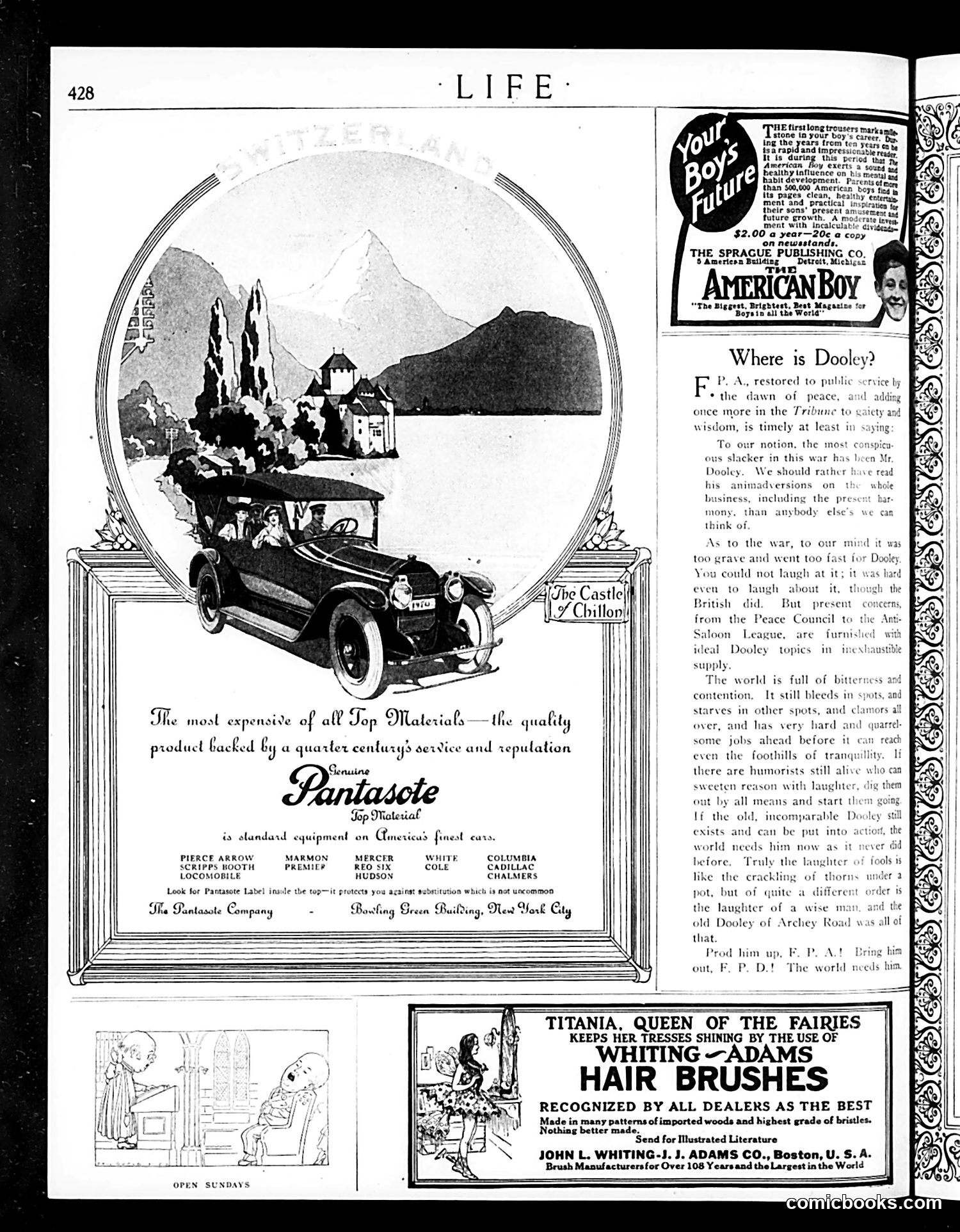
This page combines advertisements with editorial commentary on a notable public figure's return to prominence. **Main Content:** The editorial "Where is Dooley?" discusses the anticipated return of Mr. Dooley—a fictional Irish-American character known for satirical social commentary—to writing in the *Tribune* newspaper following World War I. The author argues that post-war America needs Dooley's humorous perspective on serious matters like the Peace Council and the Saloon League, noting that "the laughter of a wise man" is valuable during times of bitterness and contention. **Visual Elements:** The page features two advertisements—one for Pantasote automobile interiors (showing a luxury car near a castle) and one for Whiting-Adams hair brushes. A small cartoon labeled "Open Sundays" appears at bottom left but is too small to read clearly. **Context:** Mr. Dooley was a popular satirical character created by journalist Finley Peter Dunne, whose witty observations on American life and politics made him influential in early 20th-century journalism.
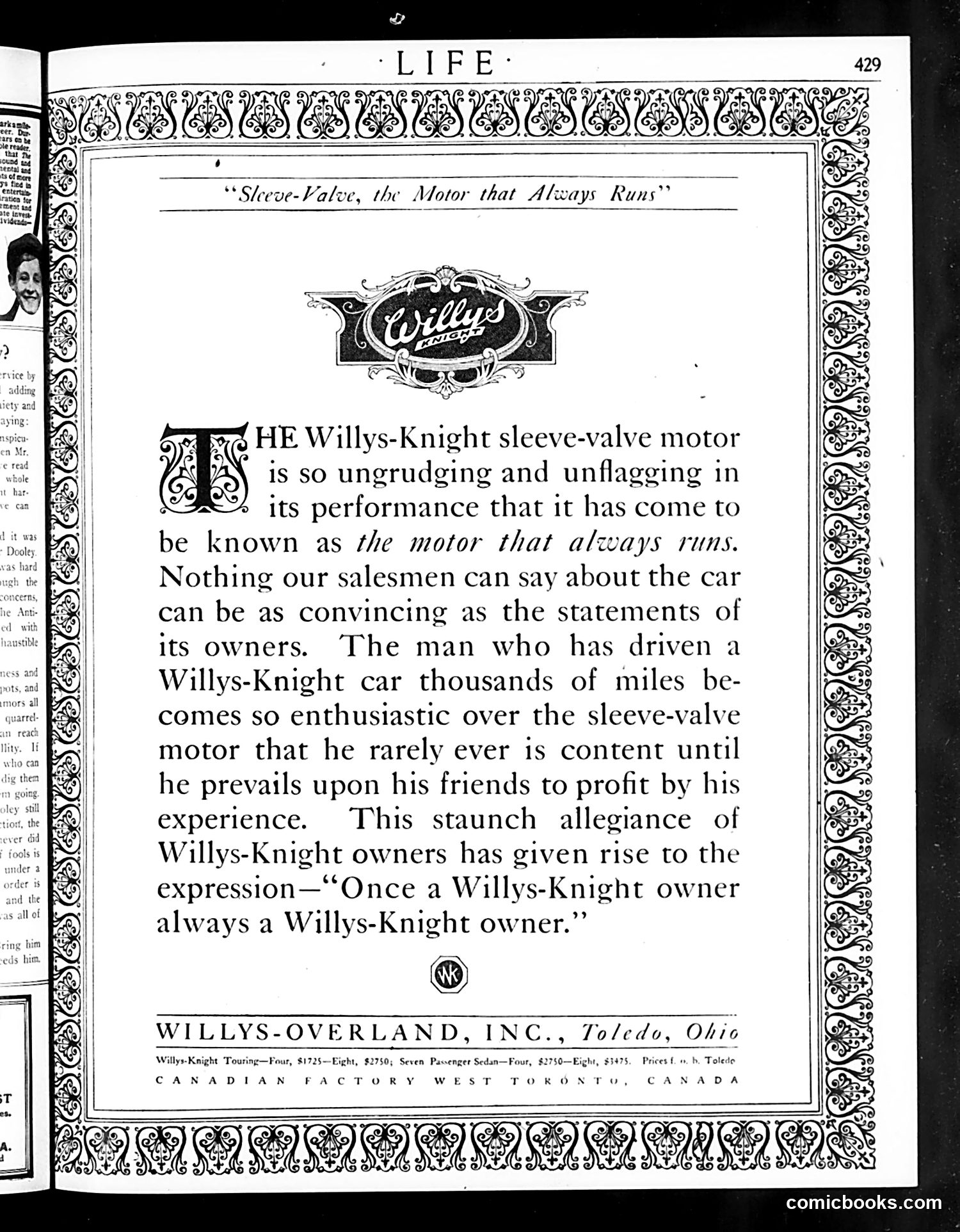
This is **not a cartoon or satire**—it's a straight automobile advertisement from Life magazine. The page promotes the **Willys-Knight**, a real car manufactured by Willys-Overland, Inc. (Toledo, Ohio). The ad emphasizes the reliability of the sleeve-valve motor, claiming it "always runs" and generates owner loyalty so strong that customers evangelize to friends. The tagline—"Once a Willys-Knight owner always a Willys-Knight owner"—reflects genuine brand loyalty messaging common in early automotive advertising. There is no political satire or caricature here. Life magazine, while known for satirical content, also carried standard commercial advertisements. This page represents straightforward 1920s marketing using testimonial-style copy to build consumer confidence in a specific automobile model and its mechanical innovation (the sleeve-valve motor).
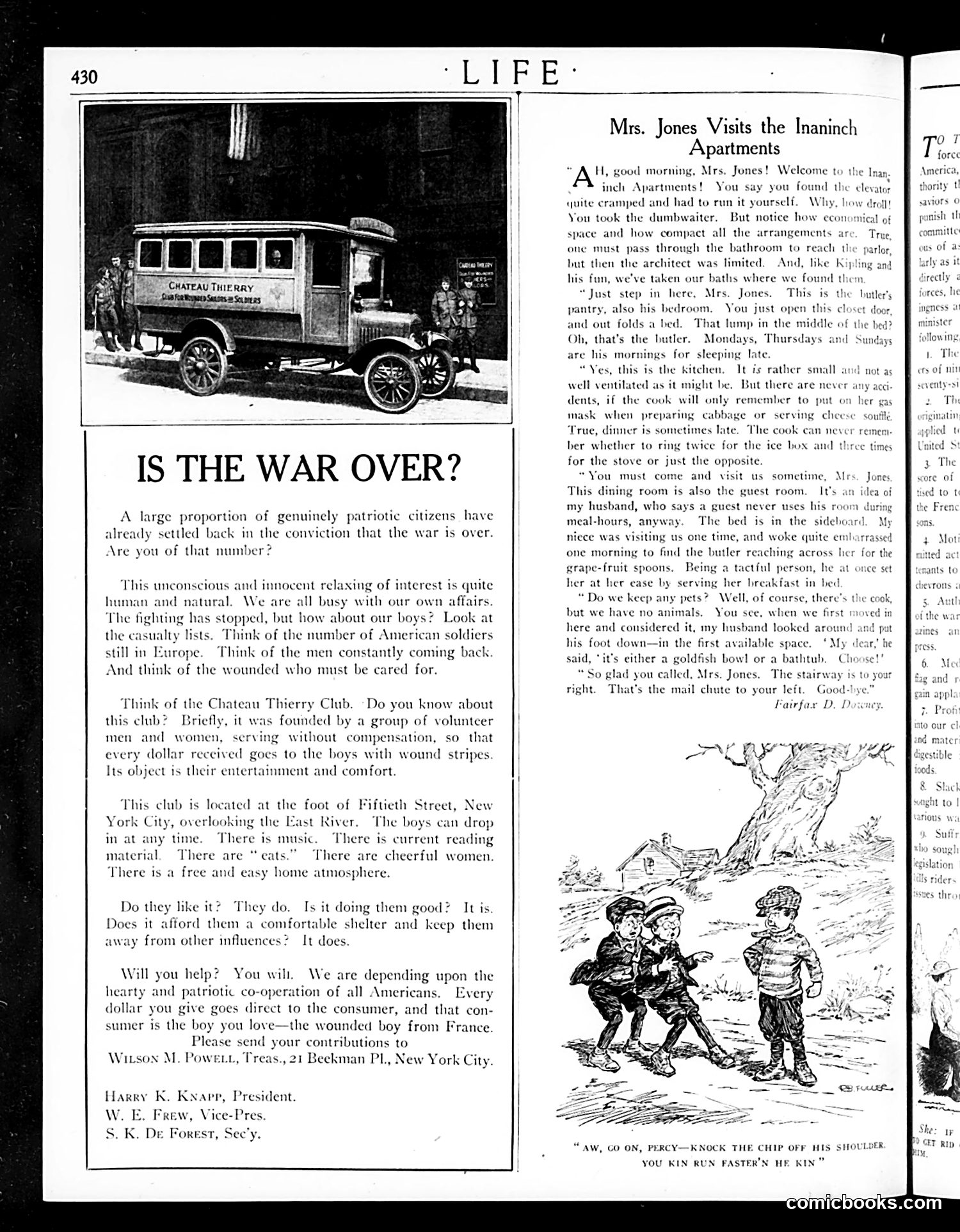
This page contains two distinct pieces of satire from the post-WWI era: **Left column ("Is the War Over?")**: A fundraising appeal for the Chateau Thierry Club, a real organization assisting wounded American soldiers returning from Europe. The text urges readers not to assume the war is truly "over" simply because fighting has stopped—thousands of soldiers remain abroad, casualties continue arriving home, and wounded men need care and comfort. It's a patriotic guilt-appeal soliciting donations. **Right column ("Mrs. Jones Visits the Inaninch Apartments")**: A satirical domestic humor piece mocking cramped, poorly-designed urban apartment living. Through a real-estate agent's tour, it reveals absurd conditions: elevators you operate yourself, bathrooms you must pass through to reach bedrooms, kitchens so small cooking creates hazards, a butler who sleeps in a closet, and a dining room that doubles as a guest bedroom. The satire targets the gap between landlord promises and actual living conditions in crowded cities. The bottom cartoon (unrelated) shows children at play, with one urging another to "knock the chip off his shoulder"—common period slang for provoking a fight.
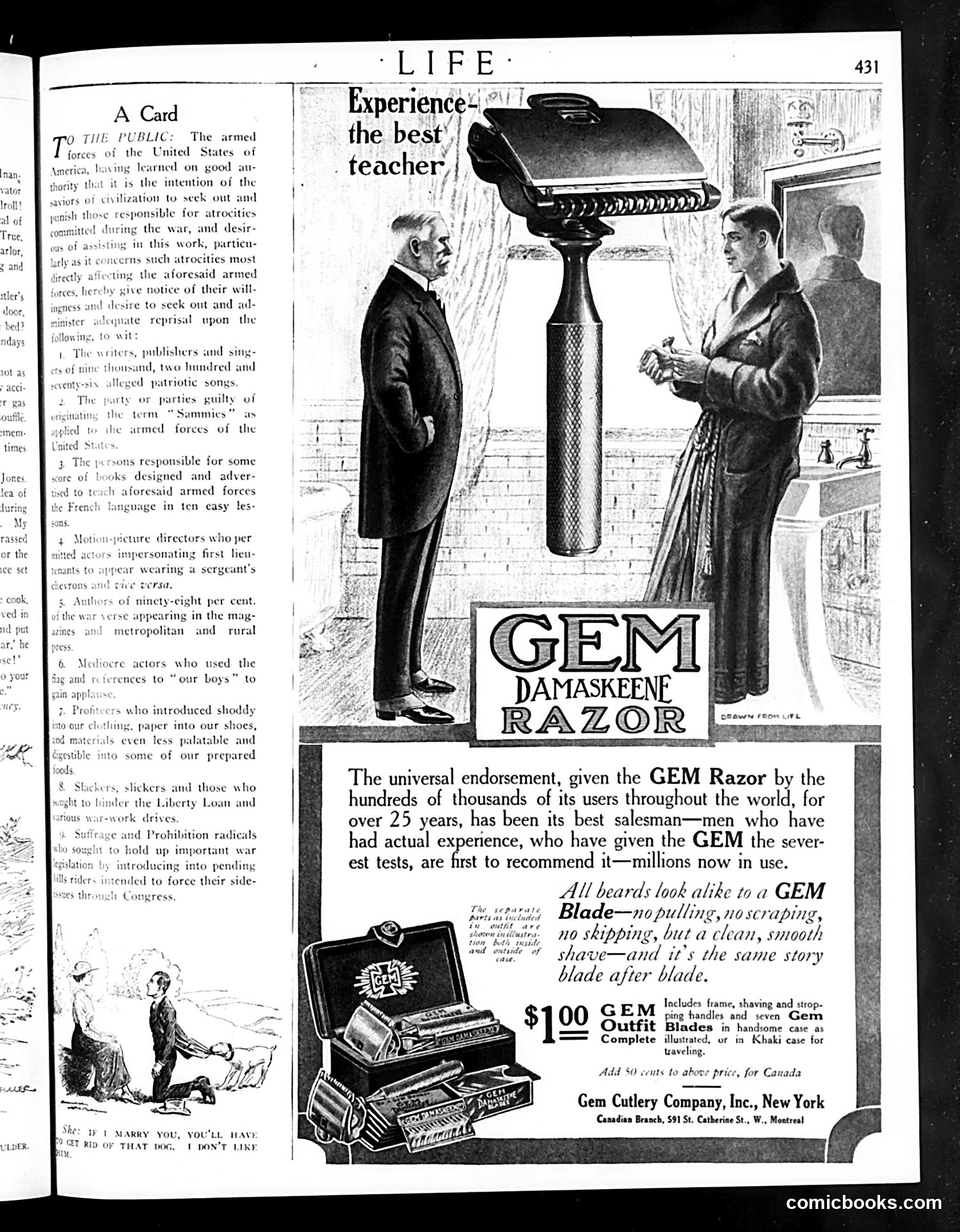
This page combines satirical editorial content with advertising. The left column presents "A Card to the Public"—a satirical list of those responsible for wartime profiteering and misconduct, including publishers of patriotic songs, actors who exploited patriotism, those who sold defective goods to the armed forces, and prohibition radicals who obstructed war loans. The tone is bitterly ironic, mock-seriously proposing these groups deserve "reprisal" for their exploitation during WWI. The main illustration shows two men examining a GEM Damascene Razor—a straightforward product advertisement claiming 25 years of user endorsement. The ad emphasizes reliable performance through "actual experience." The juxtaposition is the satire's point: while the editorial denounces wartime profiteers and con artists, a full-page advertisement occupies the same space, selling consumer goods. This exemplifies the very commercialism and profit-seeking the editorial criticizes—Life itself profits from advertising while mocking those who exploited the war effort.
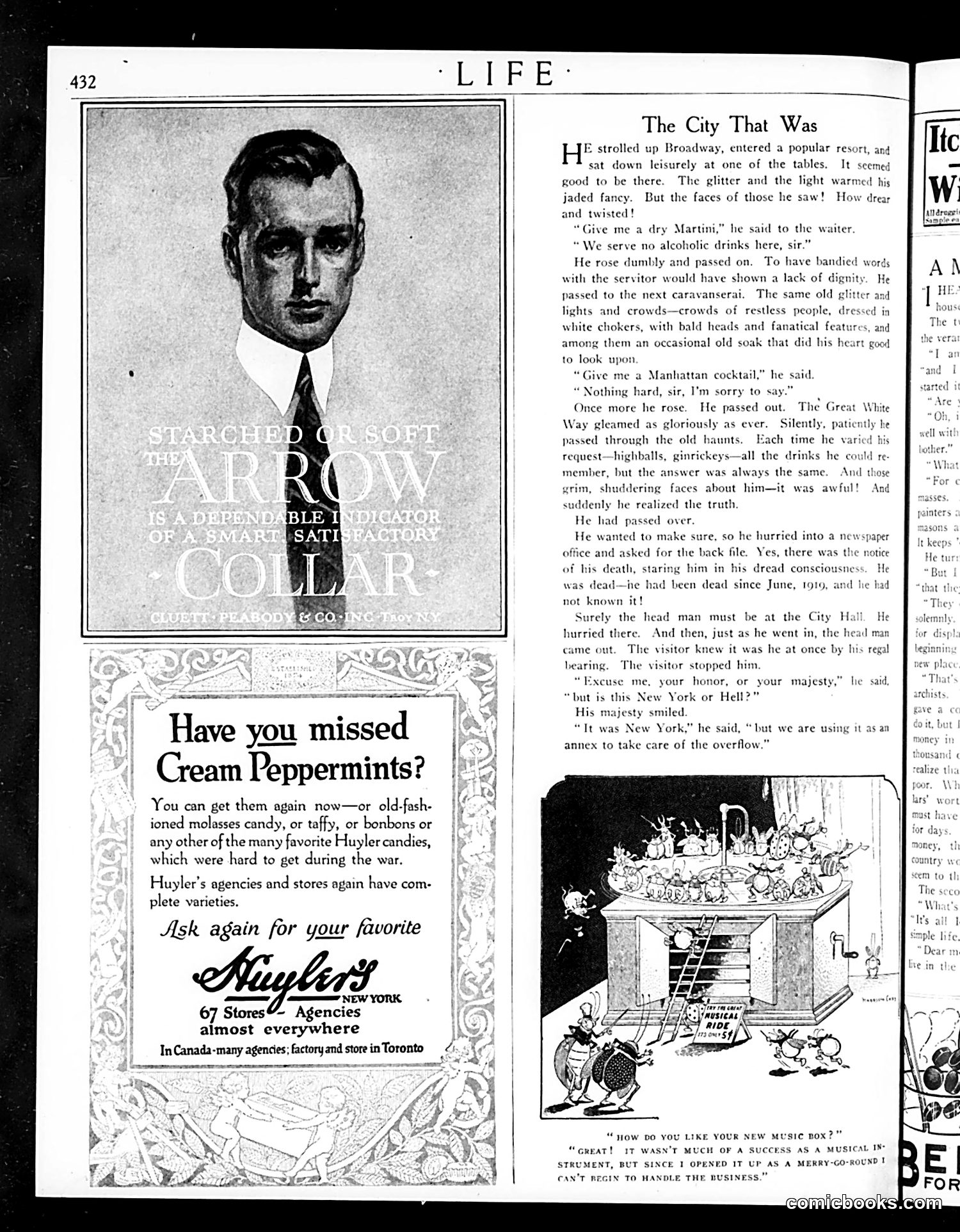
**Main Content: "The City That Was"** This satirical story depicts a man discovering he's dead, having died in June 1919 without realizing it. He wanders Broadway seeking alcoholic drinks at bars—only to find Prohibition has closed them all. The twist: he asks a city official if New York is Hell, and the mayor replies New York is now serving as "an annex" to Hell due to overcrowding. **The Satire** The piece mocks Prohibition (which began January 1920) as so oppressive that New York itself has become hellish. The grim, "fanatical" faces of citizens and shuttered bars symbolize the law's deadening effect on urban life. It's a dark joke about how a formerly vibrant city has become a dead zone. **Advertisements** The Arrow Collar ad and Huyler's Candy ad (noting candies were "hard to get during the war") reflect post-WWI consumer culture re-normalizing. **Bottom cartoon** appears to be a separate joke about a music box converted into a profitable merry-go-round, unrelated to the main narrative.
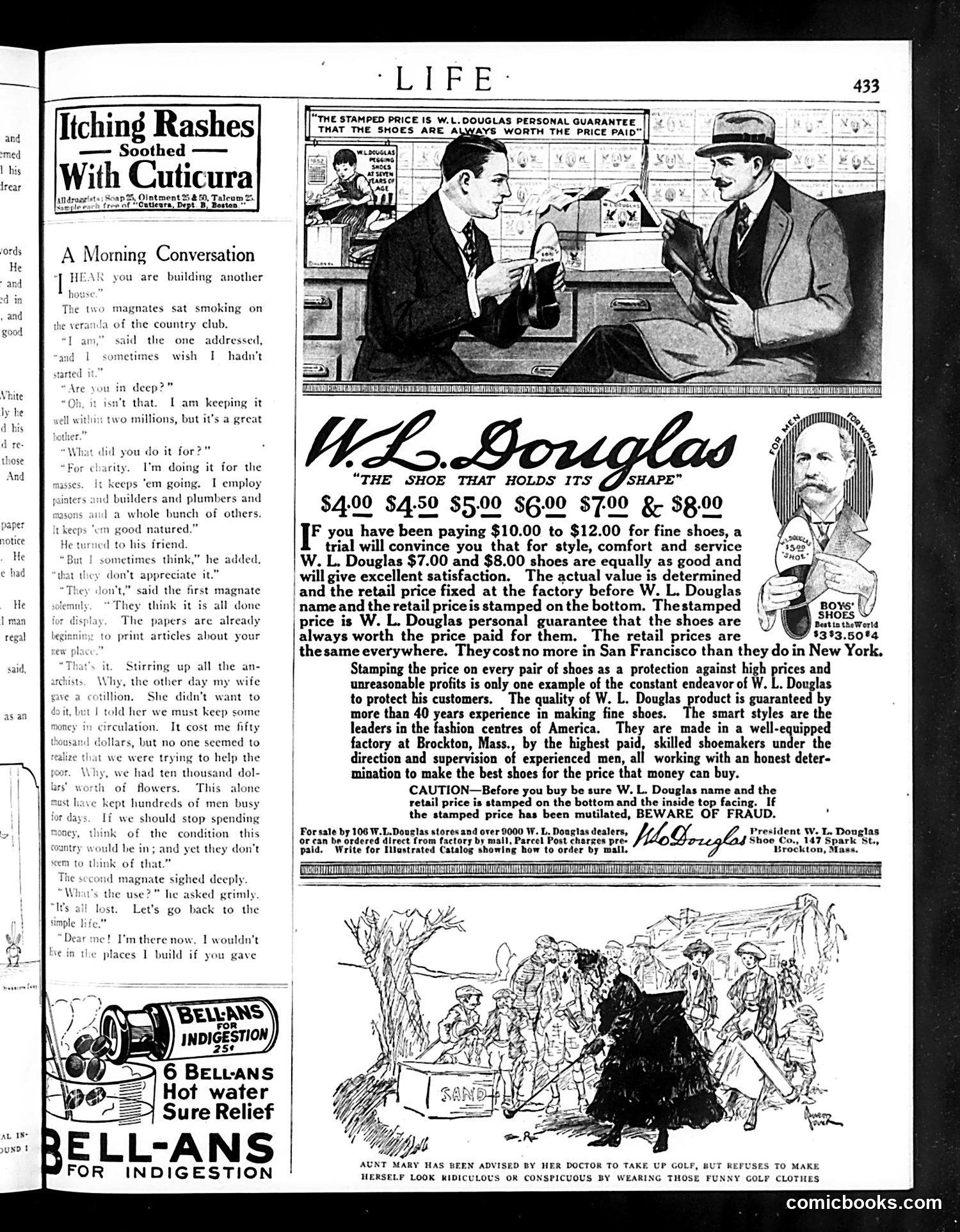
**"A Morning Conversation"** satirizes wealthy industrialists' self-justifying rhetoric about labor exploitation. Two country club magnates discuss building projects; one claims he's "keeping money in circulation" by employing workers at low wages, framing this as philanthropy rather than profit-driven business. The joke exposes the hypocrisy: he presents bare subsistence employment as generosity while hoarding wealth ("two millions"), and dismisses workers' actual needs. The conversation mocks how the wealthy rationalize inequality through paternalistic language. **The bottom cartoon** mocks women's fashion anxieties. "Aunt Mary" refuses to wear standard golf attire because she fears looking "ridiculous or conspicuous"—prioritizing social conformity and appearance over pursuing the activity itself, even on doctor's orders. It satirizes how women's self-consciousness about propriety constrains their freedom. Both pages are primarily **advertisements** (Cuticura, Bell-ans, W.L. Douglas shoes), typical of Life magazine's revenue model.
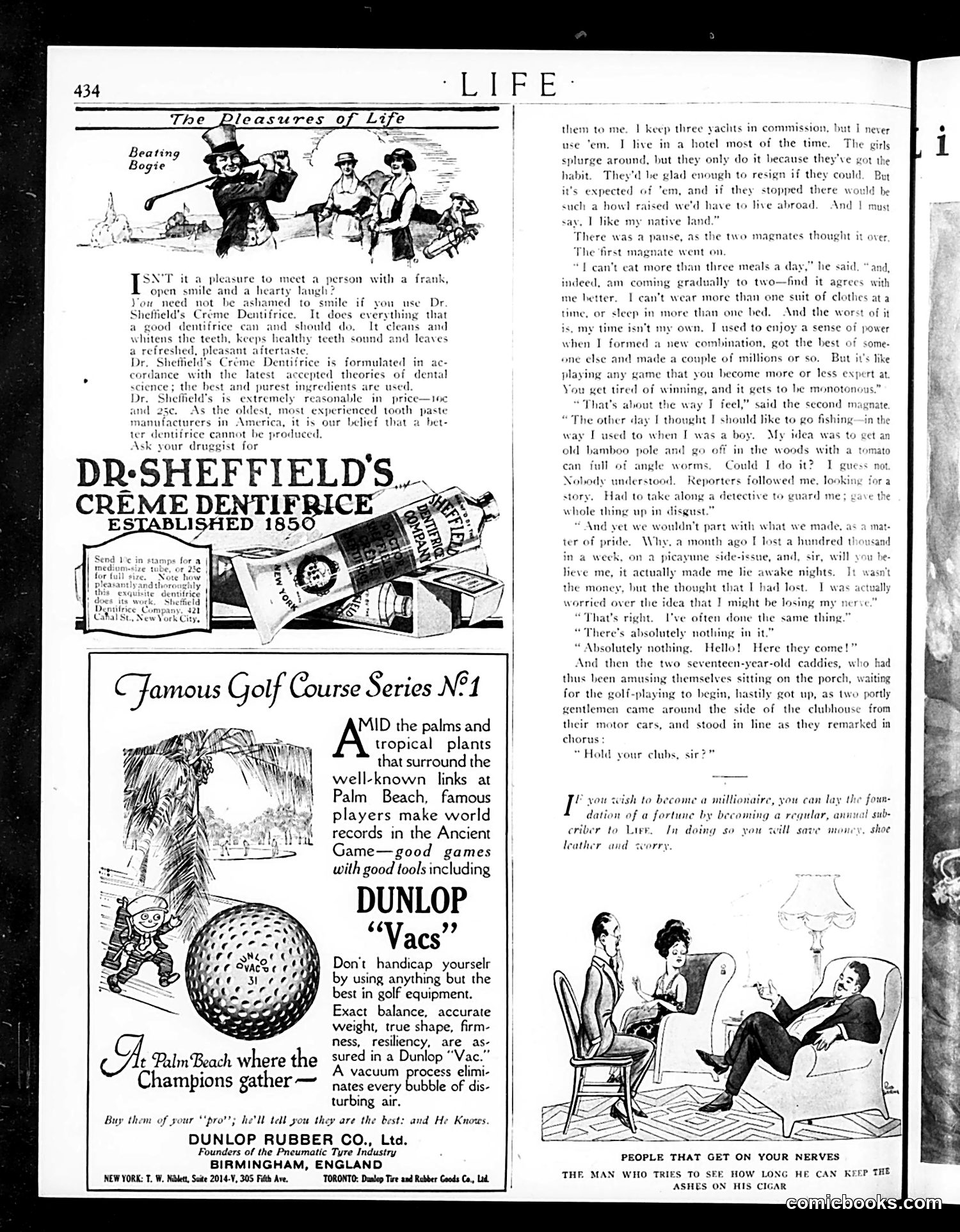
This page contains a satirical dialogue between two wealthy magnates complaining about the burdens of wealth. They boast about owning yachts they never use, multiple homes, and extravagant lifestyles—yet claim to be trapped by social expectations and unable to enjoy simple pleasures like fishing. The satire targets **wealthy industrialists of the era** who, despite their material abundance, feel constrained by the need to maintain appearances and display their fortunes. Their observation that they "can't eat more than three meals a day" or sleep in more than one bed mocks the absurdity of unlimited wealth meeting finite human needs. The punchline—that losing money actually kept one awake at night, not from financial hardship but wounded pride—exposes vanity as their true concern. The page is primarily **advertising** (toothpaste, golf equipment) with this narrative as editorial content. The social commentary reflects 1920s anxiety about conspicuous consumption and the psychological hollowness of excess wealth.