
Life, 1919-03-13 · page 24 of 42
Life — March 13, 1919 — page 24: what you’re looking at
What you’re looking at
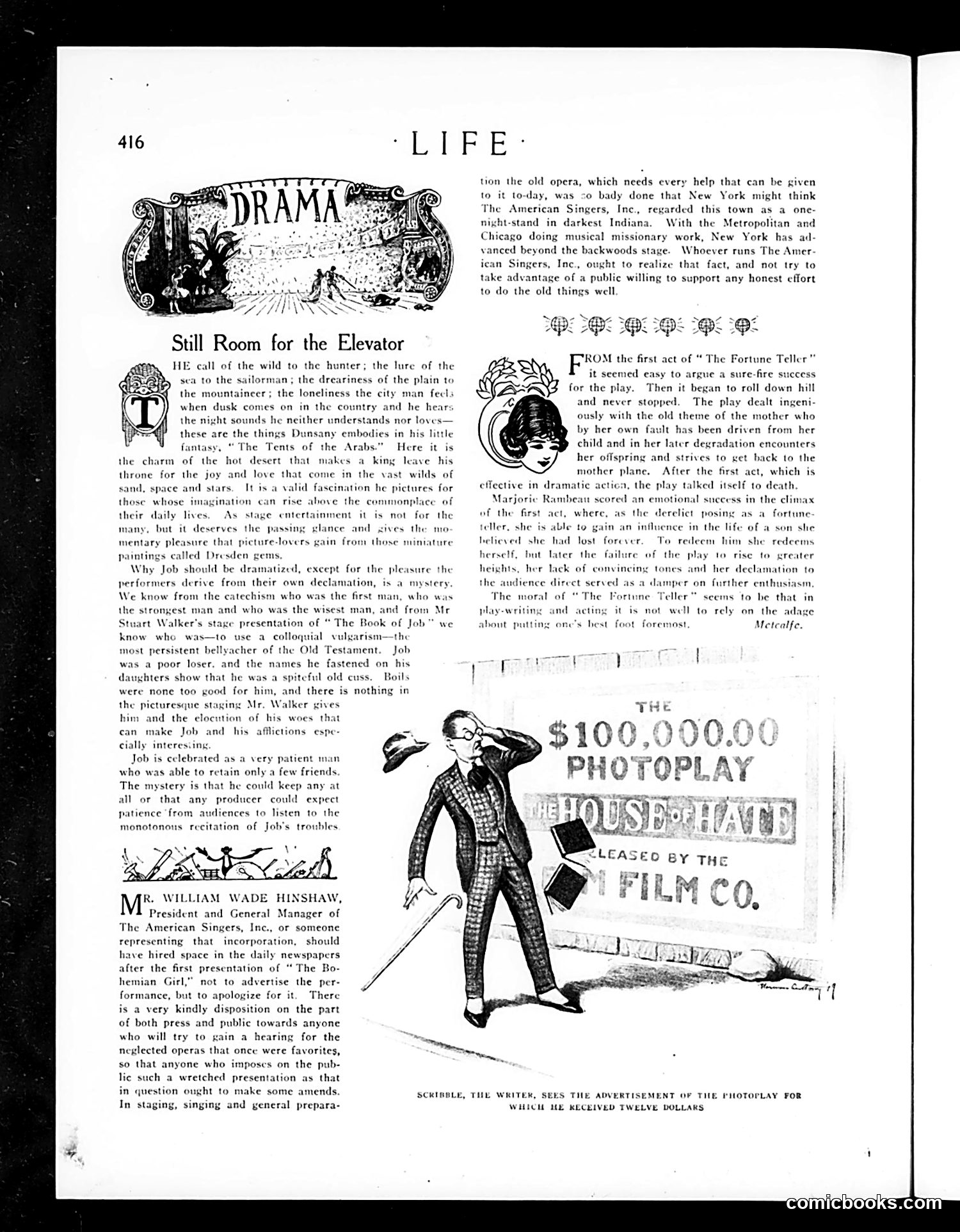
This page from *Life* magazine contains drama criticism and advertising rather than political cartoons. The main content critiques three theatrical productions: **"The Tents of the Arabs"** — praised as imaginative fantasy, though acknowledged as niche entertainment. **"The Book of Job"** — mocked for its tedious, self-indulgent staging. The critic sarcastically notes Job is celebrated as "patient" and a "poor loser," suggesting the play's lengthy recitation of complaints tests audience endurance. **"The Bohemian Girl" by The American Singers, Inc.** — harshly criticized for poor production quality. The critic suggests the company treated New York like "darkest Indiana," implying the performance was unacceptably provincial for a sophisticated city already served by the Metropolitan Opera and Chicago's musical efforts. **The advertisement** for a $100,000 photoplay ("House of Hate") shows a mustachioed man discovering advertisements—a self-referential joke about advertising itself. The satire targets theatrical mediocrity and companies exploiting audiences' goodwill toward neglected art forms.
📄 Transcribed text from this page (OCR, searchable)
Machine-transcribed from the original scan — historical spelling and the odd misread are preserved.
LTP E eal Room for the Elevator 2 call of the wild to the hunter; the lure of the sea to the s: ; the dreariness of the plain to the mountaineer; the loneliness the an feet when dusk comes on in the country and he hears the night sounds he neither understands nor loves— these are the things Dunsany embodies in his little fantasy, “The Tents of the Arabs.” Here it is the charm of the hot desert that makes a king leave his throne for the joy and love that come in the vast wilds of sand, space and stars. It is a valid fascination he pictures for sonplace of those whose imagination can rise above the their daily lives, As stage entertainment it is not for the . but it deserves the passing glance and gives the mo ntary pleasure that 7 paintings called Dresden gems cture-lovers gain from those miniature Why Job should be dramatized, except for the pleasure performers derive from their own declamation, is We know from the the strongest man and who was the wisest man, and from Mr rt Walker's stage presentation of “ The Book of Job” we know who was—to use a colloquial vulgarism—the most persistent bellyacher of the Old Testament. a poor loser. and the names he fastened on his hters show that he was a sj were none too good for him, and there is nothing in the picturesque staging Mr. Walker gives mystery. catechism who was the first man, who was ful old cuss. Boils him and the elocution of his woes that can make Job and his afflictions espe- cially interesting Job is celebrated as a very patient man who was able to retain only a few friends. The mystery is that he could keep any all or that any producer could expect nto the monotonous recitation of Job's troubles patience “from audiences to li R. WILLIAM WADE HINSHAW, President and General Manager of The American Singers, Inc., or someone representing that incorporation, should have hired space in the daily newspapers after the first presentation of “ The Bo- hemian Girl,” not to advertise the per- formance, but to apologize for it. There is a very kindly disposition on the part of both press and public towards anyone who will try to gain a hearing for the neglected operas that once were favorites, so that anyone who imposes on the pub- lic such a wretched presentation as that in question ought to make some amends. In staging, singing and general prepara- SCKIRDLE, THE WRITER, SEES THE ADVERTE tion the old opera, which needs every help that can be given to it to-day, was co bady done that New York might think The American Singers, Inc. regarded this town as a one- night-stand in darkest Indiana. With the Metropolitan and Chicago doing musical missionary work, New York has ad- vanced beyond the backwoods stage. Whoever runs The Amer- ican Singers, Inc., ought to realize that fact, and not try to take advantage of a public willing to support any honest effort to do the old things well @ > Fortune Teller” it seemed easy to argue a sure-fire success for the play. Then it began to roll down hill and never stopped. The play dealt ingeni- ously with the old theme of the mother who by her own fault has been driven from her child and in her later degradation encounters her offspring and strives to get back to the After the first act, which is effective in dramatic action, the play talked itself to death. ~s mother plane. Marjoric Rambeau scored emotional success in the clim of the first act, where, teller, she as the derelict posing as a. fort the life of a son she To redeem him she redeems able to nan influence helieved she had lost forever. herself, but 1 the failure of the play to rise to gr heights, her lack of convineing tones and her declamation to the audience direct served as a damper on further enthusiasm, The al of “ The ortne Teller” seems to be that in play-writing and acting it is not well to rely on the adage Metcalfe. about patting one’s hest foot foremost arenes ENT OF THE FHOTOPLAY FOR WHICH ALE KECEIVED TWELVE DOLLARS