
Life, 1919-03-13 · page 40 of 42
Life — March 13, 1919 — page 40: what you’re looking at
What you’re looking at
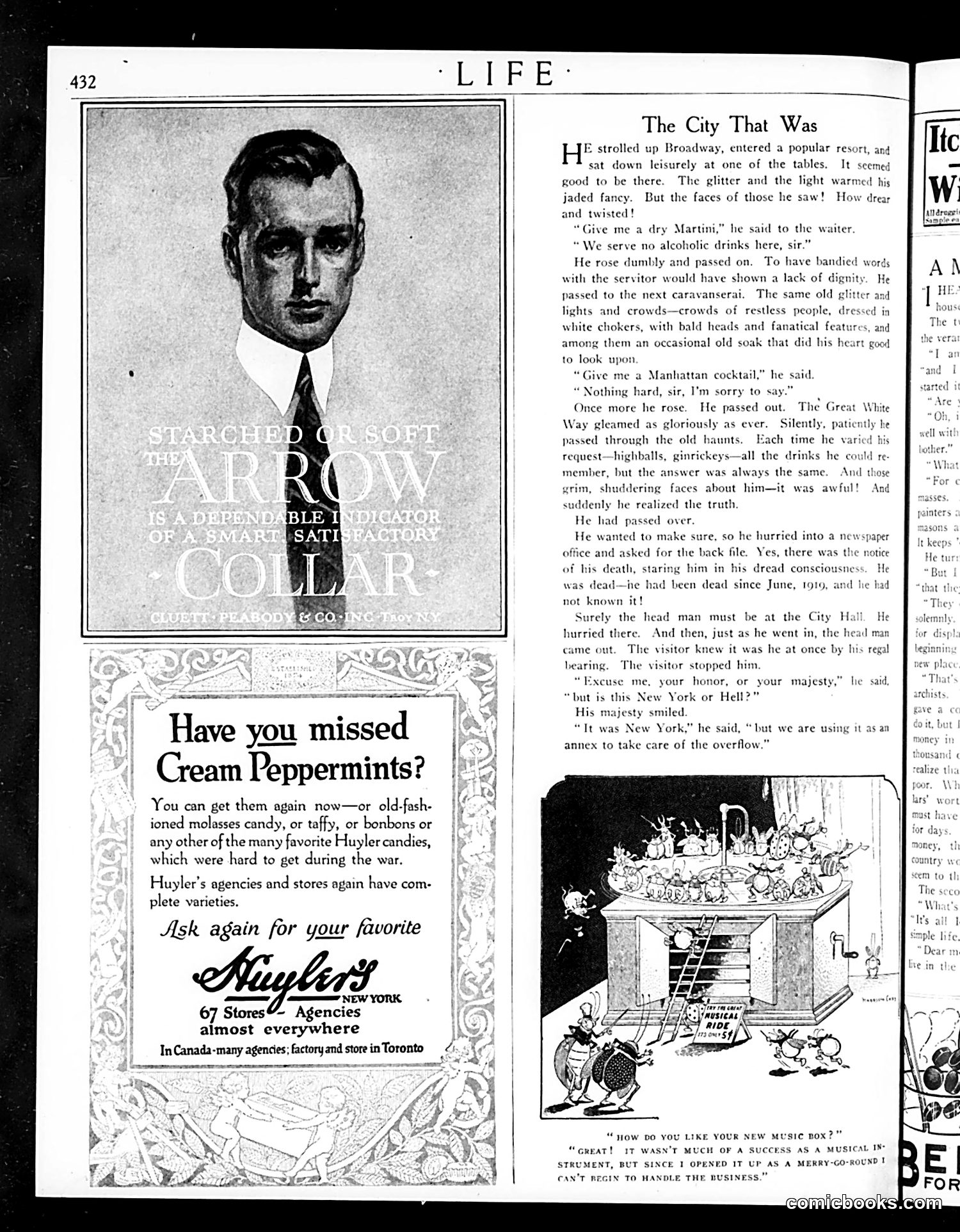
**Main Content: "The City That Was"** This satirical story depicts a man discovering he's dead, having died in June 1919 without realizing it. He wanders Broadway seeking alcoholic drinks at bars—only to find Prohibition has closed them all. The twist: he asks a city official if New York is Hell, and the mayor replies New York is now serving as "an annex" to Hell due to overcrowding. **The Satire** The piece mocks Prohibition (which began January 1920) as so oppressive that New York itself has become hellish. The grim, "fanatical" faces of citizens and shuttered bars symbolize the law's deadening effect on urban life. It's a dark joke about how a formerly vibrant city has become a dead zone. **Advertisements** The Arrow Collar ad and Huyler's Candy ad (noting candies were "hard to get during the war") reflect post-WWI consumer culture re-normalizing. **Bottom cartoon** appears to be a separate joke about a music box converted into a profitable merry-go-round, unrelated to the main narrative.
📄 Transcribed text from this page (OCR, searchable)
Machine-transcribed from the original scan — historical spelling and the odd misread are preserved.
~ Have you missed | Geam Peppermints? You can get them again now—or old-fash- ioned molasses candy, or taffy, or bonbons or any other of the many favorite Huyler candies, which were hard to get during the war. Huyler’s agencies and stores again have com- plete varieties. Ask again for your favorite Agencies almost everywhere In Canada-many agencies; factory and store in Toronto The City That Was E strolled up Broadway, entered a popular resort, and sat down leisurely at one of the tables. It seemed good to be there. The glitter and the light warmed his jaded fancy. But the faces of those he saw! How drear and twisted! “Give me a dry Martini,” he said to the waiter, “We serve no alcoholic drinks here, sir.” He rose dumbly and passed on. To have bandied words with the servitor would have shown a lack of dignity. Hi passed to the next caravanserai. The same old gl nd lights and crowds—crowds of restless people, dressed in white chokers, with bald heads and fanatical featur among them an occasional old soak that did his heart good to look upon Give me a Manhattan cocktail,” “Nothing hard, sir, I'm sorry to say. Once more he rose. He passed out. The ( Way gleamed as gloriously as ever. Silently, patiently he passed through old haunts. Each time he var request—highballs, ginrickeys—all the drinks he member, but the answer was always the same. And those grim, shuddering faces about him—it was awful! And suddenly he realized the truth. He had passed over. He wanted to make sure, so he hurried into a newspaper office and asked for the back file. Yes, there was the notice of his death, staring him in his dread con: was dead—he had been dead since June, 1919, ar not known it! Surely the head man must be at the City Hall. He hurried there. And then, just as he went in, the head man came out. The visitor knew it was he at once by his regal bearing. The visitor stopped him. xcuse me, your honor, or your majesty,” he said, “but is this New York or Hell?” His majesty smiled. “Tt was New York,” he said, “ but we are using it as an annex to take care of the overflow.” “low vo YoU LIKE YOUR NEW MUSIC Box?” “Great! IT WASN'T MUCH OF A SUCCESS AS A MUSICAL IN* STRUMENT, BUT SINCE 1 OPENED IT UP AS A MERRY-GO-ROUND T CAN'T REGIN TO HANDLE THE BUSINESS.”