
A complete issue · 38 pages · 1919
Life — February 6, 1919
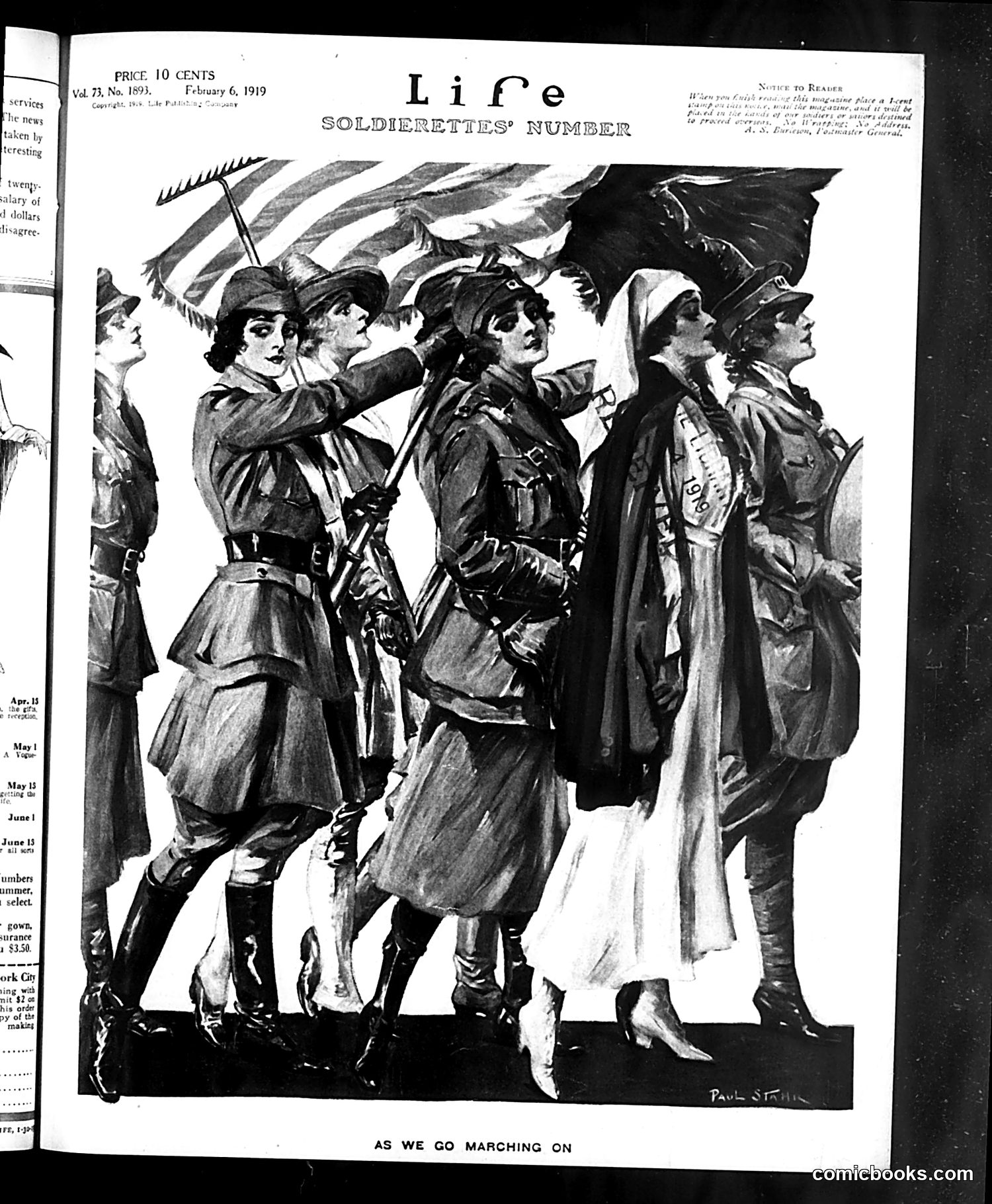
This is the cover of Life's "Soldierettes' Number," published shortly after WWI's armistice (November 1918). The illustration by Paul Staith depicts five women in military uniforms and cloaks, marching forward with flags held high, titled "As We Go Marching On." The cartoon celebrates women's military service during the war—women served in auxiliary roles as nurses, drivers, and support personnel. The heroic, triumphant pose and flags suggest pride in their contributions. However, the satirical tone typical of Life magazine may also contain subtle commentary on gender roles or the novelty of women in uniform, though the primary message appears straightforwardly celebratory of female wartime service contributions.
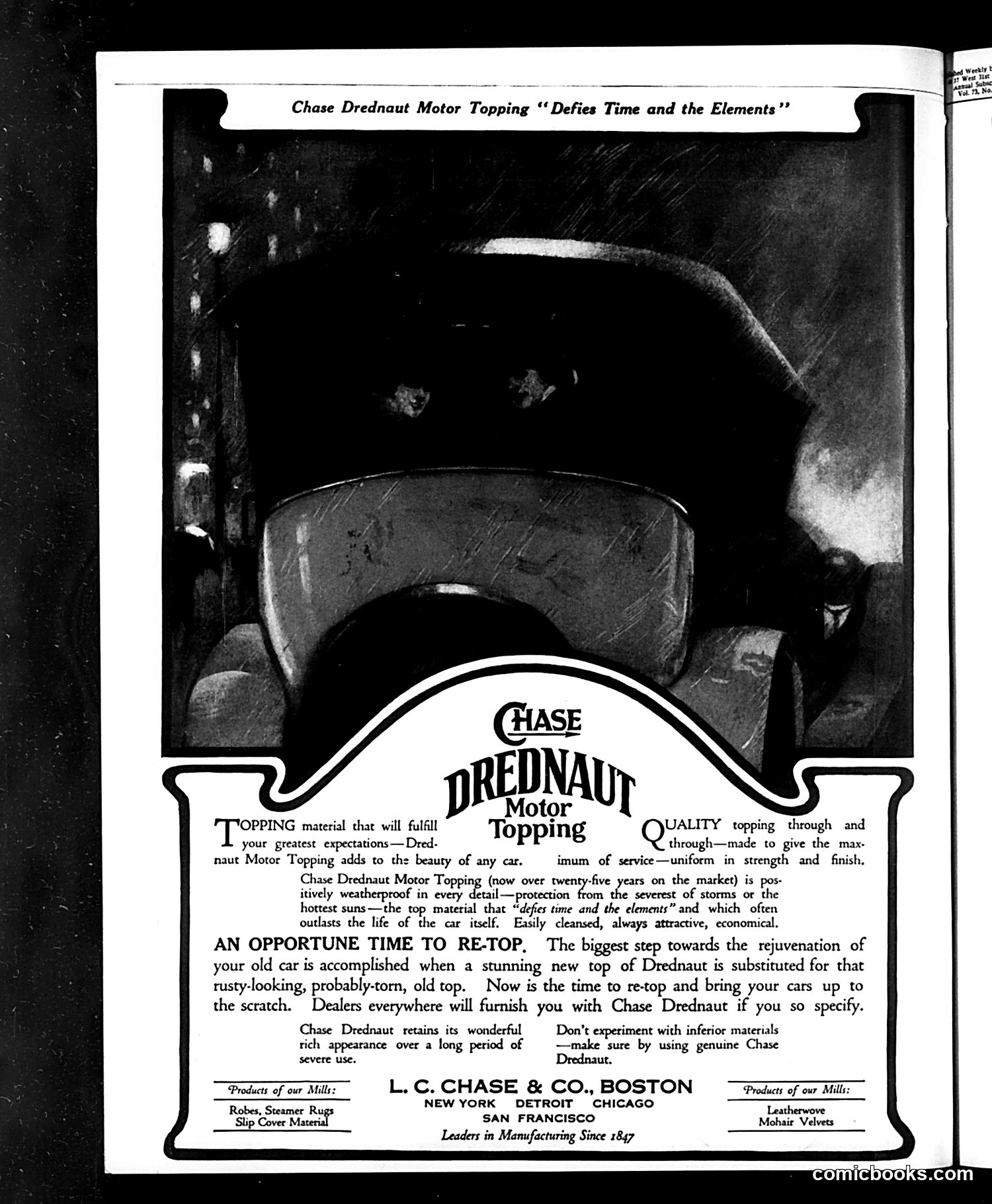
This page is **primarily an advertisement**, not political satire. It's a full-page ad for Chase Drednaut Motor Topping, a car roof material manufactured by L.C. Chase & Co. (Boston, New York, Detroit, Chicago, and San Francisco). The image shows a vintage automobile photographed from behind, emphasizing the roof's appearance. The ad copy promotes the product as weatherproof, durable, and superior to worn or torn car tops. It encourages customers to re-top their old cars with Chase Drednaut material, emphasizing quality and longevity ("over twenty-five years on the market"). The headline references "Defies Time and the Elements"—a marketing claim about the product's durability. There is no political commentary or satire on this page; it's straightforward early-20th-century automotive advertising.
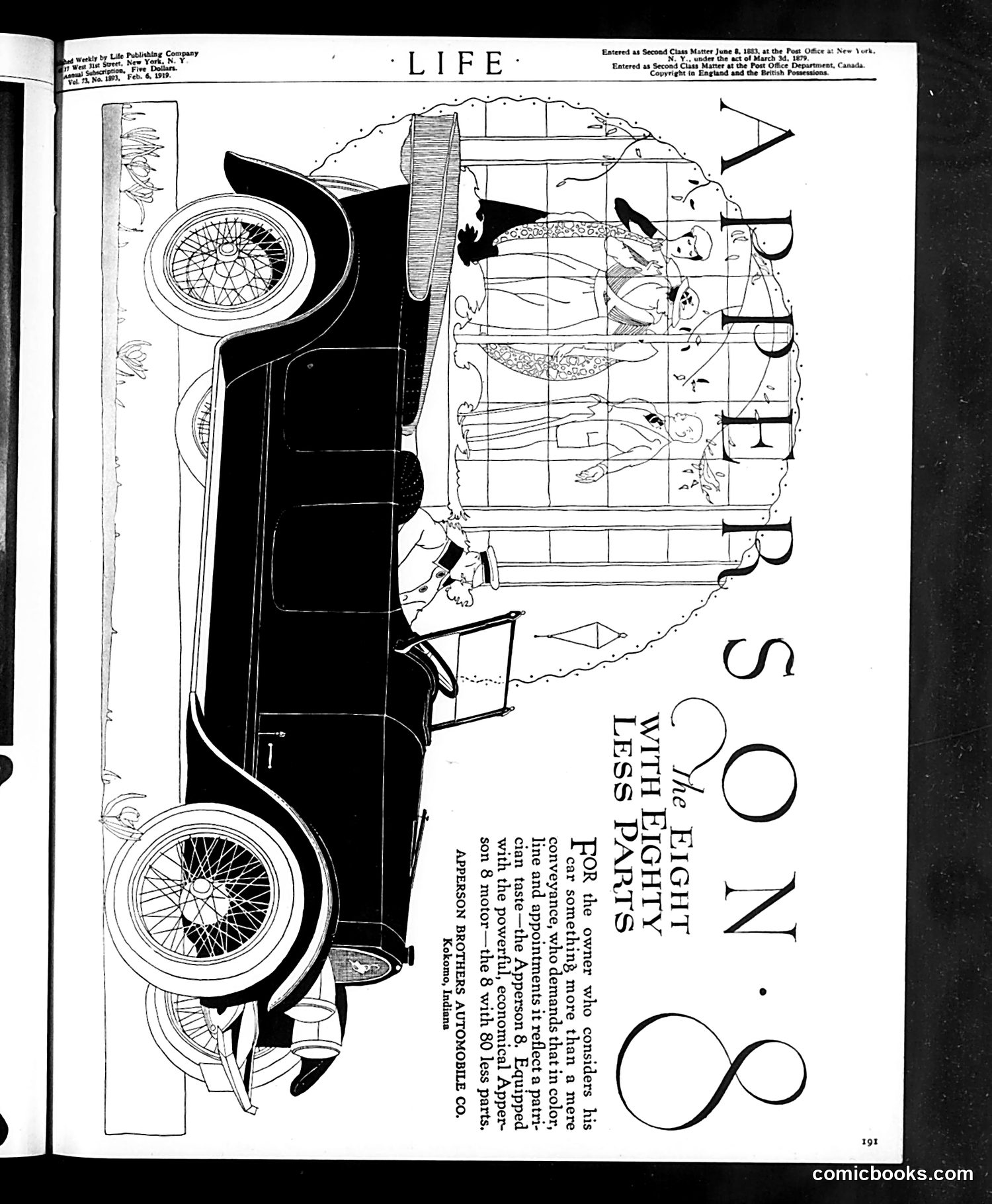
This page advertises an automobile, likely from the 1920s based on the styling. The advertisement celebrates an eight-cylinder engine design that uses fewer mechanical components than competing models. The left side shows a side-view diagram of the car's internal mechanics. The right side features a humorous anatomical diagram comparing the engine to a human head and torso, with various mechanical parts labeled as body parts. This visual metaphor—treating the engine as if it were a human body—was a common advertising technique of the era, making complex mechanical engineering accessible and memorable to consumers unfamiliar with automotive technology. The cartoon emphasizes engineering efficiency as a selling point during the competitive early automobile manufacturing period.
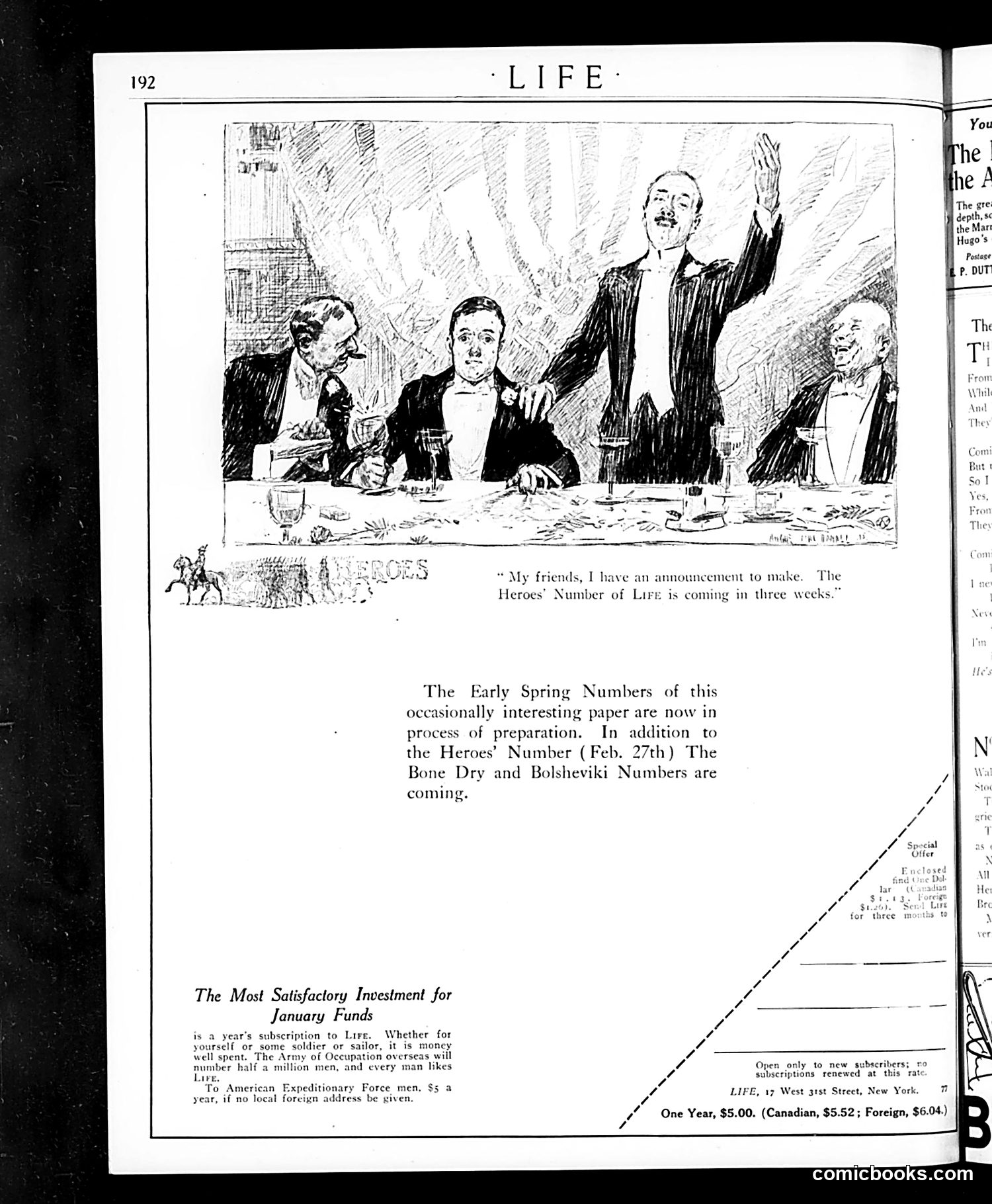
The cartoon depicts four men at a formal dinner. One stands, raising his hand to make an announcement: "My friends, I have an announcement to make. The Heroes' Number of LIFE is coming in three weeks." This is **self-promotional satire** by the magazine itself. The scene mocks formal announcements of major events—the standing figure's dramatic gesture parodies important proclamations. By treating an upcoming special magazine issue as momentous news worthy of a solemn dinner announcement, Life ridicules both its own self-importance and the tendency of publications to oversell special editions. The humor relies on inflated expectations: a special magazine issue presented with the gravity of a significant historical or political announcement. This was likely timely advertising for an upcoming "Heroes' Number" special edition.

This page is primarily **advertising and fiction**, not political satire. The main content includes: 1. **"The Four Horsemen of the Apocalypse"** - a book advertisement praising Vicente Blasco Ibáñez's WWI novel 2. **"The Woman He Left Behind"** - romantic poetry about wartime separation 3. **"In Days to Come"** - a short satirical piece mocking Wall Street. It describes Soviet and American brokers meeting to exchange telephone clerks' yacht holdings, satirizing the absurdity of wealth inequality and speculation during the 1920s. 4. **Resinol Soap advertisement** - featuring a woman washing her face, promoting skincare 5. **Bellans indigestion remedy advertisement** at bottom The page reflects post-WWI American culture: war literature popularity, romantic nostalgia, economic satire during the prosperous 1920s, and consumer product marketing.
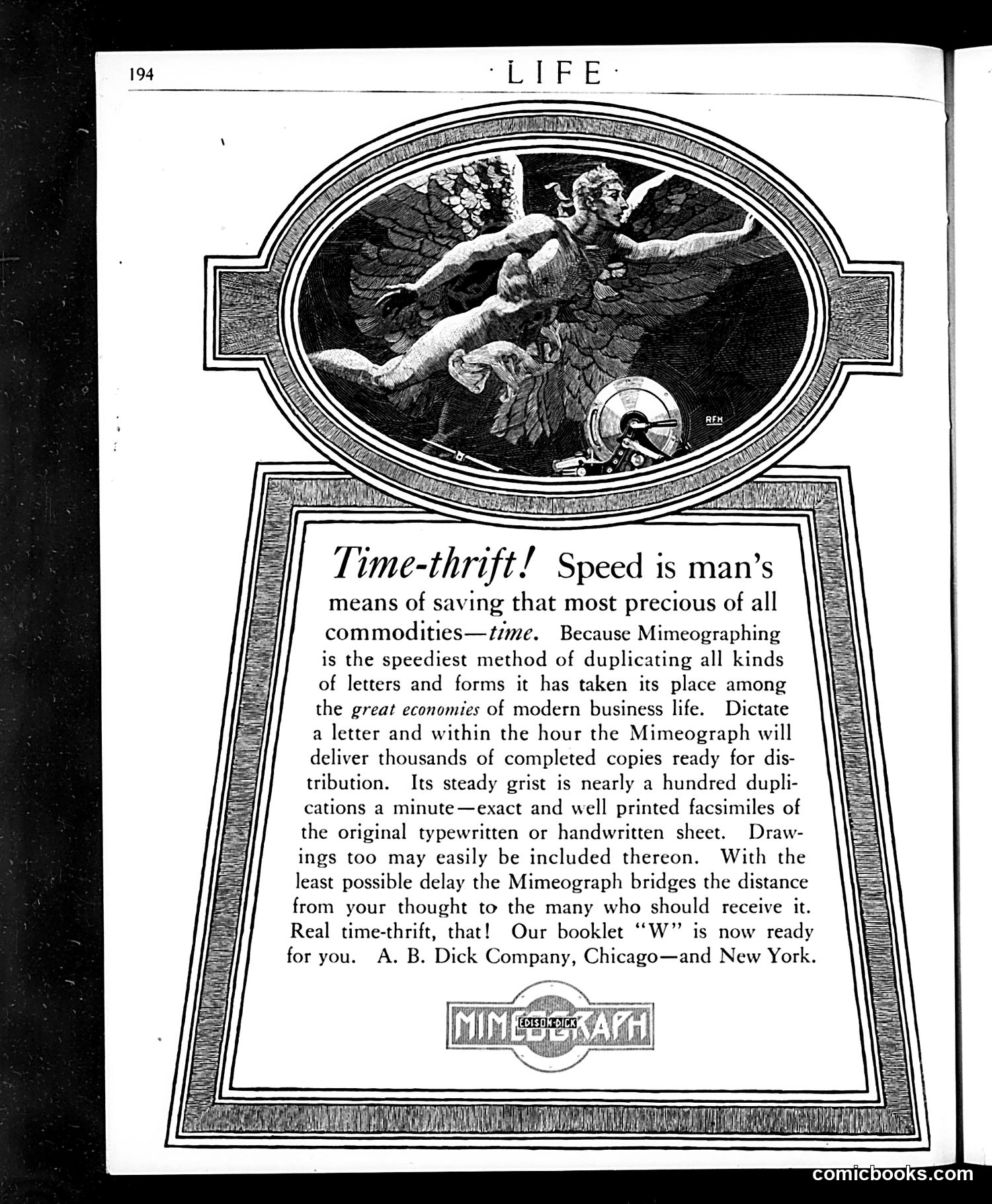
This is primarily a **full-page advertisement** for the Mimeograph machine by A.B. Dick Company, not a political cartoon. The ad uses an allegorical image of a winged male figure (appearing to represent Mercury, the Roman god of commerce and speed) to symbolize rapid business communication. The advertisement's central claim is that mimeographing saves time—"man's means of saving that most precious of all commodities." It emphasizes the machine's speed (nearly 100 duplications per minute) and efficiency in reproducing letters and forms for business distribution. The "time-thrift" concept appeals to modern business efficiency. This reflects early-20th-century industrial culture's emphasis on speed and productivity. The reference to booklet "W" and the Chicago/New York offices indicate this is contemporary corporate promotion rather than satire.
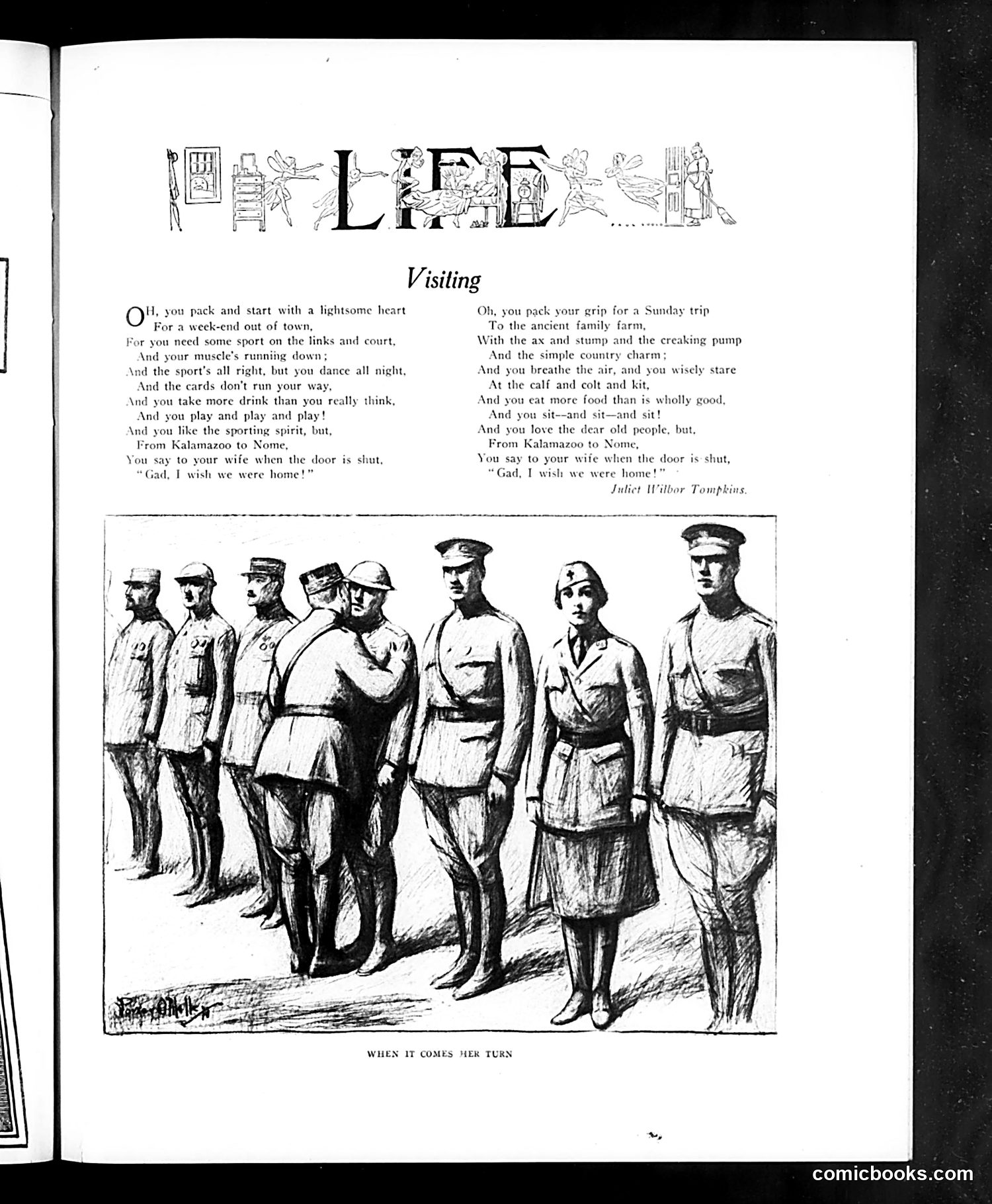
This page from *Life* magazine features a poem titled "Visiting" by Juliet Wilbor Tompkins, accompanied by a sketch captioned "WHEN IT COMES HER TURN." The poem humorously describes a weekend trip to "the ancient family farm," contrasting initial excitement with the reality of rustic labor (axes, stumps, creaking pumps) and the desire to return home. The illustration depicts seven military figures in WWI-era uniforms standing in a line. The presence of what appears to be a female soldier among male soldiers—combined with the poem's title "WHEN IT COMES HER TURN"—suggests this is satirizing women's military service or conscription during World War I. The cartoon likely comments on women's reluctant participation in wartime duties, echoing the poem's theme of initial enthusiasm followed by homesickness.
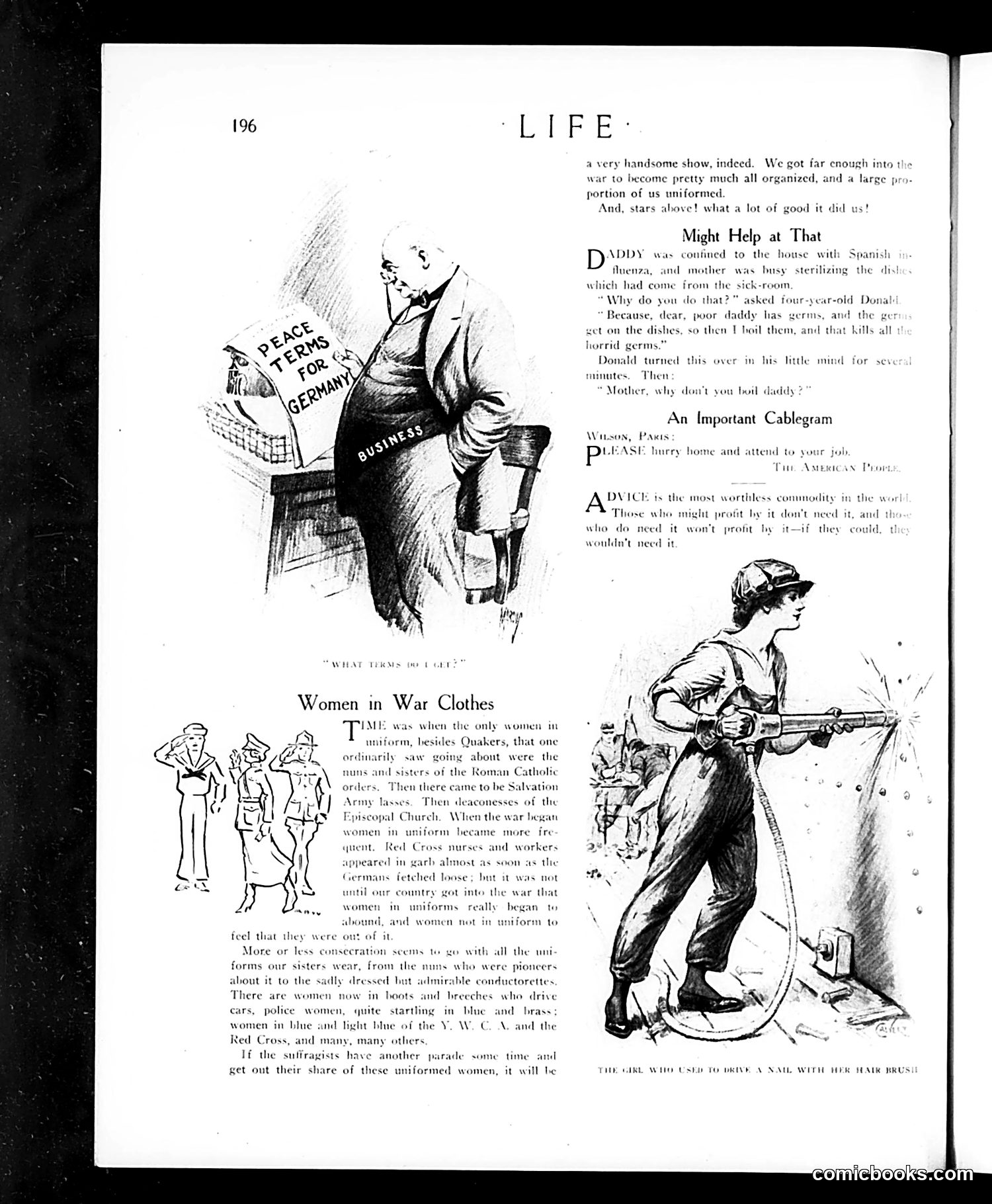
The top cartoon depicts a figure labeled "Business" being struck by hammers labeled "Peace Terms for Germany." This satirizes post-WWI peace negotiations—specifically the harsh reparations and terms imposed on Germany, suggesting they were economically destructive ("business" was being hammered). The "Women in War Clothes" section discusses female military uniforms during WWI, noting that women had taken on unprecedented roles as nurses, drivers, and Red Cross workers. The accompanying sketch shows a woman in military attire with a rifle, captioned "The Girl Who Used to Drive a Nail with Her Hair Brush"—a humorous contrast between traditional femininity and wartime military service. The final item, "An Important Cablegram," appears to be satirical advice about prioritizing work over family duties during wartime.
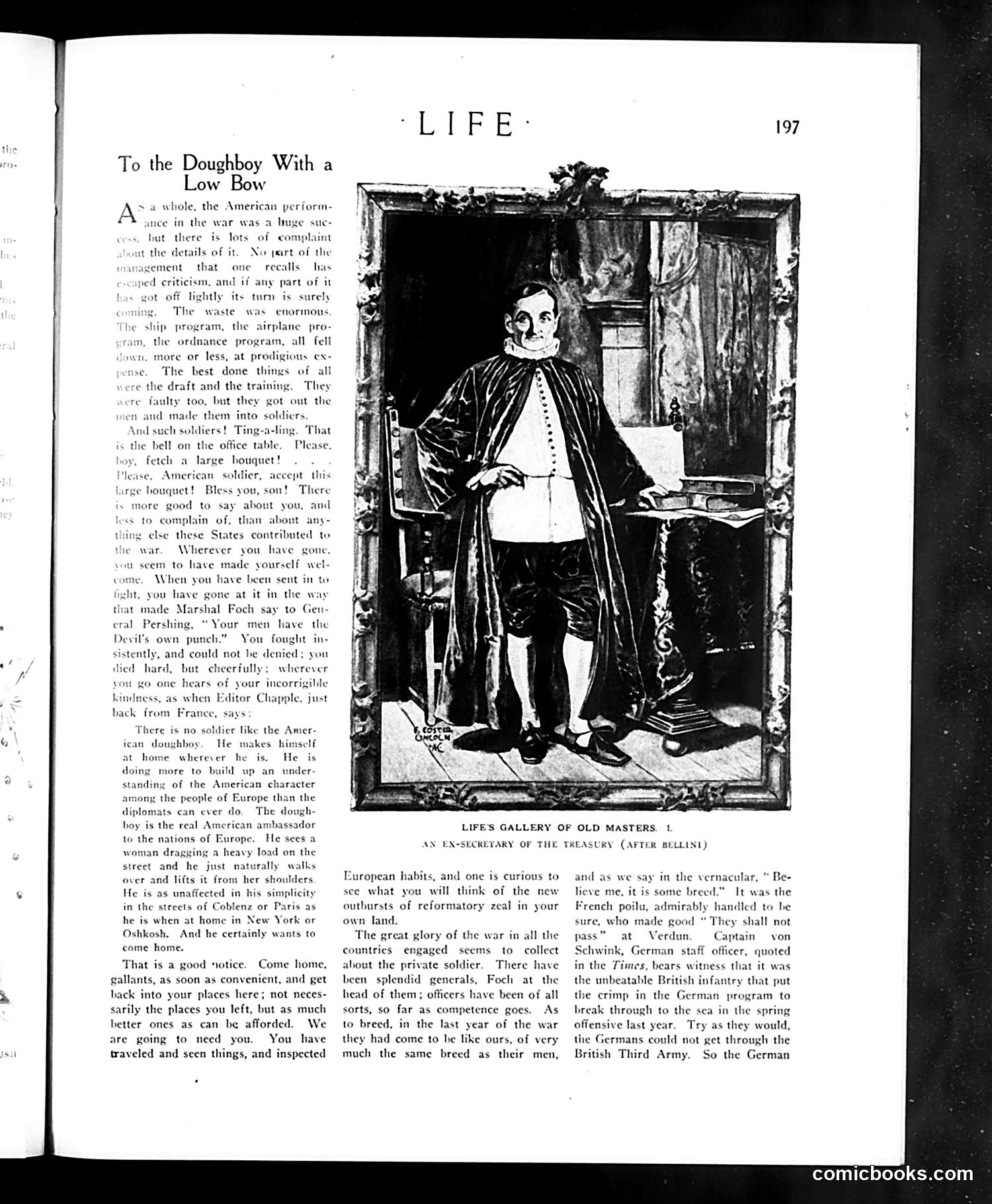
This page combines a satirical editorial essay with a classical artwork reproduction. The essay praises American soldiers ("doughboys"—WWI infantry slang) for their character and accomplishments, contrasting them favorably with European military conduct. The illustration below, titled "Life's Gallery of Old Masters: An Ex-Secretary of the Treasury (After Bellini)," appears to be a political caricature mocking a former Treasury Secretary by presenting him in classical pose. The satire suggests this official's pomposity or artistic pretension is absurdly elevated compared to his actual accomplishments. The page celebrates soldier virtue while simultaneously ridiculing civilian government officials, reflecting post-WWI American sentiment that soldiers were superior to corrupt or ineffectual politicians.
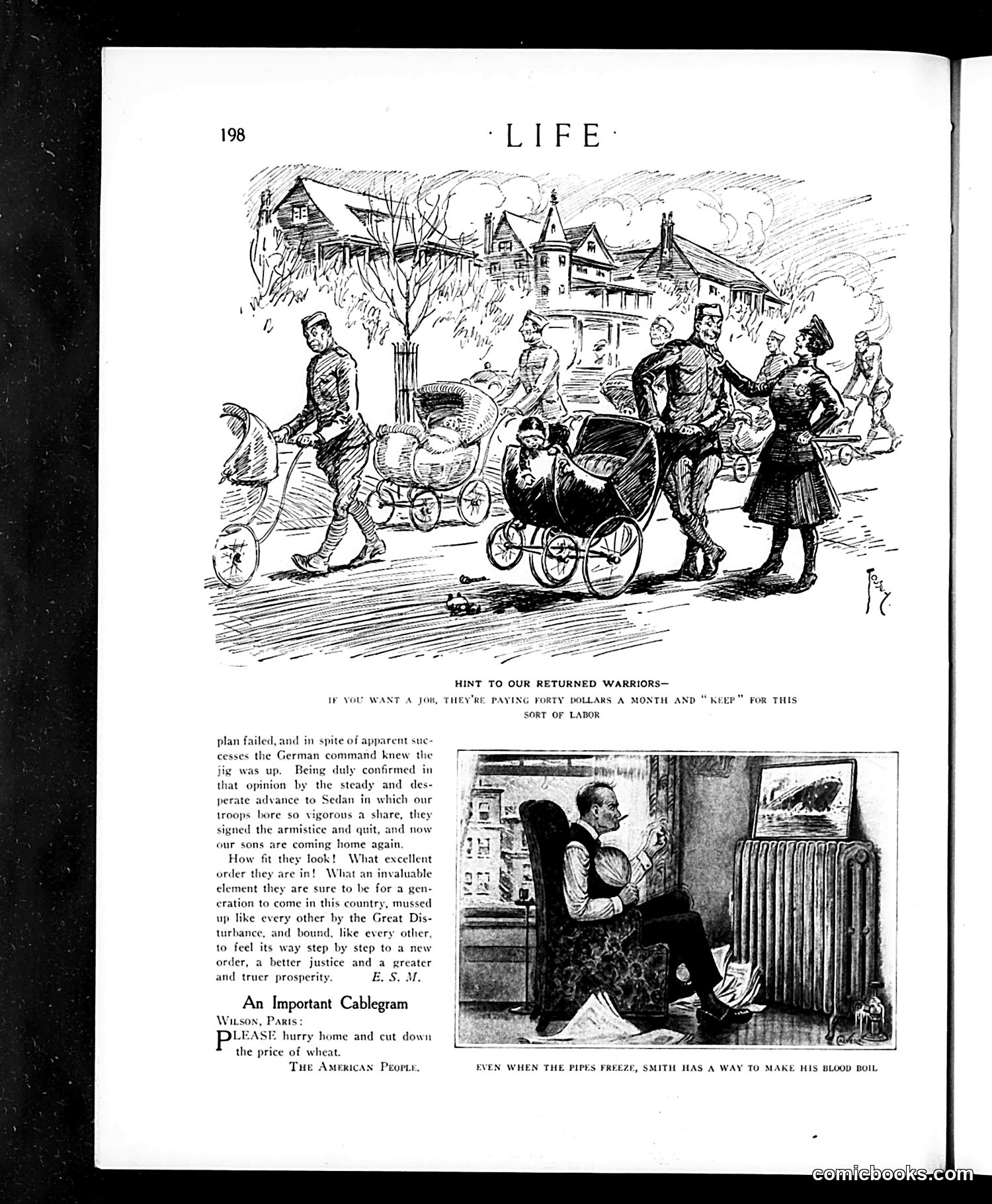
**Top Cartoon: "Hint to Our Returned Warriors"** This satirizes post-WWI job prospects for returning soldiers. The scene shows military men with baby carriages in a wealthy residential setting. The caption cynically suggests that if soldiers want employment, they should accept "$40 a month and 'keep'" (room and board)—implying they're being offered domestic servant positions rather than dignified jobs befitting their sacrifice. **Bottom Cartoon & Text** References President Wilson and calls for lowering wheat prices for "The American People." The smaller cartoon titled "Even When the Pipes Freeze, Smith Has a Way to Make His Blood Boil" appears to be unrelated domestic humor, likely a separate satirical item. The page overall criticizes inadequate post-war employment and economic conditions for veterans.
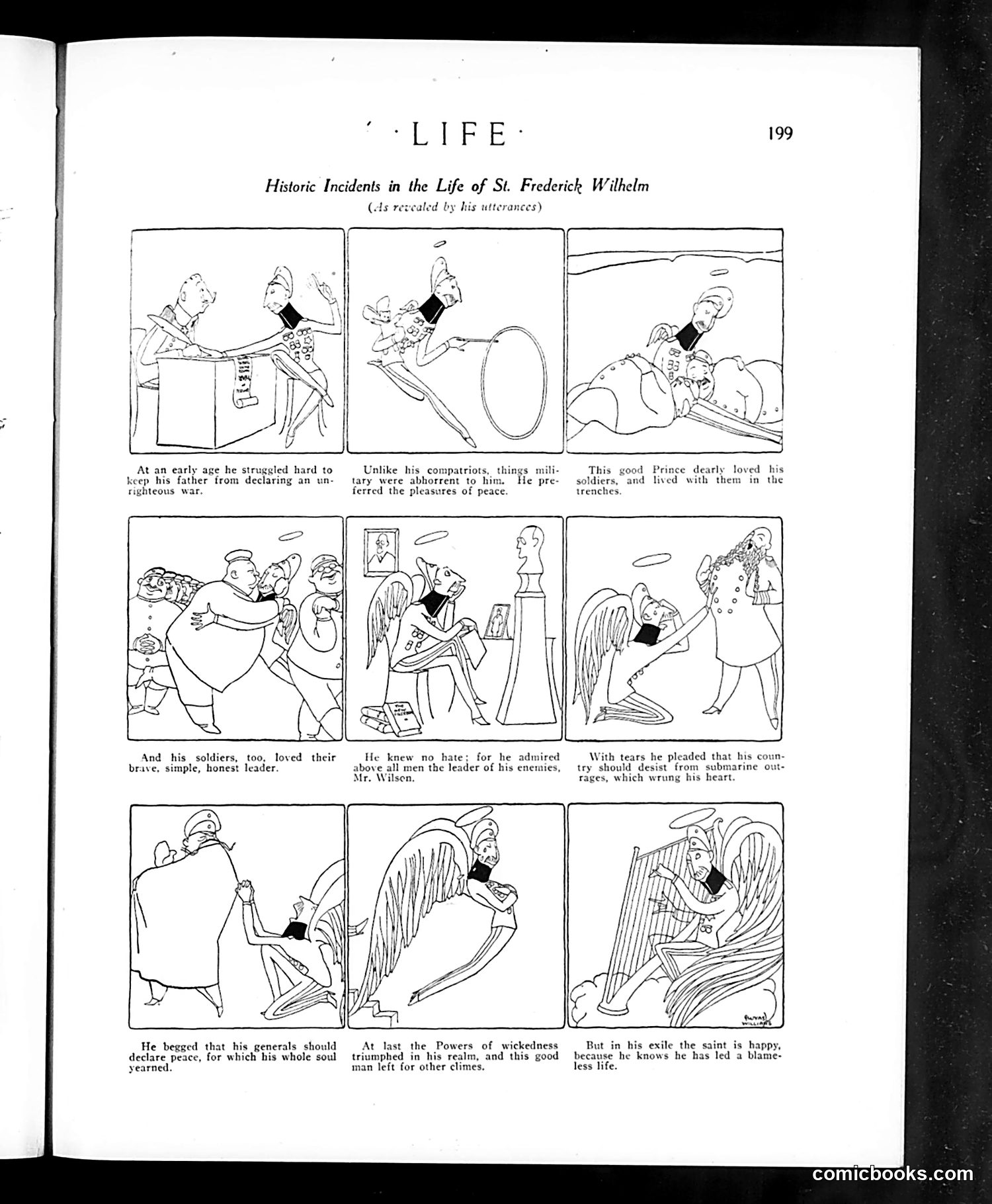
This satirical comic strip presents Frederick Wilhelm (likely a European royal figure) as a saint, mocking his character through nine panels. The narrative arc suggests he: - Struggled to prevent his father's unrighteous war - Preferred peace over military matters - Loved soldiers and lived among troops - Was admired by his soldiers as an honest leader - Showed no hatred, even of enemies - Pleaded tearfully against submarine warfare - Begged generals to declare peace - Eventually triumphed over "wickedness" - Lived happily in exile, having led a "blameless life" The heavy irony—treating him as saintly—suggests the cartoonist views Frederick Wilhelm as delusional or hypocritical about his actual wartime role and responsibility, likely criticizing a German royal's claimed pacifism during World War I.
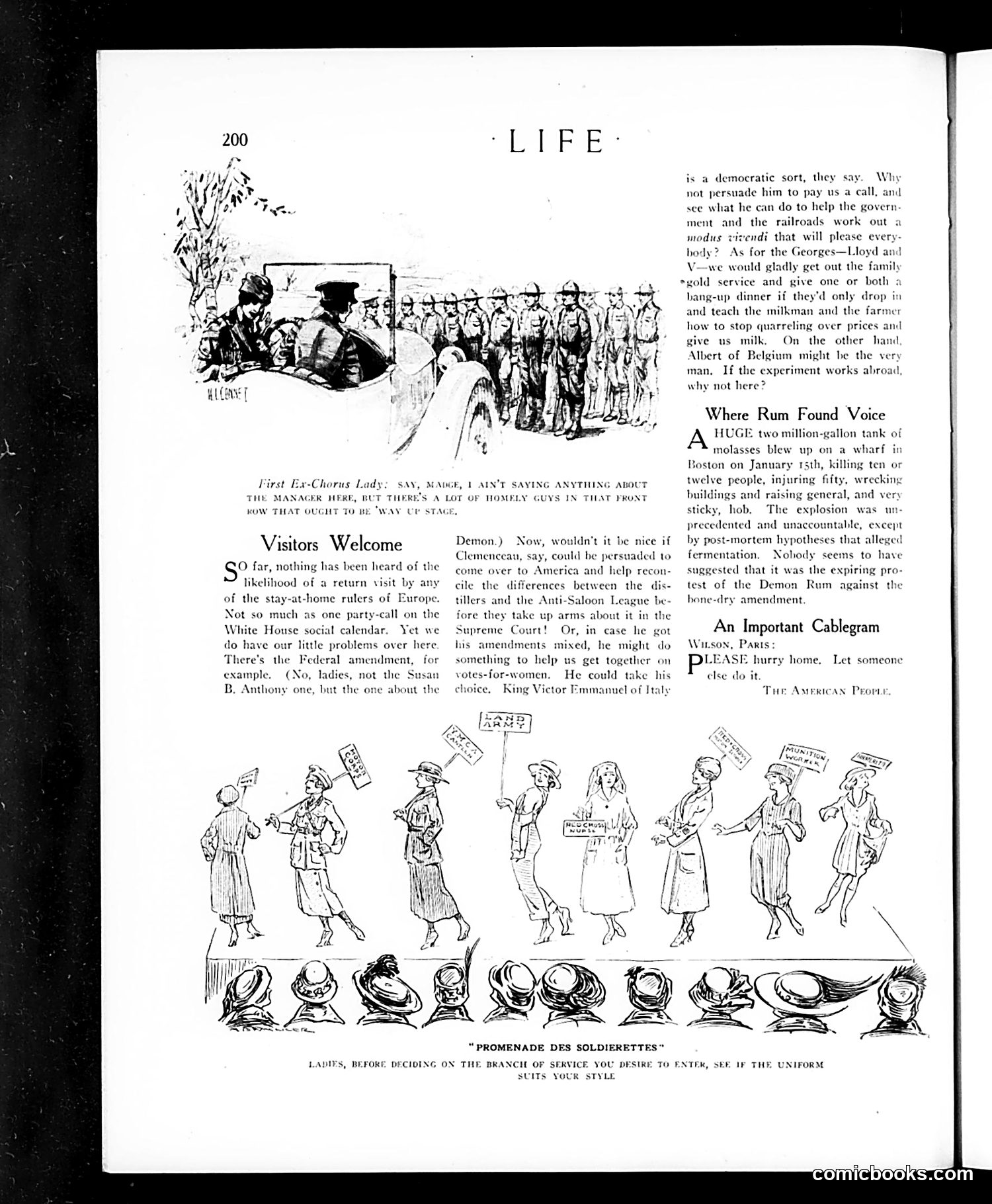
This 1919 *Life* magazine page satirizes women's wartime service and post-war identity. The top cartoon mocks the "Ex-Chorus Lady" — women who served in WWI efforts but whose contributions were being dismissed or trivialized back home. The main illustration, titled "Promenade des Soldierettes," depicts women in military-style uniforms with exaggerated hats, suggesting confusion about female military dress codes. The caption jokes that women should first "decide on the branch of service you desire to enter" and "see if the uniform suits your style" — satirizing both the novelty of women in uniform and society's superficial concern with fashion over actual service. The page reflects post-WWI anxieties about women's changing roles and the tension between acknowledging female contributions and dismissing them as temporary or performative.
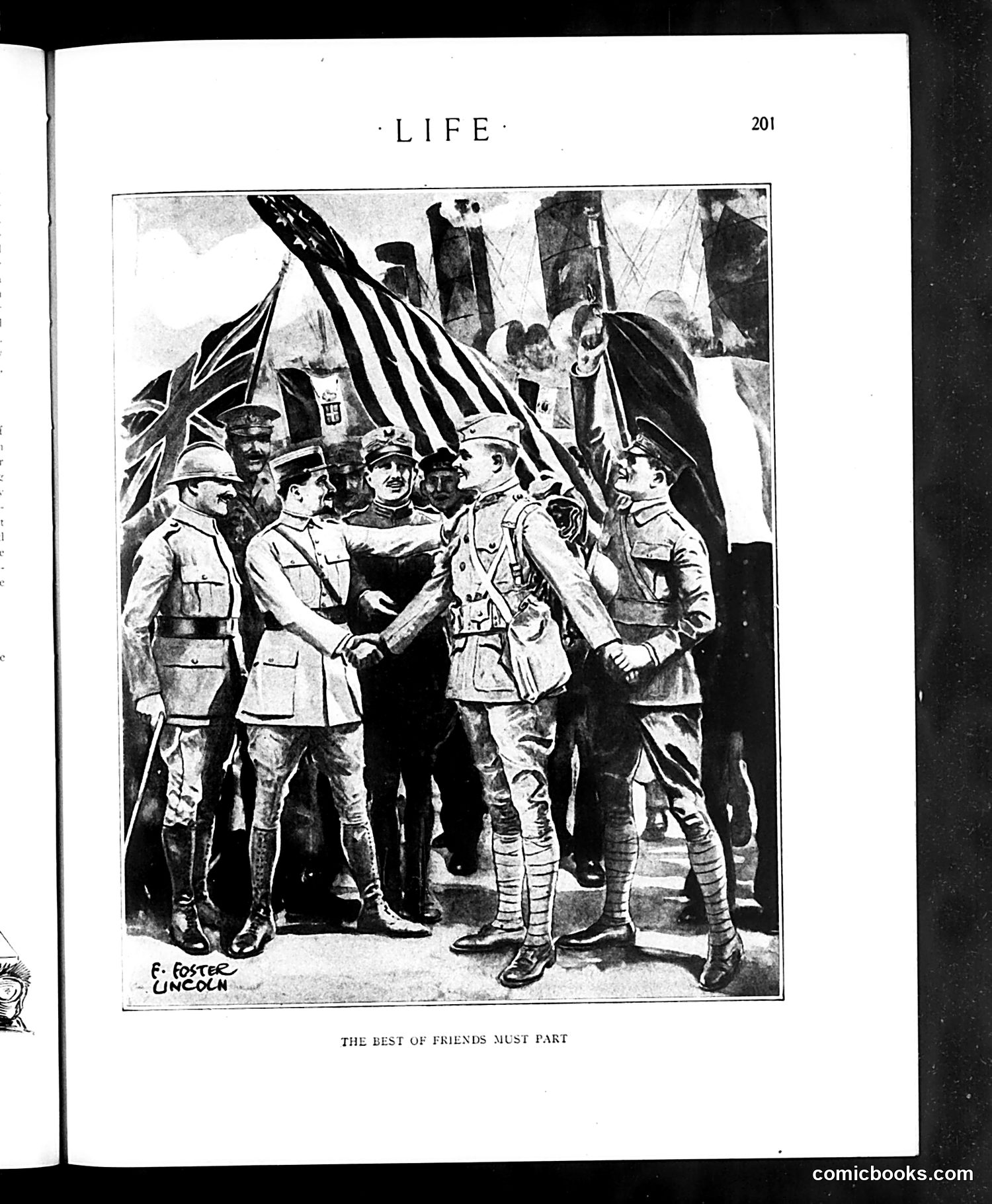
This illustration by F. Foster Lincoln depicts five military officers in WWI-era uniforms standing beneath Allied flags, clasping hands in farewell. The caption "The Best of Friends Must Part" suggests a bittersweet moment of separation among allied commanders. The scene appears to reference the end of WWI or the dissolution of the Allied military coalition, showing representatives from different nations (identifiable by their distinct uniforms and the flags behind them) parting ways. The handshake conveys both camaraderie and the inevitability of separation as the wartime alliance concludes. Without identifying specific individuals, the cartoon satirizes the temporary nature of wartime cooperation between nations with different interests, suggesting that even close military allies must eventually go their separate ways.
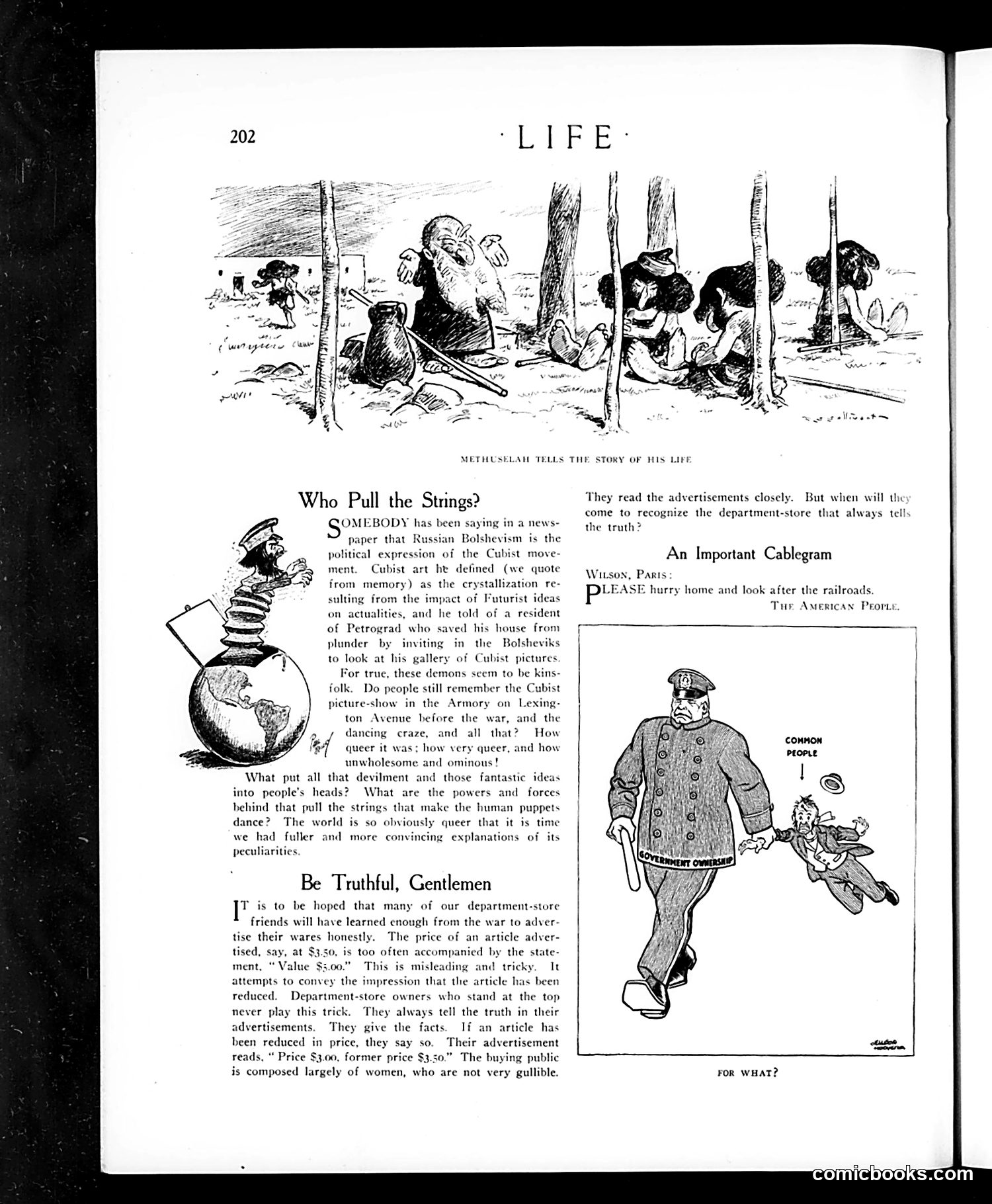
**Main Cartoon ("Who Pull the Strings?"):** This political cartoon depicts Russian Bolshevism as a puppet master controlling world events. A figure sits atop a globe manipulating strings attached to a caricatured entertainer below—likely representing how Bolshevik ideology was perceived as secretly influencing Western culture and politics. The text criticizes Cubist art as a dangerous "crystallization" of Futurist ideas supposedly exported by Bolsheviks to destabilize society. **Secondary Cartoon ("An Important Cablegram"):** A caricatured politician or public figure labeled "COMMON PEOPLE" is pulled along by what appears to be corporate or government interests ("FOR WHAT?"). This satirizes how ordinary citizens are manipulated by those in power. Both cartoons express early 20th-century American anxiety about foreign ideological influence and corporate manipulation of public opinion.
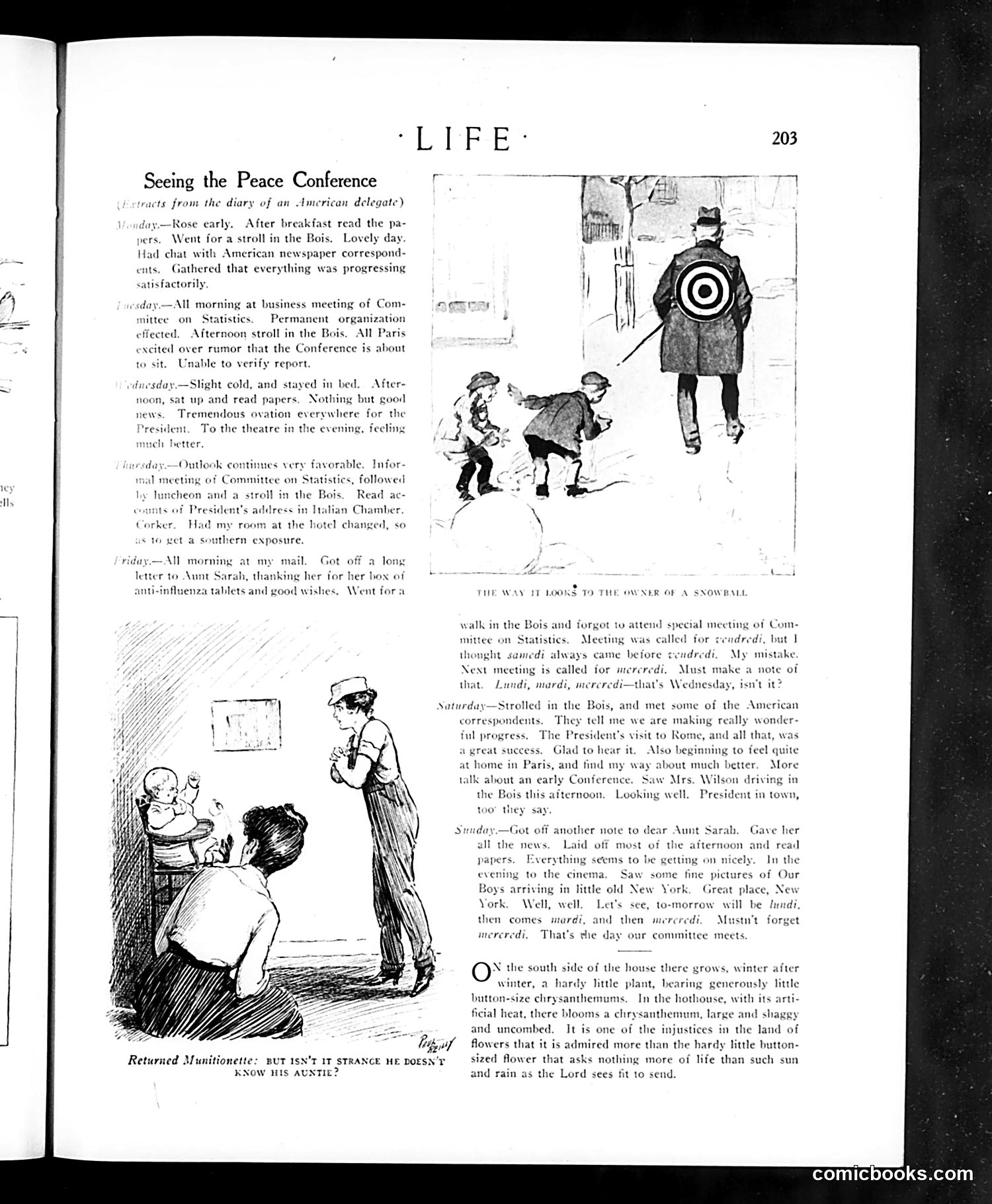
This page from *Life* magazine documents a Peace Conference (likely post-WWI, early 1920s based on context). The diary entries describe an American delegate's experience attending committee meetings and social activities in Paris. The top cartoon shows a man wearing a target on his back, walking toward children playing in snow—captioned "THE WAY IT LOOKS TO THE OWNER OF A SNOWBALL." This is visual satire: the adult feels vulnerable to snowball attacks, a humorous reversal where the authority figure becomes the defenseless target. The lower sketch, titled "RETURNED MUNITIONETTE: BUT ISN'T IT STRANGE HE DOESN'T KNOW HIS AUNTIE?" depicts a woman holding a small child, addressing a uniformed soldier. It satirizes the social disruption of WWI—soldiers returning home after years abroad to find they no longer recognize their own relatives, a poignant commentary on war's alienating effects on families.
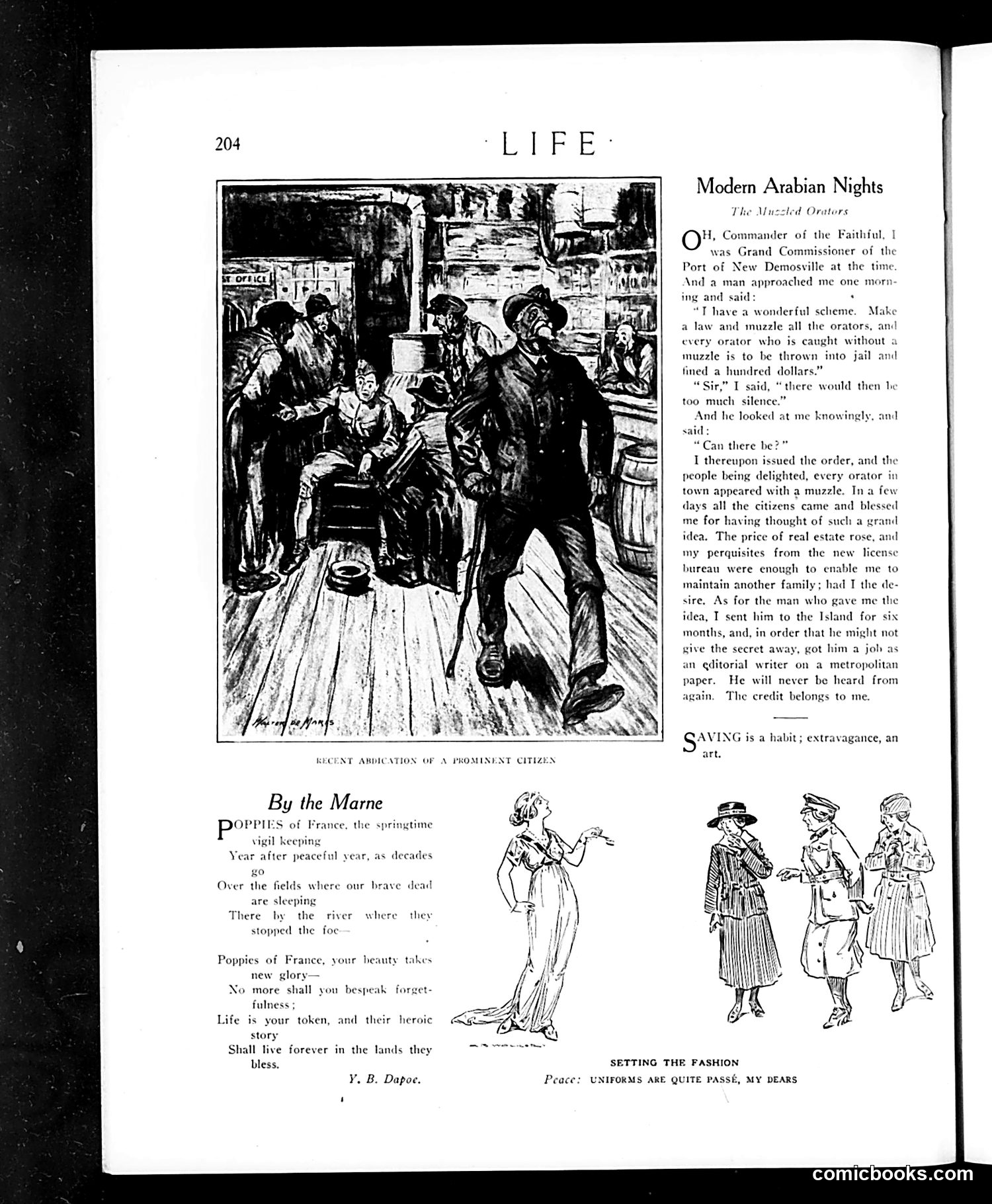
This satirical story mocks authoritarian governance disguised as public benefit. A Grand Commissioner implements a law requiring all orators to wear muzzles, with violators jailed and fined. The cynical twist: citizens celebrate the silence, real estate values rise, and the commissioner profits from licensing fees—revealing that silencing free speech actually serves corrupt officials' financial interests. The phrase "there would then be too much silence" signals the satire: the commander recognizes the absurdity but proceeds anyway. The original proposer is exiled as an editorial writer to ensure secrecy, a dark joke about suppressing dissent. This critiques early-20th-century political corruption and censorship—how unpopular policies benefit elites while masses unknowingly accept oppression. The "Arabian Nights" framing emphasizes the tale's fantastical yet pointed commentary on American democratic institutions.
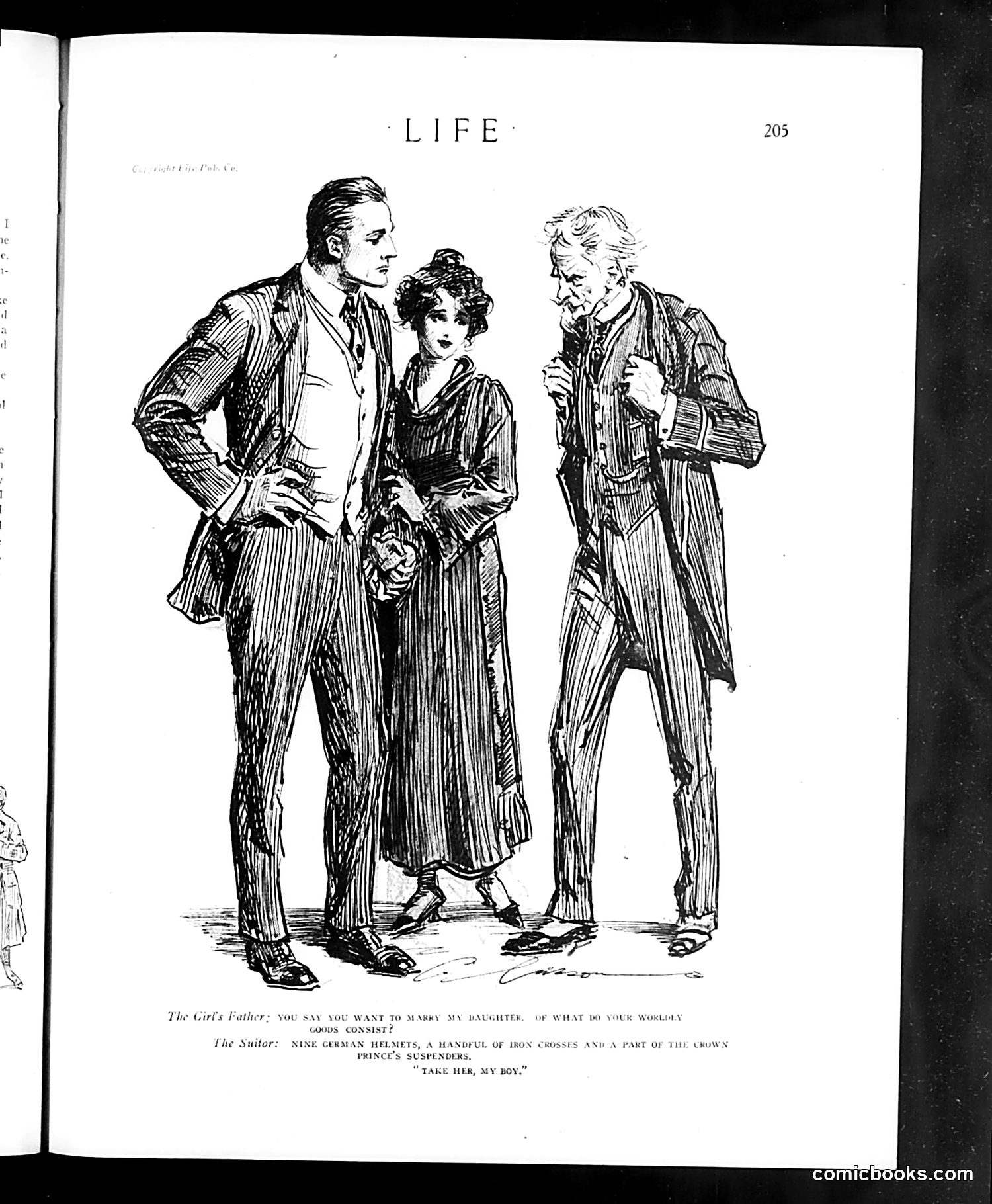
This is a single satirical cartoon from *Life* magazine (page 205) depicting three figures in formal dress. The caption identifies two characters: **The Girl's Father** asks about marriage prospects, inquiring what the suitor's "worldly goods" consist of. **The Suitor** responds by listing his assets: "nine German helmets, a handful of iron crosses and a part of the crown prince's suspenders," concluding with "Take her, my boy." The satire targets post-WWI economic conditions and the devaluation of German military memorabilia. The suitor's "wealth" consists entirely of worthless war souvenirs—German military items stripped of value after Germany's defeat. This mocks both the suitor's poverty and the glut of cheap war artifacts flooding the market, while also commenting on post-war economic desperation. The joke hinges on this absurd "dowry" of military junk being offered as legitimate bridal compensation.
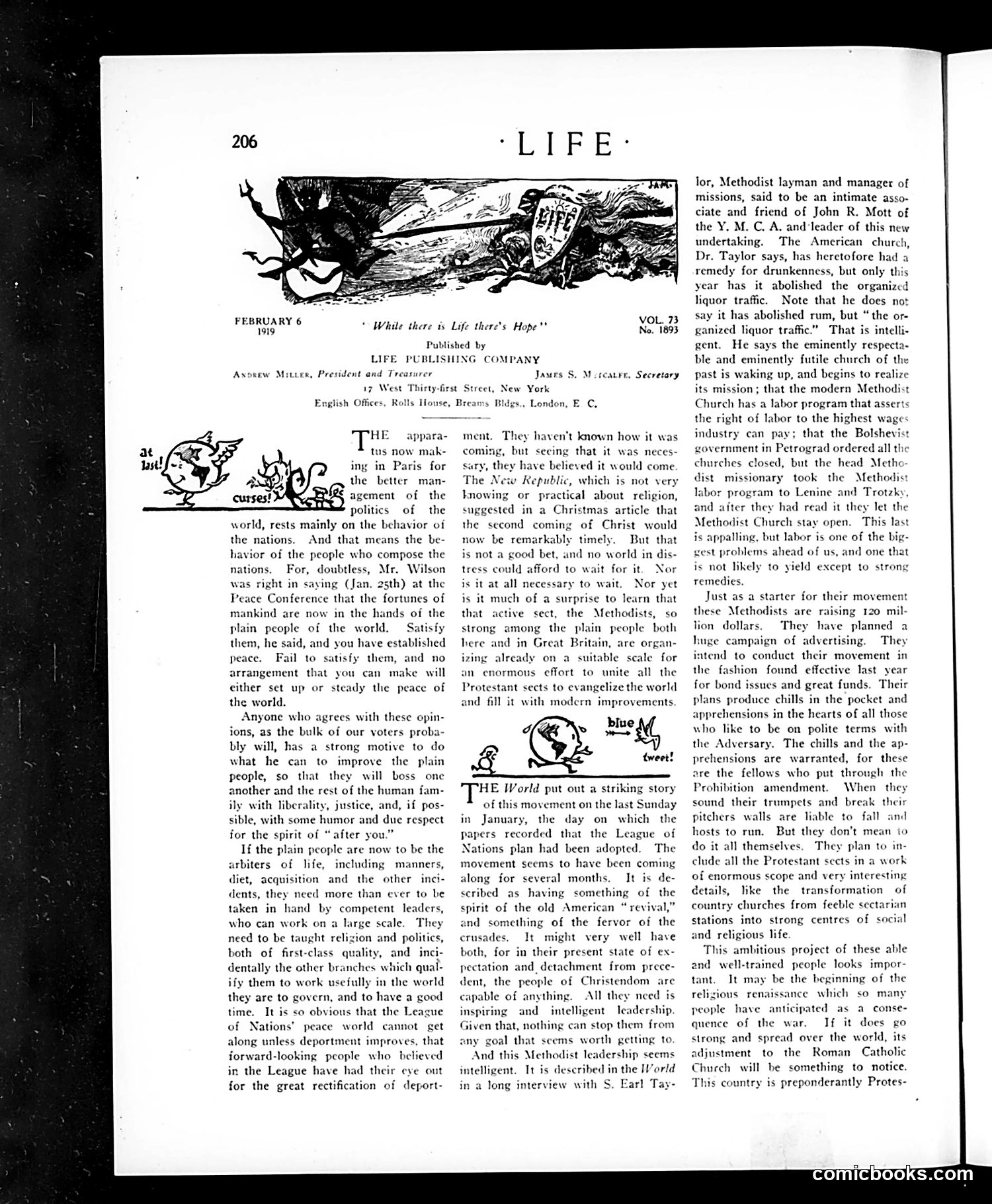
This page discusses a Methodist movement to unite Protestant sects and "evangelize the world" with "modern improvements." The article frames this as a response to the newly-adopted League of Nations plan, published the same day. The text argues that since "plain people" will determine world peace (per Wilson's recent statements), they need moral and religious instruction from competent leaders. The Methodists—described as "strong among the plain people both here and in Great Britain"—are organizing a large-scale effort resembling an old American "revival." The cartoons (appearing as decorative vignettes) are difficult to parse clearly but seem to satirize the earnest ambitions of this Protestant reform movement. The underlying point: sophisticated magazine readers would recognize the irony that post-WWI hopes for peace rest on mass moral improvement—and that American Methodists have positioned themselves as the vehicle for that improvement, combining religious fervor with progressive social reform (addressing drunkenness, labor conditions, etc.).
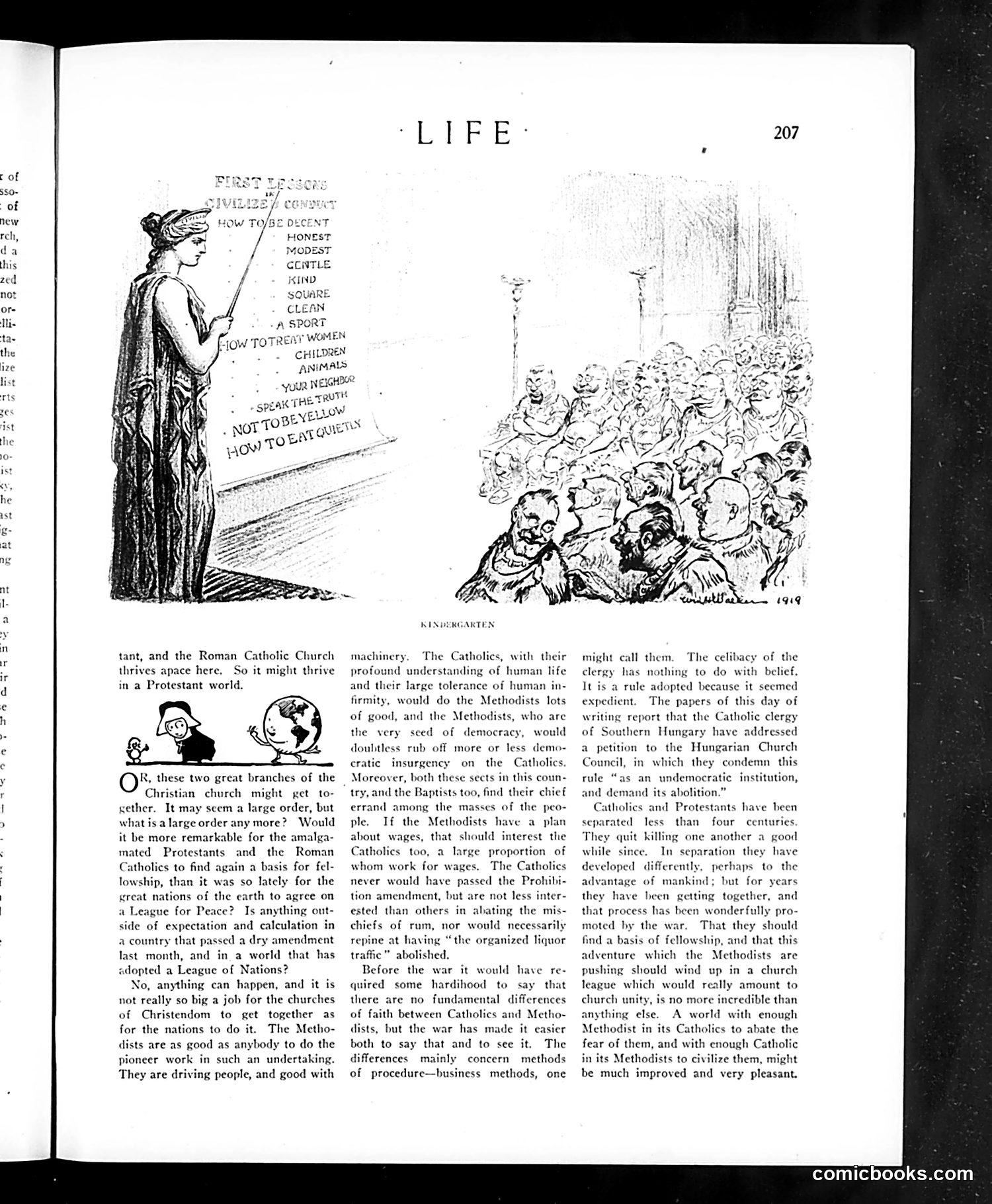
This page presents two cartoons advocating for Christian church unity between Protestants (specifically Methodists) and Roman Catholics. **Left cartoon**: A classical female figure (likely representing Wisdom or an allegorical virtue) holds a tablet listing virtues: "Honest, Modest, Gentle, Kind, Square, Clean, A Sport" and instructions like "How to Treat Women, Children, Animals" and "Speak the Truth." **Right cartoon ("Kindergarten")**: Depicts a large crowd of common people—workers and ordinary citizens—whom the text identifies as the shared constituency of both Methodist and Catholic churches. **The satire's point**: The accompanying article argues that Methodist-Catholic union is no more impossible than recent achievements (Prohibition, the League of Nations). Both churches serve working-class masses interested in labor reform and social welfare. The cartoons suggest that shared practical values and common people—not theological differences—should unite these denominations. The satire presents church merger as a logical, even overdue, social reform.
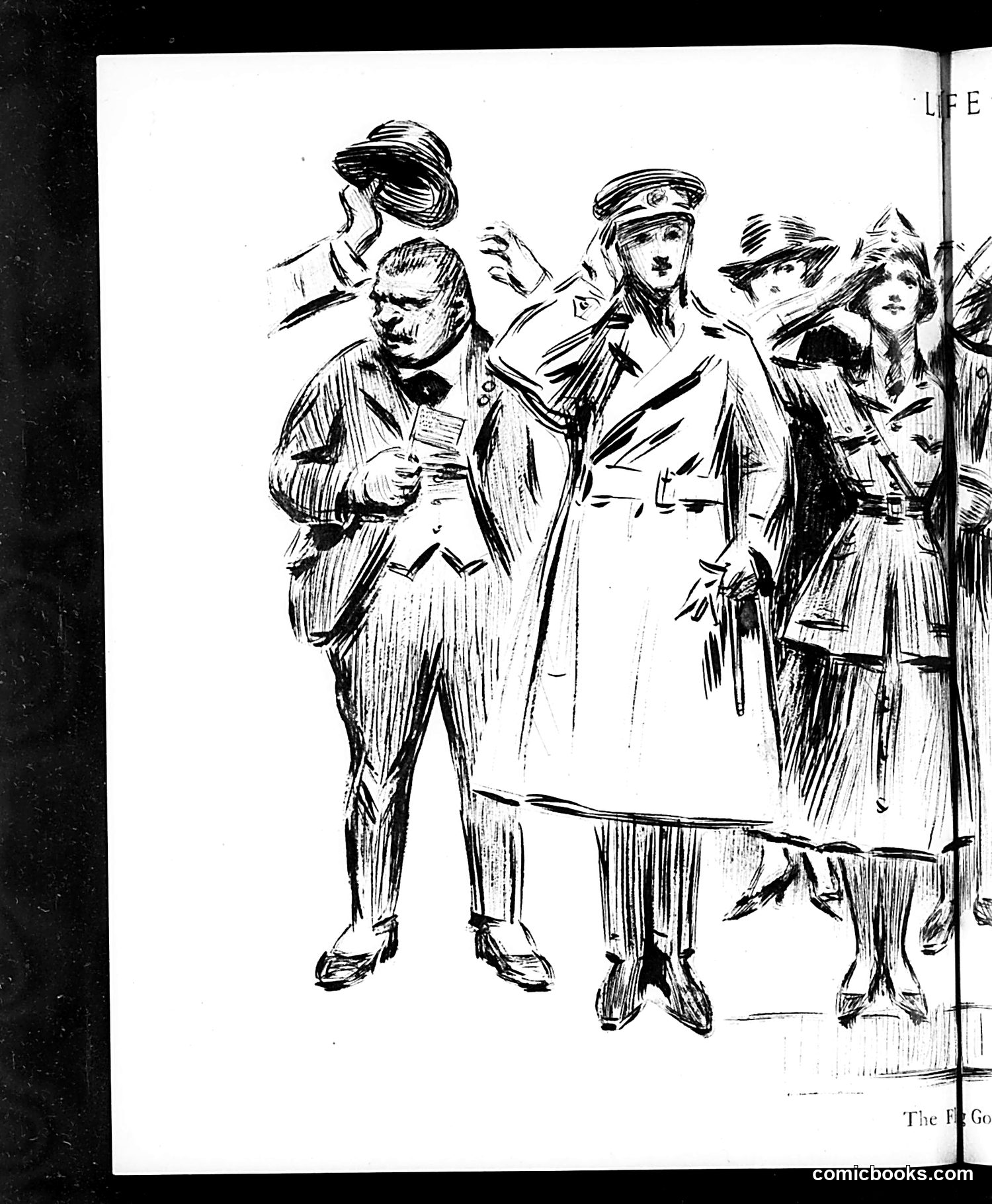
This page from *Life* magazine shows a satirical ink sketch depicting a group of people in early 20th-century dress. The central figure is a man in a suit holding what appears to be a document or ticket, surrounded by other figures including women in hats and a uniformed officer. The partial caption reads "The F—Go" (text cut off), making the specific satirical target unclear from what's visible. Without the complete caption or publication date, I cannot definitively identify the figures or explain the precise political or social commentary intended. The style and clothing suggest this likely comments on a contemporary social issue or public controversy of the *Life* era, but determining the exact subject requires the full caption text.
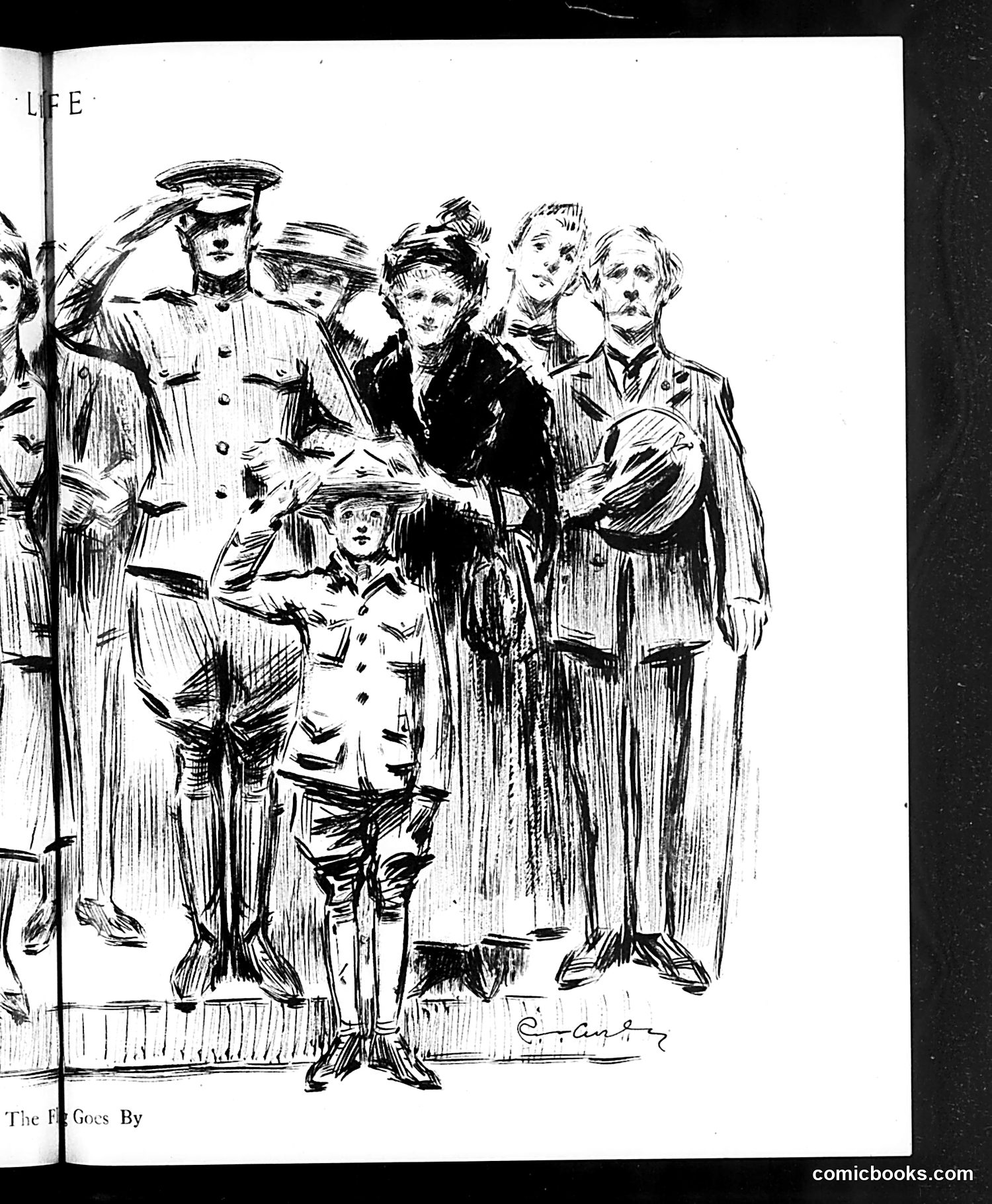
The page shows "The Flag Goes By," a satirical sketch depicting a military officer in uniform standing with a group of civilians of various ages and social stations. The composition suggests a patriotic or ceremonial moment—likely a military procession or flag-passing ceremony. The satire appears to critique social attitudes toward patriotism and military service. The diverse gathering of figures—including what appear to be working-class and upper-class civilians alongside the uniformed officer—suggests commentary on how different social classes relate to or participate in national duty or military obligation. Without the full article text, the exact target of satire remains unclear, but the juxtaposition of military authority with civilian civilians suggests commentary on conscription, social class divisions regarding military service, or public attitudes toward the military during wartime.
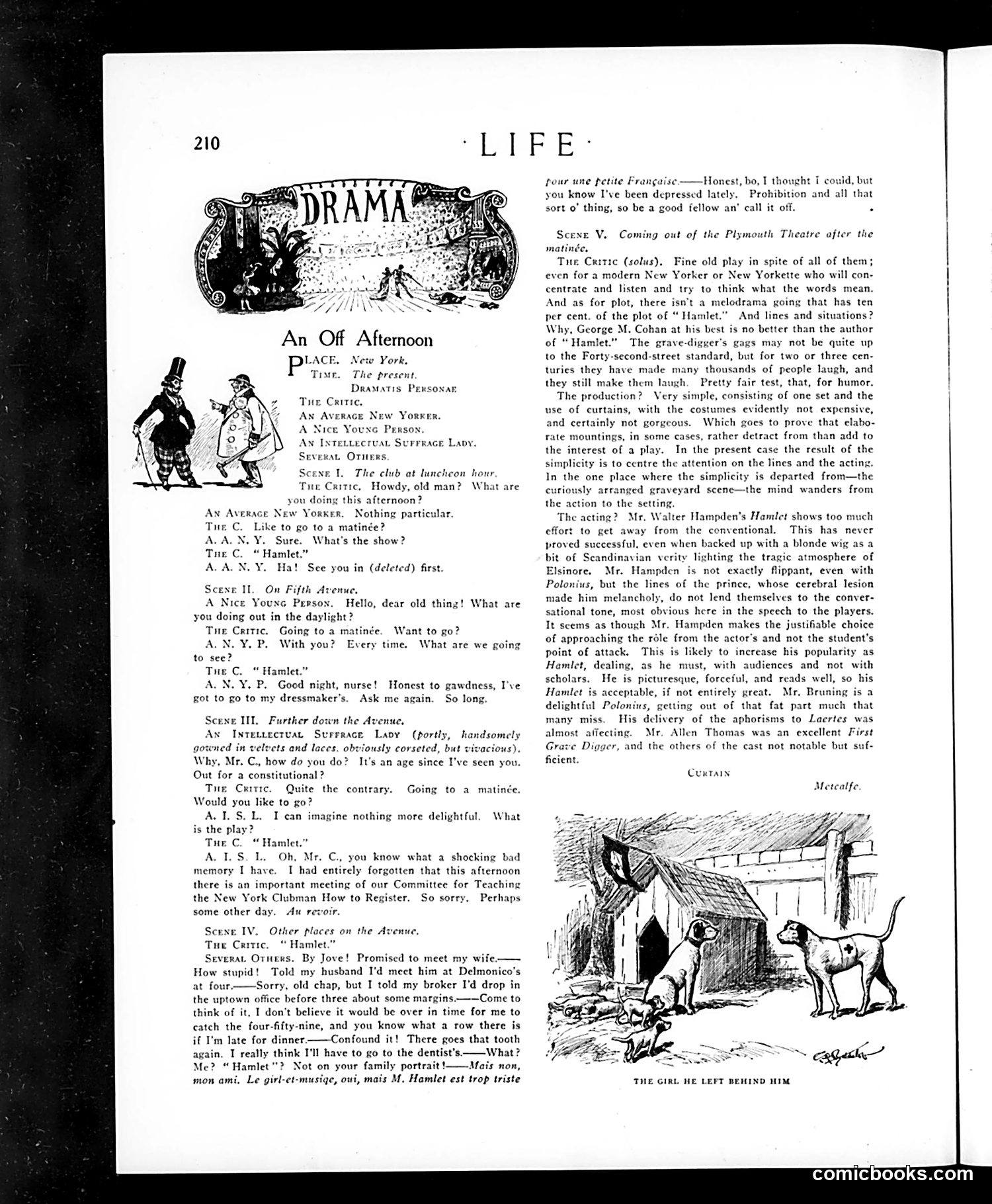
This is a satirical play-within-an-article mocking New York's social elite and their indifference to culture. A theater critic repeatedly tries to invite different acquaintances to a matinée performance of *Hamlet*, but each person—an average New Yorker, a society woman, an intellectual suffragette lady, and various others—declines with increasingly absurd excuses: dress fittings, committee meetings, broker appointments, dental work, dinner schedules, and vague ennui about the play's melancholy. The satire targets the pretensions and busy superficiality of Manhattan's upper classes, who consider themselves too occupied or sophisticated to engage with serious literature. The critic's final soliloquy praises *Hamlet* as genuinely worthwhile—suggesting the joke is that nobody else recognizes or values what he values. The accompanying illustration ("The Girl He Left Behind Him") appears unrelated to the main text.
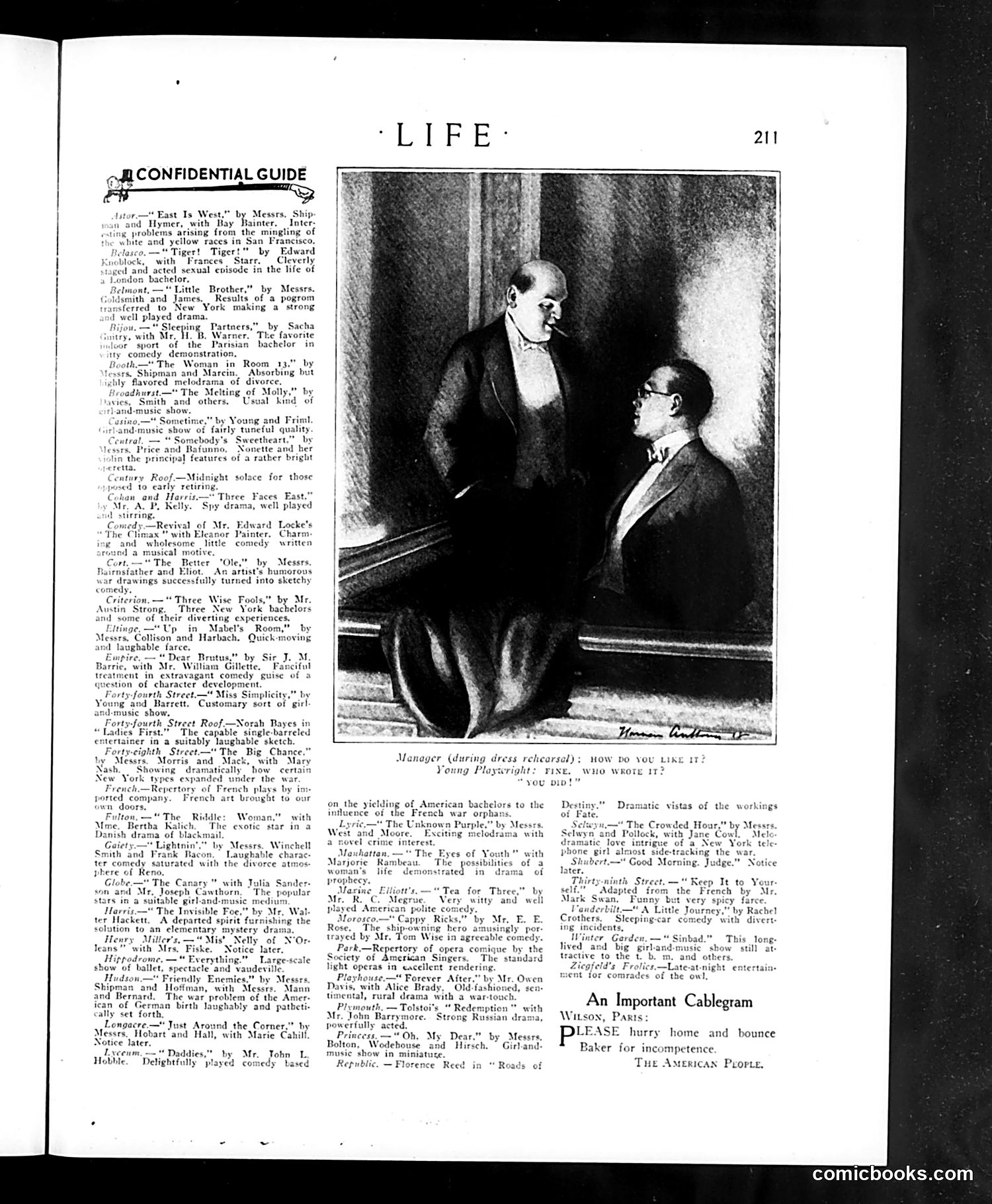
This page is primarily a **theater review section** listing Broadway productions with brief critiques. The main visual element is a photograph showing two men during what appears to be a dress rehearsal—a manager (standing) and a young playwright (seated)—with the caption asking "HOW DO YOU LIKE IT?" referencing the playwright's reaction to his own work. The accompanying **"Important Cablegram"** at bottom is satirical commentary: it's a fake urgent message from Wilson in Paris asking Baker to "hurry home and bounce Baker for incompetence"—likely mocking Secretary of War Newton Baker's performance during or after WWI. The theater reviews reflect post-WWI American drama, with several plays addressing contemporary themes: returning soldiers, the "melting pot" of immigrant life, and romantic comedies featuring "New York bachelors." The content captures the Jazz Age theatrical landscape circa 1920, showing how Broadway both entertained and processed recent historical upheaval. The satire is mild—poking fun at theatrical pretension and political management rather than sharp social critique.
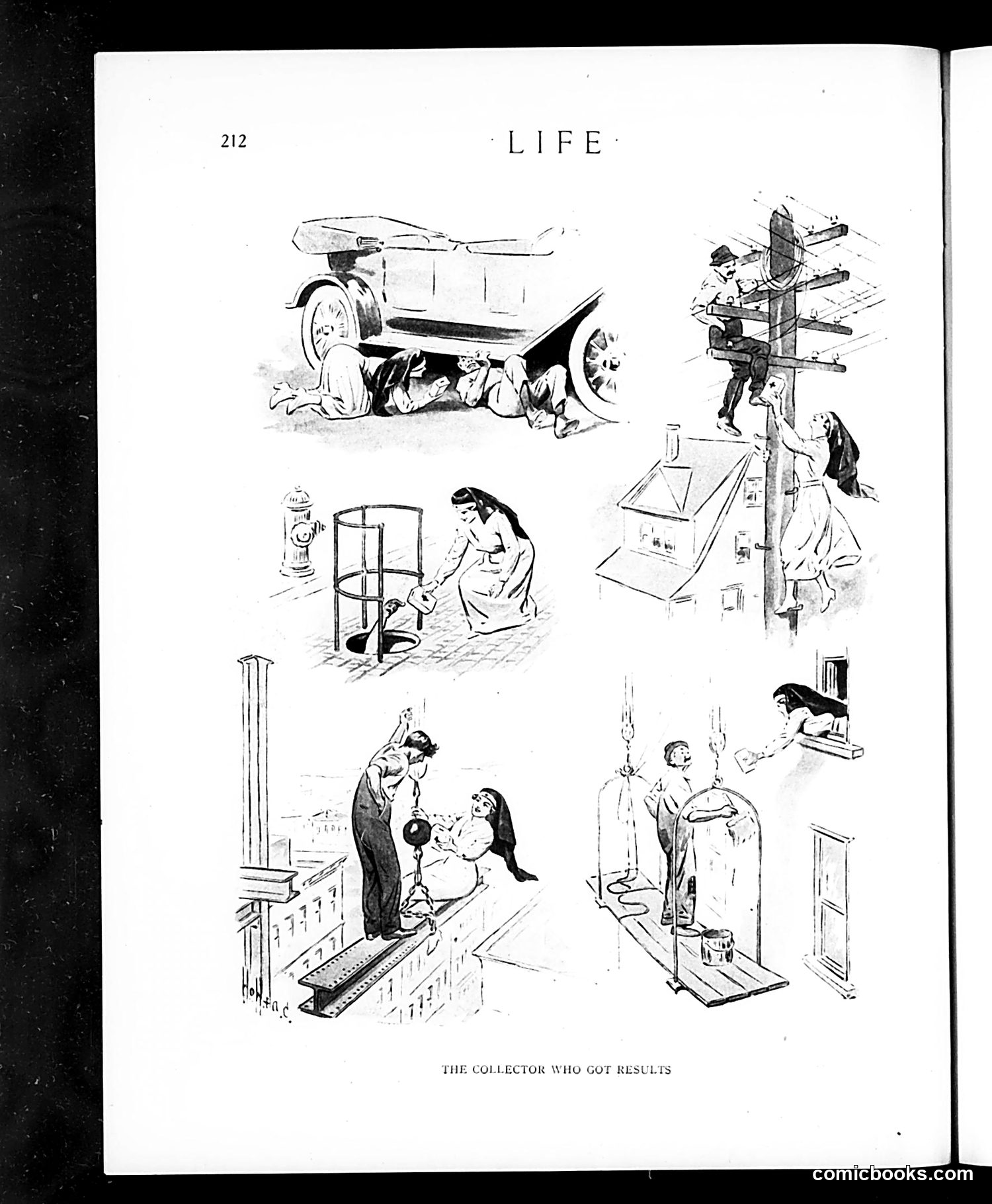
This satirical page from *Life* magazine depicts a debt collector using aggressive, underhanded tactics to extract money from debtors. The six vignettes show increasingly harsh methods: hiding under a car, cornering someone at a manhole, confronting a couple with a child, pursuing people up a pole, and forcing entry into a home. The title's irony is sharp—while these tactics "get results," the satire mocks both the ruthlessness of collection practices and society's acceptance of them. The cartoons suggest collectors prioritize payment extraction over human dignity, using intimidation, deception, and invasive surveillance. This likely reflects early 20th-century frustration with aggressive debt collection during an era lacking consumer protections. The humor derives from exaggerating real abuses into absurdist scenarios that readers would recognize as disturbingly plausible.
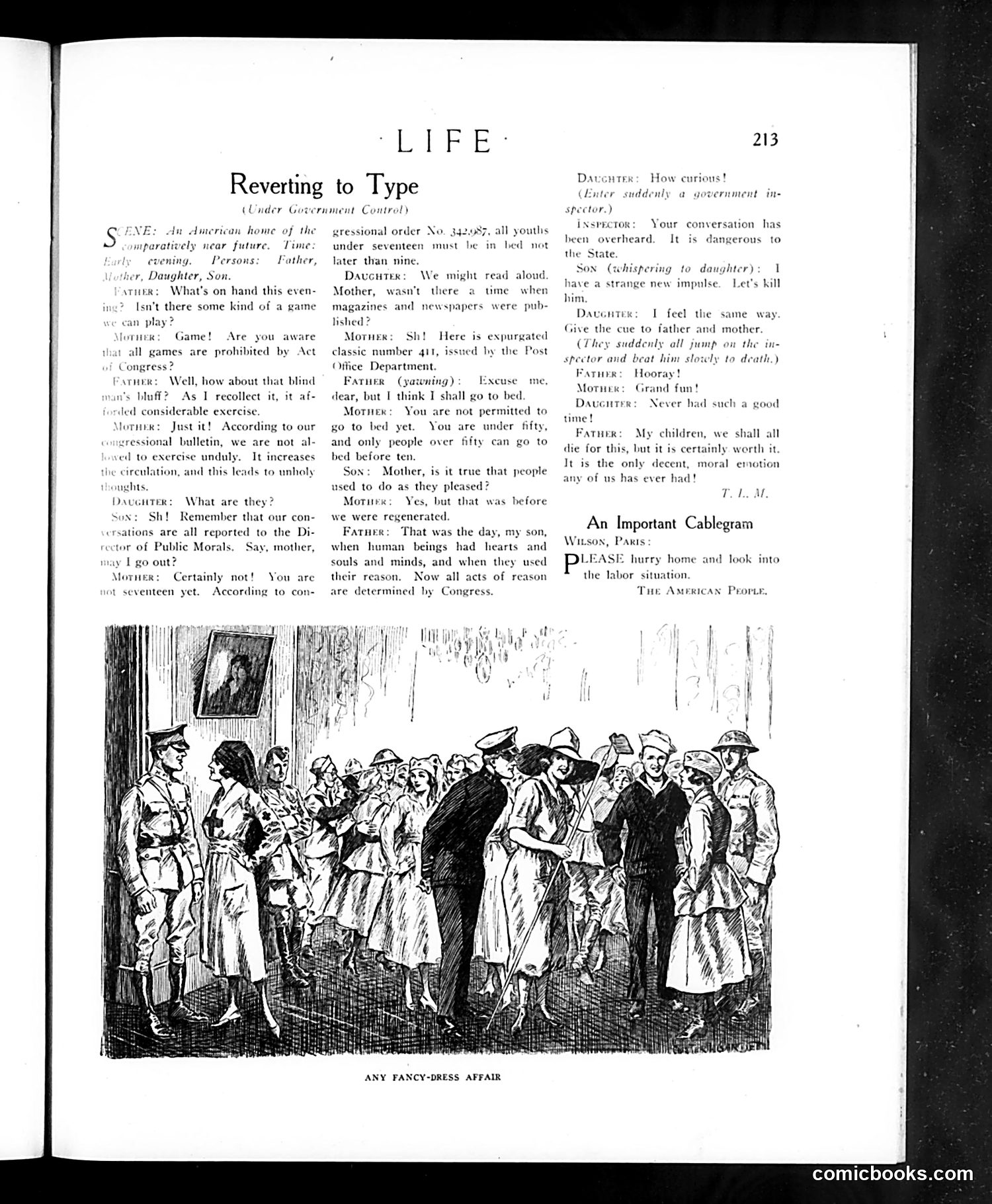
This play satirizes dystopian fears of excessive government regulation. Set in an imagined future American home, it depicts a family living under oppressive congressional control: children must be in bed by 9 p.m., games are banned, thoughts are monitored by a "Director of Public Morals," and even reading is censored by the Post Office. The satire's dark humor peaks when a government inspector arrives, prompting the family to violently attack him—described as their only "decent, moral emotion." The joke undercuts itself: the supposedly civilized state produces barbarism. The accompanying "Important Cablegram" from Wilson in Paris to "The American People" about checking on "the labor situation" likely references post-WWI labor unrest and socialist concerns, suggesting the cartoon equates government overreach with social chaos. This reflects 1920s anxieties about creeping authoritarianism and government intervention in daily life.
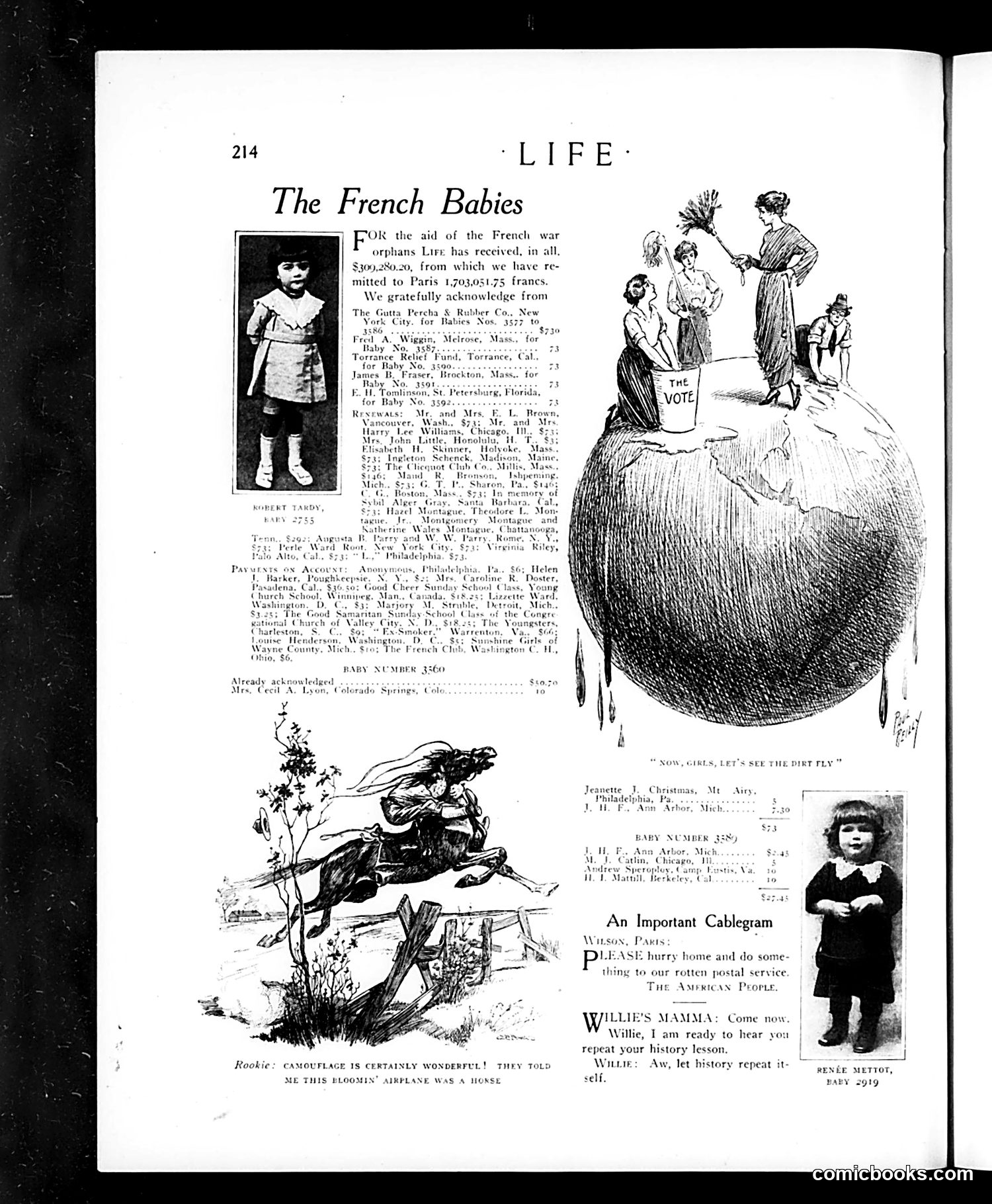
This page combines charitable appeals with wartime satire. The main content documents "The French Babies"—a Life magazine fundraising campaign for French war orphans (likely from WWI), listing donors who sponsored individual children. The cartoons mock the home front's complacency: 1. **"Now, Girls, Let's See the Dirt Fly"**: A large globe depicts women rolling up their sleeves to work—satirizing exaggerated patriotic fervor about domestic contributions while actual warfare devastates Europe. 2. **"Rookie" cartoon**: A soldier describes camouflage as turning an airplane into a horse—absurd military logic, mocking either military incompetence or soldiers' tall tales. 3. **"An Important Cablegram"**: President Wilson receives a complaint about postal service from Paris, while orphans need aid. The satire suggests Americans prioritize trivial domestic complaints over urgent humanitarian crises abroad. The overall message: Life critiques American self-satisfaction and trivial concerns during wartime suffering.
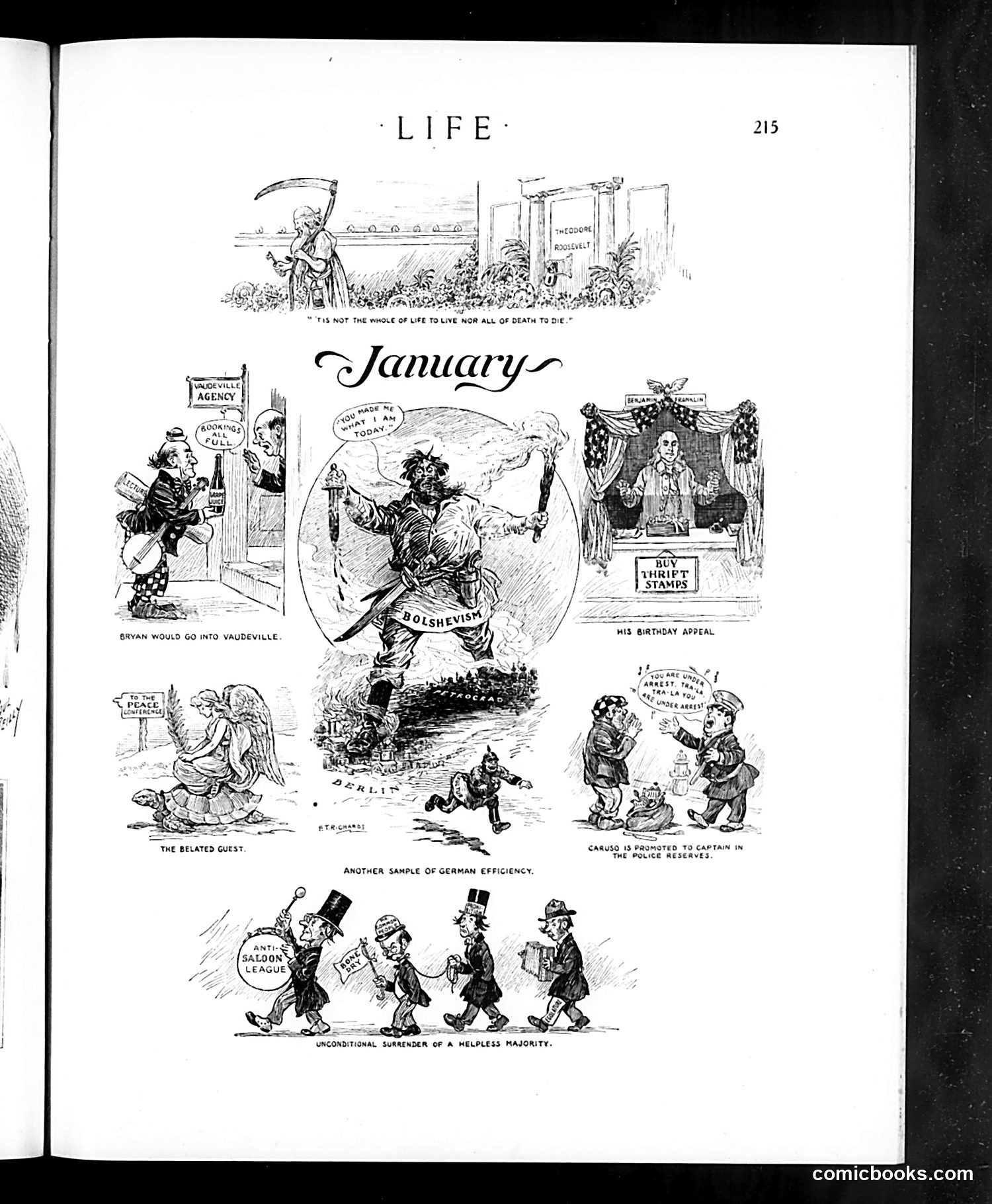
This page contains political satire cartoons about early 1900s events. The central figure labeled "Bolshevism" depicts a caricatured revolutionary juggling what appears to be weapons or chaos. Surrounding vignettes mock contemporary politics: - "Bryan would go into Vaudeville" references William Jennings Bryan - "His Birthday Appeal" shows what appears to be a political fundraising scene - "The Belated Guest" depicts Peace arriving late - References to "German Efficiency" mock German military/political conduct - "Caruso is promoted to Captain in the Police Reserves" likely refers to opera singer Enrico Caruso and some contemporary news item The overall theme satirizes post-WWI political instability, Bolshevik revolutionary threats, and various American political figures and events of the period. The artwork style is typical of early 20th-century American editorial cartooning.
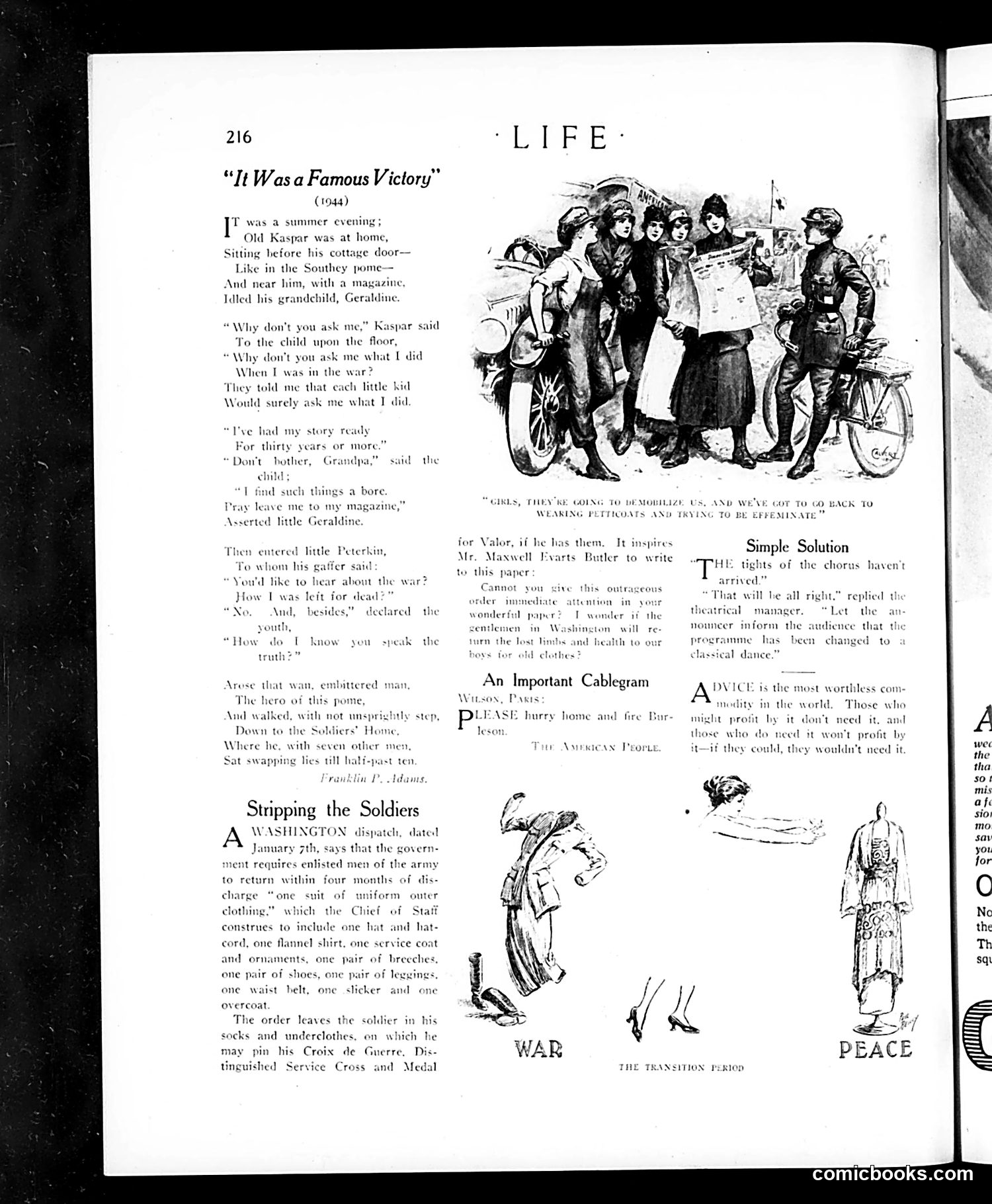
This page satirizes post-WWI disillusionment and post-WWII demobilization concerns. **"It Was a Famous Victory"** parodies Southey's poem, mocking how returning soldiers expect hero's welcomes. Old Kaspar prepares war stories for thirty years, only to have his grandchild dismiss him as boring—capturing the public's rapid loss of interest in veterans' narratives. **"Stripping the Soldiers"** criticizes military demobilization policy: soldiers must return uniforms but are discharged in their underwear and socks, left essentially destitute. The bitter cartoon caption shows women warning soldiers they'll return to civilian life unprepared and impoverished. **"Simple Solution"** jokes about theatrical producers cheaply "solving" costume shortages by claiming the program changed to "classical dance," mocking wartime corner-cutting. The **"War/Peace" transition drawings** contrast a soldier in uniform against a woman in civilian dress, visualizing the abrupt shift from military to civilian life. Overall, the page critiques society's callous treatment of returning soldiers and public indifference to their sacrifice.
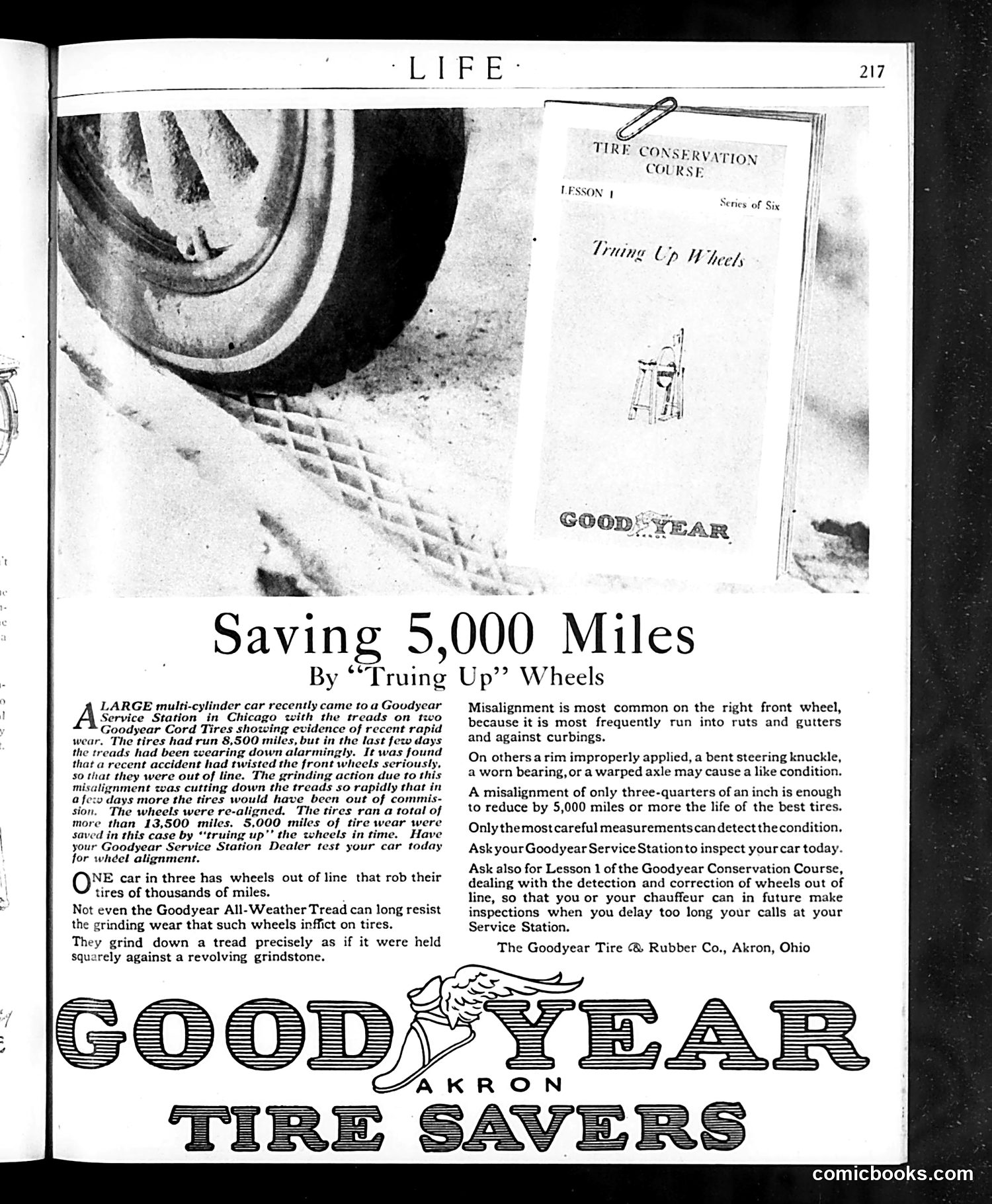
This is **not a cartoon or satire**—it's a Goodyear Tire advertisement disguised as educational content. The page presents "Lesson 1" of a "Tire Conservation Course" to appear instructional rather than purely promotional. The ad tells a case study: a car's tires wore dangerously fast due to misaligned wheels from an accident. By "truing up" (realigning) the wheels at a Goodyear Service Station, the tires gained an extra 5,000 miles of life. The pitch is straightforward: one in three cars has wheel misalignment problems that destroy tire life. Modern readers might miss that this represents early **automotive consumer education as marketing**—Goodyear frames tire care as a service benefit, positioning their dealers as trustworthy maintenance experts. The "Conservation Course" suggests responsible car ownership while directing customers to Goodyear stations. This reflects pre-Depression-era marketing strategy: building brand loyalty through educational authority rather than aggressive sales tactics.
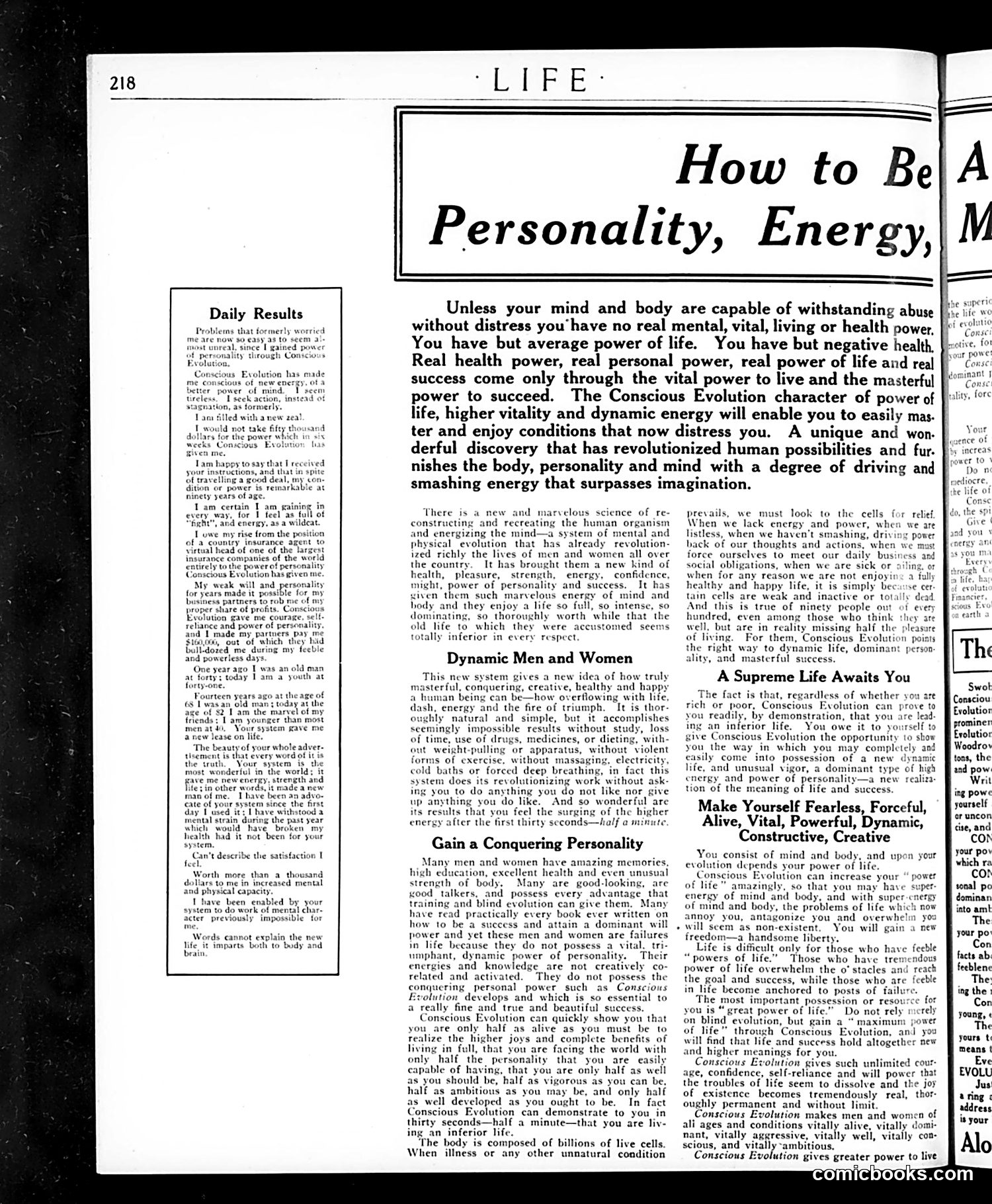
This page is **not a political cartoon** but rather a self-help advertisement disguised as testimonial journalism, typical of early 20th-century Life magazine. The "Daily Results" sidebar contains fabricated reader testimonials praising "Conscious Evolution"—a pseudoscientific self-improvement system promising to increase personality, energy, and life power through undefined mental/physical methods. Claims include: transforming a weak insurance agent into a powerful businessman, restoring youth at 40, and requiring no diet, exercise, or medication. The main article promotes the same system, using vague, grandiose language ("smashing energy," "dynamic power") while making no specific claims about *how* it actually works—classic snake-oil marketing. **The satire**: Life magazine was mocking the era's widespread pseudo-scientific self-help schemes and the credulous Americans who bought them. Modern readers recognize this as ancestor to today's wellness scams.
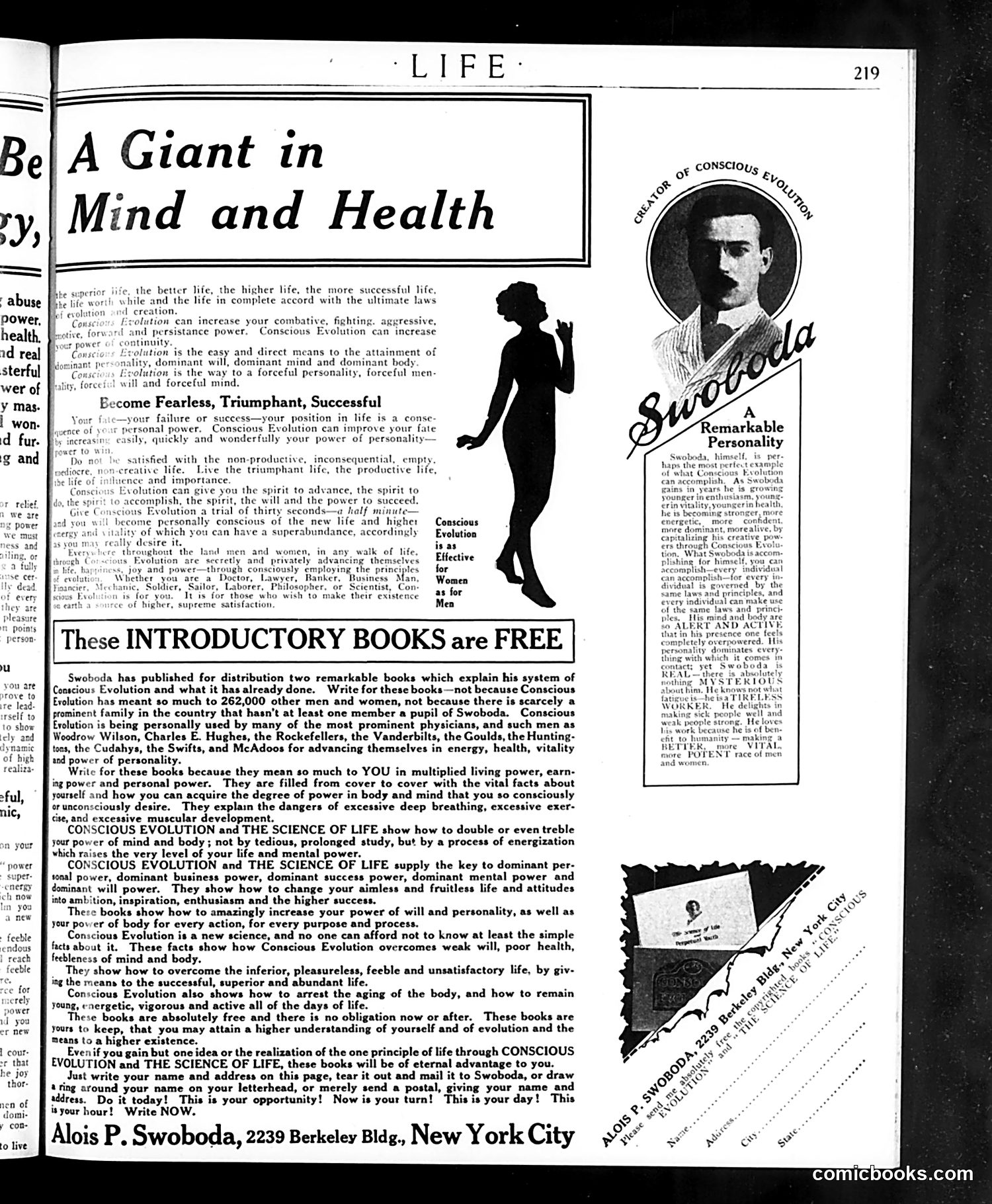
This page is **primarily advertising**, not satire. It promotes Alois P. Swoboda's self-help system called "Conscious Evolution" and "The Science of Life." The advertisement makes grandiose claims typical of early 20th-century pseudo-scientific self-improvement literature: that Swoboda's method can increase "combative, fighting, aggressive" power, create a "forceful personality," and transform readers into "fearless, triumphant" successes. Notably, the text name-drops prominent wealthy Americans (Rockefellers, Vanderbilts, Woodrow Wilson, Hughes) as supposed adherents—a common marketing tactic to lend credibility. The accompanying illustration shows a silhouetted figure in an exaggerated muscular pose, embodying the promised physical transformation. This represents the era's widespread promotion of pseudo-scientific "mind power" and self-development schemes, often mixing vague evolutionary language with promises of wealth and dominance. Modern readers would recognize this as snake-oil marketing dressed in pseudo-intellectual jargon.
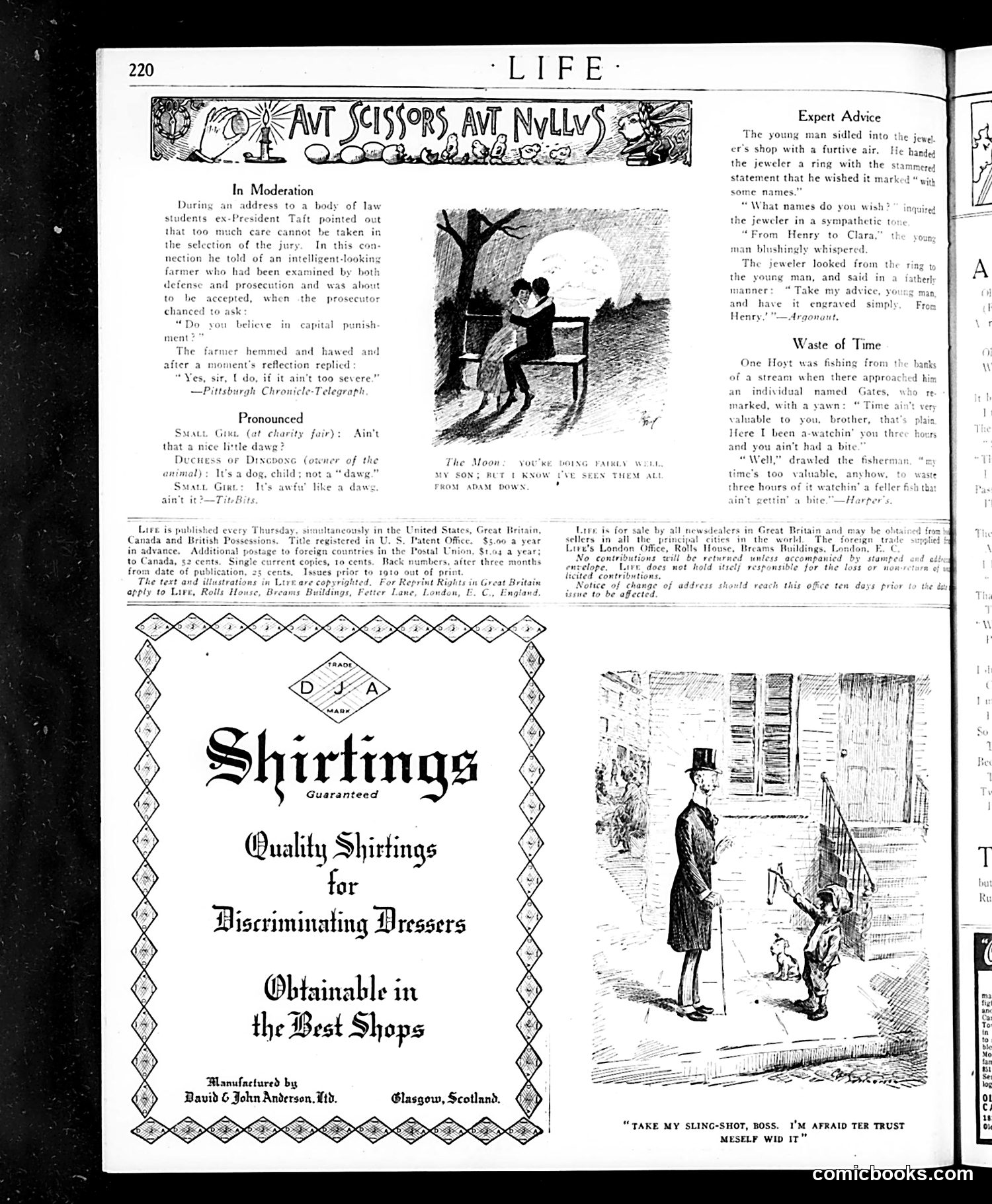
This page contains several brief humorous anecdotes typical of early 20th-century American satirical magazines: **"In Moderation"**: A farmer defends capital punishment to law students, arguing that excessive punishment cannot be taken in selecting jurors—a satirical jab at legal reasoning. **"Pronounced"**: A short dialect joke about a farmer misunderstanding the word "dawg" (dog). **"Expert Advice"**: A young man seeks a jeweler's help engraving a ring with names—the joke being the jeweler's practical suggestion to simply engrave "From Henry to Clara" rather than listing all the names. **"Waste of Time"**: Two fishermen discuss time's value; one complains he's wasted three hours fishing without a bite—mocking impatient modern life. The bottom cartoon shows a Black boy offering his slingshot to a white man with the caption "Take my sling-shot, boss. I'm afraid ter trust meself wid it"—a deeply problematic racial stereotype presenting self-deprecating obsequiousness. The page is primarily **advertising** for D.J.A. Shirtings (Glasgow).
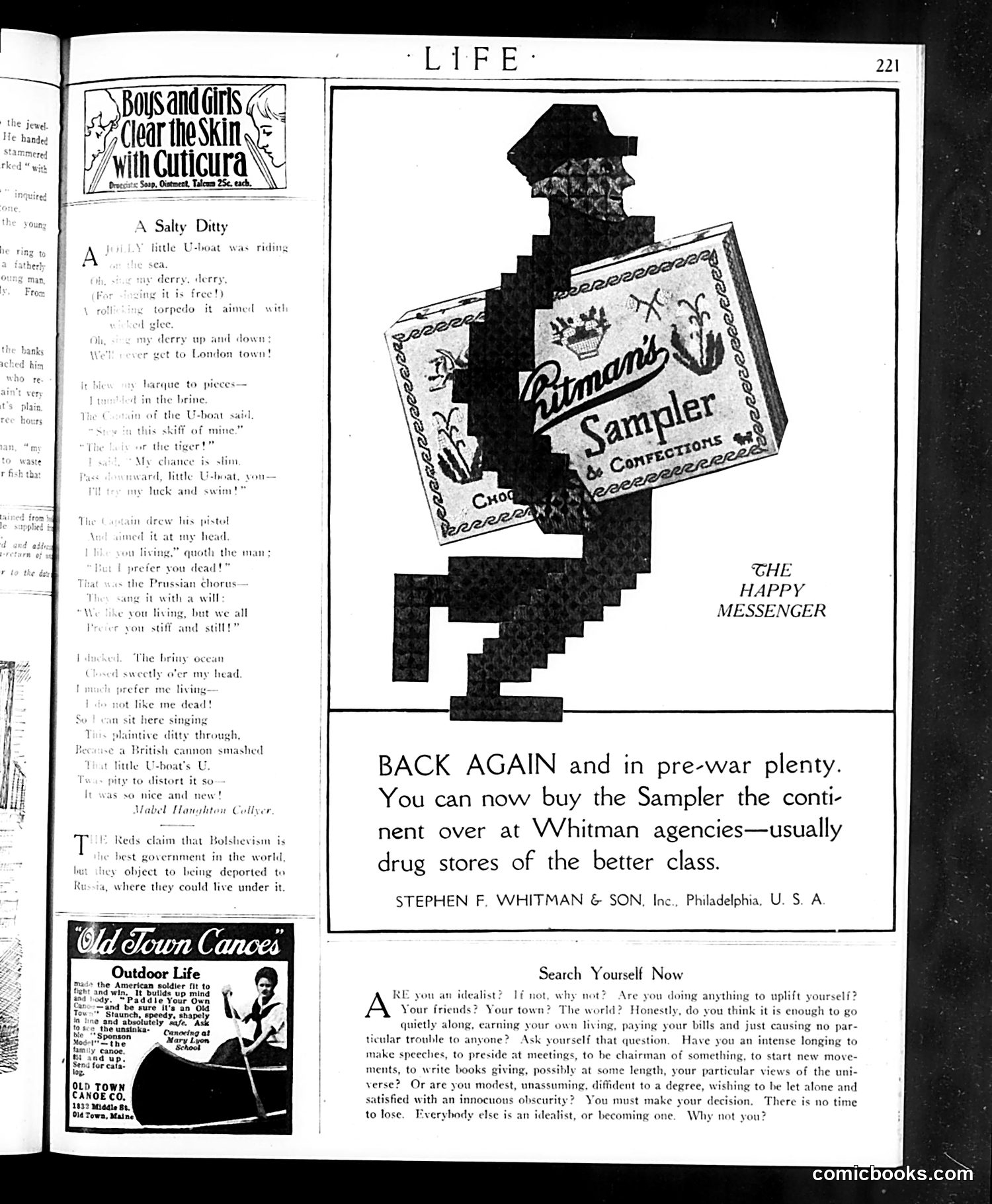
This page mixes poetry, advertising, and social commentary typical of Life's satirical format. **Main Content:** The large illustration shows a silhouetted sailor figure labeled "THE HAPPY MESSENGER" holding a Whitman Sampler candy box. This advertises the post-war return of Whitman confections to American drugstores—positioning the candy as a symbol of peacetime abundance restored. **Surrounding Material:** A poem titled "A Salty Ditty" depicts wartime naval combat with dark humor (references to U-boats, British cannons, torpedoes). Below is a brief political jab: The Reds (Bolsheviks) claim communism is superior, yet object to deportation—satirizing the hypocrisy of communist rhetoric versus their actual desire to remain in America. **"Search Yourself Now" Section:** This editorial questions readers on idealism: Are you ambitious and reform-minded, or content with obscurity? It implicitly criticizes modest inaction, urging engagement. **Overall:** The page contrasts wartime sacrifice with peacetime consumerism, while questioning American civic responsibility in the postwar period.
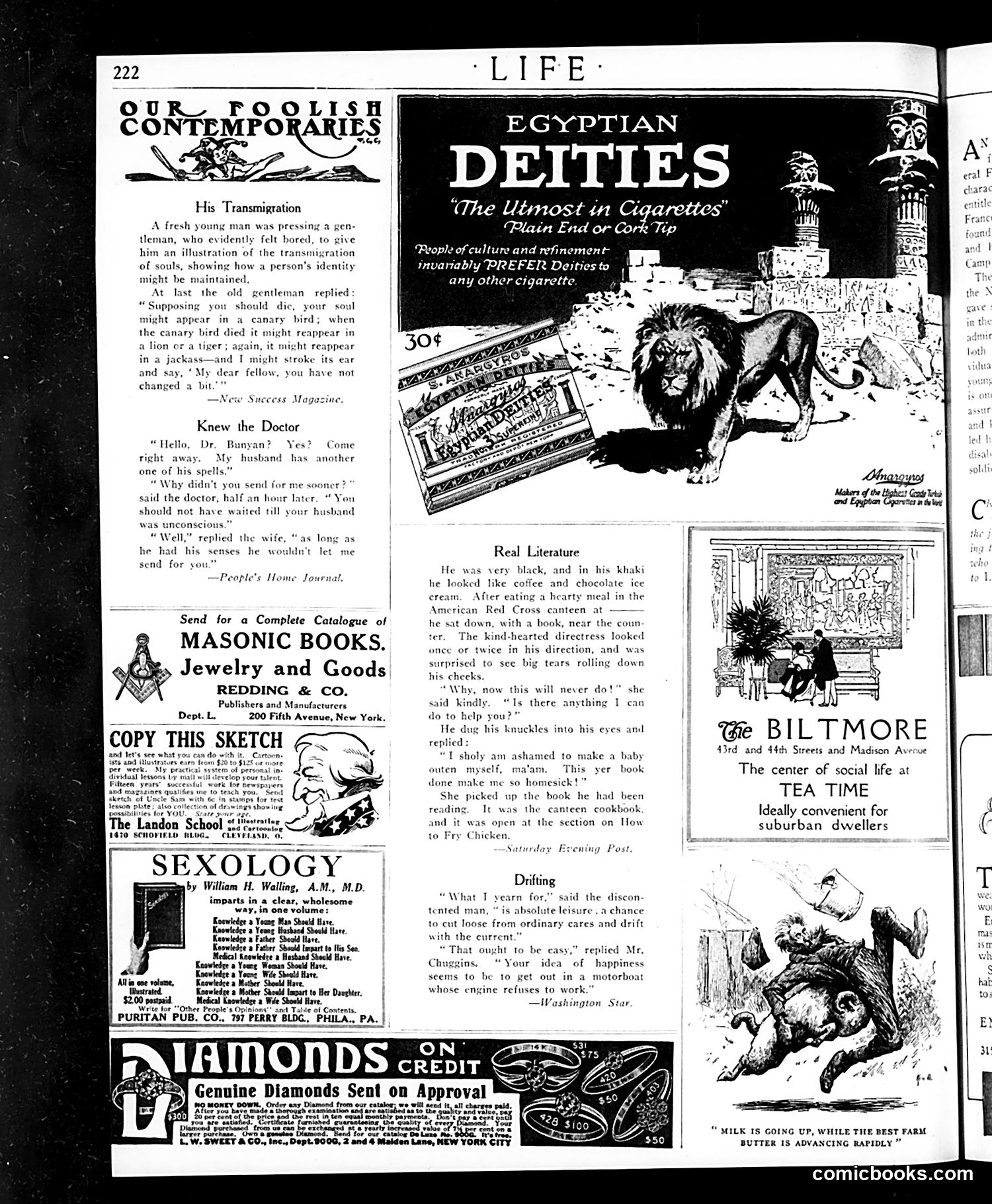
This page mixes humor columns with period advertising. The main satirical content includes: **"His Transmigration"**: A joke about reincarnation. A young man bores an older gentleman by pressing him to explain how souls maintain identity across lives. The gentleman's punchline—that nothing fundamental changes ("you have not changed a bit")—is a cutting insult wrapped in philosophy. **"Knew the Doctor"**: Domestic humor where a wife delays calling the doctor until her husband loses consciousness, claiming he wouldn't "let" her while conscious. The joke plays on marital dynamics and stubbornness. **"Real Literature"**: A sentimental anecdote about a Black soldier (identified by race and military "khaki") crying over a Red Cross canteen cookbook, homesick after reading fried chicken recipes. The humor is gentle and sympathetic rather than mocking. The page is primarily **advertising**—Egyptian Deities cigarettes, Masonic books, a correspondence art school, sexology texts, and diamonds. These ads reflect early 20th-century consumer culture and attitudes toward self-improvement literature.
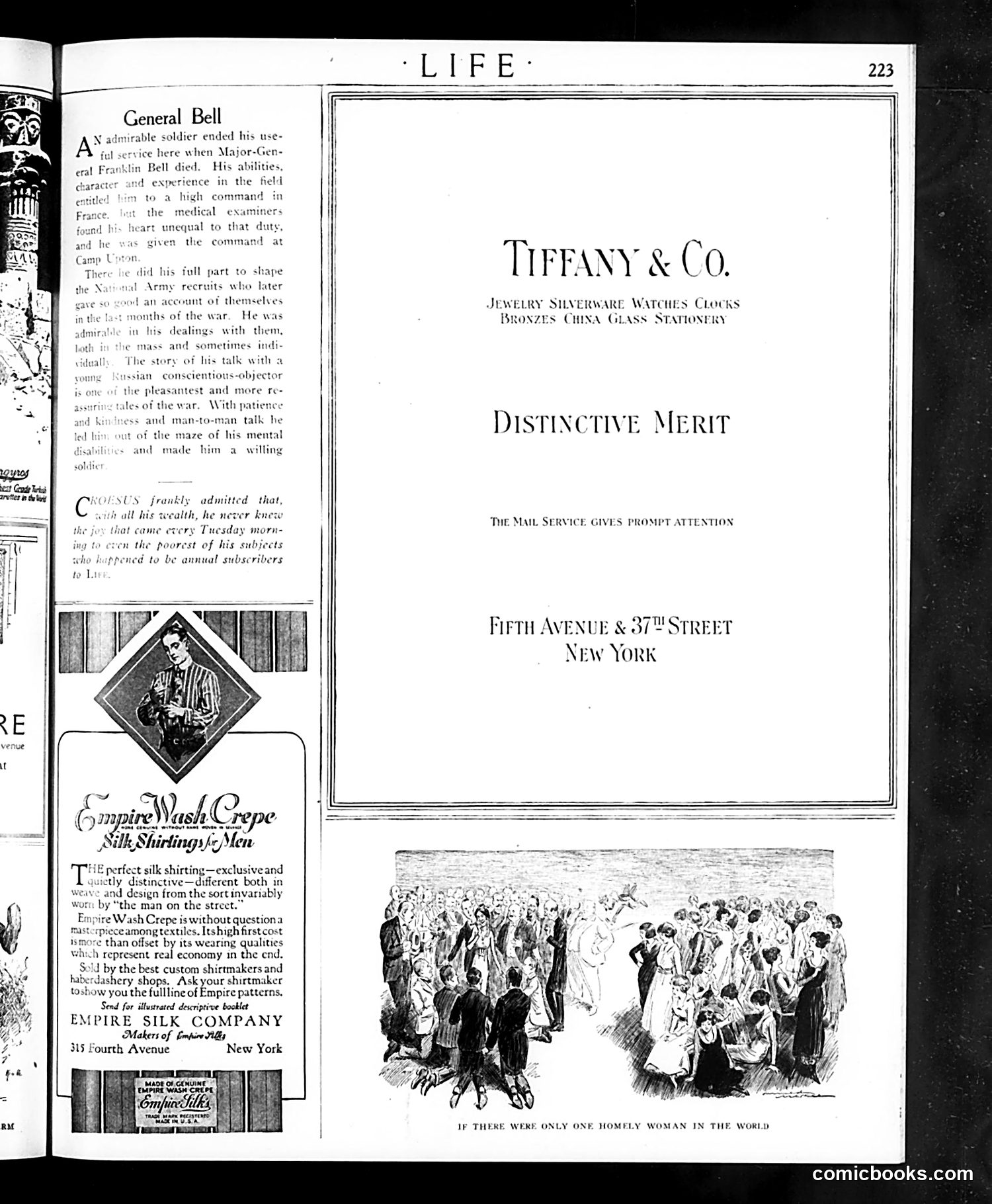
This page mixes editorial content with advertisements typical of early 20th-century magazines. **Left side:** A brief biographical sketch of "General Bell," an admirable soldier whose medical examiners found him unfit for command after Major-General Franklin Bell's death. The piece praises how he handled Russian conscientious objectors with patience and man-to-man conversation, turning one into "a willing soldier"—a wartime anecdote illustrating persuasion over coercion. **Bottom illustration:** Captioned "If There Were Only One Homely Woman in the World," this cartoon depicts a crowded social scene where a plainly dressed woman stands at center while fashionable people surround her—satirizing how appearance determines social attention and acceptance. **Right side:** Full-page advertisements for Tiffany & Co. (jewelry/luxury goods) and Empire Silk Company (high-end menswear), reflecting the magazine's affluent readership. The content juxtaposes serious wartime narrative with light social satire and luxury marketing.
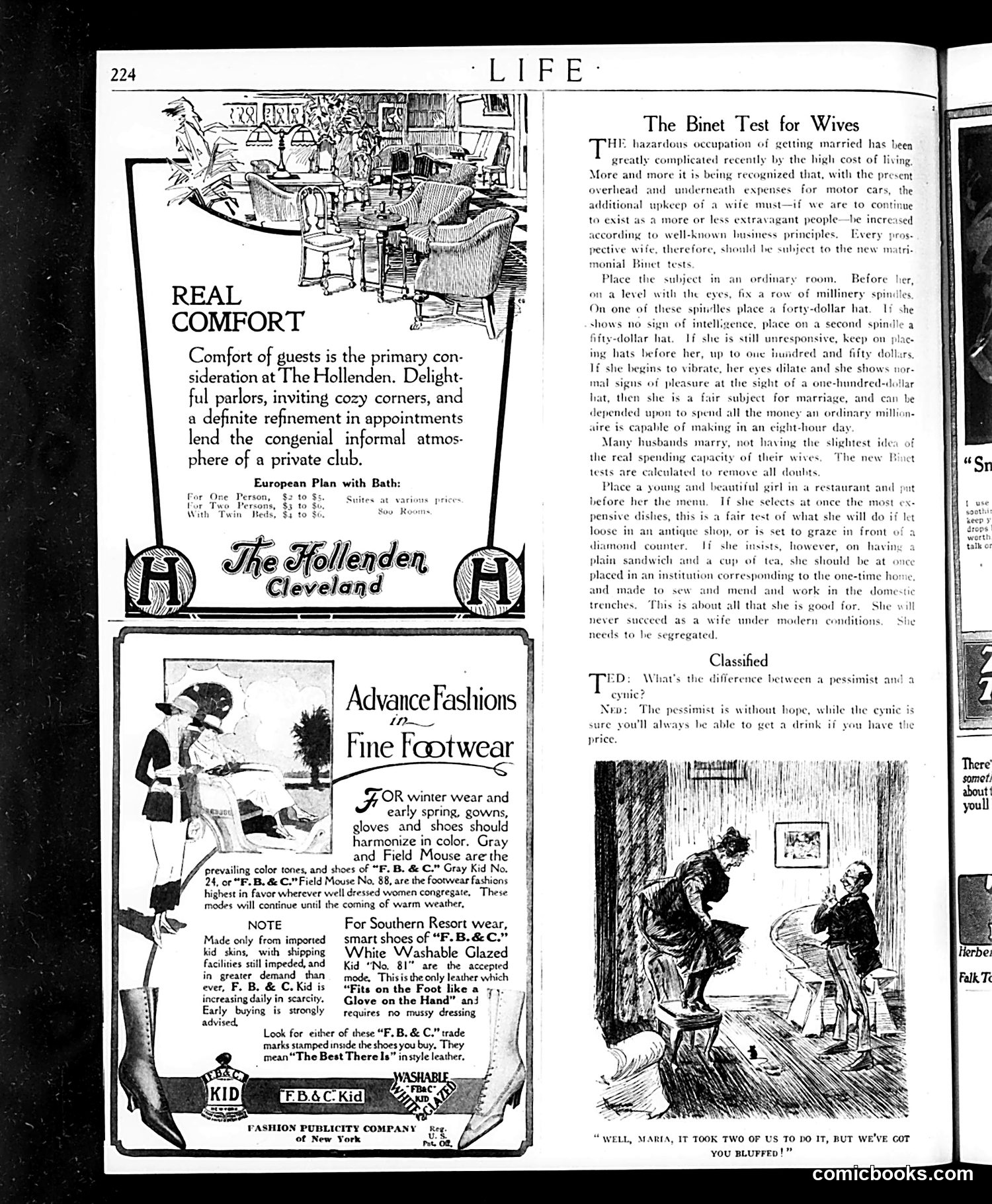
This satirical article mocks both the "scientific" IQ testing trend (the Binet test, recently developed in France) and anxious husbands worried about wives' spending habits during an economically uncertain period. The satire proposes subjecting prospective wives to absurd "tests" to predict their consumption: exposing them to increasingly expensive hats to gauge their materialism, or observing restaurant menu choices to forecast their extravagance. The joke targets husbands who fear their wives will bankrupt them through lavish spending on fashion, jewelry, and antiques. The cartoon below (captioned "Well, Maria, it took two of us to do it, but we've got you bluffed!") shows a woman catching two men in what appears to be deception—likely illustrating that wives are shrewder judges of character than husbands believe, undercutting the entire premise that women need "testing." The piece satirizes both pseudo-scientific management ideology applied to marriage and the period's class anxieties about conspicuous consumption.
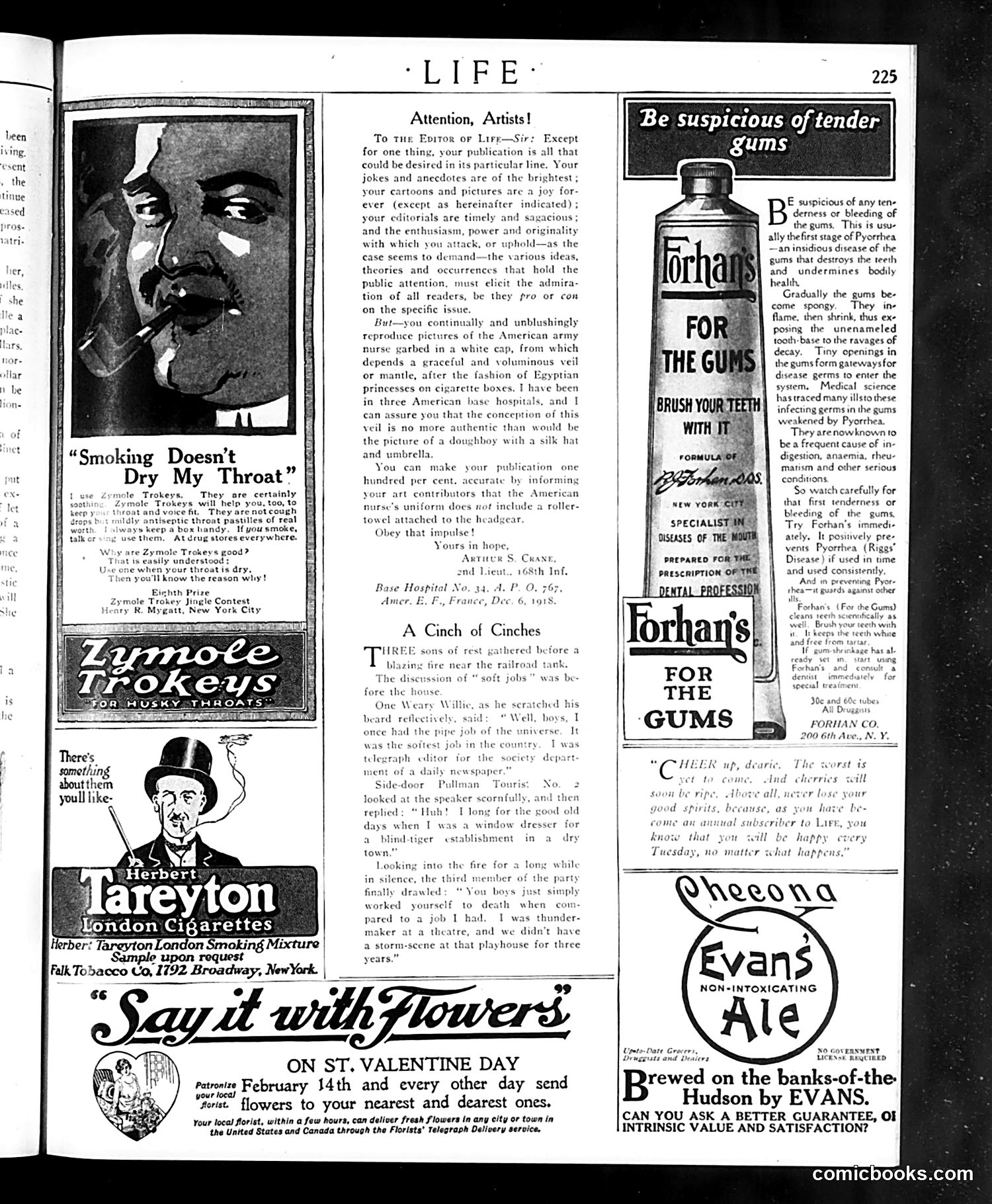
This page contains **primarily advertisements and reader correspondence**, not political cartoons requiring historical context. The main content is a **letter from an Army officer** (2nd Lieutenant Arthur S. Crane, 168th Infantry) criticizing Life's cartoonists for inaccurately depicting American military nurses. He complains they draw nurses wearing elaborate veils and headgear styled like "Egyptian princess" fashion, when the actual U.S. Army nurse uniform includes no such decoration. This is wartime satire—Life apparently mocked the military through exaggerated visual stereotypes, and the officer protests this misinformation as disrespectful to actual nurses serving in base hospitals. The page also contains a humorous short story ("A Cinch of Cinches") about hobos debating who had the easiest job, and multiple product advertisements (Zymole Trokeys lozenges, Herbert Tareyton cigarettes, Forhan's toothpaste for gum disease, Evans Ale). The "Say It with Flowers" Valentine's Day promotion is a straightforward commercial message.
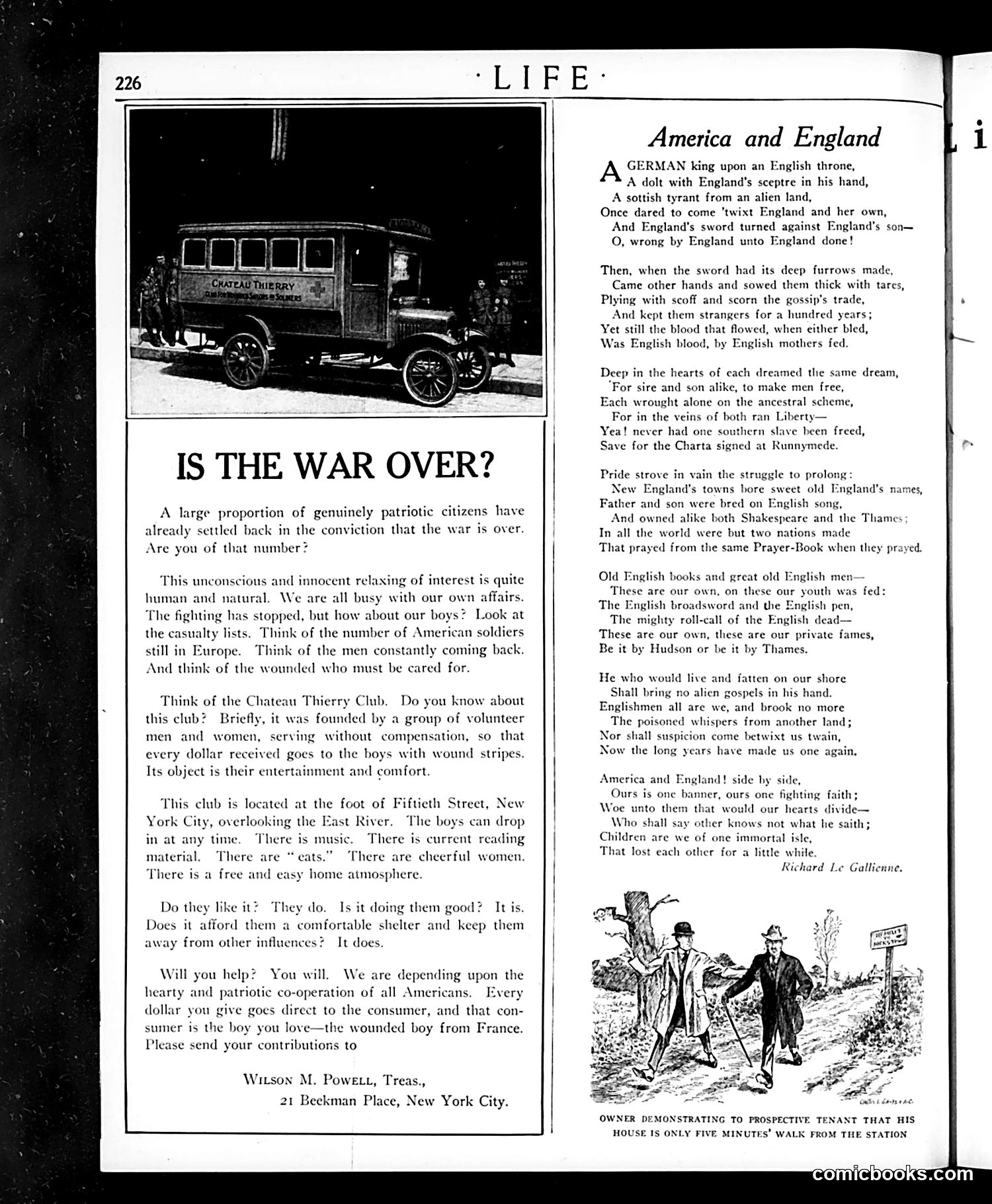
**Left Column — "Is the War Over?"** This is a fundraising appeal for the Chateau Thierry Club, a charitable organization caring for wounded American soldiers returning from World War I. The piece warns against complacency now that fighting has ceased, reminding readers that casualties continue and wounded men need support. It's a direct call for donations to help entertain and comfort disabled veterans. The photo shows a club vehicle (Chateau Thierry branded). The appeal emphasizes patriotic obligation and appeals to readers' emotional connection to "the wounded boy from France." **Right Column — "America and England"** A patriotic poem by Richard Le Gallienne celebrating Anglo-American kinship and shared cultural heritage (Shakespeare, English literature, democratic ideals). Written during WWI when America and Britain were allies, it emphasizes their common bloodlines and values, warning against "alien" influences trying to divide them. The message: Americans and English are essentially one people. **Bottom Cartoon** A real estate agent shows a prospective tenant that a house is conveniently located near the train station—a standard real estate sales pitch.