
Life, 1919-02-06 · page 19 of 38
Life — February 6, 1919 — page 19: what you’re looking at
What you’re looking at
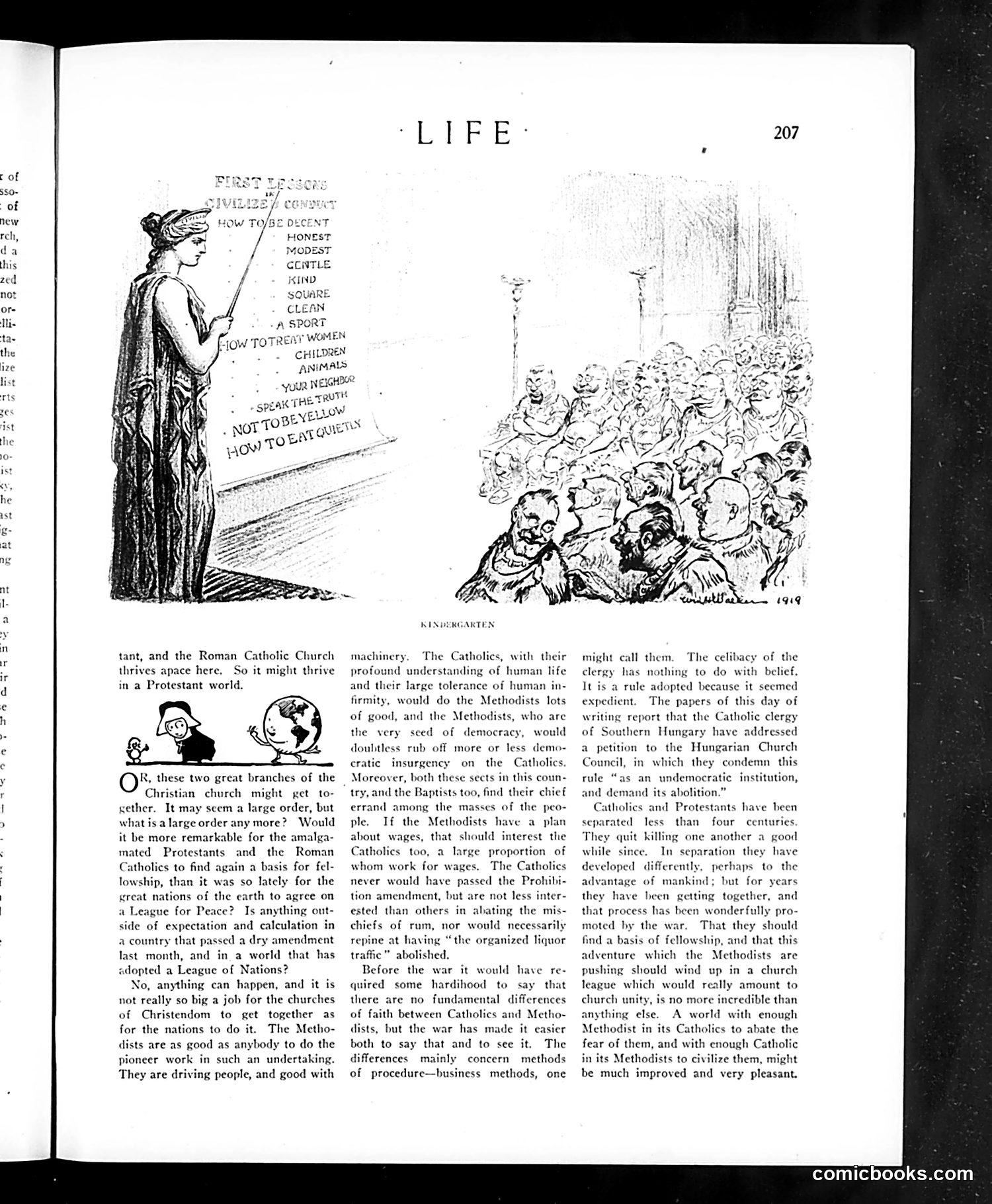
This page presents two cartoons advocating for Christian church unity between Protestants (specifically Methodists) and Roman Catholics. **Left cartoon**: A classical female figure (likely representing Wisdom or an allegorical virtue) holds a tablet listing virtues: "Honest, Modest, Gentle, Kind, Square, Clean, A Sport" and instructions like "How to Treat Women, Children, Animals" and "Speak the Truth." **Right cartoon ("Kindergarten")**: Depicts a large crowd of common people—workers and ordinary citizens—whom the text identifies as the shared constituency of both Methodist and Catholic churches. **The satire's point**: The accompanying article argues that Methodist-Catholic union is no more impossible than recent achievements (Prohibition, the League of Nations). Both churches serve working-class masses interested in labor reform and social welfare. The cartoons suggest that shared practical values and common people—not theological differences—should unite these denominations. The satire presents church merger as a logical, even overdue, social reform.
📄 Transcribed text from this page (OCR, searchable)
Machine-transcribed from the original scan — historical spelling and the odd misread are preserved.
MODEST CCNTLE KIND A SPORT it WOMEN CHILDREN ANIMALS your NEIGHI® tant, and the Roman Catholic Church thrives apace here. So it might thrive in a Protestant world. R, these two great branches of the Christian church might get to- gether. It may scem a large order, but what is a large order any more? Would it be more remarkable for the amalga- mated Protestants and the Roman holies to find again a basis for fel- lowship, than it was so lately for the great nations of the earth to agree on a League for P Is anything out- side of expectation and calculation in a country that passed a dry amendment last. month, and in a world that has adopted a League of Nations? No, anything can happen, and it is not really so big a job for the churches of Christendom to get together as for the nations to do it. The Metho- dists are as good as anybody to do the pioneer work in such an undertaking. They are driving people, and good with KINDERGARTEN machinery, The Catholics, with their profound understanding of human life and their large tolerance of human in- firmity, would do the Methodists lots of good, and the Methodists, who are the very seed of democracy, would doubtless rub off more or less demo- cratic insurgency on the Catholics. Moreover, both these sects in this coun- try, and the Baptists too, find their chief errand among the masses of the peo- ple. If the Methodists have a plan about wages, that should interest the Catholics too, a large proportion of whom work for wages. The Catholi never would have passed the Prohibi- tion amendment, but are not less inte: ested than others in abating the mis- chiefs of rum, nor would necessarily repine at having “the organized liquor traffic” abolished. Before the war it quired some hardihood to that there are no fundamental differences of faith between Catholics and Metho- dists, but the war has made it easier both to say that and to see it. The differences mainly concern methods of procedure—business methods, one would have re- say might call them. The celibacy of the clergy has nothing to do with belief, rule adopted because it seemed expedient. The papers of this day of writing report that the Catholic clergy of Southern Hungary have addressed petition to the Hungarian Church Council, in which they condemn this rule “as an undemocratic institution, and demand its abolition.” Catholics and Protestants have been ‘ated less than four centuries They quit killing one another a good while since. In separation they have developed differently, perhaps to. the advantage of mankind; but for years they have been getting together, and that process has been wonderfully pro- moted by the war. That they should find a basis of fellowship, and that this adventure which the Methodists are pushing should wind up in a church league which would really a church unity, is no more incredible than anything else. A world with enough Methodist in its Catholics to abate the fear of them, and with enough Catholic in its Methodists to civilize them, might be much improved and very pleasant. comicbooks.com