
Life, 1919-02-06 · page 18 of 38
Life — February 6, 1919 — page 18: what you’re looking at
What you’re looking at
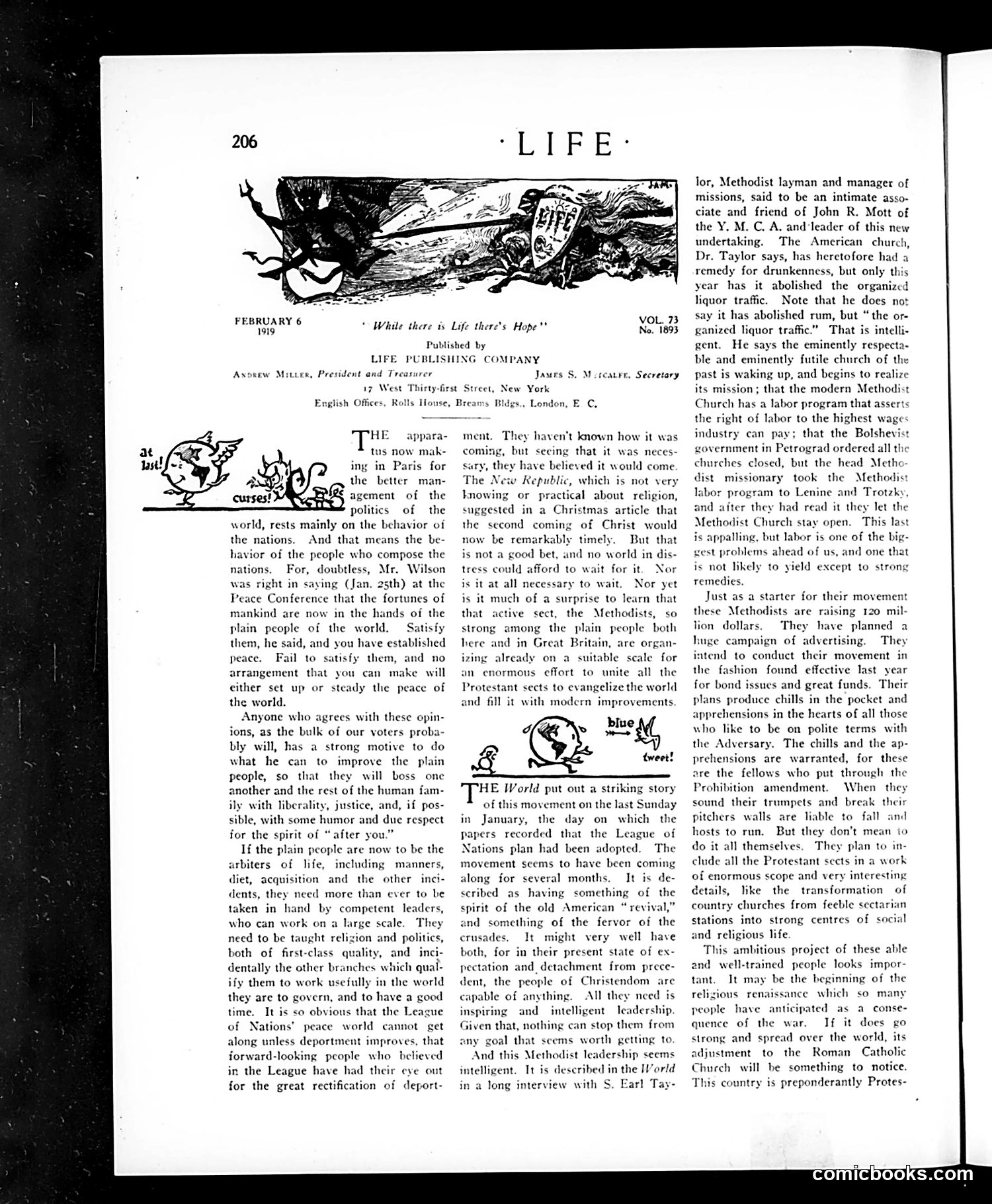
This page discusses a Methodist movement to unite Protestant sects and "evangelize the world" with "modern improvements." The article frames this as a response to the newly-adopted League of Nations plan, published the same day. The text argues that since "plain people" will determine world peace (per Wilson's recent statements), they need moral and religious instruction from competent leaders. The Methodists—described as "strong among the plain people both here and in Great Britain"—are organizing a large-scale effort resembling an old American "revival." The cartoons (appearing as decorative vignettes) are difficult to parse clearly but seem to satirize the earnest ambitions of this Protestant reform movement. The underlying point: sophisticated magazine readers would recognize the irony that post-WWI hopes for peace rest on mass moral improvement—and that American Methodists have positioned themselves as the vehicle for that improvement, combining religious fervor with progressive social reform (addressing drunkenness, labor conditions, etc.).
📄 Transcribed text from this page (OCR, searchable)
Machine-transcribed from the original scan — historical spelling and the odd misread are preserved.
FEBRUARY 6 1919 * White there is Life there's Hope" VOL. 73 No, 1893 Published by LIFE Axoxew Minter, President and Treasurer 17 West Thirty English Offices, Rolls He T# tus now mak- ing in Paris for the better man- agement of the politics of the world, rests mainly on the behavior of the nations. And that means the be- havior of the people who compose the nations. For, doubtless, Mr. Wilson was right in saying (Jan. 25th) at the Peace Conference that the fortunes of mankind are now in the hands of the plain people of the world. Satisfy them, he said, and you have established peace. Fail to satisfy them, arrangement that you can m either set up or steady the peace of the world. Anyone who agrees with these opin- ions, as the bulk of our voters prob bly will, has a strong motive to do what he can to improve the plain people, so that they will boss another and the rest of the human fam- ily with liberality, justice, and, if pos- sible, with some humor and due respect for the spirit of “after you.” If the plain people are now to be the arbiters of life, including manne diet, acquisition and the other in dents, they need more than ever to be taken in hand by competent leaders, who can work on a large scale. They need to be taught relizion and politics, both of first-class quality, and inci- dentally the other branches which qual- ify them to work usefully in the world they are to govern, and to have a good time. It is so obvious that the League of Nations’ peace world cannot get along unless deportment improves, that forward-looking people who believed in the League have had their eye out for the great rectification of deport- appara- one PUBLISHING COMPANY Jaurs S. Miscater, Secretary York » Bldgs., London, EC, reet, New Bre ment. They haven't known how it was ing, but secing that it was neces- y have believed it would come. Republic, which is not very The New knowing or practical about religion, suggested in a Christmas article that the second coming of Christ would now be remarkably timely. But that is not a good bet, and no world in dis- tress could afford to wa Nor is it at all necessary to wait. Nor yet is it much of a surprise to learn that that sect, the Methodists, strong among the plain people both here and in Great Britain, are organ- izing already on a suitable scale for an cnormous effort to unite all the Protestant sects to evangelize the world and fill it with modern improvements. blue — active so \y 'HE World put out a striking story of this movement on the last Sunday in January, the day on which the papers recorded that the League of Nations plan had been adopted. The movement seems to have been coming along for several months. It is de scribed as having something of the spirit of the old American “ revival,” and something of the fervor of the crusades. It might very well have both, for in their present state of ex- pectation and detachment from prece- dent, the people of Christendom capable of anything. All they need is inspiring and intelligent leadership. Given that, nothing can stop them from any goal that scems worth getting to And this Methodist leadership seems intelligent. It is described in the World in a long interview with S. Earl Tay- ure lor, Methodist layman and manager of missions, said to be an intimate asso- ciate and friend of John R. Mott of the Y. M, C. A. and leader of this new undertaking, The American church, Dr. Taylor says, has heretofore had a remedy for drunkenness, but only this year has it abolished the organized liquor traffic. Note that he does not y i abolished rum, but “the or- nized liquor traffic.” That is intelli- gent. He says the eminently respecta- ble and eminently futile church of the past is waking up, and begins to realize its mission; that the modern Methodist Chureh has a labor program that asserts the right of labor to the highest wages industry can pay; that the Bolshevist government in Petrograd ordered all the churches , but the head Methc dist’ missionary took the Methodist labor program to Lenine and Trotz and after they had read it they let the Methodist Church stay open. This last is appalling, but labor is one of the big gest problems ahead of us, and one tha is not likely to yield except to strong remedies Just as a starter for their movement these Methodists are raising 120 mil- lion dollars. They have planned a sign of advertising. They intend to conduct their movement in the fashion found effective last year for bond issues and great funds. Their plans produce chills in the pocket and apprehensions in the hearts of all those who like to be on polite terms with the Adversary. The chills and the ap- prehensions are warranted, for these are the fellows who put through the Prohibition amendment. When they sound their trumpets and break their pitchers walls are liable to fall and hosts to run. But the; do it all themselves. clude all the Protestant sects in a work of enormous scope and very interesting cetails, like the transformation country churches from feeble sectari stations into strong centres of social and religious life. This ambitious project of these able and well-trained people looks impor- tant. It may be the beginning of the religious renaissance which many huge cam don't mean io They plan to in- of 7 so people have anticipated as a conse- quence of the If it does go strong and spread over the world, its adjustment to the Roman Catholic Church will be something to notice. This country is preponderantly Protes- war. Ccomicbooks.com