
Life, 1919-02-06 · page 38 of 38
Life — February 6, 1919 — page 38: what you’re looking at
What you’re looking at
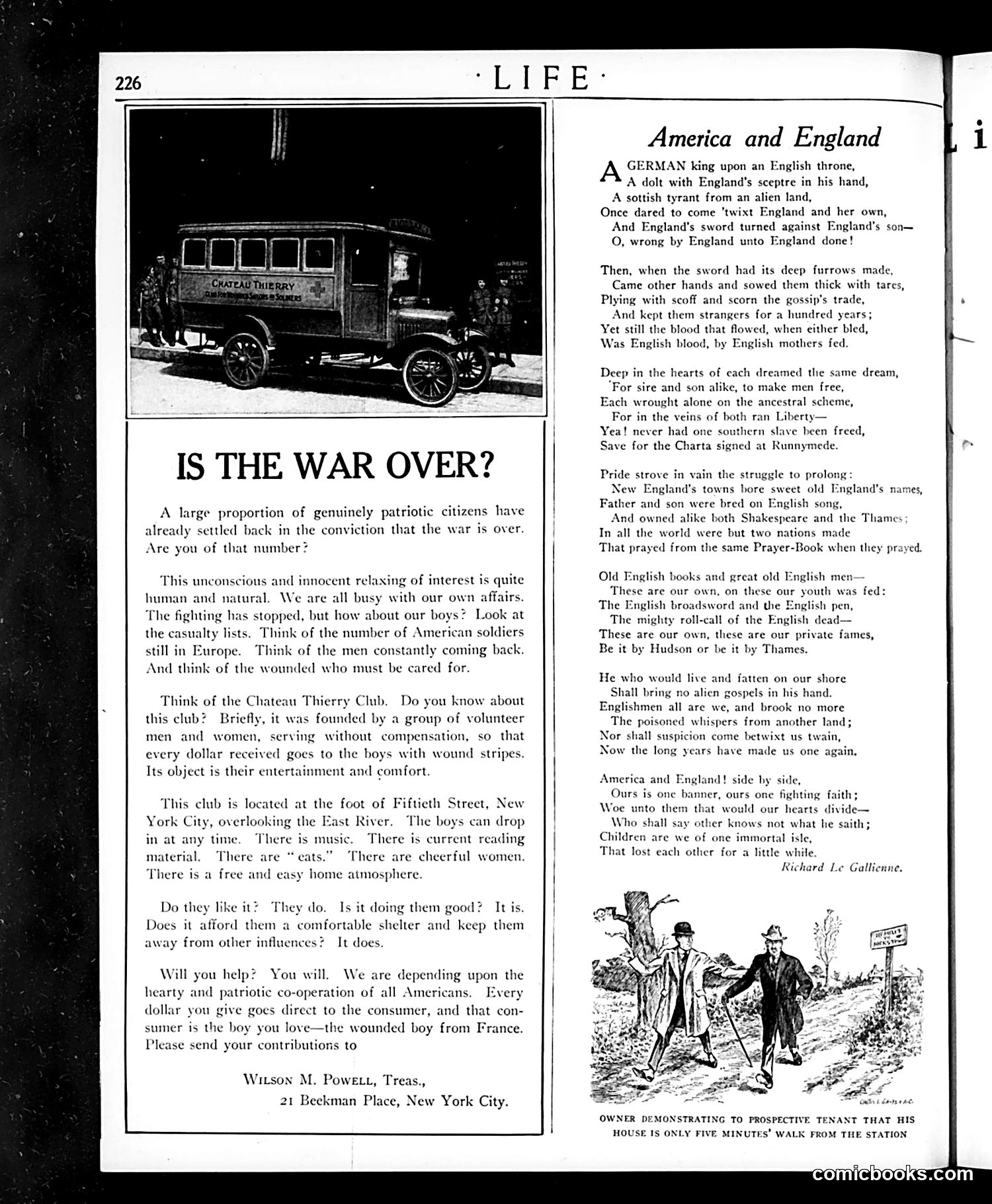
**Left Column — "Is the War Over?"** This is a fundraising appeal for the Chateau Thierry Club, a charitable organization caring for wounded American soldiers returning from World War I. The piece warns against complacency now that fighting has ceased, reminding readers that casualties continue and wounded men need support. It's a direct call for donations to help entertain and comfort disabled veterans. The photo shows a club vehicle (Chateau Thierry branded). The appeal emphasizes patriotic obligation and appeals to readers' emotional connection to "the wounded boy from France." **Right Column — "America and England"** A patriotic poem by Richard Le Gallienne celebrating Anglo-American kinship and shared cultural heritage (Shakespeare, English literature, democratic ideals). Written during WWI when America and Britain were allies, it emphasizes their common bloodlines and values, warning against "alien" influences trying to divide them. The message: Americans and English are essentially one people. **Bottom Cartoon** A real estate agent shows a prospective tenant that a house is conveniently located near the train station—a standard real estate sales pitch.
📄 Transcribed text from this page (OCR, searchable)
Machine-transcribed from the original scan — historical spelling and the odd misread are preserved.
IS THE WAR OVER? A large proportion of genuinely patriotic citizens have already settled back in the conviction that the war is over. Are you of that number? This unconscious and innocent relaxing of interest is quite human and natural. We are all busy with our own affairs. The fighting has stopped, but how about our boys? Look at the casualty lists. Think of the number of American soldiers still in Europe. Think of the men constant i And think of the wounded who must be Think of the Chateau Thierry Club. Do you know about this club? Briefly, it was founded by a group of volunteer men and women, serving without compensation, so that every dollar received goes to the boys with wound stripes. Its object is their entertainment and comfort. This club is located at the foot of Fiftieth Street, New York City, overlooking the East River. The boys can drop in at any time, There is music. There is current reading material, There are “eats.” There are cheerful women There is a free and easy home atmosphere. Do they like it? They do. Is it doing them good? It is. Does it afford them a comfortable shelter and keep them away from other influences? It does. Will you help? You will. We are depending upon the hearty and patriotic co-operation of all Americans. Every dollar you give goes direct to the consumer, and that con- sumer is the boy you love—the wounded boy from France. e send your contributions to Witson M. Powe tt, Treas., 21 Beekman Place, New York City. America and England GERMAN king upon an English throne, A dolt with England's sceptre in his hand, A sottish tyrant from an alien land, Once dared to come ‘twixt England and her own, And England’s sword turned against England's son— O, wrong by England unto England done! Then, when the sword had its deep furrows made, Came other hands and sowed them thick with tares, Plying with scoff and scorn the gossips trade, And kept them strangers for a hundred years; Yet still the blood that flowed, when either bled, Was English blood, by English mothers fed. Deep in the hearts of each dreamed the same dream, ‘For sire and son alike, to make men free, Each wrought alone on the ancestral scheme, For in the veins of both ran Liberty— Yea! never had one southern slave been freed, Save for the Charta signed at Runnymede. Pride strove in vain the struggle to prolong: New England's towns bore sweet old England's names, Father and son were bred on English song, And owned alike both Shakespeare and the Thames In all the world were but two nations made That prayed from the same Prayer-Book when they prayed. Old English books and great old English men These are our own, on these our youth was fed: The English broadsword and the English pen, The mighty roll-call of the English dead— These are our own, these are our private fames, Be it by Hudson or be it by Thames. He who would live and fatten on our shore Shall bring no alien gospels in his hand. Englishmen all are we, and brook no more The poisoned whispers from another land; Nor shall suspicion come betwixt us twain, Now the long years have made us one agai America and England! side hy side, Ours is one banner, ours one fighting Woe unto them that would our hearts divide— Who shall say other knows not what he saith; Children are we of one immortal isle, That lost each other for a little while. Richard Le Gallienne. NER DEMONSTRATING TO PROSPECTIVE TENANT THAT HIS HOUSE IS ONLY FIVE MINUTES’ WALK FROM THE STATION