
A complete issue · 34 pages · 1919
Life — January 9, 1919
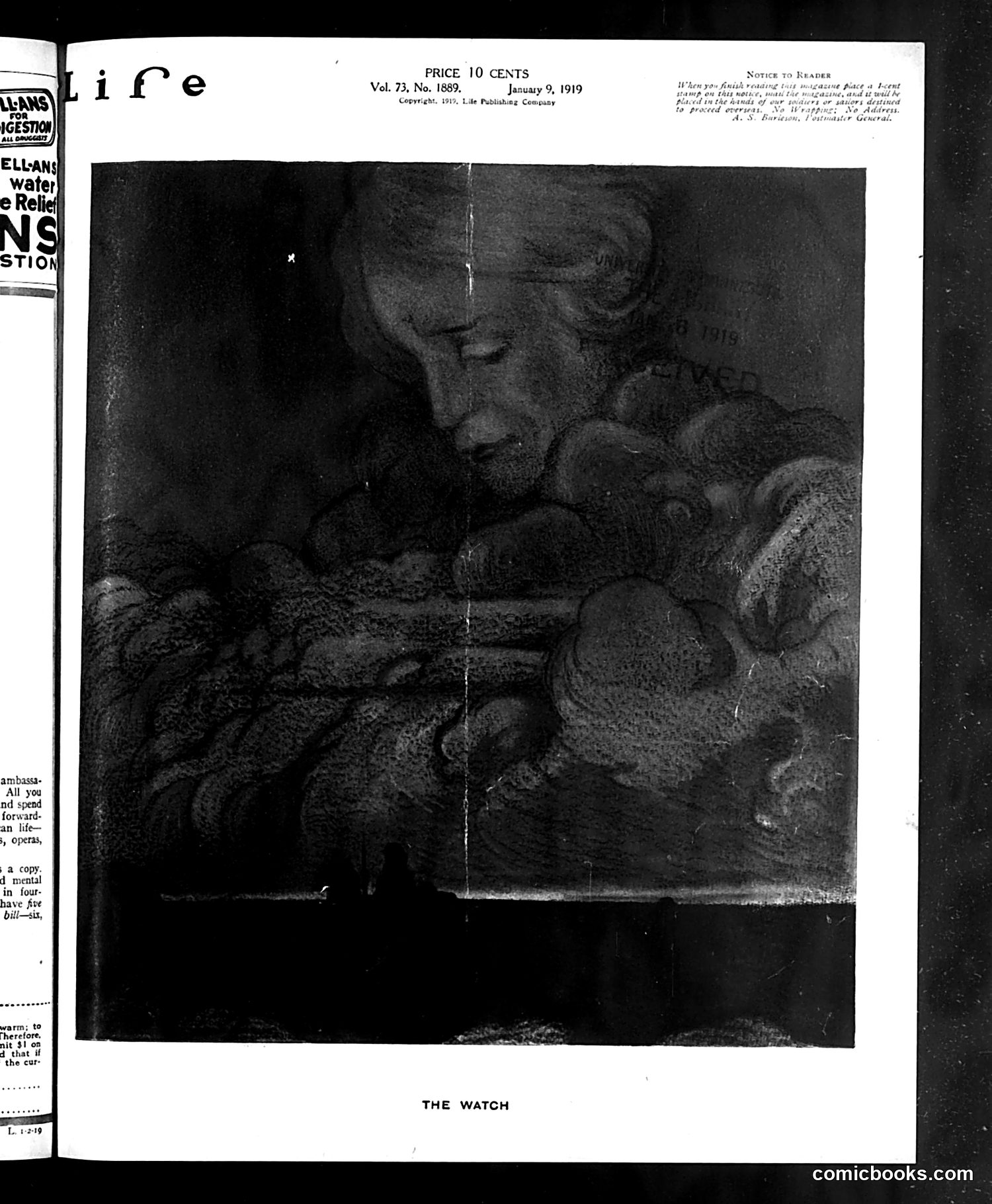
This illustration is titled "The Watch" and depicts an older man intently observing something, likely a pocket watch or timepiece. Given the January 1919 publication date—just after World War I's armistice in November 1918—this appears to be a commentary on waiting and anticipation during the post-war period. The figure's concentrated, anxious expression suggests he's monitoring something of critical importance. The title's reference to "watching" combined with the post-war timing suggests this may satirize political or military leaders anxiously tracking developments during peace negotiations or troop demobilization. Without additional caption text visible, the exact satirical target remains unclear, though the mood conveys tension about contemporary events.
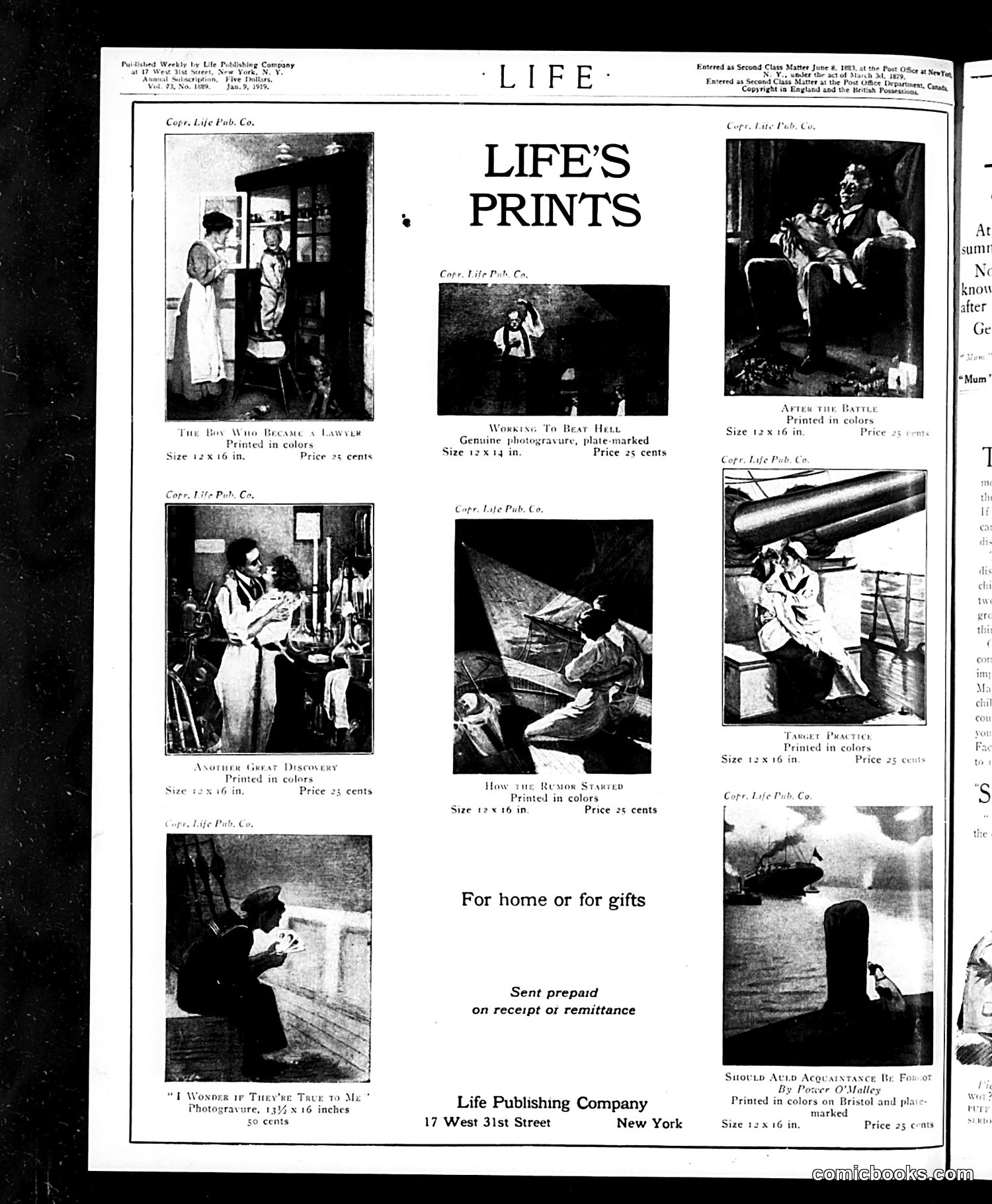
This is primarily a **product advertisement** for Life Publishing Company, showcasing prints available for purchase. Rather than political satire, the page displays seven illustrated prints depicting dramatic narrative scenes: - "The Boy Who Became a Lawyer" - "Working To Beat Hell" (German photogravure) - "After the Battle" (printed in colors) - "Another Great Discovery" (printed in colors) - "How the Russians Started" (printed in colors) - "Target Practice" (printed in colors) - "Should Acquaintance Be Forgot" (printed in colors) The prints appear to feature romantic, military, and humorous domestic scenarios typical of early-1900s popular illustration. Priced at 21-25 cents, they were marketed as gifts or home decoration. This represents Life magazine's diversified publishing business beyond satirical journalism.
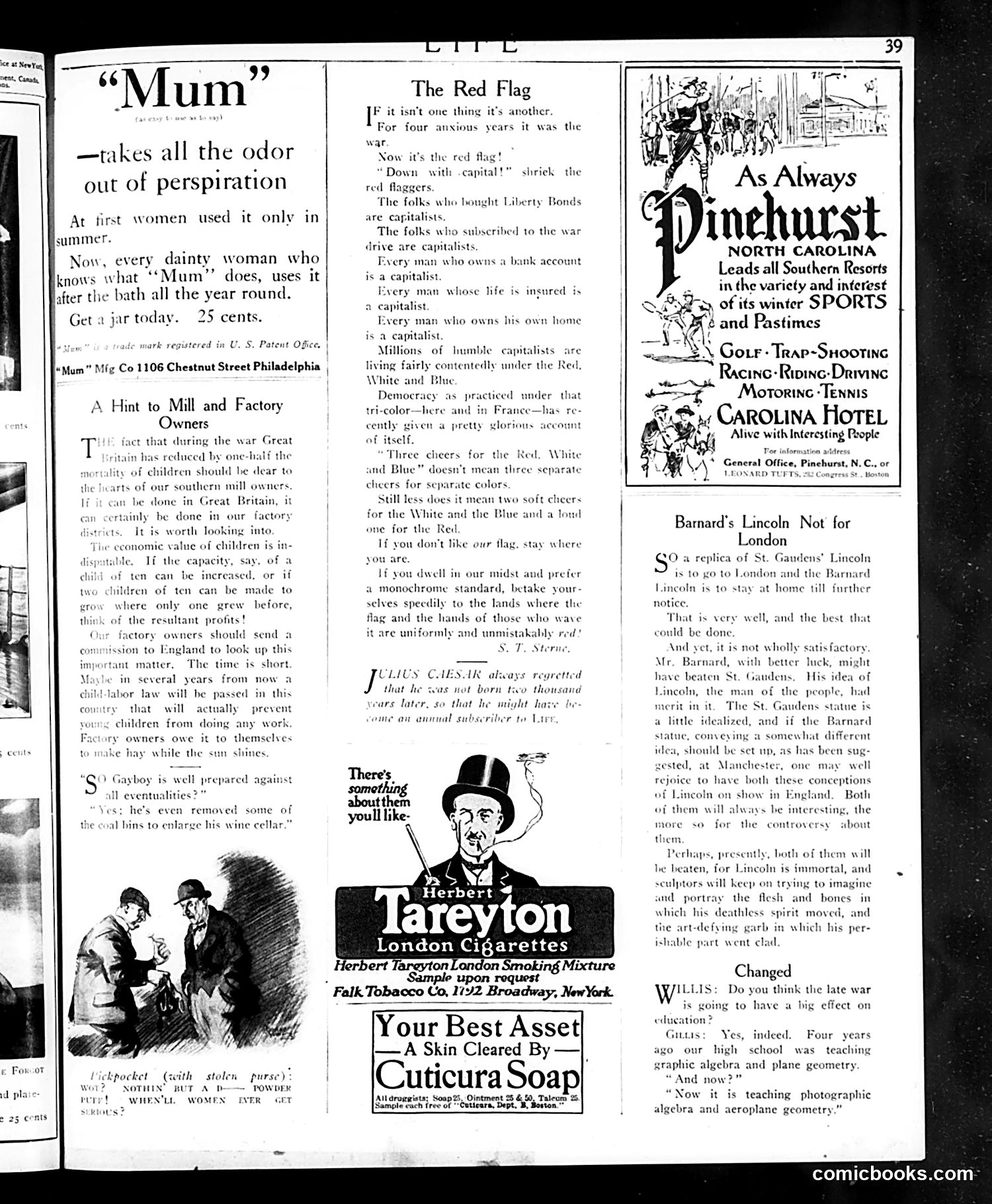
This page is primarily **advertising and commercial content** interspersed with brief editorial pieces, not political cartoons. The main political content is "The Red Flag" article by S.T. Steme, which argues satirically that capitalism—not communism—is the real threat. Steme claims that bank owners, homeowners, and the insured are all "capitalists," suggesting the Red Flag represents a danger to established property interests. The piece uses ironic rhetoric to criticize wealthy elites. The page otherwise contains ads for **Mum deodorant**, **Pinehurst resort**, **Herbert Tareyton cigarettes**, and **Cuticura Soap**—typical 1910s-1920s advertisements. The Herbert Tareyton ad features a man smoking, representing contemporary product marketing unencumbered by modern health warnings. The "Hint to Mill and Factory Owners" discusses child labor practices during wartime, advocating for factory efficiency improvements.
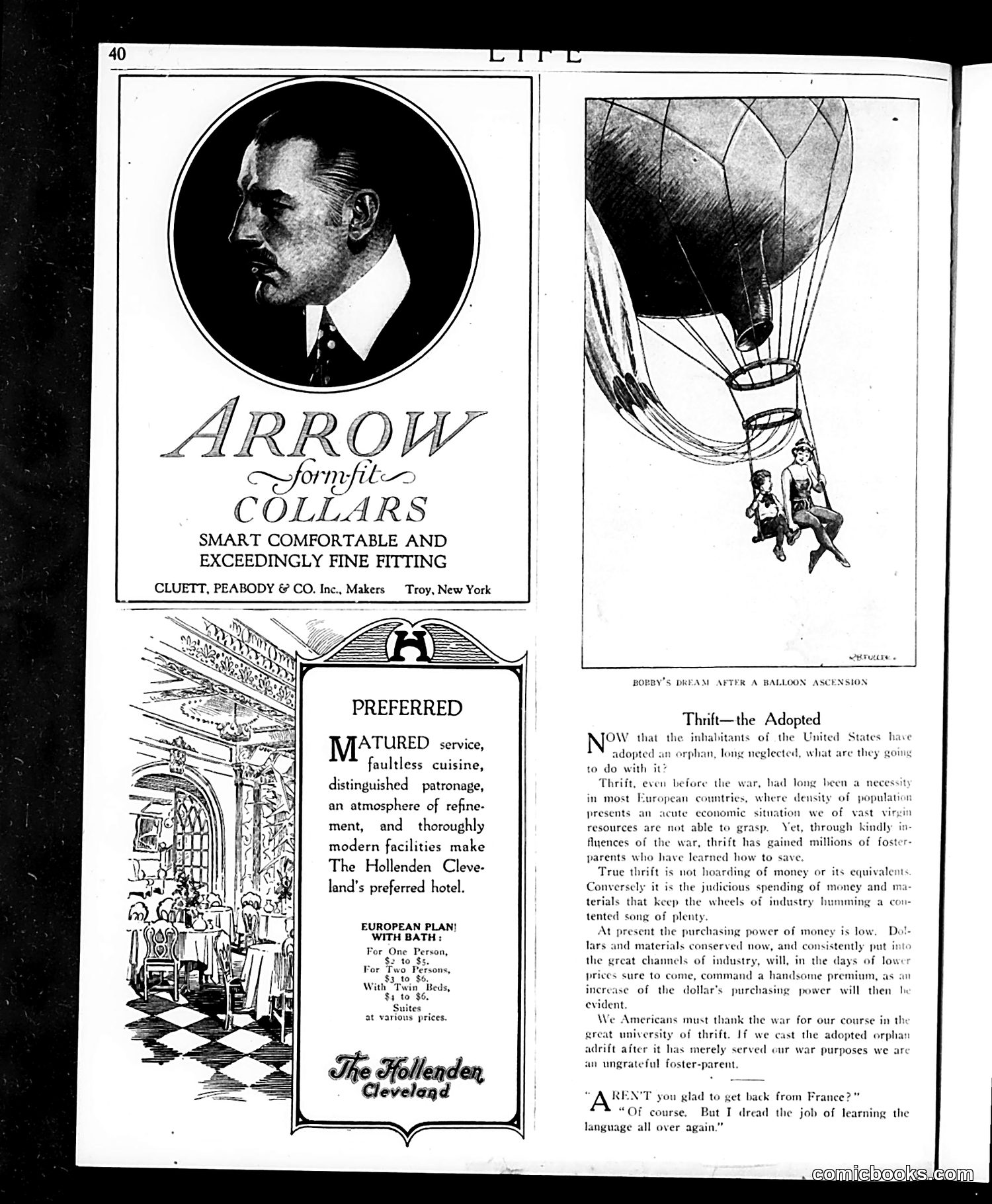
This page is primarily **advertising** with minimal satirical content. The top left features an Arrow Collar advertisement—a major brand of the era—emphasizing smart, comfortable fit. Below that is The Hollenden Cleveland hotel ad highlighting European-style amenities and reasonable pricing. The right side contains **"Bobby's Dream After a Balloon Ascension,"** a cartoon depicting two people in a hot air balloon basket. The accompanying article **"Thrift—the Adopted"** discusses post-WWI American attitudes toward thrift and conservation. The opening dialogue joke ("Aren't you glad to get back from France?") references Americans returning from WWI service. The cartoon's satire appears gentle—the dream sequence likely contrasts pre-war excess with wartime-learned frugality, fitting the article's theme about adopted thrift values gaining social acceptance among Americans after the war.
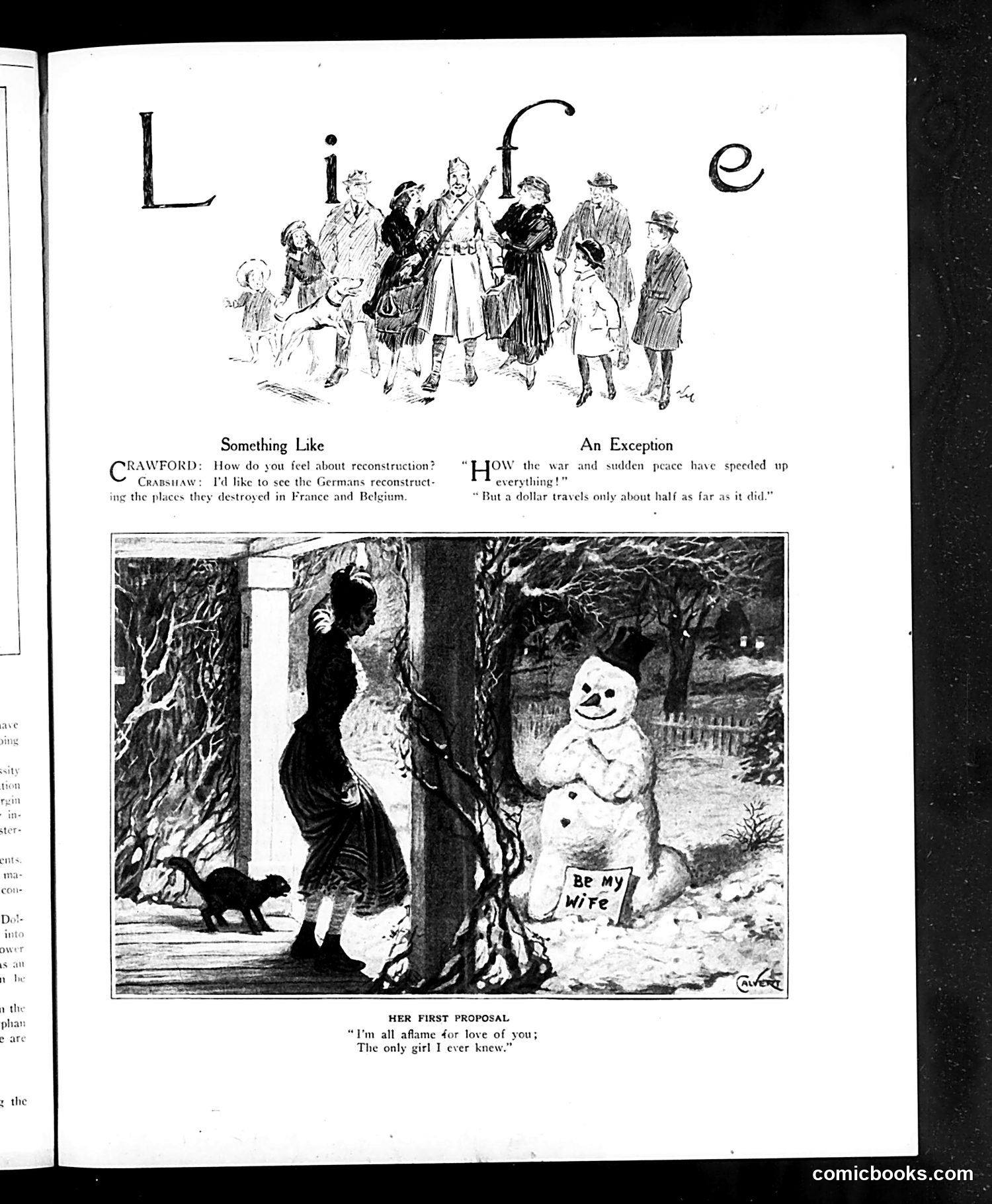
This page contains two distinct satirical pieces: **"Something Like" and "An Exception"** (top): A dialogue between two figures—Crawford and Crabshaw—discussing post-WWI reconstruction. Crawford wants to see Germans rebuild destroyed French and Belgian infrastructure; Crabshaw counters that wartime inflation makes a dollar worth only half its prewar value, so reconstruction progress appears slower than expected. This satirizes economic hardships and inflation following World War I. **"Her First Proposal"** (bottom): A cartoon showing a woman proposing to a snowman with "Be my wife" written on it. The caption reads: "I'm all ashame for love of you; The only girl I ever knew." This humorously mocks romantic sentimentality by depicting the absurdity of proposing to an inanimate object—likely satirizing either overwrought romantic expression or wartime loneliness.
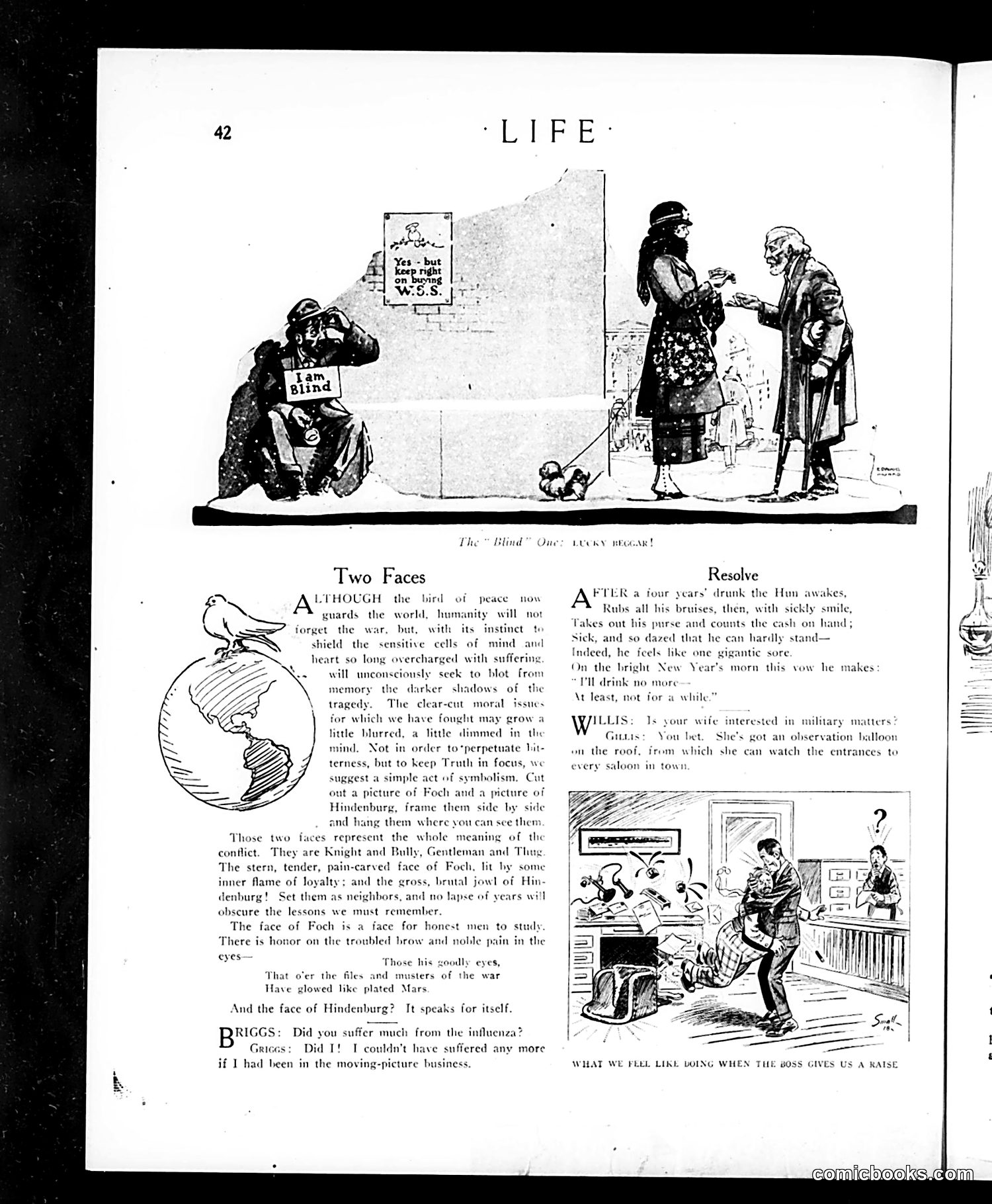
**Top Cartoon ("The 'Blind' One: Lucky Beggar!"):** This appears to satirize post-WWI attitudes. A beggar labeled "I am silent" sits while a woman with a small dog encounters an elderly man. The sign references the U.S., suggesting commentary on American isolationism or detachment from European suffering after the war. The "blind" beggar may represent willful ignorance of global consequences. **"Two Faces" Section:** Compares the faces of Foch (French WWI general) and Hindenburg (German general), analyzing their character through physiognomy—a period practice. The text argues Foch represents "honest men" while Hindenburg shows cruelty. **"Resolve" and Bottom Comic:** These appear unrelated to the political content, focusing on civilian humor about drinking resolutions and workplace dynamics. The page reflects immediate post-WWI preoccupations with peace, military figures, and American moral positioning.
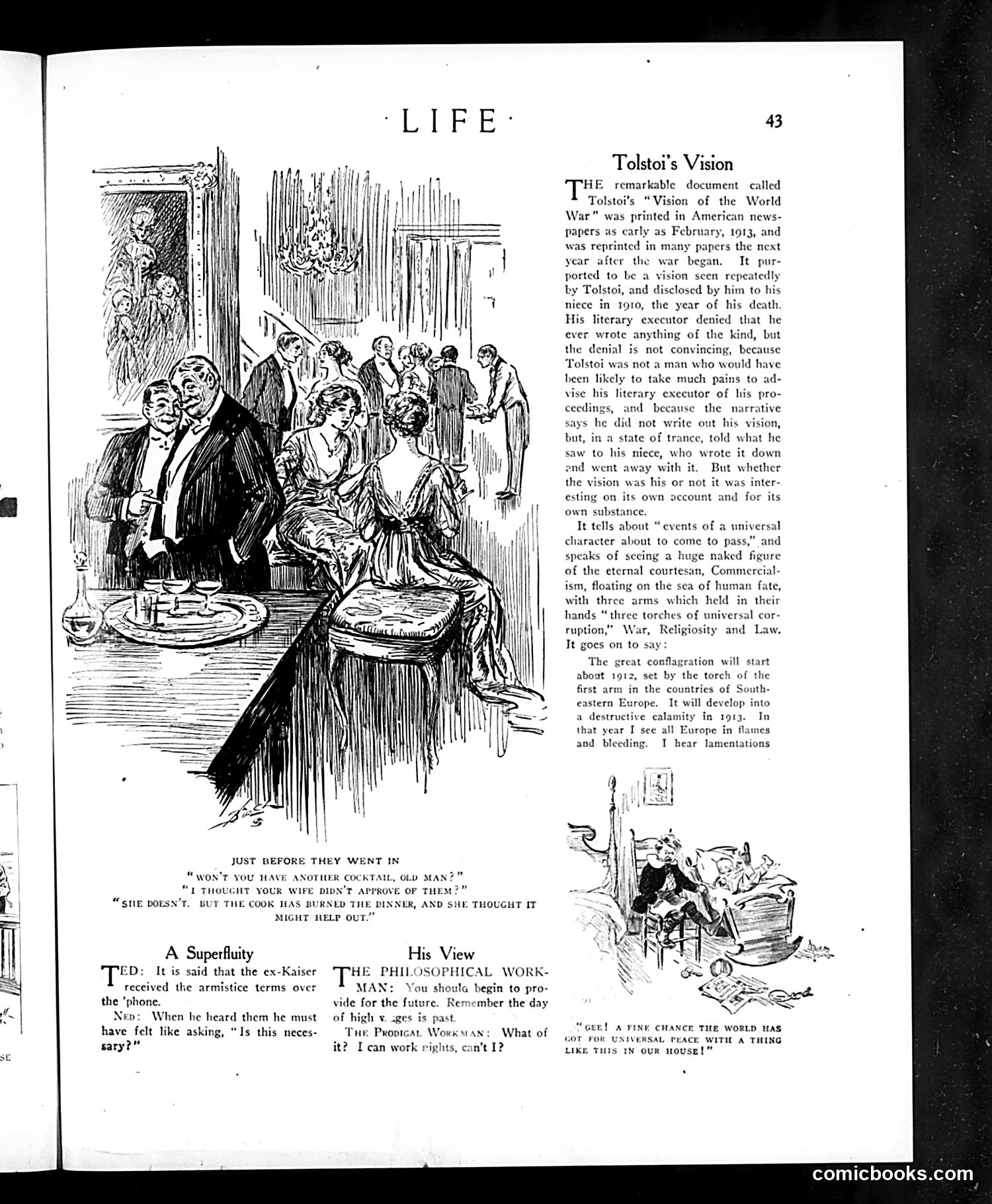
This page contains three distinct items: 1. **"Tolstoi's Vision"** — An article discussing a purported prophecy by Russian author Leo Tolstoy about World War I, allegedly disclosed to his niece. The text debates whether Tolstoy actually wrote this vision or merely spoke it in a trance state. 2. **"A Superfluity"** — A brief comic dialogue between "Ted" and "Ned" about receiving armistice terms over the telephone, with Ted asking if it's "necessary" — likely satirizing bureaucratic confusion during WWI's end. 3. **"His View"** — A dialogue between "The Philosophical Workman" and another figure about providing for the future and work rights, appearing to comment on post-war labor concerns and economic anxiety. The page reflects 1913-1918 WWI anxieties and social upheaval.
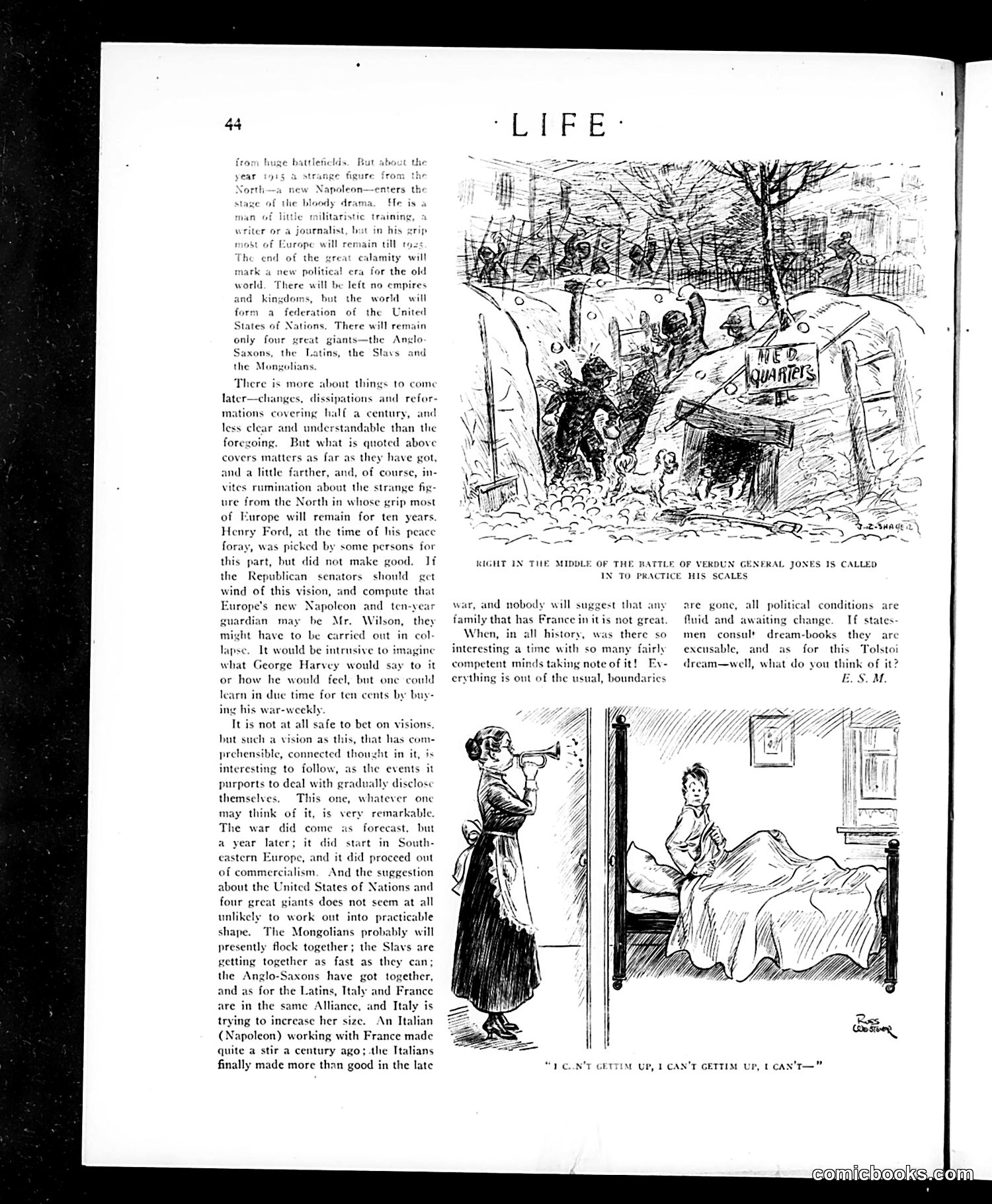
This page contains political commentary on World War I and post-war reconstruction. The top cartoon depicts chaos at "HQ Quarters" during the Battle of Verdun, with General Joffre practicing military maneuvers amid destruction. The text discusses European geopolitics, mentioning Henry Ford and suggesting "Mr. Wilson" (President Woodrow Wilson) as a potential "guardian" for post-war Europe. It predicts future conflicts between major powers and questions whether France's dominance will persist. The bottom illustration shows a woman unable to get up from bed, captioned "I CAN'T GIT'EM UP, I CAN'T GIT'EM UP, I CAN'T—" This appears satirical commentary on post-war social/domestic conditions, likely referencing war-related hardships or their aftermath. The overall tone is darkly satirical about war's consequences and international power struggles.
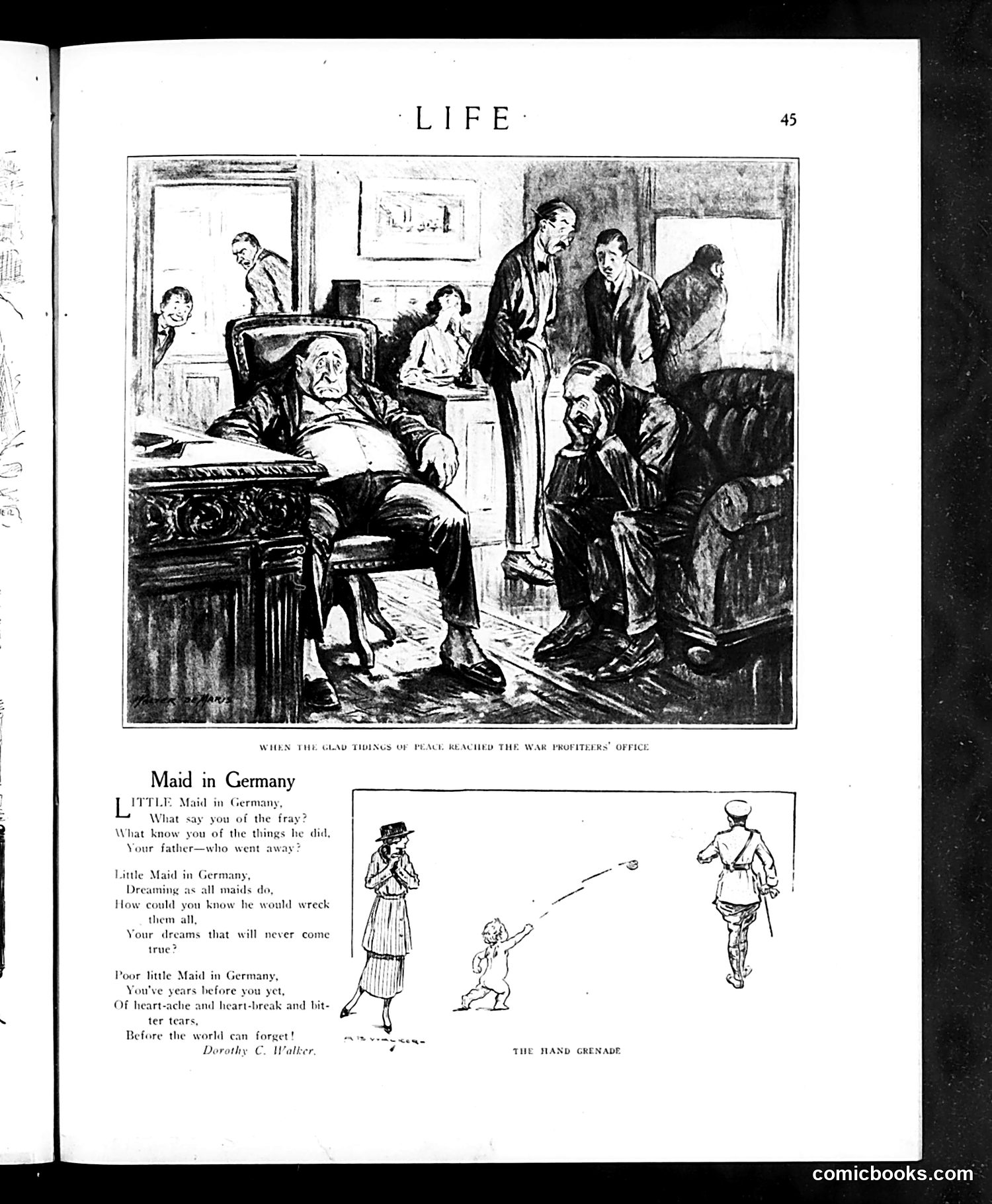
This page contains anti-war commentary from WWI era Life magazine. The top illustration depicts "When the Glad Tidings of Peace Reached the War Profiteers' Office"—showing wealthy businessmen's muted, disappointed reactions to peace news, satirizing how munitions manufacturers and defense contractors profited from prolonged conflict and would lose income if fighting ended. Below, the poem "Maid in Germany" by Dorothy C. Walker addresses a German girl, expressing sympathy for her suffering—lost father, shattered dreams—before "the world can forget." "The Hand Grenade" illustration shows a child reaching toward an explosive device, likely commenting on warfare's impact on innocent civilians. Together, these pieces critique both war profiteering and the human cost of conflict on ordinary people, especially children.
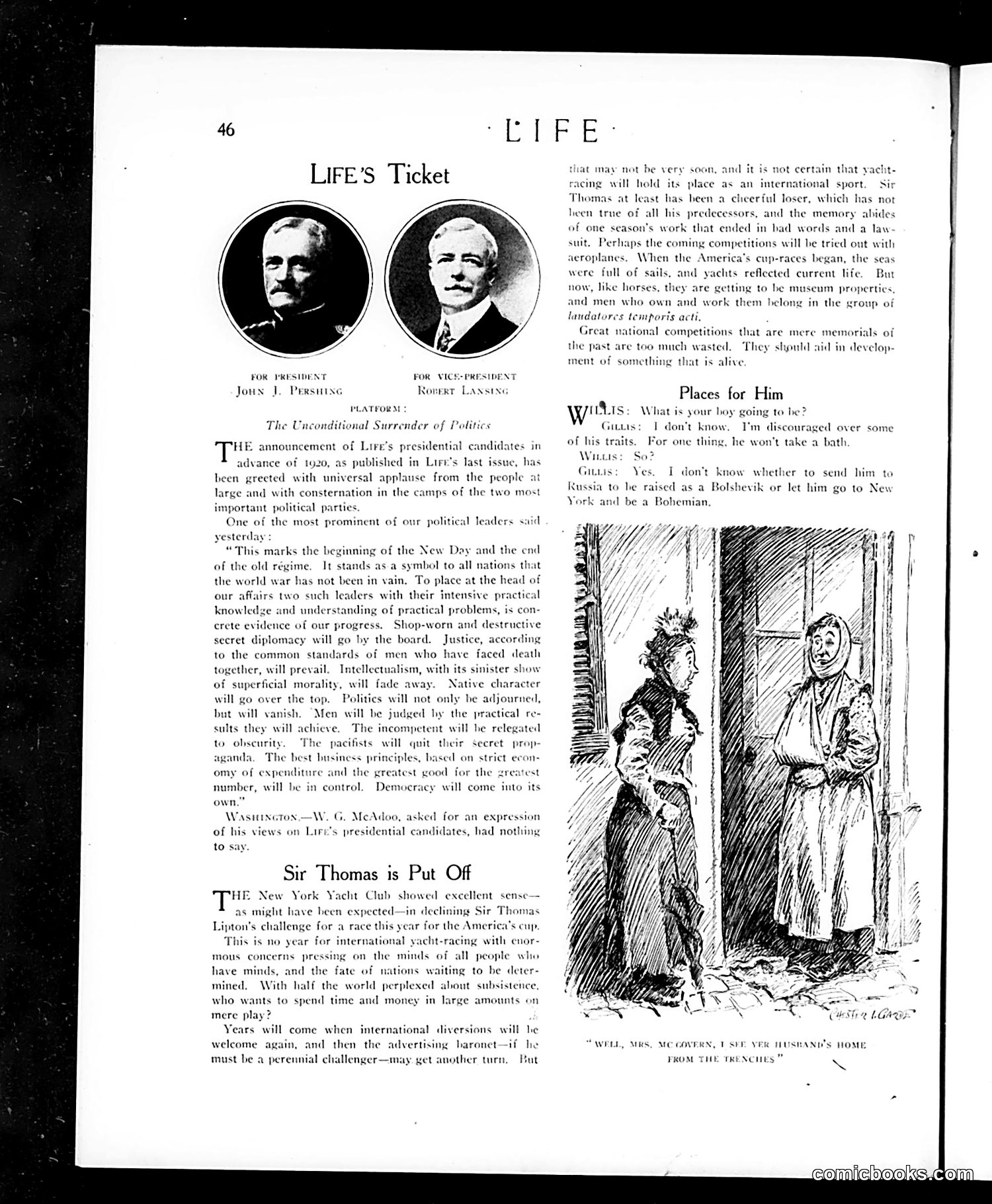
This page contains political content from an era when Life was a satirical weekly. The main feature shows two circular portraits labeled "For President: John J. Pershing" and "For Vice-President: Robert Lansing," presenting these as Life's fictional candidates. The accompanying article, "The Unconditional Surrender of Politics," appears to endorse these figures as symbols of practical leadership and native character over destructive secret diplomacy. The text suggests dissatisfaction with current political approaches. Below, "Sir Thomas is Put Off" discusses Sir Thomas Lipton's postponed America's Cup yacht race challenge, framing international sporting competition as a welcome distraction from wartime concerns. The page cartoon shows a domestic scene with unclear satirical intent without additional context.
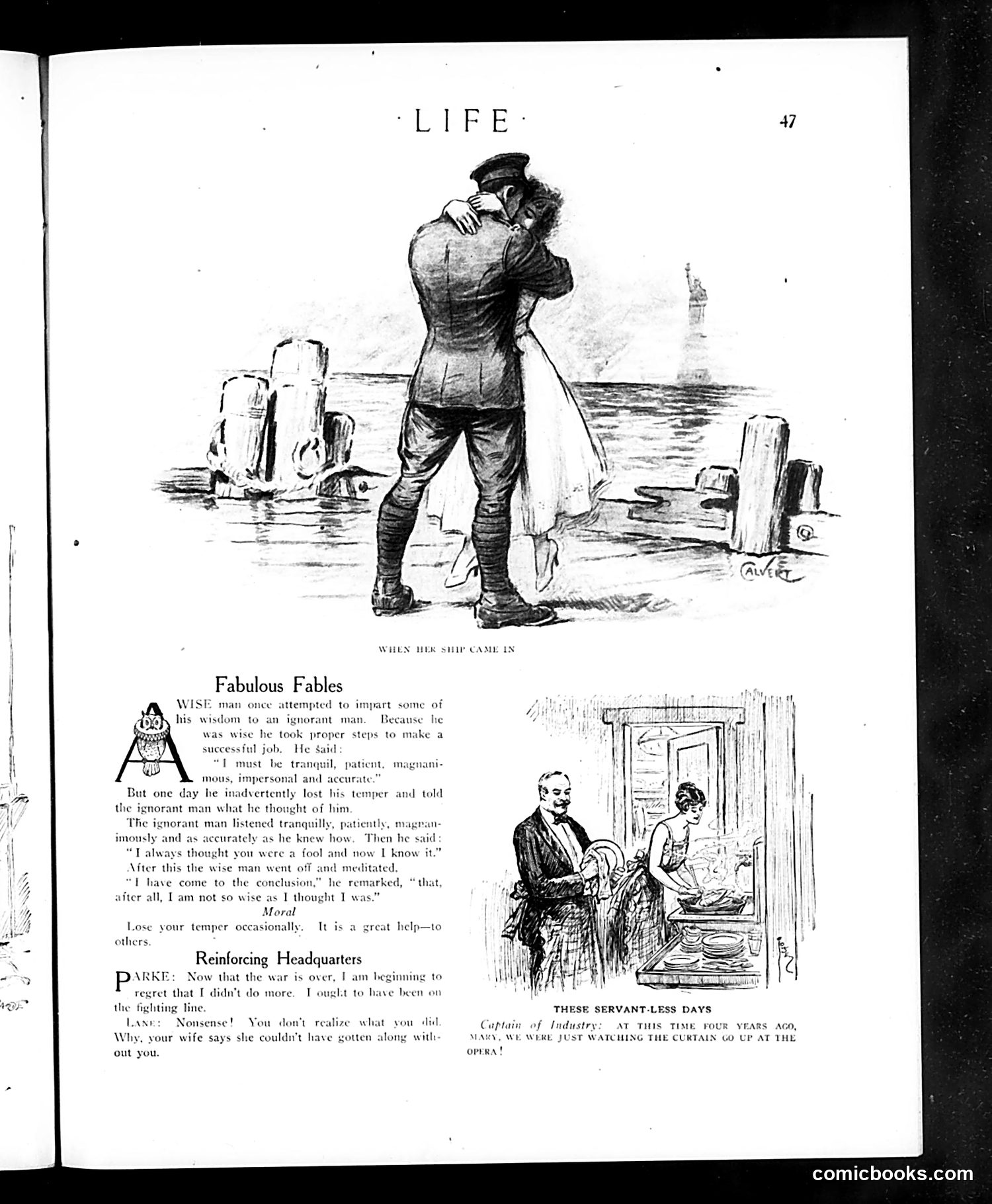
This page from *Life* magazine contains two satirical pieces: **"When Her Ship Came In"** (top illustration): A soldier embraces a woman at a dock, with Big Ben visible across the water. The caption suggests romantic reunion, likely depicting a WWI serviceman's return home. **"Fabulous Fables"** section includes two short moral tales mocking human nature. The first story ridicules a man who repeatedly fails at tasks despite expert advice, only to later claim he knew better all along—satirizing how people refuse to acknowledge foolishness. **"Reinforcing Headquarters"** depicts a domestic argument where a husband regrets missing WWI combat, and his wife tartly notes she couldn't have "gotten along without" him—implying his absence was no loss. The humor targets masculine pride, domestic discord, and post-war readjustment anxieties.
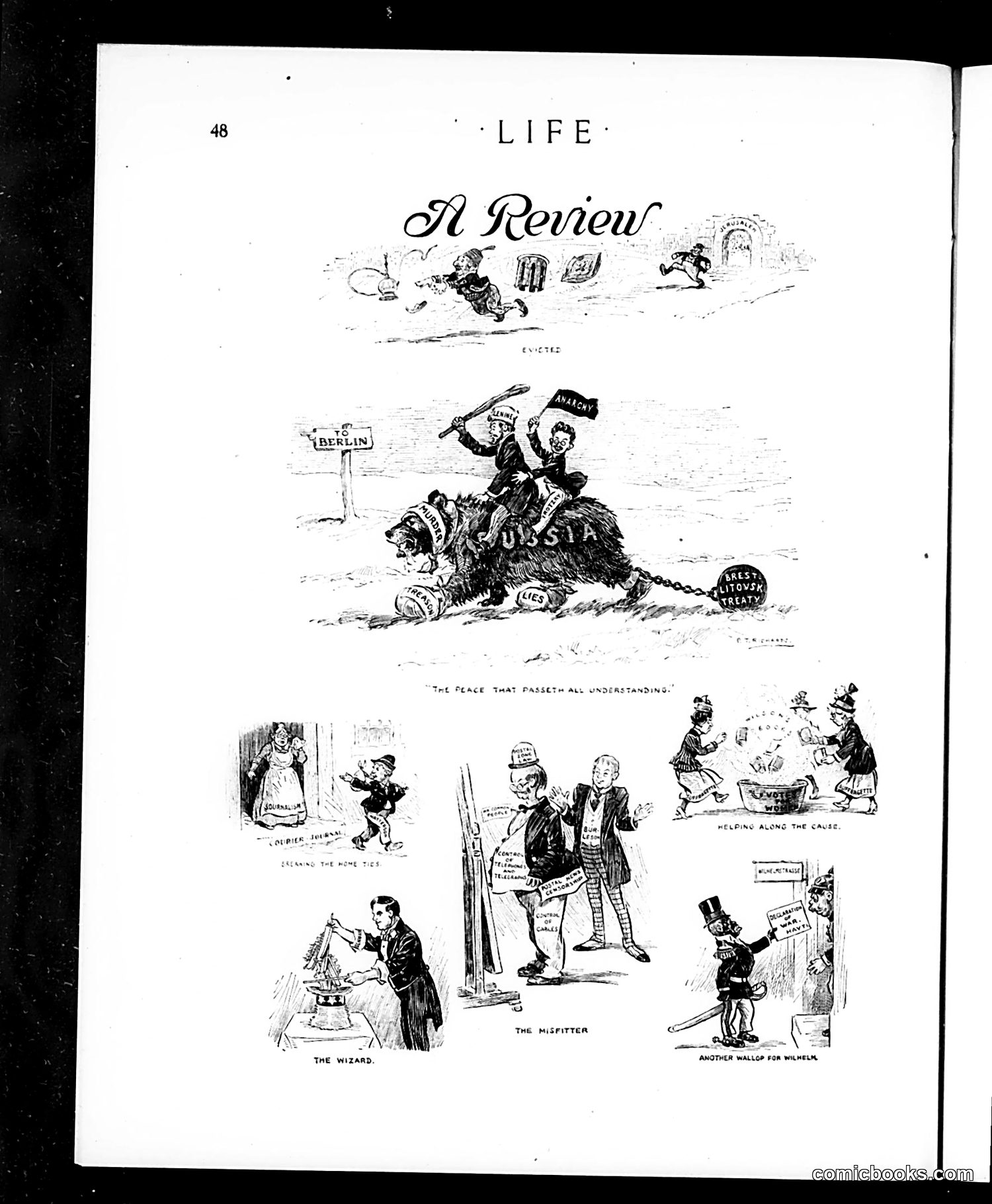
This page satirizes post-WWI peace negotiations, likely from around 1918-1919. The central cartoon shows two figures (appearing to represent Allied leaders) riding on a bear labeled "RUSSIA," heading toward "BERLIN," with flags marked "ANARCHY" and what appears to be references to revolutionary upheaval. The surrounding vignettes use stock characters—"The Wizard," "The Misfitter," "Helping Along the Cause"—depicting various political figures attempting to manage or manipulate the peace process. The caption "THE PEACE THAT PASSETH ALL UNDERSTANDING" sarcastically comments on the complexity and seeming chaos of peace negotiations. The satire suggests skepticism about whether political leaders could actually control or stabilize the post-war situation, particularly regarding Russian revolution and instability.
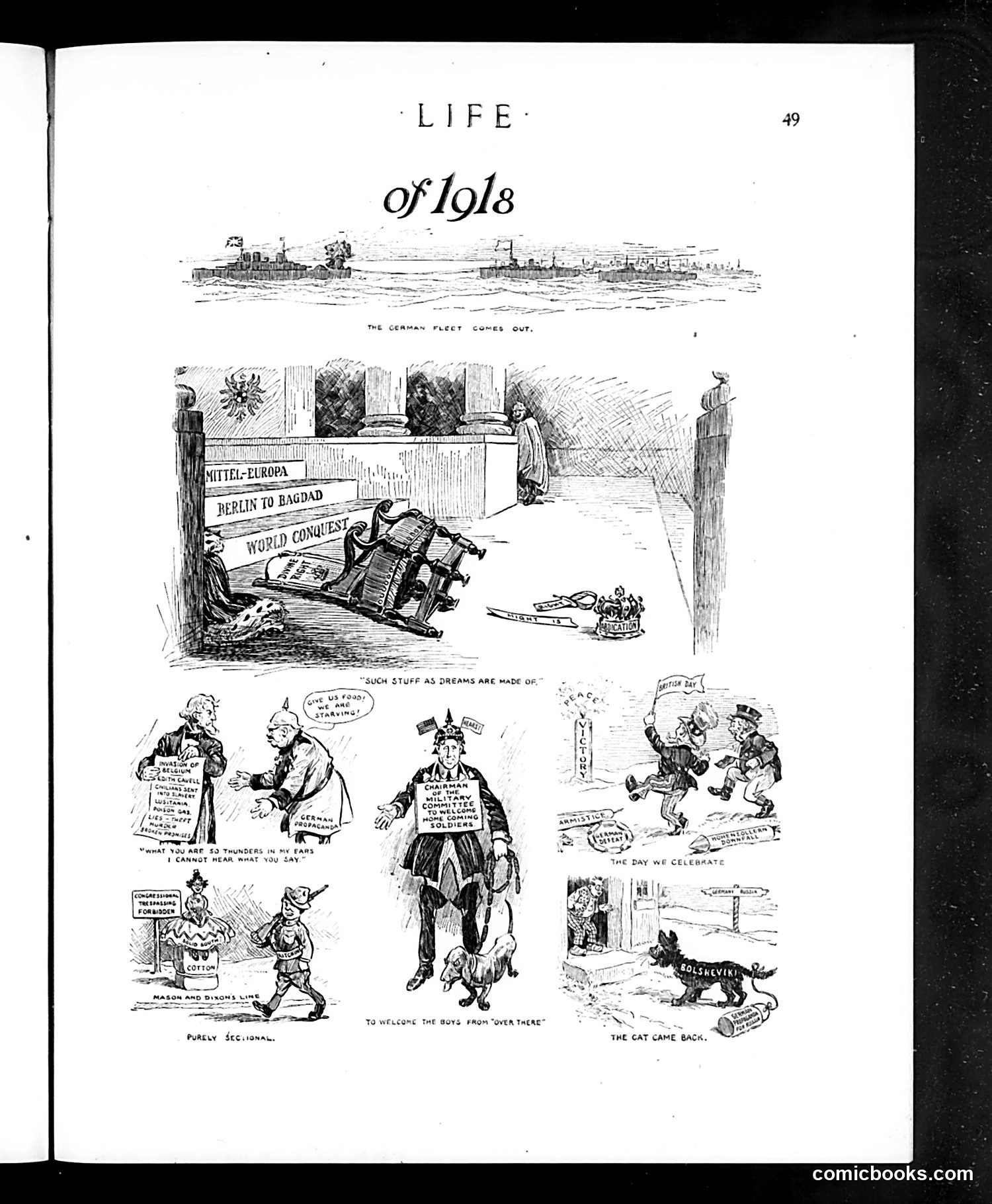
This page satirizes German military ambitions during World War I. The top illustration shows "The German Fleet Comes Out," depicting naval vessels. The central image mocks German imperial aspirations with collapsed signage reading "Mittel-Europa," "Berlin to Bagdad," and "World Conquest"—referring to Germany's expansionist territorial claims. These dreams literally lie in ruins. Lower cartoons mock specific German leadership and military pretensions. One figure labeled "Chairman" appears to be a German military leader. References to "Bolsheviki" suggest the Russian Revolution's impact. The satirical captions ("Such stuff as dreams are made of," "To welcome the boys from 'over there'") mock Germany's failed ambitions as the war turned against them in 1918. The humor targets German imperial overreach and its collapse.
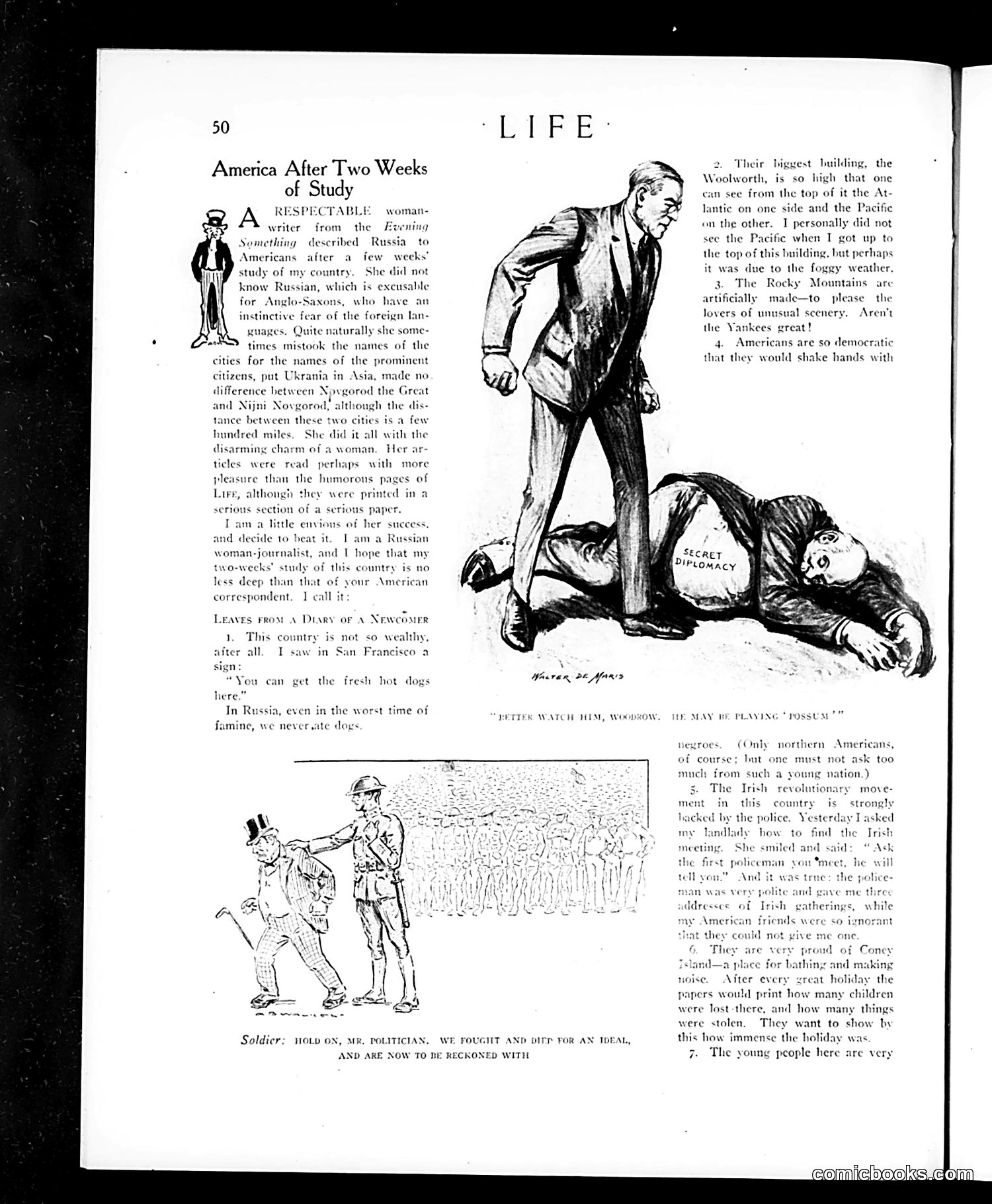
This page satirizes American perceptions of Russia following a brief study visit. The main cartoon depicts a standing American businessman or diplomat literally stepping on and crushing a figure labeled "Secret Diplomacy," suggesting American confidence and dominance over Russian diplomatic methods. The accompanying article mocks a Russian woman writer's observations of America, noting she confused Russian cities and made naive comparisons. The smaller cartoon below shows a soldier confronting a politician, captioned about fighting for ideals and expecting recognition—likely critiquing political hypocrisy regarding veterans' treatment. The overall tone is dismissive of foreign (particularly Russian) perspectives on America while satirizing American self-regard and political duplicity regarding promises to soldiers.
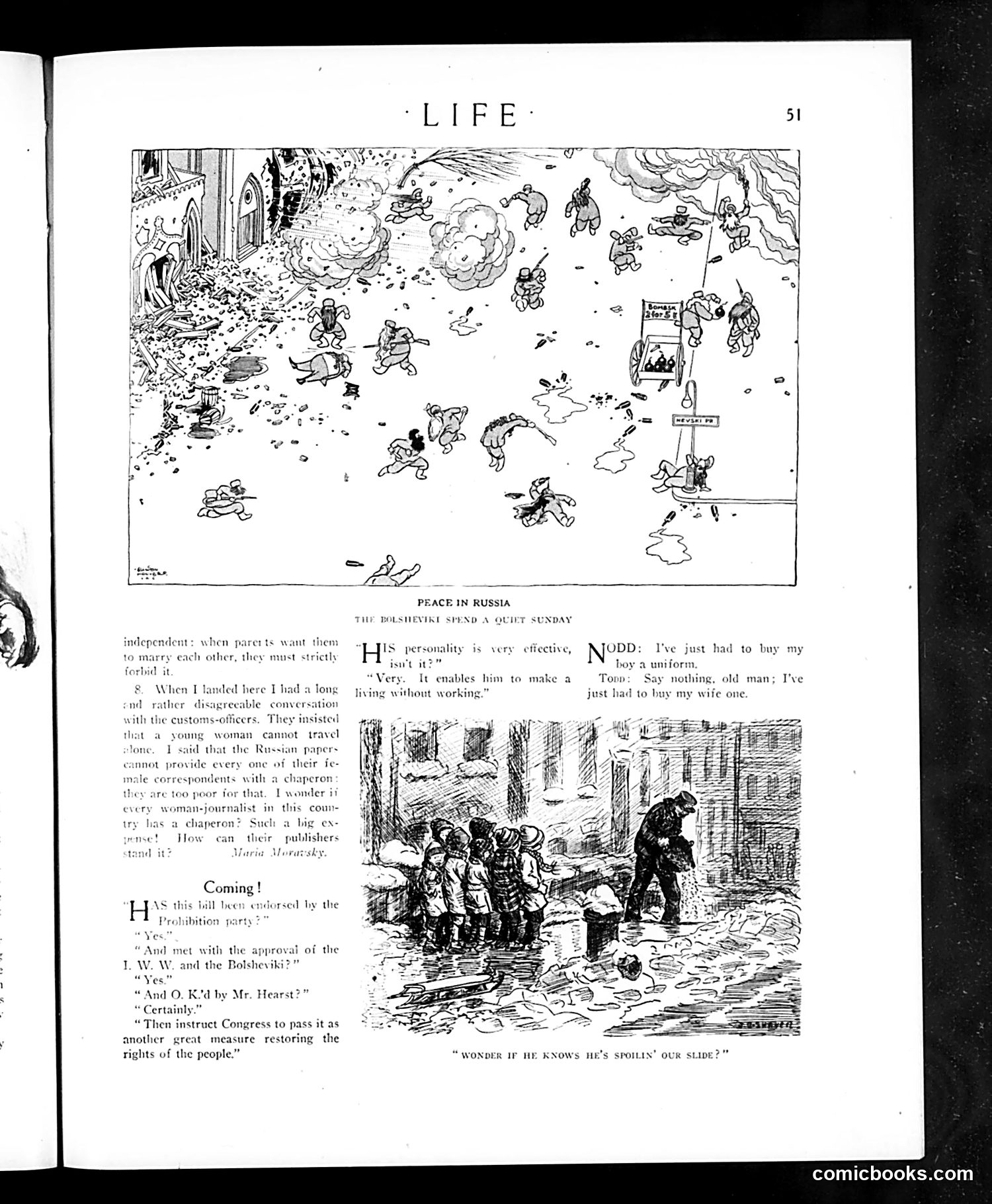
This satirical cartoon mocks the Bolshevik Revolution through contrasting images. The top illustration depicts Russian citizens engaged in chaotic, violent activities—people fighting, fleeing, and causing destruction—labeled as a "quiet Sunday." The bottom sketch shows what appears to be children playing on a snowy street, with one adult figure. The caption "Wonder if he knows he's spoils our slide?" suggests innocent play disrupted by adult turmoil. The text below discusses Russian politics, referencing approval of the I.W.W. (Industrial Workers of the World) and the Bolsheviks, with sardonic commentary about Congress "restoring the rights of the people." The satire equates Bolshevik claims of peaceful governance with actual chaos and violence—a commentary on the propaganda versus reality of early Soviet rule.
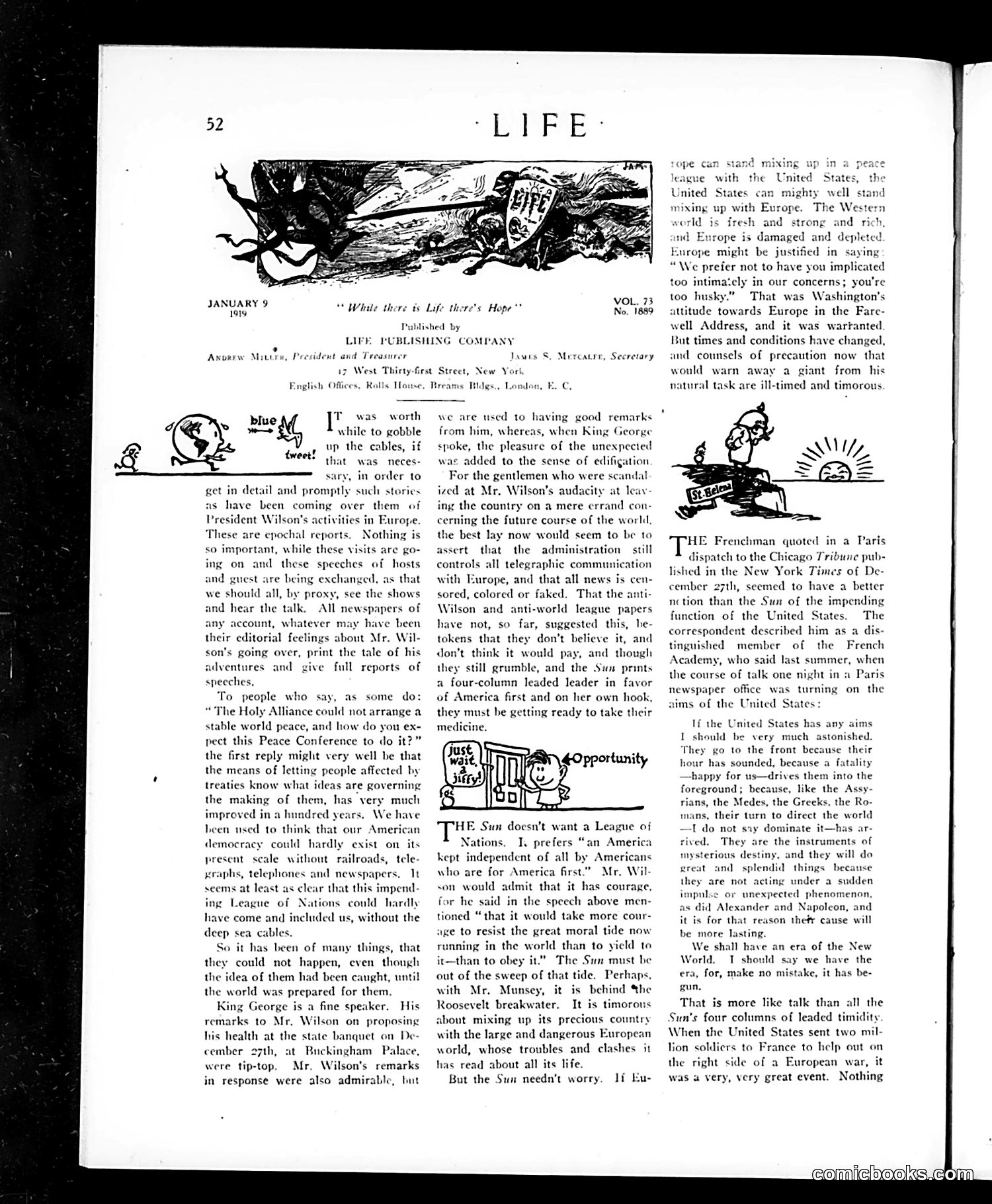
This page discusses President Wilson's activities at the Paris Peace Conference following World War I. The main text defends Wilson's trip to Europe and advocates for the League of Nations, while critiquing opponents like the *New York Sun* newspaper. **Key figures/references:** - President Wilson—defending his European mission - King George (likely George V)—praised for his diplomatic speech - The *Sun* newspaper and its owner Munsey—criticized for opposing the League of Nations and favoring isolationist "America First" positions **The satire's point:** The editorial mocks isolationist critics who claim America should avoid European entanglement. It argues that modern communications (cables, telegraphs) make international cooperation both possible and necessary—a direct response to those saying the League of Nations cannot work. The tone is pro-Wilson and pro-internationalism, dismissing skeptics as timorous and out of step with world events.
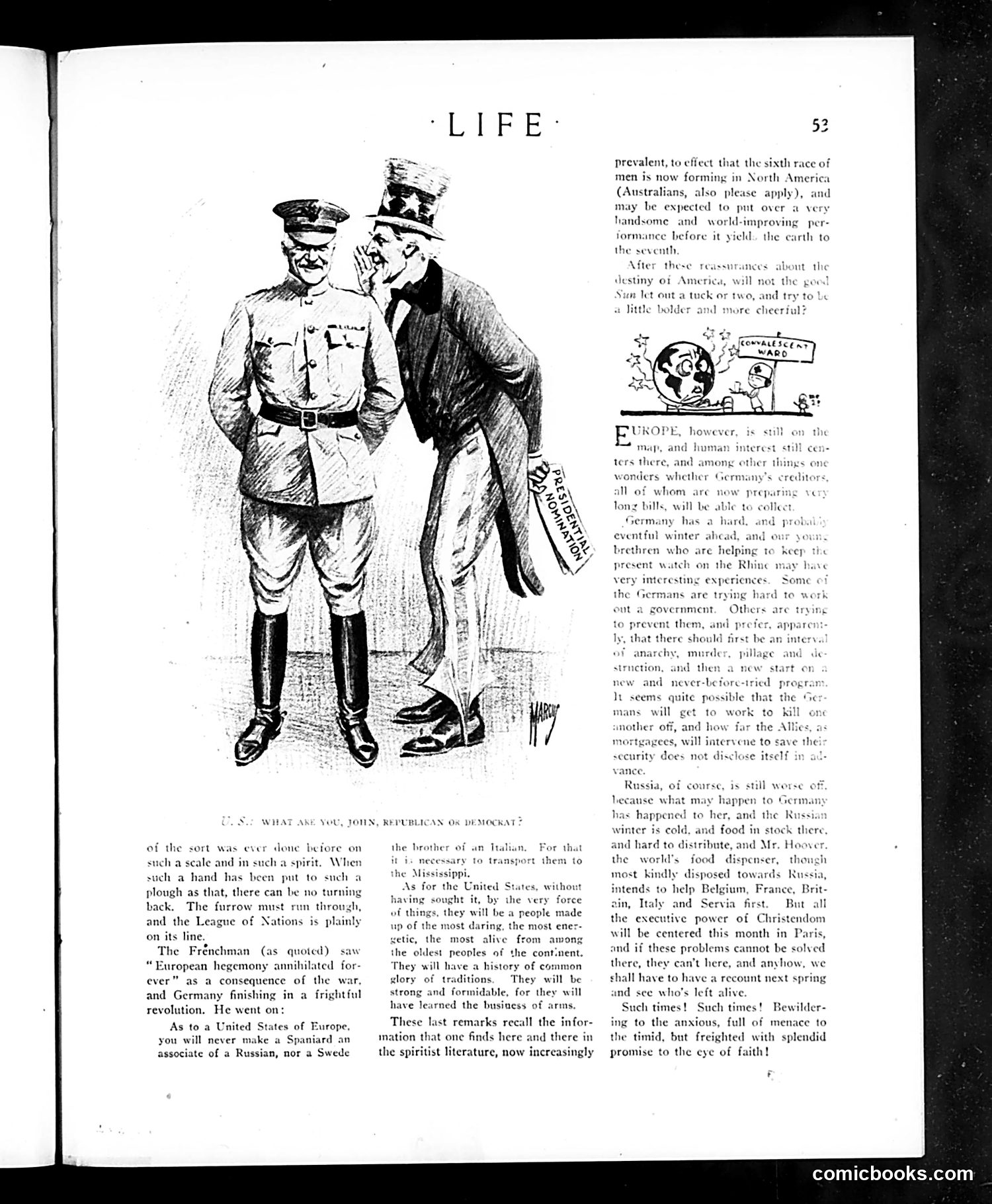
The cartoon depicts a military officer (likely representing Republican/interventionist views) confronting a civilian in formal dress (likely representing Democratic/progressive views), asking which political faction he represents. The caption's question satirizes post-WWI American political division. The accompanying text discusses post-war Europe, German revolution, the League of Nations, and American emergence as a world power. It references French predictions about a "sixth race" forming in North America—a pseudoscientific concept popular in spiritualist literature of the era—suggesting Americans would become a dominant civilization. The satire targets the disconnect between American political parties squabbling over domestic identity ("Republican or Democrat?") while Europe faces existential chaos. The cartoonist suggests such partisan bickering is trivial given America's new global responsibilities and the international stakes of 1919 (League negotiations, Russian famine, German instability). The joke: Americans arguing about party labels while civilization itself hangs in the balance.
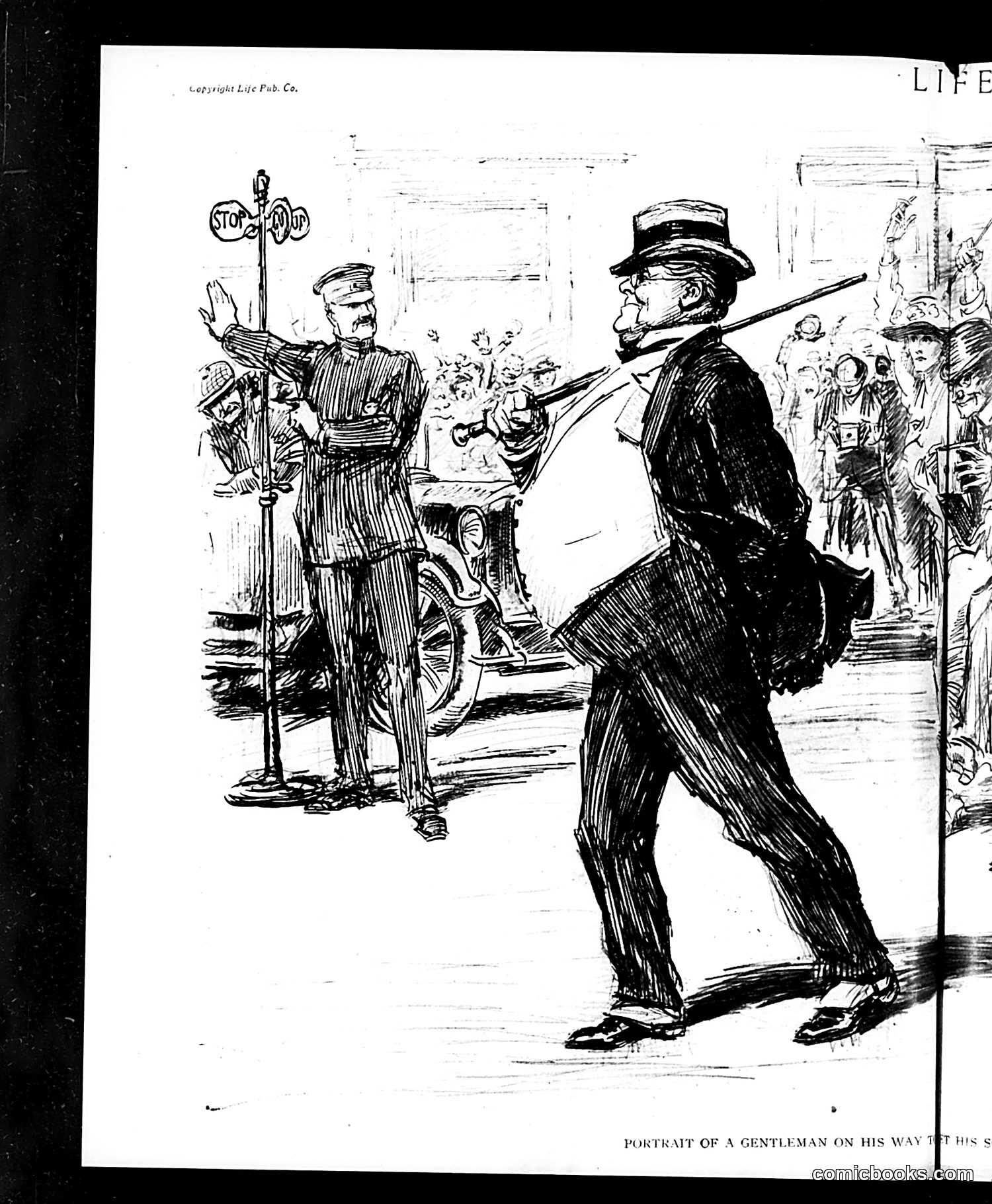
This is a satirical cartoon from *Life* magazine showing a street scene. A well-dressed gentleman in a top hat and coat strides purposefully past a police officer at a traffic stop sign. The officer, uniformed and holding up his hand, appears to be attempting to stop or direct the man, while pedestrians and a vehicle are visible in the background. The satire likely mocks wealthy or prominent men who disregard traffic laws and police authority—the implication being that a "gentleman" of means feels entitled to ignore regulations meant for ordinary citizens. The incomplete caption ("on his way t[o] it his s...") suggests the joke involves where this rule-breaker is headed, though the full text is cut off. The cartoon critiques class-based disregard for civic rules and law enforcement.
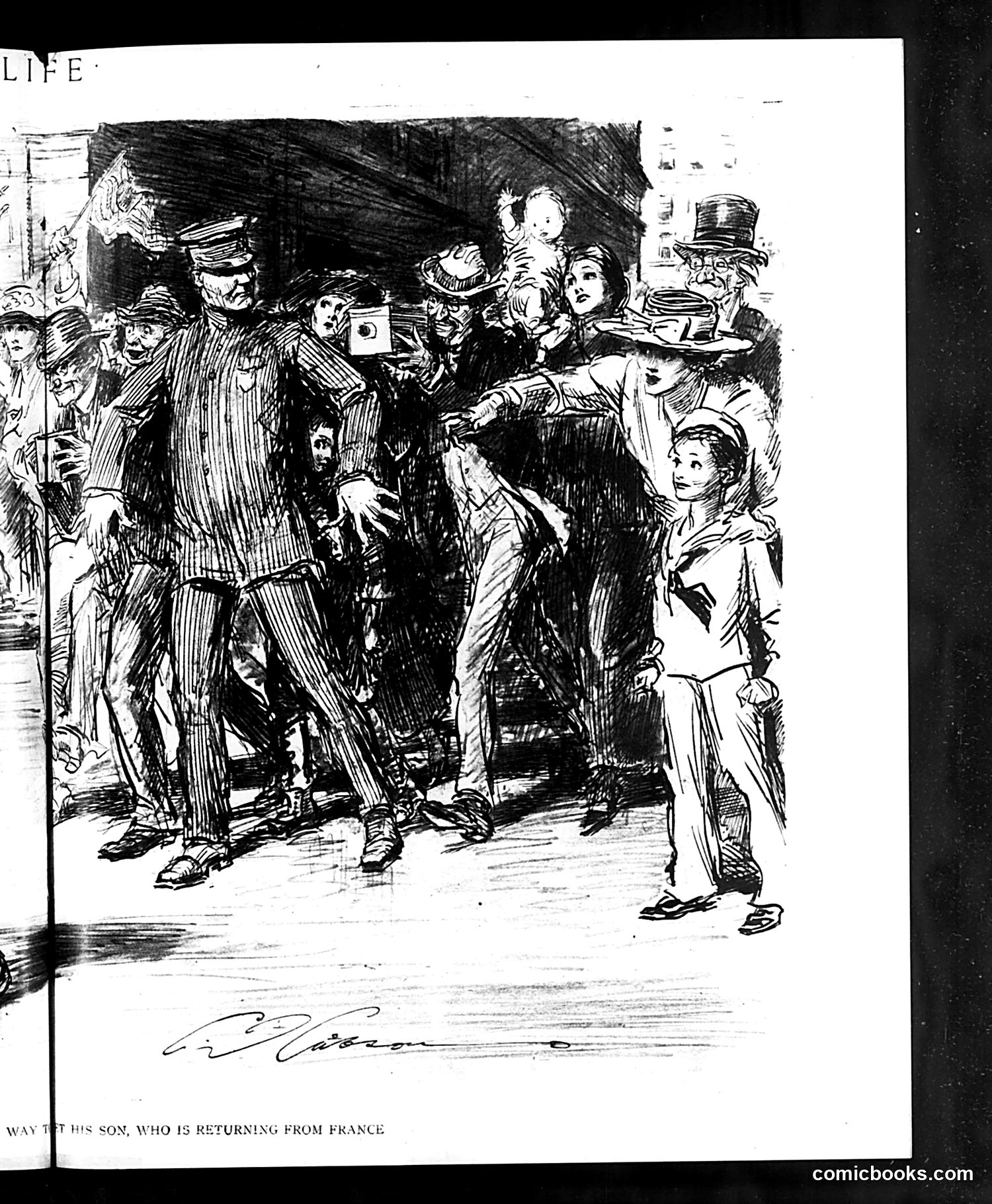
This political cartoon depicts a crowded, chaotic scene at what appears to be a public gathering or homecoming. The caption suggests this shows how people are greeting a soldier returning from France—likely referencing World War I. The satire appears to mock the excessive or disorderly nature of public receptions for returning servicemen. The densely packed crowd of civilians, women, and children surrounding the central figures suggests confusion, jostling, and lack of decorum. The exaggerated expressions and crowding imply satire about either genuine patriotic enthusiasm or perhaps the superficial nature of public celebrations. The artist's signature appears at bottom. Without a specific date visible, this likely dates to the WWI era (1917-1919) when soldier homecomings were common American events.
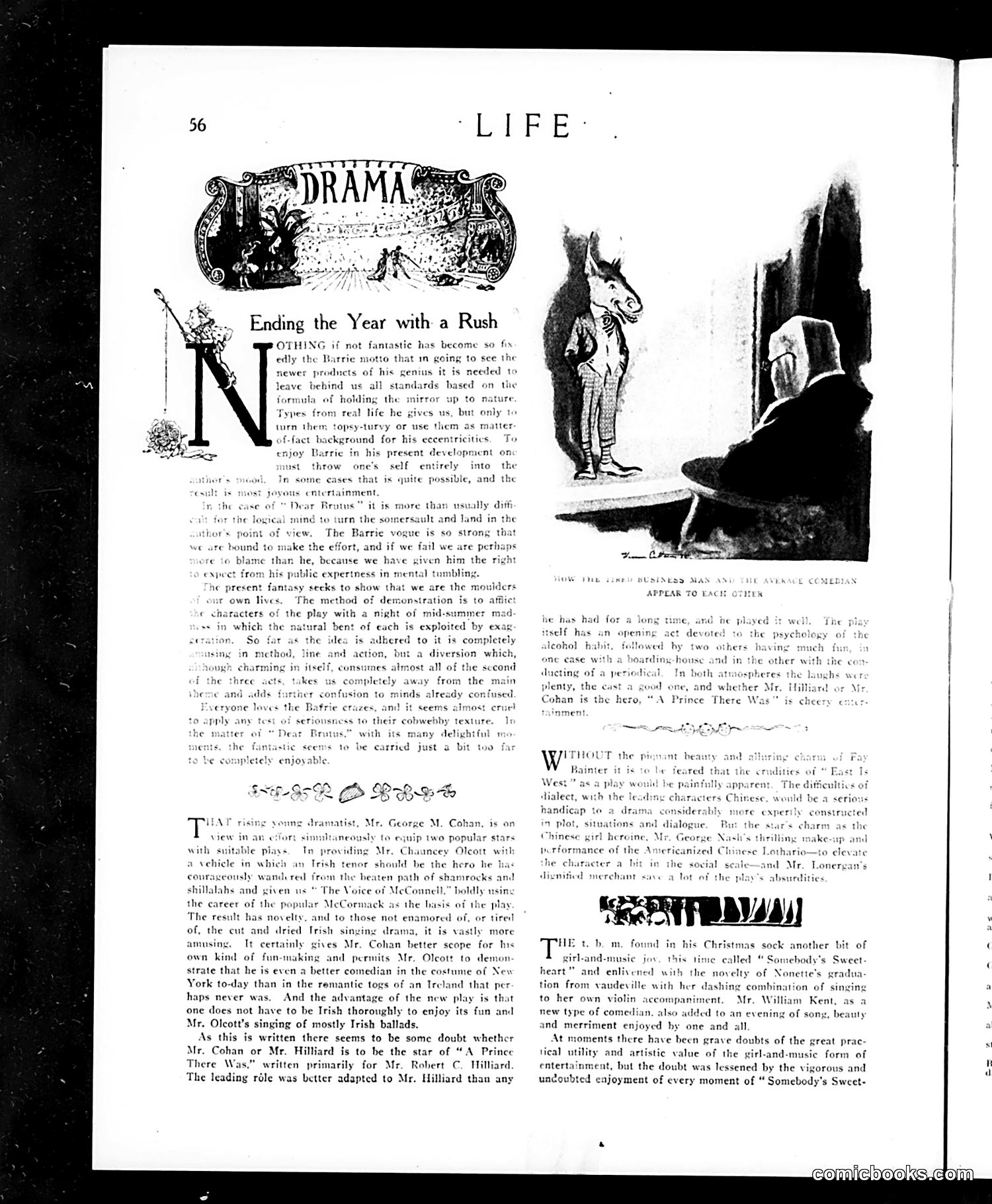
This page reviews contemporary theatrical productions, particularly focusing on J.M. Barrie's influence on modern drama. The main illustrated figure appears to be a character from an Irish-themed play, reflecting the page's discussion of "The Voice of McConnell" and works by George M. Cohan and Chauncey Olcott—playwrights known for Irish-American comedies. The article critiques Barrie's fantastical style's dominance in theater, arguing audiences expect playwrights to create imaginative, unconventional characters rather than realistic portrayals. It discusses how Barrie's method—taking ordinary people and transforming them through theatrical exaggeration—has become popular but risks losing grounding in reality. The reviews mention specific productions and performers of the era, including discussions of whether Cohan or Hilliard should star in "A Prince There Was." The overall tone suggests early 1900s theatrical debate about realism versus romanticism in drama.
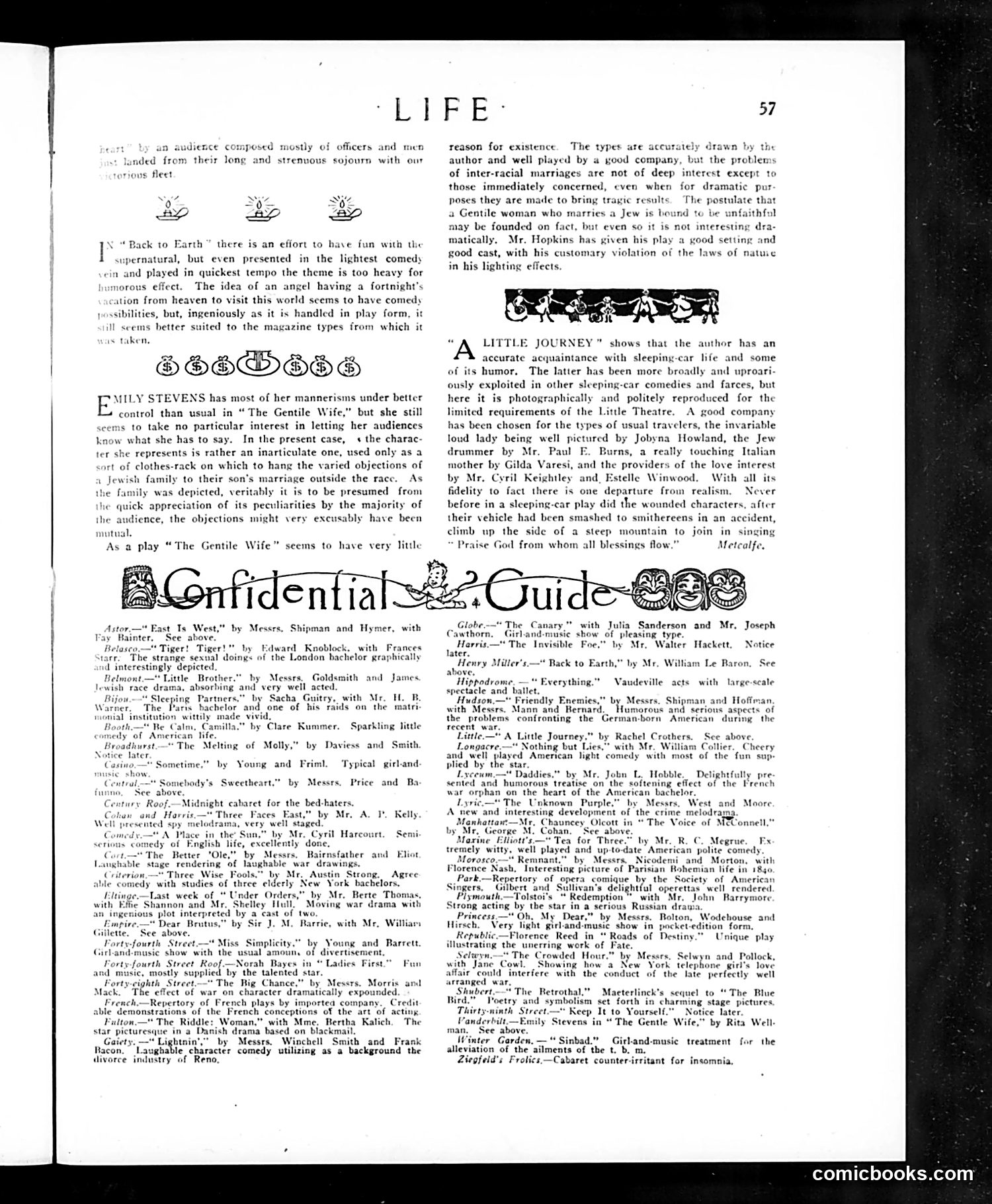
This page contains theater reviews and a small decorative header ("Confidential Guide") but no political cartoons. The content critiques Broadway plays from the 1910s-1920s era. Key reviewed plays include "The Gentile Wife" (starring Emily Stevens), which dramatizes a Jewish family's objections to their son marrying outside the faith. The critic notes the play addresses inter-racial marriage tensions but finds the subject matter heavy for comedy and the protagonist underwritten. Other productions reviewed include war dramas, romantic comedies, and French repertory works. The reviews reflect contemporary theatrical concerns: how playwrights handled serious social issues like religious/ethnic prejudice, how effectively actors conveyed character, and whether material suited its comedic or dramatic presentation. The abundance of war-themed plays suggests this was published during or shortly after World War I, when such subjects dominated popular entertainment.
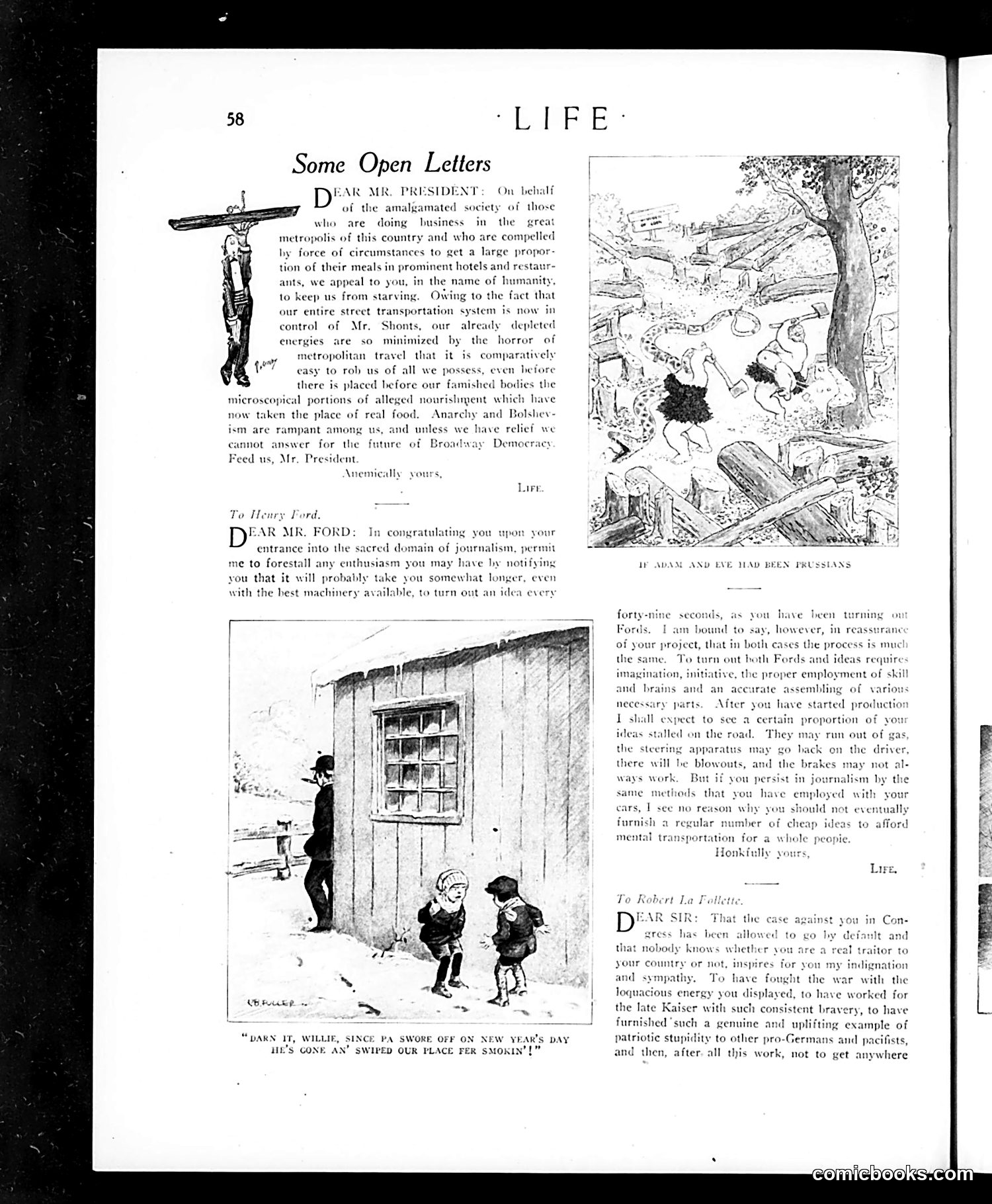
This page contains three satirical "open letters" from 1919 (based on post-WWI references). The first letter, signed "Life," appeals to the President on behalf of businessmen starving due to Mr. Shonts's control of street transportation, ironically warning that without relief, "Anarchy and Bolshevism" will result. This mocks both the transportation crisis and exaggerated Red Scare rhetoric. The second letter, to Henry Ford, congratulates him on entering journalism and humorously suggests that producing newspapers will prove as problematic as manufacturing cars—ideas, like automobiles, will break down and fail. The bottom illustration shows a child asking his father why he's now using their smoking room since swearing off on New Year's Day—a gentle domestic humor joke about broken resolutions. The third letter addresses Robert La Follette, accusing him of being a traitor for his anti-war stance during WWI, sarcastically praising his "patriotic stupidity" in supporting pro-German positions—this directly attacks pacifist/progressive opposition to the war.
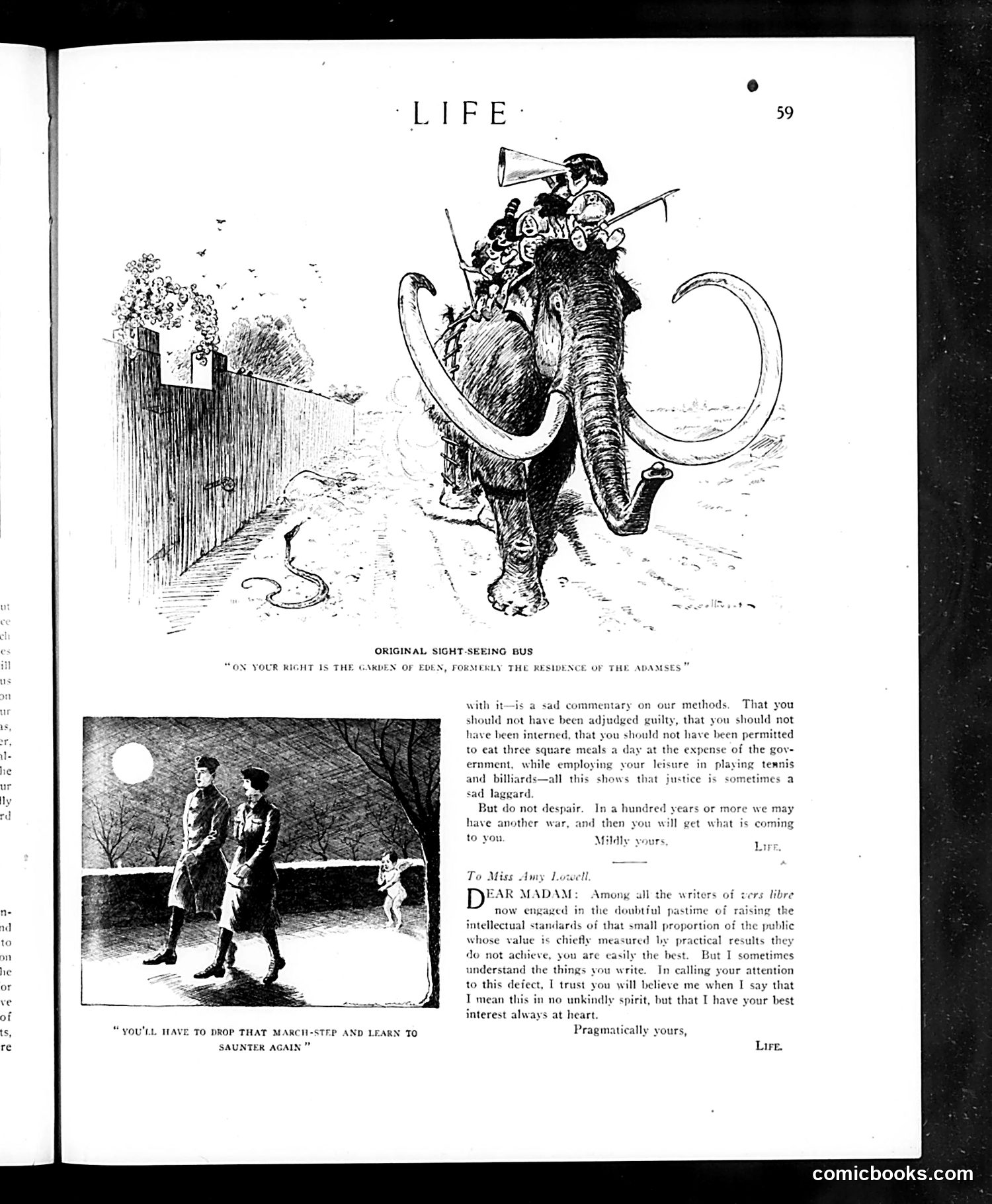
This page from *Life* magazine contains two satirical cartoons and letters: **Top cartoon:** "Original Sight-Seeing Bus" depicts a mammoth as a tourist vehicle with guides pointing out "The Garden of Eden, formerly the residence of the Adamses"—a joke mocking the Adams political family (likely John Adams or John Quincy Adams) by reducing their legacy to a prehistoric relic. **Bottom cartoon and text:** A letter to poet Amy Lowell criticizes the "vers libre" (free verse) poetry movement she championed. The figure must "drop that march-step and learn to saunter again," suggesting free verse is too rigid or pretentious. The letter sarcastically praises Lowell as "the best" while claiming not to understand her work—mockery of both modernist poetry and its small, self-important audience. The page also contains a separate letter expressing regret about wartime internment policies, predicting future wars will provide harsher justice. The satire targets political dynasties, literary modernism, and government wartime practices.
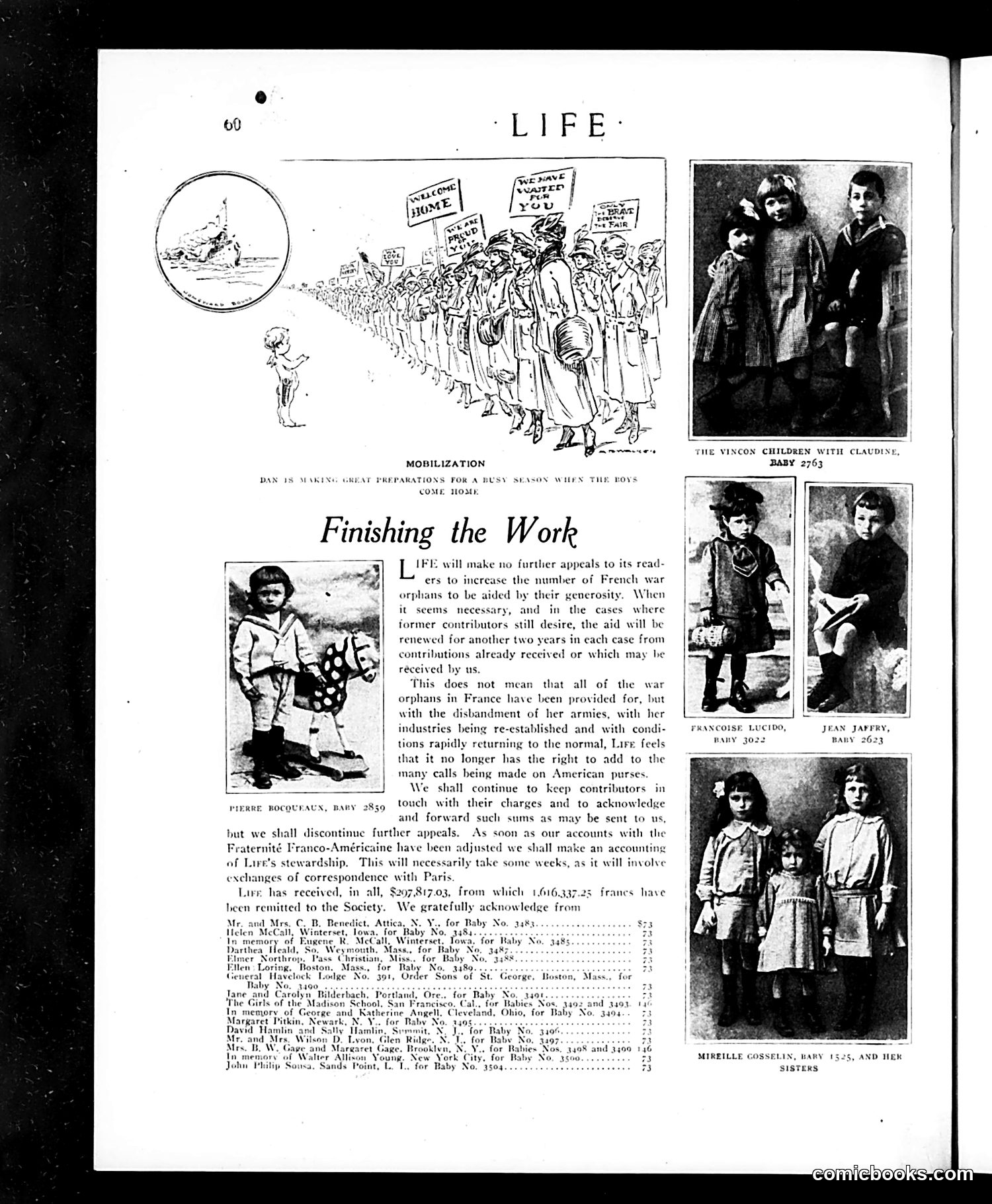
This page concludes *Life* magazine's fundraising campaign for French war orphans. The satirical cartoon "Mobilization" shows civilians preparing for soldiers' homecoming—a gentle joke about domestic "mobilization" mirroring military preparation. The main text announces *Life* will stop soliciting donations for French orphan aid, as WWI has ended and France is rebuilding. The magazine argues it's improper to continue appeals when American resources are needed domestically and France's economy is recovering. However, *Life* commits to honoring existing pledges for two more years and will account for the $297,817.03 already raised. The photographs show actual sponsored French orphans, personalizing the campaign. Names like Pierre Bocqueaux and Mireille Gosselin represent individual children donors supported. The tone is practical and somewhat relieved—the urgent crisis has passed, and normal conditions are "rapidly returning."
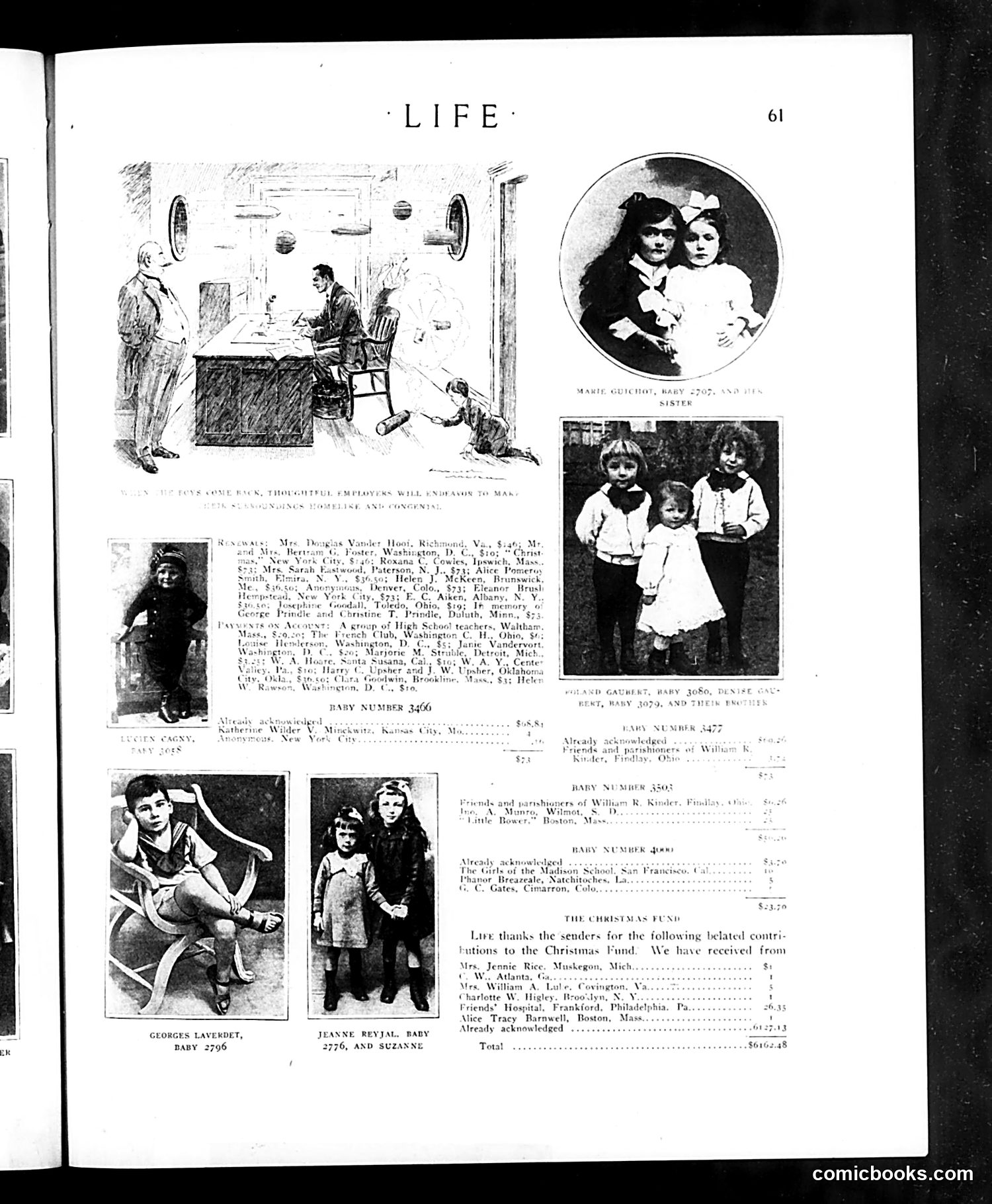
This page features **baby photographs and acknowledgments** rather than political satire. The main content includes: **Visual elements:** Multiple photographs of infants labeled with names and numbers (Baby 3466, Baby 2705, etc.), presented as if documenting a contest or charity initiative. **Text section:** "The Christmas Fund" acknowledges donors who contributed money—including individuals from various cities and institutions like Friends' Hospital in Philadelphia. Contributors gave modest sums (amounts visible suggest $1-5 range). **Context:** This appears to be a **charitable appeal page**, likely from an early 20th-century issue where Life magazine solicited Christmas donations for children's welfare. The baby photos served as emotional appeals to encourage reader contributions. **For modern readers:** This reflects an era when magazines directly fundraised for charitable causes through their pages, using sentimental imagery of children to motivate donations—a practice now considered somewhat manipulative by contemporary standards. The page contains no political cartoon or satire.
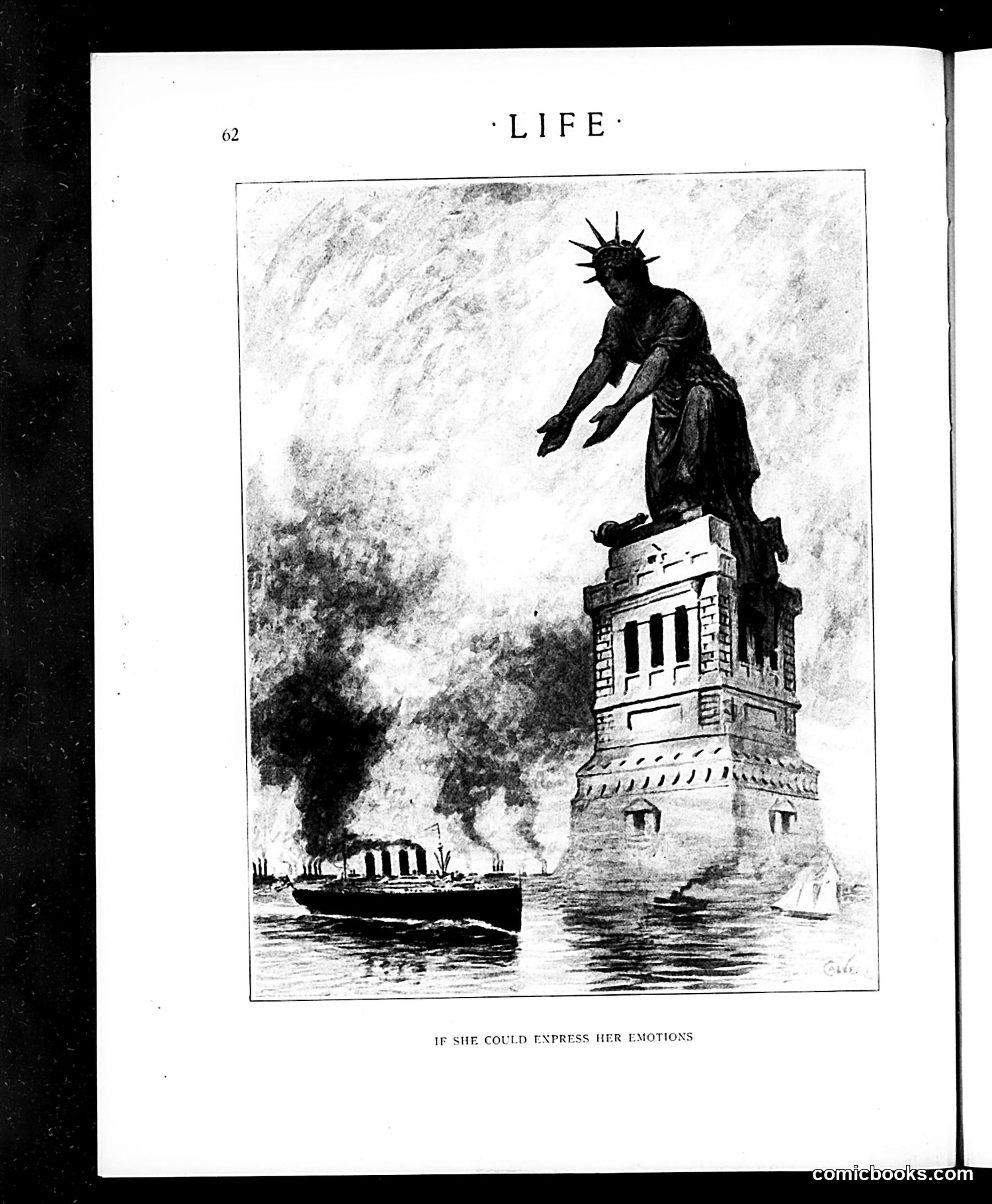
This satirical illustration depicts Lady Liberty (the Statue of Liberty personified) standing atop her pedestal, with an anguished, grotesque expression—her face contorted with spikes protruding from her head like a crown of thorns. Below, a steamship emits dark smoke while a smaller sailboat floats nearby. The cartoon appears to critique American immigration or industrial policy during the early 20th century. The caption "If She Could Express Her Emotions" suggests that Lady Liberty—traditionally a symbol of welcome and hope for immigrants—would show distress or anger about current conditions. The smoking ship likely references overcrowded, dangerous immigrant vessels or industrial pollution. The satire implies a contradiction between America's stated ideals of liberty and the harsh reality immigrants or citizens faced.
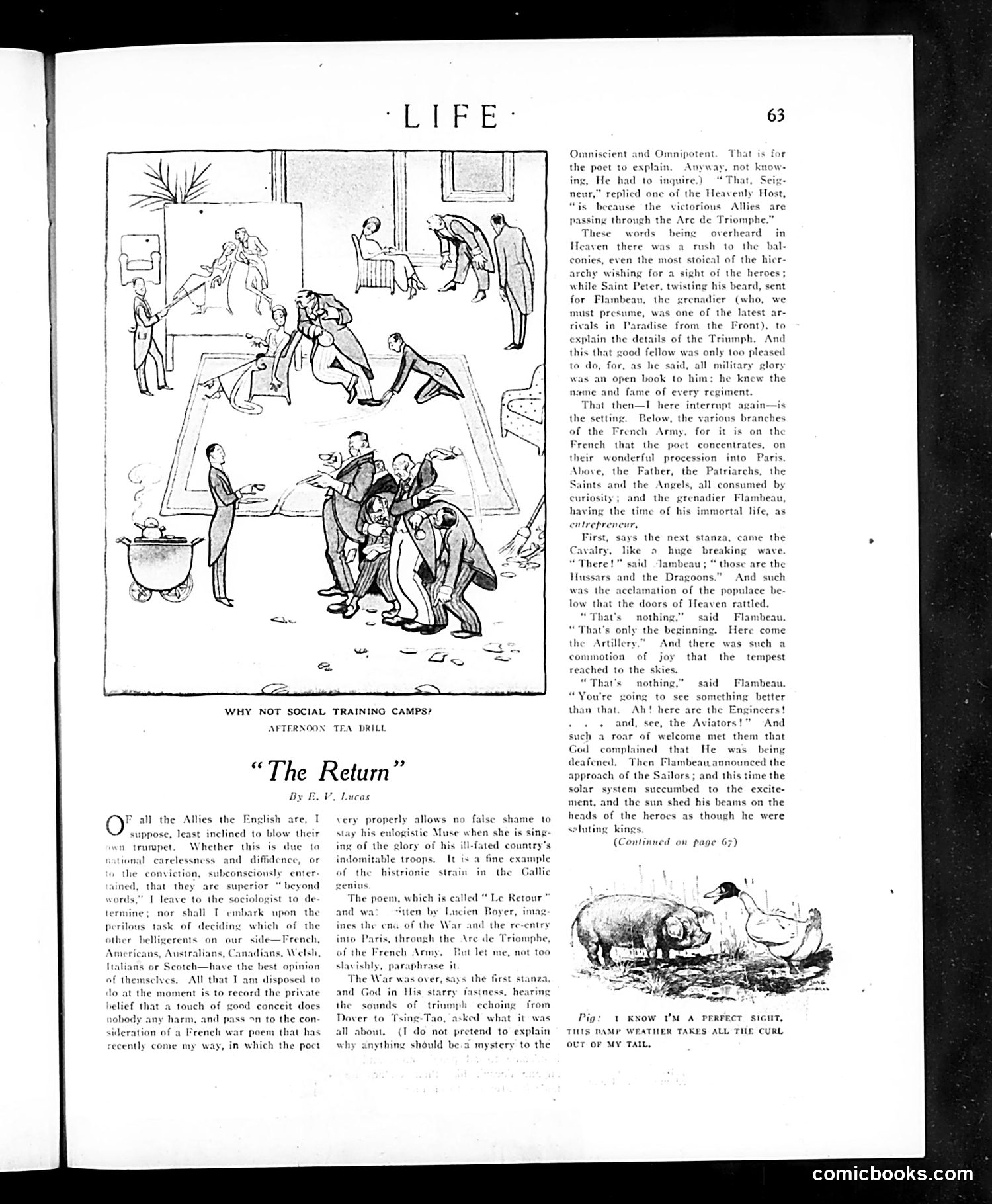
## Main Cartoon: "Why Not Social Training Camps? Afternoon Tea Drill" This cartoon satirizes British military preparedness by depicting what appears to be upper-class officers conducting an absurdly genteel "afternoon tea drill" indoors. The scene shows soldiers in formal dress engaging in leisurely tea service rather than serious combat training. The satire targets the British establishment's perceived complacency or inadequate military readiness—suggesting the officer class treats warfare as casually as afternoon social etiquette rather than serious preparation. ## "The Return" (Poem Discussion) The page discusses a French war poem by Lucien Royer about soldiers' triumphant return through the Arc de Triomphe after WWI. The satirical narrative depicts Heaven's inhabitants (God, Saints, Angels, Peter) eagerly watching various French and Allied military branches parade by—cavalry, artillery, engineers, aviators—each greeted with increasing celestial excitement. The grenadier Flambeau serves as heavenly tour guide, explaining the procession's significance. The satire likely mocks grandiose post-war celebrations and inflated military glory following the recently-ended World War I.
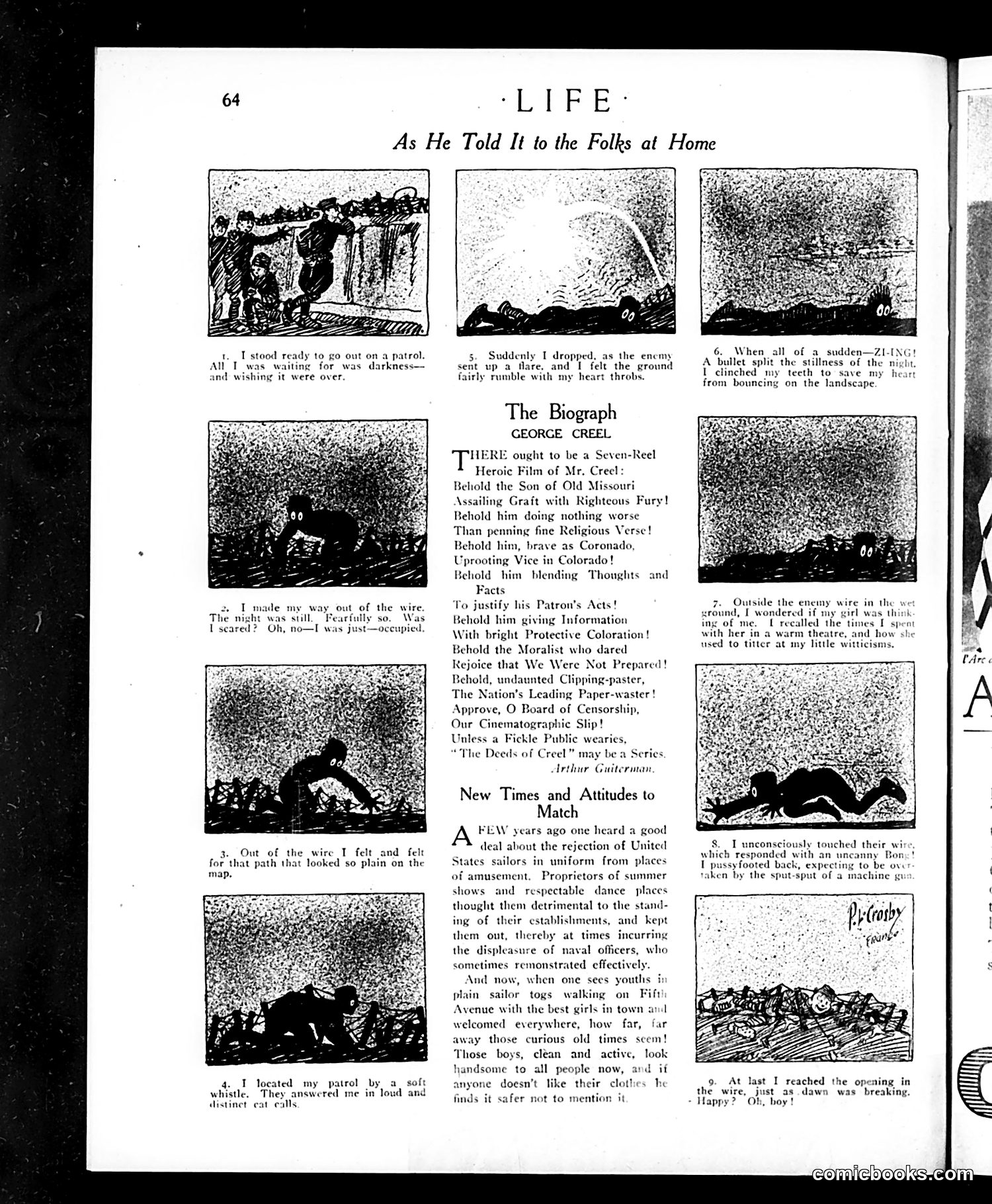
This page contains two distinct pieces: **Top section**: A soldier's first-person account of a nighttime patrol, illustrated with stark silhouettes. The narrative describes fear and homesickness—waiting for darkness, navigating by feel, dodging enemy fire, and thinking of his girlfriend in a warm theater. It's a straightforward, emotional wartime memoir presented as illustration. **"The Biograph" section**: A satirical poem mocking **George Creel**, head of the U.S. Committee on Public Information during WWI. The satire attacks Creel as a self-righteous propagandist who wraps government messaging in moral language ("Religious Verse," "Protective Coloration"). The barb about "We Were Not Prepared" likely references prewar criticism. **"New Times and Attitudes" section**: Social commentary noting that sailors were previously barred from respectable establishments (theaters, dance halls) but are now welcomed by "the best girls in town"—a reversal attributed to wartime patriotism and changed attitudes toward uniformed servicemen. The overall page reflects WWI-era American culture: soldier experiences, government propaganda criticism, and shifting social attitudes toward the military.
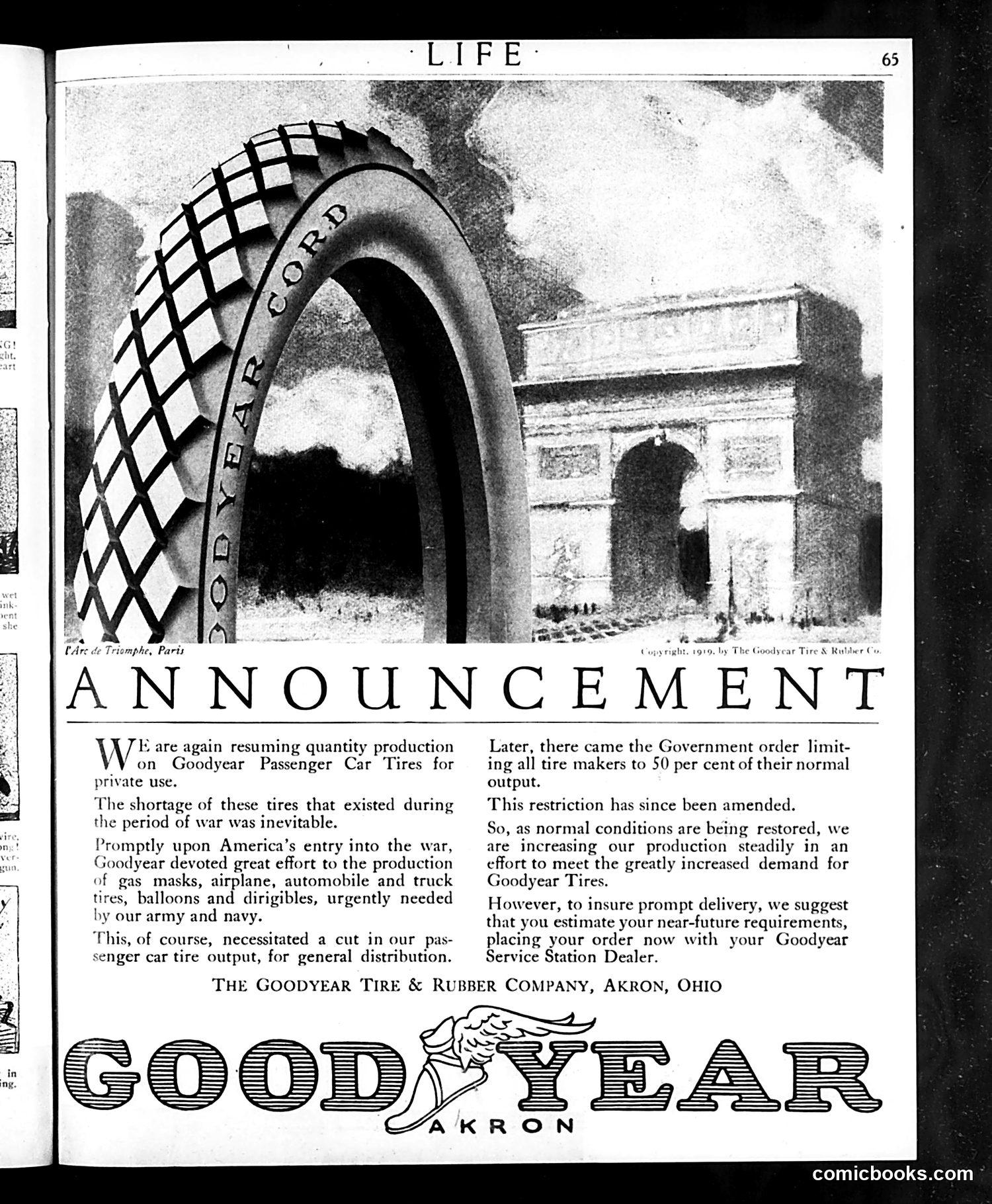
This is a **Goodyear Tire advertisement**, not a political cartoon. The page announces the resumption of passenger car tire production after World War I. **The Image:** Shows a large Goodyear tire superimposed over the Arc de Triomphe in Paris—a celebratory visual linking the company's wartime contributions to the Allied victory. **The Message:** Goodyear explains that during WWI, they pivoted production from civilian tires to military supplies (gas masks, aircraft tires, balloons, dirigibles). The government then limited all tire makers to 50% output. Now, with restrictions eased and "normal conditions being restored," Goodyear is increasing passenger tire production to meet demand. **The Pitch:** The company encourages customers to pre-order tires immediately to secure prompt delivery as demand rises. This reflects post-WWI American corporate messaging: emphasizing patriotic wartime sacrifice while pivoting back to profitable civilian markets. The Paris landmark symbolizes victory and normalcy returning.
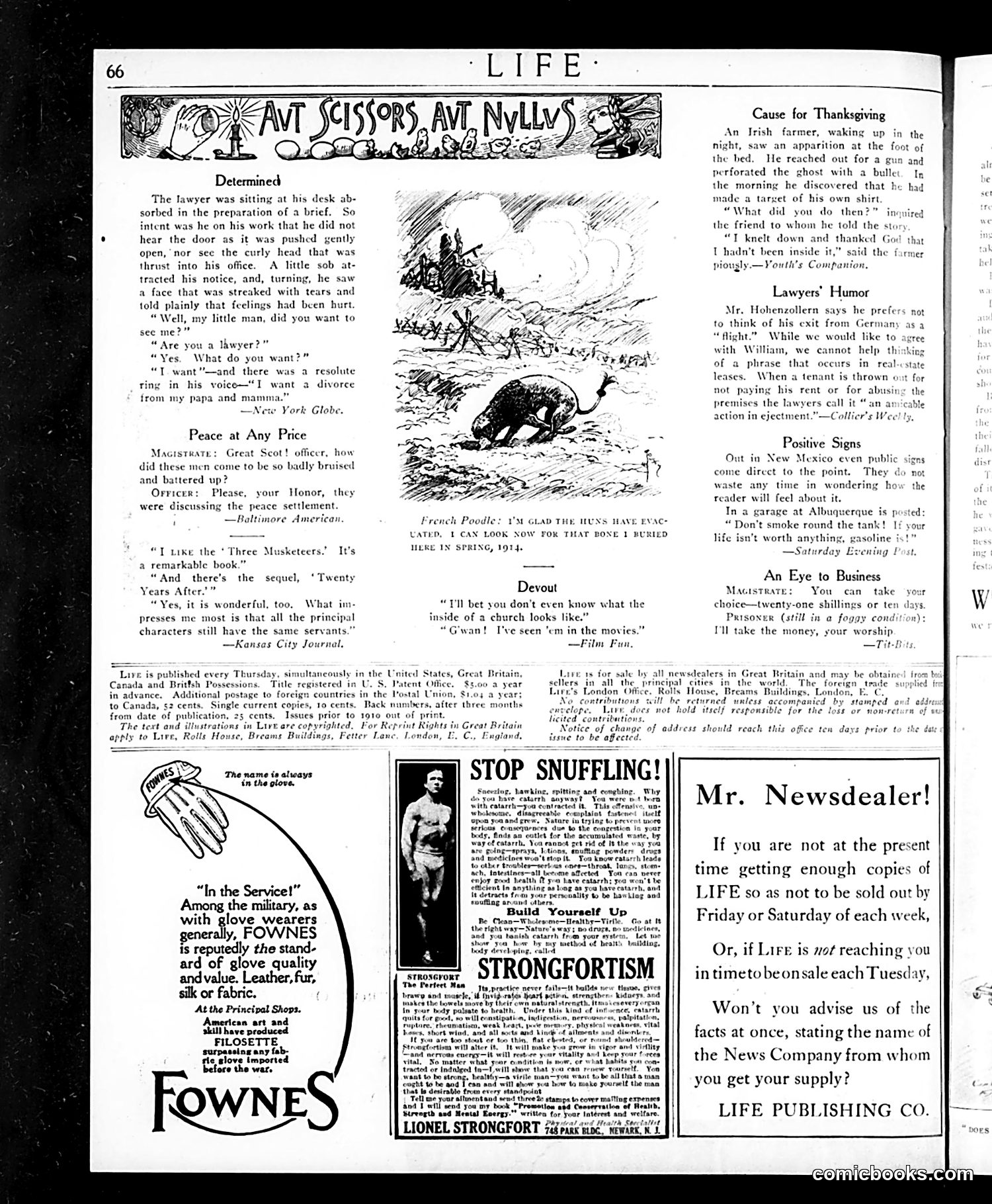
This page contains multiple brief humorous sketches typical of Life's satirical format: **"Determined"**: A child asks a lawyer for a divorce from his parents—satire on both childhood innocence and the growing prevalence of divorce. **"Peace at Any Price"**: Officers discussing men beaten up while debating the peace settlement—likely referencing WWI peace negotiations, satirizing how contentious such discussions become. **"Devout"**: A child claims knowledge of church interiors from movies rather than actual attendance—mocking shallow modern religiosity. **"French Poodle"** (illustration): A German soldier's caption celebrates evacuating ("the Huns"), then searches for a buried bone—wartime satire comparing Germans unfavorably to dogs. **"Cause for Thanksgiving"**: An Irishman shoots his own shirt thinking it a ghost, then thanks God he wasn't wearing it—ethnic humor playing on Irish stereotypes. **Other sections** include advertising (Fownes gloves) and various brief jokes about lawyers' language and signage in New Mexico. The page primarily satirizes contemporary social issues: divorce, wartime conditions, religious hypocrisy, and modern absurdities.
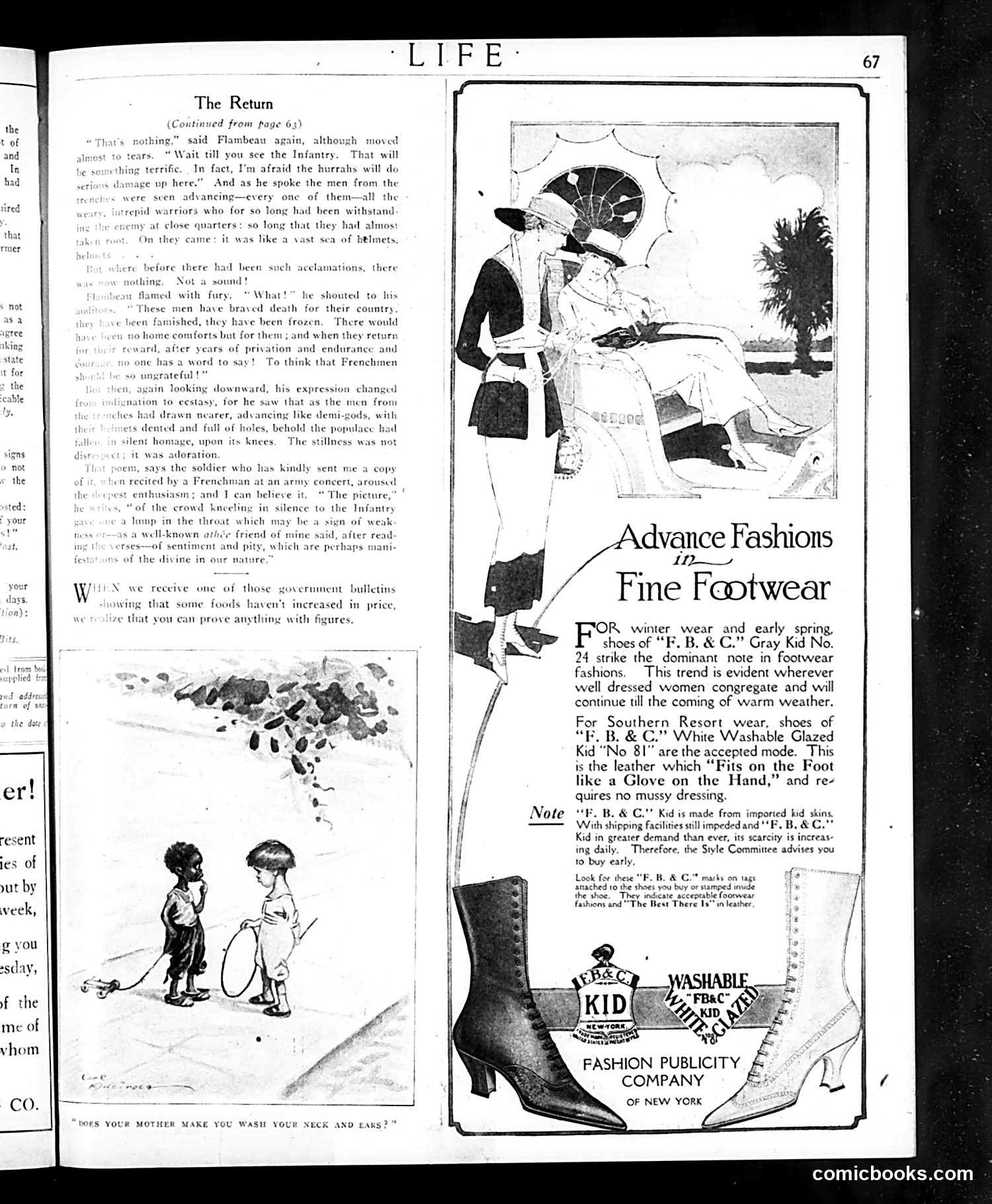
This page contains two distinct elements: **Left side:** A story excerpt titled "The Return" (continued from page 63), depicting a French military officer's emotional reaction to encountering returning soldiers. The narrative describes initial coldness from civilians, then a shift to reverent silence and kneeling as the troops pass—suggesting a commentary on patriotism, sacrifice, and public gratitude during wartime (appears to be WWI era based on context). **Right side:** A full-page advertisement for "F. B. & C." brand women's shoes, emphasizing fashionable footwear for winter and spring. The ad features illustrations of stylish women's feet and legs, promoting specific shoe models in gray kid leather and white washable glazed kid. The copy stresses exclusivity and scarcity due to shipping constraints, urging early purchase. The juxtaposition is typical of Life magazine's format—serious editorial content alongside commercial advertising. The advertisement takes up substantial page real estate, reflecting the magazine's revenue model.
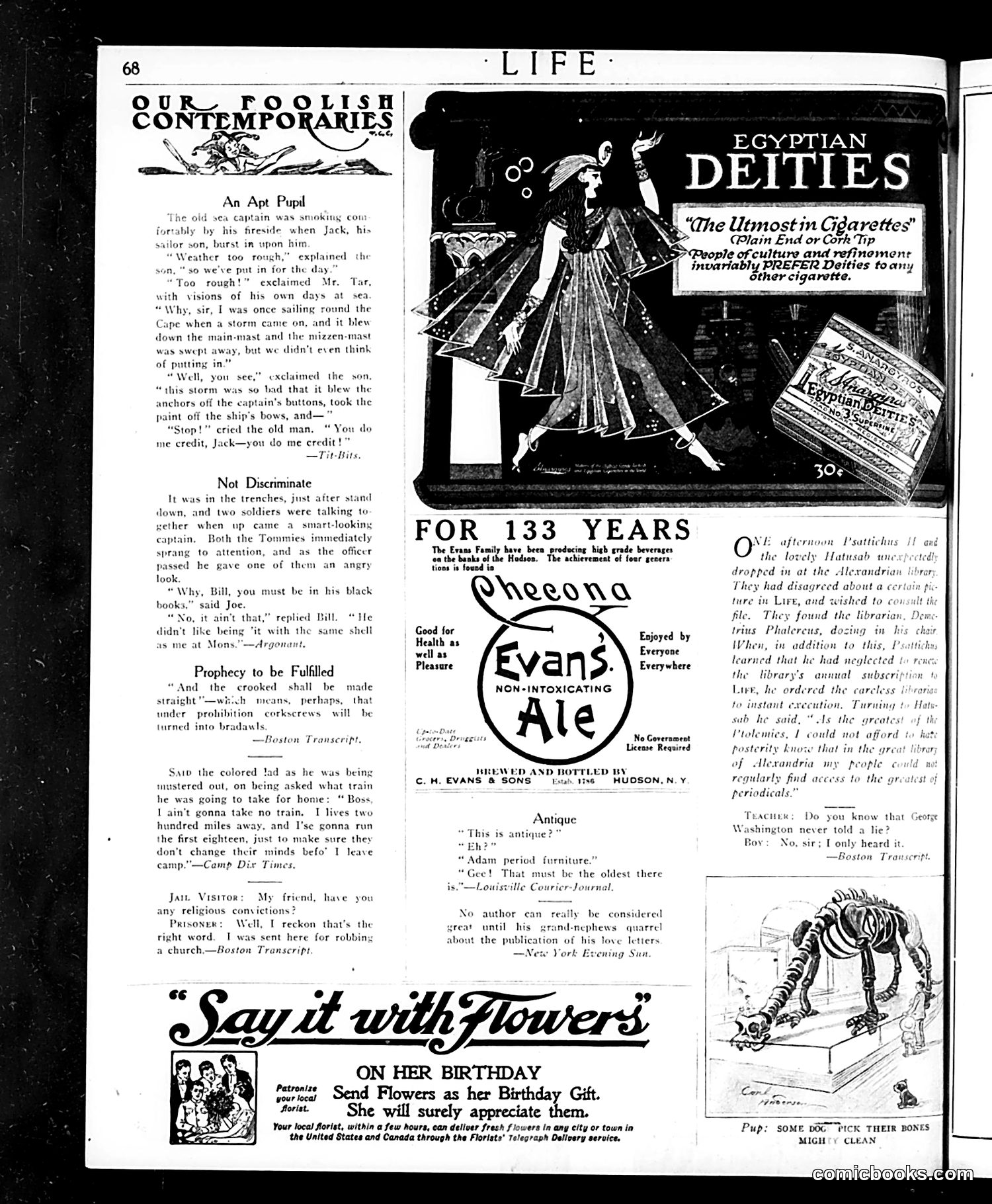
This page contains **humorous short anecdotes** rather than political cartoons. The pieces satirize social situations and human nature: **"An Apt Pupil"**: A sailor son one-ups his father's boasting about naval hardships with an absurdly exaggerated storm story, earning the old man's grudging admiration for matching his bluster. **"Not Discriminate"**: A WWI trench joke where a captain dislikes a soldier not for any offense, but because they both survived the same artillery shell at Mons—he resents the soldier's luck. **"Prophecy to be Fulfilled"**: A Prohibition-era joke predicting that when alcohol is banned, corkscrews will be repurposed as straightening tools (bradawls)—mocking both Prohibition and crooked politicians. Other items include military humor, a church robbery confession, and period advertisements (Egyptian Deities cigarettes, Evans Ale, flower delivery service). The page reflects **1920s American humor**: WWI references, Prohibition-era jokes, and genteel comedy typical of Life magazine's satirical style.
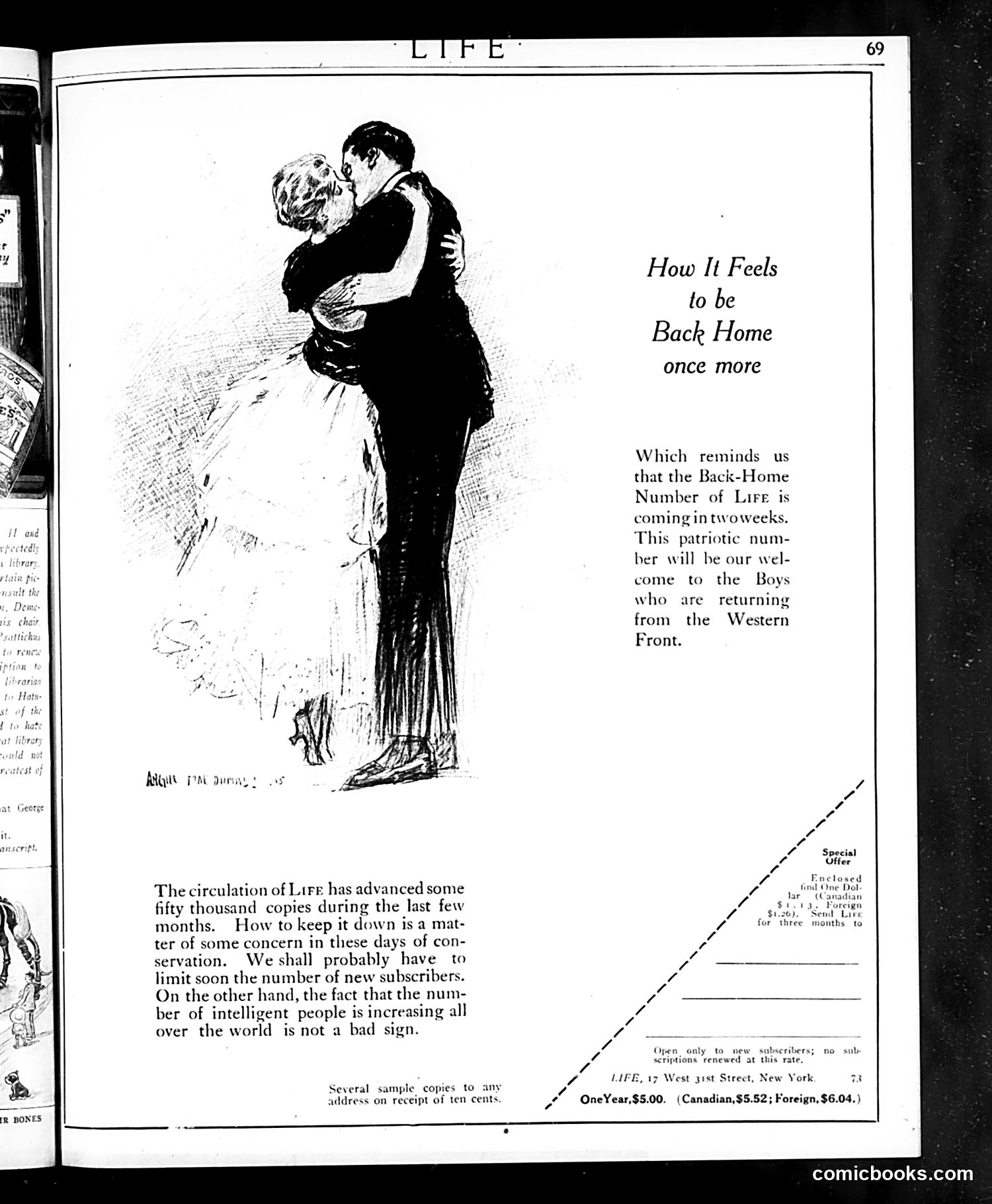
This page promotes an upcoming "Back-Home Number" of *Life* magazine, timed to welcome American soldiers returning from World War I's Western Front. The illustration depicts a romantic reunion—a soldier in military uniform embracing a woman, likely representing the emotional homecomings soldiers and their loved ones anticipated. The editorial text uses this patriotic timing to boost subscriptions, noting *Life*'s circulation has grown by fifty thousand copies in recent months. The magazine playfully claims it may need to limit new subscribers due to conservation concerns (likely referencing WWI rationing), while expressing satisfaction that "intelligent people" are increasing worldwide. The "Back-Home Number" framing transforms the magazine into a patriotic welcome-home publication for returning troops, using sentimentality and national pride as marketing tools. The special subscription offer (one dollar enclosed) targets new readers during this patriotic moment.
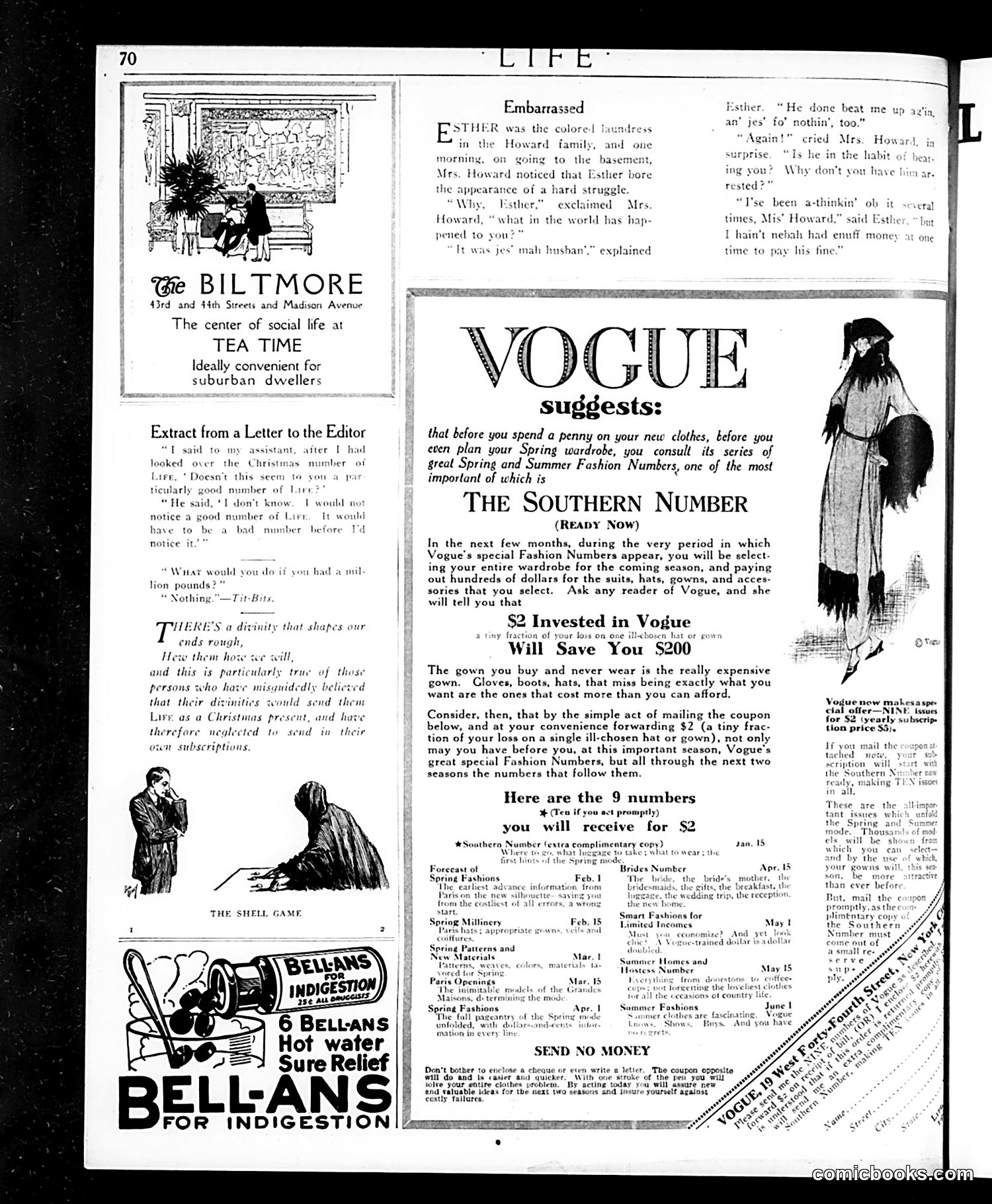
This page contains a short story mocking an African American domestic worker named Esther employed by the Howard family. The "joke" centers on Esther appearing disheveled one morning. When Mrs. Howard asks what happened, Esther explains her husband beat her ("It was jes' mah husban'"). Mrs. Howard responds by suggesting Esther should have had him arrested, to which Esther replies she lacks money to pay his fine. The "humor" relies on crude racial stereotyping—dialect, poverty, domestic violence, and the implication that this situation is comedic rather than serious. This reflects early 20th-century Life magazine's casual use of racist caricature and violent domestic abuse as entertainment for white readers. The story's cruelty toward both women and Black Americans would be immediately recognized as deeply offensive today, though it apparently passed as acceptable satire in this era.