
Life, 1919-01-09 · page 20 of 34
Life — January 9, 1919 — page 20: what you’re looking at
What you’re looking at
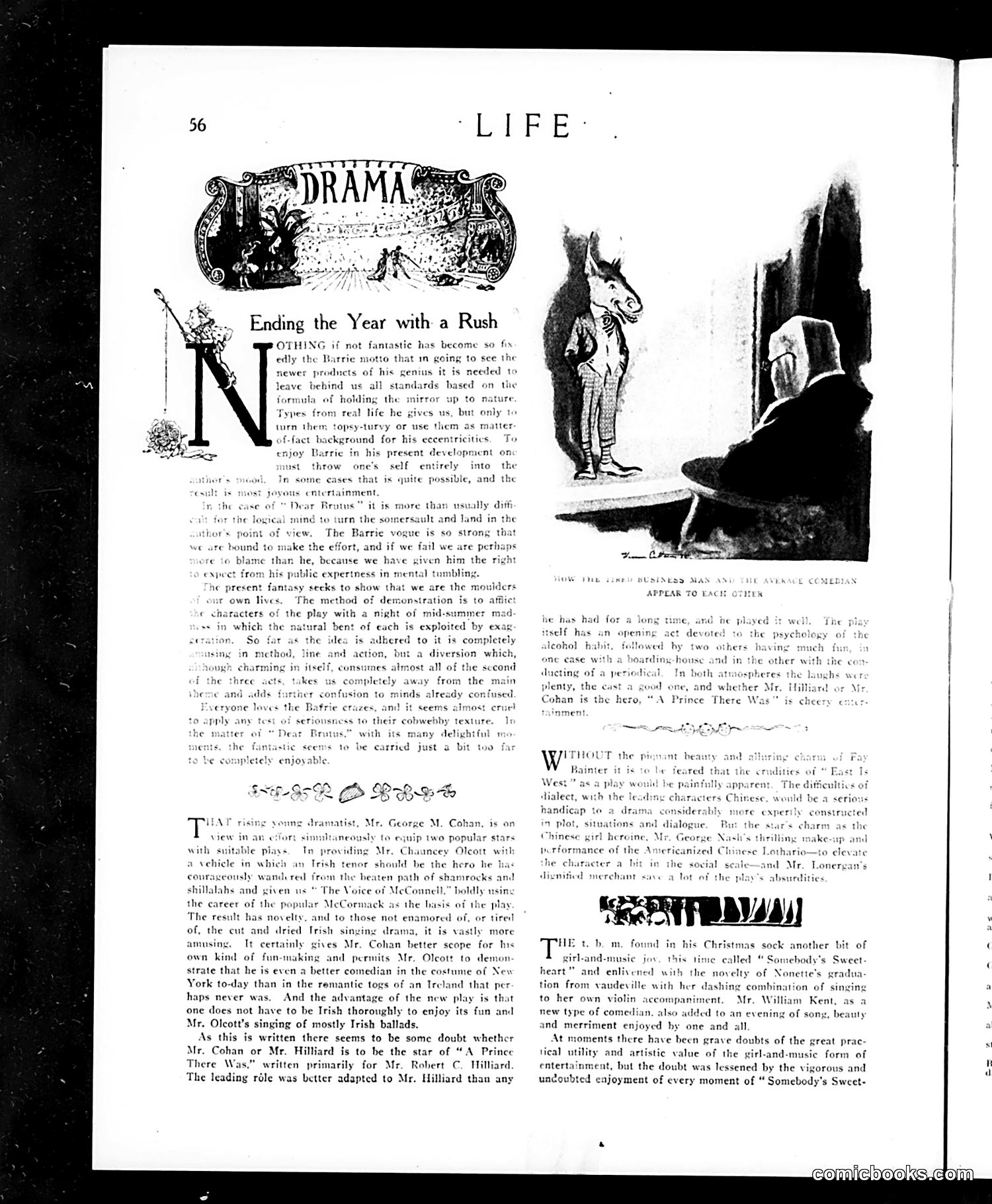
This page reviews contemporary theatrical productions, particularly focusing on J.M. Barrie's influence on modern drama. The main illustrated figure appears to be a character from an Irish-themed play, reflecting the page's discussion of "The Voice of McConnell" and works by George M. Cohan and Chauncey Olcott—playwrights known for Irish-American comedies. The article critiques Barrie's fantastical style's dominance in theater, arguing audiences expect playwrights to create imaginative, unconventional characters rather than realistic portrayals. It discusses how Barrie's method—taking ordinary people and transforming them through theatrical exaggeration—has become popular but risks losing grounding in reality. The reviews mention specific productions and performers of the era, including discussions of whether Cohan or Hilliard should star in "A Prince There Was." The overall tone suggests early 1900s theatrical debate about realism versus romanticism in drama.
📄 Transcribed text from this page (OCR, searchable)
Machine-transcribed from the original scan — historical spelling and the odd misread are preserved.
Ending the Year with a Rush OTHING if edly the Barrie fantastic has become so fix 10 that in going to see the newer products of his gi leave behind us all standards hased us it is needed to ef holding the mirror up to nature Types from real life he gives us, but only y oF use them as matter turn them topsy-tu {-fact background for his ece development on: ricitics, To enjoy Barrie in his presen ust throw one’s self entirely is quite possible, a entertainment Dear Bromus” it is more than usually diff ind to turn f view. The Barrie vogu ort, and if we f © somersault and Jand in the is so strong tha il ve given him the ri are perha « are bound to make the e tha ct from his public expertness in mental tumbling. he, because we h ne presen ont own liv © characters of s+ in which seration. So ng in me ough charming in itself, ¢ fantasy secks to show that we are the moulders method of dem with a night of mid-summer mad natural bent of each is exploited by exax de od, line and onstration is to afiii Ihered to it is co takes us completely away i the nfusion to eryone loves the Bafrie crazes, and texture. 1 apply any test of seriousness to their cobwebby ater of “Dear Brotus.” with its many delightful mo enjo: Ts r : natist, Mr. George M. C view in an effort sinmtaned with suitable piays. Tn providing Mr. Chauncey sly to equip two pe Ieott with a vehicle in which an Trish tenor should be the hero couraxcously wandered from the beaten path of shamrocks and shillalahs and given us * The Voice of McConnell.” boldly the career of the popular McCormack as the basis of the play The re has novelty, and to those not enamored of, or tire: of, the cut and dried Trish singing drama, it is vastly more amusing. It certainly gives Mr. Cohan better scope for his own kind of fun-making and permits Mr, Oleott to demon te that he is even a better comedian in the costume of New York to-day t and that per haps never was, And the advantage of the new play is that one does not have to be Irish thoroughly to enjoy its fun and Mr. Olcott’s singing of mostly Irish ballads. As this is written there seems to be some doubt whether Mr. Cohan or Mr. Hilliard is to be the star of “A Prince There Was.” written primarily for Mr. Robert C. Hilliard. The leading réle was better adapted to Mr. Hilliard than any st in the remantic togs of an Ire OW ME GiNPU BUSINESS MAN AN boAvt COMEDIAN opening ac devoted to the p owed hy two having one case w oarding-house and in the other with ducting of a periodical, In both atmosphe “ lenty, the cast: one, and whether r Cohan is the hero, rince There W. : savent V ITHOUT the pi ring ¢ r Bainter it is 10 Ie East Is lialect, with the leading characters ¢ ¢ a serious na considerably more ucted Chinese girl heroine, Mr. George Nash's thrilling inake-up and handicap to a dra plot, si ons anil dialogy rio—to clev vorformance of the Americanized Chinese character a in the sovial scale Lonergan’s nitied merchant save nt af the play ne ii) IY HE t. bm. found in his Christmas sock another bit of irl-and-music jor. this time called “ Somehody's Sweet- heart” and enlivened with the novelty of Nonette’s gradua- tion from vaudeville with her dashing combination of singing to her own violin accompaniment. Mr. William Kent, as a new type of comedian, also added to an evening of sons, beauty and merriment enjoyed by one and all At moments there have been grave doubts of the great prac: form of t, but the doubt was lessened by the vigorous and joyment of every moment of “ Somebody's Sweet- tical utility and artistic value of the girl-and entertainm undoubted ¢: