
Life, 1919-01-09 · page 16 of 34
Life — January 9, 1919 — page 16: what you’re looking at
What you’re looking at
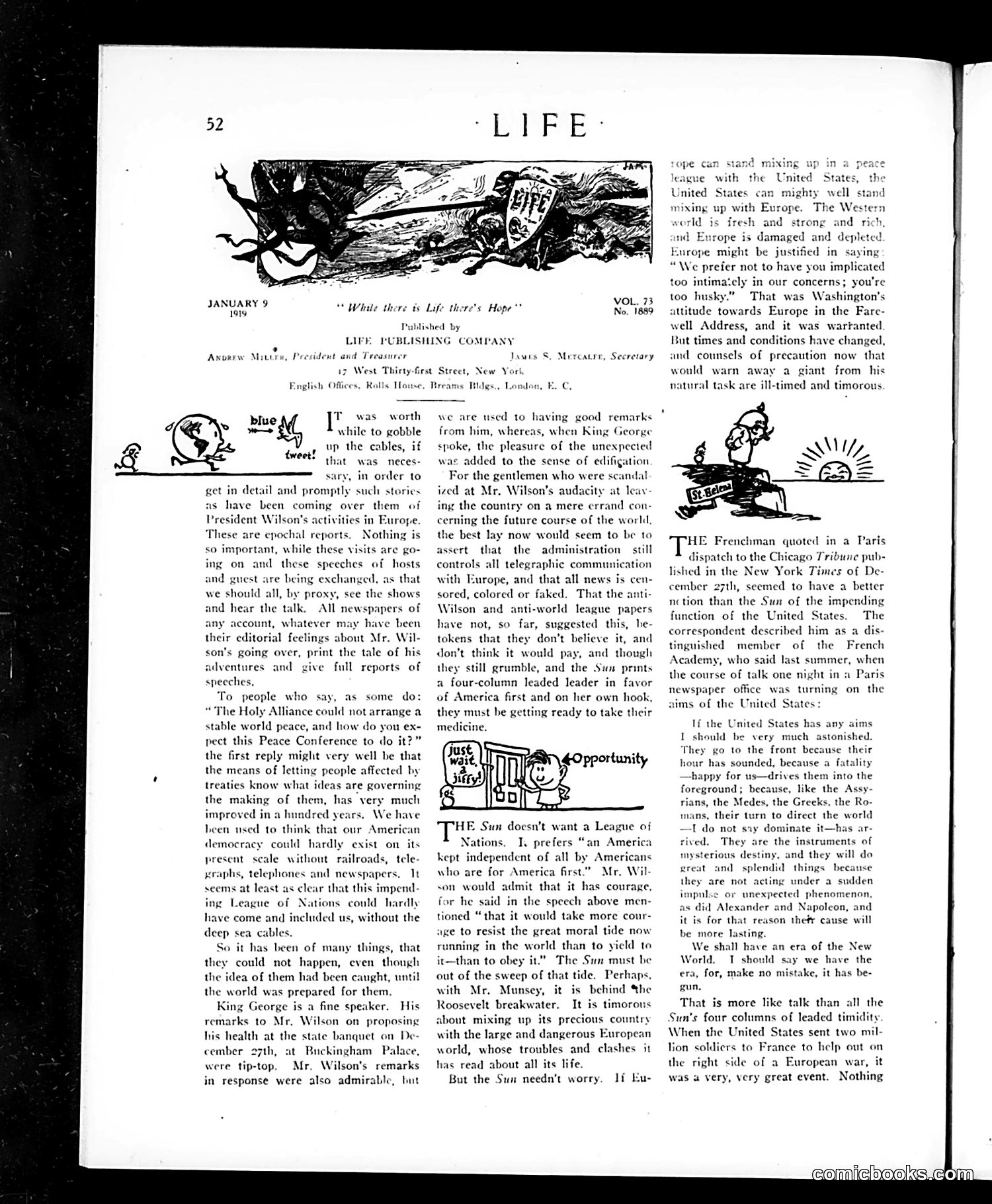
This page discusses President Wilson's activities at the Paris Peace Conference following World War I. The main text defends Wilson's trip to Europe and advocates for the League of Nations, while critiquing opponents like the *New York Sun* newspaper. **Key figures/references:** - President Wilson—defending his European mission - King George (likely George V)—praised for his diplomatic speech - The *Sun* newspaper and its owner Munsey—criticized for opposing the League of Nations and favoring isolationist "America First" positions **The satire's point:** The editorial mocks isolationist critics who claim America should avoid European entanglement. It argues that modern communications (cables, telegraphs) make international cooperation both possible and necessary—a direct response to those saying the League of Nations cannot work. The tone is pro-Wilson and pro-internationalism, dismissing skeptics as timorous and out of step with world events.
📄 Transcribed text from this page (OCR, searchable)
Machine-transcribed from the original scan — historical spelling and the odd misread are preserved.
JANUARY 9 1919 “Whale there ts Life there’ Published by LFF ° Axvarw Mittra, President and 7 PUB “asurer English Offices, Ralls Horse I was while to gobble up the cables, if that neces- sary, in order to get in detail and promptly such stories as have been coming over them of Dresident Wilson’s activities in Europe. These are epochal reports. Nothing is so important, while these visits are go- ing on and these speeches of hosts worth was and guest are being exchanged, as that we should all, by proxy, see the shows nd hear the talk. All newspapers of any account, whatever may have been their editorial feelings about Mr. Wil- son's going over, print the tale of his adventures and give full reports of speeches, To people who say, as some do: “ The Holy Alliance could not arrange a stable world peace, and how do you eo pect this Peace Conference to do it? the first reply might very well be that the means of letting people affected by treaties know what ideas are governing the making of them, has very much improved in a hundred years. We have een used to think that our American democracy could hardly exist on its present. scale without railroads, tele- xraphs, telephones and newspapers. It seems at least as clear that this impend- ing League of Nations could hardly have come and included us, without the deep sea cables. So it has been of many things, that they could not happen, even though the idea of them had been caught, until the world was prepared for them, King George is a fine speaker. His remarks to Mr. Wilson on proposing his health at the state banquet on De- cember 27th, at Buckingham Palace were tip-top, Mr, Wilson's remarks in response were also admirable, but HING COMPANY Jawes S. Mercatre, Secretary 7 West Thirty-first Street, New Yor Rreams Bldgs., London, we are used to having good remarks from him, whereas, when King ¢ spoke, the pleasure of the unexpected was added to the sense of edifigation For the gentlemen who were scandal ized at Mr, Wilson’s audacity at le: ing the country on a mere errand con cerning the future course of the worl. the best lay now would seem to be to assert that the administration still controls all telegraphic communication with Europe, and that all news is cen- sored, colored or faked. That the anti- Wilson and anti-world league papers have not, so far, suggested this, he- tokens that they don’t believe it, and don’t think it would pay, and thoug! they still grumble, and the Su prints a four-column leaded leader in favor of America first and on her own hook, they must be getting ready to take their medicine. Or gC HE Sun doesn’t want a League of Nations. I. prefers “an America kept independent of all by Americans who are for America first.” Mr. Wil son would admit that it has courage, for he said in the speech above men- tioned “ that it would take more cour- age to resist the great moral tide now running in the world than to yield to it—than to obey it.” The Sun must be out of the sweep of that tide. Perhaps, with Mr. Munsey, it is behind She Roosevelt breakwater. It is timorous pout mixing up its precious country with the large and dangerous European world, whose troubles and clashes it has read about all its life. But the Sun needn't worry. Ii Eu- league with United United States can migh mixing up with Europe. The Wester world is fresh and strong and nd pe is damaged and depleted States, th ell stand Europe might be justified in saying “We preier not to have you implicated too intimately in our concerns; you're too husky.” That was Washington's attitude towards Europe in the Fare- well Address, and it was wartanted. But times and conditions have changed, and counsels of precaution now that would warn away a giant from his natural task are ill-timed and timorous. HE Frenchman quoted in a Paris dispatch to the Chicago Tribune pub- lished in the New York Times of De- cember 27th, seemed to have a better nction than the Sun of the impending function of the United States. The correspondent described him as a dis- tinguished member of the French Academy, who said last summer, when the course of talk one night in a Paris newspaper office was turning on the aims of the United States: If the United States has any I should be very much astonished. They go to the front because their hour has sounded, because a fatality —happy for us—drives them into the foreground; because, like the Assy- rians, the Medes, the Greeks, the Ro- mans, their turn to direct the world —I do not say dominate it—has ar- rived. They are mysterious destiny, and they will do the instruments of great and splendid things because they are not acting under a sudden upulse or unexpected phenomenon, as did Alexander and Napoleon, and it is for that reason thefr cause will be more lasting. We shall have an era of the New World. 1 should say we have the era, for, make no mistake, it has be- gun, That is more like talk than all the Sun's four columns of leaded timidity When the United States sent two mil- lion soldiers to France to help out on the right side of a European war, it was a very, very great event. Nothing