
Life, 1919-01-09 · page 7 of 34
Life — January 9, 1919 — page 7: what you’re looking at
What you’re looking at
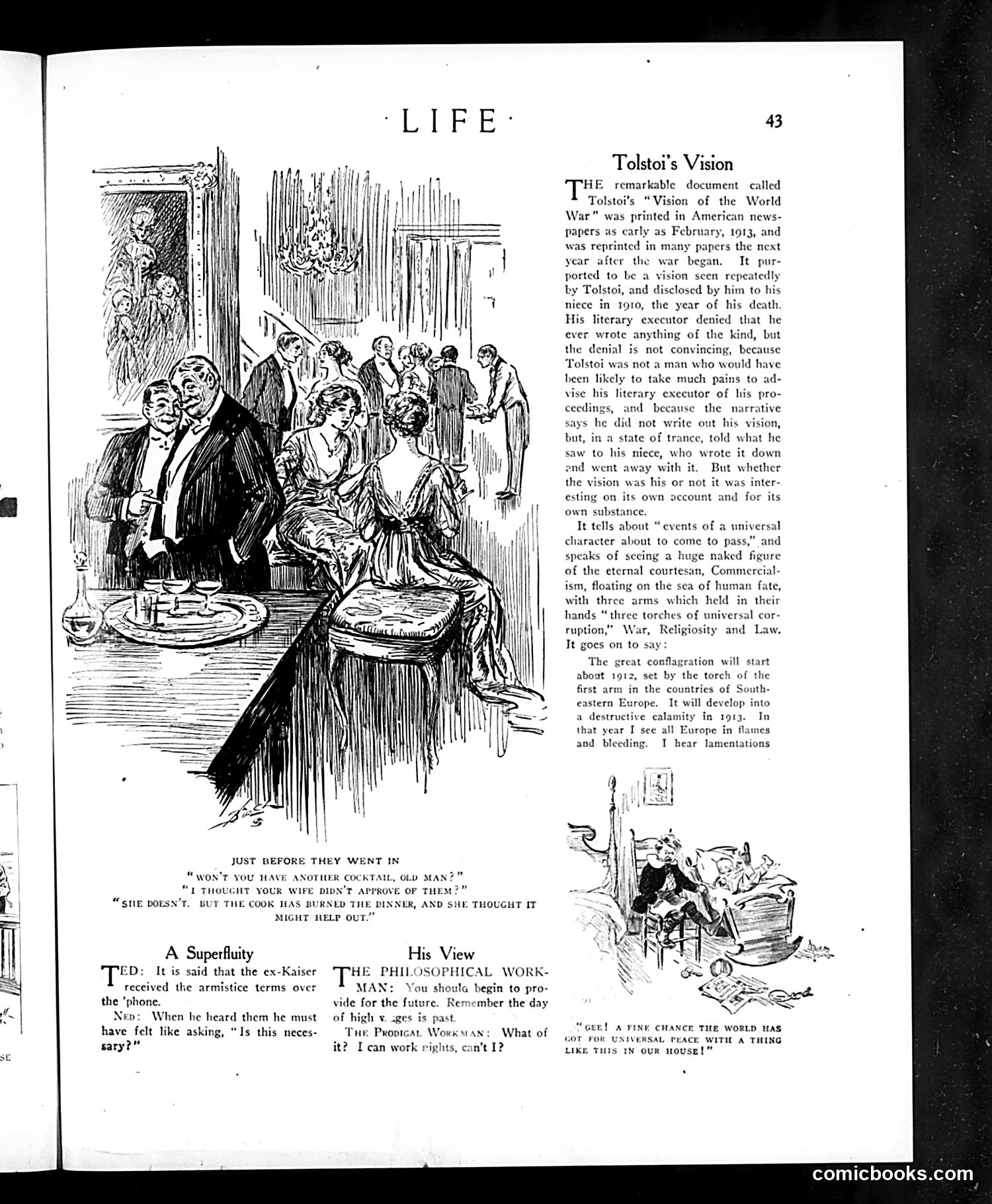
This page contains three distinct items: 1. **"Tolstoi's Vision"** — An article discussing a purported prophecy by Russian author Leo Tolstoy about World War I, allegedly disclosed to his niece. The text debates whether Tolstoy actually wrote this vision or merely spoke it in a trance state. 2. **"A Superfluity"** — A brief comic dialogue between "Ted" and "Ned" about receiving armistice terms over the telephone, with Ted asking if it's "necessary" — likely satirizing bureaucratic confusion during WWI's end. 3. **"His View"** — A dialogue between "The Philosophical Workman" and another figure about providing for the future and work rights, appearing to comment on post-war labor concerns and economic anxiety. The page reflects 1913-1918 WWI anxieties and social upheaval.
📄 Transcribed text from this page (OCR, searchable)
Machine-transcribed from the original scan — historical spelling and the odd misread are preserved.
JUST BEFORE THEY WENT IN “WON'T YOU HAVE ANOTHER COCKTAIL, OLD MAN?” “THOUGHT YOUR WIFE DIDN'T APPROVE OF THEM BUT THE COOK HAS BURNED THE DINNER, AND SHE THOUGHT IT “SIE DOESN'T. MIGHT HELP 0UT.” A Superfluity ED: It is said that the ex-Kaiser received the armistice terms over the ’phone. Nev: When he heard them he must have felt like asking, “Is this neces- sary?” His View TH = PHILOSOPHICAL WORK- N: You shoula begin to pro- vide for the future. Remember the day of high v. ages is past Tue Provicar Work MAN: What of it?) L can work rights, can't 1? 43 Tolstoi’s Vision 'HE remarkable document called Tolstoi’s “Vision of the World s printed in American news- as early as February, 1913, and was reprinted in many papers the next year after the war began. It pur- ported to be a vision scen repeatedly by Tolstoi, and disclosed by him to his niece in 1910, the year of his death. His literary executor denied that he ever wrote anything of the kind, but the denial is not convincing, because Tolstoi was not a man who would have been likely to take much pains to ad- vise his literary executor of his pro- ceedings, and because the narrative says he did not write out his vision, but, in a state of trance, told what he saw to his niece, who wrote it down end went away with it. But whether the vision was his or not it was inter- esting on its own account and for its own substance. It tells about “events of a universal character about to come to pass,” and speaks of seeing a huge naked figure of the eternal courtesan, Commercial- ism, floating on the sea of human fate, with three arms which held in their hands “ three torches of universal cor- ruption,” War, Religiosity and Law. It goes on to say The great con ion will start about 1912, set by the torch of the first arm in the countries of South- eastern Europe. It will develop into a destructive calamity in 1913. In that year I see all Europe in flames and bleeding. I hear lamentations “Geel A PINE CHANCE THE WORLD HAS GOT FOR UNIVERSAL PEACE WITH A THING LIKE THIS IN OUR HOUSE!” comicbooks.com