
A complete issue · 76 pages · 1918
Life — December 5, 1918
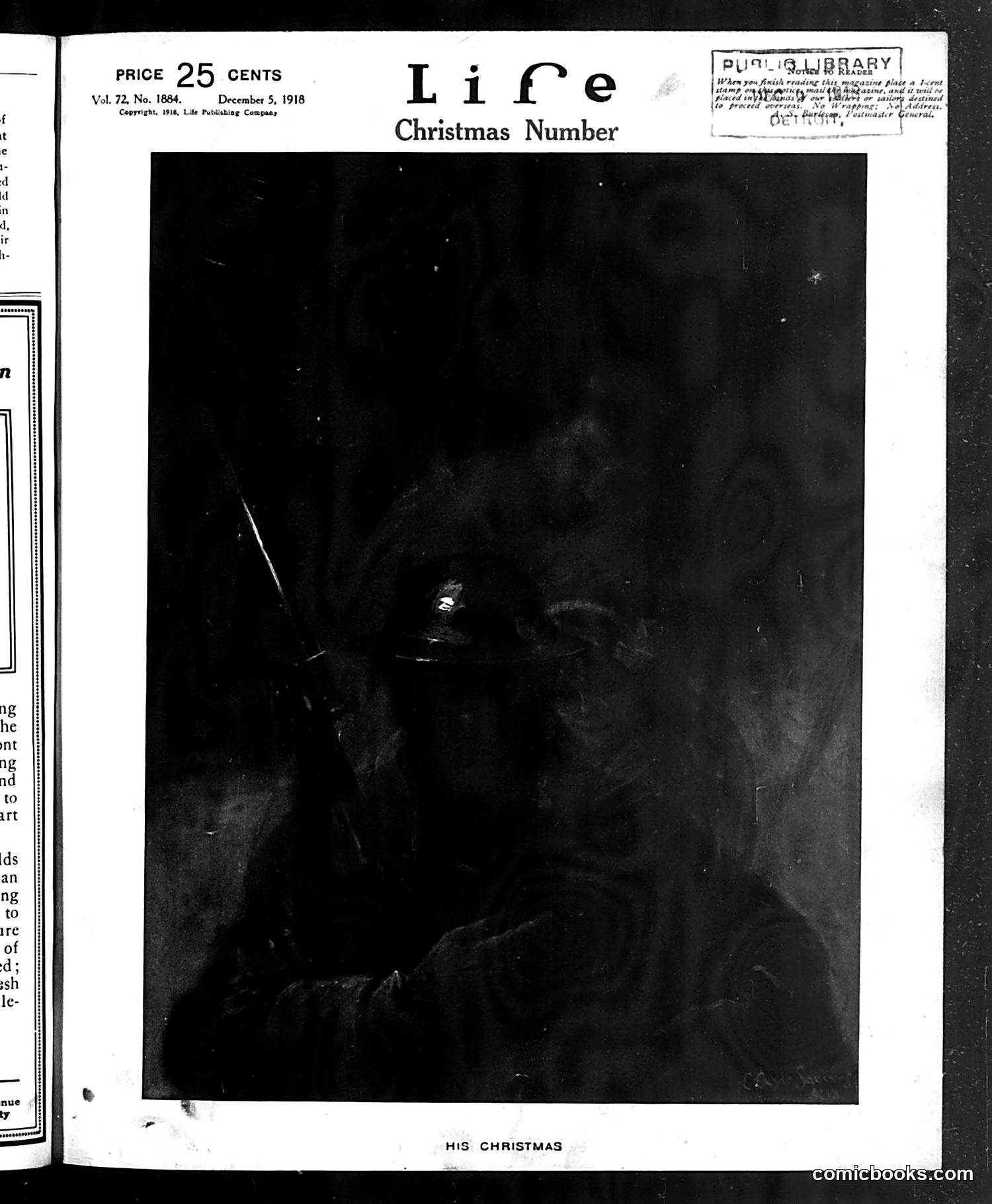
This appears to be the cover of Life's Christmas Number from December 5, 1918—just weeks after World War I's armistice (November 11, 1918). The image shows a dark, shadowy figure titled "HIS CHRISTMAS" at the bottom. Given the timing and the somber, mysterious nature of the illustration, this likely depicts a soldier or military figure contemplating Christmas during wartime's immediate aftermath. The heavily darkened image and isolated figure suggest themes of loss, sacrifice, or the emotional toll of war on those who fought. Without clearer visual details, I cannot definitively identify the specific subject, but the Christmas Number timing and post-WWI context suggest commentary on how returning soldiers and the nation itself would experience the holiday following unprecedented carnage.
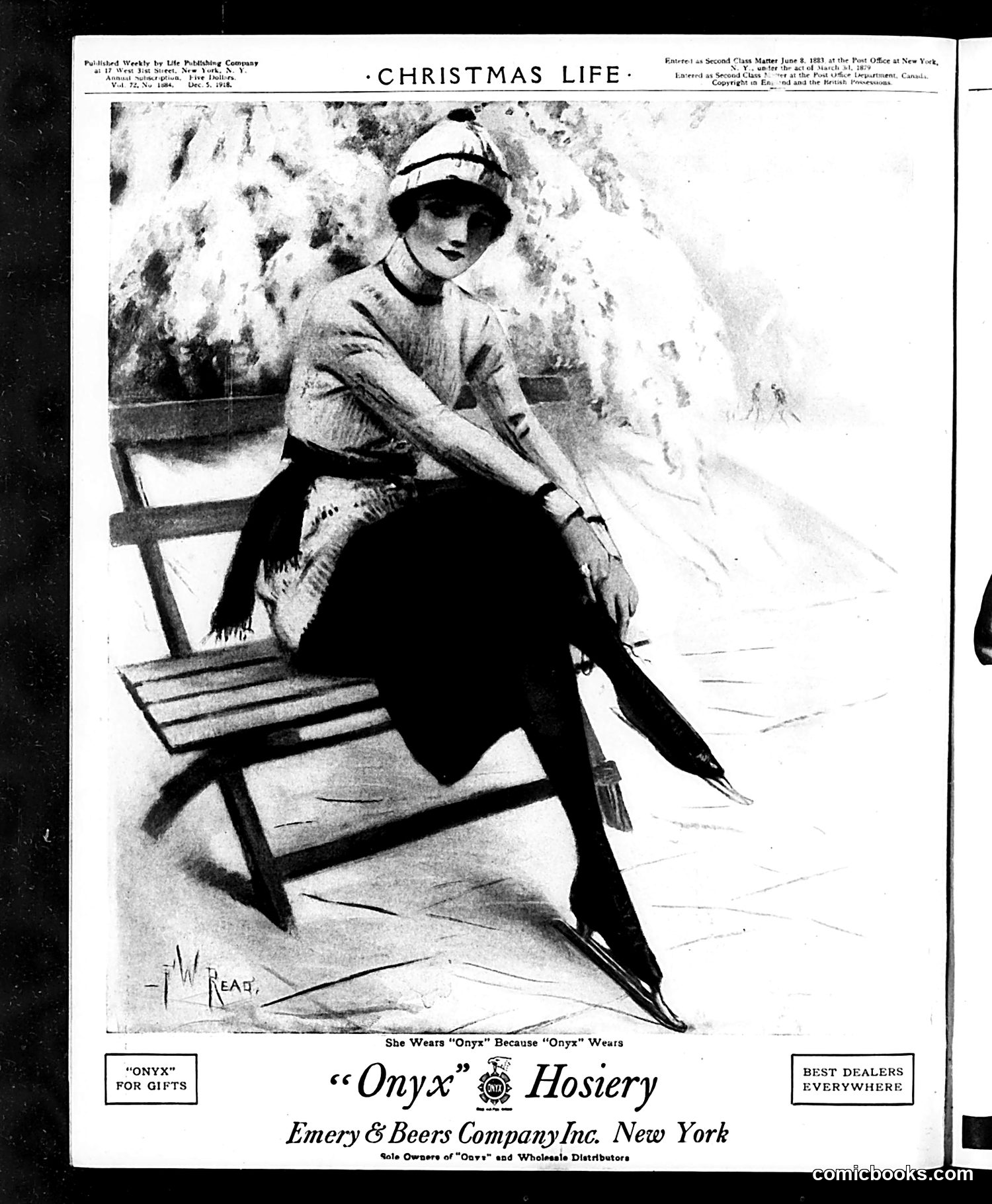
This is primarily an **advertisement**, not political satire. It promotes "Onyx" brand hosiery made by Emery & Beers Company of New York. The illustration shows a woman in 1920s attire (cloche hat, dark skirt, light sweater) sitting on a beach chair, displaying her legs in the advertised stockings. The accompanying caption reads "She Wears 'Onyx' Because 'Onyx' Wears"—a pun suggesting the hosiery's durability. The social context: this reflects the "Roaring Twenties" when women's fashion became less restrictive. The casual beach setting and visible legwear were relatively modern for the era. The page notes "Onyx for Gifts" and "Best Dealers Everywhere," indicating this was a premium product marketed for holiday purchasing.
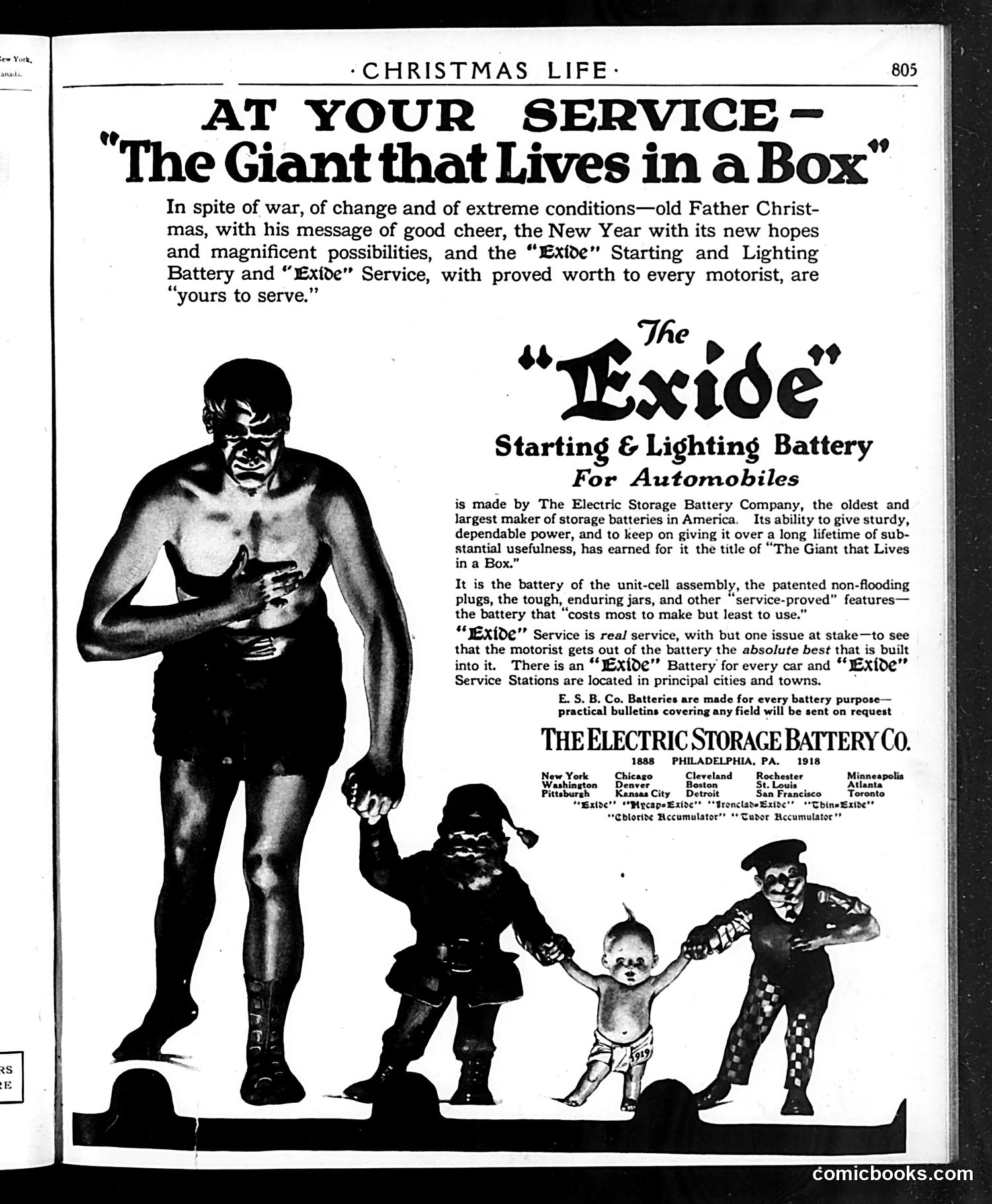
This is primarily a **commercial advertisement**, not political satire. The page advertises the "Exide" Starting and Lighting Battery for automobiles, made by The Electric Storage Battery Company (established 1888). The imagery uses a mythological reference: a large muscular male figure (appearing to represent a classical giant or Hercules) is depicted with smaller figures including what appear to be Santa Claus, a baby, and a clown or jester. This "Giant that Lives in a Box" is a metaphor for the battery's power and reliability. The Christmas-themed framing ("old Father Christmas," "New Year") connects seasonal goodwill messaging to product reliability. The ad emphasizes the battery's durability and superiority over competitors, positioning it as a dependable service ready to help motorists through difficult conditions—likely referencing wartime restrictions or hardships affecting 1918 readers.
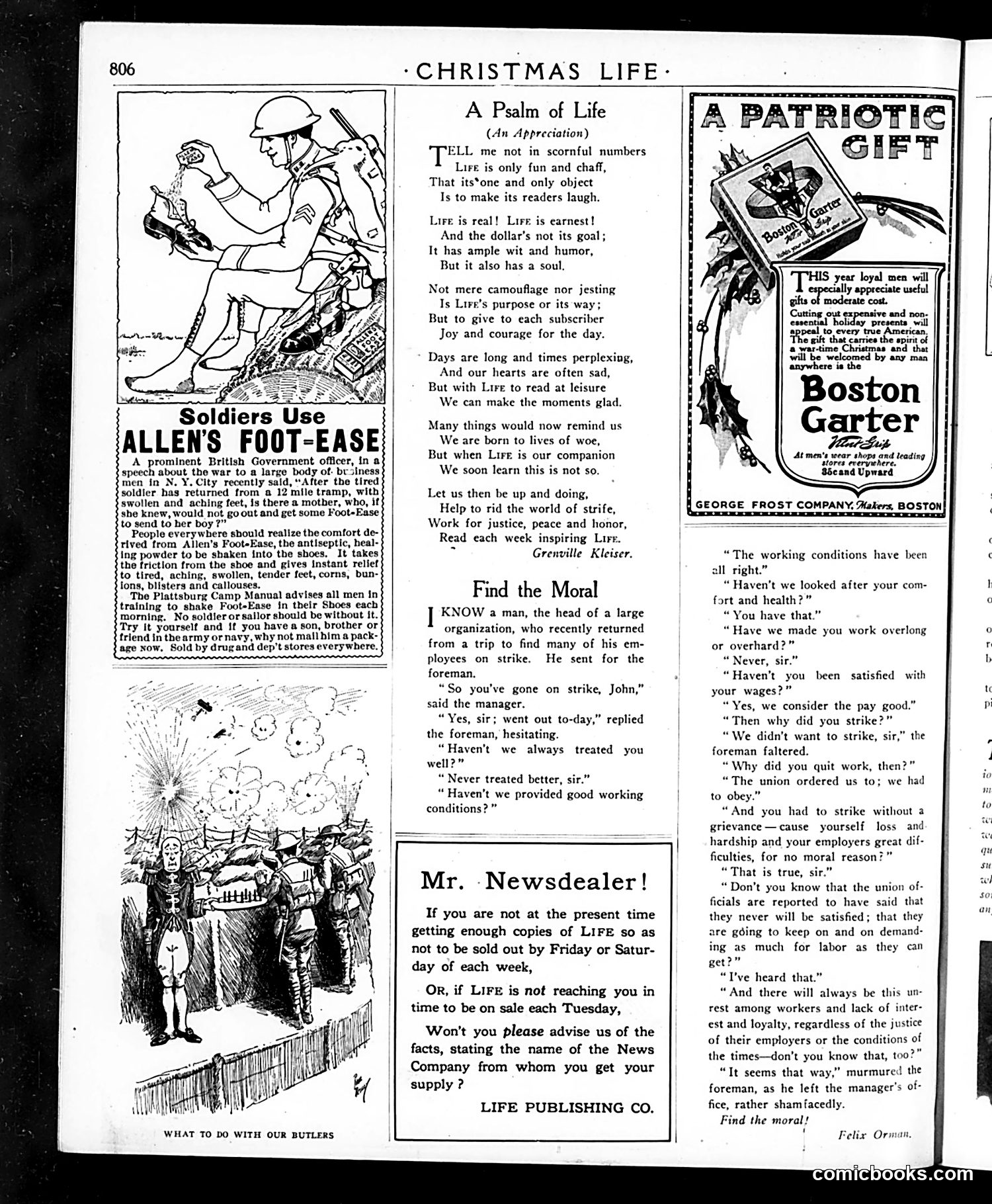
**Upper Left - "Soldiers Use Allen's Foot-Ease"**: Advertisement featuring a soldier examining his feet, promoting a foot powder product with testimonial from a British officer praising relief from marching discomfort. **Center - "A Psalm of Life" and "Find the Moral"**: A poem by Greville Kleiser encouraging readers toward purpose and action, followed by a dialogue between a manager and striking foreman. The moral appears critical of labor disputes—the foreman admits the company treated workers well, provided good conditions, and paid fairly, yet the union ordered a strike anyway, causing "loss and hardship" to both workers and employers. **Right Side**: Boston Garter advertisement. **Lower Left - Illustration**: Appears to show carolers or holiday figures, captioned "What to Do with Our Butlers." The page primarily contains period advertising and moralizing content about labor relations.
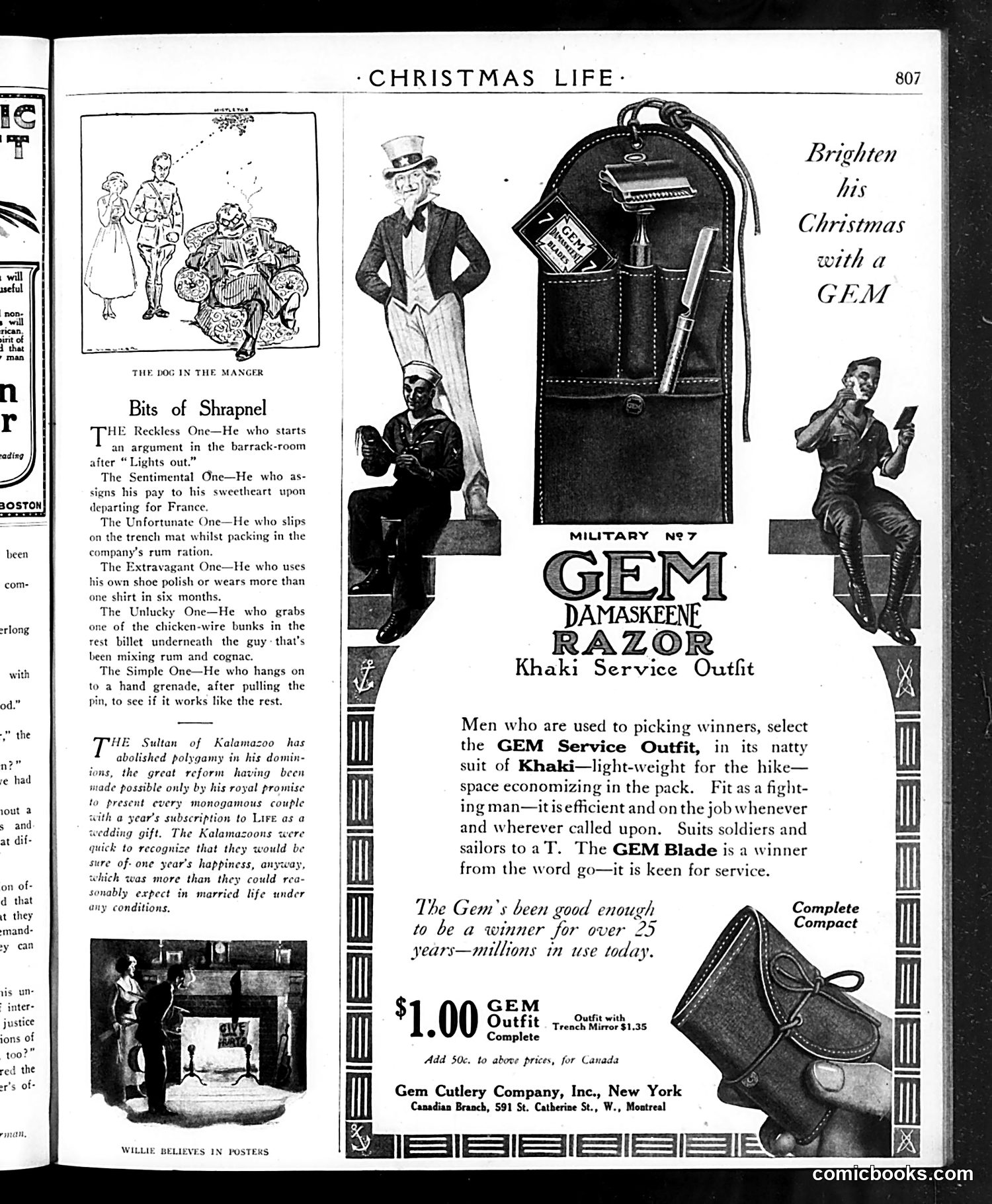
This page is primarily **advertising with minimal satirical content**. The dominant element is a full-page ad for GEM Damascene Razors (Military No. 7), marketed as a "Khaki Service Outfit" for soldiers—highlighting its durability and portability for military use during wartime. The small left-side section titled "Bits of Shrapnel" contains brief character sketches of military types (the Reckless One, the Sentimental One, etc.), offering gentle satire of soldier archetypes rather than pointed political commentary. Below that, "Willis Believes in Posters" appears to be a minor comic vignette. The page reflects **WWI-era advertising**, targeting soldiers and those buying gifts for servicemen. The satirical content is incidental to the commercial purpose.
This page is primarily **promotional text** for Life magazine itself, not political satire. The decorative border consists of illustrated faces of various people in period dress—likely representing Life's diverse readership or the magazine's artistic style. The text celebrates Life's role during World War I, boasting of its circulation growth and international reach ("John Bull Number," "French Number," "Berlin Number"). It announces upcoming contributors including artist Charles Dana Gibson and editor Edward Sanford Martin. The "Best Christmas Gift: $5 a Year" pitch at the bottom is a subscription advertisement. The border illustrations are decorative rather than caricatured satire—they appear to show different character types or nationalities in a generic illustrative manner rather than mocking specific individuals. This is essentially a **house advertisement**, not editorial content.
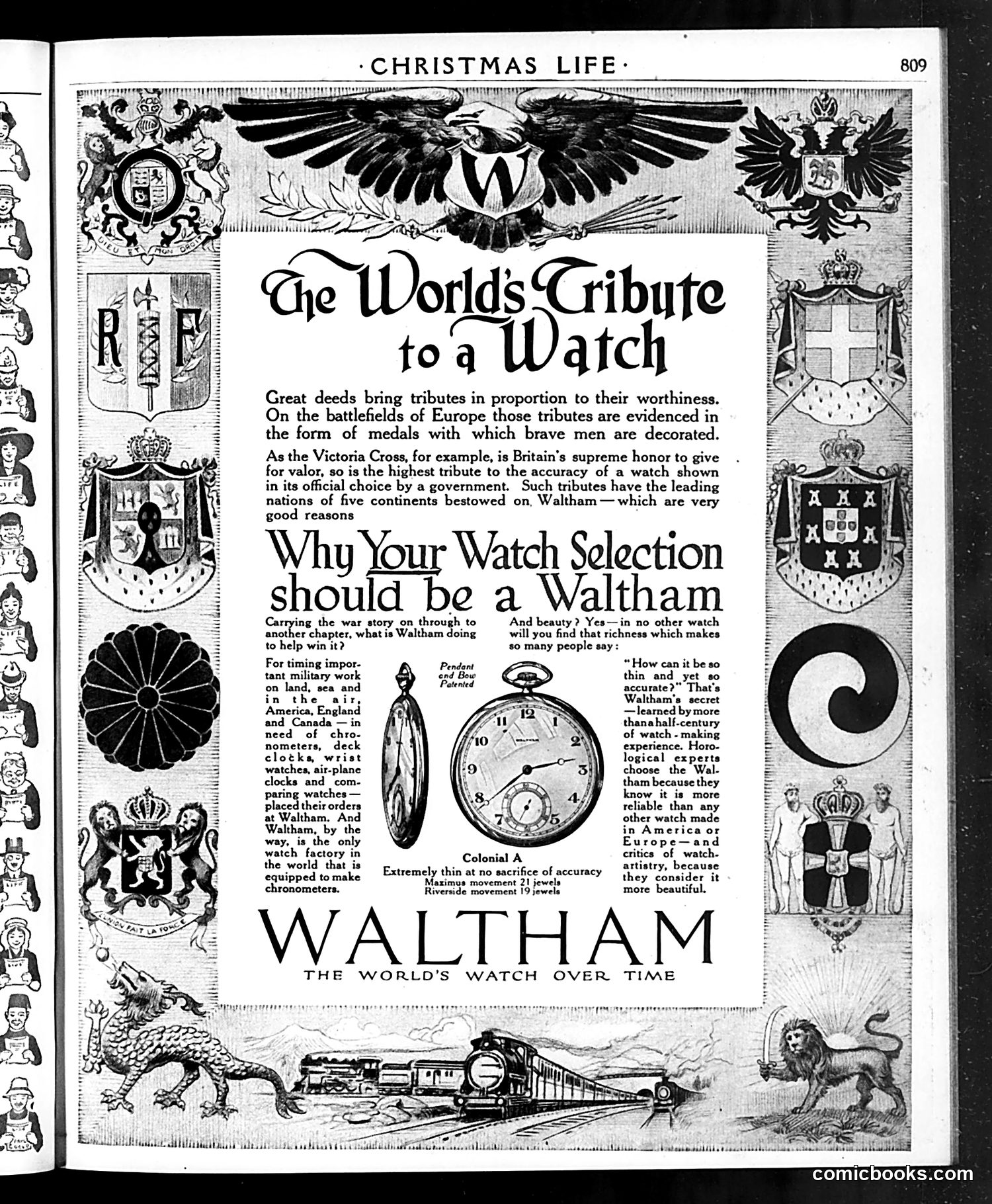
This is a **Waltham Watch advertisement**, not satire or political cartoons. The page uses patriotic heraldry and imperial symbolism (coats of arms, eagles, crowns) to market watches as a prestigious, internationally-recognized product. The text claims Waltham watches received government honors comparable to military medals like the Victoria Cross, positioning them as tributes to craftsmanship and precision. It emphasizes that Waltham is "the only watch factory in the world equipped to make chronometers" — a claim of technical superiority. The "Colonial A" watch pictured is described as "extremely thin at no sacrifice of accuracy," appealing to consumers who valued both elegance and reliability. The advertisement leverages nationalism and imperial prestige to justify the watch's premium positioning during what appears to be the World War I era.
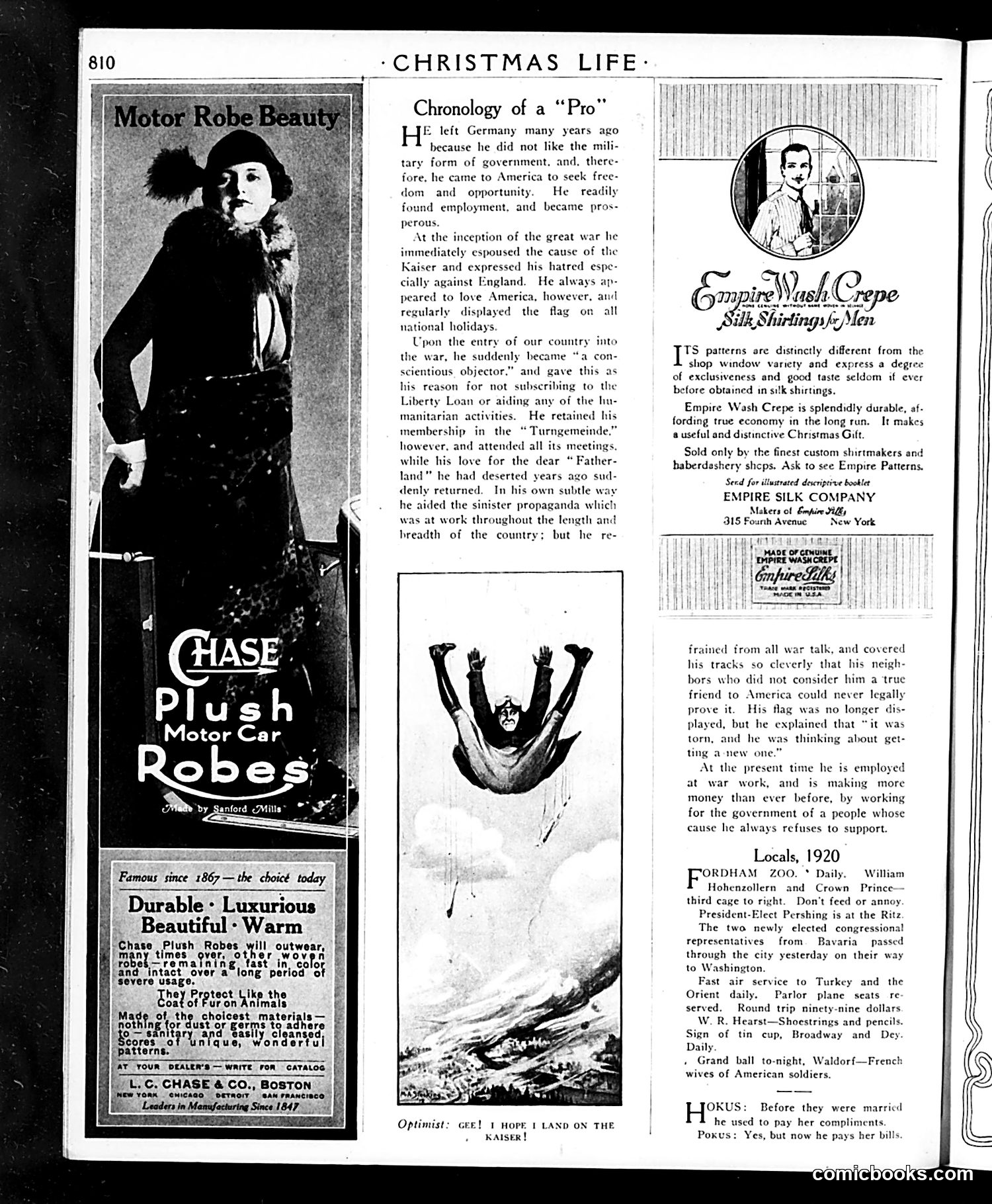
The central cartoon depicts a figure falling upside-down, captioned "Optimist: GEE! I HOPE I LAND ON THE KAISER!" This is a WWI-era satire referencing Kaiser Wilhelm II of Germany. The "optimist" joke suggests that even falling helplessly, someone would hope to land on (harm) the Kaiser—expressing intense anti-German sentiment during American involvement in the war. The text above describes a "Pro" (presumably a German-American) who left Germany opposing militarism, but during WWI became a "conscientious objector" to American war efforts. The narrative criticizes him for refusing to support America while displaying German patriotism, suggesting disloyalty. Together, these pieces reflect 1920 American suspicion of German-Americans during and after WWI.
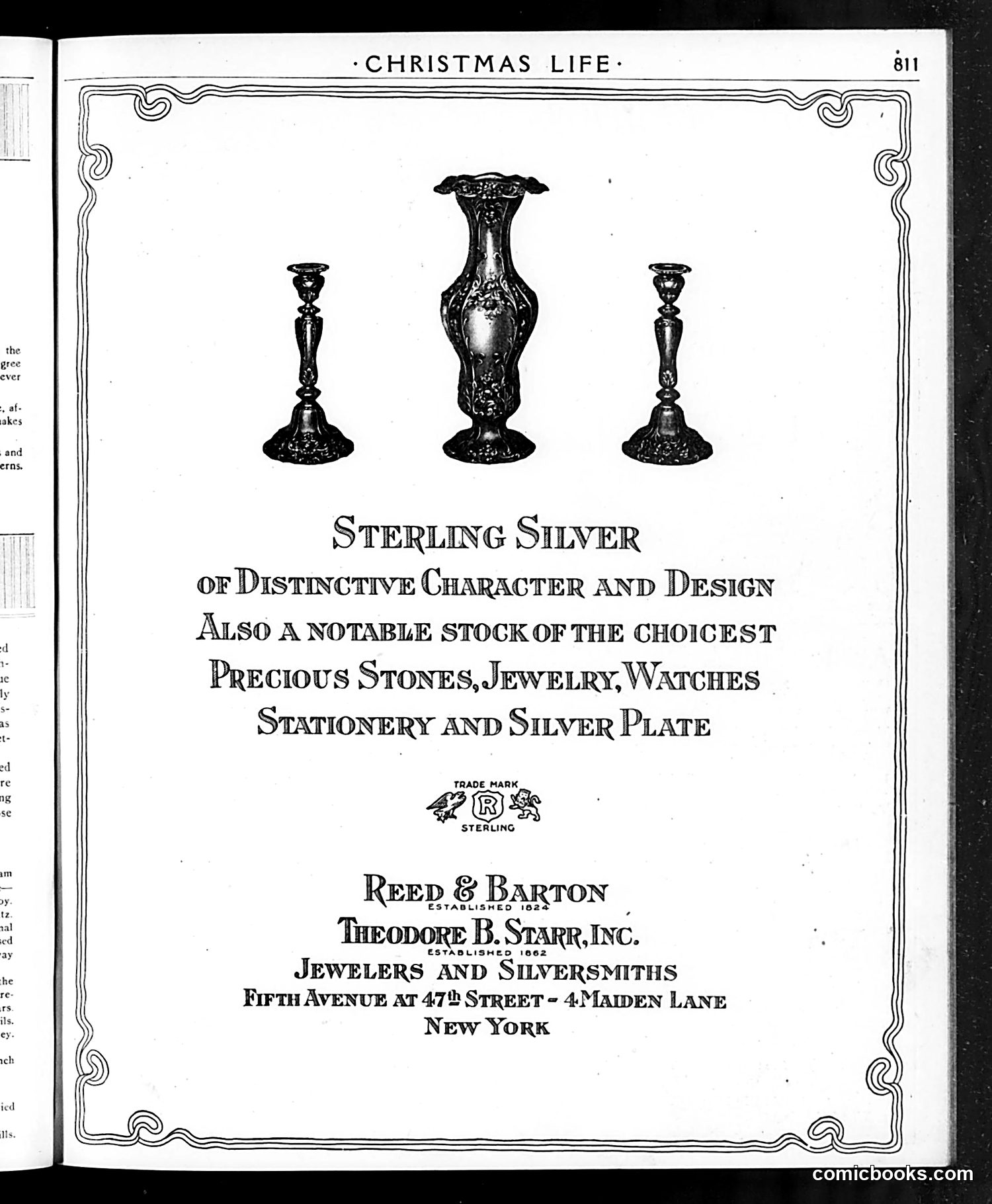
This is a **full-page advertisement**, not a cartoon. It promotes sterling silver goods and jewelry from Reed & Barton (established 1825) and Theodore B. Starr, Inc. (established 1862), New York jewelers and silversmiths. The page displays three ornate silver vessels—two candlesticks flanking a decorative vase—to showcase the "distinctive character and design" of their sterling silver work. The ad emphasizes their stock of precious stones, jewelry, watches, stationery, and silver plate. This appears in a Christmas-themed issue of *Life* magazine, positioning luxury goods as holiday gift options for affluent readers. The decorative border and formal typography reflect early 20th-century advertising aesthetics.
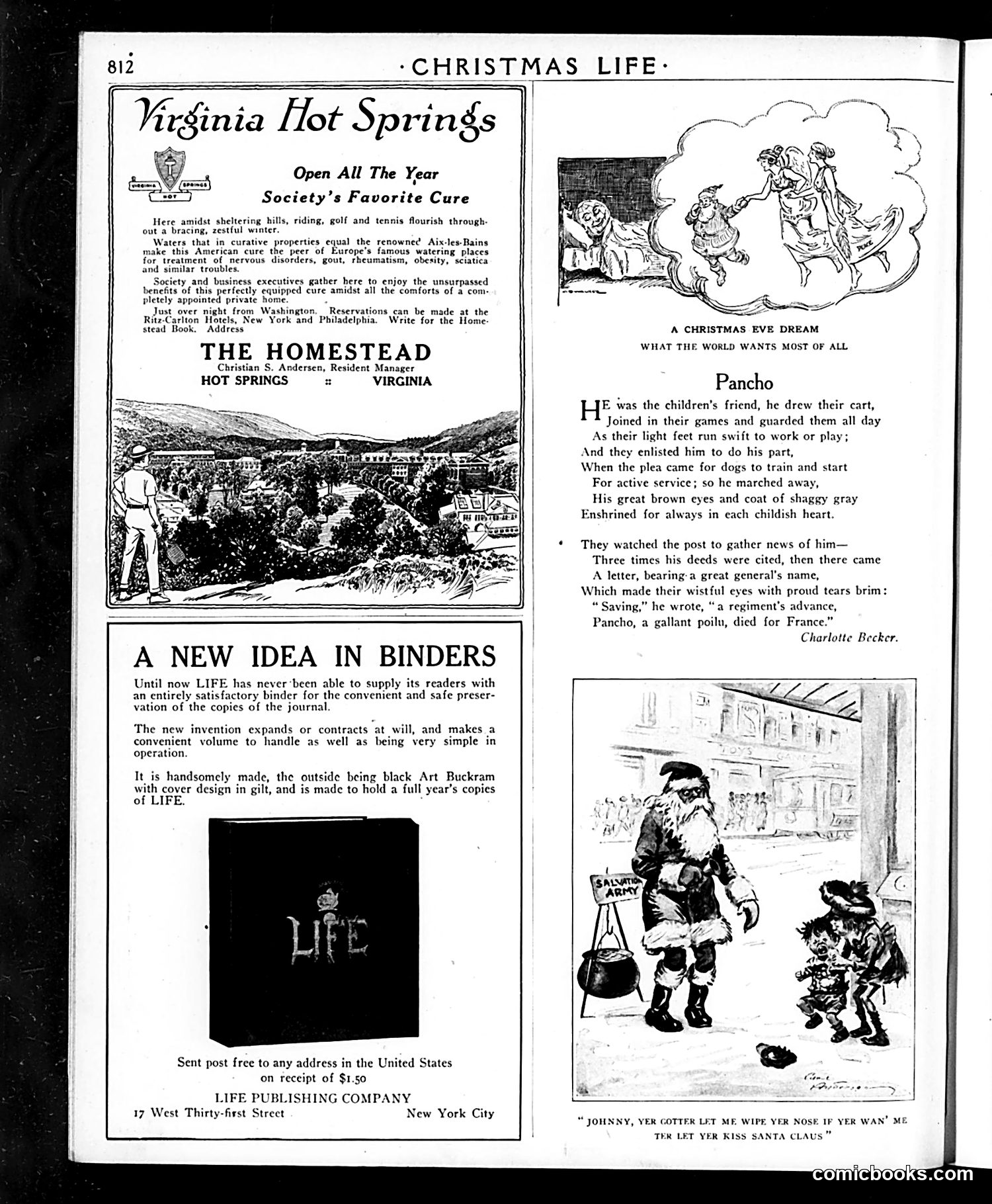
This page is primarily **advertising and editorial content** rather than political satire. The main elements are: 1. **Virginia Hot Springs resort advertisement** - promoting a health spa as a winter destination 2. **"The Homestead" hotel advertisement** - showing a pastoral resort landscape in Hot Springs, Virginia 3. **"A New Idea in Binders"** - promoting a LIFE magazine storage binder with gilt cover design 4. **"Pancho" - a Christmas poem** by Charlotte Becker about a children's dog who dies in military service ("died for France"), framed as sentimental wartime content 5. **Accompanying illustration** showing Santa Claus with a child, with dialect-heavy caption ("yer gotter let me wipe yer nose") The page reflects **early 20th-century commercial publishing** mixed with patriotic, sentimental holiday content. No obvious political satire is present.
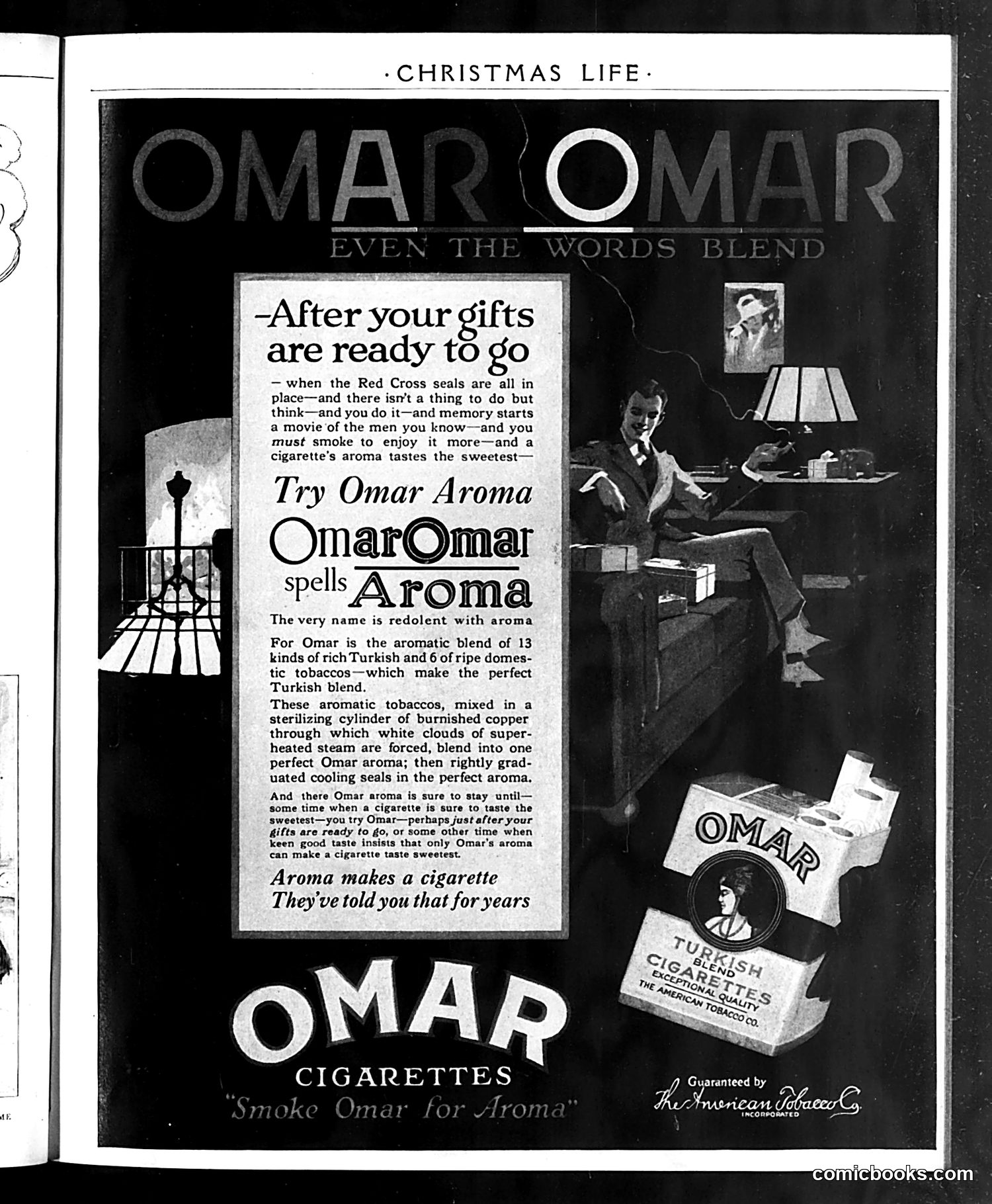
This is **not a political cartoon or satire** — it is a **cigarette advertisement** for Omar cigarettes, disguised as editorial content under the "Christmas Life" section header. The ad features a man at a desk receiving gifts, with the tagline "Smoke Omar for Aroma." It promotes Omar's blend of Turkish and domestic tobaccos, claiming the cigarette's aromatic qualities make it an ideal gift. The repeated name "Omar Omar" and emphasis on "Aroma" are wordplay marketing devices. The accompanying product images and packaging are displayed prominently. This represents early 20th-century advertising practices where cigarette companies purchased prominent magazine placement to promote their products under the guise of lifestyle editorial content — a practice now heavily restricted due to health concerns.
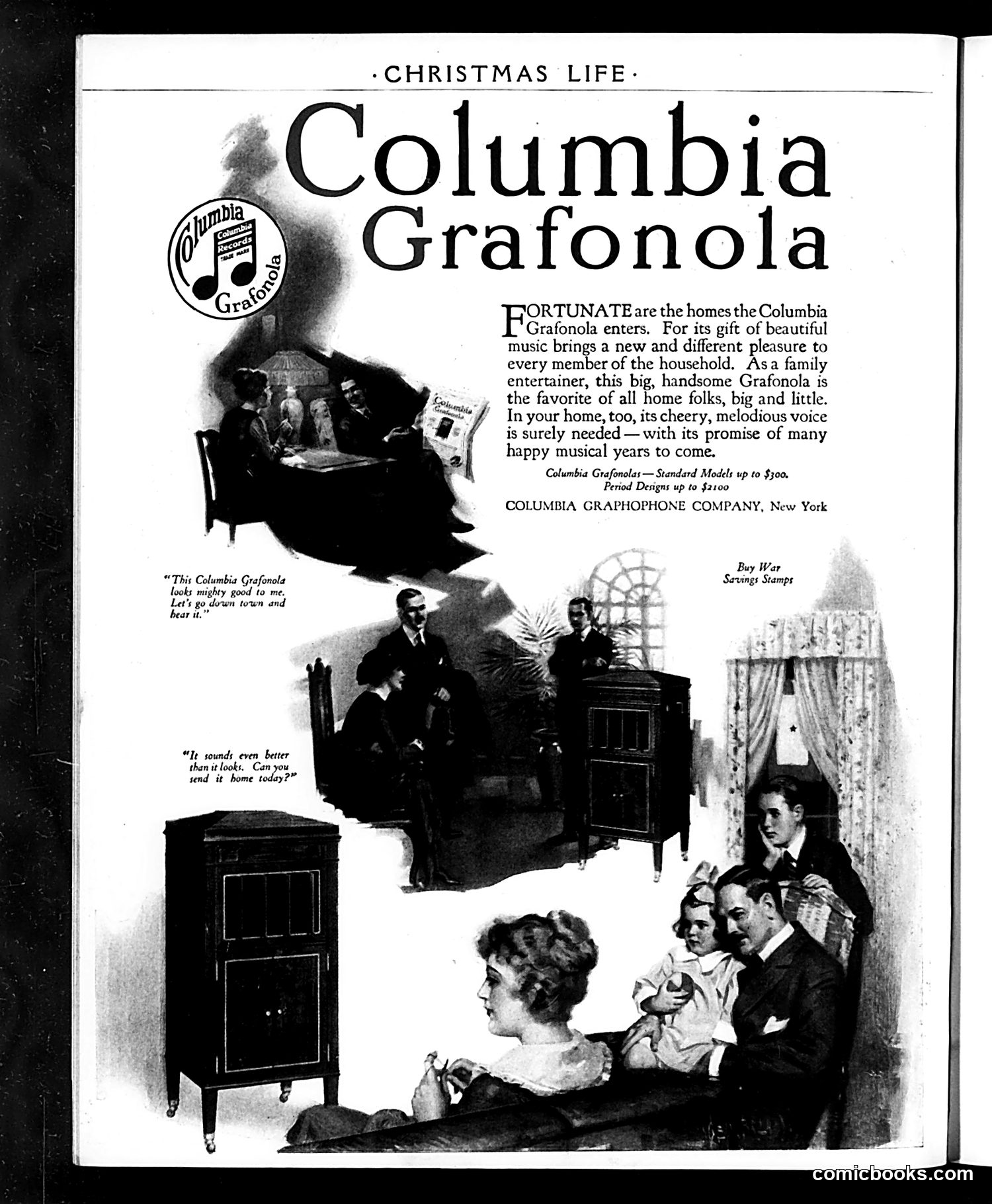
This is a **Christmas advertisement** for the Columbia Grafonola, a gramophone (record player) manufactured by Columbia Graphophone Company, New York. The ad uses idealized domestic scenes to market the device as essential home entertainment. It depicts families of different sizes enjoying music together during the holidays, emphasizing how the Grafonola brings "a new and different pleasure to every member of the household." The text promises that owning this "big, handsome" machine will provide "many happy musical years to come." Pricing is listed as Standard Models up to $700 and Period Designs up to $1,100. There's also a reference to "Buy War Savings Stamps," indicating this ad likely dates to **World War I era**, when such patriotic appeals were common in American advertising. This is straightforward product advertising, not political satire.
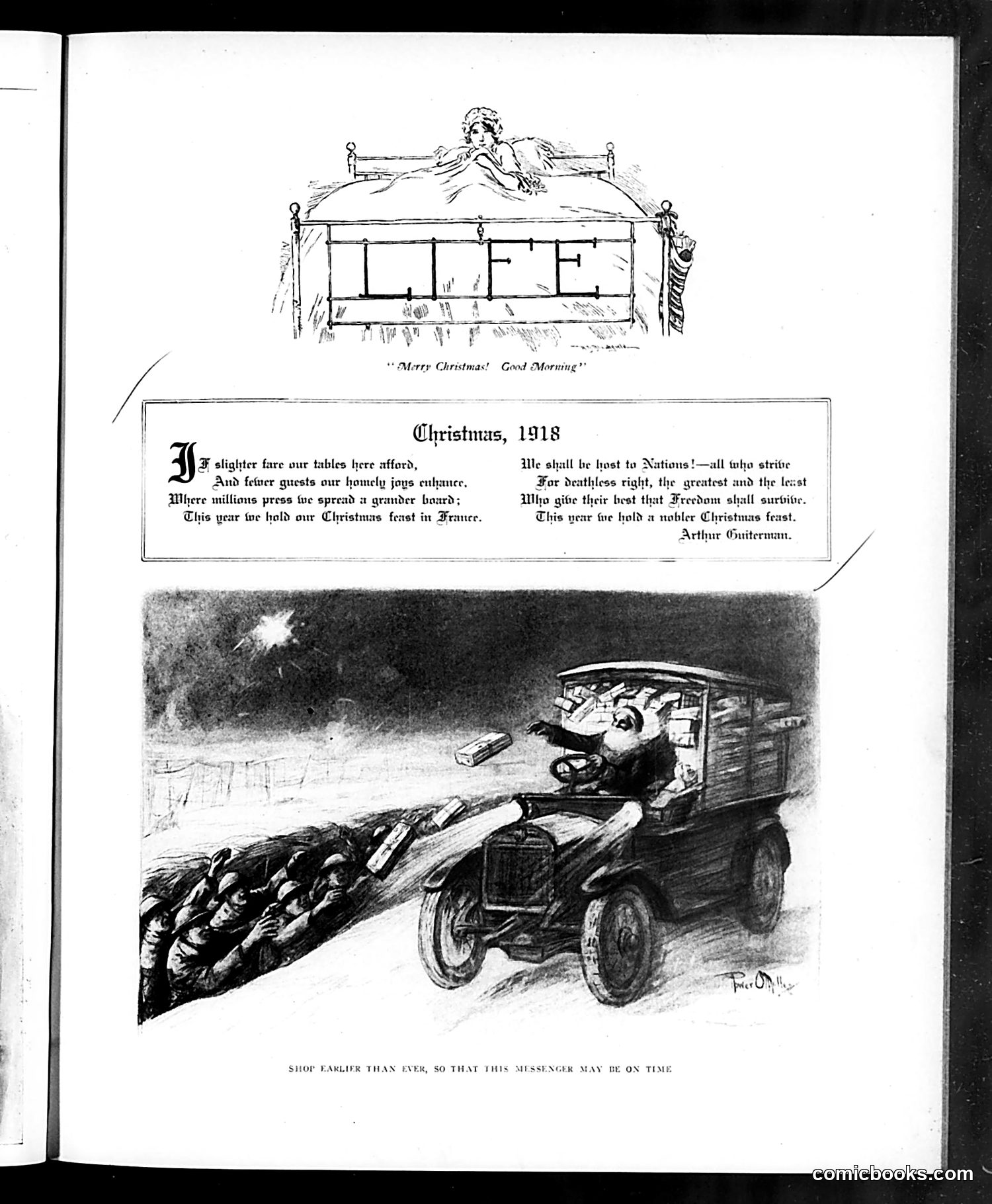
This page presents a stark contrast between holiday idealism and wartime reality. The top illustration shows a cozy domestic Christmas bed scene with the caption "Merry Christmas! Good Morning!"—a cheerful domestic fantasy. Below, a poem by Arthur Guiterman acknowledges slighter fare and fewer guests, referencing holding Christmas "in France"—indicating soldiers abroad during World War I (which ended November 1918). The main cartoon depicts a grim reality: a truck loaded with fallen soldiers drives past, while Santa Claus waves from above. The caption reads "SHOP EARLIER THAN EVER, SO THAT THIS MESSENGER MAY BE ON TIME"—darkly suggesting Santa must hurry to deliver gifts before soldiers die. The satire critiques the disconnect between commercial Christmas cheerfulness and the actual cost of war—casualties still arriving home in 1918.
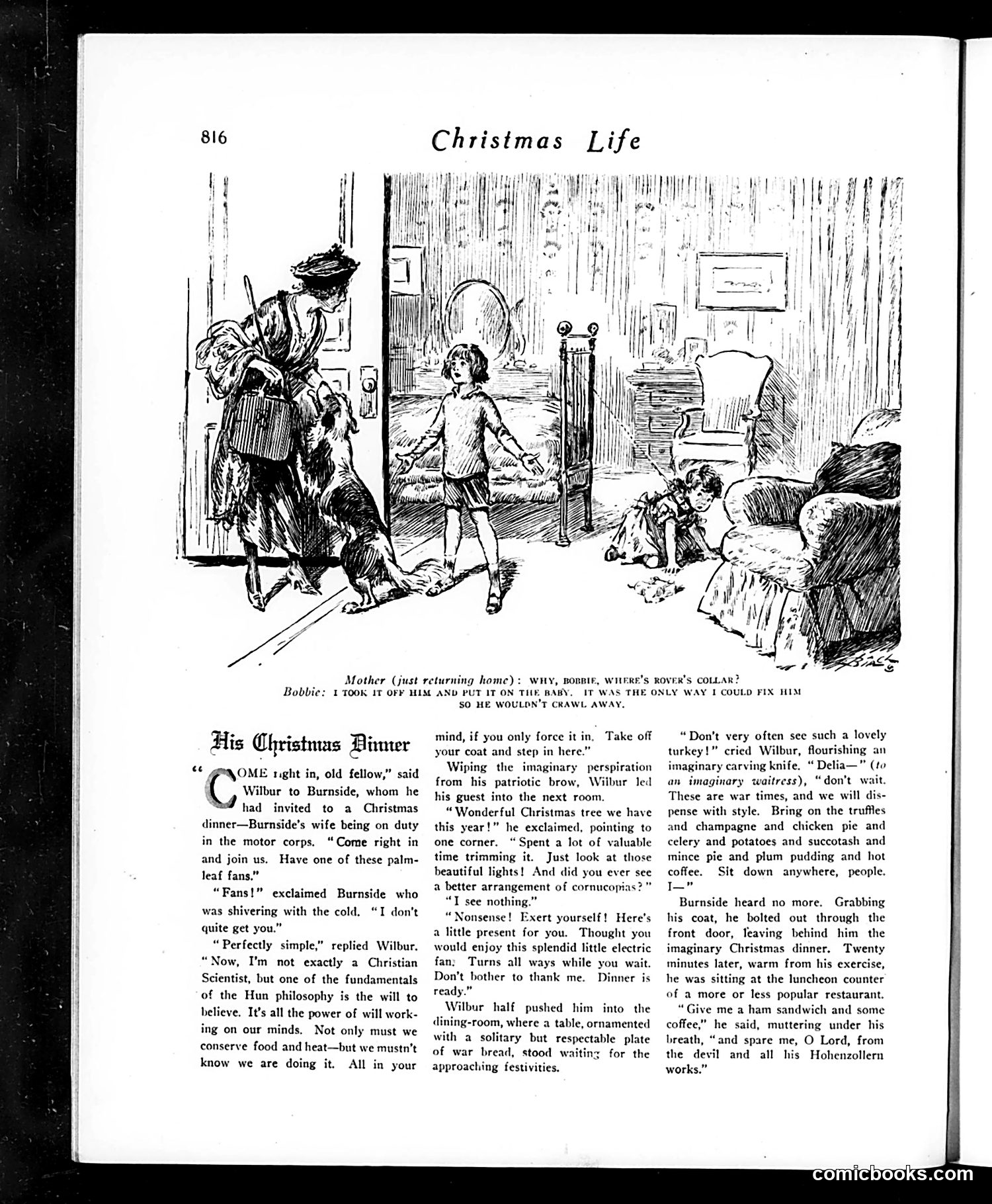
This illustration depicts a domestic Christmas scene with social commentary about wartime sacrifice. A woman (labeled "Mother") returns home to find her children playing with toys while she's been away doing war work ("motor corps" duty). A male visitor, Wilbur, lectures the children's host Burnside about conservation and willpower during wartime—arguing that enjoying luxuries like a Christmas turkey and electric fan is unpatriotic when resources should support the war effort. The satire targets self-righteous wartime moralizing: Wilbur pontificates about sacrifice while actually sneaking away to enjoy a ham sandwich at a restaurant. The piece mocks the hypocrisy of those who publicly preach deprivation while privately indulging, a common wartime tension during either WWI or WWII rationing periods.
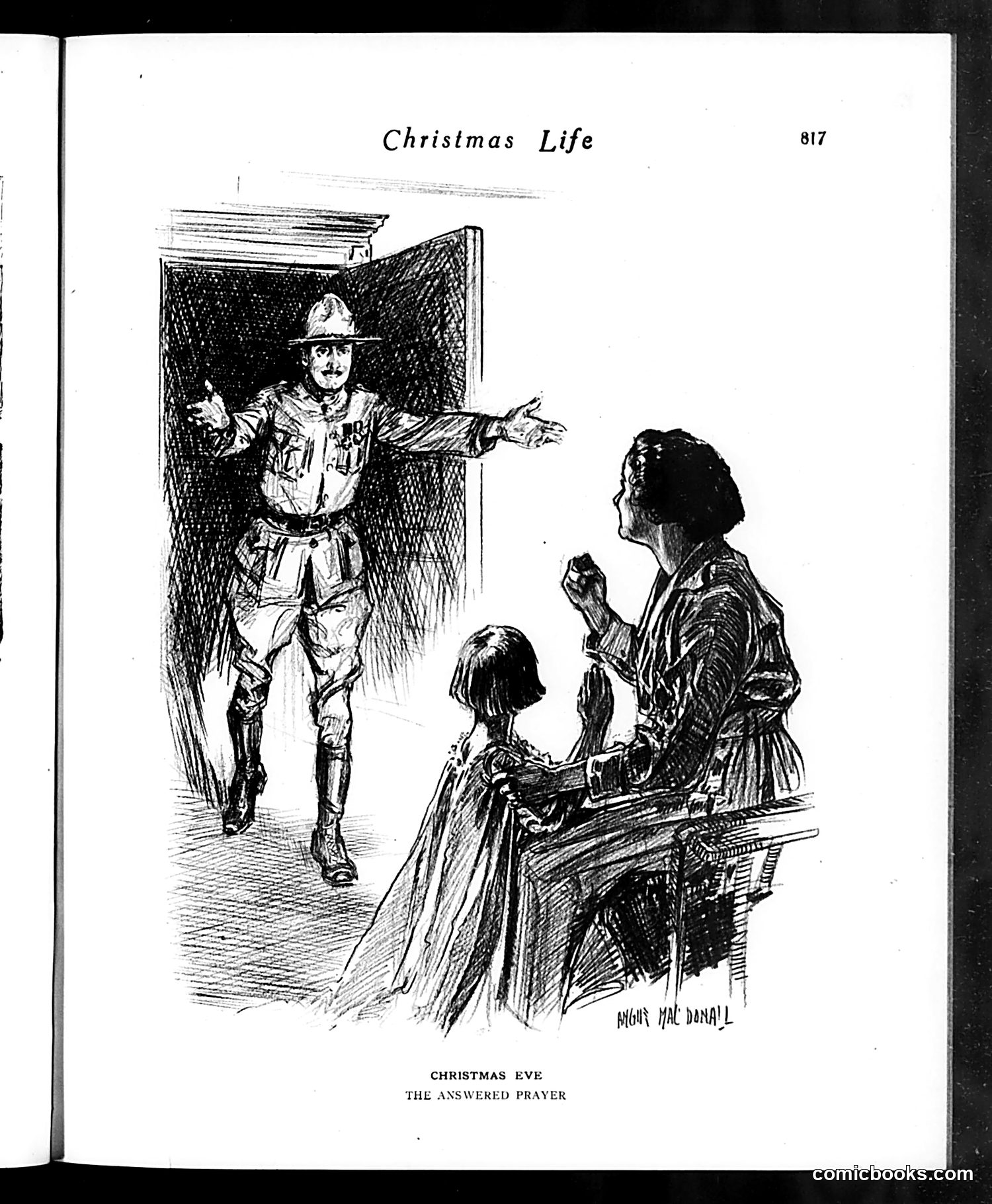
This illustration depicts a military officer in World War I uniform surprising a woman and child during Christmas Eve. The title "The Answered Prayer" suggests the woman's prayer—likely for a soldier's safe return home—has been miraculously fulfilled by his unexpected appearance at the door. The cartoon plays on wartime sentiment and emotional family reunions. The soldier's sudden arrival during the holiday represents the answered hopes of countless families separated by WWI. The dramatic lighting and composition emphasize the emotional weight of the moment—a Christmas miracle of homecoming. The satire appears gentle, celebrating patriotic sentimentality and the public's yearning for soldiers' returns during wartime, rather than critiquing it.
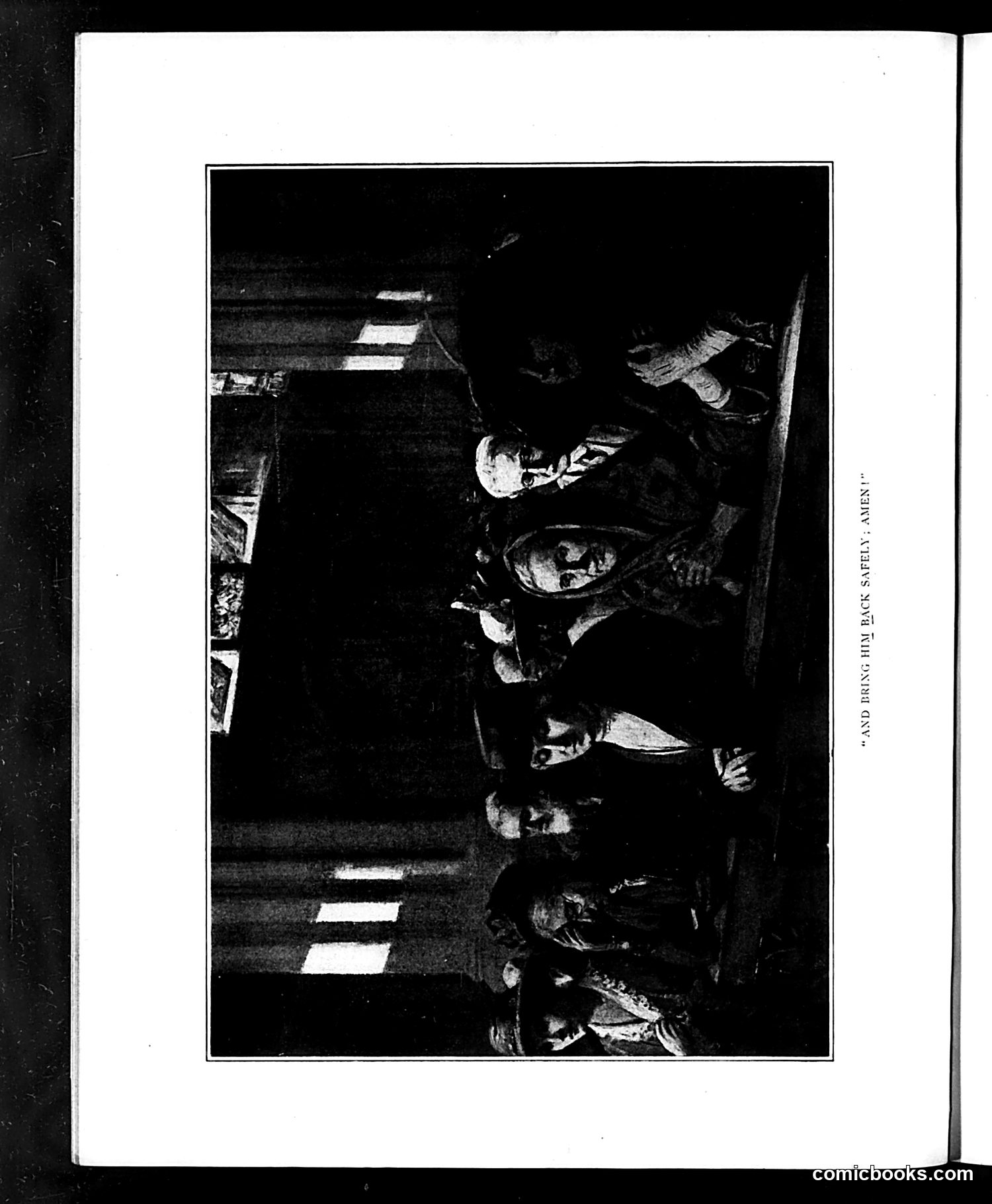
The image is a black and white illustration showing what appears to be a classical or allegorical scene with multiple figures in dramatic poses. However, the OCR text provided is essentially non-functional—it contains only formatting symbols and characters without readable content. Without legible accompanying text, I cannot definitively identify the specific political or social references, the figures depicted, or the satirical point being made. The caption on the right margin appears to read something ending in "MISERY," but the full text is unclear in this reproduction. To accurately explain this cartoon's meaning to a modern reader, I would need either clearer text or additional context about the publication date and subject matter.
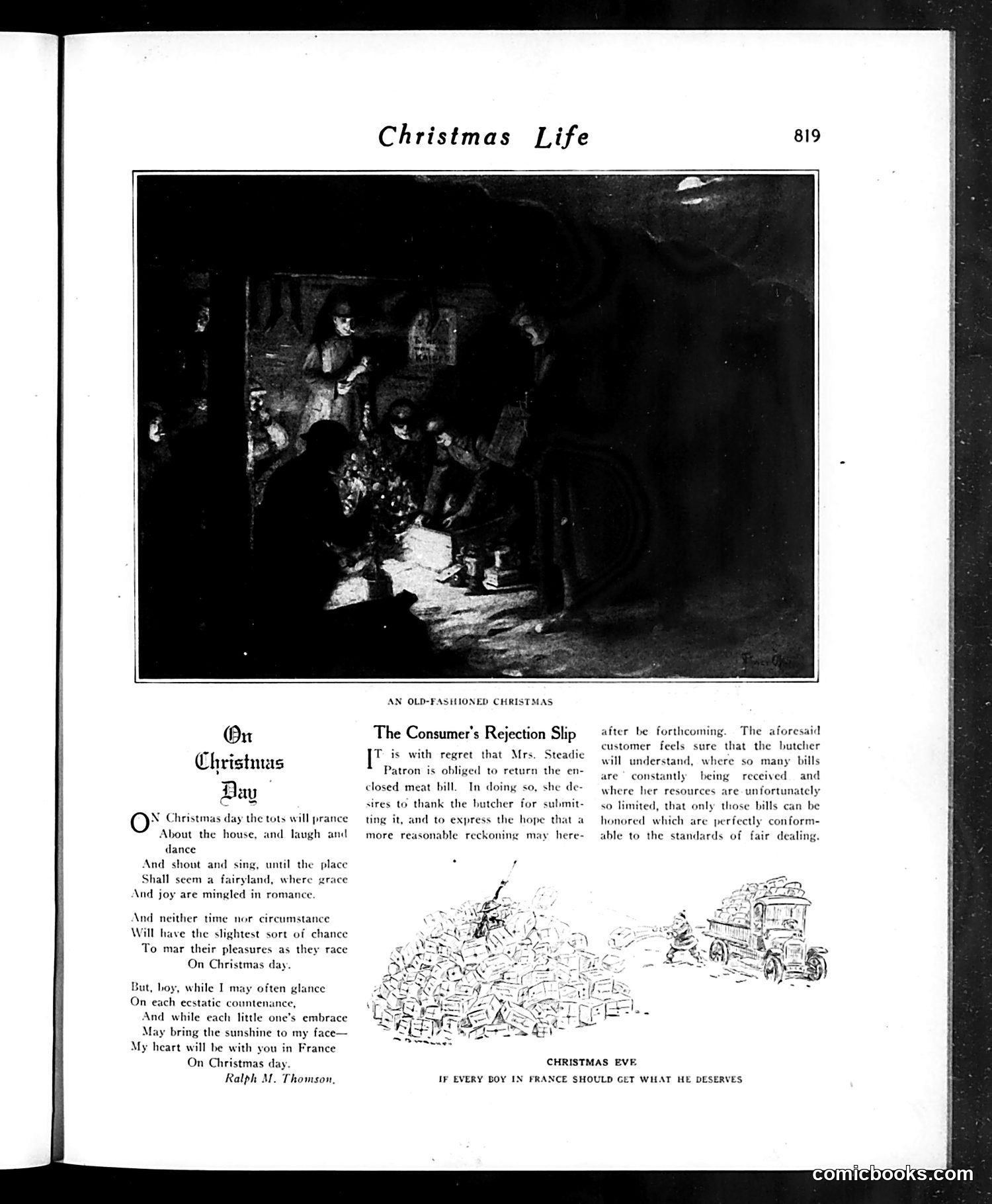
This page contains wartime Christmas content, likely from World War I (given the France reference). The main elements are: **Poem "On Christmas Day"** by Ralph M. Thomson expresses poignant nostalgia—a father describes children celebrating Christmas at home while his heart remains with loved ones fighting in France, reflecting the emotional toll of the war on families separated by military service. **"The Consumer's Rejection Slip"** is satirical commentary on wartime inflation and economic hardship. Mrs. Steadie Patron formally rejects a butcher's bill as unreasonably expensive, using polite business language to mask her inability to afford meat prices. The satire targets both inflated wartime costs and the absurdity of consumers having to "reject" essential goods they cannot pay for. **"Christmas Eve" illustration** depicts gift-giving—a truck delivering presents—with the caption "If Every Boy in France Should Get What He Deserves," likely sarcastically suggesting soldiers deserve better treatment or compensation than they receive. Overall, the page balances sentimental patriotism with biting social commentary on wartime hardship affecting civilians.
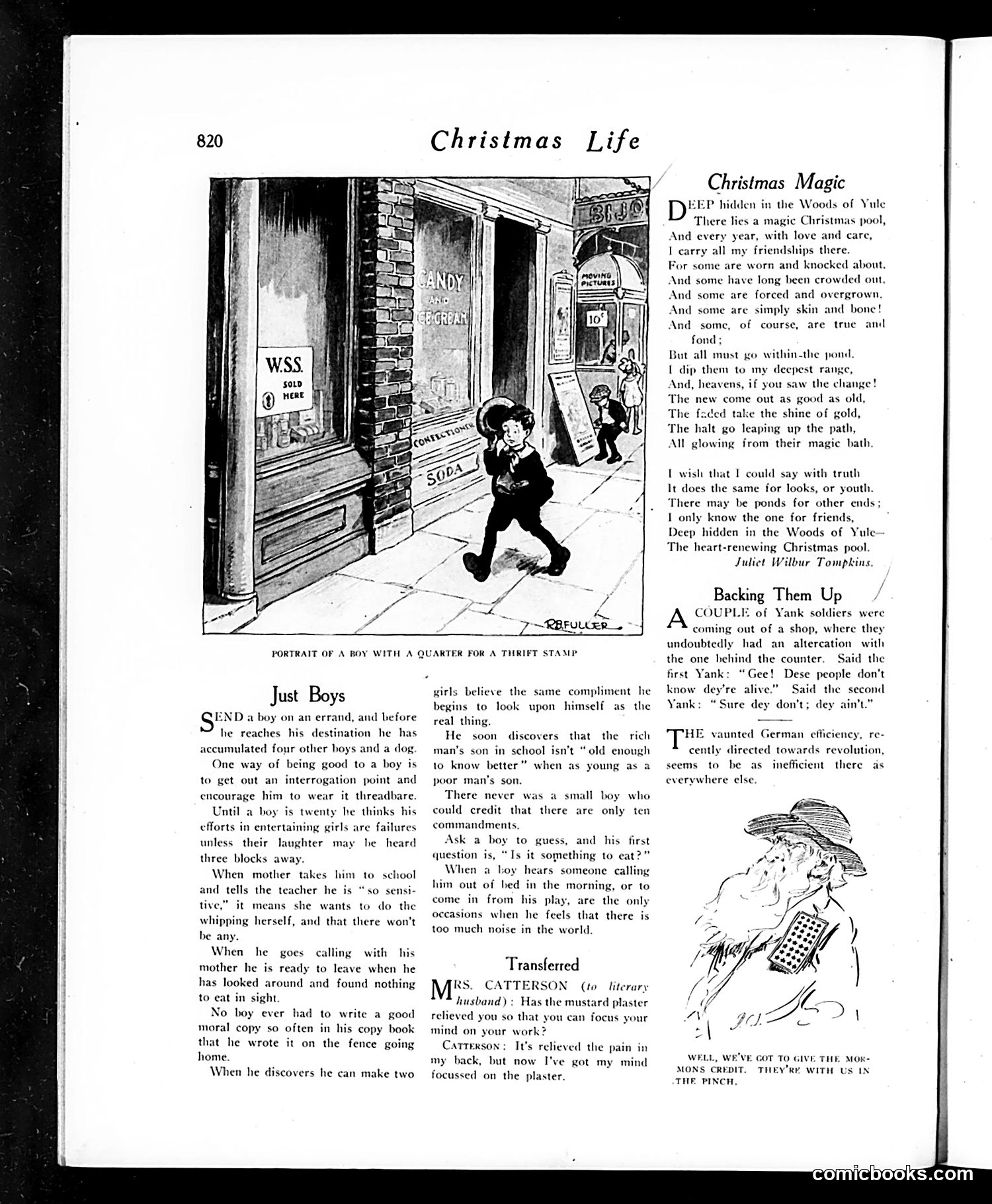
This page contains three distinct pieces: **"Just Boys"** is a humorous essay about boys' behavior—their tendency to accumulate followers, exaggerate their social success with girls, and their priorities (food, play, sleep). **"Christmas Magic"** is a sentimental poem by Juliet Wilbur Tompkins about metaphorically restoring worn friendships through a magical Christmas pool, representing renewal and care. **"Backing Them Up"** and **"Transferred"** are short satirical anecdotes. The first depicts American soldiers (Yankees) complaining that British shopkeepers don't appreciate being alive, suggesting cultural friction between allies. The second shows a man whose mustard plaster (a heating medical treatment) relieved his back pain but now he's obsessively focused on the plaster itself—a joke about displaced anxiety. The page reflects WWI-era American humor, with references to American soldiers' perspective on European allies and domestic wartime experiences.
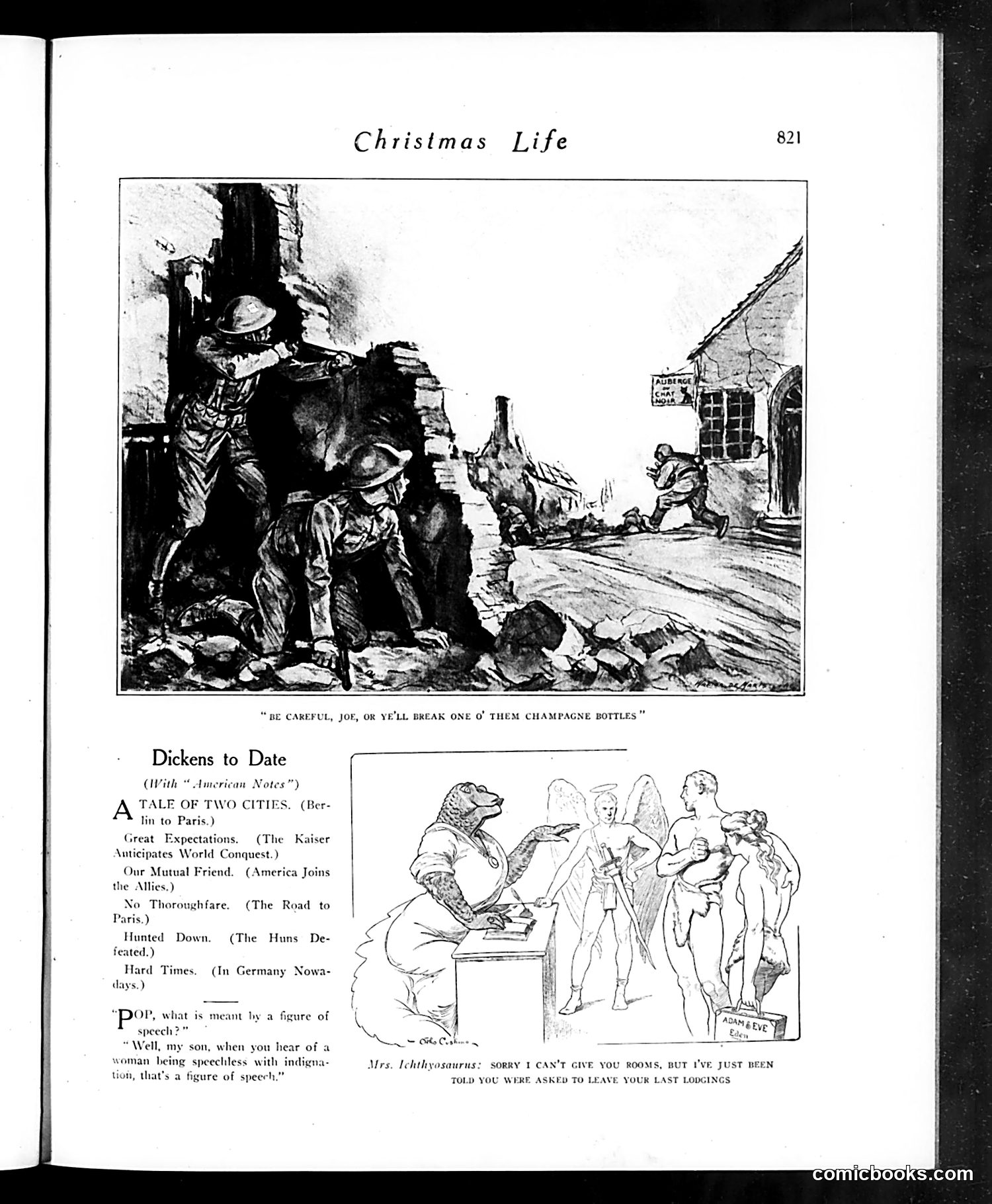
**Top Illustration**: A World War I trench scene showing soldiers handling champagne bottles with the caption "Be careful, Joe, or ye'll break one o' them champagne bottles." This depicts soldiers in a combat zone treating luxury goods carelessly—likely satirizing the absurdity of warfare or soldiers' irreverent attitude toward material goods amid destruction. **"Dickens to Date" Section**: A clever wordplay exercise adapting Charles Dickens novel titles to contemporary WWI references: - "Tale of Two Cities" (Berlin to Paris)—the warring nations - "Great Expectations" (Kaiser Anticipates World Conquest)—mocking German ambitions - "Our Mutual Friend" (America Joins the Allies)—America's recent entry into WWI - "Hunted Down" (The Huns Defeated)—anti-German sentiment **Bottom Cartoon**: Mrs. Ichthyosaurus (a dinosaur character, suggesting outdated thinking) refuses lodging, claiming previous tenants were asked to leave—likely political satire about nations or governments being unwelcome or unreliable guests. The page satirizes WWI through literary references and dark humor about warfare and international relations.
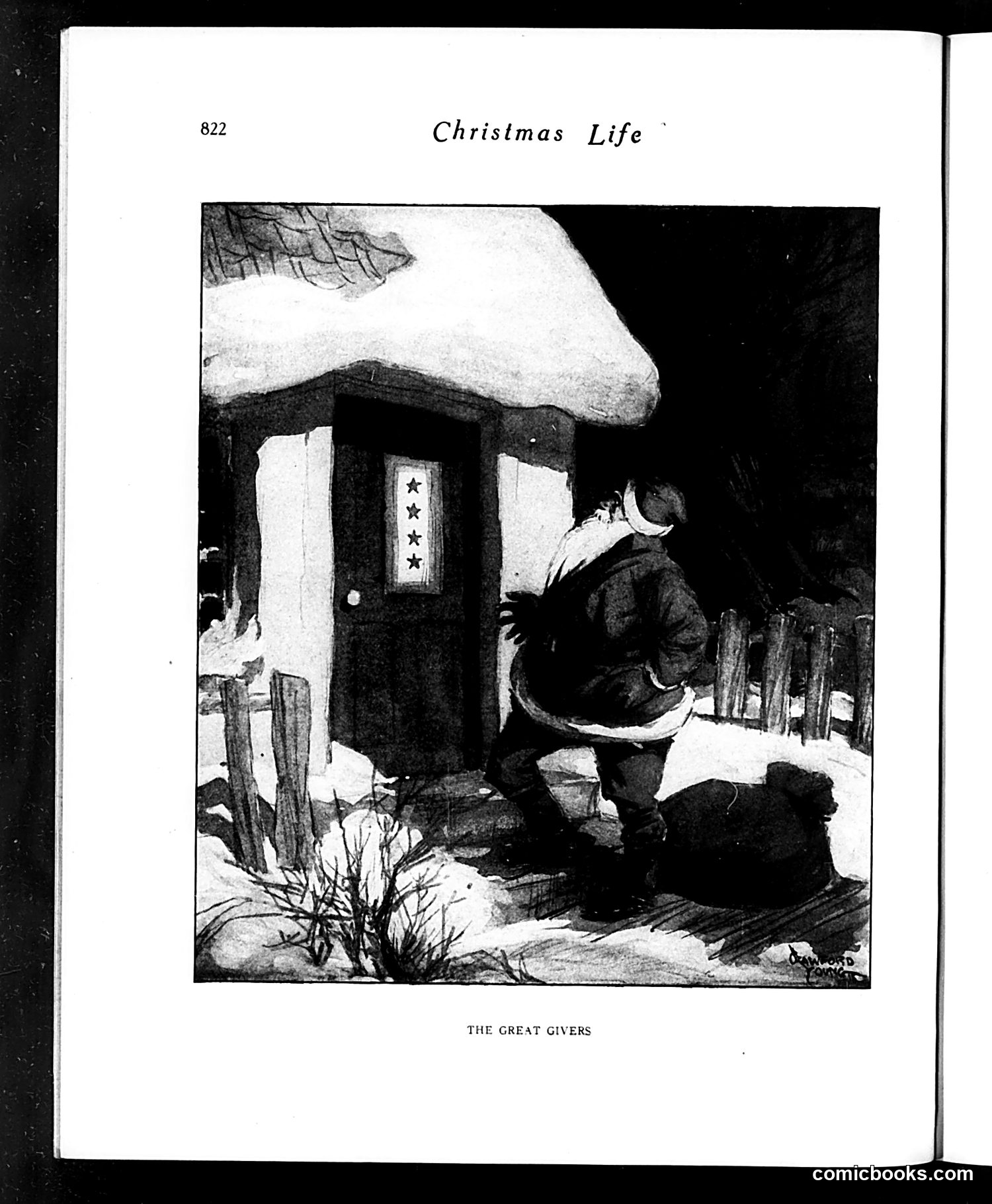
This illustration shows a figure in winter clothing depositing something into a small house or structure with a snow-covered roof and a door marked with stars. The title "The Great Givers" suggests satirical commentary on Christmas charity or generosity. The image likely critiques wealthy or privileged individuals presenting themselves as generous benefactors during the holiday season. The modest, humble dwelling contrasts with the well-dressed giver, potentially mocking performative charity or the gap between givers and recipients. The stars on the door may reference humble circumstances or poorhouse conditions. Without additional context from the magazine's date and surrounding articles, the specific targets remain unclear, but the satire appears directed at how Christmas giving was publicly performed or portrayed.
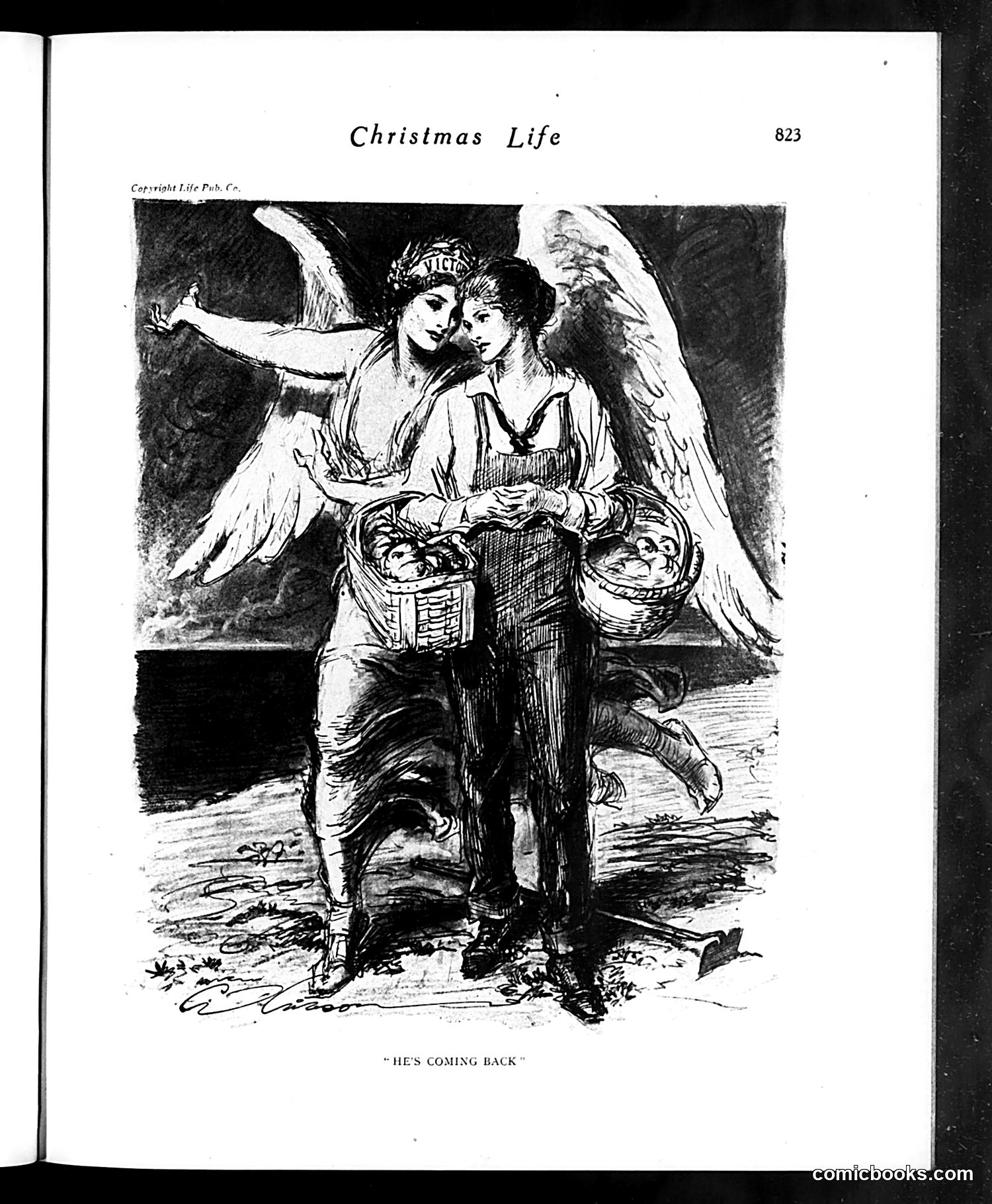
This is a Christmas-themed illustration from *Life* magazine titled "He's Coming Back." The image shows two angelic figures with wings holding baskets, standing over what appears to be a human figure below them. The composition suggests a heavenly or supernatural scene. Without additional context or clearer OCR text, the specific satirical meaning is difficult to determine with certainty. The title "He's Coming Back" could reference Christ's return (appropriate for Christmas), a soldier returning from war, or a satirical commentary on a public figure's reappearance. The angels and baskets might suggest abundance, charity, or redemption—common Christmas themes. The illustration's style and *Life* magazine's satirical nature suggest social commentary, but the exact target remains unclear from the image alone.
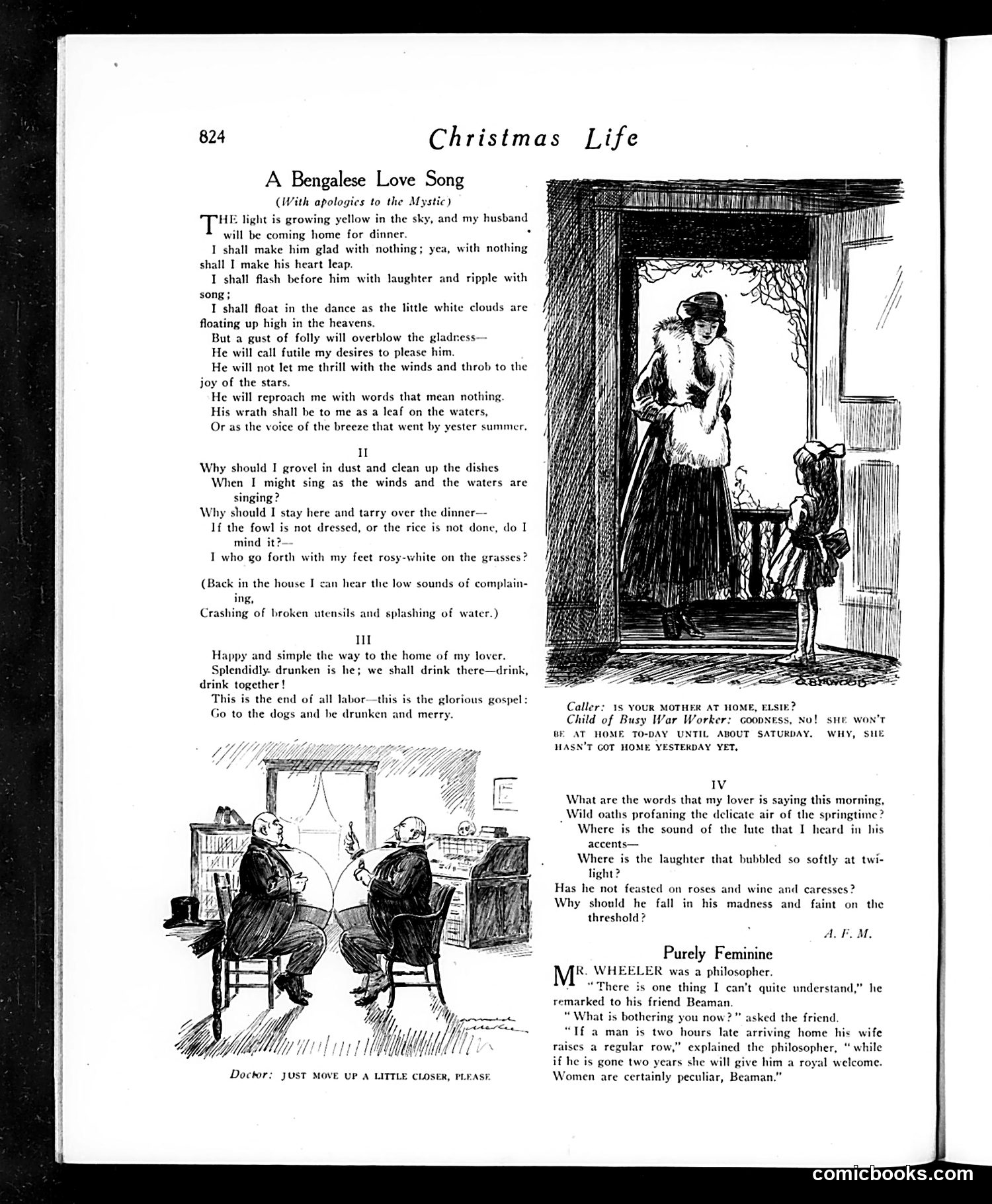
This page contains three distinct satirical pieces about gender relations and domestic life, likely from the WWI era (referenced by "Busy War Worker"). **"A Bengalese Love Song"**: A mock-exotic poem mocking both Orientalism and women's domestic frustrations. The speaker ironically idealizes her husband while describing his ingratitude, her thankless housework, and his drunkenness. The satire targets husbands' unreasonable expectations—they demand cheerfulness and perfect meals while offering only criticism and neglect. The accompanying illustration shows a woman at a doorway greeting her husband. **War Worker Cartoon**: Shows a child telling a caller the mother won't be home until Saturday because she's been away working (wartime factory work). This references women's expanded roles during WWI. **"Purely Feminine"**: A joke about female logic. A philosopher notes the apparent contradiction: wives rage when husbands arrive two hours late, but welcome them warmly after two-year absences. The humor targets women as "peculiar" and illogical, though ironically the joke may also critique male obliviousness to reasonable expectations. All three pieces employ humor to comment on marital tensions and changing gender roles.
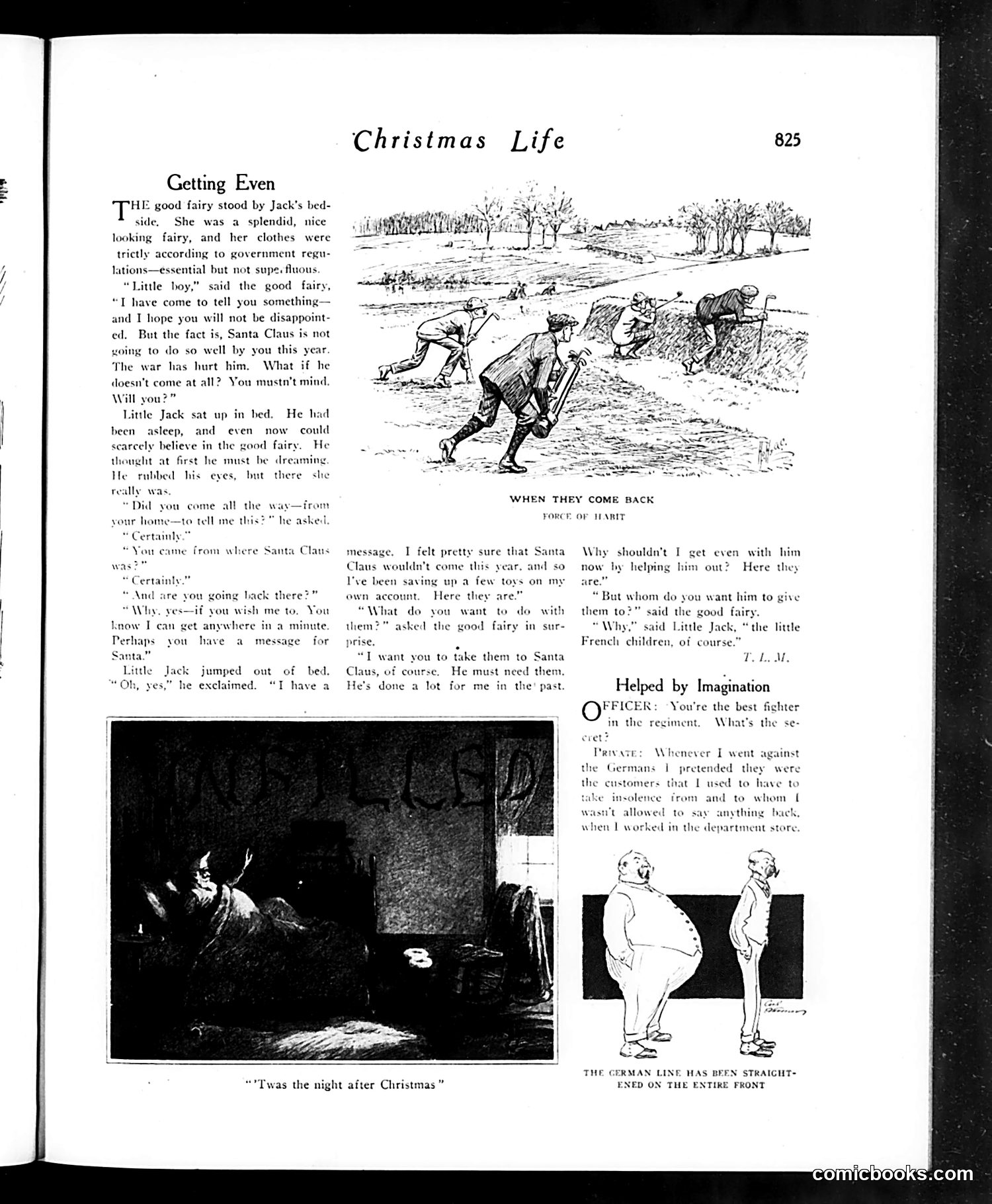
This page contains two separate stories illustrating wartime sacrifice and resilience during World War I. **"Getting Even"** depicts a fairy visiting a boy named Jack to explain that Santa Claus cannot deliver gifts due to war hardships. Rather than disappointment, Jack demonstrates patriotic generosity by offering his own saved toys—specifically requesting they go to French children (Britain's allies). The story promotes civilian sacrifice and child-centered propaganda supporting the war effort. **"Helped by Imagination"** features a military dialogue where an officer praises a soldier's fighting ability. The soldier explains his secret: when facing Germans, he mentally transforms them into demanding department-store customers from his civilian job. This humor derives from the ironic comparison—enduring rude customers prepared him psychologically for combat. The caption's reference to the "straightened" German line likely alludes to recent military gains. Both stories use fantasy and humor to frame wartime hardship as character-building, aimed at maintaining civilian morale during WWI.
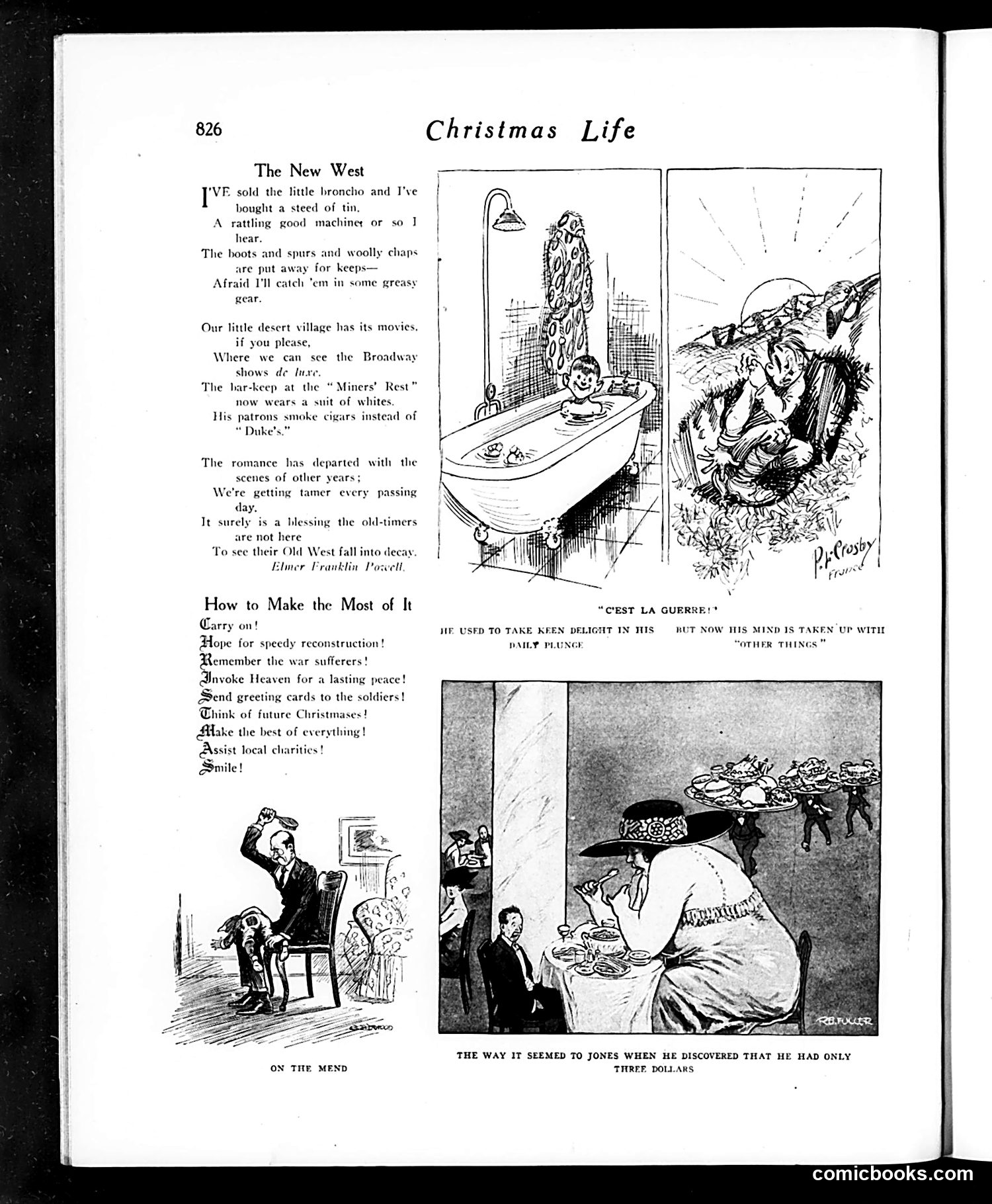
**"The New West" poem** satirizes the modernization of the American frontier. A rancher has abandoned traditional Western life—selling his horse for a tin automobile, trading boots and spurs for modern clothes—as his village gains movies and Broadway culture. The bar now serves cigars instead of cheap tobacco ("Duke's"). The poem laments this loss of frontier romance, suggesting "old-timers" would mourn seeing their rugged West "fall into decay." This reflects early 20th-century anxieties about industrialization erasing authentic American identity. **"How to Make the Most of It"** appears to offer Christmas advice during wartime (likely WWI, given "war sufferers" and soldiers references). The cartoon "On the Mend" shows someone attempting self-improvement. **"C'est la Guerre"** depicts a man who once enjoyed daily swimming but now has his mind on "other things"—wartime concerns. **"Three Dollars"** shows someone's shock at discovering financial poverty, likely a commentary on economic hardship during the war period.
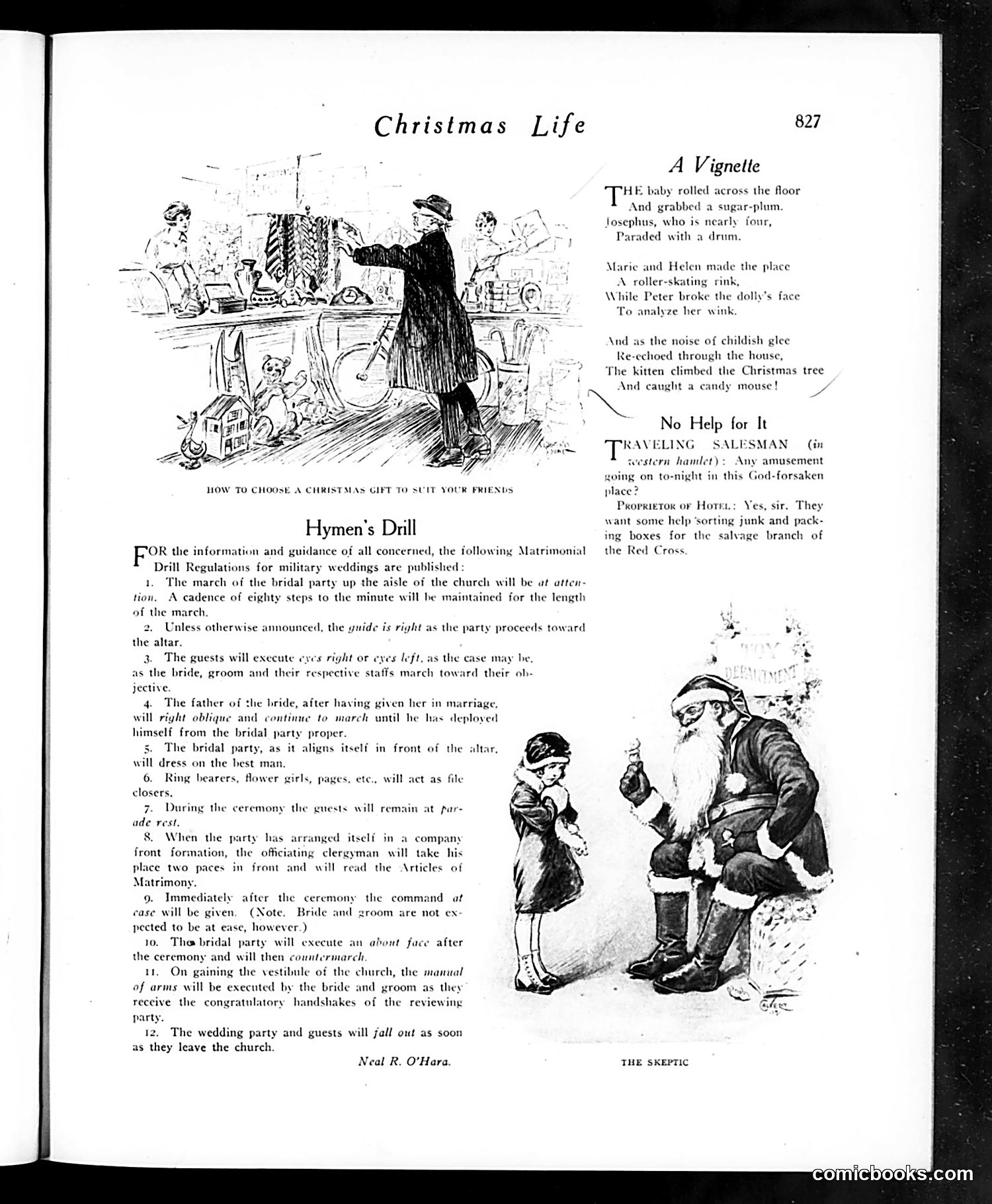
This page contains Christmas-themed satirical content typical of early-20th-century Life magazine humor. **"A Vignette"** is a lighthearted poem depicting chaotic holiday domesticity—children destroying toys and furniture while celebrating Christmas, culminating in the kitten catching a candy decoration. The gentle satire mocks the messy reality of family celebrations versus idealized Christmas imagery. **"No Help for It"** presents a brief dialogue joke: a traveling salesman asks a hotel proprietor about evening entertainment in a small town. The proprietor's response—that locals are busy sorting "junk and packing boxes for the Red Cross"—satirizes wartime charitable efforts, suggesting even small-town residents are mobilized for the war effort, leaving no time for amusement. **"Hymen's Drill"** parodies military wedding ceremonies by presenting elaborate "Matrimonial Drill Regulations" in military language (cadence, formations, manual of arms). This satirizes both the formality of military weddings and the absurdity of applying rigid military precision to marriage ceremonies. **"The Skeptic"** illustration appears to show a cynical character—likely representing wartime skepticism or doubt.
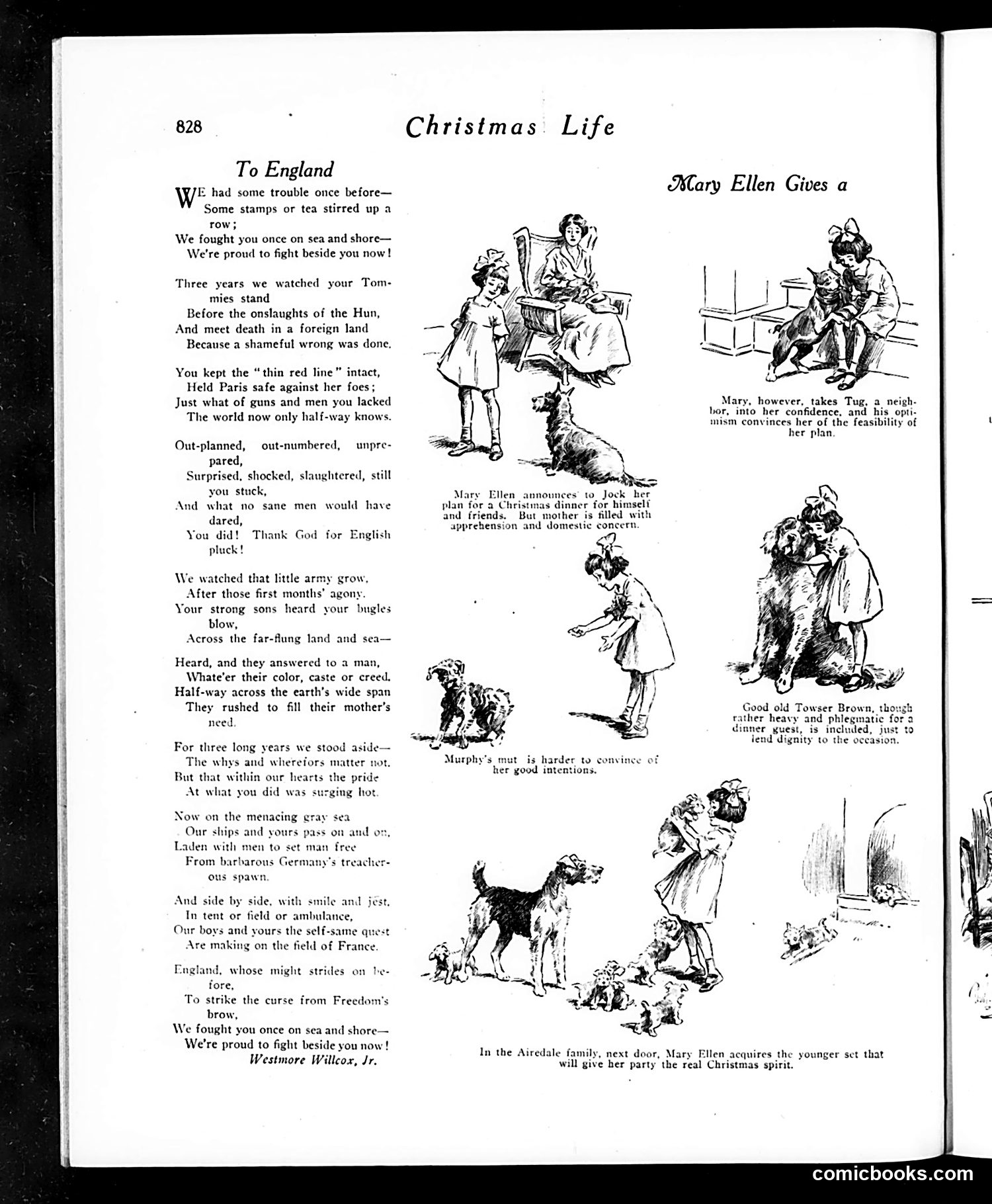
This page combines patriotic verse with a humorous domestic story, both addressing WWI themes. **Left side ("To England"):** A poem by Westmore Willcox Jr. addresses Britain, referencing their historical conflicts ("stamps or tea stirred up a row" — the American Revolution) while celebrating their current alliance in WWI. It praises British resilience against "the Hun" (Germany), their recruitment of troops "half-way across the earth's wide span," and joint American-British efforts "on the field of France." The message: past enemies are now proud allies against Germany. **Right side ("Mary Ellen Gives a Party"):** A series of illustrated vignettes shows a girl named Mary Ellen planning a Christmas dinner for a soldier named Jock. Her mother worries about the practicality, but Mary Ellen persuades neighbors—including "Tug," "Towser Brown," and dogs from the "Airedale family"—to contribute, ultimately gathering enough support for a proper Christmas celebration. **The connection:** Both pieces promote wartime unity and morale, blending patriotic solidarity with heartwarming domestic generosity toward soldiers.
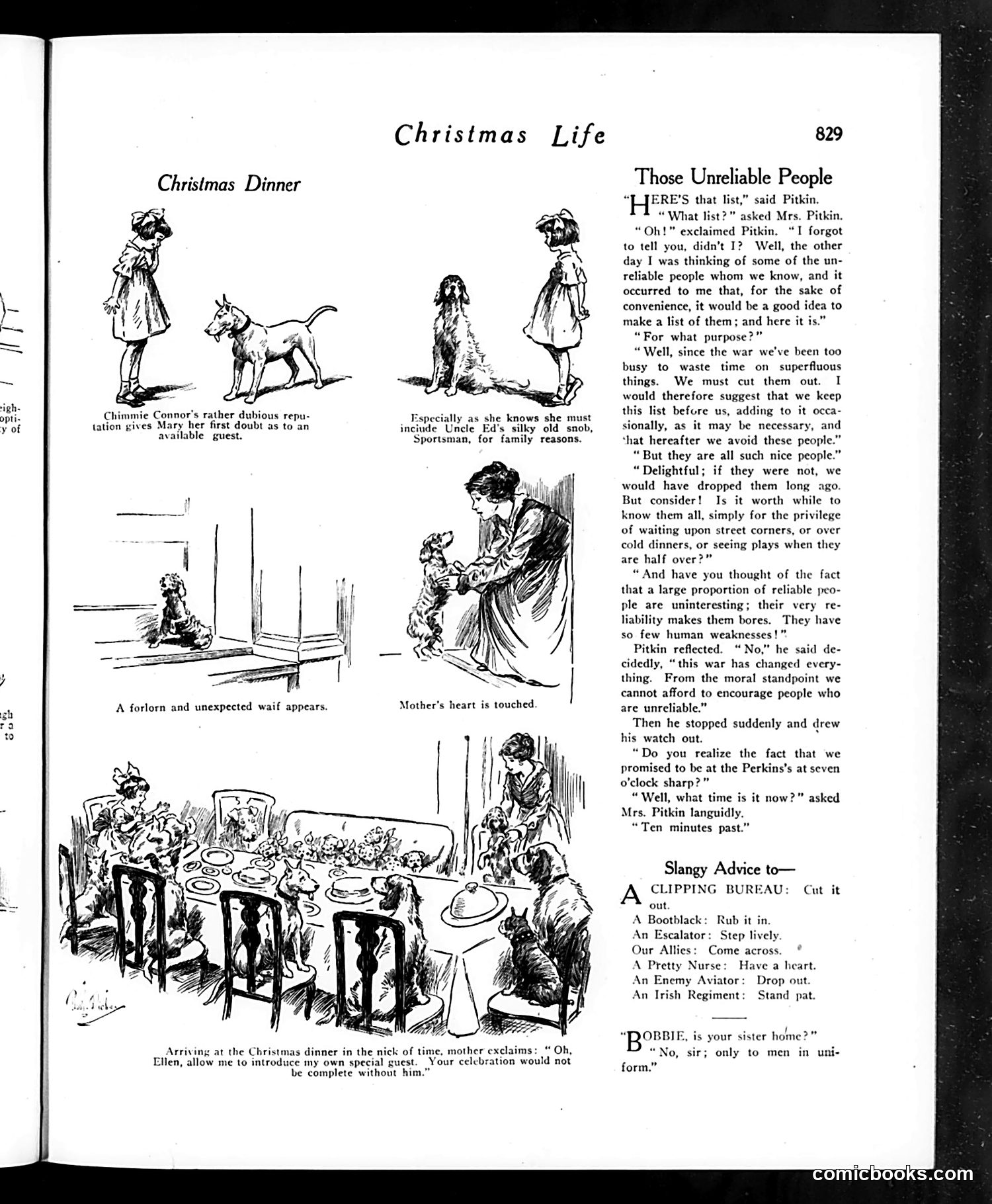
This satirical piece mocks the hypocrisy of middle-class wartime morality. Mr. Pitkin proposes creating a list of "unreliable people" to eliminate from their social circle, arguing that during wartime (WWI, based on references to allies and enemy aviators), society must cut wasteful social obligations and focus resources efficiently. The joke's punchline is Pitkin's immediate self-contradiction: having just lectured about avoiding unreliable people, he's now *ten minutes late* to the Perkins's dinner—making himself exactly the kind of unreliable person he condemns. His moral posturing collapses under the weight of his own inconsistency. The accompanying "Christmas Dinner" comic strip shows a parallel theme: bringing an unexpected waif guest to dinner, suggesting that actual kindness trumps social conventions—a counterpoint to Pitkin's cold calculation about whom to "cut out."
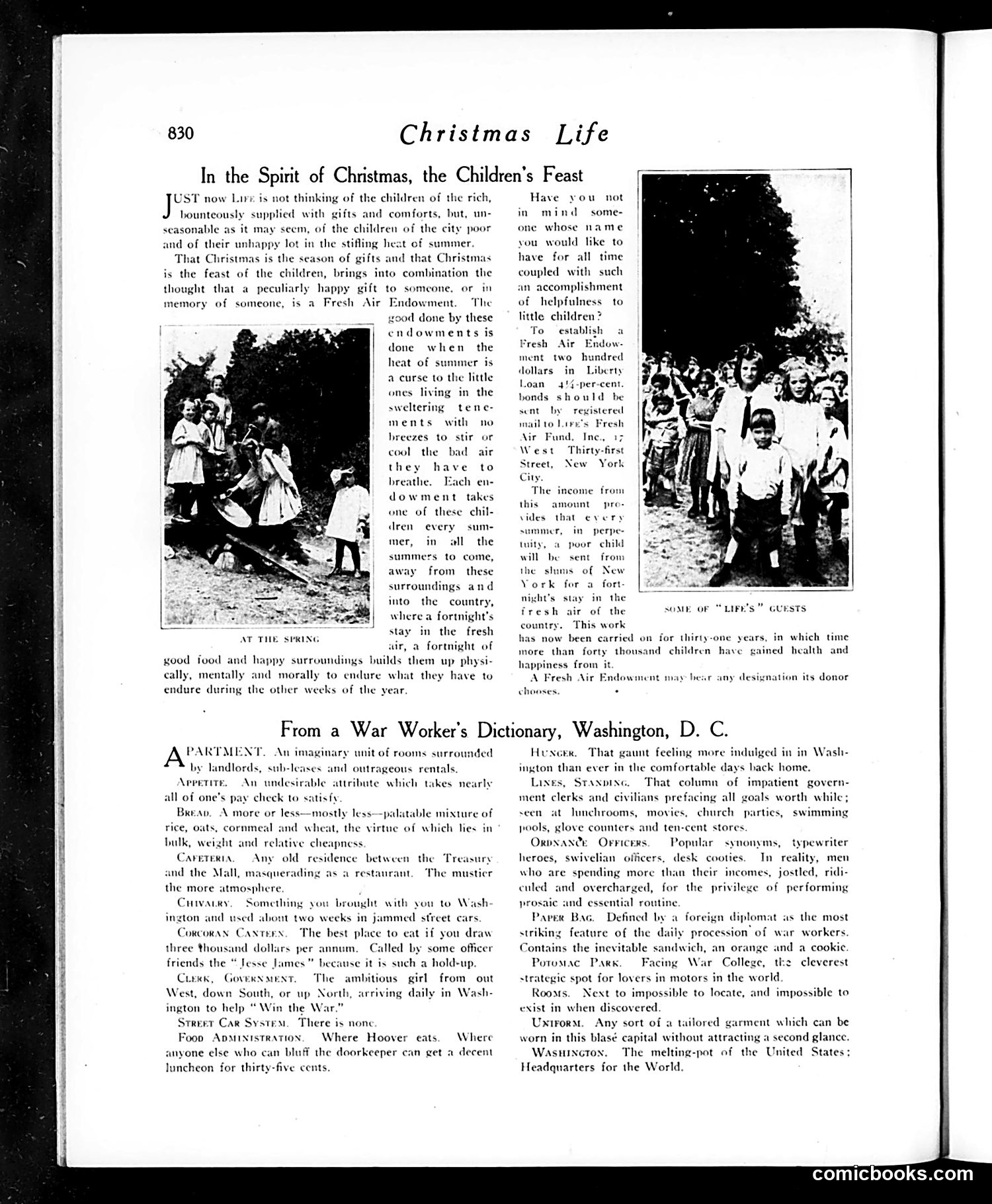
This page contains two distinct pieces: **Top section—"In the Spirit of Christmas, the Children's Feast"**: Life magazine advocates for "Fresh Air Endowments," a charitable program (active 31+ years by publication) providing poor urban children summer countryside retreats. The accompanying photographs show city children at play and receiving care. This is a genuine philanthropic appeal, not satire—Life urges readers to donate $200 in Liberty bonds to establish permanent endowments funding annual trips for poor children escaping tenement heat. **Bottom section—"From a War Worker's Dictionary"**: This *is* satirical, mocking Washington D.C. during World War I. It uses mock-dictionary definitions to critique wartime bureaucracy: overcrowded "apartments," inadequate food, price-gouging restaurants, long lines, and government workers living beyond their means. The tone is cynical humor about wartime Washington's inefficiency and discomfort—likely resonating with readers frustrated by wartime conditions. The page juxtaposes earnest charity advocacy with sharp social criticism.
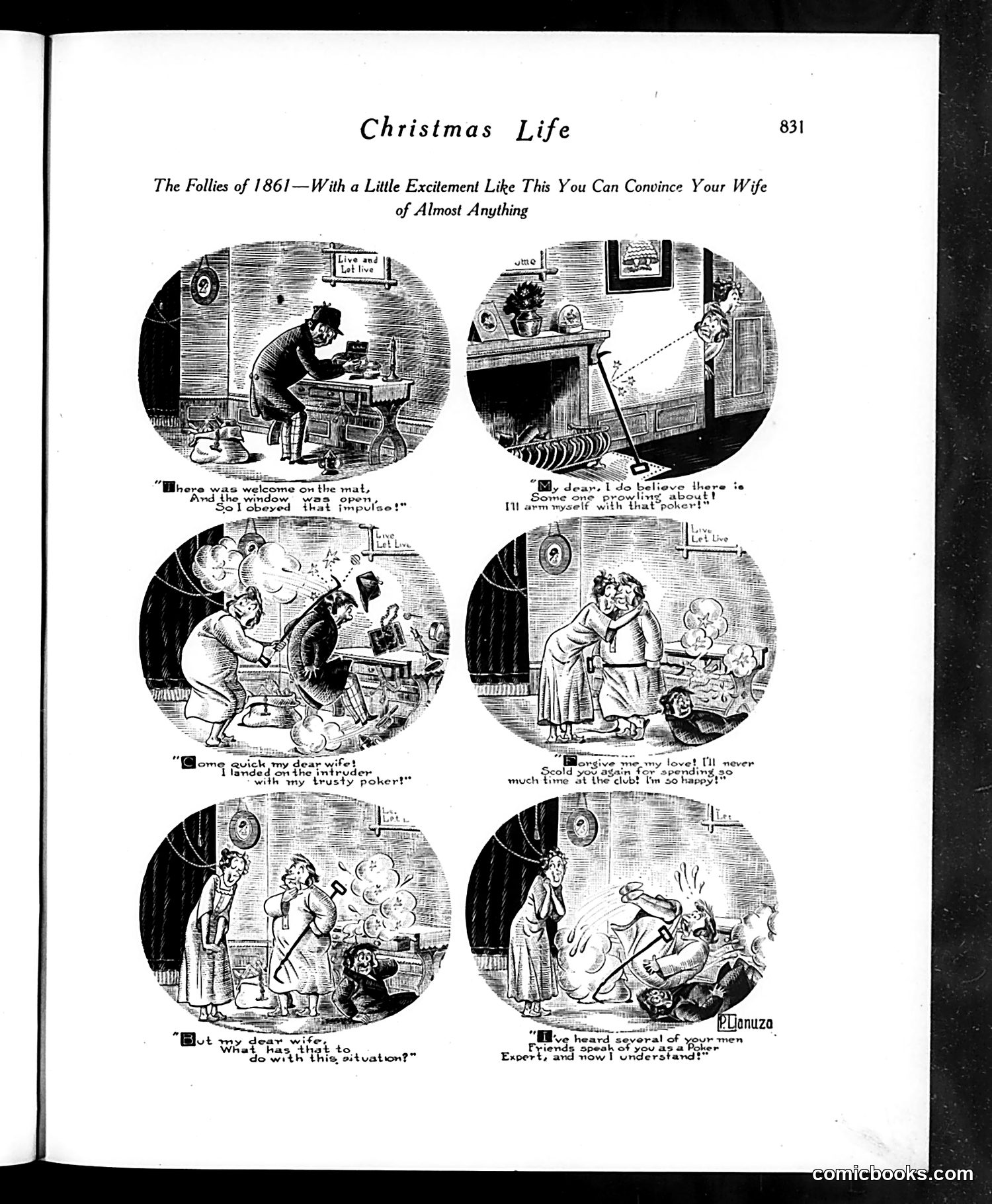
This is a satirical six-panel comic from Life magazine about domestic deception during the Civil War era (1861). The narrative follows a husband attempting to convince his wife of various false situations through theatrical staging and props. The humor targets masculine duplicity in marriage: the husband stages increasingly elaborate scenarios—claiming a burglar exists, that he's injured, that he's received a military commission—to justify suspicious behavior or expenditures to his credulous wife. Each panel shows the wife's gullible acceptance of his transparent fabrications. The title's reference to "Follies of 1861" situates this as contemporary satire about wartime anxieties and the general foolishness of both spouses—husbands for their scheming, wives for their naiveté. The joke relies on 19th-century gender assumptions about female credulity and male cunning in domestic relations.
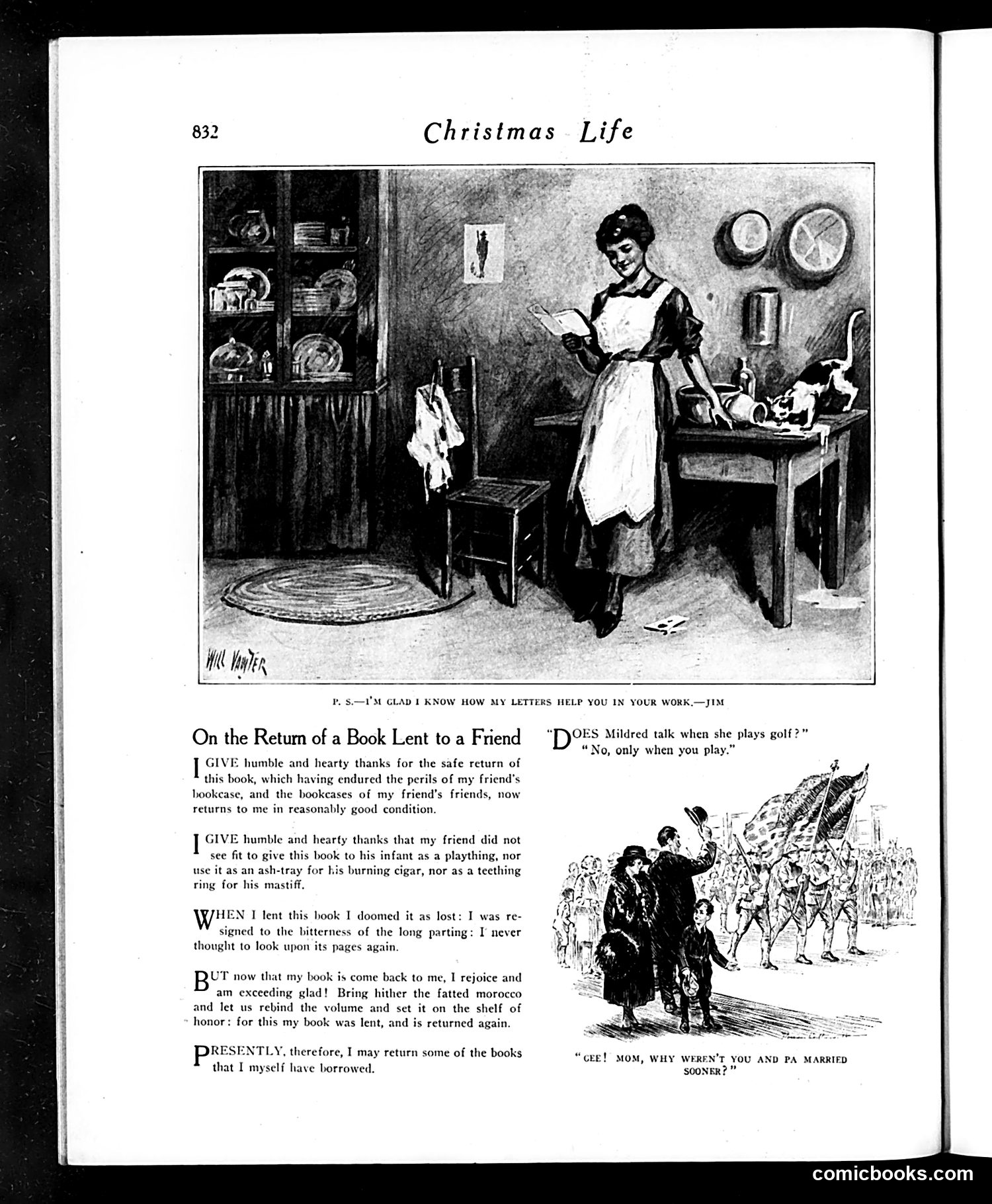
This page contains two satirical pieces typical of early 20th-century American humor: **Top cartoon** (by Will Hacer): Shows a woman in a kitchen reading a letter, illustrating the caption about letters helping with work. The humor is gentle domestic comedy. **Main article**: "On the Return of a Book Lent to a Friend" is mock-biblical satire, written in faux-religious language ("GIVE humble and hearty thanks," "fatted morocco"). It humorously exaggerates the perils books face when lent—being damaged by children, used as ashtrays, teething rings for dogs—treating the book's safe return as a miraculous resurrection worthy of celebration. The final line jokes that the author will now lend out *their own* borrowed books, suggesting reciprocal irresponsibility. **Bottom cartoon**: A golf joke playing on the double meaning of "talk"—Mildred doesn't chatter during play, only when *you're* playing (implying you're so bad it's entertaining). The page satirizes the anxiety of lending personal possessions and the casual carelessness of borrowers—social friction recognizable across eras.
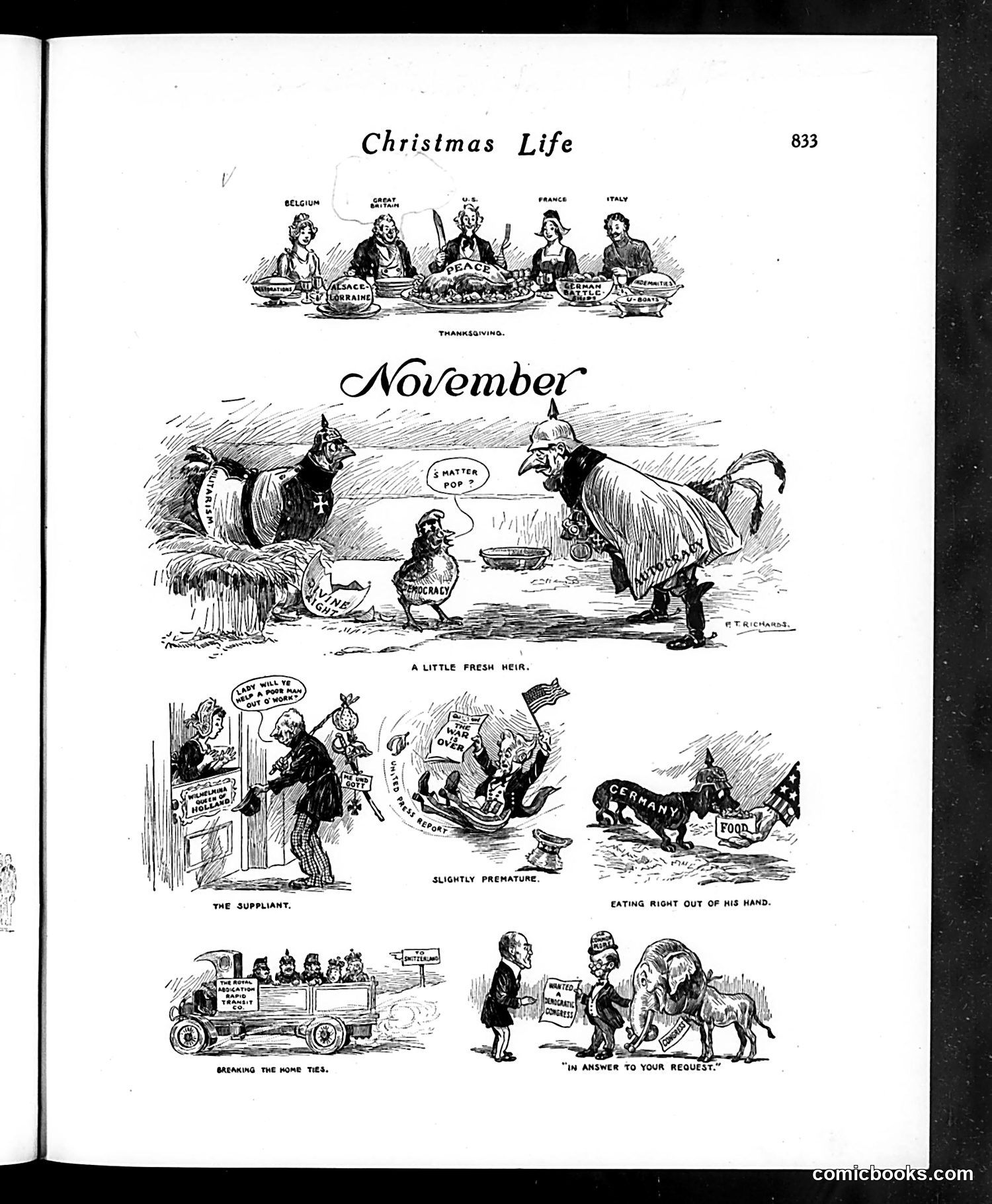
This page satirizes European political tensions during November (likely pre-WWI era, given the "Christmas Life" framing). The top panel depicts national personifications at a Thanksgiving table: Belgium, Great Britain, France, Italy, and others—suggesting international diplomatic relations. The subsequent November cartoons use animal metaphors: roosters and hens represent nations in conflict ("A Little Fresh Heir"). Other panels titled "The Suppliant," "Slightly Premature," and "Eating Right Out of His Hand" depict diplomatic maneuvering and power imbalances between nations, with Germany prominently featured. "Breaking the Home Ties" and "In Answer to Your Request" appear to reference military mobilization and military alliances—satirizing how nations were drawn into conflicts through obligations and requests. The overall message critiques the fragile balance of European power and impending military entanglements.
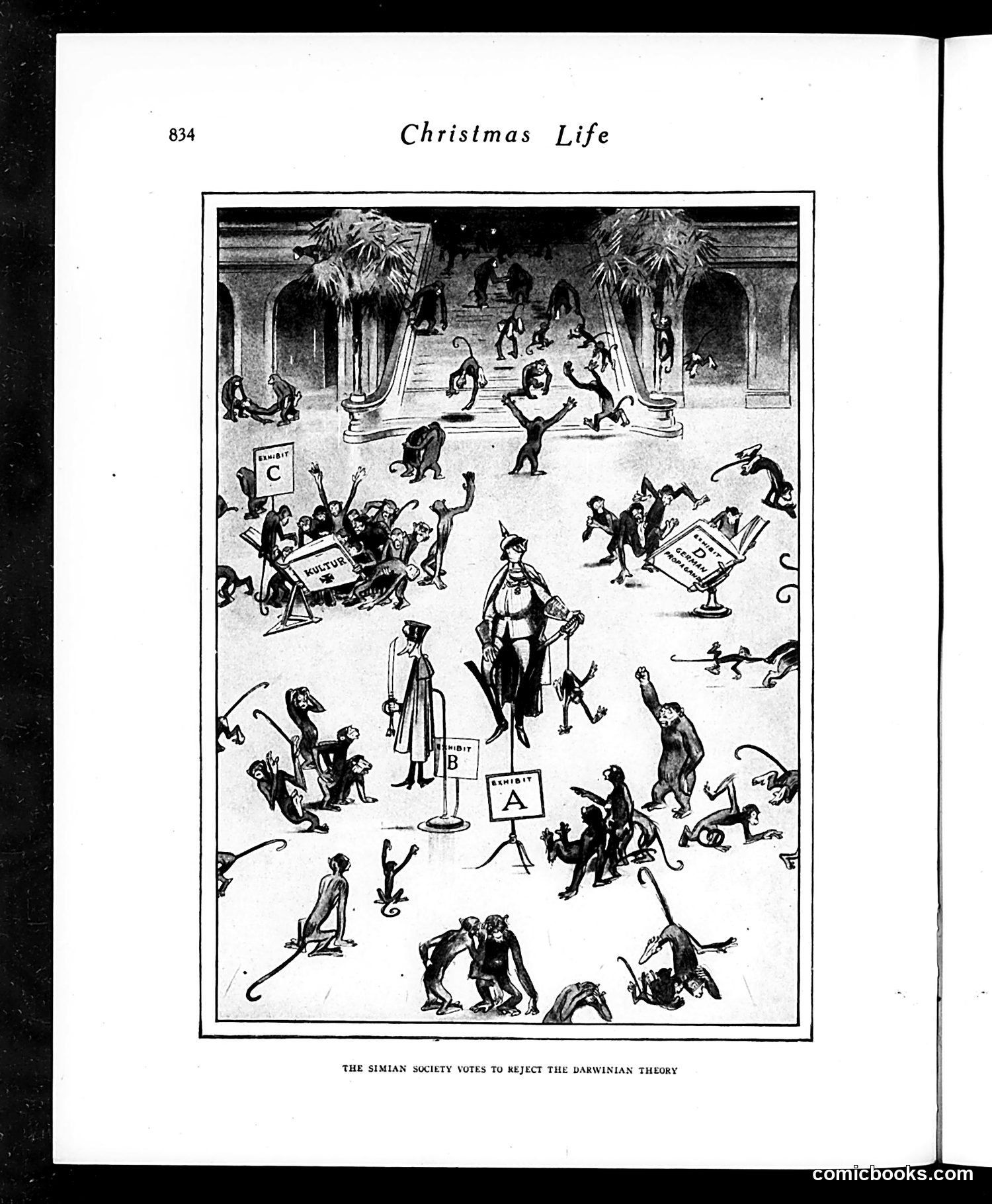
This satirical cartoon depicts monkeys and apes gathered in what appears to be a formal assembly or courtroom setting, labeled "The Simian Society Votes to Reject the Darwinian Theory." The joke targets Darwin's theory of evolution, which proposed that humans descended from primates. By showing apes "voting" to reject this theory, the cartoonist satirizes those who denied evolution—suggesting they're behaving irrationally, almost as if apes themselves were denying their relationship to humanity. The cartoon likely references early 20th-century American resistance to evolutionary theory, particularly strong among religious groups. The formal parliamentary setting mocks both the serious scientific debates of the era and the stubbornness of evolution's opponents, implying their rejection of science is as absurd as primates voting against their own biological history.
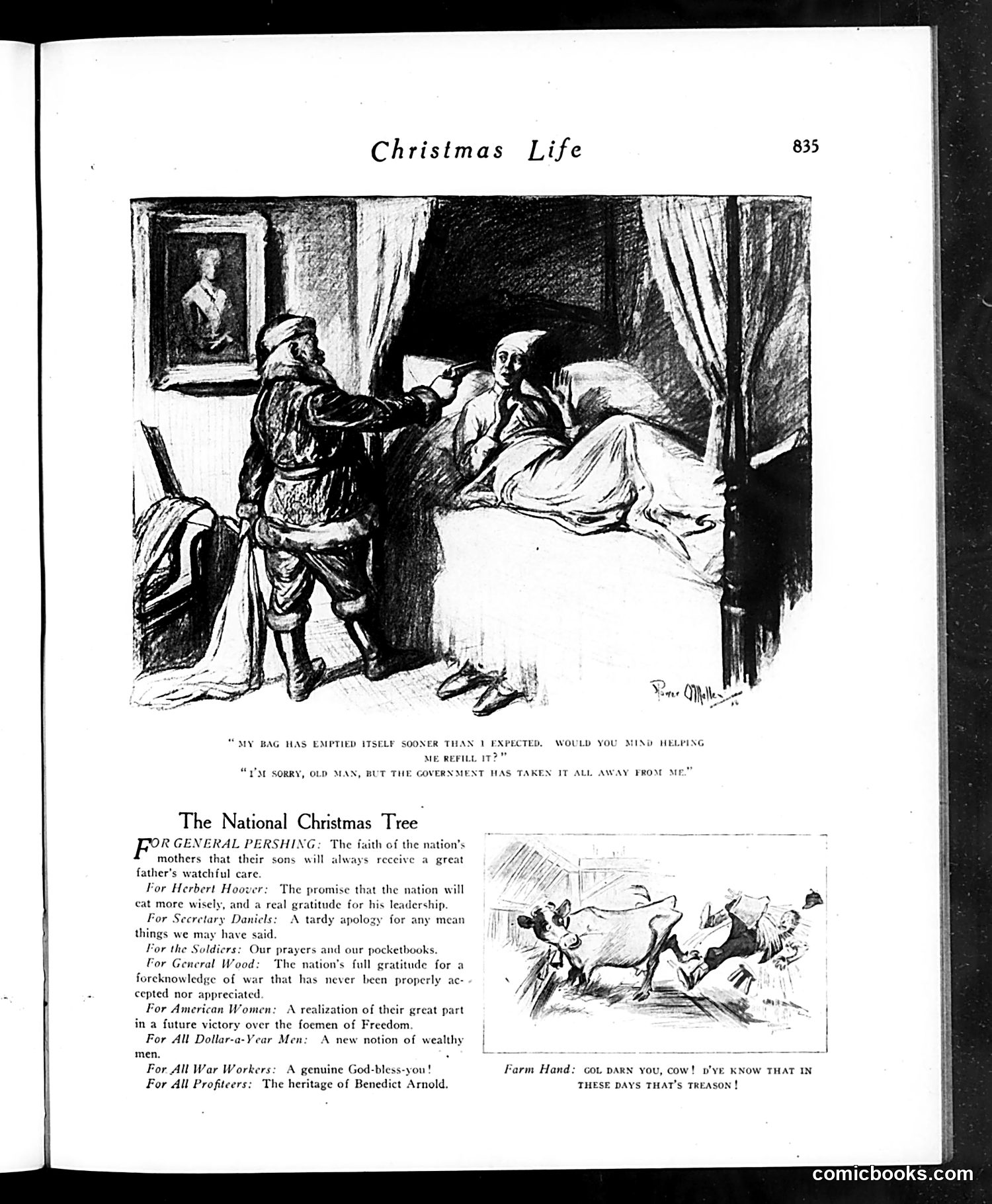
**Top Cartoon:** A wealthy man's money bag has depleted faster than expected, so he asks a poorer acquaintance for help refilling it. The response—"the government has taken it all away from me"—satirizes wartime taxation and wealth redistribution. The joke targets wealthy individuals facing higher taxes while the working class has nothing left to give. **"National Christmas Tree" Section:** This is not a cartoon but a satirical gift list for prominent WWI-era figures. It mocks various leaders and groups: - **General Pershing, Herbert Hoover, Secretary Daniels, General Wood**: Political/military figures receiving backhanded "wishes" - The wishes are sarcastic: soldiers get prayers and pocketbooks; profiteers get compared to Benedict Arnold (a traitor) **Farm Hand cartoon:** A farmer scolds his cow for eating during wartime, calling it "treason"—satirizing civilian sacrifice and the moral imperative to conserve resources for the war effort. **Overall context:** This page reflects WWI-era American anxieties about government control, class inequality, and rationing.
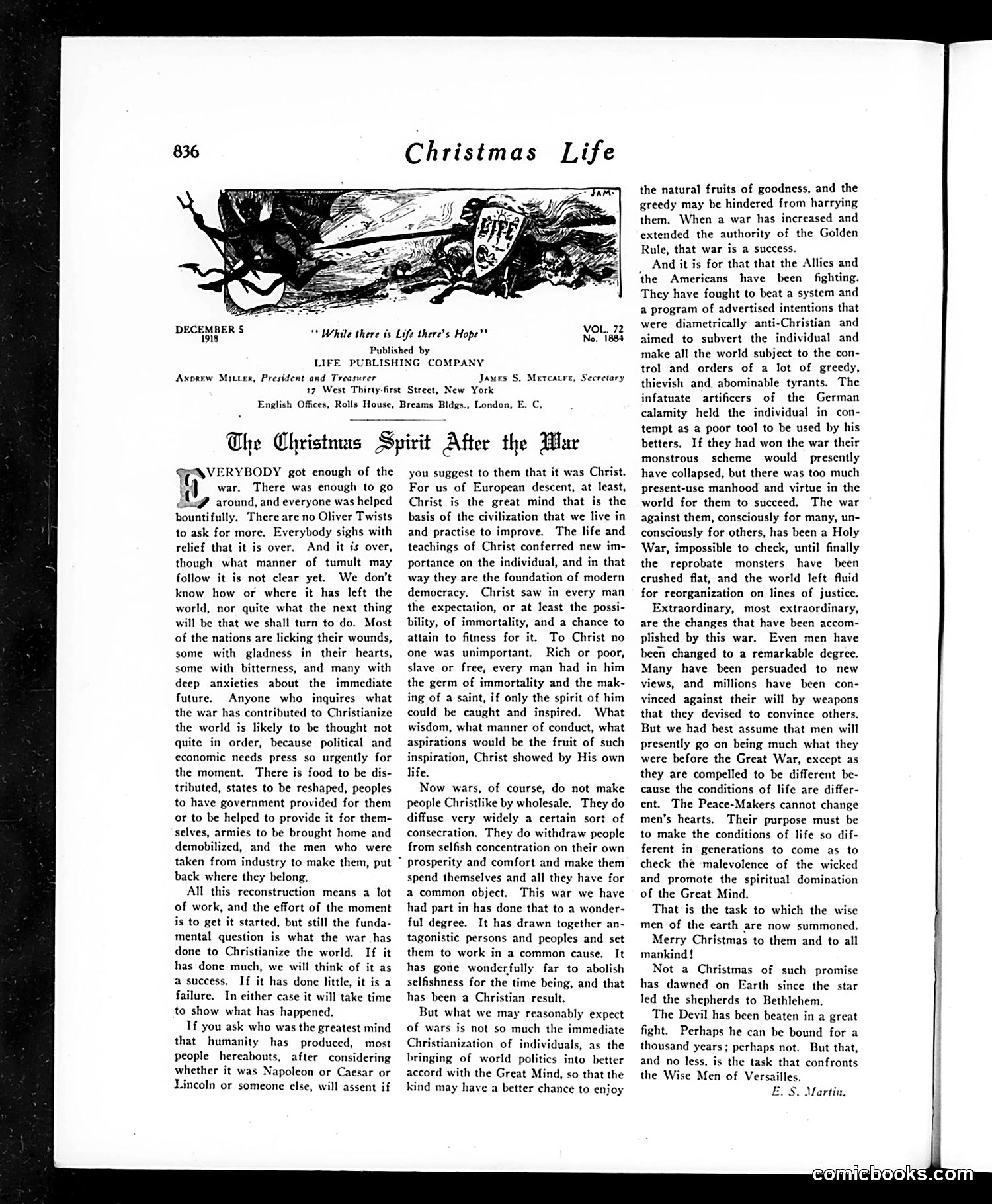
This December 5, 1918 *Life* magazine page marks the armistice ending World War I (November 11, 1918). The small cartoon at top shows a dead soldier with a shield labeled "DIEU" (God), illustrating the essay's central tension. The article by E.S. Martin argues that while WWI temporarily unified people in sacrifice and drew them away from selfish concerns—mimicking Christian values—the war's true test is whether it will reshape world politics toward justice and away from greed. Martin questions whether warfare genuinely "Christianizes" humanity or merely creates temporary moral improvement. The implicit satire targets the gap between Christian ideals and wartime reality. While soldiers died "for" Christian civilization, Martin suggests the war's actual spiritual legacy remains uncertain. The piece anticipates post-war disillusionment, questioning whether peace will bring genuine moral progress or merely restore selfishness.
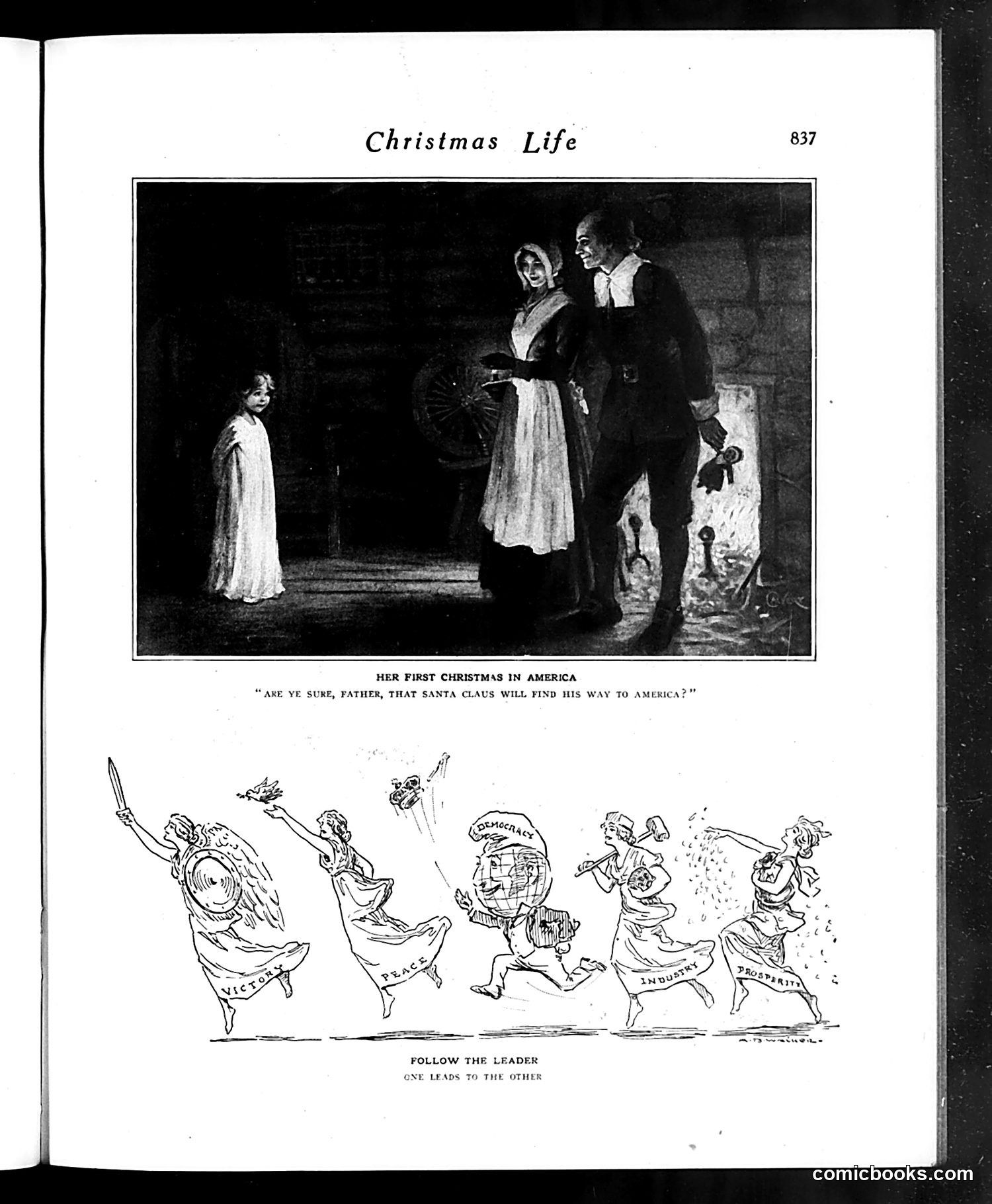
The page contains two satirical cartoons about Christmas and American values. The top image depicts an immigrant family's first Christmas in America, with a child asking her father if Santa Claus can find them in their new country—implying anxiety about whether American Christmas traditions will reach newcomers. The bottom cartoon, titled "Follow the Leader," shows allegorical female figures labeled with concepts like "Victory," "Peace," "Desperation," "Inquiry," and "Prosperity" dancing in a line. The caption "One Leads to the Other" suggests a causal chain of consequences—likely satirizing how one outcome (possibly victory or peace) inevitably leads to others (desperation, inquiry). This appears to be early 20th-century commentary on immigration and American post-war social/political consequences, though the specific historical context remains unclear without the publication date.
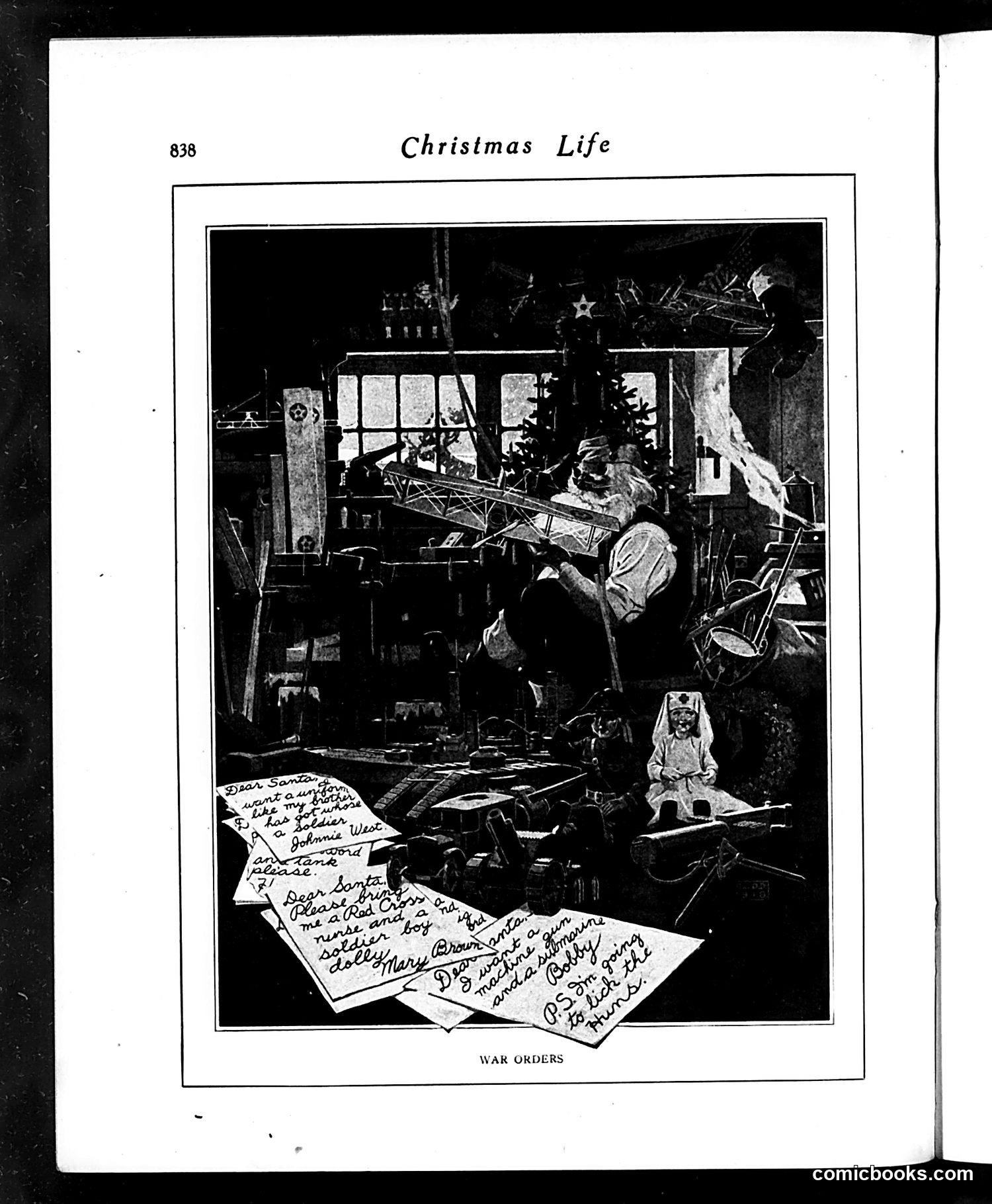
This wartime illustration depicts a poignant domestic scene: a father in military uniform sits in a workshop or garage surrounded by toys and mechanical projects, while children await Christmas gifts. The handwritten letters scattered in the foreground appear to be military orders or correspondence. The satire critiques the collision between Christmas—a holiday of family togetherness and gift-giving—and wartime obligations. The soldier father, presumably receiving deployment orders during the holiday season, must balance his desire to provide gifts and spend time with his children against military duty calling him away. The "War Orders" caption emphasizes how military necessity disrupts the civilian ideal of Christmas family life. This reflects American home-front anxieties during a period of military mobilization, likely World War II or its immediate aftermath.
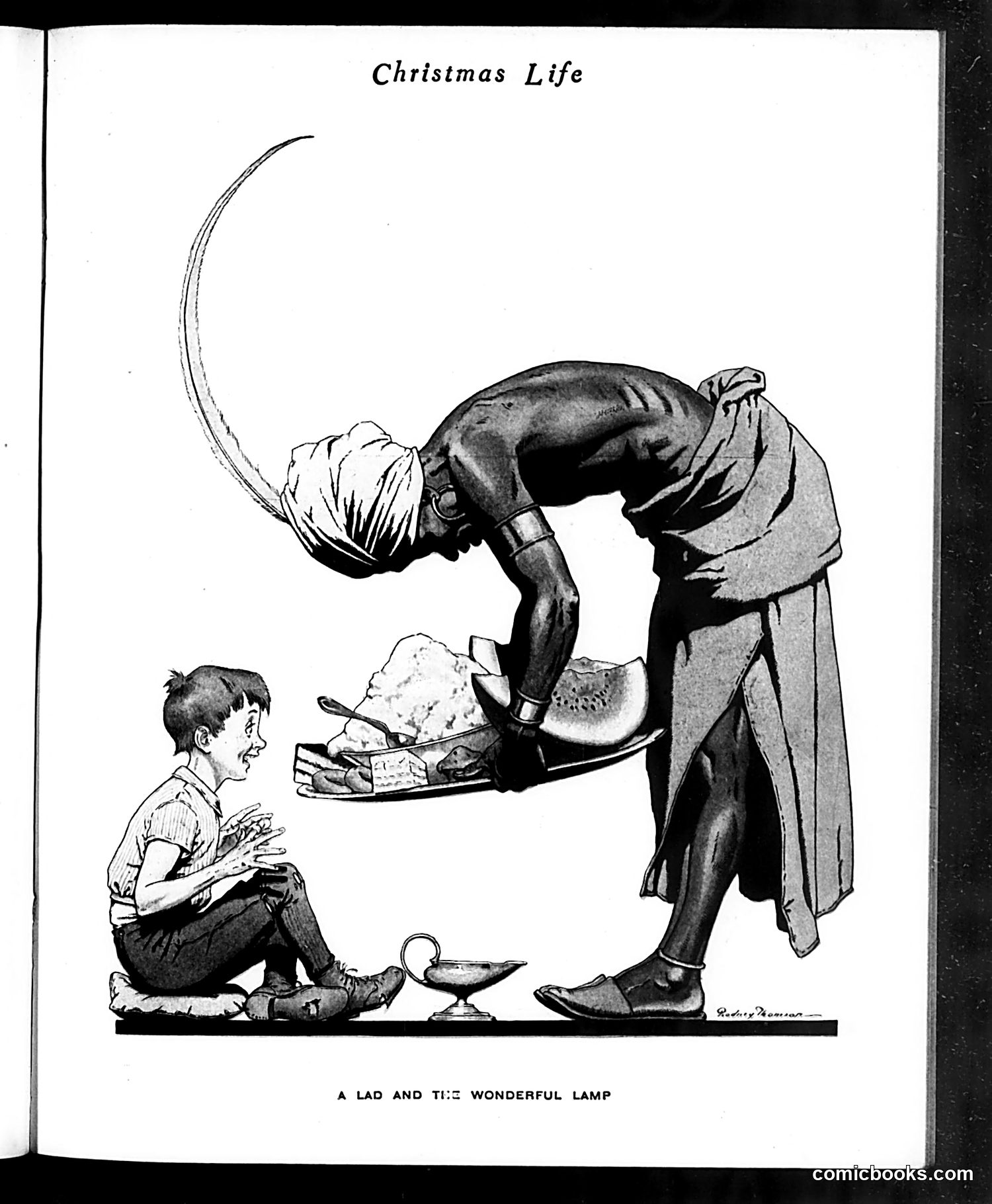
This Christmas-themed cartoon depicts a scene referencing Aladdin's lamp. A young boy sits on the ground gazing upward at a genie-like figure emerging from a magical lamp, who holds a platter of food. The genie appears to be presenting a generous meal to the child. The satire likely comments on Christmas generosity and wish-fulfillment—the magical abundance the holiday promises, especially to children. Given the boy's modest appearance and the genie's grand presentation, the cartoon may satirize either the gap between Christmas expectations and reality for poor children, or conversely, celebrate the "magic" of charitable giving during the season. The reference to the wonderful lamp suggests transformative holiday generosity granting wishes.
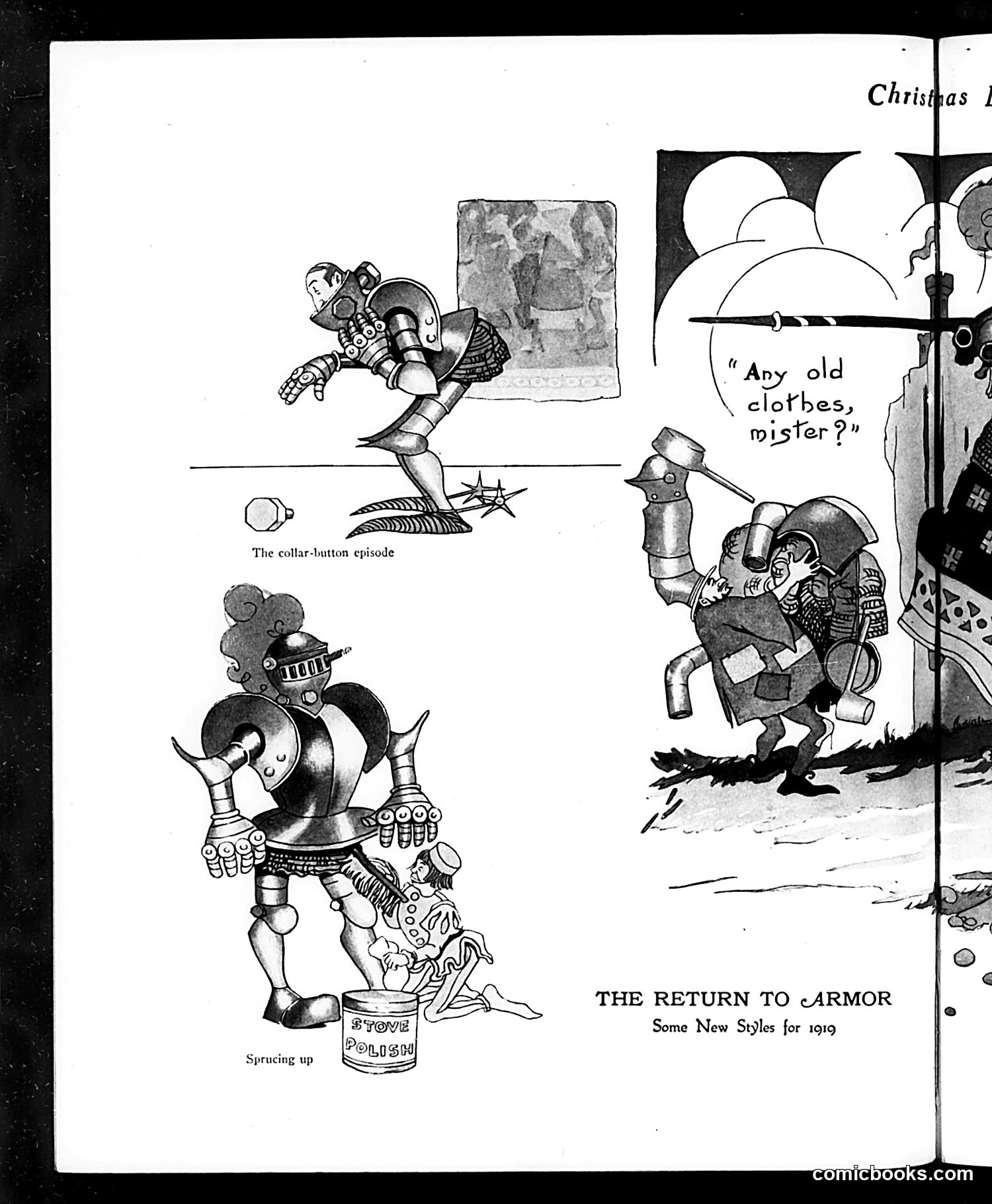
This satirical page mocks the fashion trends emerging after World War I's end in 1918. The cartoons depict absurdly over-armored, robotic figures—likely representing both the militarization of society and the restrictive, heavily-corseted women's fashions of the era. "The collar-button episode" shows a soldier struggling with an oversized button, suggesting the impracticality of formal dress codes. "Sprucing up" depicts an exaggerated armored figure using Polish, satirizing elaborate grooming rituals. The main panel shows a beggar asking "Any old clothes, mister?"—contrasting poverty with society's obsession with fashionable armor-like garments. The joke targets post-war society's simultaneous militaristic values and superficial fashion obsessions while highlighting class inequality.
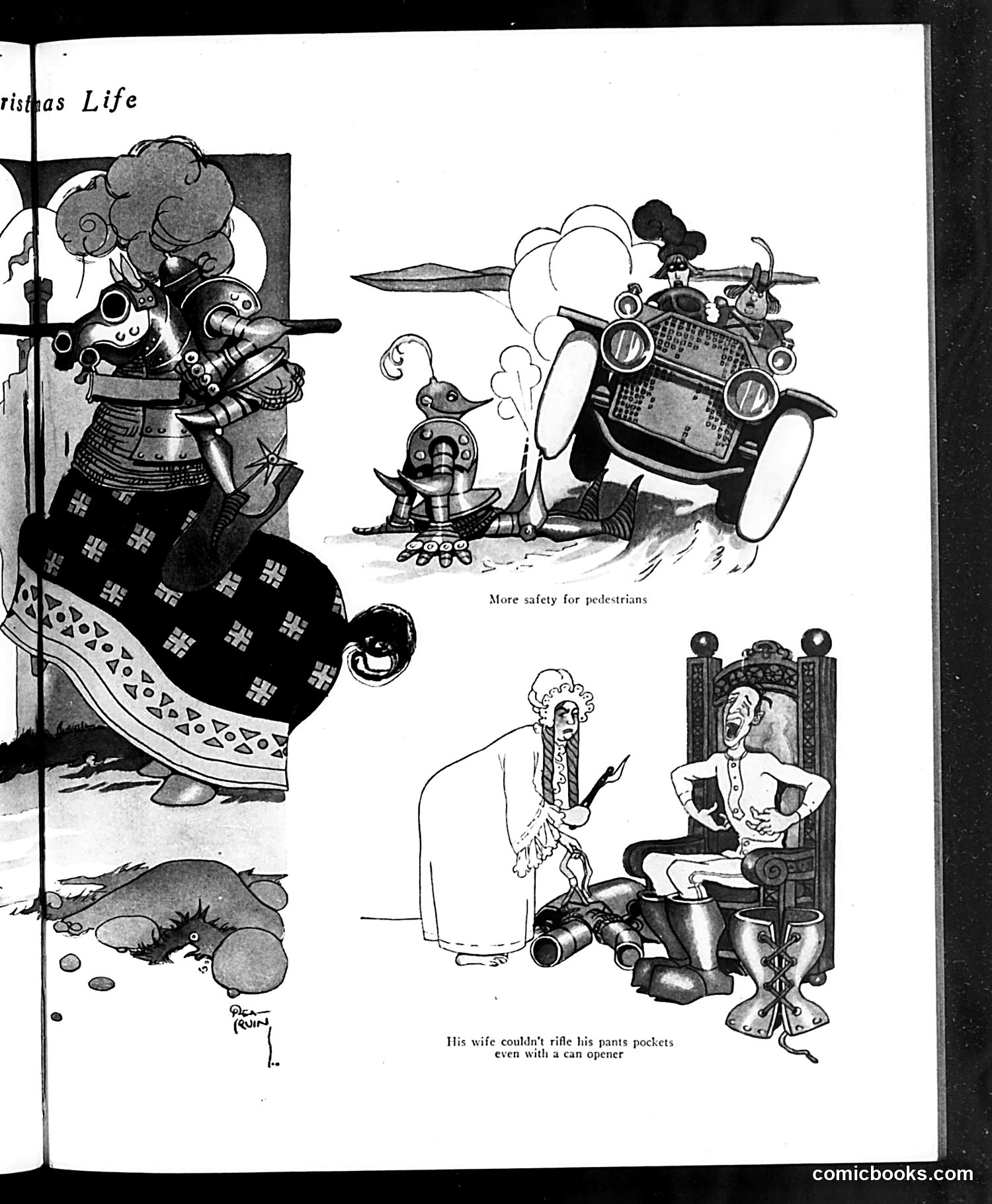
This page contains two unrelated cartoons from *Life* magazine's satirical section. **Top cartoon:** Titled "More safety for pedestrians," it depicts absurdly over-armored, mechanical vehicles with protruding gadgets and weapons. The satire criticizes either automobile safety design of the era (possibly WWI-influenced) or mock-warns that "safety" measures are becoming dangerously excessive and weaponized. **Bottom cartoon:** Shows a man and woman in a bedroom; the caption reads "His wife couldn't rifle his pants pockets even with a can opener." This jokes about either husbands' secretive pocket-keeping habits or suggests pants were so tightly fitted or constructed that accessing pockets was nearly impossible—likely commentary on contemporary men's fashion or domestic finances/control. Both cartoons use exaggeration for comedic social observation, typical of early-20th-century *Life* magazine humor.
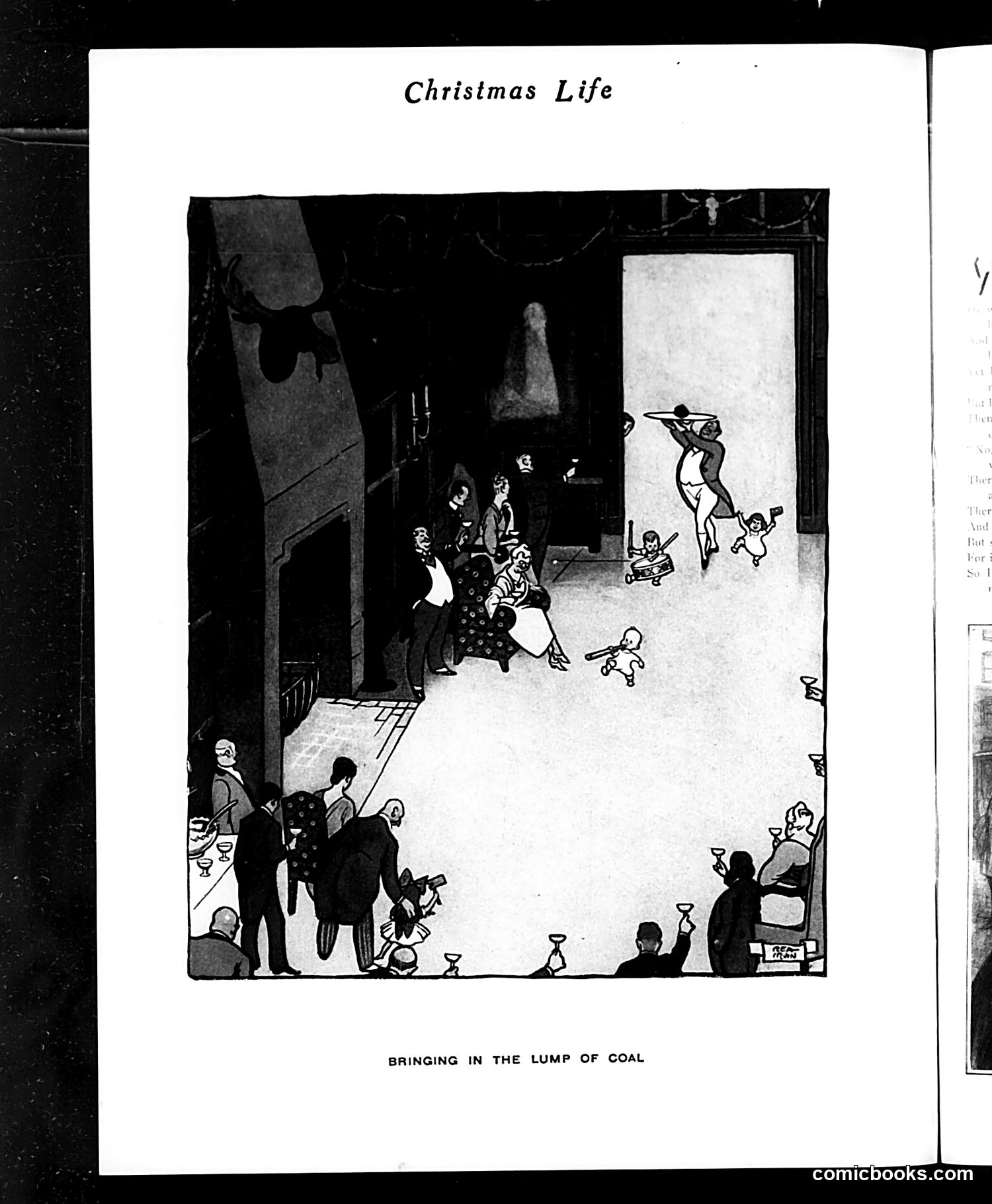
This satirical illustration depicts a Christmas party scene where adults and children gather in what appears to be an elegant interior space. The title references the traditional threat that misbehaving children receive coal instead of gifts from Santa Claus. The cartoon appears to satirize the contrast between wealthy adult revelers (visible at the margins, holding drinks) and children playing in the center space. The "lump of coal" likely functions as social commentary—possibly critiquing either parental indifference to children's behavior during holiday celebrations, or the economic disparity between adults' festive excess and children's modest expectations or treatment. The architectural setting and formal dress suggest this depicts upper-class Christmas entertainment, making the satirical point about class, childhood, and holiday traditions.
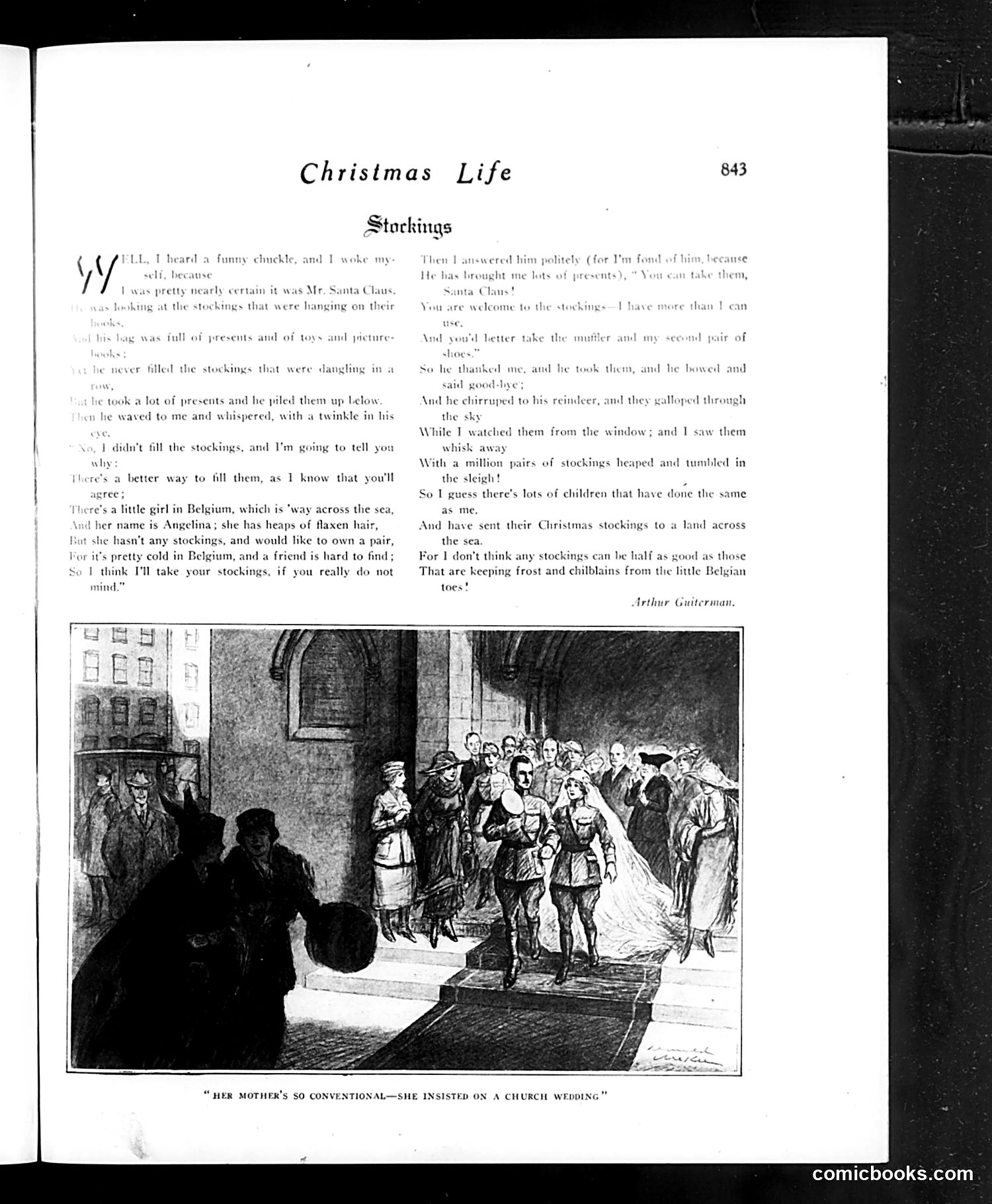
This is a Christmas-themed moral tale rather than political satire. A child recounts waking on Christmas morning to find Santa Claus has filled stockings with presents. However, the narrator reveals they've decided to donate their own stockings to a poor Belgian girl named Angelina who lacks warm clothing in a cold climate. The illustration shows what appears to be a formal church or palace wedding scene, depicting "her mother's so conventional—she insisted on a church wedding," suggesting the text includes multiple unrelated Christmas stories on this page. The piece exemplifies early 20th-century sentimental charitable messaging—using Christmas as a framework to encourage children toward generosity and awareness of less fortunate children in war-affected Europe (likely WWI-era Belgium, which experienced severe hardship). The satire is gentle: mocking the narrator's initial selfishness while celebrating their ultimate selflessness.
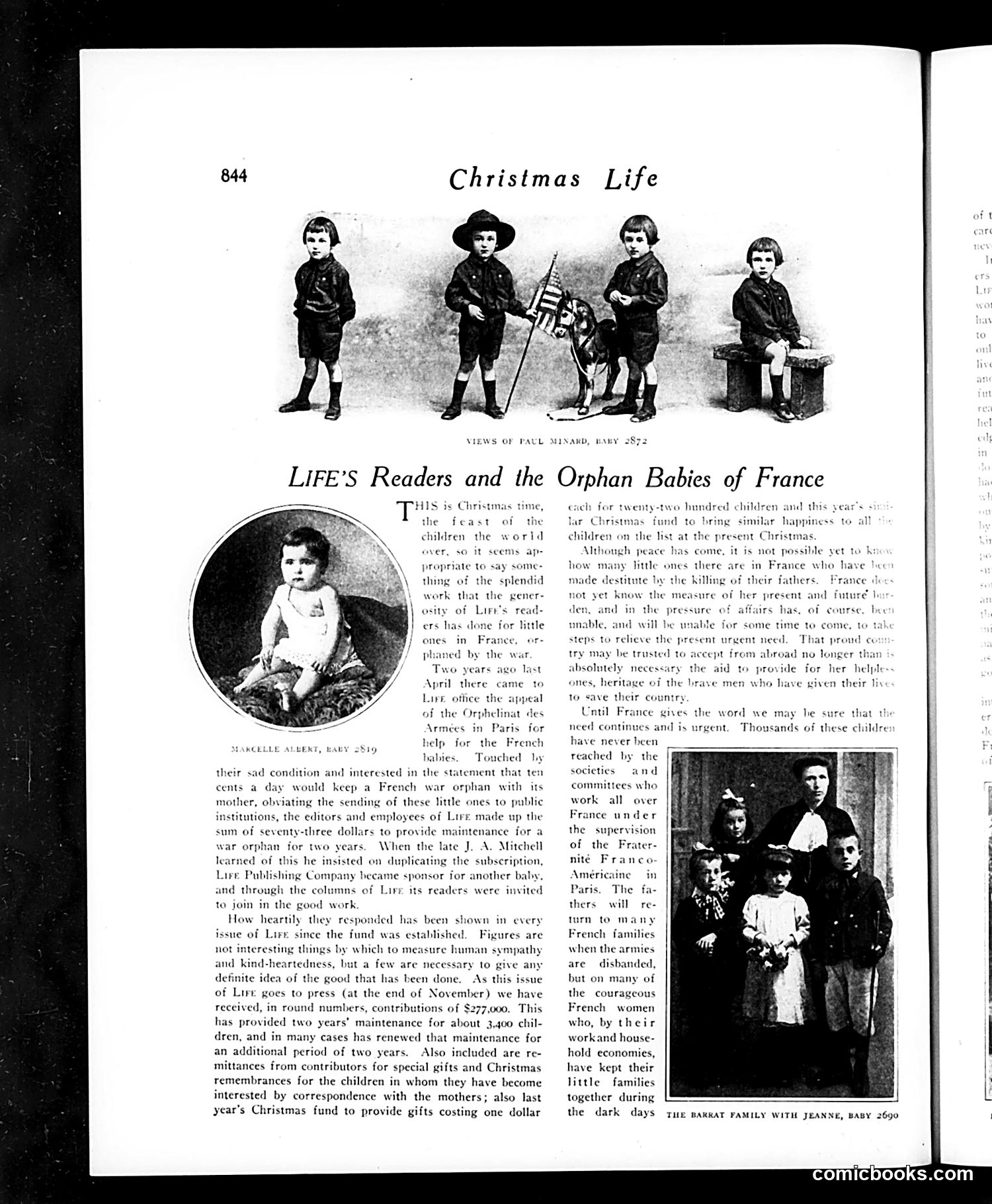
This is a charitable appeal, not satire. During World War I, *Life* magazine's readers raised funds to support French war orphans—children whose fathers were killed in combat. The article documents how the magazine's editors and J.A. Mitchell (the publisher) initiated the effort by donating $73, then duplicated it, eventually raising $277,000 to provide two years of maintenance for approximately 3,400 children. The photographs show named French orphans (Paul Minard, Marcelle Aubry, the Barkat family with Jeanne) as evidence of real children benefiting from readers' donations. The appeal emphasizes that France cannot yet fully care for these children and requests continued American generosity. This represents *Life*'s role as a progressive publication promoting humanitarian aid to war-affected civilians—a significant aspect of early 20th-century American charitable journalism.
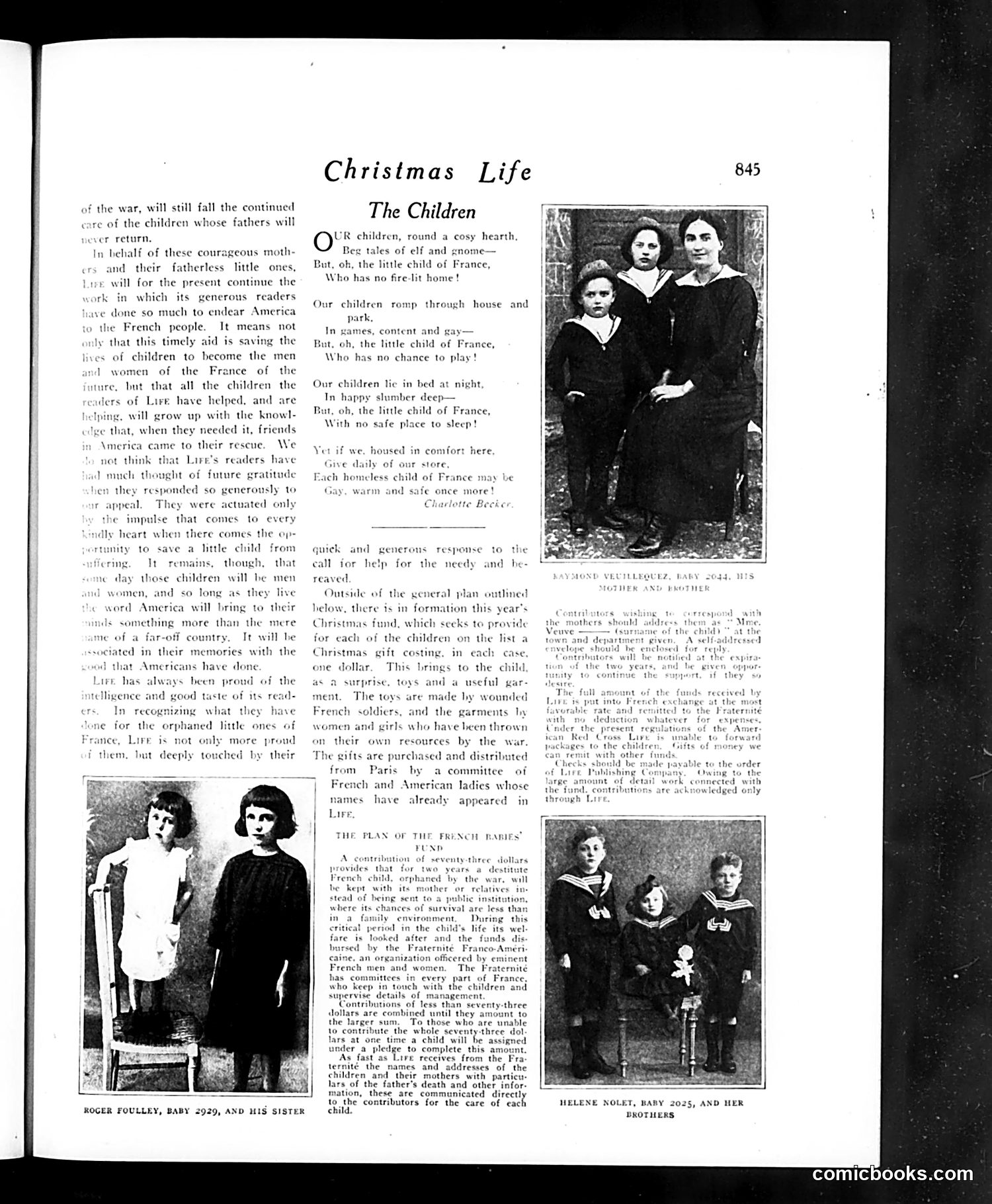
This page presents a sentimental charity campaign for French war orphans, not satire. During WWI, Life magazine solicited American donations to support fatherless French children through the "French Babies' Fund." The text contrasts comfortable American children with destitute French ones—those without "fire-lit homes" or "safe places to sleep." The accompanying photographs show specific orphans (named with identification numbers like "Baby 2929") to personalize the appeal. The donation structure allowed Americans to sponsor individual children for seventy-three dollars, keeping orphans with mothers rather than institutions. French soldiers made toys; local women made garments for distribution from Paris. This represents Life's progressive advocacy: using photography and emotional narrative to mobilize middle-class American philanthropy toward European war relief. The page reflects genuine WWI-era humanitarian concern, not mockery.
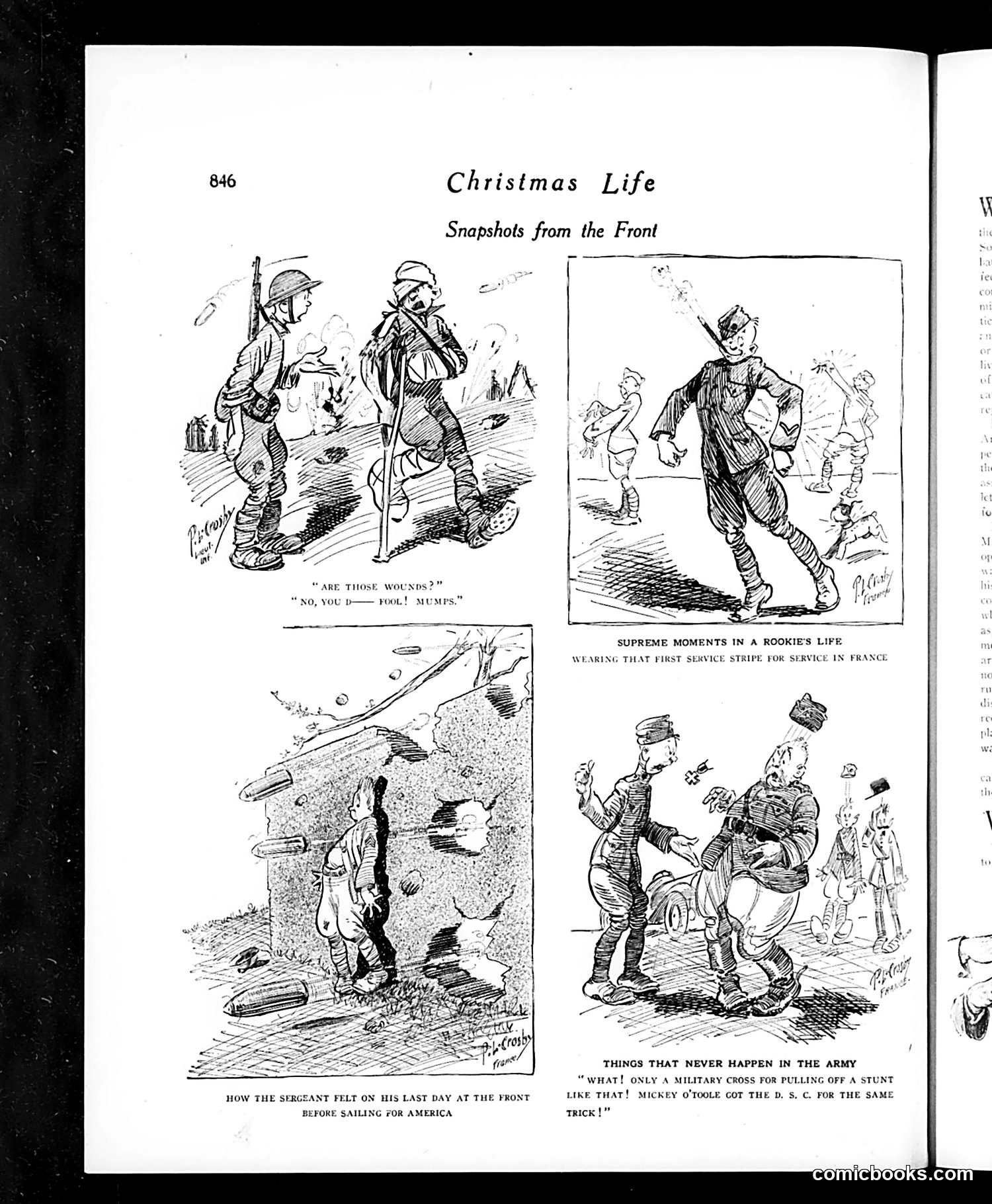
This page presents four cartoons satirizing American military life during World War I. The humor targets common soldier experiences: 1. **Top left**: A wounded soldier's complaint about mumps (not battle wounds)—mocking disease's prevalence in camps. 2. **Top right**: A rookie proudly wearing his first service stripe after France deployment—poking fun at military vanity. 3. **Bottom left**: A sergeant's emotional breakdown on his final day before returning home—sympathetic humor about war's toll. 4. **Bottom right**: A soldier's complaint that his friend Mickey O'Toole received a Distinguished Service Cross for the same trick—satirizing the arbitrary nature of military decorations and favoritism. The page's subtitle "Snapshots from the Front" frames these as realistic glimpses of soldier life, blending gentle mockery of military culture with the underlying gravity of WWI service.
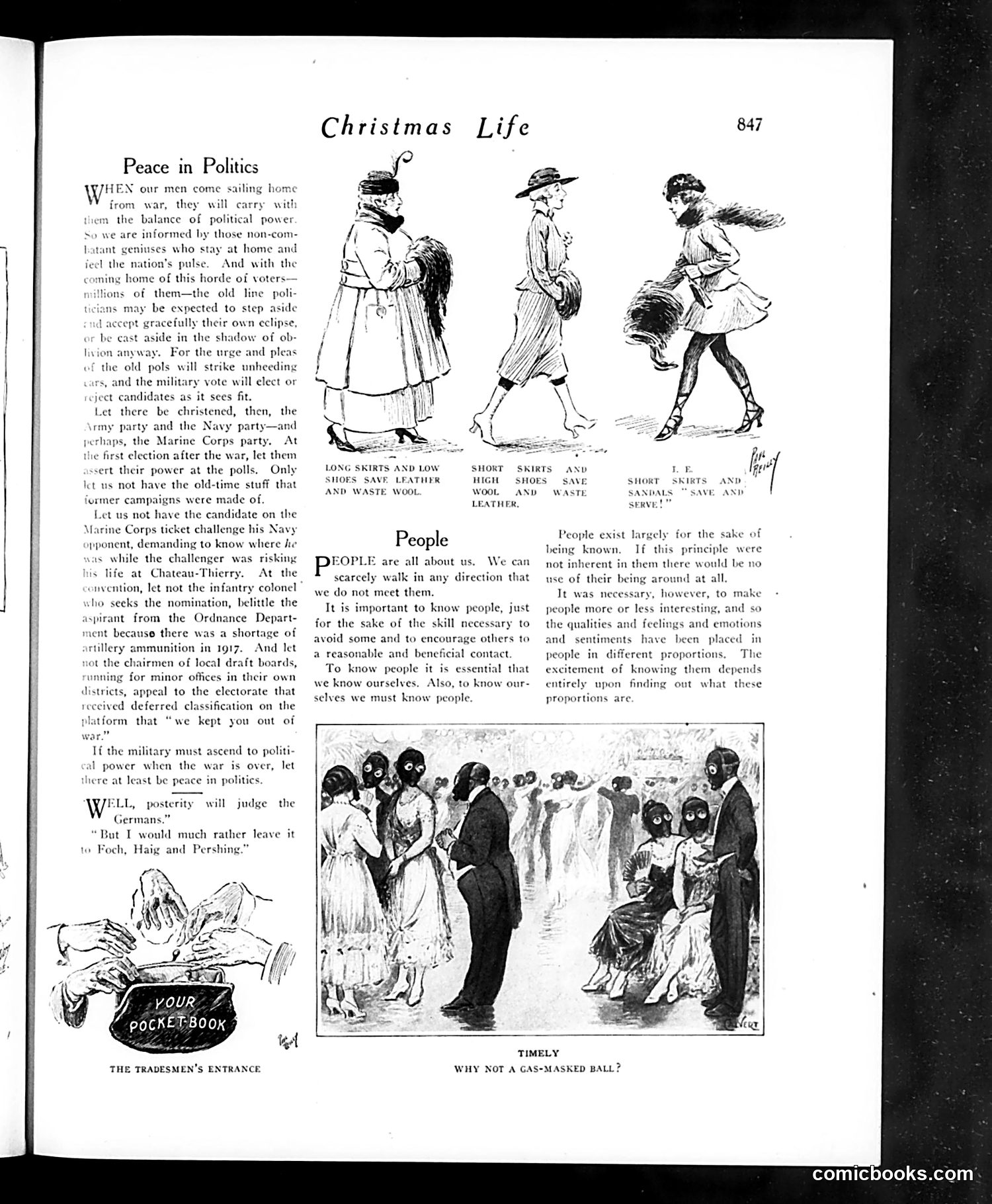
This page contains two satirical pieces addressing post-WWI concerns: **"Peace in Politics"** warns against returning soldiers dominating post-war elections. The article cautions that newly organized "Army party" and "Navy party" candidates shouldn't rehash war grievances or attack each other's wartime service records (referencing real WWI battles like Chateau-Thierry). The cartoon "The Tradesmen's Entrance" likely mocks politicians treating military votes as back-door power grabs rather than legitimate democratic participation. **Fashion cartoons** at top show women's wartime clothing conservation—long skirts and low shoes versus short skirts and sandals—illustrating fabric rationing efforts. **"People" section** and the cartoon "Why Not a Gas-Masked Ball?" satirize post-war social life. The gas-masked figures suggest society was still obsessed with war imagery and protective measures, even as civilians attempted normal activities. The sardonic title questions whether gas masks had become fashionable party accessories, mocking the lingering trauma and paranoia of chemical warfare.
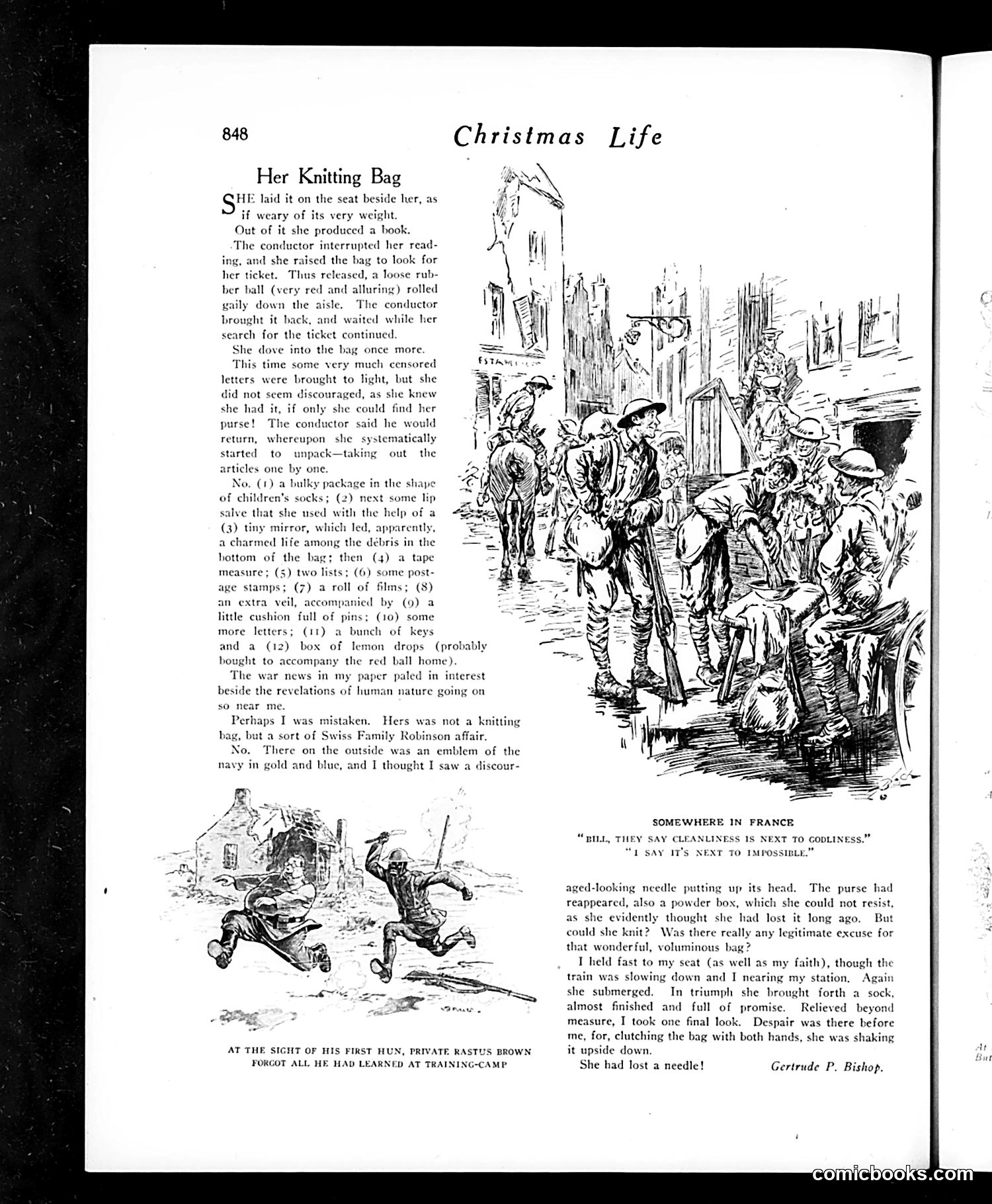
This is a humorous domestic story (not political satire) set during World War I. The narrator observes a woman on a train whose overstuffed knitting bag becomes comically chaotic when she searches for her ticket. **The humor:** The bag's contents—rubber balls, censored letters, mirrors, tape measures, photographs, pins, lemon drops, and eventually a half-finished sock—spill out one by one, revealing the bag as less a practical knitting project and more a chaotic catch-all. The irony is that after all this unpacking, she finally produces a sock, seemingly vindicating her "knitting bag" claim—only to discover she's lost the needle. **The context:** The story mocks women's famously disorganized purses through an extended comedic catalog. The "Swiss Family Robinson" reference suggests her bag contains everything needed for survival. The accompanying cartoon shows soldiers, likely referencing the wartime setting when such domestic humor provided relief. The patriotic naval emblem on the bag's exterior suggests the woman supports the war effort, making her knitting (socks for soldiers) a patriotic act—yet undercut by the comedy of her incompetence.
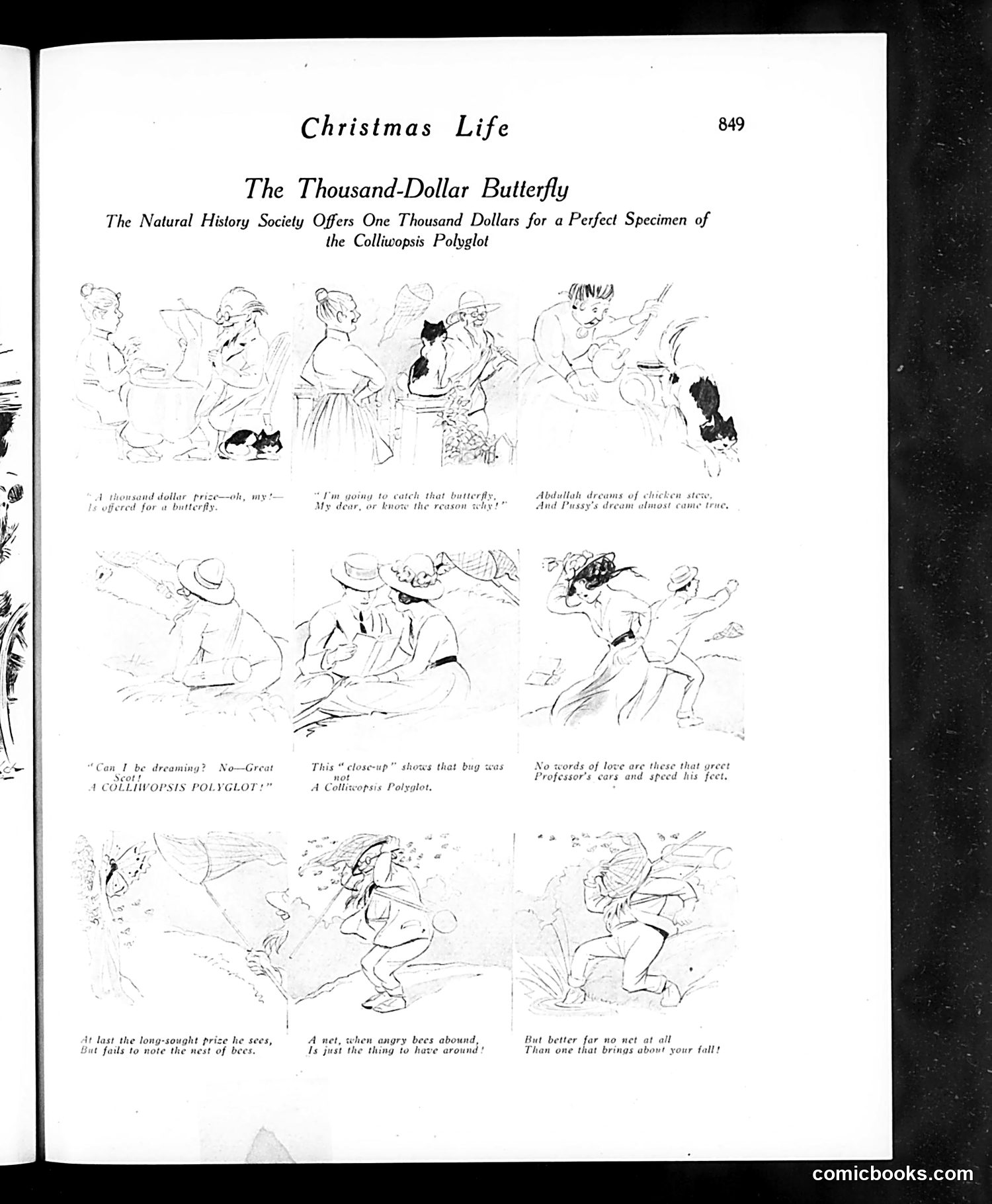
This is a humorous comic strip about a man pursuing a rare butterfly ("Colliwopsis Polyglot") for which the Natural History Society offers a $1,000 prize. The joke follows his escalating misadventures: he spots the butterfly, attempts to catch it with a net, but repeatedly encounters obstacles—particularly angry bees protecting their nest. The satire mocks obsessive collectors and the pursuit of scientific specimens, suggesting the "prize" comes at ridiculous cost. Each panel shows the protagonist getting increasingly battered and humiliated in his hunt, with captions providing running commentary on his suffering. The humor relies on slapstick physical comedy typical of early 20th-century magazines: the would-be scientist outmatched by nature, his dignity destroyed for a dubious goal. It's a gentle mockery of academic pretension and specimen-collecting mania popular among natural historians of the era.
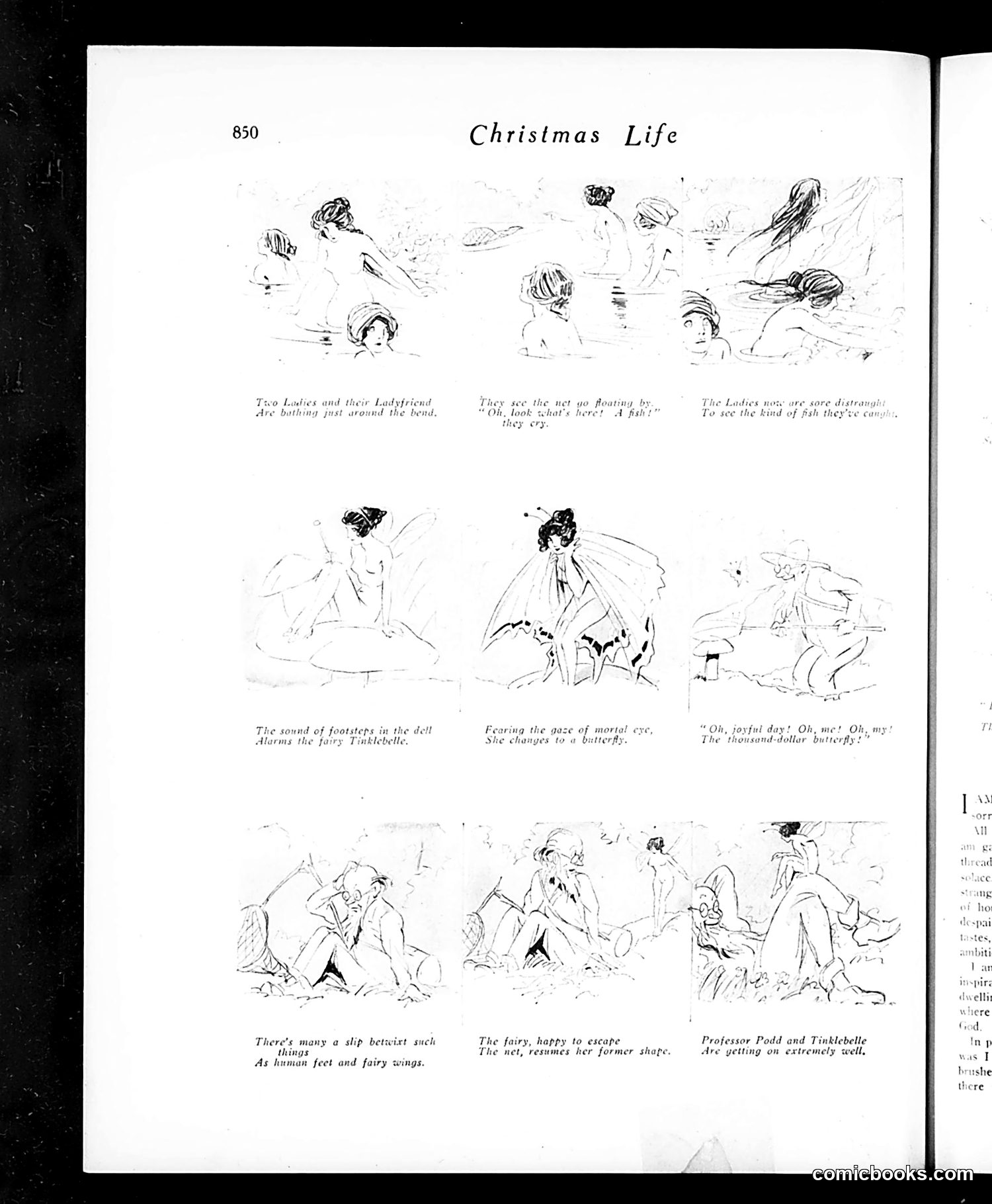
This page presents a whimsical fairy-tale narrative in sequential sketches. The story appears to follow ladies bathing in a pond who encounter magical transformations. The central joke involves a woman who briefly becomes a fairy (gaining wings), then escapes this enchanted state to resume her "former shape" as a human. The phrase "There's many a slip betwixt such things / As human feet and fairy wings" suggests the precarious boundary between ordinary life and magical fantasy. The final caption references "Professor Podd and Tinklebelle," apparently characters managing an extreme (likely comical) situation. The overall piece satirizes romantic Victorian fairy-tale conventions through absurdist humor—depicting the incongruity of everyday people encountering magical transformation and the relief/humor of returning to mundane reality.
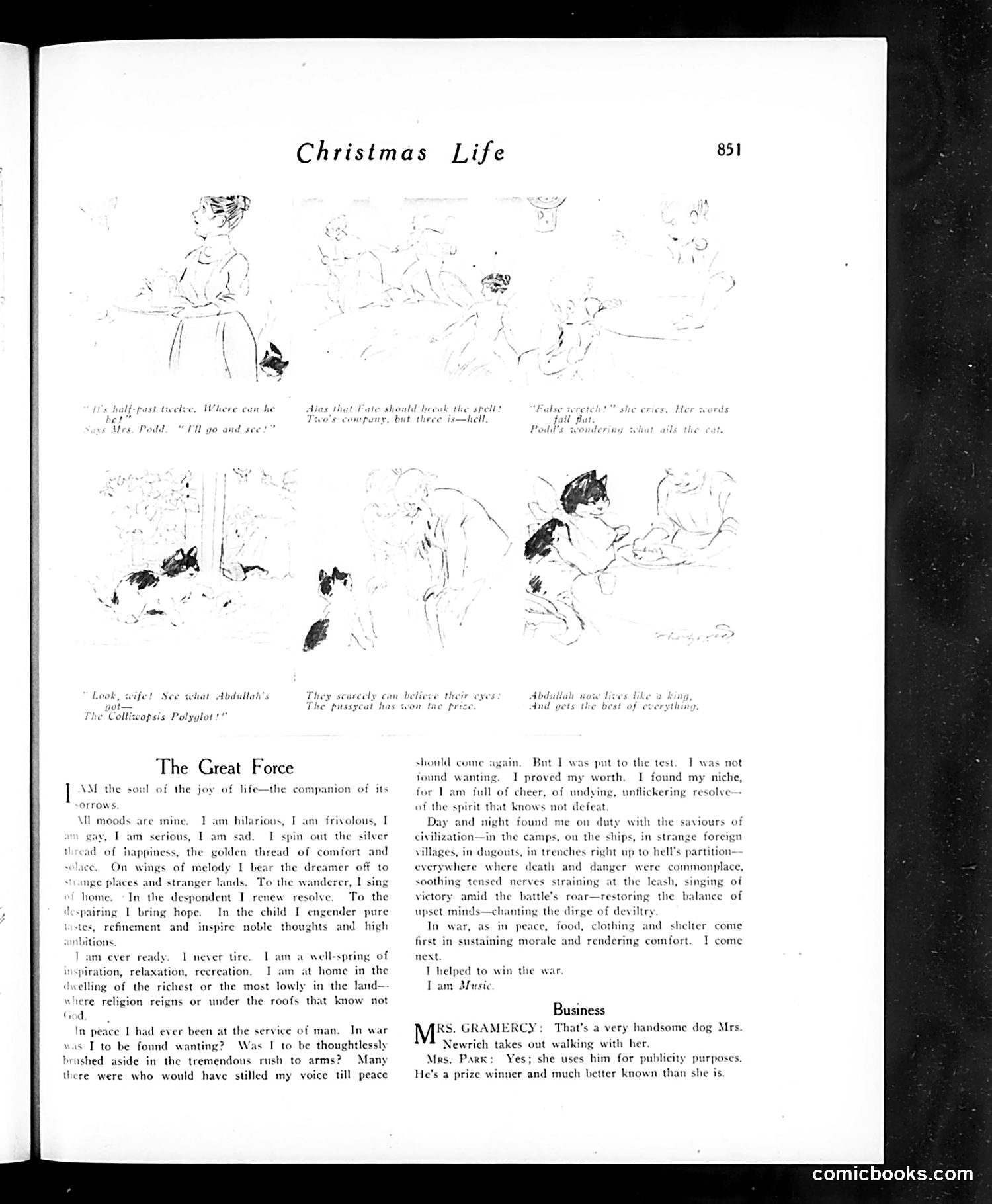
The top half contains three cartoon vignettes depicting Christmas domestic scenes with children and adults. The captions reference a "Fate" breaking a spell and a cat, suggesting humor about holiday chaos and pet mischief. The main article, "The Great Force," is a personified monologue by **Music**—presented as a character claiming indispensable wartime service. Music boasts of lifting morale in WWI military camps, trenches, and ships, arguing it was essential to winning the war alongside food and shelter. At bottom, "Business" is a brief joke about Mrs. Newrich (a caricature name suggesting a newly-wealthy person) who walks her prize-winning dog primarily for publicity purposes, with the dog being more famous than its owner—satire of vanity and status-seeking among the nouveau riche.
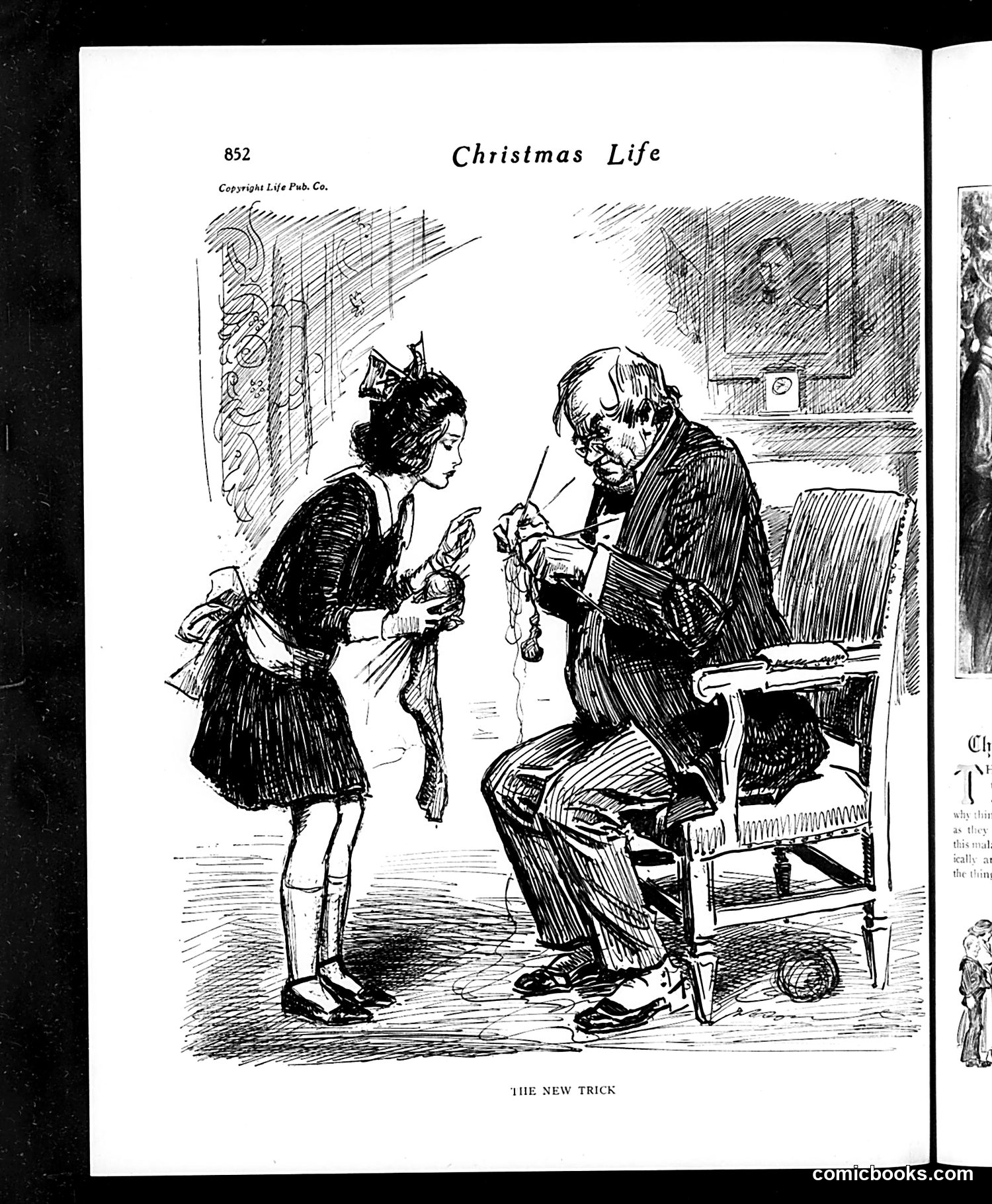
This satirical illustration shows an older man sitting in a chair demonstrating what appears to be a magic trick or sleight-of-hand with string to a young girl standing before him. The caption "THE NEW TRICK" suggests he's teaching her something deceptive. The humor likely plays on the contrast between the elderly figure's shabby appearance and worn clothing versus the domestic, respectable setting. The "trick" being demonstrated—possibly related to gift-wrapping or some form of deception—may satirize either parental trickery around Christmas gift-giving, or commentary on social pretense during the holiday season. Without additional context about Life magazine's specific 1920s-era satirical focus, the precise social target remains unclear, though the image appears to mock holiday-related deception or fraud.
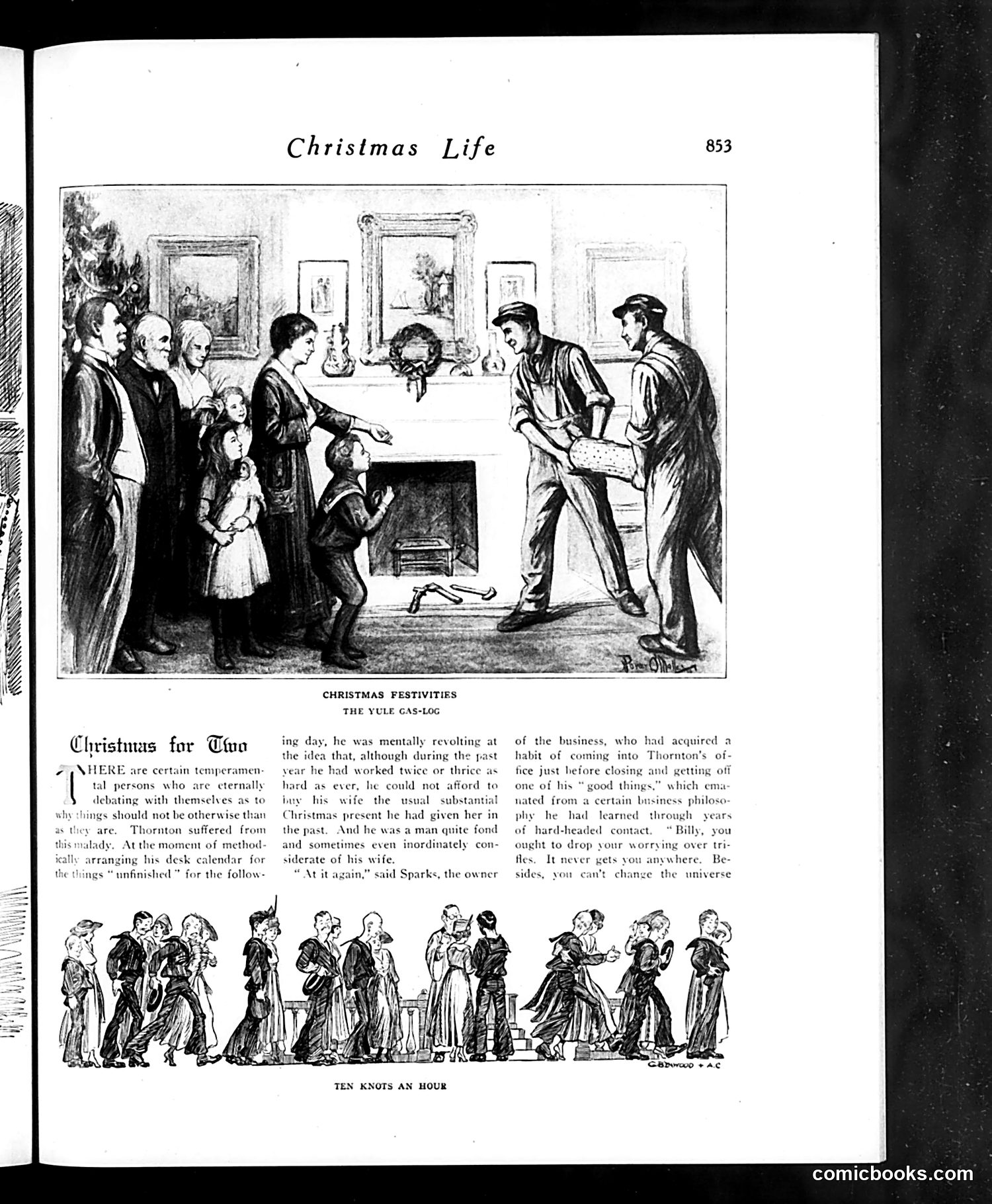
This page satirizes the financial anxieties of middle-class men during the Christmas season. The main illustration shows a working man (Thornton) struggling with the tension between wanting to give his wife a traditional substantial Christmas gift and his inability to afford it due to economic hardship. The accompanying text reveals Thornton's mental conflict: despite working as hard as ever, he cannot provide the usual present. His colleague Sparks offers cynical workplace philosophy, essentially telling him to accept life's disappointments—"you can't change the universe." The satire targets both masculine pride and the commercialization of Christmas. The humor lies in depicting the tension between sentimental ideals (generous gift-giving, marital devotion) and harsh economic reality. The "Yule Gas-Log" caption suggests artificial comfort replacing genuine warmth, reinforcing the theme of unmet expectations. This reflects early-20th-century anxieties about masculine economic responsibility and the burden of holiday expectations.
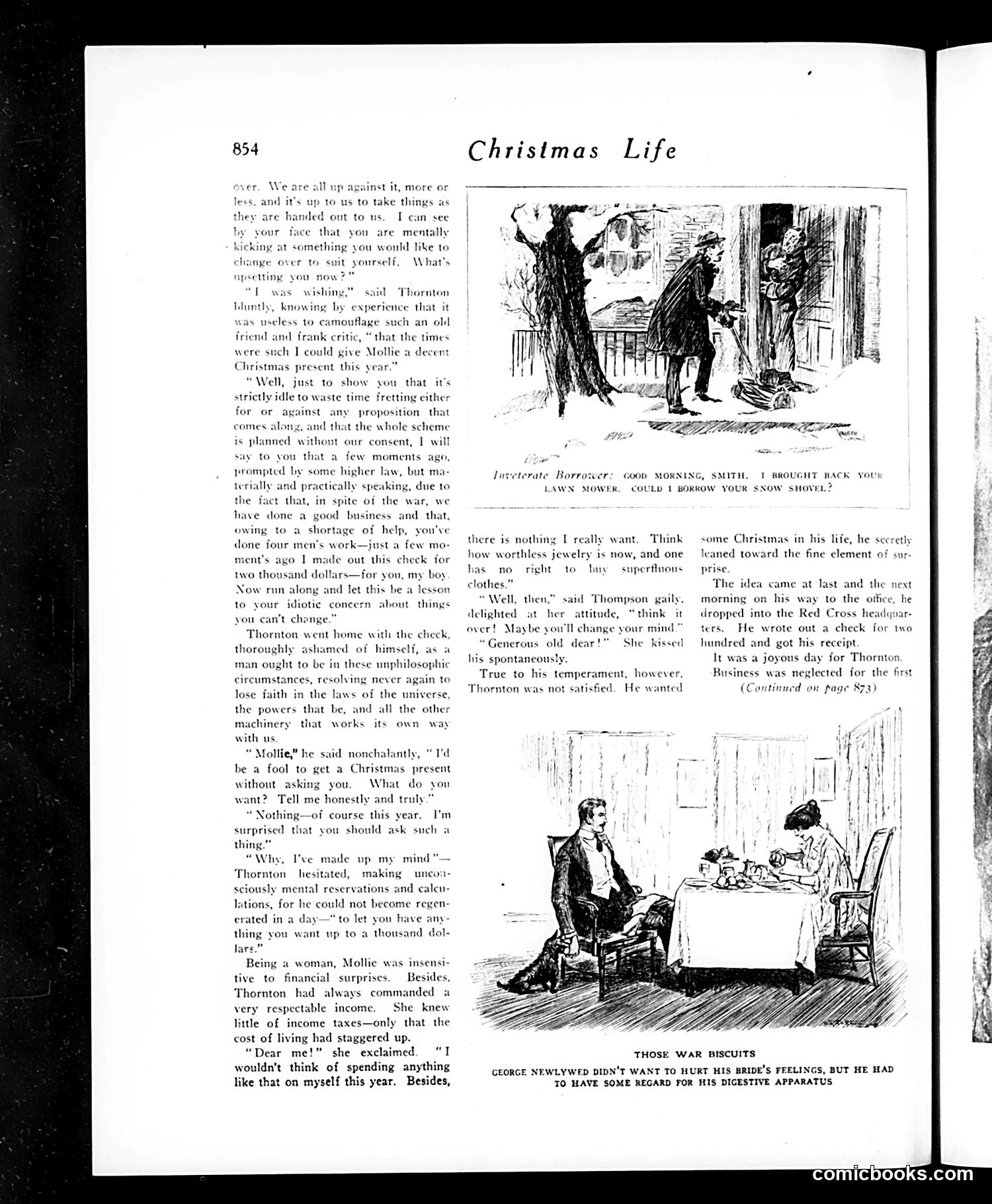
This page presents a story about financial morality during wartime. A man named Thornton receives a $2,000 bonus from his employer, who philosophizes that such windfalls come from the universe's benevolent design—conveniently ignoring that Thornton did four men's work due to wartime labor shortages. Thornton wants to give his wife Mollie a lavish Christmas gift, but she refuses on principle, citing how "worthless jewelry is now" and that buying "superfluous clothes" is inappropriate. Instead, Thornton secretly donates to the Red Cross, finding satisfaction in wartime charity rather than personal indulgence. The page satirizes middle-class wartime attitudes: employers congratulating themselves for bonuses while workers sacrifice; wives performing moral reasoning about consumption; and the redirection of excess wealth toward patriotic causes rather than personal pleasure—all presented as noble restraint during the war effort. The bottom cartoon about "War Biscuits" likely mocks rationed or inferior wartime food quality.
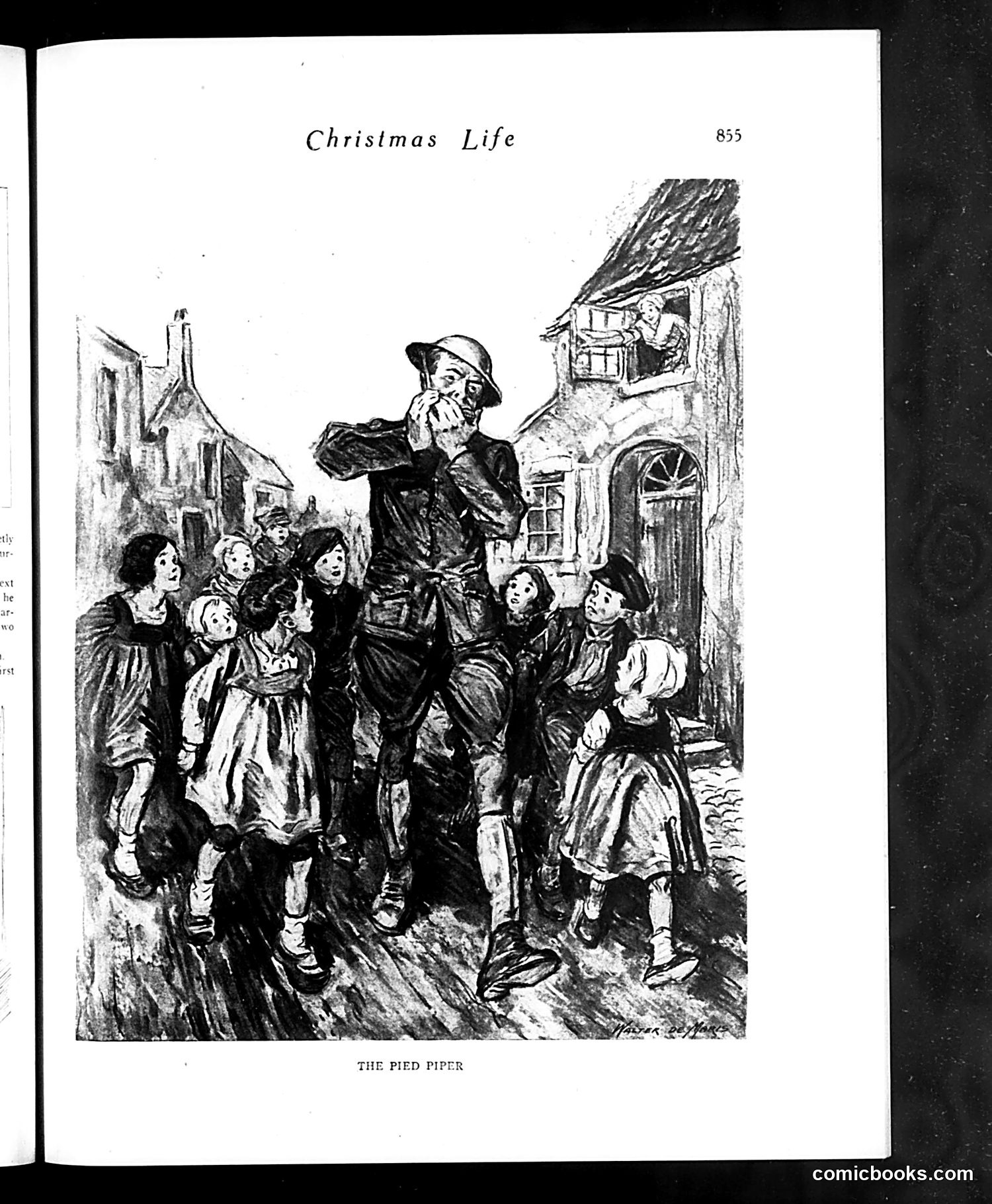
This illustration depicts the famous German folk legend of the Pied Piper of Hamelin—a mysterious musician who allegedly led away all the children of a town after the townspeople refused to pay him for ridding them of rats. The image shows a tall figure in a hat and coat, playing a pipe while children of various ages follow him down a medieval street lined with buildings. The children appear enchanted or compelled by his music. This appears as a straightforward literary illustration rather than political satire. Published under "Christmas Life," it likely served as festive seasonal content—a classic tale appropriate for the holiday issue. The page number 855 suggests this is from a substantial publication.
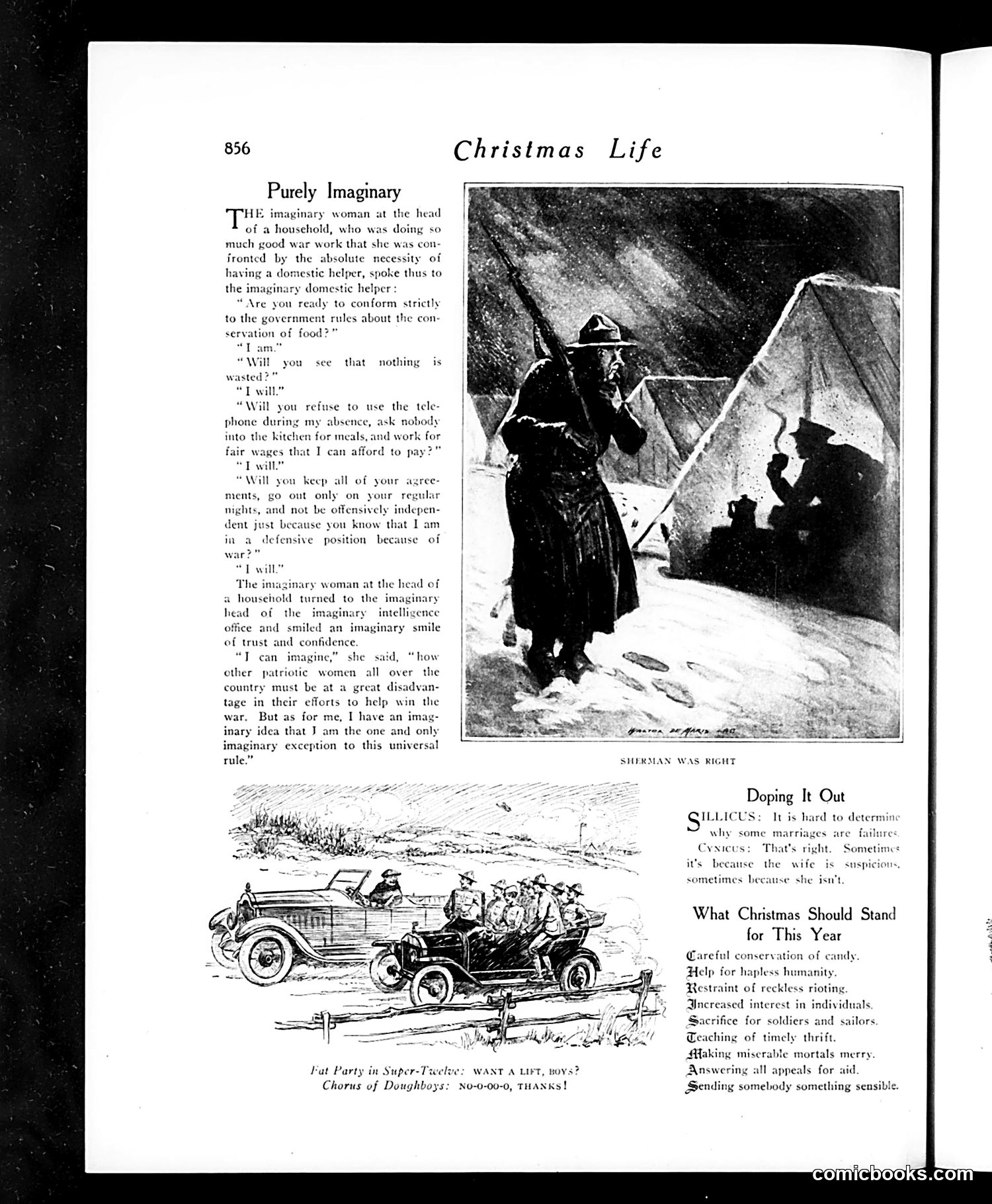
This *Life* magazine page from WWI era satirizes upper-class women's wartime hypocrisy. **"Purely Imaginary"** mocks a wealthy housewife who congratulates herself for strict patriotic sacrifice—demanding her domestic helper follow government food-conservation rules, work cheaply, avoid phone use, and accept restricted freedoms. The joke: the housewife is entirely *imaginary*, as is her servant's compliance. The text reveals her actual exception: she alone believes she deserves exemption from universal wartime sacrifice because of her "defensive position." **"Sherman Was Right"** (bottom left) shows soldiers refusing a ride in an overloaded car with civilians—a quip referencing General Sherman's famous statement that "war is hell," suggesting civilian life remains frivolous even during conflict. The sidebar "What Christmas Should Stand for This Year" lists patriotic virtues (conservation, restraint, sacrifice), directly contrasting with the imaginary woman's self-deception about her own patriotism. **The satire targets**: class privilege masquerading as sacrifice; women's selective application of wartime rules; domestic worker exploitation.
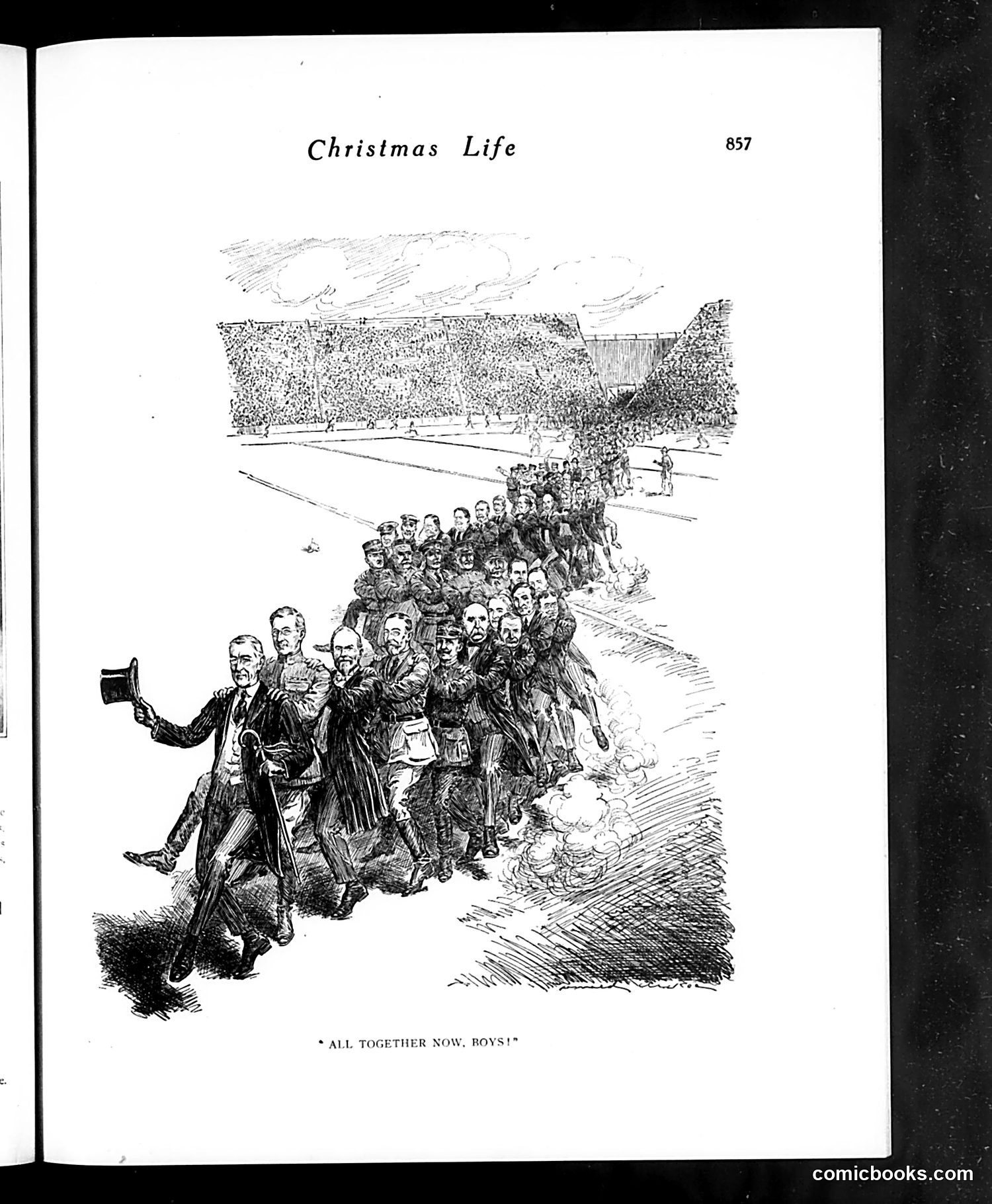
This satirical cartoon depicts a military procession or parade, with a uniformed leader in front holding what appears to be a hat or cap, exhorting soldiers behind him. The caption "All Together Now, Boys!" suggests coordination or unity being demanded. The context likely concerns early 20th-century military mobilization or wartime organization. The figure leading appears to be a commanding officer or political leader rallying troops. The satirical point seems to mock the forced or artificial nature of military unity—the ironic "all together" suggests the difficulty of achieving genuine cohesion or the hollow nature of such appeals. Without the publication date visible, the specific military context remains unclear, though the style suggests WWI or interwar period.
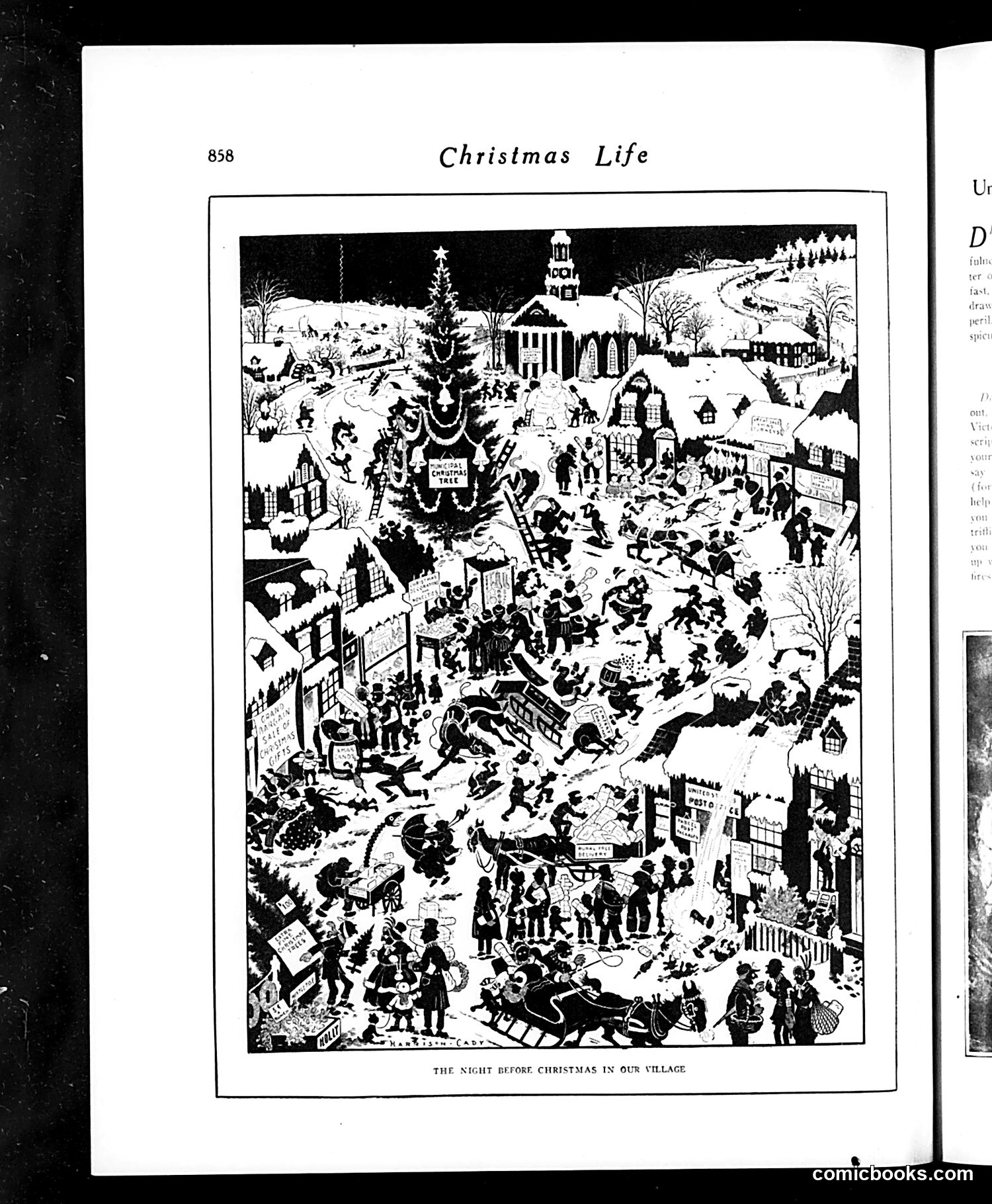
This is a detailed black-and-white illustration depicting a bustling Christmas Eve scene in a village. The image shows a crowded, busy town square filled with numerous figures engaged in various holiday activities: sledding, shopping, caroling, and general celebration around a large decorated Christmas tree in the center. A church with a steeple is visible in the background, and snow covers the landscape. Rather than political satire, this appears to be a wholesome, nostalgic illustration celebrating small-town American Christmas traditions. It's a visual pun on the famous poem "The Night Before Christmas," reimagined as a crowded, chaotic community event rather than the quiet domestic scene described in the poem. The humor lies in the contrast between the poem's peaceful narrative and this frenetic village celebration.
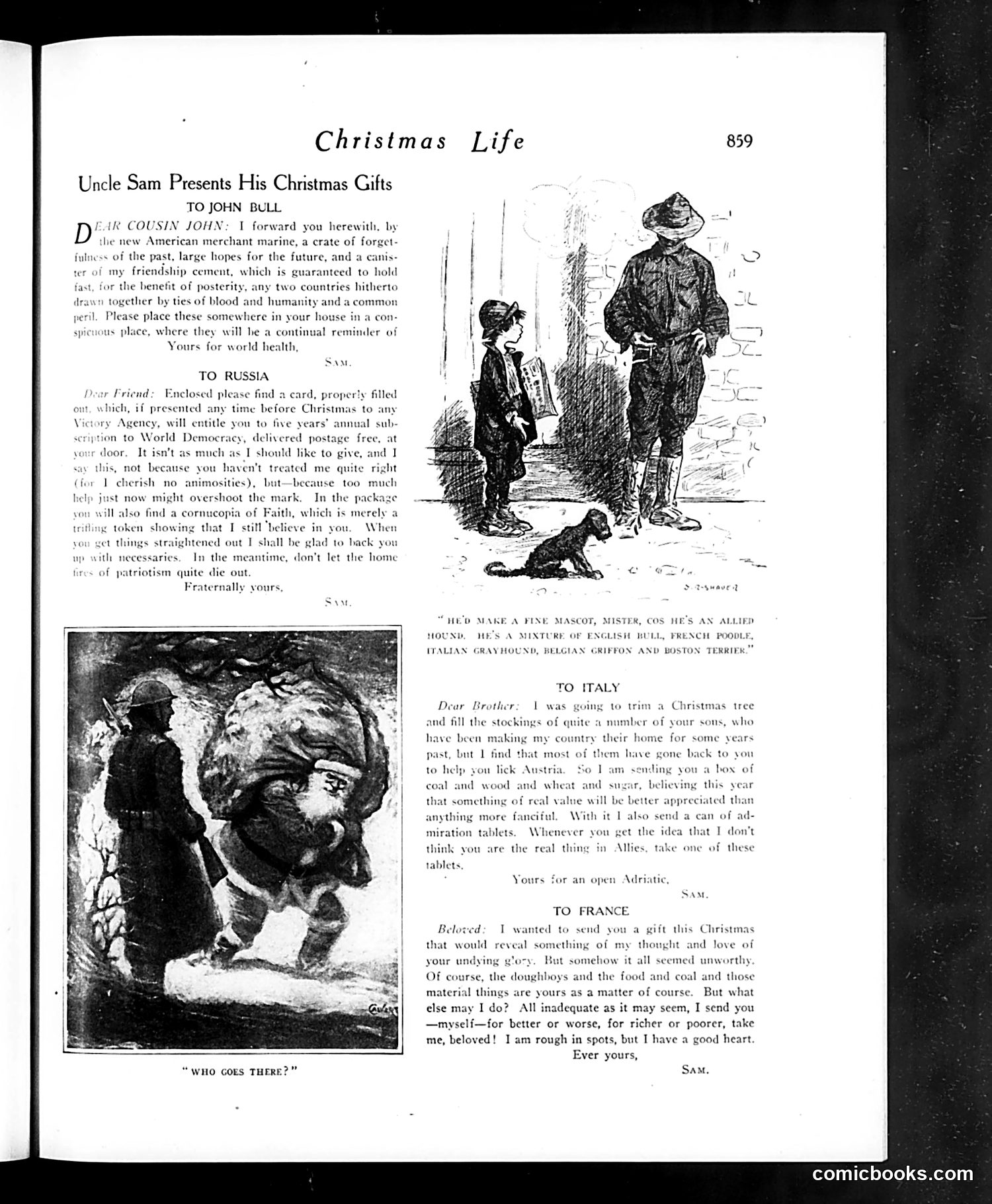
This page presents Uncle Sam's personified gifts to Allied nations during World War I. To "John Bull" (Britain), he sends forgiveness and friendship cement to bind nations together. To Russia, he offers a subscription to "World Democracy" but cautiously—suggesting wariness despite alliance. To Italy, he sends practical supplies (coal, wood, wheat, sugar) rather than luxuries, implying Italy's recent entry into the war and uncertain loyalty. To France, he offers himself emotionally and materially, expressing romantic devotion to France's "undying glory." The accompanying sketches show Uncle Sam with Allied representatives and a mixed-breed dog symbolizing the Allied coalition's disparate members (English bull, French poodle, Italian greyhound, Belgian griffon, Boston terrier). The satire reflects American attitudes toward each ally: protective paternalism toward some, cautious skepticism toward others, and sentimental reverence for France.
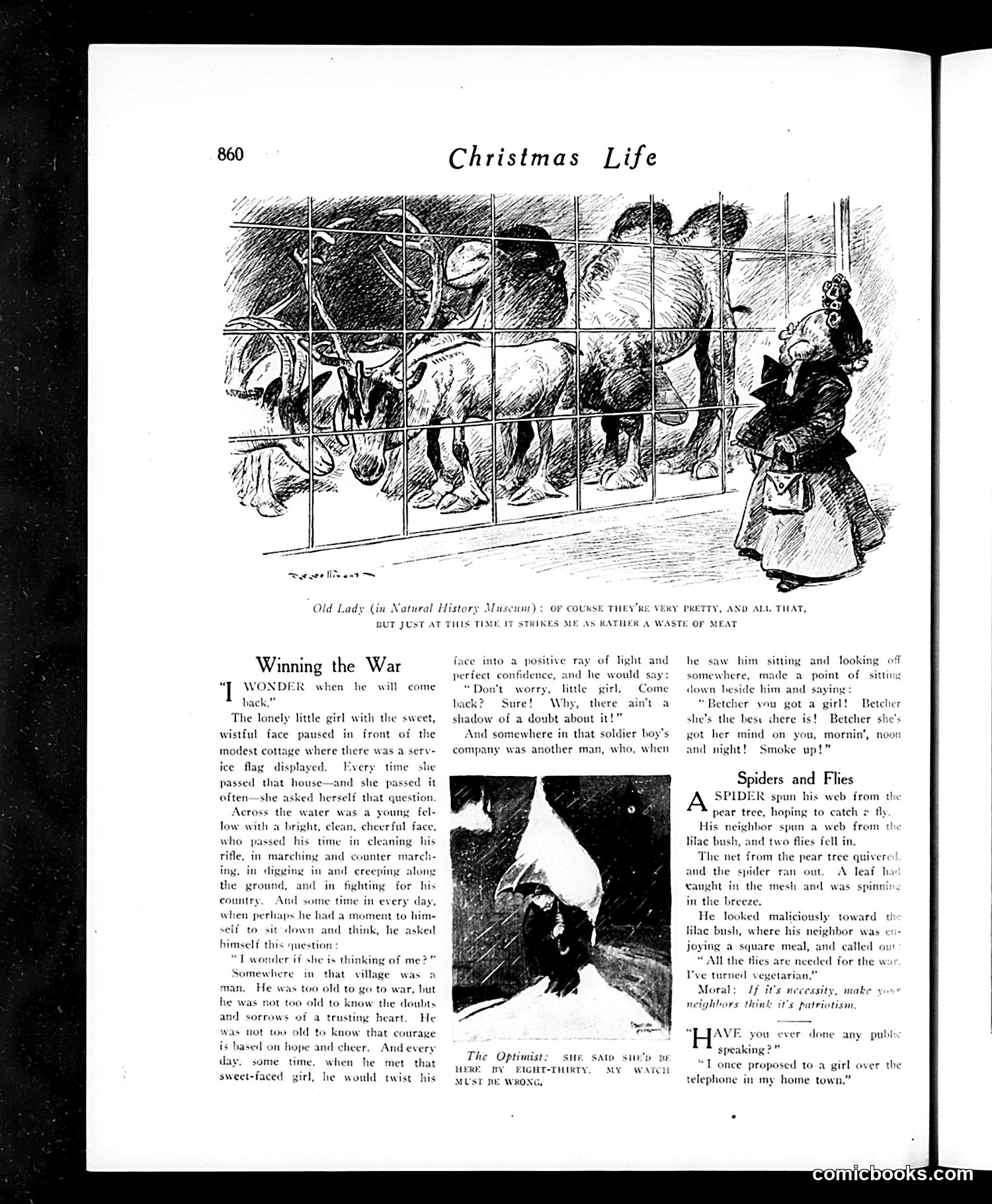
This page contains three separate pieces of wartime satire, likely from WWI: **"Winning the War"**: A sentimental story about a young girl watching a soldier's service flag, an older man, and a soldier—each wondering if they're being thought of. The narrative emphasizes emotional courage and hope sustaining the home front during war. **"Old Lady (in Natural History Museum)"**: The single-panel cartoon shows a woman viewing dinosaur skeletons, remarking that at this moment they strike her "as rather a waste of meat"—dark humor suggesting food rationing or scarcity during wartime. **"Spiders and Flies"**: An Aesop-style fable where one spider catches flies for the war effort while another claims to have "turned vegetarian" from patriotism. The moral warns against false patriotic justifications for selfish behavior. **"The Optimist"**: A brief joke about someone confidently predicting his watch will be wrong by 8:30—trivializing minor concerns during wartime. These pieces collectively mock civilian anxieties and false patriotism while celebrating genuine sacrifice and hope.
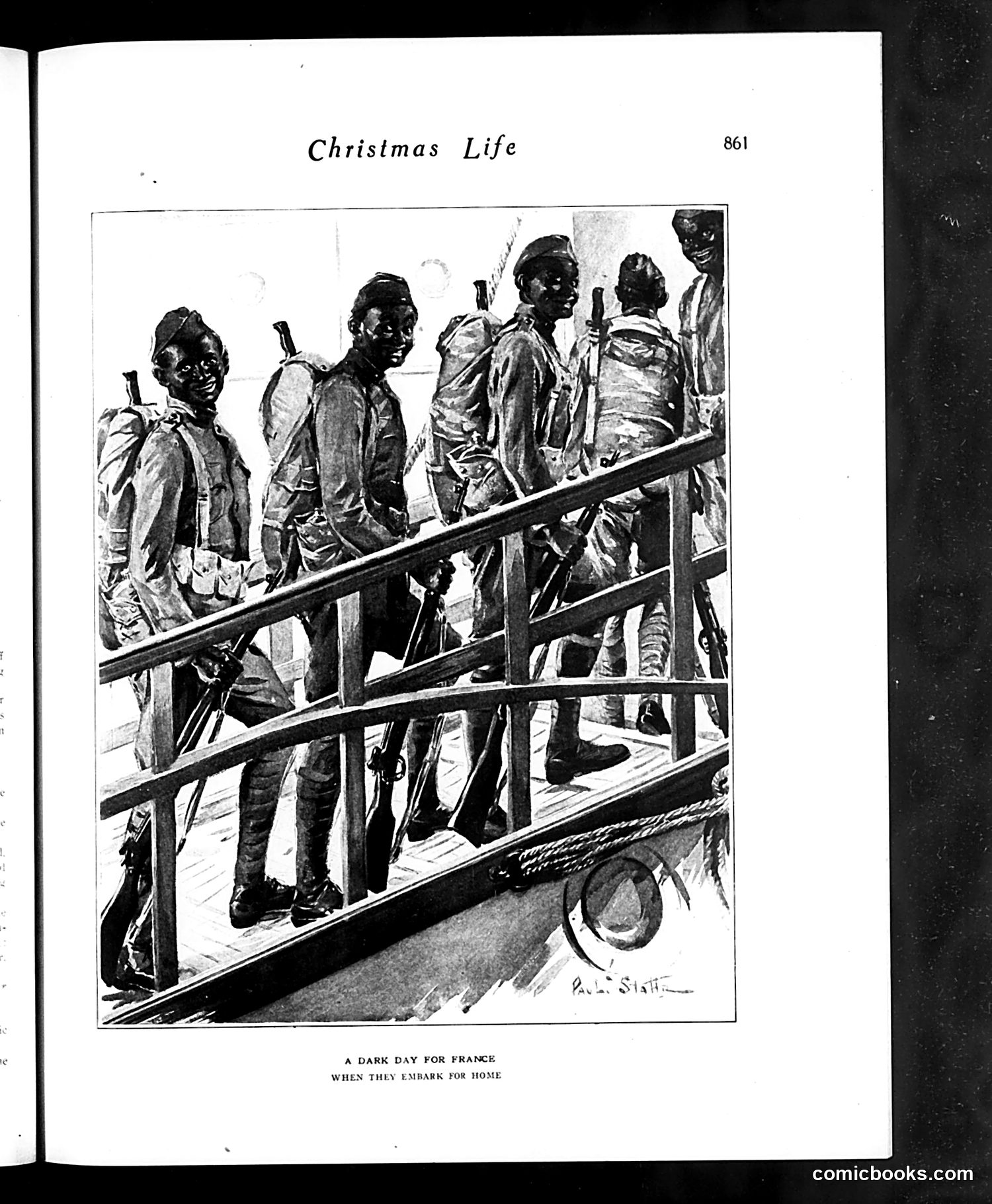
This illustration depicts soldiers boarding a ship to return home, captioned "A Dark Day for France—When They Embark for Home." The image appears to reference World War I, showing uniformed soldiers (likely French troops) ascending a gangway. The satire's meaning is ambiguous without additional context. The caption could suggest: - **Irony about France losing manpower** as soldiers depart for home (viewing their departure as harmful to French interests) - **Criticism of military demobilization** after war - **Commentary on the human cost** of war, treating soldiers' departure as a national loss The artist signature reads "B.J. Slait" (or similar). Without knowing Life magazine's editorial stance at this specific date, the precise satirical target—whether it mocks French leadership, wartime sacrifice, or something else—remains unclear.
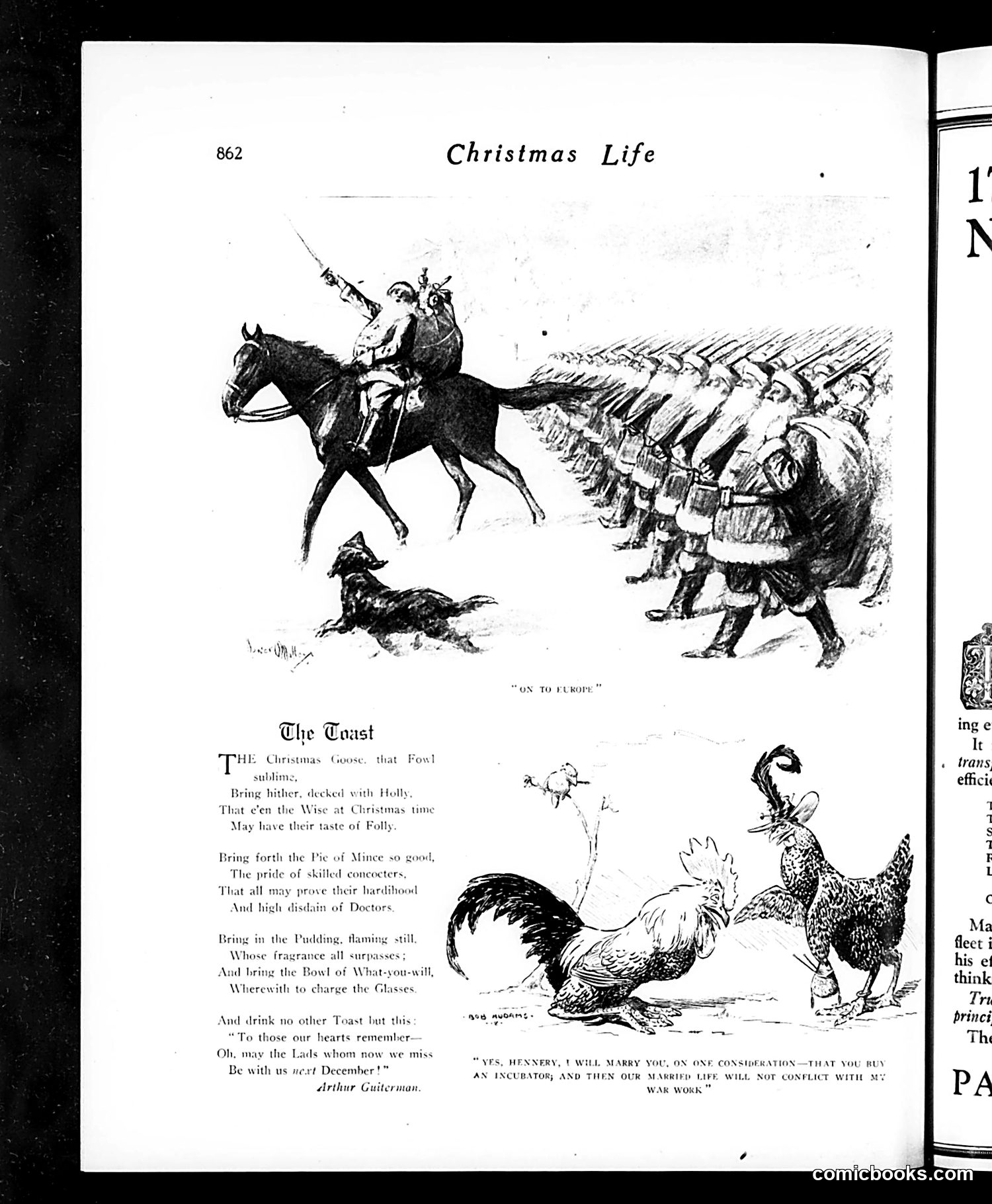
This WWI-era *Life* magazine page combines Christmas sentiment with wartime commentary. The top cartoon titled "On to Europe" depicts soldiers marching in formation while a mounted military figure leads them forward, with a small dog observing—satirizing the mobilization of troops to the European theater. Below, "The Toast" is a nostalgic poem by Arthur Guiterman calling for traditional Christmas foods and drink, urging readers to remember absent soldiers with the refrain "may the Lads whom now we miss / Be with us next December!" The bottom cartoon shows a humorous domestic scene: a hen tells a rooster she'll marry him only if he buys an incubator, since otherwise their married life will "conflict with my war work"—a tongue-in-cheek reference to women entering the workforce during WWI, even applying industrial logic (incubators replacing natural reproduction) to civilian life during wartime mobilization.

This is not a cartoon or satirical content—it's a **full-page advertisement** for Packard Motor Car Company, disguised within *Life* magazine's Christmas issue. The ad announces results of a "National Truck Efficiency Test" involving 1,760 Packard trucks tested over three months. It lists prize winners in three truck-capacity classes, with $5,025 in total awards distributed. The pitch emphasizes that Packard conducted this test in cooperation with the National Council of Defense and War Industries Board—framing truck efficiency as a **patriotic, wartime contribution** to save railroad capacity for government military use (likely WWI era, given the references). The ad's strategy targets small fleet owners by claiming the test's "transportation principles" apply universally—whether you own one delivery truck or a large fleet—and invites readers to visit their local Packard dealer for free consultation. There is no satire here; it's straightforward corporate marketing exploiting wartime efficiency concerns to promote Packard's competitive advantage.
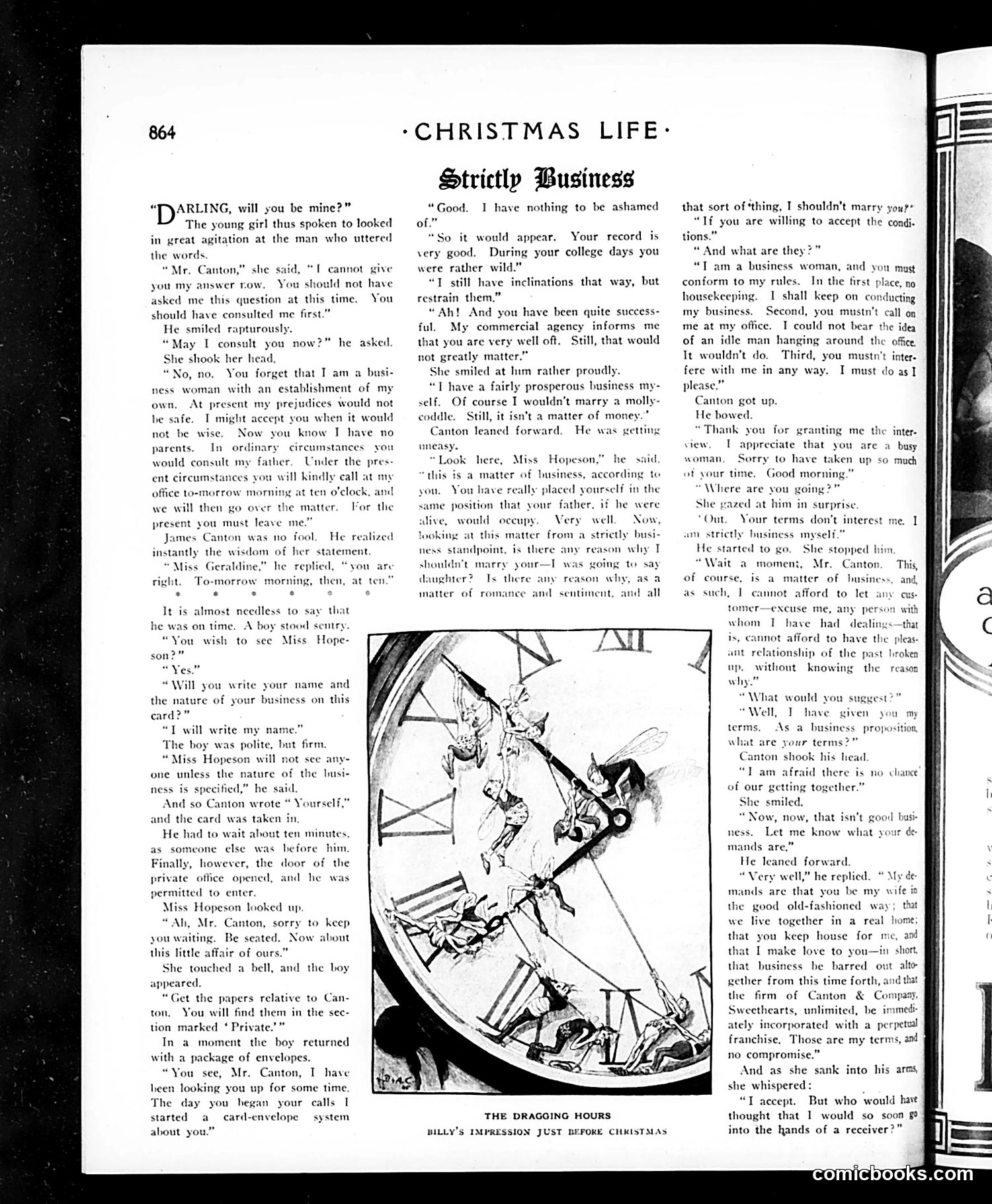
This story satirizes the emerging tension between traditional courtship and early-20th-century business culture. The humor centers on Miss Hopeson, a successful businesswoman who treats romantic proposal with the same clinical efficiency she applies to commerce. When Mr. Canton proposes marriage, she refuses to answer emotionally, instead directing him to her *office* the next morning "at ten o'clock"—treating his proposal like a business appointment. She maintains a filing system tracking his background ("card-envelope system"), negotiates marriage terms like a contract, and imposes strict conditions: he cannot interfere with her business, cannot visit her office, and must accept her continued independence. The satire targets both the rigidity of professional business culture and the challenge posed by educated, economically independent women to traditional gender roles. Her insistence on maintaining her own establishment and refusing an "idle man" around the office reflects anxieties about women's economic power in this era. The cartoon's title, "Strictly Business," underscores how completely commercial logic has replaced romantic sentiment—reducing marriage itself to a negotiated contract between equals.
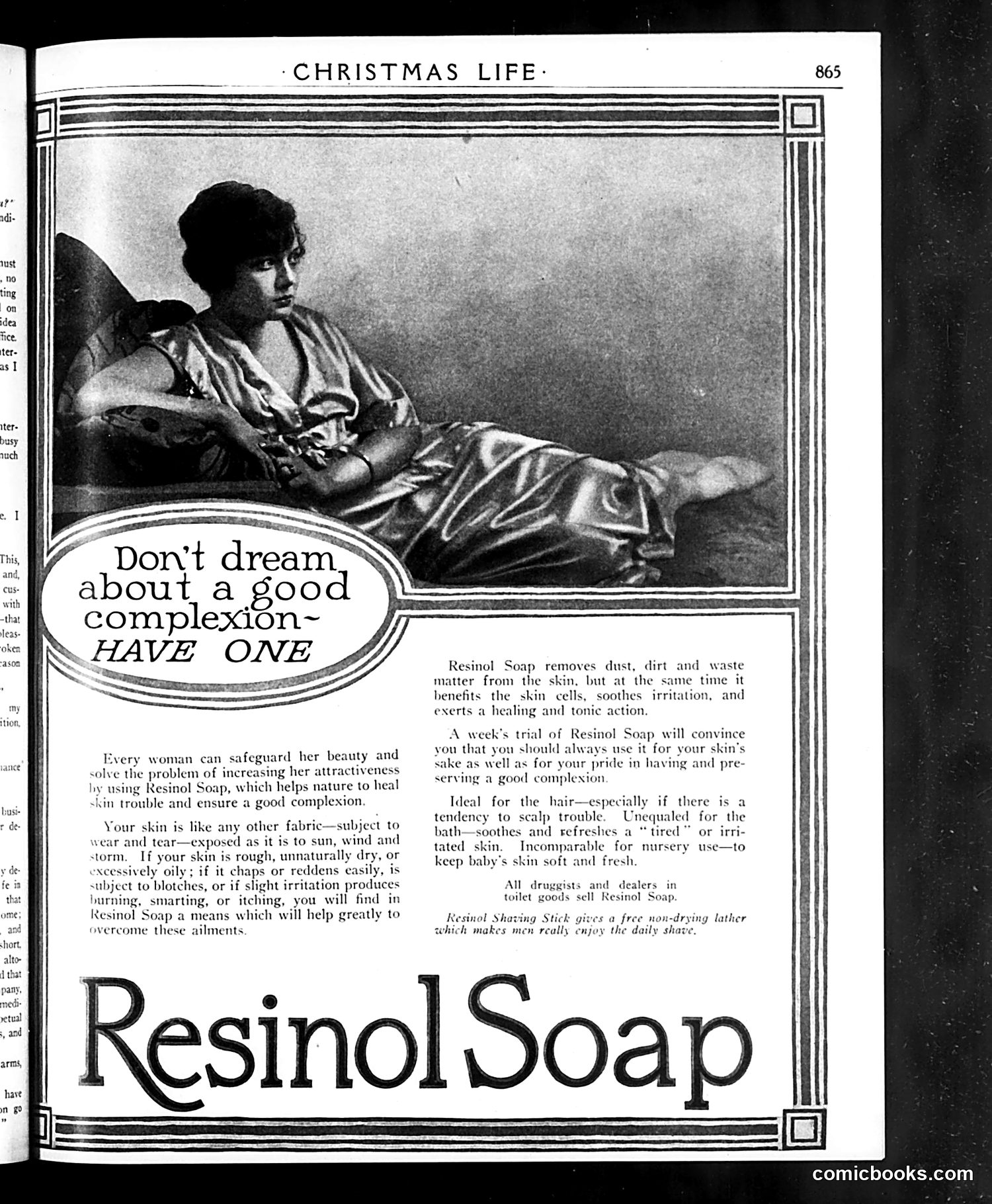
This is a **Resinol Soap advertisement**, not satire or a political cartoon. The page appears in *Life* magazine's "Christmas Life" section (page 865). The ad features a glamorous woman in classical repose, accompanying copy that promises Resinol Soap will solve skin problems and preserve beauty. The tagline "Don't dream about a good complexion—HAVE ONE" frames skincare as achievable through the product. The advertisement reflects early 20th-century beauty marketing that: - Positioned women's appearance as essential to their value - Used pseudo-scientific language ("benefits skin cells," "tonic action") - Promoted the product for multiple uses (face, hair, babies) - Connected complexion to femininity and social standing For modern readers, this illustrates how vintage advertising sold insecurity alongside products, treating skin maintenance as a woman's responsibility for attractiveness and "pride."
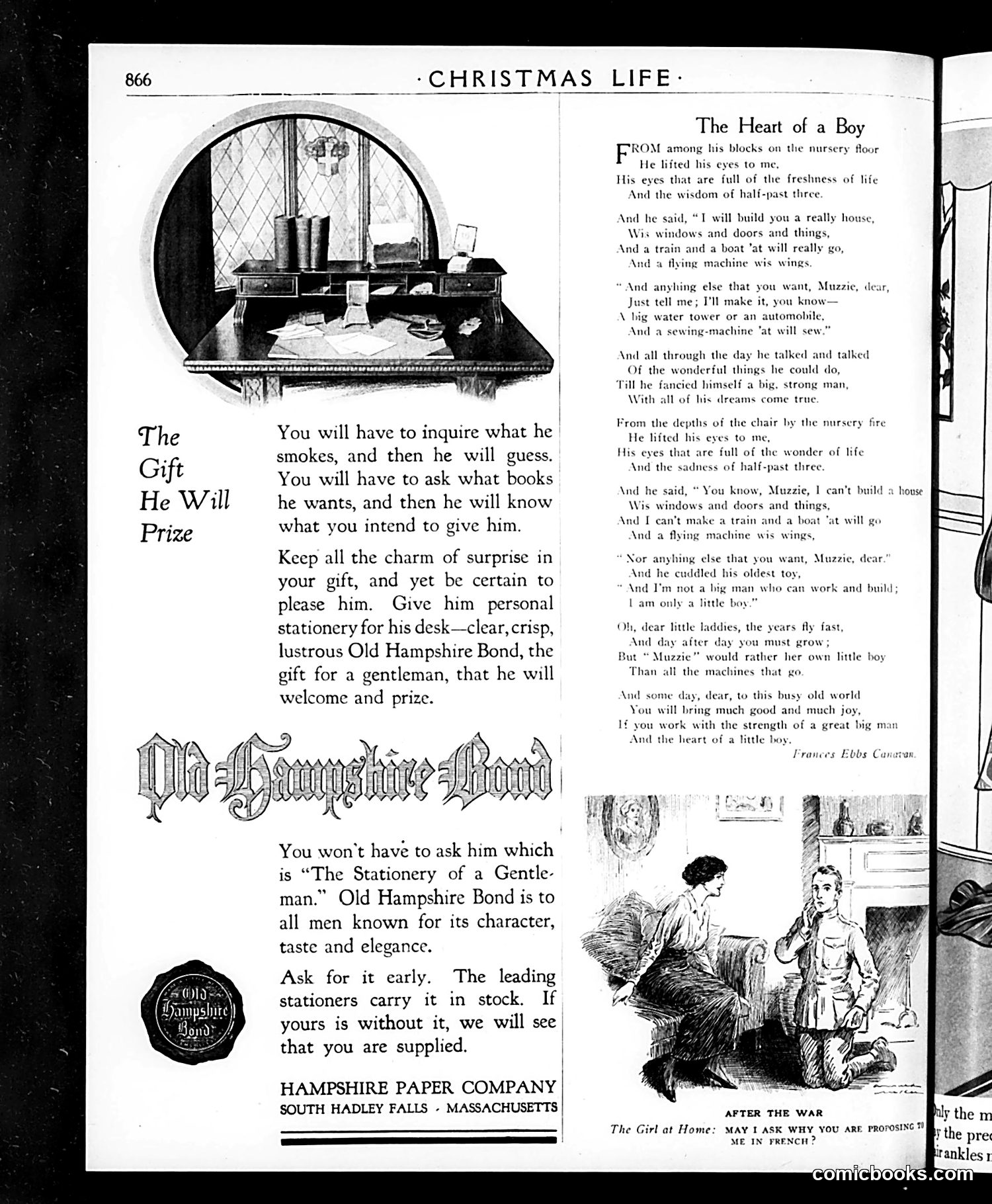
This page contains two distinct pieces: **Left side:** An advertisement for Old Hampshire Bond stationery by the Hampshire Paper Company. The ad targets gift-givers seeking presents for gentlemen, emphasizing that quality stationery is a sophisticated, universally recognized gift requiring no guesswork about the recipient's preferences. **Right side:** "The Heart of a Boy," a sentimental poem by Frances Ebbs Canavan about a young child's boundless ambitions—building houses, trains, boats, flying machines—contrasted with his later realization of his limitations as "only a little boy." The poem concludes with a mother's wisdom: childhood innocence and earnest effort matter more than grand accomplishments. **Bottom illustration:** "After the War" appears to be a brief cartoon caption-joke about a soldier proposing to a woman in French, presumably learned during WWI service abroad. The girl's surprised question suggests either bewilderment at the language choice or satirical commentary on soldiers' changed behavior post-war. The page blends commercial advertising with nostalgic, family-focused editorial content typical of early 20th-century *Life* magazine.
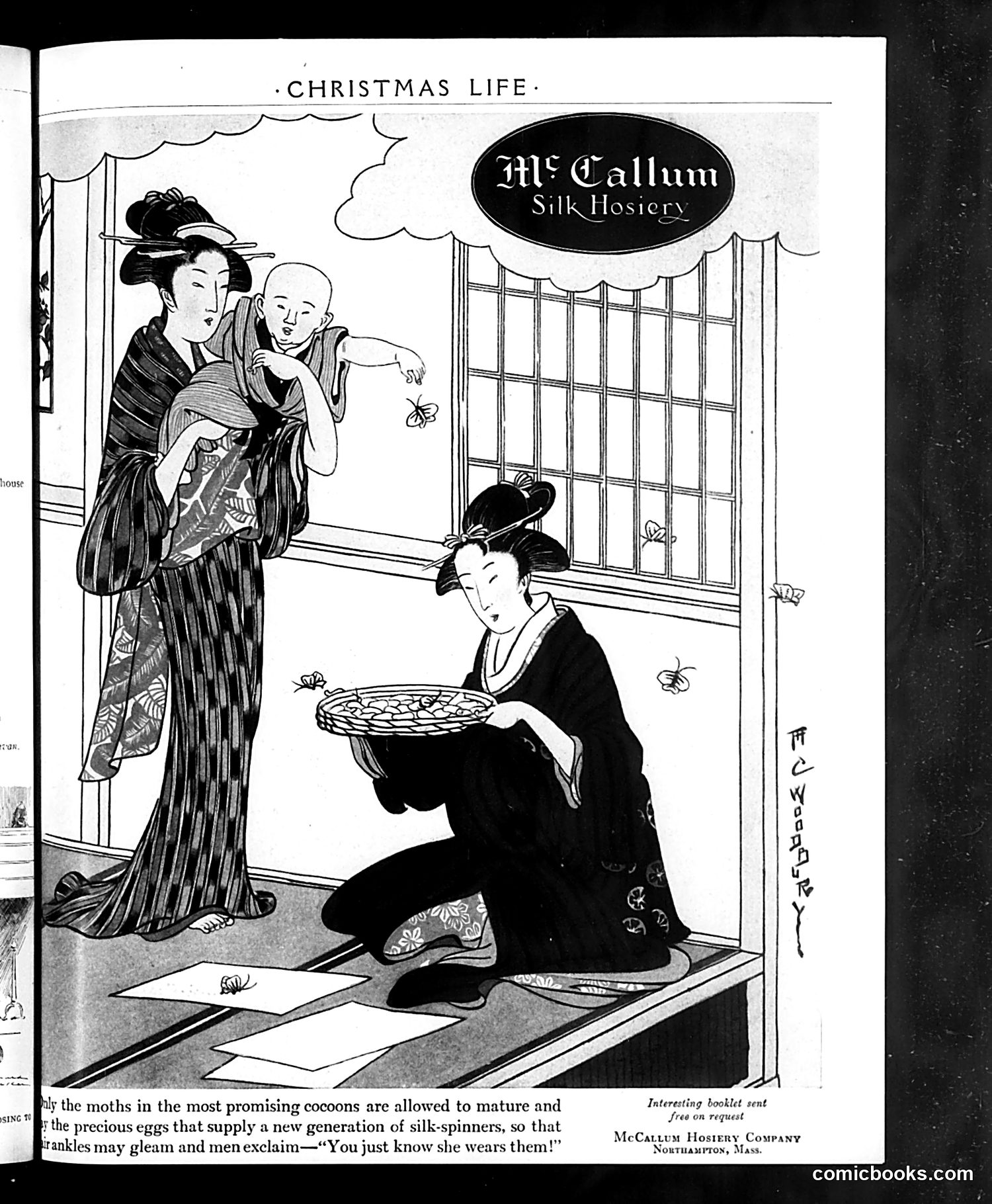
This page is primarily an **advertisement for McCallum Silk Hosiery**, disguised as editorial content in Life magazine's "Christmas Life" section. The illustration depicts an East Asian (likely Japanese) domestic scene with three figures examining silk cocoons and eggs. The accompanying text explains the silk production process—how only moths from the best cocoons are allowed to mature to produce eggs for new silk-spinners. **The satire/pitch**: The ad uses exotic imagery and technical detail about silk cultivation to create aspirational appeal. The tagline—"You just know she wears them!"—plays on the luxury and prestige associated with silk stockings. The joke is that McCallum wants readers to understand they're buying not just hosiery, but the product of careful, almost scientific cultivation—suggesting superior quality and justifying the premium price. The East Asian setting exoticizes silk production, playing into early 20th-century consumer marketing that associated distant, "refined" cultures with luxury goods.
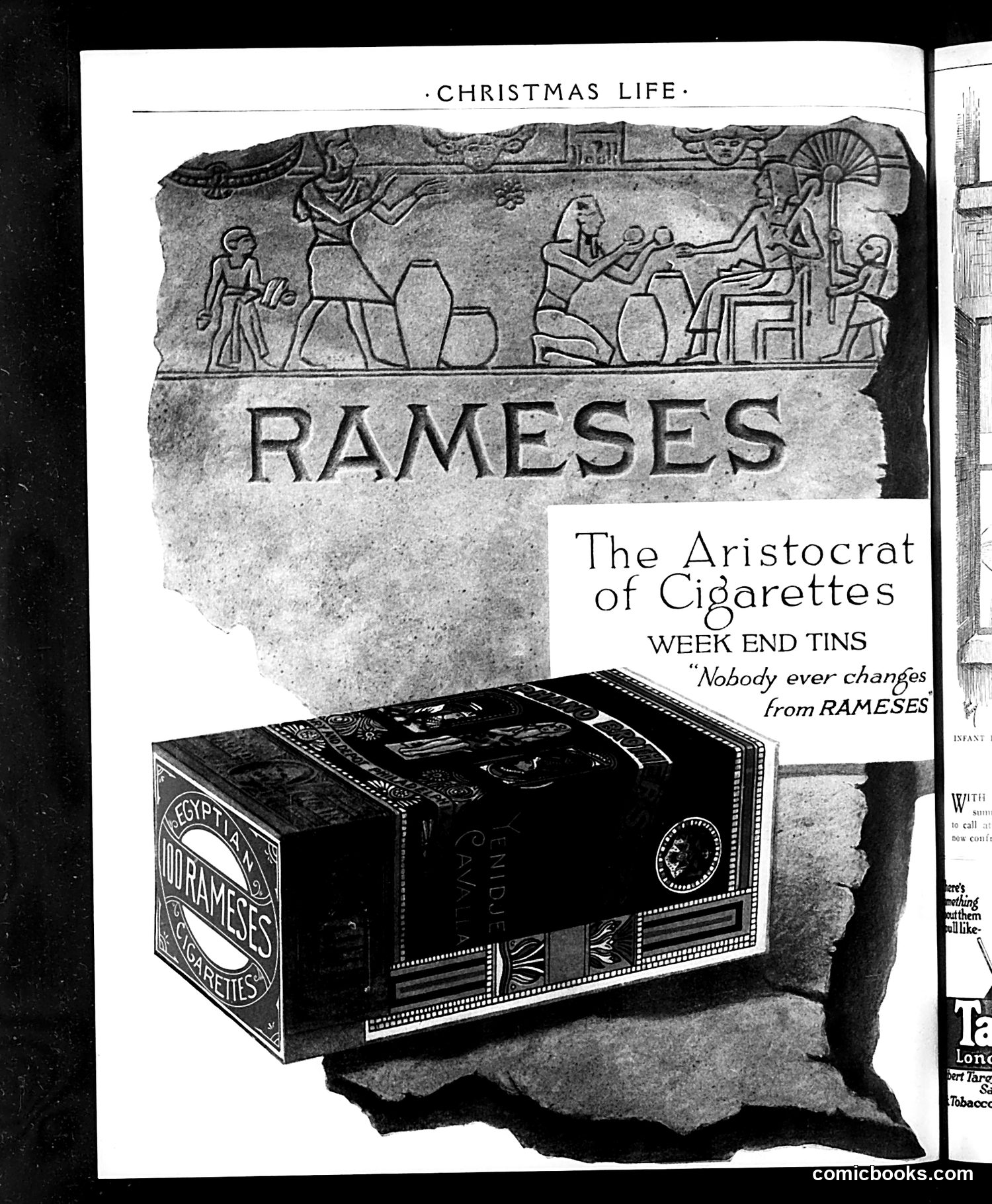
This is primarily a **cigarette advertisement**, not editorial satire. The page uses an Egyptian artifact motif—showing what appears to be a hieroglyphic relief carving labeled "RAMESES"—to market Rameses brand cigarettes as "The Aristocrat of Cigarettes." The ad employs a common early 20th-century marketing strategy: associating a consumer product with ancient prestige and exotic glamour. The Egyptian imagery (Rameses was a pharaoh) suggests luxury and timelessness, reinforced by the slogan "Nobody ever changes from RAMESES"—implying the product's superior, established quality. The "Week End Tins" format offered cigarettes in decorative packaging suitable as gifts. This reflects a pre-regulation era when cigarette advertising appeared freely in mainstream publications without health warnings.
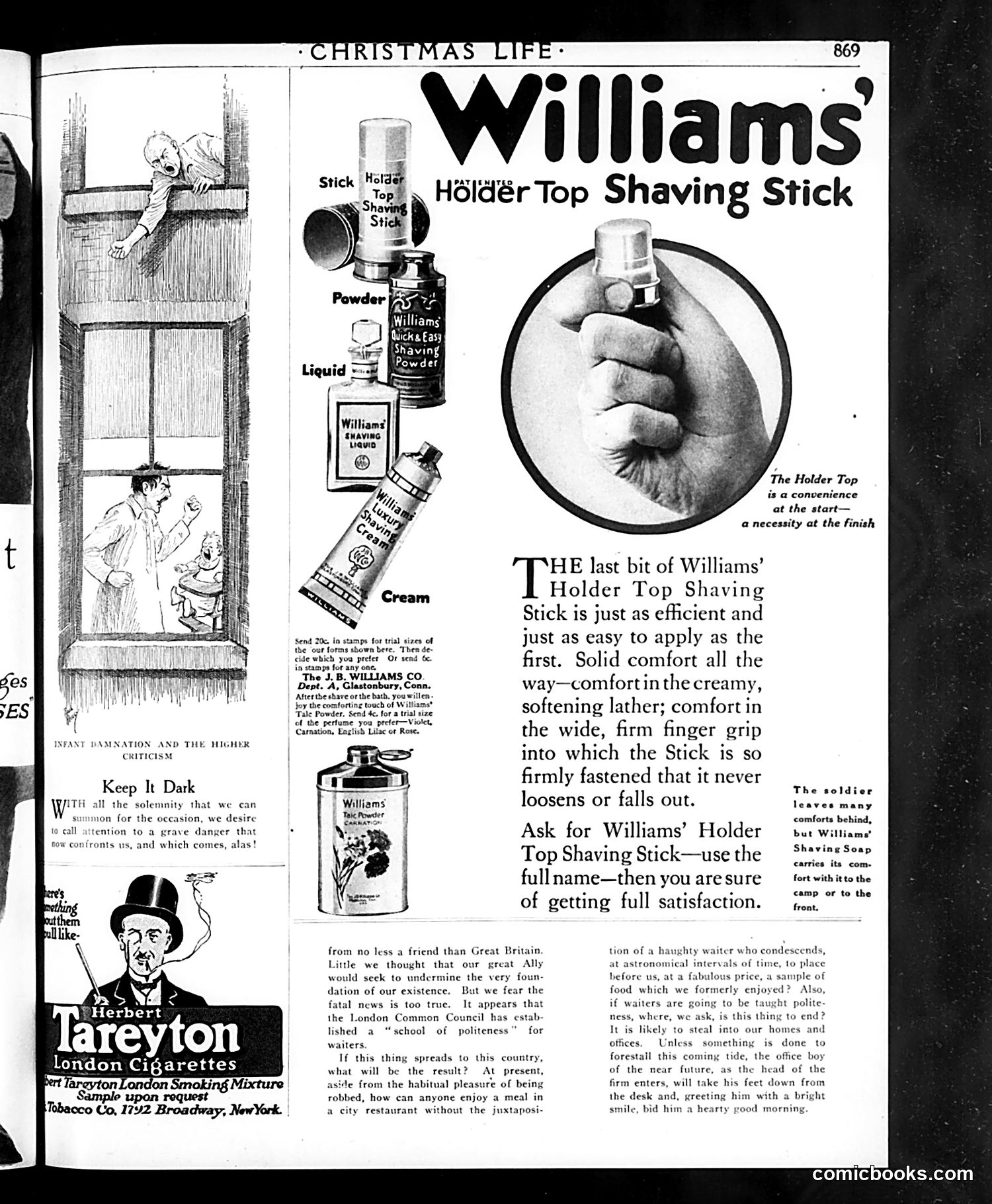
This page contains two distinct pieces: **Right side:** A Williams' Holder Top Shaving Stick advertisement showing the product's features and grip design. **Left side:** A satirical article titled "Keep It Dark" mocking British social refinement. The piece humorously warns that Britain has established a "school of politeness" for waiters, and expresses mock horror that this courtesy might spread to America. The satire suggests that American restaurant culture depends on waiters being rude and dismissive—that polite service would fundamentally undermine the dining experience. The author sarcastically fears politeness might even infect American offices, where office boys would stop putting their feet on desks and actually greet their bosses respectfully. The accompanying cartoon (left) depicts characters in various states of social disorder, supporting the theme of satirizing excessive formality and politeness as unwelcome social threats. This reflects early 20th-century American attitudes viewing British etiquette as stuffy and unnecessary.
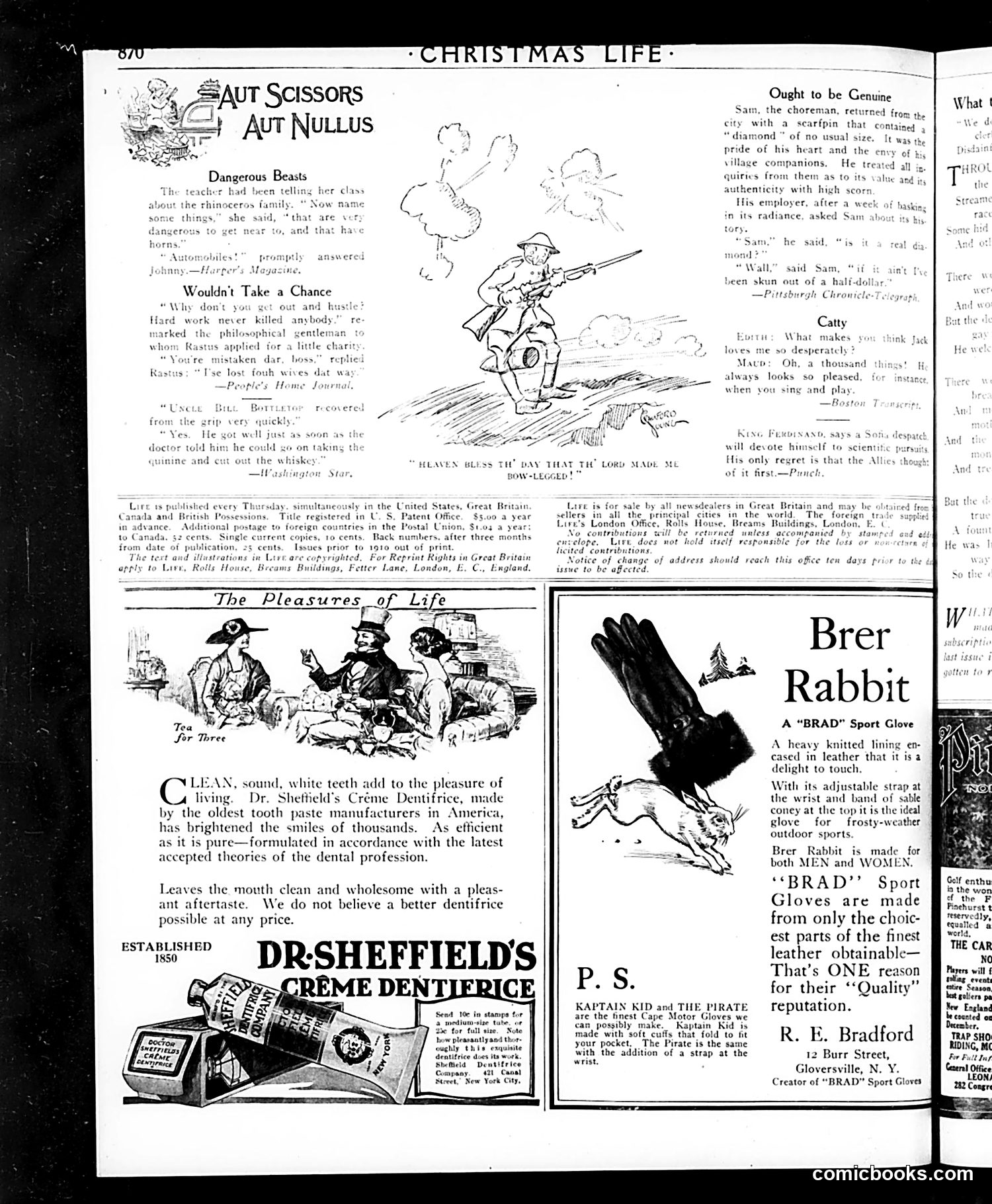
This page from *Life* magazine consists primarily of **advertisements and filler content** rather than coherent satirical cartoons. The main cartoon, titled "Wouldn't Take a Chance," depicts a brief dialogue about work and charity—likely a gentle joke about a man unwilling to take risks or help others, though the humor is unclear without fuller context. The bulk of the page features **product advertisements**: Dr. Sheffield's Creme Dentifrice (toothpaste), established 1850; Brer Rabbit "BRAD" Sport Gloves; and references to Captain Kid and Pirate motor gloves. These ads, typical of the era, emphasize product quality and utility. A small section titled "The Pleasures of Life" shows three men sharing tea—a straightforward illustration without obvious satire. The page also includes brief humor snippets (labeled "Catty" and referencing King Ferdinand) but these are too fragmentary to interpret meaningfully. Overall, this appears to be a standard editorial page mixing light humor with period advertisements rather than presenting developed political or social satire.
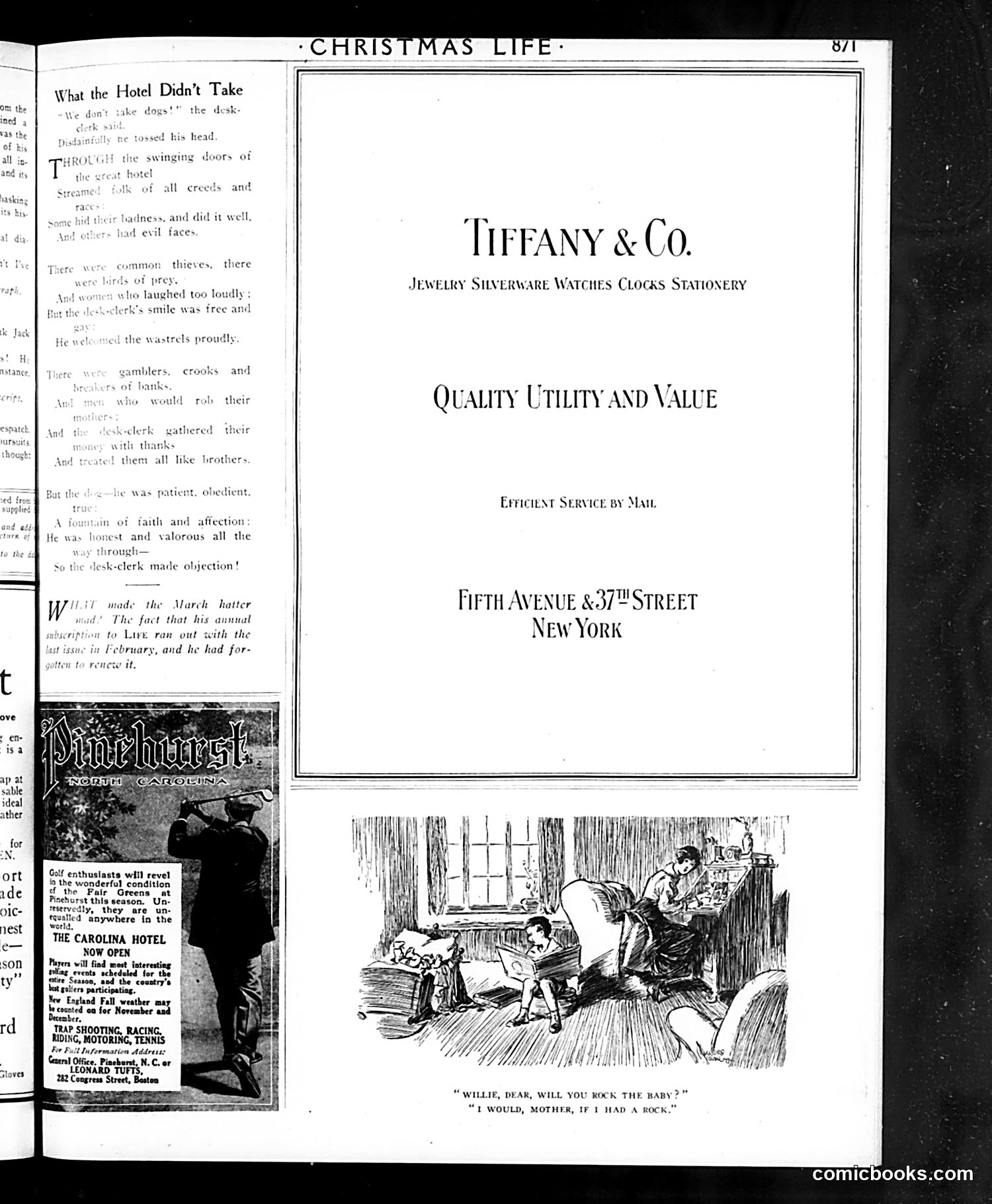
This page is primarily **advertising and title space** rather than political satire. The dominant content is a Tiffany & Co. luxury goods advertisement (jewelry, silverware, watches, clocks, stationery) positioned centrally. On the left, "What the Hotel Didn't Take" appears to be a short story or sketch about a humble desk clerk at a hotel who, despite encounters with various unsavory characters (thieves, birds of prey, women of loose morals, gamblers, crooks), maintains his dignity, honesty, and good character—treating everyone kindly. Below that are advertisements for **The Carolina Hotel** and **Pinehurst** resort, promoting leisure activities (golf, trap shooting, racing, riding, motoring, tennis) for wealthy patrons. At the bottom, a brief humorous domestic cartoon shows a mother asking her son Willie to rock the baby; his reply—"I would, Mother, if I had a rock"—is a play on words suggesting he'd use a rock instead of gently rocking the cradle, implying childhood mischief. The page reflects **early 20th-century consumer culture** and leisure-class entertainment.
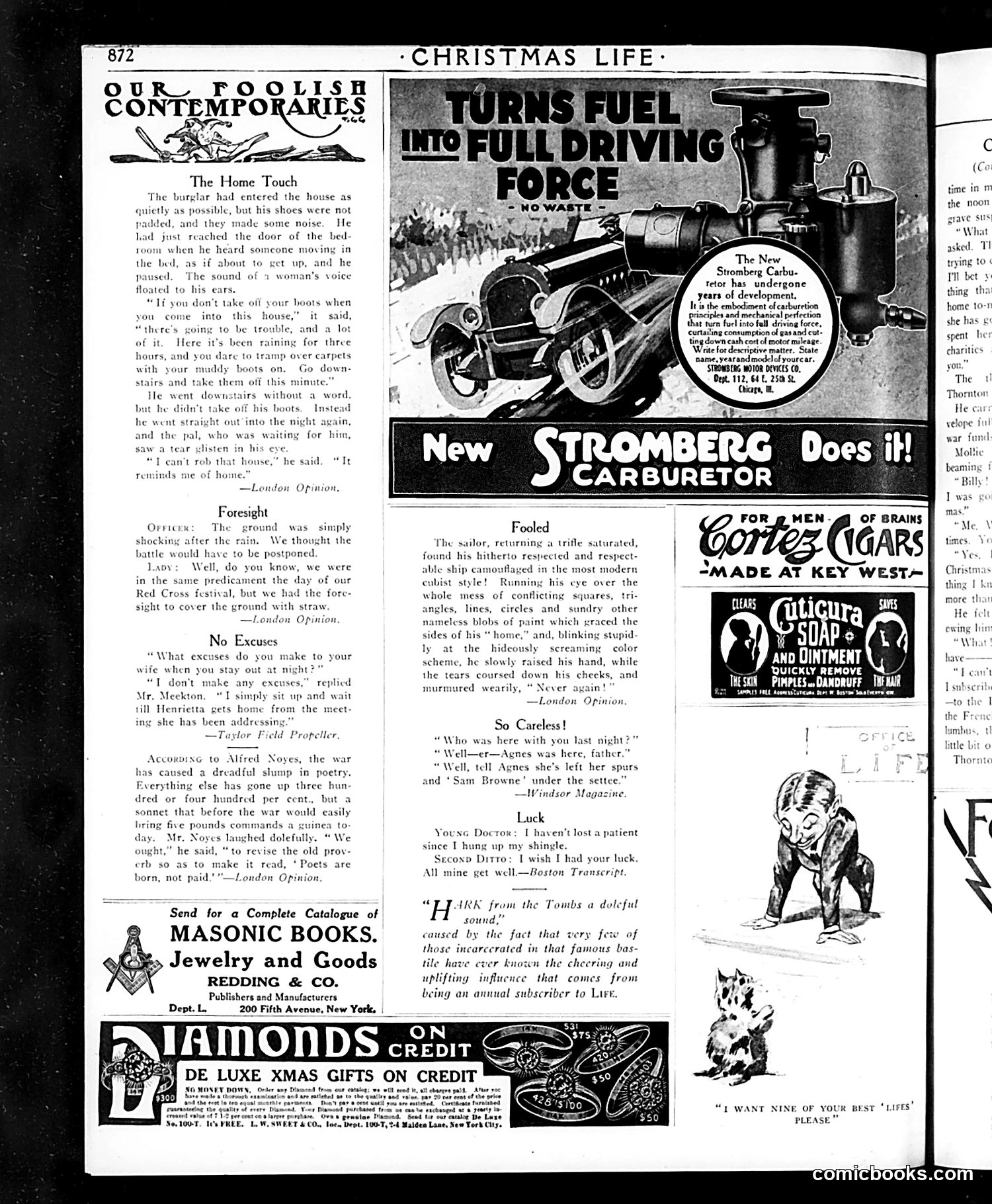
This page from *Life* magazine contains humorous short anecdotes and advertisements typical of early 20th-century satirical journalism. **The Main Cartoons/Jokes:** "The Home Touch" depicts a burglar interrupted by a homeowner who scolds him for tracking mud on carpets—the humor lies in the burglar's politeness despite committing a crime; he leaves rather than face domestic complaints. "Foresight," "No Excuses," and other brief pieces are wordplay-based humor: a woman notes it rained three hours before a social event, a man refuses to apologize to his wife, and a doctor brags about patient survival rates. **The Advertisements** promote contemporary products: Stromberg carburetors (automobiles), Cuticura soap for skin conditions, and Masonic books. **Social Context:** The humor assumes readers value domestic propriety and middle-class respectability. The "Home Touch" joke satirizes how powerful domestic authority can be—even criminals defer to it. Overall, this reflects pre-WWI attitudes toward gender roles, class, and consumer culture, with gentle rather than harsh satire.
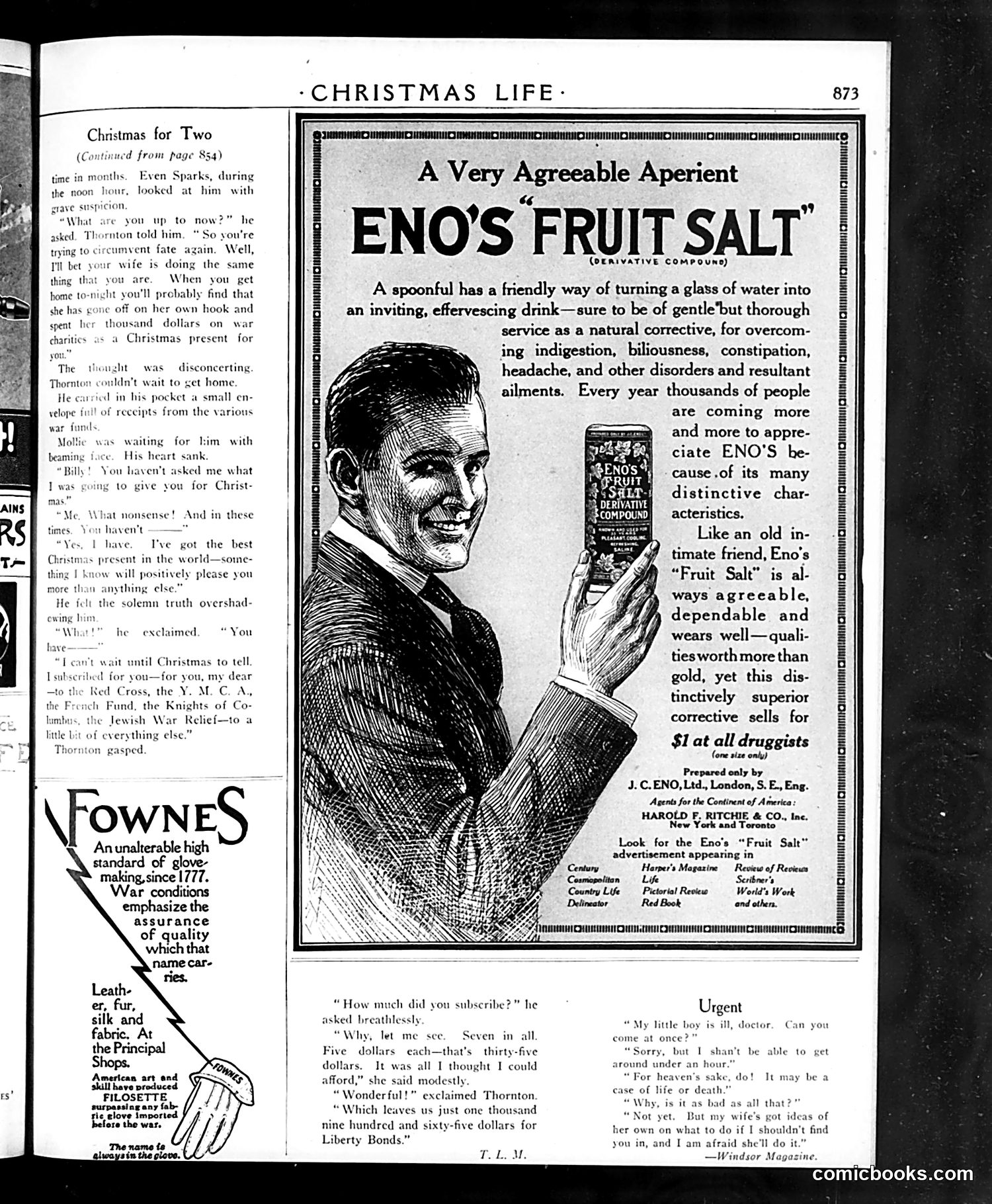
This page contains two distinct elements: **Main Story ("Christmas for Two"):** A wartime domestic narrative about a couple's Christmas gift exchange during WWI. The husband plans to give his wife war bonds, but discovers she's already donated $35 to various charitable causes—the Red Cross, YMCA, French Fund, Knights of Columbus, and Jewish War Relief. The humor lies in their mutual sacrifice and the ironic competition to contribute to the war effort rather than buy personal gifts. This reflects 1910s-era patriotic sentiment during American involvement in World War I. **Advertisements:** The page also features ads for Fownes gloves (emphasizing quality maintained since 1777, relevant during wartime) and Eno's Fruit Salt (a digestive remedy), plus a brief comic anecdote about a doctor visit. The "Christmas for Two" story satirizes how thoroughly WWI patriotism had infiltrated American domestic life—even romantic gift-giving was redirected toward war charities rather than personal indulgence.
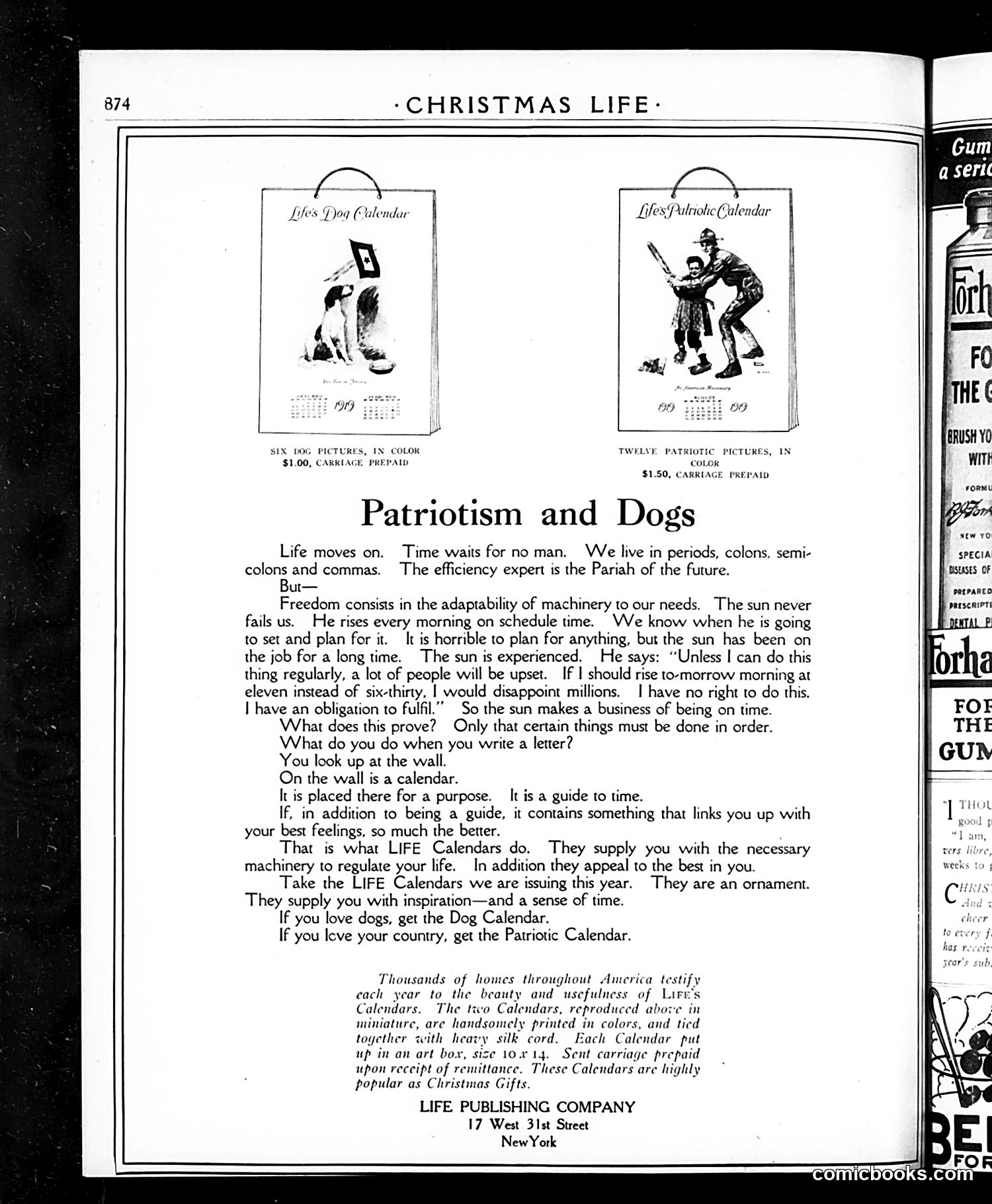
This is primarily a **product advertisement** for LIFE magazine's calendars, with a philosophical sales pitch rather than political satire. The page advertises two calendars: a "Dog Calendar" (six pictures, $1.00) and a "Patriotic Calendar" (twelve pictures, $1.50). The accompanying essay, "Patriotism and Dogs," uses whimsical logic to justify why calendars matter. The satire is mild and self-aware: it mocks the era's obsession with "efficiency experts" and rigid scheduling by arguing that even the sun understands the importance of punctuality and routine. The essay then pivots to selling calendars as tools that regulate life while offering emotional appeal—patriotism for one's country, companionship for dog lovers. The implied message to modern readers: calendars are both practical and inspirational gifts. The "patriotism" angle suggests this advertisement appeared during a period (likely WWI-era America, based on the patriotic imagery) when nationalist sentiment was marketable. The tone is tongue-in-cheek but earnest—typical of early 20th-century advertising that mixed philosophy with commerce.
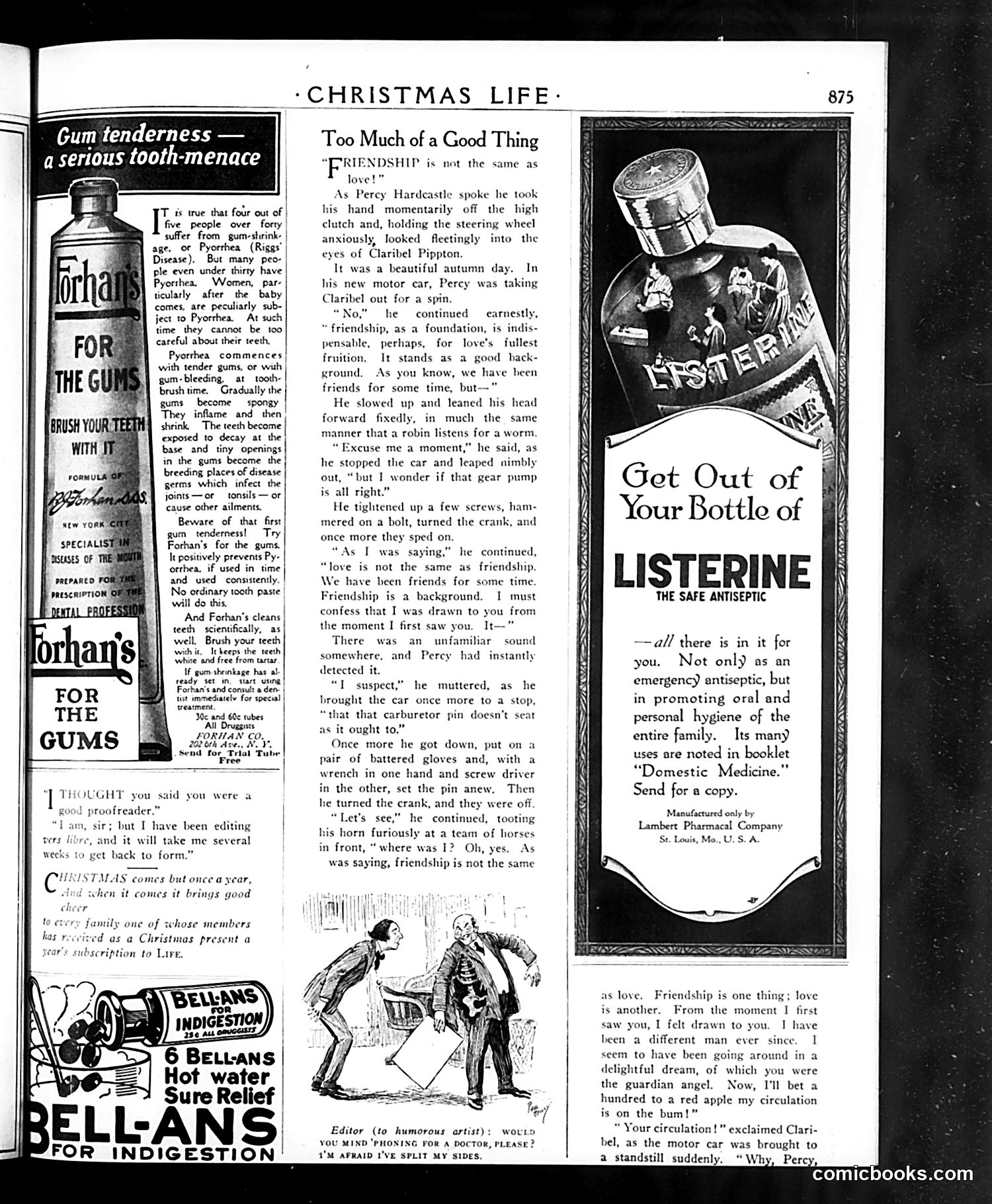
This page contains a short story titled "Too Much of a Good Thing" satirizing romantic declarations interrupted by practical concerns. Percy Hardcastle attempts to confess his love to Claribel Pippton during a car ride, but repeatedly stops mid-sentence to fix mechanical problems—a gear pump, carburetor pin—treating automotive maintenance as more urgent than romance. The humor lies in the contrast between sincere emotional expression and mundane car troubles, reflecting early 1900s anxieties about automobile reliability. The page also includes period advertisements (Forhan's toothpaste, Listerine antiseptic, Bellans indigestion remedy) and a small cartoon about a proofreader versus editor. The cartoons and ads are typical of *Life* magazine's satirical advertising parodies and humorous social commentary.
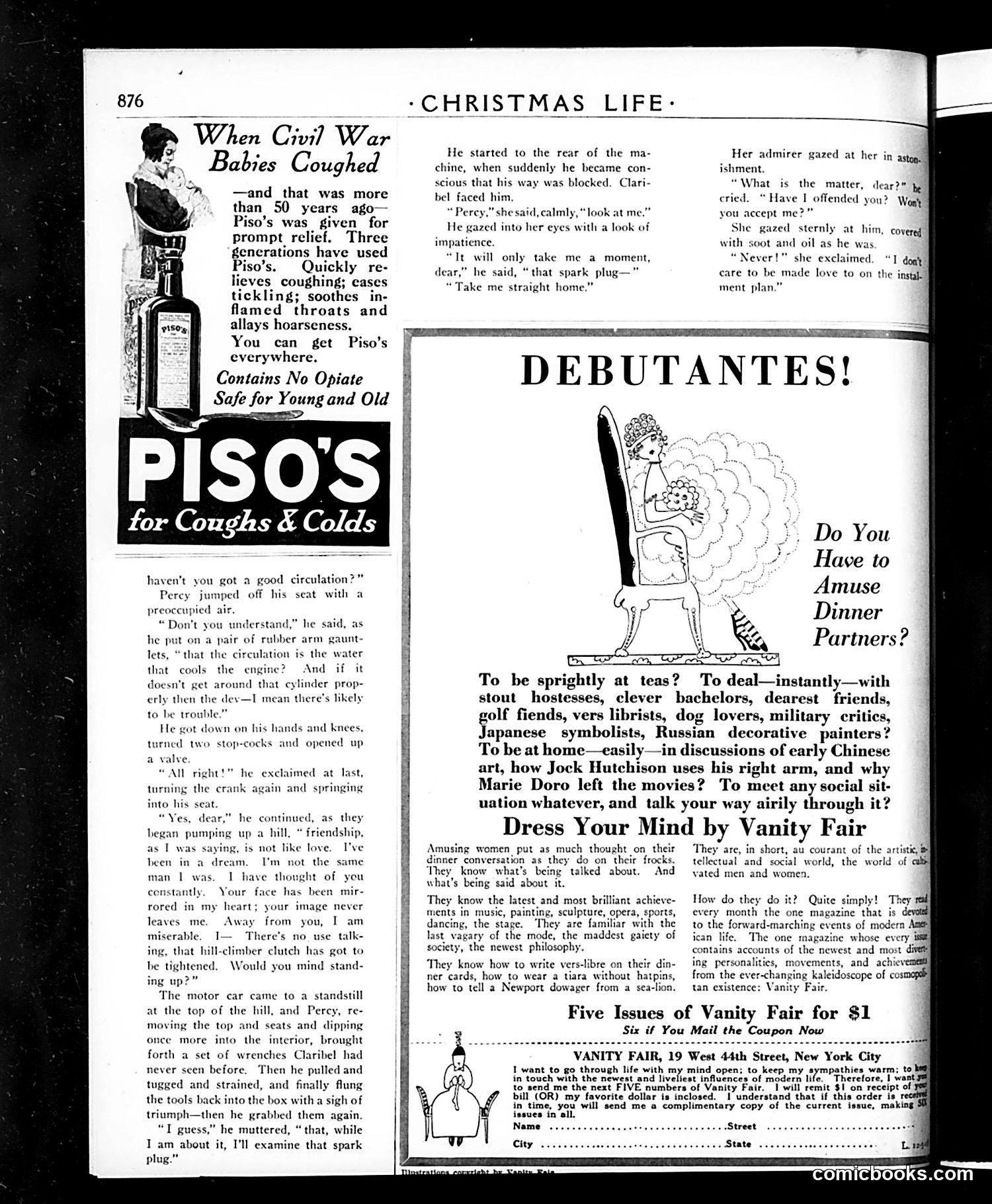
This page contains two unrelated pieces of period content: **Left side:** A Piso's cough medicine advertisement featuring a Civil War-era anecdote. The ad emphasizes the product's 50+ year track record and claims it safely relieves coughs without opiates—relevant because opiate-laced medicines were common then but becoming controversial. **Right side:** A humorous short story about a car breakdown. A man obsesses over his vehicle's mechanical problems (circulation, spark plugs, clutch) while attempting to propose romance to a woman named Claribel, covered in engine grease. The satire mocks how mechanical preoccupations distract from genuine emotion—a commentary on early automobiles' unreliability and men's absorption in this new technology. **Below:** A Vanity Fair magazine advertisement targeting women, promising to help them develop intellectual sophistication ("dress your mind") so they can navigate social situations by discussing art, sports, philosophy, and fashion—reflecting 1920s concerns about women's cultural education and social competence.
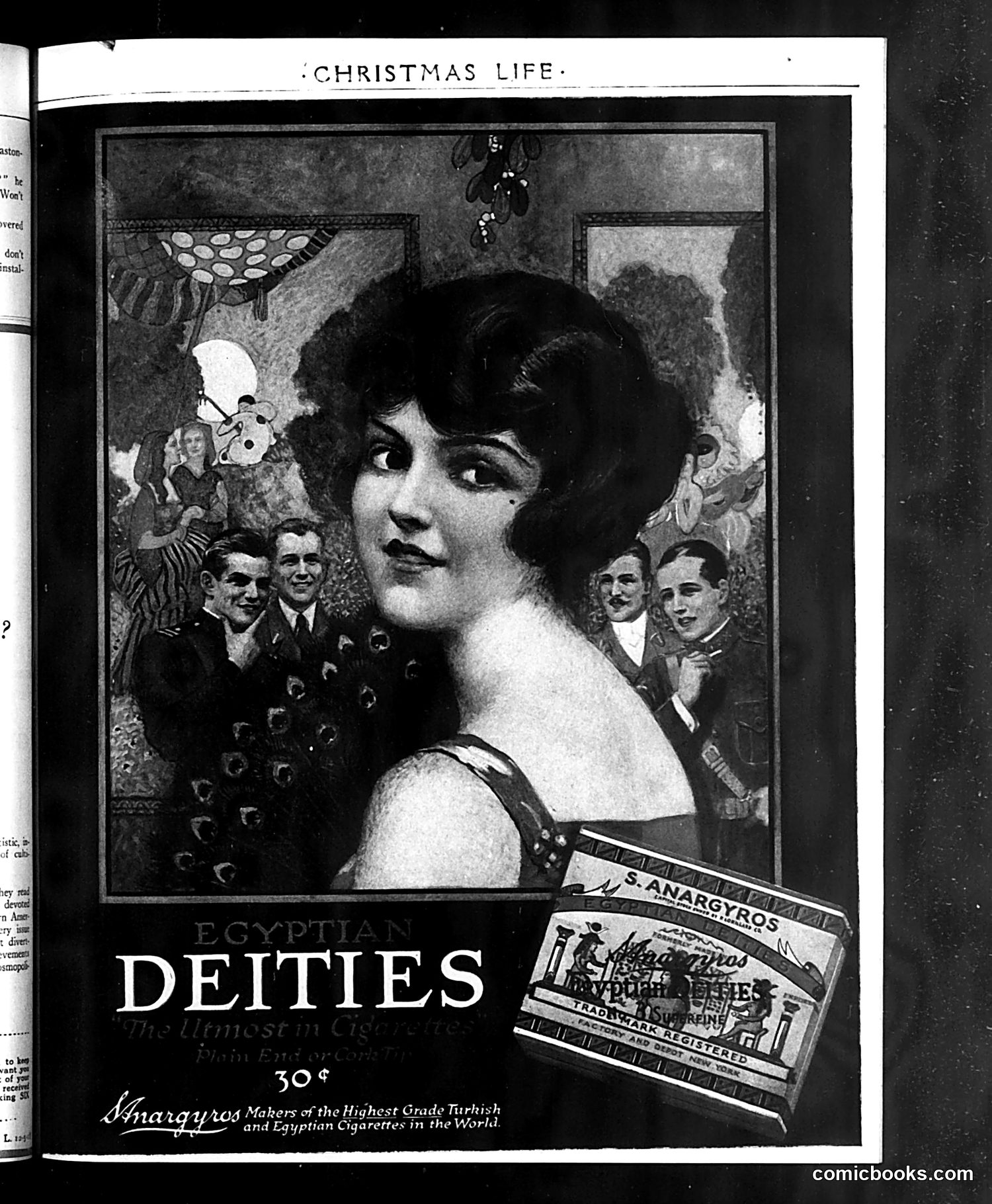
This is primarily a **cigarette advertisement** for Snargyros brand Turkish and Egyptian cigarettes, priced at 30 cents. The page header reads "CHRISTMAS LIFE," indicating it appeared in Life magazine's Christmas issue. The advertisement features a stylized woman's portrait in profile, with men in formal attire visible in the background and decorative holiday elements (mistletoe, Christmas imagery) above. The composition suggests this is aspirational lifestyle advertising typical of the era—positioning cigarettes as associated with sophistication, social gathering, and festive celebration. There is **no apparent political satire or social commentary**. This is straightforward commercial advertising using glamorous imagery to market cigarettes during the holiday season.
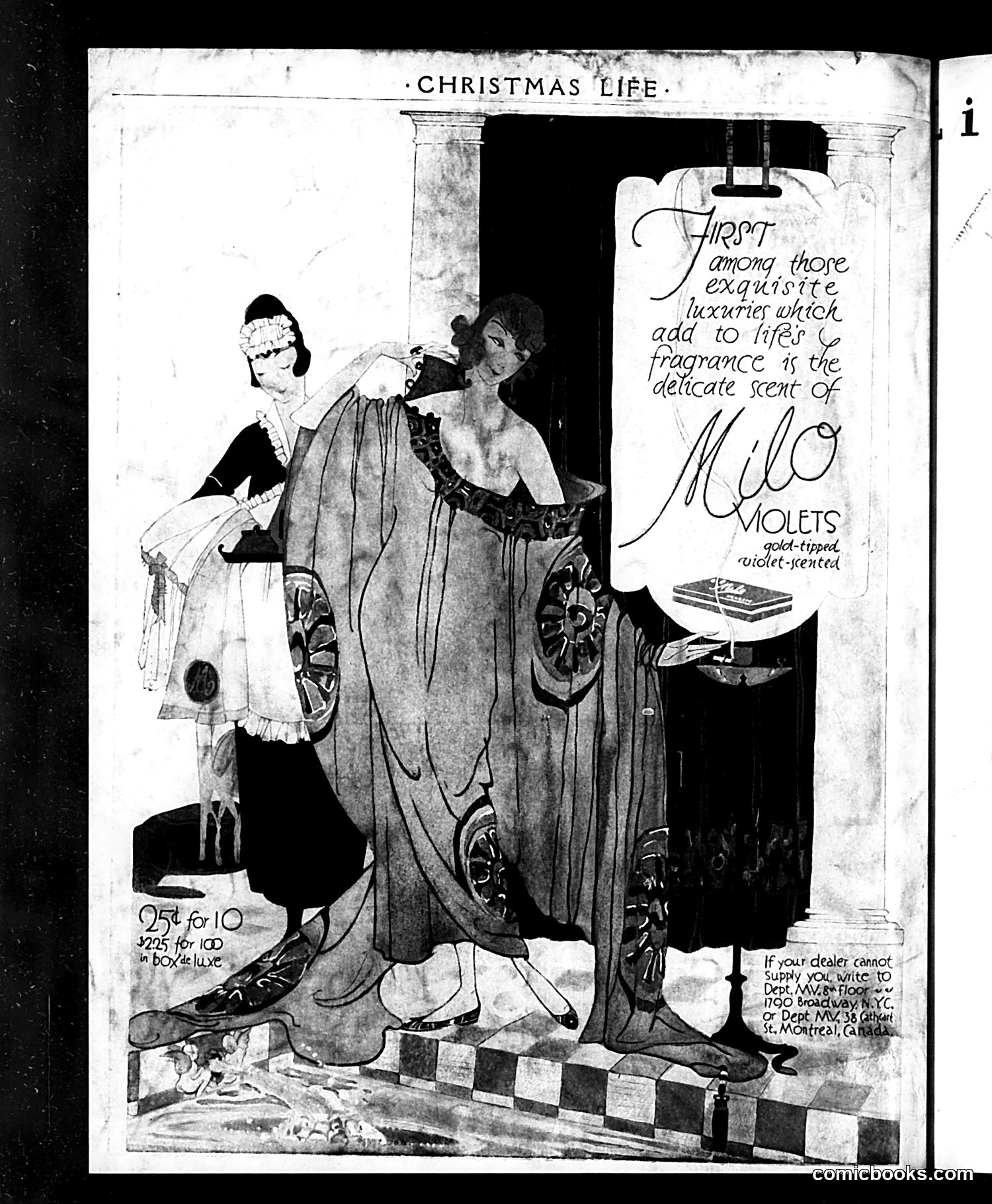
This is a **perfume advertisement** for "Millo Violets," not political satire. The page header reads "Christmas Life," indicating this is a holiday gift-giving advertisement. The illustration shows two elegantly dressed women in 1920s fashion examining or presenting a perfume product. The ad copy emphasizes fragrance as a luxury gift, claiming it's "first among those exquisite luxuries which add to life's fragrance." The price "$6 & 10" and "in box de luxe" indicates this was marketed as an upscale Christmas present. The checkered floor and classical columns suggest sophistication and wealth. Small contact information at bottom provides dealer locations in New York and Montreal. This reflects early 20th-century advertising targeting women consumers for luxury goods during the holiday shopping season.