
Life, 1918-12-05 · page 34 of 76
Life — December 5, 1918 — page 34: what you’re looking at
What you’re looking at
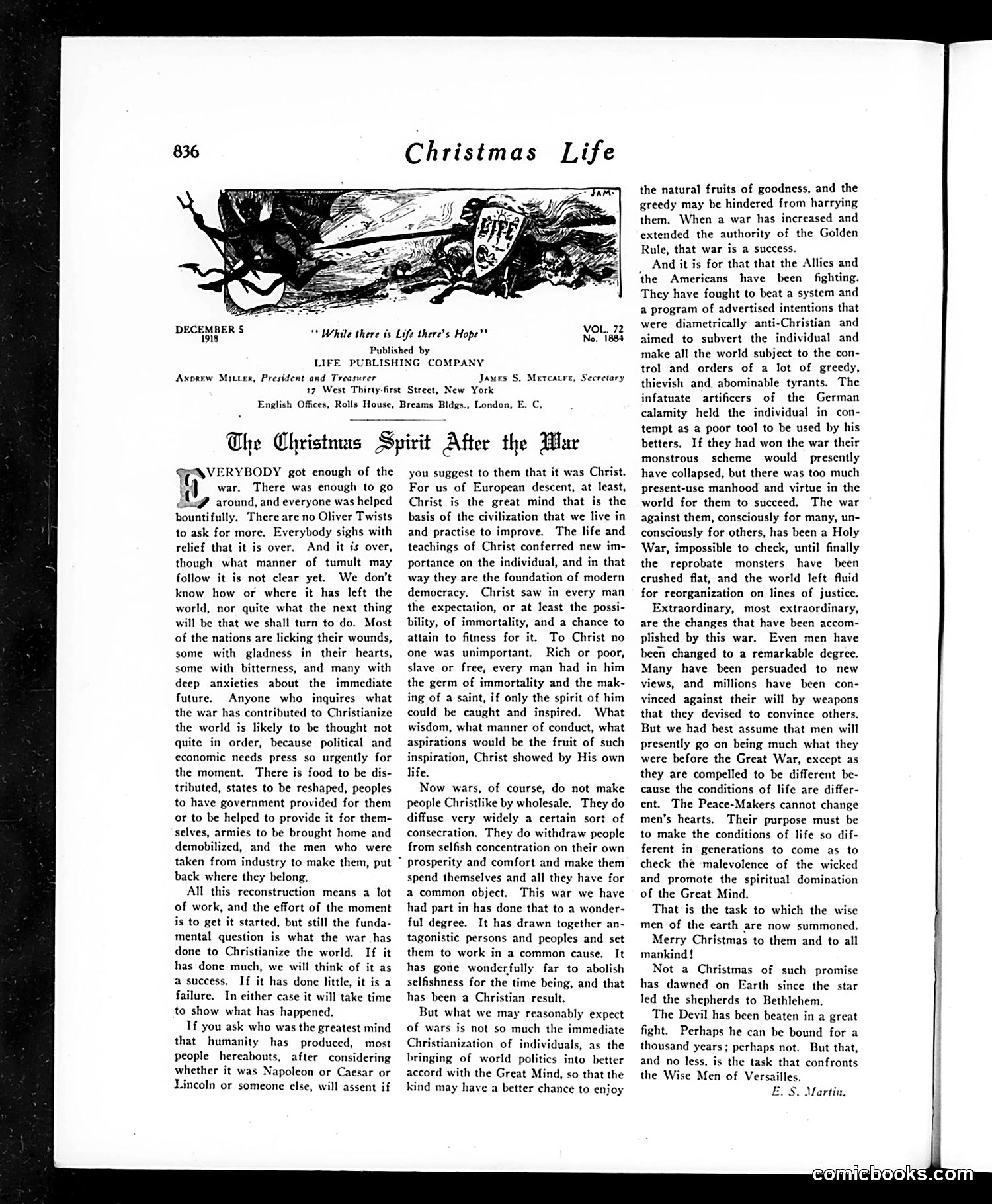
This December 5, 1918 *Life* magazine page marks the armistice ending World War I (November 11, 1918). The small cartoon at top shows a dead soldier with a shield labeled "DIEU" (God), illustrating the essay's central tension. The article by E.S. Martin argues that while WWI temporarily unified people in sacrifice and drew them away from selfish concerns—mimicking Christian values—the war's true test is whether it will reshape world politics toward justice and away from greed. Martin questions whether warfare genuinely "Christianizes" humanity or merely creates temporary moral improvement. The implicit satire targets the gap between Christian ideals and wartime reality. While soldiers died "for" Christian civilization, Martin suggests the war's actual spiritual legacy remains uncertain. The piece anticipates post-war disillusionment, questioning whether peace will bring genuine moral progress or merely restore selfishness.
📄 Transcribed text from this page (OCR, searchable)
Machine-transcribed from the original scan — historical spelling and the odd misread are preserved.
DECEMBER 5 1918, Christmas Life “White there is Life there's Hope” Published by LIFE PUBLISHING COMPANY Axparw Mittex, President and Treasurer Jawes S, Metcatre, Secretary 17 West Thirty-first Street, New York English Offices, Rolls House, Breams Bldgs., London, E. C. The Christmas Spirit After the War GEAVERYBODY got enough of the WG war. There was enough to go EWP around, and everyone was helped bountifully. There are no Oliver Twists to ask for more. Everybody sighs with relief that it is over. And it is over, though what manner of tumult may follow it is not clear yet. We don’t know how or where it has left the world, nor quite what the next thing will be that we shall turn to do. Most of the nations are licking their wounds, some with gladness in their hearts, some with bitterness, and many with deep anxieties about the immediate future. Anyone who inquires what the war has contributed to Christianize the world is likely to be thought not quite in order, because political and economic needs press so urgently for the moment. There is food to be dis- tributed, states to be reshaped, peoples to have government provided for them or to be helped to provide it for them- selves, armies to be brought home and demobilized, and the men who were taken from industry to make them, put ~ back where they belong. All this reconstruction means a lot of work, and the effort of the moment is to get it started, but still the funda- mental question is what the war has done to Christianize the world. If it has done much, we will think of it as a success, If it has done little, it is a failure. In either case it will take time to show what has happened. Tf you ask who was the greatest mind that humanity has produced, most people hereabouts, after considering whether it was Napoleon or Caesar or Lincoln or someone else, will assent if you suggest to them that it was Christ. For us of European descent, at least, Christ is the great mind that is the basis of the civilization that we live in and practise to improve. The life and teachings of Christ conferred new im- portance on the individual, and in that way they are the foundation of modern democracy. Christ saw in every man the expectation, or at least the possi- bility, of immortality, and a chance to attain to fitness for it. To Christ no one was unimportant. Rich or poor, slave or free, every man had in him the germ of immortality and the mak- ing of a saint, if only the spirit of him could be caught and inspired. What wisdom, what manner of conduct, what aspirations would be the fruit of such inspiration, Christ showed by His own life. Now wars, of course, do not make people Christlike by wholesale. They do diffuse very widely a certain sort of consecration. They do withdraw people from selfish concentration on their own prosperity and comfort and make them spend themselves and all they have for a common object. This war we have had part in has done that to a wonder- ful degree. It has drawn together an- tagonistic persons and peoples and set them to work in a common cause. It has gone wonderfully far to abolish selfishness for the time being, and that has been a Christian result. But what we may reasonably expect of wars is not so much the immediate Christianization of individuals, as the bringing of world politics into better accord with the Great Mind, so that the kind may have a better chance to enjoy the natural fruits of goodness, and the greedy may be hindered from harrying them. When a war has increased and extended the authority of the Golden Rule, that war is a success. And it is for that that the Allies and ‘the Americans have been fighting. They have fought to beat a system and a program of advertised intentions that were diametrically anti-Christian and aimed to subvert the individual and make all the world subject to the con- trol and orders of a lot of greedy, thievish and. abominable tyrants. The infatuate artificers of the German calamity held the individual in con- tempt as a poor tool to be used by his betters. If they had won the war their monstrous scheme would presently have collapsed, but there was too much present-use manhood and virtue in the world for them to succeed. The war against them, consciously for many, un- consciously for others, has been a Holy War, impossible to check, until finally the reprobate monsters have been crushed flat, and the world left fluid for reorganization on lines of justice. Extraordinary, most extraordinary, are the changes that have been accom- plished by this war. Even men have been changed to a remarkable degree. Many have been persuaded to new views, and millions have been con- vinced against their will by weapons that they devised to convince others. But we had best assume that men will presently go on being much what they were before the Great War, except as they are compelled to be different be- cause the conditions of life are differ- ent, The Peace-Makers cannot change men’s hearts. Their purpose must be to make the conditions of life so dif- ferent in generations to come as to check the malevolence of the wicked and promote the spiritual domination of the Great Mind. That is the task to which the wise men of the earth are now summoned. Merry Christmas to them and to all mankind! Not a Christmas of such promise has dawned on Earth since the star led the shepherds to Bethlehem. The Devil has been beaten in a great fight. Perhaps he can be bound for a thousand years; perhaps not. But that, and no less, is the task that confronts the Wise Men of Versaille: Martin.