
Life, 1918-12-05 · page 4 of 76
Life — December 5, 1918 — page 4: what you’re looking at
What you’re looking at
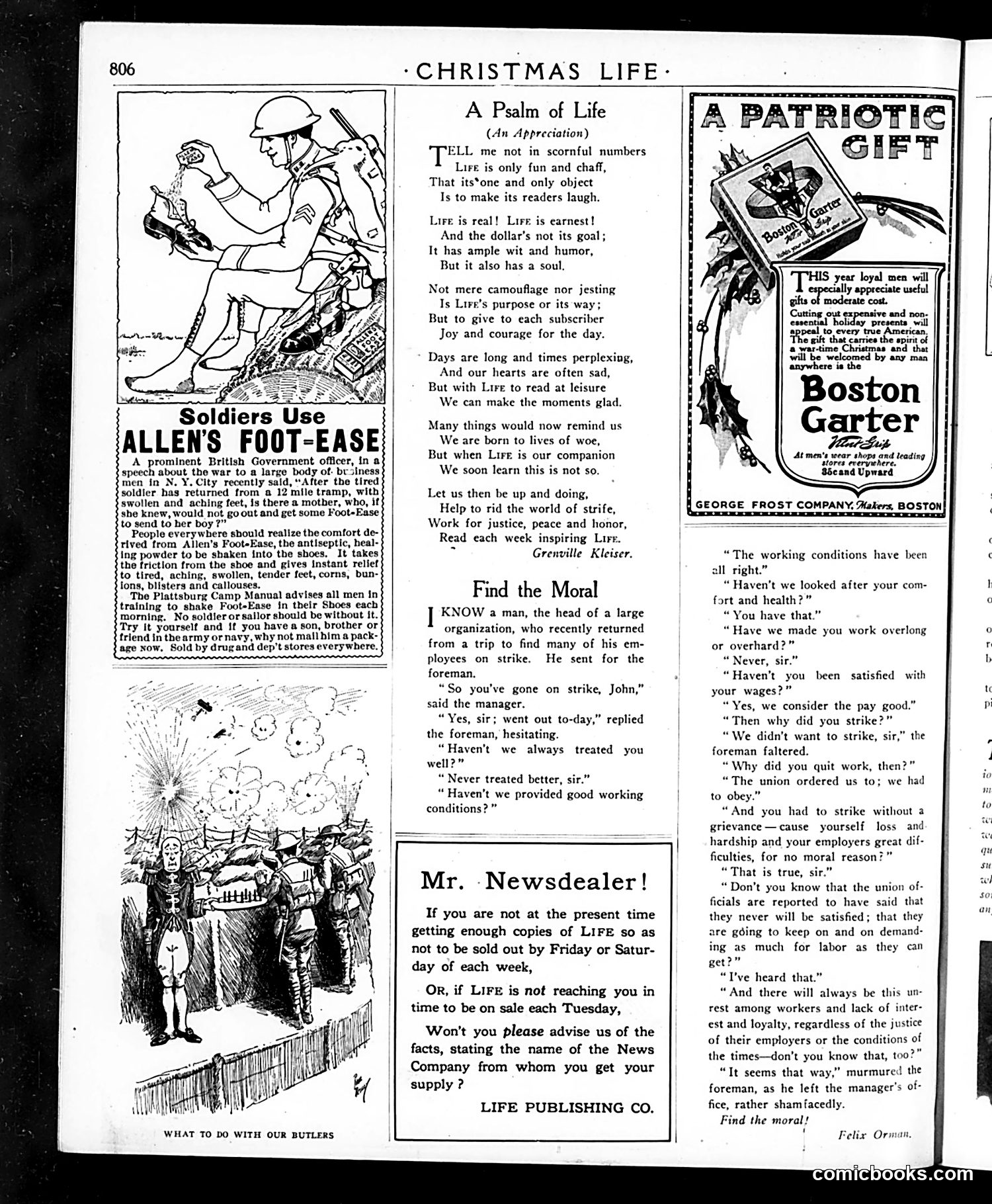
**Upper Left - "Soldiers Use Allen's Foot-Ease"**: Advertisement featuring a soldier examining his feet, promoting a foot powder product with testimonial from a British officer praising relief from marching discomfort. **Center - "A Psalm of Life" and "Find the Moral"**: A poem by Greville Kleiser encouraging readers toward purpose and action, followed by a dialogue between a manager and striking foreman. The moral appears critical of labor disputes—the foreman admits the company treated workers well, provided good conditions, and paid fairly, yet the union ordered a strike anyway, causing "loss and hardship" to both workers and employers. **Right Side**: Boston Garter advertisement. **Lower Left - Illustration**: Appears to show carolers or holiday figures, captioned "What to Do with Our Butlers." The page primarily contains period advertising and moralizing content about labor relations.
📄 Transcribed text from this page (OCR, searchable)
Machine-transcribed from the original scan — historical spelling and the odd misread are preserved.
“CHRISTMAS LIFE- ALLENS FOOT-EASE A prominent British Government officer, in a speech about the war to a large body of- br iness men in N, ¥. City recently sald, “After the tired soldier has returned from a 12 mile tramp, with swollen and aching feet, is there a mother, who, if she knew, would not go out and get some Foot-Ease to send to her boy ?” People everywhere should realize the comfort de- rived from Allen's FooteEase, the antiseptic, heal- ing powder to be shaken into the shoes. It takes the friction from the shoe and gives instant relief to tired, aching, swollen, tender feet, corns, bun- fons, blisters and callouses. ‘The Plattsburg Camp Manual advises all men in training to shake Foot-Ease in their Shoes each morning. No soldier or sailor should be without it. Try It yourself and if you have a son, brother or friend in the army or navy, why not mail bim a pack- fase Now, Sold by drugand dep’t stores everywhere. A Psalm of Life (An Appreciation) LL me not in scornful numbers Lire is only fun and chaff, That its*one and only object Is to make its readers laugh. Lire is real! Lire is earnest! And the dollar's not its goal; It has ample wit and humor, But it also has a soul. Not mere camouflage nor jesting E'S purpose or its way; But to give to each subscriber Joy and courage for the day. Days are long and times perplexing, And our hearts are often sad, But with Lire to read at leisure We can make the moments glad. Many things would now remind us We are born to lives of woe, But when Lire is our companion We soon learn this is not so. Let us then be up and doing, Help to rid the world of strife, Work for justice, peace and honor, Read each week inspiring Lire. 7 Grenville Kleiser. Find the Moral KNOW a man, the head of a large organization, who recently returned from a trip to find many of his em- ployees on strike. He sent for the foreman, “So you've gone on strike, John,” said the manager. “Yes, sir; went out to-day,” replied the foreman, hesitating. “Haven't we always treated you well?” “Never treated better, sir.” “Haven't we provided good working conditions?” Mr. -Newsdealer! If you are not at the present time [A PATRIOTIC ee ee giscl medeasco. Cutting out expensive and non- ensential holiday presents wall appeal to every true American. ait that carries the spint of 8 wartime jas and will be welcomed by anywhere is the Boston Garter VientBup At men's wear shops and leading stores everywhere, Séeand Upward any man “The working conditions have been all right.” “ Haven't we looked after your com- fort and health?” “You have that.” “Have we made you work overlong or overhard?” “Never, sir.” “Haven't you been satisfied with your wages?” “Yes, we consider the pay good.” “Then why did you strike?” “We didn’t want to strike, sir,” the foreman faltered. “Why did you quit work, then?” “The union ordered us to; we had to obey.” “And you had to strike without a grievance —cause yourself loss and hardship and your employers great dif- ficulties, for no moral reason?” “That is true, sir.” “Don't you know that the union of- ficials are reported to have said that they never will be satisfied; that they are géing to keep on and on demand- ing as much for labor as they can get?” “I've heard that.” “And there will always be this un- rest among workers and lack of inter- est and loyalty, regardless of the justice of their employers or the conditions of the times—don’t you know that, too?” “Tt seems that way,” murmured the foreman, as he left the manager's of- fice, rather shamfacedly. Find the moral! | Felix Orman. getting enough copies of LIFE so as Not to be sold out by Friday or Satur- day of each week, OR, if LIFE is not reaching you in time to be on sale each Tuesday, Won't you please advise us of the facts, stating the name of the News Company from whom you get your supply ? LIFE PUBLISHING CO. WHAT TO DO WITH OUR BUTLERS