
A complete issue · 33 pages · 1918
Life — September 26, 1918
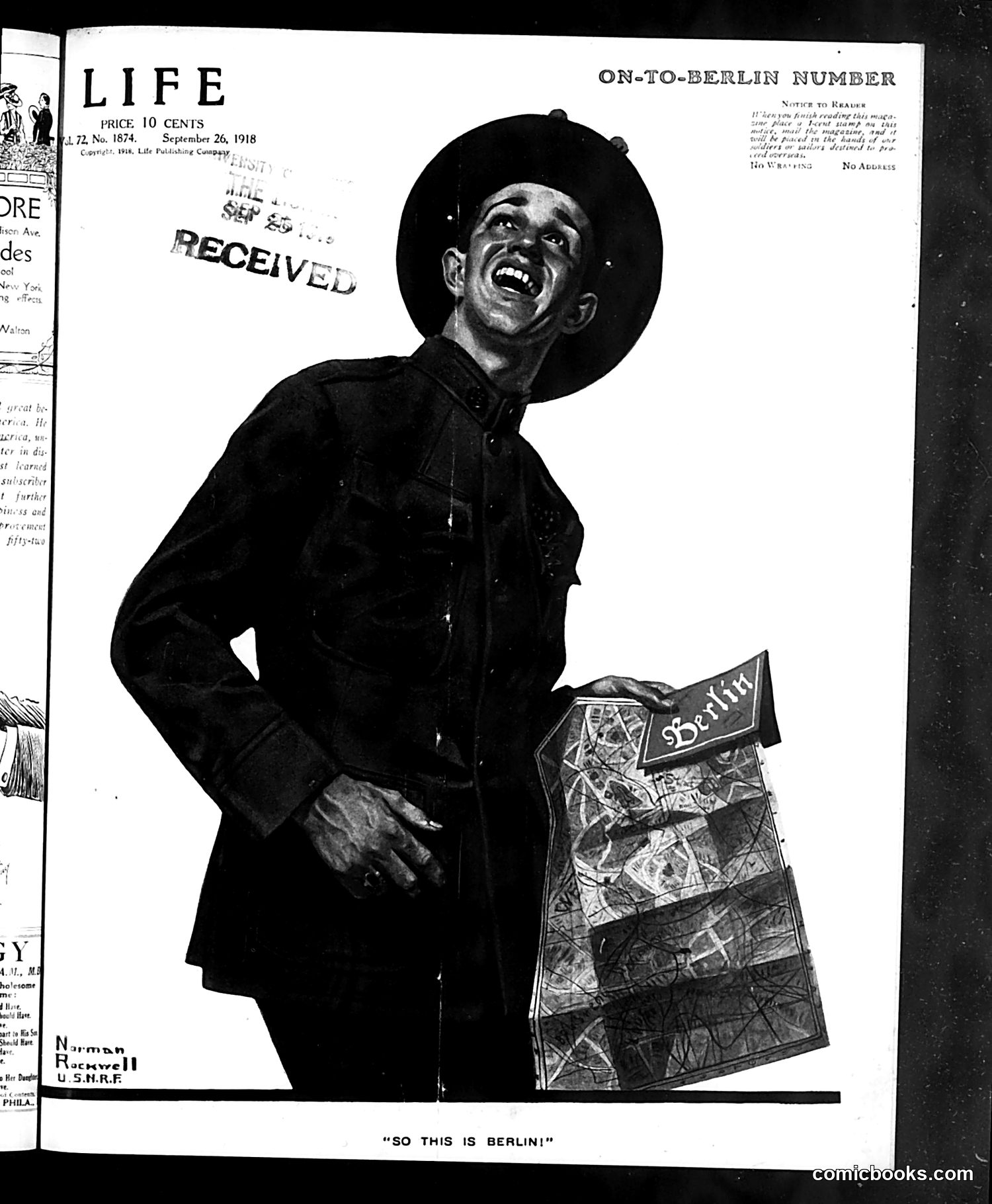
This cover satirizes German military ambitions during World War I's final weeks. The figure, drawn by Norman Rockwell, depicts a German soldier or official holding a map labeled "Berlin," looking skyward with an exaggerated, almost manic expression. The title "So This Is Berlin!" suggests ironic commentary on German expectations versus reality. Published in late September 1918, when Germany faced imminent defeat, the cartoon mocks German confidence or delusion about their position. The soldier's gleeful expression contrasts with the deteriorating military situation. The accompanying article "On-To-Berlin Number" likely discusses Allied advances toward Germany itself—a prospect unthinkable years earlier—making the German's optimistic pose darkly comic to American readers experiencing the war's endgame.
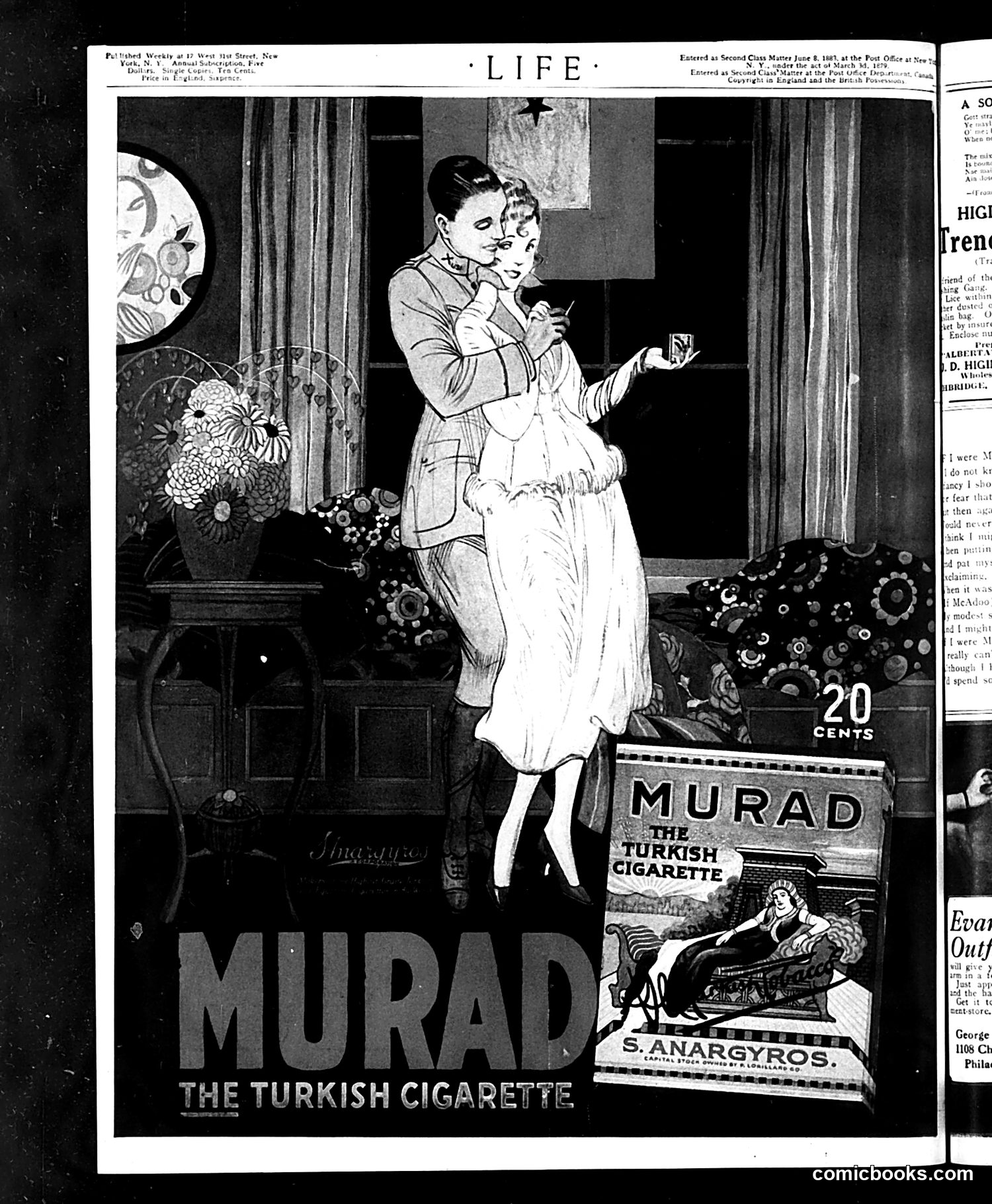
This is primarily a **cigarette advertisement**, not political satire. The image shows a woman holding a child, both gazing at a Murad Turkish Cigarette package. The aesthetic is deliberately romanticized and aspirational—appealing to early 20th-century consumer desires for exotic luxury goods. The "Turkish" branding reflects the period's fascination with Oriental exoticism. The decorative interior (flowers, art, fine furnishings) suggests wealth and sophistication. The woman's elegant dress and the child's presence create an idealized domestic scene meant to associate the product with refined taste and family contentment. This represents vintage advertising's unabashed use of emotional manipulation and lifestyle imagery—particularly striking to modern readers given contemporary cigarette marketing restrictions.
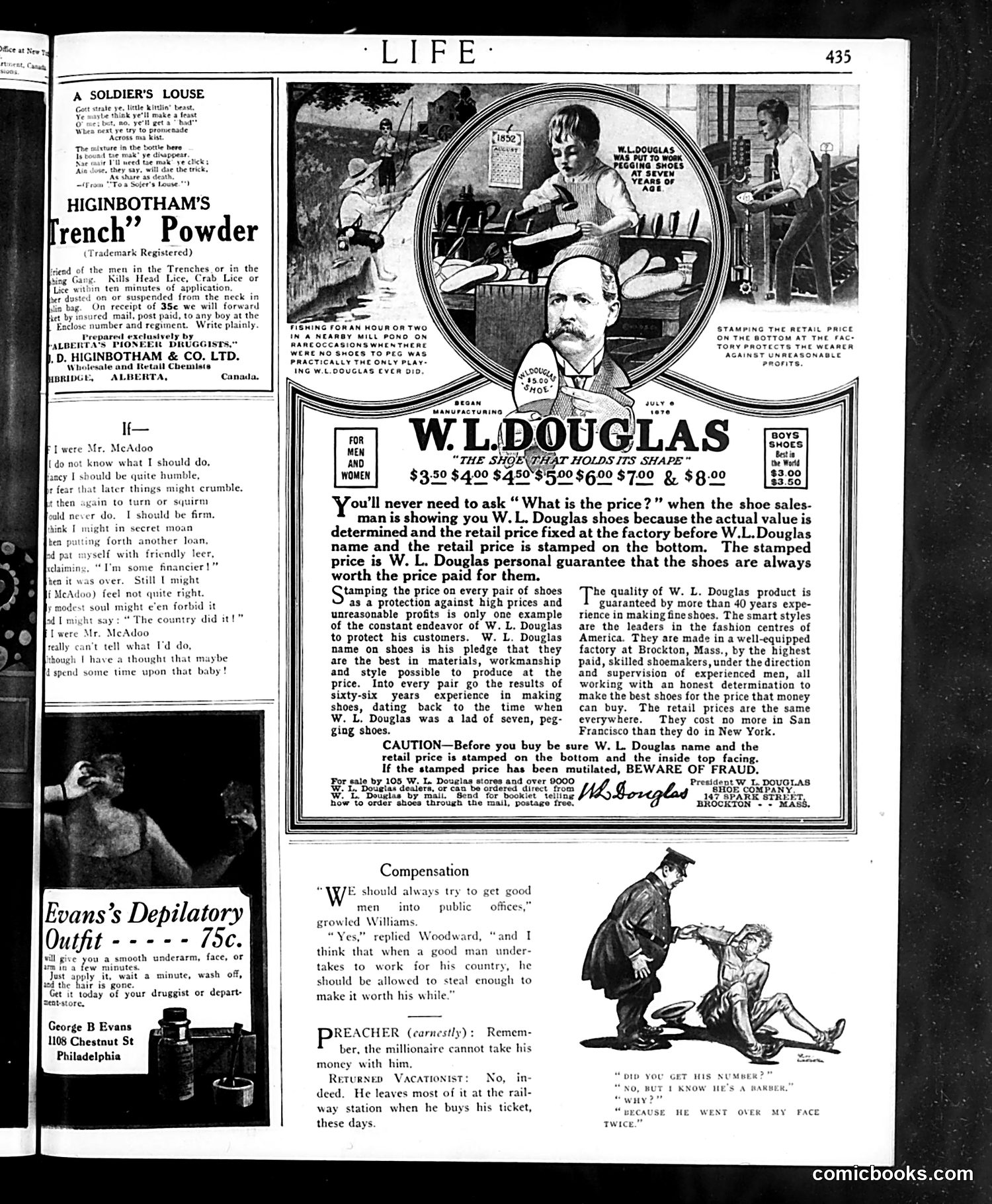
This page is dominated by a **W.L. Douglas shoe advertisement** featuring price-stamping claims and factory authenticity guarantees—the main content is commercial rather than satirical. The bottom cartoon titled **"Compensation"** depicts a social/political joke: A well-dressed man (likely a politician or official) bends toward a poor, ragged figure, with dialogue about "good men" in public office being "allowed to steal enough to make it worth his while." This satirizes **corruption in government**—the implication that public servants expect financial gain from their positions as compensation for service. The accompanying anecdotes mock various character types (billionaire, preacher, vacationist), but the primary satire targets **institutional dishonesty** in politics.
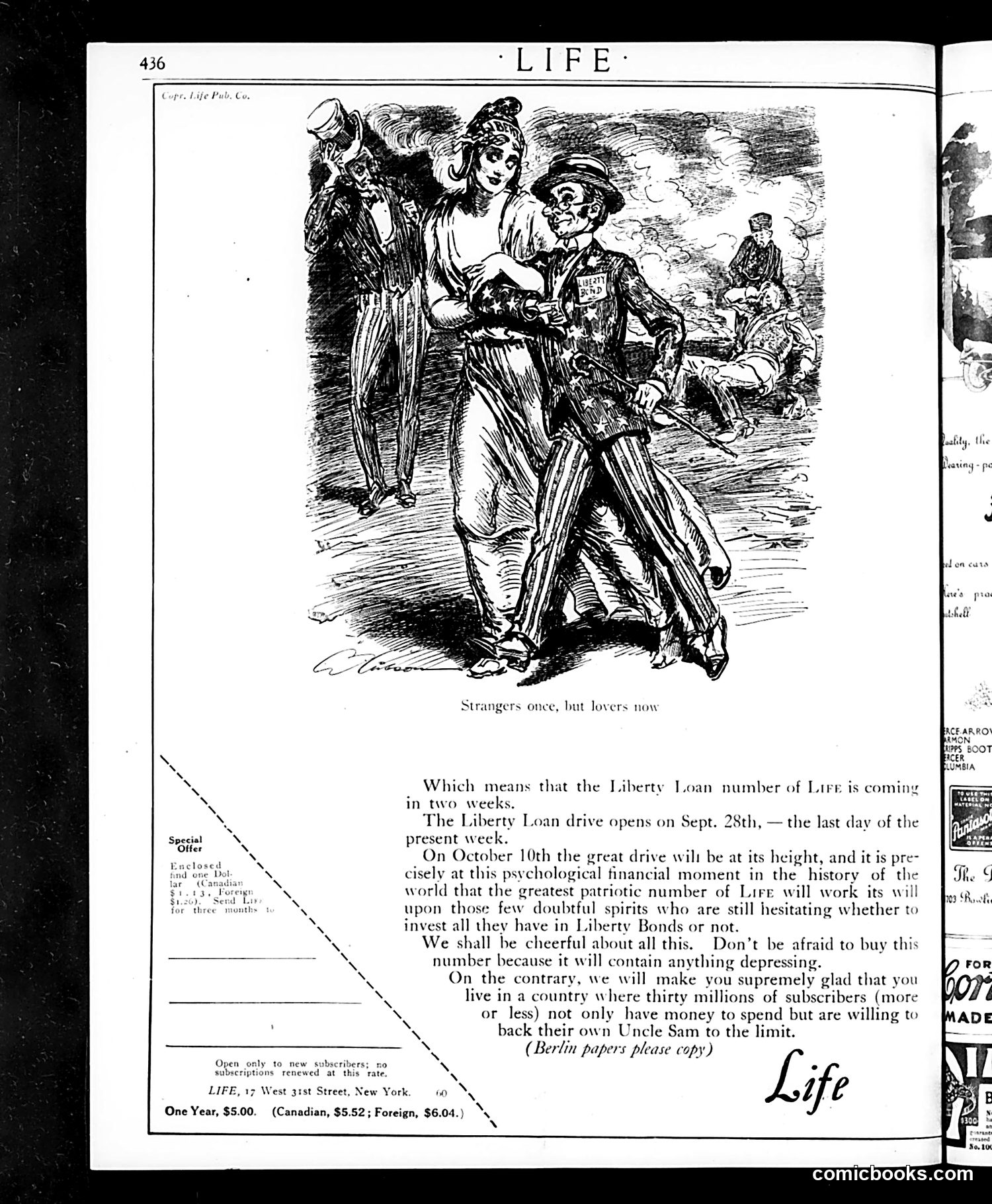
**The Cartoon:** The illustration titled "Strangers once, but lovers now" depicts a woman and a uniformed military officer in an intimate moment, with other soldiers visible in the background. The soldier wears what appears to be a WWI-era uniform with a medal. **The Context:** The accompanying text discusses the Liberty Loan drive, launching September 28th. The satire suggests romantic entanglements between American women and foreign soldiers (likely Allied forces during WWI) as motivation for war bond investment. The cartoon cynically implies that emotional/romantic appeals—particularly involving soldiers—will encourage citizens to purchase Liberty Bonds, conflating personal relationships with patriotic financial duty. **The Point:** Life satirizes how governments use emotional manipulation and romance narratives to promote war financing.
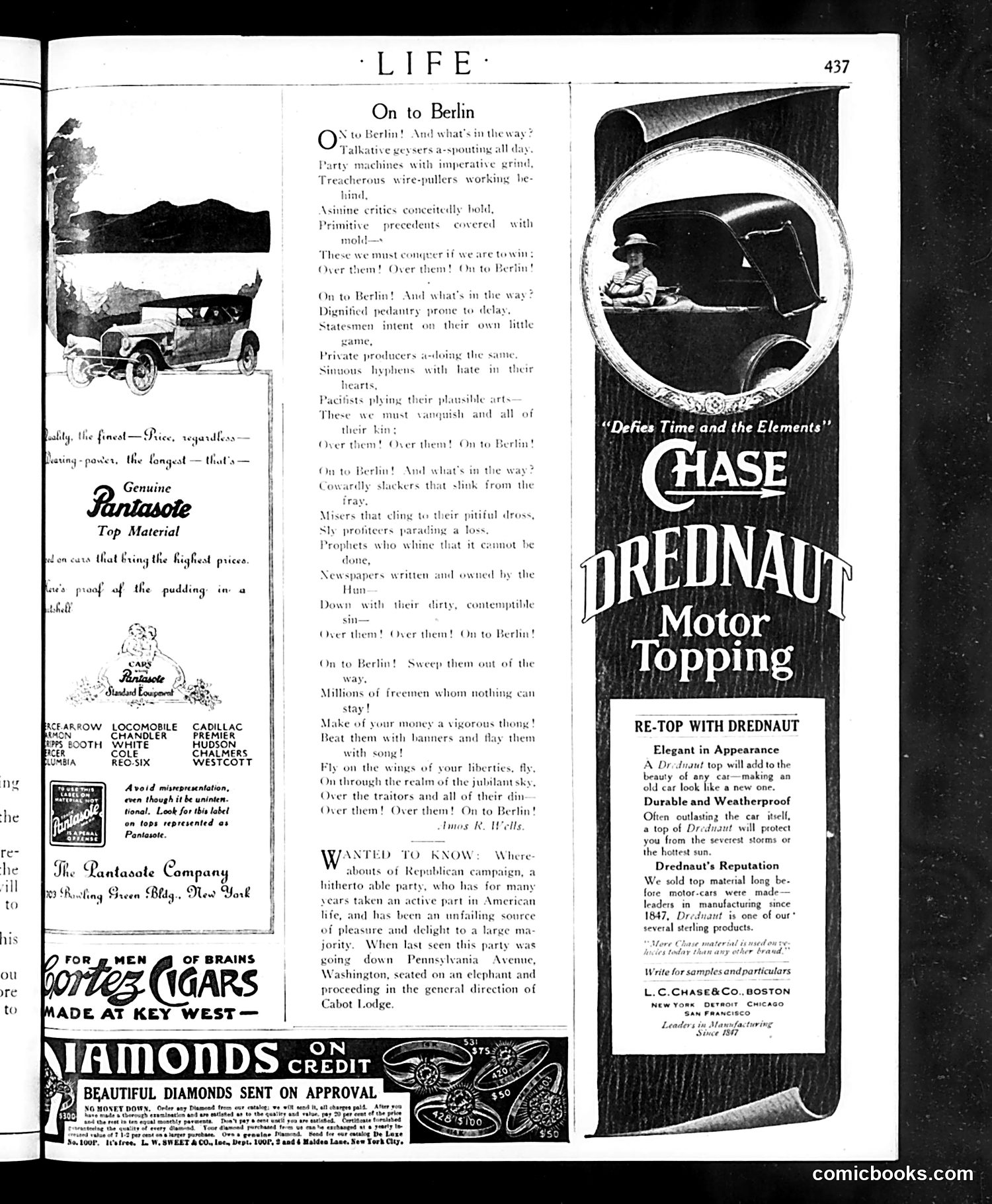
This page is primarily **advertising**, not political satire. The left side contains ads for Pantasote Top Material (automobile upholstery), Portes Cigars, and Diamonds on Credit. The right side features a large Chase Drednaut Motor Topping advertisement. The only editorial content is a poem titled "On to Berlin" by Amasa C. Wells, which appears to satirize various American social types—talkers, critics, pacifists, profiteers—all heading toward Berlin. The poem's tone is critical of these groups' hypocrisy and self-interest during what appears to be a World War I context. The poem concludes with a "Wanted to Know" section asking about Republican campaign contributors.
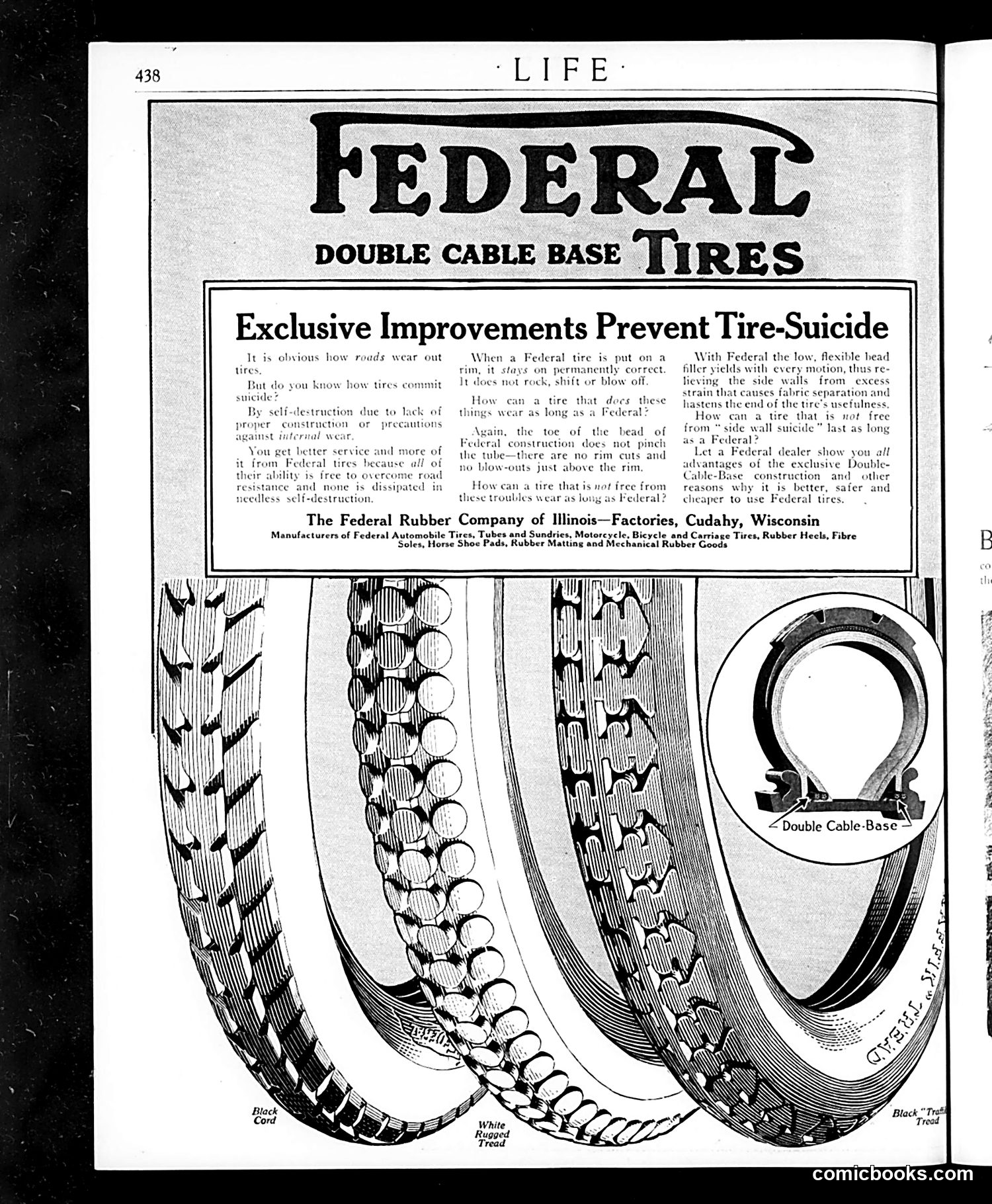
This page is **primarily an advertisement**, not a cartoon. It promotes Federal Double Cable Base Tires manufactured by The Federal Rubber Company of Illinois. The ad uses humorous language to pitch tire durability, asking rhetorically whether tires commit "suicide" through poor construction. It contrasts tires that fail prematurely with Federal's exclusive "Double Cable Base" design, which supposedly prevents common tire failures like rim cuts and blowouts. The visual shows cross-sections of three tire designs and a close-up of the double cable base feature. The ad's tongue-in-cheek tone—personifying tire failure as self-destruction—was typical early-20th-century advertising copy meant to entertain while selling. This reflects an era when tire reliability was a genuine consumer concern for early automobiles.
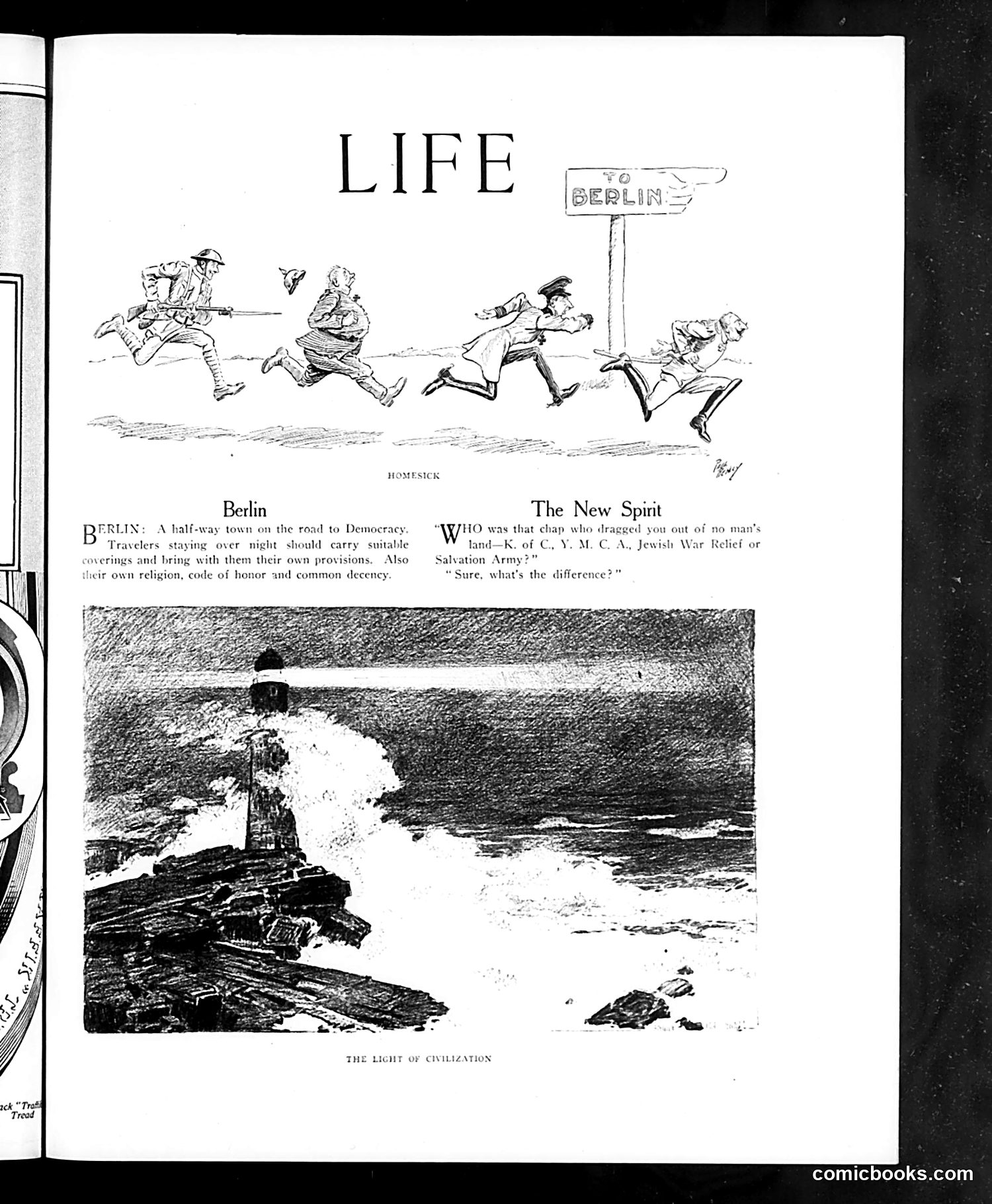
This page contains two distinct pieces: **"Homesick" cartoon (top):** Shows several figures running toward a "Berlin" signpost. The sketch satirizes post-WWI displacement—people from various backgrounds (suggested by their different dress) are depicted fleeing or returning, illustrating the chaos and refugee movements following World War I's end. **"The New Spirit" section (middle):** A brief text piece questioning the difference between charitable organizations (Y.M.C.A., Jewish War Relief, Salvation Army). The satire suggests these organizations, despite different names and missions, may be functionally identical. **"The Light of Civilization" photograph (bottom):** A lighthouse against turbulent seas, likely serving as either counterpoint to the chaos above or commentary on civilization's fragility post-war. The page satirizes post-WWI social upheaval and institutional distinctions.
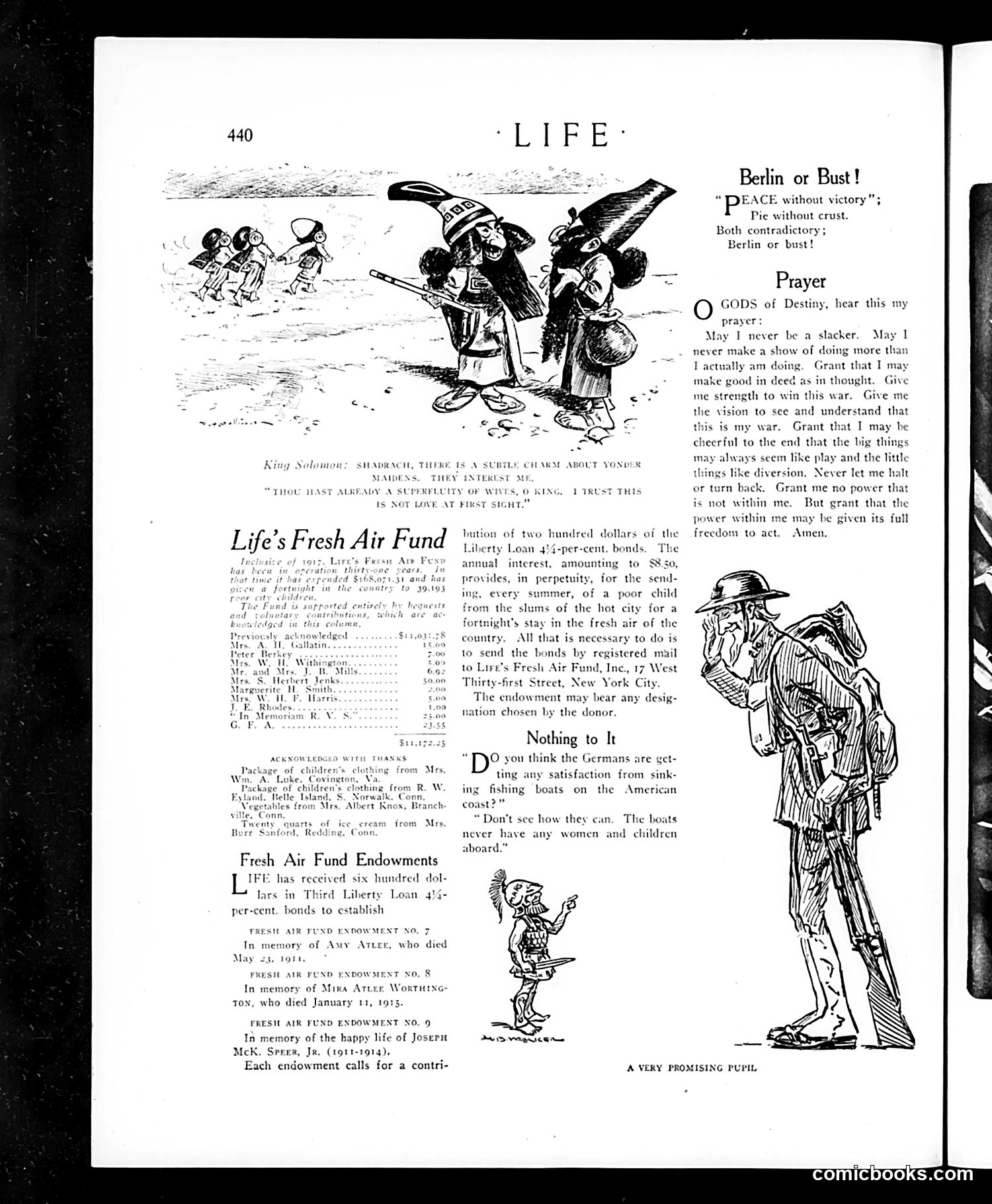
This WWI-era Life magazine page features anti-German propaganda. The top cartoon shows two caricatured figures (appearing to represent Germany and an ally) with exaggerated features holding weapons, captioned with King Solomon's statement about charm and interest. The title "Berlin or Bust!" expresses the Allied war aim: either defeat Germany decisively or face total destruction. The accompanying prayer reflects American determination to win unconditionally—rejecting any "peace without victory." The lower cartoon titled "A Very Promising Pupil" shows what appears to be a German soldier figure being trained or instructed, likely satirizing Germany's military preparation or aggressive expansion. The page reflects 1917-1918 American attitudes: unwavering commitment to total victory and distrust of negotiated peace settlements.
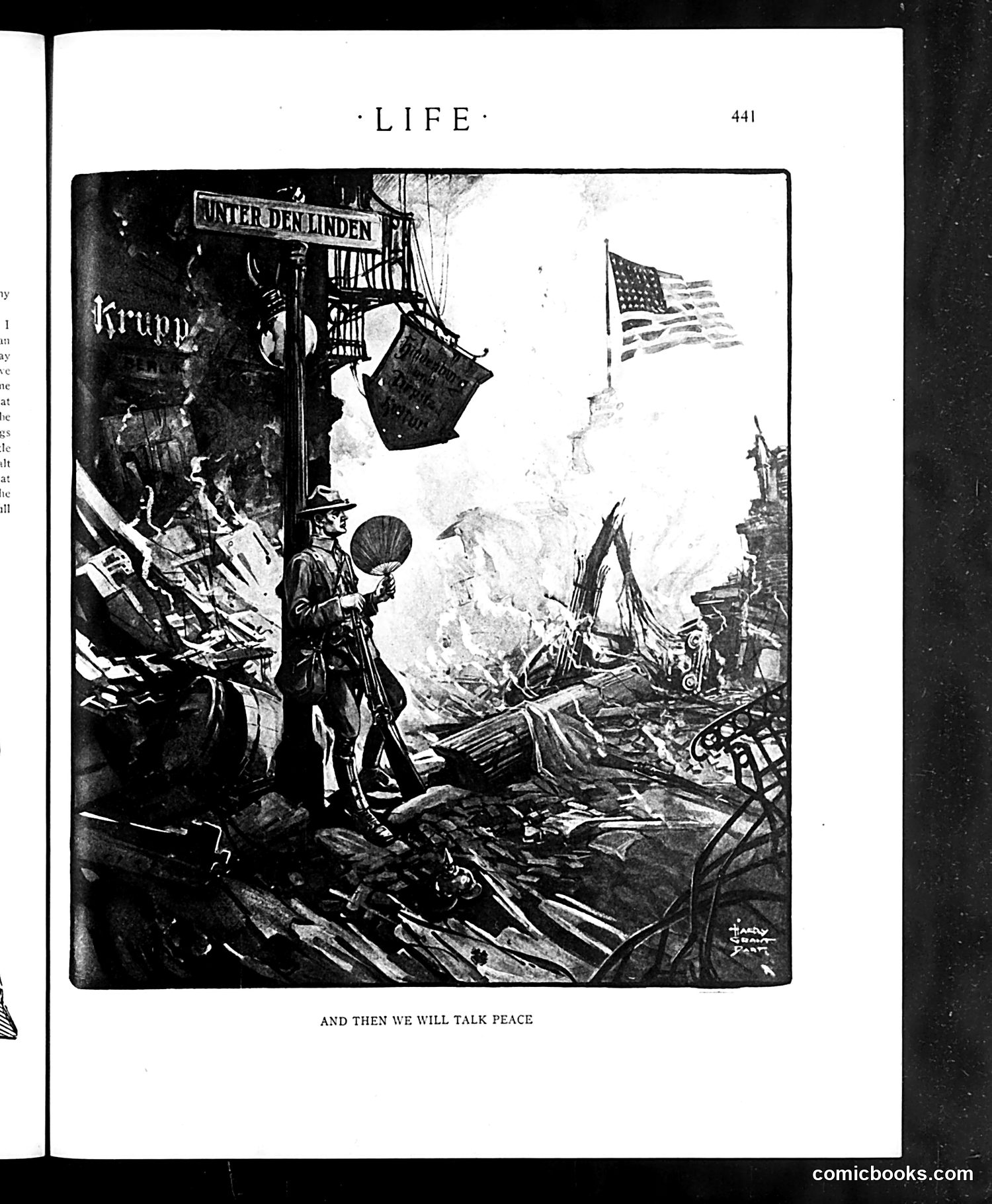
This is a WWI-era satirical illustration titled "And Then We Will Talk Peace." The image depicts an American soldier standing amid the wreckage of war—destroyed buildings, debris, and military equipment—holding what appears to be a fan or insignia. An American flag flies prominently above the devastation. A sign reading "UNTER DEN LINDEN" (a famous Berlin street) suggests this represents a conquering American presence in Germany. The cartoon's message is ironic: it suggests that peace negotiations can only occur *after* military victory and the complete destruction of the enemy. The soldier's confident stance amid ruins implies American determination to achieve total victory before any peace talks begin. This reflects WWI-era American propaganda emphasizing unconditional surrender as a precondition for peace.
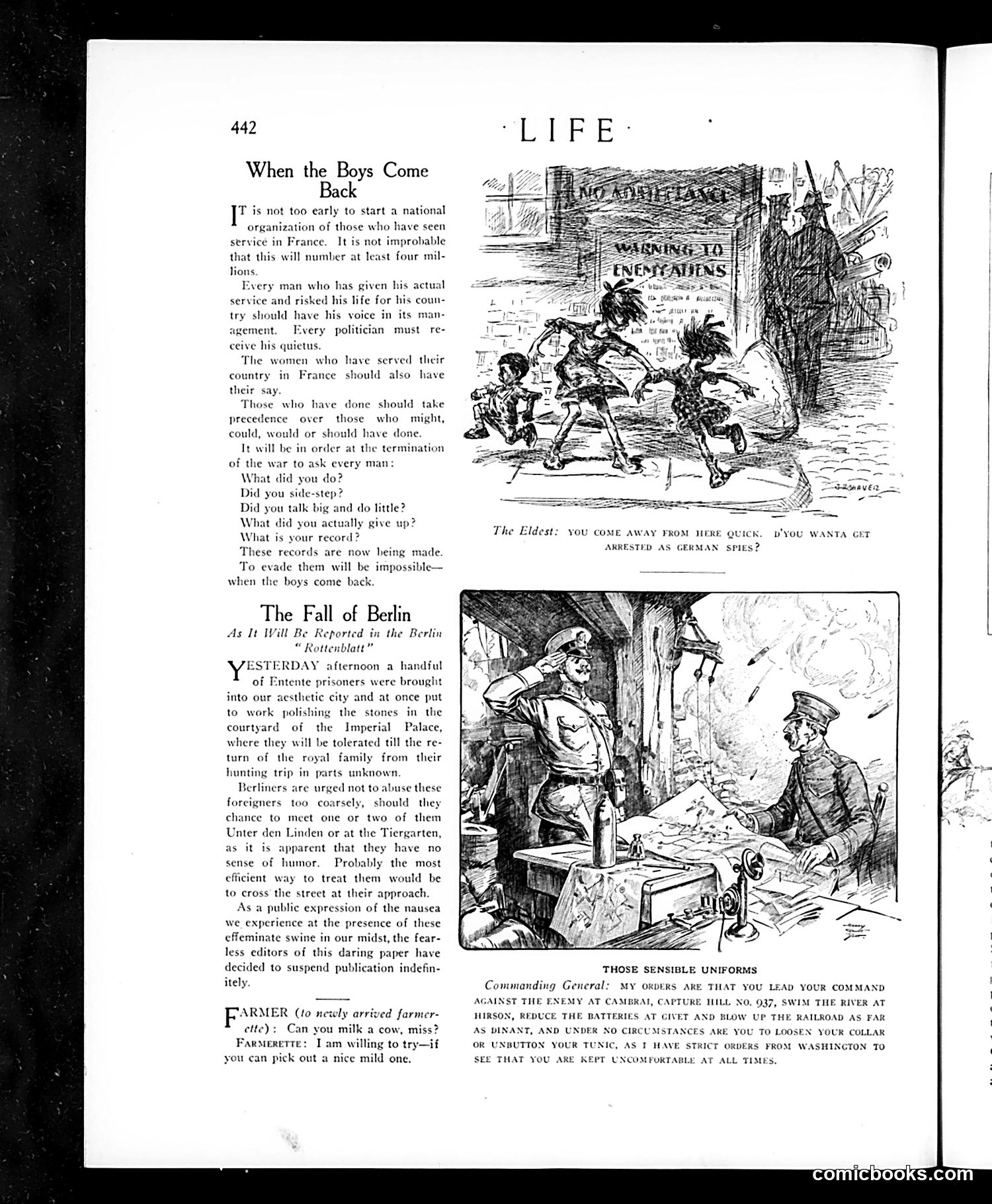
This page contains two satirical pieces about World War I: **"When the Boys Come Back"** critiques how returning soldiers will be evaluated—politicians will demand soldiers' service records and accomplishments, while questioning their valor and contributions. The satire suggests this interrogation will be difficult to manage fairly. **"The Fall of Berlin"** depicts German prisoners of war in Berlin being put to work cleaning the Imperial Palace courtyards. The cartoon satirizes the irony of defeated enemies laboring in the enemy's capital. The accompanying "Commanding General" orders are absurdist military humor, mocking military bureaucracy through exaggerated, contradictory commands about prisoner treatment. Both pieces reflect American WWI-era attitudes toward soldiers' homecoming and enemy occupation.
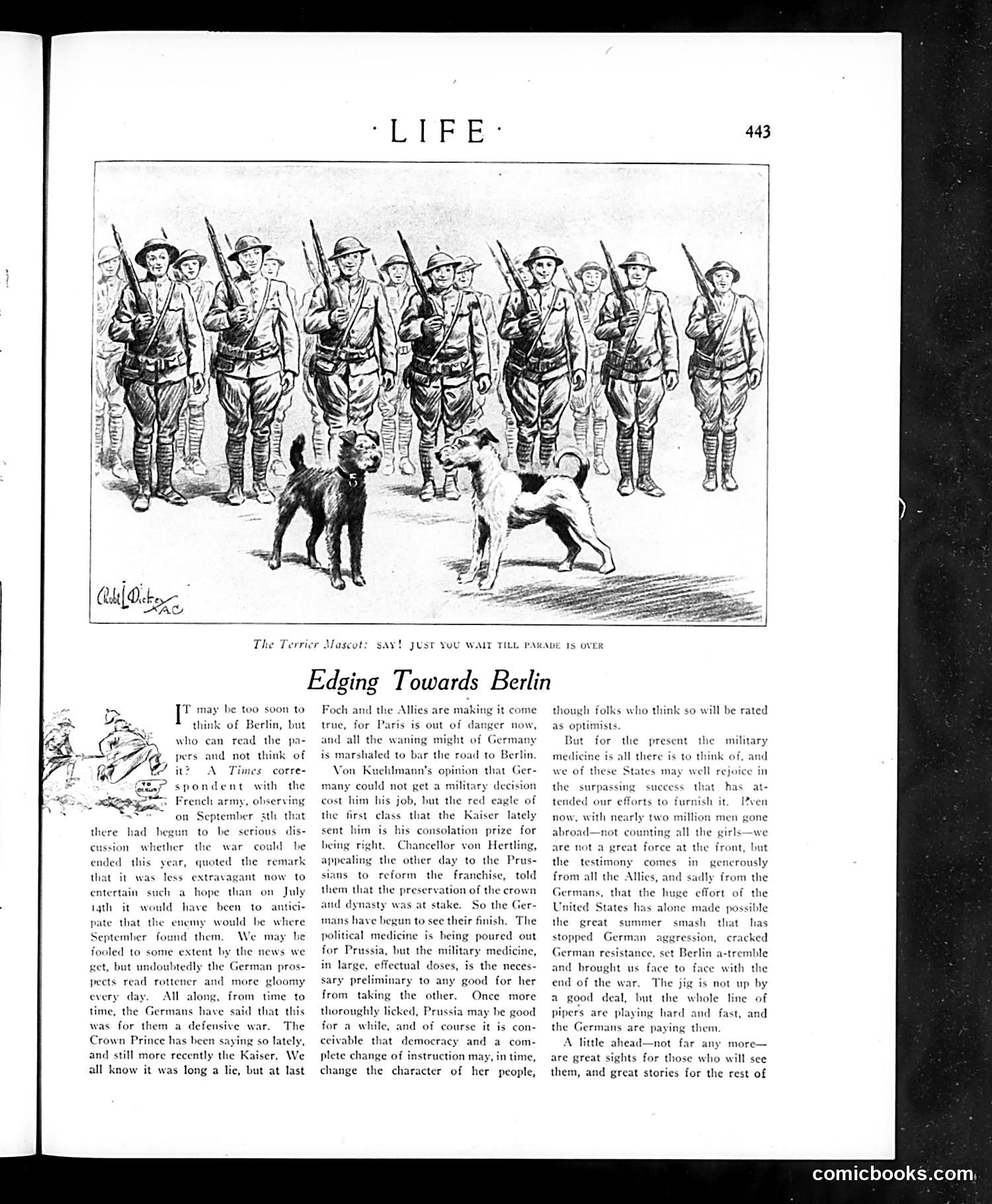
**The Cartoon:** A line of armed soldiers (appearing to be American or Allied troops based on their uniforms and helmets) stands at attention while two dogs in front of them engage in a standoff. The caption reads: "The Terrier Mascot: say! just you wait till parade is over." **The Satire:** This is a WWI-era cartoon playing on the phrase "edging towards Berlin"—the Allies' military advance toward Germany. The joke uses dogs as stand-ins: the "terrier mascot" (representing Britain, given its terrier identity) warns another dog that once the formal parade ends, a real fight will occur. It's commentary on military posturing and the notion that formal military protocol masks the genuine aggression to come in actual combat.
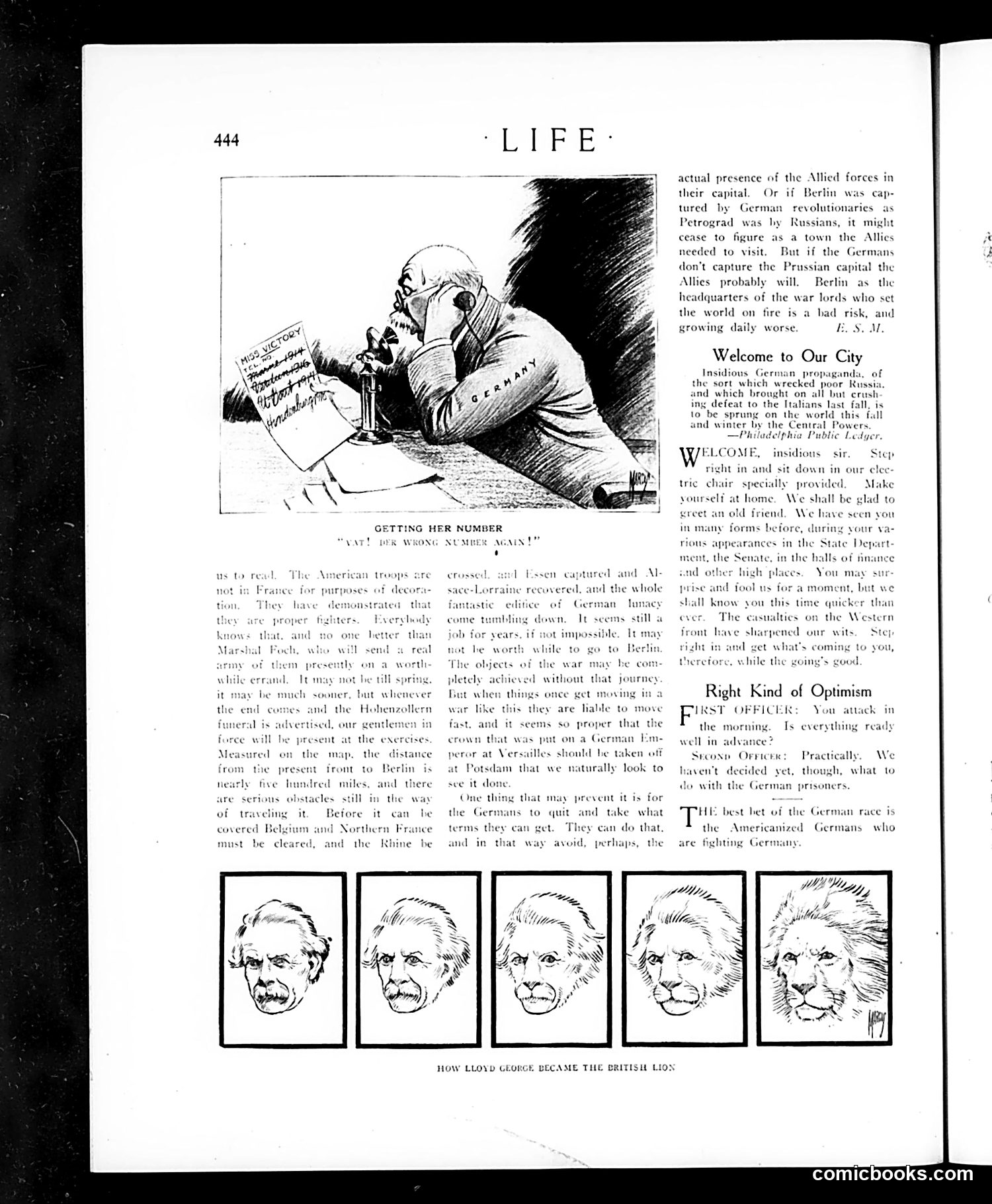
The main cartoon titled "Getting Her Number" depicts Germany as a skeletal figure desperately trying to extract military intelligence. The accompanying articles "Welcome to Our City" and "Right Kind of Optimism" discuss Allied military prospects and German surrender possibilities during WWI's final stages. The series at bottom, "How Lloyd George Became the British Lion," transforms British Prime Minister David Lloyd George's face progressively into a lion—a symbol of British strength and courage. This appears to celebrate Lloyd George's aggressive war leadership. The overall page conveys American/Allied optimism about victory, mocking German desperation while praising British resolve. The content reflects the magazine's pro-Allied stance during the First World War's conclusion.
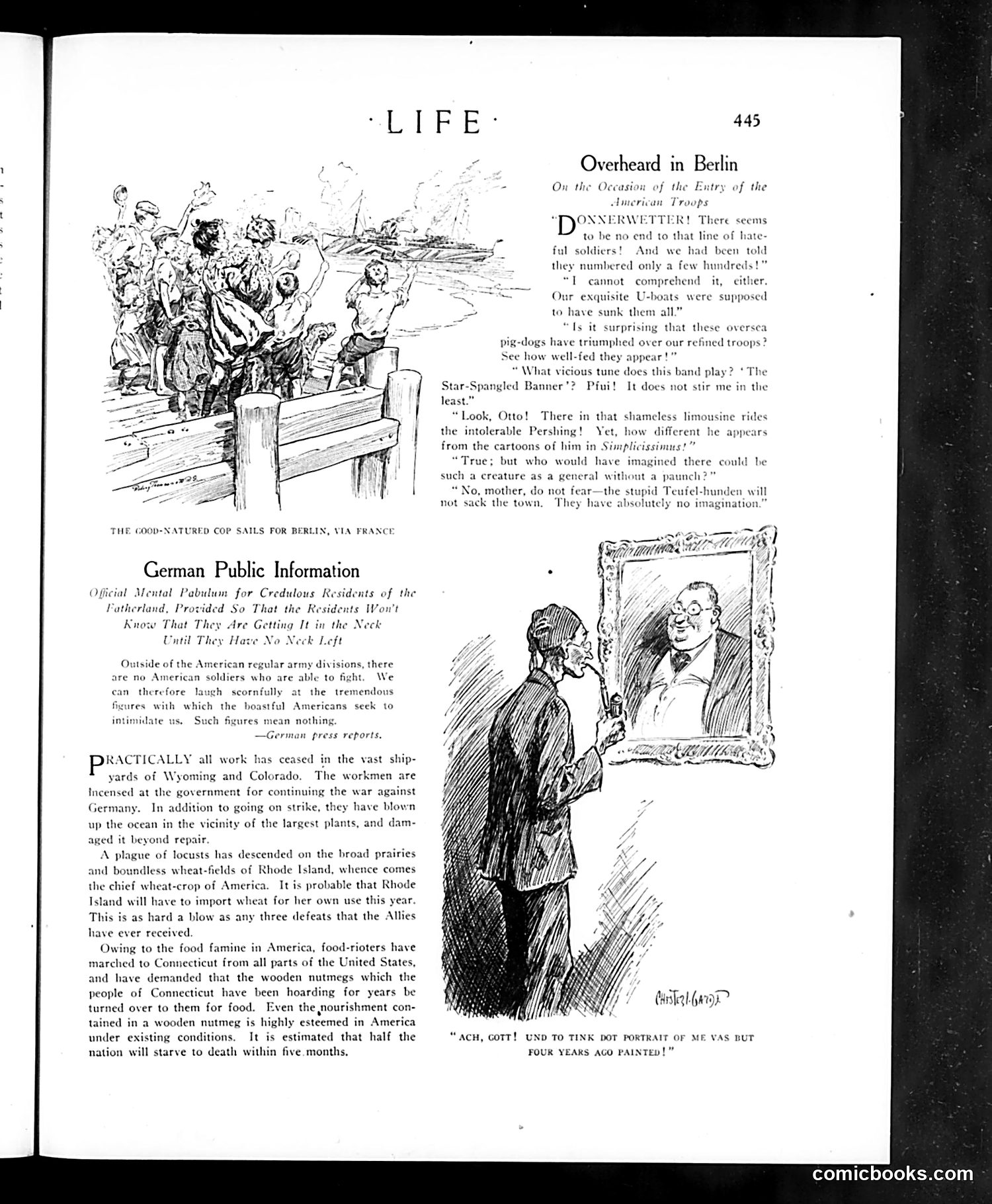
This page satirizes German propaganda distributed to convince Germans they're winning WWI. The top cartoon shows German sailors supposedly sinking American U-boats, with the caption mocking their boasts: "The Star-Spangled Banner? Pfui! It does not stir me in the least." The bottom section, titled "German Public Information," presents fake German claims that American troops outside regular army divisions "are not able to fight." The text then pivots to expose the lie—describing actual American industrial sabotage, food shortages, and labor unrest supposedly caused by Germans, suggesting the propaganda is mere wishful thinking. The framed cartoon shows a German official presenting an outdated portrait, implying German intelligence is hopelessly out of date. The satire mocks German delusion about the war's reality.
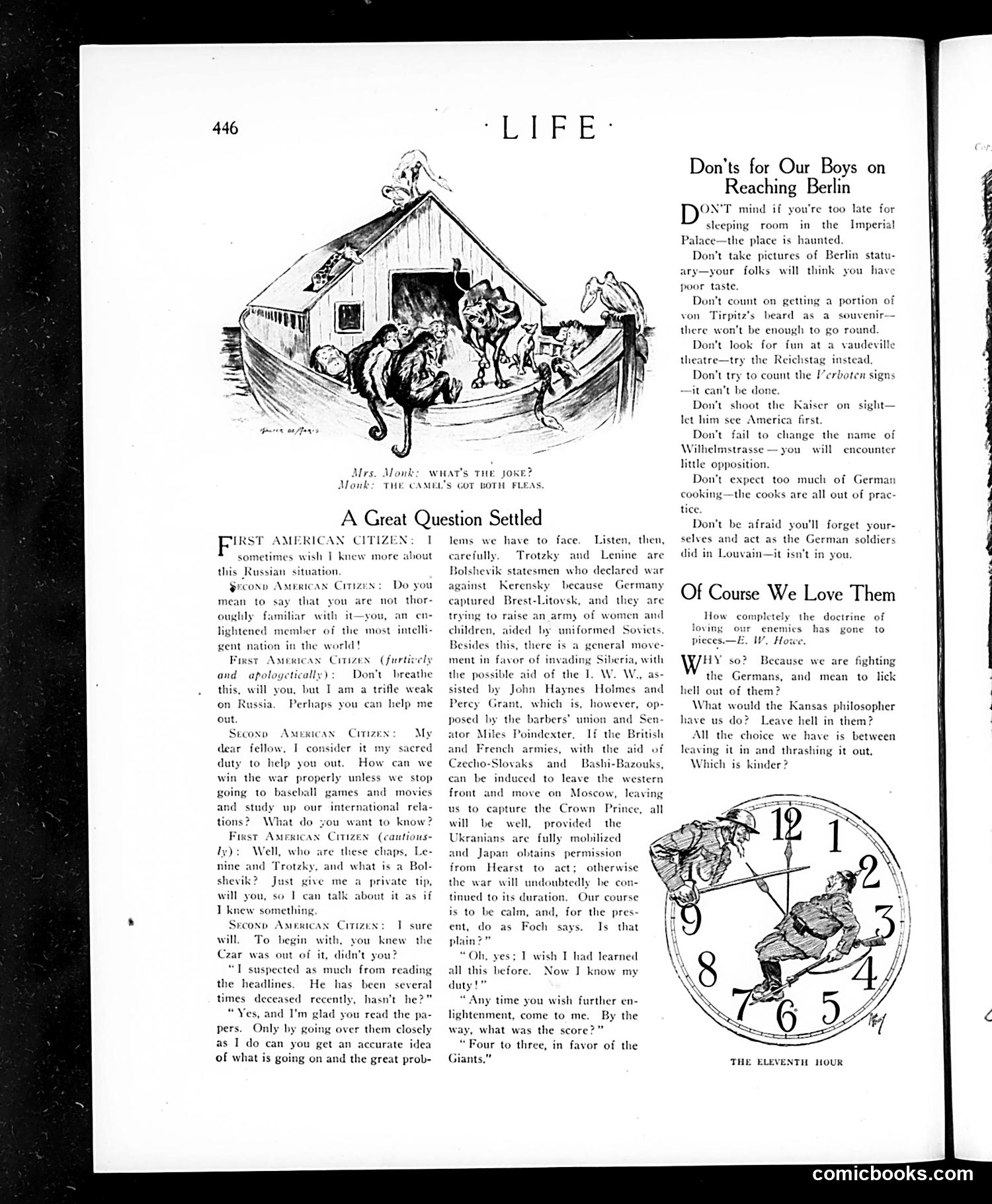
This page contains wartime satirical content directed at American soldiers heading to Berlin during World War I. The top cartoon depicts a chaotic scene labeled "Mess Mont: The Camel's Got Both Fleas," apparently mocking the confusion of military operations. The main text sections—"A Great Question Settled," "Don'ts for Our Boys on Reaching Berlin," and "Of Course We Love Them"—offer tongue-in-cheek advice and commentary. The humor targets both German culture (mocking statuary, cooking, and the Kaiser) and American soldiers' likely misconduct in occupied territory. The "Eleventh Hour" clock illustration appears to reference time-sensitive wartime urgency. Overall, the page uses satire to process anxieties about American occupation of enemy territory and soldier behavior abroad.
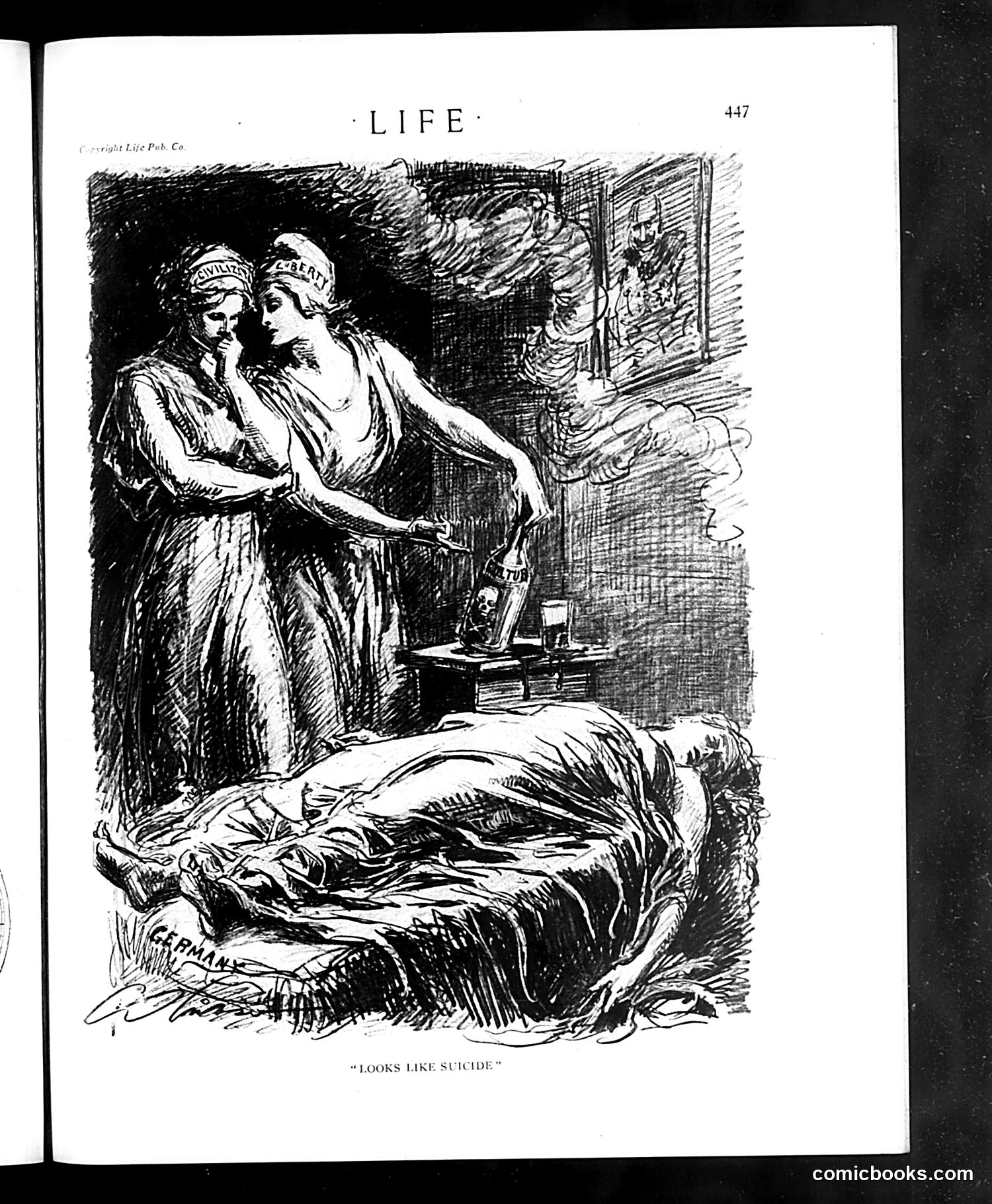
This appears to be a satirical cartoon from *Life* magazine depicting a dramatic scene. Two women in early 20th-century dress stand over a prone male figure, examining what appears to be an apparent death or overdose scenario. One woman points to evidence on a nearby table. The caption "Looks Like Suicide" suggests social commentary on either: - The ease with which deaths were misclassified or covered up - Skepticism about official narratives of suspicious deaths - Dark humor about domestic crises or scandals The women's composed demeanor and clinical investigation suggest they may be authorities, investigators, or society figures dismissing a suspicious death. Without additional context, the specific target of satire—whether a particular incident, social problem, or public figure—remains unclear.
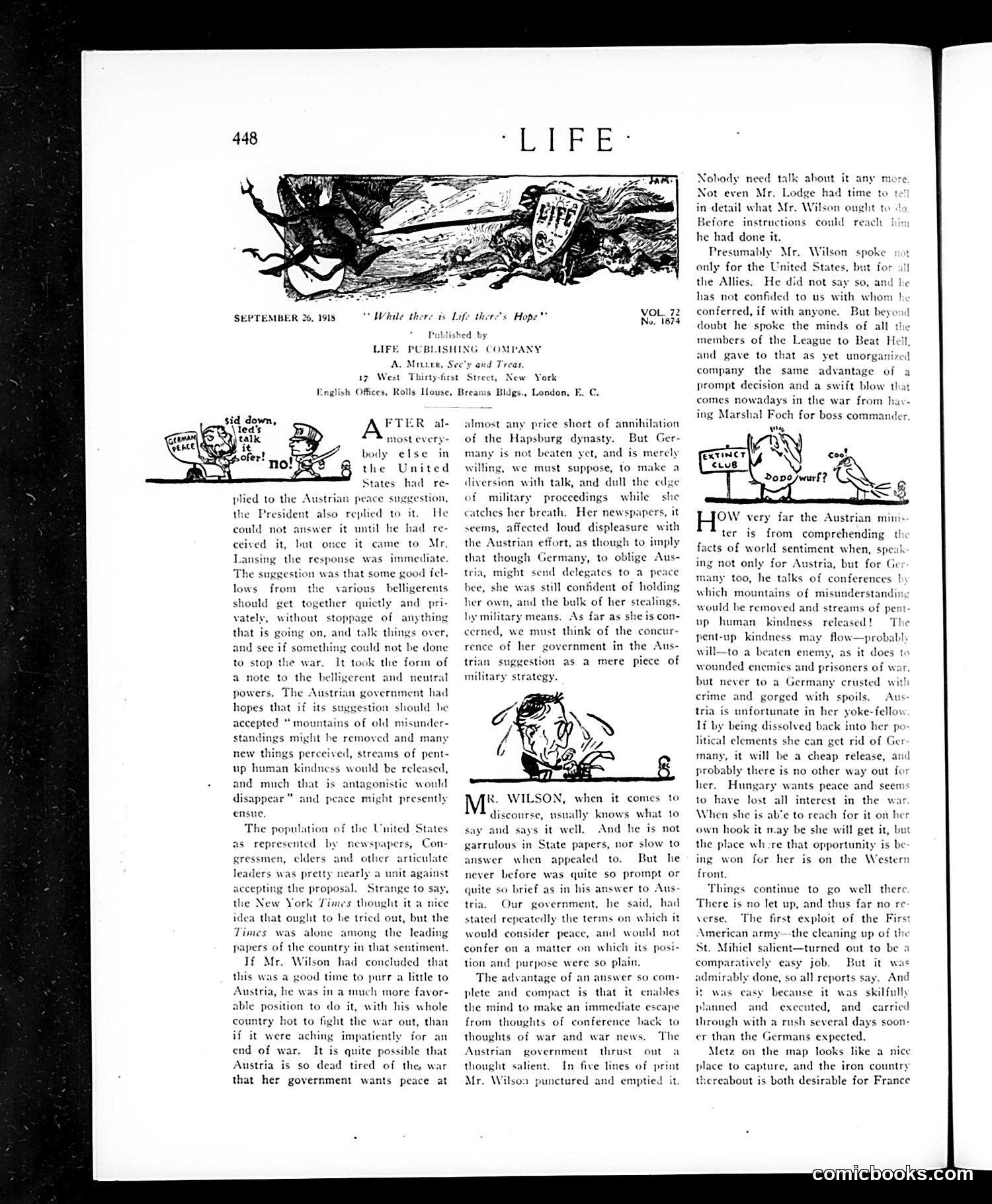
This page satirizes President Wilson's swift rejection of Austria-Hungary's peace proposal during World War I. The cartoons and text mock the Austrian suggestion that belligerent nations' leaders meet privately to resolve their "misunderstandings" and release "pent-up human kindness." The satire targets Austria's naïveté and Germany's cynical manipulation. The text suggests Austria is genuinely war-weary, while Germany merely uses the peace feeler as a tactical distraction. Wilson's dismissal is praised: he reportedly stated America's peace terms were fixed and required no discussion—"puncturing" the Austrian proposal in five lines of print, making further debate unnecessary. The page mocks Senator Lodge and others who might have elaborated endlessly on Wilson's position. The overall tone celebrates American decisiveness while ridiculing both Austrian desperation and German strategic cunning.
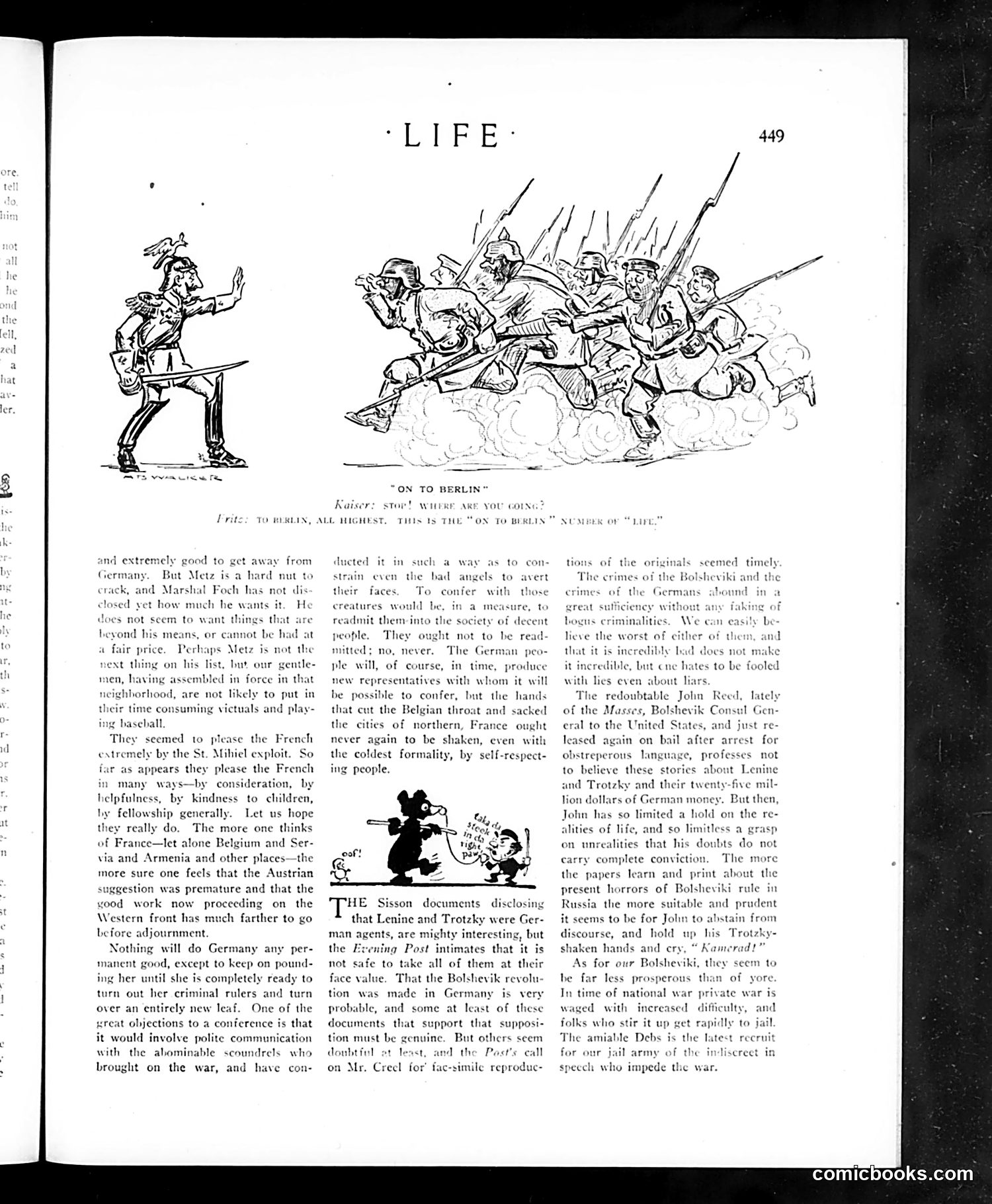
This page contains anti-German and anti-Bolshevik satire from World War I. The main cartoon "On to Berlin" depicts the German Kaiser expressing alarm as allied soldiers advance, shown emerging from smoke/clouds with bayoneted rifles. The caption has the Kaiser asking "Where are you going?"—a mocking reference to Life's own "On to Berlin" slogan promoting continued prosecution of the war. The text argues that Germany deserves complete military defeat, not negotiated peace. It dismisses any diplomatic accommodation with German leadership as morally wrong. The article also attacks Bolshevik Russia, claiming Lenin and Trotsky were German agents (referencing the controversial "Sisson Documents"). It criticizes John Reed (the radical journalist) for defending the Bolsheviks and mentions Eugene Debs as an anti-war agitator imprisoned for opposing the war effort. The satire assumes readers support total victory and view both Germany and Bolshevism as existential threats requiring suppression.
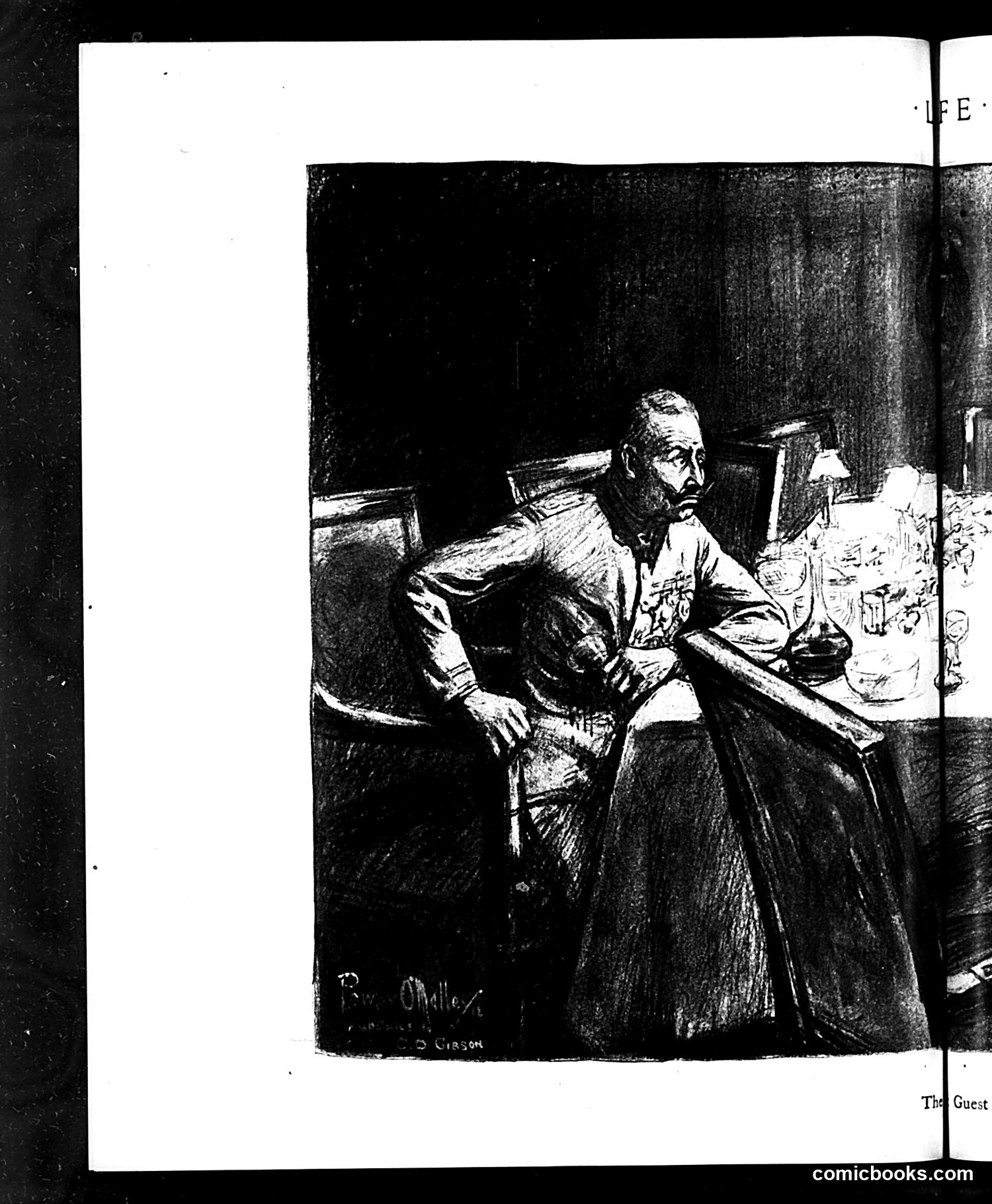
This illustration depicts a man in military uniform (suggested by the decorated chest and formal attire) sitting at what appears to be a dining table. He seems uncomfortable or contemplative, with his hand raised to his face in a gesture suggesting worry or unease. The setting is an interior room with sparse furnishings. Without additional context from the magazine's text, the specific identity and satirical purpose remain unclear. The title "The Guest" suggests this may reference a notable military or political figure visiting during a particular historical moment, but the OCR text provides only the page marker "comicbooks.com," making it impossible to determine the exact political or social commentary intended.
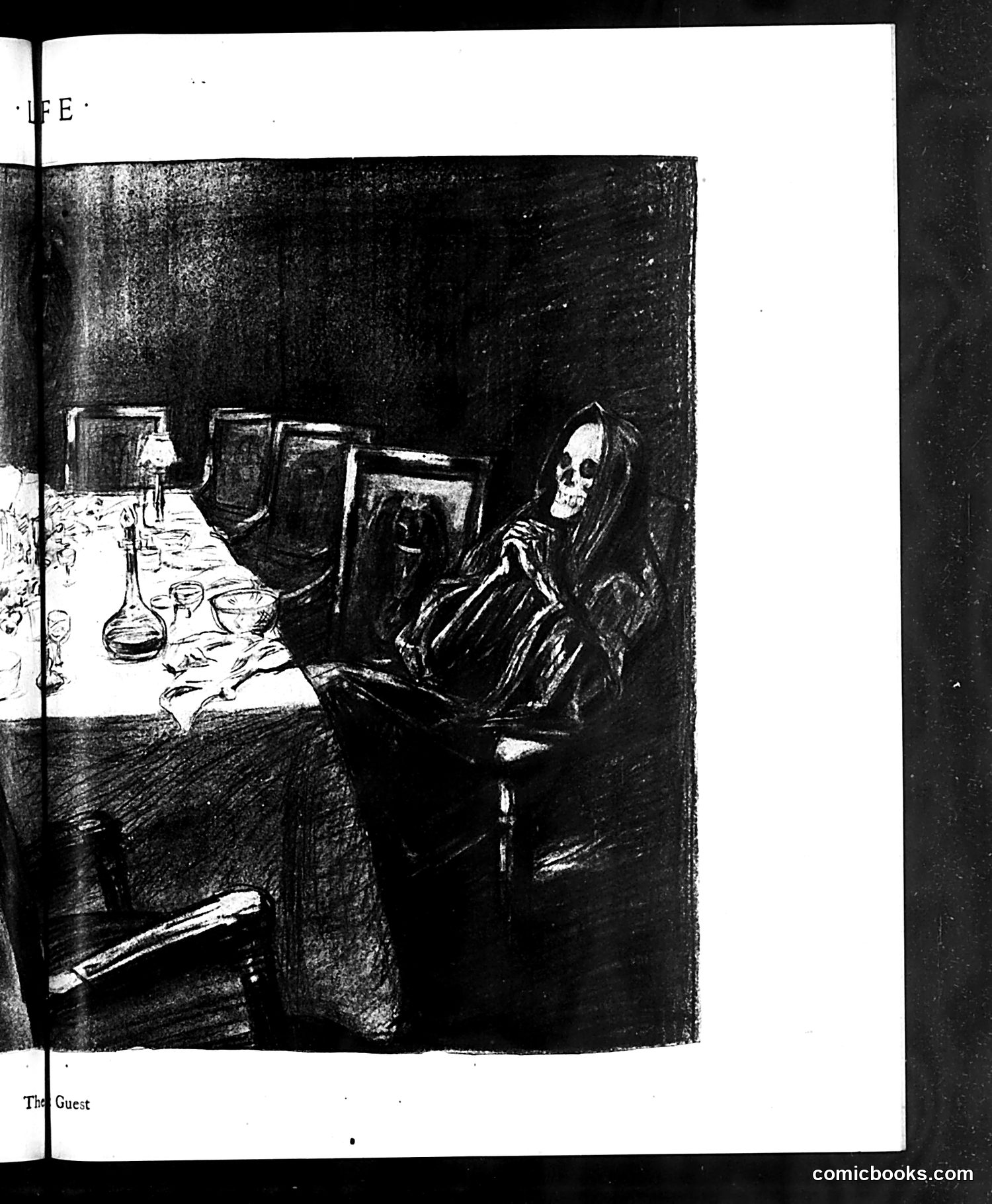
This appears to be a black and white illustration titled "The Guest" from Life magazine. The image depicts a skeletal or death-like figure in dark clothing seated at a formal dining table set with bottles, glasses, and place settings. The figure's skull-like face and skeletal appearance suggest Death personified. The rich table setting and formal atmosphere create stark contrast with the morbid guest. The satire likely critiques some contemporary social or political condition—possibly excess, mortality, or an unwelcome presence at society's table. Without additional context about the publication date or accompanying article text, the specific target of this memento mori commentary remains unclear, though it appears to be commentary on serious social or political themes through darkly humorous imagery.
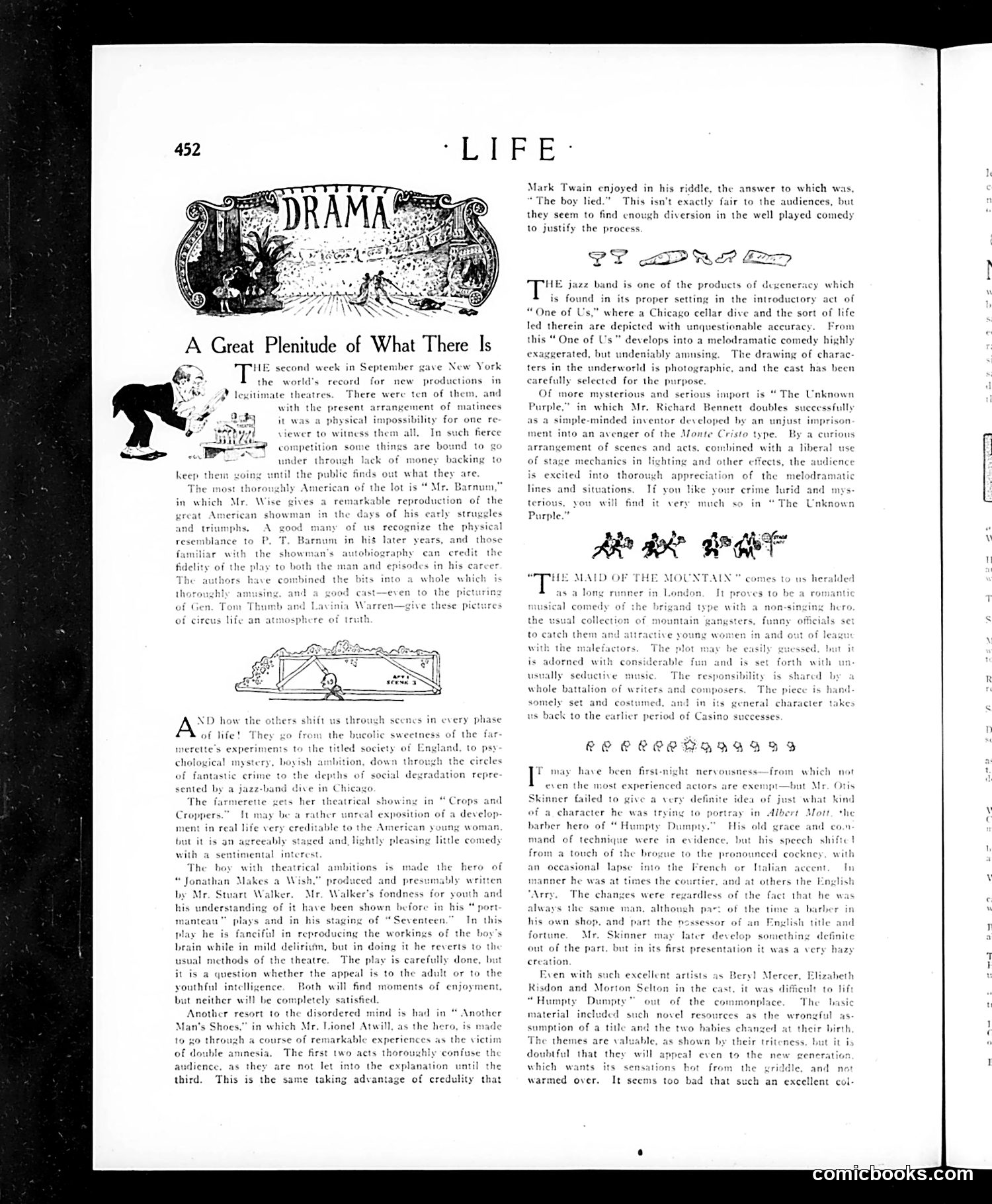
This page reviews ten new Broadway theatrical productions opening in September. The critic discusses plays including "Mr. Barnum" (featuring an actor's recreation of P.T. Barnum), "Crops and Croppers" (depicting a farmerette), and "Jonathan Makes a Wish" (a Stuart Walker production exploring a boy's delirious fantasies). The review mentions "One of Us" (set in a Chicago jazz-dive cellar, depicting underworld life), "The Unknown Purple" (a Monte Cristo-type melodrama about a wronged inventor), and "The Maid of the Mountain" (a musical comedy). The illustrated figure appears to be a theatrical performer in character. The satire is gentle—the critic notes the physical impossibility of reviewing ten simultaneous productions, suggesting some will fail due to lack of backing. The tone is appreciative of American theatrical ambition despite the commercial chaos of opening week.
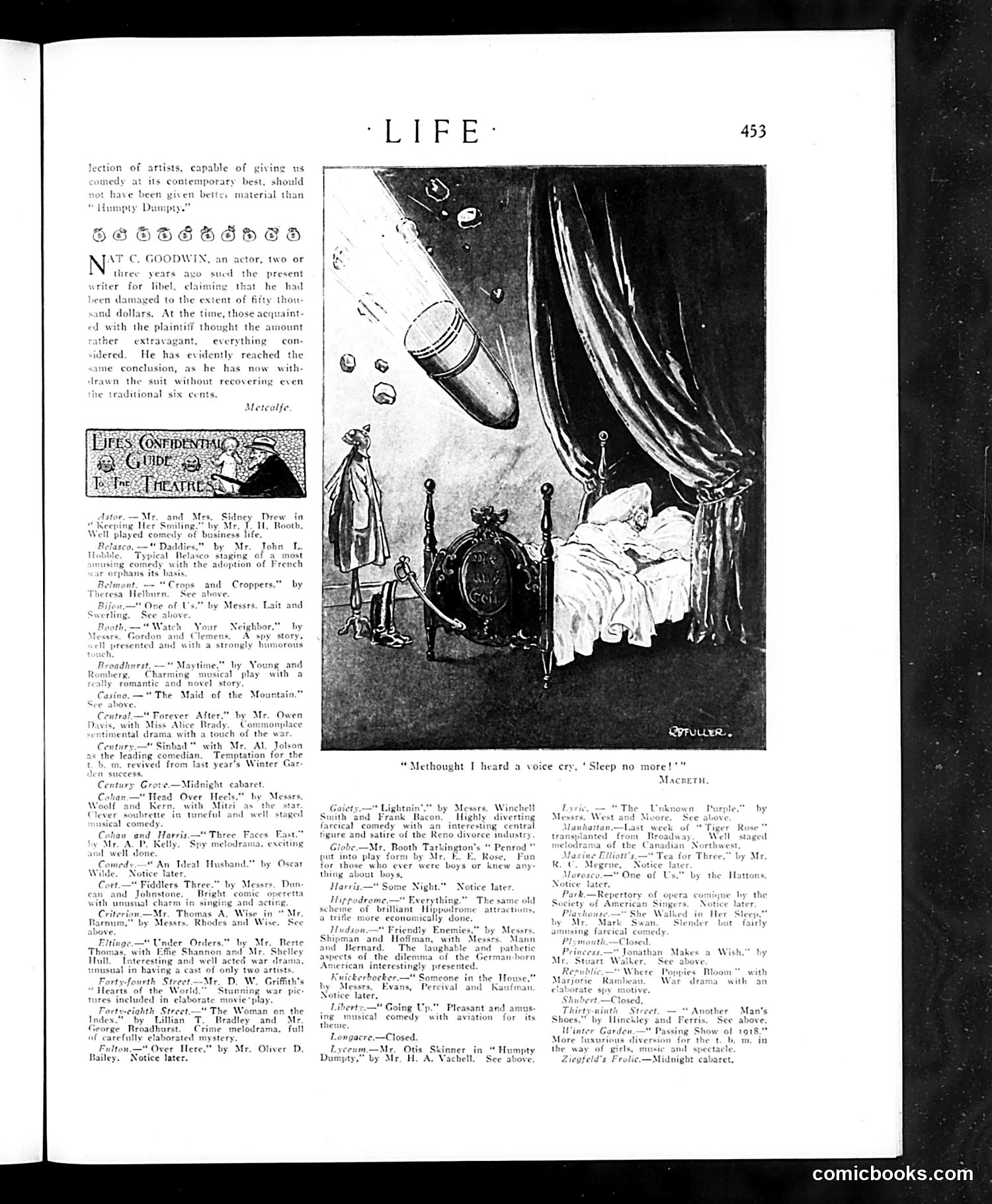
This page consists primarily of **theatre reviews and entertainment listings** rather than political cartoons. The single illustration shows a bedroom scene labeled "Methought I heard a voice cry, 'Sleep no more!'" — a reference to Shakespeare's *Macbeth*, depicting what appears to be a dramatic moment with a figure in bed and another looming above. The text reviews various Broadway productions and performers, including works by Sidney Drew, Owen Davis, and Al Jolson. There's a brief news item about **Nat C. Goodwin**, an actor who sued for libel fifty thousand dollars but withdrew the suit without recovery, settling for merely "the traditional six cents"—a satirical jab at a frivolous lawsuit. The page reflects early 20th-century theatrical culture and entertainment journalism, with no apparent political commentary. The "Sleep no more" caption appears to be a simple theatrical joke rather than social satire.
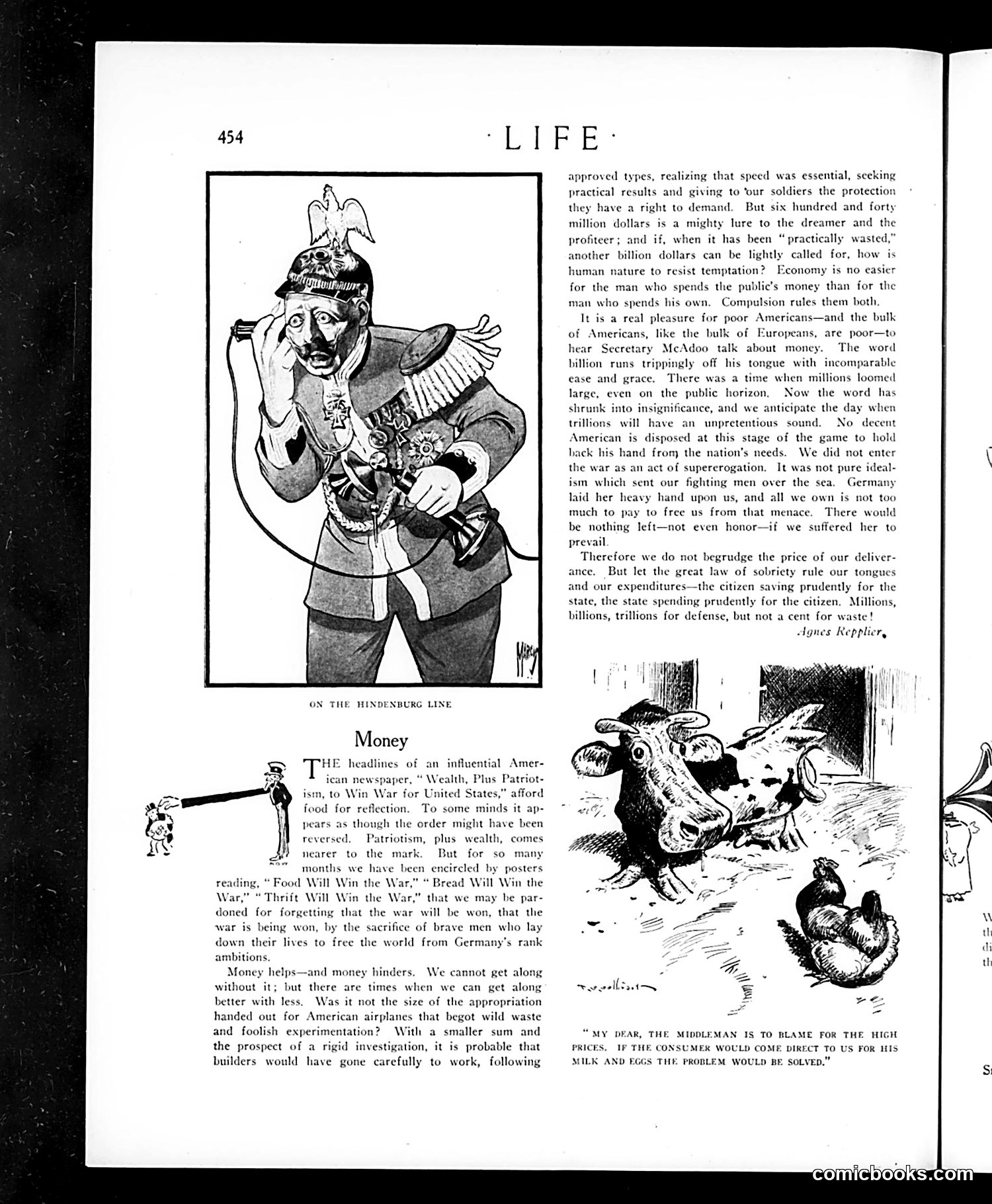
**Top Cartoon ("On the Hindenburg Line"):** This depicts a caricatured German military figure (likely Kaiser Wilhelm II, given the Prussian uniform and eagle insignia) laden with military decorations and weapons. The "Hindenburg Line" reference places this during WWI, satirizing German militarism and imperial excess. **Article "Money" by Agnes Repplier:** Written during American WWI involvement, this editorial criticizes wasteful military spending while defending necessary wartime expenditures. Repplier argues that $640 million appropriated for airplanes produced "wild waste and foolish experimentation" due to lack of oversight. She praises Secretary of Treasury McAdoo's rhetoric about sacrifice but urges fiscal discipline: "Millions, billions, trillions for defense, but not a cent for waste." **Bottom Cartoon:** Shows farm animals (cow, chicken) speaking to a consumer about middlemen causing high food prices—a domestic economic complaint during wartime inflation. **Overall Context:** The page addresses tension between patriotic spending and fiscal responsibility during WWI, criticizing both military waste and wartime profiteering.
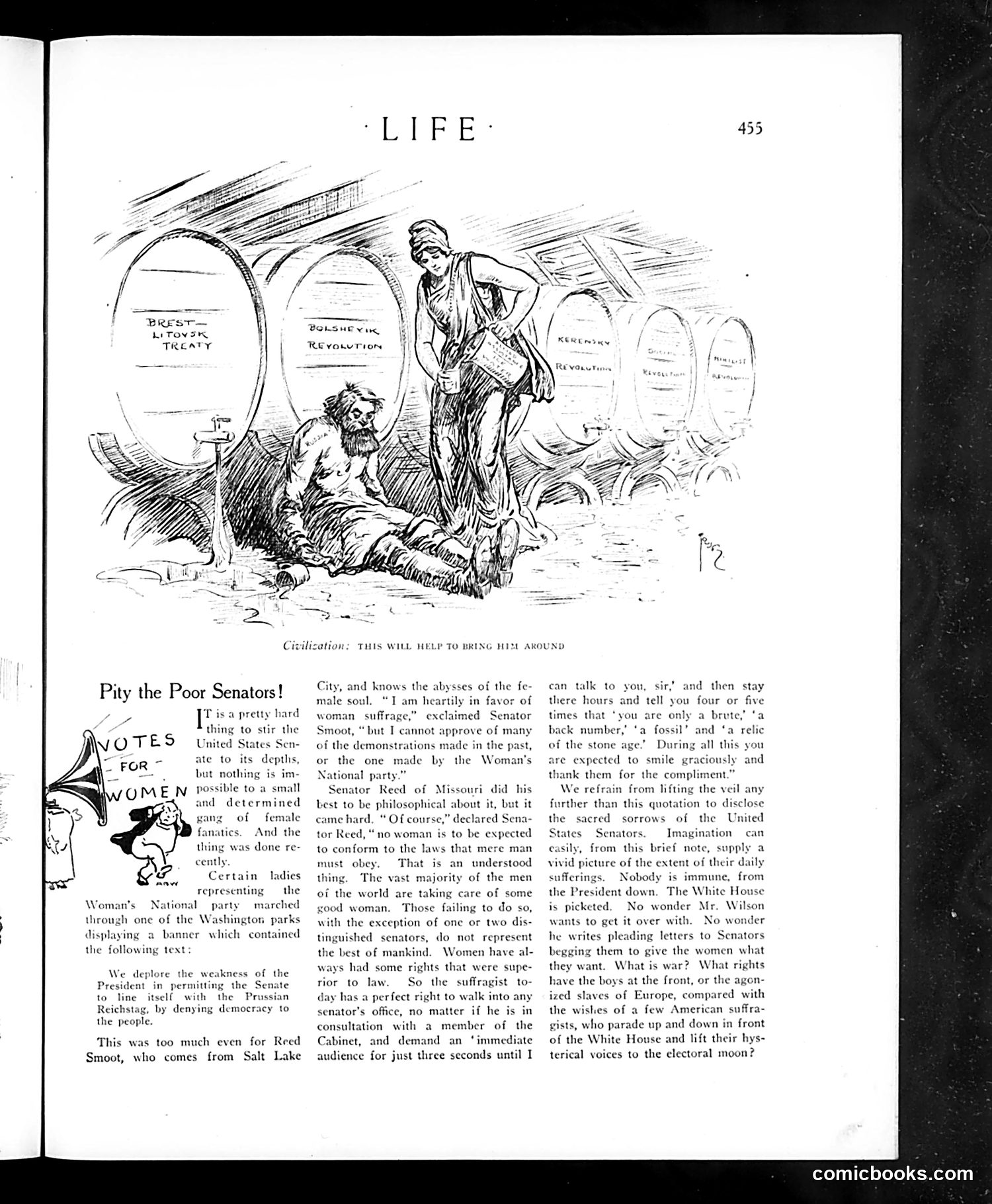
This 1918 Life magazine page satirizes female suffragists' tactics by mocking sympathetic male senators. The cartoon depicts a disheveled man amid barrels labeled with international crises (Brest-Litovsk Treaty, Bolshevik Revolution) being confronted by a woman activist—suggesting women's suffrage demands distract from serious wartime concerns. The text ridicules senators like Reed Smoot and Senator Reed who, while opposing women's suffrage philosophically, acknowledge suffragists' "right" to disrupt their offices. The article sarcastically portrays suffragists as unreasonable, comparing their demands unfavorably to soldiers' sacrifices in World War I. The caption "This will help to bring him around" implies that harassment will change senators' minds—presented as absurd. Overall, the satire defends senators against persistent suffrage activists, framing women's political engagement as hysterical disruption rather than legitimate democratic protest.
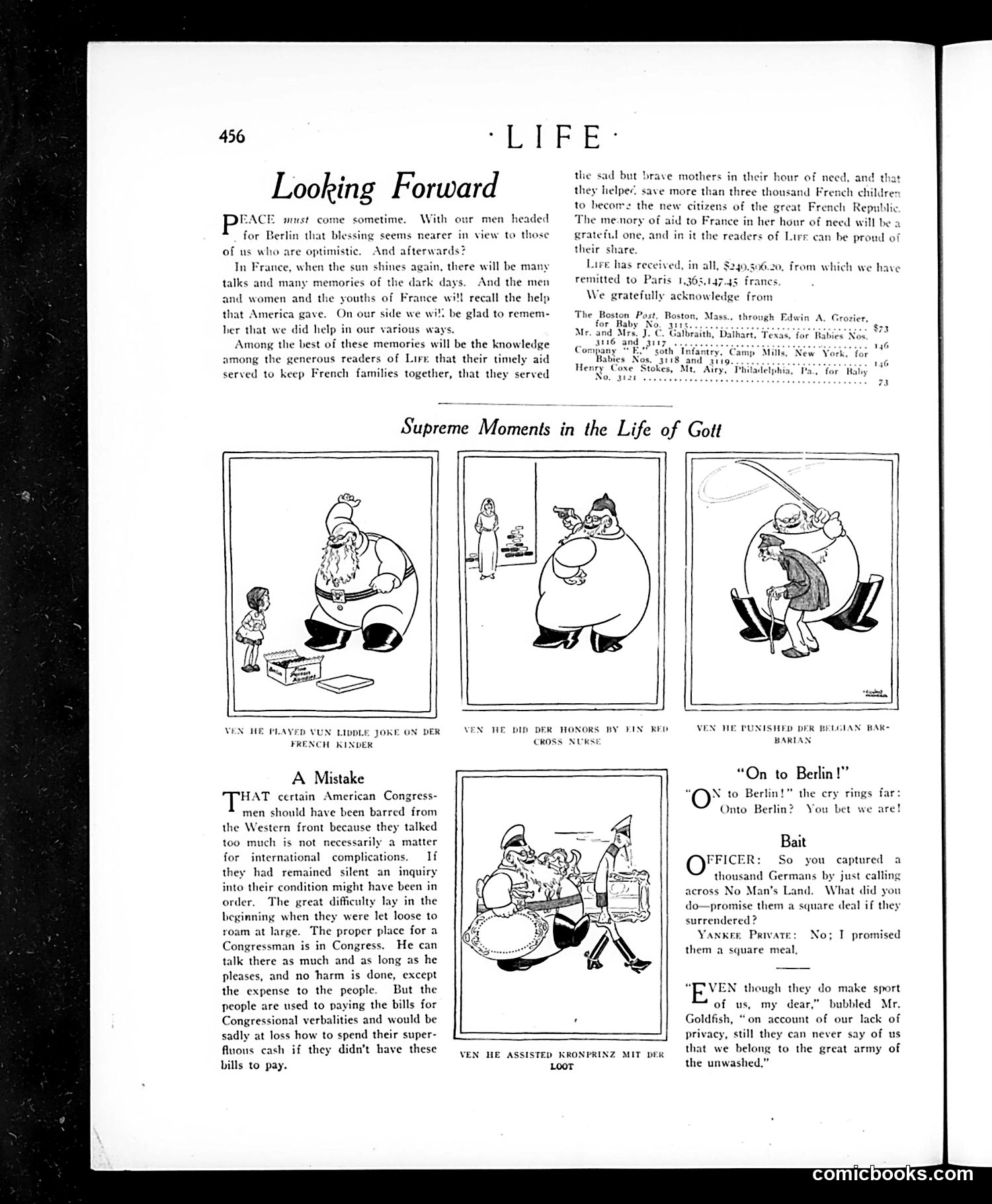
This page contains satirical commentary on World War I, specifically celebrating American aid to France and mocking German military leadership. **"Supreme Moments in the Life of Gott"** presents three cartoons in German-accented English captions, depicting a rotund figure (representing Kaiser Wilhelm II or German authority) in absurd situations: playing a joke on French children, awarding honors via a "fin kid," and punishing a "Belgian barbarian." The satire ridicules German conduct, particularly toward civilians. **"A Mistake"** criticizes American congressmen visiting the Western Front for talking too much—essentially suggesting they should remain in Congress where their verbosity is expected and contained. **"On to Berlin!"** presents a dialogue between an officer and yankee private about capturing Germans through promises of food ("square meal"). The joke mocks German soldiers' desperation while portraying American pragmatism. The page's opening celebrates American financial aid to France ($243,306.20 raised), framing American contributions as morally superior. Overall, this is wartime propaganda glorifying America's role while denigrating the enemy through caricature and humor.
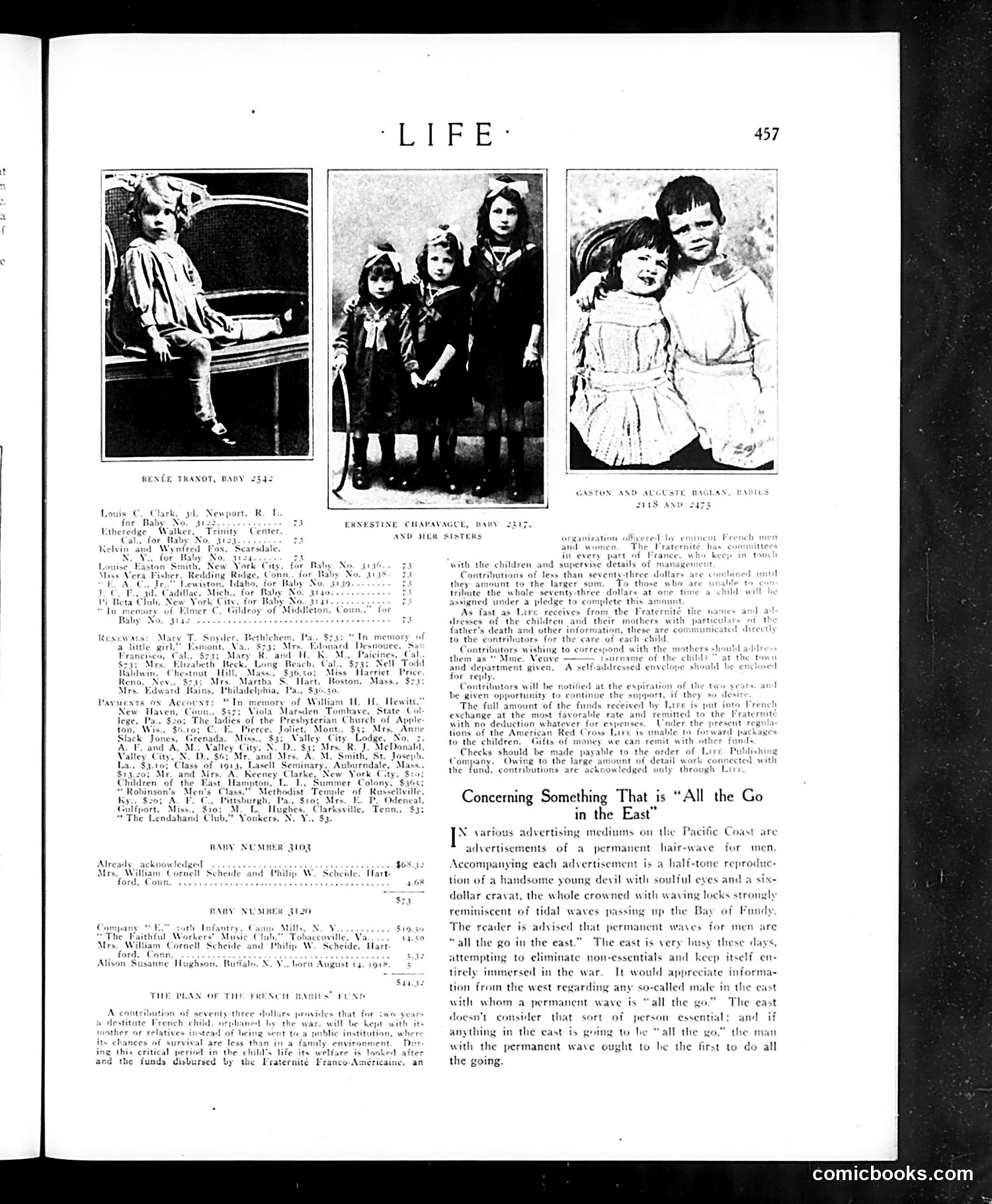
This page is primarily **not a political cartoon** but rather a charity fundraising publication for French war orphans ("The Plan of the French Baby Fund"), listing donors who contributed money to support orphaned children during World War I. The only satirical content appears in the brief article "Concerning Something That is 'All the Go in the East.'" This is a **wartime critique** mocking East Coast men's fashion—specifically permanent hair waves advertised as trendy. The satire suggests these waves are frivolous at a time when the nation should be focused on the war effort. The piece sarcastically implies that men sporting permanent waves should be among the first sent to fight, implying they're non-essential to the war effort and therefore expendable. The photographs show children and mothers connected to the orphan relief program. The overall page reflects Life's role during WWI in promoting charitable causes while gently mocking civilian superficiality during wartime.
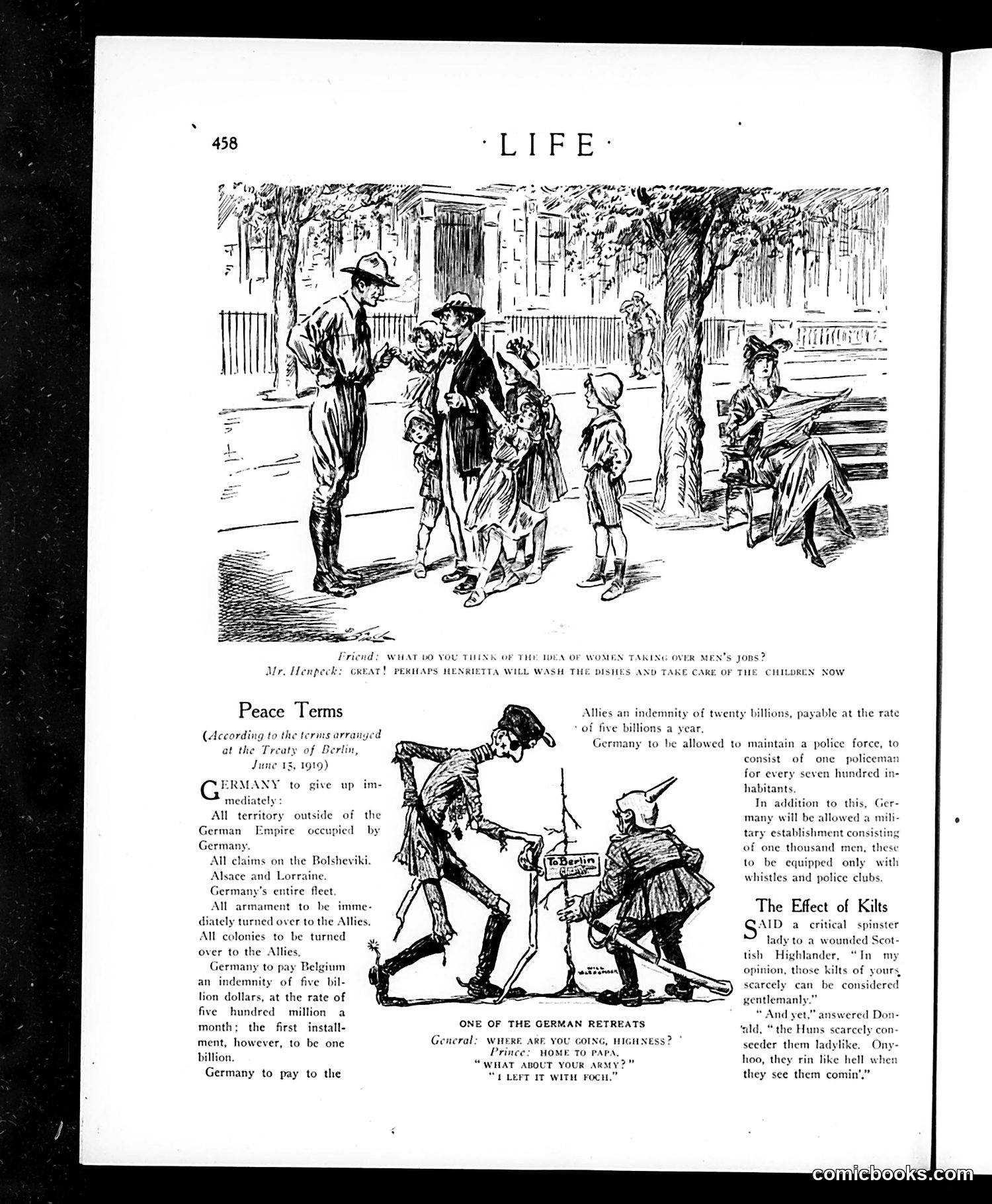
This page contains three distinct satirical pieces from 1919, following WWI's conclusion: **Top cartoon**: Mocks domestic role reversals. A henpecked husband welcomes women entering the workforce, hoping his wife will finally do housework—suggesting men used women's domestic duties as an excuse to avoid them. **"Peace Terms"**: Lists the Treaty of Berlin's harsh conditions imposed on Germany: territorial losses, military restrictions (one policeman per 700 inhabitants, armed only with whistles), massive reparations, and colonial surrender. The accompanying cartoon shows a fleeing German prince admitting he abandoned his army to French General Foch—humiliating Germany's military defeat. **"The Effect of Kilts"**: A joke about Scottish Highland dress. A woman questions whether kilts are gentlemanly; a Scotsman responds that German soldiers (Huns) find them so intimidating they "run like hell" when seeing them. It's crude wartime propaganda celebrating Scottish martial reputation over defeated Germans. All three pieces reflect post-war American attitudes: domestic anxiety, German humiliation, and triumphalism over victory.
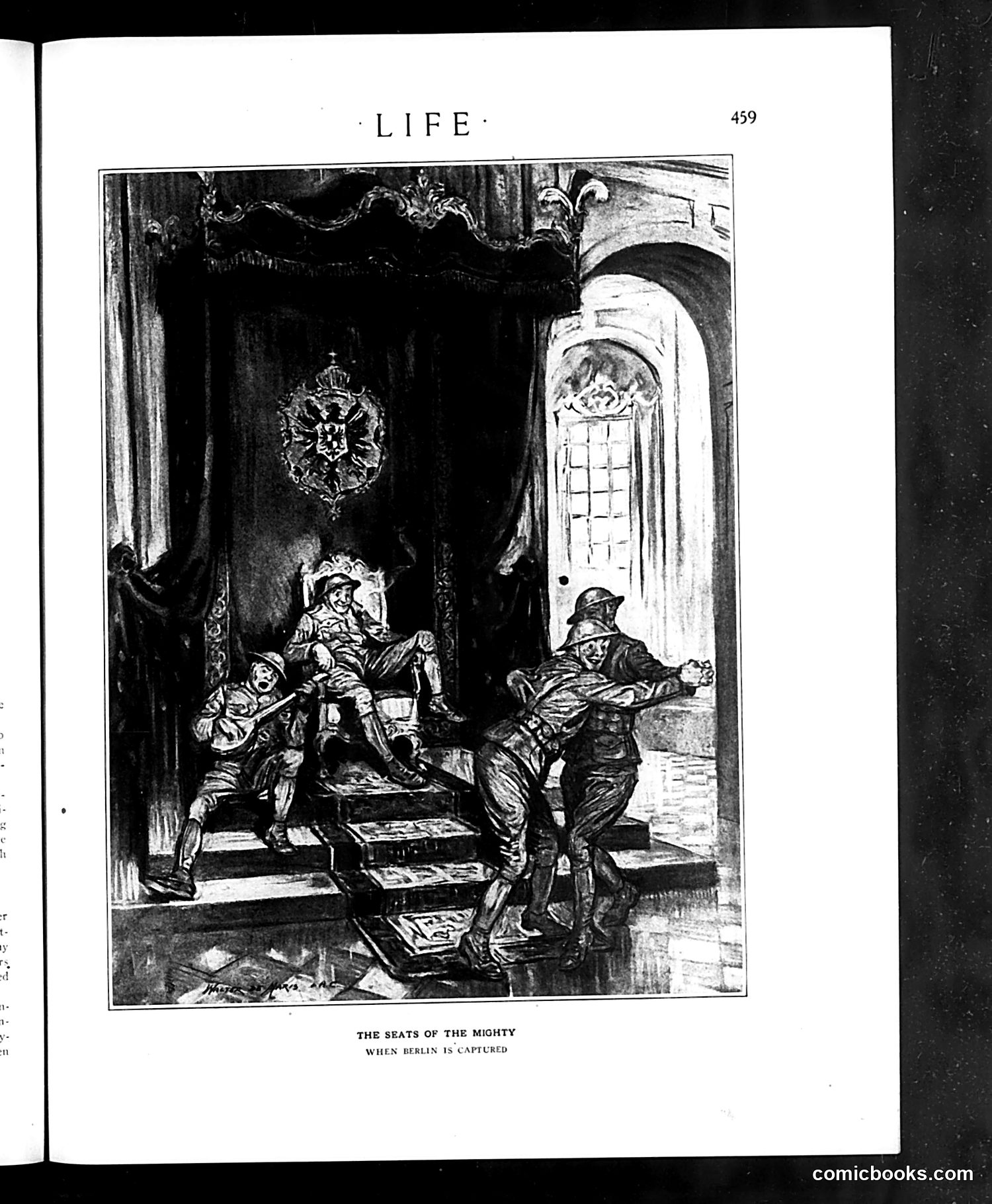
This is a wartime satirical illustration depicting soldiers occupying what appears to be a grand German palace or government building—likely a reference to the anticipated Allied capture of Berlin during World War II. The drawing shows military figures seated in or lounging around an ornate interior with imperial insignia visible on the walls, suggesting the overthrow of Nazi authority. The satire appears to comment on the contrast between the "mighty" seats of power and their occupation by common soldiers, inverting the hierarchy of authority. The humor likely plays on the idea of everyday troops claiming the prestigious spaces formerly held by Nazi leadership. The publication date and specific historical moment remain unclear from the visible text alone.
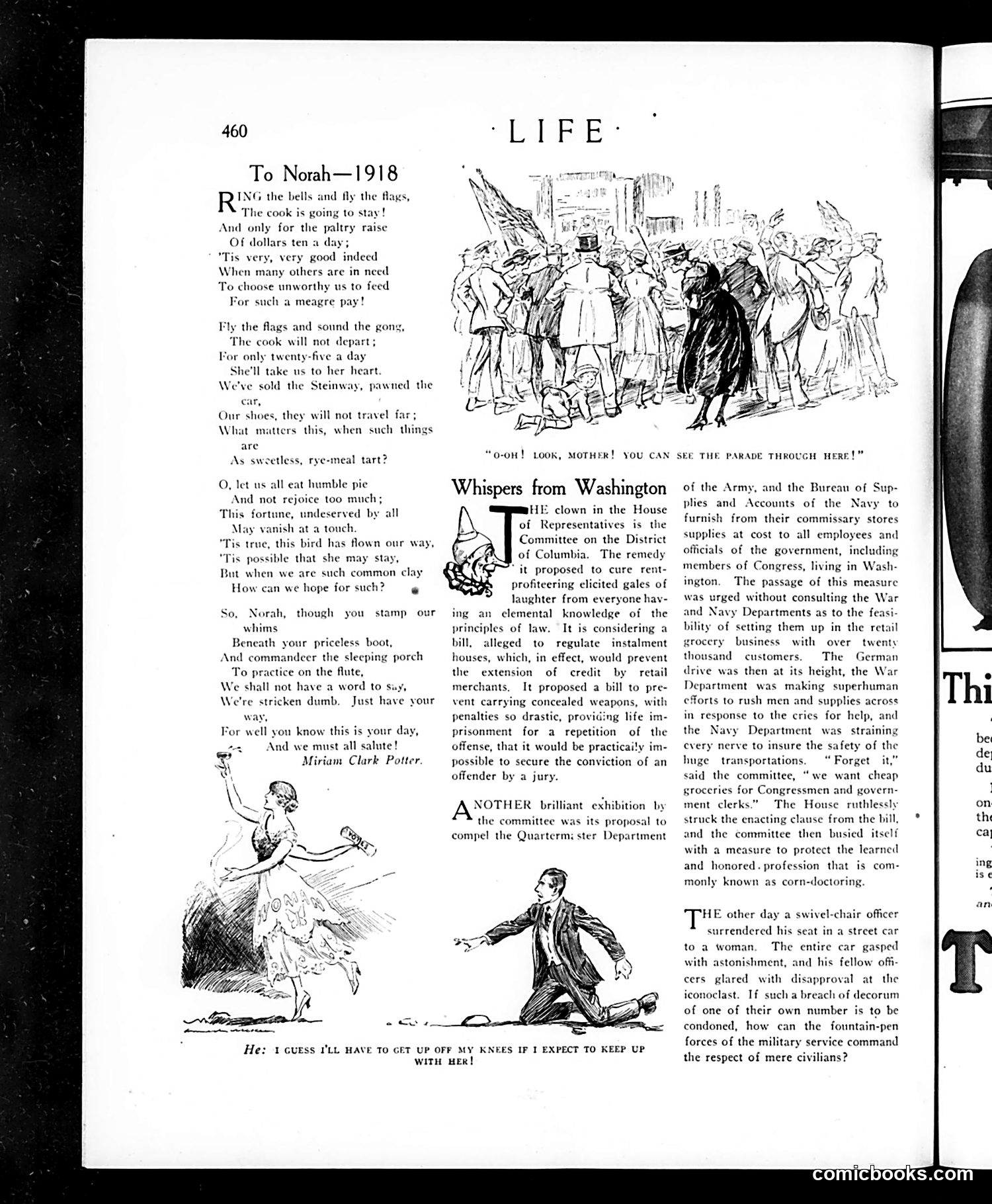
## Main Content: "To Norah—1918" A poem by Miriam Clark Potter celebrating a domestic cook who agrees to stay employed for a modest $25/day raise during WWI. The tone is satirical—the family ironically celebrates this "fortune" while acknowledging their own financial desperation (they've sold their piano and pawned their car). The poem mocks both the family's neediness and their obsequious gratitude toward household help, with illustrations showing a man literally on his knees to keep the cook employed. ## "Whispers from Washington" A satirical column criticizing the House Committee on the District of Columbia for proposing absurd legislative solutions during wartime (the German offensive was ongoing). Specific targets include: - A rent-profiteering bill deemed laughably unworkable - A weapons bill with impractically severe penalties - Attempting to convert military supply departments into retail grocery stores for Congressional convenience while the War Department desperately mobilized for the war effort A final anecdote ridicules military officers who disapprove when one officer gives his seat to a woman—mocking rigid military decorum as obstacles to civilian respect. The page satirizes wartime mismanagement and civilian absurdity.
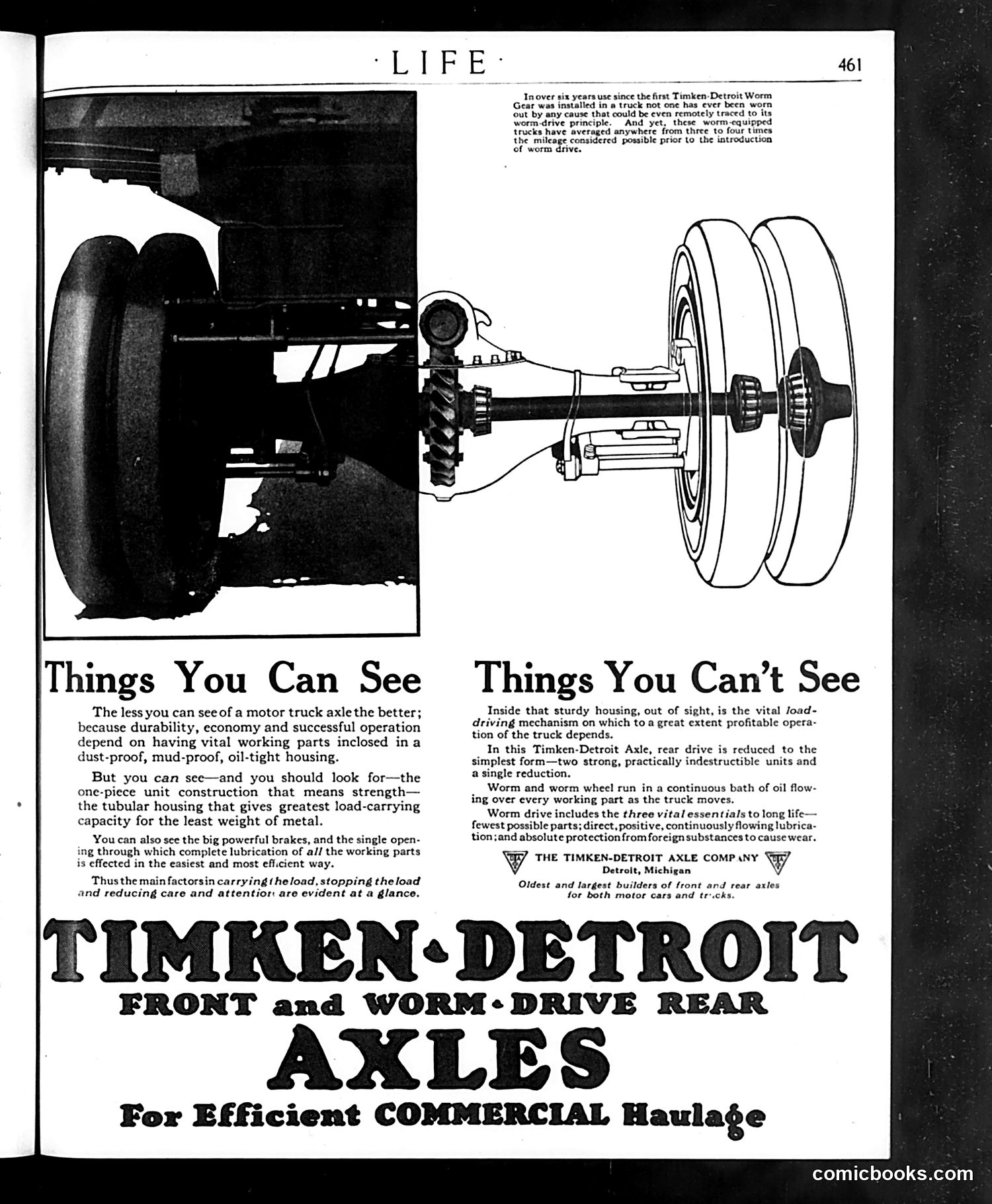
This is **not a cartoon or satire**—it's a vintage advertisement for Timken-Detroit truck axles, appearing in *Life* magazine (page 461). The ad uses a pedagogical "Things You Can See / Things You Can't See" format to market commercial truck components. The left side shows a photograph of an actual axle assembly; the right displays a technical diagram of internal mechanisms. The copy emphasizes durability and reliability: Timken-Detroit axles have supposedly run for six+ years without wear, and trucks equipped with them allegedly achieved 3-4 times the mileage previously considered possible. The "Things You Can't See" section highlights the hidden engineering—worm-drive mechanisms, continuous oil lubrication, and fewer moving parts—framing invisibility as a virtue (internal strength and protection). This reflects early 20th-century advertising strategy: using technical explanations and comparative demonstrations to establish brand superiority for industrial/commercial products. There is no political satire or caricature present.
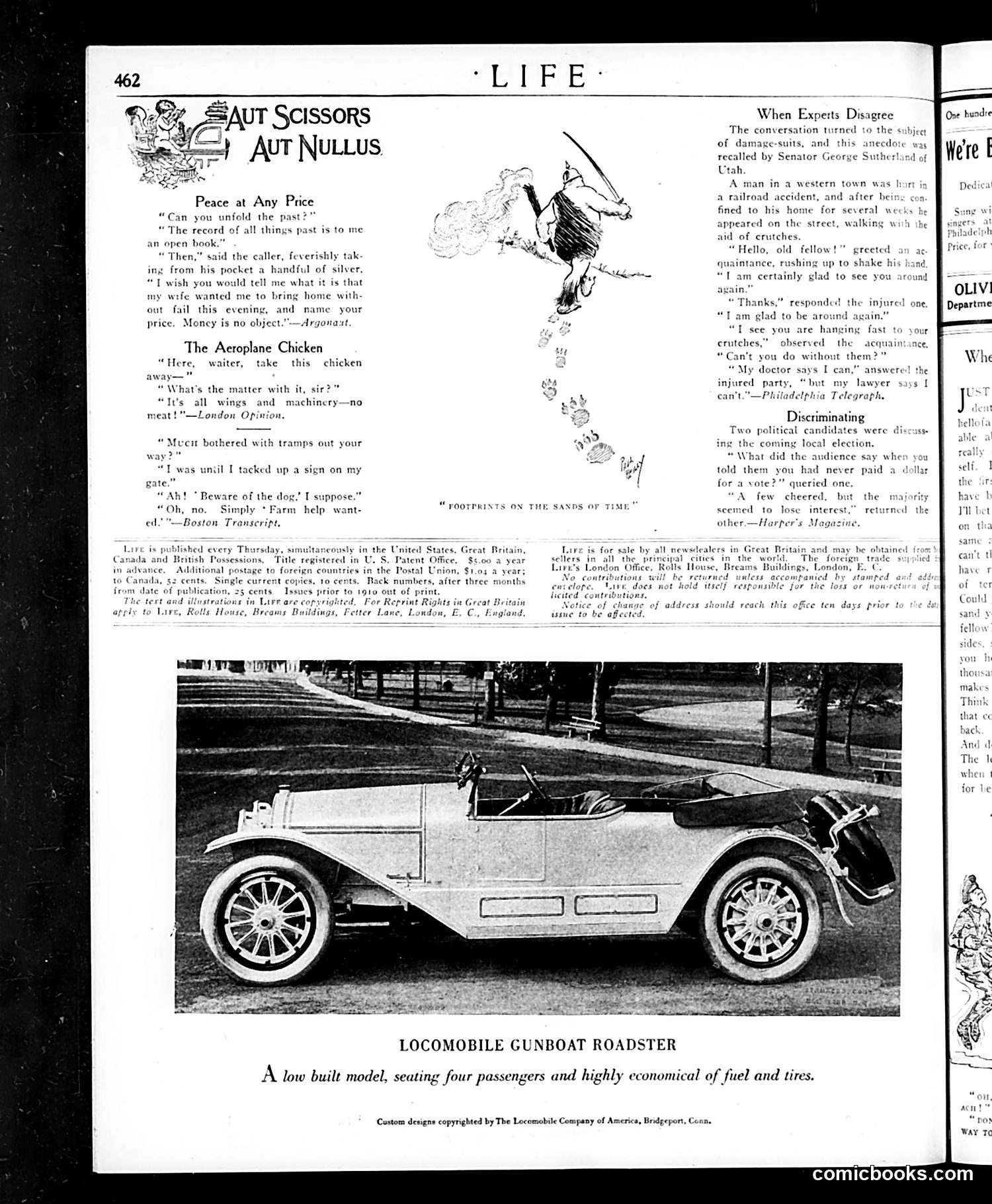
This page from Life magazine contains three satirical anecdotes ("Aut Scissors, Aut Nullus") plus a car advertisement. **The humor pieces** mock social pretension and absurdity: - "Peace at Any Price" satirizes a man willing to pay any sum for information his wife wants—the joke being marriage's financial demands. - "The Aeroplane Chicken" plays on modern technology hype (aviation was new), mocking a waiter's absurd description of a chicken as "all wings and machinery." - "Discriminating" ridicules two political candidates during a local election; one loses voter interest by admitting he never paid for a vote—the satire suggesting this honesty disqualifies him in corrupt local politics. **The illustration** labeled "Footprints on the Sands of Time" shows a figure trudging through sand, visually complementing the satirical commentary. **The advertisement** for the Locomobile Gunboat Roadster emphasizes economy and practicality—typical early automotive marketing. The page reflects early 20th-century American middle-class anxieties: marriage costs, technological change, and local political corruption.
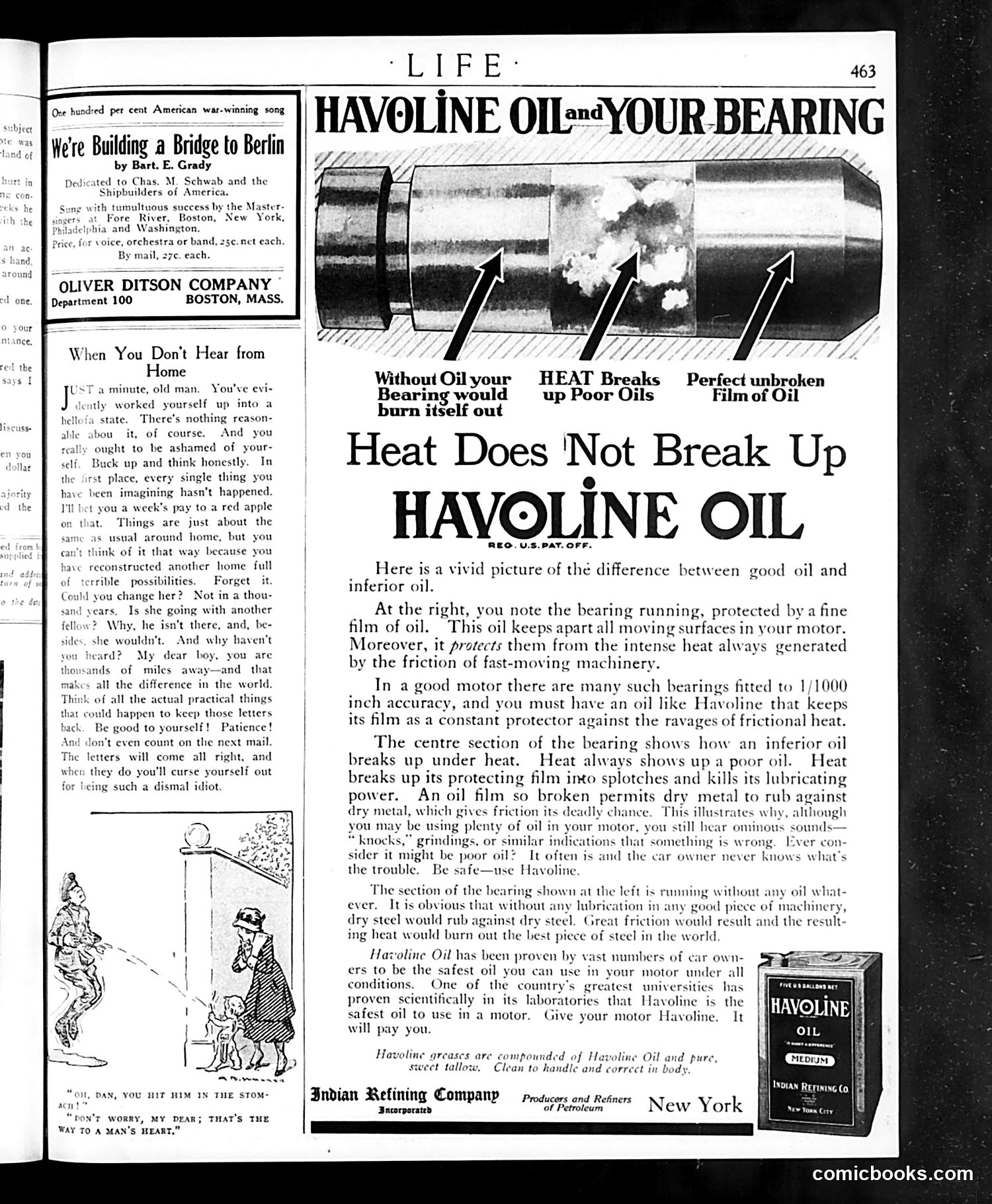
This page combines two unrelated items typical of early 20th-century magazines: **Left side:** A sentimental advice column titled "When You Don't Hear from Home," addressing a soldier or serviceman anxious about lack of correspondence from his sweetheart. The writer reassures him that mail delays are normal and urges patience, referencing the difficulty of communication during wartime separation. A small cartoon below depicts domestic reconciliation ("That's the way to a man's heart"). **Right side:** A full-page advertisement for Havoline Oil by Indian Refining Company. The ad uses technical diagrams of engine bearings to illustrate why quality oil matters—showing how inferior oil "breaks up" under heat while quality Havoline maintains a protective film. The ad claims Havoline is scientifically proven superior and endorsed by universities. The juxtaposition reflects Life's business model: editorial content adjacent to advertising, with no separation. The page appears designed for American readers during WWI, when soldier correspondence anxiety was common.
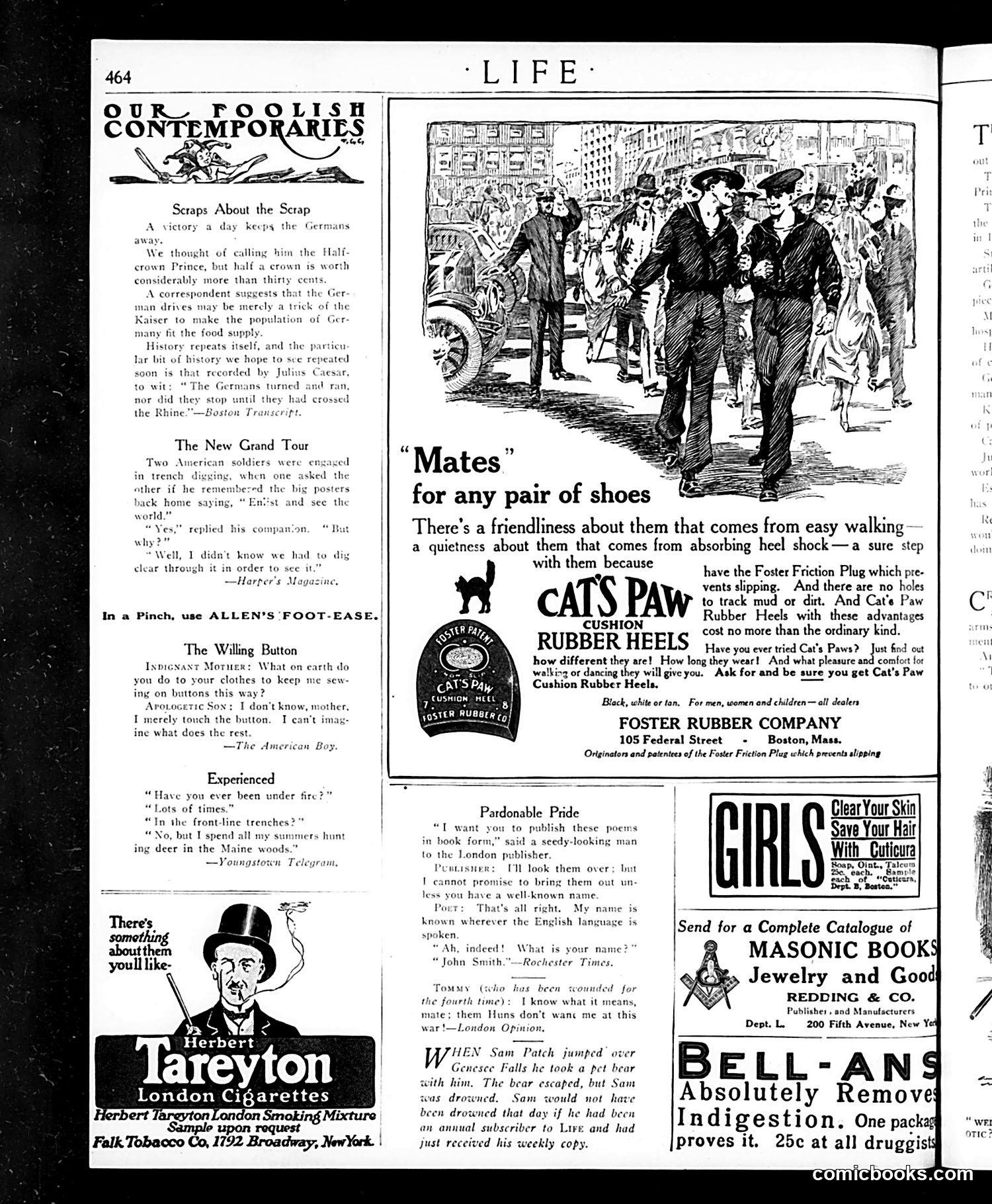
This page from *Life* magazine combines satirical commentary with period advertisements. The main cartoon content addresses World War I: **"Our Foolish Contemporaries"** section mocks German propaganda and American soldiers' naiveté. One anecdote describes soldiers in trenches asking a companion why they must "dig clear through" to see big posters—suggesting soldiers blindly follow orders without understanding their purpose. Another joke about "The New Grand Tour" has soldiers viewing the war as tourist spectacle rather than serious conflict. **"The Willing Button"** jokes about absent-mindedness, while **"Experienced"** contrasts civilian hunting with combat—a commentary on how Americans romanticize war. The **Herbert Tareyton cigarette ad** features a man with a black eye, the caption suggesting there's "something about them you'll like"—likely a play on how the product's quality compensates for social embarrassment or poor judgment. The remainder comprises typical period advertisements (shoe heels, masonic books, indigestion remedy, hair treatments), standard for *Life*'s revenue model.
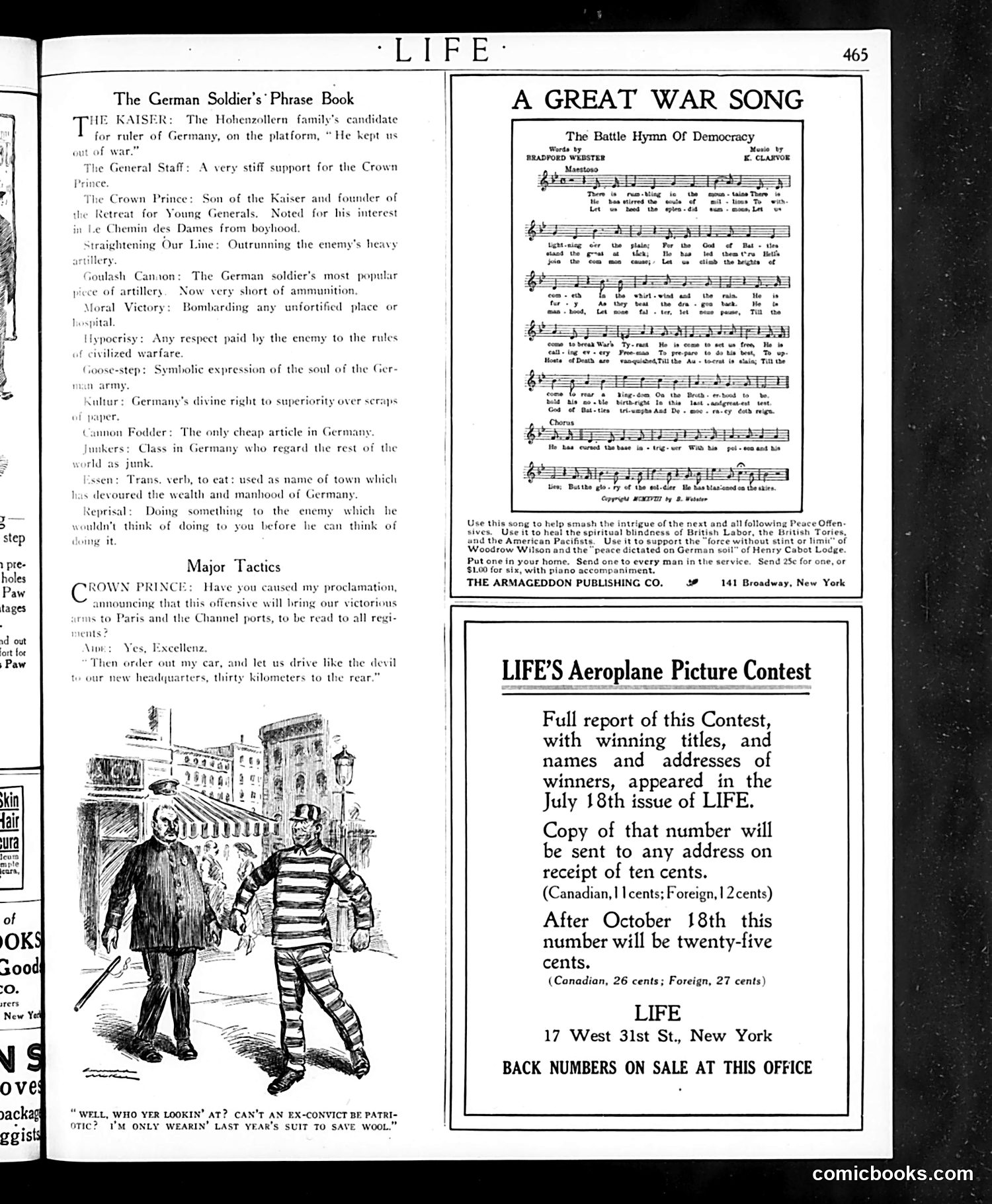
This page contains WWI-era American propaganda satirizing Germany. The left section, "The German Soldier's Phrase Book," mocks German military terminology through bitter wordplay: "Moral Victory" means bombing unfortified targets; "Cannon Fodder" labels soldiers cheap; "Kulture" represents claimed superiority masking imperialism. These entries ridicule German justifications for aggressive warfare. The bottom cartoon shows two men—one dressed as an ex-convict in striped clothing, the other civilian. It satirizes American patriotism during fabric rationing, with the convict claiming he's merely reusing last year's wool suit for patriotic sacrifice. The joke mocks both performative patriotism and the absurdity of asking civilians (even criminals) to contribute to war efforts through rationing. The right side features a patriotic war song promoting American peace efforts against German aggression, reinforcing the page's anti-German messaging typical of American WWI propaganda.