
A complete issue · 34 pages · 1918
Life — September 5, 1918
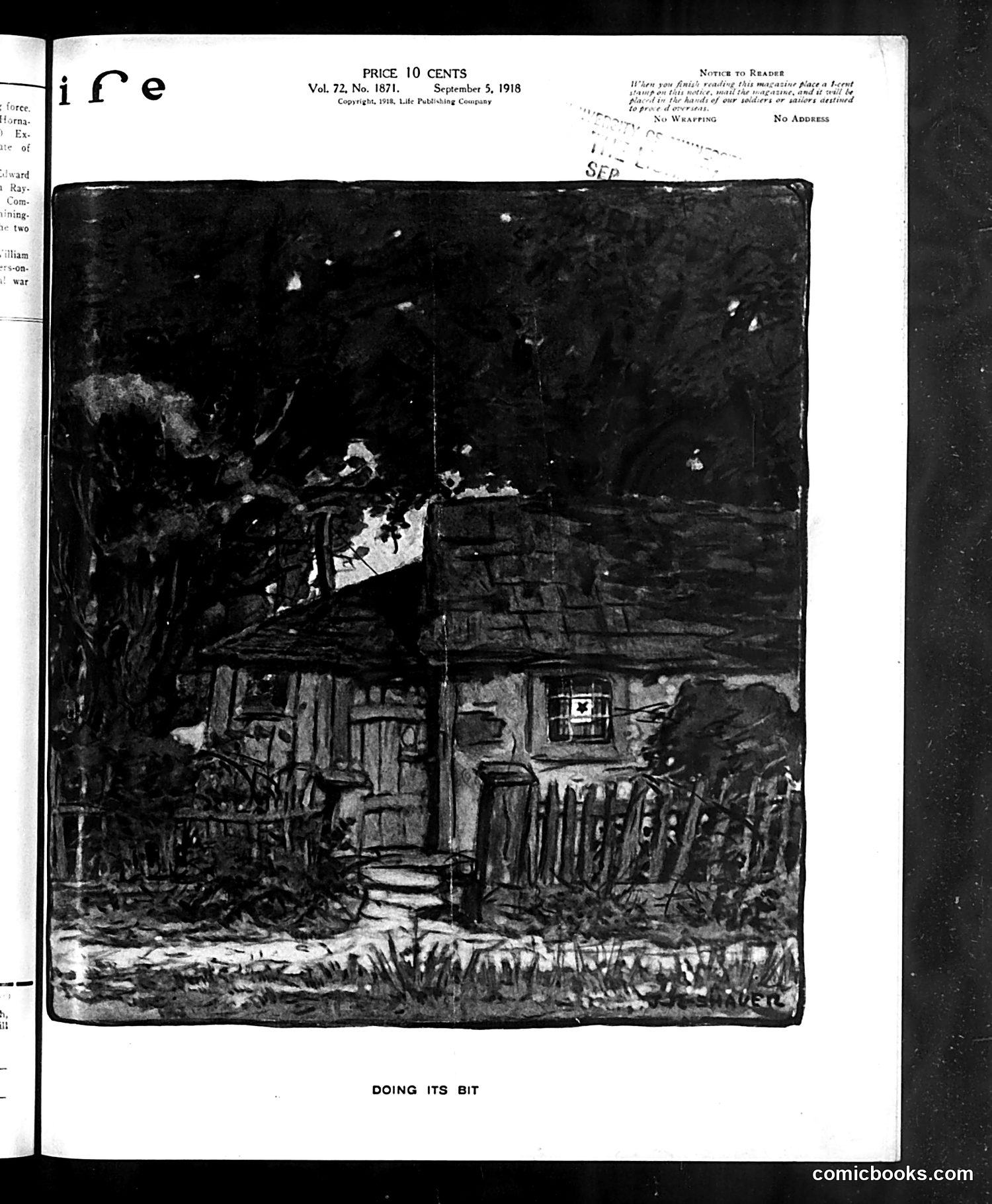
This page features an illustration titled "Doing Its Bit," showing a modest cottage at night with a lit window. The image appears to be a wartime-era cartoon, published during World War I (note the September 1918 date, weeks before the armistice). The satirical point likely concerns how American civilians contributed to the war effort through conservation measures—the lit window presumably representing a home participating in energy rationing or "blackout" procedures. The phrase "doing its bit" was common wartime rhetoric encouraging patriotic sacrifice on the home front. The dark, somewhat grim artistic style emphasizes the serious nature of wartime conditions affecting ordinary American households.
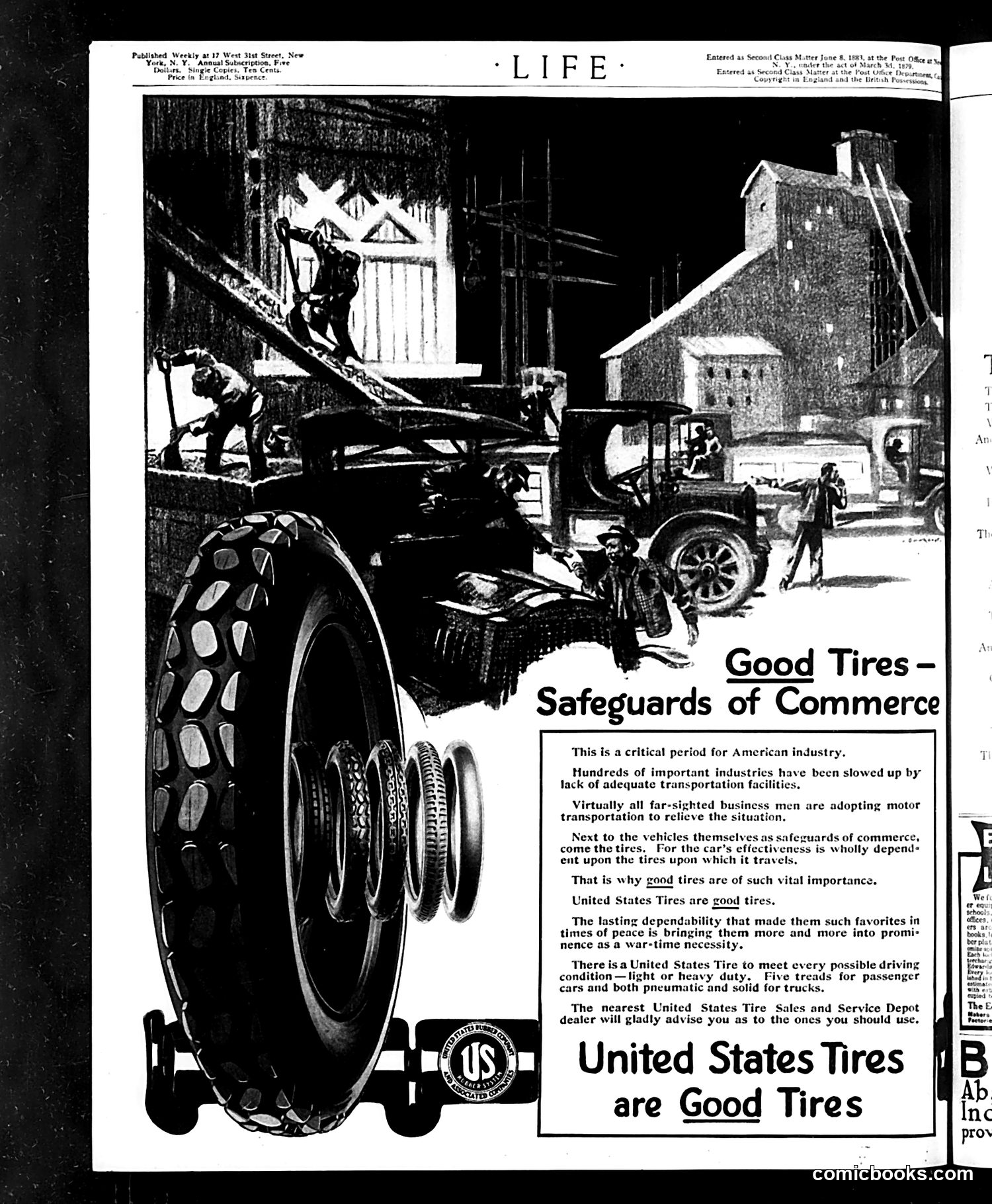
This page is **primarily a United States Tires advertisement**, not satire or political commentary. The large illustration shows a tire prominently displayed alongside an industrial/commercial scene with trucks, a factory building, and workers—emphasizing the tire's role in commerce and transportation. The ad's argument is straightforward: during what it calls "a critical period for American industry," good tires are essential infrastructure. It claims hundreds of industries have been slowed by inadequate transportation, and that motor transport is solving this problem. Therefore, quality tires matter for national commerce. The "safeguards of commerce" headline positions reliable tires as vital to economic function—a practical business appeal rather than satire. This reflects post-WWI industrial concerns about efficiency and American economic competitiveness.
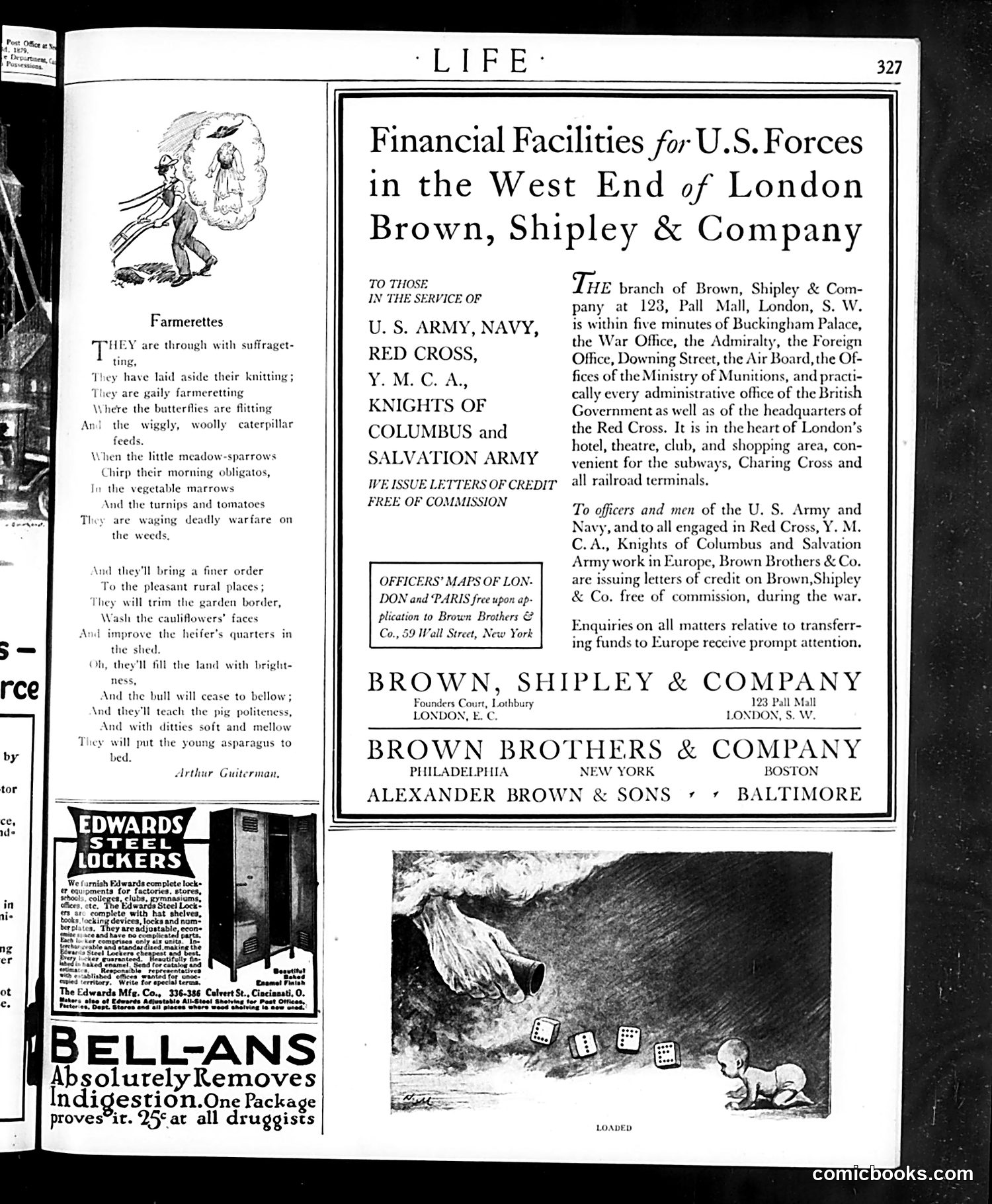
This page is primarily **advertising**, with a satirical poem on the left about "Farmerettes." The poem celebrates women agricultural workers—likely referencing WWI-era female farm labor, as the adjacent ads target U.S. military personnel. The verse humorously describes women taking over farming duties, "laying aside their knitting" to manage crops and livestock. The tone is gently mocking but ultimately celebratory, portraying these workers as capable of transforming rural spaces with "brightness" and teaching "pig politeness." The main illustration shows a woman's profile integrated with farm imagery. **Context**: During World War I, women entered agricultural work as men enlisted, making "Farmerettes" a visible social phenomenon. The satire here acknowledges this role reversal with affectionate humor rather than criticism, reflecting contemporary attitudes toward female wartime contributions.
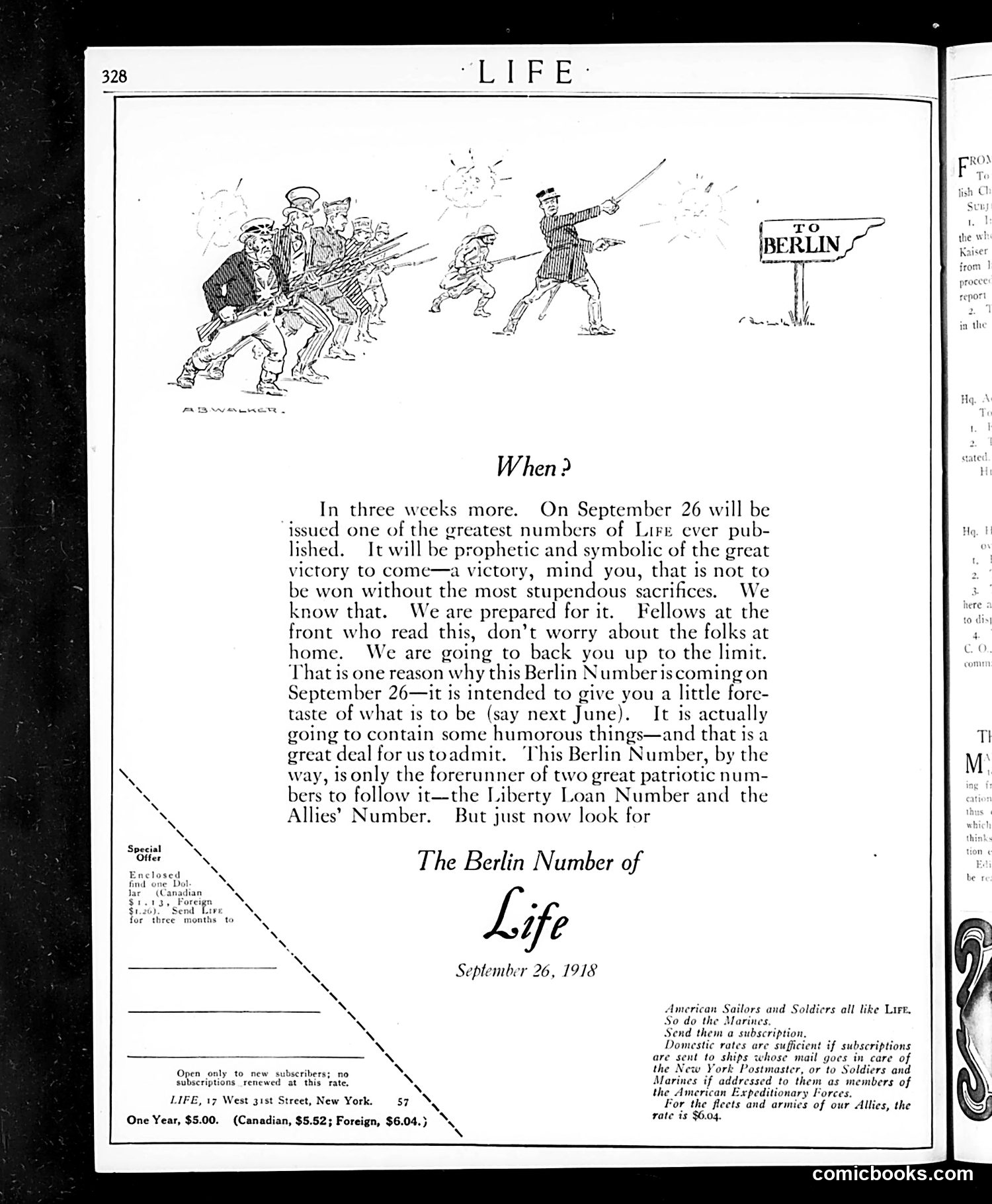
This page announces Life's upcoming "Berlin Number" for September 26, 1918, during World War I's final weeks. The cartoon at top depicts American soldiers attacking German forces (labeled "Advance"), with a signpost pointing "To Berlin," expressing American military optimism as Allied forces pushed toward Germany. The text promises this special issue will be "prophetic and symbolic of the great victory to come" and contain "humorous things"—combining patriotic confidence with satire. The magazine solicits new subscriptions, offering domestic rates of $5/year. The timing is significant: Germany surrendered November 11, 1918, so this represents wartime American morale at war's apparent endgame, mixing combat imagery with magazine promotion.
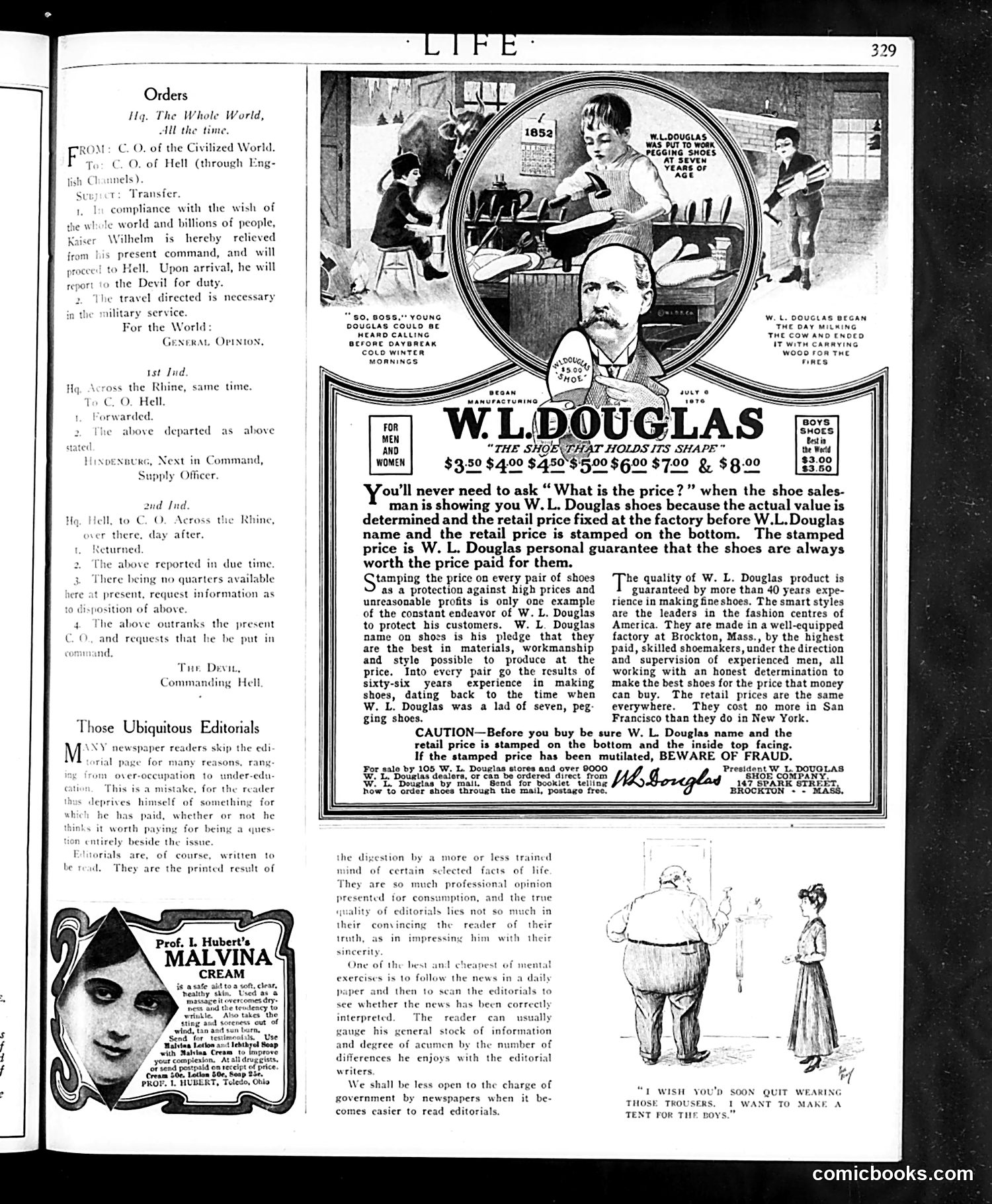
This page is primarily a **W.L. Douglas shoe advertisement**, not political satire. The ad features a portrait of William L. Douglas, a shoe manufacturer, surrounded by scenes of shoe manufacturing and salesmanship. The advertisement emphasizes Douglas's personal guarantee of quality, noting his shoes are "made in a well-equipped factory in Brockton, Mass., by the highest paid, skilled shoemakers." The copy stresses that the retail price is stamped on every shoe as protection against fraud and price gouging. The page includes a "Caution" warning consumers to verify the Douglas name and stamped price, indicating contemporary concerns about counterfeiting. The remaining content consists of editorial text about magazine editorials and an unrelated advertisement for "Malvina Cream" cosmetics.
This page contains a **wartime advertisement**, not satire or editorial content. It's a public message from The White Company (truck manufacturer, Cleveland) addressing truck owners during what appears to be **World War I or early WWII**. The message explains that military demand for White Trucks by U.S. and French armies has become so urgent that civilian commercial deliveries will be delayed. However, the company assures customers that parts supply will continue uninterrupted and that White Service will maintain support for thousands of trucks nationwide. The company frames this as a patriotic appeal—prioritizing "national welfare"—to gain customer understanding and approval for reduced commercial production. It's essentially propaganda aimed at maintaining goodwill while redirecting manufacturing toward military needs.
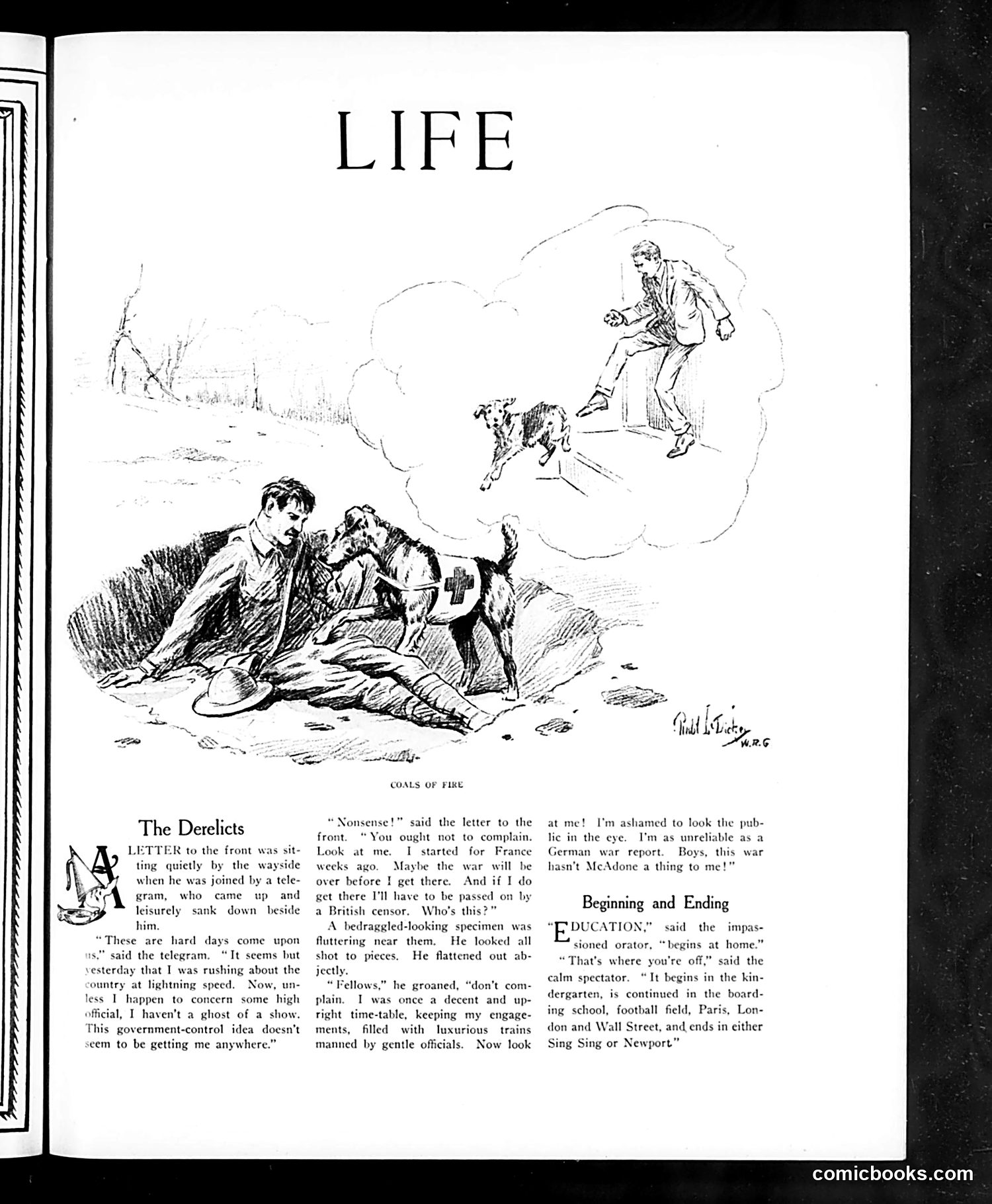
The top cartoon titled "Coals of Fire" depicts a man and dog resting outdoors, daydreaming (shown in the thought bubble above). The dream shows a gentleman with a dog in what appears to be a pleasant countryside scene. The accompanying text story, "The Derelicts," concerns a letter from someone heading to France during wartime (likely WWI, given the reference to "the war" and French censorship). The correspondent expresses frustration about military bureaucracy and travel complications. Below, "Beginning and Ending" is a brief humorous dialogue contrasting "education" - joking that it begins in kindergarten but "ends in either Sing Sing or Newport," referencing prison or wealthy resort destinations. This satirizes class disparities in American justice and outcomes.
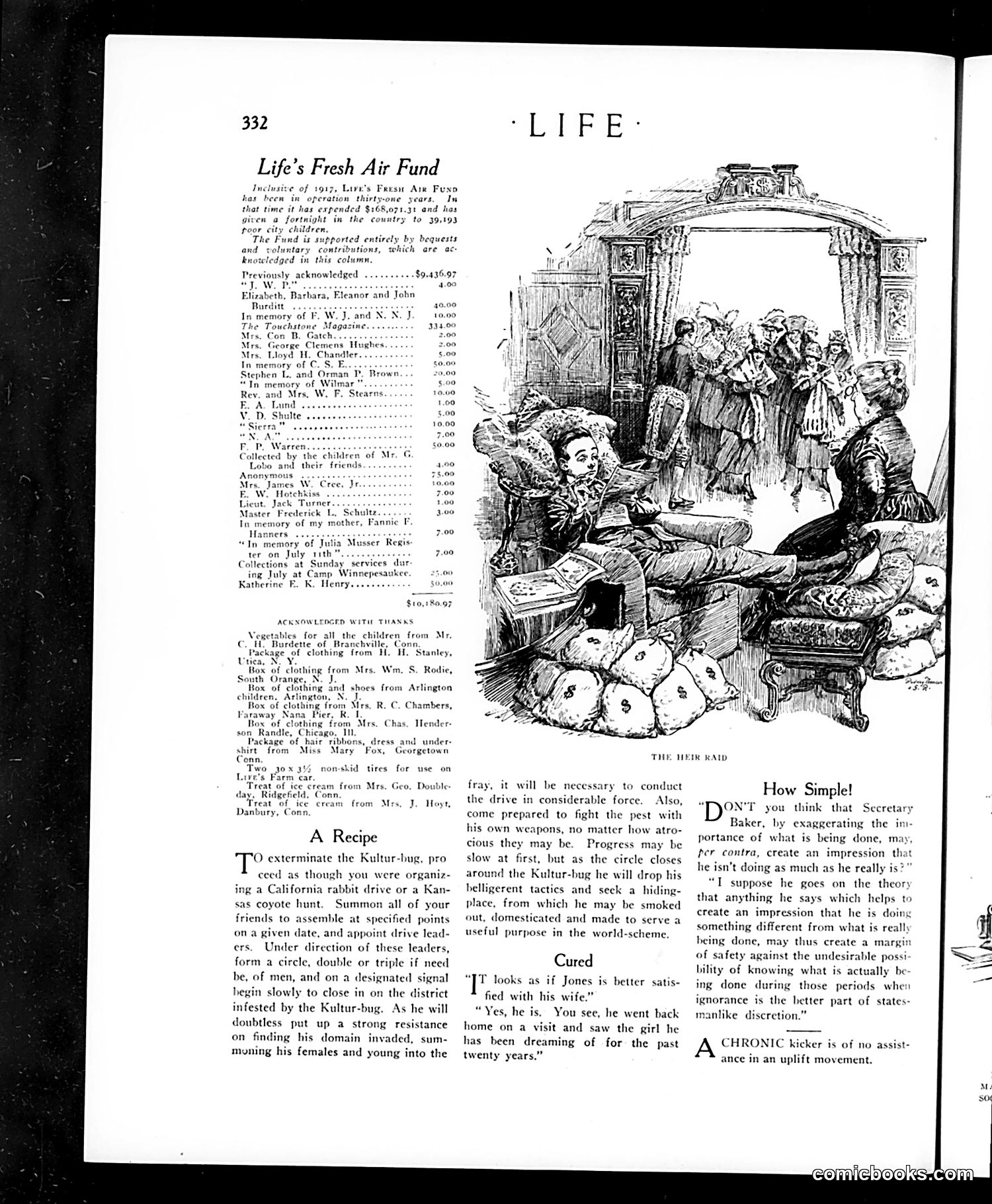
This cartoon satirizes wealth inequality and inheritance during the Progressive Era. The illustration shows well-dressed wealthy individuals and children lounging comfortably indoors while receiving money (marked with "$" symbols on bags/bundles). The title "The Heir Raid" is a pun on "air raid," suggesting inherited wealth descends upon the privileged like an attack. The satire critiques how wealth passes unchanged through generations to heirs who haven't earned it, while the accompanying text discusses social problems and charitable efforts. The contrast between the comfortable interior scene and references to "poor city children" elsewhere on the page emphasizes economic disparity—some inherit fortunes through birth alone, while others lack basic resources.
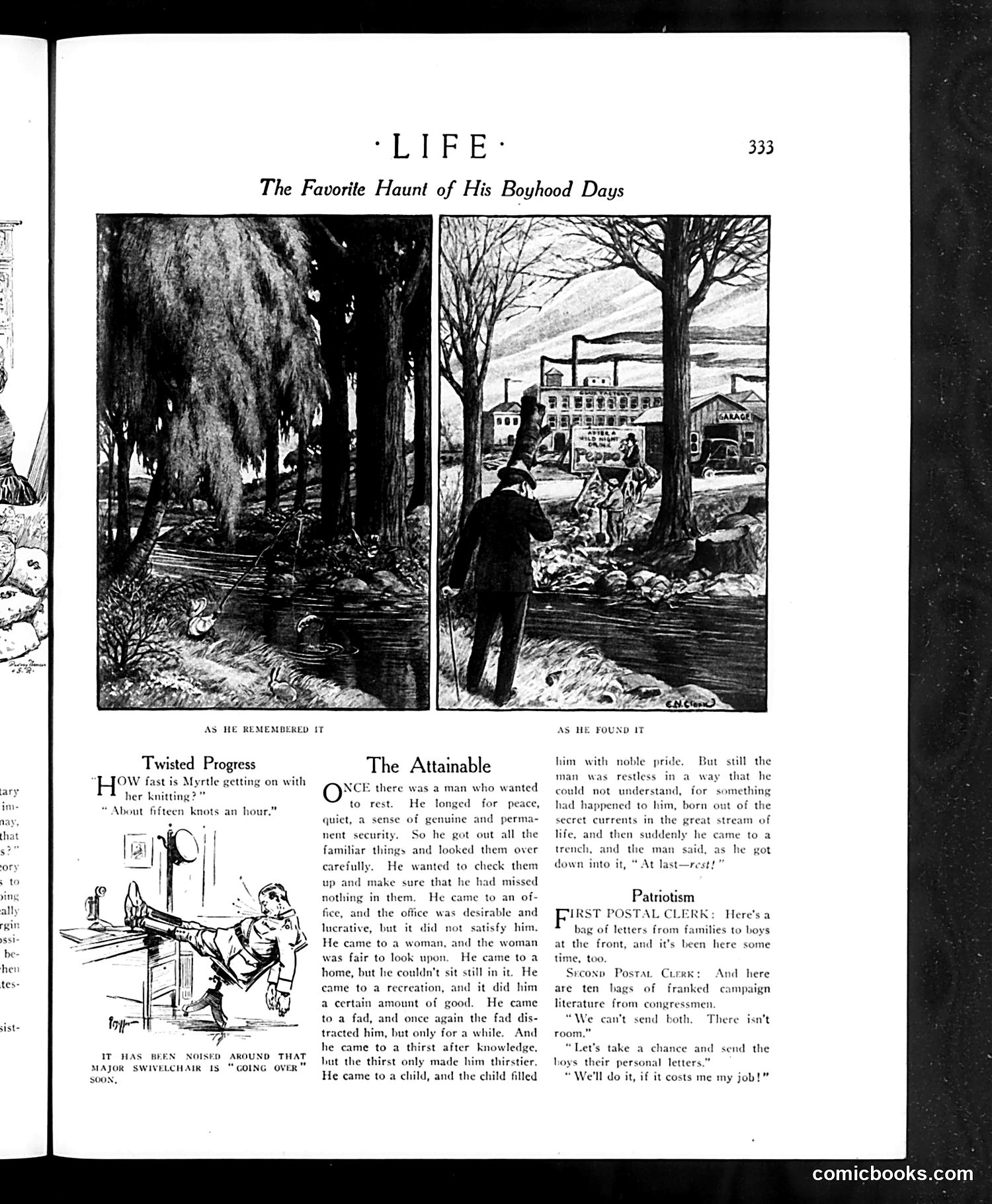
This page contains three distinct pieces: 1. **"The Favorite Haunt of His Boyhood Days"** — Two illustrated panels showing a man revisiting a childhood location by a stream near an old industrial building. The piece appears nostalgic rather than satirical. 2. **"Twisted Progress"** — A brief humorous sketch about a woman (Myrtle) knitting, with a man commenting on her speed ("About fifteen knots an hour"). This is lighthearted domestic humor. 3. **"The Attainable"** — A longer story about a restless man searching for peace and security, moving through various life situations (office, woman, home, recreation, fad, thirst, knowledge, child) but finding satisfaction only with a child. This appears to be sentimental rather than satirical. 4. **"First Postal Clerk" / "Patriotism"** — A dialogue between postal workers discussing sending campaign literature and personal letters to boys at the front during wartime, suggesting WWI-era patriotic duty. The page emphasizes nostalgia, domestic life, and wartime patriotism rather than sharp political satire.
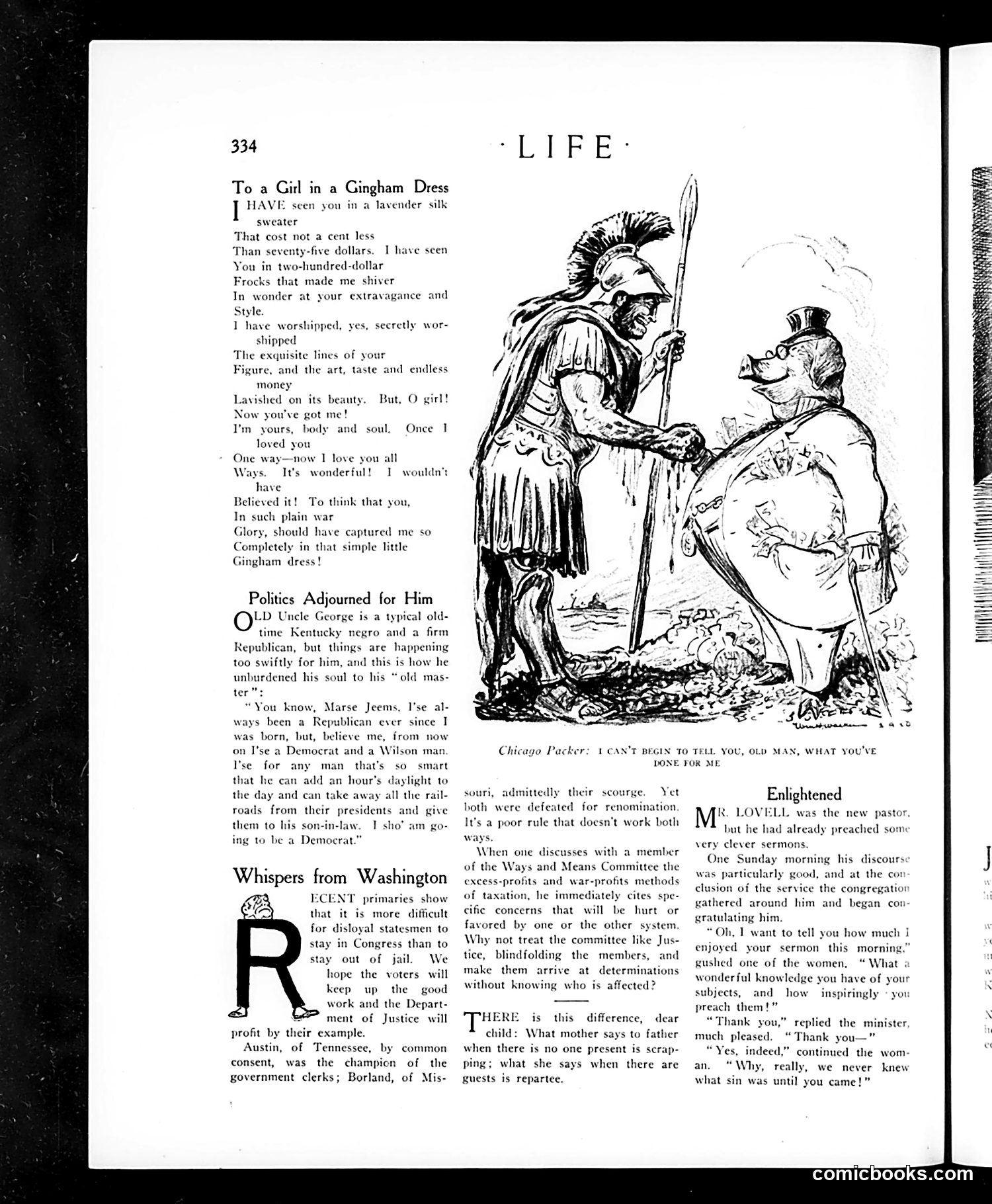
The main illustration depicts a figure in classical/Roman military dress (labeled as "Mars," the god of war) speaking with a portly civilian gentleman wearing a top hat. The caption reads: "CHICAGO PACKER: I CAN'T BEGIN TO TELL YOU, OLD MAN, WHAT YOU'VE DONE FOR ME." This satirizes the relationship between the military-industrial complex and Chicago's meatpacking industry during World War I. The "packer" (meatpacking magnate) profited enormously from wartime demand for provisions, while Mars (war personified) credits him with the profits war generates. The cartoon critiques how industrialists enriched themselves through military conflict—a common Progressive-era complaint about war profiteering and corruption.
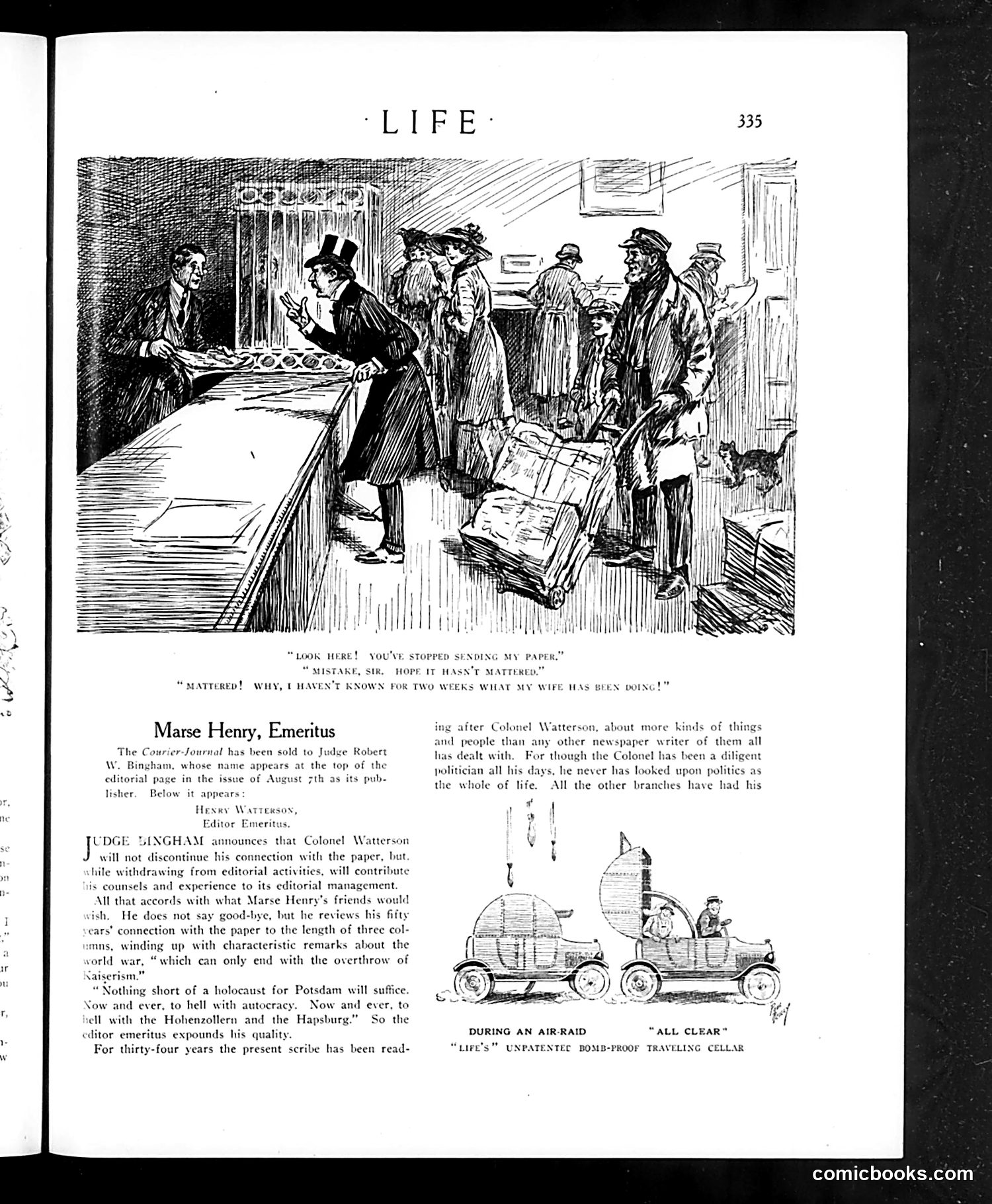
**Top Cartoon:** Shows a man at a desk (likely a newspaper editor or official) confronted by visitors with papers. The caption reads: "Look here! You've stopped sending my paper." "Mistake, sir. Hope it hasn't mattered." "Mattered! Why, I haven't known for two weeks what my wife has been doing!" This is a joke about newspaper dependency—the implication being that the man relied on reading about his wife's social activities in the paper to know what she was doing, satirizing both newspaper gossip columns and marital disconnect. **Bottom Section:** "Marse Henry, Emeritus" announces Colonel Watterson's retirement from the newspaper. The accompanying cartoon shows bomb-proof traveling vehicles labeled "During an Air-Raid" and "All Clear"—likely referencing WWI air-raid concerns and the absurdity of mobile bomb shelters.
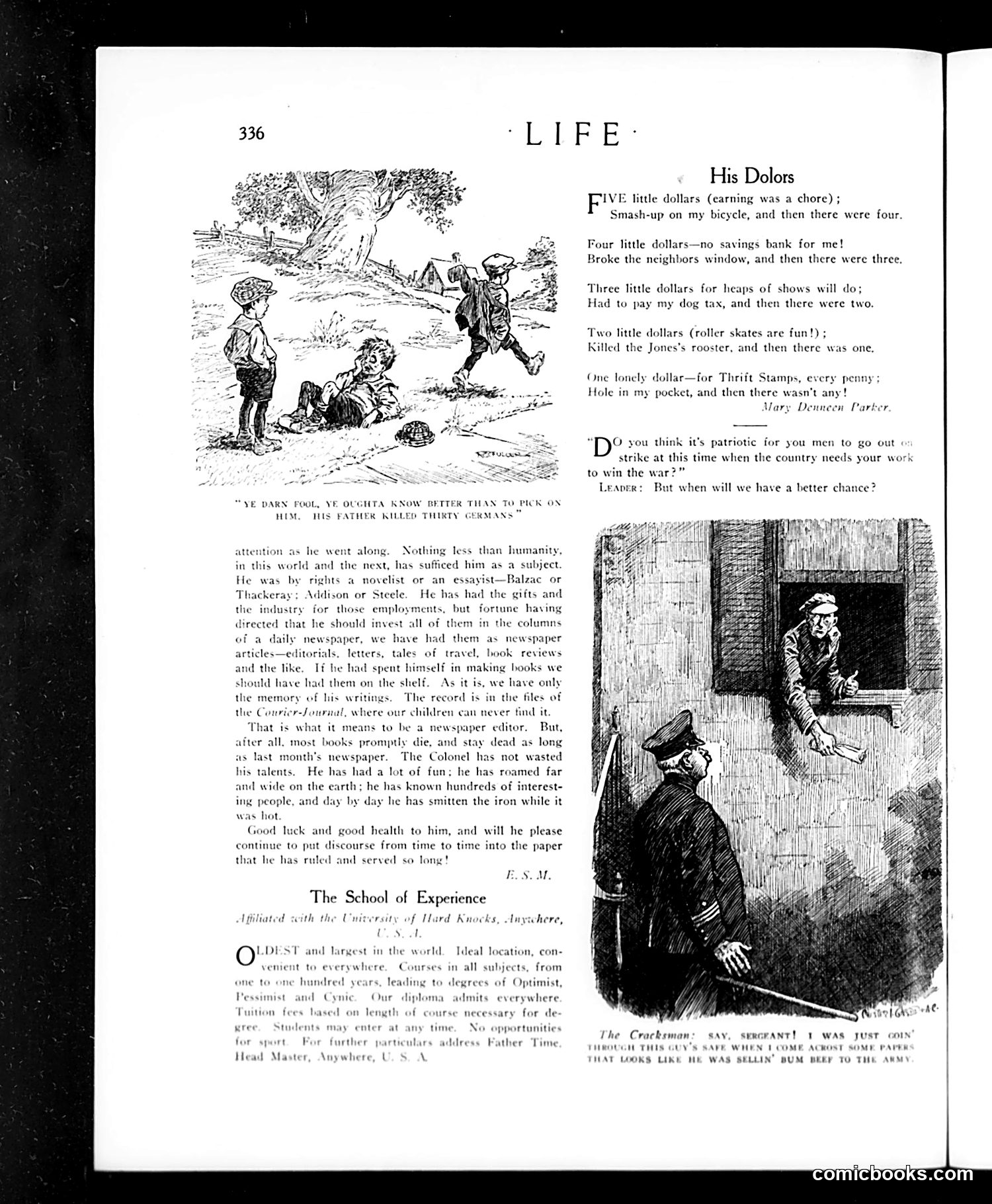
This is a satirical poem about childhood poverty, written by Mary Denween Parker. It traces the loss of five dollars through a series of mishaps: a bicycle accident, a broken neighbor's window, dog taxes, roller skates that killed a rooster, and finally a hole in the pocket that lost the last dollar (spent on Thrift Stamps). The accompanying illustration shows children in ragged clothes, depicting working-class childhood hardship. The poem satirizes both children's financial precariousness and the era's emphasis on thrift and saving—ironically titled "His Dolors" (sorrows/dollars pun). The dialogue below about striking during wartime references WWI labor debates about patriotism versus workers' rights—a contemporary political tension when this was published.
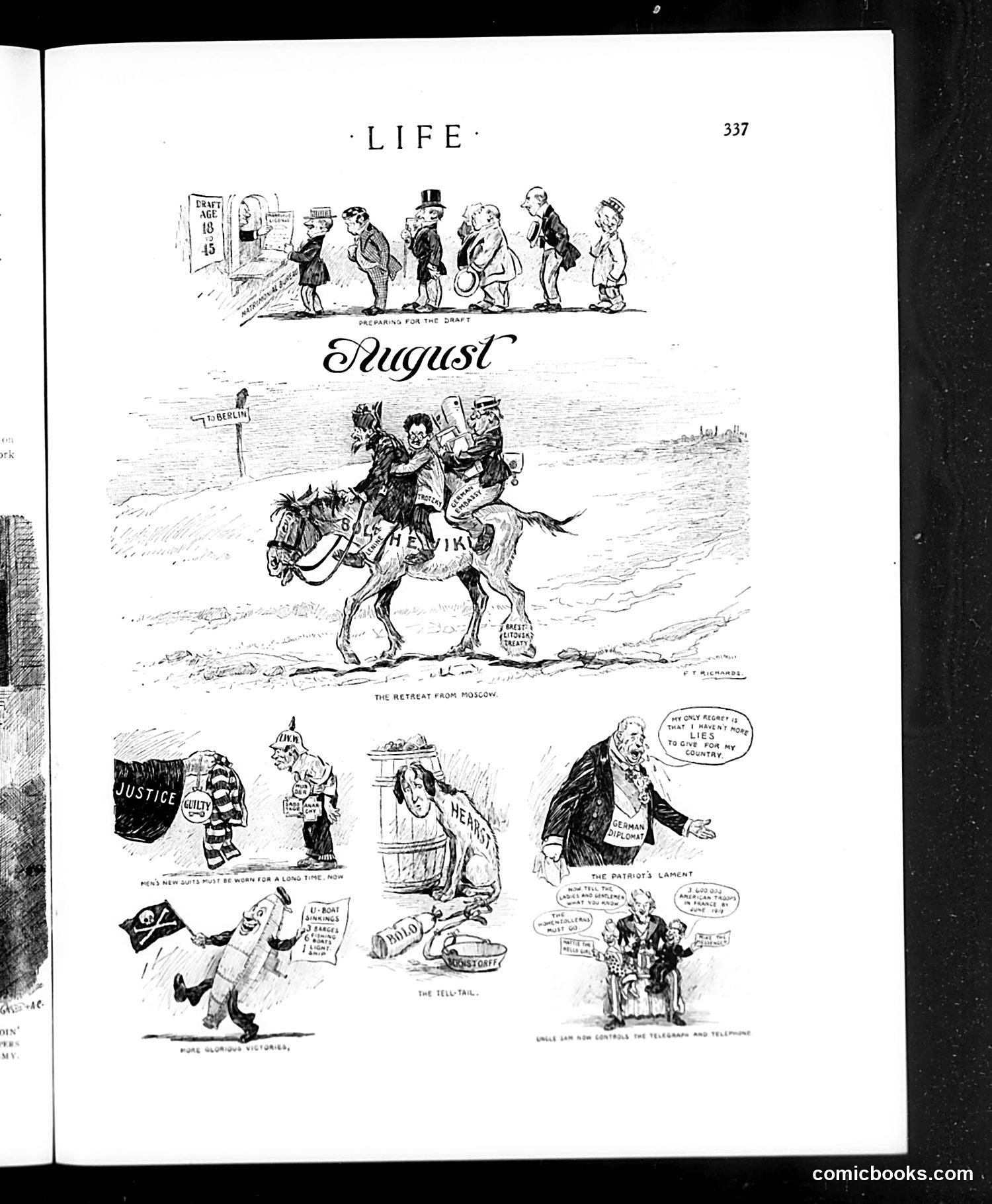
This page from *Life* magazine presents August 1918 WWI commentary through multiple cartoon panels: **Top section**: "Preparing for the Draft" shows men of various ages queuing at a draft board—satirizing conscription anxiety. **Main illustration**: "The Retreat from Moscow" depicts figures (likely Allied leaders) struggling atop a camel labeled "HIKE," referencing the difficult Russian military situation and withdrawal. **Bottom panels** include: - "Justice" and military scenes criticizing war conduct - "The Patriot's Lament"—an older figure lamenting lies told to support the war - "The Tell-Tale"—figures discussing domestic control of information - A final panel about "Uncle Sam Controls the Telegraph and Telephone" The overall theme critiques military conscription, the failed Russian campaign, and government propaganda/information control during WWI.
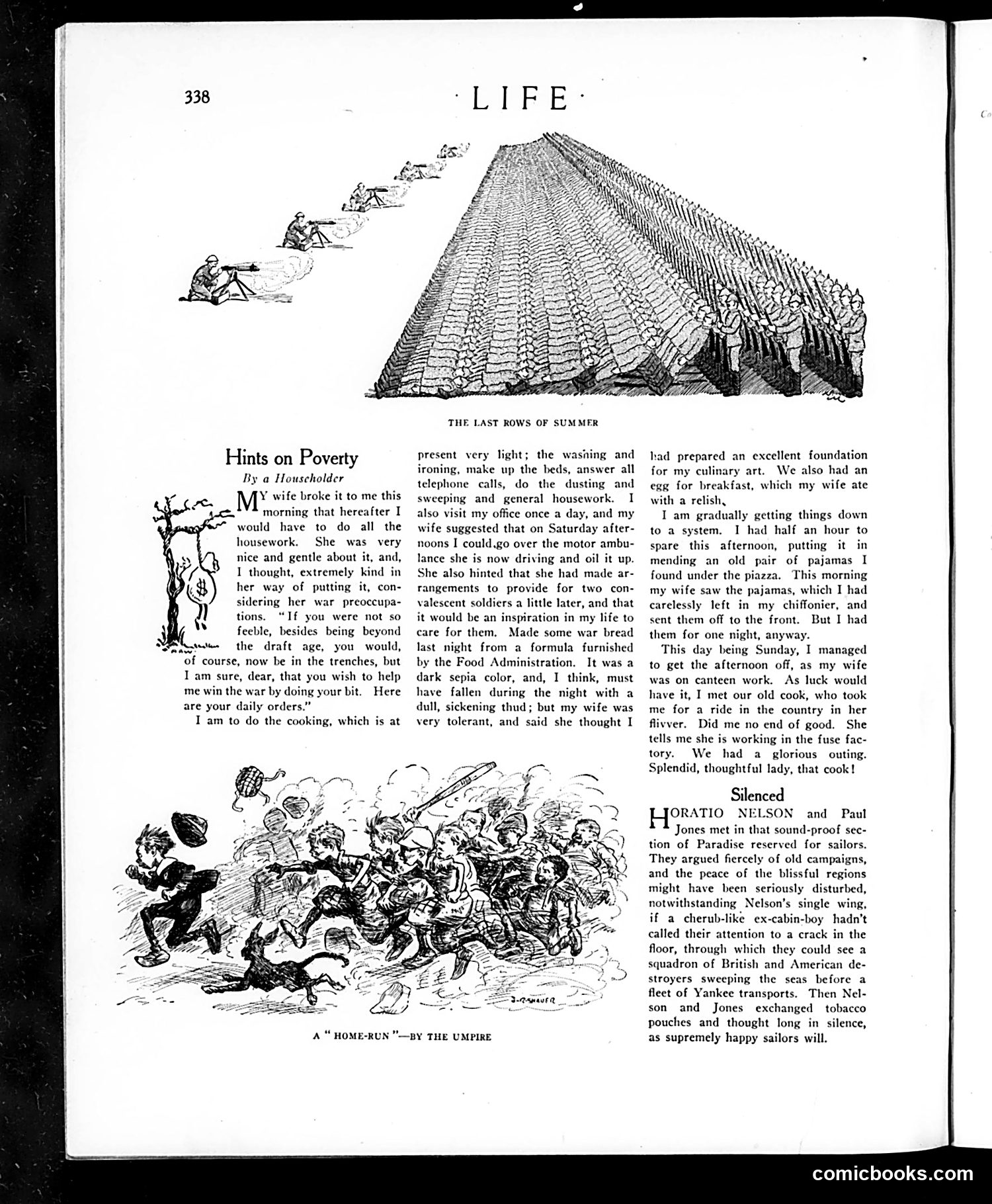
This page contains two distinct pieces: **"Hints on Poverty by a Householder"** features a housewife describing wartime domestic economy during what appears to be WWI. She details making war bread, managing servants for two soldiers, and reusing old clothing—practical advice for middle-class families adapting to wartime rationing and labor shortages. **"Silenced"** depicts a naval scene where sailors Horatio Nelson and Paul Jones meet in "Paradise" and observe British and American destroyers fighting German U-boats. Their exchange of tobacco pouches represents allied cooperation, with the caption suggesting "supremely happy sailors" appreciate the unity despite the war's devastation. Both pieces reflect American home-front experience and emphasize allied partnership during the Great War.
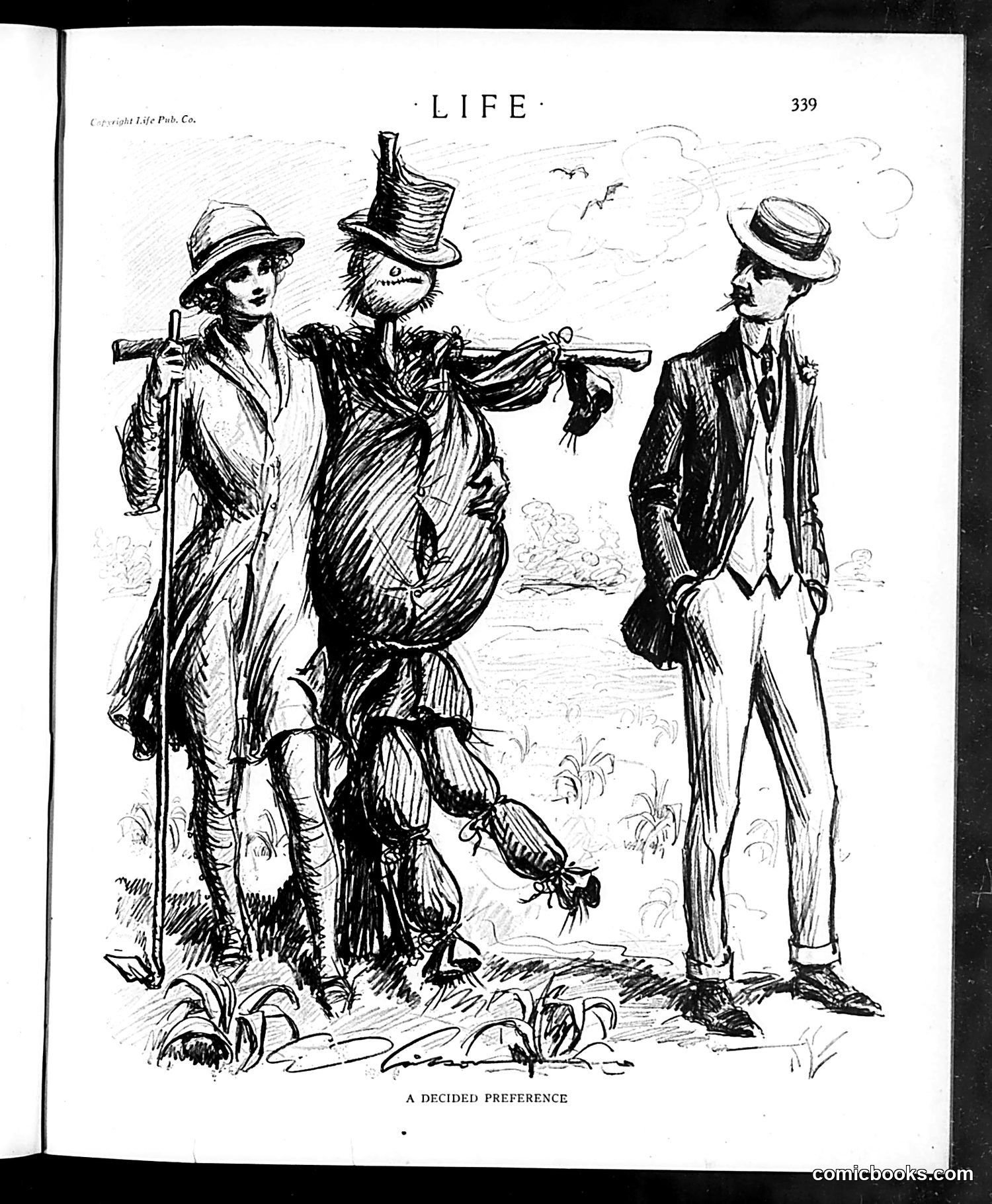
This Life magazine cartoon satirizes attitudes toward hunting and game. Three well-dressed gentlemen in formal attire and hats stand in a landscape, one holding a rifle. The central figure carries dead birds (game) and appears to be the subject of the joke. The caption "A Decided Preference" suggests the cartoon mocks a choice or preference—likely commenting on class attitudes toward hunting. The formal dress of these urban-appearing men contrasts with the rural hunting setting, possibly satirizing wealthy city dwellers who engage in field sports. The specific satirical point remains unclear without additional context, but it appears to critique either hunting culture, class pretensions, or gentlemen's sporting practices of the era depicted. The style suggests early-to-mid 20th century.
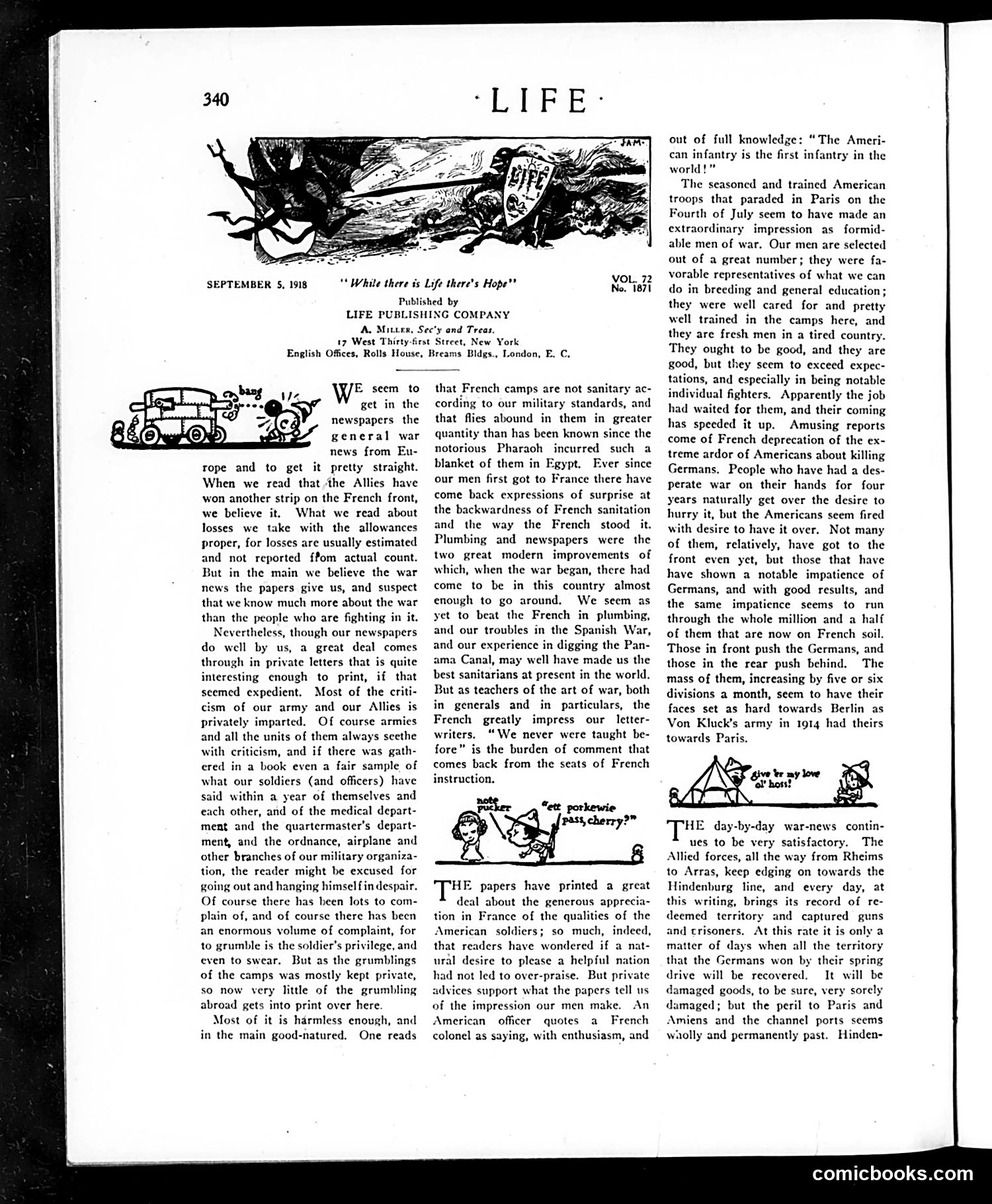
This page contains editorial commentary on American Expeditionary Forces in France during the final months of World War I. The cartoons appear to show soldiers in military situations, though details are small. The text discusses how American troops impressed French military leaders, contrasting American sanitation standards and military training favorably with French practices. A French colonel allegedly stated: "The American infantry is the first infantry in the world!" The author acknowledges that while newspapers report war news reliably, soldiers' private letters reveal more candid (often critical) observations about camp conditions, medical care, and military organization—complaints the author notes are typical soldier grumbling but mostly kept private. The piece celebrates American military professionalism while gently satirizing the mutual admiration between allies and the contrast between public praise and private soldier complaints.
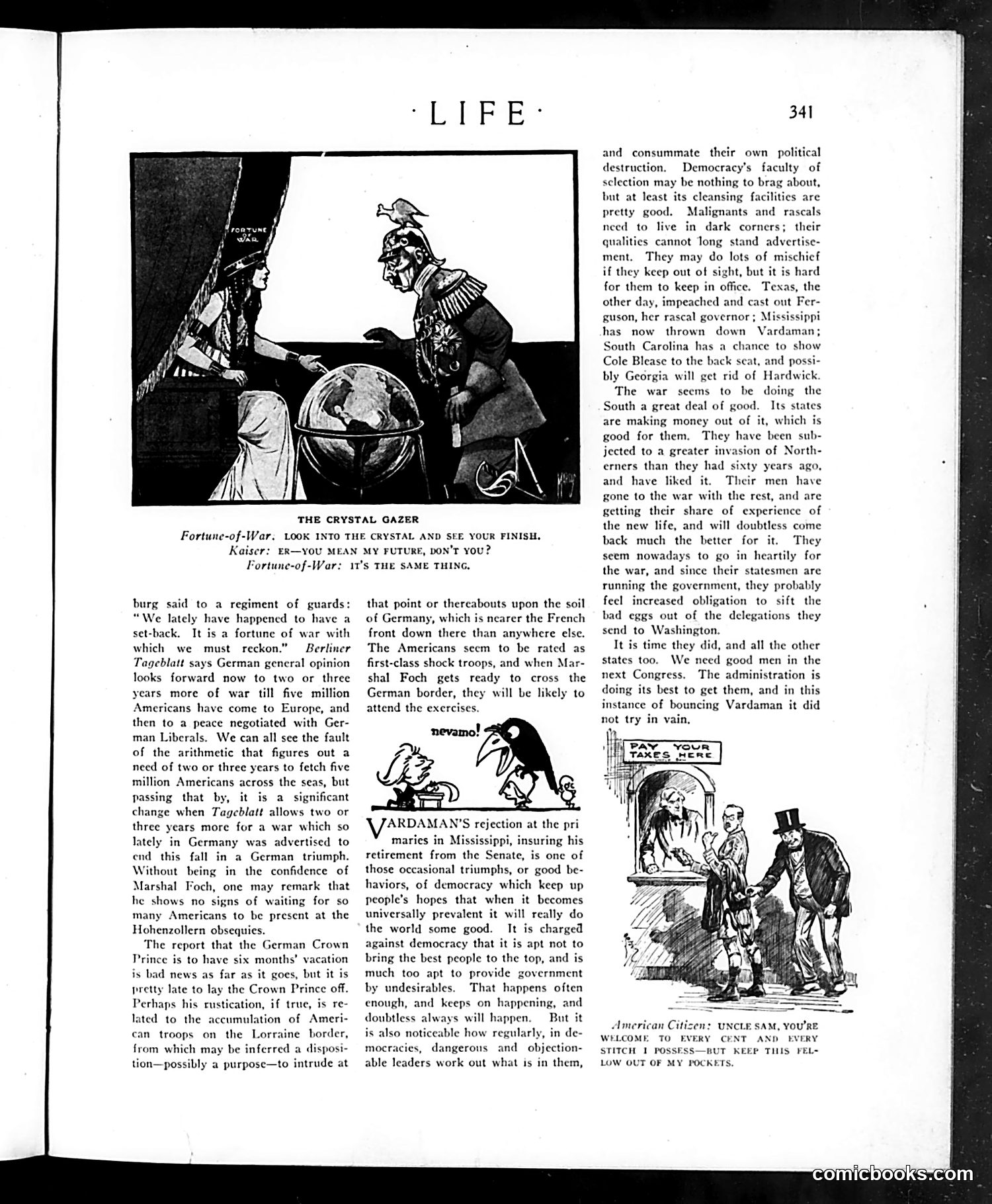
**The Crystal Gazer cartoon** depicts a fortune teller showing the German Kaiser his future in a crystal ball. The Fortune-of-War figure tells him "your finish" is the same as his future—a dark joke predicting German defeat in World War I. The Kaiser's nervous response ("you mean my FUTURE, don't you?") suggests he understands the implication. **The surrounding text** discusses German expectations of prolonged war (2-3 more years) before American troops arrive in significant numbers, contrasting this with earlier German predictions of quick victory. It mocks German military optimism as delusional. **The secondary article** celebrates the electoral defeat of Senator **Vardaman of Mississippi**, praising democracy's ability to eventually purge corrupt or dangerous politicians. It also notes Southern political figures like **Ferguson (Texas)**, **Blease (South Carolina)**, and **Hardwick (Georgia)** facing removal—suggesting ongoing Southern political reform during WWI. The page's overall theme: American confidence in victory and faith in democratic self-correction.
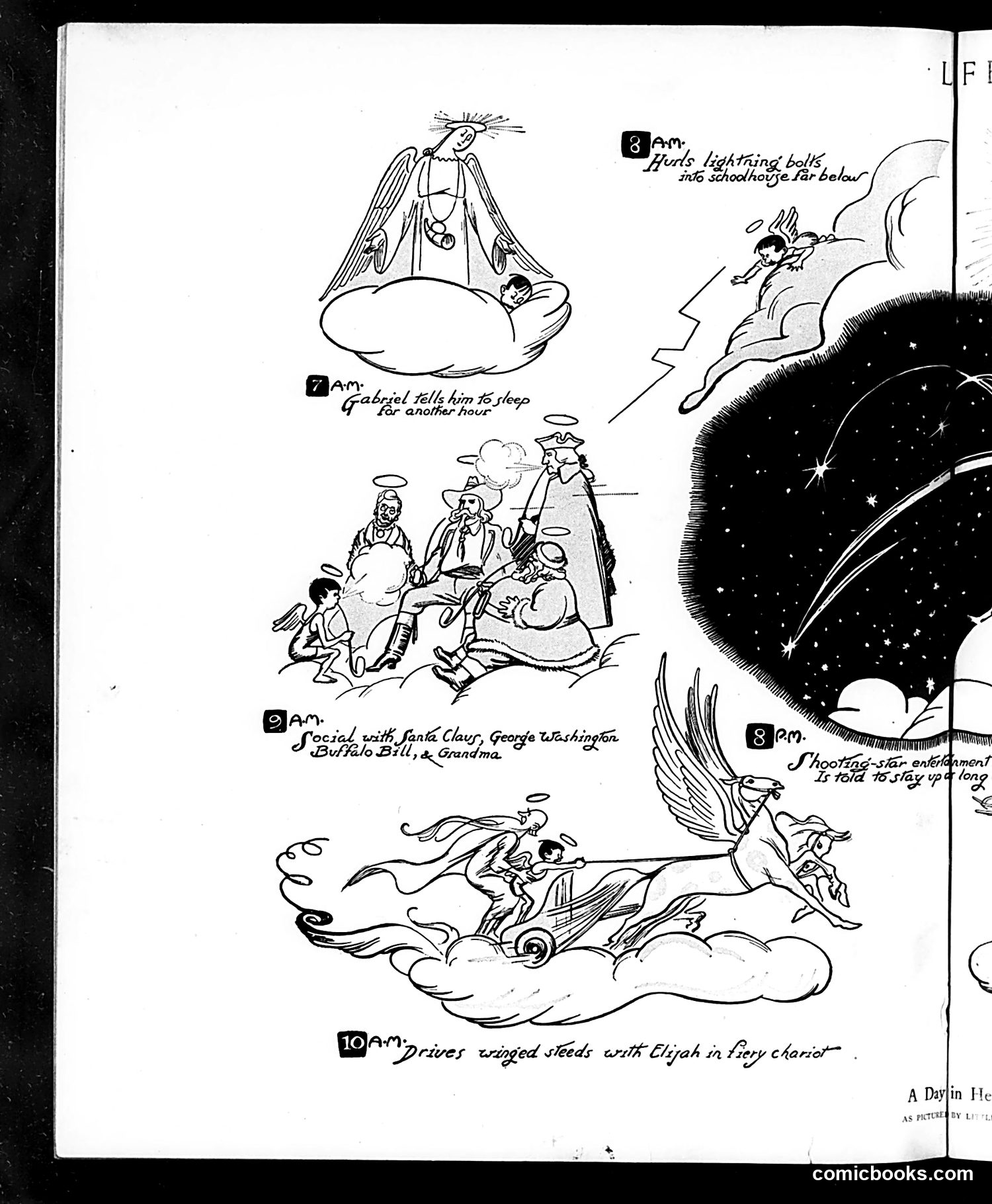
This page depicts "A Day in Heaven"—a satirical sequence showing the afterlife activities of famous figures. The numbered scenes include: **7.** Gabriel telling someone to sleep longer **8.** Angel Amy hurling lightning bolts into a schoolhouse below (satirizing destructive behavior) **9.** A social gathering with Santa Claus, George Washington, Buffalo Bill, and Grandma—mixing historical/mythical figures to suggest heaven's eclectic population **10.** A driver (appears to be the prophet Elijah, referenced by name) in a fiery chariot with winged steeds The satire mocks both religious conceptions of heaven and the American tendency to canonize cultural icons—conflating historical heroes (Washington), frontier legends (Buffalo Bill), and mythical figures (Santa). The humor lies in depicting these "heavenly" figures engaged in mundane or absurd activities, undermining their elevated status.
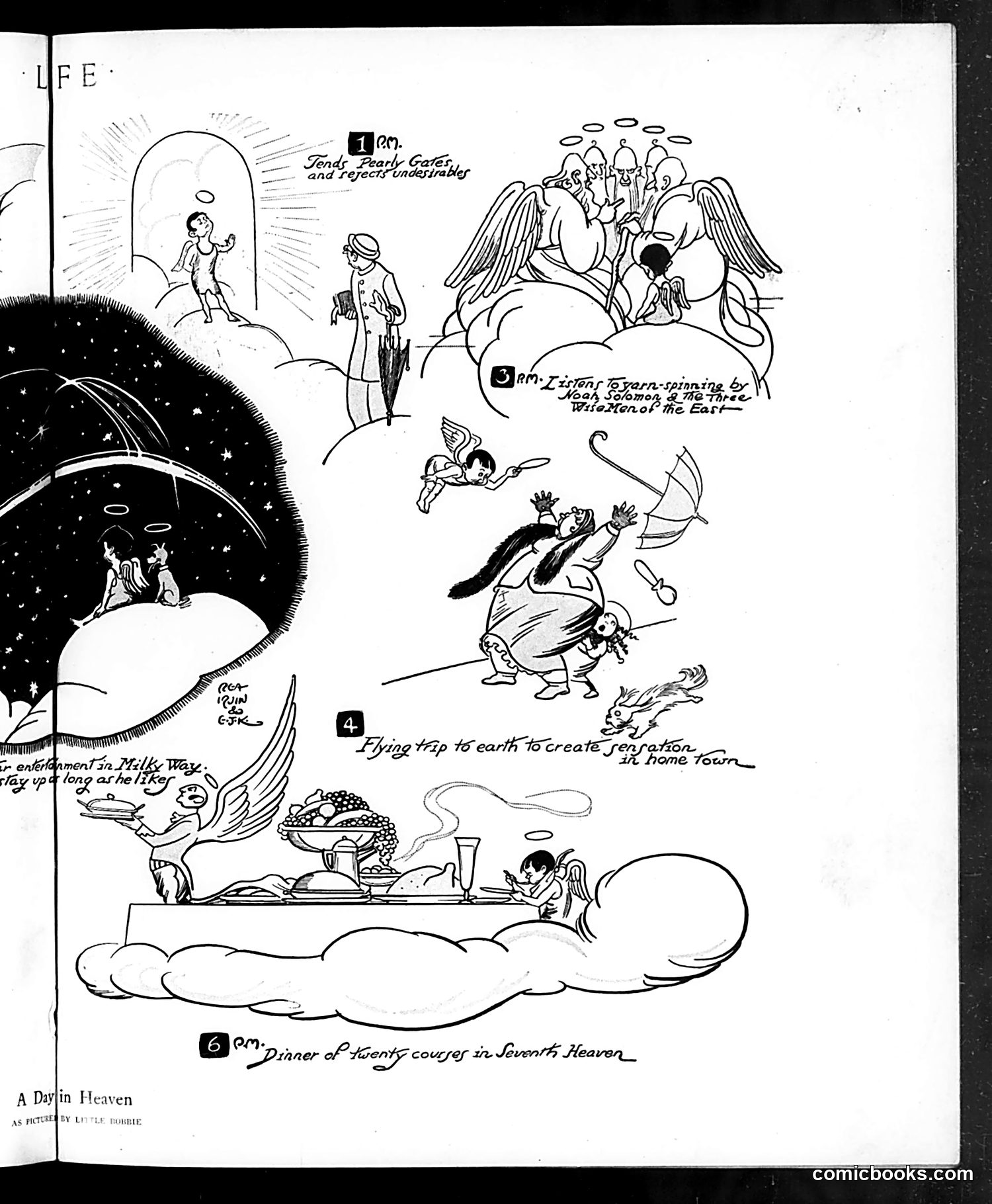
This appears to be a satirical illustration sequence titled "A Day in Heaven," depicting what the afterlife offers various figures. Panel 1 shows someone at "Pearly Gates" rejecting "undesirables." Panel 3 depicts "Lucifer Tavern-spinning" entertainment with biblical figures (Noah, Solomon). Panel 4 shows a flying trip to Earth for "recreation in home town." Panel 6 concludes with "Dinner of twenty covers in Seventh Heaven." The satire appears to mock heaven as a place offering earthly pleasures and entertainment—taverns, flying trips home, fine dining—rather than spiritual reward. It likely satirizes contemporary American materialism and conventional religious expectations, suggesting heaven caters to indulgent desires rather than spiritual transcendence. The rejection of "undesirables" at the gates hints at social prejudice being preserved even in the afterlife.
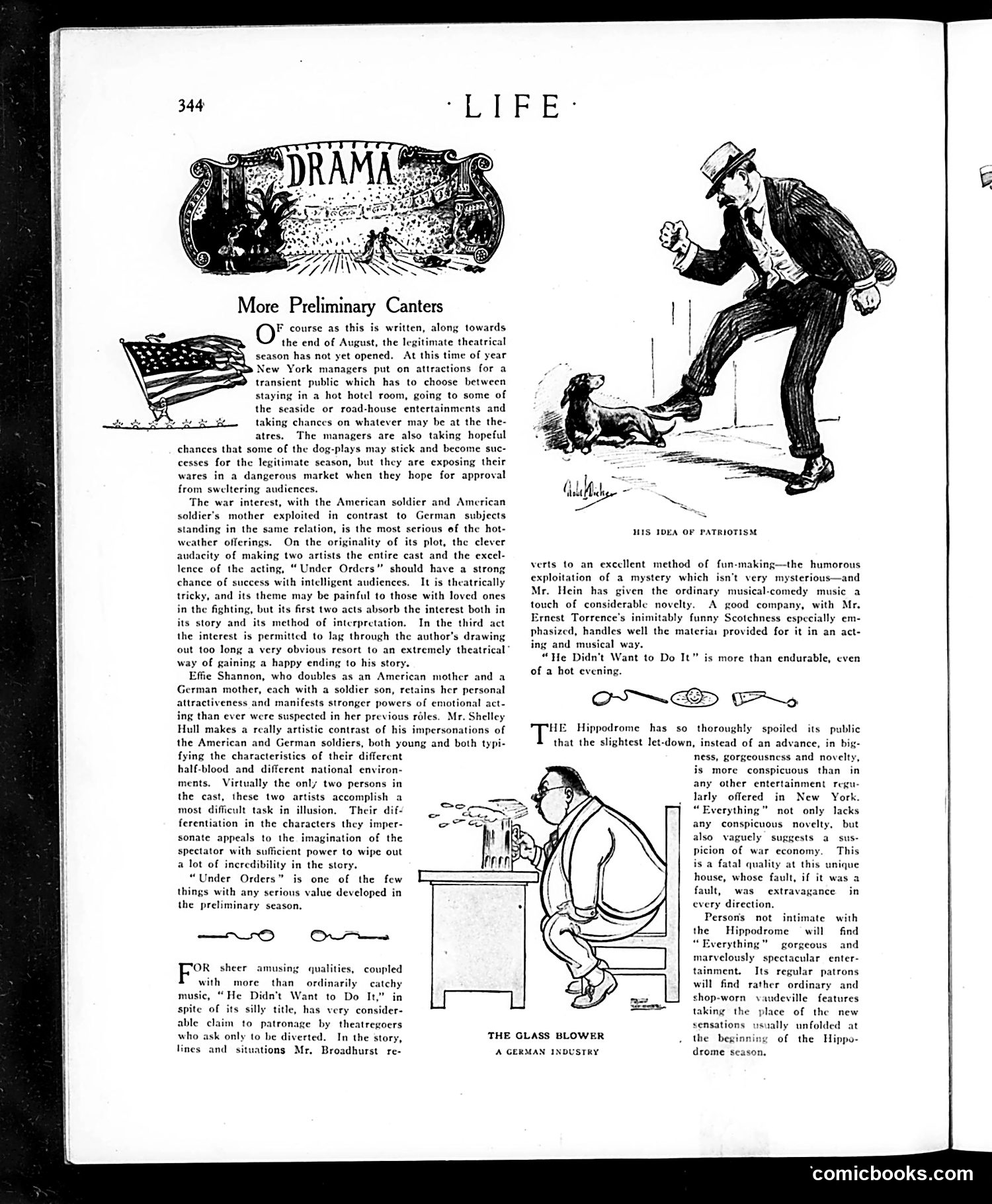
This drama review page from Life (circa August, during theatrical off-season) contains two cartoon illustrations satirizing patriotism and German industry. **Top cartoon ("His Idea of Patriotism"):** A man in a suit chases a dachshund (recognizably German by breed association) with a stick. This is anti-German wartime satire—the dachshund represents Germany, and the cartoon mocks superficial "patriotism" expressed through hostility toward German things rather than substantive support. **Bottom cartoon ("The Glass Blower: A German Industry"):** Shows a portly man at a desk, apparently representing German industrial capacity. The caption likely satirizes German manufacturing claims or war production propaganda. **Context:** The text references World War I—it mentions American soldiers, German subjects, and a play ("Under Orders") exploiting war themes. The cartoons reflect American wartime sentiment, using visual mockery of German identity to appeal to patriotic audiences skeptical of German claims. The page primarily reviews contemporary summer theater productions for transient New York audiences choosing between hot hotels and entertainment.
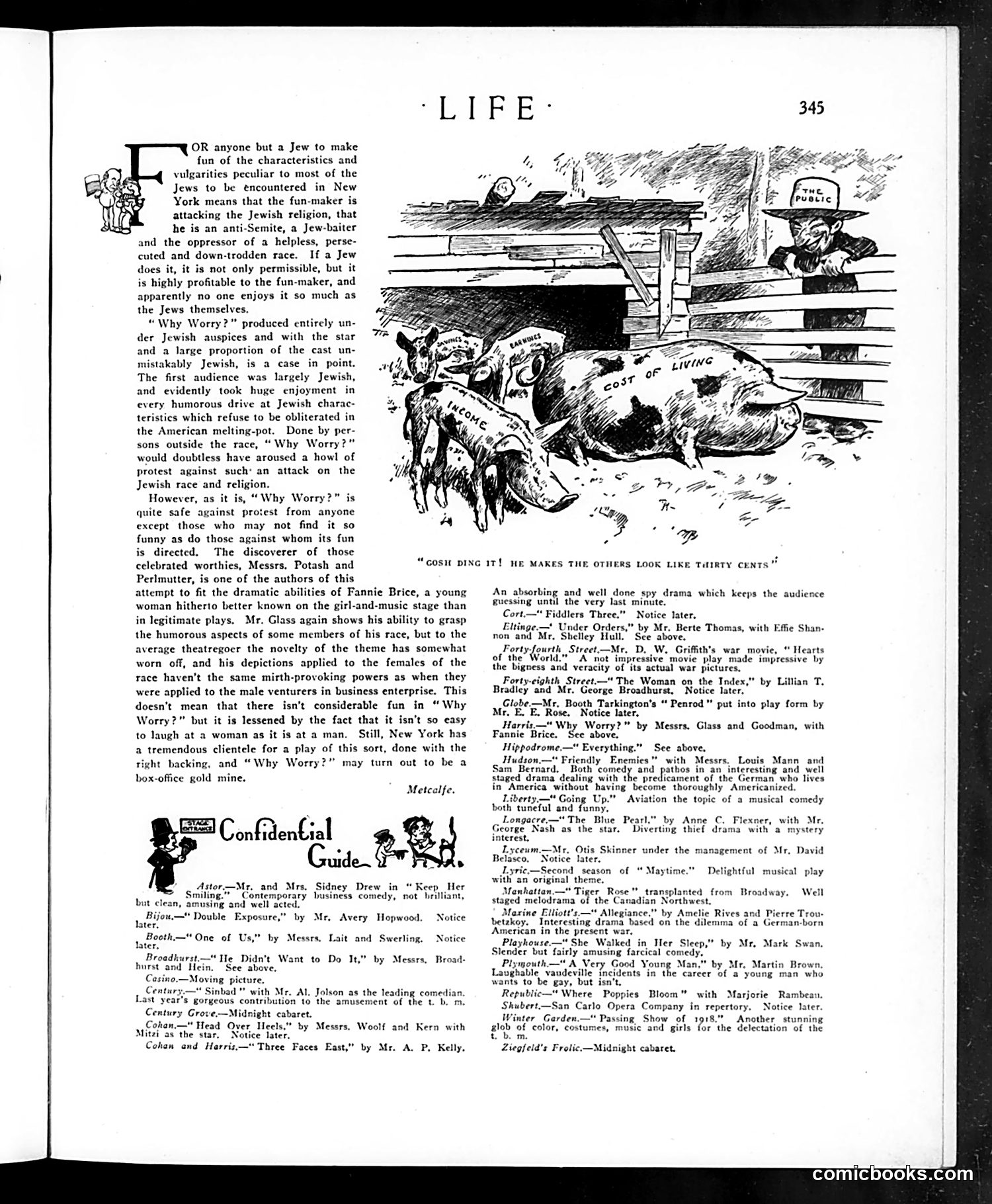
This page reviews theatrical productions, with the main editorial focus on the play "Why Worry?" starring Fannie Brice. The critic (Metcalfe) argues that Jewish playwrights and performers can satirize Jewish stereotypes without accusation of antisemitism, whereas non-Jewish creators depicting the same characteristics would face accusations of bigotry and hatred. The cartoon accompanying the text depicts a man labeled "THE PUBLIC" observing another figure who "makes the others look like thirty cents"—likely referencing how Brice's performance outshines competitors. The piece references Potash and Perlmutter (Jewish characters created by Montague Glass), noting audiences enjoyed ethnically-specific humor when presented by Jewish creators themselves. Metcalfe suggests the play's humor about Jewish characteristics "refuse to be obliterated in the American melting-pot," reflecting early 20th-century assimilation debates. The critic acknowledges the audience appeal while noting the novelty has somewhat worn thin.
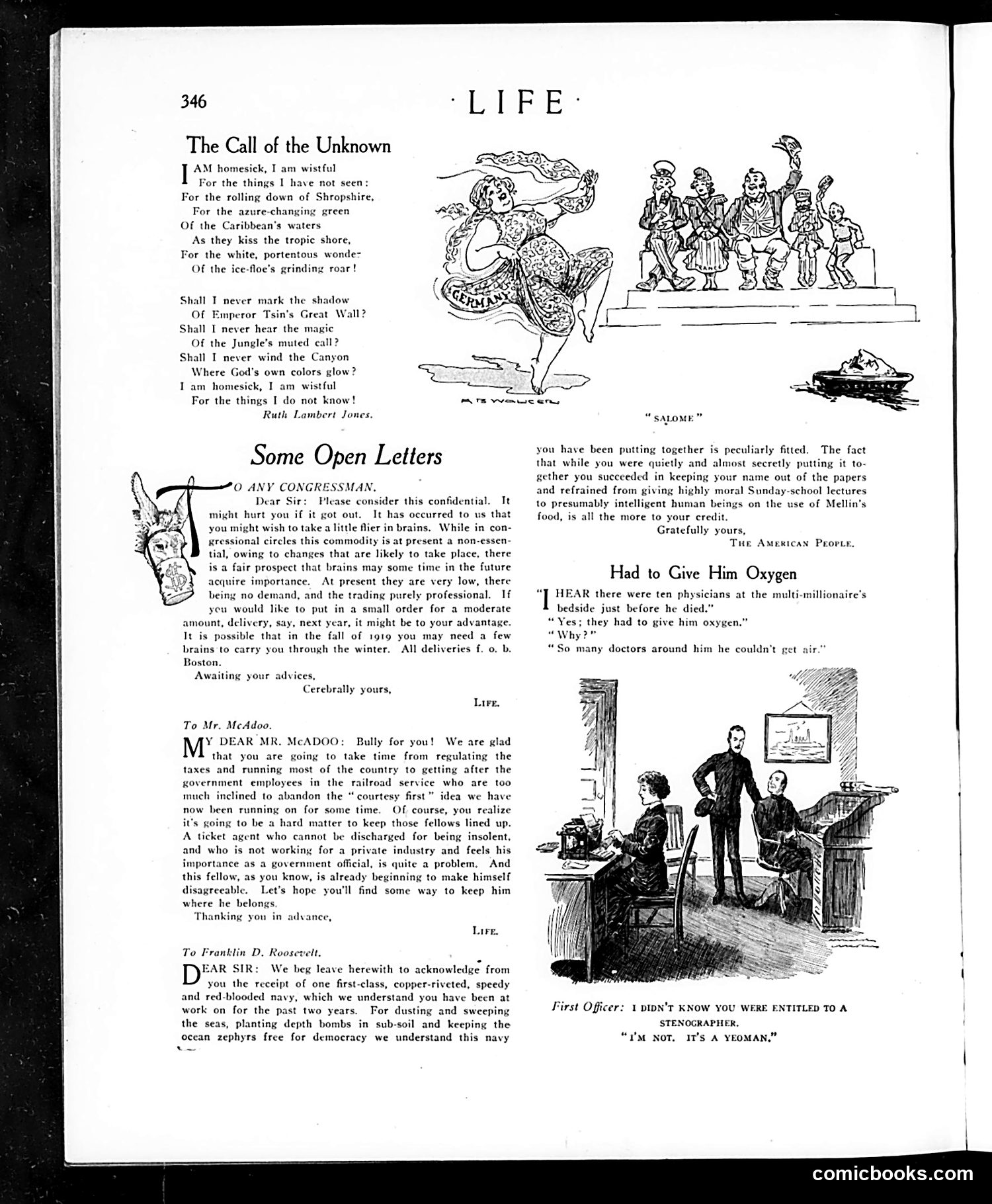
This page contains satirical letters and cartoons from Life's "Some Open Letters" section, mocking public figures and social issues of the era (appears to be post-WWI, circa 1919). **The Letters:** - A mock letter to "Any Congressman" sarcastically suggests congressmen purchase "brains" as a commodity, implying they lack intelligence - To Secretary McAdoo: congratulates him on disciplining railroad employees, while ironically noting government workers feel entitled and are hard to control - To Franklin D. Roosevelt: praises his naval buildup for democracy while mocking his usual tendency to publicize his accomplishments through moral lectures **The Cartoons:** The bottom cartoon jokes about a wealthy man's death: ten doctors couldn't save him because "so many doctors around him he couldn't get air"—satirizing how excessive medical attention can be counterproductive. The other cartoon shows a military officer correcting a subordinate about terminology (stenographer vs. yeoman), a minor bureaucratic joke. The satire targets government inefficiency, wealth inequality, and self-aggrandizing politicians.
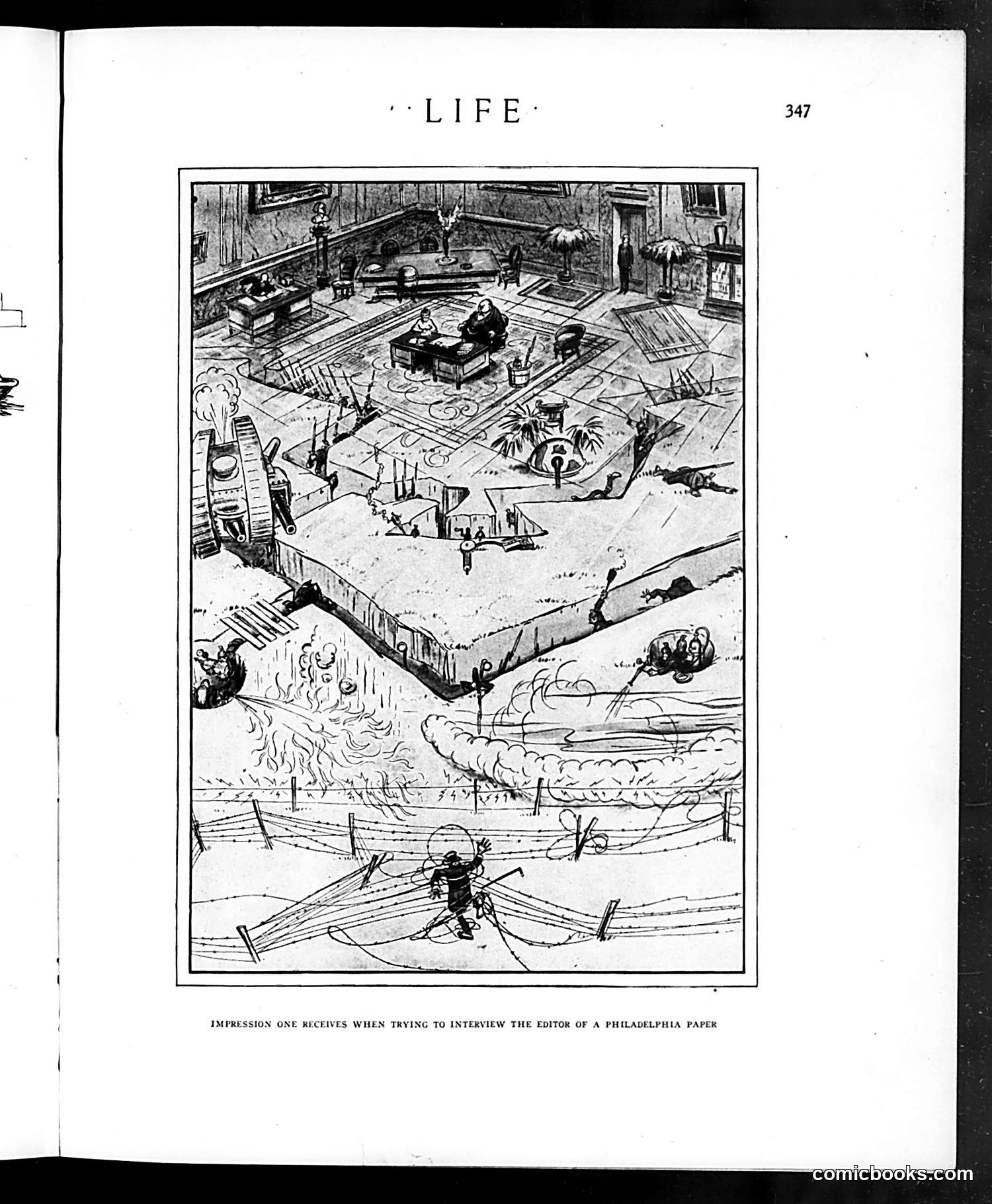
This is a satirical illustration depicting the chaotic experience of attempting to meet with a newspaper editor in Philadelphia. The cartoon shows a surreal, multi-layered obstacle course: the visitor must navigate through an elaborate indoor palace or building (top), traverse dangerous terrain including fire and water hazards (middle sections), and finally confront what appears to be a large dragonfly or mechanical creature (bottom). The joke satirizes the difficulty of gaining access to a busy newspaper editor—suggesting the appointment process is absurdly complicated and fraught with nearly insurmountable obstacles. It humorously exaggerates the barriers between ordinary people and those in positions of power and influence. The specific reference to "a Philadelphia paper" likely points to a particular publication's notoriously difficult editor, though the exact paper isn't identified here.
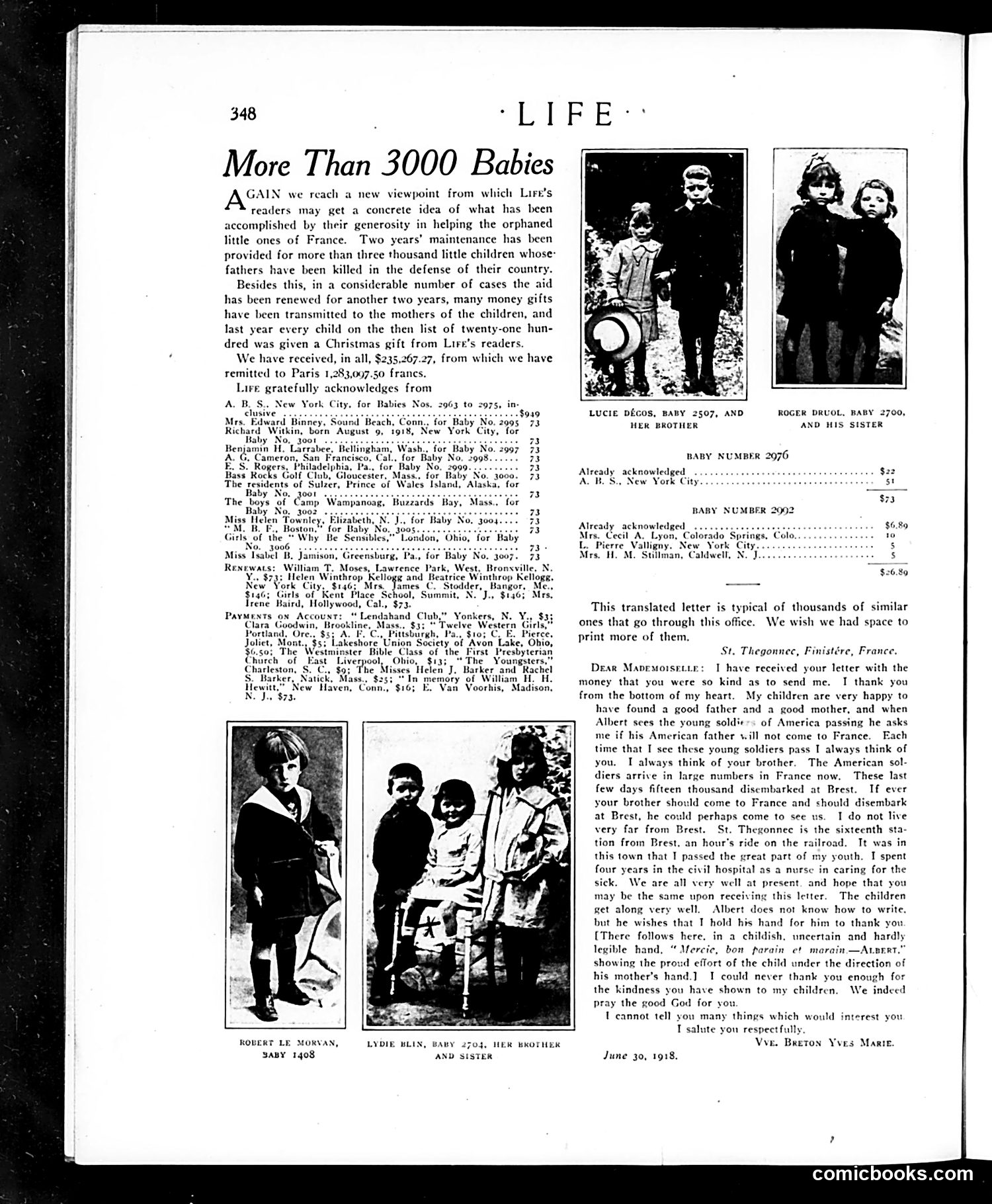
This page documents Life magazine's charitable campaign to support French war orphans during World War I. The heading "More Than 3000 Babies" celebrates that readers' donations have funded two years of maintenance for over 3,000 children whose fathers died defending France. The page lists donor names and amounts, then reproduces a translated letter from a French woman (Mme. Breton Yvé Marie) in St. Thegonnec, thanking American donors. She describes her adopted children thriving under American patronage, mentions the influx of American soldiers arriving at Brest, and expresses hope that donors' relatives might visit France. The photographs show the sponsored children—typical beneficiaries of this international aid effort. This represents Life's role as both satirical magazine and civic institution, mobilizing reader generosity toward Allied war victims. The specificity of names and donation amounts demonstrates the personal, direct nature of early 20th-century charitable giving.
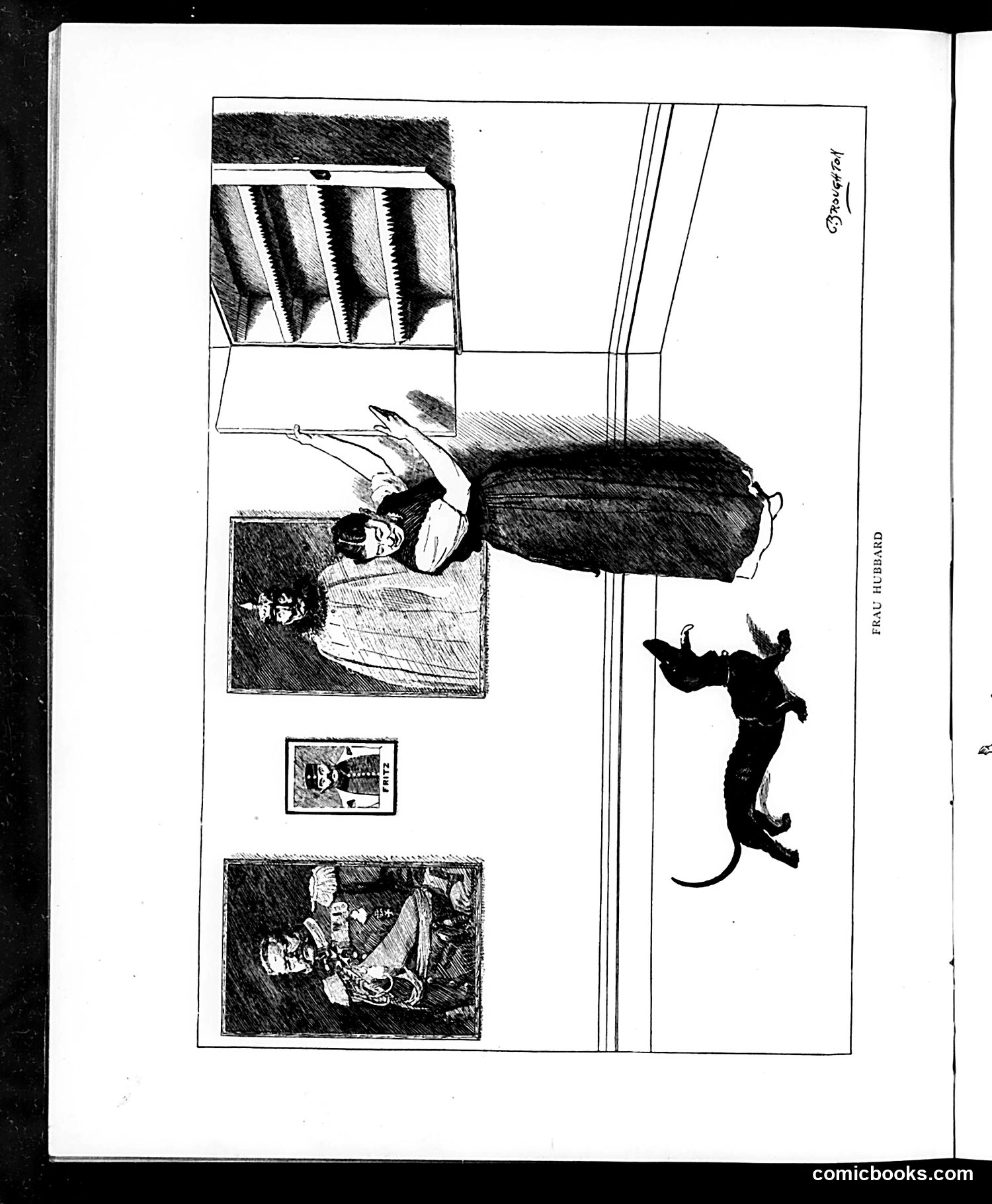
This page is rotated 90 degrees and contains a satirical illustration labeled "FRANK HUBBARD" (visible on the right margin). The central figure is a portly man in formal dress standing in what appears to be a bedroom. Below are smaller domestic scenes, and a black silhouette of a rat appears on the right. The cartoon likely depicts a moral or domestic satire, common to Life magazine's humor. The rat imagery suggests either literal pest problems or metaphorical corruption/betrayal. The bedroom setting and formal dress suggest commentary on bourgeois hypocrisy or infidelity—typical targets of early 20th-century American satirical magazines. However, without clearer text or additional context about "Frank Hubbard," the specific political or social reference remains **unclear**. The OCR text is too corrupted to confirm the intended subject.
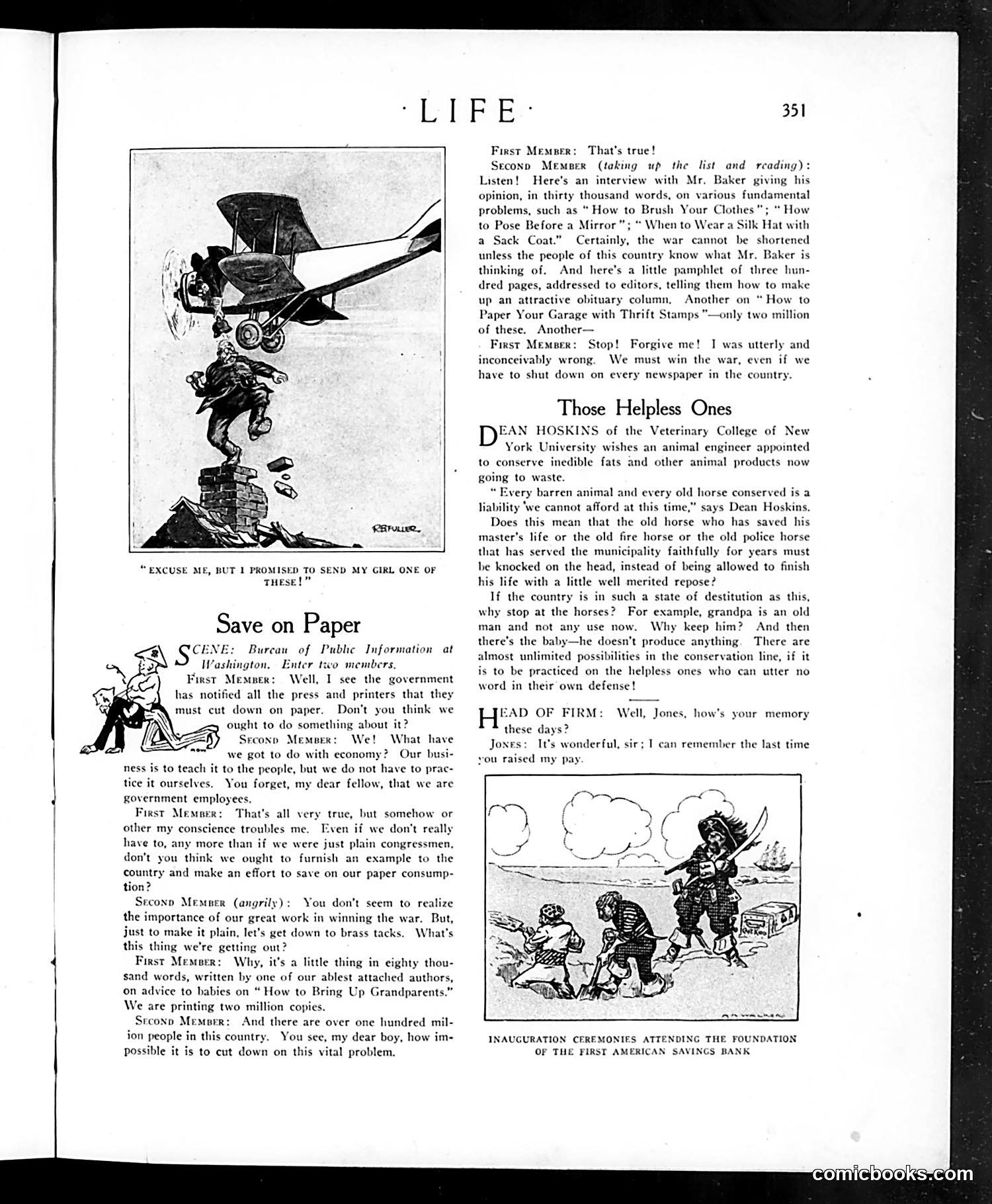
## "Save on Paper" This satirical dialogue mocks government hypocrisy regarding wartime paper conservation. Two Bureau of Public Information employees debate cutting paper use—but defend their massive publications (80,000-word baby advice guides, 300-page editorial instructions, "thrift stamp" pamphlets printed in millions) as "vital" to winning the war. The joke: they lecture the public on conservation while wastefully printing trivial content themselves, claiming their work's importance exempts them from sacrifice. ## "Those Helpless Ones" This piece sarcastically critiques Dean Hoskins's proposal to conserve animal products by killing aged, unproductive animals. The author extends the logic absurdly to humans—elderly grandparents and babies produce "nothing," so why spare them? It's dark satire exposing the moral bankruptcy of utilitarian wartime thinking applied without compassion to the vulnerable. ## "Jones's Memory" A brief joke: an employer asks if an employee's memory is good; Jones replies he remembers the last pay raise—implying none have occurred since.
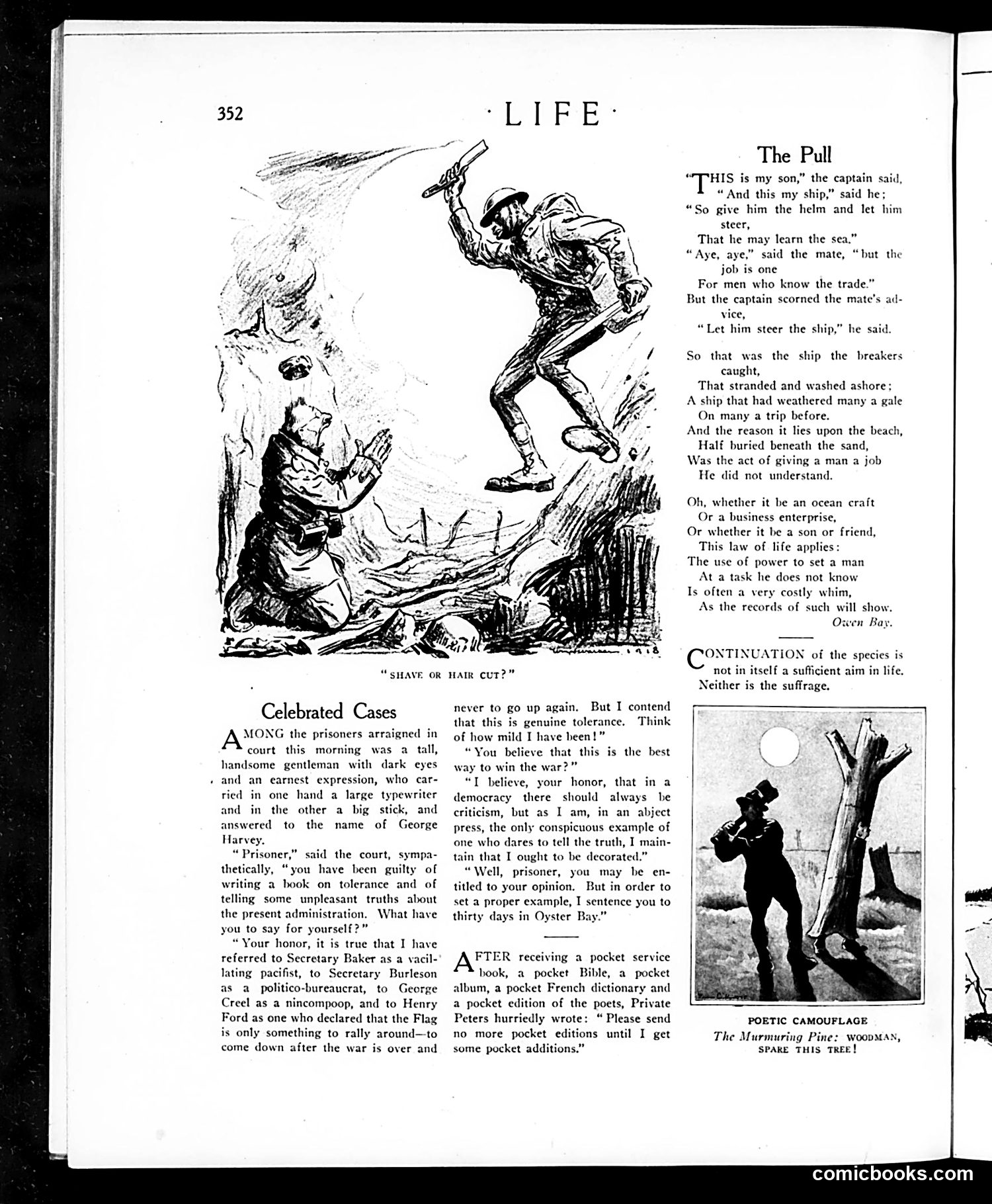
This page satirizes **WWI-era government censorship and nepotism**. The top cartoon mocks George Harvey, a real magazine editor and critic who attacked Wilson administration officials—Secretary Baker (war), Burleson (postmaster general overseeing censorship), George Creel (propaganda chief), and Henry Ford. The "court" sentences Harvey to "Oyster Bay" (Theodore Roosevelt's home, implying exile), ridiculing how criticism of the war effort faced legal threats during wartime. "The Pull" poem criticizes **political nepotism**—giving positions to unqualified relatives. A ship captain gives his son the helm despite the mate's warning; the ship wrecks. It's an allegory for wartime appointments made through connections rather than competence. Both pieces target how WWI governments suppressed dissent and rewarded loyalty over ability, presenting this as dangerous to democracy and national interests.
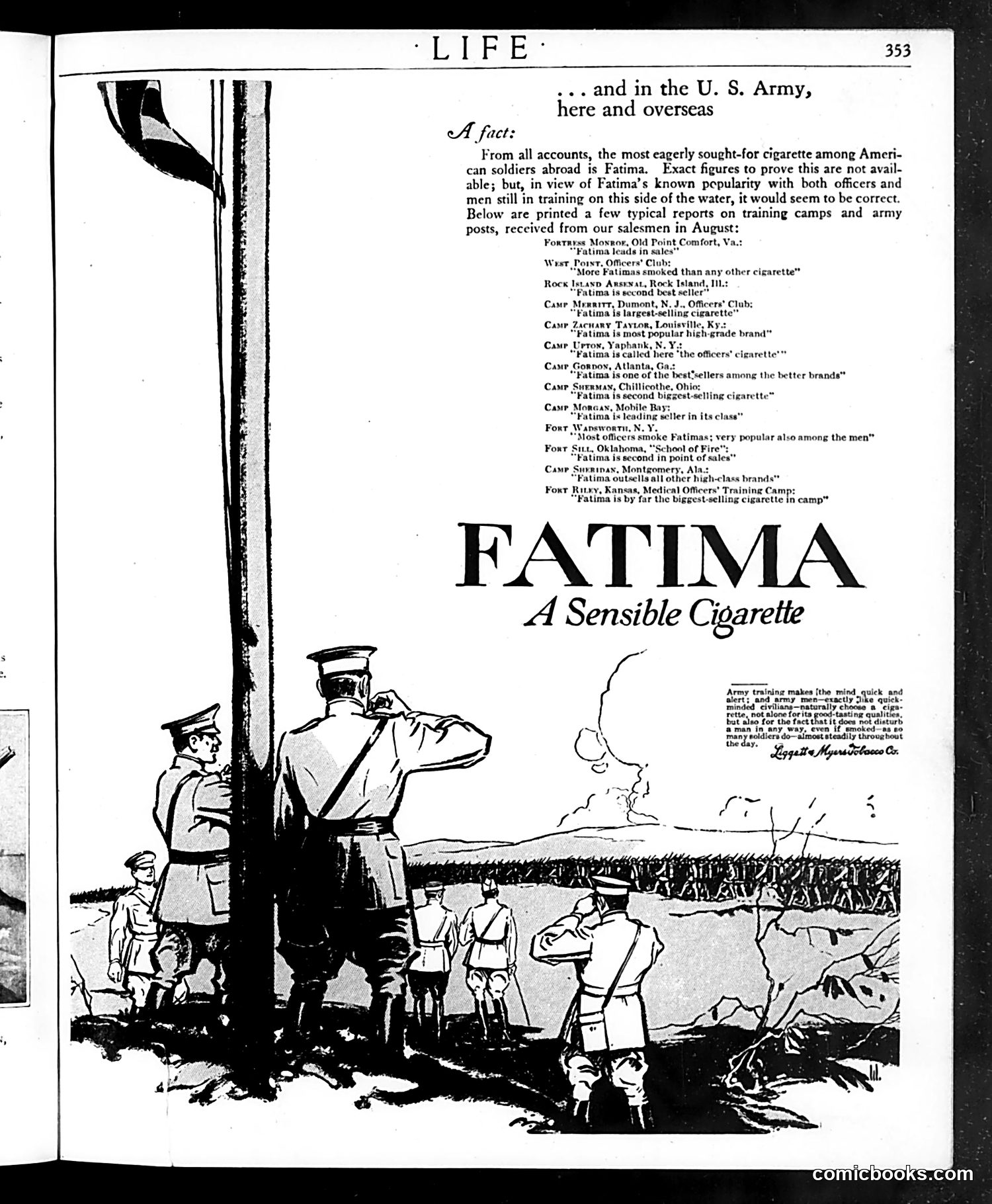
This is a **cigarette advertisement** disguised as a news article, exploiting World War I patriotism. The page presents Fatima cigarettes as the preferred smoke of American soldiers, both at training camps and overseas. The illustration shows soldiers at attention near a flagpole during military training—a patriotic scene meant to associate Fatima with duty and army life. The "fact" section consists entirely of fabricated testimonials from various military camps (Fort Washburn, Camp Upton, etc.), each claiming Fatima is the "most popular" or "best-selling" cigarette among officers and enlisted men. These quotes are unverified marketing claims presented as documentary evidence. The tagline "A Sensible Cigarette" is ironic to modern readers, though contemporaries may have seen it as emphasizing quality/moderation. **The satire/point**: This ad cynically exploits soldiers' patriotism and military authority to sell cigarettes by falsely claiming institutional endorsement. It's propaganda marketing disguised as journalism—a technique Life magazine (itself satirical) was apparently willing to run, or was mocking.
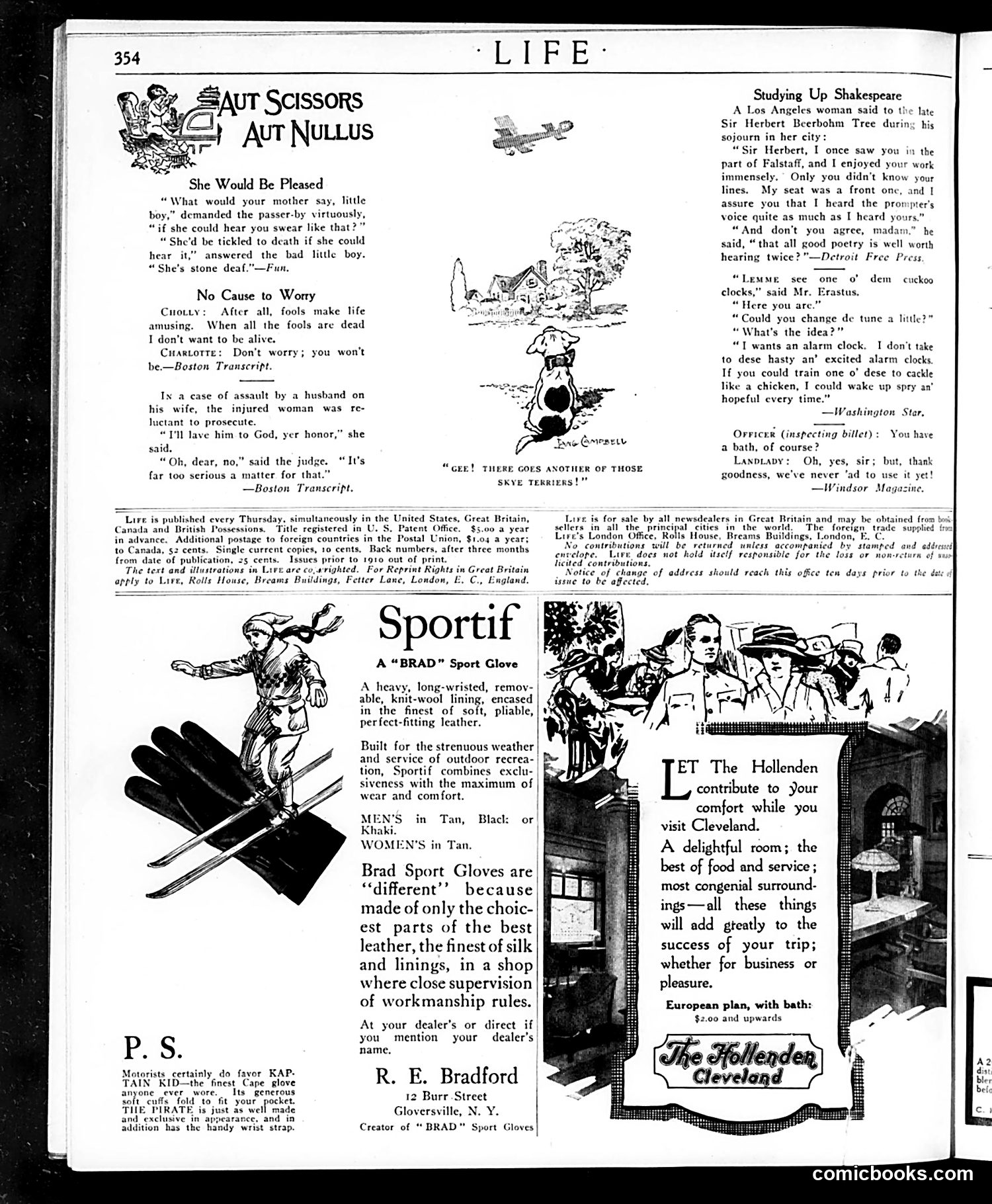
This page mixes brief humorous anecdotes with advertisements. The cartoons and jokes reflect early 20th-century sensibilities: **"She Would Be Pleased"** satirizes a child's crude language—a passer-by scolds a boy for swearing, but the boy reveals his deaf mother wouldn't care. The humor relies on Victorian anxieties about children's propriety. **"No Cause to Worry"** presents cynical exchanges: one about preferring death to a world of fools, another about a wife reluctant to prosecute her abusive husband, calling it "God's business." This reflects period attitudes normalizing domestic violence as private matters. **The Beerbohm Tree anecdote** jokes about the famous actor's reliance on prompters during his Falstaff performance, with his witty comeback suggesting repetition enhances poetry. The remaining items are brief quips about alarm clocks and military lodging. The page is primarily **advertising**—for "Brad" sport gloves and the Hollenden hotel in Cleveland—using the humorous framing typical of Life's format.
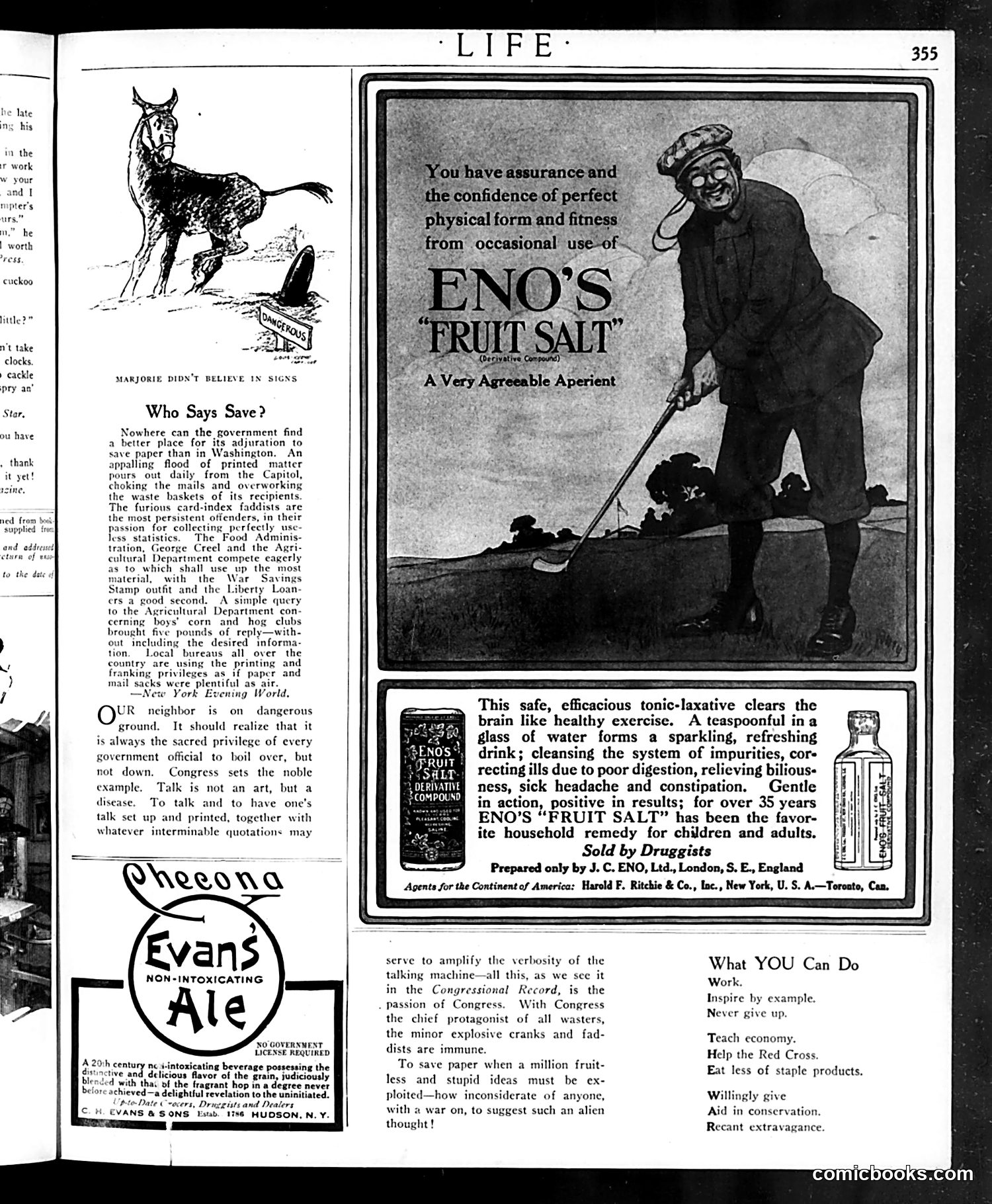
**Main Cartoon ("Marjorie Didn't Believe in Signs"):** A simple sketch shows a horse bucking off its rider near a sign reading "DANGEROUS." The satire is straightforward: ignoring warnings leads to consequences. **Editorial Satire ("Who Says Save?"):** This piece mocks government hypocrisy during WWI. While officials urge citizens to conserve paper for the war effort, Congress itself floods the mail with wasteful printed matter—card-index statistics, Agricultural Department replies, Food Administration documents. The author excoriates Congressional officials as the worst offenders, calling Congress "the chief protagonist of all wasters." The irony: asking people to sacrifice while government officials ignore their own conservation pleas. **Context:** This reflects genuine WWI-era paper rationing and conservation campaigns, making the contradiction between official messaging and actual practice a pointed criticism of governmental waste and hypocrisy. **Advertisements:** The page also features period ads for Eno's Fruit Salt (a laxative) and Evans Ale, unrelated to editorial content.
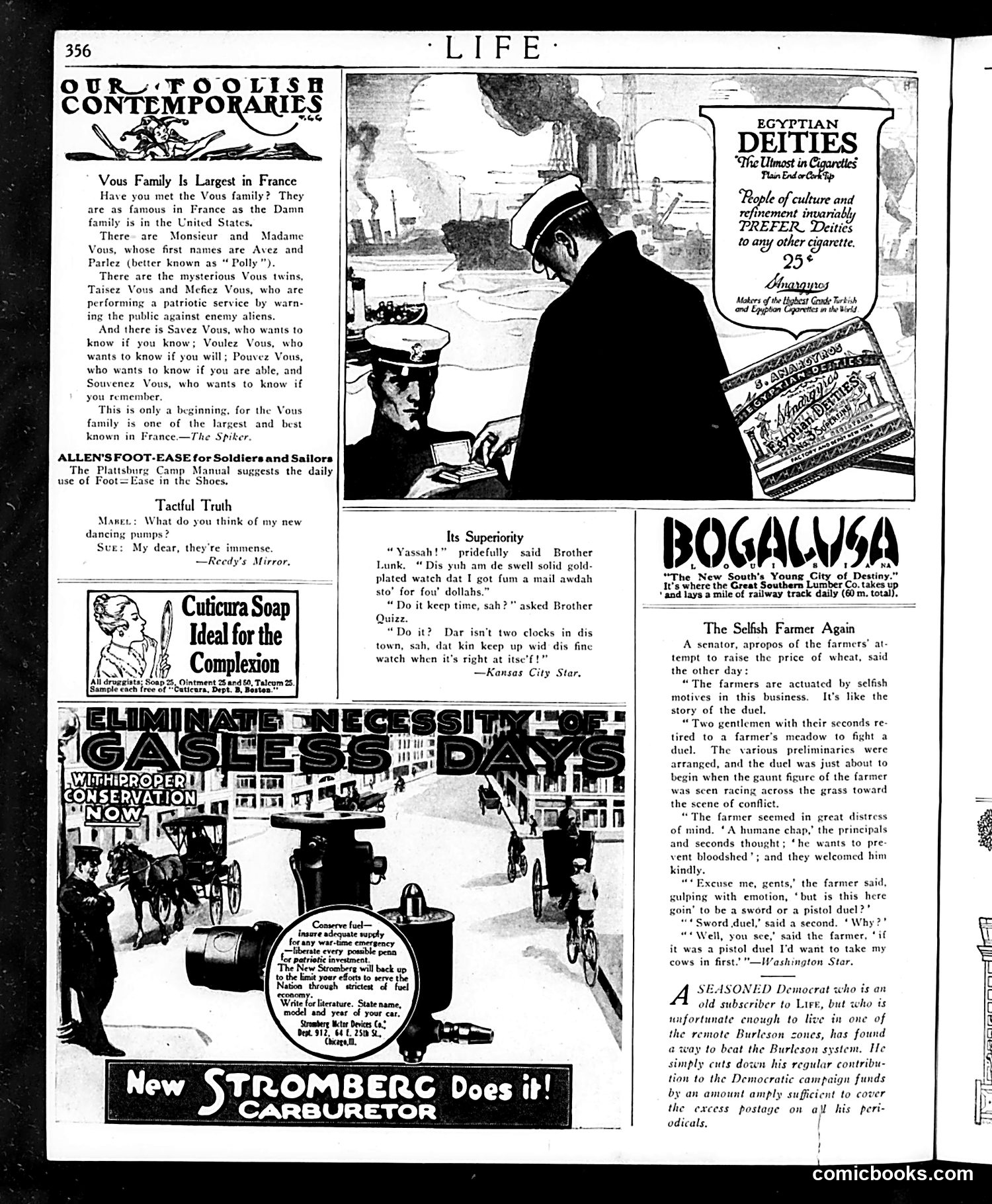
This page mixes humor with wartime content (likely WWI era, given references to "enemy aliens" and conservation). **Main Satirical Content:** The "Vous Family" piece is a French language pun—"Vous" is French for "you," so the article plays on homophones: Avez Vous ("Do you have"), Parlez Vous ("Do you speak"), Taisez Vous ("Be quiet"), etc. It's absurdist humor treating grammatical constructions as if they were an actual prominent French family, mocking both French naming conventions and perhaps wartime paranoia about spies. **Other Items:** The "Selfish Farmer" anecdote satirizes farmers' demands for higher wheat prices during wartime, using a joke about a farmer interrupting a duel—he only cares about his cows being safe, suggesting farmers prioritize profit over patriotism. The page is otherwise dominated by **period advertisements** (Cuticura Soap, Stromberg Carburetor, Egyptian Deities cigarettes) and brief jokes from other publications' humor columns. The content reflects American satirical magazine conventions of mixing advertising with short-form humor pieces.
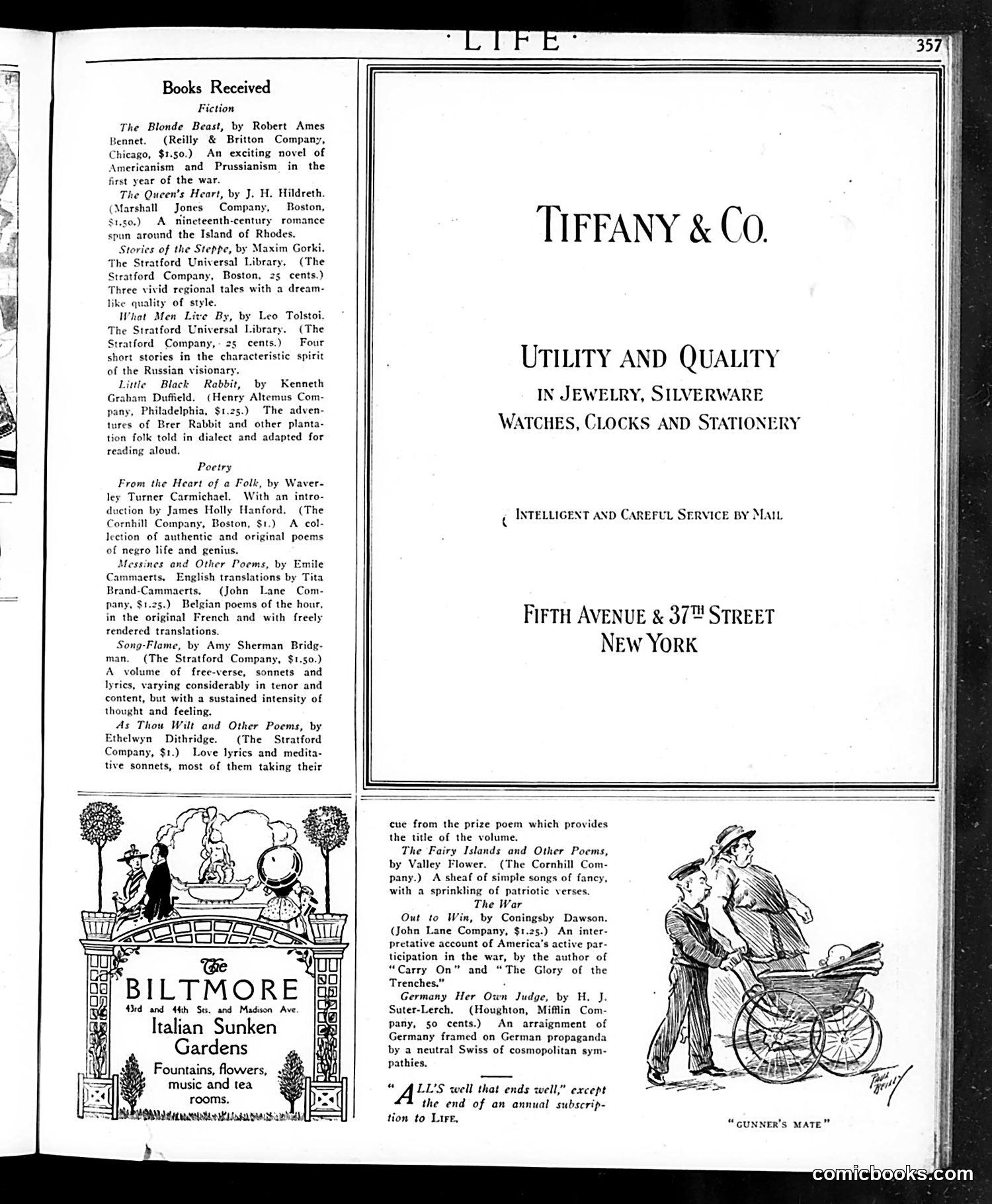
This page is primarily a **book review section** with advertisements, not political satire. The main content lists newly published fiction and poetry, with emphasis on war-related works—reflecting America's WWI involvement (the page mentions "America's active participation in the war"). The single cartoon, titled **"Gunner's Mate,"** depicts two soldiers with a bicycle, likely illustrating military humor about wartime logistics or troop movements. The style suggests early 20th-century American military life. The advertisements—**Tiffany & Co.** (luxury jewelry) and the **Biltmore Hotel** (upscale lodging)—represent typical magazine advertising targets of affluent readers. The page's tone reflects 1917-1918 America: patriotic poetry collections appear alongside war memoirs and accounts of German propaganda, indicating contemporary preoccupation with the global conflict. Nothing here constitutes direct political satire; rather, it documents period concerns and consumer culture.
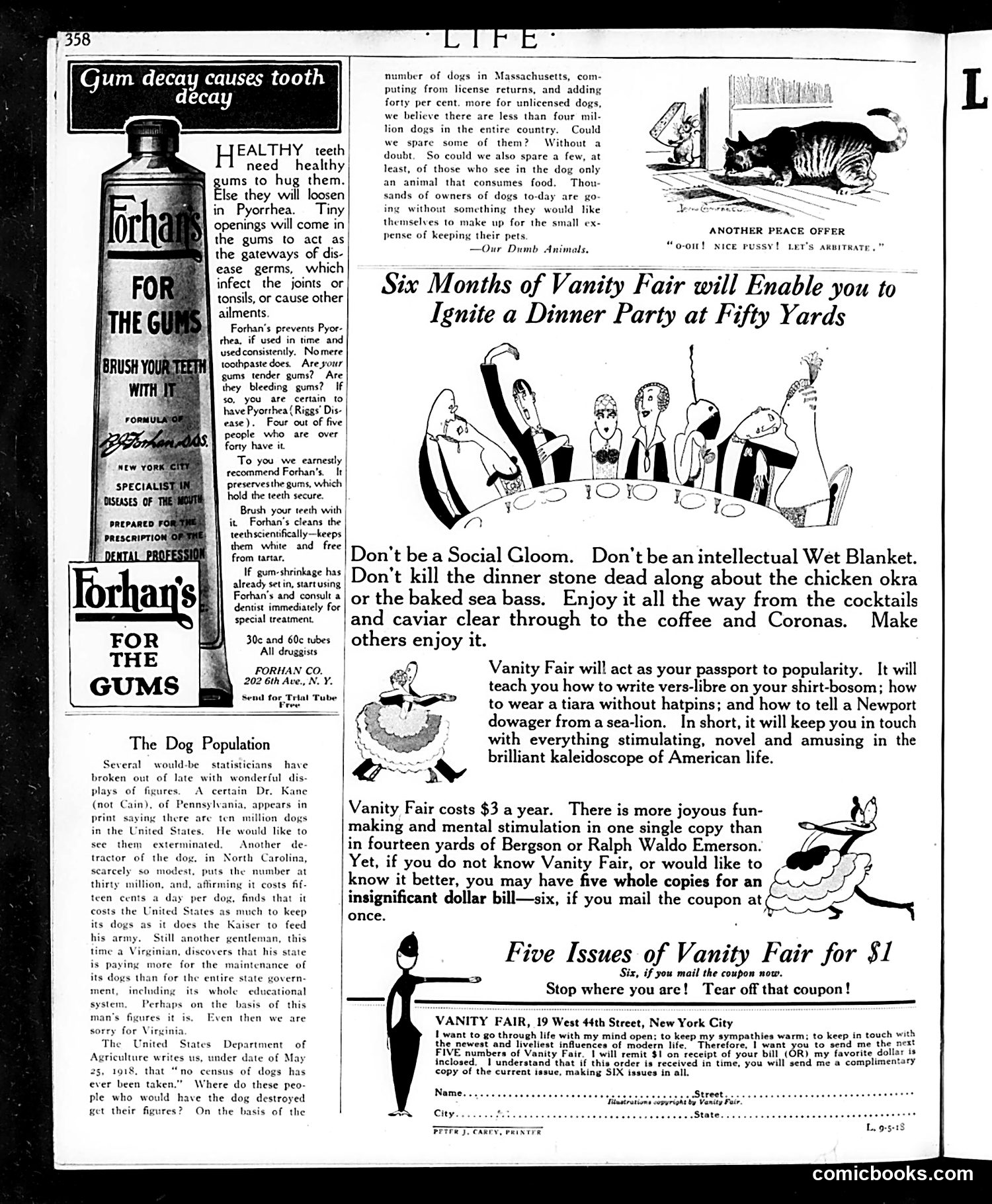
This page combines two distinct elements: a **Forhan's toothpaste advertisement** (left) and a **Vanity Fair magazine promotion** (right), with a brief editorial piece on dog population statistics in between. **The Forhan's ad** uses health warnings typical of early 20th-century advertising—claiming the product prevents pyorrhea (gum disease) and tooth decay. It targets middle-class consumers anxious about dental health. **The Vanity Fair promotion** mocks social pretension through illustrated vignettes of dinner parties. It satirizes aspiring sophisticates who worry about etiquette ("Don't be a Social Gloom," "Don't kill the dinner stone dead") and offers absurd tips like wearing tiaras without hatpins and writing vers-libre poetry on shirt-bosoms. The satire targets status-conscious readers seeking to appear cultured and urbane. **"The Dog Population" section** reports on statisticians debating whether America has 4-30 million dogs, with various critics calculating their economic burden on the nation—a lighthearted critique of pointless statistical debates during wartime (reference to Kaiser suggests WWI era). The page reflects Life's role as satirical commentary on American consumer culture and social anxiety.