
Life, 1918-09-05 · page 20 of 34
Life — September 5, 1918 — page 20: what you’re looking at
What you’re looking at
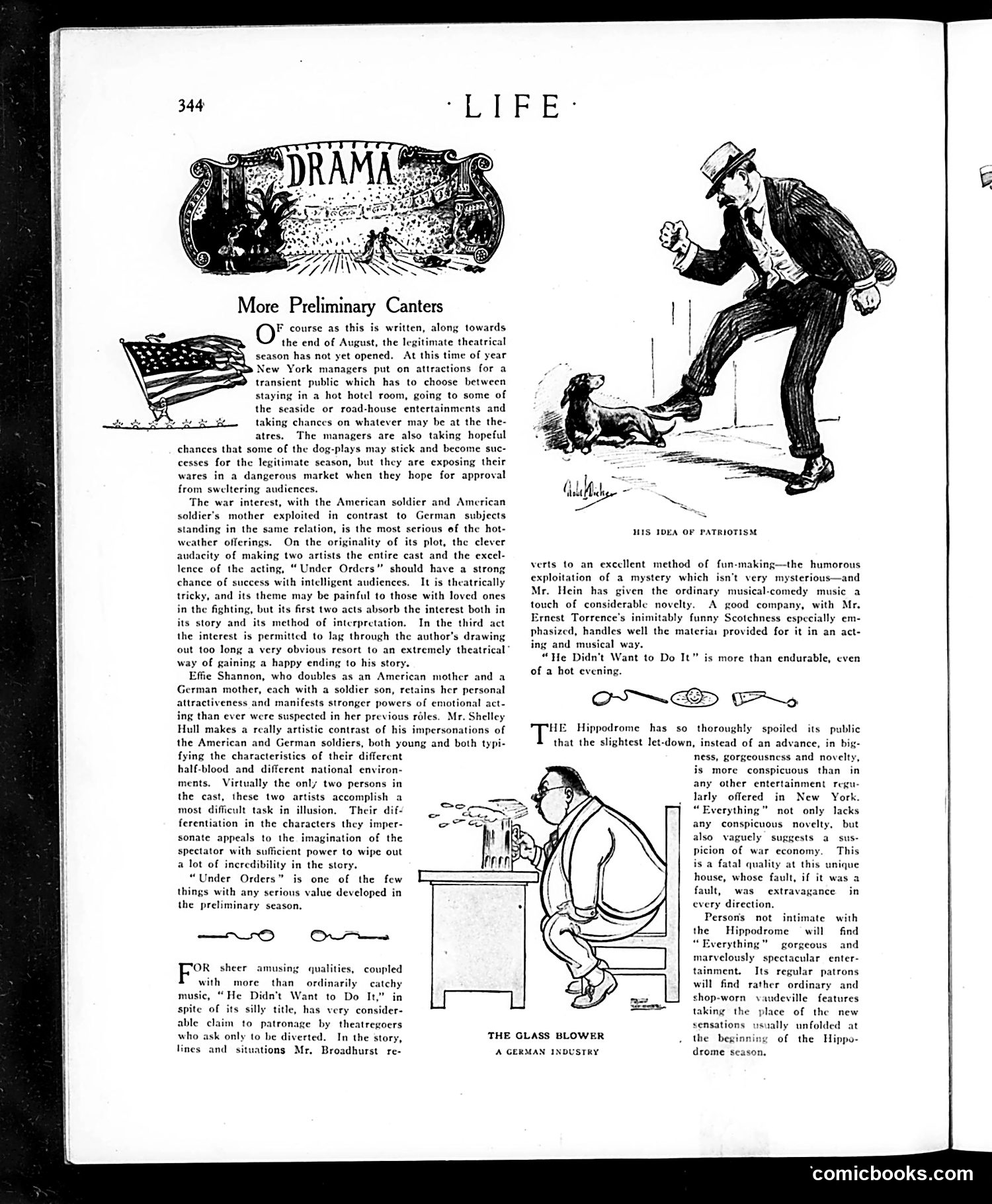
This drama review page from Life (circa August, during theatrical off-season) contains two cartoon illustrations satirizing patriotism and German industry. **Top cartoon ("His Idea of Patriotism"):** A man in a suit chases a dachshund (recognizably German by breed association) with a stick. This is anti-German wartime satire—the dachshund represents Germany, and the cartoon mocks superficial "patriotism" expressed through hostility toward German things rather than substantive support. **Bottom cartoon ("The Glass Blower: A German Industry"):** Shows a portly man at a desk, apparently representing German industrial capacity. The caption likely satirizes German manufacturing claims or war production propaganda. **Context:** The text references World War I—it mentions American soldiers, German subjects, and a play ("Under Orders") exploiting war themes. The cartoons reflect American wartime sentiment, using visual mockery of German identity to appeal to patriotic audiences skeptical of German claims. The page primarily reviews contemporary summer theater productions for transient New York audiences choosing between hot hotels and entertainment.
📄 Transcribed text from this page (OCR, searchable)
Machine-transcribed from the original scan — historical spelling and the odd misread are preserved.
More Preliminary Canters O course as this is written, along towards the end of August, the legitimate theatrica season has not yet opened. At this time of year New York managers put on attractions for a transient public which has to choose between staying in a hot hotel room, going to some of the seaside or road-house entertainments and taking chances on whatever may be at the the- atres. The managers are also taking hopeful chances that some of the dog-plays may stick and become suc- cesses for the legitimate season, but they are exposing their wares in a dangerous market when they hope for approval from sweltering audiences. The war interest, with the American soldier and American soldier's mother exploited in contrast to German subjects standing in the same relation, is the most serious ef the hot- weather offerings. On the originality of its plot, the clever audacity of making two artists the entire cast and the excel- lence of the acting, “Under Orders” should have a strong chance of success with intelligent audiences. It is theatrically tricky, and its theme may be painful to those with loved ones in the fighting, but its first two acts absorb the interest both in its story and its method of interpretation. In the third act the interest is permitted to lag through the author's drawing out too long a very obvious resort to an extremely theatrical way of gaining a happy ending to his story. Effie Shannon, who doubles as an American mother and a German mother, each with a soldier son, retains her personal attractiveness and manifests stronger powers of emotional act- ing than ever were suspected in her previous roles. Mr, Shelley Hull makes a really artistic contrast of his impersonations of the American and German soldiers, both young and both typi- fying the characteristics of their different half-blood and different national environ- ments. Virtually the only two persons in the cast, these two artists accomplish a most difficult task in illusion. Their dif- ferentiation in the characters they imper- sonate appeals to the imagination of the spectator with sufficient power to wipe out a lot of incredibility in the story. “Under Orde: is one of the few things with any serious value developed in the preliminary season. SO ow ‘OR sheer amusing qualities, coupled with more than ordinarily catchy music, “He Didn't Want to Do It,” in spite of its silly title, has very consider- able claim to patronage by theatregoers who ask only to be diverted. In the story, lines and situations Mr, Broadhurst re- THE GLASS BLOWER A GERMAN INDUSTRY MIS IDEA OF PATRIOTISA verts to an excellent method of fun-making—the humorous exploitation of a mystery which isn’t very mysteriou: id Mr. Hein has given the ordinary musical-comedy music a touch of considerable novelty. A good company, with Mr. Ernest Torrence’s inimitably funny Scotchness especially em- phasized, handles well the materia: provided for it in an act- ing and musical way. “He Didn't Want to Do It” is more than endurable, even of a hot evening. HE Hippodrome has so thoroughly spoiled its public that the slightest let-down, instead of an advance, in big- ness, gorgcousness and novelty, is more conspicuous than in any other entertainment regu- larly offered in New York. “Everything” not only lacks any conspicuous novelty, but also vaguely suggests a sus- picion of war economy. This is a fatal quality at this unique house, whose fault, if it was a fault, was extravagance in every direction. Persons not intimate with the Hippodrome will find “Everything” gorgeous and marvelously spectacular enter- tainment. Its regular patrons will find rather ordinary and shop-worn vaudeville features taking the place of the new sensations usually unfolded at 4% of the Hippo- drome season. . the beginni ‘comicbooks.com