
Life, 1918-09-05 · page 27 of 34
Life — September 5, 1918 — page 27: what you’re looking at
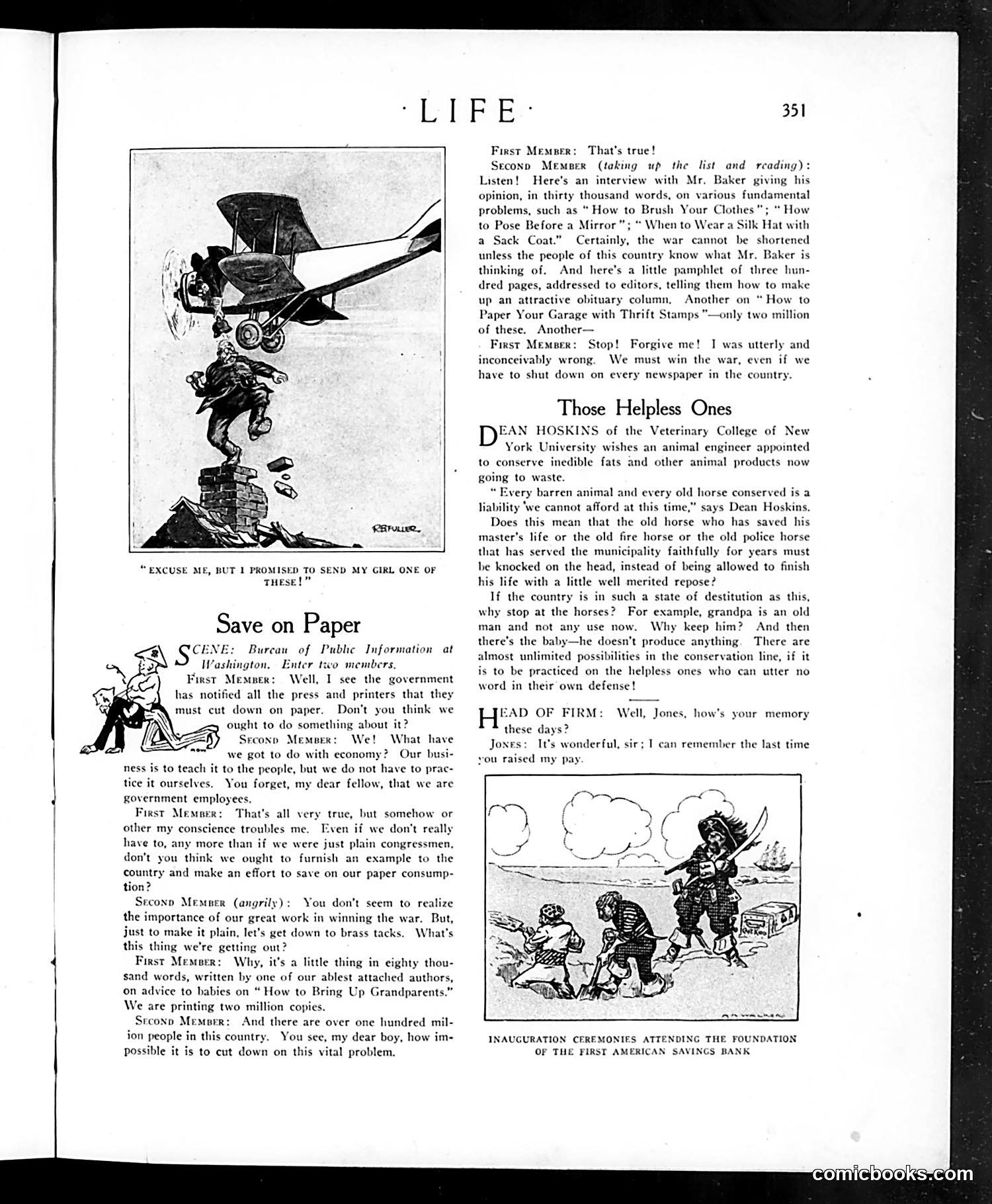
What you’re looking at
## "Save on Paper" This satirical dialogue mocks government hypocrisy regarding wartime paper conservation. Two Bureau of Public Information employees debate cutting paper use—but defend their massive publications (80,000-word baby advice guides, 300-page editorial instructions, "thrift stamp" pamphlets printed in millions) as "vital" to winning the war. The joke: they lecture the public on conservation while wastefully printing trivial content themselves, claiming their work's importance exempts them from sacrifice. ## "Those Helpless Ones" This piece sarcastically critiques Dean Hoskins's proposal to conserve animal products by killing aged, unproductive animals. The author extends the logic absurdly to humans—elderly grandparents and babies produce "nothing," so why spare them? It's dark satire exposing the moral bankruptcy of utilitarian wartime thinking applied without compassion to the vulnerable. ## "Jones's Memory" A brief joke: an employer asks if an employee's memory is good; Jones replies he remembers the last pay raise—implying none have occurred since.
📄 Transcribed text from this page (OCR, searchable)
Machine-transcribed from the original scan — historical spelling and the odd misread are preserved.
“EXCUSE ME, BUT I PROMISED TO SEND MY GIRL ONE OF THESE!” Save on Paper CENE: Bureau of Pubhe Information at Washington. Enter two members, First Memper: Well, I see the government has notified all the press and printers that they must cut down on paper. Don’t you think we ought to do something about it? Srconp Member: We! What have we got to do with economy? Our busi- ness is to teach it to the people, but we do not have to prac- tice it ourselves. You forget, my dear fellow, that we are government employees. First Memner: That's all very true, but somehow or other my conscience troubles me. Even if we don’t really have to, any more than if we were just plain congressmen, don’t you think we ought to furnish an example to the country and make an effort to save on our paper consump- tion? Seconp Memner (angrily): You don’t seem to realize the importance of our great work in winning the war. But, just to make it plain, let's get down to brass tacks. What’: this thing we're getting out? First Memeer: Why, it’s a little thing in eighty thou- sand words, written by one of our ablest attached authors, on advice to babies on “ How to Bring Up Grandparent We are printing two million copies Secon Memper: And there are over one hundred mil- ion people in this country. You see, my dear boy, how im- Possible it is to cut down on this vital problem. ~LIFE- 351 First Memper: That's true! Seconp Memeer (taking up the list and reading): Listen! Here's an interview with Mr. Baker giving his opinion, in thirty thousand words, on various fundamental problems, such as “ How to Brush Your Clothes"; “ How to Pose Before a Mirror”; “ When to Wear a Silk Hat with a Sack Coat.” Certainly, the war cannot be shortened unless the people of this country know what Mr. Baker is thinking of. And here's a little pamphlet of three hun- dred pages, addressed to editors, telling them how to make up an attractive obituary column, Another on “ How to Paper Your Garage with Thrift Stamps "—only two million of these. Another— First Memper: Stop! Forgive me! I was utterly and inconceivably wrong. We must win the war, even if we have to shut down on every newspaper in the country. Those Helpless Ones AN HOSKINS of the Veterinary College of New York University wishes an animal engineer appointed to conserve inedible fats and other animal products now going to waste. “ Every barren animal and every old horse conserved is a liability ‘we cannot afford at this time,” says Dean Hoskins, Does this mean that the old horse who has saved his master’s life or the old fire horse or the old police horse that has served the municipality faithfully for years must be knocked on the head, instead of being allowed to finish his life with a little well merited repose? If the country is in such a state of destitution as this, why stop at the horses? For example, grandpa is an old man and not any use now. Why keep him? And then there’s the baby—he doesn’t produce anything. There are almost unlimited possibilities in the conservation line, if it is to be practiced on the helpless ones who can utter no word in their own defense! HEAD OF FIRM: Welt, Jones, how's your memory these days? Joxes: It’s wonderful, sir; I can remember the last time you raised my pay INAUGURATION CEREMONIES ATTENDING THE FO! NDATION OF THE FIRST AMERICAN SAVINGS BANK