
Life, 1918-09-05 · page 16 of 34
Life — September 5, 1918 — page 16: what you’re looking at
What you’re looking at
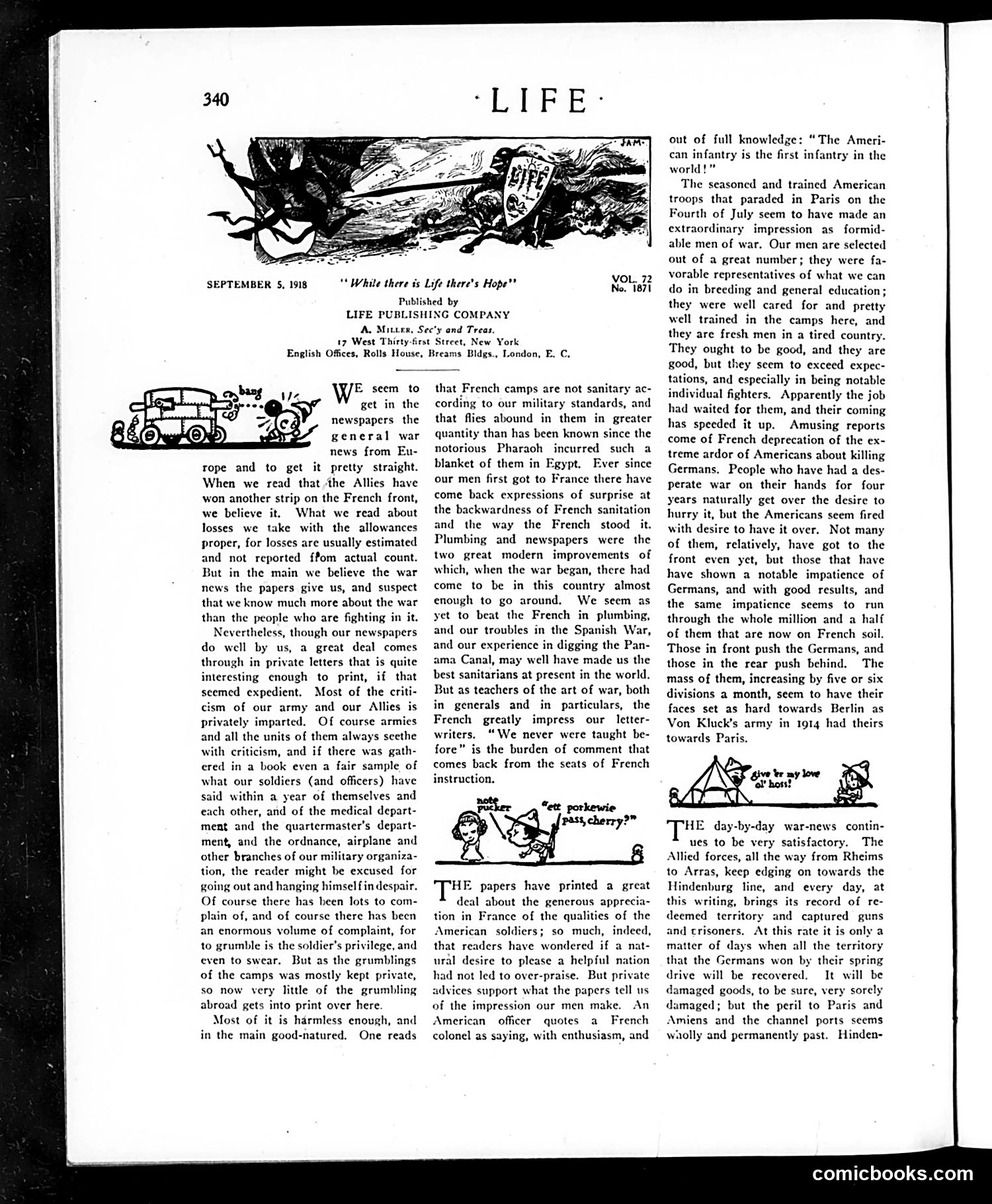
This page contains editorial commentary on American Expeditionary Forces in France during the final months of World War I. The cartoons appear to show soldiers in military situations, though details are small. The text discusses how American troops impressed French military leaders, contrasting American sanitation standards and military training favorably with French practices. A French colonel allegedly stated: "The American infantry is the first infantry in the world!" The author acknowledges that while newspapers report war news reliably, soldiers' private letters reveal more candid (often critical) observations about camp conditions, medical care, and military organization—complaints the author notes are typical soldier grumbling but mostly kept private. The piece celebrates American military professionalism while gently satirizing the mutual admiration between allies and the contrast between public praise and private soldier complaints.
📄 Transcribed text from this page (OCR, searchable)
Machine-transcribed from the original scan — historical spelling and the odd misread are preserved.
SEPTEMBER 5, 1918 ‘* While there is Life there's Hope"" Published by LIFE PUBLISHING COMPANY A. Mutter, Sec’y and Treas, 17 West Thirty-first Street, New York English Offices, Rolls House, Breams Bldgs., London, E. C. We seem to get in the newspapers the general war news from Eu- rope and to get it pretty straight. When we read that the Allies have won another strip on the French front, we believe it, What we read about losses we take with the allowances proper, for losses are usually estimated and not reported ffom actual count. But in the main we believe the war news the papers give us, and suspect that we know much more about the war than the people who are fighting in it. Nevertheless, though our newspapers do well by us, a great deal comes through in private letters that is quite interesting cnough to print, if that seemed expedient. Most of the criti- cism of our army and our Allies is privately imparted. Of course armies and all the units of them always seethe with criticism, and if there was gath- ered in a book even a fair sample of what our soldiers (and officers) have said within a year of themselves and each other, and of the medical depart- ment and the quartermaster’s depart- ment, and the ordnance, airplane and other branches of our military organiza- tion, the reader might be excused for going out and hanging himself in despair. Of course there has been lots to com- plain of, and of course there has been an enormous volume of complaint, for to grumble is the soldier's privilege, and even to swear. But as the grumblings of the camps was mostly kept private, so now very little of the grumbling abroad gets into print over here. Most of it is harmless enough, and in the main good-natured. One reads that French camps are not sanitary ac- cording to our military standards, and that flies abound in them in greater quantity than has been known since the notorious Pharaoh incurred such a blanket of them in Egypt. Ever since our men first got to France there have come back expressions of surprise at the backwardness of French sanitation and the way the French stood it. Plumbing and newspapers were the two great modern improvements of which, when the war began, there had come to be in this country almost enough to go around. We seem as yet to beat the French in plumbing, and our troubles in the Spanish War, and our experience in digging the Pan- ama Canal, may well have made us the best sanitarians at present in the world. But as teachers of the art of war, both in generals and in particulars, the French greatly impress our letter- writers, “We never were taught be- fore” is the burden of comment that comes back from the seats of French instruction. 'HE papers have printed a great deal about the generous apprecia- tion France of the qualities of the American soldiers; so much, indeed, that readers have wondered if a nat- ural desire to please a helpful nation had not led to over-praise. But private advices support what the papers tell us of the impression our men make. An American officer quotes a French colonel as saying, with enthusiasm, and out of full knowledge: “The Ameri- can infantry is the first infantry in the world!” The seasoned and trained American troops that paraded in Paris on the Fourth of July seem to have made an extraordinary impression as formid- able men of war. Our men are selected out of a great number; they were fa- vorable representatives of what we can do in breeding and general education; they were well cared for and pretty well trained in the camps here, and they are fresh men in a tired country. They ought to be good, and they are good, but they seem to exceed expec- tations, and especially in being notable individual fighters. Apparently the job had waited for them, and their coming has speeded it up. Amusing reports come of French deprecation of the ex- treme ardor of Americans about killing Germans. People who have had a des- perate war on their hands for four years naturally get over the desire to hurry it, but the Americans seem fired with desire to have it over. Not many of them, relatively, have got to the front even yet, but those that have have shown a notable impatience of Germans, and with good results, and the same impatience seems to run through the whole million and a half of them that are now on French soil. Those in front push the Germans, and those in the rear push behind. The mass of them, increasing by five or six divisions a month, seem to have their faces set as hard towards Berlin as Von Kluck’s army in 1914 had theirs towards Paris. HE day-by-day war-news contin- ues to be very satisfactory. The Allied forces, all the way from Rheims to Arras, keep edging on towards the Hindenburg line, and every day, at this writing, brings its record of re- deemed territory and captured guns and crisoners, At this rate it is only a matter of days when all the territory that the Germans won by their spring drive will be recovered. It will be damaged goods, to be sure, very sorely damaged; but the peril to Paris and Amiens and the channel ports seems waolly and permanently past. Hinden- comicbooks.com