
Life, 1918-09-05 · page 21 of 34
Life — September 5, 1918 — page 21: what you’re looking at
What you’re looking at
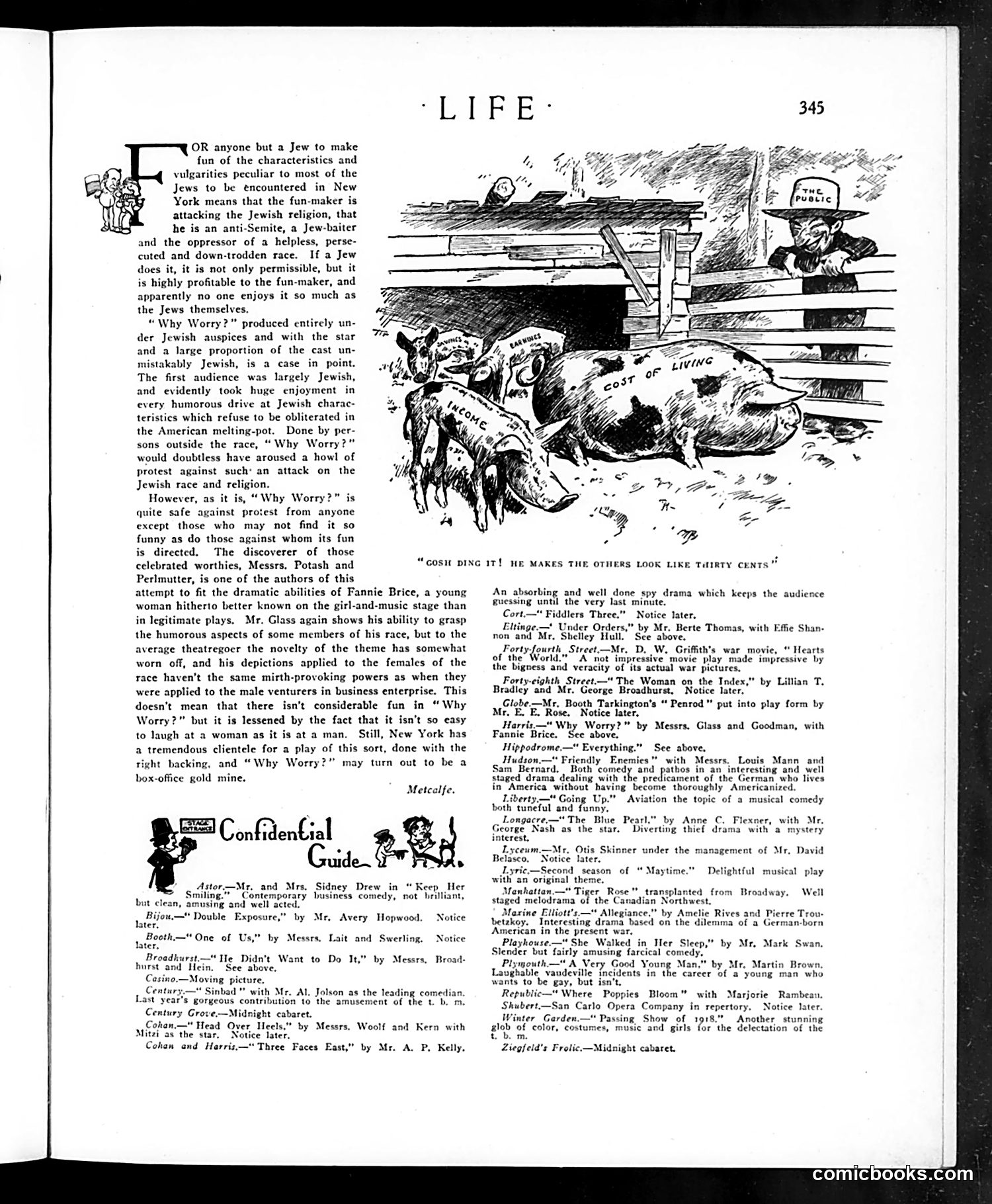
This page reviews theatrical productions, with the main editorial focus on the play "Why Worry?" starring Fannie Brice. The critic (Metcalfe) argues that Jewish playwrights and performers can satirize Jewish stereotypes without accusation of antisemitism, whereas non-Jewish creators depicting the same characteristics would face accusations of bigotry and hatred. The cartoon accompanying the text depicts a man labeled "THE PUBLIC" observing another figure who "makes the others look like thirty cents"—likely referencing how Brice's performance outshines competitors. The piece references Potash and Perlmutter (Jewish characters created by Montague Glass), noting audiences enjoyed ethnically-specific humor when presented by Jewish creators themselves. Metcalfe suggests the play's humor about Jewish characteristics "refuse to be obliterated in the American melting-pot," reflecting early 20th-century assimilation debates. The critic acknowledges the audience appeal while noting the novelty has somewhat worn thin.
📄 Transcribed text from this page (OCR, searchable)
Machine-transcribed from the original scan — historical spelling and the odd misread are preserved.
OR anyone but a Jew to make fun of the characteristics and vulgarities peculiar to most of the Jews to be encountered in New York means that the fun-maker is attacking the Jewish religion, that he is an anti-Semite, a Jew-baiter and the oppressor of a helpless, perse- cuted and down-trodden race. If a Jew does it, it is not only permissible, but it is highly profitable to the fun-maker, and apparently no one enjoys it so much as the Jews themselves. “Why Worry?” produced entirely un- der Jewish auspices and with the star and a large proportion of the cast un- mistakably Jewish, is a case in point. The first audience was largely Jewish, and evidently took huge enjoyment in every humorous drive at Jewish charac- teristics which refuse to be obliterated in the American melting-pot. Done by per- sons outside the race, “Why Worry?” would doubtless have aroused a howl of protest against such’ an attack on the Jewish race and religion. However, as it is, “Why Worry?” is quite safe against protest from anyone except those who may not find it so funny as do those against whom its fun is directed. The discoverer of those celebrated worthies, Messrs. Potash and Perlmutter, is one of the authors of this attempt to fit the dramatic abilities of Fannie Brice, a young woman hitherto better known on the girl-and-music stage than in legitimate plays. Mr. Glass again shows his ability to grasp the humorous aspects of some members of his race, but to the average theatregocr the novelty of the theme has somewhat worn off, and his depictions applied to the females of the race haven't the same mirth-provoking powers as when they were applied to the male venturers in business enterprise. This doesn’t mean that there isn’t considerable fun in “ Why Worry?” but it is lessened by the fact that it isn’t so easy to laugh at a woman as it is at a man. Still, New York has a tremendous clientele for a play of this sort, done with the right backing, and “Why Worry?” may turn out to be a box-office gold mine, Metcalfe. Confidential SR Astor—Mr, and Mrs, Sidney Drew in “ Keep Her Smiling.” “Contemporary Inusiness comedy, not brilliant, but clean, amusing and well acted. Double Exposure,” by Mr, Avery Hopwood. Notice Bocth.— One of Us," by Messrs, Lait and Swerling. later. Broadhw He Didn't Want to Do It,” by Messrs, Broad- hurst and Hein, See above, Casino.—Moving picture. Century.— Sinbad" with Mr. Al, Jolson as the leading comedian Last year's gorgeous contribution to the amusement of the tb. ™. Century Grove-—Midnight cabaret. Cohan.—" Head Qver Heels,” by Messrs. Woolf and Kern with Mitai asthe star, Notice later. Cohan and Horris,—" Three Faces East,” by Mr. A. P, Kelly. Notice “GOSH DING IT! HE MAKES THE OTHERS LOOK LIKE THIRTY CENTS" SS — An absorbing and well done spy drama which keeps the audience guessing until the very last minute. Cort,—"* Fiddlers Three.” Notice later. Eltinge — Under Orders,” by Mr. Berte Thomas, with Effie Shan- non and Mr, Shelley Hull.” See above. Forty-fourth Street.—Mr, D, W. Griffith's war movie, “ Hearts of the World.” A not impressive movie play made impressive by the bigness and veracity of its actual war pictures, Forty-eighth Street.— The Woman on the Index,” by Lillian T. Bradley and Mr. George Broadhurst, Notice later. Globe—Mr, Booth Tarkington's “ Penrod" put into play form by Mr. E, E, Rose. Notice later, Harris—“ Why Worry?” by Messrs. Glass and Goodman, with Fannie Brice. See above. Hippodrome.—" Everything.” See above, Hudson.—"* Friendly Enemies” with Messrs. Louis Mann and Sam Bernard. | Hoth comedy and pathos in an interesting and well staged drama dealing with the predicament of the German who lives in America without having become thoroughly Americanized. Liberty.—" Going Up.” Aviation the topic of a musical comedy both tuneful and funny, _Longacre.—" The Blue Pearl,” by Anne C. Flexner, with Mr. corge Nash as the star. Diverting thief drama with’ a mystery nterest. Lyceum.—Mr. Otis Skinner under the management of Mr. David Belasco. Notice later. Lyrie-—Second season of “ Maytime." with an original theme. Manhattan.—" Tiger Rose" transplanted from Broadway, Well staged melodrama of the Canadian Northwest. Marine Elliott’s.— Mlegiance.” by Amelie Rives and Pierre Trou- betzkoy, Interesting drama based on the dilemma of a German-born American in the present war. Playhouse.—" She Walked in Mer Sleep,” by Mr, Mark Swan. Slender but fairly amusing farcical comedy. Plymouth.—" A Very Good Young Man,” by Mr. Martin Brown, Laughable vaudeville incidents in the career of a young man who wants to be gay, but isn't. Republic—" Where Poppies Bloom” with Marjorie Rambeau. Shubert.—San Carlo Opera Company in repertory. Notice later. inter Garden.— Passing Show of 1918." Another stunning glob of color, costumes, music and girls for the delectation of the tb. m Ziegfeld’s Frolic.—Midnight cabaret. Delightful musical play comicbooks.com