
A complete issue · 36 pages · 1918
Life — August 15, 1918
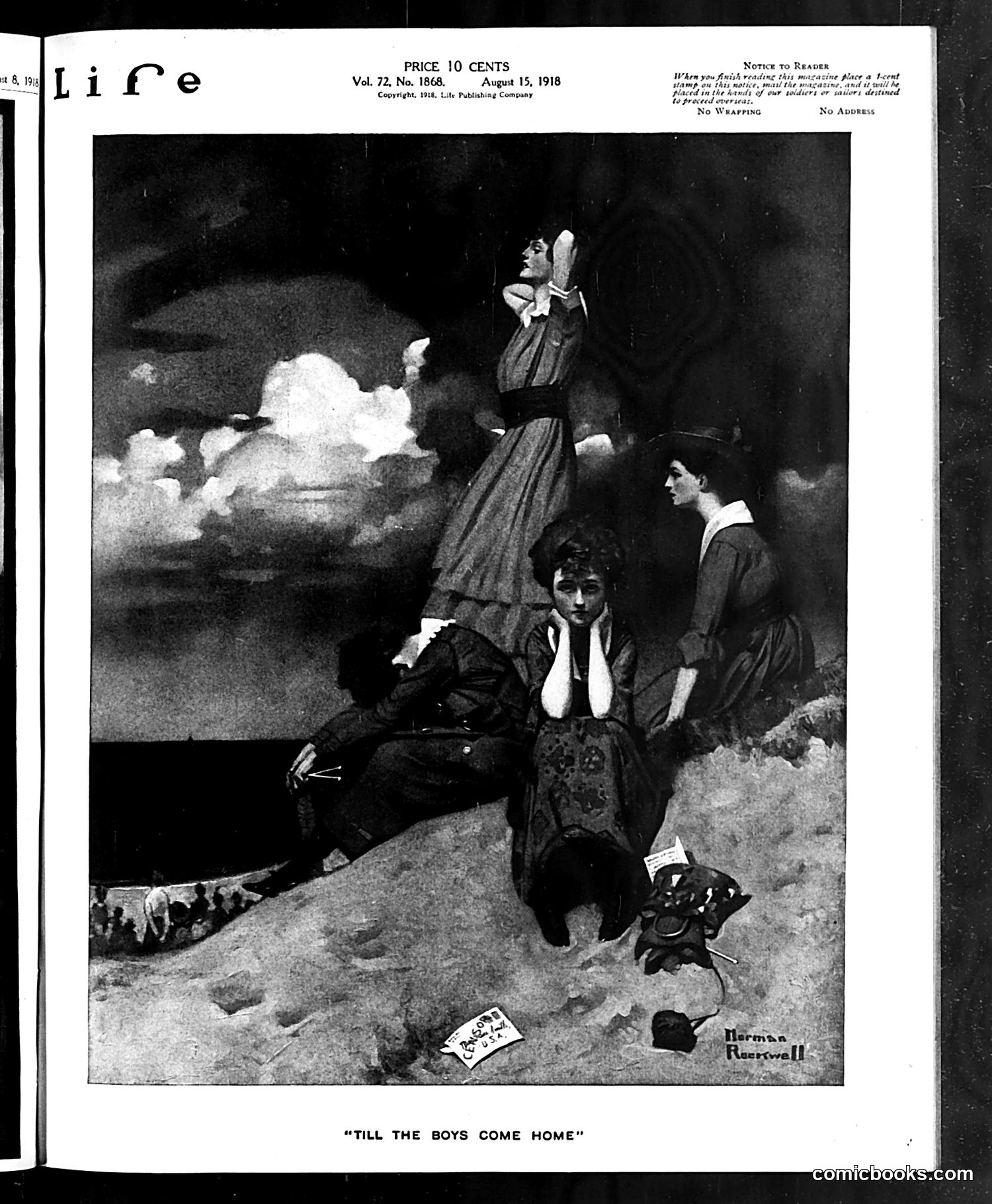
This August 1918 *Life* magazine cartoon depicts a wartime domestic scene. The title references the popular WWI song "Till the Boys Come Home," reflecting anxiety about soldiers abroad during the final months of World War I. The image shows women on a beach at night, gazing skyward toward clouds and celestial imagery—likely representing prayers or hopes directed toward servicemen overseas. Their postures suggest worry or longing. The composition emphasizes emotional waiting and separation, common themes in American home-front culture during 1918. The satirical angle appears subtle here; *Life* likely used this sentimental scene to comment on civilian morale, wartime sacrifice, or perhaps the gap between romantic expectations and harsh battlefield realities. The beach setting suggests escape or liminal space between home and the distant war.
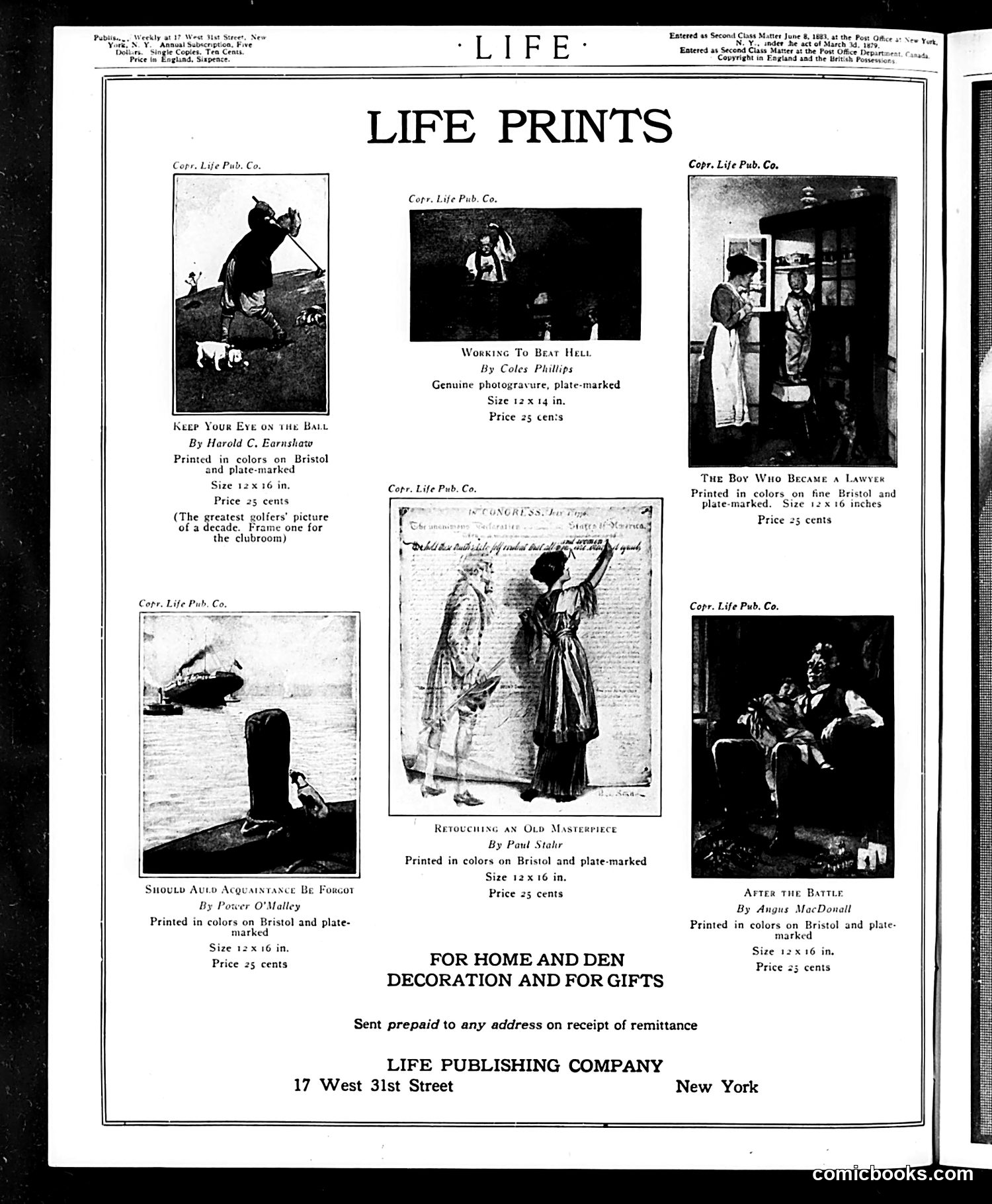
This page is primarily **advertising** for Life Publishing Company's art prints, not satirical content. It showcases six available prints for home decoration, all priced at 25 cents each. The prints advertised include: - "Keep Your Eye on the Ball" by Harold C. Evanson - "Should Auld Acquaintance Be Forgot" by Forcer O'Malley - "Working to Beat Hell" by Coles Phillips - "Retouching an Old Masterpiece" by Paul Stahr - "The Boy Who Became a Lawyer" (artist uncredited) - "After the Rehearsal" by Angus MacDonald These appear to be sentimental, humorous genre scenes rather than political satire. The page functions as a mail-order catalog offering prints "for home and den decoration and for gifts," representing typical early-20th-century consumer advertising.
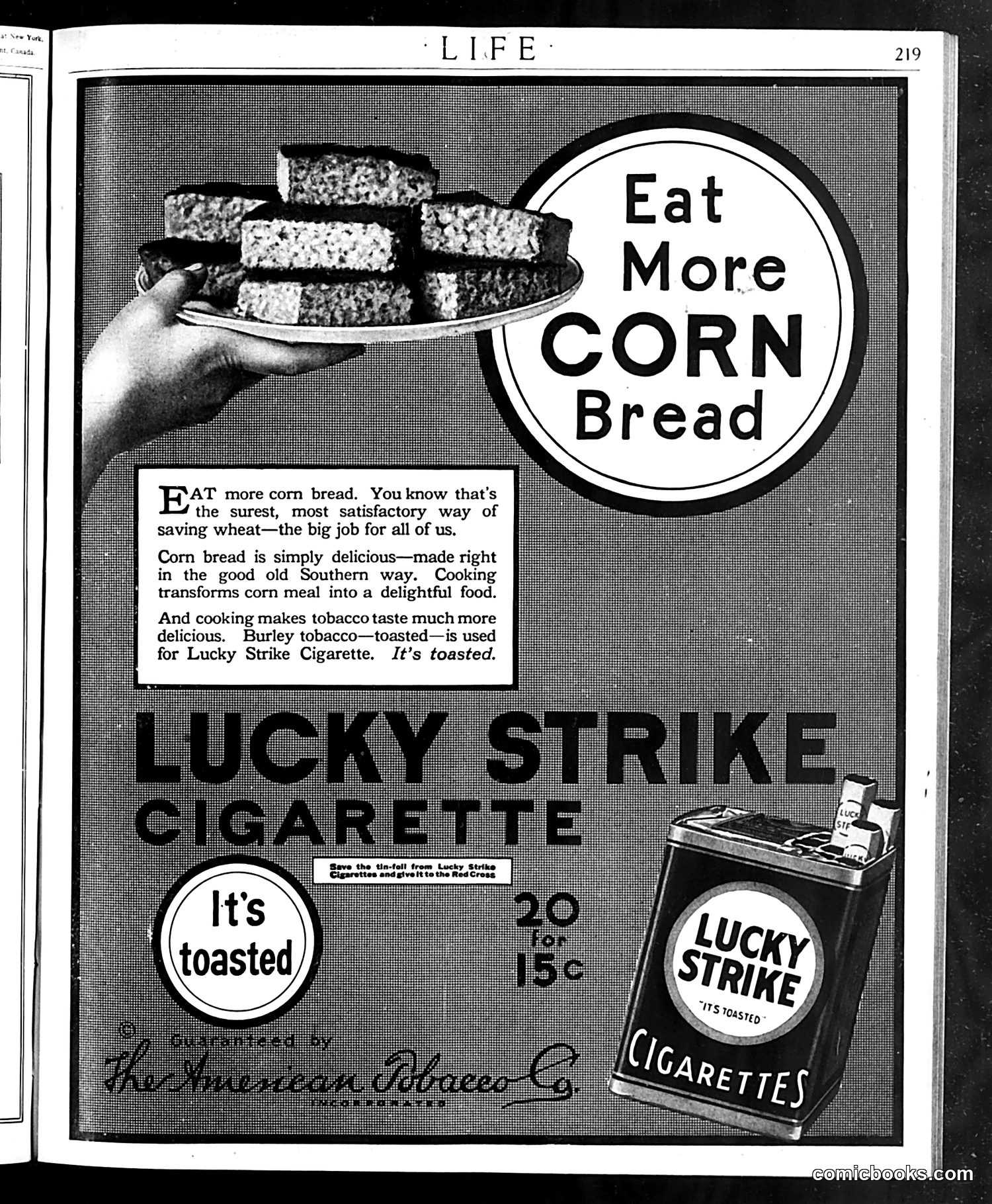
This is a **cigarette advertisement**, not satire or political commentary. The page uses a patriotic appeal during what appears to be a wartime period (likely WWI or WWII, based on the reference to "the big job for all of us" and donation language mentioning the Red Cross). The ad cleverly combines two messages: promoting cornbread consumption as a wheat-saving measure (framed as civic duty) alongside selling Lucky Strike cigarettes. The absurd juxtaposition—linking tobacco consumption to patriotic food rationing—would seem ridiculous today, but reflects how advertisements once blended commercial products with wartime public-service messaging to appear socially responsible while actually promoting smoking. The tagline "It's toasted" was Lucky Strike's standard marketing claim.
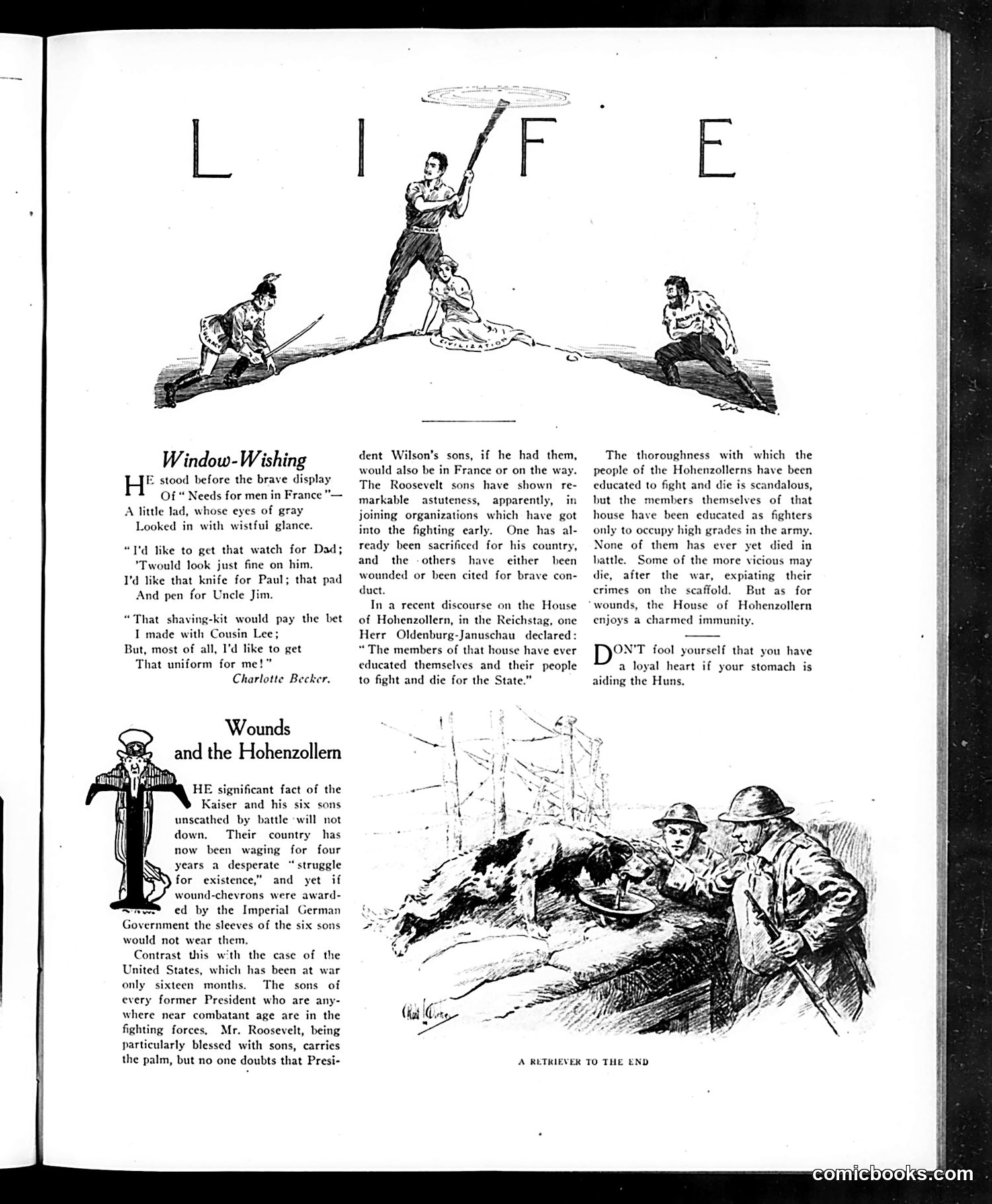
The top cartoon "Window-Wishing" depicts a woman and child gazing at a military display, with dialogue expressing desire for wartime luxuries (watches, shaving kits, uniforms) they cannot afford. The satire targets civilian materialism and war profiteering—people using the conflict as shopping wish-lists rather than understanding sacrifice. The lower section "Wounds and the Hohenzollern" compares German and American military families. It notes the Kaiser's six sons fighting despite four years of war, contrasting this with former President Roosevelt's sons serving in combat. The text argues the Hohenzollern family demonstrates commitment to their state, implying American aristocracy (like Roosevelts) should similarly sacrifice. The bottom illustration shows wounded soldiers, emphasizing the human cost of such family service.
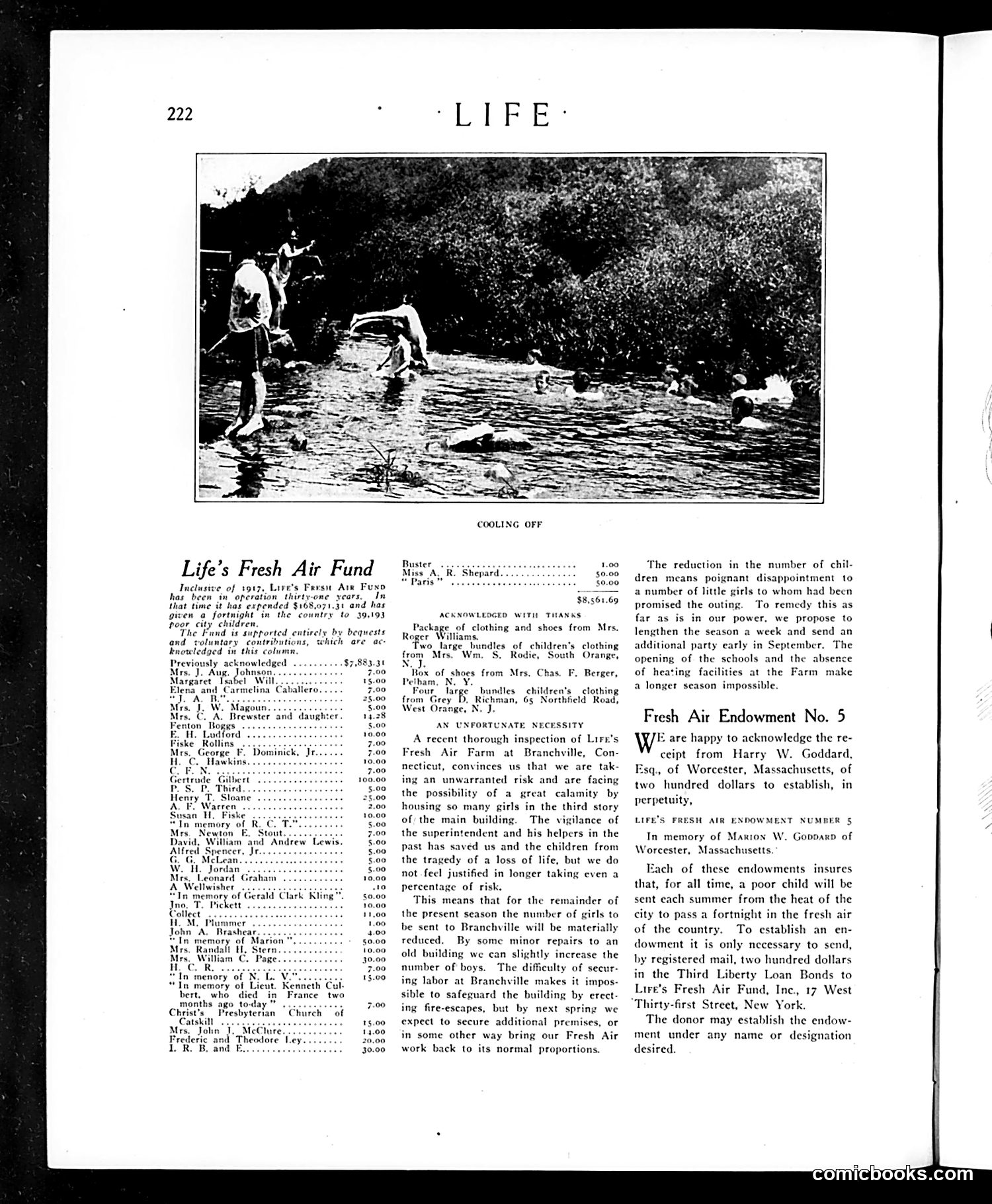
This page from *Life* magazine features a photograph titled "Cooling Off" showing children swimming in what appears to be a natural body of water, with trees in the background. The accompanying text discusses "Life's Fresh Air Fund," a charitable initiative providing poor urban children respite in the countryside during summer. The article details donations received and acknowledges a $200 contribution from Harry W. Goddard of Worcester, Massachusetts, establishing "Fresh Air Endowment No. 5." This is not satire but rather earnest philanthropic reporting. The content reflects early-20th-century Progressive Era values emphasizing urban children's access to nature and fresh air as remedies for city poverty. The fundraising list and endowment system represent period charitable practices.
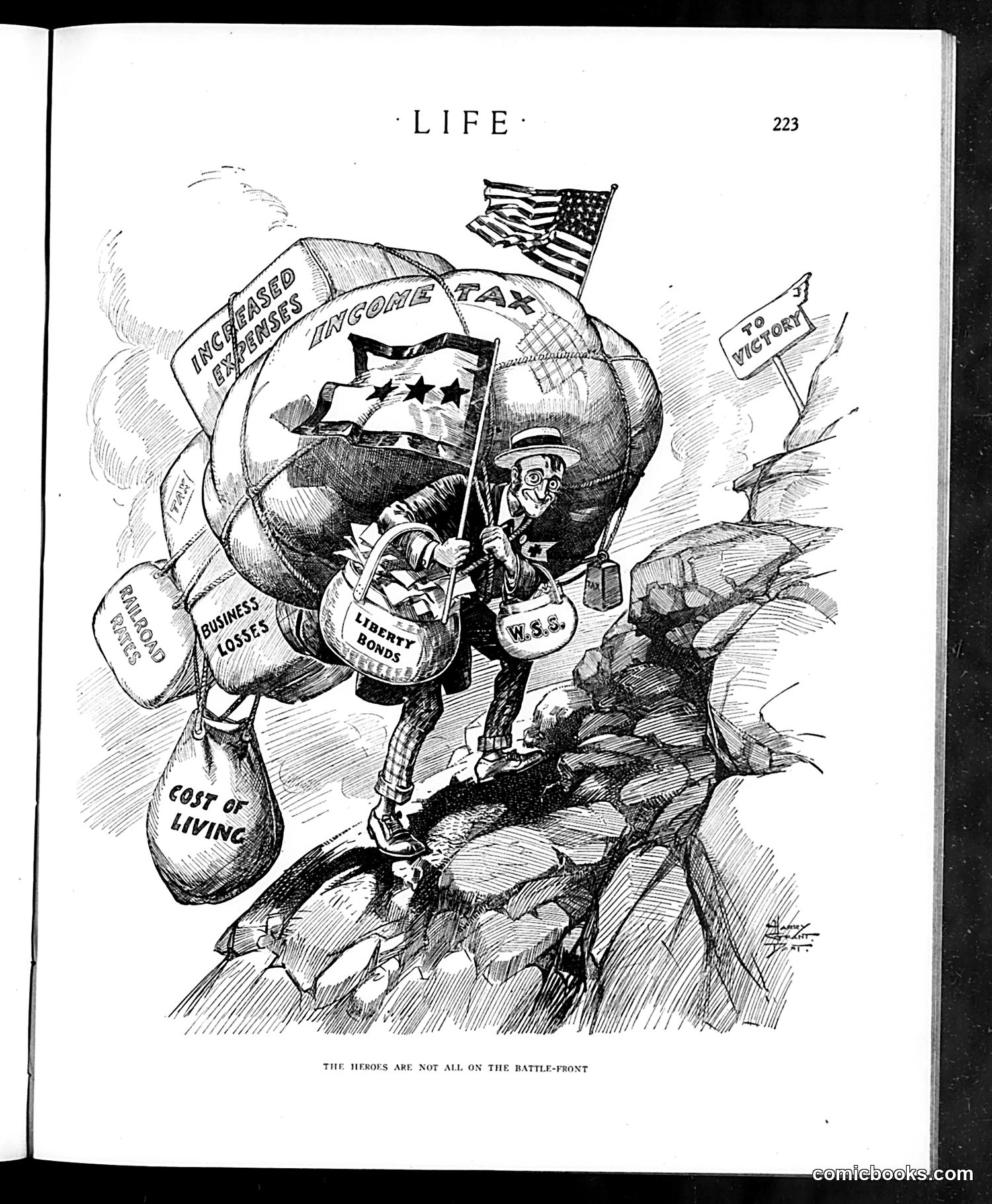
This WWI-era cartoon depicts Uncle Sam climbing a steep mountain toward a "Victory" flag. He's burdened by large sacks labeled with domestic economic problems: "Increased Expenses," "Income Tax," "Business Losses," "Ruined Creditors," "Cost of Living," and "Liberty Bonds." The American flag flies above. The satire suggests that American civilians on the home front—struggling with inflation, taxation, and financial hardship—are also "heroes" fighting a battle, not just soldiers at war. The cartoon criticizes the economic toll of WWI on ordinary Americans, arguing that wartime sacrifice extended beyond the battlefield to families and workers managing financial strain. The caption reinforces this message of civilian sacrifice.
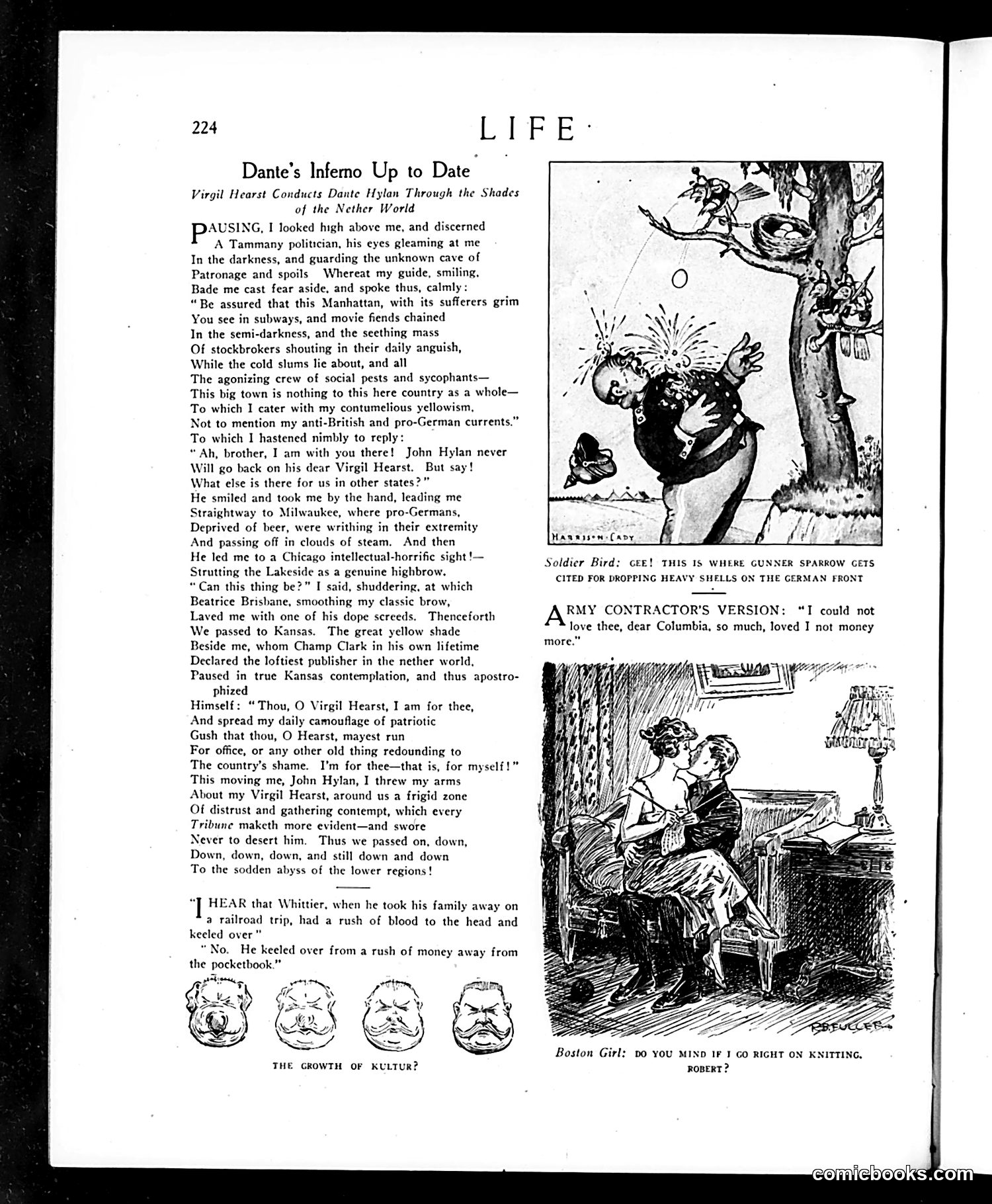
This page satirizes early 20th-century American urban and social conditions through literary and contemporary references. The main text parodies Dante's *Inferno*, using it to critique modern city life—specifically "this big town" (likely New York), with its subways, tenements, and social problems. The dialogue between "Virgil Hearst" and "John Hylan" appears to reference William Randolph Hearst (the newspaper magnate) and John Hylan (NYC mayor), using them as guides through urban "hell." The three small cartoons at bottom left show "The Growth of Kultur"—progressive facial expressions suggesting mockery of German cultural pretensions, likely WWI-era commentary. The two illustrated vignettes on the right depict domestic scenes with bawdy captions about soldiers and romantic encounters, typical of Life's humorous social commentary of the era.
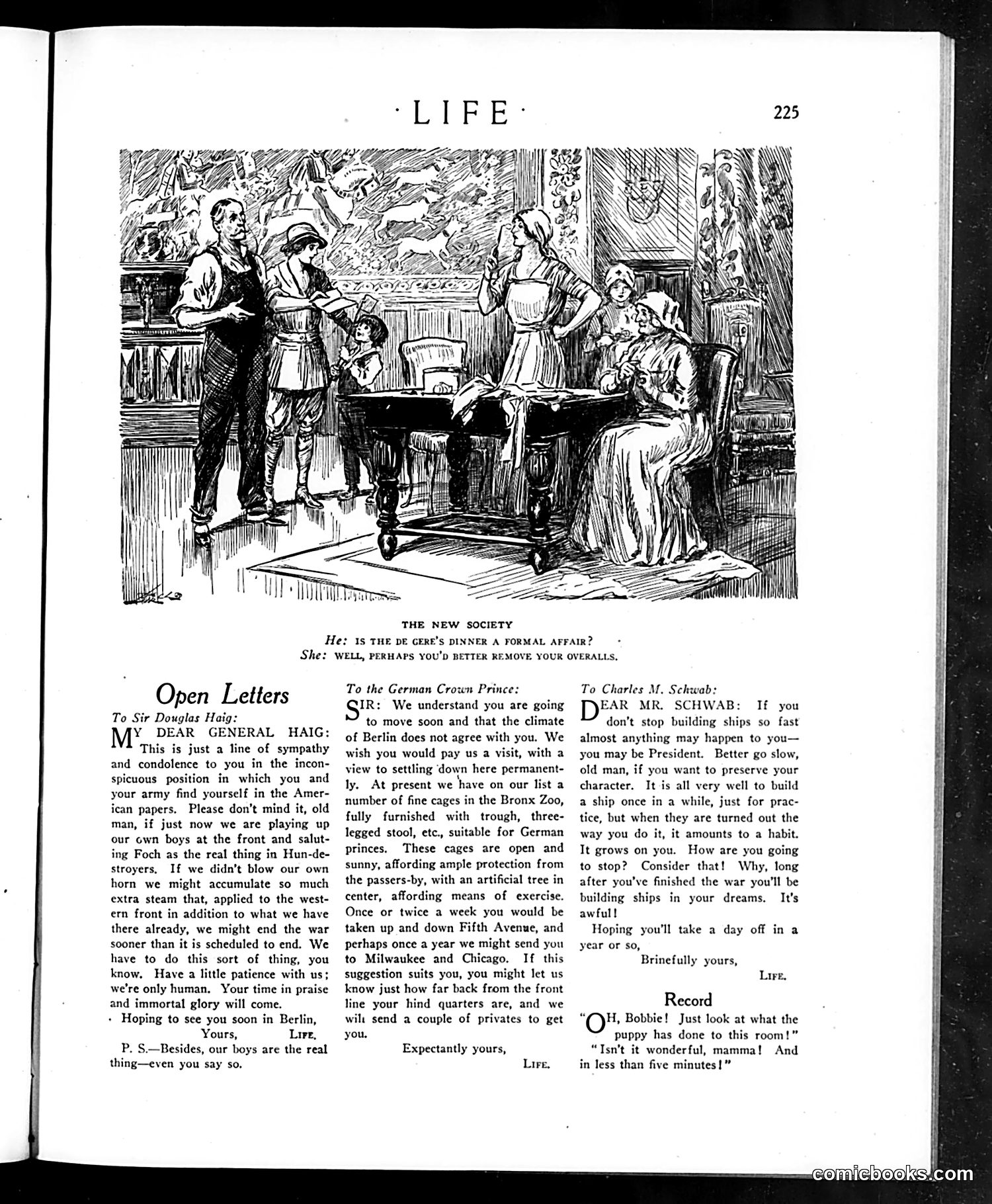
The top illustration satirizes high society dinner etiquette. The caption jokes that a gentleman asks if the dinner is "a moral affair," and the woman responds he should remove his overalls—mocking the pretension of formal social gatherings and suggesting that working-class attire (overalls) is unsuitable for refined company. The "Open Letters" section contains three humorous letters: one to General Haig about WWI troop management, one to a German Crown Prince suggesting he relocate to the Bronx Zoo, and one to Charles M. Schwab about preserving character while building ships. These appear to be satirical commentary on contemporary political figures and post-war concerns, using absurdist humor typical of Life magazine's style.
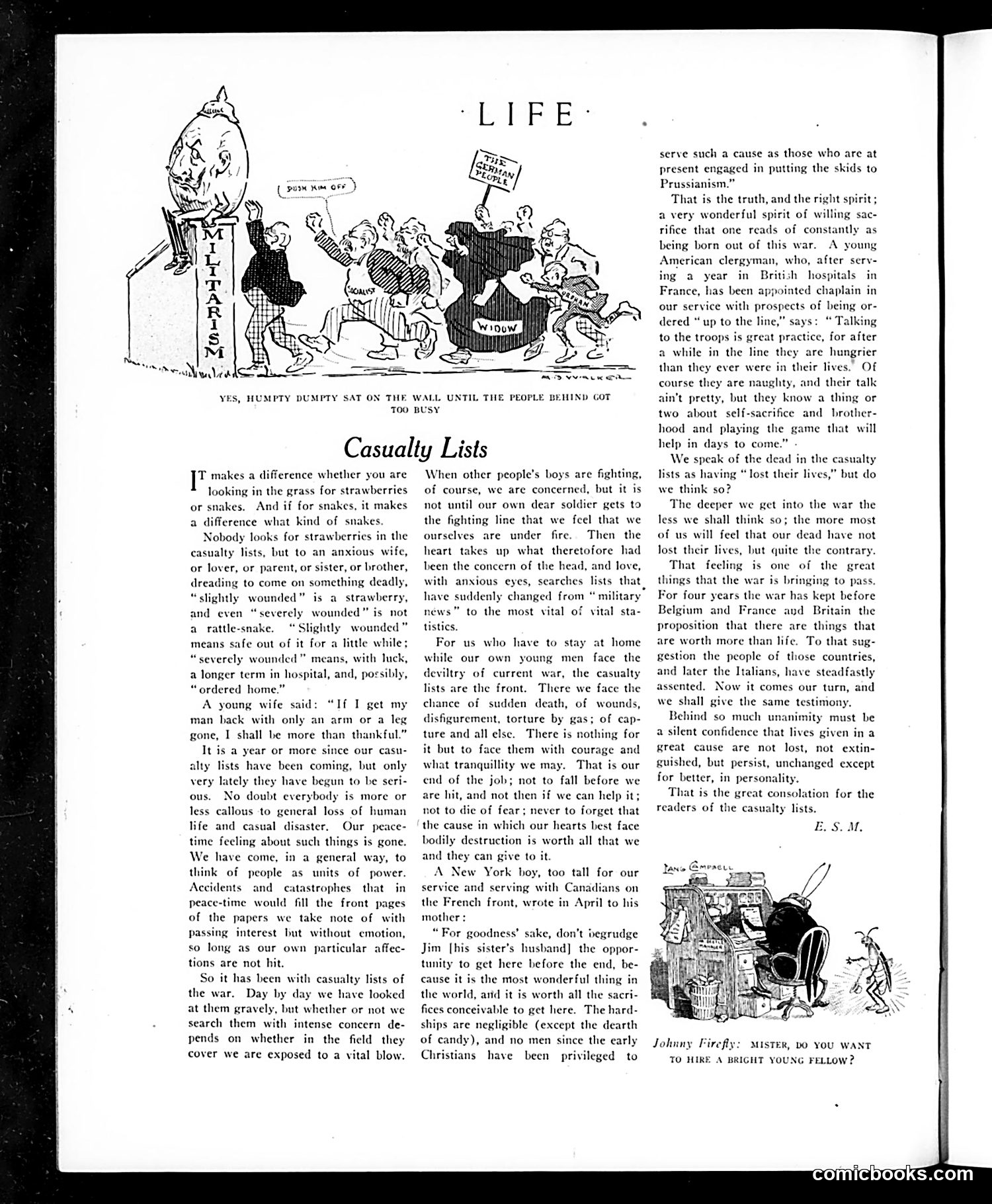
**The Main Cartoon** (top): Shows a large figure labeled "MILITARISM" sitting on a wall while various figures below—appearing to represent civilians, including children—hold signs reading "STOP PRUSSIAN-ISM" and other protest messages. The caption reads: "YES, HUMPTY DUMPTY SAT ON THE WALL UNTIL THE PEOPLE BEHIND GOT TOO BUSY." **Meaning**: This is anti-German propaganda from WWI era. The cartoon equates German militarism with Humpty Dumpty—an unstable, vulnerable force that will eventually fall when common people focus on resistance. The reference to "Prussian-ism" targets Prussian military culture as the root cause of the war. **Context**: Life magazine used satire to support American entry into WWI against Germany.
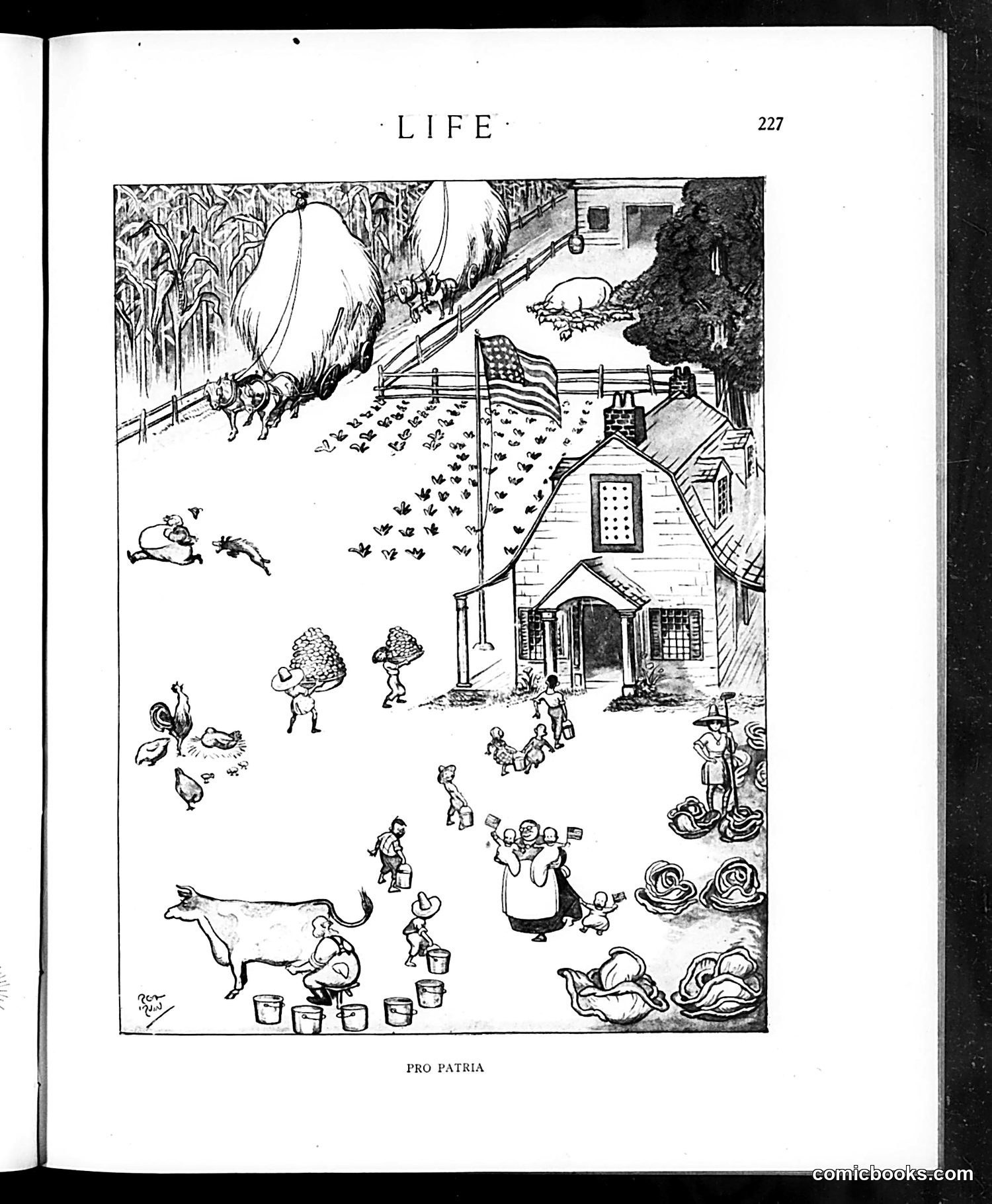
This illustration depicts an idealized American farm scene with the caption "Pro Patria" (Latin: "for the fatherland"). The cartoon satirizes patriotic rhetoric by contrasting nationalist propaganda with actual rural life. The image shows a working farm with various activities: children, adults, livestock, crops, and agricultural labor. The American flag prominently displayed suggests government or patriotic appeals. The satire appears to critique how abstract patriotic calls are disconnected from the concrete realities of ordinary citizens—particularly farmers and working families who bear the practical burden of "serving the nation." The cartoon likely comments on jingoistic appeals or war rhetoric that ask citizens to sacrifice, questioning what patriotism actually means for everyday Americans working their land.
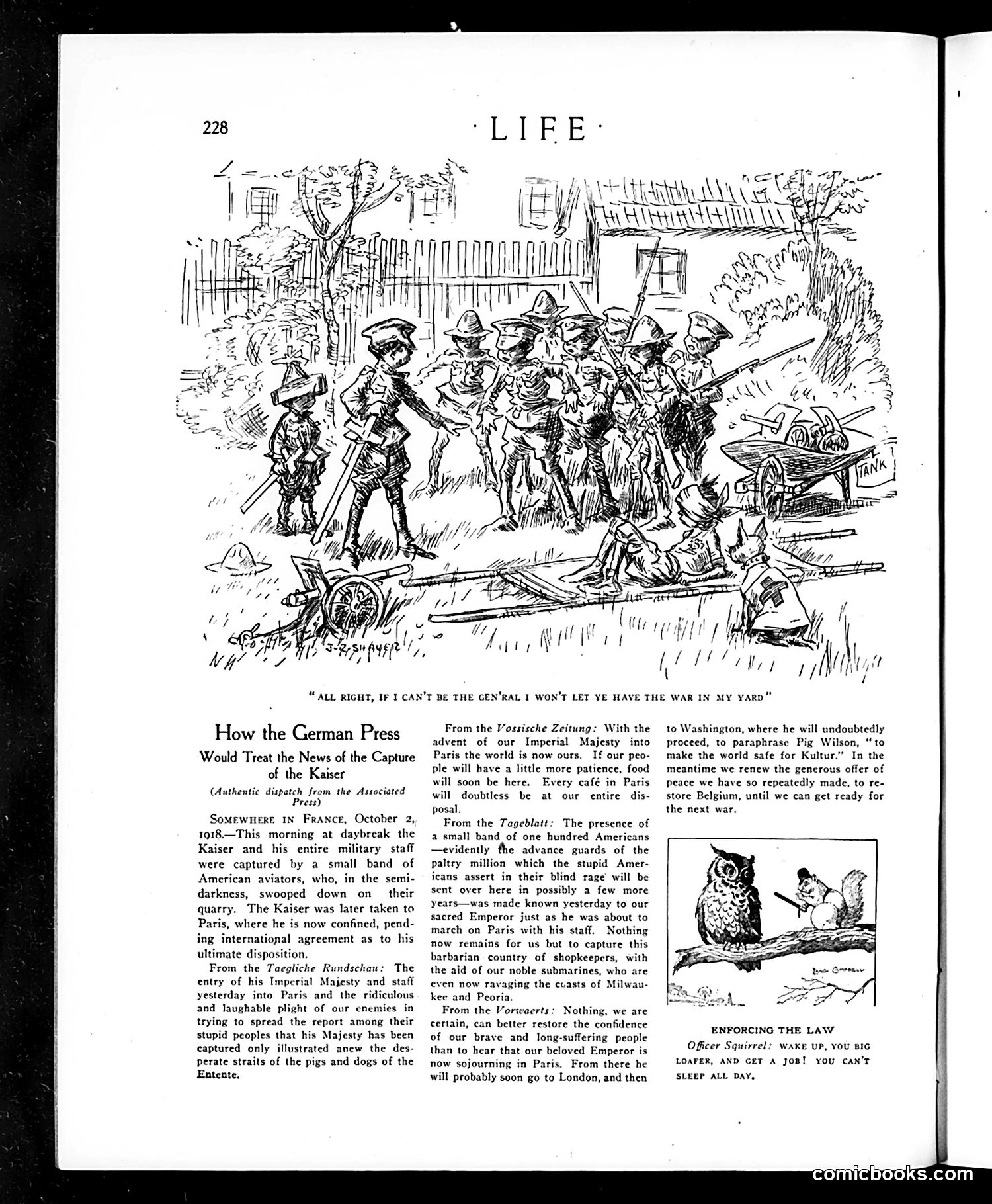
This October 1918 Life cartoon satirizes Kaiser Wilhelm II's imminent defeat and capture. The sketch depicts the German Kaiser (center, in military dress) surrounded by soldiers, with the caption suggesting his petulant refusal to accept military loss. The cartoon mocks the Kaiser as a spoiled, obstinate figure—childishly threatening to deny others victory rather than accept his own defeat. This reflects real historical context: Germany's military collapse was imminent in late 1918, just before the November armistice. The accompanying article quotes German newspapers claiming the Kaiser was captured, treating the rumor satirically. The overall point: Wilhelm's desperate position reduces him to impotent, absurd threats as his empire crumbles.
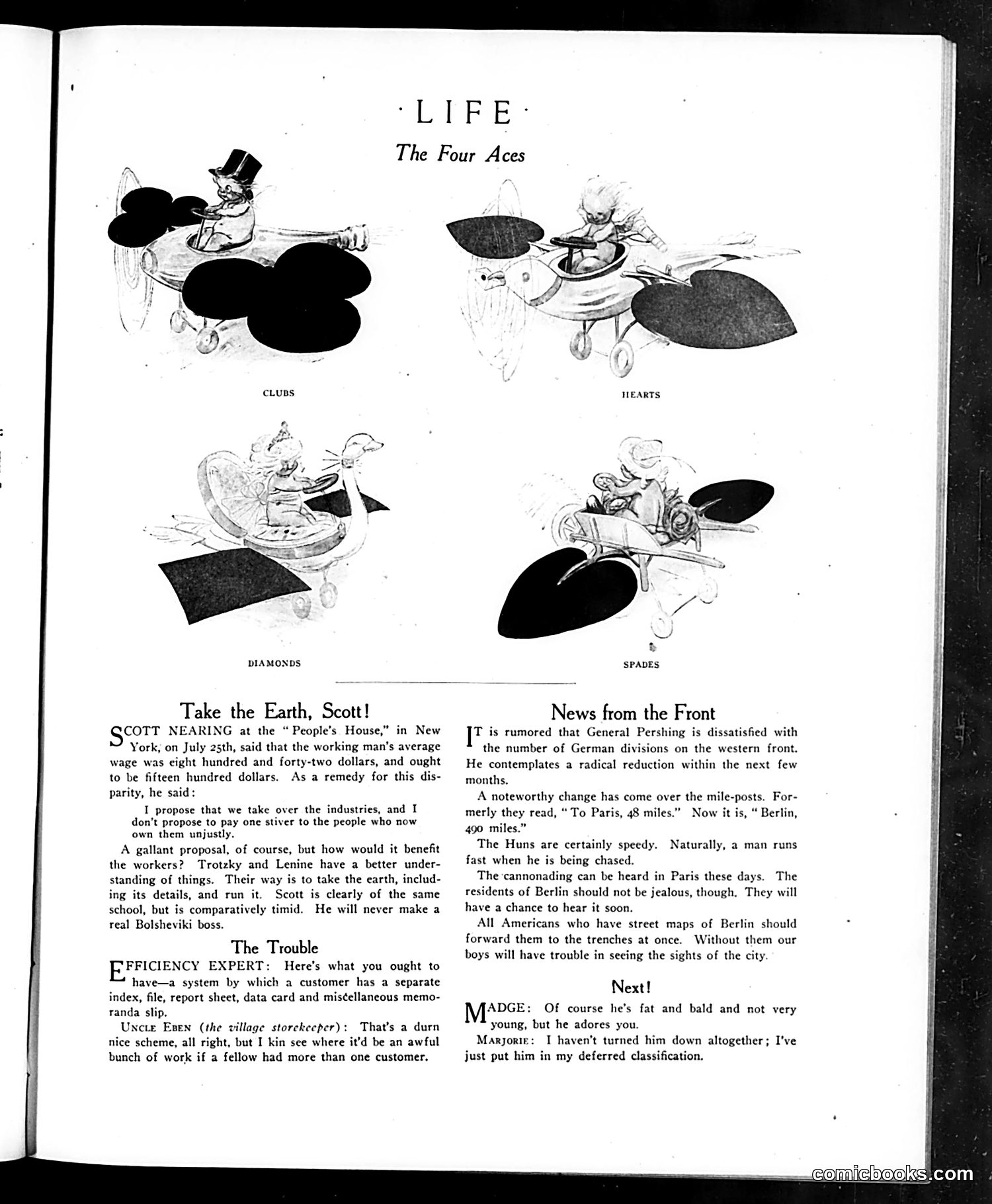
This page contains four satirical cartoons using playing card suits as metaphors for World War I military/political situations: - **Clubs**: Depicts a figure with a car, likely referencing civilian wage disputes (the text mentions Scott earning $840 and deserving a raise) - **Hearts, Diamonds, Spades**: Military-themed scenes with figures in vehicles, apparently commenting on war conditions The accompanying articles reference General Pershing's dissatisfaction with German divisions on the Western Front, and humorous observations about German distance from Paris changing from "48 miles" to "400 miles." The bottom section includes workplace efficiency commentary and a brief dialogue ("Next!") about someone's physical appearance and romantic prospects. The cartoons use exaggerated caricature and dark shapes to convey their satirical points about wartime conditions, military strategy, and domestic concerns.
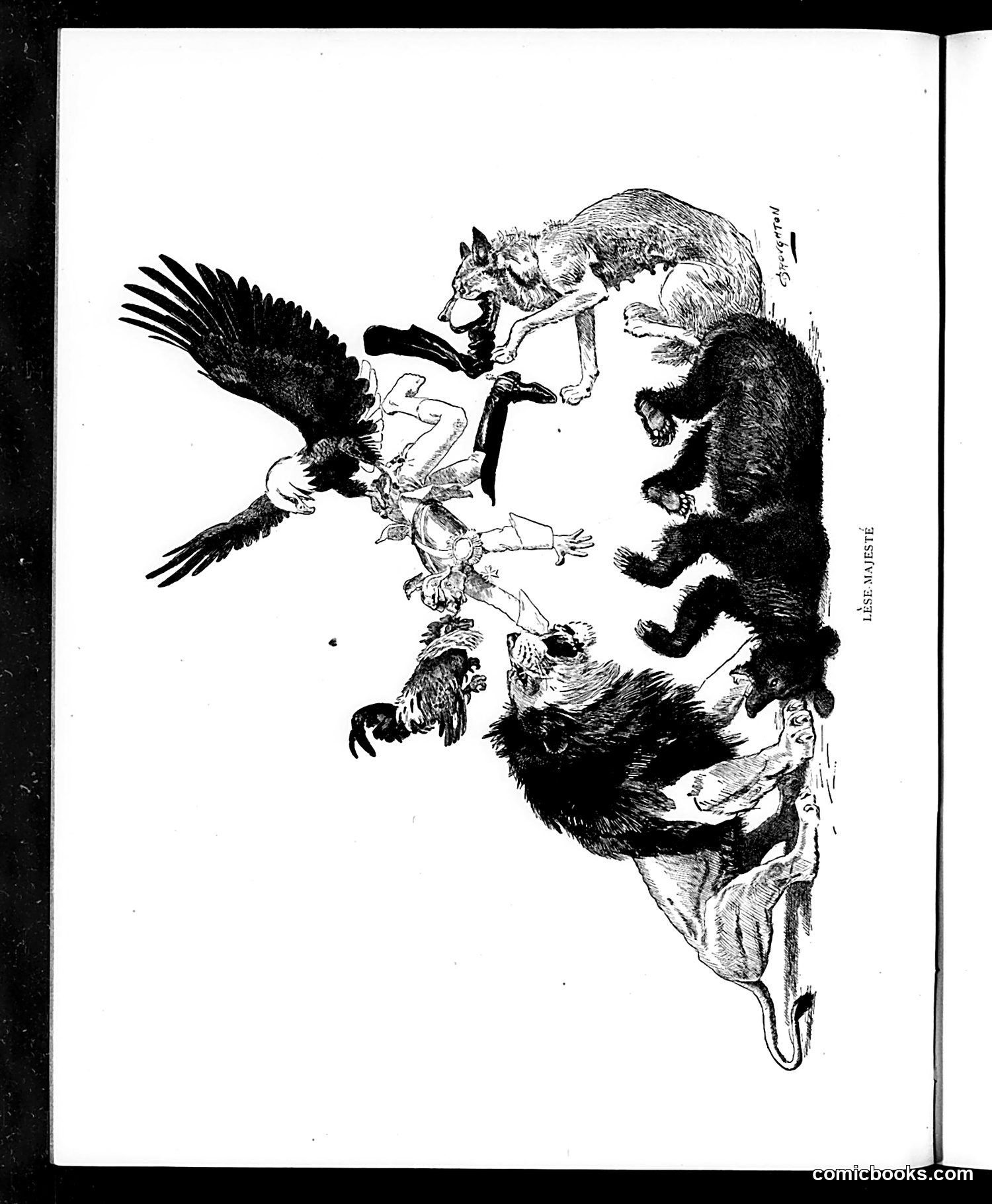
This appears to be a satirical illustration showing a human figure being attacked or surrounded by various animals - including what looks like an eagle, bear, wolf, and other creatures. The text "HERE MANIFEST" appears on the right margin. The cartoon likely references "Manifest Destiny," the 19th-century American doctrine justifying westward expansion. The human figure (possibly representing American expansionism or a political figure) is depicted under assault by wild animals, suggesting the violent and chaotic consequences of this expansionist policy. The animals may represent Native American tribes, rival powers, or the untamed wilderness itself - forces that resist or retaliate against American territorial ambitions. The satire critiques the costs and brutality associated with Manifest Destiny ideology, presenting expansion not as noble progress but as a dangerous, animalistic conflict.
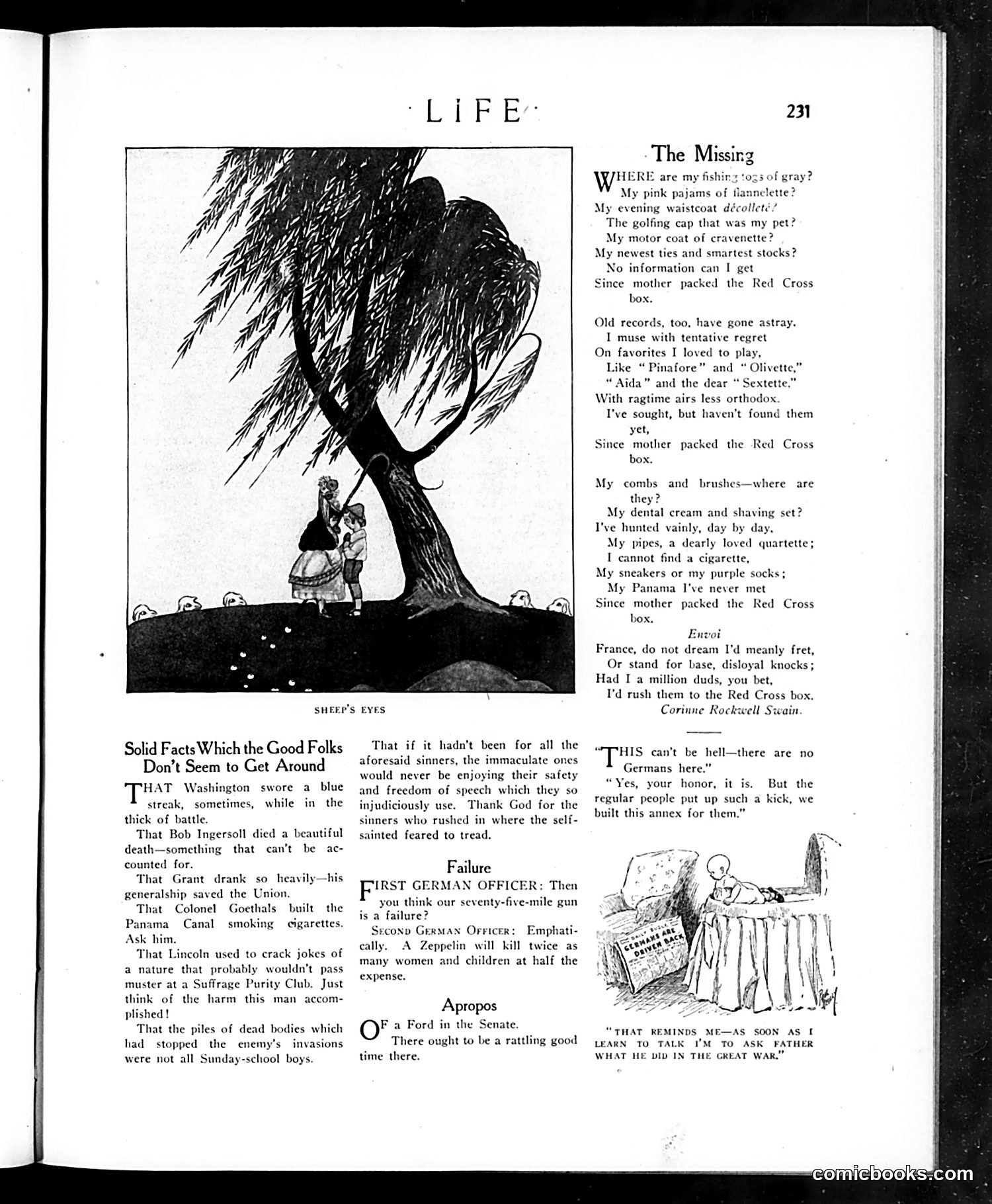
This Life magazine page contains war-related satire about material shortages during World War I. The poem "The Missing" humorously catalogs personal items a mother packed away in a Red Cross relief box—fishing gear, pajamas, ties, combs, pipes, socks—that the narrator now desperately needs but cannot find. Below, "Solid Facts Which the Good Folks Don't Seem to Get Around" satirizes historical revisionism, listing famous figures (Washington, Grant, Lincoln, Colonel Goethals) and their actual vices or accomplishments, countering romanticized versions. The dialogue sections mock German military justifications for weapons like Zeppelins and 75-mile guns used against civilians. The illustration "Sheep's Eyes" depicts a woman and children sheltering under a tree, suggesting civilian vulnerability to bombardment.
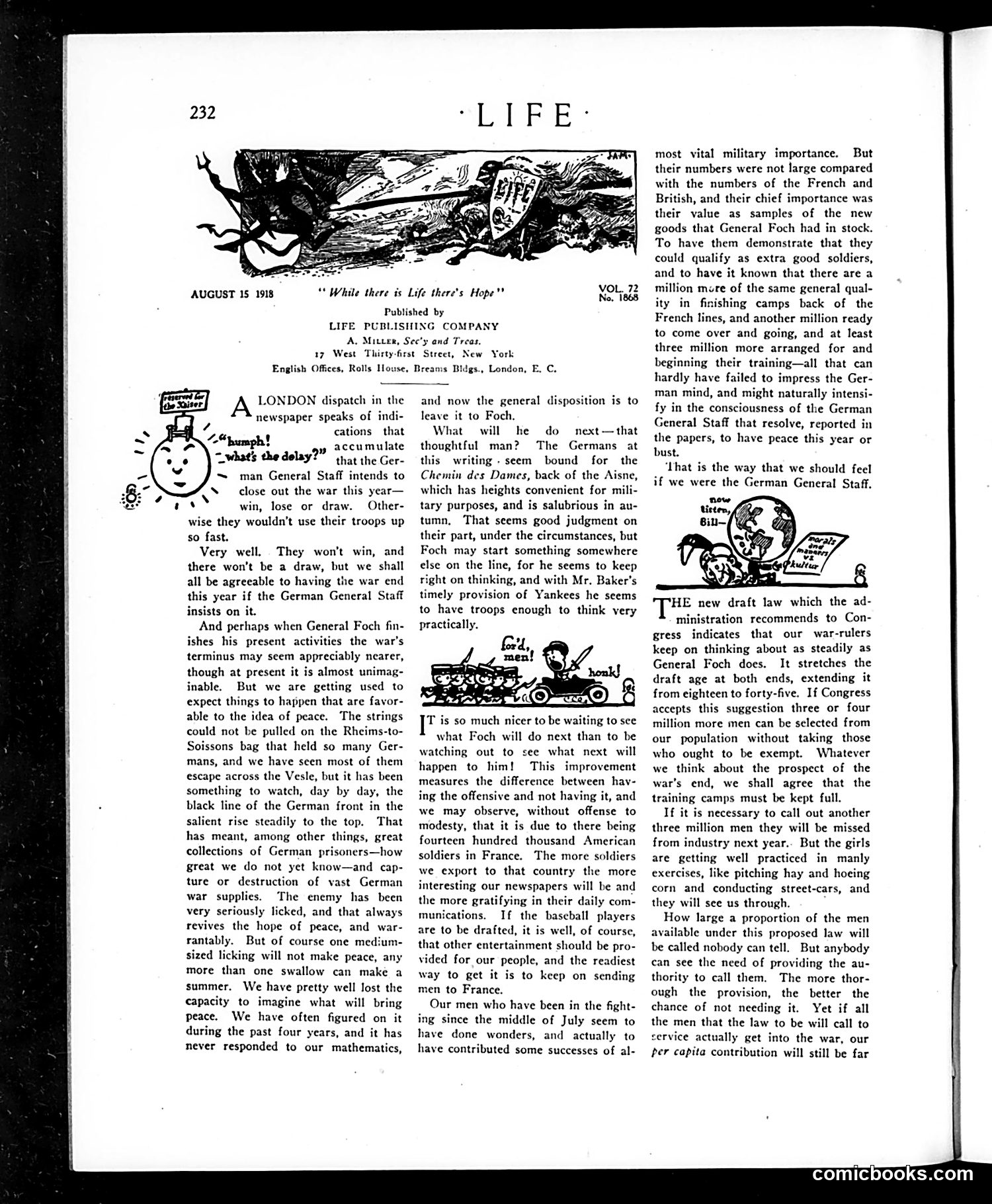
This page contains satirical commentary on World War I's final months. The main cartoon depicts an impatient figure asking "What's the delay?" regarding German General Staff intentions to end the war in 1918. The text sarcastically welcomes German plans to finish the war, noting that while Germany won't win or achieve a draw, Americans would accept ending it this year. The piece praises recent Allied military successes, particularly the capture of German prisoners and supplies near Rheims-Soissons, crediting American forces under French General Foch's command. The satire focuses on how 1.4 million American soldiers in France have transformed the war's momentum from defensive to offensive operations. Rather than anxiously watching what happens to Allied forces, Americans now pleasantly anticipate what Foch will do next. A secondary section discusses proposed draft law extensions, humorously suggesting that if baseball players are drafted, the entertainment loss matters less given exciting war developments.
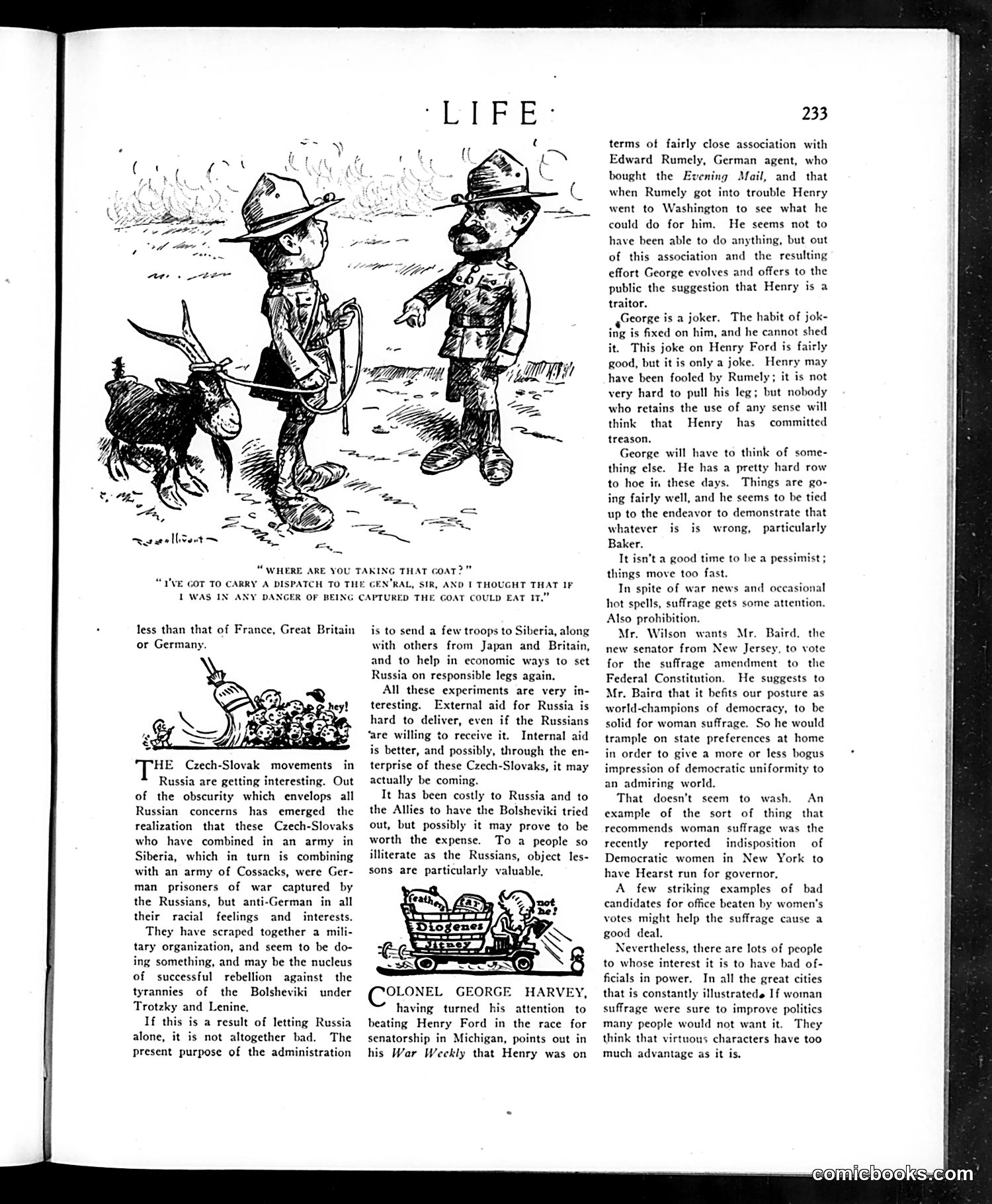
This page contains two distinct satirical pieces from WWI-era *Life* magazine: **Top Cartoon**: A soldier explains he's carrying a goat as a dispatch courier, reasoning that if captured, the enemy might eat the goat instead of him. The joke plays on wartime desperation and absurd logic. **Main Article**: Colonel George Harvey attacks Henry Ford as a traitor, citing Ford's association with Edward Rumely (a German agent who owned the *Evening Mail*). The author dismisses this as mere joking—Harvey is known for exaggeration—and defends Ford, suggesting he was merely duped rather than genuinely disloyal. The piece critiques Harvey's pessimism during wartime. **Context**: This reflects suspicions about Ford's pacifism and his *Evening Mail* connections during WWI. The article also briefly addresses Czech-Slovak military movements in Siberia, women's suffrage, and Prohibition—contemporary political concerns of 1918.
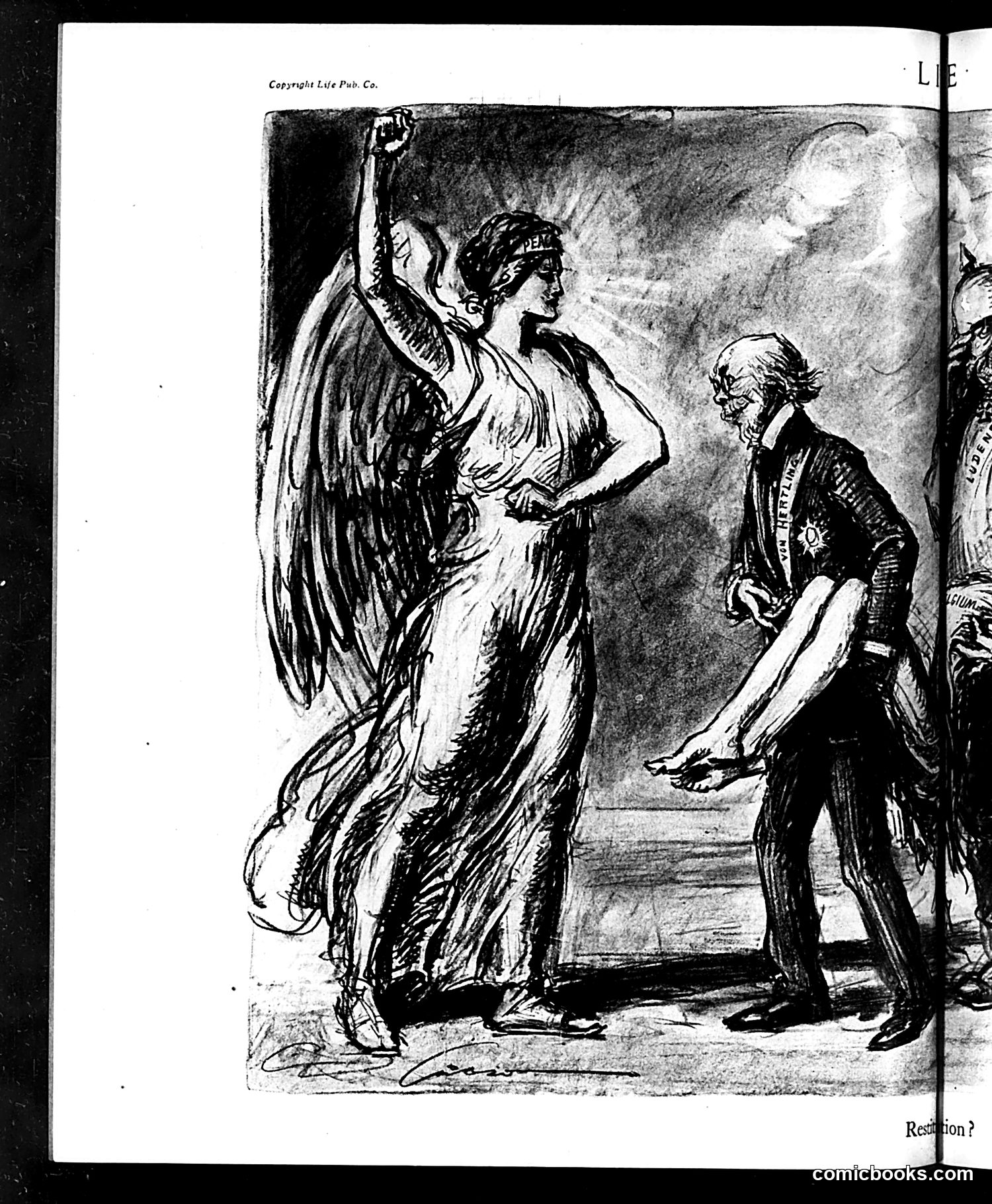
This page contains a single political cartoon copyrighted by Life Publishing Co. The image depicts an allegorical female figure with wings (representing Liberty or Victory) with her fist raised, confronting a well-dressed man in formal military or diplomatic attire on the right. A third figure appears partially visible on the far right. The caption at bottom reads "Rebellion?" suggesting the cartoon comments on resistance to authority or established order. The winged woman's aggressive posture and raised fist indicate defiance or revolutionary spirit, while the formally-dressed man's stance suggests he represents the establishment or governing power. Without a visible date or additional text, the specific historical context remains unclear—this could reference various early 20th-century political conflicts or labor disputes, but the exact reference cannot be determined from the image alone.
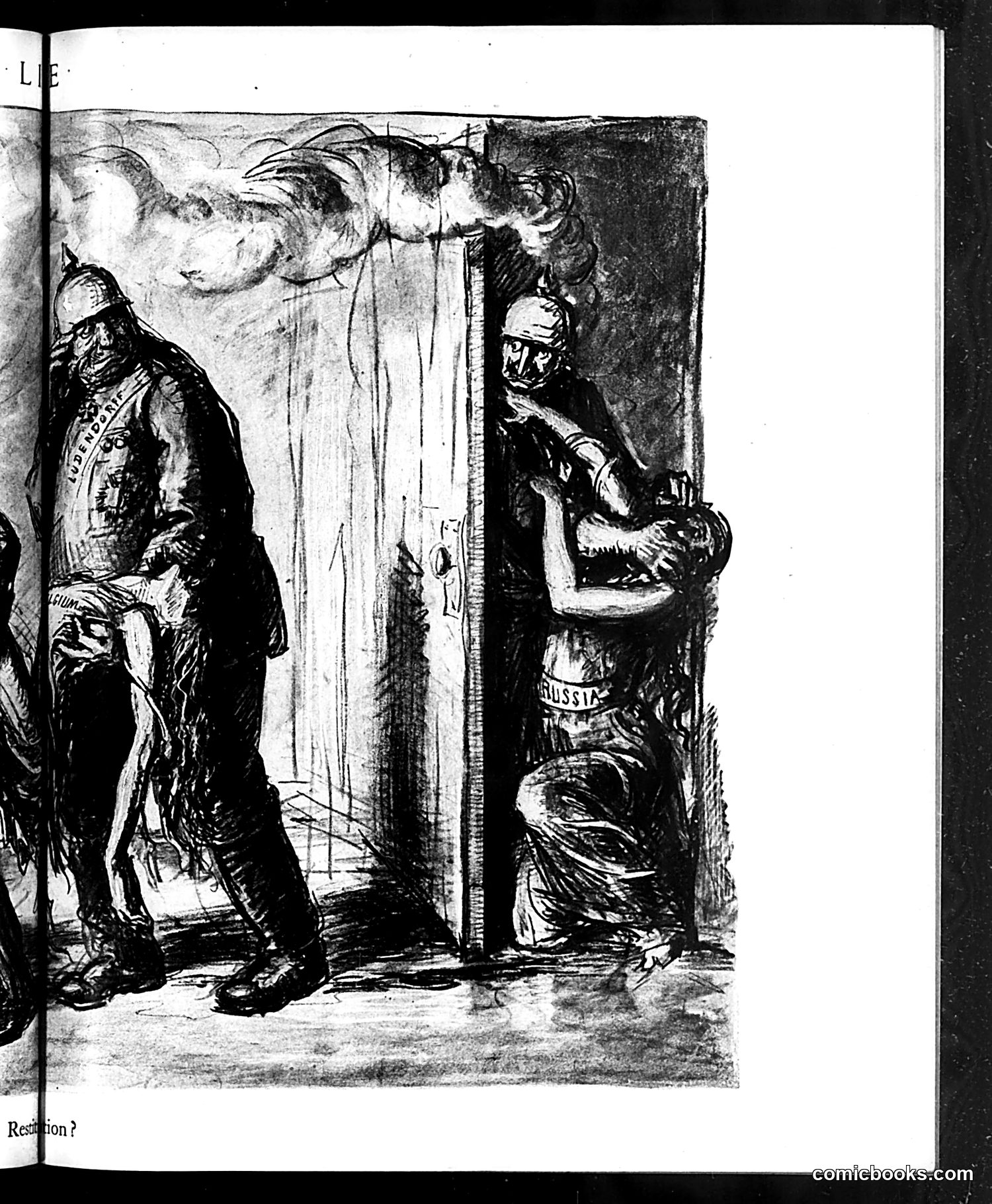
This political cartoon depicts two figures in what appears to be a confrontational scene at a doorway. The figure on the right is labeled "RUSSIA" and holds what looks like a child or small person. The figure on the left, wearing formal attire and a hat, confronts this Russian figure. The cartoon's title "Restriction?" suggests it comments on diplomatic tensions regarding restrictions or limitations—likely related to early 20th-century international relations. The dramatic body language and the positioning of the figures suggests conflict over control or authority. Without the specific publication date visible, the exact political moment remains unclear, though this appears to address Russian foreign policy and Western responses to it during a period of diplomatic tension.
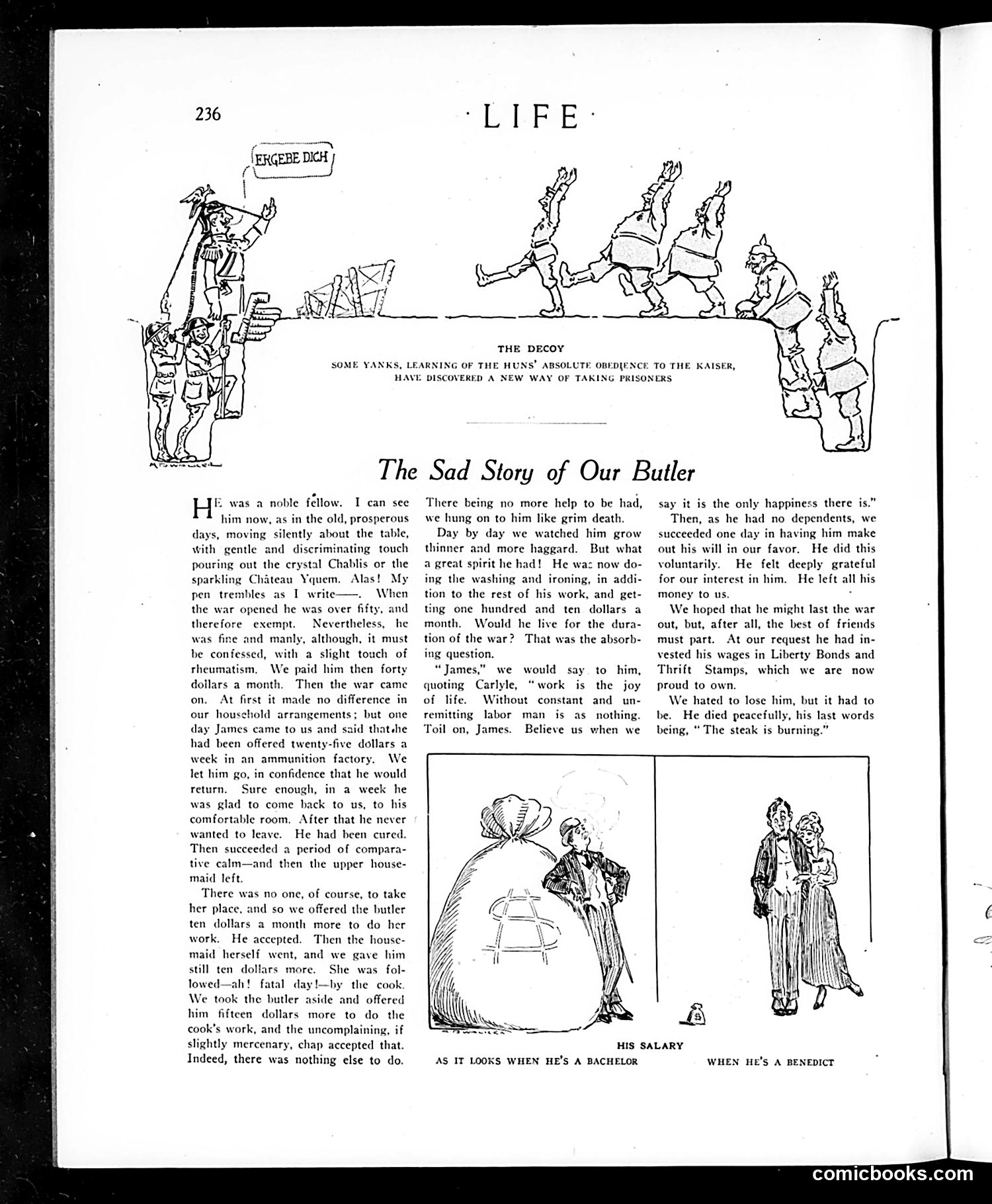
This WWI-era piece satirizes wealthy American households exploiting domestic servants during wartime labor shortages. **The Setup:** A butler, initially paid $40/month, becomes indispensable when other household staff enlist or seek better factory wages. His employers incrementally increase his pay (adding $10, then $10, then $15 monthly) while piling on additional duties—laundry, ironing, cooking—until he's doing all household work. **The Satire:** The wealthy narrator uses manipulative philosophy ("work is the joy of life") to justify the exploitation. The situation escalates absurdly: they pressure him to make them his beneficiary and invest his wages in war bonds, ultimately working him to death. **The Point:** This mocks the hypocrisy of privileged Americans who exploit wartime conditions and vulnerable workers while patriotically investing in the war effort. The butler's final words—"The steak is burning"—suggest he died at his post, still serving. The illustration showing his "salary" as a bachelor versus married man underscores economic desperation forcing service work.
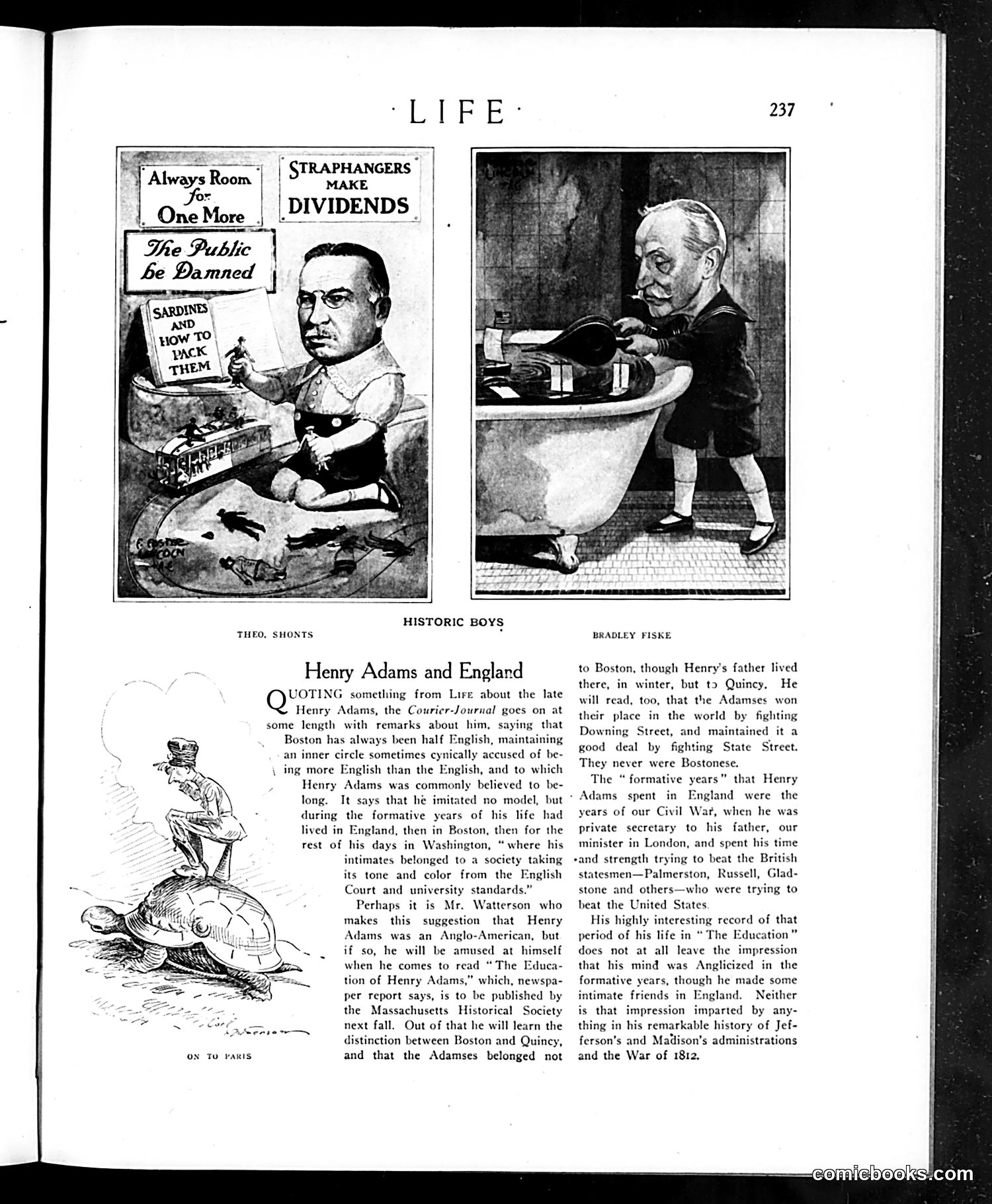
**Top Left Cartoon (Theo. Shonts):** A caricatured railroad executive holds signs reading "Always Room for One More," "The Public Be Damned," and "Sardines and How to Pack Them," while sardines spill from a crowded streetcar below. This satirizes overcrowded public transit and corporate indifference to passenger welfare—referencing the infamous "public be damned" attitude of 19th-century robber barons prioritizing profit over service. **Top Right Cartoon (Bradley Fiske):** An elderly man pours what appears to be dividends or money into a bathtub. This likely critiques wealthy financiers accumulating excessive corporate profits. **Main Article:** A defense of historian Henry Adams against accusations he was "Anglicized," arguing instead that Adams actively opposed British interests during the Civil War (as secretary to his diplomat father) and remained committed to American ideals. The piece disputes Eastern establishment stereotypes about Boston elites.
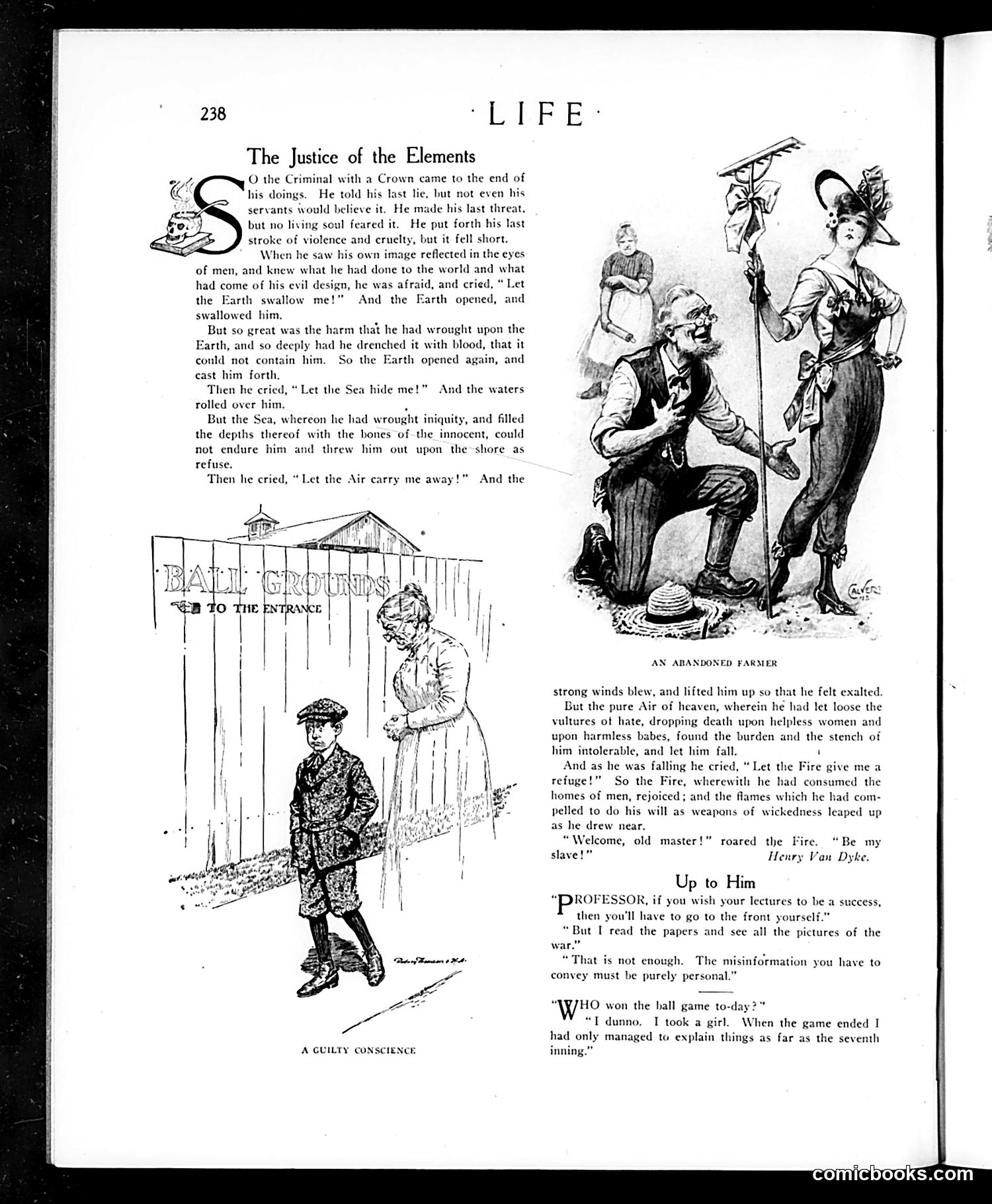
This page contains allegorical and humorous commentary likely from WWI era. **"The Justice of the Elements"** (main text): A moral fable depicting a "Criminal with a Crown"—apparently a wartime leader—rejected by nature itself. Earth, Sea, Air, and Fire successively refuse to shelter him, each having been corrupted by his violence. The piece, attributed to Henry Van Dyke, uses biblical language to suggest divine judgment against a militaristic ruler whose crimes are so profound that even the elements condemn him. **Left cartoon ("A Guilty Conscience")**: Shows a figure in an institutional setting, appearing anxious or remorseful, suggesting internal moral struggle. **Right cartoon ("An Abandoned Farmer")**: Depicts rural figures, possibly commenting on agricultural disruption caused by war or conscription. **"Up to Him"** section: Three brief satirical exchanges mocking academic distance from war, and romantic distraction—light social humor contrasting with the page's weightier moral themes.
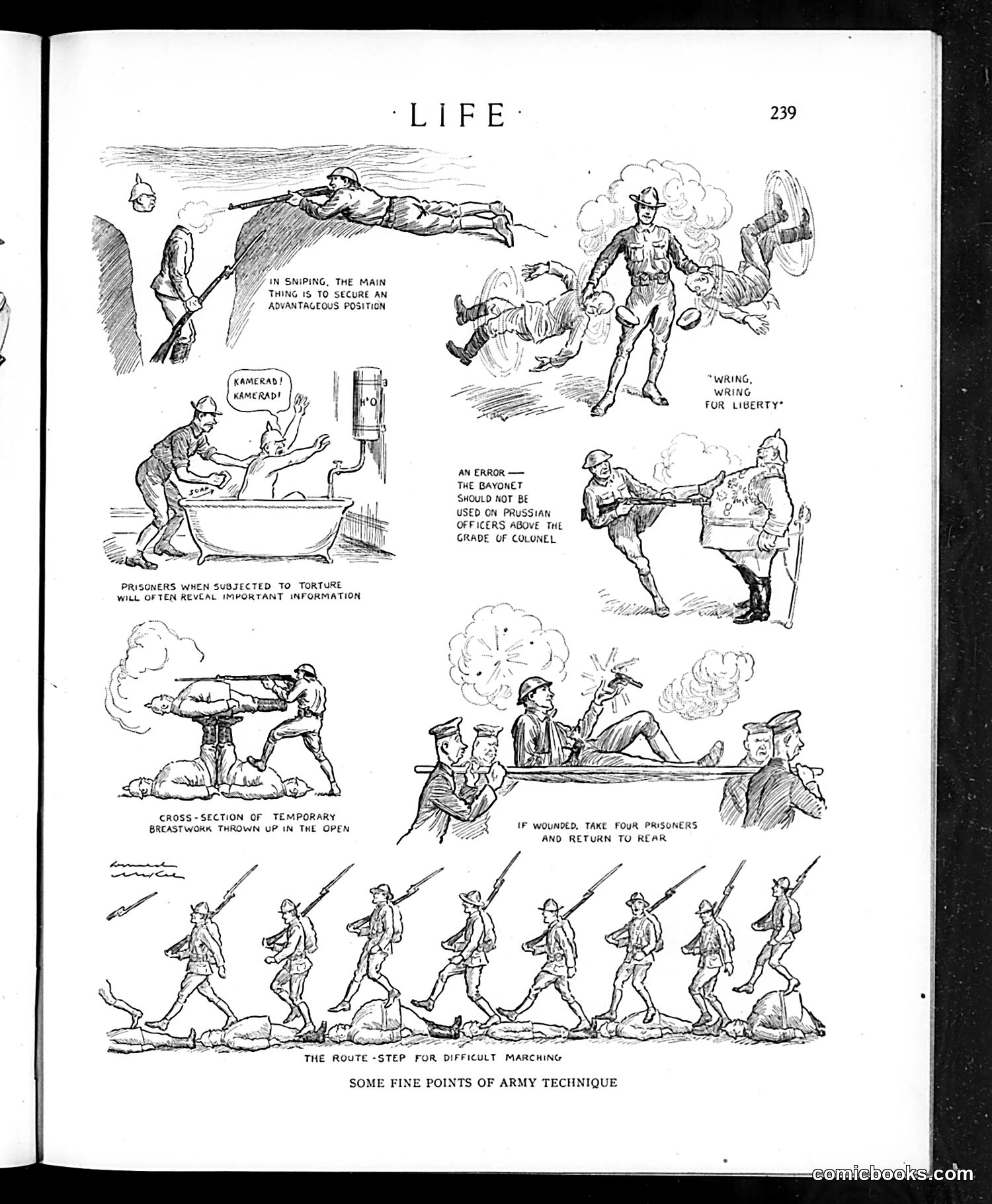
This satirical page mocks German military practices during World War I. The cartoons present ostensibly instructional diagrams for army technique while exposing alleged German brutality: - **"Kamerad" scene**: German soldiers torturing prisoners for information - **Bayonet instruction**: Darkly jokes that bayonets shouldn't be used on high-ranking Prussian officers (implying they *are* used on lower ranks) - **Torture caption**: Straightforwardly states prisoners reveal information under torture - **Casualty handling**: Instructions to retrieve wounded soldiers - **Marching formations**: Standard military technique The page weaponizes wartime propaganda stereotypes of "Prussian militarism" and German atrocities. By framing brutality as official military doctrine rather than aberration, Life presents German military culture itself as inherently barbaric—a common Allied propaganda technique during WWI designed to justify American involvement and demonize the enemy.
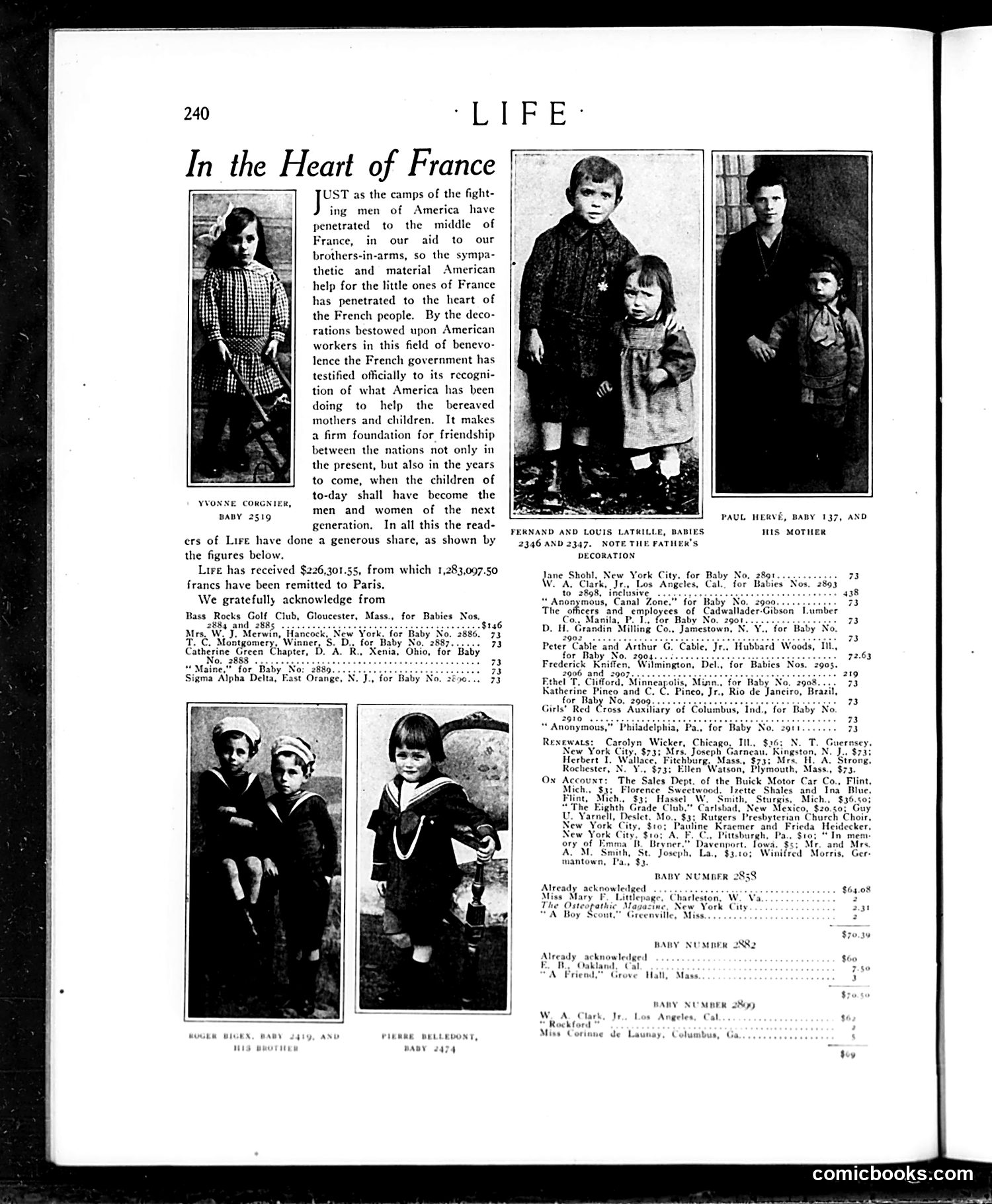
This is not a cartoon but a charitable appeal page. It documents American donations to aid French war orphans during World War I. The photographs show French children who have received American assistance, with captions identifying them (e.g., "Yvonne Corgnier, Baby 2519"). The article's central argument: American soldiers fighting in France have been joined by American charitable workers helping French children. This dual effort—military and humanitarian—establishes lasting friendship between nations. The French government officially recognized this benevolence through decorations. The page lists donors and amounts contributed to "Life" magazine's relief fund, which remitted over $1.2 million francs to Paris. Donations ranged from individuals to organizations (golf clubs, church choirs, Boy Scouts). **Context for modern readers**: This reflects WWI-era American involvement in European relief efforts and the contemporary belief that humanitarian aid abroad would strengthen international relations for decades to come.
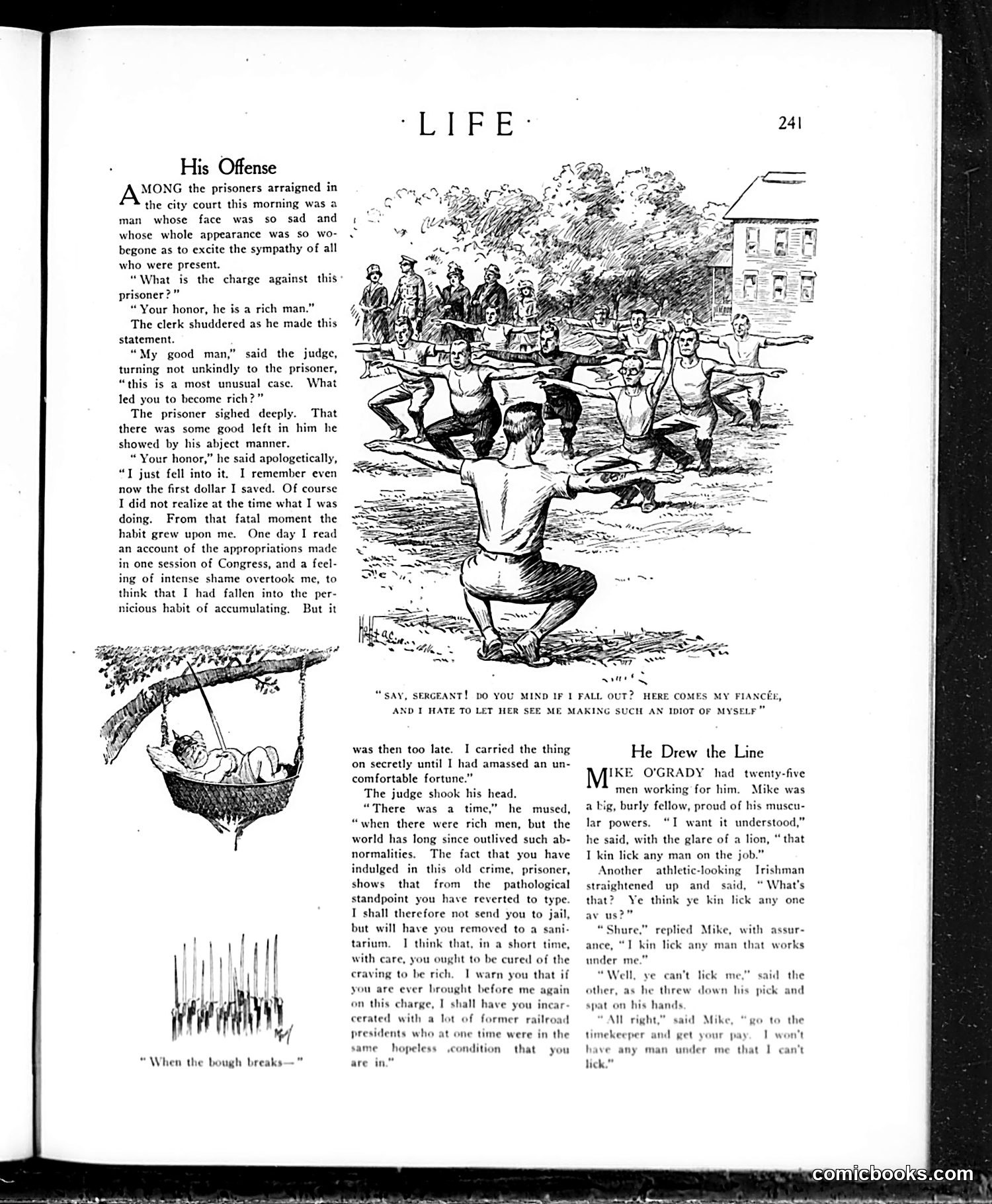
This page contains two separate satirical pieces satirizing American wealth and labor dynamics circa early 20th century. **"His Offense"** mocks the wealthy through absurdist humor. A rich man is brought to court where being wealthy is treated as a crime/illness requiring sanitarium treatment. The judge suggests wealth is an "abnormality" the modern world has "outlived," and compares the prisoner to former railroad presidents in similar "hopeless condition." The satire targets both wealth accumulation itself and the judicial system's failure to address real crimes by the wealthy. **"He Drew the Line"** presents a working-class comedy about Mike O'Grady, a foreman who claims he can lick any man under him. When challenged by an equal worker, Mike refuses to fight—asserting he'll only dominate subordinates. The cartoon ridicules workplace bullying and cowardice masked by authority. Both pieces reflect Progressive Era skepticism toward capitalism and labor exploitation.
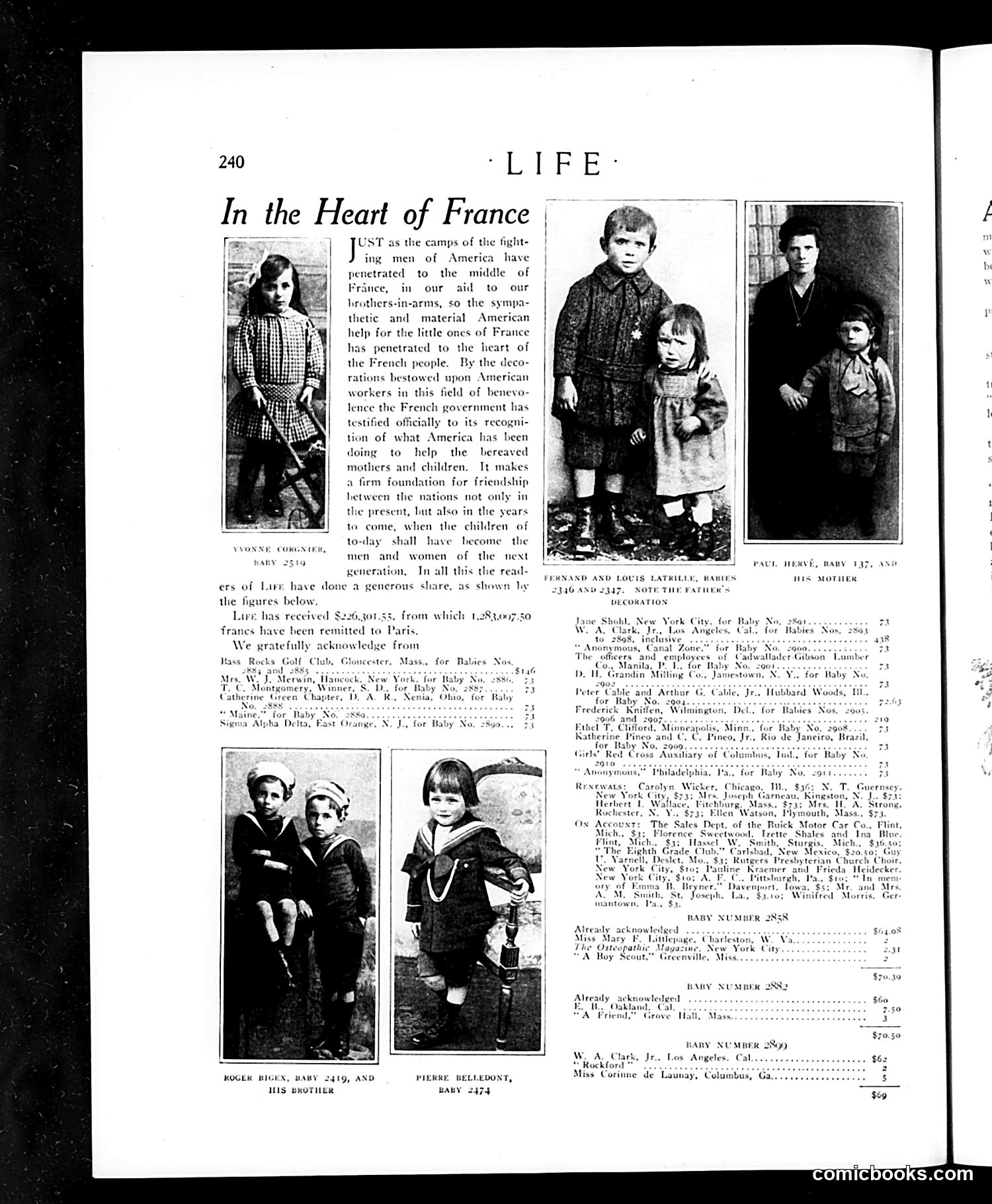
This page documents American charitable aid to French children during World War I. The text explains that American camps and aid workers have extended support to France's war-affected children, creating goodwill between nations. The photographs show French children who received assistance—identified by baby registry numbers (e.g., "Baby 2419," "Baby 2474")—apparently part of a formal sponsorship or relief program. The children are presented as beneficiaries of American generosity. The bulk of the page lists donors and amounts contributed to this relief effort, showing how American individuals, organizations, and businesses funded aid to French war orphans and displaced children. The "Lire" mentioned refers to money remitted to Paris for this purpose. Rather than satire, this is sincere advocacy: the page uses photographs of grateful, well-dressed French children to inspire continued American donations to a relief organization during the war.
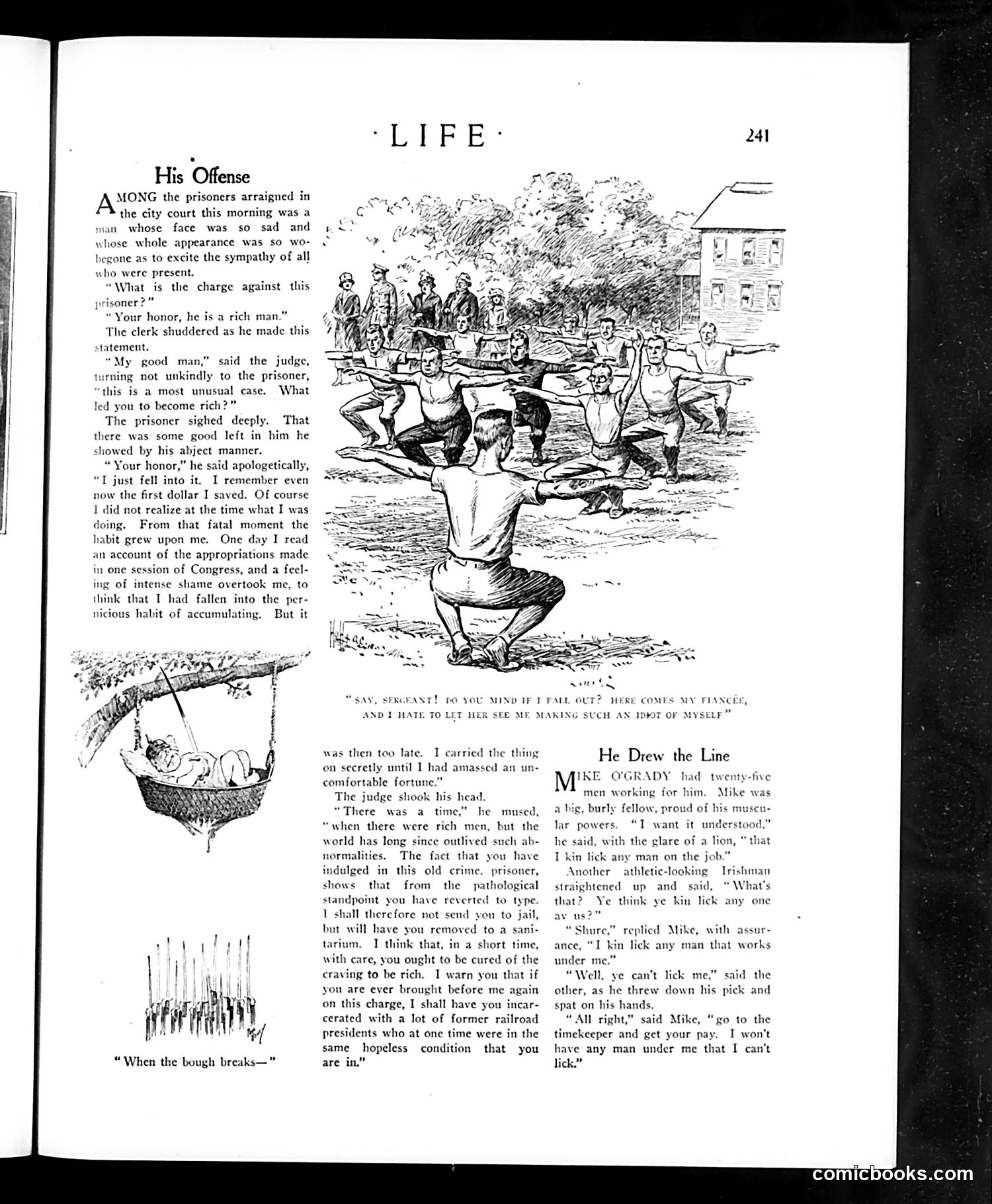
This page contains two satirical pieces mocking different aspects of American society: **"His Offense"** satirizes wealth accumulation during an era of progressive reform. A rich man is arraigned in court as if wealth itself were a crime. The judge treats it as a pathological condition requiring sanitarium treatment, comparing wealthy men to "former railroad presidents" — likely referencing the robber baron class of the Gilded Age who faced public criticism. The satire targets both the wealthy (for accumulating fortunes) and indirectly suggests the absurdity that society views wealth-building as criminal. **"He Drew the Line"** depicts two working-class Irish laborers (suggested by names "Mike O'Grady" and dialect). Mike boasts he can beat any man under him, but when challenged, he fires the worker rather than fight — establishing his limit. The humor lies in his contradiction: he won't tolerate a subordinate he cannot physically dominate, revealing workplace power dynamics and masculine pride among laborers. Both pieces use humor to critique social hierarchies and character flaws.
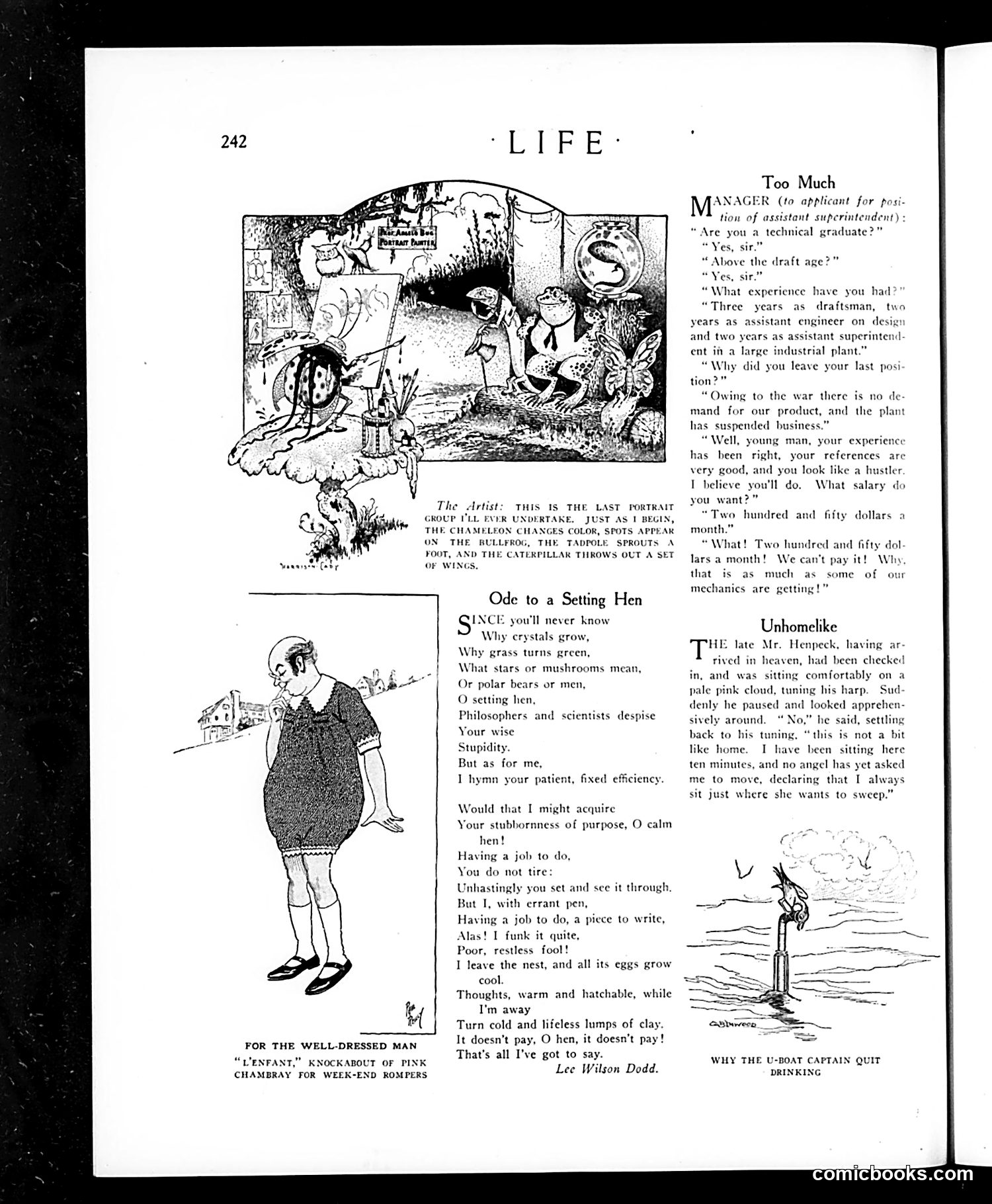
This page contains three separate satirical pieces reflecting WWI-era concerns: **"Too Much"**: A job interview cartoon mocking wage expectations. A young man with impressive credentials (technical degree, military-age exempt, extensive experience) asks for $250/month—only to be rejected as excessive, since some mechanics earn less. The satire targets wartime wage inflation and employers' resistance to paying qualified workers fairly despite labor shortages. **"Ode to a Setting Hen"**: A poem by Lee Wilson Dodd contrasting a hen's focused productivity with the author's procrastination and artistic paralysis. The "errant pen" and abandoned creative work appear to reference wartime disruptions to civilian life and morale. **"Unhomelike"**: A joke about Mr. Henpeck in heaven, relieved that no one orders him around—a domesticity gag playing on the henpecked husband trope common in period humor. **"Why the U-Boat Captain Quit Drinking"**: A caption accompanying a cartoon of a drowning figure, likely referencing German submarine warfare and its dangers.
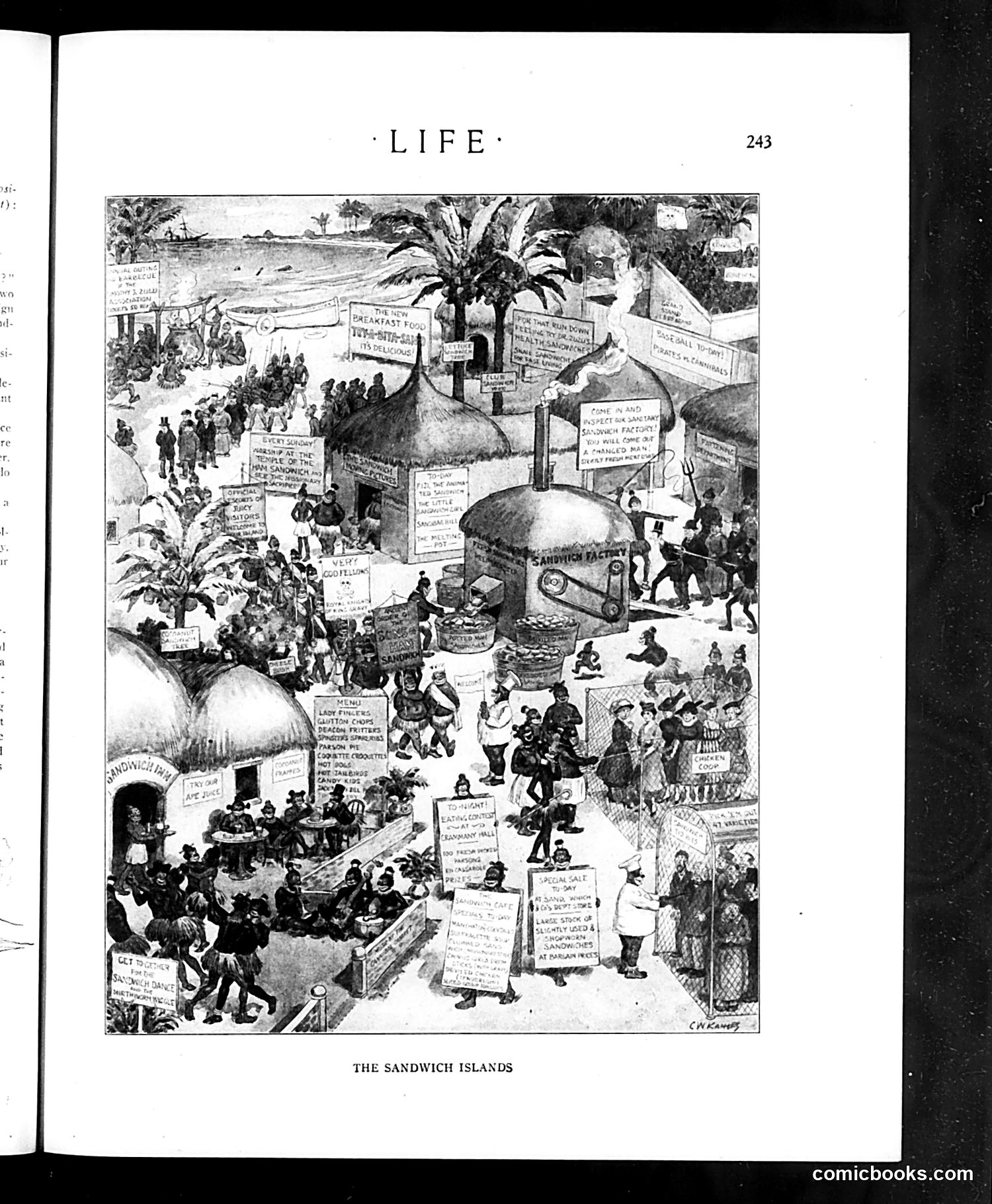
This is a satirical bird's-eye-view illustration of the Hawaiian Islands (historically called the Sandwich Islands). The cartoon depicts a bustling tourist destination and commercial hub crowded with visitors, vendors, and various attractions—hotels, restaurants, shops, and recreational facilities marked with visible signs. The satire appears to critique the commercialization and overdevelopment of Hawaii. What was once an exotic, isolated destination has become a densely packed tourist trap with aggressive marketing (numerous visible signs advertising services and goods). The dense crowds and chaotic layout suggest the cartoonist views this commercialization as excessive or degrading to the islands' character. This likely reflects early-to-mid 20th-century anxieties about tourism's impact on native cultures and pristine locations.
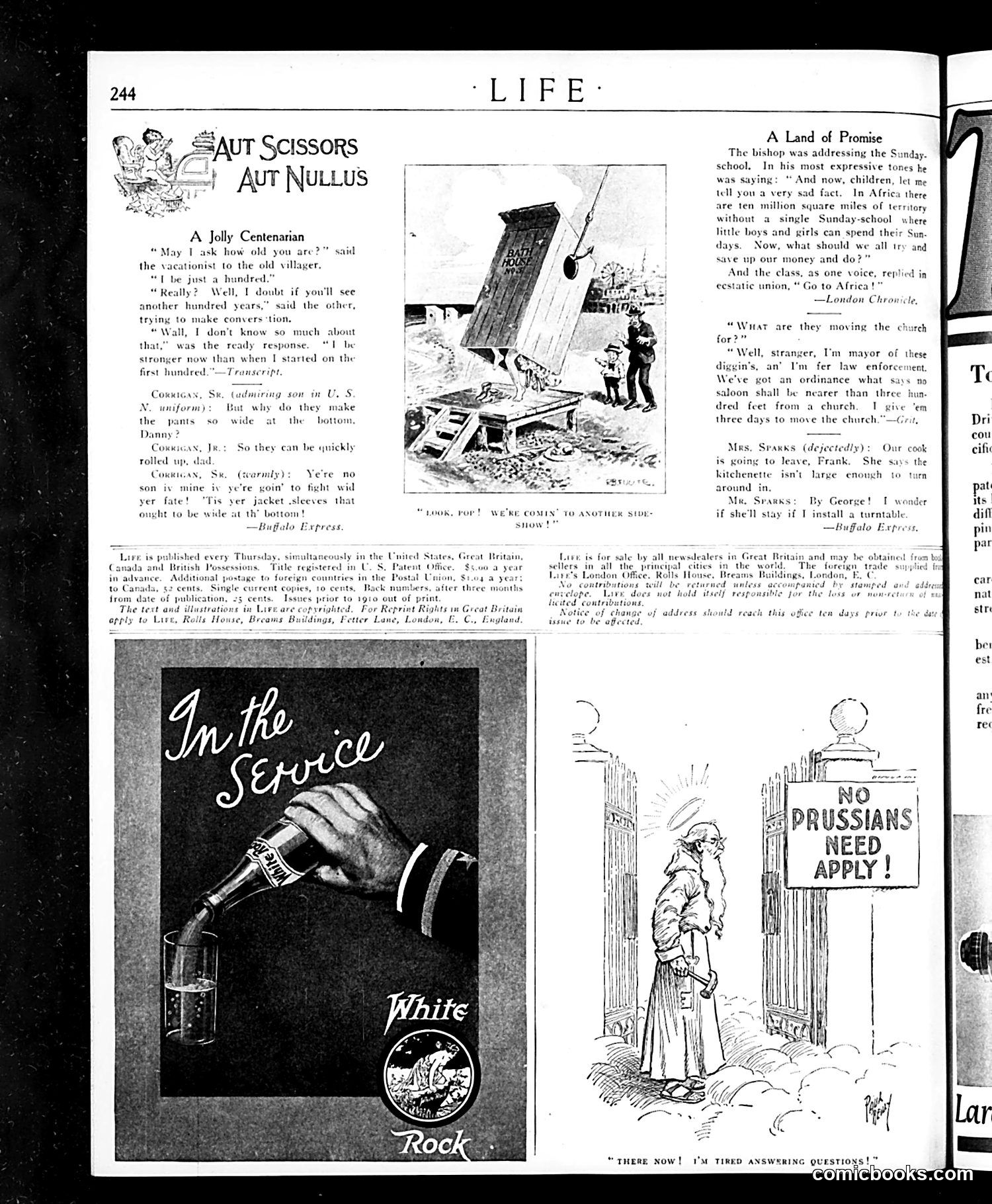
This page contains several satirical items targeting early 20th-century social attitudes: **"A Land of Promise"**: A bishop tells Sunday school children that Africa lacks Christian institutions, then asks what they should do. The children's enthusiastic response—"Go to Africa!"—satirizes both missionary zeal and the desire to send children far away, suggesting the bishop's appeal backfired comically. **"No Prussians Need Apply"**: A cartoon showing a German soldier turned away at heaven's gates with a sign barring Prussians. This references anti-German sentiment, likely from World War I era, mocking Prussian militarism by suggesting divine judgment against them. **"In the Service" (advertisement)**: A White Rock beverage ad showing a bottle being poured, using patriotic/military service language as marketing. The page also includes humorous dialect jokes about old age and military uniforms. The overall tone reflects period attitudes toward foreign missions, German enemies, and working-class life.
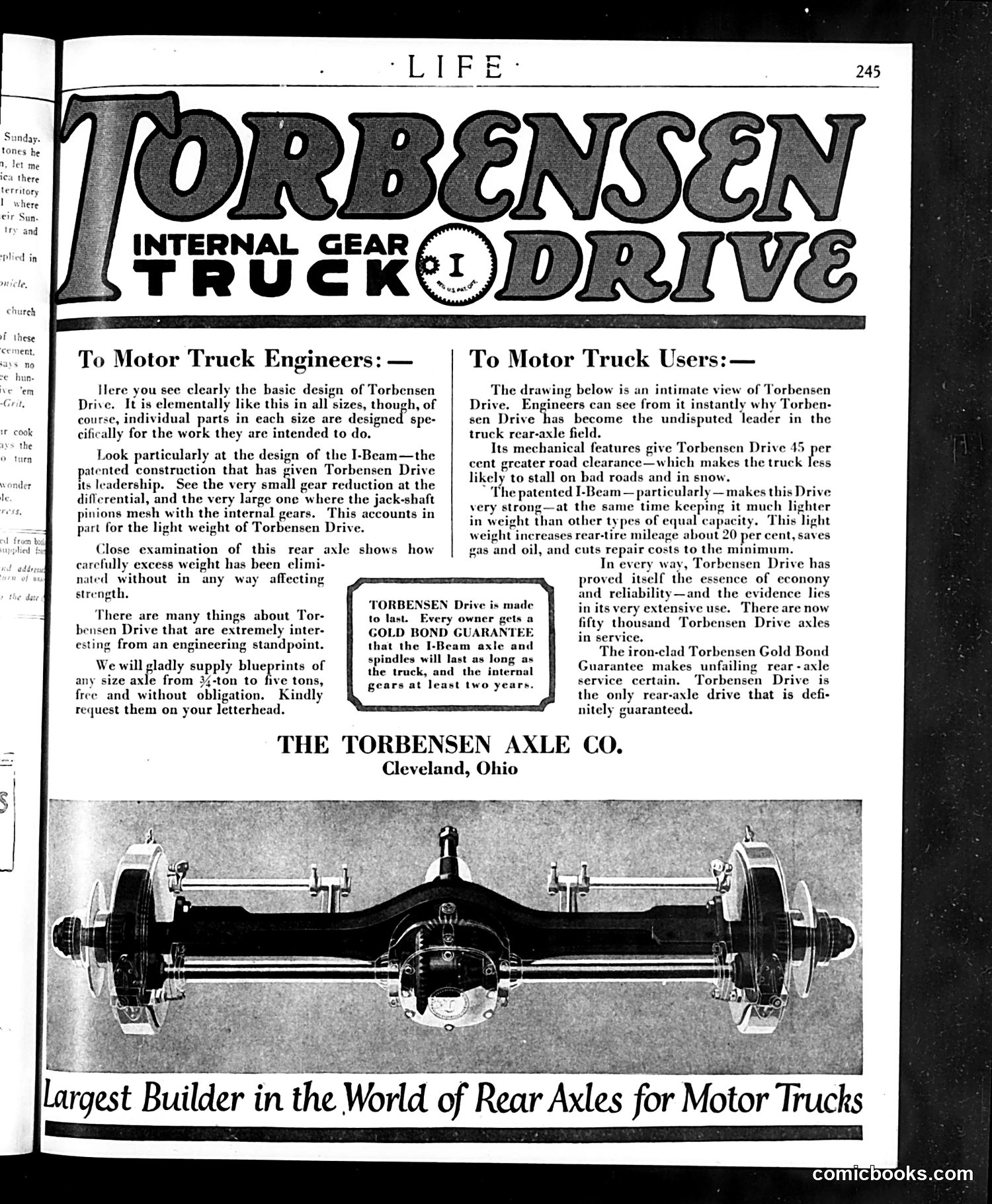
This page is **entirely an advertisement**, not satire or political commentary. It promotes the Torbensen Internal Gear Drive, a rear axle system for motor trucks manufactured by The Torbensen Axle Company of Cleveland, Ohio. The ad uses technical marketing language targeting two audiences: engineers (emphasizing design features like the I-Beam construction and gear ratios) and truck users (highlighting practical benefits: 45% greater road clearance, lighter weight, 20% longer tire life, and fuel savings). The central image shows a technical cross-section diagram of the rear axle assembly. Claims include a "Gold Bond Guarantee" covering the I-beam axle and spindles for the truck's lifetime, plus internal gears for two years. The ad boasts fifty thousand units in service and positions Torbensen as "Largest Builder in the World of Rear Axles for Motor Trucks." This represents early 20th-century industrial advertising in *Life* magazine—straightforward product promotion with no satirical intent.
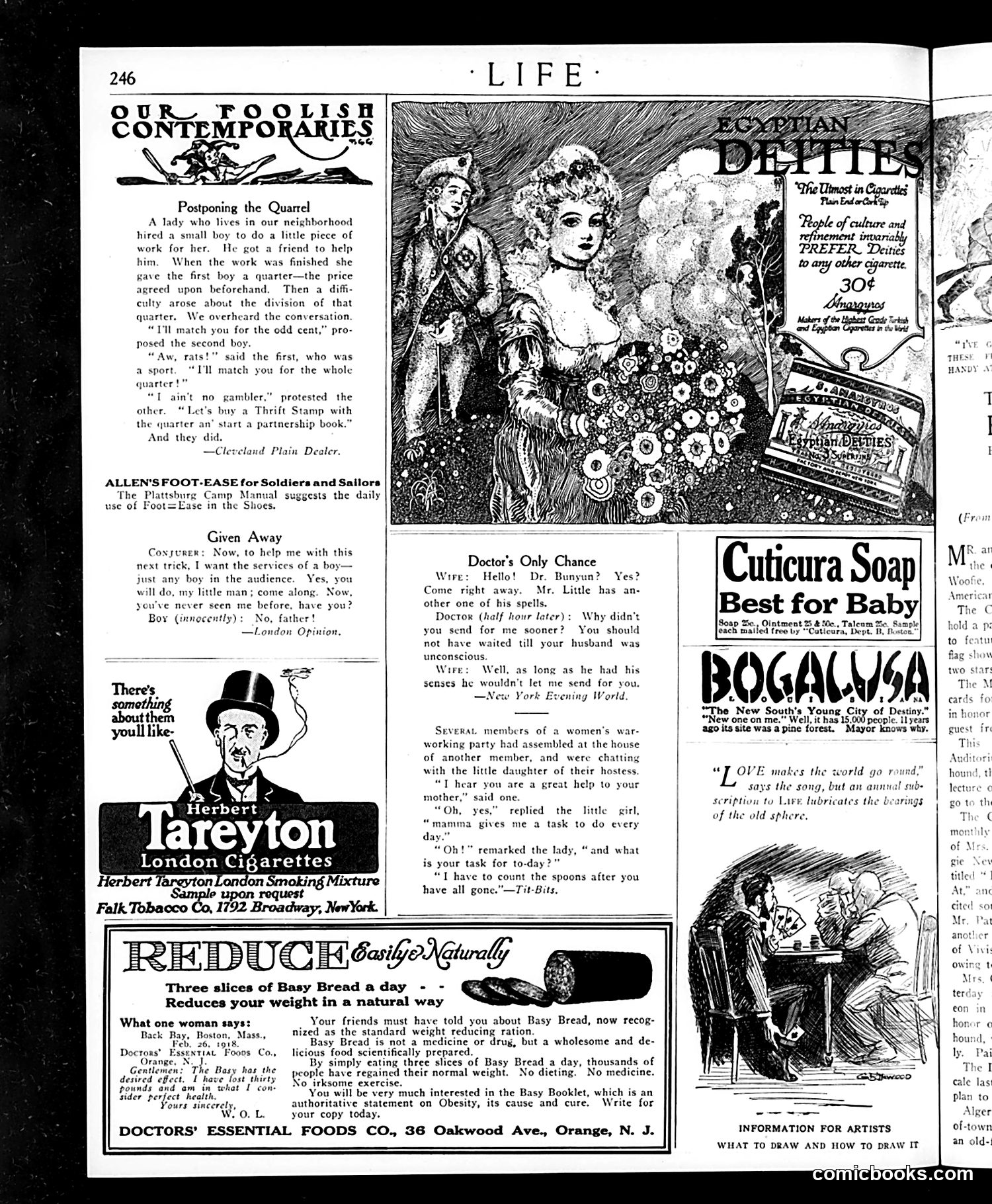
This page collects short humorous anecdotes satirizing everyday foolishness. The main cartoons mock human behavior: **"Postponing the Quarrel"**: Two boys dispute dividing a quarter (25 cents). Rather than fight, they compromise by buying a Thrift Stamp together—satire on how people avoid conflict through bureaucratic solutions rather than decisive action. **"Given Away"**: A conjurer asks a boy if they've met before. The boy says "No, father!"—the joke being the boy accidentally reveals their relationship, sabotaging the magician's trick. **"Doctor's Only Chance"**: A sick man refuses to call a doctor while conscious, only allowing it once he's unconscious—absurdist humor about stubborn male pride preventing necessary medical care. **"Mother's Helper"**: A girl's task is counting spoons after guests leave—implying the family steals silverware, a crude joke about working-class petty theft. The page is primarily satirical humor targeting ordinary people's illogical behavior, combined with period advertisements (cigarettes, weight-loss bread, soap).
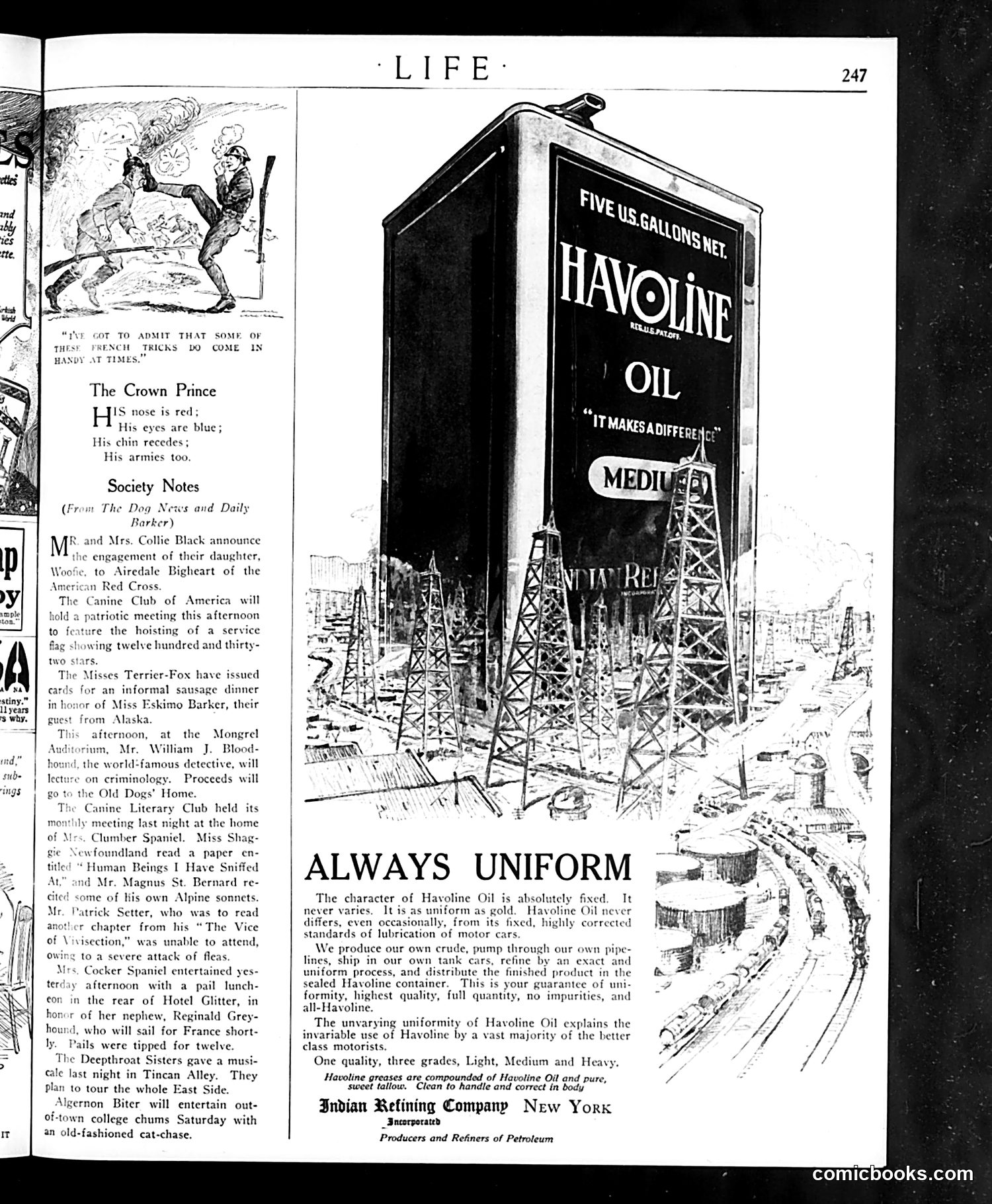
**The Cartoon:** The small sketch at top left depicts two figures performing tricks, with text referencing "French tricks" coming in handy. This appears to be satirical commentary on military tactics—likely alluding to World War I and the German Crown Prince's military campaigns. **"The Crown Prince" Poem:** This is anti-German satire mocking the German Crown Prince Wilhelm. The physical descriptions (red nose, blue eyes, receding chin) are caricature insults, with the final line—"His armies too"—being the political jab: his armies are "receding" (retreating/failing), mirroring his weak physical appearance. This reflects American/Allied wartime propaganda ridiculing German leadership. **"Society Notes":** A humorous mock-society column using dog breeds as character names making puns on human names—entirely lighthearted domestic satire with no political content. **Advertisement:** The large Havoline Oil advertisement is standard commercial content, not satirical. The page demonstrates *Life* magazine's dual function: serious wartime political satire mixed with whimsical humor and advertising.
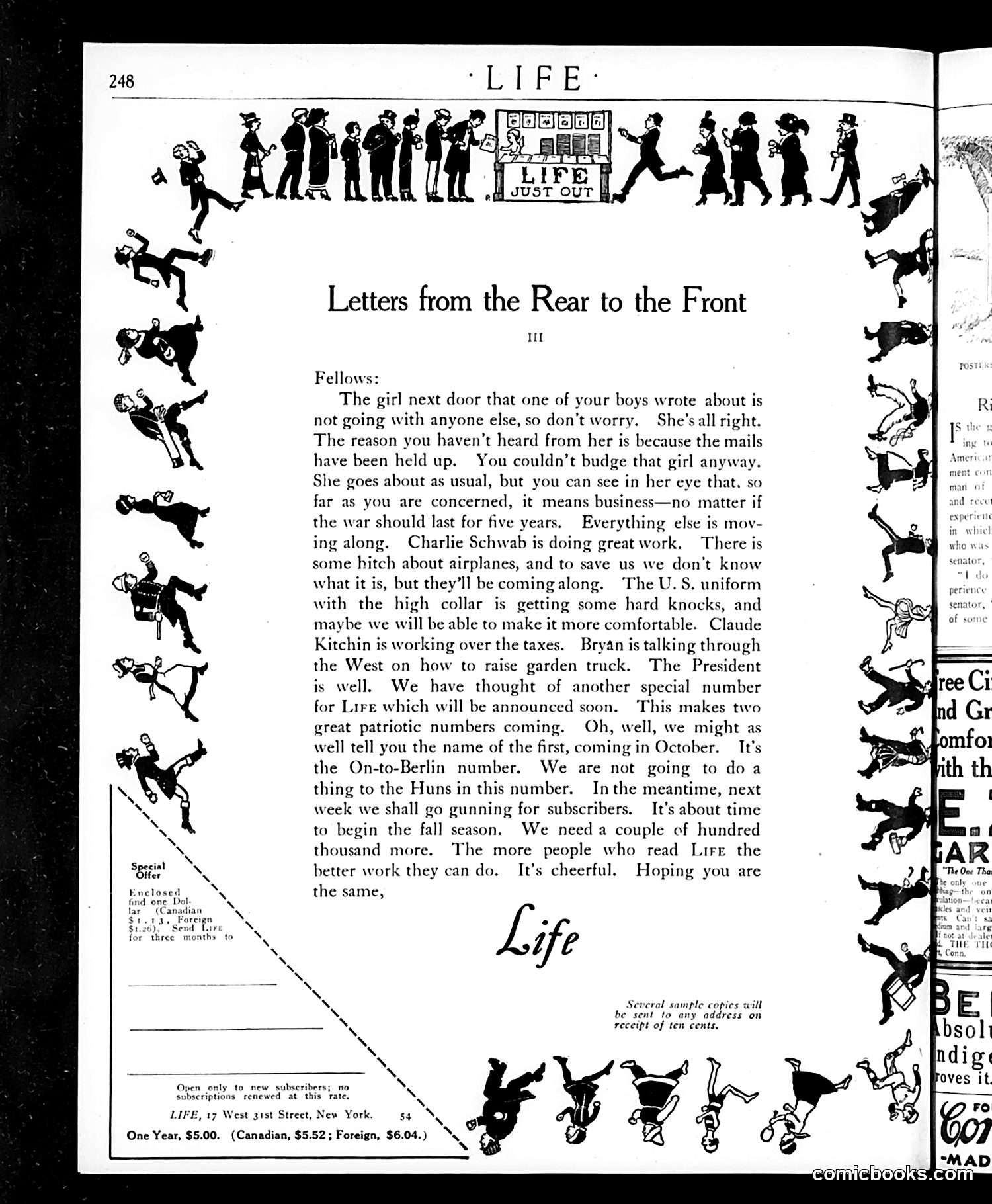
This page is a **letter from Life magazine's editors to servicemen**, likely from World War I era (references to "Huns," Berlin, and raising war bonds date this to 1917-1918). The satirical letter reassures soldiers about their girlfriends back home and updates them on the American war effort. Key figures mentioned: - **Charlie Schwab**: Industrialist managing munitions production - **Claude Kitchin**: Congressman handling war taxes - **William Jennings Bryan**: Former presidential candidate now promoting agricultural production ("garden truck") - **The President**: Woodrow Wilson The humor lies in the **casual, gossipy tone** addressing serious wartime matters—girlfriend updates mixed with industrial output and taxation. The decorative border of tumbling soldiers emphasizes the magazine's satirical nature. Life announces an upcoming "On-to-Berlin" issue and solicits new subscriptions, framing patriotic magazine reading as supporting the war effort. The tone is encouraging but somewhat tongue-in-cheek about civilian contributions to the war.
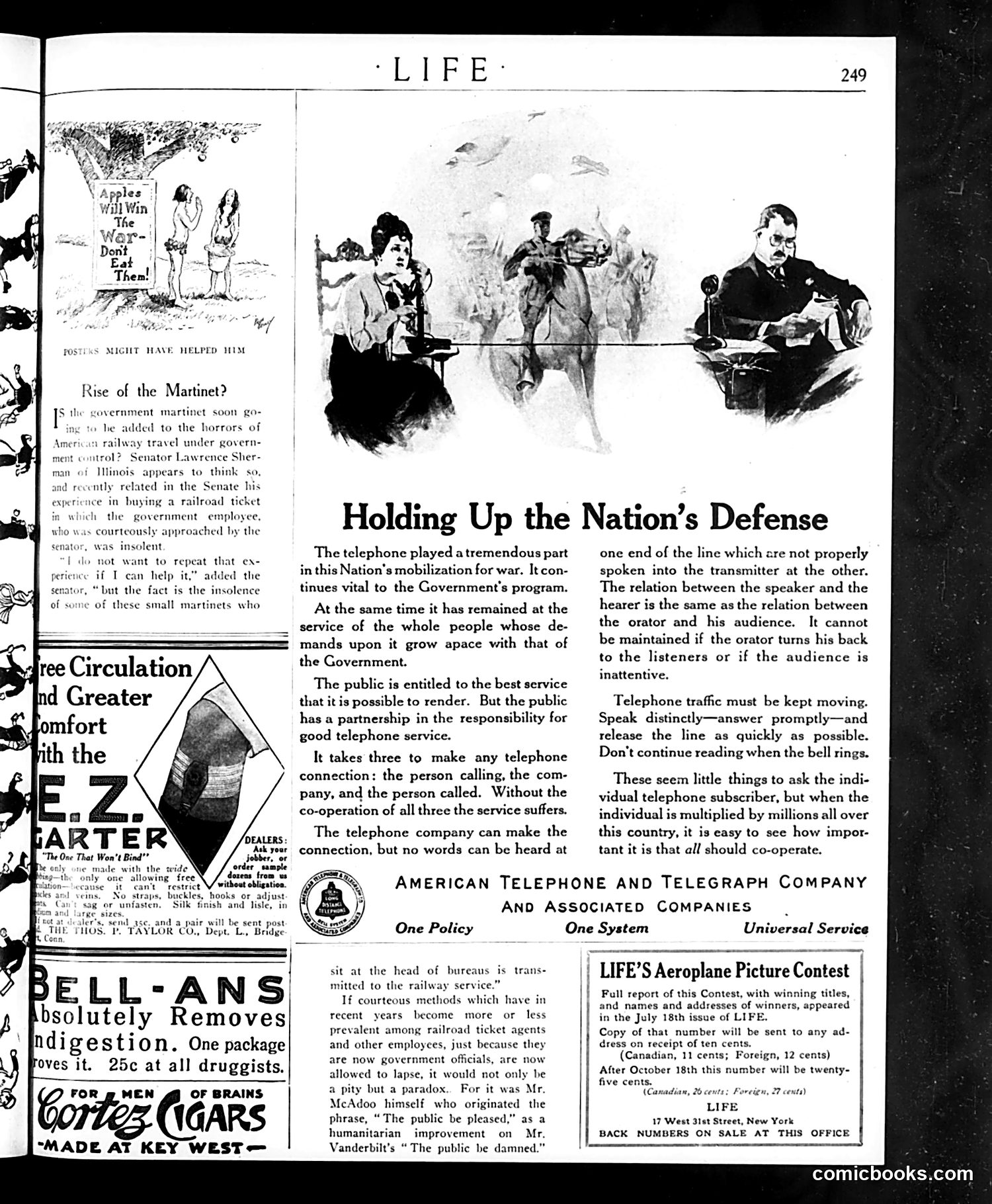
This page contains a political commentary and wartime public service advertisement rather than a traditional cartoon. **"Rise of the Martinet?" section** critiques Senator Lawrence Sherman of Illinois, who complained to the Senate about allegedly rude railroad ticket employees. The piece sarcastically questions whether government control during wartime mobilization will introduce harsh, rigid bureaucratic behavior ("martinet" = strict disciplinarian) into transportation services. **"Holding Up the Nation's Defense"** is a telephone company advertisement masquerading as civic responsibility messaging. It argues that telephone service is vital to war mobilization but requires public cooperation—users must speak clearly, answer promptly, and hang up quickly. The ad emphasizes that poor service results from users' inattention, not company failure, subtly shifting responsibility from AT&T to individual subscribers. The historical context: This appears from WWI-era, when government took control of railroads and telephone systems for war purposes. The pieces defend these services against criticism while subtly promoting corporate interests.
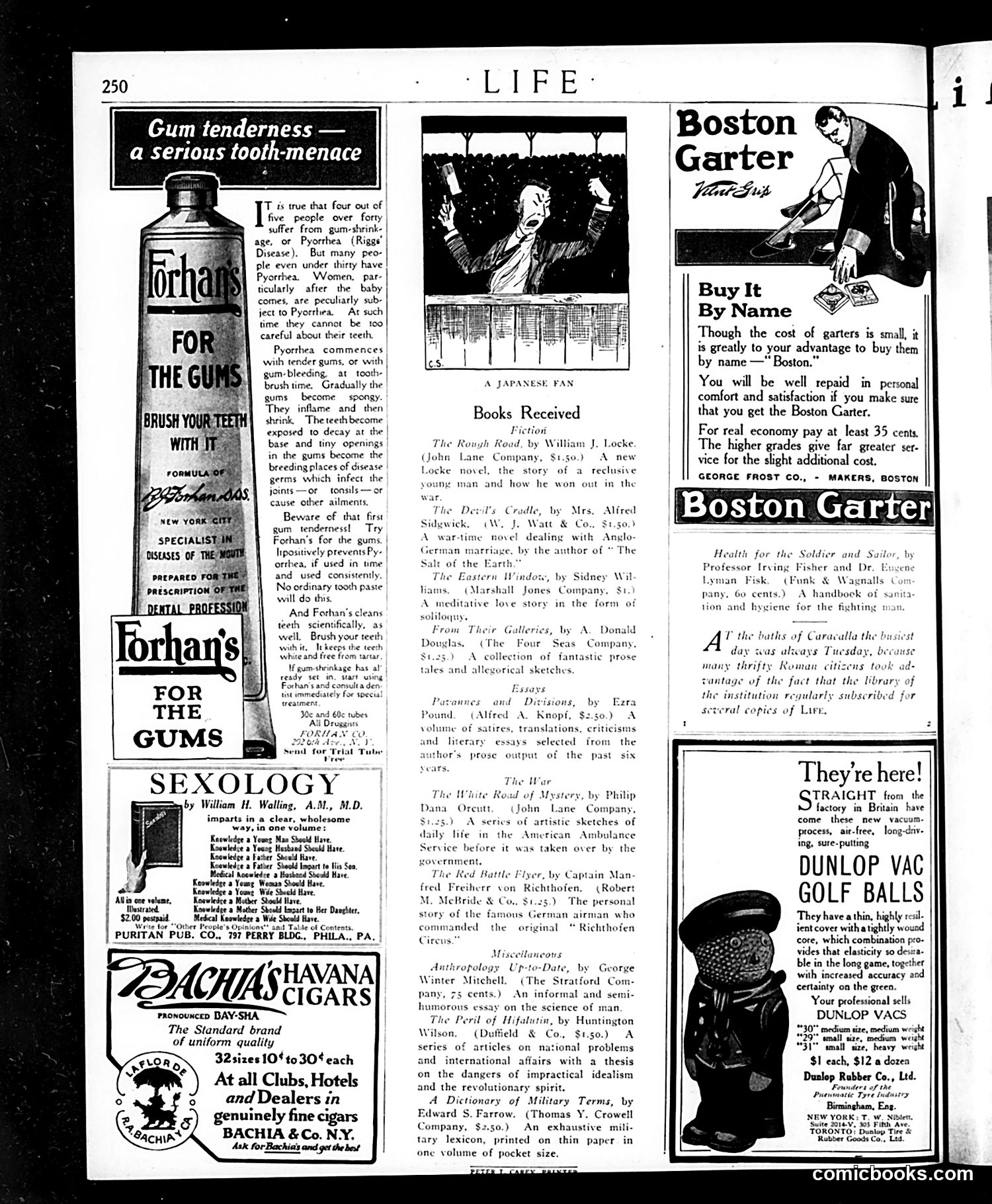
This page from *Life* magazine is primarily **advertising and book reviews**, not political satire. The main content includes: **Advertisements:** Forhan's toothpaste (promoting gum disease prevention), Bachia cigars, Boston Garters (men's sock supporters), and Dunlop golf balls—typical commercial messaging of the era. **"A Japanese Fan"** illustration appears to be a humorous sketch of Japanese culture, reflecting early 20th-century Western fascination with and stereotyping of Japan. **Book Reviews section** lists contemporary fiction and non-fiction, including notably: - Works about World War I (references to German pilot von Richthofen) - Social commentary (*The Peril of Hifalutin* on idealism and revolution) - Educational works on sexuality and military terminology The page reflects **post-WWI American culture**: consumer capitalism, lingering war references, and emerging social frankness about previously taboo topics like sexual health.