
Life, 1918-08-15 · page 27 of 36
Life — August 15, 1918 — page 27: what you’re looking at
What you’re looking at
This page contains two satirical pieces mocking different aspects of American society: **"His Offense"** satirizes wealth accumulation during an era of progressive reform. A rich man is arraigned in court as if wealth itself were a crime. The judge treats it as a pathological condition requiring sanitarium treatment, comparing wealthy men to "former railroad presidents" — likely referencing the robber baron class of the Gilded Age who faced public criticism. The satire targets both the wealthy (for accumulating fortunes) and indirectly suggests the absurdity that society views wealth-building as criminal. **"He Drew the Line"** depicts two working-class Irish laborers (suggested by names "Mike O'Grady" and dialect). Mike boasts he can beat any man under him, but when challenged, he fires the worker rather than fight — establishing his limit. The humor lies in his contradiction: he won't tolerate a subordinate he cannot physically dominate, revealing workplace power dynamics and masculine pride among laborers. Both pieces use humor to critique social hierarchies and character flaws.
📄 Transcribed text from this page (OCR, searchable)
Machine-transcribed from the original scan — historical spelling and the odd misread are preserved.
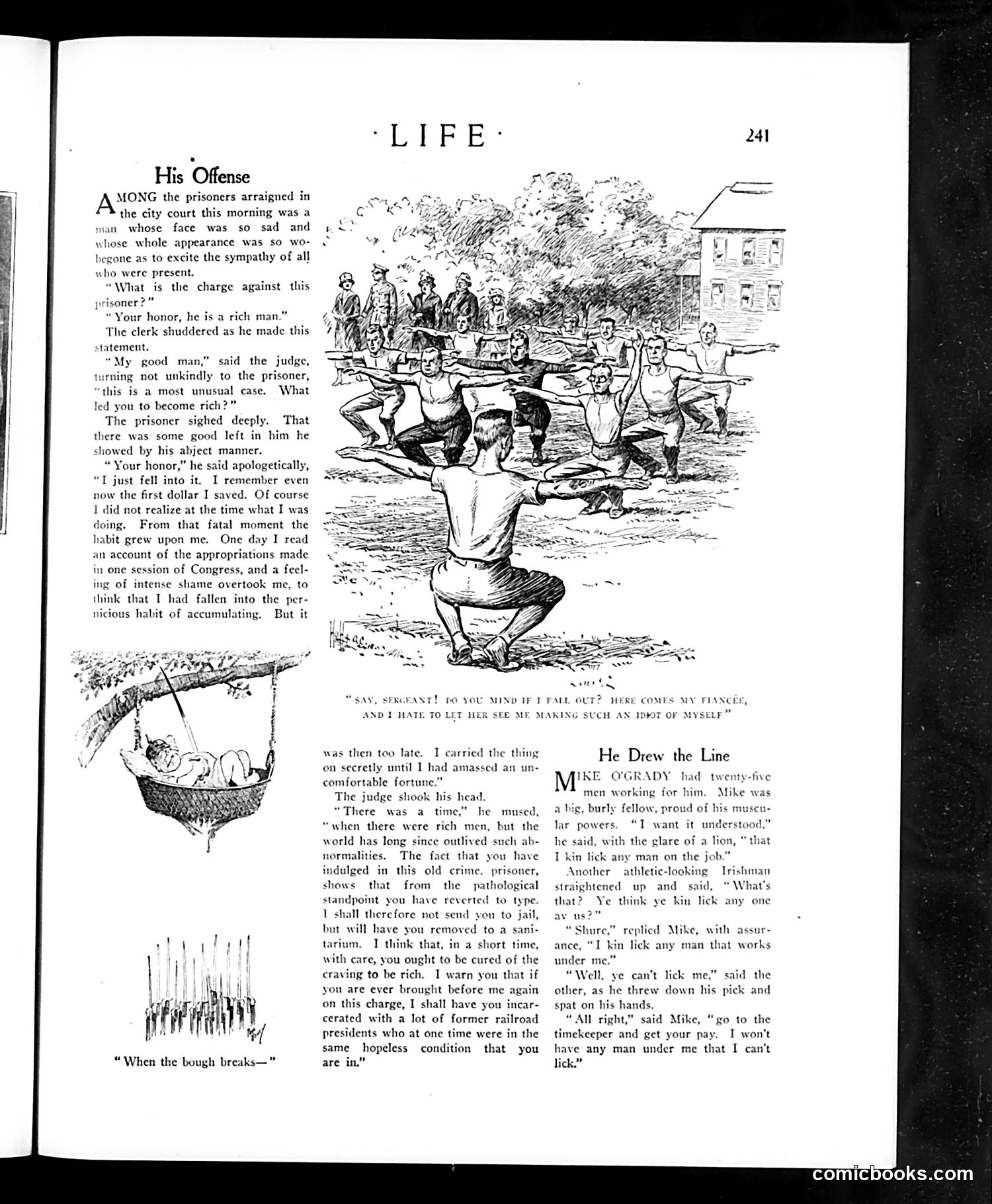
His Offense {ONG the prisoners arraigned in the city court this morning was a man whose face was so sad and whose whole appearance was so wo- hegone as to excite the sympathy of all who were present. “What is the charge against this soner?” Your honor, he is a rich man.” The clerk shuddered as he made this statement. “My good man,” said the judge, turning not unkindly to the prisoner, “this is a most unusual case. What led you to become rich?” The prisoner sighed deeply. That there was some good left in him he showed by his abject manner. he said apologetically, “TI just fell into it. I remember even now the first dollar I saved. Of course 1 did not realize at the time what I was doing. From that fatal moment the habit grew upon me. One day I read an account of the appropriations made in one session of Congress, and a feel- of intense shame overtook me, to ink that I had fallen into the per- nicious habit of accumulating. But it “When the bough breaks—” SAY, SERGEANT! 10 YOU MIND IFT FALL OUT? HERE COMES MY FIANCEE, AND I MATE TO LET HER SEE ME MAKING SUCH AN 1D#T OF MYSELF” was then too late. I carried the thing on secretly until I had amassed an un- comfortable fortune. The judge shook his head. “There was a time,” he mused, when there were rich men, but the world has long since outlived such ab- normalities. The fact that you have indulged in this old crime. prisoner, shows that from the pathological standpoint you have reverted to type. 1 shall therefore not send you to jail, but will have you removed to a sani- tarium. I think that, in a short time, with care, you ought to be cured of the craving to be rich. I warn you that if you are ever brought before me again on this charge, I shall have you incar- cerated with a lot of former railroad presidents who at one time were in the same hopeless condition that you are in.” He Drew the Line IKE O'GRADY had men working for him a hig, burly fellow, proud of his muscu- “T want it understood,” twenty-five Mike was lar powers. he said, with the glare of a lion, “that kin lick any man on the job.” Another athletic-looking Irishman straightened up and said, “ What's that? Ye think ye kin lick any one avous?” hur ance, “I kin lick under me.” “Well, ye can’t lick me,” said the other, as he threw down his pick and spat on his hands. “All right,” said Mike, “go to the timekeeper and get your pay. I won't have any man under me that I can't lick." replicd Mike, with assur- any man that works comicbooks.com