
Life, 1918-08-15 · page 20 of 36
Life — August 15, 1918 — page 20: what you’re looking at
What you’re looking at
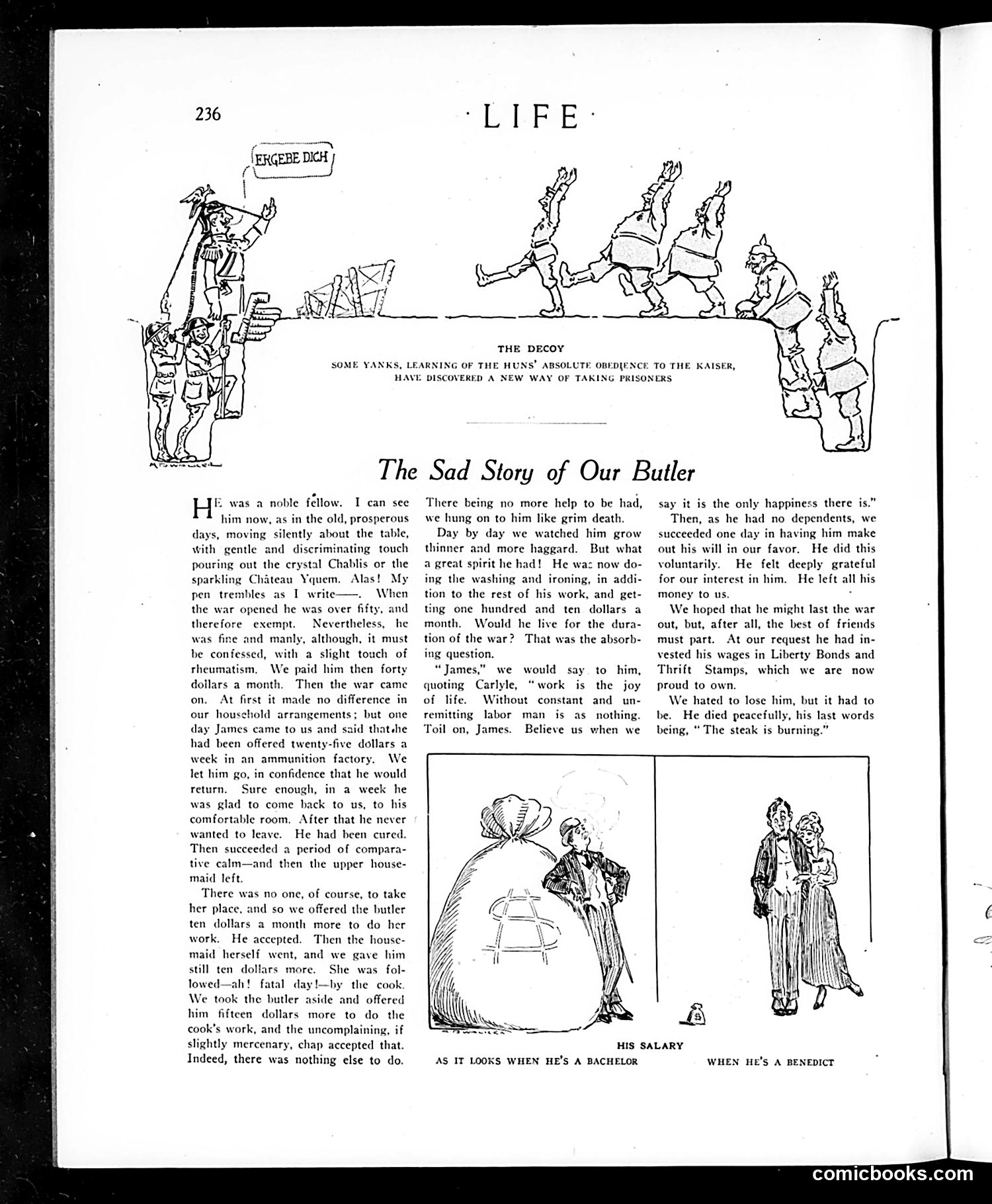
This WWI-era piece satirizes wealthy American households exploiting domestic servants during wartime labor shortages. **The Setup:** A butler, initially paid $40/month, becomes indispensable when other household staff enlist or seek better factory wages. His employers incrementally increase his pay (adding $10, then $10, then $15 monthly) while piling on additional duties—laundry, ironing, cooking—until he's doing all household work. **The Satire:** The wealthy narrator uses manipulative philosophy ("work is the joy of life") to justify the exploitation. The situation escalates absurdly: they pressure him to make them his beneficiary and invest his wages in war bonds, ultimately working him to death. **The Point:** This mocks the hypocrisy of privileged Americans who exploit wartime conditions and vulnerable workers while patriotically investing in the war effort. The butler's final words—"The steak is burning"—suggest he died at his post, still serving. The illustration showing his "salary" as a bachelor versus married man underscores economic desperation forcing service work.
📄 Transcribed text from this page (OCR, searchable)
Machine-transcribed from the original scan — historical spelling and the odd misread are preserved.
SOME YANKS, LEARNING OF THE HU THE DECOY ABSOLUTE OBEDIENCE TO THE KAISER, HAVE DISCOVERED A NEW WAY OF TAKING PRISONERS The Sad Story of Our Butler ; was a noble fellow. I can see him now, as in the old, prosperous ys, moving silently about the table, with gentle and discriminating touch pouring out the crystal Chablis or the sparkling Chateau Yquem. Alas! My pen trembles as I write—. When the war opened he was over fifty, and therefore exempt. Nevertheless, he was fine and manly, although, it must he confessed, with a slight touch of rheumatism. We paid him then forty dollars a month. Then the war came on. At first it made no difference in our household arrangements; but one day James came to us and said thatshe had been offered twenty-five dollars a week in an ammunition factory. We let him go, in confidence that he would return. Sure enough, in a week he was glad to come back to us, to his comfortable room. After that he never wanted to leave. He had been cured. Then succeeded a period of compar. tive calm—and then the upper hous maid left, There was no one, of course, to take her place, and so we offered the butler ten dollars a month more to do her work. He accepted. Then the house- maid herself went, and we gave him still ten dollars more. She was fol- lowed—ah! fatal day!—by the cook We took the butler aside and offered him fifteen dollars more to do the cook's work, and the uncomplaining, if slightly mercenary, chap accepted that. Indeed, there was nothing else to do. There being no more help to be had, we hung on to him like grim death. Day by day we watched him grow thinner and more haggard. But what a great spirit he had! He waz now do- ing the washing and ironing, in addi- tion to the rest of his work, and get- ting one hundred and ten dollars a month. Would he live for the dura- tion of the war? That was the absorb- ing question. “James,” we would say to him, quoting Carlyle, “work is the joy of life. Without constant and un- remitting labor man is as nothing. Toil on, James. Believe us when we say it is the only happiness there i Then, as he had no dependents, we succeeded one day in having him make out his will in our favor. He did this voluntarily. He felt deeply grateful for our interest in him. He left all his money to us. : We hoped that he might last the war out, but, after all, the best of friends must part. At our request he had in- vested his wages in Liberty Bonds and Thrift Stamps, which we are now proud to own. We hated to lose him, but it had to be. He died peacefully, his last words being, “ The steak is burning.” HIS SALARY AS IT LOOKS WHEN HE’S A BACHELOR WHEN HE'S A BENEDICT comicbooks.com