
Life, 1918-08-15 · page 16 of 36
Life — August 15, 1918 — page 16: what you’re looking at
What you’re looking at
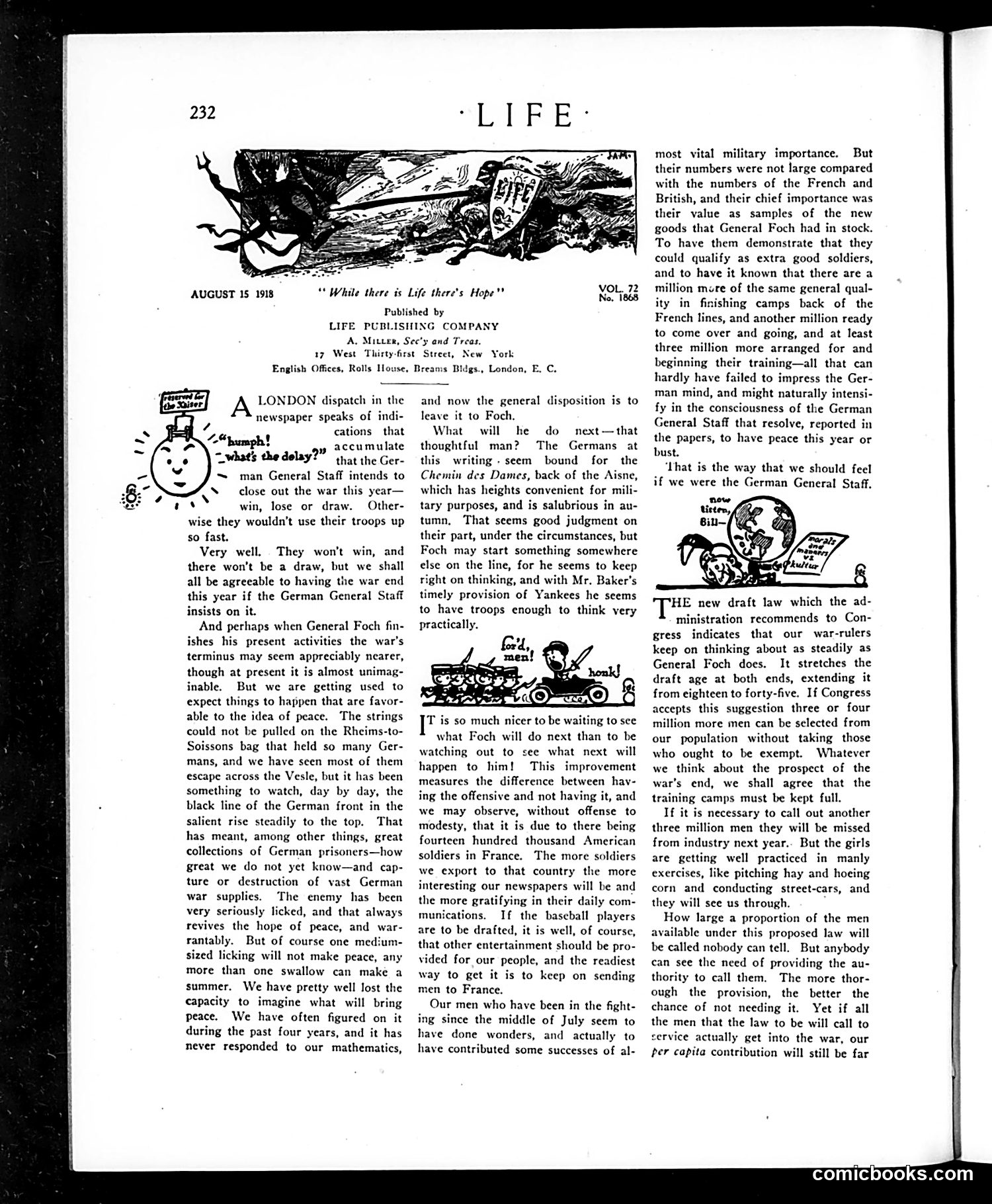
This page contains satirical commentary on World War I's final months. The main cartoon depicts an impatient figure asking "What's the delay?" regarding German General Staff intentions to end the war in 1918. The text sarcastically welcomes German plans to finish the war, noting that while Germany won't win or achieve a draw, Americans would accept ending it this year. The piece praises recent Allied military successes, particularly the capture of German prisoners and supplies near Rheims-Soissons, crediting American forces under French General Foch's command. The satire focuses on how 1.4 million American soldiers in France have transformed the war's momentum from defensive to offensive operations. Rather than anxiously watching what happens to Allied forces, Americans now pleasantly anticipate what Foch will do next. A secondary section discusses proposed draft law extensions, humorously suggesting that if baseball players are drafted, the entertainment loss matters less given exciting war developments.
📄 Transcribed text from this page (OCR, searchable)
Machine-transcribed from the original scan — historical spelling and the odd misread are preserved.
AUGUST 15 1918 “While there is Life there's Hope"* Published by LIFE PUBLISHING COMPANY A, Mutter, Sec'y and Treas. 17 West English Offices, Rolls House, Breams BI LONDON dispatch in the newspaper speaks of indi- AM emph! cations that P on accumulate Lwhats the delay?” that the Ger- ™ man General Staff intends to ‘\ close out the war this year— win, lose or draw. Other- wise they wouldn’t use their troops up so fast. Very well. They won't win, and there won't be a draw, but we shall all be agreeable to having the war end this year if the German General Staff insists on it. And perhaps when General Foch fin- ishes his present activities the war's terminus may seem appreciably nearer, though at present it is almost unimag- inable. But we are getting used to expect things to happen that are favor- able to the idea of peace. The strings could not be pulled on the Rheims-to- Soissons bag that held so many Ger- mans, and we have seen most of them escape across the Vesle, but it has been. something to watch, day by day, the black line of the German front in the salient rise steadily to the top. That has meant, among other things, great collections of German prisoners—how great we do not yet know—and cap- ture or destruction of vast German war supplies. The enemy has been very seriously licked, and that always revives the hope of peace, and war- rantably. But of course one medium- sized licking will not make peace, any more than one swallow can make a summer. We have pretty well lost the capacity to imagine what will bring peace. We have often figured on it during the past four years, and it has never responded to our mathematics, ‘Thisty-first Street, New York s., London, E, C. and now the general disposition is to leave it to Foch, What will) he do thoughtful man? The Germans at this writing. seem bound for the Chemin des Dames, back of the Aisne, which has heights convenient for mili- tary purposes, and is salubrious in au- tumn, That seems good judgment on their part, under the circumstances, but Foch may start something somewhere else on the line, for he seems to keep right on thinking, and with Mr. Baker's timely provision of Yankees he seems to have troops enough to think very practically. next —that T is so much nicer to be waiting to see what Foch will do next than to be watching out to see what next will happen to him! This improvement measures the difference between hav- ing the offensive and not having it, and we may observe, without offense to modesty, that it is due to there being fourteen hundred thousand American soldiers in France. The more soldiers we export to that country the more interesting our newspapers will be and the more gratifying in their daily com- munications. If the baseball players are to be drafted, it is well, of course, that other entertainment should be pro- vided for our people, and the readiest way to get it is to keep on sending men to France. Our men who have been in the fight- ing since the middle of July seem to have done wonders, and actually to have contributed some successes of al- most vital military importance. But their numbers were not large compared with the numbers of the French and British, and their chief importance was their value as samples of the new goods that General Foch had in stock. To have them demonstrate that they could qualify as extra good soldiers, and to have it known that there are a million more of the same general qual- ity in finishing camps back of the French lines, and another million ready to come over and going, and at least three million more arranged for and beginning their training—all that can hardly have failed to impress the Ger- man mind, and might naturally intensi- fy in the consciousness of the German General Staff that resolve, reported in the papers, to have peace this year or bust. ‘That is the way that we should feel if we were the German General Staff. HE new draft law which the ad- ministration recommends to Con- gress indicates that our war-rulers keep on thinking about as steadily as General Foch does. It stretches the draft age at both ends, extending it from eighteen to forty-five. If Congress accepts this suggestion three or four million more men can be selected from our population without taking those who ought to be exempt. Whatever we think about the prospect of the war's end, we shall agree that the training camps must be kept full. If it is necessary to call out another three million men they will be missed from industry next year.. But the girls are getting well practiced in manly exercises, like pitching hay and hoeing corn and conducting street-cars, and they will see us through. How large a proportion of the men available under this proposed law will be called nobody can tell. But anybody can see the need of providing the au- thority to call them. The more thor- ough the provision, the better the chance of not needing it. Yet if all the men that the law to be will call to service actually get into the war, our ber capita contribution will still be far comicbooks.com