
Life, 1918-08-15 · page 15 of 36
Life — August 15, 1918 — page 15: what you’re looking at
What you’re looking at
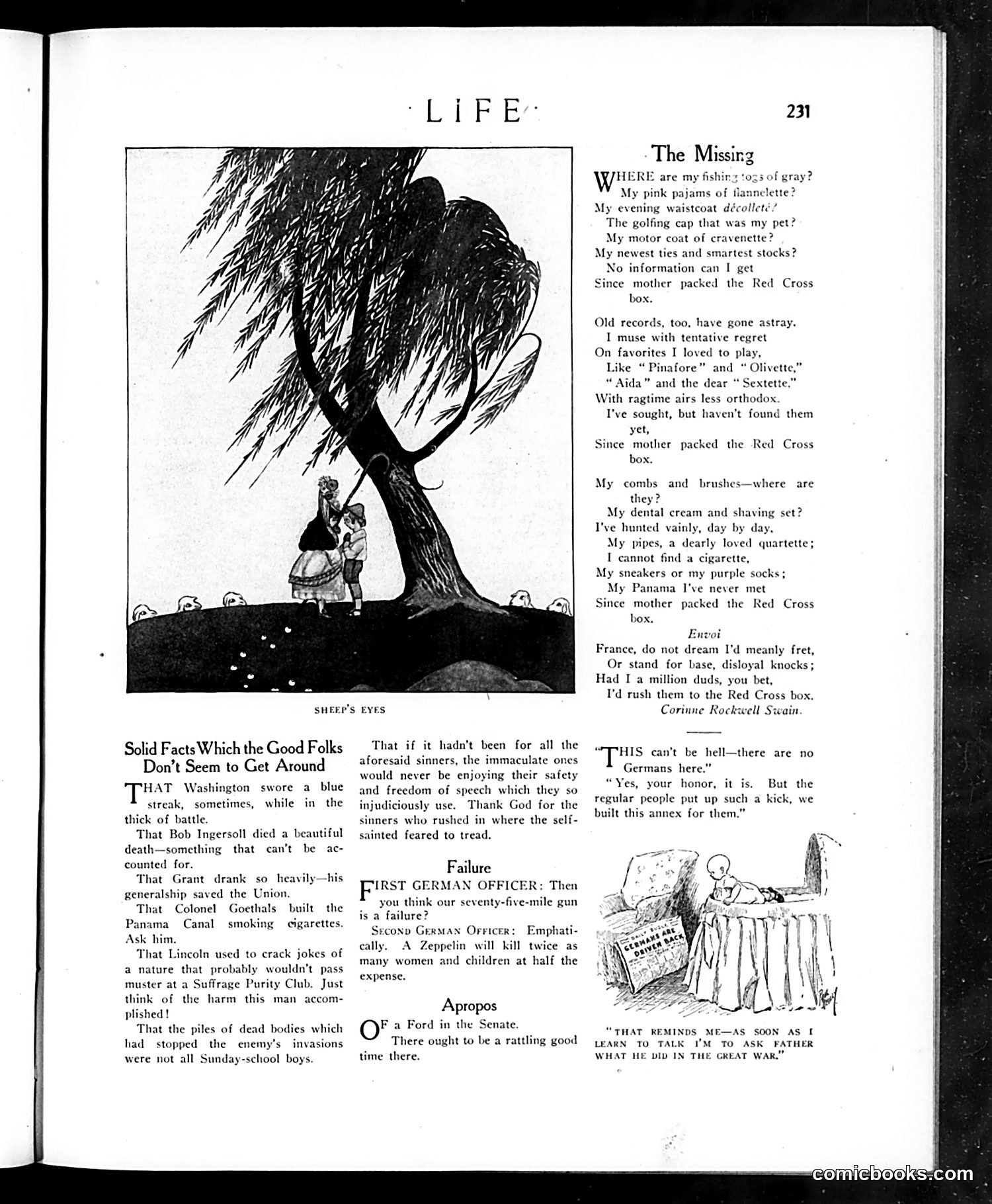
This Life magazine page contains war-related satire about material shortages during World War I. The poem "The Missing" humorously catalogs personal items a mother packed away in a Red Cross relief box—fishing gear, pajamas, ties, combs, pipes, socks—that the narrator now desperately needs but cannot find. Below, "Solid Facts Which the Good Folks Don't Seem to Get Around" satirizes historical revisionism, listing famous figures (Washington, Grant, Lincoln, Colonel Goethals) and their actual vices or accomplishments, countering romanticized versions. The dialogue sections mock German military justifications for weapons like Zeppelins and 75-mile guns used against civilians. The illustration "Sheep's Eyes" depicts a woman and children sheltering under a tree, suggesting civilian vulnerability to bombardment.
📄 Transcribed text from this page (OCR, searchable)
Machine-transcribed from the original scan — historical spelling and the odd misread are preserved.
SHEEP'S Solid Facts Which the Good Folks Don’t Seem to Get Around HAT Washington streak, sometimes, thick of battle. That Bob Ingersoll died a beautiful death—something that can’t be ac- counted for. That Grant drank so heavily—his generalship saved the Union. That Colonel Goethals Panama Canal smoking Ask him. hat Lincoln used to crack jokes of a nature that probably wouldn’t pass muster at a Suffrage Purity Club. Just think of the harm this man accom- plished! That the piles of dead bodies which had stopped the enemy's invasions were not all Sunday-school boys. swore a blue while in the built the cigarettes. EYES That if it hadn't been for all the aforesaid sinners, the immaculate ones would never be enjoying their s: and freedom of speech which they so injudiciously use. Thank God for the sinners who rushed in where the self- sainted feared to tread. Failure IRST GERMAN OFFICER: Then you think our seventy-five-mile gun is a failure? Seconp German Orrici Emphati- cally. A Zeppelin will kill twice as many women and children at half the expense. Apropos F a Ford in the Senate. There ought to be a rattling good time there, 231 My evening waistcoat décolleté? The golfing cap that was my pet? My motor coat of cravenette? My newest ties and smartest stocks? No information can I get Since mother packed the Red Cross box. Old records, too, have gone astray. I muse with tentative regret On favorites I loved to play, Like “Pinafore” and “ Olivette,” and the dear “ Sextette,” With ragtime airs less orthodox. I've sought, but haven't found them yet, Since mother packed the Red Cross box. My combs and brushes—where they? My dental cream and shaving set? I've hunted vainly, day by day, My pipes, a dearly loved quartette; are I cannot find a cigarette, My sneakers or my purple socks; My Panama I've never met Since mother packed the Red Cross box. Envoi France, do not dream I'd meanly fret, Or stand for base, disloyal knocks; Had I a million duds, you bet, I'd rush them to the Red Cross box. Corinne Rockwell Swain “THIS can't be hell—there are no Germans here.” “Yes, your honor, it is. But the regular people put up such a kick, we built this annex for them.” “THAT LEARN TO TALK I'M TO WHAT HE DID IN THE GREAT WAR