
Life, 1918-08-15 · page 10 of 36
Life — August 15, 1918 — page 10: what you’re looking at
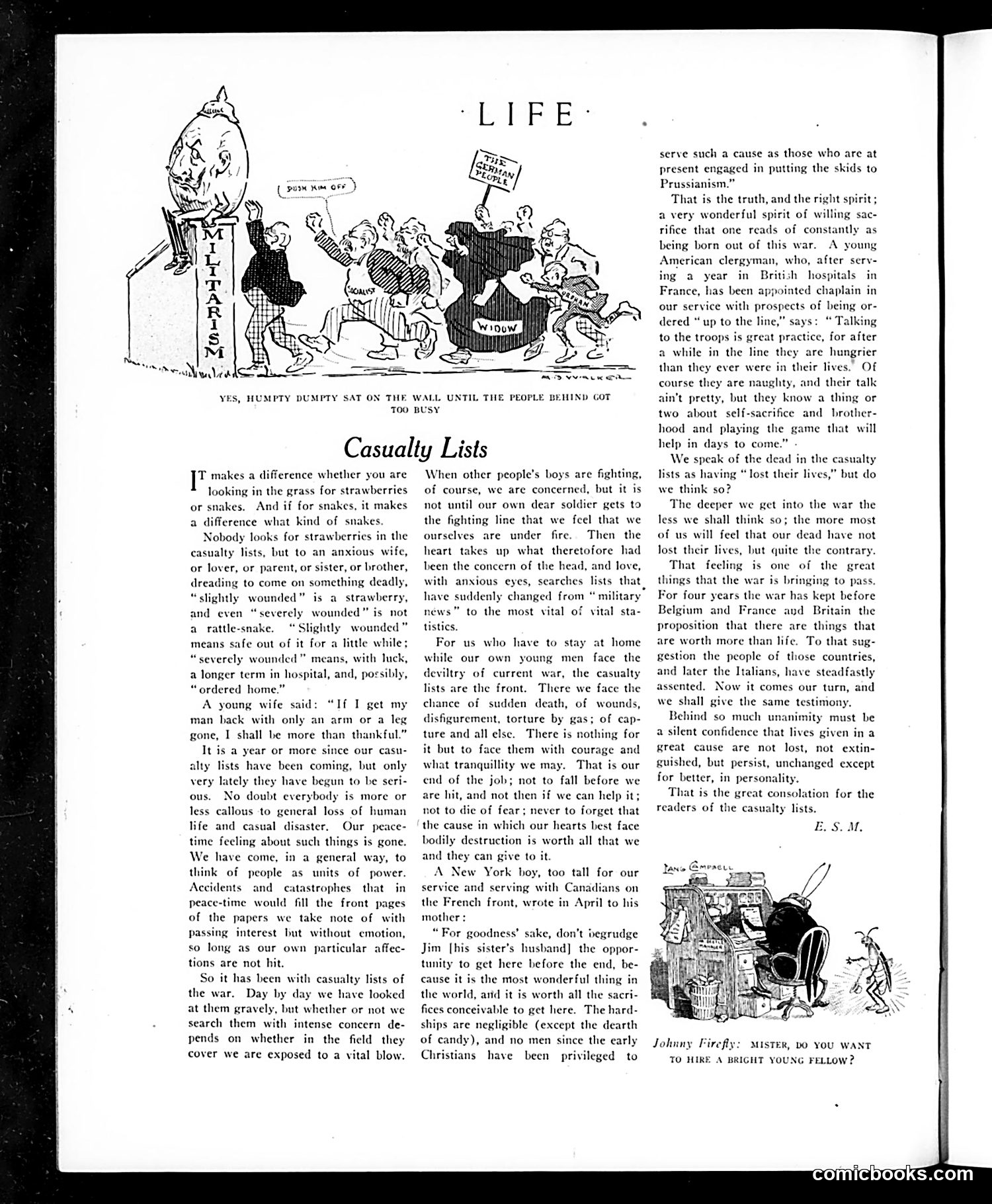
What you’re looking at
**The Main Cartoon** (top): Shows a large figure labeled "MILITARISM" sitting on a wall while various figures below—appearing to represent civilians, including children—hold signs reading "STOP PRUSSIAN-ISM" and other protest messages. The caption reads: "YES, HUMPTY DUMPTY SAT ON THE WALL UNTIL THE PEOPLE BEHIND GOT TOO BUSY." **Meaning**: This is anti-German propaganda from WWI era. The cartoon equates German militarism with Humpty Dumpty—an unstable, vulnerable force that will eventually fall when common people focus on resistance. The reference to "Prussian-ism" targets Prussian military culture as the root cause of the war. **Context**: Life magazine used satire to support American entry into WWI against Germany.
📄 Transcribed text from this page (OCR, searchable)
Machine-transcribed from the original scan — historical spelling and the odd misread are preserved.
YES, HUMPTY DUMPTY Too Bi SAT ON THE W. ALL UNTIL THE PEOPLE BEHIND GOT Casualty Lists T makes a difference whether you are looking in the grass for strawberries or snakes. And if for snakes, it makes a difference what kind of snakes. Nobody looks for strawberries in the casualty lists, but to an anxious wife, or lover, or parent, or sister, or brother, dreading to come on something deadly, wounded” is a strawberry, “ slightly and even “severely wounded” is not a rattle-snake. “Slightly wounded” means safe out of it for a little while; “severely wounded” means, with luck, a longer term in hospital, and, possibly, “ordered home.” A young wife said: “If I get my man back with only an arm or a leg gone, I shall be more than thankful.” It is a year or more since our casu- alty lists have been coming, but only very lately they have begun to be seri- ous. No doubt everybody is more or less callous to general loss of human life and casual disaster, Our peace- time feeling about such things is gone. We have come, in a general way, to think of people as units of power. Accidents and. catastrophes that in peace-time would fill the front pages of the papers we take note of with passing interest but without cmotion, so long as our own particular affec- tions are not hit. So it has been with casualty lists of the war. Day by day we have looked at them gravely, but whether or not we search them with intense concern de- pends on whether in the field they cover we are exposed to a vital blow. When other people's boys are fighting, of course, we are concerned, but it is not until our own dear soldier gets to the fighting line that we fcel that we ourselves are under fire. Then the heart takes up what theretofore had heen the concern of the head, and love, with anxious eyes, searches lists that have suddenly changed from “ military” ws” to the most vital of vital sta- tistics. For us who have to stay at home while our own young face the deviltry of current war, the casualty lists are the front. There we face the chance of sudden death, of wounds, disfigurement, torture by gas; of cap- ture and all else. There is nothing for it but to face them with courage and what tranquillity we may. That is our end of the job; not to fall before we are hit, and not then if we can help it; not to die of fear; never to forget that the cause in which our hearts best face bodily destruction is worth all that we and they can give to it. A New York hoy, too tall for our service and serving with Canadians on the French front, wrote in April to his mother : “For goodness’ sake, don't begrudge Jim [his sister’s husband] the oppor- tunity to get here before the end, be- cause it is the most wonderful thing in the world, arid it is worth all the sacri- fices conceivable to get here. The hard- ships are negligible (except the dearth of candy), and no men since the early Christians have been privileged to men serve such a cause as those who are at nt engaged in putting the skids to pres Prussianism. That is the truth, and the right spirit; a very wonderful spirit of willing sac- rifice that one reads of constantly as being born out of this war. A young American clergyman, who, after serv- ing a year in British France, has been appointed chaplain in with prospects of being or- dered “up to the line,” says: “ Talking to the troops is great prac’ for after a while in the line they are hungrier than they ever were in their lives. Of course they are naughty, and their talk ain’t pretty, but they know a thing or two about self-sacrifice and brother- hood and playing the game that will help in days to come. We speak of the dead in the casualty lists as having “lost their lives,” but do we think so? The deeper we get into the war the less we shall think so; the more most of us will feel that our dead have not lost their lives, hut quite the contrary. That feeling is one the great things that the war is bringing to pass. For four years the war has kept before Belgium and France aud Britain the proposition that there are things that are worth more than life. To that sug- gestion the people of those countries, and later the Italians, have steadfastly assented. Now it comes our turn, and we shall give the same testimony, Behind so much unanimity must be a silent confidence that lives given in a lost, not extin- guished, but persist, unchanged except for better, in personality. That is the great consolation for the readers of the casualty lists. hospitals in our sery of great cause are not Lane Gmvace Johnny Firefly: sister, vo you wy TO HIRE A BRIGHT YOUNG FELLOW?