
Life, 1918-08-15 · page 21 of 36
Life — August 15, 1918 — page 21: what you’re looking at
What you’re looking at
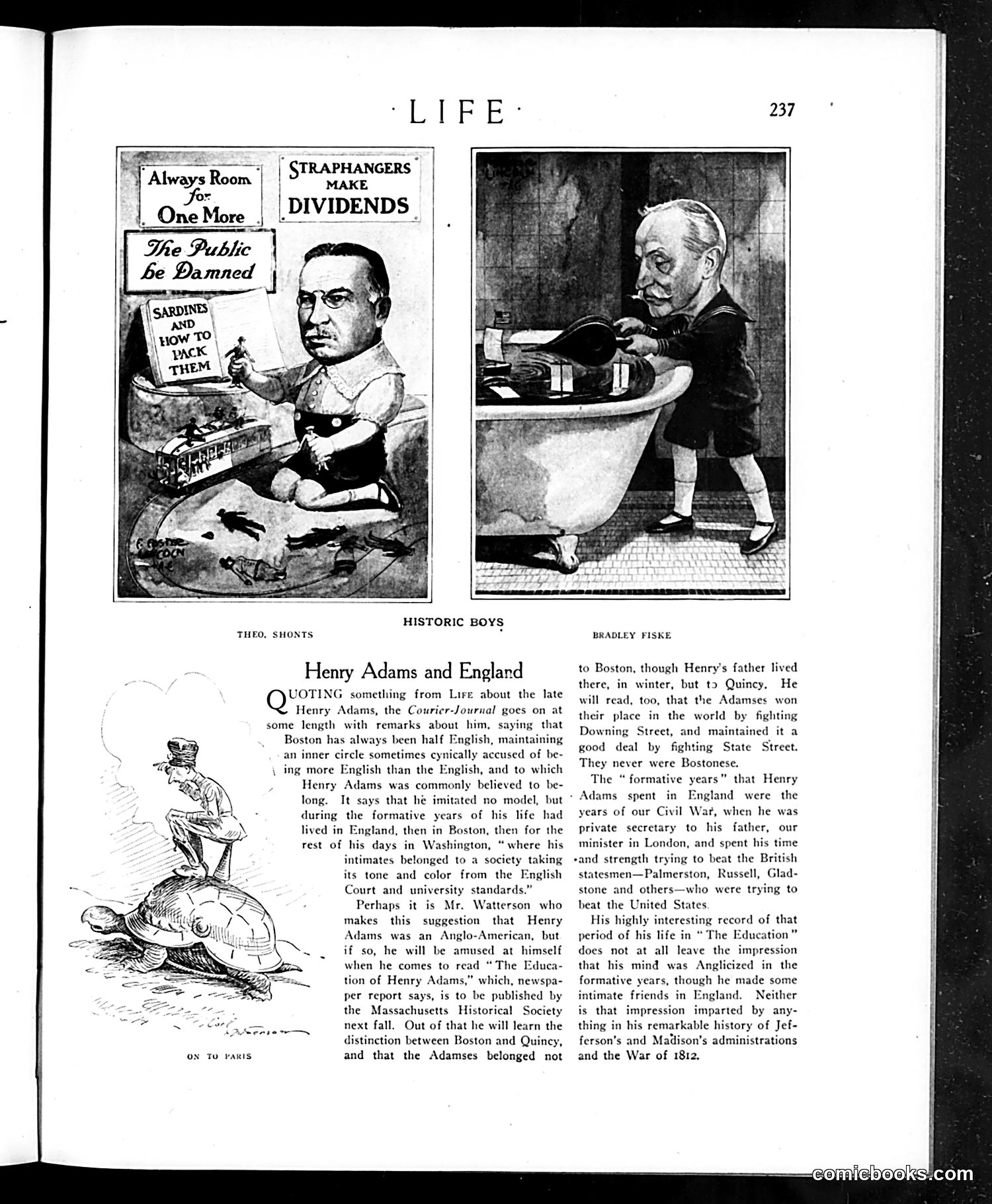
**Top Left Cartoon (Theo. Shonts):** A caricatured railroad executive holds signs reading "Always Room for One More," "The Public Be Damned," and "Sardines and How to Pack Them," while sardines spill from a crowded streetcar below. This satirizes overcrowded public transit and corporate indifference to passenger welfare—referencing the infamous "public be damned" attitude of 19th-century robber barons prioritizing profit over service. **Top Right Cartoon (Bradley Fiske):** An elderly man pours what appears to be dividends or money into a bathtub. This likely critiques wealthy financiers accumulating excessive corporate profits. **Main Article:** A defense of historian Henry Adams against accusations he was "Anglicized," arguing instead that Adams actively opposed British interests during the Civil War (as secretary to his diplomat father) and remained committed to American ideals. The piece disputes Eastern establishment stereotypes about Boston elites.
📄 Transcribed text from this page (OCR, searchable)
Machine-transcribed from the original scan — historical spelling and the odd misread are preserved.
| DIVIDENDS | ‘YT Always Room | | _Une More _| The Public | be Damned J HISTORIC BOYS THEO, SHONTS . Henry Adams and Englard QUOTING something from Lire about the late Henry Adams, the Courier-Journal goes on at some length with remarks about him, ing that Boston has always been half English, maintaining an inner circle sometimes cynically accused of be- \ ing more English than the English, and to which Henry Adams was commonly believed to be- long. It says that he imitated no model, but during the formative years of his life had lived in England, then in Boston, then for the rest of his days in Washington, “where his intimates belonged to a society taking its tone and color from the English Court and university standards.” Perhaps it is Mr. Watterson who makes this suggestion that Henry Adams was an Anglo-American, but if so, he will be amused at himself when he comes to read “The Educa- tion of Henry Adams,” which, newspa- per report says, is to be published by the Massachusetts Historical Society next fall. Out of that he will learn the distinction between Boston and Quincy, ON TO YARIS and that the Adamses belonged not BRADLEY FISKE to Boston, though Henry's father lived there, in winter, but to Quincy, He will read, too, that the Adamses won their place in the world by fighting Downing Street, and maintained it a good deal by fighting State Street. They never were Bostonese. The “formative years” that Henry - Adams spent. in gland were the years of our Civil War, when he was vate secretary to his father, our ister in London, and spent his time and strength trying to beat the British statesmen—Palmerston, Russell, d= stone and others—who were trying to beat the United States His highly interesting record of that period of his life in “ The Education” does not at all leave the impression that his mind was Anglicized in the formative years, though he made some intimate friends in England. Neither is that impression imparted by any- thing in his remarkable history of Jef- ferson’s and Madison's administrations and the War of 1812,