
A complete issue · 36 pages · 1918
Life — August 8, 1918
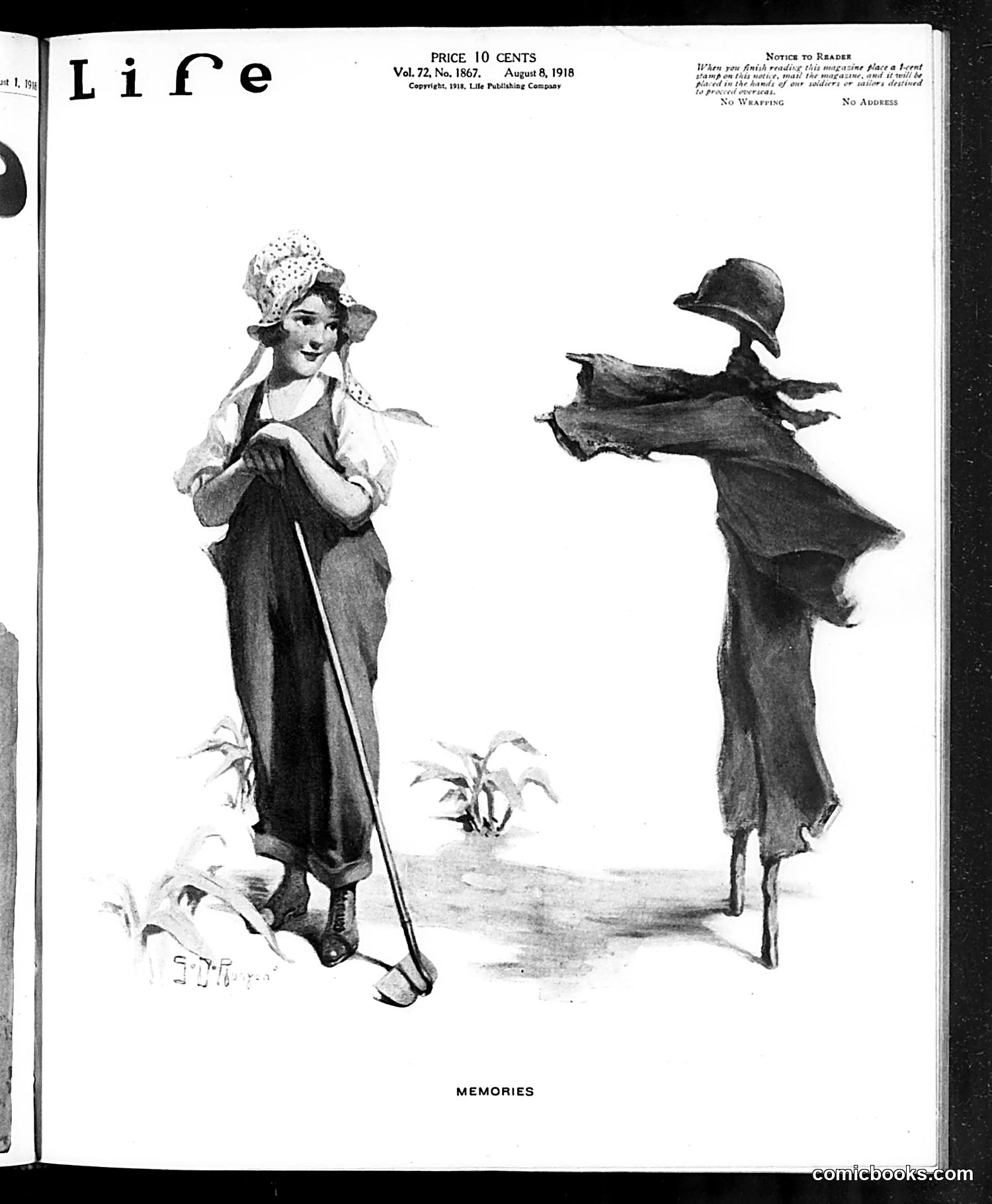
This page titled "Memories" presents two figures in what appears to be a nostalgic or reflective comparison. The left figure is a woman in working attire (dark pants, white shirt, headscarf) holding a farming tool, suggesting agricultural or manual labor. The right figure appears to be the same woman in more fashionable dress with a flowing coat and hat, in a more refined pose. The cartoon likely comments on wartime changes in women's roles. During World War I, women entered traditionally male-dominated work like farming and factory labor. This image may satirize either the temporary nature of these opportunities or the contrast between women's actual wartime contributions and their pre-war domestic expectations—suggesting these "memories" of independence would be fleeting.
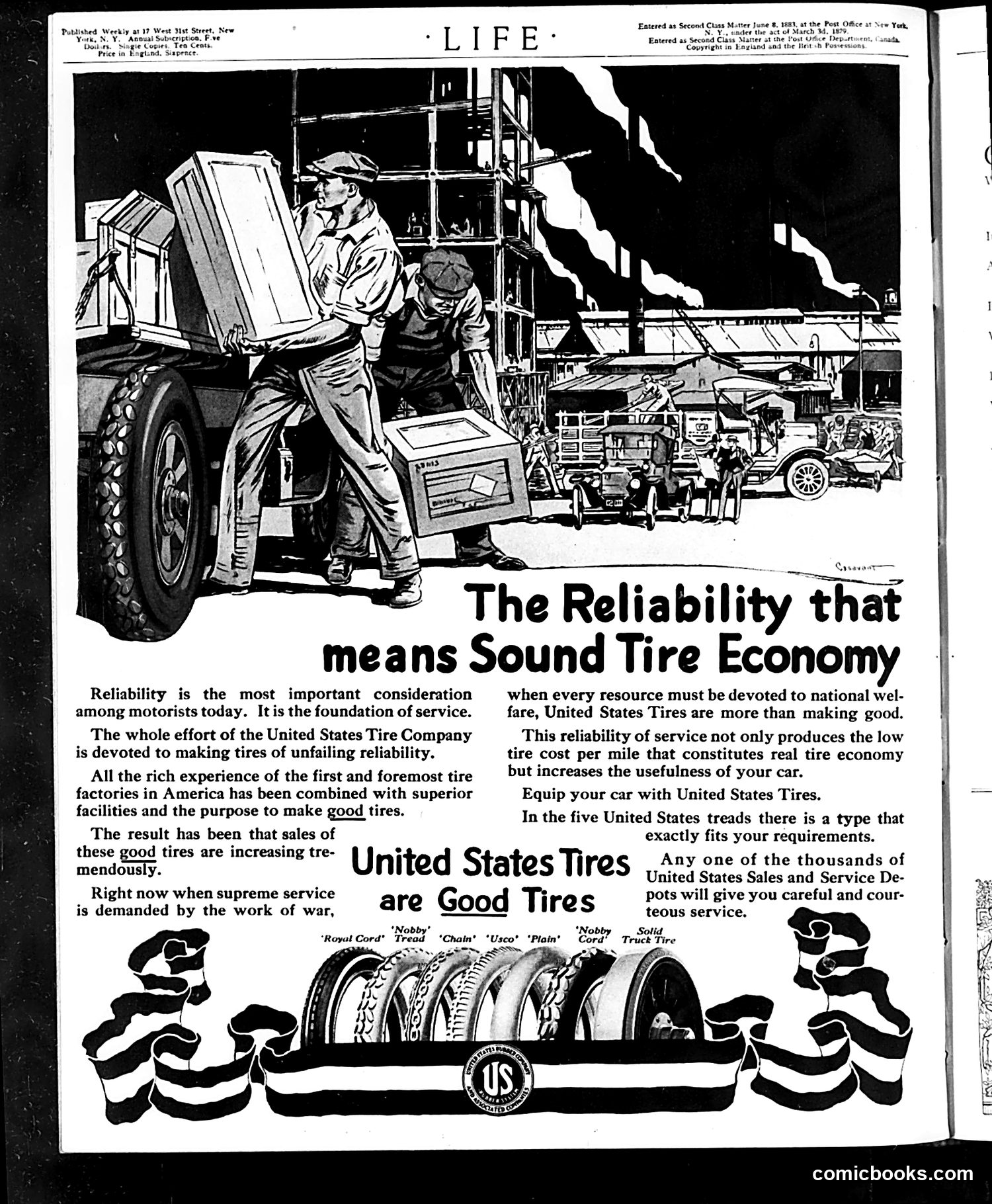
This is a **United States Tires company advertisement**, not political satire. The page promotes tire reliability during what appears to be WWI era (referenced by "when every resource must be devoted to national welfare"). The illustration shows workers loading crates onto a truck, emphasizing industrial productivity and wartime supply chains. The ad argues that US Tires' reliability translates to "tire economy"—lower cost-per-mile and vehicle longevity. The bottom displays six tire models ('Royal Cord,' 'Nobby Tread,' 'Chain,' 'Usco,' 'Plain,' 'Solid Truck Tire'), suggesting product diversity for different vehicle needs. The patriotic framing—linking tire quality to national service during wartime—was typical commercial messaging of the 1910s-20s, positioning consumer products as contributions to the war effort.
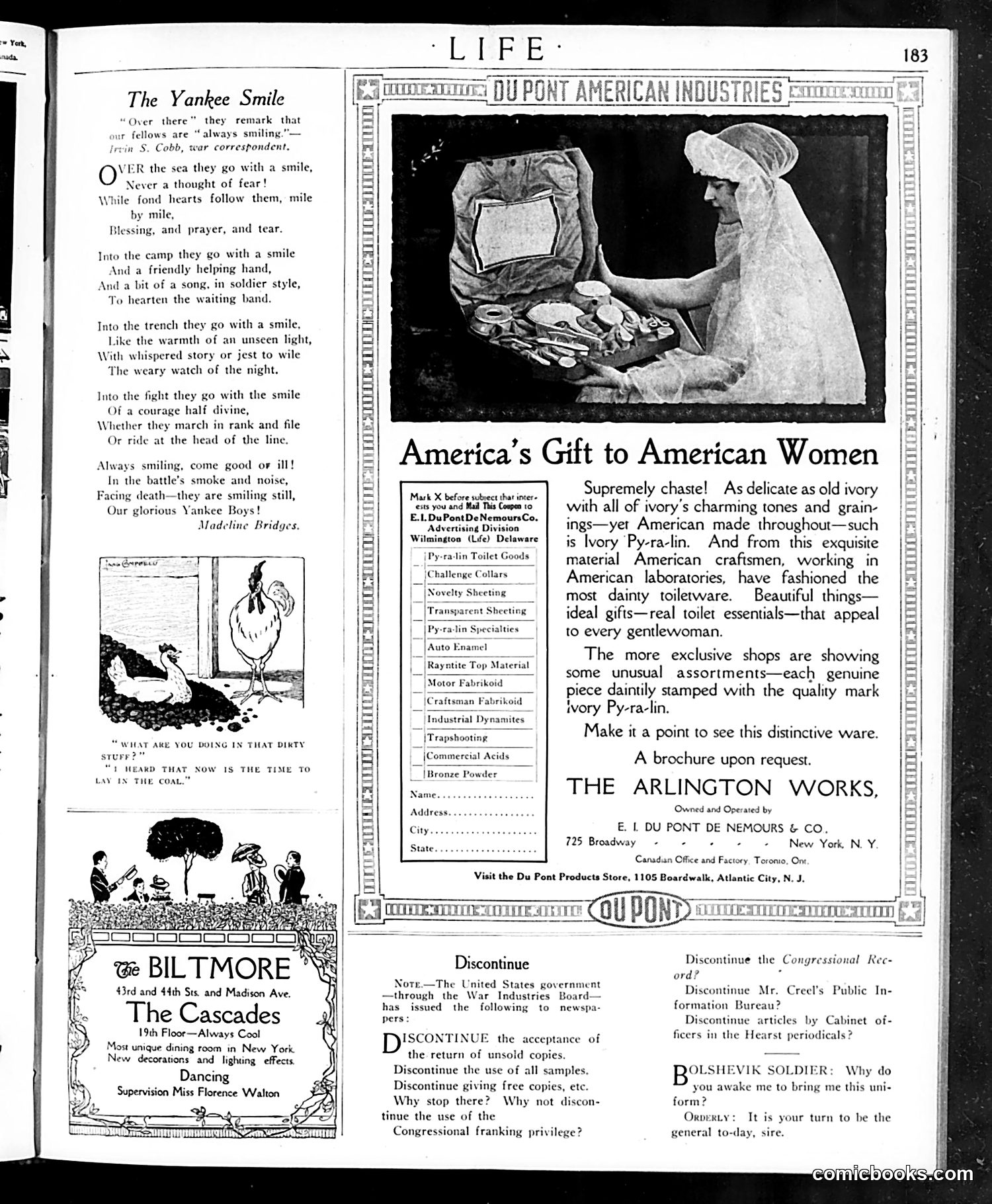
This page is primarily **advertising and light editorial content**, not political satire. **Left side:** "The Yankee Smile" is a patriotic poem by Madeline Bridges celebrating American soldiers' morale during what appears to be **World War I** (references to trenches, battles, marching). The accompanying cartoon shows a soldier humorously discussing "dirty stuff" with another soldier. **Right side:** A DuPont Industries advertisement for "Py-ra-lin" (celluloid) toilet goods marketed as "America's Gift to American Women," emphasizing quality American craftsmanship. **Bottom:** Restaurant advertisement for The Biltmore's Cascades dining room. The page reflects early-20th-century commercial and patriotic messaging, with the poem serving as morale-building wartime content rather than satire. The juxtaposition of war sentiment with luxury consumer advertising is notable.
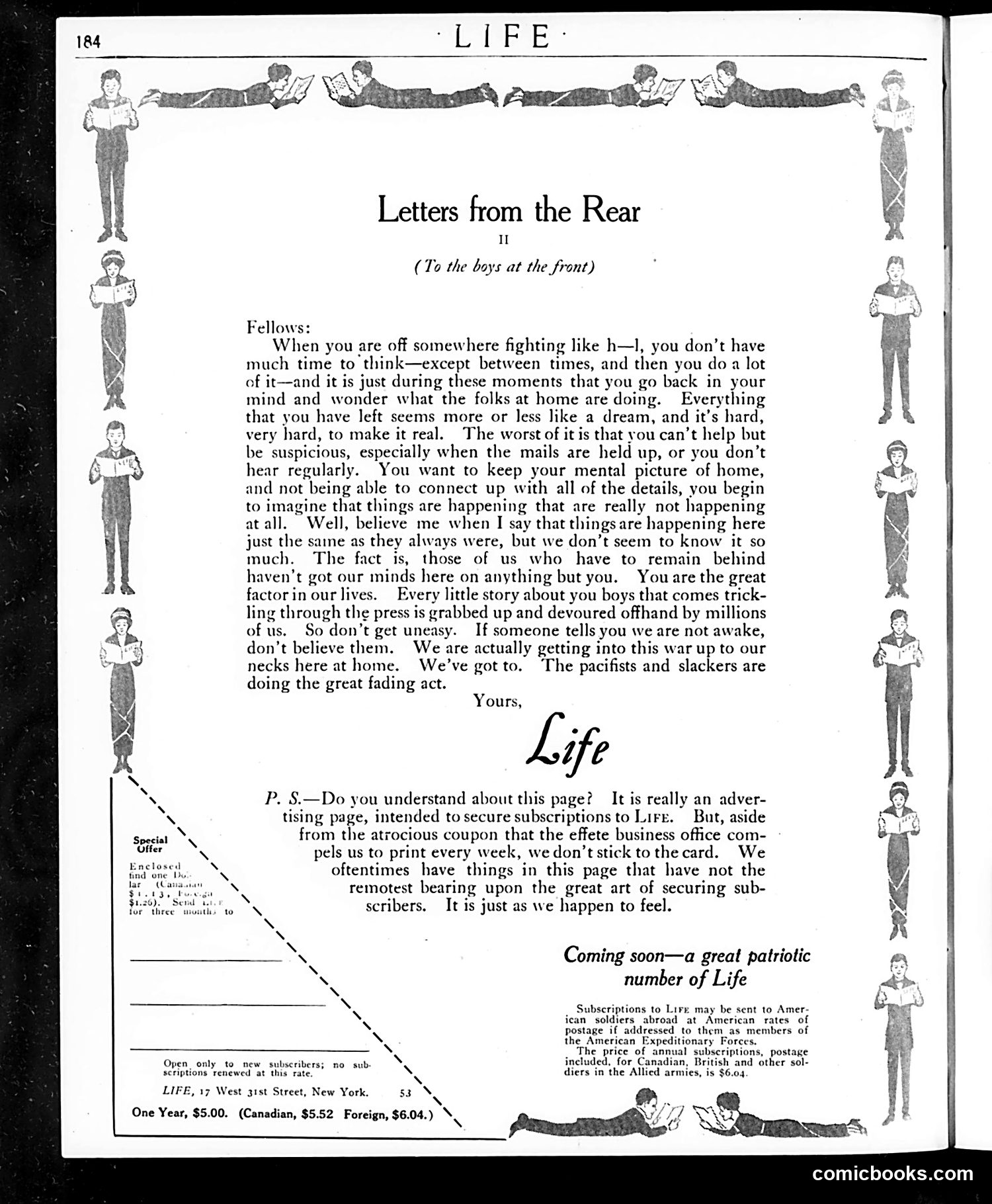
This page is primarily a **letter to soldiers at the front** from *Life* magazine's editors, not a political cartoon. The content addresses homesickness and disconnection experienced by deployed troops. The editors acknowledge that soldiers worry about home life and miss details, which can fuel imagination and anxiety. They reassure readers that life continues normally at home despite wartime conditions. The P.S. note admits this is essentially an **advertising page** designed to secure subscriptions, but claims *Life* prints content based on genuine editorial feeling rather than strict commercial rules. The decorative border features illustrated figures in military uniforms. This appears to be **WWI-era content**, given references to soldiers abroad and "American Expeditionary Forces."
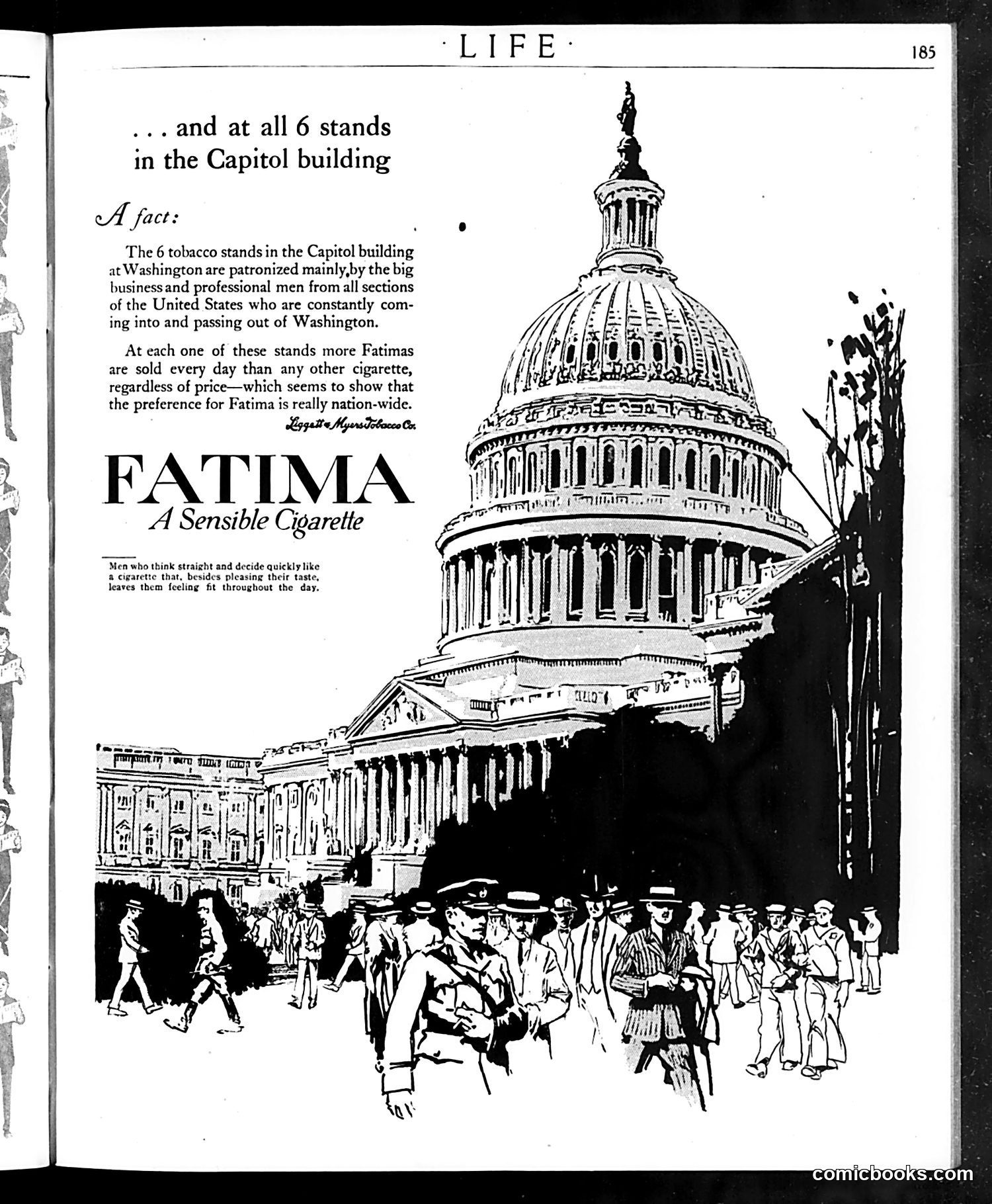
This is primarily a **cigarette advertisement**, not political satire. It promotes Fatima cigarettes by claiming they're sold more frequently than competitors at all six tobacco stands in the U.S. Capitol building, supposedly because of preference among "big business and professional men from all sections of the United States." The advertisement features an illustration of the Capitol building with crowds of people outside, designed to evoke prestige and authority. The tagline calls Fatima "A Sensible Cigarette," and includes a testimonial about how men who smoke it "think straight and decide quickly." This reflects early 20th-century advertising practices: using government institutions and appeals to masculinity/professional success to market tobacco products—tactics that would later become illegal.
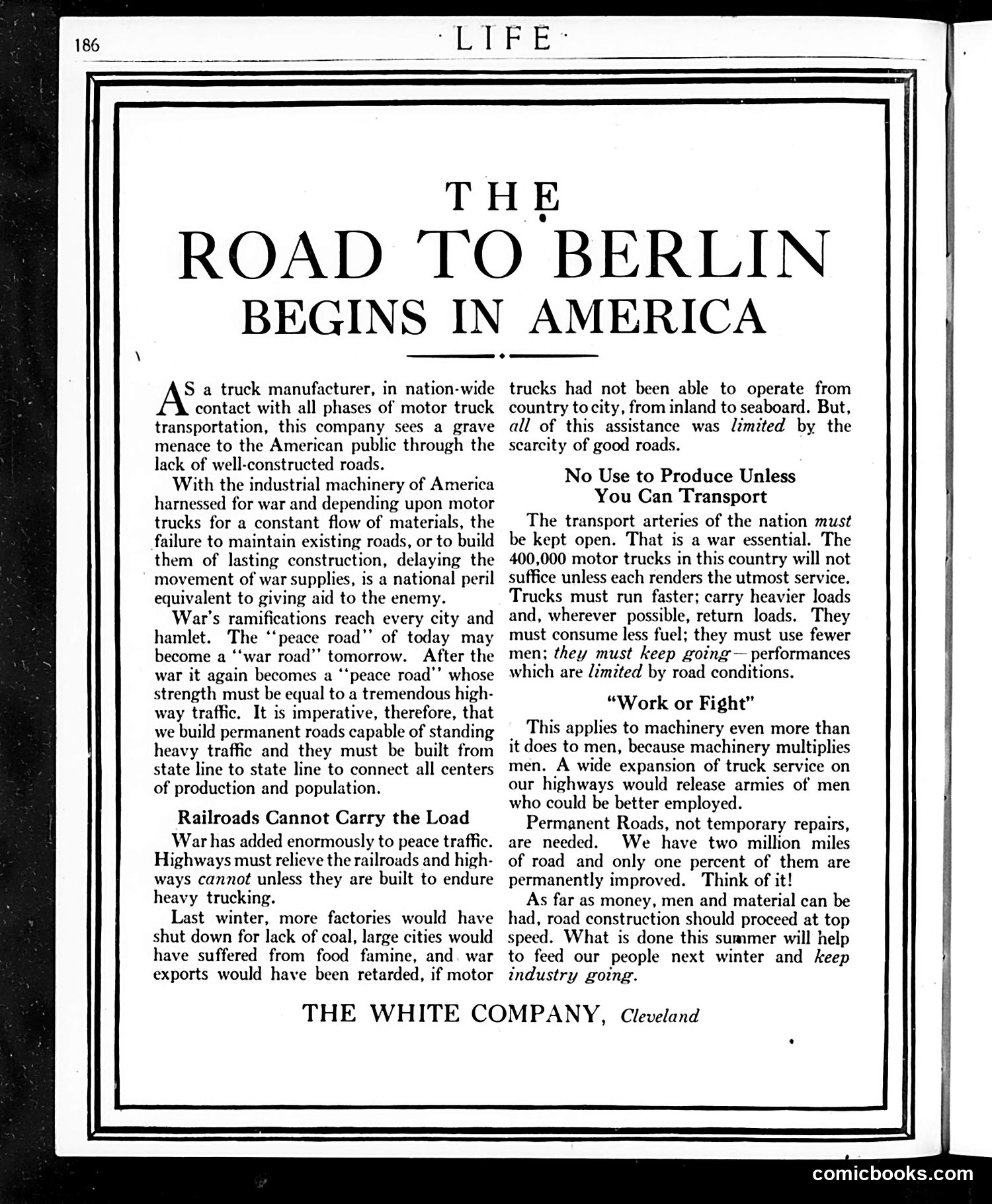
This is **not a satirical cartoon** but rather a **serious wartime advertisement** from The White Company (a truck manufacturer in Cleveland). Published during World War I, it argues that America's inadequate road infrastructure threatens military logistics. The ad's central argument: with 400,000 motor trucks needed to transport war materials, poor roads severely limit efficiency. It claims railroads alone cannot handle the burden, so the nation must urgently build permanent, high-quality highways connecting production centers. The phrase "The Road to Berlin Begins in America" uses martial rhetoric to frame infrastructure investment as a patriotic war necessity. This represents typical WWI-era corporate appeals linking commercial interests (truck sales) to national defense, lobbying for government road-building expenditure as essential war support.
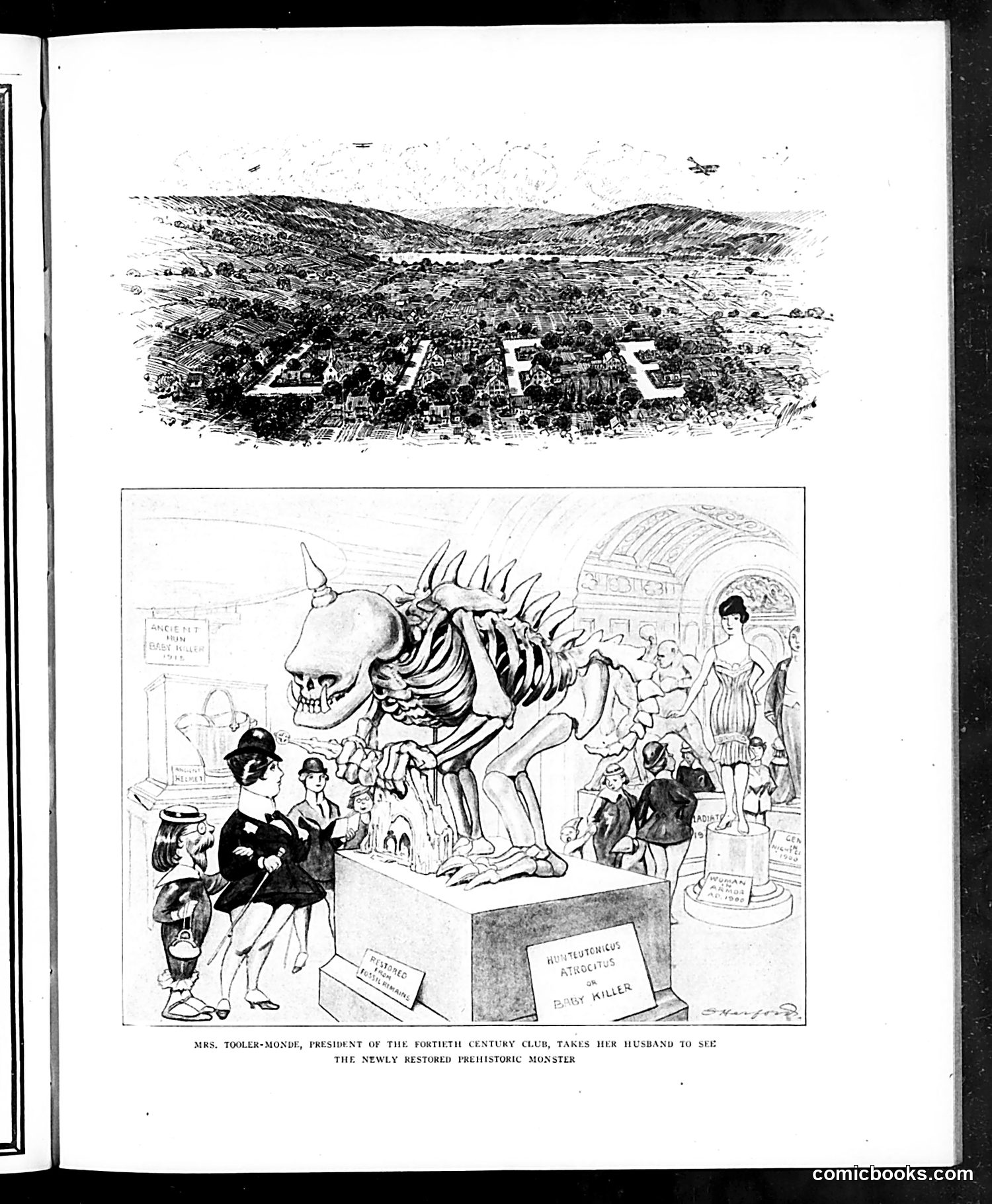
This satirical cartoon depicts **Mrs. Tooler-Monde, President of the Fortieth Century Club**, showing her husband a reconstructed prehistoric monster in what appears to be a museum exhibit. The joke targets wealthy women's clubs and their pretensions to culture and sophistication. The "Fortieth Century Club" is a humorous inversion—suggesting these organizations, though modern, aspire to ancient importance. The monster, labeled as "newly restored prehistoric," appears grotesquely exaggerated with spikes and skeletal features. The satire mocks both the authenticity of museum exhibits and the social aspirations of club members who display them. The casual gallery setting with other visitors suggests museums as status symbols for the elite. The husband's bemused expression implies gentle mockery of his wife's enthusiasm for such displays.
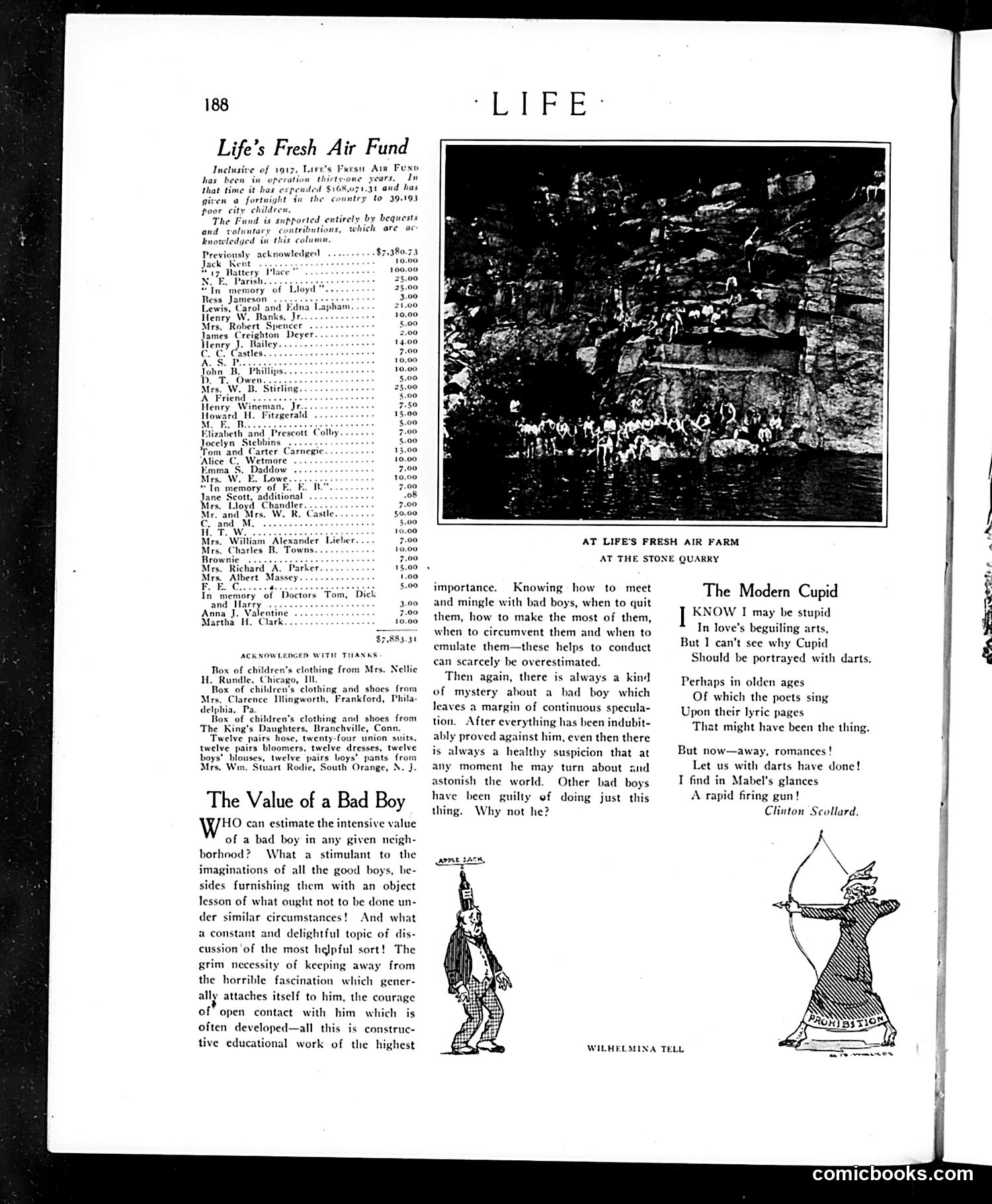
This page contains three distinct elements: 1. **Life's Fresh Air Fund**: A fundraising list acknowledging donors who contributed to send poor city children to the countryside—a genuine charitable initiative. 2. **"The Value of a Bad Boy"**: An essay arguing that "bad boys" serve an educational purpose by providing moral contrast to good children. The text emphasizes how contact with misbehaving youth teaches valuable lessons about behavior. This reflects early 20th-century progressive educational thinking about character development through social exposure. 3. **"The Modern Cupid"**: A humorous poem by Clinton Scollard mocking Cupid as outdated, preferring modern warfare (darts, guns) to traditional romantic arrows. The accompanying illustrations are decorative rather than satirical. The page blends philanthropic appeal, social commentary, and light verse—typical of Life's format as a satirical but socially conscious publication.
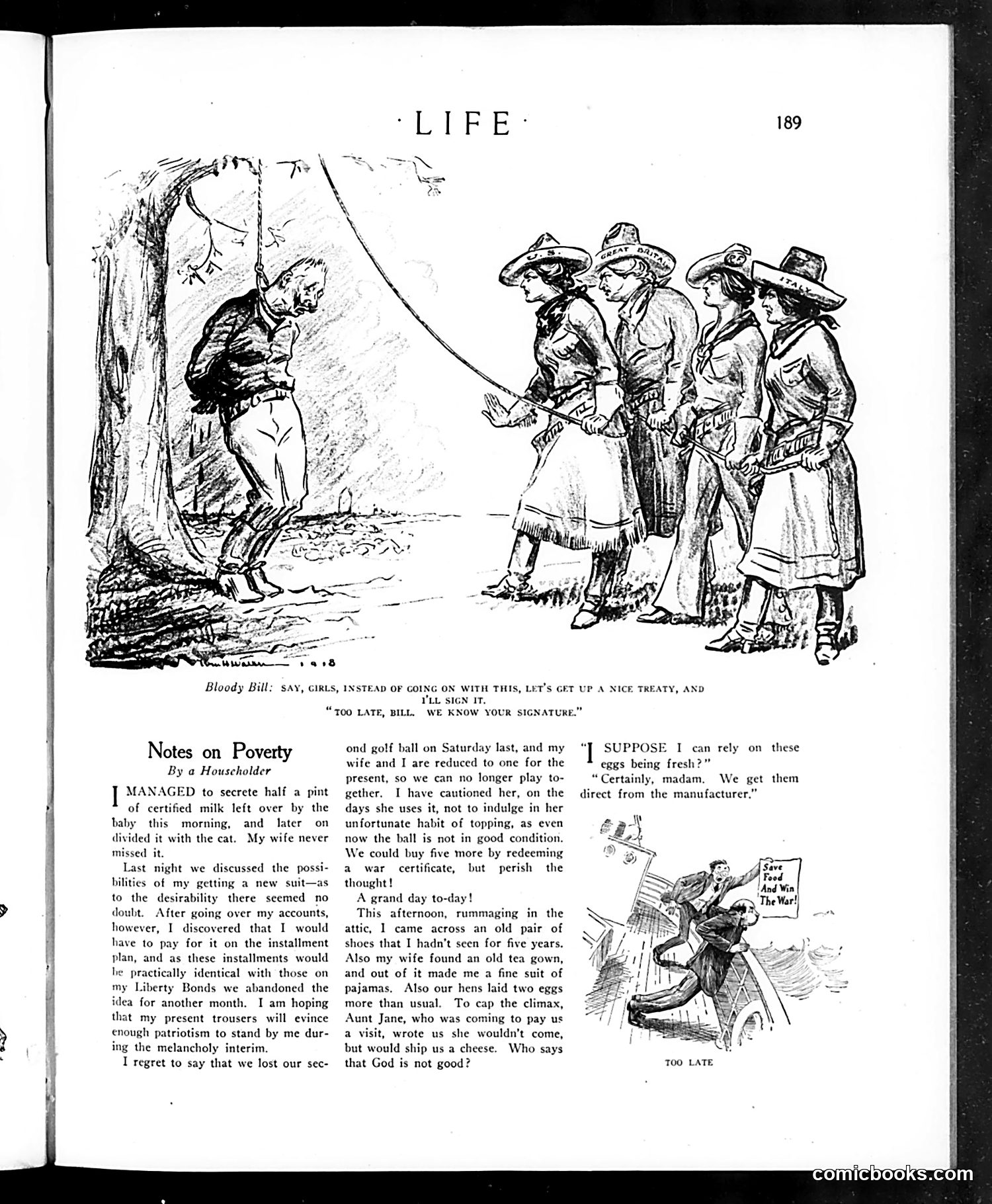
**Top Cartoon ("Bloody Bill"):** Shows a disheveled man by a tree proposing to four women in military-style hats that they sign a "treaty" instead of continuing their current activity. The caption indicates this is "Bloody Bill" attempting to negotiate peace. This appears to satirize someone (likely a political or military figure nicknamed "Bloody Bill") seeking to end conflict through formal agreement rather than action—the women's uniforms suggest wartime involvement. **"Notes on Poverty":** A humorous first-person account by a householder describing creative wartime economizing: secreting milk, reusing old items, avoiding new purchases, and managing with reduced circumstances. It satirizes middle-class anxiety during what appears to be WWI rationing, showing attempts to maintain dignity while pinching pennies. The small illustration ("Too Late") depicts someone with food-related supplies, reinforcing the economy theme.
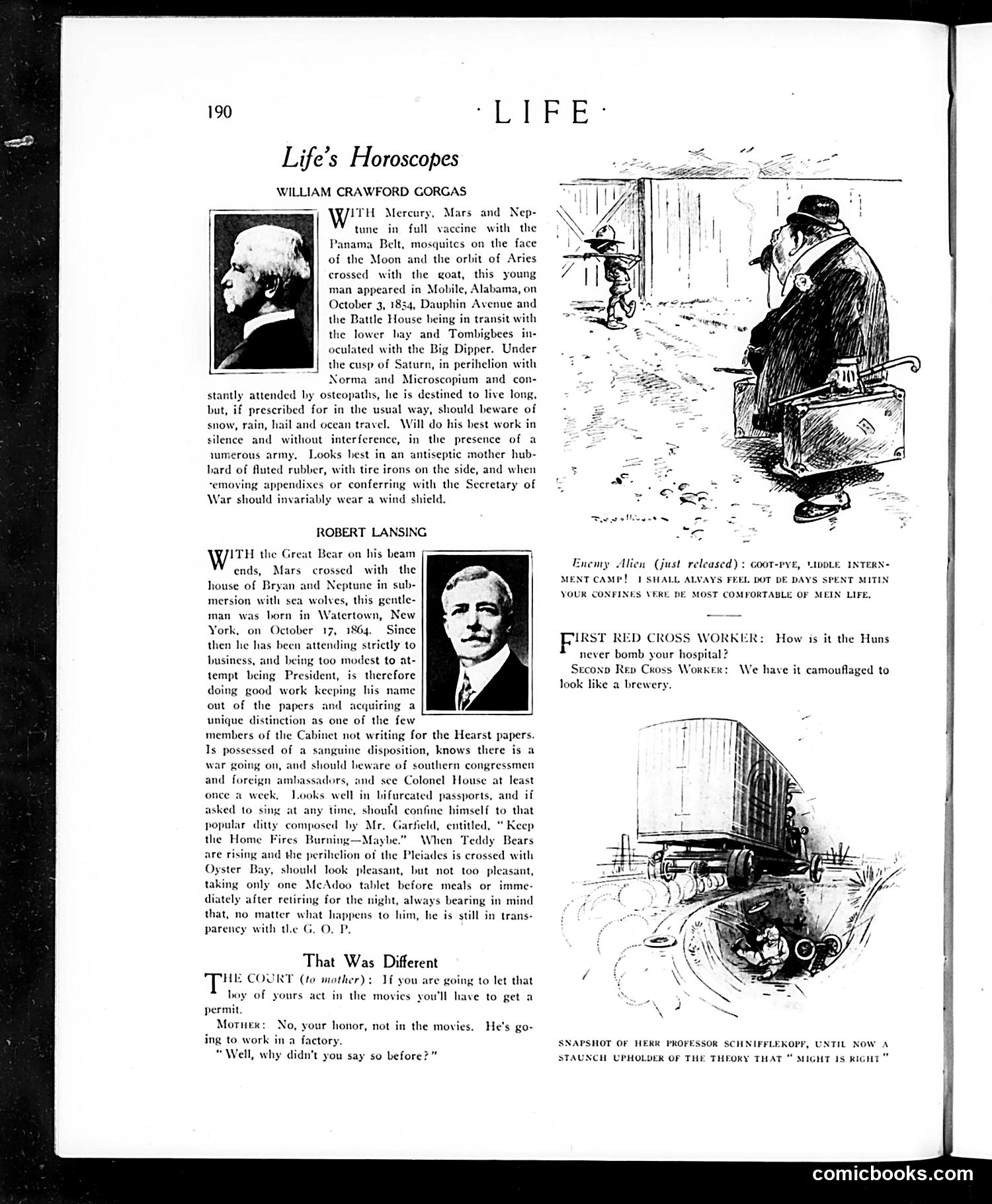
This page contains three satirical pieces from Life magazine (a humor publication, not the photo magazine): 1. **"Life's Horoscopes"** by William Crawford Gorgas - astrological character sketches of public figures (two portraits shown, but their identities aren't clearly labeled in visible text). 2. **A WWI-era cartoon** showing an "Enemy Alien" in an internment camp speaking with guards about hospital conditions, making dark humor about wartime detention. 3. **"That Was Different"** - a brief comedic dialogue between a court and a mother about her son avoiding factory work by claiming he needs to act in movies instead. The humor relies on wartime anxieties, bureaucratic absurdity, and domestic comedy typical of American satirical magazines during the World War I period.
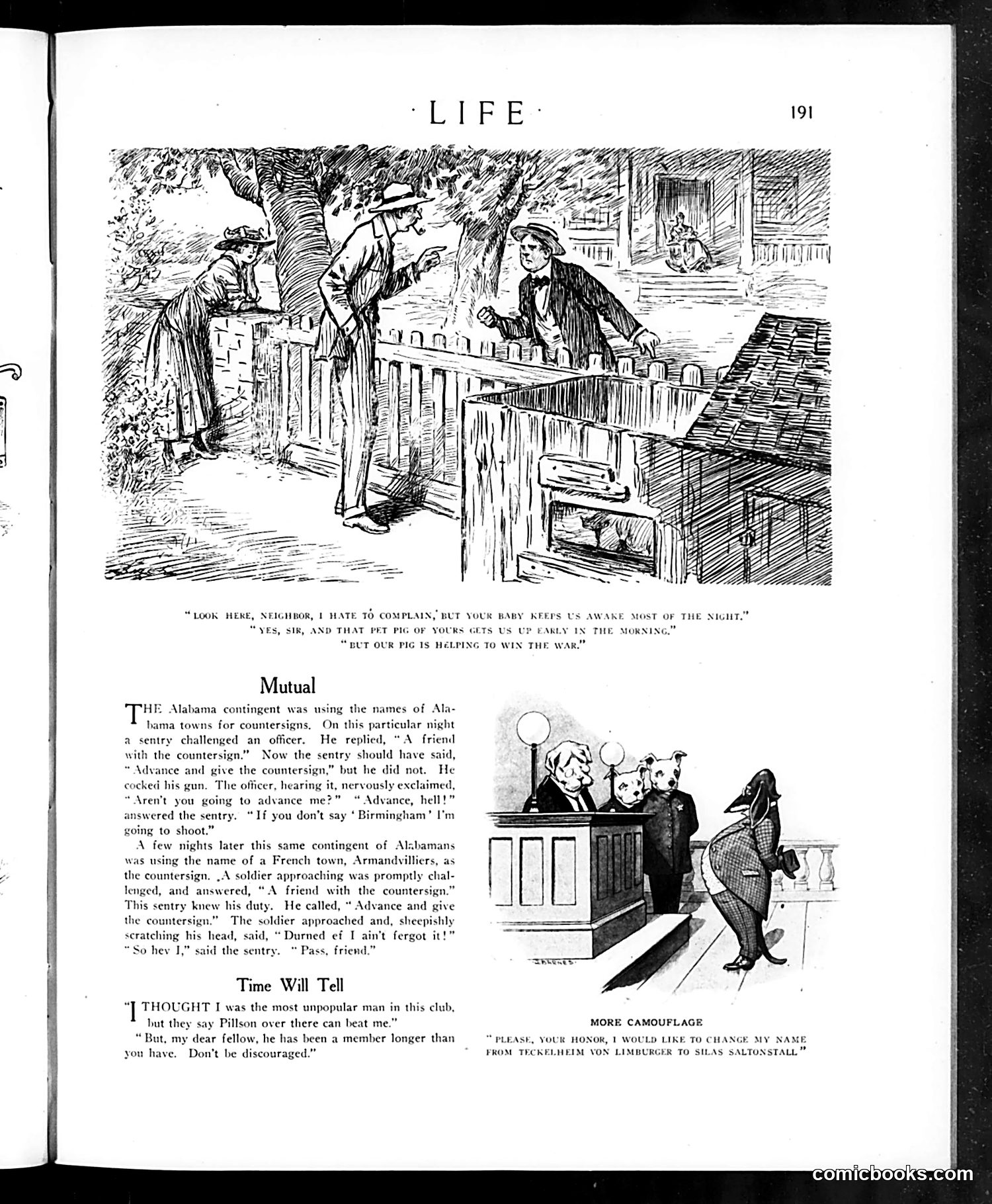
This page contains three separate humorous pieces typical of Life's satirical style: 1. **Top illustration**: A domestic complaint joke about a neighbor's noisy pig that wakes the household. The humor relies on the contrast between the neighbor's apology and the absurd claim that the pig helps "win the war"—likely referencing WWI-era patriotic rhetoric where citizens justified inconveniences as war contributions. 2. **"Mutual"**: A military anecdote about Alabama soldiers using town names as countersigns. The joke plays on miscommunication and regional dialect ("Birmingham" misheard as "Advance, hell!"), a common trope mocking rural soldiers. 3. **"Time Will Tell"**: A club banter joke about unpopularity, with a reassuring punchline about seniority. 4. **"More Camouflage"**: A cartoon about name-changing, apparently mocking German-sounding names during the wartime period.
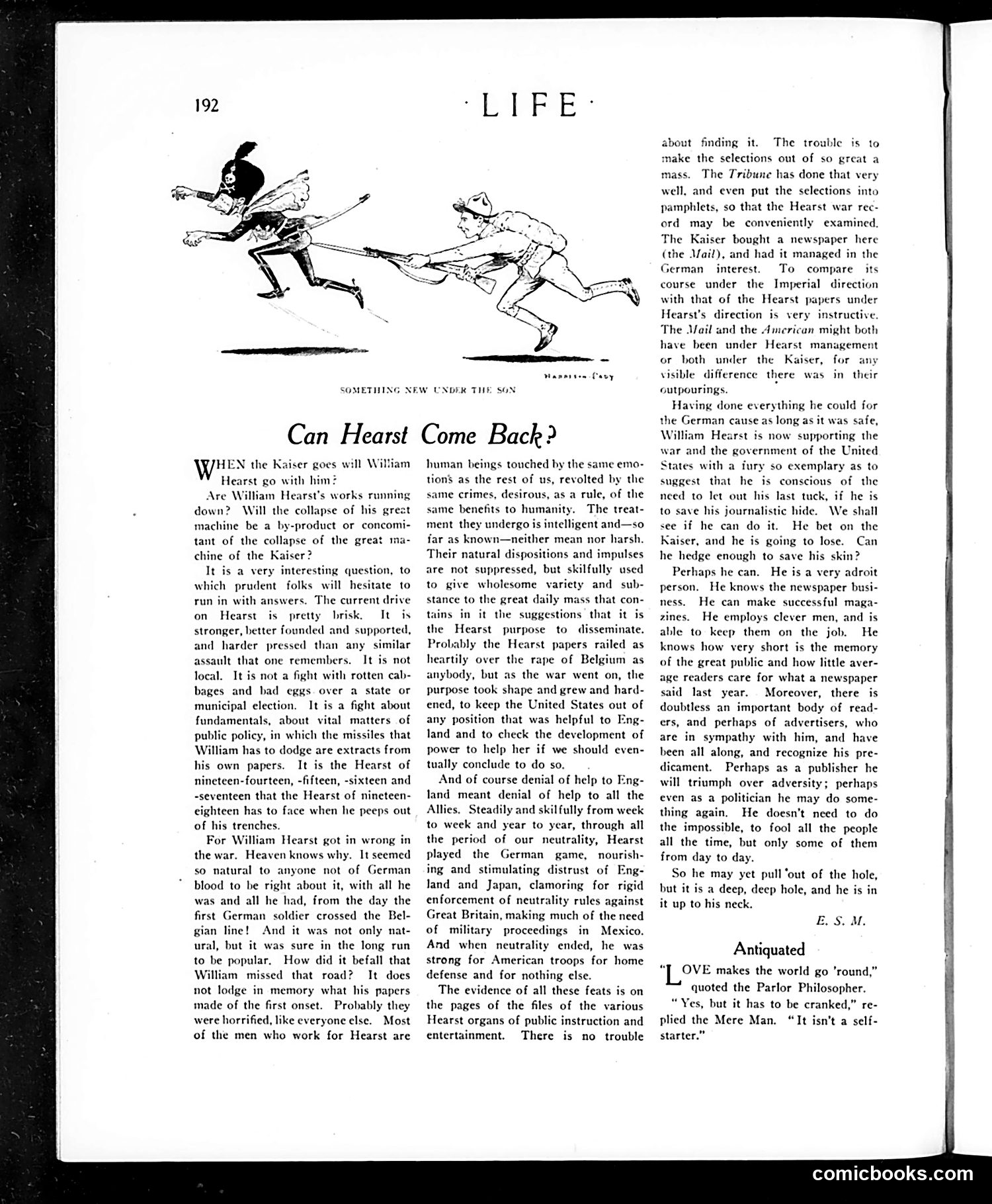
This page features a political cartoon titled "Something New Under the Sun" by Cesare Enea, depicting two figures in a physical struggle—one appears to be a winged fairy or sprite pulling away from a larger human figure. The accompanying article questions whether William Hearst (the newspaper magnate) can maintain his influence and power after World War I ends. The cartoon's meaning is unclear from the image alone, but the text discusses Hearst's controversial wartime positions, his support for Germany initially, and his current backing of U.S. interests. The piece suggests Hearst remains influential in publishing despite his checkered record, questioning whether he'll recover his reputation post-war. The "something new" likely satirizes Hearst's attempted reinvention.
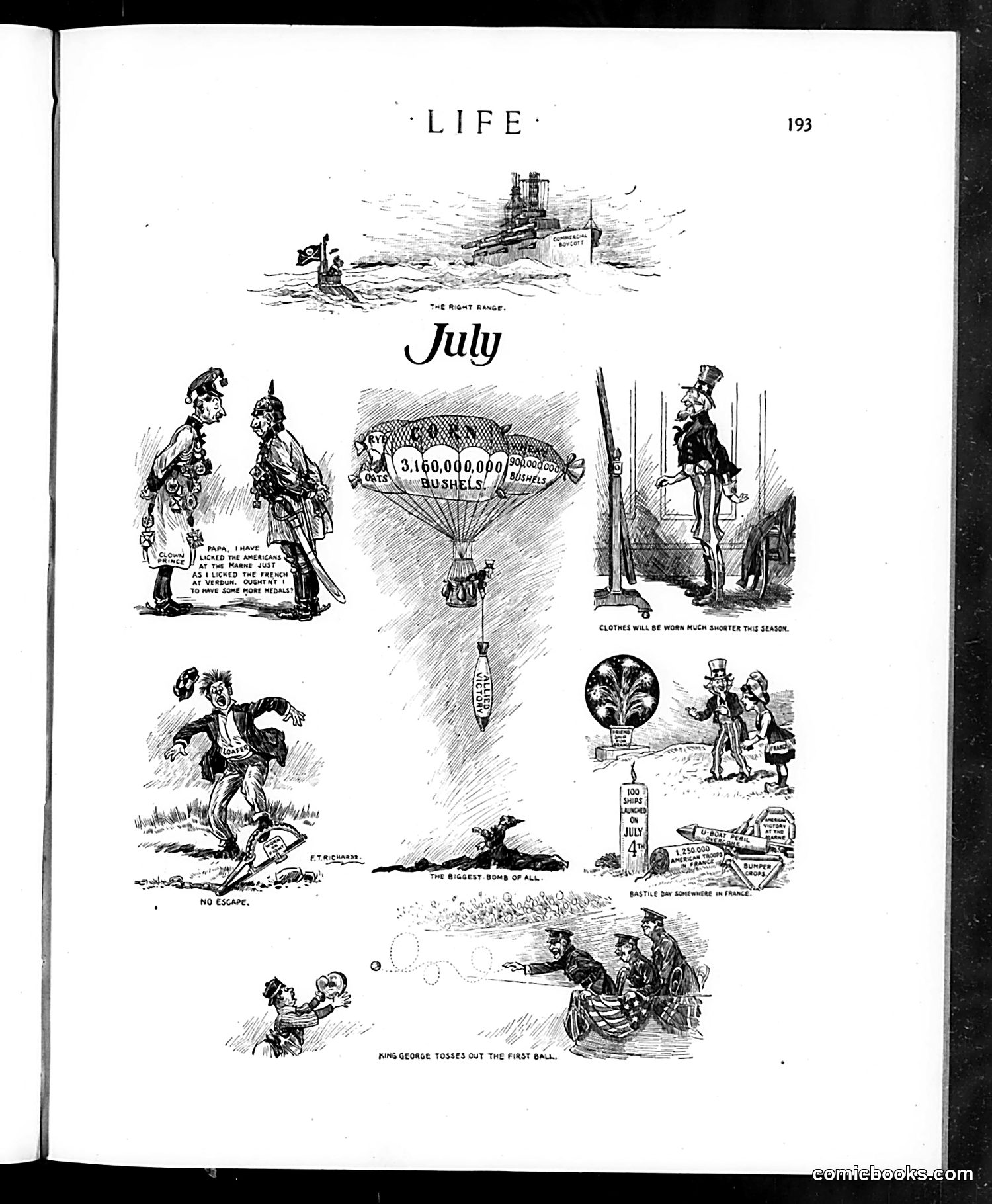
This page from *Life* magazine's July issue contains several satirical cartoons commenting on World War I events and home-front concerns. The central image depicts a massive bomb labeled "3,160,000,000 BUSHELS" descending—likely representing grain/food destruction during wartime. Surrounding vignettes mock military and civilian responses: one shows soldiers discussing medals, another features a figure escaping (labeled "NO ESCAPE"), and references to shortened clothing and battle statistics appear throughout. The bottom cartoon notes "KING GEORGE TOSSES OUT THE FIRST BALL," suggesting sporting events continued during wartime. Overall, the page satirizes the contrast between domestic normalcy and the enormous scale of wartime destruction, military bureaucracy, and public indifference to sacrifice.
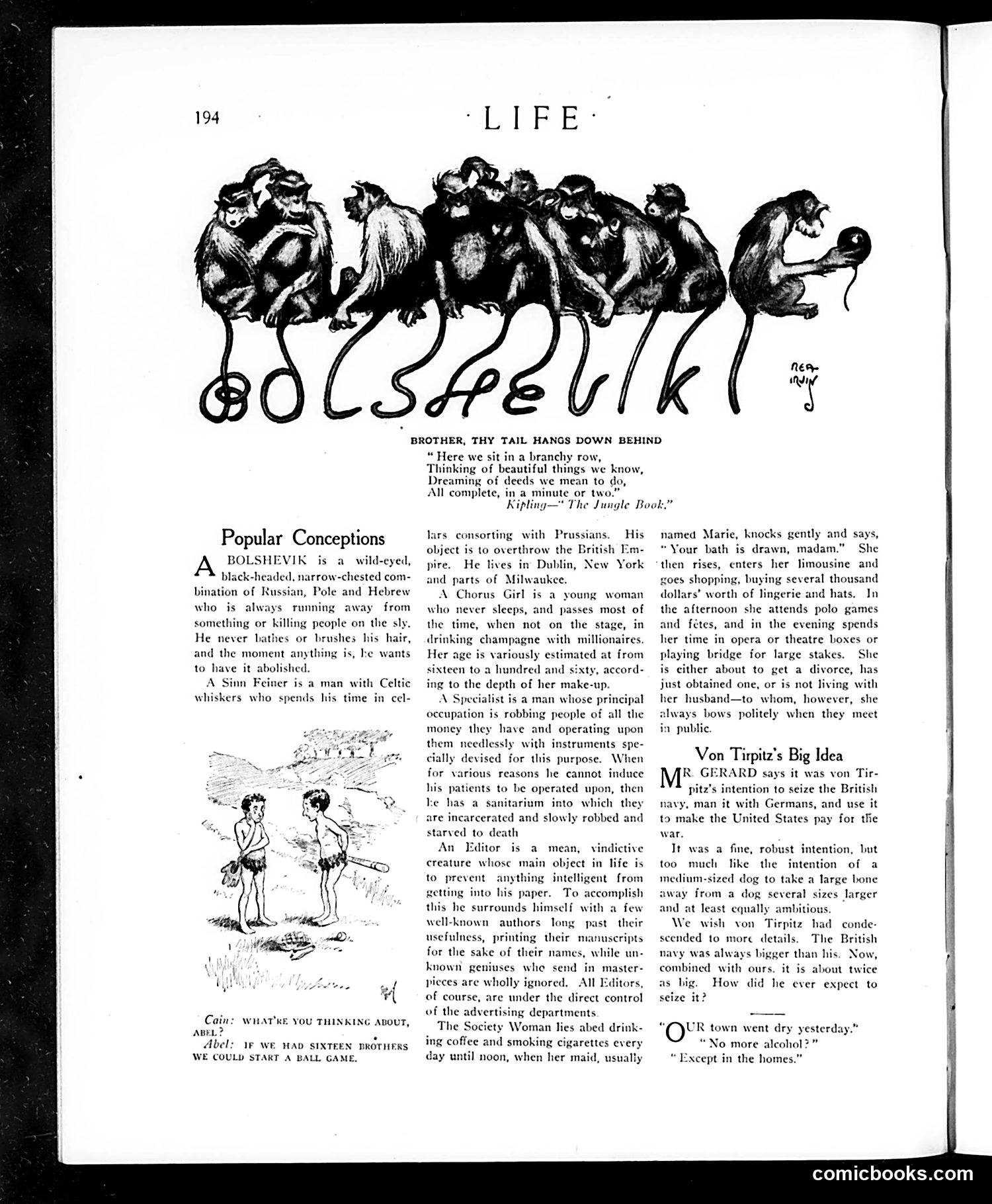
The top illustration depicts monkeys arranged in a line forming the word "BOLSHEVIKI," with a quote from Kipling's *Jungle Book*. This is anti-Bolshevik propaganda, equating Russian communists with animals—a common satirical trope during the post-WWI Red Scare era when American anxieties about communist revolution ran high. Below, the page defines various "Popular Conceptions": stock character types including a Bolshevik (described as violent and running), a Specialist (a criminal robbing people), and other social stereotypes. The cartoon featuring two nude figures discusses starting "a ball game," offering crude humor typical of the era's satirical magazine style.
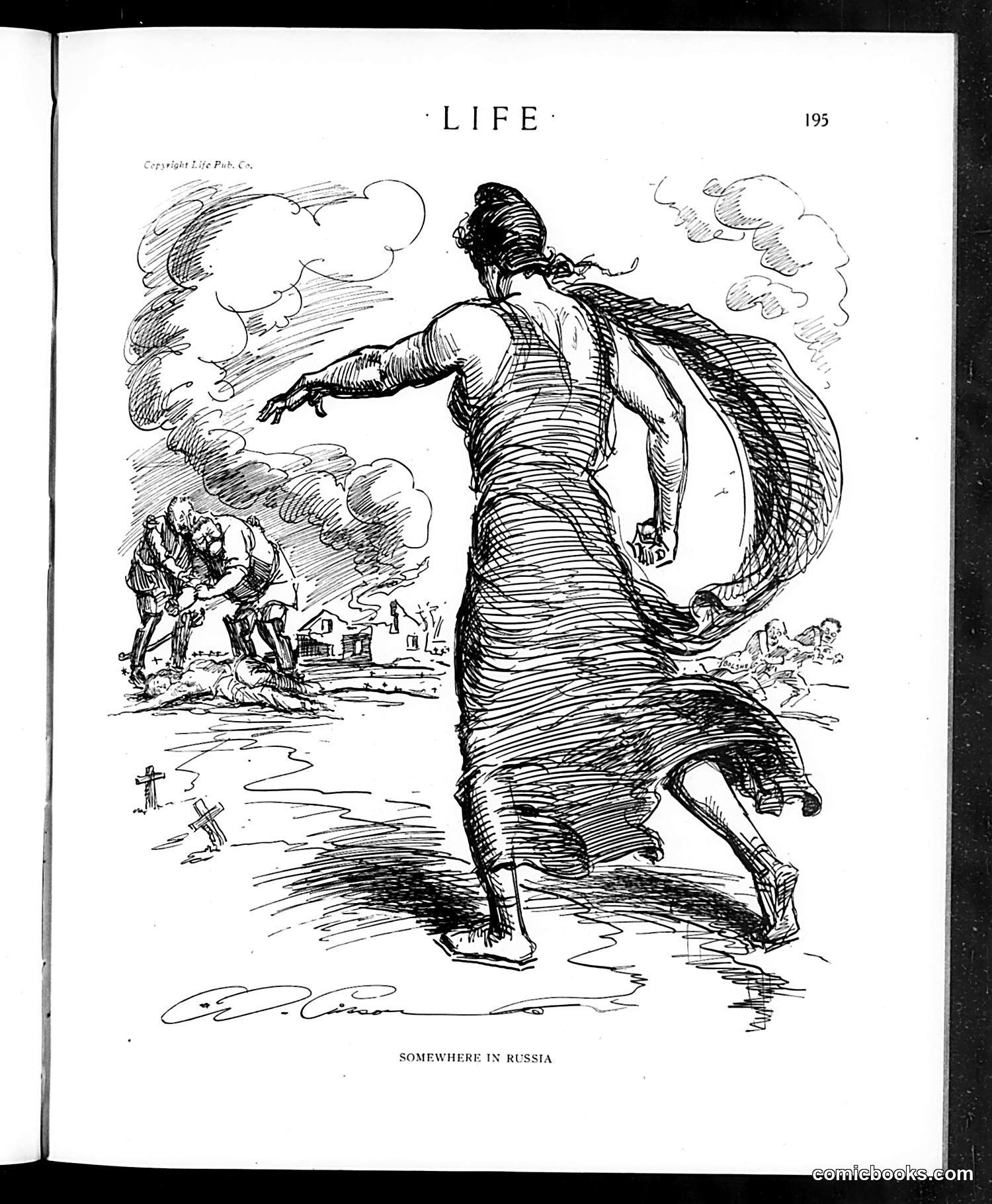
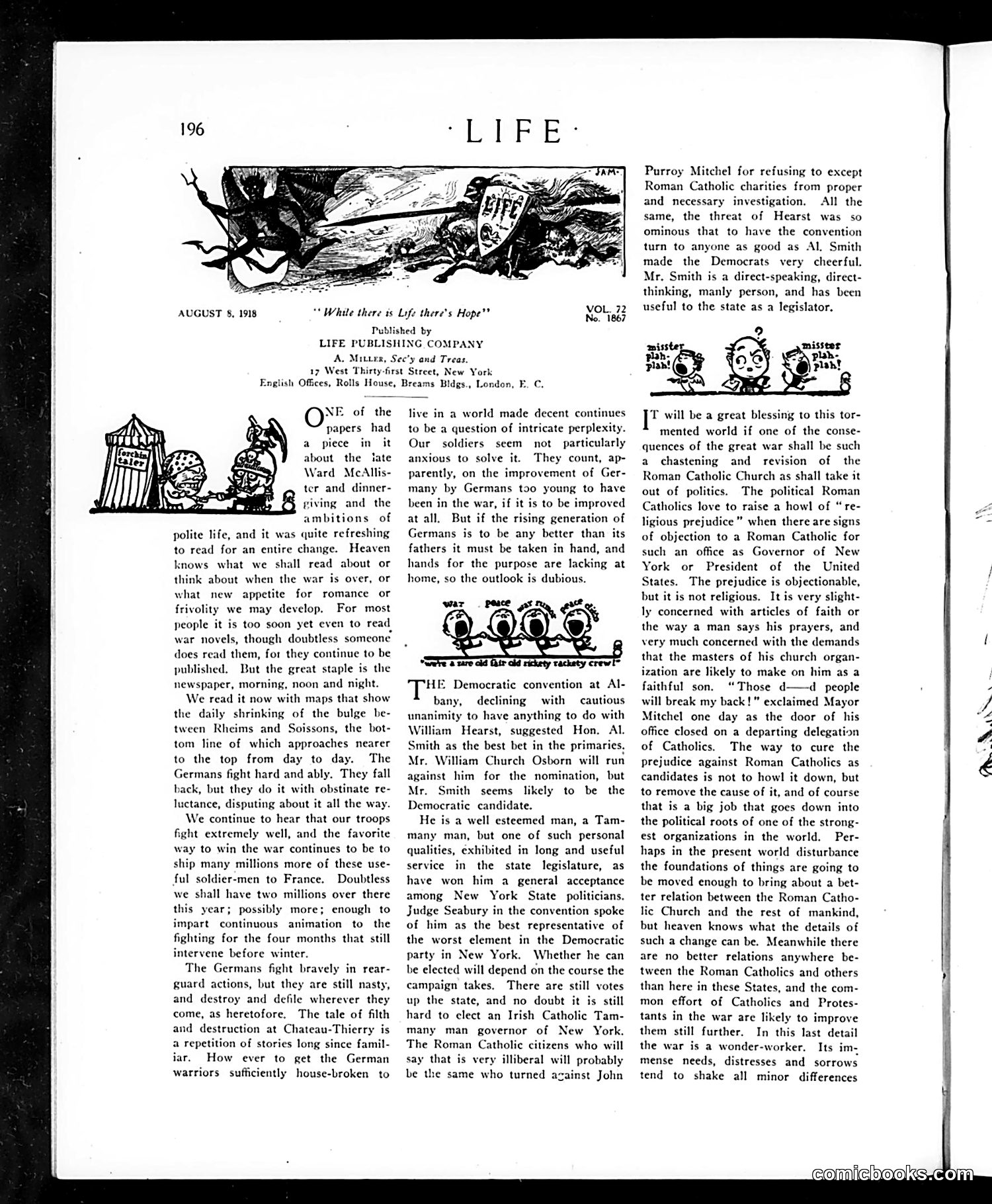
This page contains political commentary on New York's Democratic convention and World War I, rather than traditional cartoons. **Main content:** The editorial discusses the Democratic Party's rejection of William Hearst as a candidate, instead endorsing Al Smith for governor. Smith is described as a Tammany Hall politician of generally good character and legislative service, though Judge Seabury criticized him as "the best representative of the worst element in the Democratic party." **The satirical point:** The piece notes the contradiction between Catholic voters who opposed investigating Roman Catholic charities under Mayor Mitchell, yet now support Smith despite his Tammany connections. The unnamed cartoons at top and margins appear to be generic wartime illustrations rather than specific political satire. **Historical context:** This was written during WWI (note references to fighting near Rheims and Soissons), when German military conduct drew intense criticism, and when religious and machine politics influenced New York elections significantly.
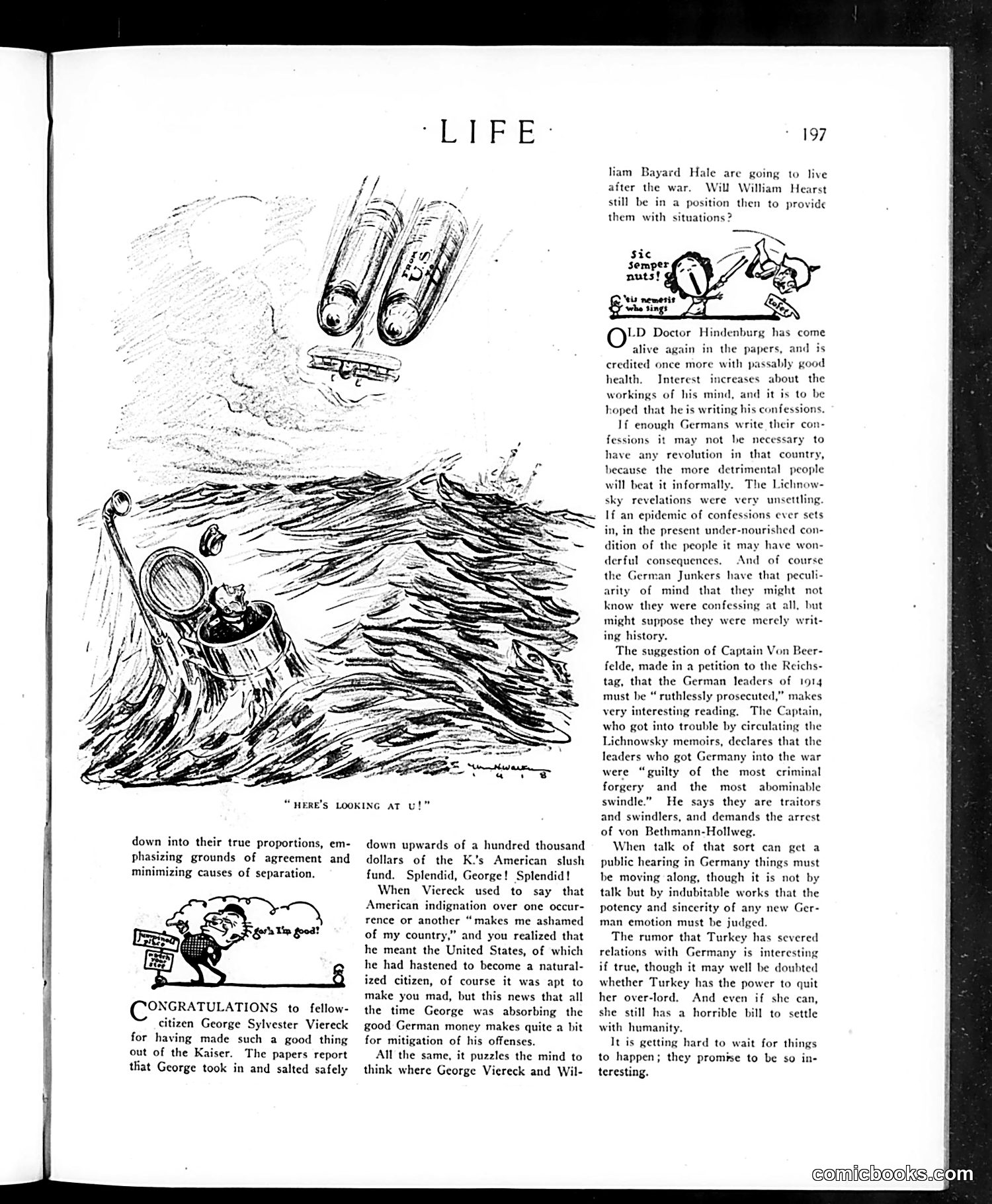
This page satirizes German propagandists operating in America during World War I. **George Sylvester Viereck** is mocked for accepting over $100,000 from the German Kaiser's "American slush fund" while publicly claiming to be ashamed of America—revealing his hypocrisy as a naturalized citizen secretly working for Germany's interests. The cartoon ridicules **William Bayard Hale** (likely another pro-German operative) alongside Viereck, sarcastically wondering where they'll find employment after Germany loses. The text also discusses German confessions and internal recriminations (referencing the Lichnowsky memoirs and Captain Von Beerfelde's accusations), suggesting Germany's leadership faced blame for starting the war. The satire's point: German propaganda agents profited while pretending patriotism, and post-war Germany would face reckoning for its warmongering elite.
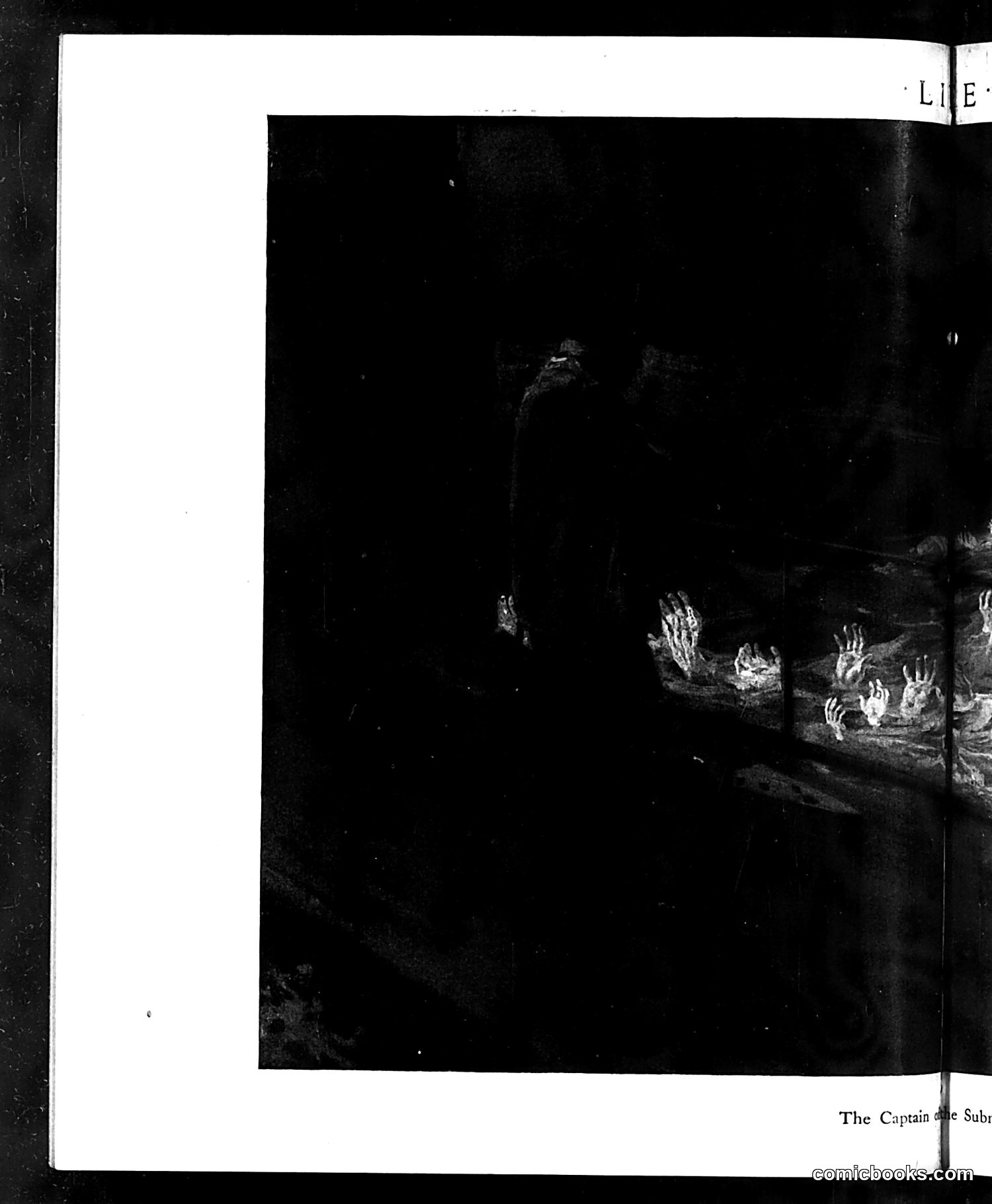
This page appears to be from Life magazine and contains a dark, heavily shadowed illustration. The caption reads "The Captain a[nd] Sub[marine]" (partially visible at bottom), suggesting the image depicts a submarine-related scene, likely military in nature. The image itself is extremely dark and difficult to parse clearly. However, it appears to show figures in what might be a submarine interior, with some lighter details visible on the right side that could represent water, waves, or interior vessel elements. Without clearer visibility of the illustration's details or additional context from surrounding text, I cannot confidently identify specific caricatures, political figures, or the precise satirical point. The submarine subject suggests this may reference naval/military themes common to early-20th-century American satire, but the specific historical reference remains unclear from this reproduction.
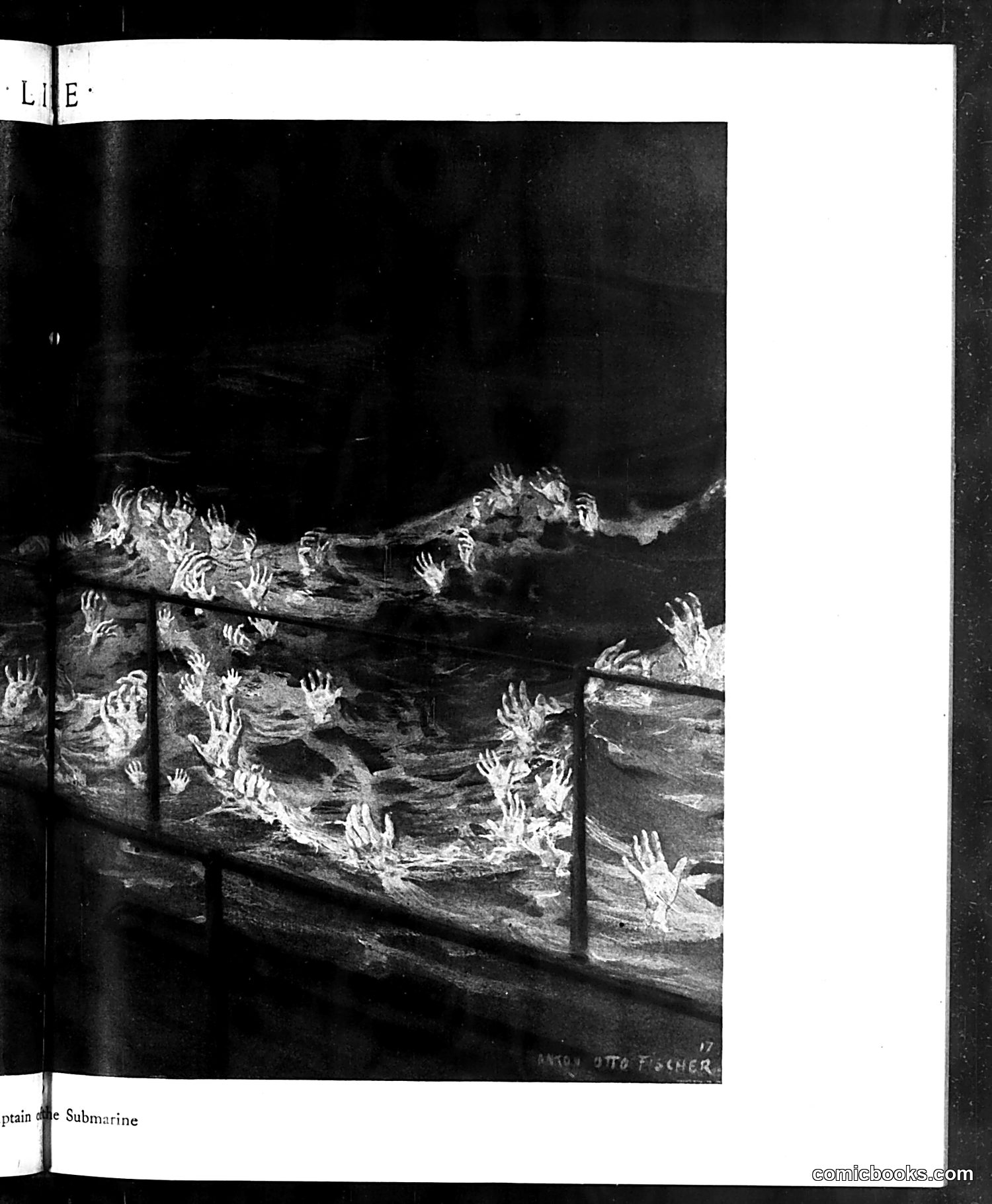
This page shows a surreal black and white illustration featuring dismembered hands emerging from dark water around wooden logs or debris. The image is credited to "Otto Fischer" (visible at bottom). The partial text "ptain e Submarine" (likely "Captain" and "Submarine") suggests this relates to submarine warfare. Given Life magazine's satirical nature, this appears to be commentary on submarine combat, possibly depicting the aftermath of naval warfare or a submarine attack. The grotesque imagery of disembodied hands reaching upward creates a haunting, nightmarish quality—likely intending to critique the horrors or moral dimensions of submarine warfare. However, without the complete caption or article text, I cannot definitively identify the specific historical event, military figure, or political message being satirized.
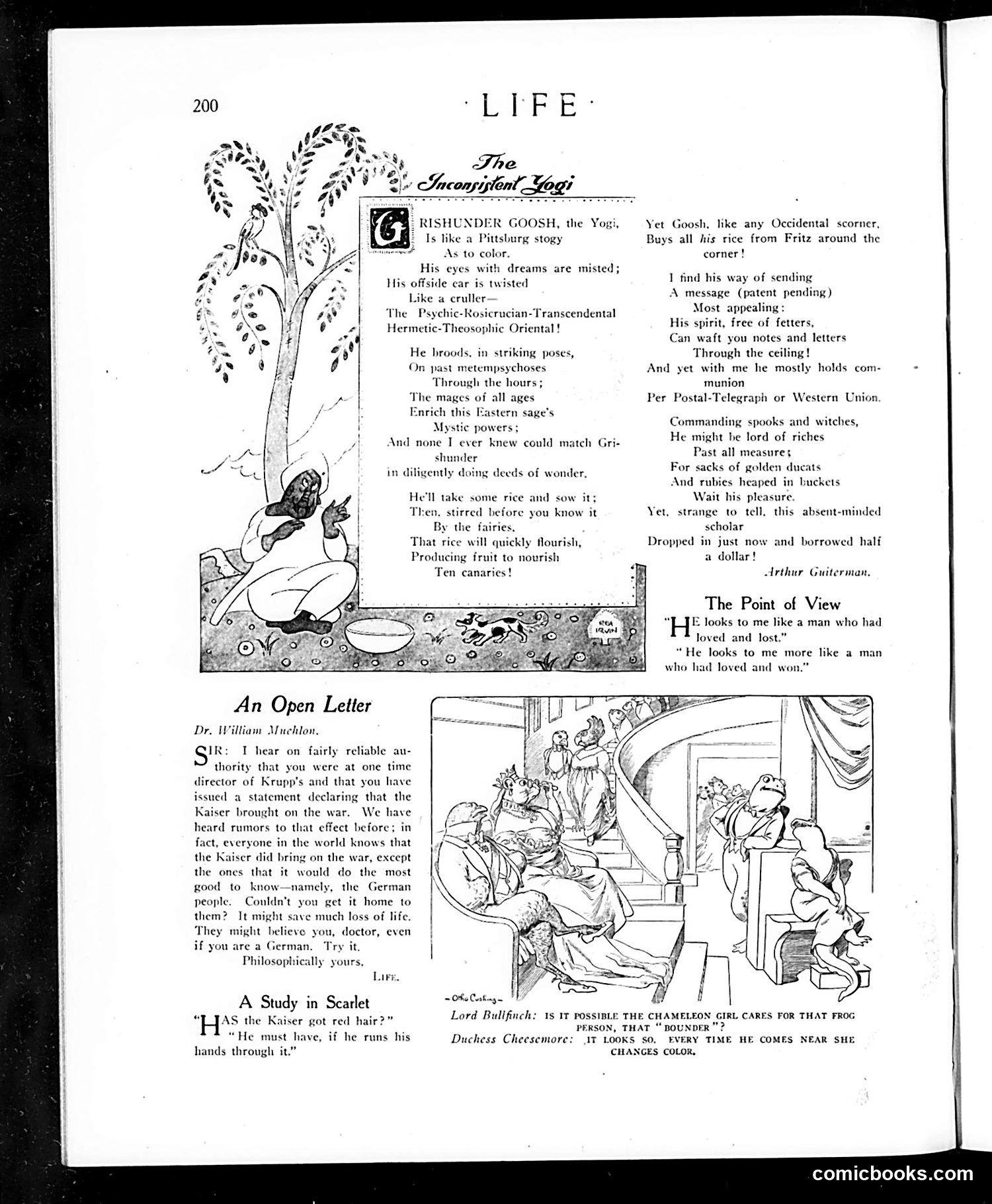
This page contains WWI-era American satire mocking both mysticism and German war responsibility. **"The Incongruent Yogi"** ridicules a fake Eastern mystic named Grishunder Goosh who poses as spiritually transcendent but betrays himself through mundane contradictions—he performs "miracles" yet buys rice from "Fritz" (Germany) and borrows money via Western Union instead of supernatural means. The satire targets popular American fascination with fraudulent Eastern spiritualism. **"An Open Letter"** directly addresses Dr. William Muchlon (apparently a former Krupp's director) asking him to convince Germans that the Kaiser caused the war. This reflects American frustration that German citizens rejected responsibility for WWI's outbreak, despite widespread international acknowledgment of German culpability. **"A Study in Scarlet"** is a brief joke about the Kaiser's red hair, implying his aggressive temperament. **"The Point of View"** presents contrasting romantic interpretations of the same man's appearance—lost love versus successful love—a common humor format. All content reflects American wartime propaganda efforts and period attitudes toward both German accountability and Oriental mysticism.
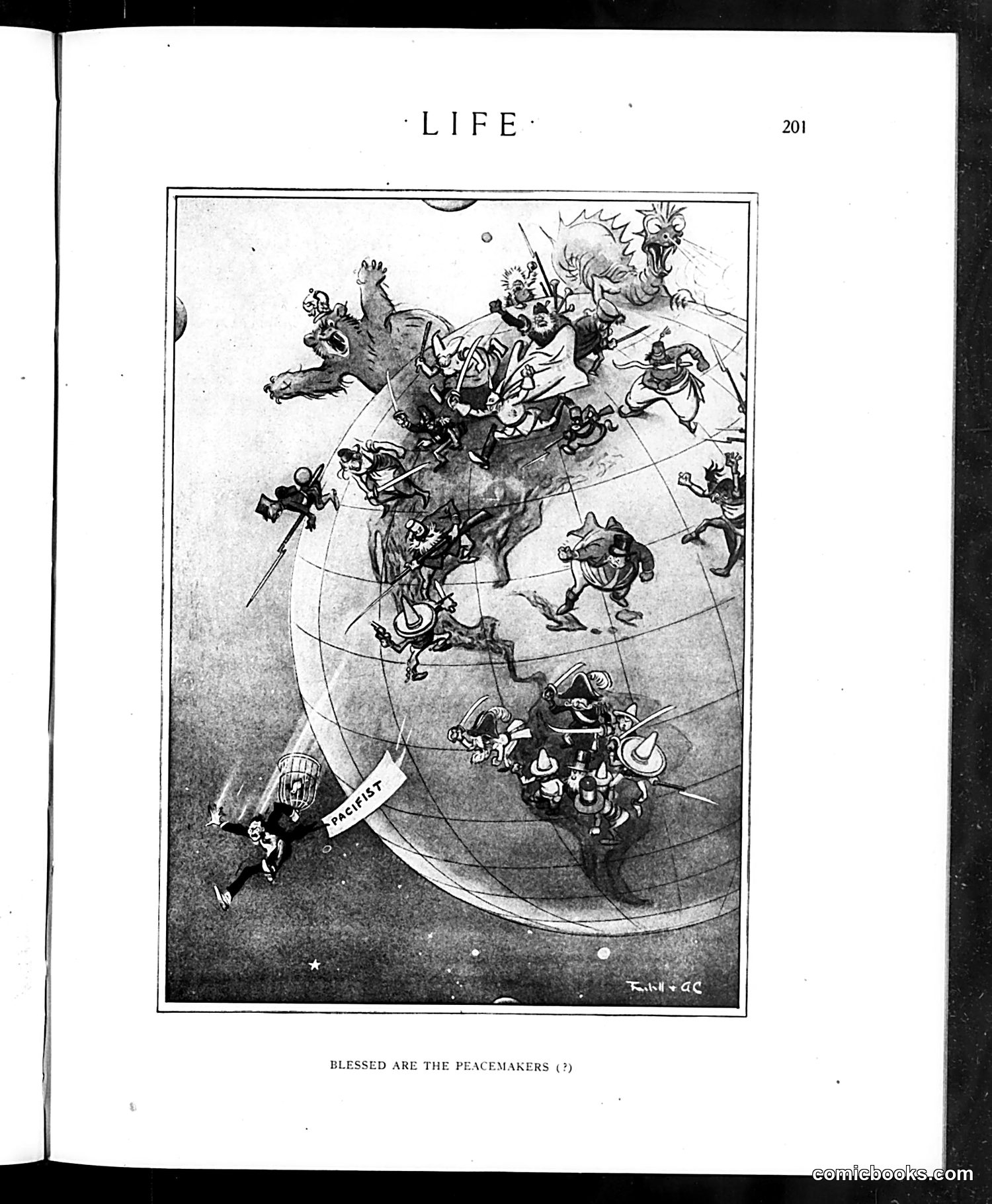
This political cartoon depicts a globe covered with armed military figures and conflict, ironically titled with a biblical reference to peacemakers. The question mark signals skepticism about the notion of peace. The cartoon shows numerous soldiers, weapons, and aggressive figures distributed across the Earth's surface, suggesting widespread global militarism and warfare. The label "PACIFIST" appears on at least one figure, likely indicating ironic commentary on so-called pacifists who paradoxically engage in or support military action. The satire critiques the contradiction between proclaimed peaceful intentions and actual warlike behavior during what appears to be an era of international tension—possibly referencing World War I or its aftermath period when peace conferences were held but arms races continued.
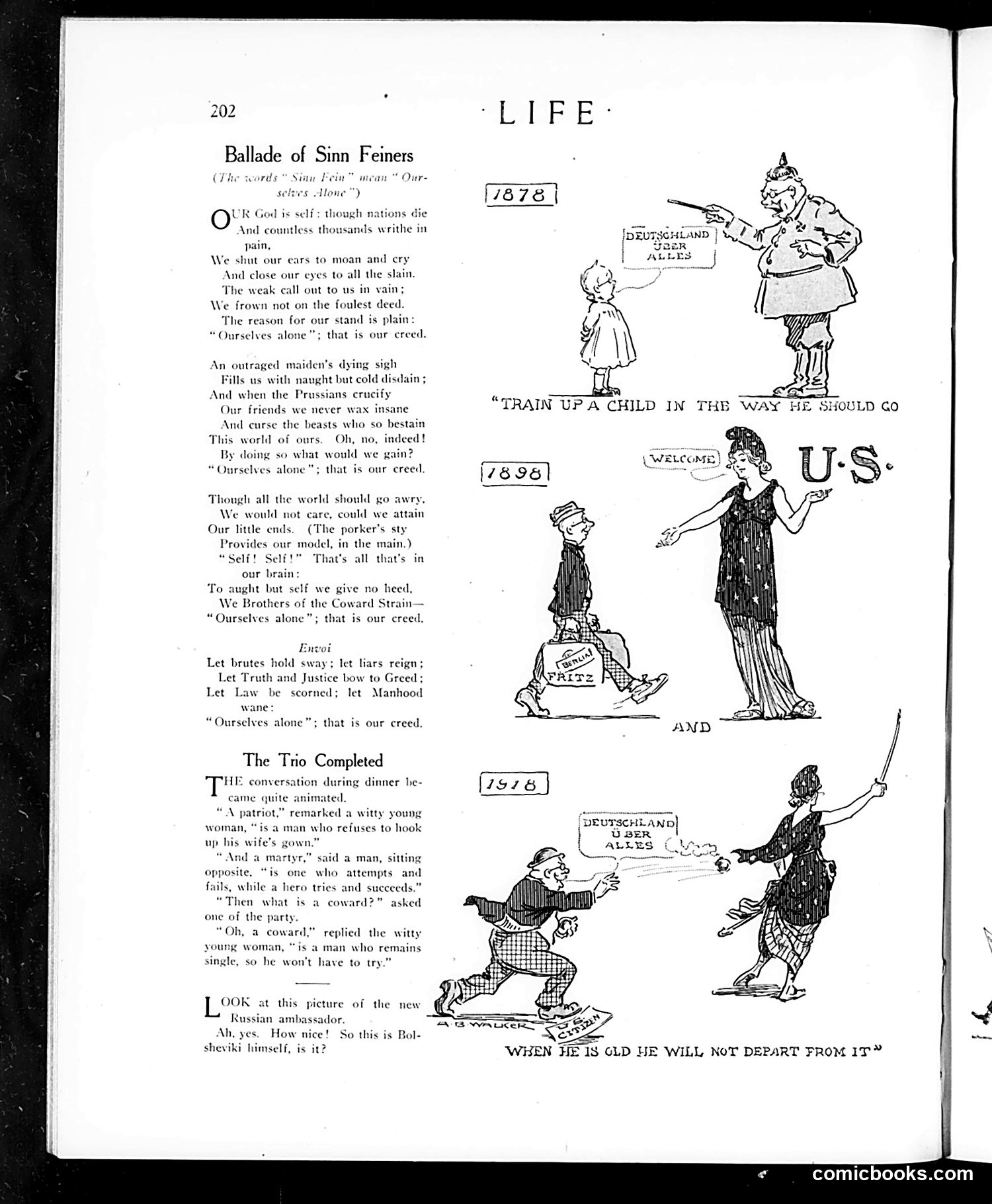
This page contains anti-Irish nationalist satire from around World War I. The "Ballade of Sinn Féiners" attacks the Irish independence movement's philosophy of "Sinn Féin" ("ourselves alone"), portraying Irish nationalists as selfish cowards indifferent to others' suffering—particularly Belgian and French victims of German aggression during the war. The accompanying cartoons satirize German-American relations and Irish neutrality during WWI. The top cartoon appears to show German influence on Irish children. The middle cartoon depicts an American woman welcoming a child and rejecting German culture ("Deutschland Über Alles"). The bottom cartoon mocks a Russian ambassador, likely referencing post-Bolshevik Revolution tensions. The brief dialogue section ridicules patriotism, martyrdom, and cowardice, contextualizing American attitudes toward non-interventionists and neutral parties during the war. The satire assumes readers share pro-Allied sympathies.
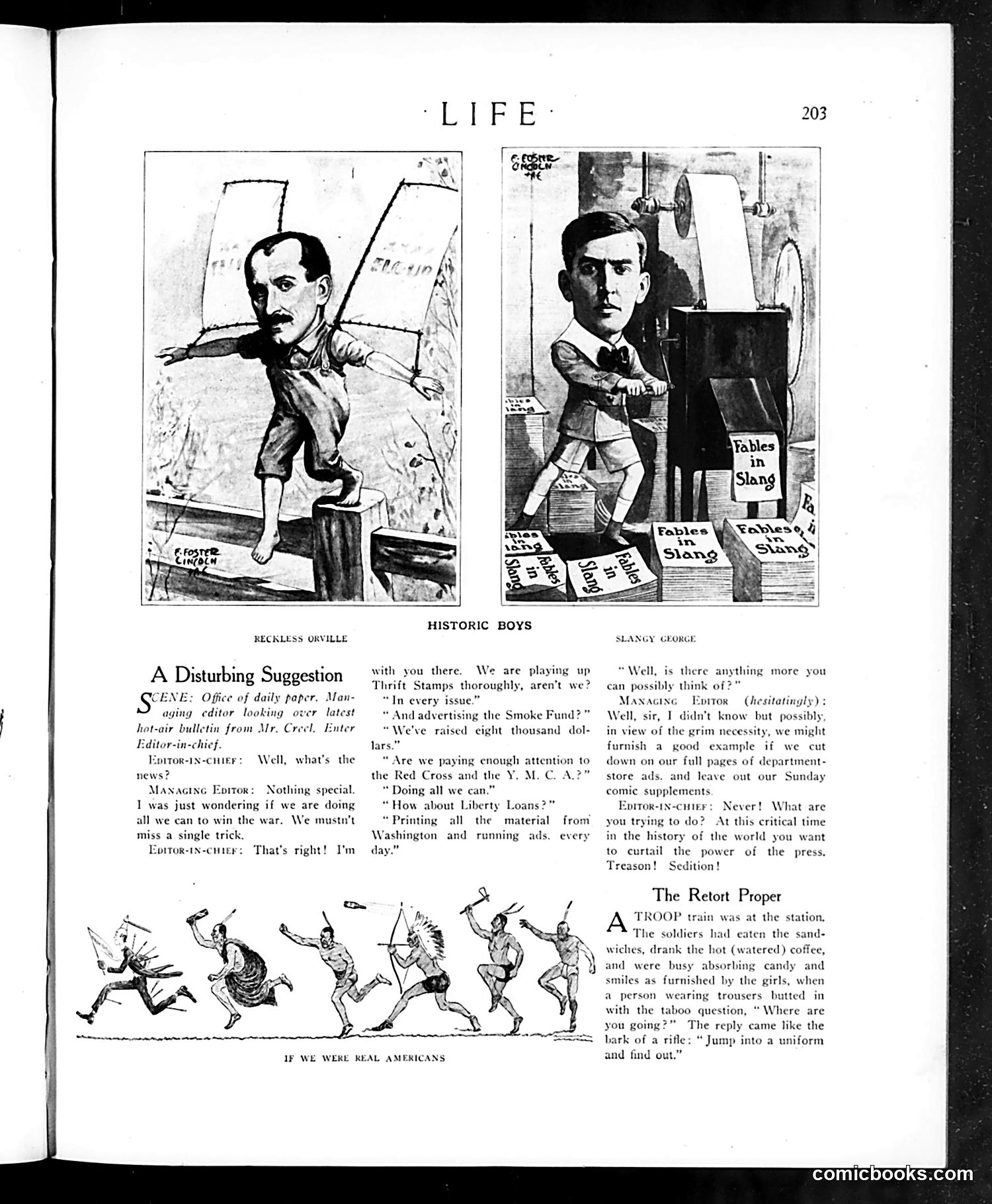
This 1917-1918 WWI-era *Life* magazine page satirizes American wartime propaganda and media management. **"A Disturbing Suggestion"** mocks George Creel's Committee on Public Information, which coordinated war propaganda. Two newspaper editors discuss all their patriotic efforts—promoting war bonds, Red Cross campaigns, thrift stamps—when one dangerously suggests cutting department-store ads to set an example. The editor-in-chief horrifies him, calling this "Treason! Sedition!"—absurdly treating commercial advertising as essential to winning the war. **"Historic Boys"** caricatures two figures (labeled "Reckless Orville" and "Slangy George," likely referring to contemporary public figures) in similar exaggerated poses to military heroes. **"If We Were Real Americans"** shows soldiers dancing chaotically. **"The Retort Proper"** humorously depicts a soldier's patriotic comeback when asked where he's going: "Jump into a uniform and find out." The satire's core: *Life* ridicules how thoroughly commercial interests have infiltrated wartime patriotism, making advertising protection seem as important as actual war effort.
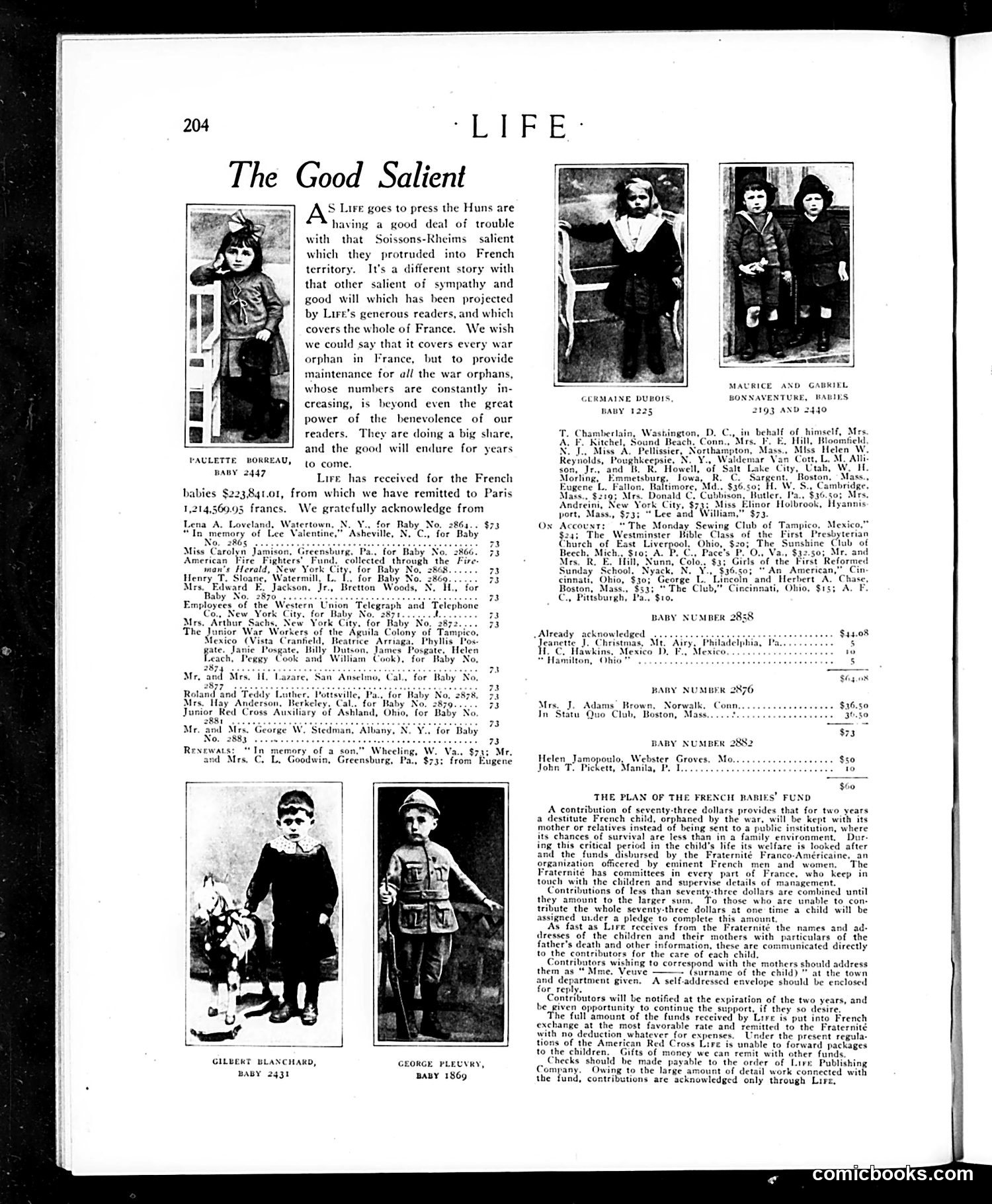
This page documents Life magazine's charitable campaign to support French war orphans during World War I. The title "Good Salient" puns on military terminology: while German forces hold a dangerous "salient" (protruding position) in French territory, Life has created a charitable "salient" of American goodwill extending into France. The page displays photographs of specific orphans being supported (Paulette Borreau, Germaine Dubois, Maurice and Gabriel Bonnaventure, Gilbert Blanchard, George Pleuvry) and lists donors who contributed to their care. The accompanying text explains Life's fundraising mechanism: $73 provides two years of support keeping a child with relatives rather than in institutions. This represents Progressive Era American philanthropy—Life leveraged its readership to sustain French child victims of war through an organized, documented system overseen by the Fraternité Franco-Américaine. The page exemplifies how American magazines mobilized public sentiment and charitable donations during WWI.
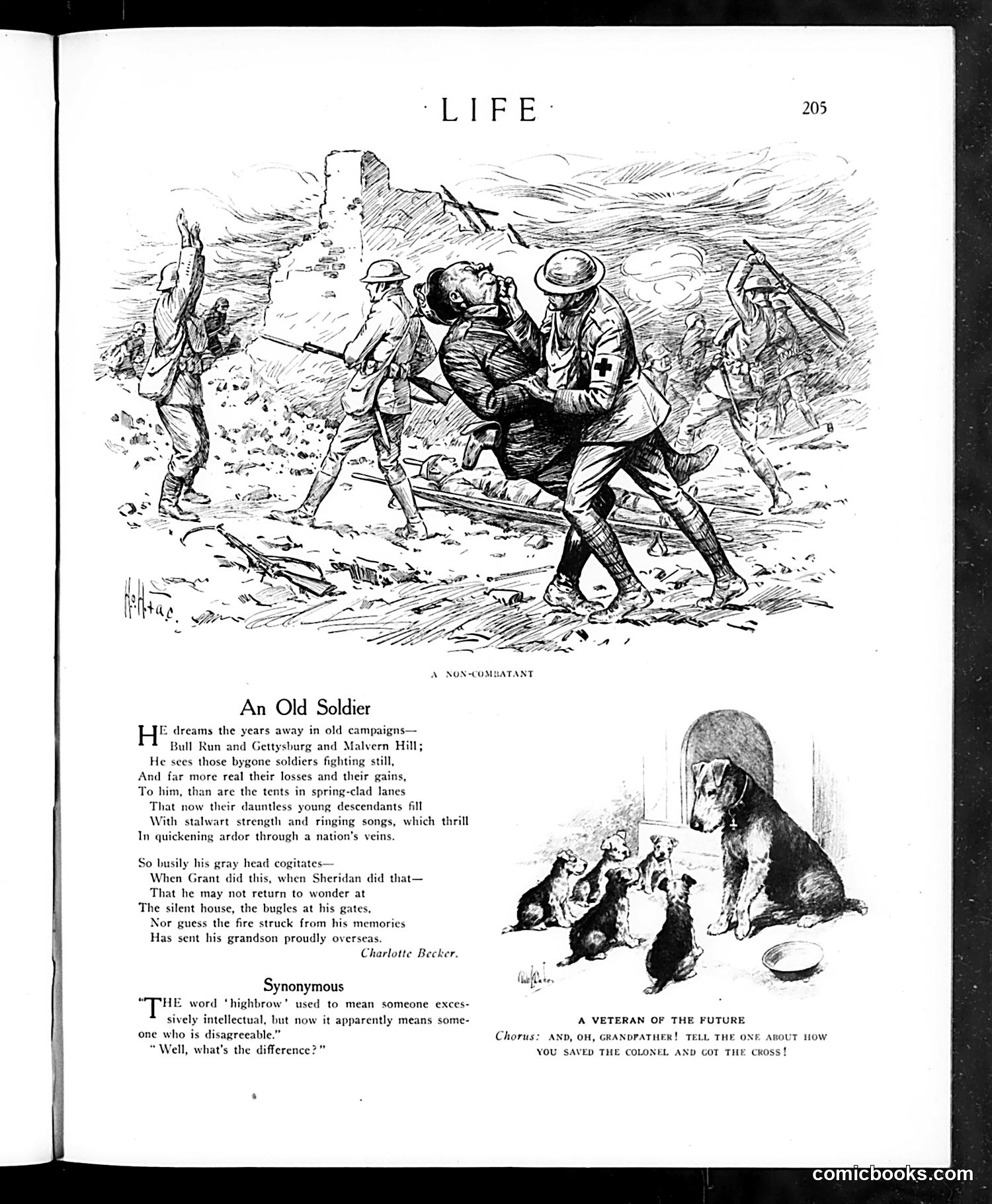
This page contains two interconnected satirical pieces about war and aging. **"An Old Soldier"** (poem by Charlotte Becker): A Civil War veteran is so absorbed in nostalgic memories of past battles (Bull Run, Gettysburg, Malvern Hill) and historical military figures (Grant, Sheridan) that he fails to notice his own grandson has enlisted and gone overseas—likely to World War I. The satire critiques how romanticizing past wars can blind older generations to present sacrifices. **"A Veteran of the Future"** (illustration): Shows an elderly dog being pestered by puppies demanding war stories. The caption parodies the previous poem's scenario: the grandson (now represented as a dog-descendant) will someday bore his own children with tales of his WWI service, perpetuating the cycle of glorified military nostalgia. Together, these pieces satirize how each generation mythologizes its wars while remaining oblivious to current ones—and how survivors inevitably transmit these romantic narratives to younger generations.
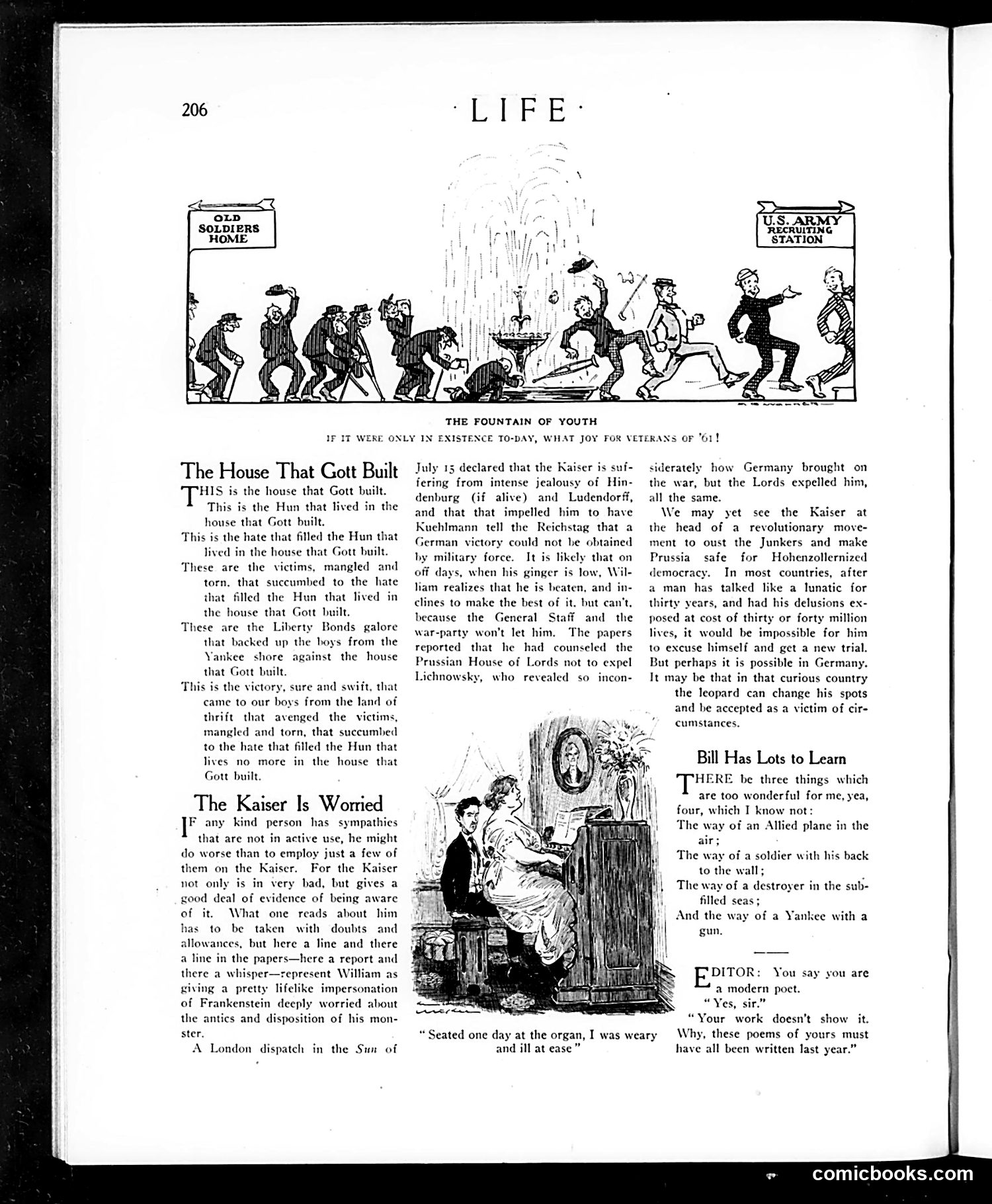
This page contains WWI-era American propaganda satirizing Germany and Kaiser Wilhelm II. **"The House That Gott Built"** is a cumulative nursery-rhyme style poem mocking German responsibility for the war. "Gott" (God) is a pun on the German name, satirizing German claims of divine favor. The poem traces consequences from the "Hun" (dehumanizing term for Germans) through victims, Liberty Bond fundraising, to Allied victory. **"The Kaiser Is Worried"** discusses Wilhelm II's apparent mental distress, reporting (via London sources) that he envies his generals Hindenburg and Ludendorff, and may be seeking peace while his war-party prevents it. The satire suggests the German leader has become a "Frankenstein" unable to control events. **"The Fountain of Youth"** cartoon at top depicts old soldiers being rejuvenated between an "Old Soldiers Home" and "U.S. Army Recruiting Station"—likely satirizing recruitment of aging veterans. **"Bill Has Lots to Learn"** is an unrelated poetic joke about American military inexperience with modern warfare technology. The page overall reflects American wartime sentiment portraying Germany as responsible aggressors and the Kaiser as a weakening, worried leader.
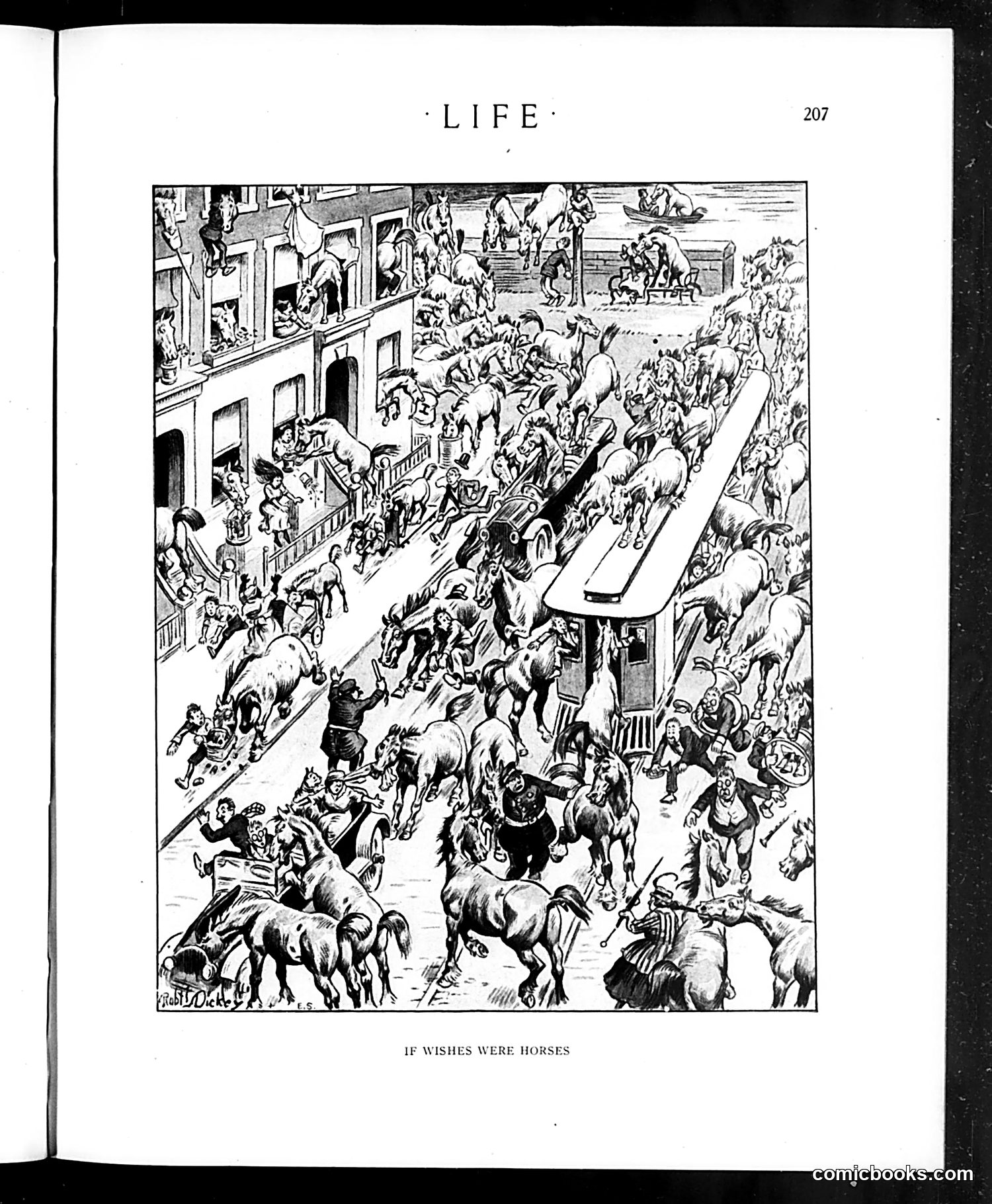
This satirical cartoon depicts a chaotic urban street scene overrun with horses—a visual pun on the old proverb "If wishes were horses, beggars would ride." The crowded street includes pedestrians, streetcars, buildings, and what appears to be early 20th-century city life, but horses dominate the scene in absurd numbers. The satire likely comments on impractical wishful thinking or unrealistic urban planning. The specific context remains unclear without additional historical markers, but the cartoon humorously imagines the literal consequence of wishes materializing—creating complete urban pandemonium. It's a commentary on the gap between desires and practical reality, rendered through visual absurdist humor typical of Life magazine's style.
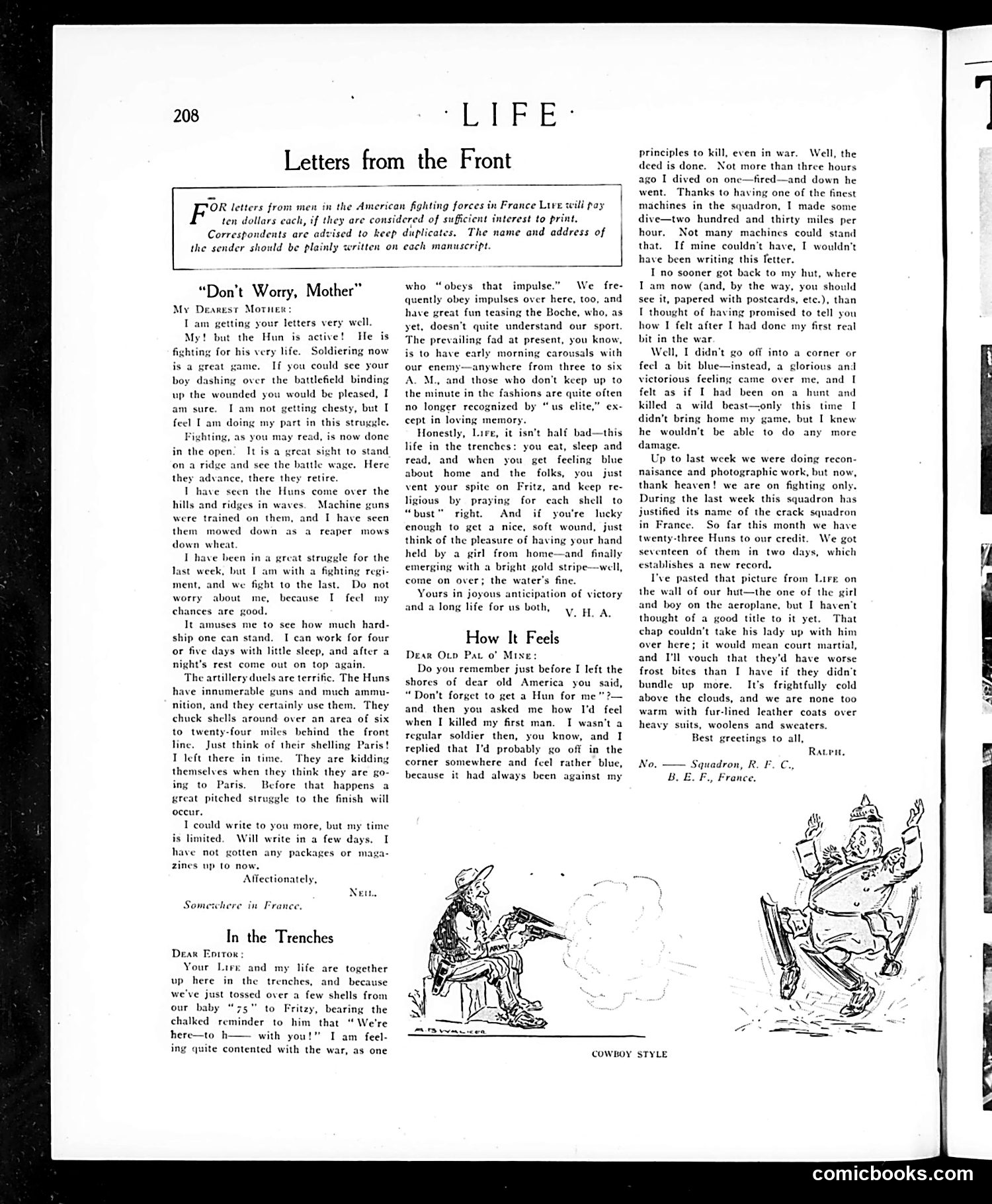
This page presents letters from American soldiers fighting in France during World War I, soliciting reader submissions for publication. The magazine paid ten dollars per letter deemed sufficiently interesting. The letters reveal soldiers' perspectives on trench warfare: one describes the intense fighting, artillery bombardments, and machine-gun assaults with apparent pride in service. Another adopts a darkly humorous tone about life in the trenches, mentioning shelling German positions ("Fritzy" and "the Boche"—period slang for Germans) and joking about wounds as a path to recognition. The included cartoon labeled "COWBOY STYLE" (bottom right) appears to satirize American soldiers' casual, somewhat reckless attitude toward combat, depicting a figure in an exaggerated, playful battle pose. These letters served propaganda purposes, reassuring the American home front that soldiers were handling warfare with courage and even good humor during the brutal conflict.
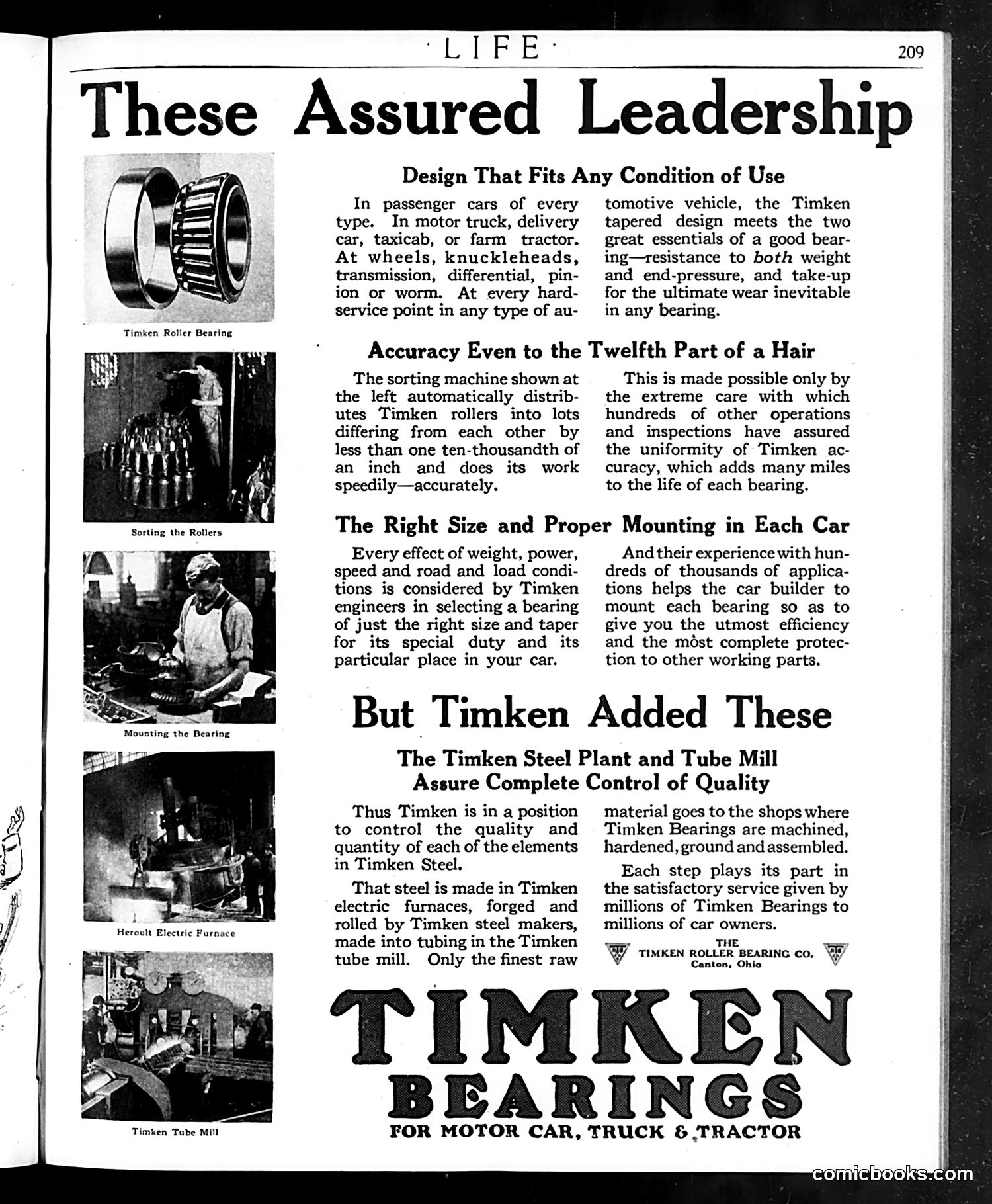
This is not a political cartoon but rather a full-page advertisement for Timken Roller Bearings, a real automotive parts manufacturer. The page uses the heading "These Assured Leadership" as a marketing claim about product quality and consistency. The "satire" is implicit in Life magazine's format—it's a parody of corporate advertising language itself. The exaggerated precision claims ("accuracy even to the twelfth part of a hair") and the earnest photographs of industrial processes mock the grandiose self-promotion typical of 1920s-1930s corporate advertising. The point isn't satirizing politics or public figures, but rather the pretentious marketing rhetoric companies used to sell standardized industrial components. The page exemplifies how Life often used humorous juxtaposition of ads against editorial content to gently ridicule American consumer culture and manufacturing claims.
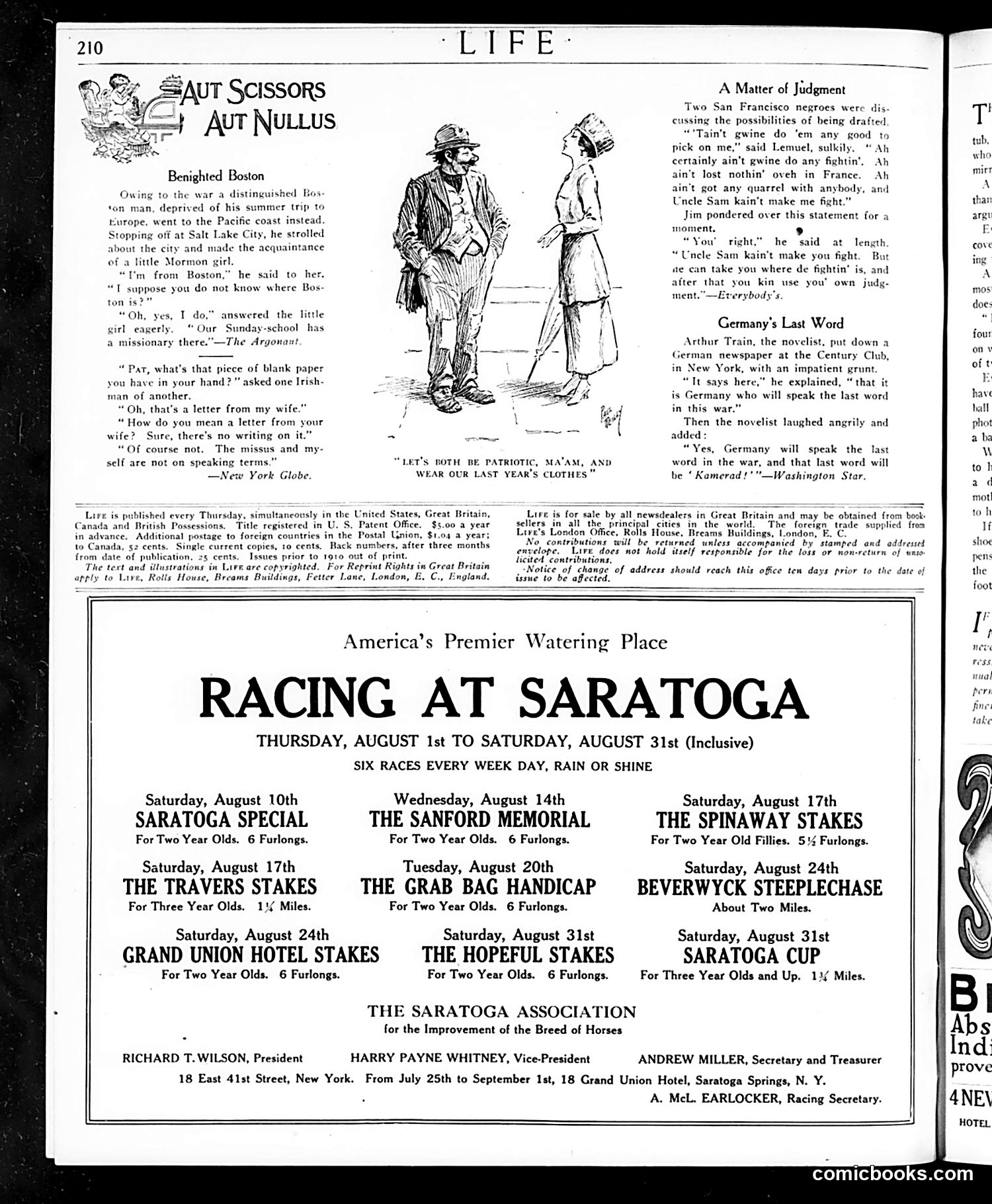
This page contains several brief satirical jokes and a large horse-racing advertisement. The cartoons illustrate early-twentieth-century humor: **"Benighted Boston"** mocks provincial Bostonians through stories of a man from that city appearing ignorant or foolish to those elsewhere (Utah, Ireland). The title itself is a pun on Boston's cultural pretensions. **The war-related humor** reflects World War I context: the unnamed cartoon shows a man suggesting he and a woman both wear last year's clothing, framed as patriotic conservation—likely satirizing those who use patriotism to justify frugality. **"A Matter of Judgment"** presents stereotyped dialect humor about African Americans discussing military drafting, reflecting period attitudes toward race and conscription. **"Germany's Last Word"** is a pun-based joke: a writer suggests Germany's "last word" in the war will be "Kamerad!" (German for "comrade/surrender")—implying German defeat and surrender. The page is dominated by a Saratoga horse-racing advertisement, indicating this publication carried substantial paid advertising.
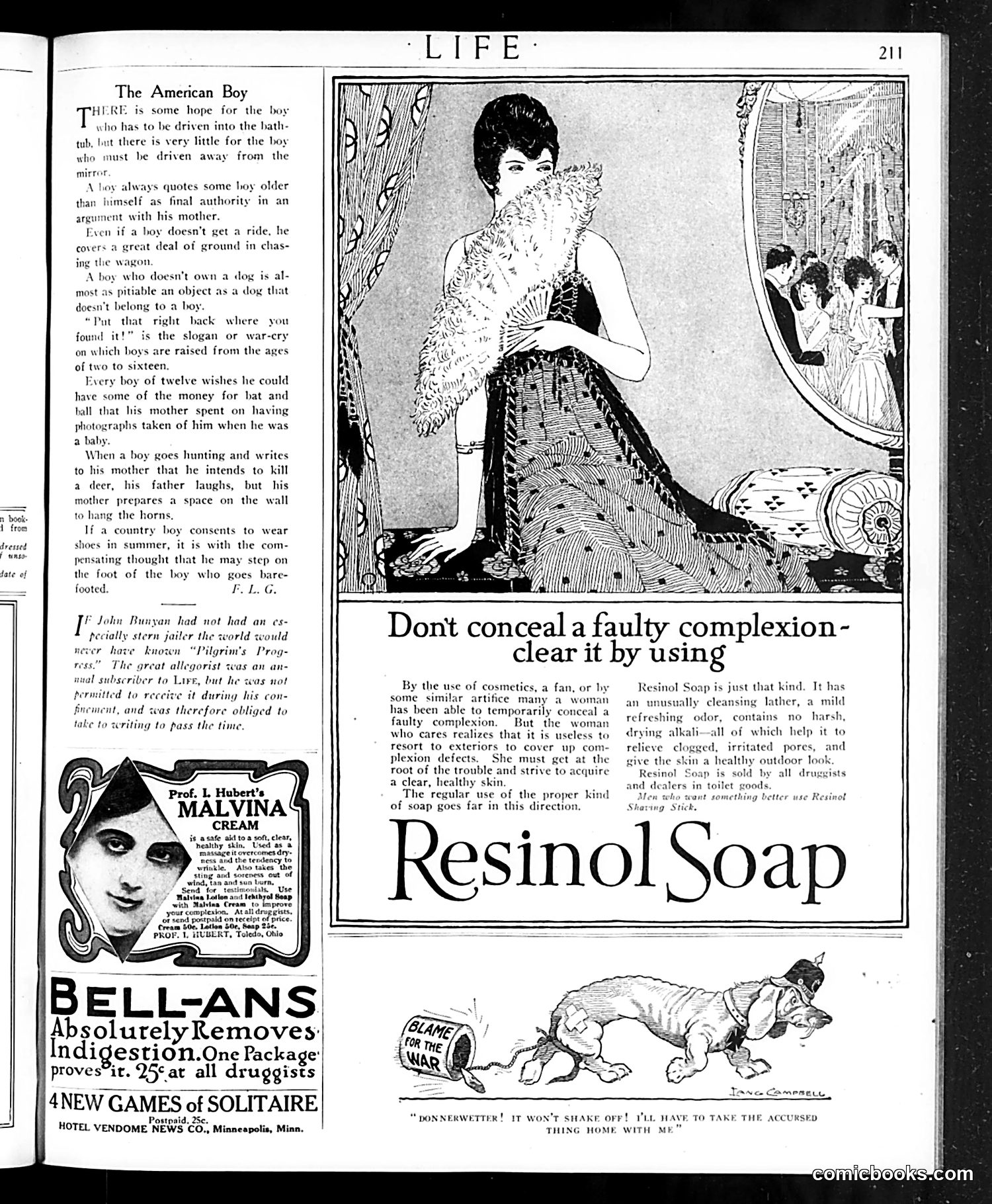
**"The American Boy" Essay:** A humorous column observing boys' behavior—their vanity, resistance to bathing, attachment to dogs, and hunting ambitions. It includes a digression crediting John Bunyan's imprisonment as inspiration for writing *Pilgrim's Progress*, humorously suggesting Life magazine was his only reading material. **Bottom Cartoon:** A dachshund shakes off water after a bath, with German expletive "Donnerwetter!" The joke plays on the dog's difficulty removing water and its owner's exasperation—likely satirizing the challenge of bathing animals, a relatable domestic frustration. **Advertisements:** The page contains period beauty and digestive remedy ads (Malvina Cream, Bell-Ans, Resinol Soap), typical of early 20th-century magazines. These ads promoted cosmetics and patent medicines now considered ineffective or dubious. The page reflects typical Life content: light social commentary mixed with commercial messaging.
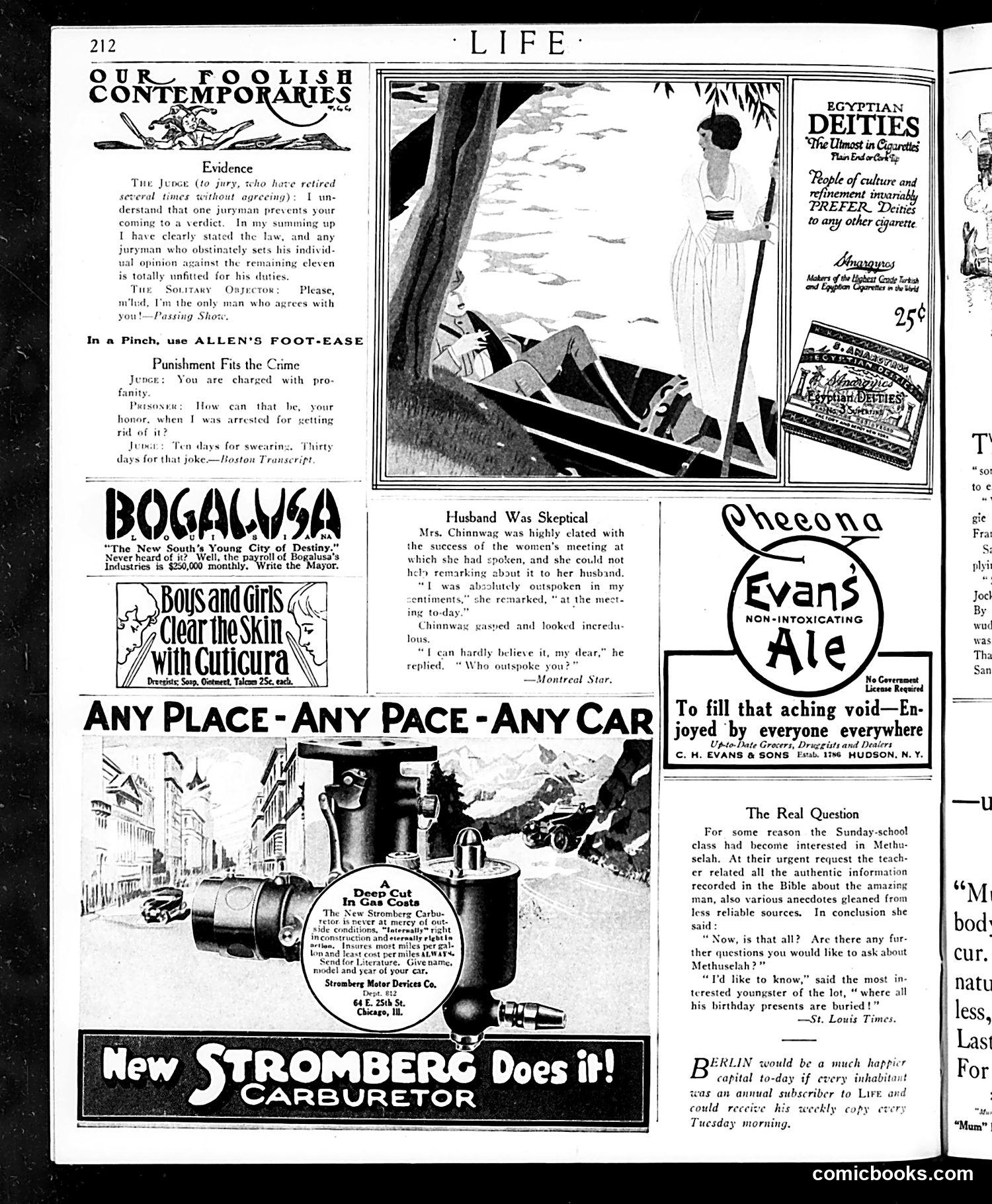
This page contains several satirical pieces typical of *Life*'s humor: **"Our Foolish Contemporaries"** shows a judge criticizing a juror for independent thinking—the joke being that the judge claims the juror "obstinately sets his individual [opinion]" against the other eleven, only for the court officer to reveal he's the *only* juror who agreed with the judge. It satirizes judicial arrogance and groupthink. **"Punishment Fits the Crime"** jokes about a man arrested for profanity who claims he was arrested for "getting rid of it"—the judge then punishes him more severely for making a pun than for swearing, mocking judicial absurdity. **"Husband Was Skeptical"** depicts a woman bragging about speaking up at a meeting; her husband expresses disbelief, sarcastically asking "Who outspoke you?"—implying she's habitually talkative. **"The Real Question"** shows children learning about the biblical Methuselah; the punchline has a child ask where all his birthday presents are buried—humor from a child's literal, materialistic thinking. The remaining content is period advertising for automobiles, cigarettes, and beverages.
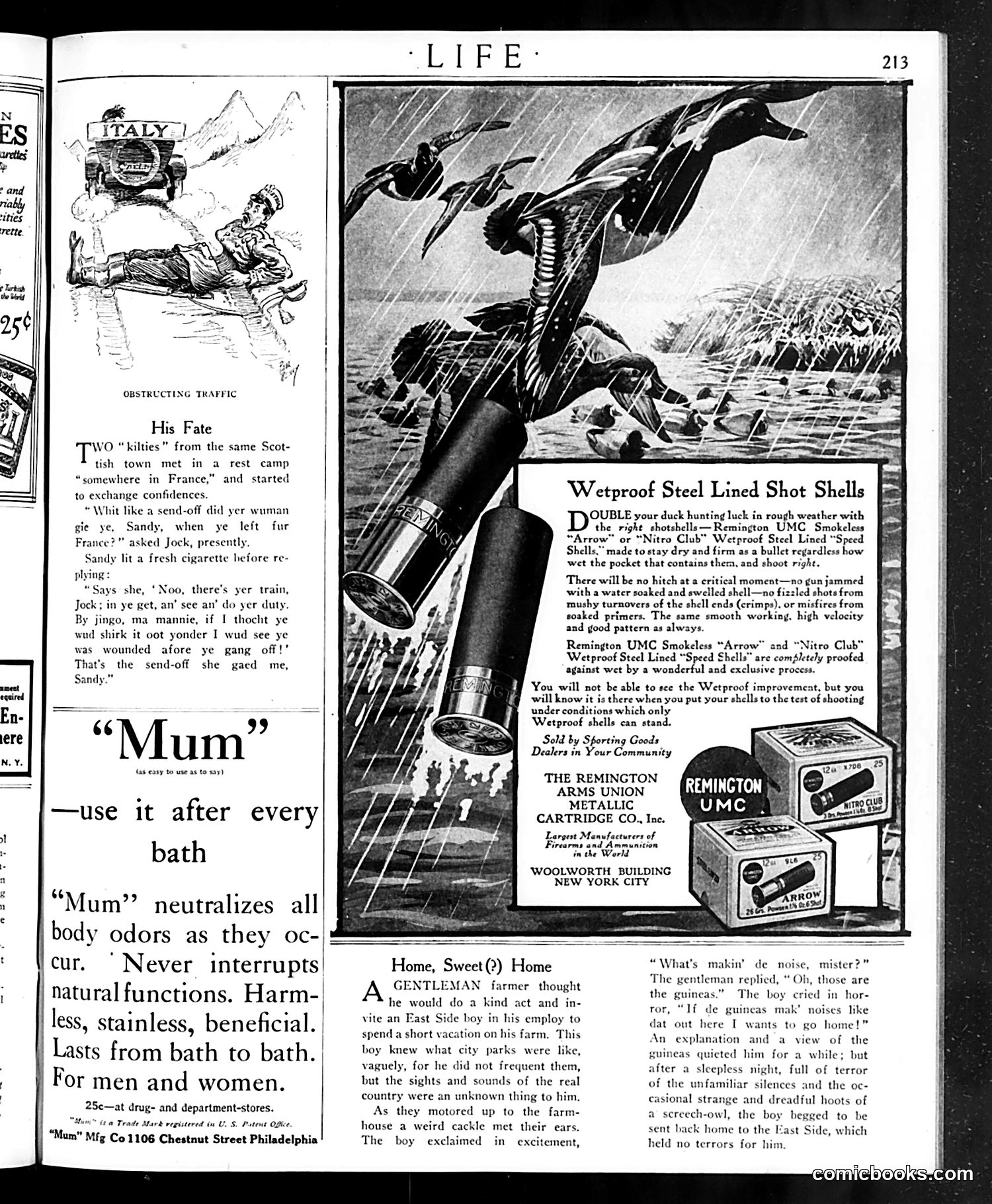
This page contains three distinct sections: **Top Left - "Obstructing Traffic" Cartoon:** A satirical sketch depicting two Scottish soldiers ("kilties") in WWI France exchanging stories. The dialogue uses heavy Scottish dialect to humorously contrast masculine bravado with domestic reality—one soldier boasts his wife sent him off with tough love, saying she'd wound him herself rather than see him shirk duty. The satire gently mocks both wartime masculinity and the gap between soldiers' heroic self-image and their actual circumstances. **Right Side - Remington Ammunition Advertisement:** A full-page ad for waterproof shotgun shells featuring dramatic hunting imagery. This is straightforward commercial content targeting hunters, emphasizing product reliability in wet conditions. **Bottom - "Home, Sweet (?) Home" Anecdote:** A humorous short story about an East Side (working-class New York) boy invited to a wealthy farmer's home. The joke relies on class contrast: the boy finds rural sounds (guinea fowl, owls) terrifying and unfamiliar, preferring the known dangers of urban streets to the "unknown" countryside—inverting typical pastoral romanticism.
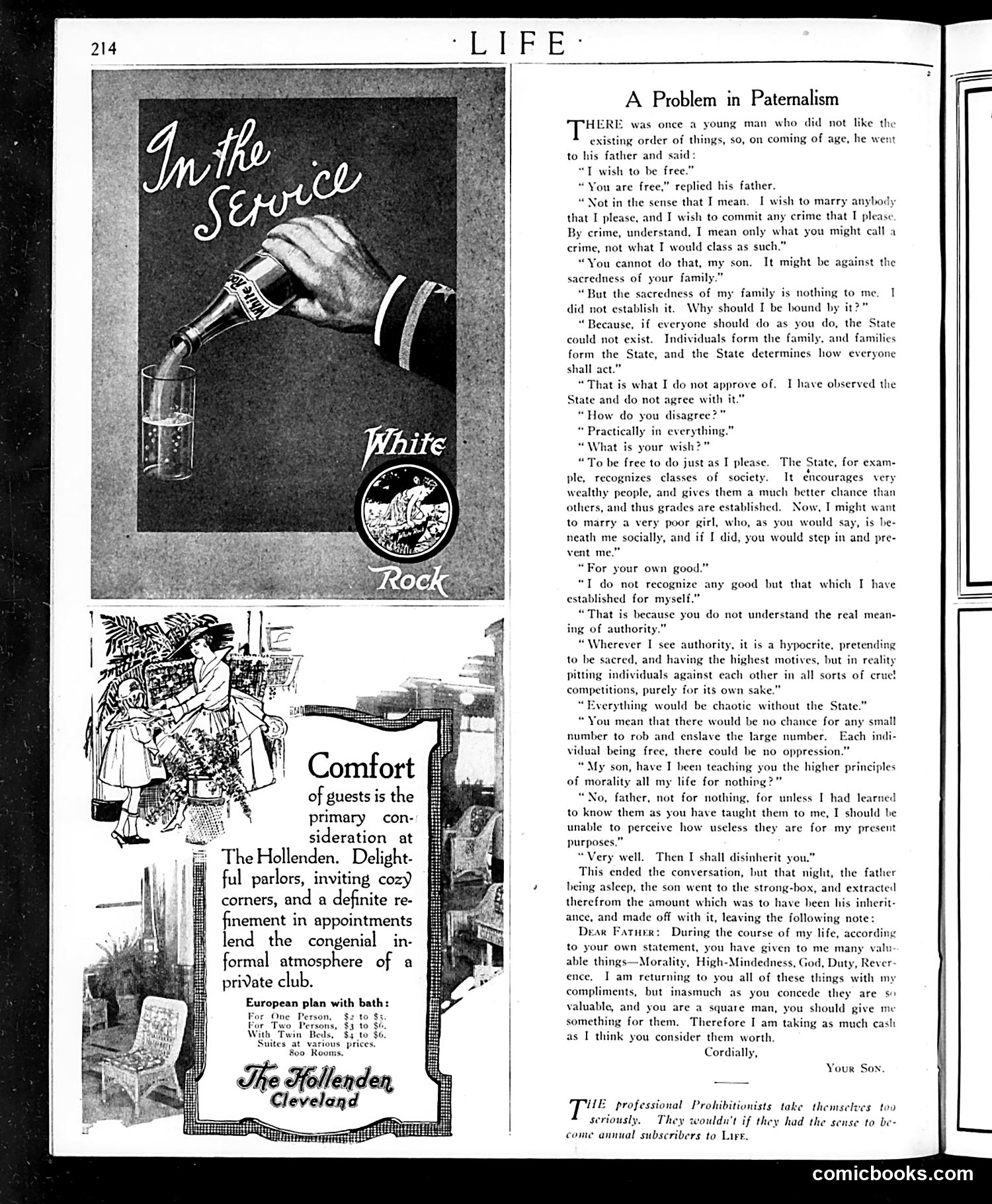
This satirical dialogue presents a philosophical debate between a young man and his father about individual freedom versus state authority. The son argues for absolute personal liberty—to marry whom he pleases and commit crimes without restriction—while the father defends traditional family and state hierarchies as necessary social structures. The satire targets both positions: the father's paternalistic authority (which the son exposes as hypocritical) and the son's radical individualism (which he undercuts by stealing his inheritance after losing the argument). The punchline—the son rejecting his father's "gifts" of morality while stealing money—suggests that idealistic principles collapse when personal interest emerges. This appears to critique anarchist or radical libertarian thought of the era alongside conservative paternalism. The concluding joke about Prohibitionists implies Life viewed moralizing authority figures as equally self-defeating.
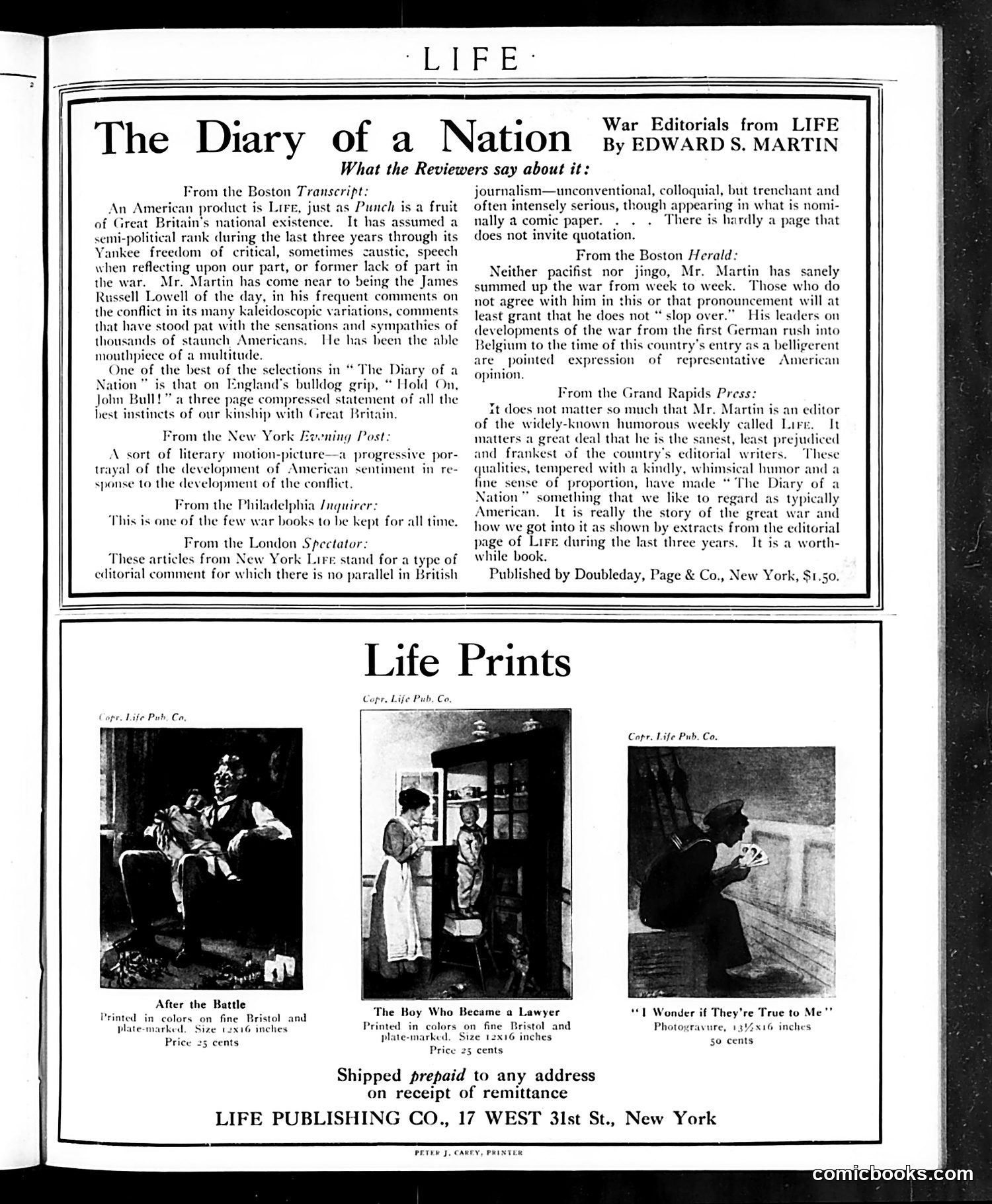
This is primarily an advertisement and book review page, not editorial content. **Main content:** Edward S. Martin's *The Diary of a Nation*, a collection of his war editorials from LIFE magazine, is being promoted through favorable reviews from major American newspapers (Boston Transcript, Herald; New York Evening Post; Philadelphia Inquirer; Grand Rapids Press) and British publication (London Spectator). **The point:** These reviews position LIFE's editor Martin as a serious, balanced voice on America's involvement in World War I—neither pacifist nor warmongering, but thoughtfully capturing American sentiment's evolution from neutrality toward entry. The framing suggests LIFE, though nominally a comic/satirical magazine, offered substantive political commentary during the war years. **Below:** An advertisement offering three available art prints from LIFE for purchase, priced 25-50 cents. The page reflects LIFE's dual identity: humorous weekly with genuine political authority on contemporary events.
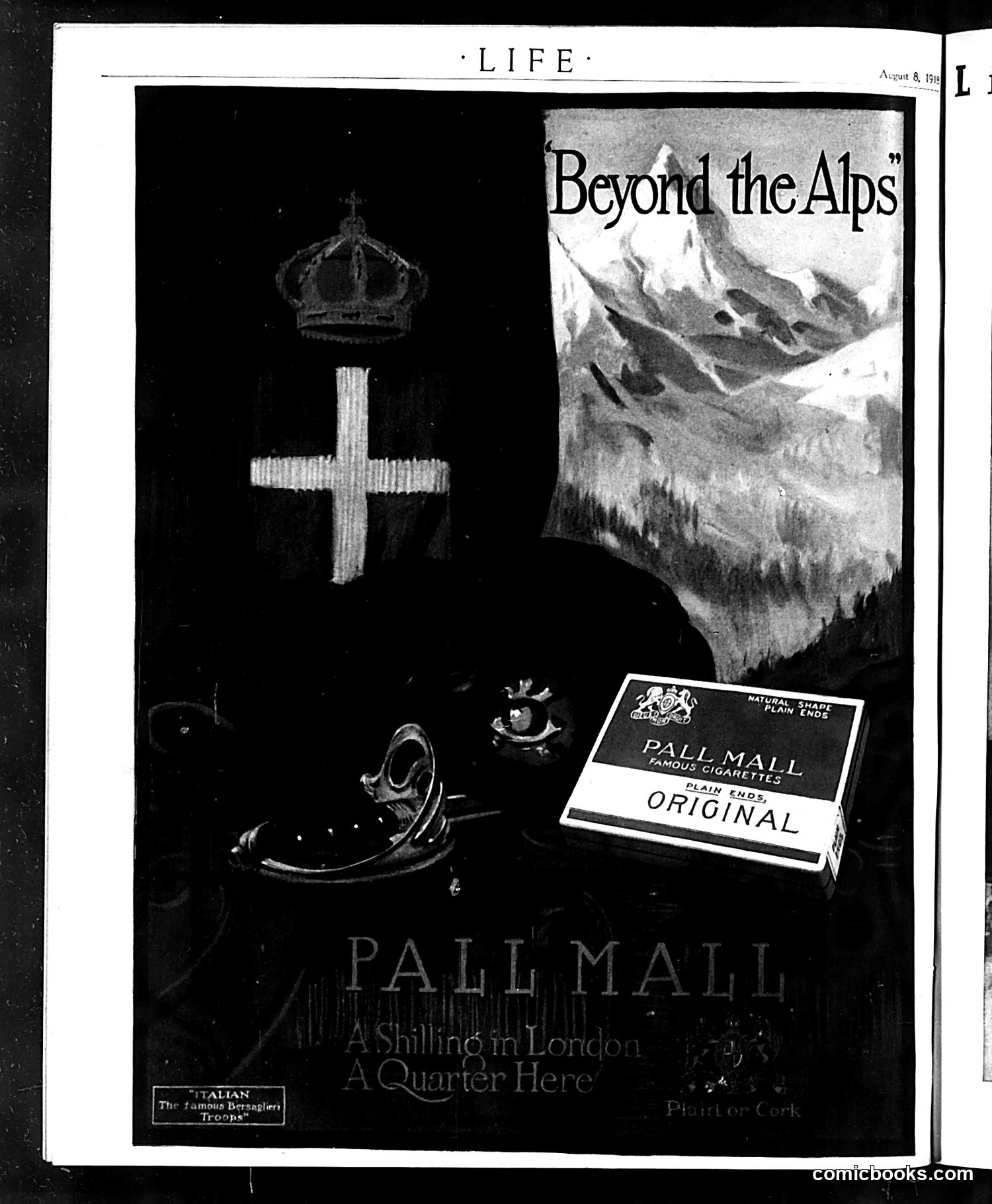
This page is primarily **advertising for Pall Mall cigarettes**, not political satire. The layout juxtaposes two images: on the left, a religious symbol (a crown above a cross, suggesting British royal or military insignia); on the right, a mountain landscape labeled "Beyond the Alps." The ad copy emphasizes "A Shilling in London / A Quarter Here," suggesting price comparison between British and American markets. The cigarette package is prominently displayed in the center. The religious/military imagery appears designed to associate Pall Mall with prestige and British sophistication—a common advertising strategy in this era. The "Beyond the Alps" reference evokes European elegance and worldliness. This is commercial rather than satirical content, typical of *Life* magazine's advertising pages from August 1924.