
Life, 1918-08-08 · page 12 of 36
Life — August 8, 1918 — page 12: what you’re looking at
What you’re looking at
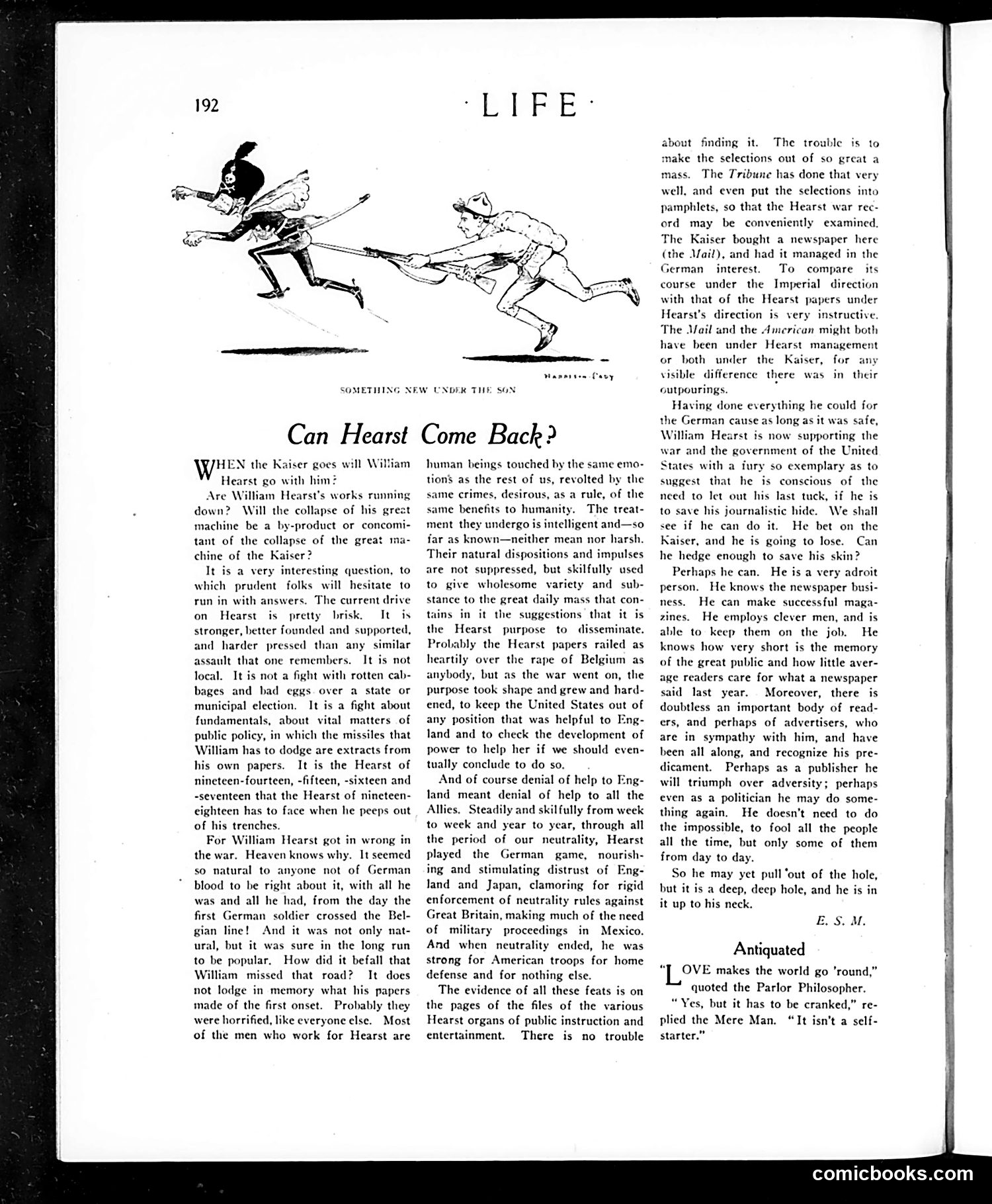
This page features a political cartoon titled "Something New Under the Sun" by Cesare Enea, depicting two figures in a physical struggle—one appears to be a winged fairy or sprite pulling away from a larger human figure. The accompanying article questions whether William Hearst (the newspaper magnate) can maintain his influence and power after World War I ends. The cartoon's meaning is unclear from the image alone, but the text discusses Hearst's controversial wartime positions, his support for Germany initially, and his current backing of U.S. interests. The piece suggests Hearst remains influential in publishing despite his checkered record, questioning whether he'll recover his reputation post-war. The "something new" likely satirizes Hearst's attempted reinvention.
📄 Transcribed text from this page (OCR, searchable)
Machine-transcribed from the original scan — historical spelling and the odd misread are preserved.
SOMETHING NEW UNDER THE SON Can Hearst Come Bach? HEN the Kaiser goes will William Hearst go with him? Are William Hearst's works running down? Will the collapse of his great machine be a by-product or concomi- tant of the collapse of the great ma- chine of the Kaiser? It is a very interesting question, to which prudent folks will hesitate to run in with answers. The current drive on Hearst is pretty brisk. It is stronger, better founded and supported, and harder pressed than any similar assault that one remembers. It is not local. It is not a fight with rotten cab- bages and bad eggs over a state or municipal election. It is a fight about fundamentals, about vital matters of public policy, in which the missiles that William has to dodge are extracts from his own papers. It is the Hearst of nineteen-fourteen, -fifteen, -sixteen and -seventeen that the Hearst of nineteen- eighteen has to face when he peeps out of his trenches. For William Hearst got in wrong in the war. Heaven knows why. It seemed so natural to anyone not of German blood to be right about it, with all he was and all he had, from the day the first German soldier crossed the Bel- gian line! And it was not only nat- ural, but it was sure in the long run to be popular. How did it befall that William missed that road? It does not lodge in memory what his papers made of the first onset. Probably they were horrified, like everyone else. Most of the men who work for Hearst are human beings touched by the same emo- tion’ as the rest of us, revolted by the same crimes, desirous, as a rule, of the same benefits to humanity. The treat- ment they undergo is intelligent and—so far as known—neither mean nor harsh. Their natural dispositions and impulses are not suppressed, but skilfully used to give wholesome variety and sub- stance to the great daily mass that con- tains in it the suggestions that it is the Hearst purpose to disseminate. Probably the Hearst papers railed as heartily over the rape of Belgium as anybody, but as the war went on, the purpose took shape and grew and hard- ened, to keep the United States out of any position that was helpful to Eng- land and to check the development of power to help her if we should even- tually conclude to do so, And of course denial of help to Eng- land meant denial of help to all the Allies. Steadily and skilfully from week to week and year to year, through all the period of our neutra Hearst played the German game, nourish- ing and stimulating distrust of Eng- Jand and Japan, clamoring for rigid enforcement of neutrality rules against Great Britain, making much of the need of military proceedings in Mexico. And when neutrality ended, he was strong for American troops for home defense and for nothing else. The evidence of all these feats is on the pages of the files of the various Hearst organs of public instruction and entertainment. There is no trouble about finding it. The trouble is to make the selections out of so great a mass. The Tribune has done that very well, and even put the selections into pamphlets, so that the Hearst war rec- ord may be conveniently examined. The Kaiser bought a newspaper here (the Mail), and had it managed in the German interest. To compare its course under the Imperial direction with that of the Hearst papers under Hearst's direction is very instructive. The Vail and the American might both have been under Hearst management or both under the Kaiser, for visible difference there was in. their outpourings. Having done everything he could for the German cause as long as it was safe, William Hearst is now supporting the war and the government of the United States with a fury so exemplary as to suggest that he is conscious of the need to Iet out his last tuck, he is to save his journalistic hide. We shall see if he can do it. He bet on the Kaiser, and he is going to lose. Can he hedge enough to save his skin? Perhaps he can. He is a very adroit person. He knows the newspaper busi- ness. He can make successful maga- zines. He employs clever men, and is able to keep them on the job. He knows how very short is the memory of the great public and how little aver- age readers care for what a newspaper said last year. Moreover, there is doubtless an important body of read- ers, and perhaps of advertisers, who are in sympathy with him, and have been all along, and recognize his pre- dicament. Perhaps as a publisher he will triumph over adversity; perhaps even as a politician he may do some- thing again. He doesn’t need to do the impossible, to fool all the people all the time, but only some of them from day to day. any So he may yet pull ‘out of the hole, but it is a deep, deep hole, and he is in it up to his neck. E..S. BM. Antiquated “[ OVE makes the world go ‘round,” quoted the Parlor Philosopher. “Yes, but it has to be cranked,” re- plied the Mere Man. “It isn't a self- starter.” comicbooks.com