
Life, 1918-08-08 · page 16 of 36
Life — August 8, 1918 — page 16: what you’re looking at
What you’re looking at
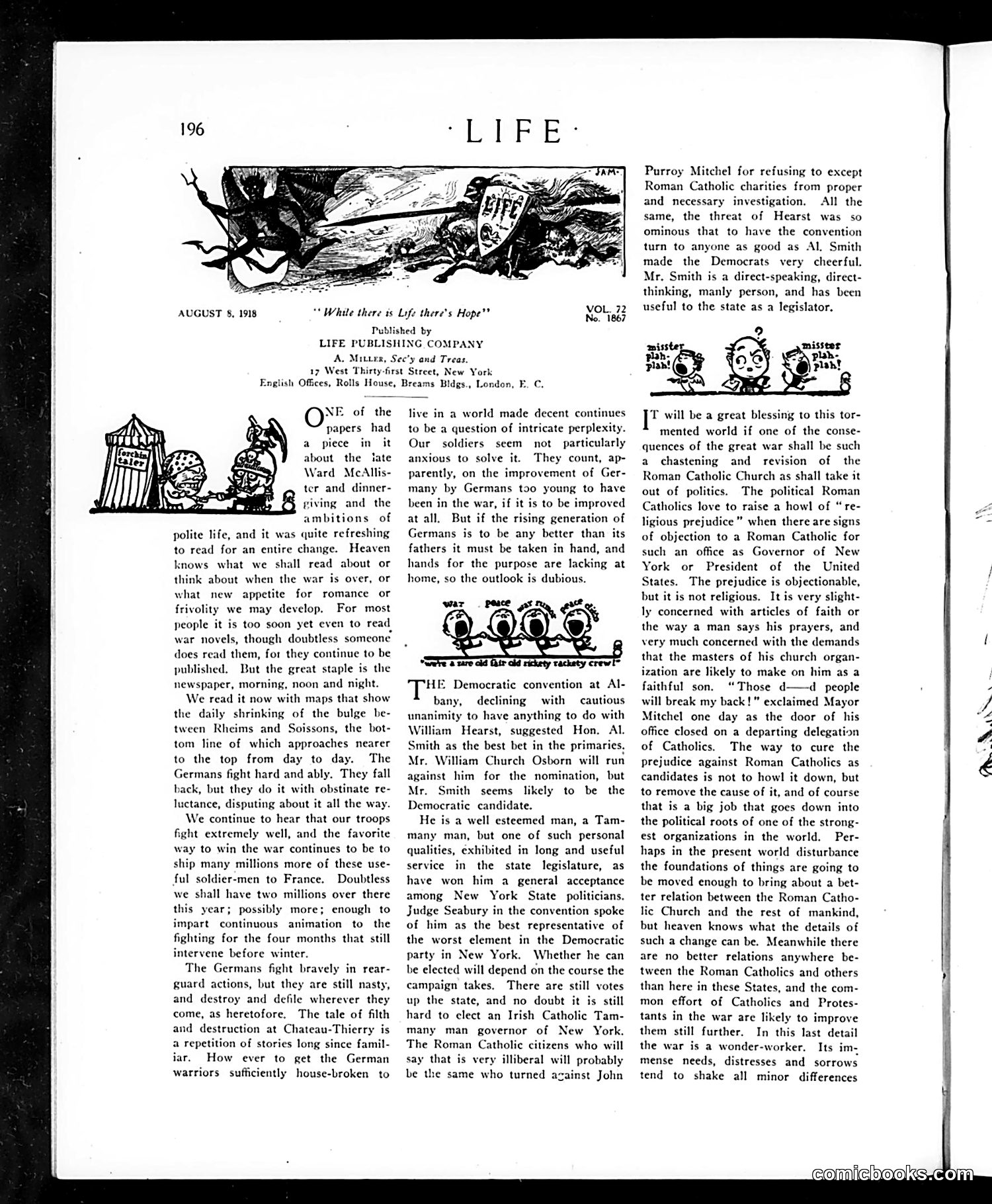
This page contains political commentary on New York's Democratic convention and World War I, rather than traditional cartoons. **Main content:** The editorial discusses the Democratic Party's rejection of William Hearst as a candidate, instead endorsing Al Smith for governor. Smith is described as a Tammany Hall politician of generally good character and legislative service, though Judge Seabury criticized him as "the best representative of the worst element in the Democratic party." **The satirical point:** The piece notes the contradiction between Catholic voters who opposed investigating Roman Catholic charities under Mayor Mitchell, yet now support Smith despite his Tammany connections. The unnamed cartoons at top and margins appear to be generic wartime illustrations rather than specific political satire. **Historical context:** This was written during WWI (note references to fighting near Rheims and Soissons), when German military conduct drew intense criticism, and when religious and machine politics influenced New York elections significantly.
📄 Transcribed text from this page (OCR, searchable)
Machine-transcribed from the original scan — historical spelling and the odd misread are preserved.
AUGUST 8, 1918 “White there is Life there's Hope” Published by LIFE PUBLISHING COMPANY A. Mittrr, Sec'y and Treas. 17 West Thirty-first Street, New York English Offices, Rolls House, Breams Bldgs., London, FE. C. of the papers had a piece in it about the Ward MeAllis- ter and dinner- giving and the ambitions of polite life, and it was quite refreshing to read for an entire change. Heaven knows what we shall read about or think about when the war is over, or appetite for romance or For most what ne frivolity we may develop. people it is too soon yet even to read, war novels, though doubtless someone does read them, for they continue to be published. But the great staple is the newspaper, morning, noon and night. We read it now with maps that show the daily shrinking of the bulge be- tween Rheims and Soissons, the bot- tom line of which approaches nearer to the top from day to day. The Germans fight hard and ably. They fall back, but they do it with obstinate re- luctance, disputing about it all the way. We continue to hear that our troops fight extremely well, and the favorite way to win the war continues to be to ship many millions more of these use- ful soldier-men to France. Doubtless we shall have two millions over there this year; possibly more; enough to impart continuous animation to the fighting for the four months that still intervene before winter. The Germans fight bravely in rear- guard actions, but they are still nasty, and destroy and defile wherever they come, as heretofore. The tale of filth and destruction at Chateau-Thierry is a repetition of stories long since famil- How ever to get the German warriors sufficiently house-broken to jar. live in a world made decent continues to be a question of intricate perplexity. Our soldiers seem not particularly anxious to solve it. They count, ap- parently, on the improvement of Ger- many by Germans too young to have been in the war, if it is to be improved at all. But if the rising generation of Germans is to be any better than its fathers it must be taken in hand, and hands for the purpose are lacking at home, so the outlook is dubious. HE Democratic convention at Al- bany, declining with cautious unanimity to have anything to do with William Hearst, suggested Hon. Al. Smith as the best bet in the primaries, Mr. William Church Osborn will run against him for the nomination, but Mr. Smith seems likely to be the Democratic candidate. He is a well esteemed man, a Tam- many man, but one of such personal qualities, exhibited in long and useful service in the state legislature, as have won him a general acceptance among New York State politicians. Judge Seabury in the convention spoke of him as the best representative of the worst element in the Democratic party in New York. Whether he can be elected will depend on the course the campaign takes. There are still votes up the state, and no doubt it is still hard to clect an Irish Catholic Tam- many man governor of New York. The Roman Catholic citizens who will say that is very illiberal will probably be the same who turned against John Purroy Mitchel for refusing to except Roman Catholic charities from proper and necessary investigation. All the same, the threat of Hearst was so ominous that to have the convention turn to anyone as good as Al, Smith made the Democrats very cheerful. Mr, Smith is a direct-speaking, direct- thinking, manly person, and has been useful to the state as a legislator. [ will be a great blessing to this tor- mented world if one of the conse- quences of the great war shall be such a hastening and revision of the Roman Catholic Church as shall take it out of politics. The political Roman Catholics love to raise a howl of “re- ligious prejudice” when there are signs of objection to a Roman Catholic for such an office as Governor of New York or President of the United States. The prejudice is objectionable, but it is not religious. It is very slight- ly concerned with articles of faith or the way a man says his prayers, and very much concerned with the demands that the masters of his church organ- ization are likely to make on him as a faithful son, “Those d—d people will break my back!” exclaimed Mayor Mitchel one day as the door of his office closed on a departing delegation of Catholics. The way to cure the prejudice against Roman Catholics as candidates is not to howl it down, but to remove the cause of it, and of course that is a big job that goes down into the political roots of one of the strong- est organizations in the world. Per- haps in the present world disturbance the foundations of things are going to be moved enough to bring about a bet- ter relation between the Roman Catho- lic Church and the rest of mankind, but heaven knows what the details of such a change can be. Meanwhile there are no better relations anywhere be- tween the Roman Catholics and others than here in these States, and the com- mon effort of Catholics and Protes- tants in the war are likely to improve them still further. In this last detail the war is a wonder-worker. Its imz mense needs, distresses and sorrows tend to shake all minor differences