
Life, 1918-08-08 · page 6 of 36
Life — August 8, 1918 — page 6: what you’re looking at
What you’re looking at
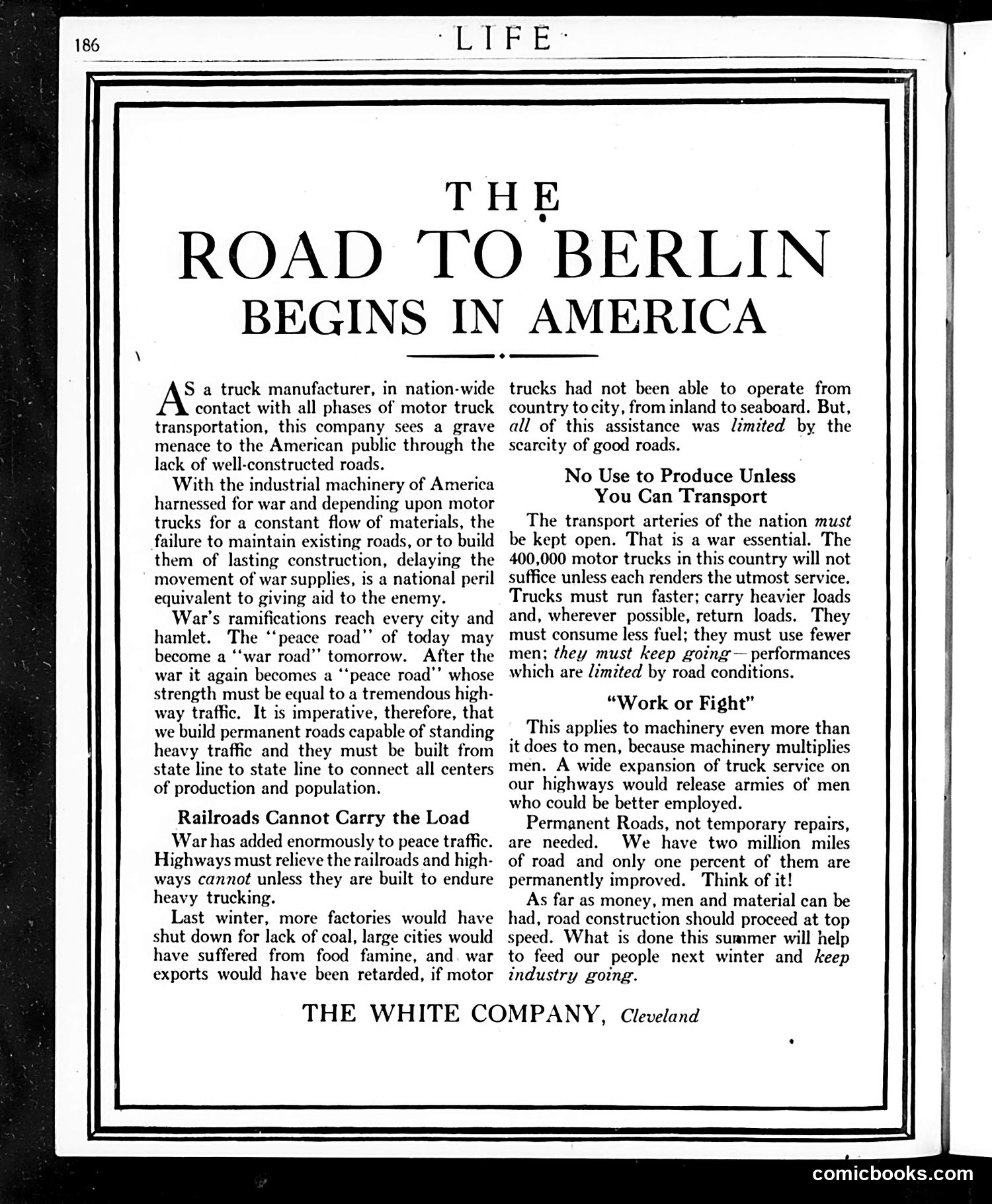
This is **not a satirical cartoon** but rather a **serious wartime advertisement** from The White Company (a truck manufacturer in Cleveland). Published during World War I, it argues that America's inadequate road infrastructure threatens military logistics. The ad's central argument: with 400,000 motor trucks needed to transport war materials, poor roads severely limit efficiency. It claims railroads alone cannot handle the burden, so the nation must urgently build permanent, high-quality highways connecting production centers. The phrase "The Road to Berlin Begins in America" uses martial rhetoric to frame infrastructure investment as a patriotic war necessity. This represents typical WWI-era corporate appeals linking commercial interests (truck sales) to national defense, lobbying for government road-building expenditure as essential war support.
📄 Transcribed text from this page (OCR, searchable)
Machine-transcribed from the original scan — historical spelling and the odd misread are preserved.
THE ROAD TO BERLIN BEGINS IN AMERICA S a truck manufacturer, in nation-wide contact with all phases of motor truck transportation, this company sees a grave menace to the American public through the lack of well-constructed roads. With the industrial machinery of America harnessed for war and depending upon motor trucks for a constant flow of materials, the failure to maintain existing roads, or to build them of lasting construction, delaying the movement of war supplies, is a national peril equivalent to giving aid to the enemy. War's ramifications reach every city and hamlet. The ‘‘peace road’’ of today may become a ‘‘war road”’ tomorrow. After the war it again becomes a ‘‘peace road’” whose strength must be equal to a tremendous high- way traffic. It is imperative, therefore, that we build permanent roads capable of standing heavy traffic and they must be built from state line to state line to connect all centers of production and population. Railroads Cannot Carry the Load War has added enormously to peace traffic. Highways must relieve the railroads and high- ways cannot unless they are built to endure heavy trucking. Last winter, more factories would have shut down for lack of coal, large cities would have suffered from food famine, and. war exports would have been retarded, if motor ° trucks had not been able to operate from country to city, from inland to seaboard. But, all of this assistance was limited by the scarcity of good roads. No Use to Produce Unless You Can Transport The transport arteries of the nation must be kept open. That is a war essential. The 400,000 motor trucks in this country will not suffice unless each renders the utmost service. Trucks must run faster; carry heavier loads and, wherever possible, return loads. They must consume less fuel; they must use fewer men; they must keep going — performances which are limited by road conditions. “Work or Fight” This applies to machinery even more than it does to men, because machinery multiplies men. A wide expansion of truck service on our highways would release armies of men who could be better employed. Permanent Roads, not temporary repairs, are needed. We have two million miles of road and only one percent of them are permanently improved. Think of it! As far as money, men and material can be had, road construction should proceed at top speed. What is done this summer will help to feed our people next winter and keep industry going. THE WHITE COMPANY, Cleveland comicbooks.com