
Life, 1918-08-08 · page 34 of 36
Life — August 8, 1918 — page 34: what you’re looking at
What you’re looking at
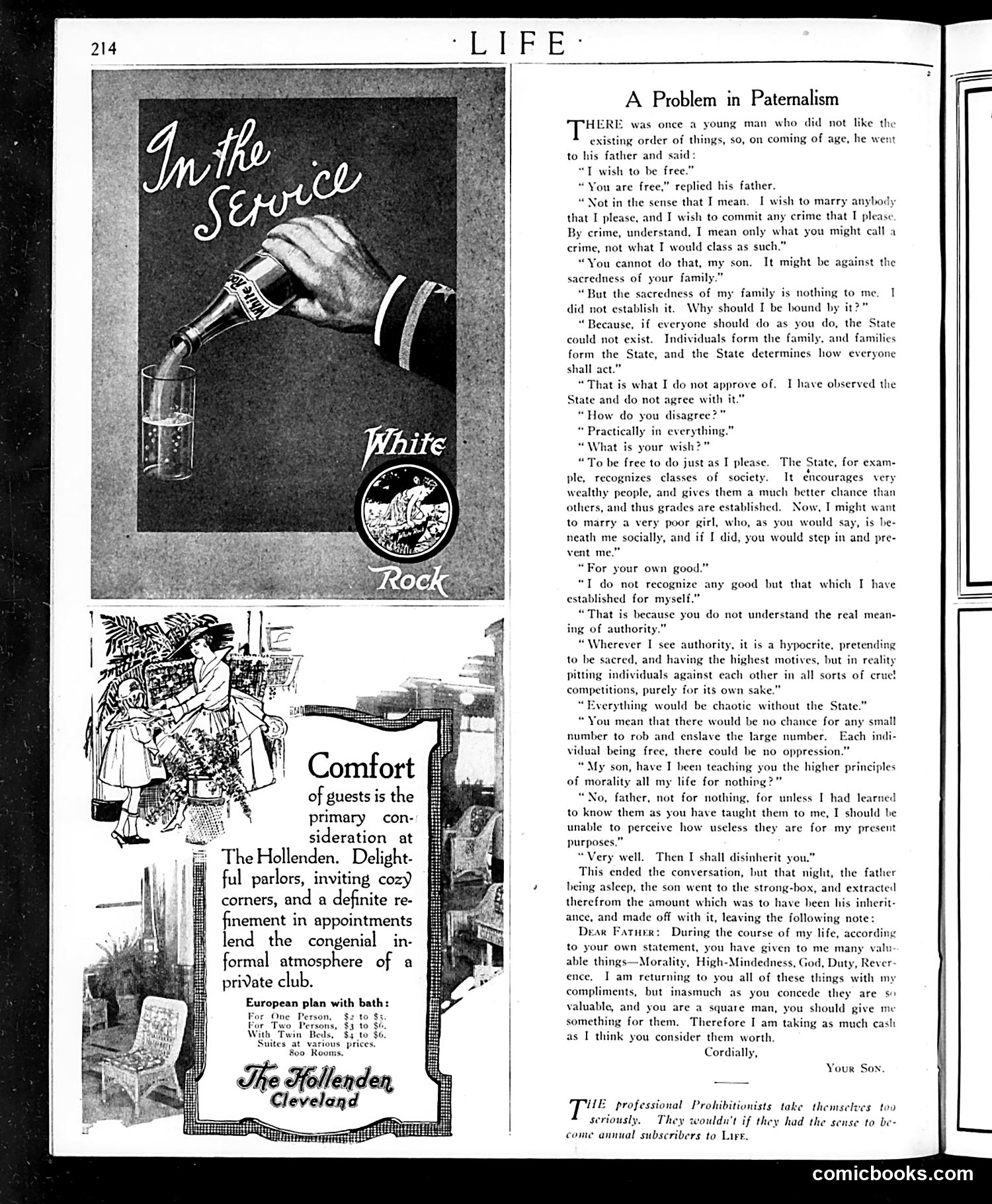
This satirical dialogue presents a philosophical debate between a young man and his father about individual freedom versus state authority. The son argues for absolute personal liberty—to marry whom he pleases and commit crimes without restriction—while the father defends traditional family and state hierarchies as necessary social structures. The satire targets both positions: the father's paternalistic authority (which the son exposes as hypocritical) and the son's radical individualism (which he undercuts by stealing his inheritance after losing the argument). The punchline—the son rejecting his father's "gifts" of morality while stealing money—suggests that idealistic principles collapse when personal interest emerges. This appears to critique anarchist or radical libertarian thought of the era alongside conservative paternalism. The concluding joke about Prohibitionists implies Life viewed moralizing authority figures as equally self-defeating.
📄 Transcribed text from this page (OCR, searchable)
Machine-transcribed from the original scan — historical spelling and the odd misread are preserved.
i Comfort of guests is the primary con- sideration at The Hollenden. Delight- ful parlors, inviting cozy corners, and a definite re- finement in appointments lend the congenial in- formal atmosphere of a private club. European plan with bath: Person, $2 to $ 1 rersons, $3 to $6 With Twin Beds,” $3 to $6. Suites at various prices. 800 Ri Tae Teesa A Problem in Paternalism HERE was once a young man who did not like the existing order of things, so, on coming of age, he went to his father and sai “LT wish to be free.’ “You are free,” replied his father. “Not in the sense that I mean. I wish to marry anybody that I please, and I wish to commit any crime that T please. By crime, understand, I mean only what you might call a crime, not what I would class as such.” “You cannot do that, my son. It might be aj sacredness of your family.” “But the sacredness of my family is nothing to me. 1 did not establish it. Why should I be bound by it?” “Because, if everyone should do as you do, the State could not exist. Individuals form the family, and families form the State, and the State determines how everyone shall act.” “That is what I do not approve of. I have observed the State and do not agree with it.” “How do you di * Practically in every’ “What is “To be free to do just as I please. The State, for exam- ple, recognizes classes of society. It encourages very wealthy people, and gives them a much better chance than others, and thus grades are established. Now, I might want to marry a very poor girl, who, as you would say, is be- neath me socially, and if [ did, you would step in and pre- vent me.” “For your own good.” “T do not recogi any good but that which I have established for myself.” “That is because you do not understand the real mean- ing of authority.” “Wherever I sce authority, it is a hypocrite, pretending to be sacred, and having the highest motives, but in reality pitting individuals against each other in all sorts of crue! competitions, purely for its own sake.” verything would be chaotic without the State.” “You mean that there would be no chance for any small number to rob and enslave the large number. Each indi- vidual being free, there could be no oppression.” “My son, have I been teaching you the higher principles of morality all my life for nothing?” “No, father, not for nothing, for unless I had learned to know them as you have taught them to me, I should be unable to perceive how useless they are for my present purposes,” “Very well. Then I shall disinherit you.” This ended the conversation, but that night, the father being asleep, the son went to the strong-box, and extracted therefrom the amount which was to ¢ been his inherit- ance, and made off with it, leaving the following not Deak Fatuer: During the course of my life, according to your own statement, you have given to me many valu able things—Morality, High-Mindedness, God, Duty, Rever- ence. I am returning to you all of these things with my compliments, but inasmuch as you concede they are so valuable, and you are a square man, you should give me something for them. Therefore I am taking as much cash as I think you consider them worth, Cordially, Your Son. WIE professional Prohibitionists take themselves too seriously, They wouldn't if they had the sense to be- come annual subscribers to Lire. | \|\--_—noo a7 comicbooks.com