
A complete issue · 36 pages · 1918
Life — July 25, 1918
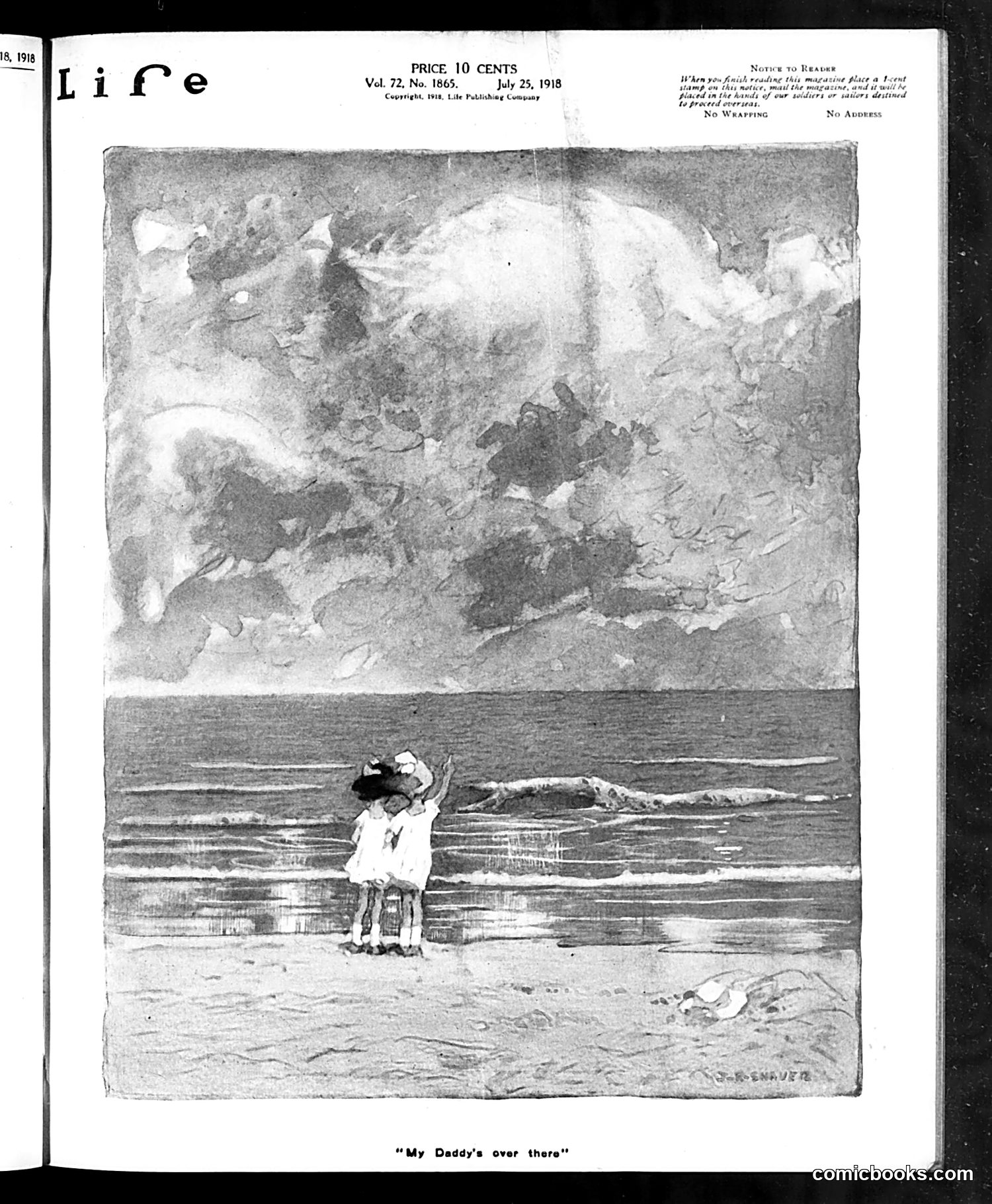
This page contains a single illustration titled "My Daddy's over there," showing a child at the beach pointing toward the ocean while an adult holds them. The caption references a father absent due to military service. Published during World War I (note the 1918 date), this image carries poignant wartime sentiment. The composition—child gazing across the water toward Europe where American forces fought—evokes the emotional toll of the war on families left behind. The illustration appeals to patriotic nostalgia and validates sacrifice, a common rhetorical strategy in 1918 American media to maintain civilian morale and support for the ongoing conflict. The sentimental rather than satirical approach suggests this particular page uses emotional appeal rather than political mockery.
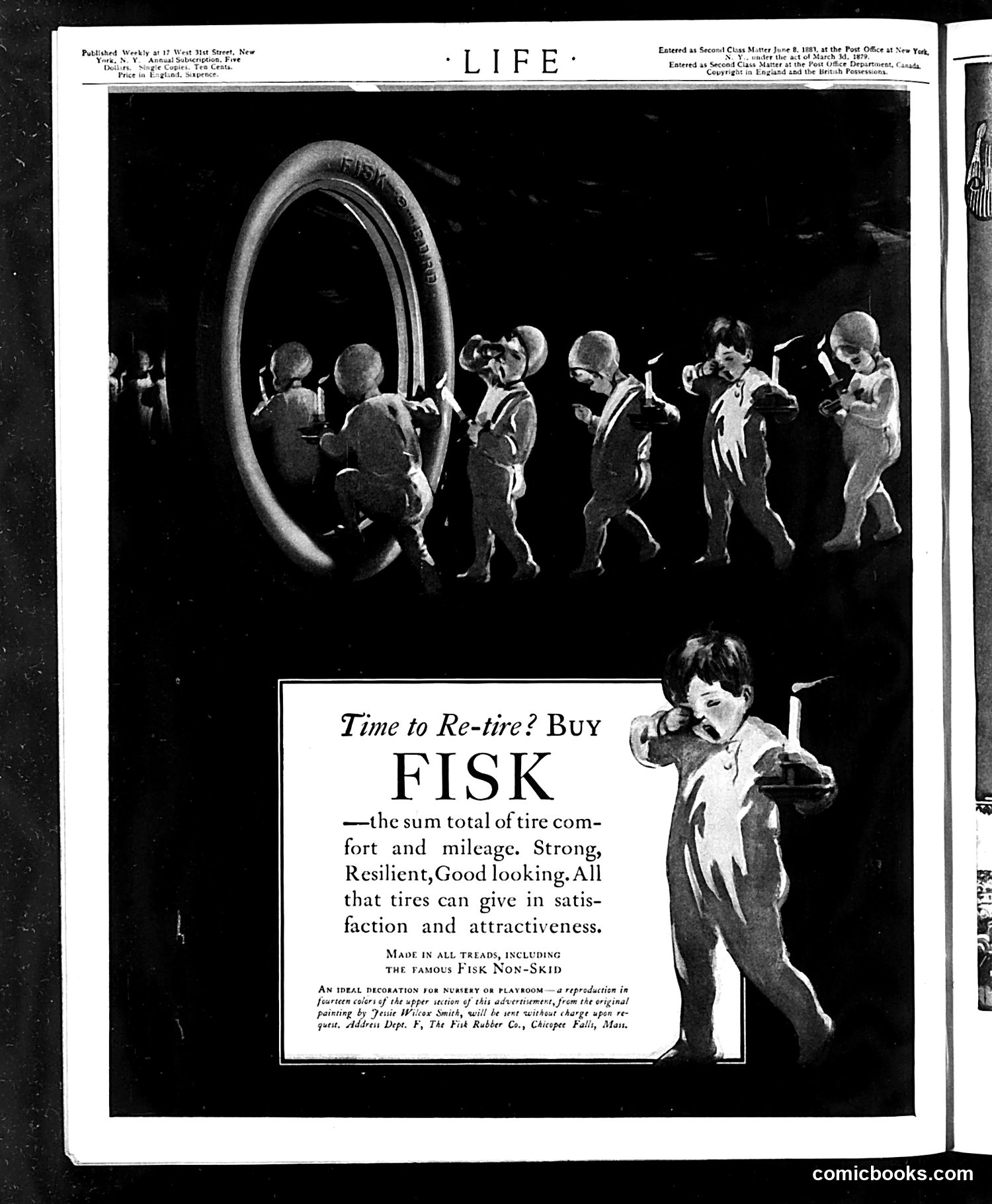
This page is primarily a **Fisk tire advertisement**, not political satire. The upper illustration shows babies or cherubs arranged around a large tire, apparently playing musical instruments—a whimsical scene promoting tire quality. The advertisement emphasizes Fisk tires as "strong, resilient, good looking," offering "comfort and mileage." The lower section features a small figure (possibly a child or cherub) in period clothing, likely meant as decorative branding imagery. The text notes this image is "an ideal decoration for nursery or playroom"—suggesting the company marketed their tires using charming, child-centered imagery to appeal to family-oriented consumers during the early automotive era. This reflects early 20th-century advertising strategy: associating products with wholesome, appealing imagery rather than technical specifications.
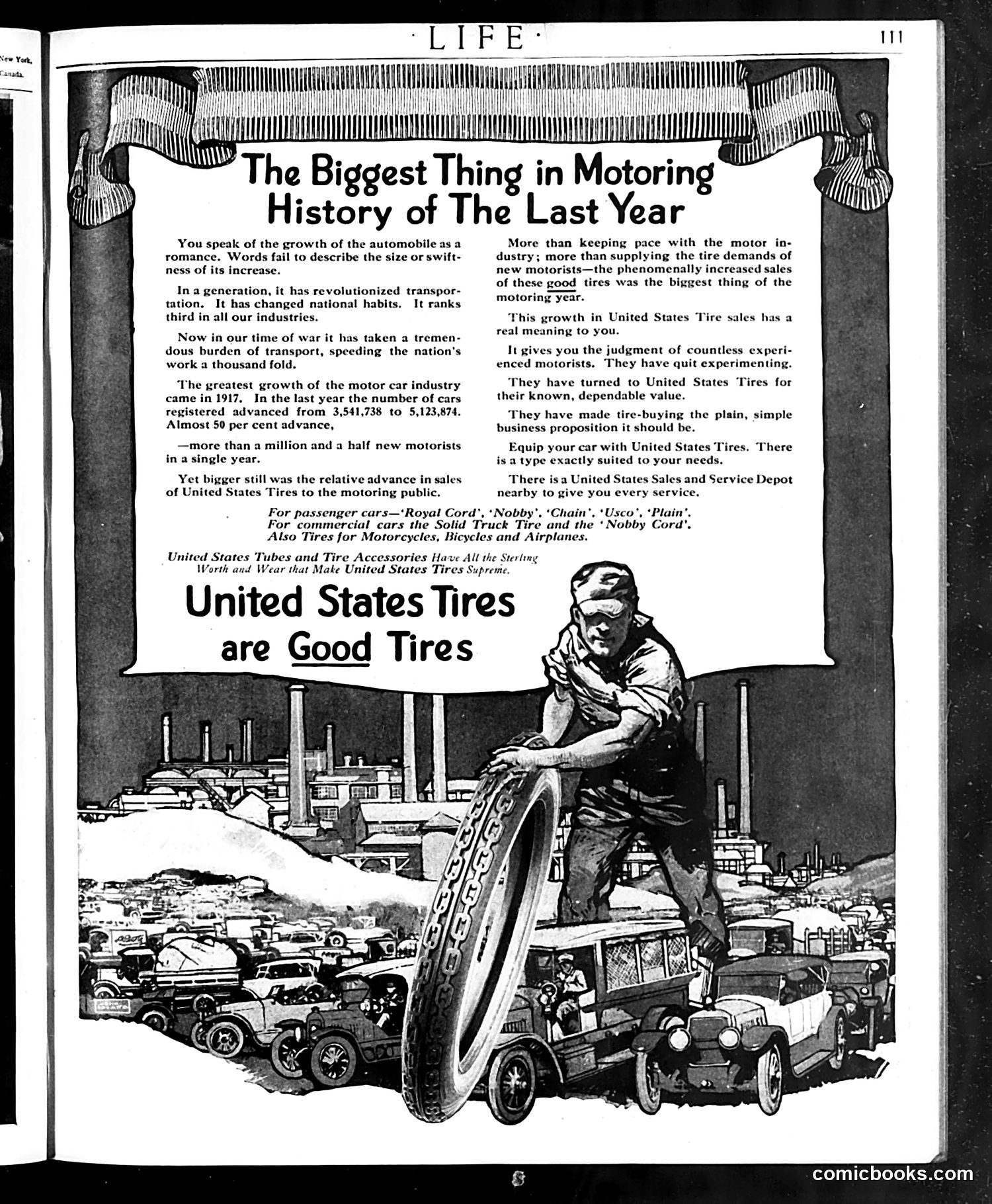
This page is **primarily an advertisement** for United States Tires, not satire. The headline claims tire sales growth is "The Biggest Thing in Motoring History of The Last Year." The illustration shows a giant worker holding an oversized tire above a factory and toy-sized automobiles, emphasizing the company's industrial scale and manufacturing power. This visual metaphor—the worker dwarfing the cars—suggests United States Tires' dominance in the industry. The text argues that motorists should choose these tires based on "countless experienced motorists'" endorsement and availability through service depots. The mention of "war" likely references World War I's impact on industrial production. This is straightforward commercial advertising using hyperbole and industrial imagery rather than political satire.
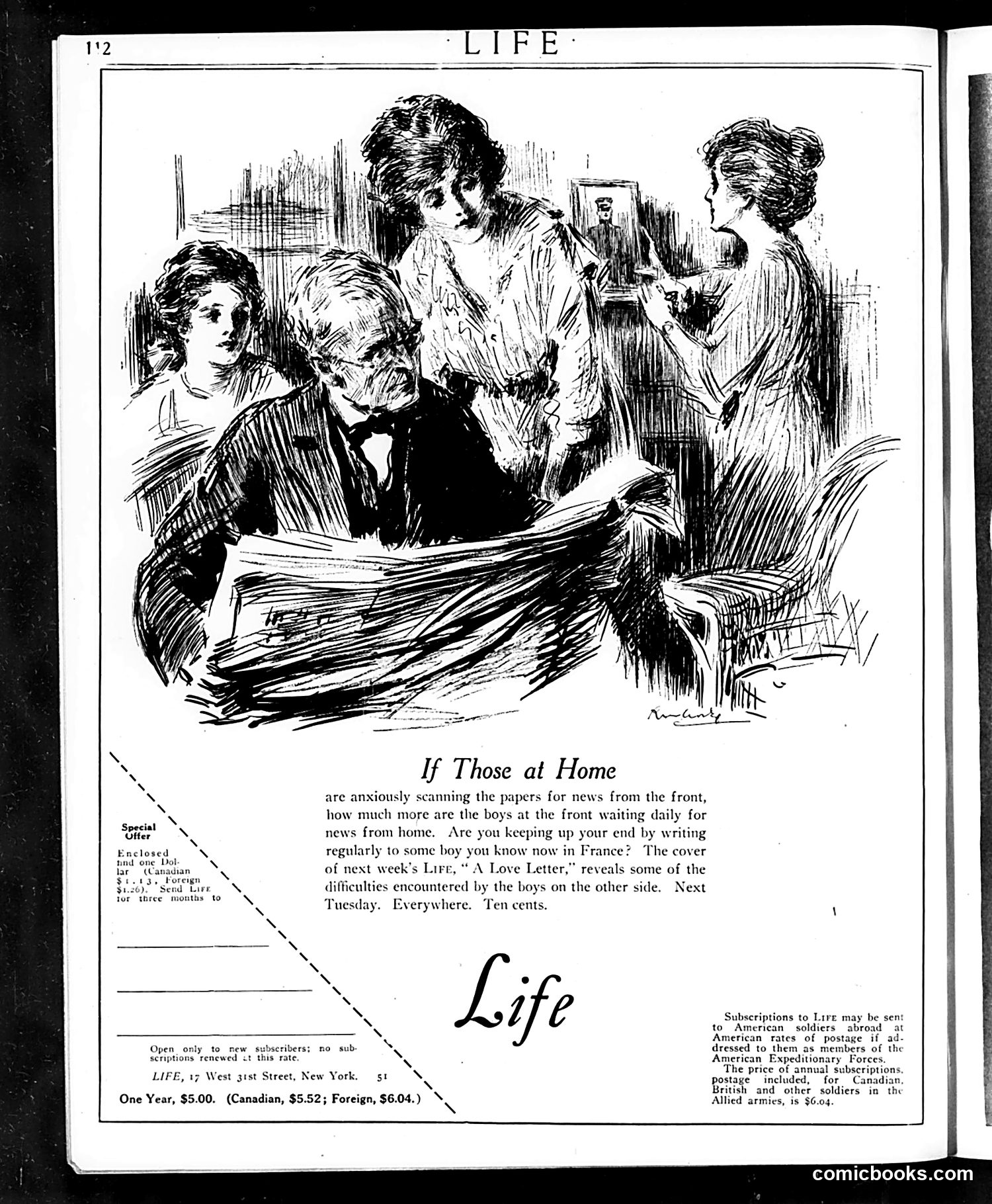
This Life magazine page appeals to American readers to maintain correspondence with soldiers serving in World War I ("the boys at the front"). The illustration shows a domestic scene where family members anxiously read newspapers for war updates, while soldiers overseas desperately await letters from home. The satire's point: civilians focused on distant news reports underestimate soldiers' emotional needs. Those in France depend on personal mail far more than families realize. The accompanying text urges readers to write regularly to soldiers they know, emphasizing this human connection matters more than headlines. The "Love Letter" cover referenced suggests next week's issue will address soldiers' longing for home—a common WWI morale concern. This represents Life magazine's patriotic messaging supporting the war effort through emotional appeals.
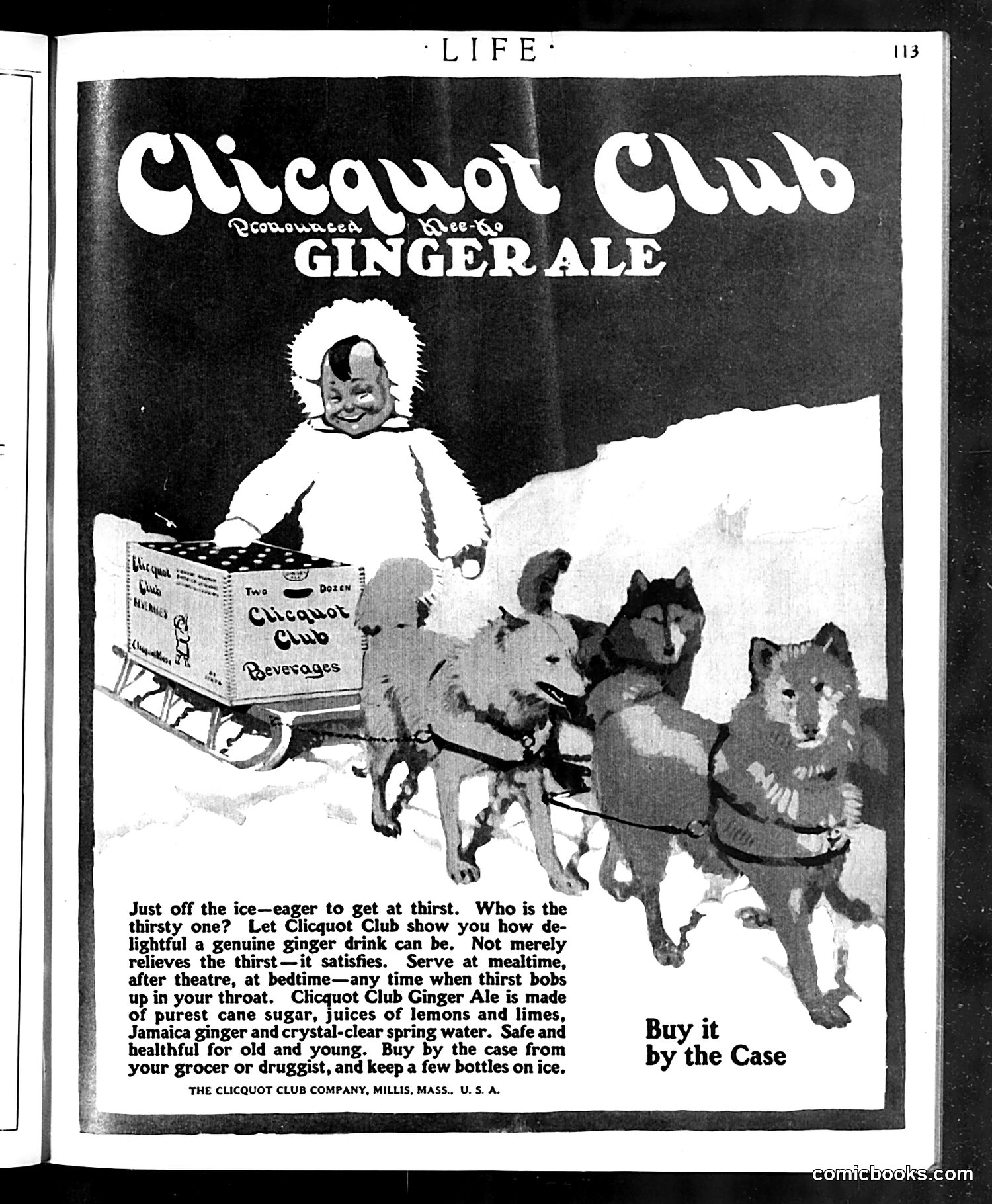
This is a **straightforward advertisement**, not a political cartoon. It advertises Clicquot Club Ginger Ale, a real soft drink brand produced in Mills, Massachusetts. The ad uses an Inuit/Arctic theme: a figure in heavy winter clothing is shown with a dog sled team in snowy conditions. The visual joke is that even in the frozen north, people get thirsty and want this ginger ale. The accompanying text emphasizes the drink's purity—made from cane sugar, lemon/lime juice, ginger, and spring water—and recommends serving it "any time when thirst bobs up in your throat." This reflects early-twentieth-century advertising conventions: exotic imagery and pseudoscientific health claims were common sales tactics.
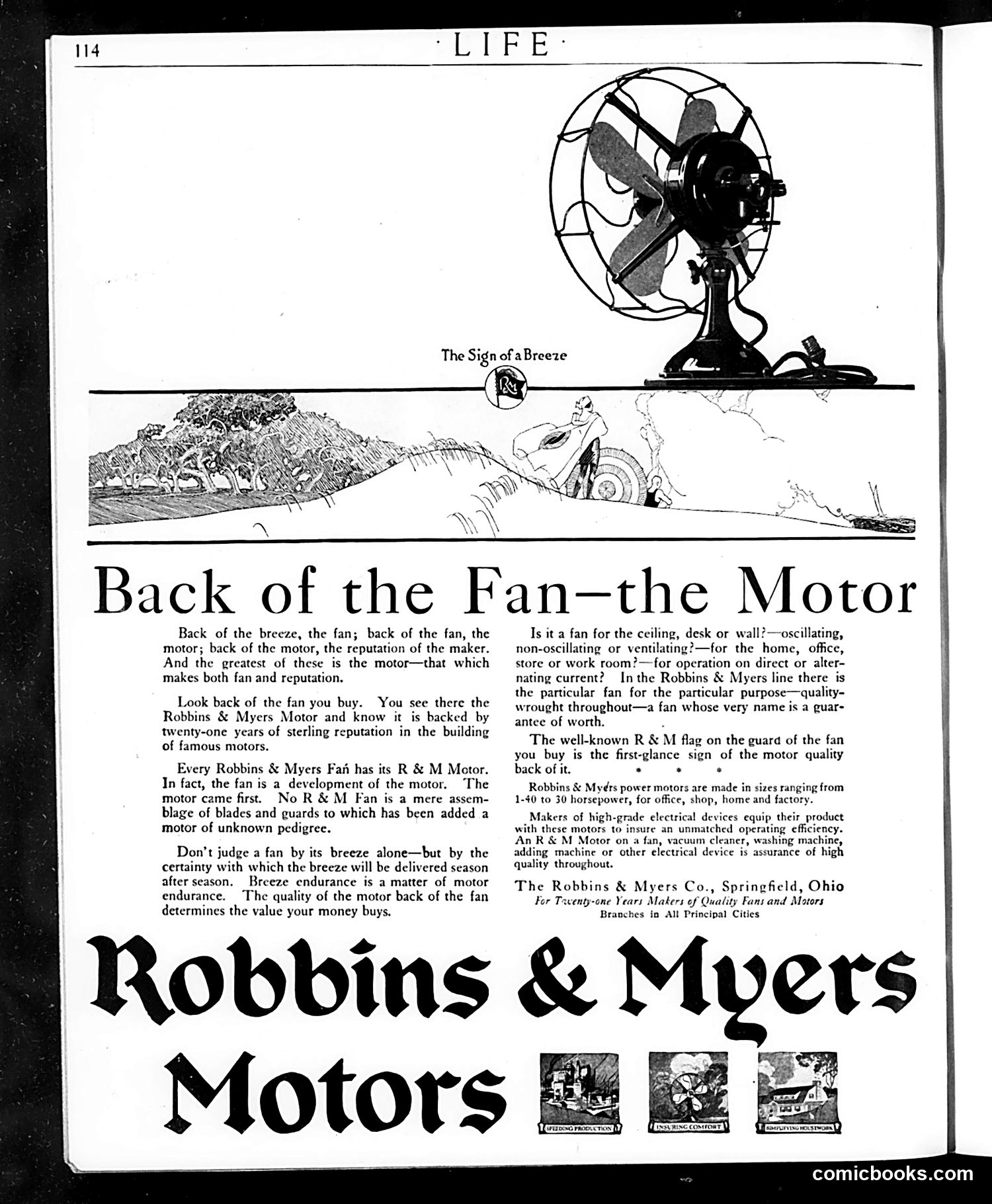
This page is **primarily an advertisement**, not satire or political cartoon. It promotes Robbins & Myers Motors, a fan manufacturer based in Springfield, Ohio. The small illustration titled "The Sign of a Breeze" shows a person on a motorcycle or bicycle being blown by wind—a visual pun introducing the fan product. The main body advertises electric fans for homes and offices, emphasizing that the quality lies in the **motor**, not just the breeze it produces. The R&M brand supposedly guarantees reliable motors backed by twenty-one years of reputation. Three small photographs at the bottom show the motors in use in various applications (vacuum cleaners, washing machines, etc.). There is **no political commentary or satire** present—this is straightforward early 20th-century consumer advertising.
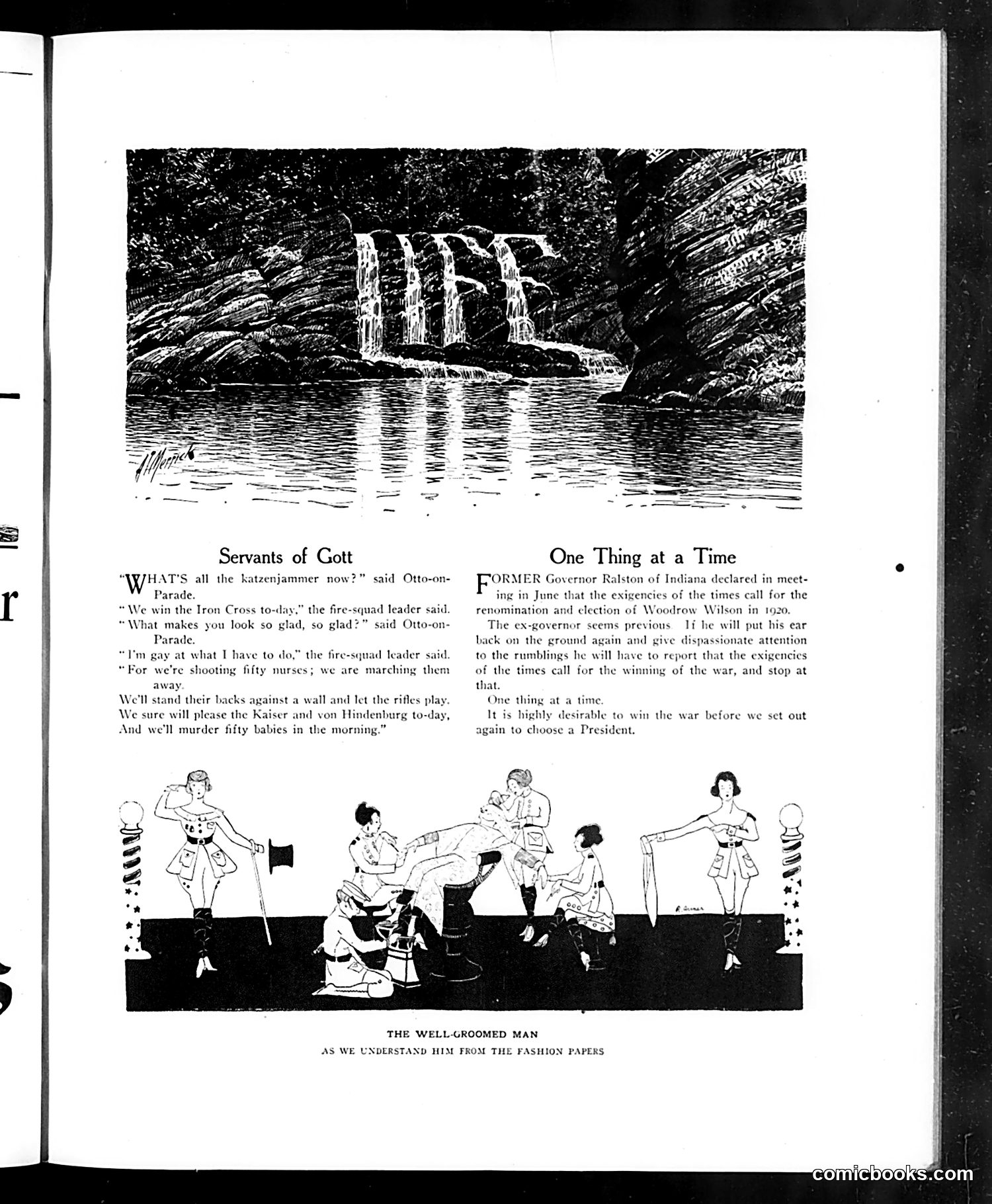
**Top Section - "Servants of Gott"**: A dialogue between a fire-squad leader and "Otto-on-Parade" (likely a German soldier, given the name "Otto" and "Gott"—German for God). The leader boasts about shooting fifty nurses and marching them away, planning to murder fifty babies by morning. This is wartime satire mocking German military brutality during World War I, portraying German soldiers as callous killers. **"One Thing at a Time"**: References Former Governor Ralston of Indiana and Woodrow Wilson, suggesting political squabbling over war priorities rather than focusing on winning the war first. **Bottom cartoon - "The Well-Groomed Man"**: A satirical fashion illustration showing men in various poses, likely mocking male vanity and fashion consciousness during wartime when such concerns seemed trivial. The overall page uses dark humor to critique both enemy brutality and American domestic frivolousness during WWI.
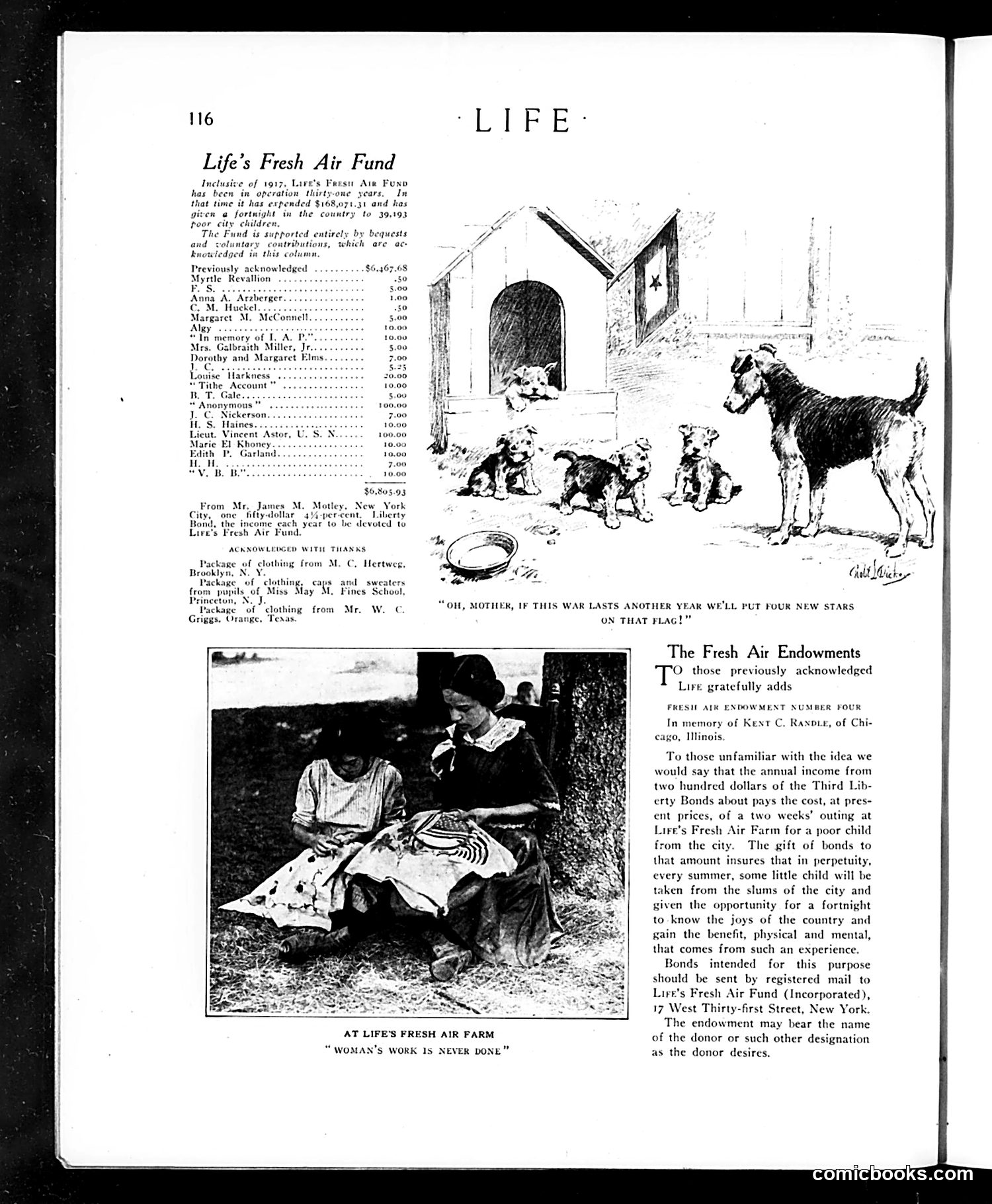
This page documents Life magazine's charitable **Fresh Air Fund**, which provided two-week summer outings for poor urban children. The top illustration shows dogs greeting children at the farm—a hopeful image of rural escape from city slums. The photograph captioned "Woman's Work Is Never Done" depicts women doing laundry at Life's Fresh Air Farm, illustrating the labor required to support the program. The accompanying cartoon shows a mother dog with puppies, with the caption: "Oh, Mother, If This War Lasts Another Year We'll Put Four New Stars On That Flag!" This references **World War I**—the stars represent additional sons who would enlist or be drafted. It darkly jokes that prolonged war will eventually claim her puppies as soldiers. The page promotes endowments supporting the charity's mission.
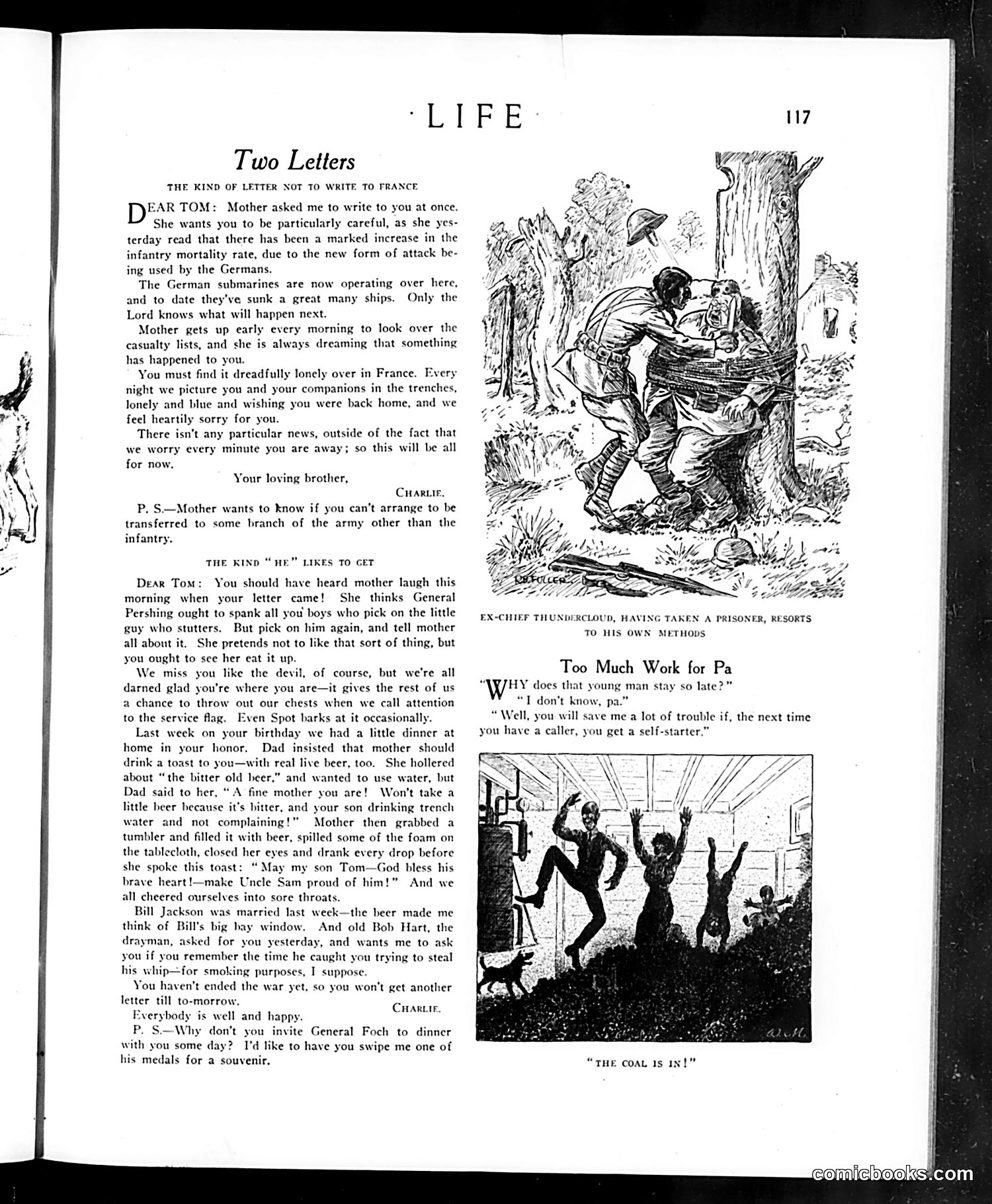
This page contains two sections: personal letters from soldiers in WWI France, and a cartoon titled "Too Much Work for Pa." **The Letters:** Tom and Charlie write home about infantry casualties from new German attack methods, submarine warfare, and homesickness. They include personal anecdotes (birthdays, friends) to maintain morale. **The Cartoon:** Shows a man (Pa) surrounded by what appears to be children with their hands raised. The caption "The Coal is In!" suggests rationing or fuel scarcity during wartime. The joke appears to satirize how domestic duties—likely coal delivery and distribution—create overwhelming work for the household's primary adult male, reflecting WWI-era home-front labor pressures and resource management anxieties on the American civilian population.
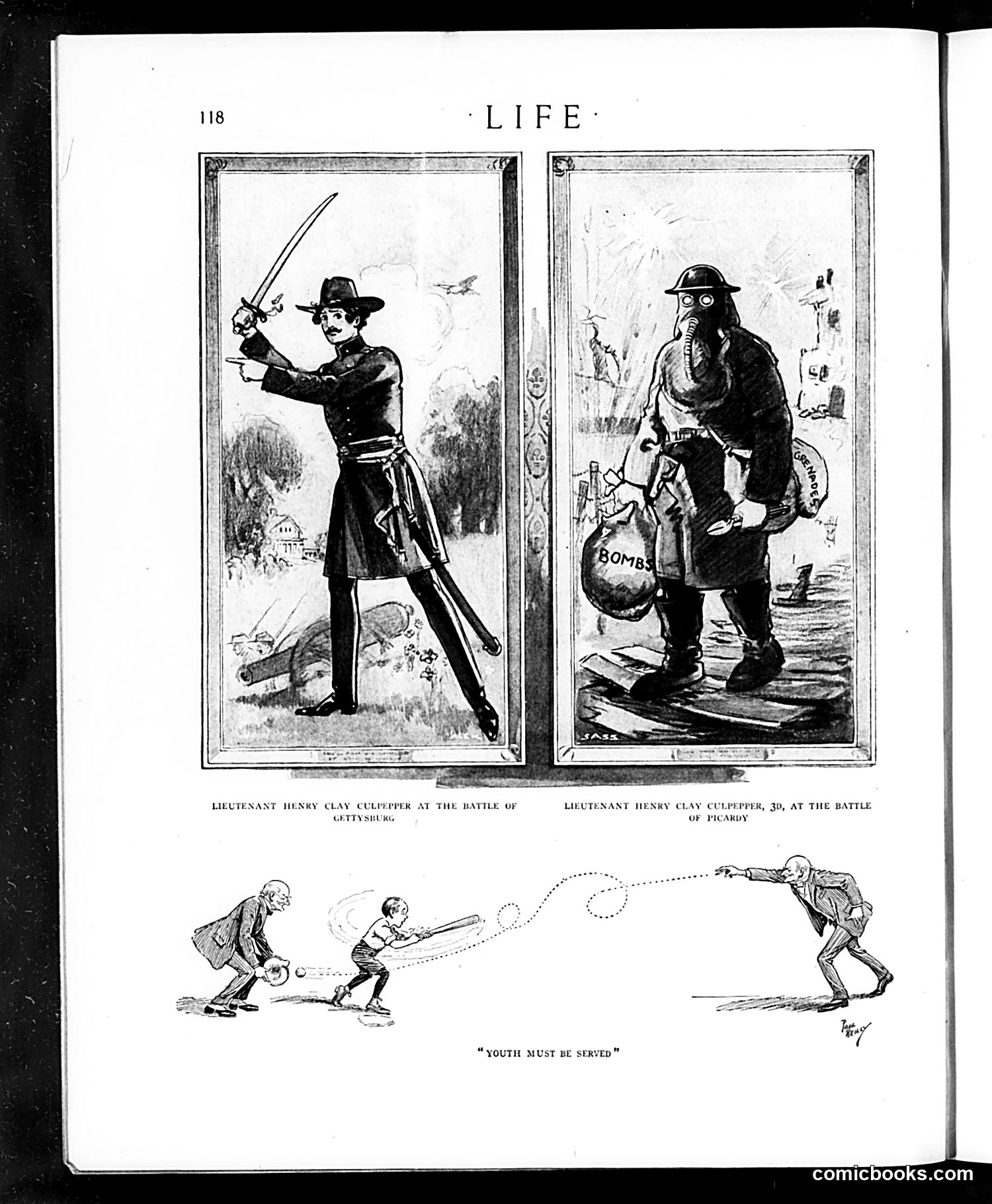
This page satirizes Lieutenant Henry Clay Culpeper during the American Civil War era. The top two panels depict him as a military officer at the Battles of Gettysburg and Picaroy, though the exaggerated, theatrical poses suggest mockery of his military competence or heroic pretensions. The bottom cartoon, titled "Youth Must Be Served," shows what appears to be a generational conflict: an older figure (possibly representing established authority or old guard politics) batting a ball toward a younger figure. This likely critiques tensions between traditional leadership and emerging younger political forces during Reconstruction. The caricatured style and overall tone suggest *Life* magazine was lampooning military figures or politicians perceived as ineffective or theatrical—common targets of 19th-century American political humor.
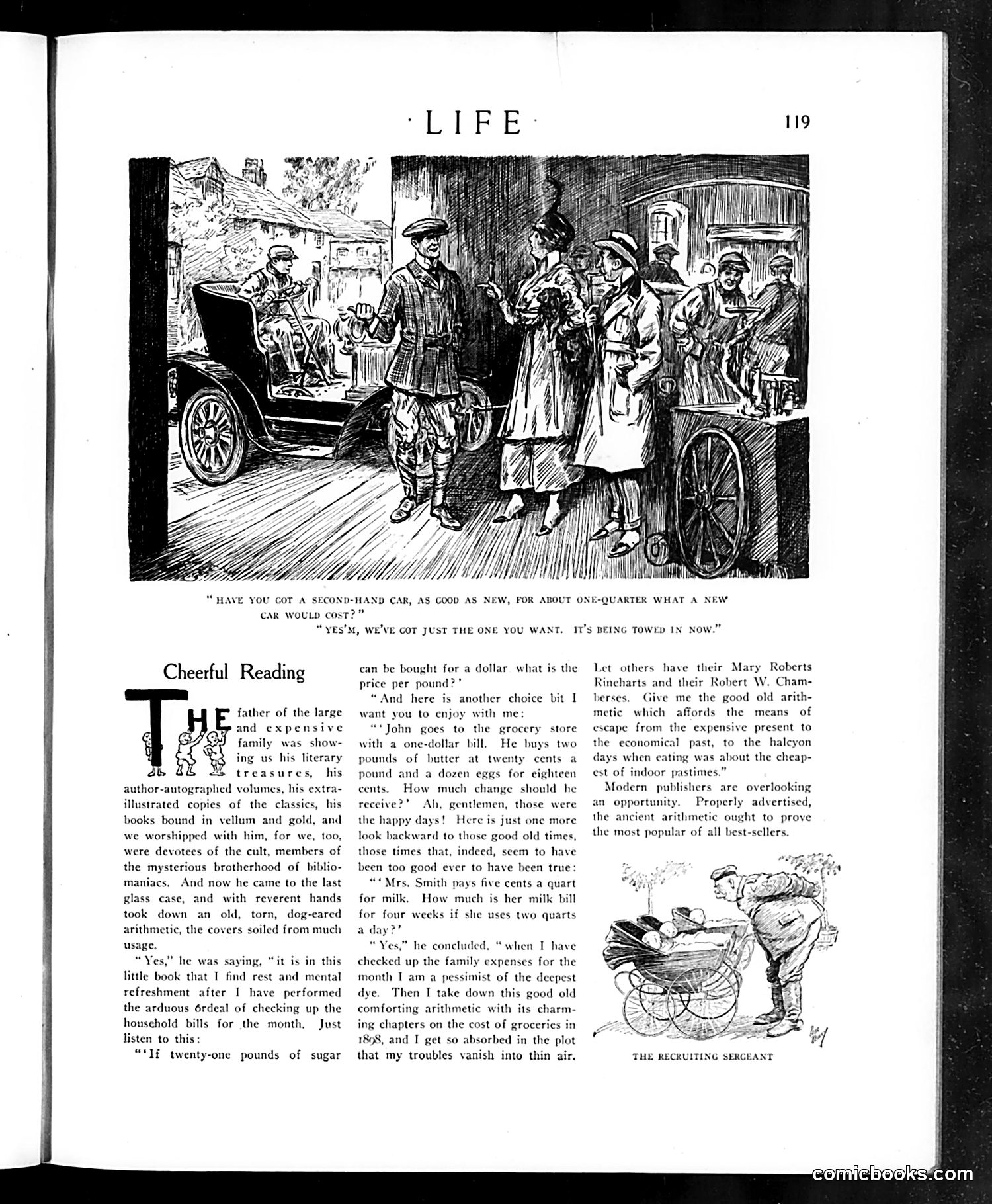
**Top Cartoon:** This depicts a street scene where someone is selling a second-hand automobile. The buyer asks if they have "a second-hand car, as good as new, for about one-quarter what a new car would cost?" The seller responds "Yes'm, we've got just the one you want. It's being towed in now." The satire mocks the used-car sales industry—specifically the deceptive practice of selling damaged vehicles as bargains. The joke hinges on the car needing to be towed in, meaning it's non-functional, yet the salesman still pitches it as a desirable deal. This reflects early 20th-century consumer skepticism about automobile dealers' honesty. **Bottom Section:** "Cheerful Reading" discusses household budgeting and grocery costs, with a separate illustration titled "The Recruiting Sergeant" showing a soldier recruiting figure—likely satirizing military recruitment tactics, though the specific context is unclear from this excerpt.
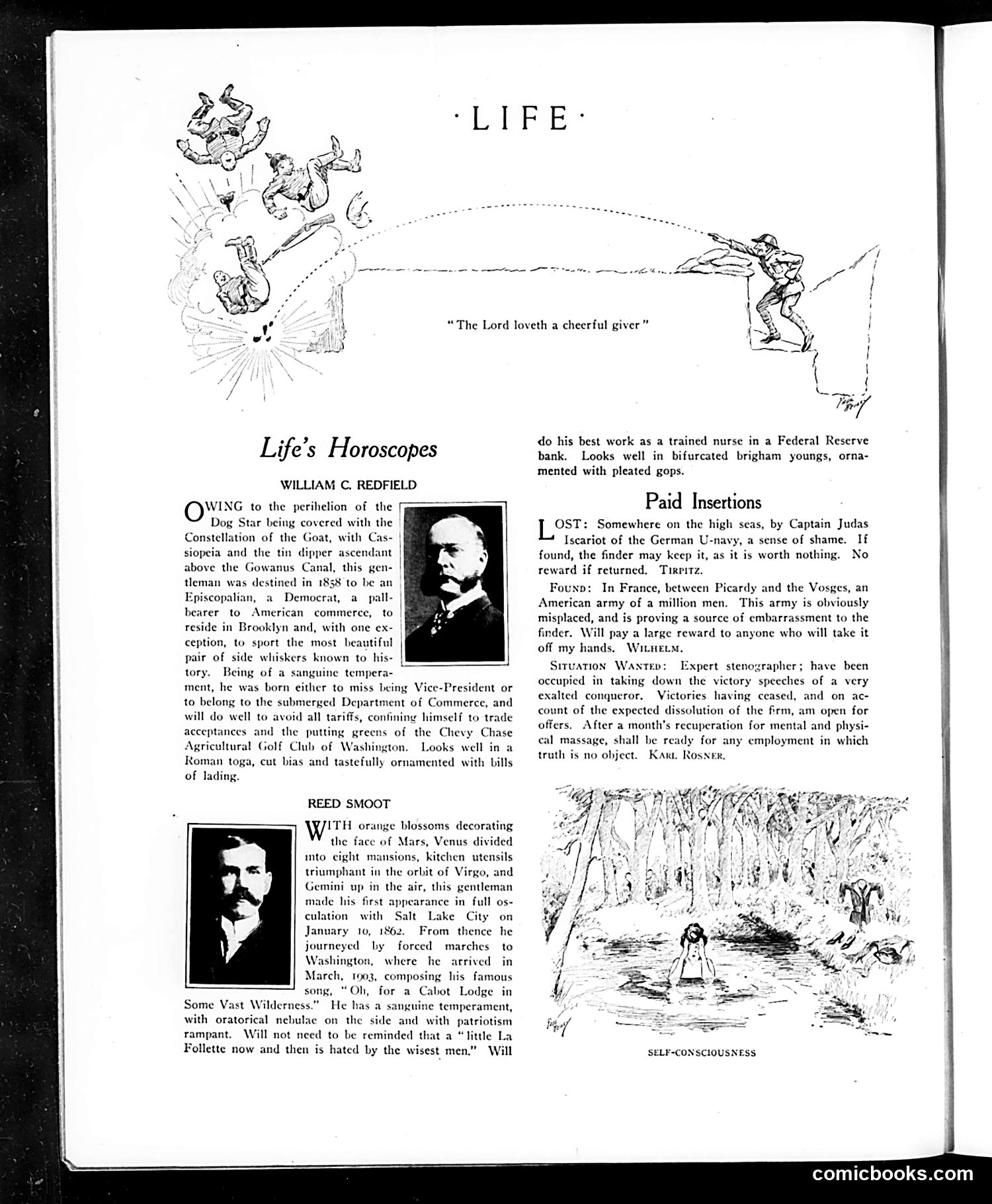
This page combines biographical sketches with satirical humor typical of early 20th-century Life magazine. **"Life's Horoscopes"** by William C. Redfield features two portrait-accompanied character sketches: 1. **William C. Redfield** - described as a Brooklyn gentleman with refined taste, characterized through his social affiliations (Dog Star Club, Vice-President of Commerce Department). The satire mocks his pretensions to sophistication. 2. **Reed Smoot** - depicted with orange blossoms and poetic language about Mars and Venus, journeyed to Washington in March 1902. The text's flowery descriptions appear ironically incongruous with his political career. The page also includes "Paid Insertions" (classified ads) and a sketch titled "Self-Consciousness" showing a figure in water. These sections represent Life's typical mix of satire, practical humor, and commercial content for educated, affluent readers.
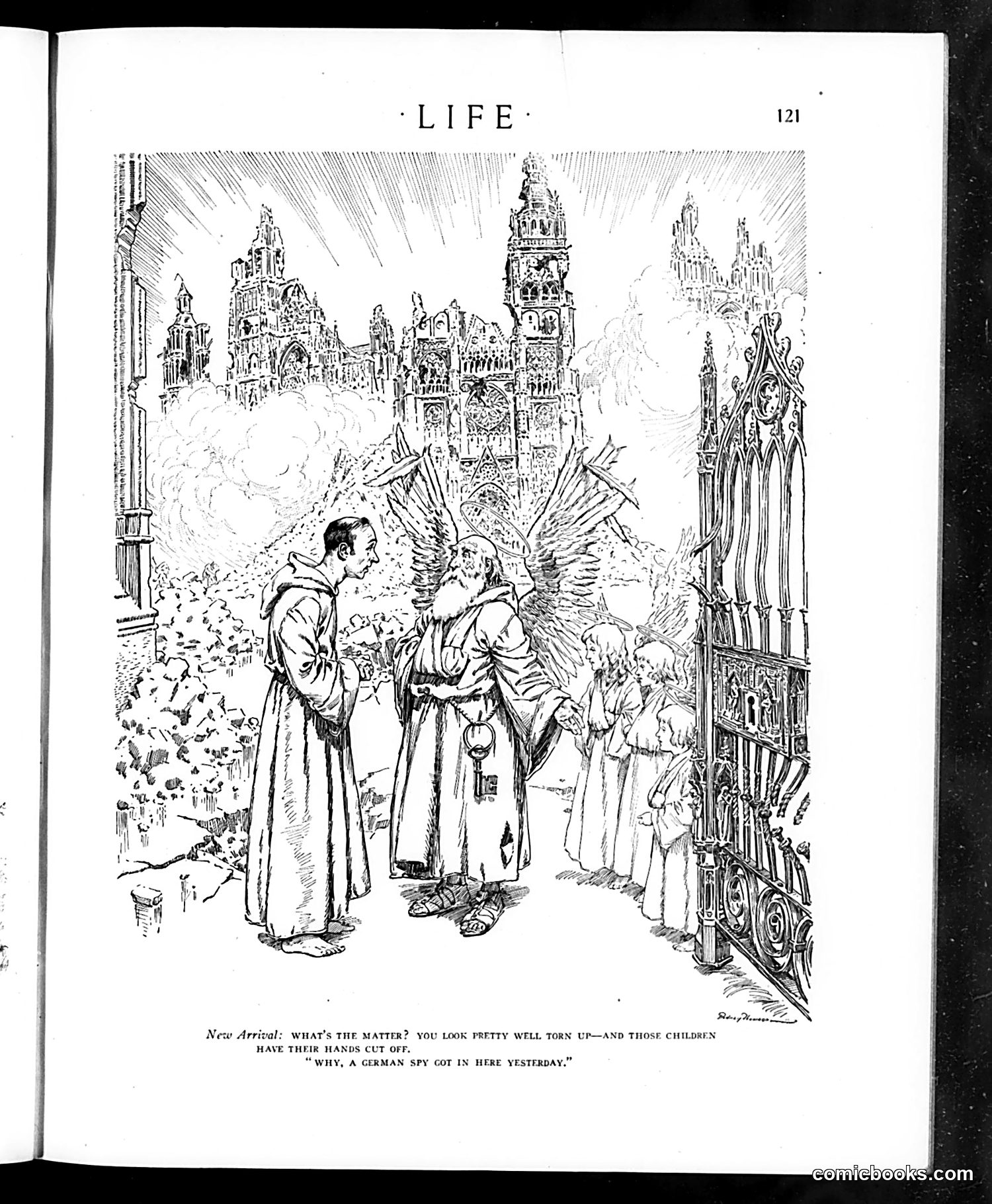
This is a wartime satirical cartoon from *Life* magazine, likely from World War I era, depicting religious/clerical figures at the gates of heaven. Two robed priests or monks converse with an angel, while children with severed hands stand nearby. The caption reads: "New Arrival: What's the matter? You look pretty well torn up—and those children have their hands cut off. 'Why, a German spy got in here yesterday.'" The cartoon satirizes German wartime atrocities, specifically referencing documented reports of Belgian children having hands amputated during the German invasion of Belgium (1914). By placing this scene at heaven's gates, the artist condemns German actions as so morally heinous they're incomprehensible even in sacred space. The "German spy" framing sarcastically suggests such brutality couldn't originate from normal warfare—only from deliberate evil.
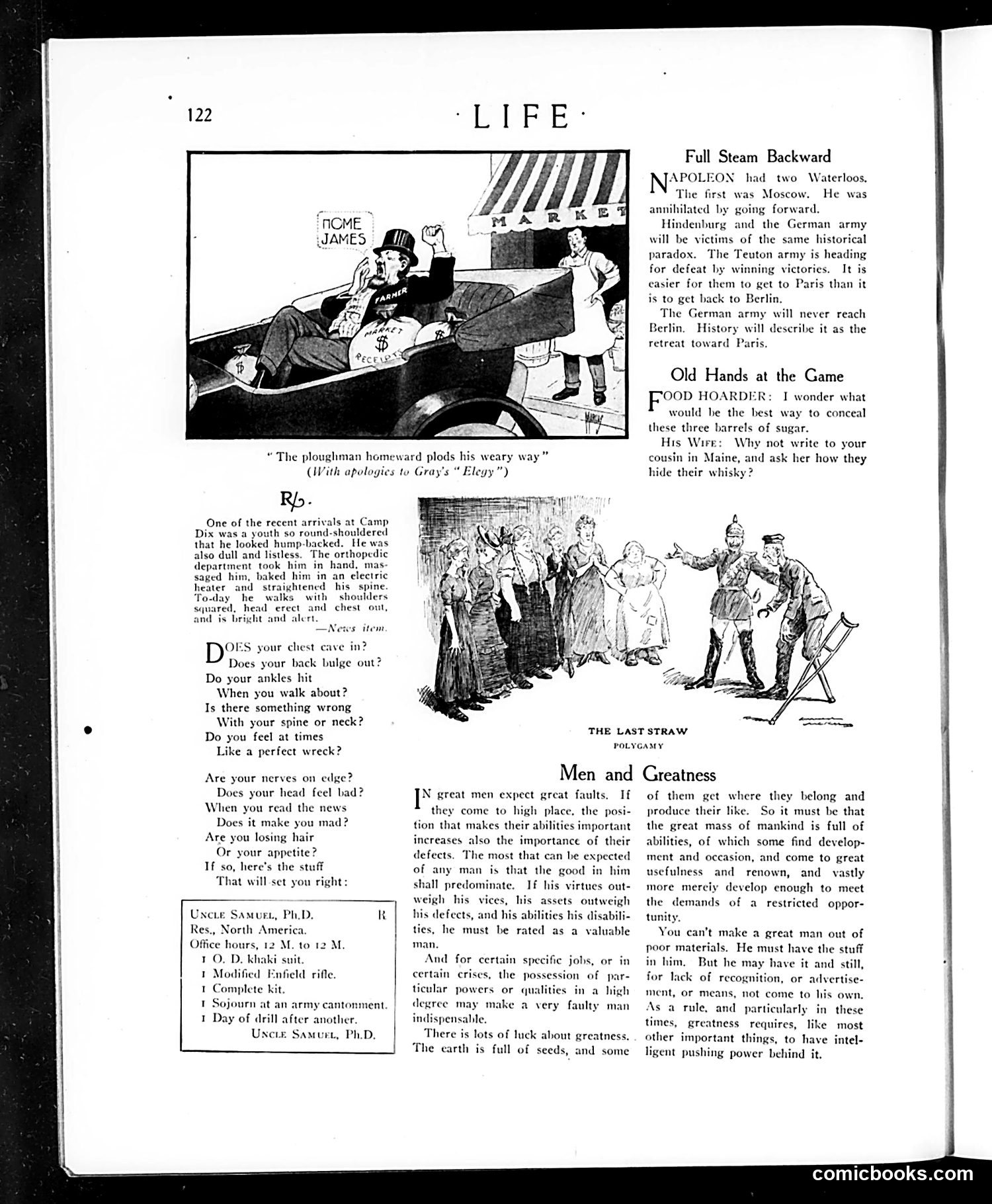
This cartoon satirizes **profiteering during wartime**, likely WWI era. A rotund businessman labeled "Home James" sits contentedly in a luxury automobile, his lap overflowing with money bags marked "$". A woman (possibly representing the nation or a war widow) stands outside looking in, while the caption references Gray's "Elegy" ironically—contrasting the poem's humble laborer with this wealthy war profiteer. The joke: while soldiers fight and ordinary citizens struggle, domestic businessmen grow fat on wartime contracts and inflation. The "homeward" journey is not earned labor but exploitation of national crisis for personal gain. This reflects Progressive-era anger at industrial titans accumulating fortunes while the nation mobilized for war.
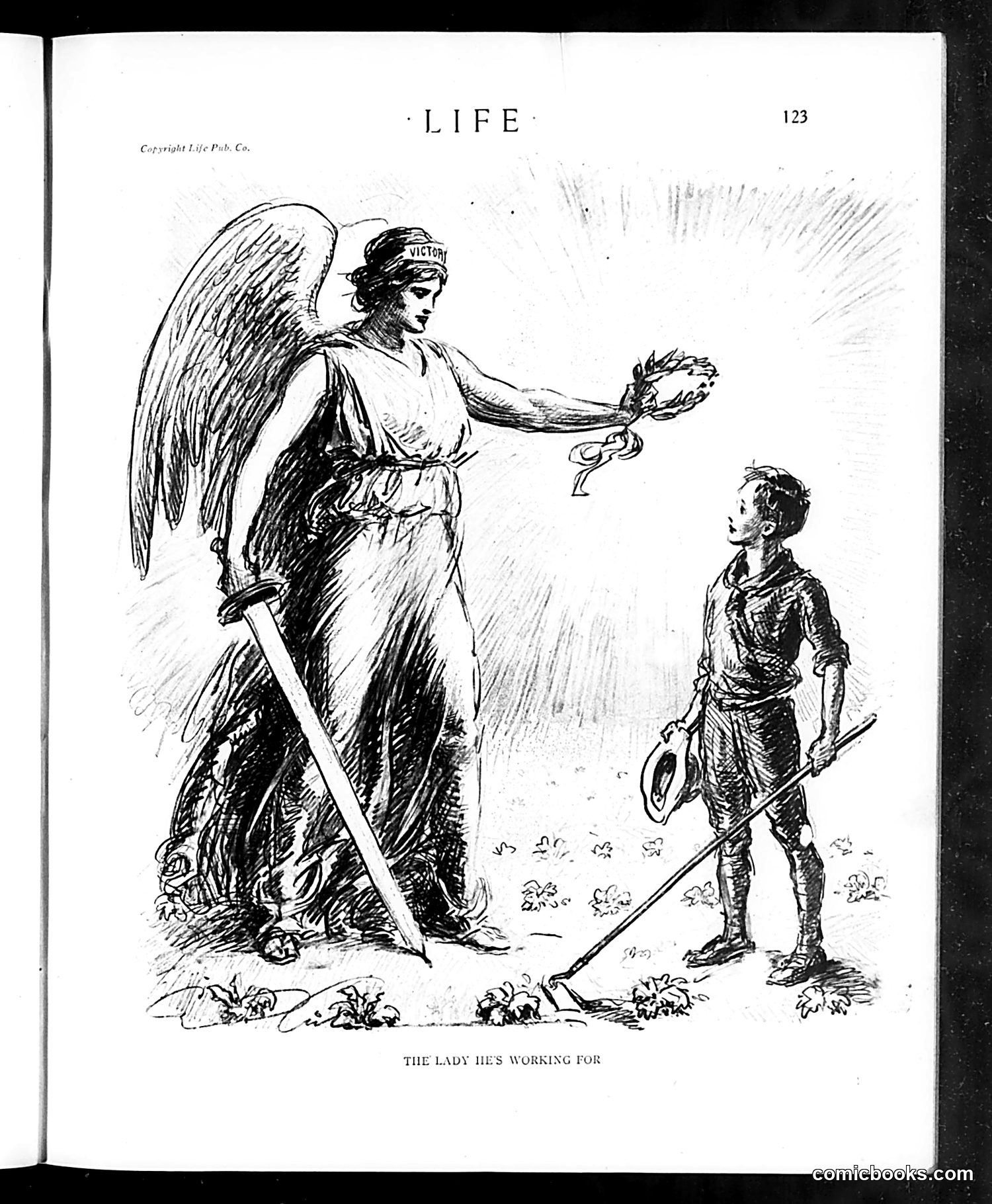
This cartoon depicts **Victory** (the winged female figure wearing a "Victory" headband) handing a laurel wreath to a young male soldier or warrior. The figure on the right holds tools—a spade and circular shield—suggesting manual labor or construction work. The title's pun plays on the phrase "working for" (laboring on behalf of). The cartoon satirizes the idea that Victory rewards those engaged in physical, practical work rather than grand military heroics. It likely comments on how **post-war reconstruction or industrial labor** was being celebrated as essential to national success—or critiques the gap between military glory and the unglamorous work of rebuilding. The specific historical context remains unclear without additional publication date information.
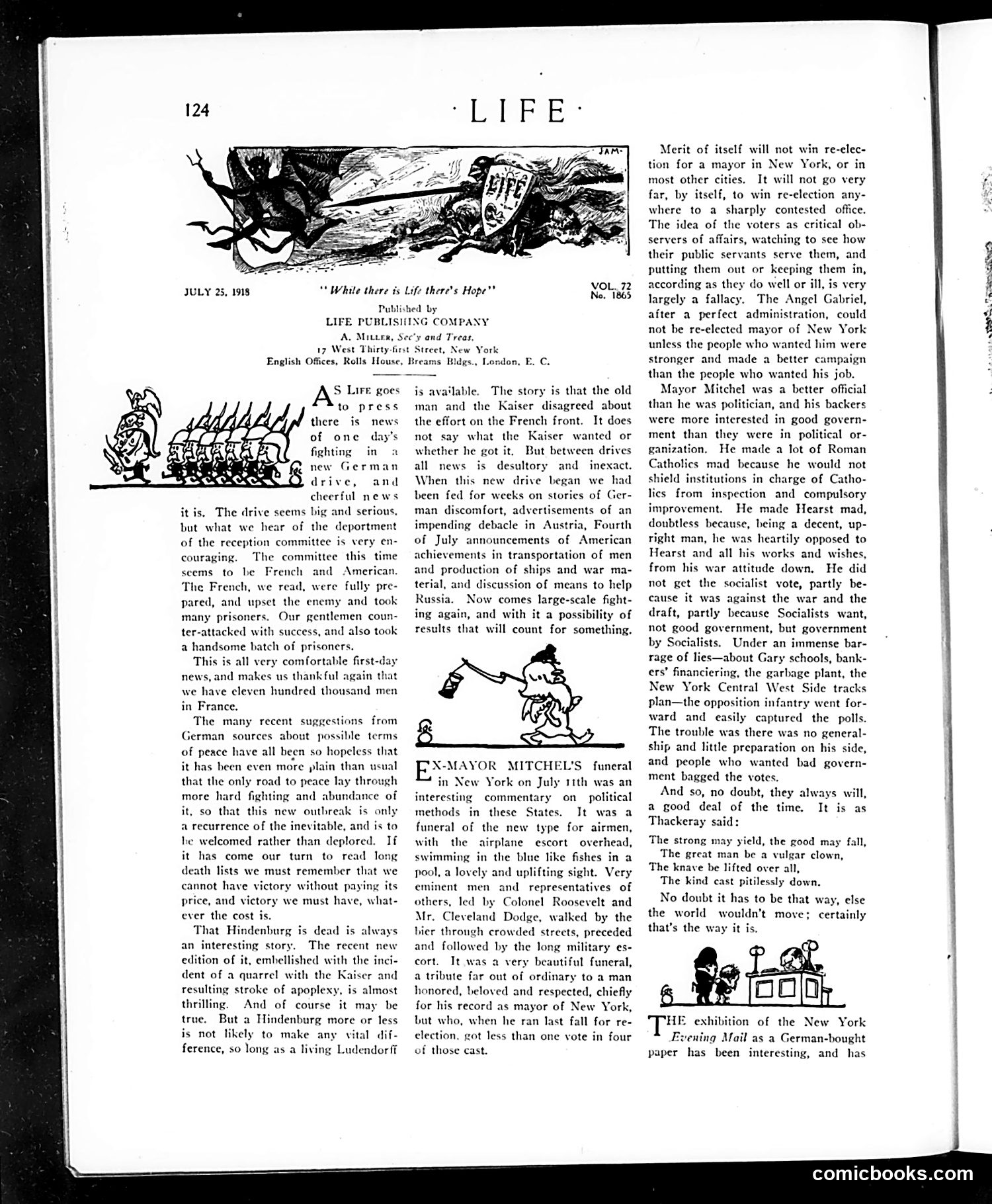
This page discusses two main topics: the ongoing German military offensive on the French front in World War I, and former New York City Mayor John Purroy Mitchel's funeral on July 11th. The **WWI commentary** frames the German drive as inevitable and welcomes it as an opportunity for decisive American-French action, citing 1.1 million American troops in France. The **Mitchel satire** is more pointed. Mitchel received an elaborate funeral with military honors and attended by prominent figures like Theodore Roosevelt, yet he lost his re-election bid months earlier, receiving "less than one vote in four." Life uses this to mock the notion that voter merit-based decision-making—suggesting voters are rational observers of public service—is largely "a fallacy." The cartoon's implicit argument: political success depends on factors beyond administrative competence.
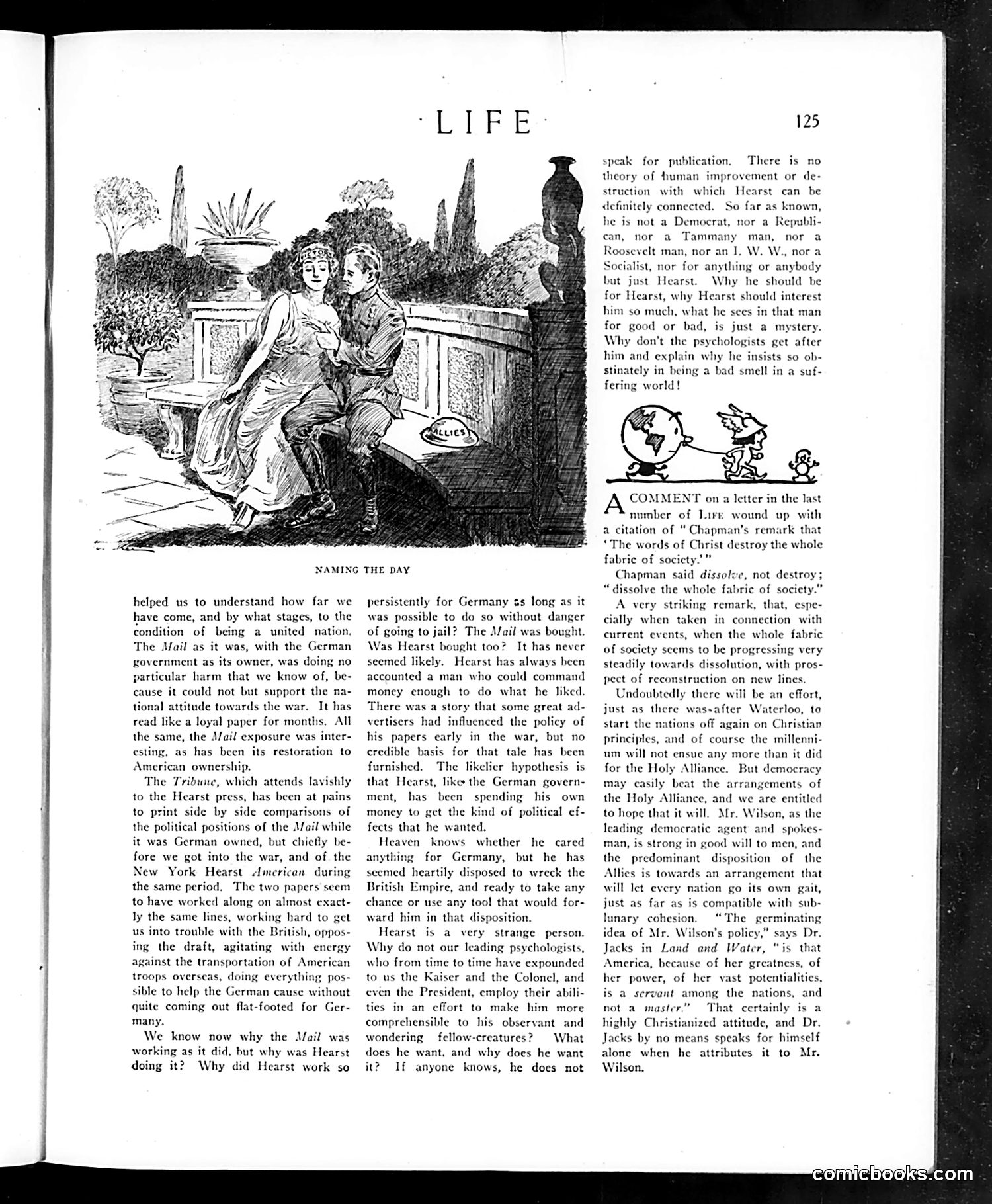
This page critiques **William Randolph Hearst**, the powerful newspaper magnate, during World War I. The text contrasts Hearst's pro-German editorial stance with the German-owned *New York Mail*, which was exposed and restored to American ownership. The article questions why Hearst persistently undermined American war efforts—opposing the draft, agitating against Britain, supporting the German cause—without facing legal consequences like the *Mail* did. Unlike the *Mail* (which was bought by German interests), Hearst apparently financed this pro-German agenda himself, suggesting ideological anti-British sentiment rather than direct payment. The satirical point: Hearst is a mysterious political operator whose true motivations remain incomprehensible. The author mockingly suggests psychologists should analyze him as they would public figures, since Hearst claims no Democratic, Republican, Socialist, or other standard political identity—only self-interest. His mysterious desire to "wreck the British Empire" and create "a bad smell in a suffering world" represents dangerous, unprincipled power divorced from any coherent ideology or public good.
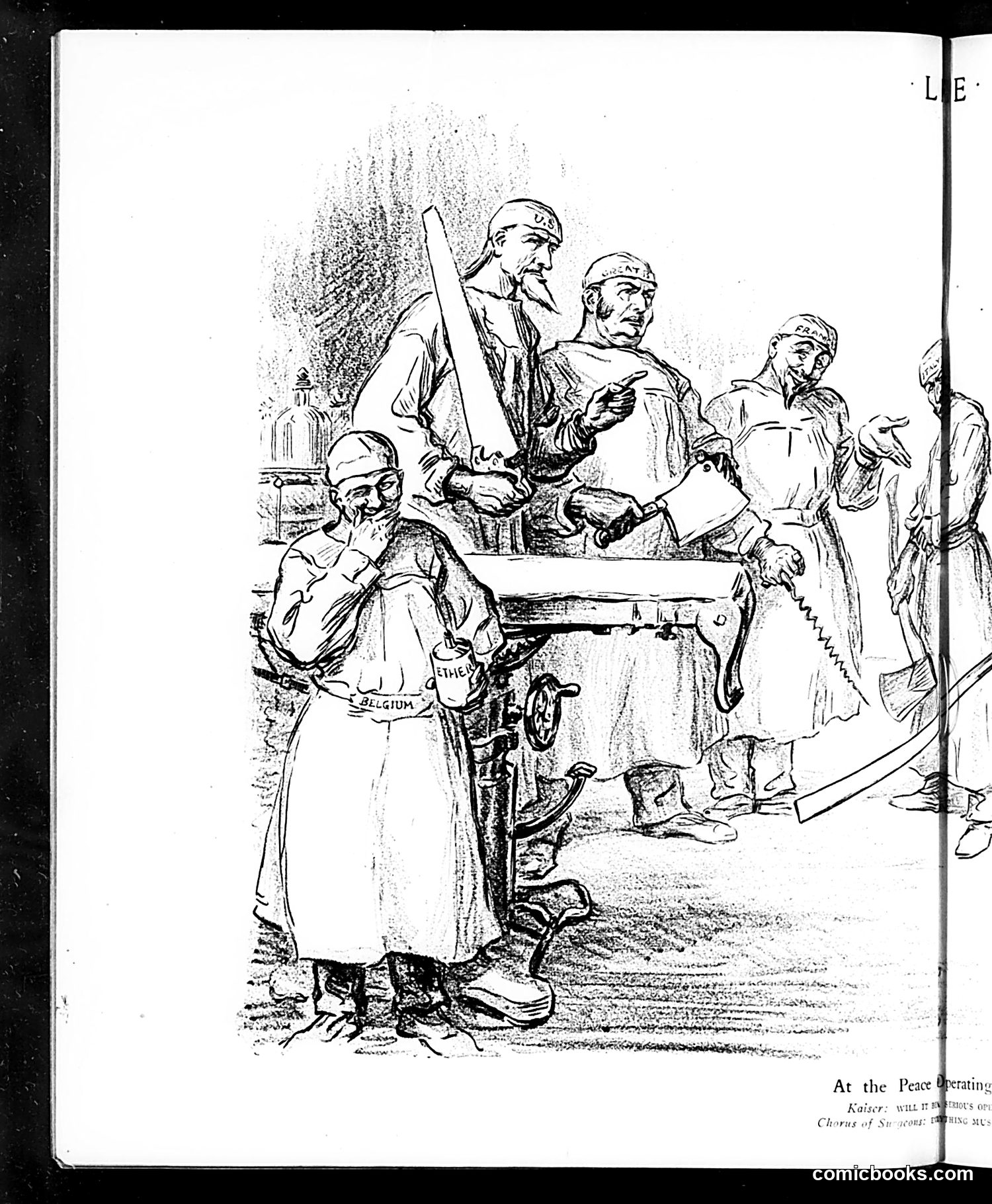
This political cartoon satirizes peace negotiations, likely from World War I era. The image shows a surgical operating theater where Belgium (labeled on the figure's uniform) lies on an operating table as a patient. A Kaiser (German Emperor) figure presides above like a surgeon, while other figures—apparently representing Allied nations or peace negotiators—stand around observing or participating. The satire compares peace-making to surgery, with Belgium depicted as the wounded subject requiring intervention. The "operating" reference suggests the peace process is being conducted by those in power (particularly the Kaiser) rather than addressing Belgium's actual suffering and devastation from German occupation. The cartoon critiques how smaller nations' interests may be subordinated during major power negotiations.
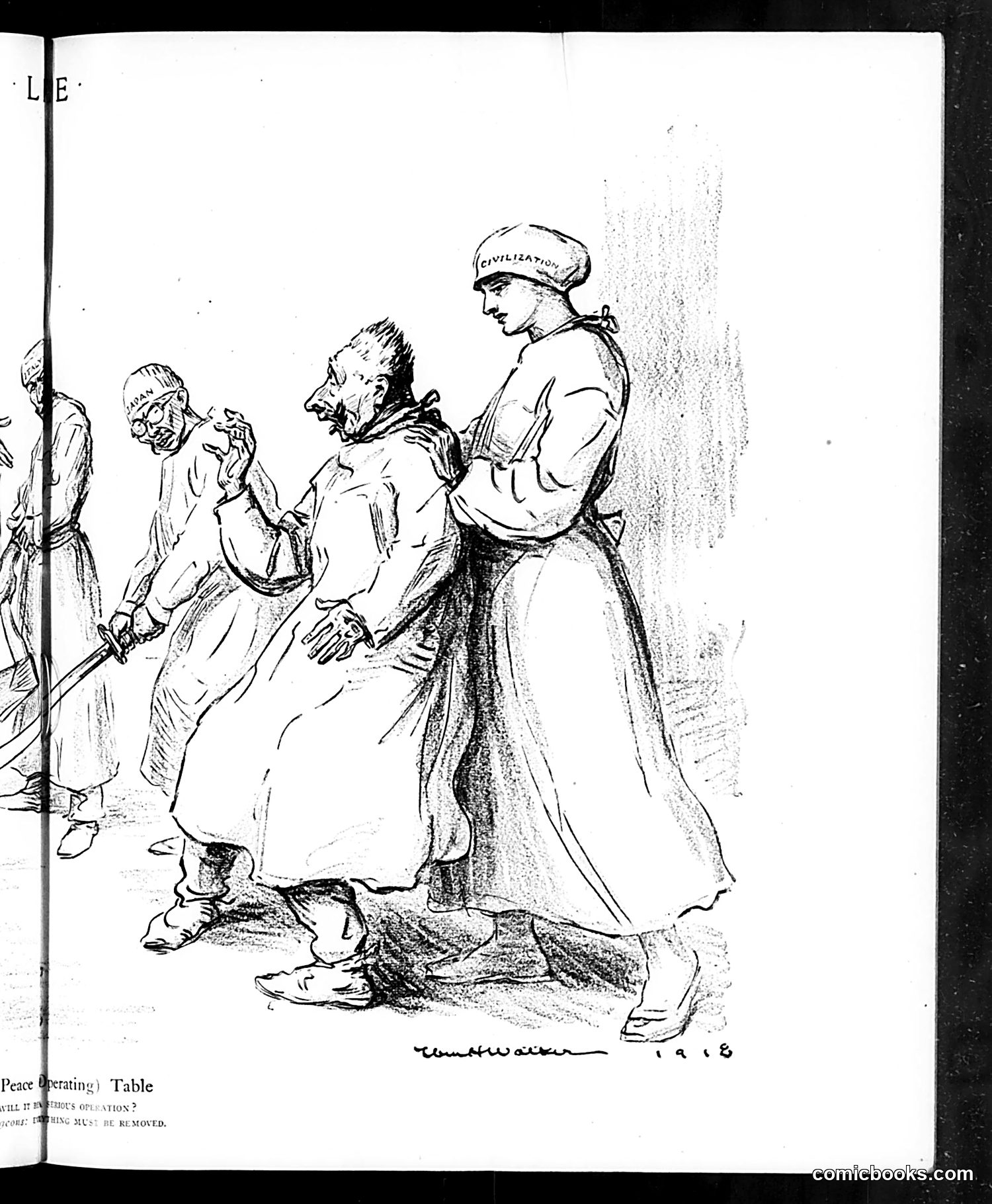
This cartoon depicts a medical/surgical scene labeled "Peace Operating Table," satirizing peace negotiations, likely from World War I era (dated 1918 visible in the image). The figure wearing a cap labeled "Civilization" appears to be a surgeon or doctor, operating on a patient representing "Peace." Other figures around the table seem to be observers or assistants—possibly representing different nations or political interests involved in peace treaty negotiations. The satire suggests that peace-making was being treated as a delicate surgical procedure requiring careful handling, or alternatively, that peace was being "operated on" (manipulated or carved up) by various powers at the negotiating table. The dark humor implies skepticism about whether these negotiations would successfully restore genuine peace.
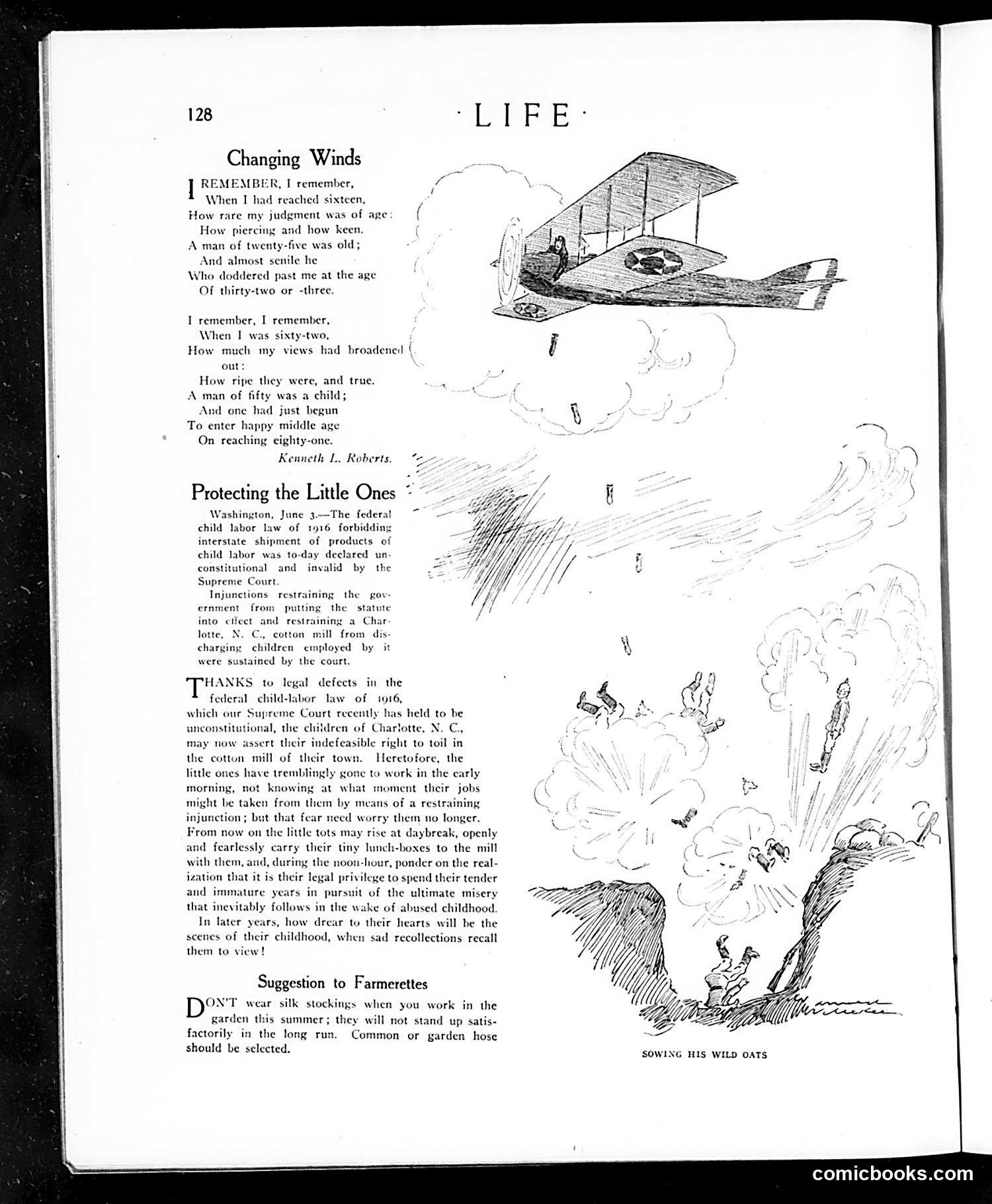
**"Changing Winds"** is a humorous poem about how our judgment of age shifts as we mature—at sixteen, anyone over thirty seemed ancient; by sixty-two, we realize a fifty-year-old is actually young. **"Protecting the Little Ones"** is bitter satire. The text describes a 1916 Supreme Court decision that struck down federal child-labor laws as unconstitutional. Life mocks this ruling by sarcastically "celebrating" that children in Charlotte, North Carolina can now legally work in cotton mills without fear of injunctions. The author condemns this outcome, warning that child labor leads to lifelong misery and traumatic memories. **"Sowing His Wild Oats"** (the illustration) depicts a young man scattering seeds—literal wild oats—as he flies above a landscape in an early airplane. This is likely commentary on youthful recklessness or irresponsibility, using the common idiom "sowing wild oats." The page criticizes judicial decisions harmful to children and workers while offering practical domestic advice to women.
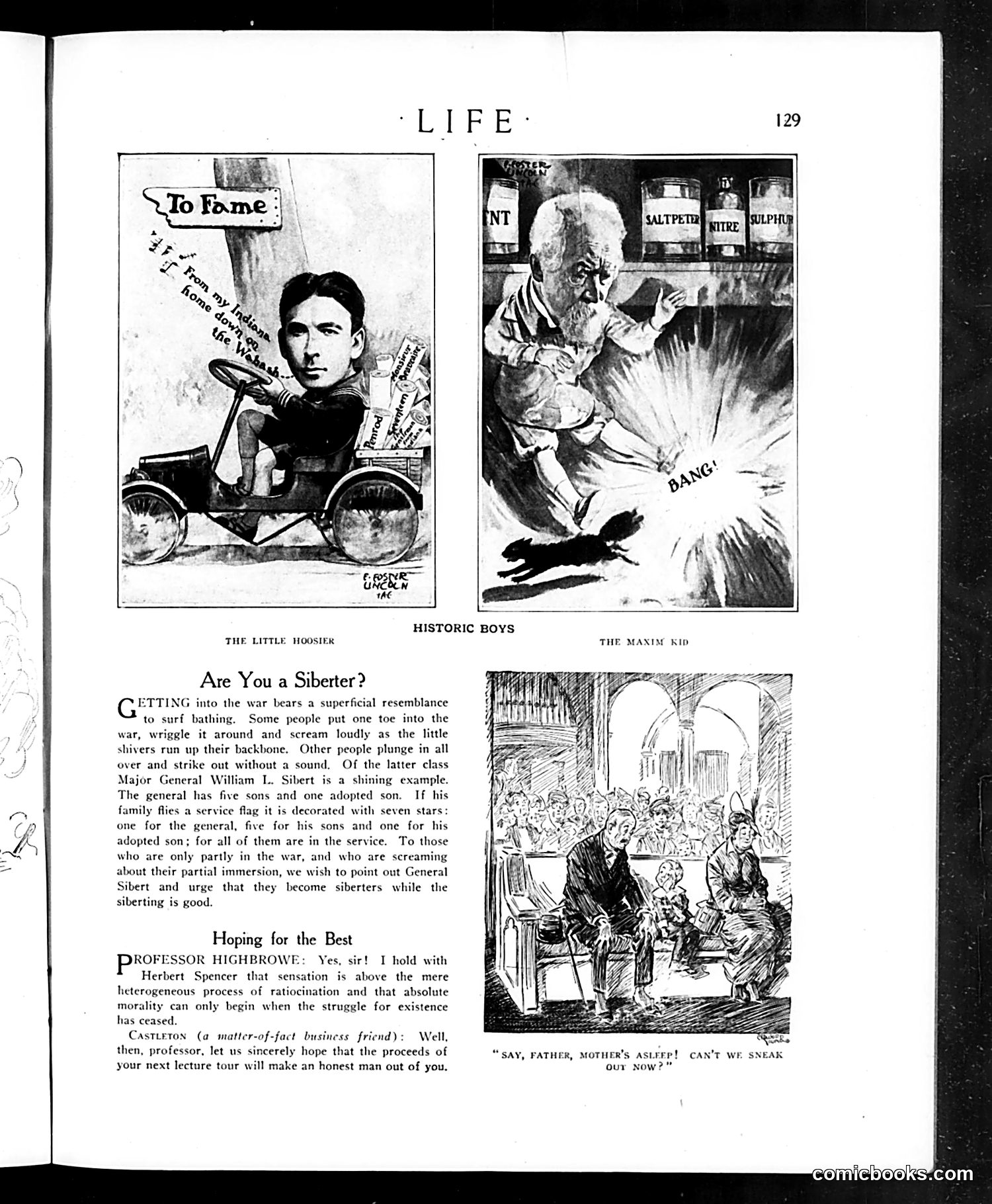
This page from Life magazine contains WWI-era satirical content: **"The Little Hoosier"** cartoon depicts Major General William L. Sibert, praised for fully committing his family to the war effort—he and all six sons (five biological, one adopted) serve. The text coins the term "siberter" to mock civilians who only partially support the war while complaining loudly, contrasting them with Sibert's complete family sacrifice. **"Hoping for the Best"** features Professor Highbrowe spouting pseudo-intellectual philosophy about morality requiring peace, while his pragmatic friend Castleton sardonically hopes the professor's lecture profits will finally make him act morally—mocking academic pretension disconnected from action. **"The Maxim Kid"** cartoon shows a child asking his father to let them sneak out while mother sleeps, likely satirizing Americans attempting to avoid war obligations or rationing regulations through sneaky means. All three pieces use satire to pressure Americans toward greater wartime commitment and sacrifice.
This is a sentimental WWI poem celebrating a military dog and his human companion. The narrative follows a unnamed dog who serves alongside a surgeon's son on the Western Front, retrieving wounded soldiers and providing comfort in the trenches. The poem uses heroic language to elevate the dog's service—he wears a "uniform" (white with a red cross), demonstrates loyalty unto death, and ultimately saves his wounded master by allowing a boy soldier to carry him to safety. The references to "Huns," "Prussians," and vivid battle imagery ("shrapnel," "bayonets," "gas-soaked plain") situate this in WWI's brutal trench warfare. The satire or sentiment here isn't political mockery but rather patriotic glorification of wartime sacrifice—framing even a "cur" (stray dog) as deserving honor for service. For modern readers, it represents early-20th-century sentimentality about warfare and animal heroism, typical of 1910s-era *Life* magazine content.
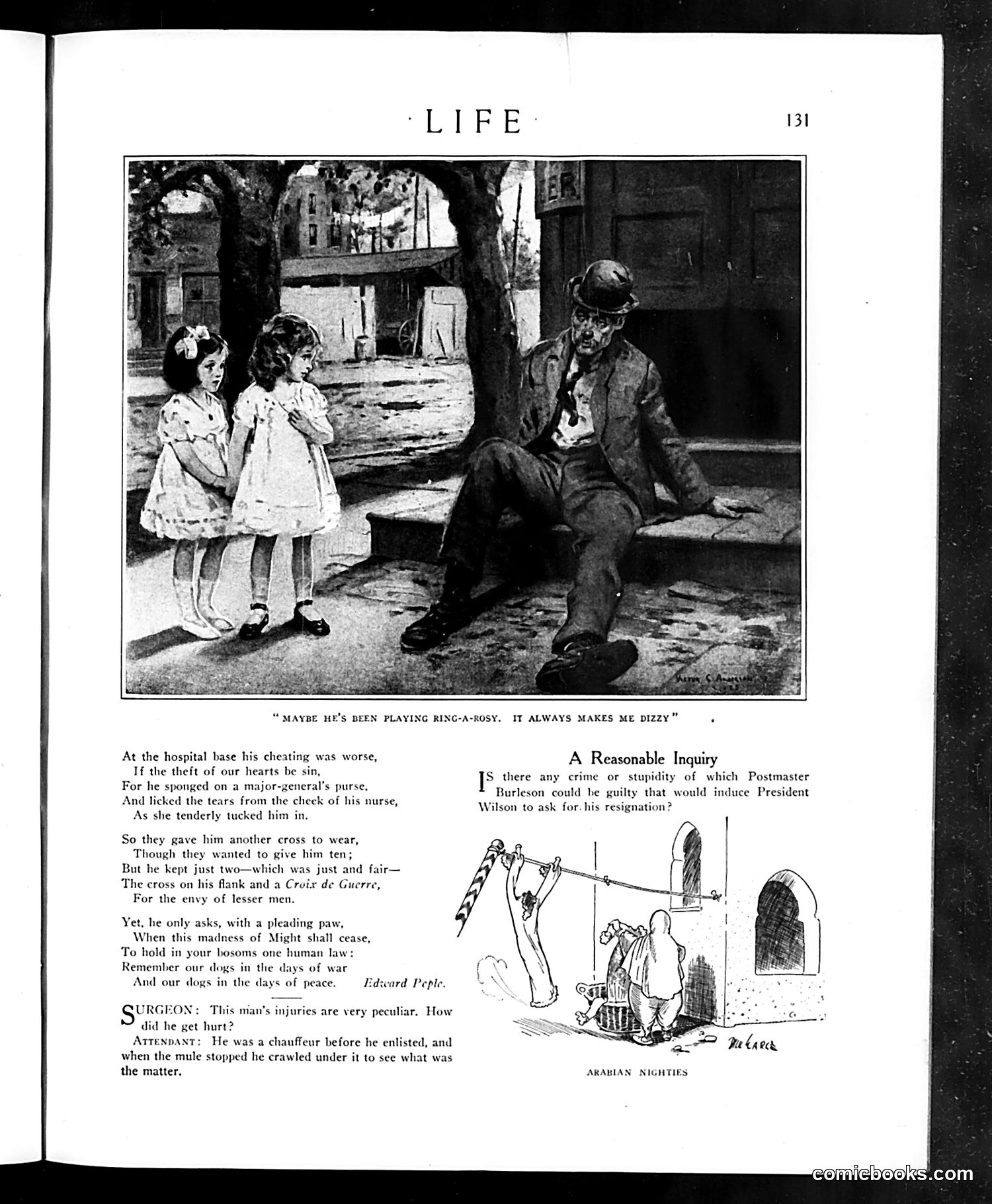
This page contains two distinct satirical pieces from WWI-era Life magazine: **Top cartoon & poem**: Depicts a decorated soldier with two young girls. The poem mocks a soldier who exploited others during wartime—sponging off officers' money, flirting with nurses—yet received military honors (crosses, Croix de Guerre) anyway. The satire targets undeserving soldiers rewarded despite moral failings, while paradoxically asking readers to honor all war dogs (soldiers) in peace and war. **"A Reasonable Inquiry"**: A biting attack on Postmaster General Albert S. Burleson under President Wilson. The caption sarcastically suggests Burleson is so incompetent or corrupt that almost nothing would prompt Wilson to demand his resignation—implying the President tolerates egregious misconduct. **Bottom anecdote**: A joke about a chauffeur-turned-soldier injured when a mule stopped; he crawled under it to check the problem, clearly commentary on stupidity or poor military judgment. All three pieces reflect wartime frustration with military incompetence, corruption, and misplaced honors.
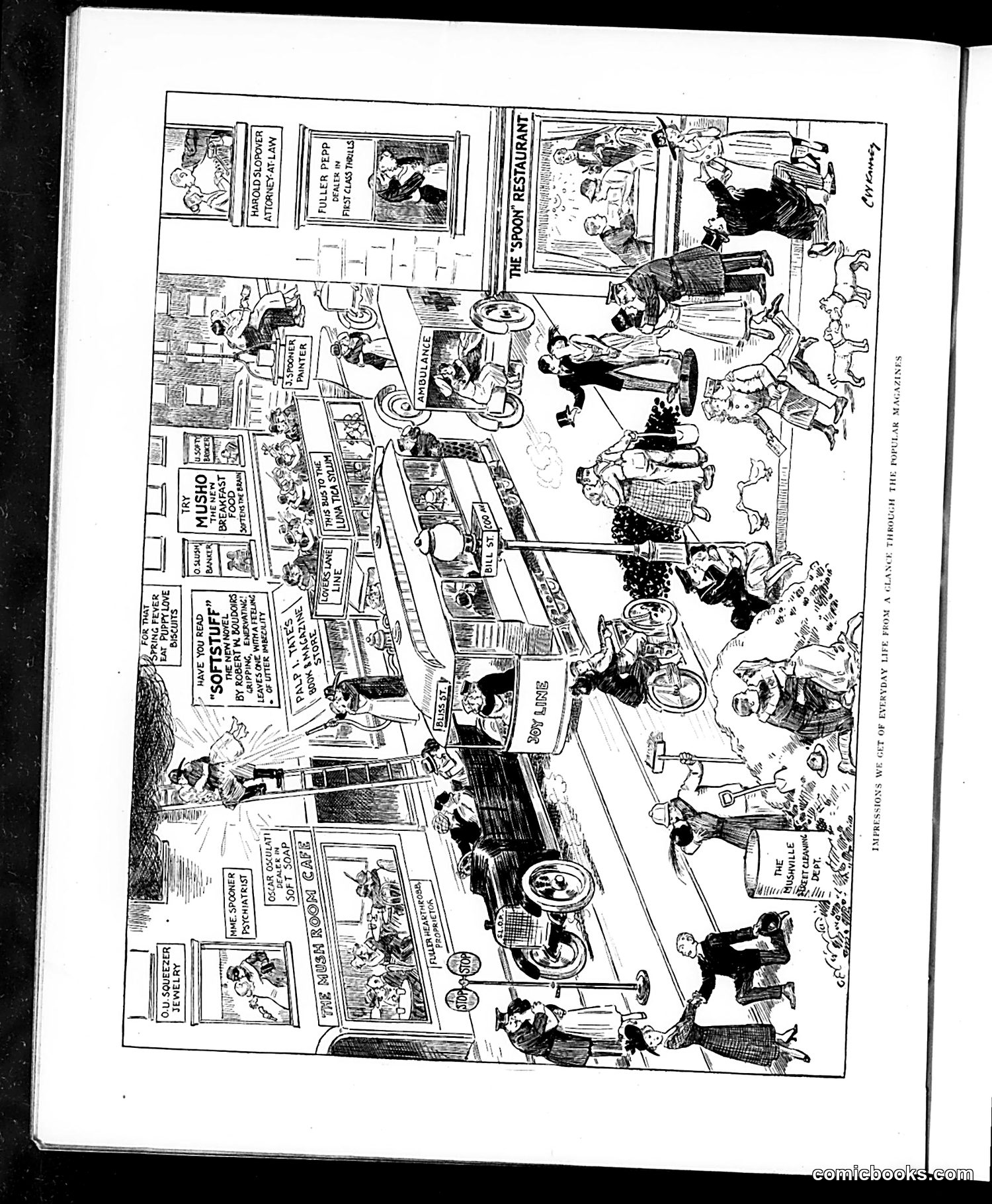
I cannot reliably read this page due to the image orientation and OCR quality. The page appears to contain a satirical comic or cartoon layout with multiple panels, characters, and text boxes arranged in a complex format typical of early-to-mid 20th century Life magazine. However, the image is rotated and the OCR text is corrupted/reversed, making it impossible for me to accurately identify specific figures, political references, or the satire's intended meaning without risking factual errors. To provide an accurate analysis meeting the standards you've requested, I would need either: a properly oriented image or legible text. I apologize that I cannot be more helpful here.
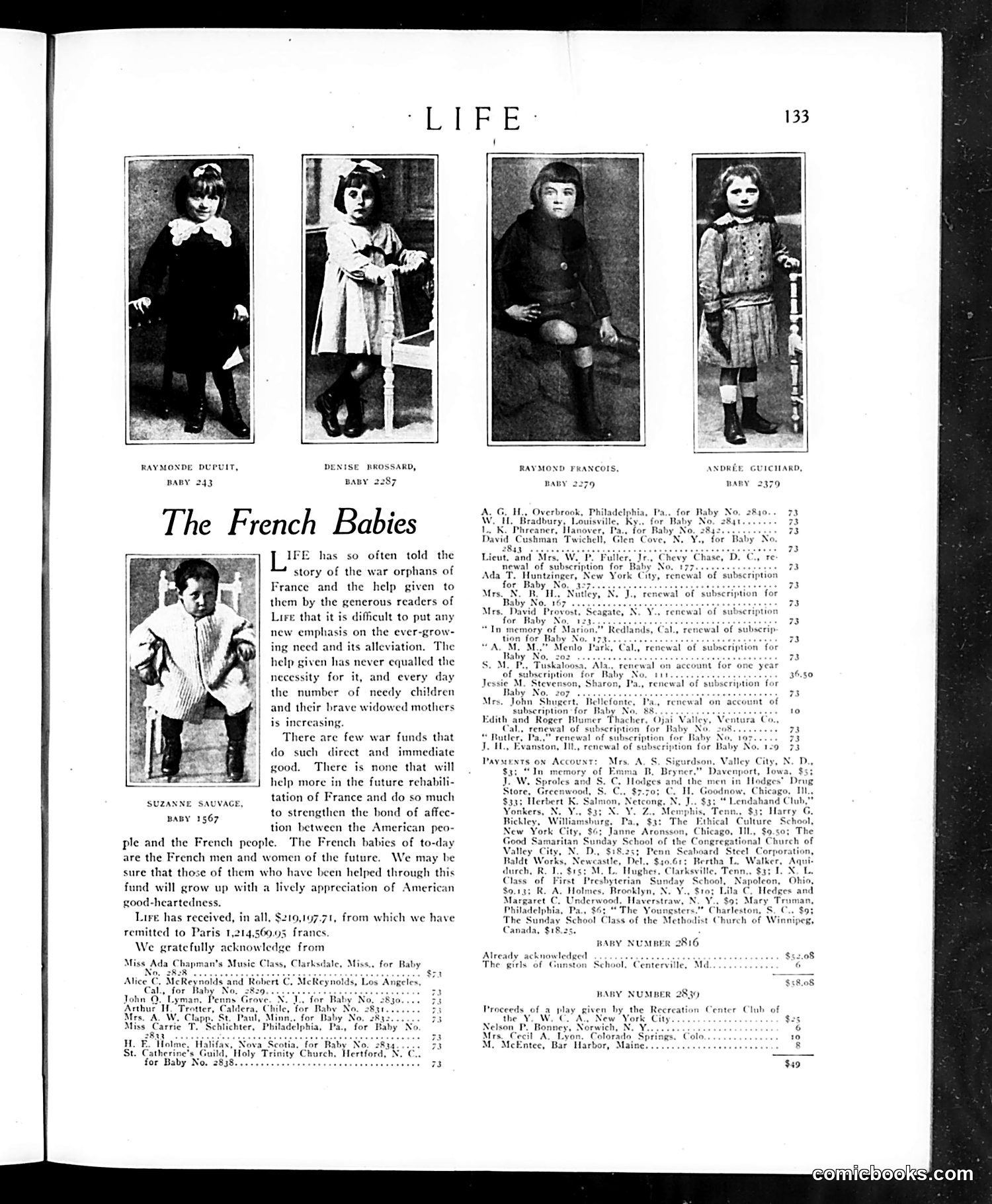
This page documents **Life magazine's ongoing fundraising campaign for French war orphans**, titled "Lire" (a French currency reference). The four photographs at top show individual French children being supported through reader donations. The accompanying article explains that Life has collected over $210,000 to aid French orphans and widowed mothers left destitute by World War I. The piece argues this fund serves dual purposes: immediate humanitarian relief and long-term strengthening of Franco-American bonds, as these children represent "the French men and women of the future." The bulk of the page lists **individual and organizational donors** with contribution amounts, ranging from music classes to church groups to named individuals. This public acknowledgment served both to thank donors and encourage additional contributions. The single larger photograph (Suzanne Sauvage, Baby 1567) personalizes the appeal—a common fundraising tactic showing the specific children American readers' money would help. For modern readers: this represents early 20th-century philanthropic journalism, using mass media and emotional appeals to mobilize charitable giving for international relief.
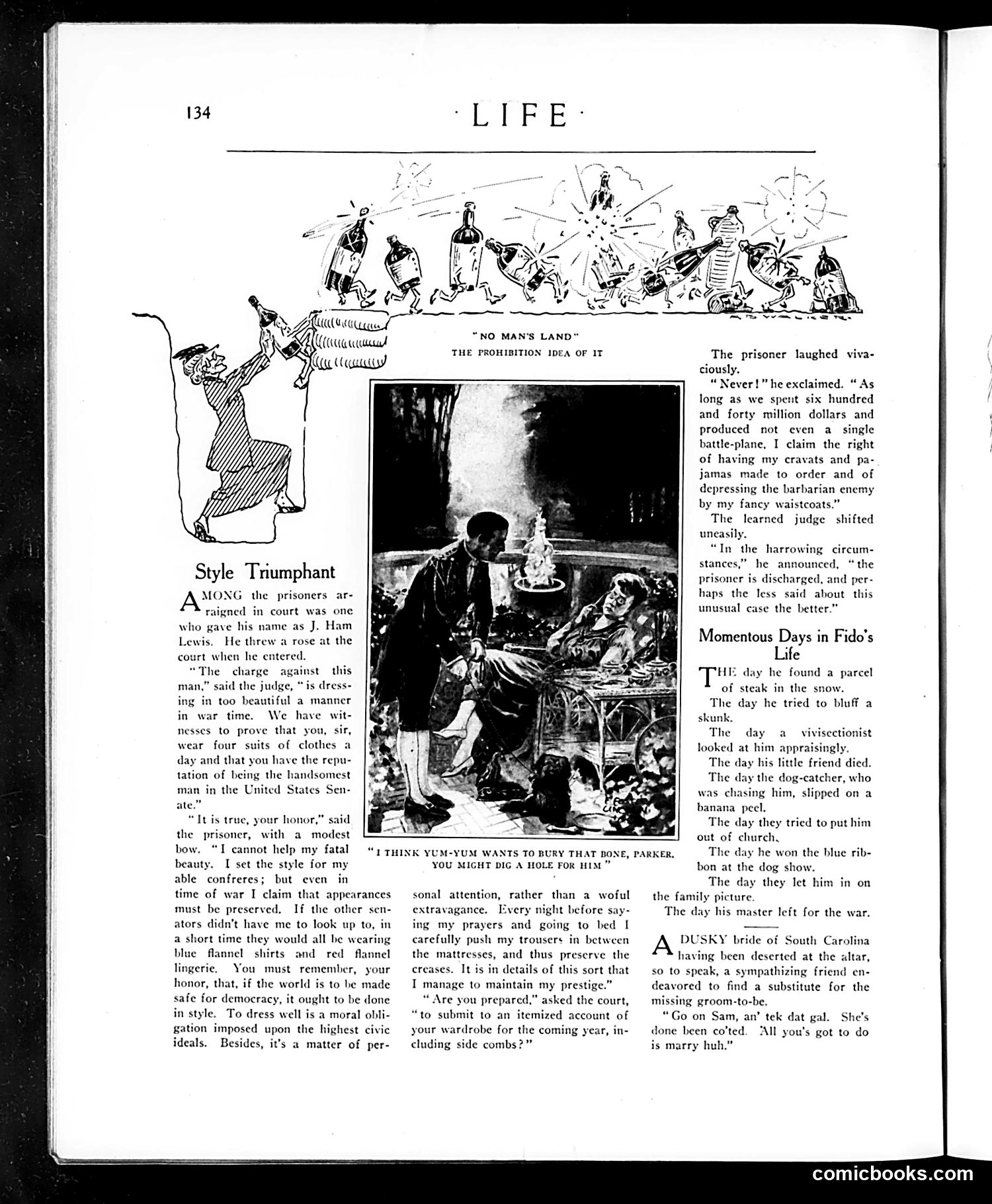
**"Style Triumphant"** mocks Senator J. Ham Lewis (identifiable by the rose-throwing entrance), known for his flamboyant fashion. During WWI, he's prosecuted for wearing four suits daily while the nation sacrifices. His defense—that stylish senators set a moral example and that appearances preserve democracy—satirizes vanity during wartime. The judge discharges him, suggesting the absurdity isn't worth discussing. The joke: Life ridicules wealthy politicians' priorities when soldiers die and military budgets fail (the "$640 million" without producing a single plane references wasteful wartime spending). **"No Man's Land—The Prohibition Idea"** (top cartoon) shows civilians blown apart by explosions, sarcastically framing Prohibition as chaotic as a war zone. This anti-Prohibition commentary suggests the ban creates societal destruction equivalent to battlefield carnage. The dog stories and marriage anecdote are humorous filler unrelated to political satire.
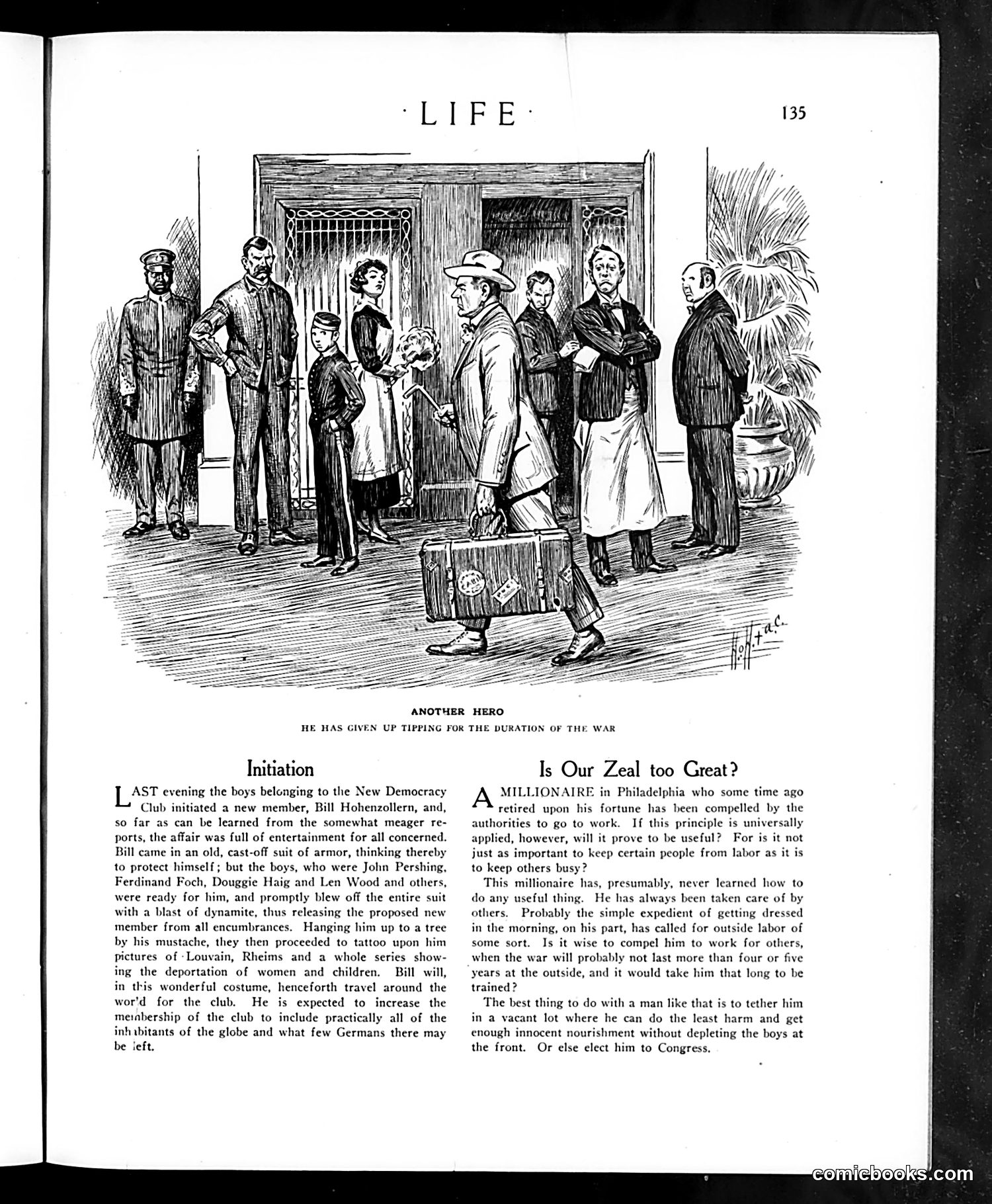
This Life magazine page contains two satirical pieces from World War I era: **"Another Hero"** (cartoon): Mocks wealthy Americans who avoided military service by giving up tipping as their patriotic contribution. The visual joke shows a well-dressed man with a suitcase—implying he traveled while others fought—presenting this trivial sacrifice as heroic wartime effort. **"Initiation"** (text): A dark fantasy where "Bill Hohenzollern" (Kaiser Wilhelm II, Germany's emperor) is humiliated by Allied generals (Pershing, Foch, Haig, Wood) during a mock club initiation, tattooed with images of German atrocities (Louvain, Rheims), then sent worldwide as a recruitment tool. It's wartime propaganda portraying German defeat as inevitable and deserved. **"Is Our Zeal too Great?"**: Questions whether forcing a retired Philadelphia millionaire to work serves the war effort, sarcastically suggesting he'd be useless labor and ironically proposes relegating him to a vacant lot or Congress instead—commentary on upper-class exemption from sacrifice. All three pieces satirize class privilege and lack of genuine wartime contribution.
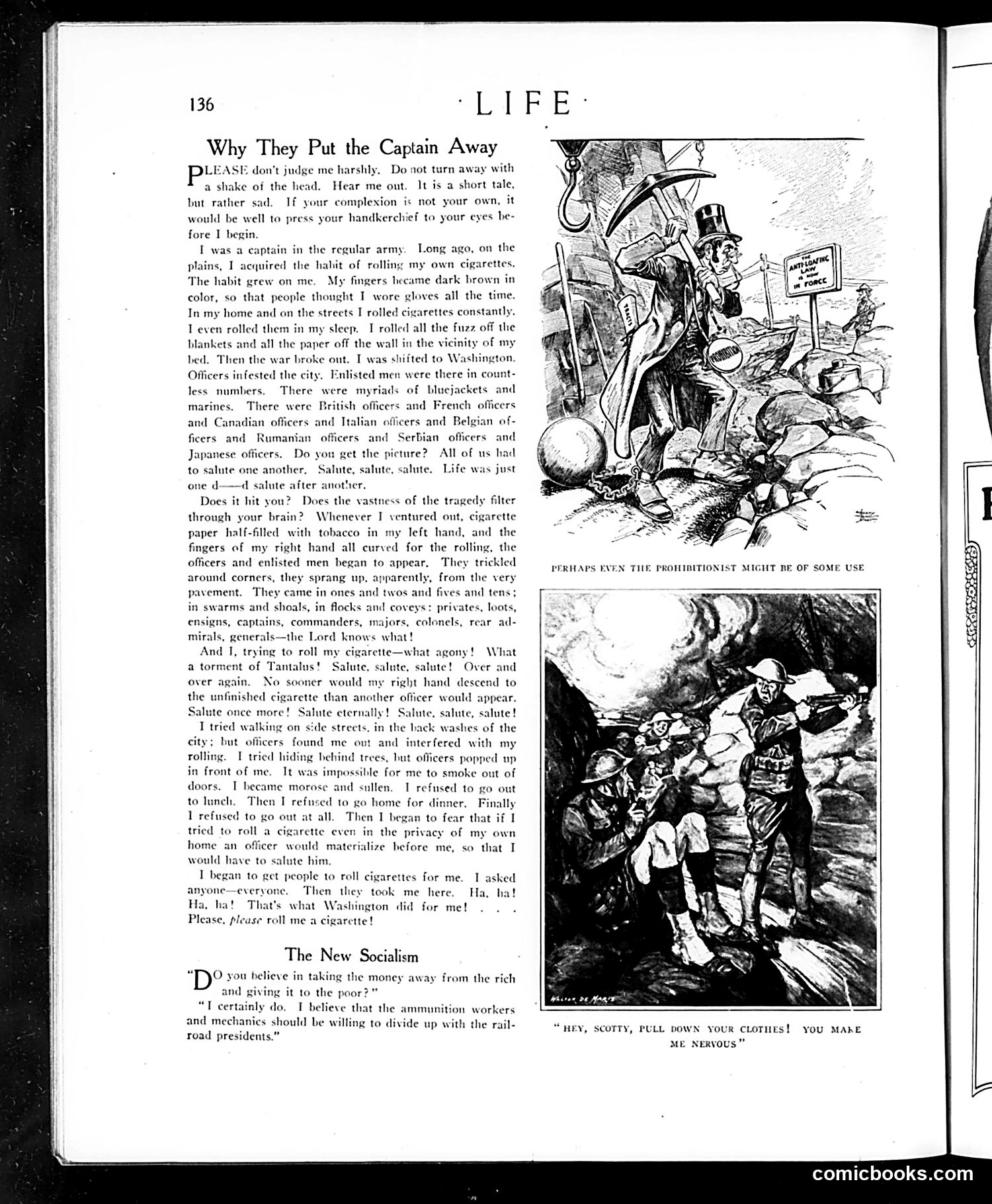
## "Why They Put the Captain Away" This humorous piece satirizes **military protocol during WWI**. A Army captain describes his descent into obsessive-compulsive behavior: he habitually rolls cigarettes and cannot stop, even when his fingers become permanently stained. When stationed in Washington during the war, he encounters an absurd problem—the city swarms with officers from allied nations (British, French, Canadian, Italian, Belgian, Romanian, Serbian, Japanese). Military etiquette requires constant saluting. His compulsion to roll cigarettes conflicts fatally with this duty: every time he attempts rolling, another officer appears, forcing him to salute mid-roll. The torture becomes unbearable. He withdraws entirely indoors, eventually requesting others roll cigarettes for him, leading to his institutionalization. **The satire**: mocks both rigid military hierarchy and the chaos of coordinating multiple Allied armies in Washington, while using the protagonist's nervous breakdown to comment on how absurd wartime protocol could be. ## "The New Socialism" A brief dialogue joke about wealth redistribution, where someone advocates taking money from the rich for the poor—specifically mentioning ammunition workers should share with railroad presidents. The accompanying illustration appears unrelated or uses crude humor.
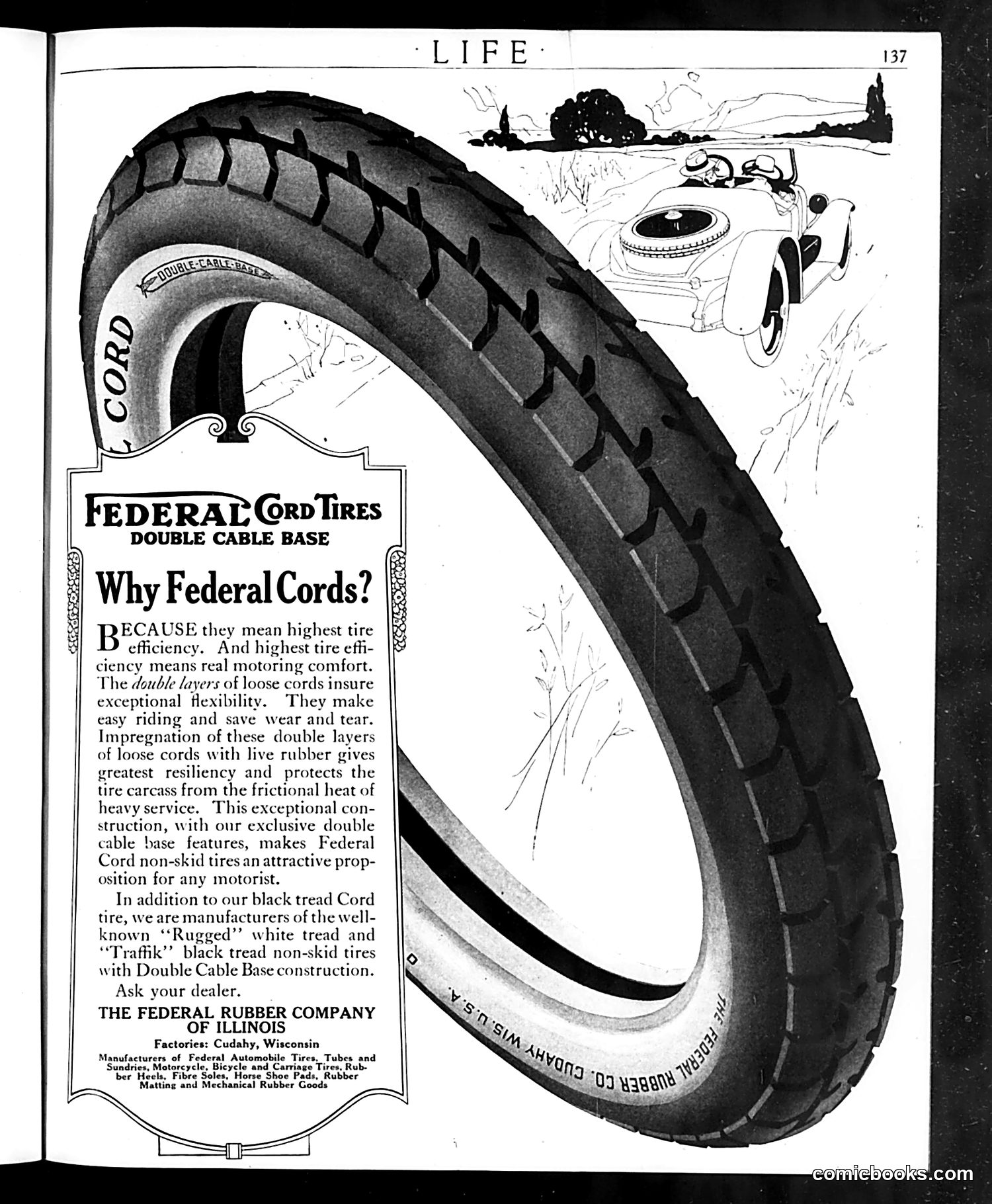
This page is **primarily an advertisement**, not political satire or editorial cartooning. It's a full-page ad for Federal Cord Tires from The Federal Rubber Company of Illinois (factories in Cudahy, Wisconsin). The image shows a large, dramatically rendered tire in cross-section alongside a sketch of a vintage automobile on a country road. The accompanying text explains the tire's technical features—specifically its "double cable base" construction with double layers of loose cords, which the company claims provides superior flexibility, comfort, and durability compared to competing tires. There is **no political or social satire present**. This is straightforward early 20th-century automotive advertising, using technical product explanation and appealing imagery to market tire superiority to motorists. The page number (137) and "LIFE" masthead indicate it appeared in *Life* magazine, which accepted commercial advertisements alongside its satirical content.
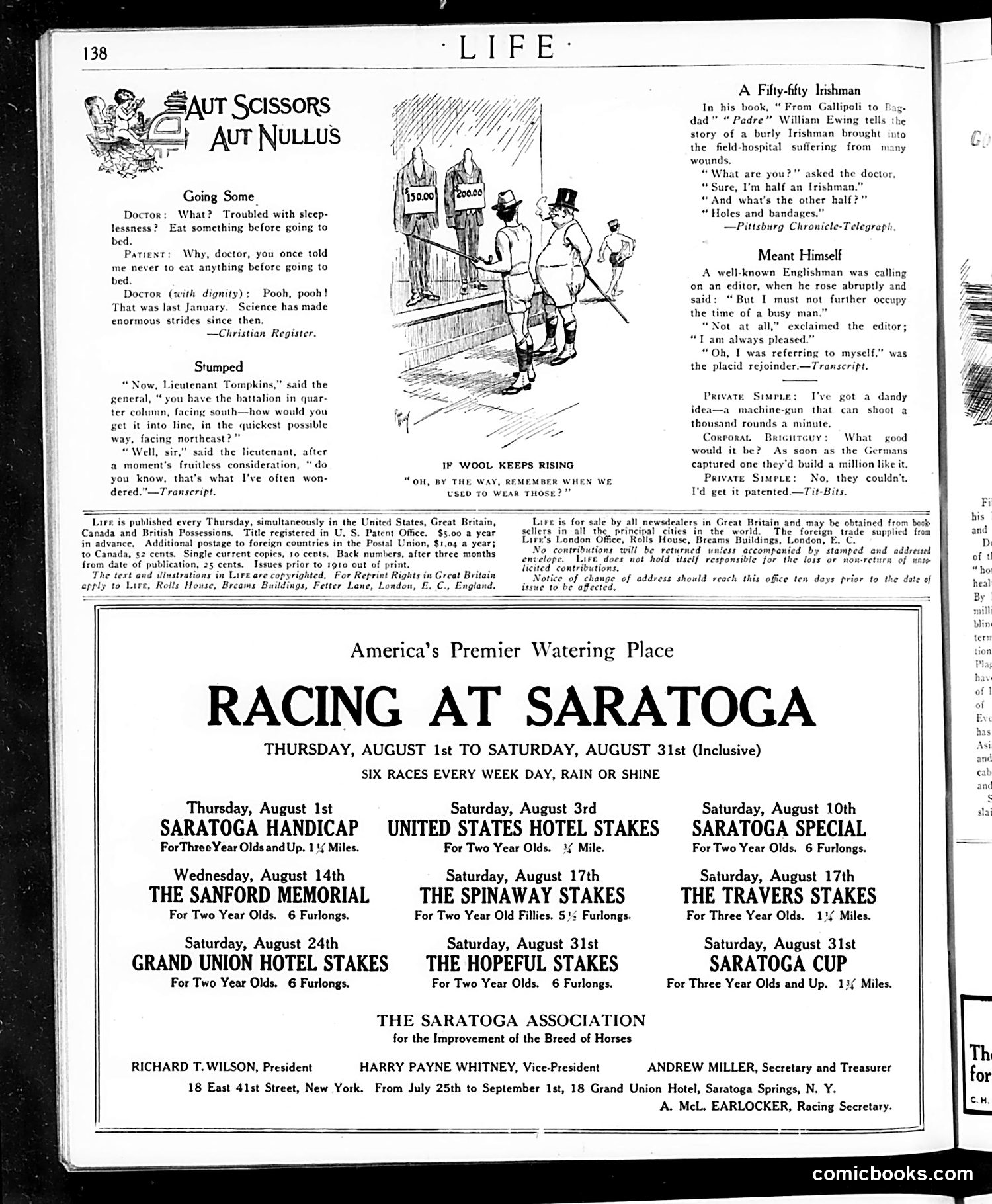
This page from *Life* magazine features several short humorous anecdotes in the "Aut Scissors Aut Nullus" (scissors or nothing) section—a regular humor column. The jokes satirize professional incompetence and literal-mindedness: **"Going Some"** mocks a doctor's inconsistency—he contradicts his own earlier medical advice, blaming "science" for the reversal. **"A Fifty-fifty Irishman"** is a wartime hospital joke playing on Irish stereotypes; a wounded soldier claims to be "half Irish" and "half holes and bandages." **"Meant Himself"** ridicules polite pretense—an Englishman's excuse about respecting the editor's time actually reveals self-regard. **"Stumped"** depicts a military officer unable to answer a simple tactical question, suggesting military incompetence. The remainder is a substantial advertisement for horse racing at Saratoga Springs, New York—a major leisure destination for wealthy Americans—listing stakes races throughout August.
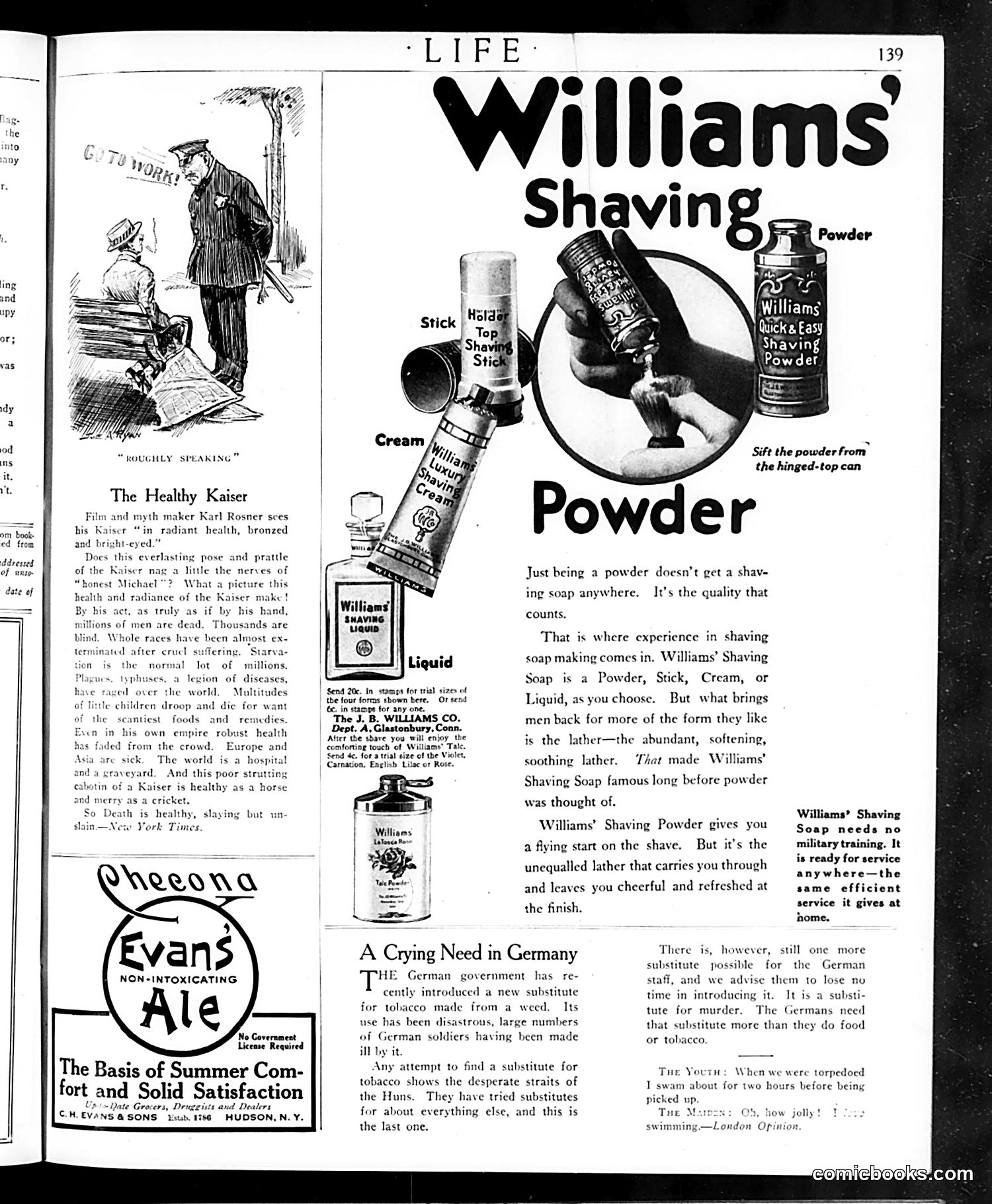
This page contains advertisements alongside satirical commentary about World War I. **"The Healthy Kaiser" cartoon** (upper left): A sketch captioned "Roughly Speaking" mocks Kaiser Wilhelm II's propagandists (specifically mythmaker Karl Rosner) for portraying him as radiantly healthy and vigorous. The accompanying text sarcastically contrasts this propaganda with the devastating reality of the war—millions starved, diseased, and dying across Europe and the Kaiser's own empire. The satire attacks the disconnect between official German narratives of imperial strength and the actual human suffering caused by the war. **"A Crying Need in Germany"** (lower right): This section satirizes Germany's desperation, noting they've introduced tobacco substitutes made from weeds that sicken soldiers. Life sardonically suggests Germans need "a substitute for murder" more than food or tobacco—a cutting indictment of German war conduct and the futility of their situation. The page primarily advertises Williams' Shaving products alongside this anti-German war commentary, reflecting Life's role as both a satirical and commercial publication during WWI.
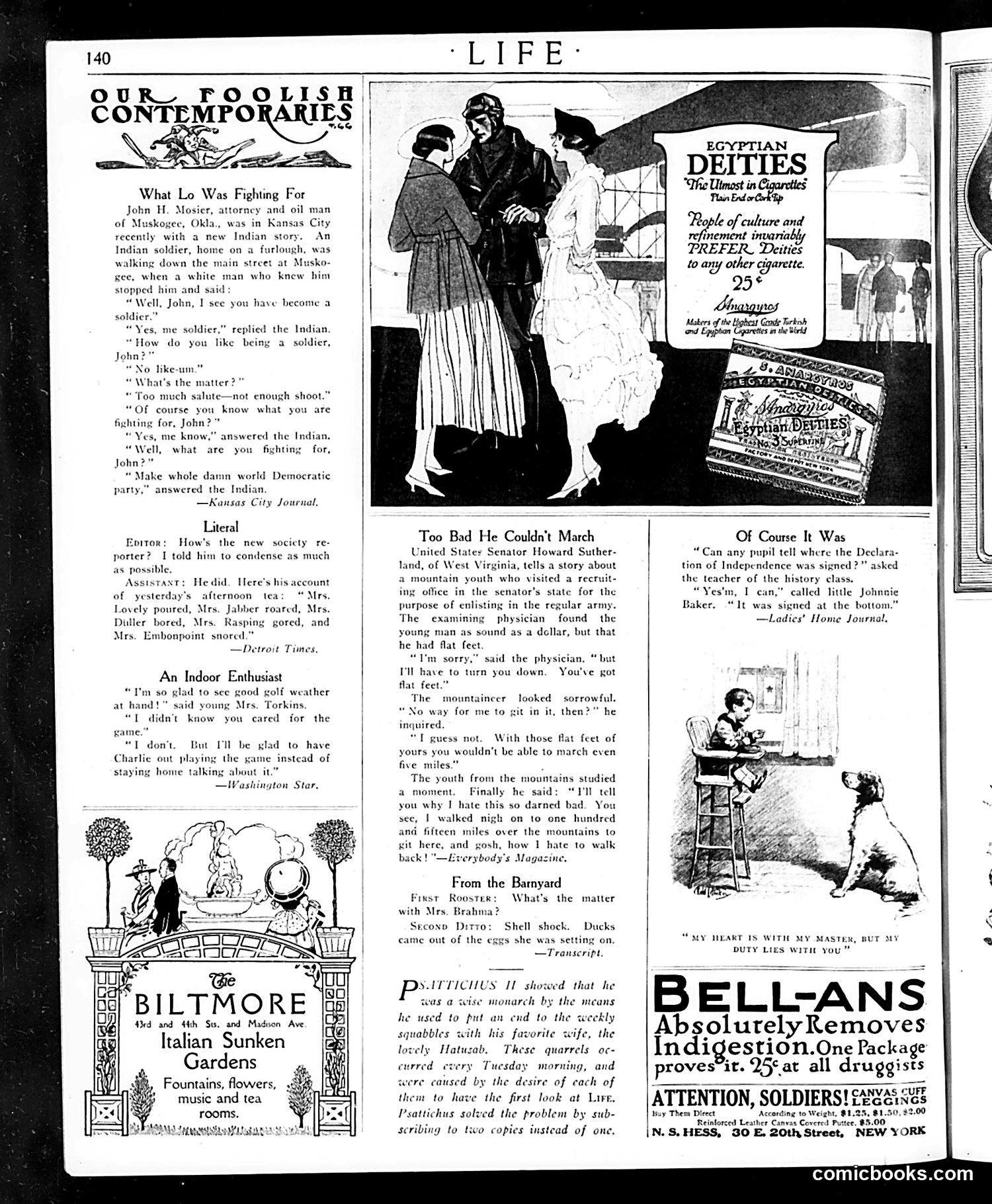
This page contains satirical humor pieces typical of Life's "Our Foolish Contemporaries" section, which mocked contemporary figures and situations. **Main Cartoon/Story**: "What Lo Was Fighting For" presents an Indigenous soldier explaining to a white man why he enlisted in WWI. The joke relies on period stereotypes—the soldier speaks in broken English ("No like-um," "Too much salute—not enough shoot") and reveals his motivation is to "make whole damn world Democratic party." The satire targets both the soldier's perceived naiveté and contemporary American political rhetoric about the war being fought for democracy. **Other Humorous Anecdotes**: Brief comic pieces about a would-be soldier rejected for flat feet, a society reporter who condenses too literally, and a rooster dealing with "shell shock" from ducks. The page is predominantly **advertising** (Egyptian Deities cigarettes, Bell-Ans indigestion remedy, military leggings, the Biltmore hotel), typical of this magazine's format. The humor reflects 1910s-1920s attitudes: crude ethnic stereotyping, domestic comedy, and WWI references suggest this predates American entry into the war or covers its immediate aftermath.
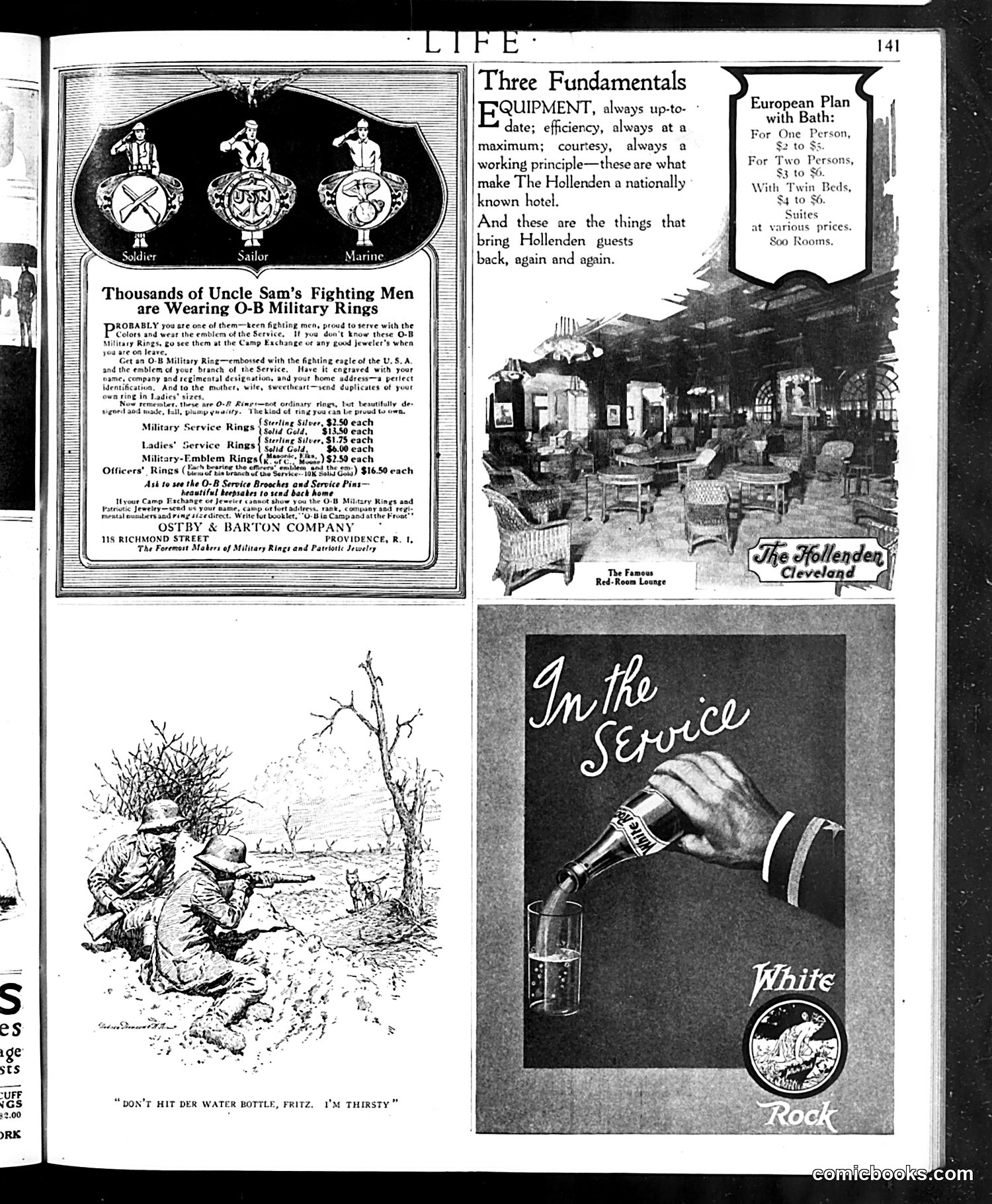
This page contains three distinct elements: **Top Left - Military Rings Advertisement:** An ad for O-B Military Rings sold to U.S. servicemen (Soldier, Sailor, Marine depicted). The rings featured military emblems and could be engraved with personal details. These were patriotic souvenirs marketed to troops and their families back home—typical WWI morale-boosting merchandise. **Top Right - Hotel Advertisement:** The Hollenden Hotel in Cleveland promotes itself using military language ("Three Fundamentals"), appealing to servicemen on leave with modest room rates ($2-6). **Bottom Left - Cartoon:** Shows American soldiers in a trench. One soldier addresses an enemy ("Fritz"—a generic German name) asking not to hit his water bottle because he's thirsty. The humor is dark WWI trench warfare satire: even enemies recognize basic human needs like drinking water amid combat. This reflects the grim, absurdist comedy common in WWI-era publications depicting the grinding reality of trench warfare. The page overall targets servicemen and their families with patriotic advertising mixed with satirical commentary on military life.
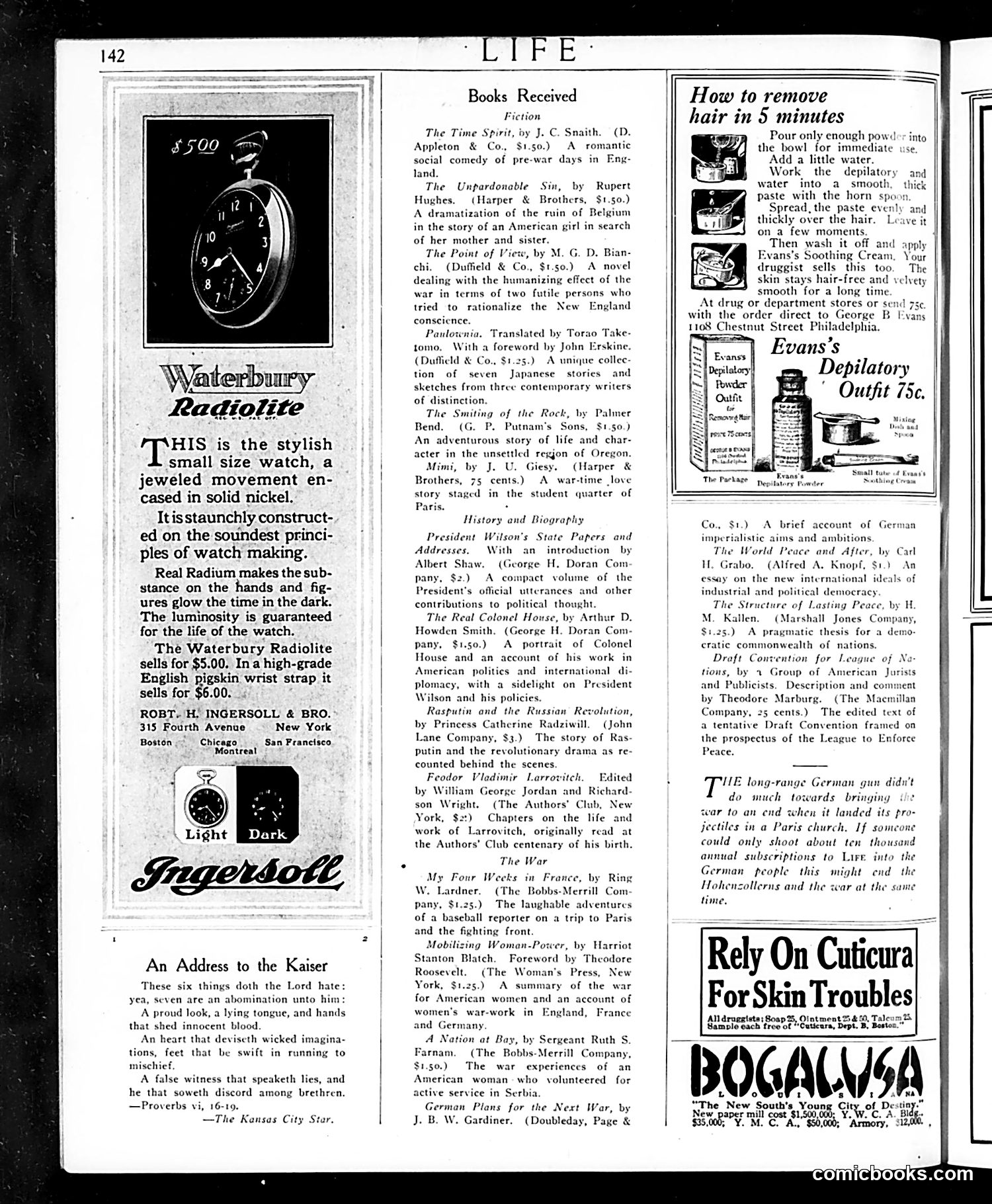
This page is primarily **advertising and book reviews**, not political satire. The main content includes: **Left side**: A Waterbury Radiolite watch advertisement emphasizing its luminous radium hands and affordability ($5-6), marketed as a practical timepiece. **Center**: Book reviews listing recent publications on WWI-related topics—novels about Belgium's destruction, war experiences, and works on President Wilson and Russian politics (Rasputin, Revolution). **Bottom left**: A moral verse from Proverbs attributed to the Kansas City Star, condemning pride, lies, and bloodshed—likely an anti-Kaiser editorial statement, given its placement alongside war-focused book reviews. **Right side**: Hair removal product advertisements (Evans's Depilatory Outfit) and Cuticura skincare ads. The page reflects **wartime America** (circa 1918): commercial normalcy coexists with serious engagement with WWI literature and implicit moral judgment against German aggression through the biblical passage.
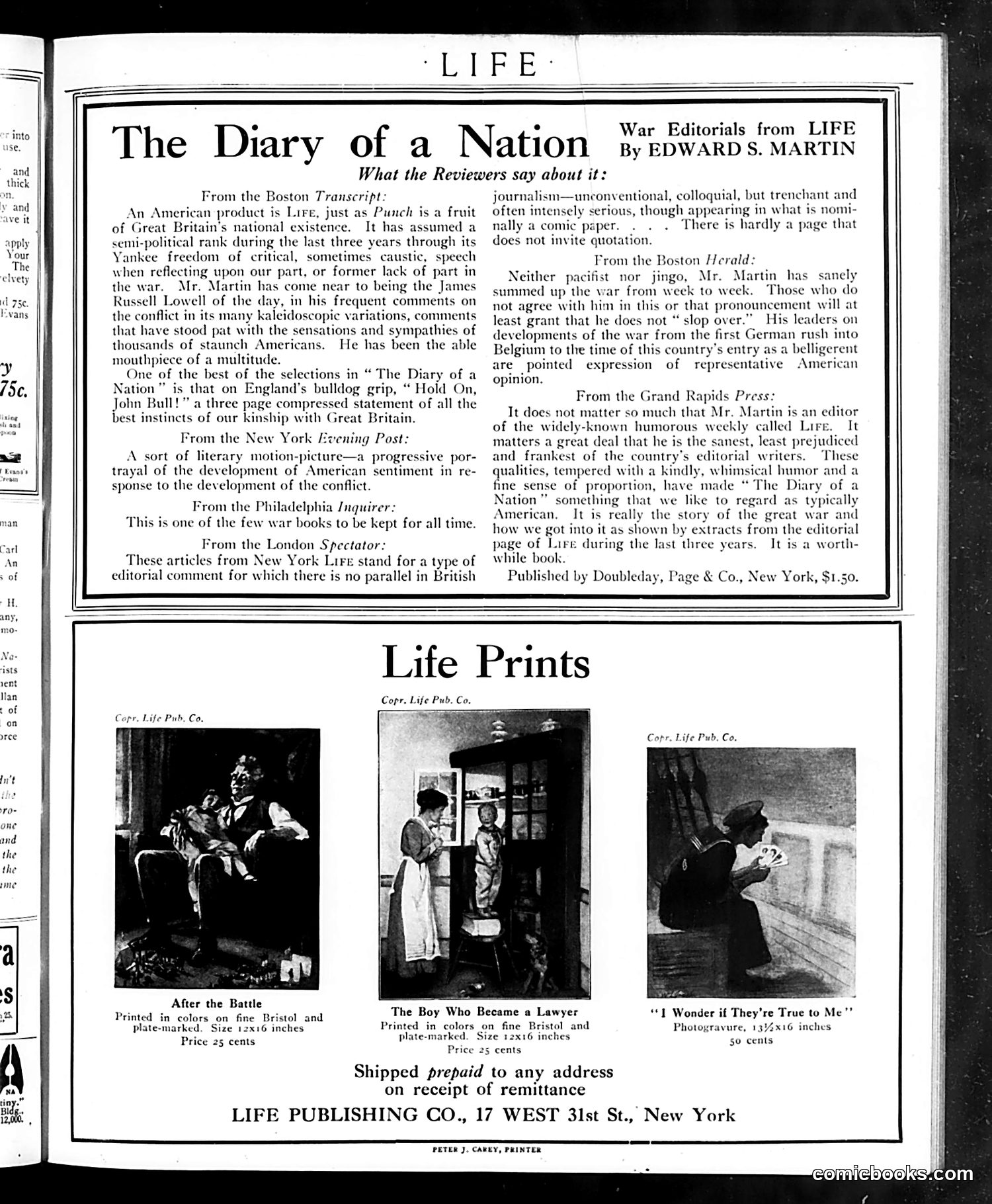
This page is primarily advertising and editorial promotion, not a cartoon. It advertises a book called "The Diary of a Nation," a collection of war editorials by Edward S. Martin from *Life* magazine. The text includes favorable reviews from newspapers praising Martin's commentary on America's involvement in World War I. The page notes that *Life*—presented as America's equivalent to Britain's *Punch*—offered unusually candid, colloquial editorial commentary on the war. The reviews emphasize Martin's balanced, non-polemical approach ("neither pst nor jingo"). The bottom section advertises three unrelated *Life* prints for sale: "After the Battle," "The Boy Who Became a Lawyer," and "I Wonder if They're True to Me." This appears to be a standard magazine advertisements page from the war era.
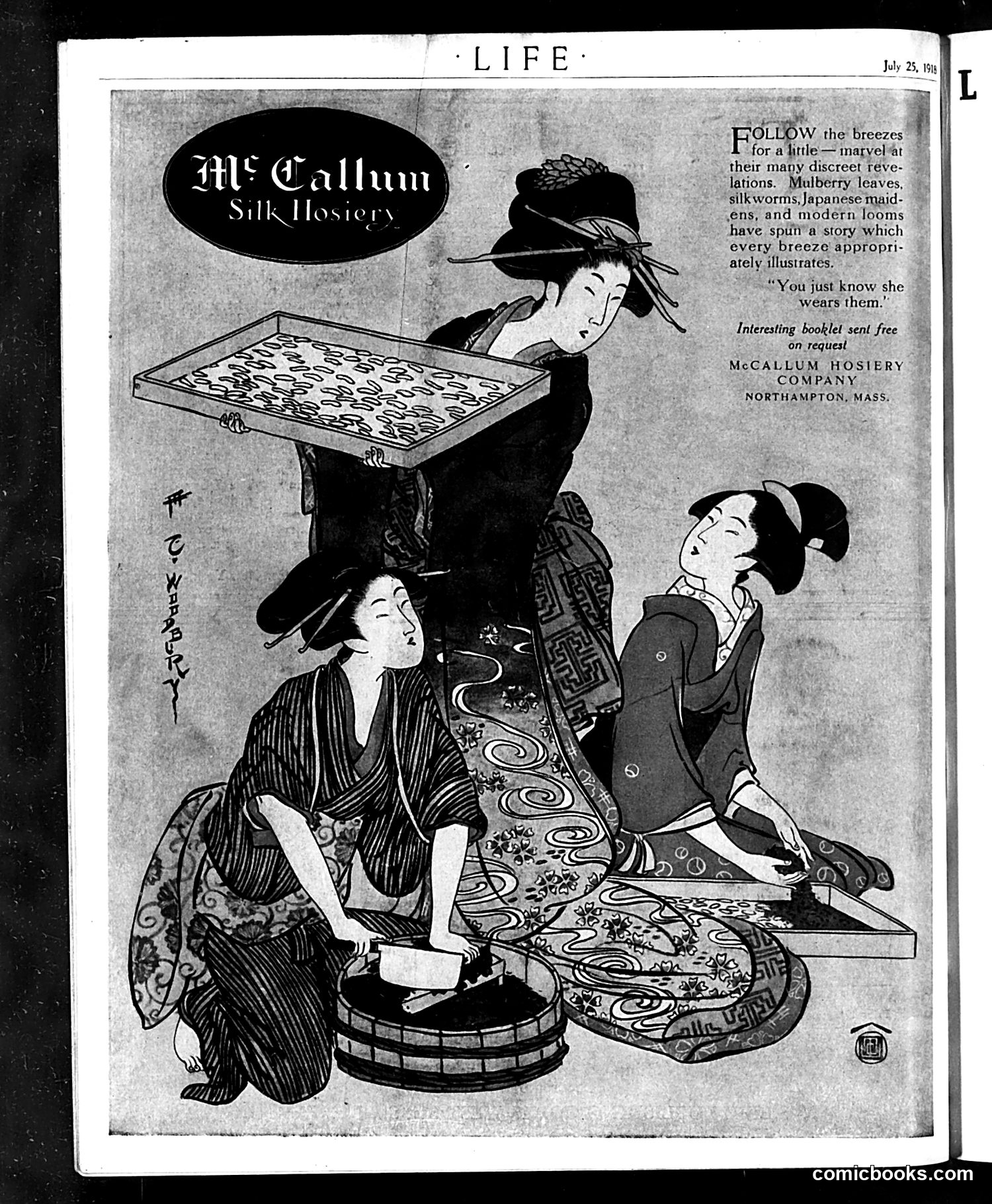
This is a **commercial advertisement**, not political satire. It promotes McCallum Silk Hosiery from Northampton, Massachusetts. The illustration uses **Japanese aesthetic imagery**—three figures in Japanese dress examining silk fabric—to market women's silk stockings. The accompanying text romanticizes the product's origin story, tracing silk from mulberry leaves and silkworms through "Japanese maidens" to "modern looms." The tagline "You just know she wears them" suggests social prestige: wearing McCallum hosiery signals sophistication. This reflects early 20th-century marketing that associated imported Asian silk with luxury and refinement. The ad offers a free booklet to interested readers, a common promotional tactic of the era. The Japanese imagery, while exotic to American audiences, was a standard visual device to convey silk's exotic prestige rather than any political statement.