
Life, 1918-07-25 · page 20 of 36
Life — July 25, 1918 — page 20: what you’re looking at
What you’re looking at
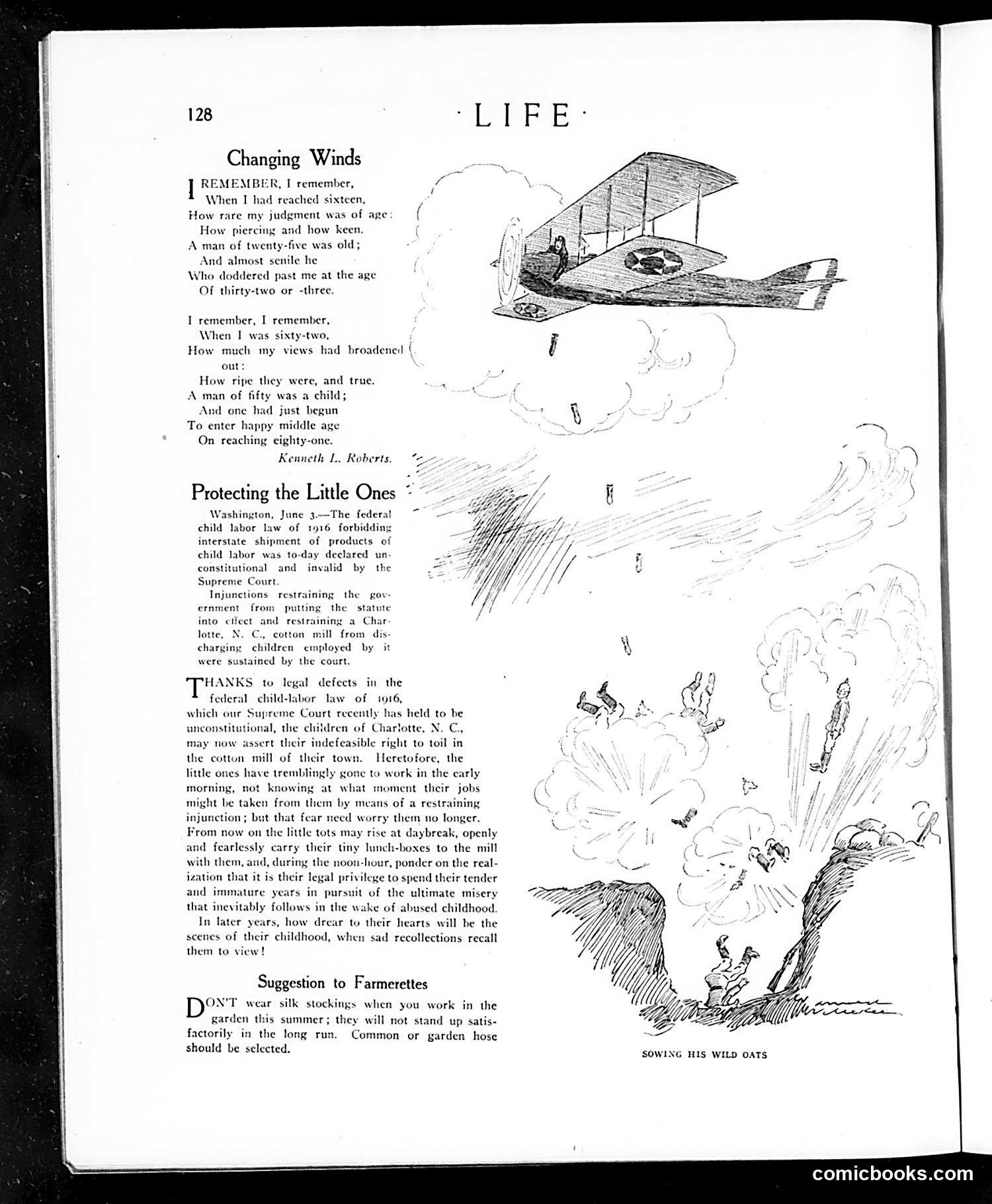
**"Changing Winds"** is a humorous poem about how our judgment of age shifts as we mature—at sixteen, anyone over thirty seemed ancient; by sixty-two, we realize a fifty-year-old is actually young. **"Protecting the Little Ones"** is bitter satire. The text describes a 1916 Supreme Court decision that struck down federal child-labor laws as unconstitutional. Life mocks this ruling by sarcastically "celebrating" that children in Charlotte, North Carolina can now legally work in cotton mills without fear of injunctions. The author condemns this outcome, warning that child labor leads to lifelong misery and traumatic memories. **"Sowing His Wild Oats"** (the illustration) depicts a young man scattering seeds—literal wild oats—as he flies above a landscape in an early airplane. This is likely commentary on youthful recklessness or irresponsibility, using the common idiom "sowing wild oats." The page criticizes judicial decisions harmful to children and workers while offering practical domestic advice to women.
📄 Transcribed text from this page (OCR, searchable)
Machine-transcribed from the original scan — historical spelling and the odd misread are preserved.
Changing Winds REMEMBER, I remember, When I had reached sixteen, How rare my judgment was of age How piercing and how keen. A man of twenty-five was old; And almost senile he Who doddered past me at the age Of thirty-two or -three. I remember, I remember, When I was How much my views had broadened | out: How ripe they were, and true. A man of fifty was a child; And one had just begun To enter happy middle age On reaching eighty-one. Kenneth 1.. Roberts, Protecting the Little Ones * Washington, June 3.—The fede! child labor law of 1916 forbiddi interstate shipment of products of child labor was to-day declared un constitutional and invalid by the Supreme Court Injunctions restraining the gov- ernment from putting the statute into cticct and restraining a Char lotte, N. C., cotton mill from dis- charging children employed. by it were sustained by the court. HANKS to legal defects in the federal child-labor law of 1916, which our Supreme Court recently has held to he unconstitutional, the children of Chartotte, N. C., n now assert their indefeasible right to toil in the cotton mill of their town. Heretofore, the little ones have tremblingly gone to work in the early morning, not knowing at what moment their jobs might be taken from them by means of a restraining junction; but that fear need worry them no longer. om now on the little tots may rise at daybreak, openly and fearlessly carry their tiny lunch-boxes to the mill with them, and, during the noon-hour, ponder on the real- ization that it is their legal privilege to spend their tender and immature years in pursuit of the ultimate misery that inevitably follows in the wake of abused childhood. In later rs, how drear to their hearts will be the scenes of their childhood, when sad recollections recall them to view! Suggestion to Farmerettes ON'T wear silk stockings when you work in the garden this summer; they will not stand up satis- factorily in the long run. Common or garden hose should be selected. SOWING HIS WILD OATS comicbooks.com