
Life, 1918-07-25 · page 17 of 36
Life — July 25, 1918 — page 17: what you’re looking at
What you’re looking at
This page critiques **William Randolph Hearst**, the powerful newspaper magnate, during World War I. The text contrasts Hearst's pro-German editorial stance with the German-owned *New York Mail*, which was exposed and restored to American ownership. The article questions why Hearst persistently undermined American war efforts—opposing the draft, agitating against Britain, supporting the German cause—without facing legal consequences like the *Mail* did. Unlike the *Mail* (which was bought by German interests), Hearst apparently financed this pro-German agenda himself, suggesting ideological anti-British sentiment rather than direct payment. The satirical point: Hearst is a mysterious political operator whose true motivations remain incomprehensible. The author mockingly suggests psychologists should analyze him as they would public figures, since Hearst claims no Democratic, Republican, Socialist, or other standard political identity—only self-interest. His mysterious desire to "wreck the British Empire" and create "a bad smell in a suffering world" represents dangerous, unprincipled power divorced from any coherent ideology or public good.
📄 Transcribed text from this page (OCR, searchable)
Machine-transcribed from the original scan — historical spelling and the odd misread are preserved.
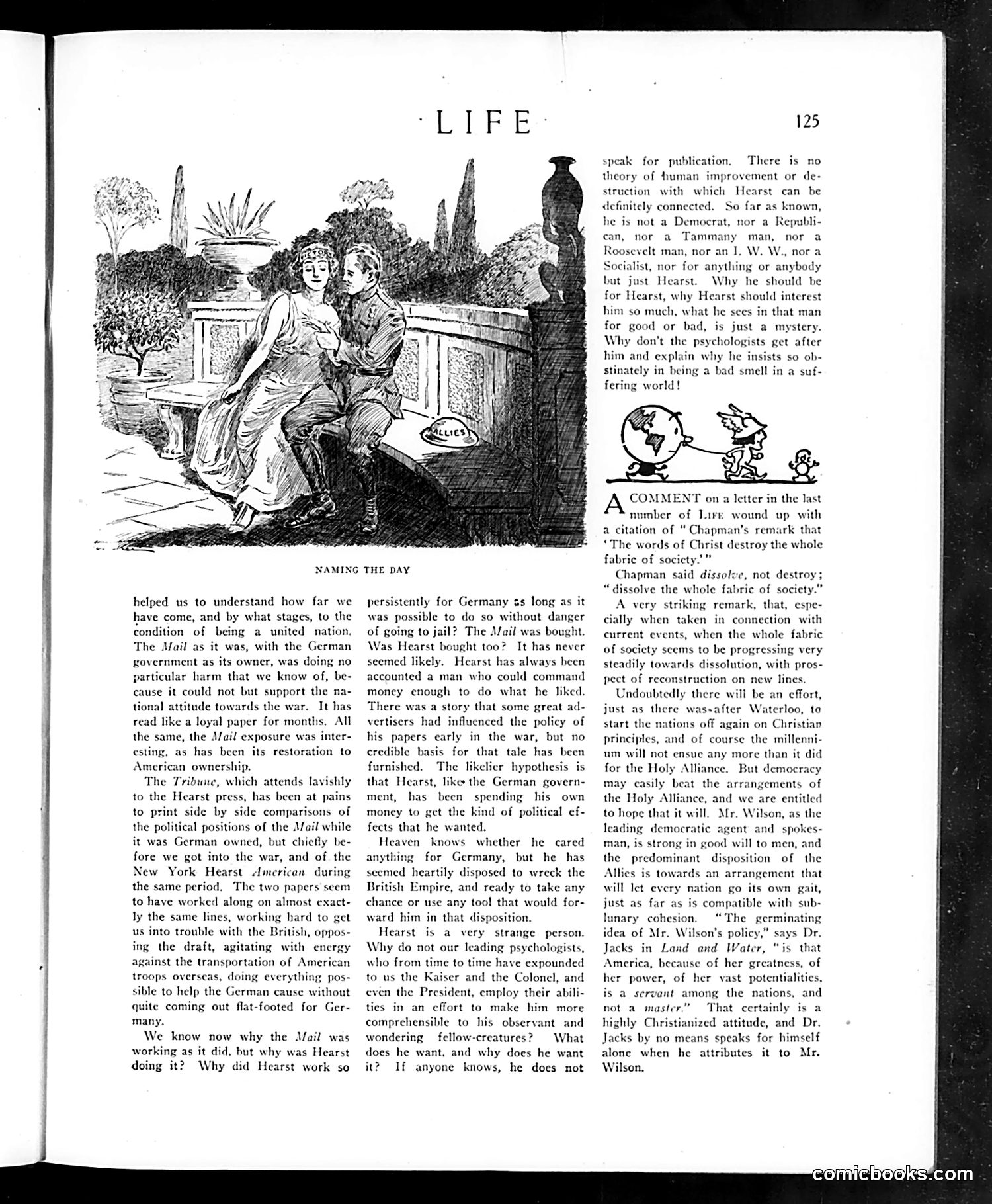
NAMING THE DAY helped us to understand how far we have come, and by what stages, to the condition of being a united nation, The Mail as it was, with the German government as its owner, was doing no particular harm that we know of, be- cause it could not but support the na- tional attitude towards the war. It has read like a loyal paper for months, All the same, the A/ail exposure was inter- ing, as has been its restoration to The Tribune, which attends lavishly to the Hearst press, has been at pains to print side by side comparisons of the political positions of the Mail while it was German owned, but chiefly be- fore we got into the war, and of the New York Hearst American during the same period. The two papers seem to have worked along on almost exact- ly the same lines, working hard to get us into trouble with the British, oppos- ing the draft, agitating with energy against the transportation of American troops overseas, doing everything pos- sible to help the German cause without quite coming out flat-footed for Ger- many. We know now why the Mail was working as it did, but why was Hearst doing it? Why did Hearst work so persistently for Germany as long as it was possible to do so without danger of going to jail? The Mail was bought. Was Hearst bought too? It has never seemed likely. Hearst has always been accounted a man who could command money enough to do what he liked. There was a story that some great ad- vertisers had influenced the policy of his papers early in the war, but no credible basis for that tale has been furnished. The likelier hypothesis is that Hearst, like the German govern- ment, has been spending his own money to get the kind of political ef- fects that he wanted. Heaven knows whether he cared anything for Germany, but he has seemed heartily disposed to wreck the British Empire, and ready to take any chance or use any tool that would for- ward him in that disposition, Hearst is a very strange person. Why do not our leading psychologists, who from time to time have expounded to us the ser and the Colonel, and even the President, employ their abili- ties in an effort to make him more comprehensible to his observant and wondering fellow-creatures? = What does he want, and why does he want it? If anyone knows, he does not 125 speak for publication. There is no theory of fiuman improvement or de- with which Hearst can be dcfinitely connected. So far as known, he is not a Democrat, nor a Republi- can, nor a Tammany man, nor a Roosevelt man, nor an I. W. W., nor a Socialist, nor for anything or anybody but just Hearst. Why he should be for Hearst, why Hearst should interest him so much, what he sees in that man for good or bad, is just a mystery. Why don't the psychologists get after him and explain why he insists so ob- stinately in being a bad smell in a suf- fering world! struction COMMENT on a letter in the last number of Lire wound up with a citation of “ Chapman's remark that ‘The words of Christ destroy the whole fabric of soci ne Chapman said dissolve, not destroy; “dissolve the whole fabric of society.” A very striking remark, that, espe- cially when taken in connection with current events, when the whole fabric of society seems to be progressing very steadily towards dissolution, with pros- pect of reconstruction on new lines. Undoubtedly there will be an effort, just as there was-after Waterloo, to start the nations off again on Christian principle nd of course the millenni- um will not ensue any more than it did for the Holy Alliance. But democracy may casily beat the arrangements of the Holy Alliance, and we are entitled to hope that it will. Mr. Wilson, as the leading democratic agent and spokes- man, is strong in good will to men, and the predominant disposition of the Allies is towards an arrangement that will let every nation go its own gait, just as far as is compatible with sub- lunary cohesion. “The germinating idea of Mr. Wilson’s policy,” says Dr. Jacks in Land and Water, “is that America, because of her greatness, of her power, of her vast potentialities, is a servant among the nations, and not a master.” That certainly is a highly Christianized attitude, and Dr. Jacks by no means speaks for himself alone when he attributes it to Mr. Wilson.