
A complete issue · 36 pages · 1918
Life — July 18, 1918
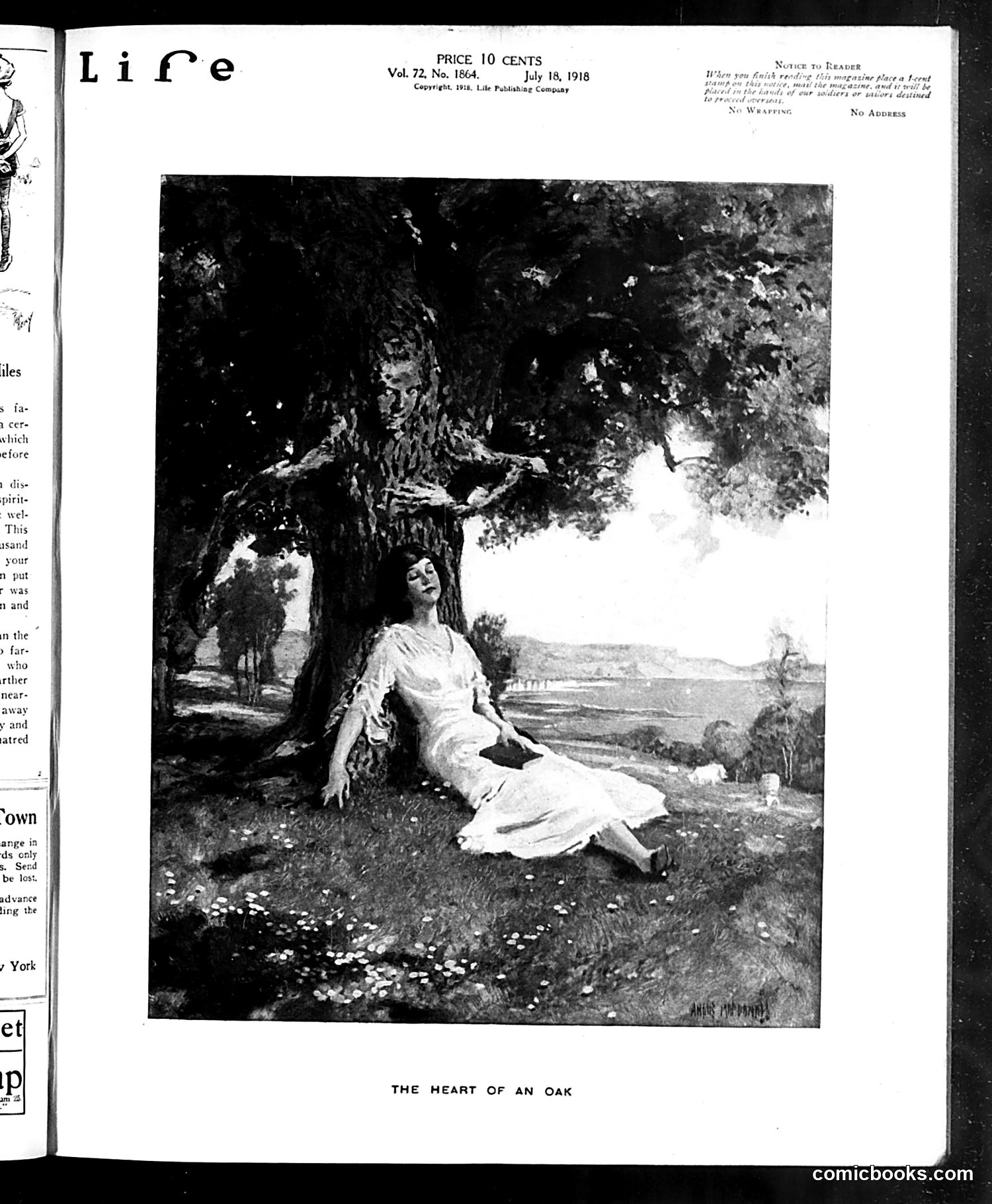
This is not a political cartoon but rather an artistic illustration titled "The Heart of an Oak." It depicts a woman in a white dress reclining against the trunk of a large, gnarled oak tree in a pastoral landscape. The image appears to be a romantic or allegorical artwork rather than satire. The title likely references the famous British patriotic song "Heart of Oak" (1759), which celebrates British naval strength and courage. However, the illustration itself seems to be purely aesthetic—a sentimental portrayal of femininity and nature rather than political commentary. Without accompanying text explaining its context, the specific satirical or political intent (if any) remains unclear.
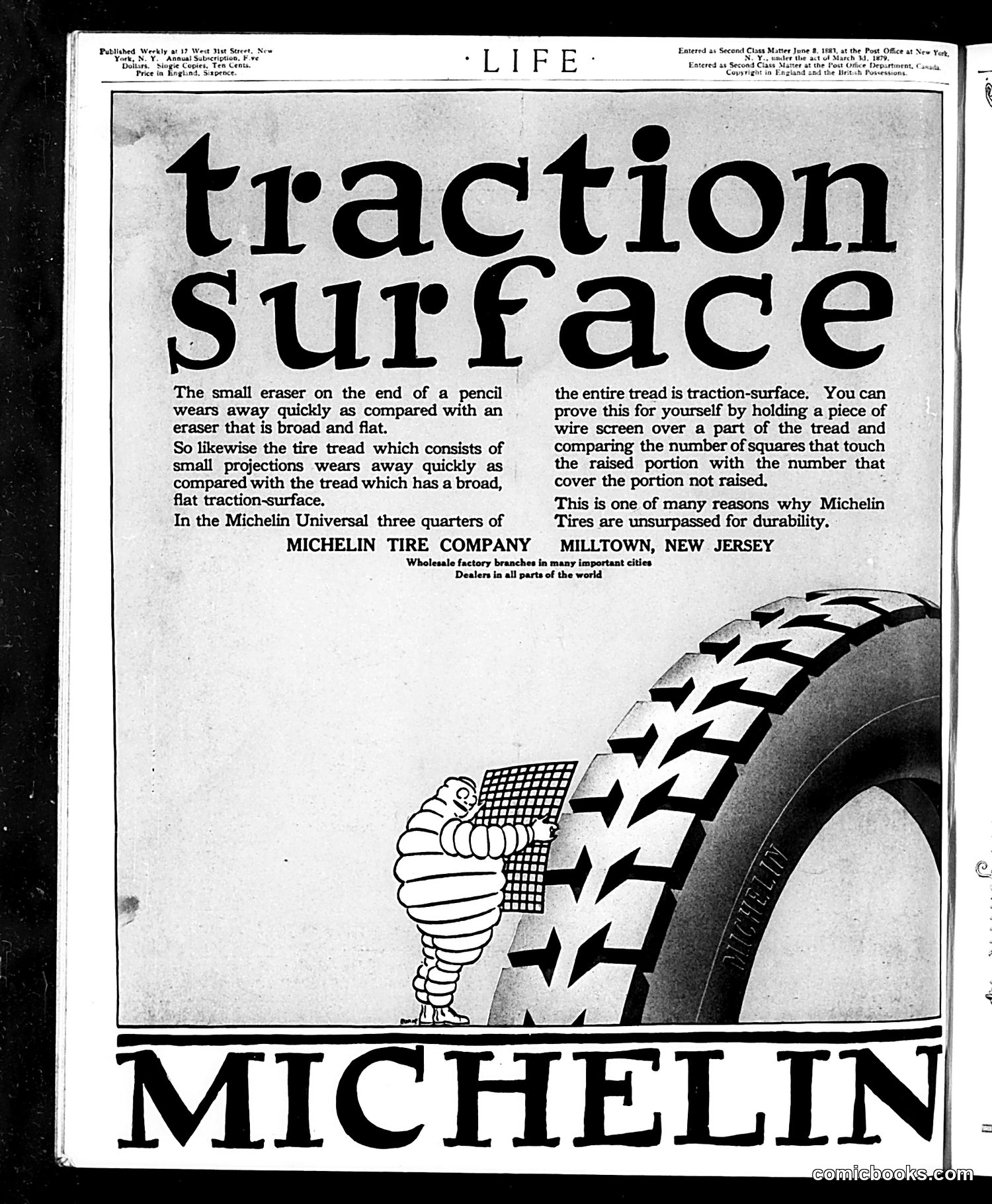
This is a **Michelin Tire advertisement**, not political satire. The page promotes Michelin's "traction surface" tire technology by comparing tire wear to pencil eraser wear—small projections wear away quickly, while broad, flat surfaces last longer. The illustration shows the Michelin Man (Bibendum, their mascot) holding a wire screen against a tire's tread, demonstrating how to count contact points. The ad claims this proves Michelin tires have superior durability due to their flat traction surface. **No political or social satire is present.** This is straightforward early 20th-century advertising copy explaining a product feature to consumers, appearing in *Life* magazine alongside satirical content—a common practice of the era.
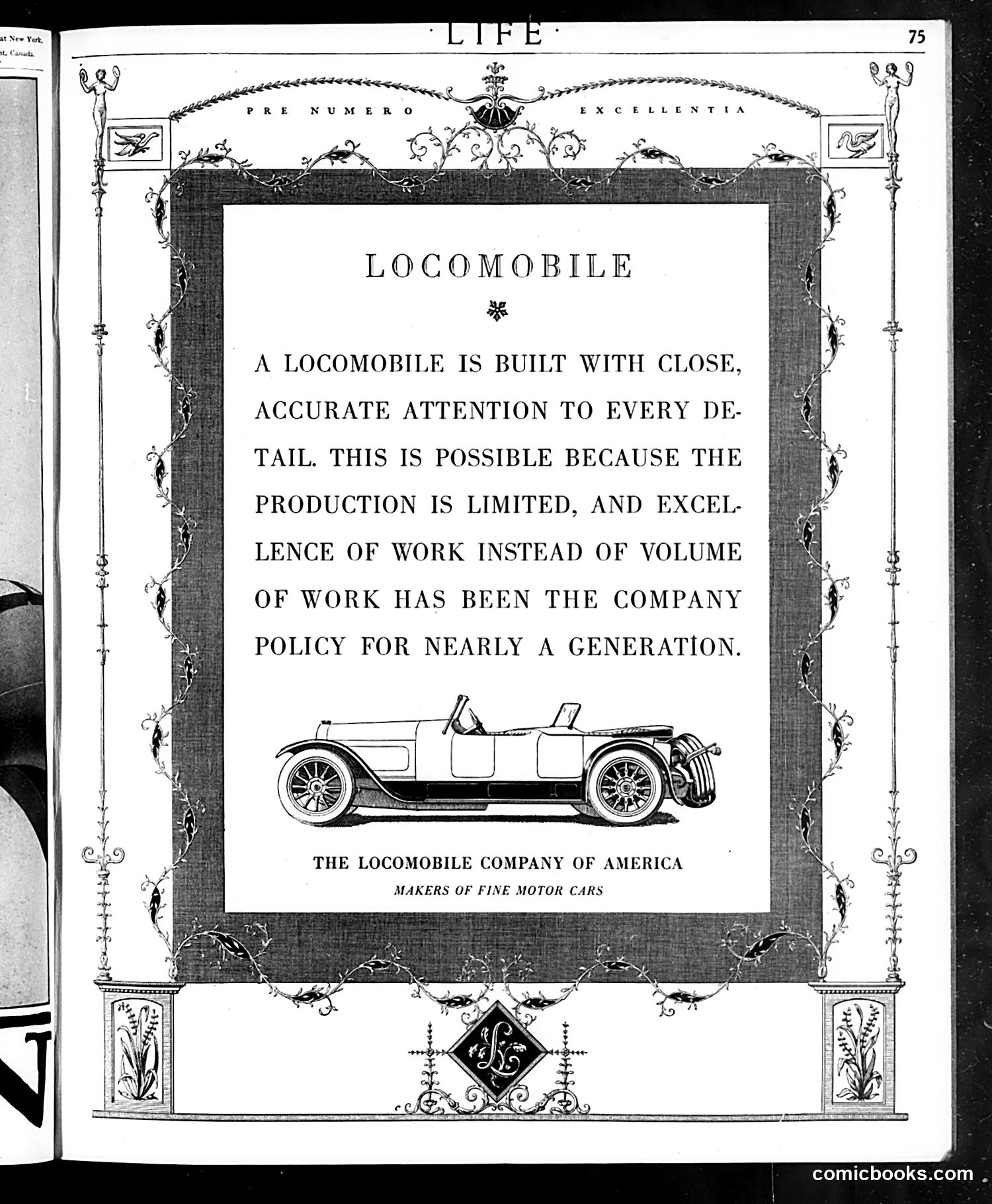
This page is a full-page advertisement for the Locmobile Company of America, not political satire or a cartoon. The ornate Art Nouveau border and formal "Pre Numero Excellentia" header mimic Life magazine's design style, but the content is purely commercial. The ad argues that Locmobile builds cars with meticulous attention to detail because they prioritize "excellence of work instead of volume of work." This reflects early 20th-century luxury automobile marketing, positioning limited production as a mark of quality and craftsmanship—a contrast to mass-market competitors like Ford. The vintage touring car illustration demonstrates the product being advertised.
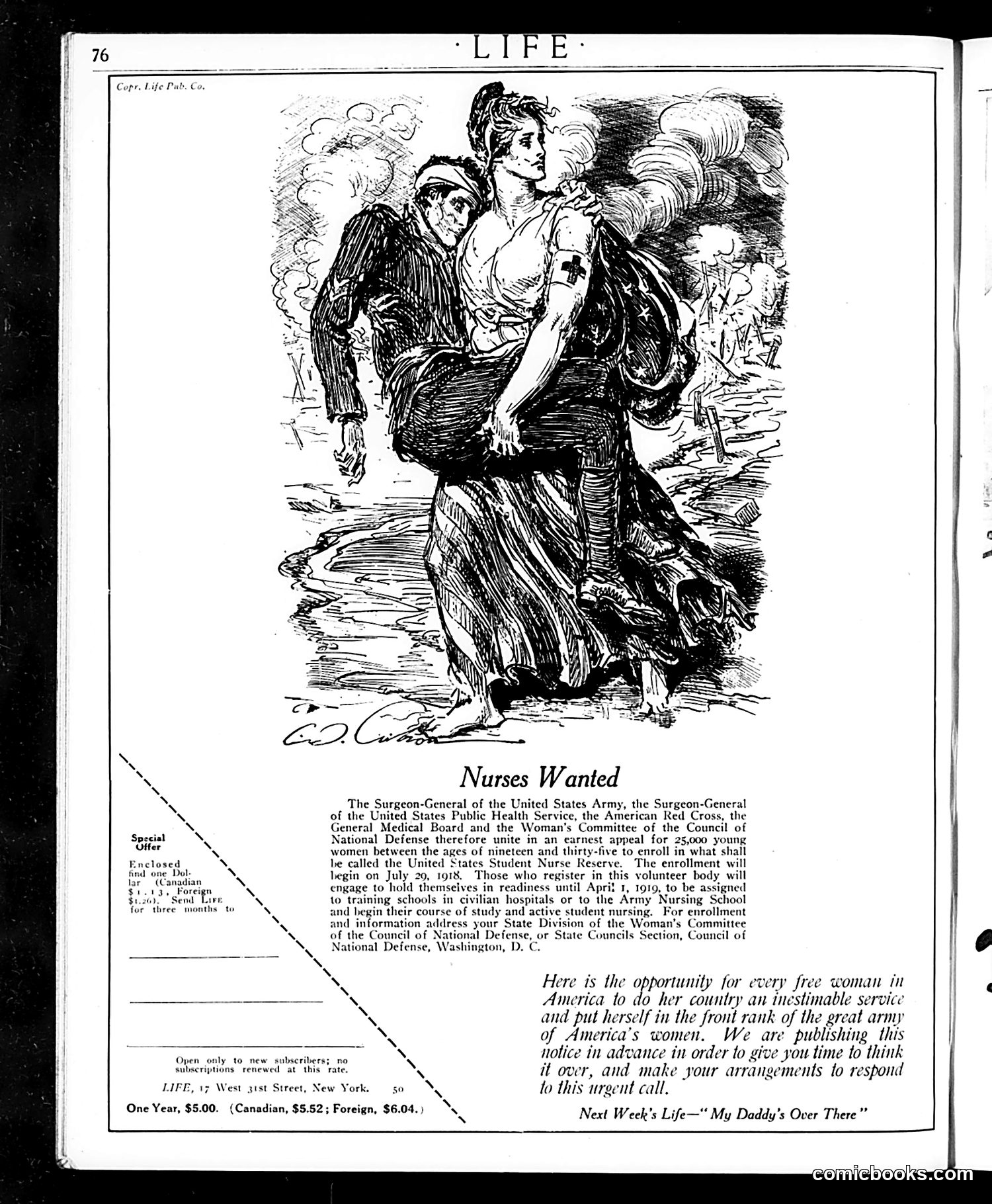
This is a wartime recruitment advertisement, not political satire. The illustration depicts Liberty (the allegorical female figure, identifiable by her classical drapery) carrying a wounded soldier, with military personnel in the background. The text announces an urgent call for 25,000 volunteer nurses, aged 18-35, to serve in World War I. Registration began July 20, 1918, with assignments starting April 1, 1919, at civilian hospitals or the Army Nursing School. The appeal emphasizes patriotic duty: "Here is the opportunity for every free woman in America to do her country an incalculable service." This reflects the massive medical demands of late-stage WWI, when casualty care required unprecedented numbers of trained nurses. The call represents both genuine wartime need and gendered expectations of women's contribution to the war effort.
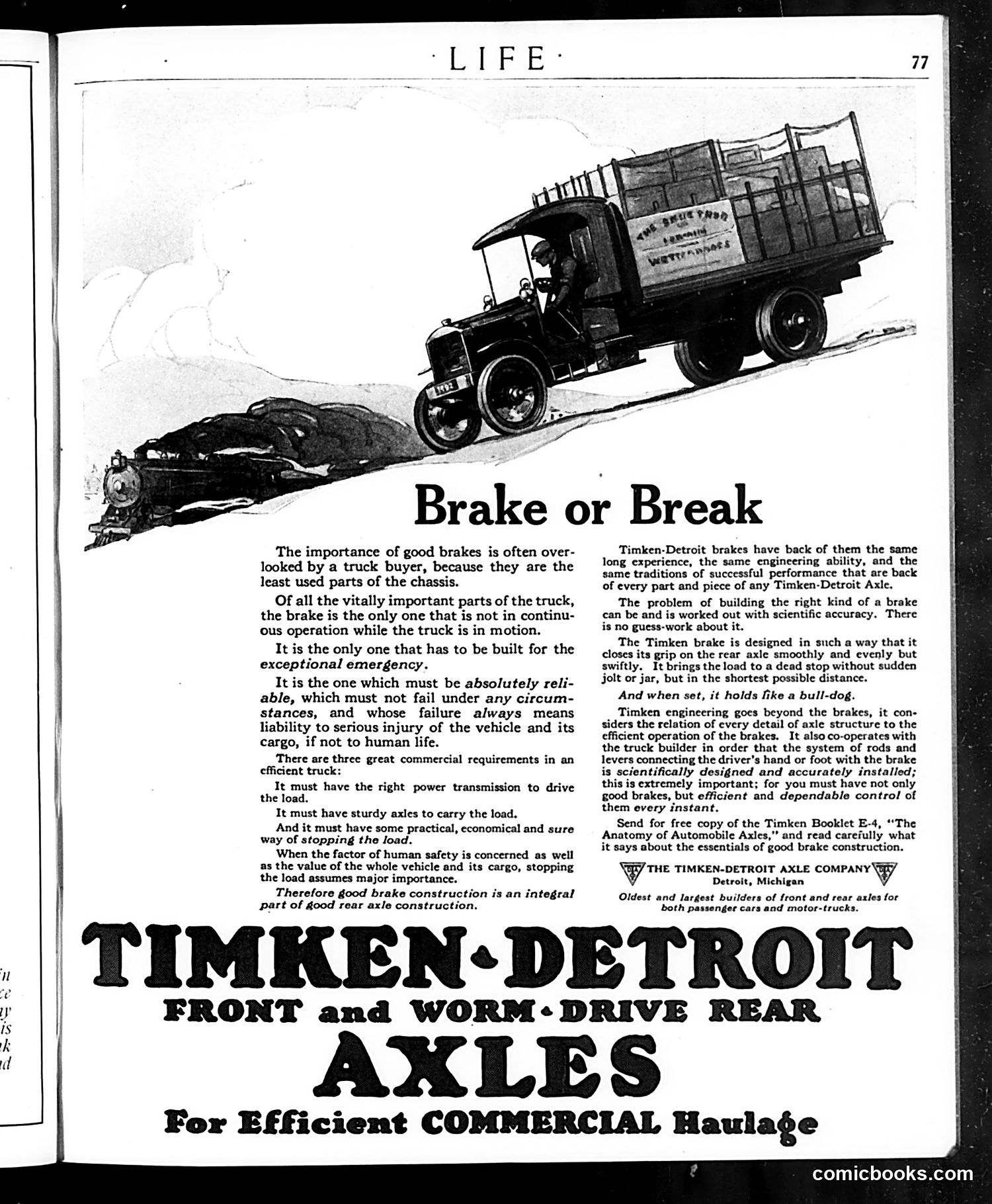
This page is **primarily an advertisement**, not satirical content. It's a Timken-Detroit Axle Company ad from *Life* magazine (page 77). The illustration shows a truck on an incline above a wrecked locomotive, with the headline "Brake or Break." This is **not political satire** but rather commercial messaging about vehicle safety and reliability. The ad argues that good brakes are essential for trucks, positioning Timken-Detroit brakes as superior because they're reliable and engineered for safety. The dramatic locomotive wreck serves as a visual metaphor for catastrophic failure—warning that inadequate brakes cause disaster. This reflects early-20th-century commercial advertising's use of fear and safety concerns to promote industrial products to fleet buyers.
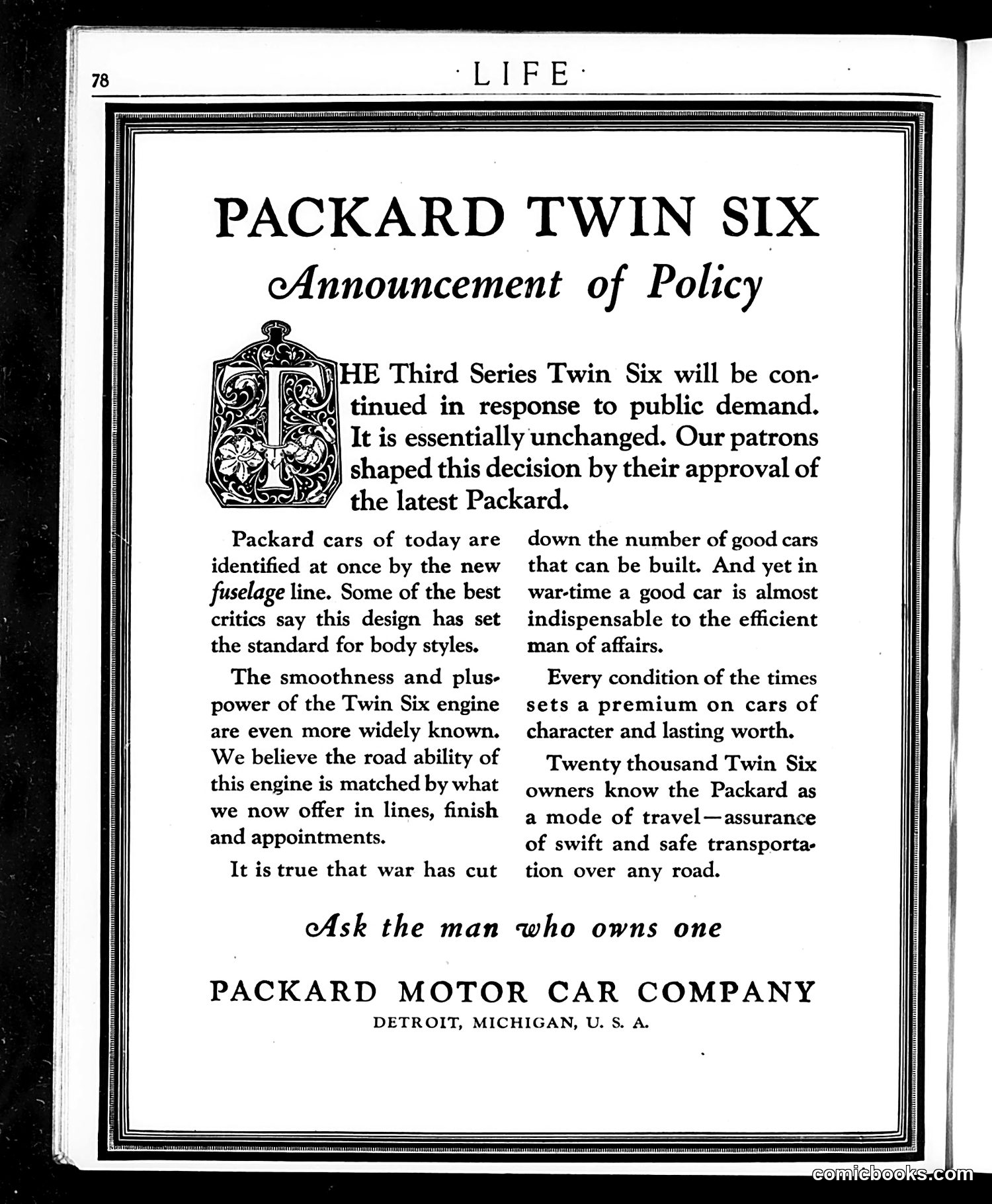
This page is **not a cartoon or satire—it's a straightforward advertisement** for the Packard Twin Six automobile, published in *Life* magazine (which carried both humor and ads). The ad announces continued production of the Packard Twin Six's third series in response to public demand. It highlights the car's distinctive "fuselage" body design, praised by critics as setting a standard for automotive styling. The ad emphasizes the engine's smoothness and power, the car's reliability, and its reputation among owners as dependable transportation. The reference to "war has cut down the number of good cars" suggests this was published during or shortly after World War I, when automobile manufacturing was constrained by military demands. The appeal to "the efficient man of affairs" targets business professionals seeking quality and dependability.
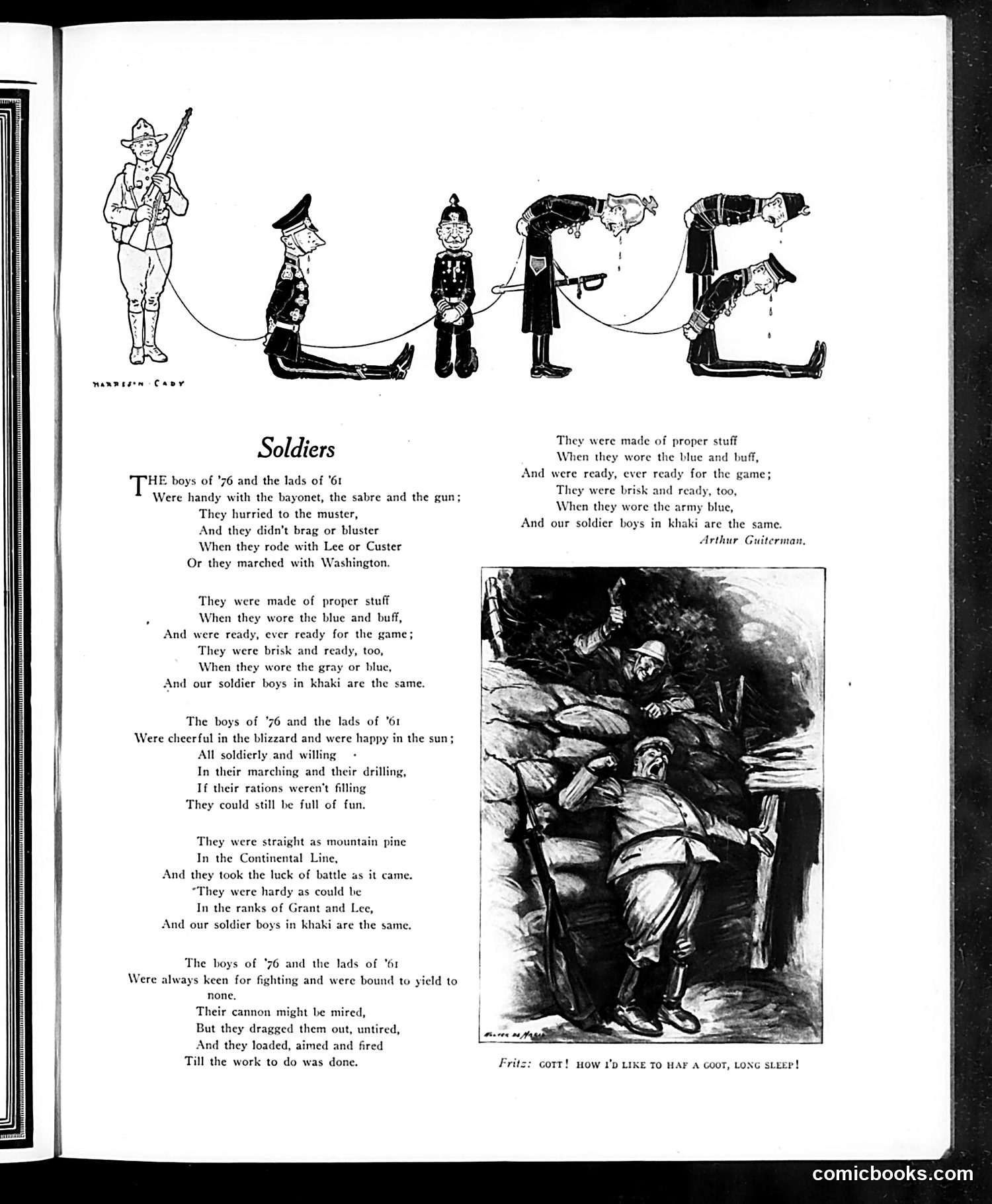
This page presents a patriotic poem celebrating American soldiers, comparing Civil War veterans ("boys of '76 and lads of '61") with contemporary khaki-uniformed soldiers (presumably from WWI). The top illustration shows a humorous chain of soldiers in various poses of exhaustion or exaggerated obedience—a visual joke about military discipline and the physical demands of soldiering. The poem praises soldiers' readiness, bravery, and willingness to endure hardship. The accompanying sketch depicts a sleeping soldier, captioned "Fritz: corr! how I'd like to haf a goot, long sleep!"—likely referencing a German soldier (Fritz being a stereotypical German name), suggesting even the enemy recognizes the grueling nature of war. The overall message frames American soldiers as worthy successors to honored military traditions.
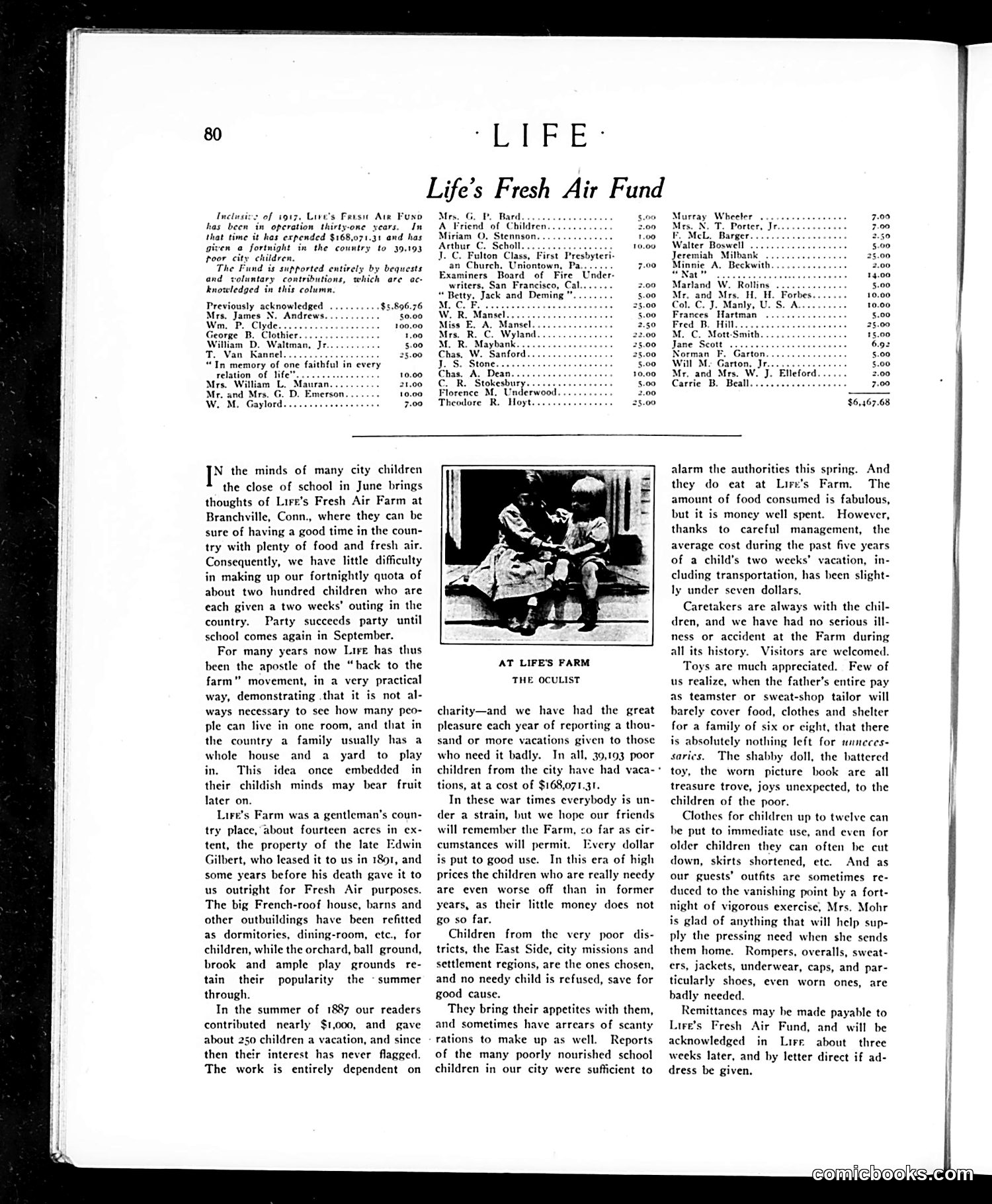
This page documents Life magazine's charitable initiative providing two-week country vacations for poor urban children. The accompanying photograph shows "The Oculist" — an adult examining a child's eyes at Liff's Farm, the program's location in Connecticut. The text emphasizes the fund's practical social mission: enabling approximately 200 impoverished children annually to experience fresh air and rural life. It notes the program has operated for thirty-one years with strong reader support (nearly $1,000 donated in 1889 alone). The article highlights how minimal costs—under seven dollars per child for transportation and board—provide measurable humanitarian benefit, contrasting stark urban poverty with wholesome country experiences. The piece appeals to Victorian-era charitable sensibilities while documenting concrete social welfare work.
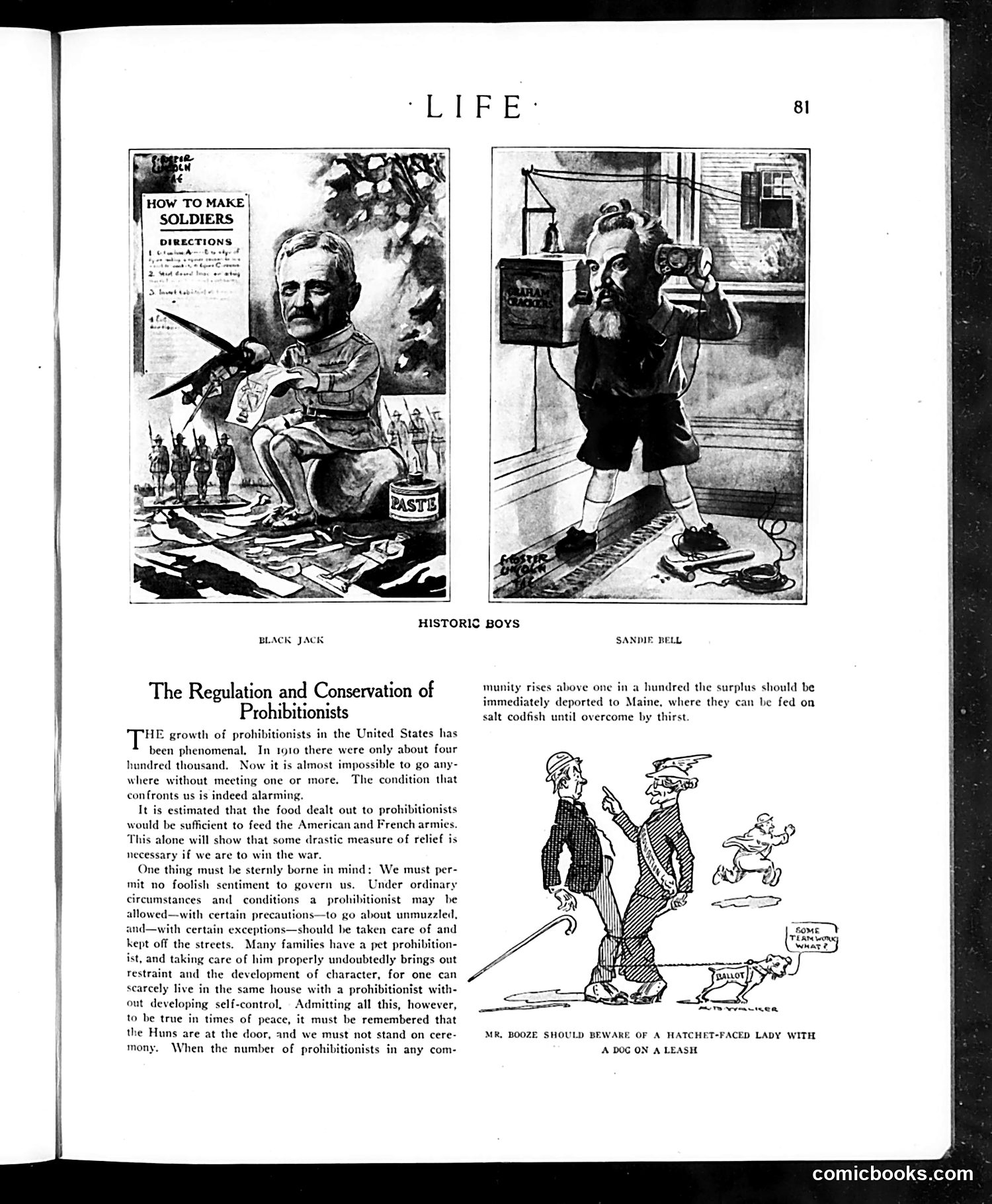
This page satirizes the explosive growth of Prohibition supporters in the United States. The article notes that by 1910, prohibitionists numbered only about 400,000; now "it is almost impossible to go anywhere without meeting one or more." The satire proposes treating prohibitionists like an overpopulation problem: excess prohibitionists should be "deported to Maine, where they can be fed on salt codfish until overcome by thirst"—a darkly humorous suggestion that the movement has become unmanageably widespread. The cartoon illustrations (labeled "Historic Boys"—showing caricatured figures as "Black Jack" and "Sandie Bell") and the bottom cartoon about "Mr. Booze" and "a hatchet-faced lady" reference Carrie Nation, the famous temperance activist known for violent saloon raids.
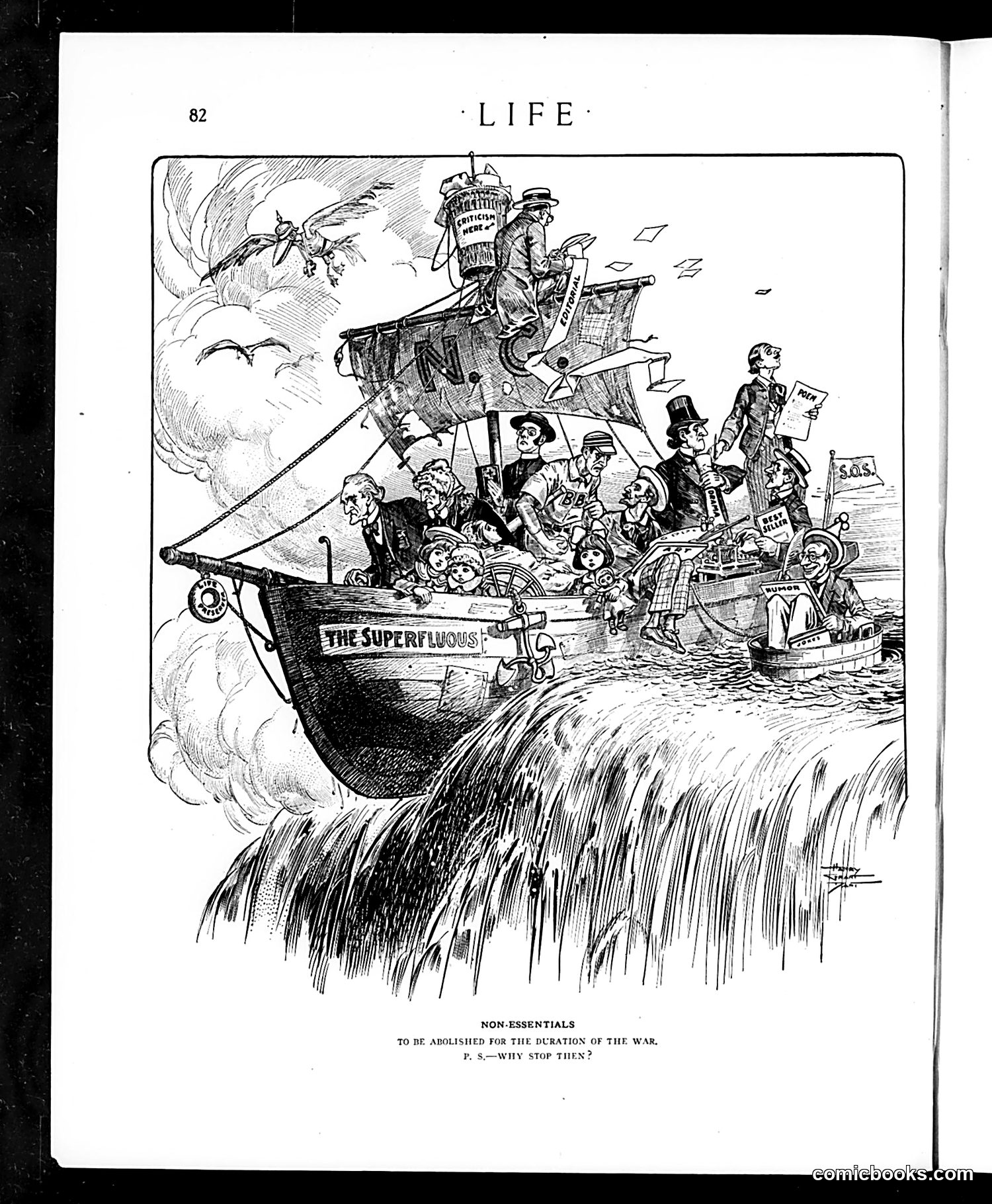
This is a satirical cartoon from *Life* magazine criticizing wartime spending priorities. The central image depicts a ship labeled "THE SUPERFLUOUS" precariously perched atop a waterfall, crowded with well-dressed figures (likely politicians and bureaucrats) seemingly oblivious to danger. The caption reads: "NON-ESSENTIALS TO BE ABOLISHED FOR THE DURATION OF THE WAR. P.S.—WHY STOP THEN?" The satire critiques government claims about eliminating wasteful spending during wartime. The ship's unstable position suggests the danger of such policies, while the sarcastic postscript implies skepticism—that once wartime justifies cutting "non-essentials," politicians won't voluntarily restore spending afterward. The cartoon uses dark humor to question both government fiscal management and political sincerity during what appears to be World War I.
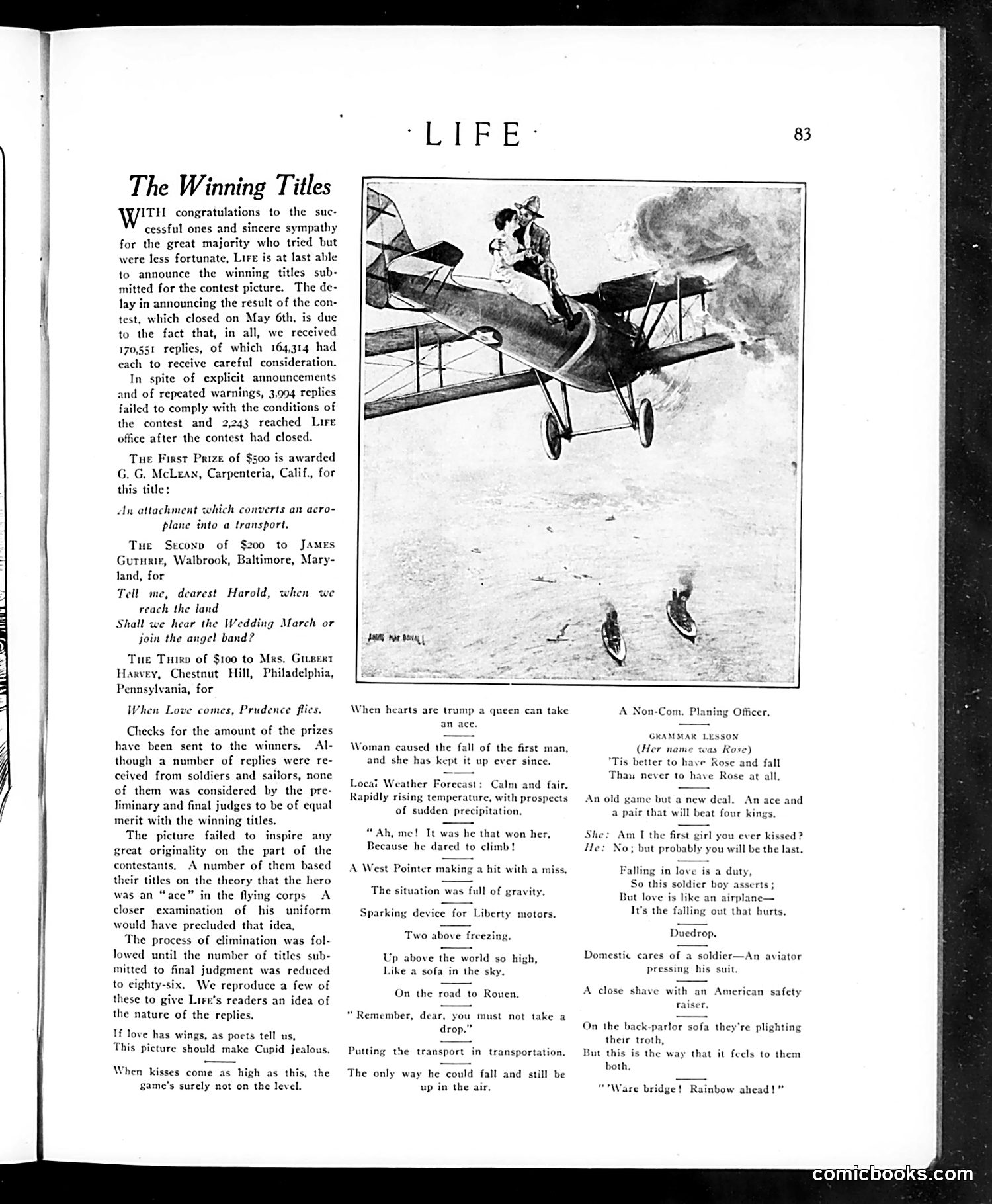
This page announces winners of a Life magazine contest for humorous picture captions. The large photograph shows an early airplane (appears to be pre-WWI era) with people on the ground below, illustrating one winning entry. The winning captions are puns and jokes exploiting wordplay: - "An attachment which converts an aeroplane into a transport" (converting aircraft to transport) - References to romance ("Tell me, dearest Harold...") and domestic situations - Aviation-themed humor ("Up above the world so high, / Like a sofa in the sky") The satirical element is gentle—mocking romantic clichés and the absurdity of early aviation rather than politics. The contest itself celebrated readers' wit, a common early-20th-century magazine engagement strategy. The humor relies entirely on wordplay and situational comedy rather than visual caricature.
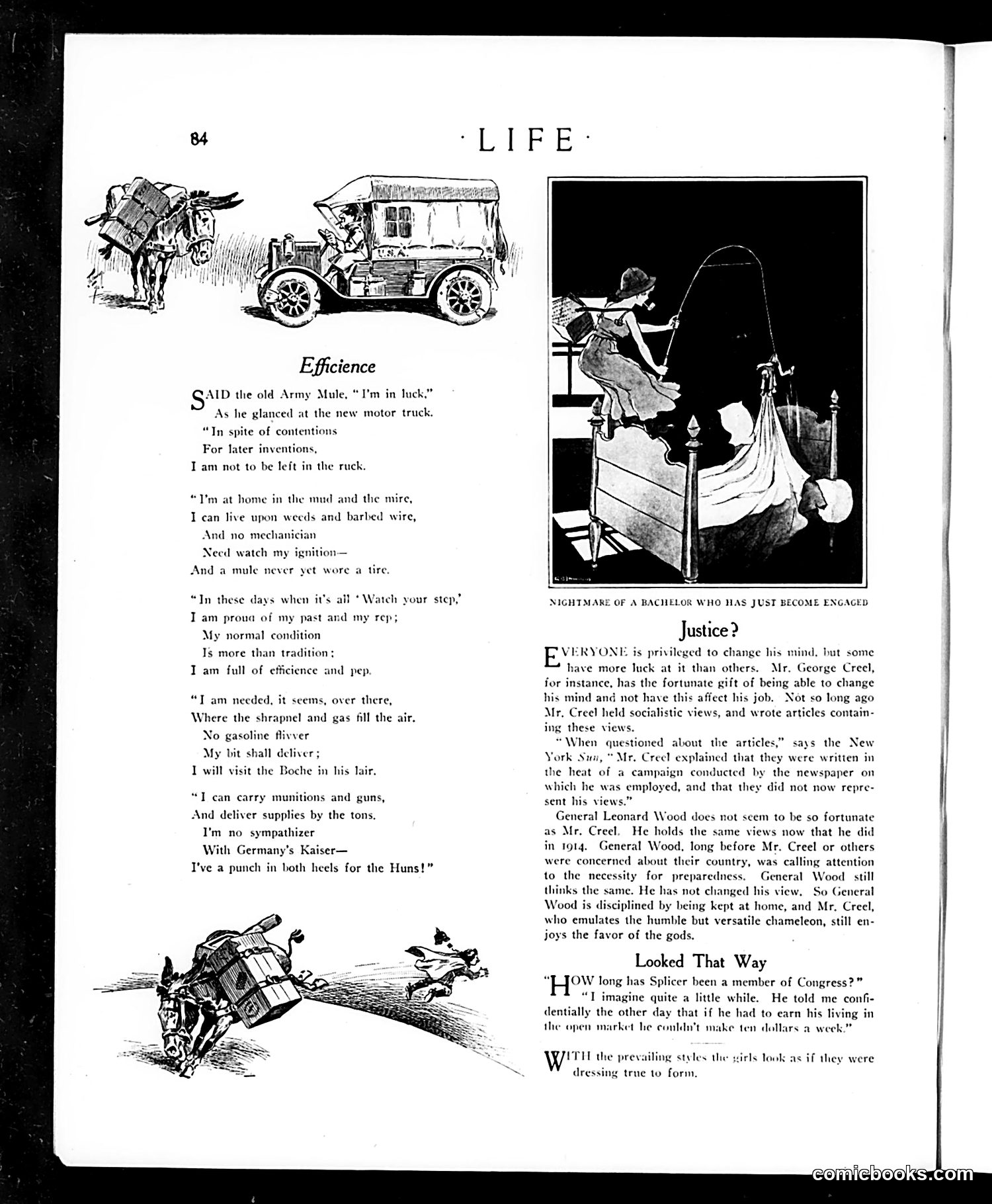
The left cartoon contrasts an old Army mule (representing obsolete military technology) with a modern motor truck, celebrating industrial "efficiency." The accompanying poem has the mule boasting of its reliability despite lacking modern conveniences—it needs no mechanic, tire changes, or gasoline, and can still deliver supplies and munitions. The right section discusses whether wealthy individuals like Mr. Creel have the right to change their political views without professional consequences. It references General Leonard Wood, who maintained consistent views since 1914, versus Mr. Creel, who changed positions. The piece questions whether holding unpopular opinions should affect employment—a debate about free thought versus professional consistency, framed as "Justice?"
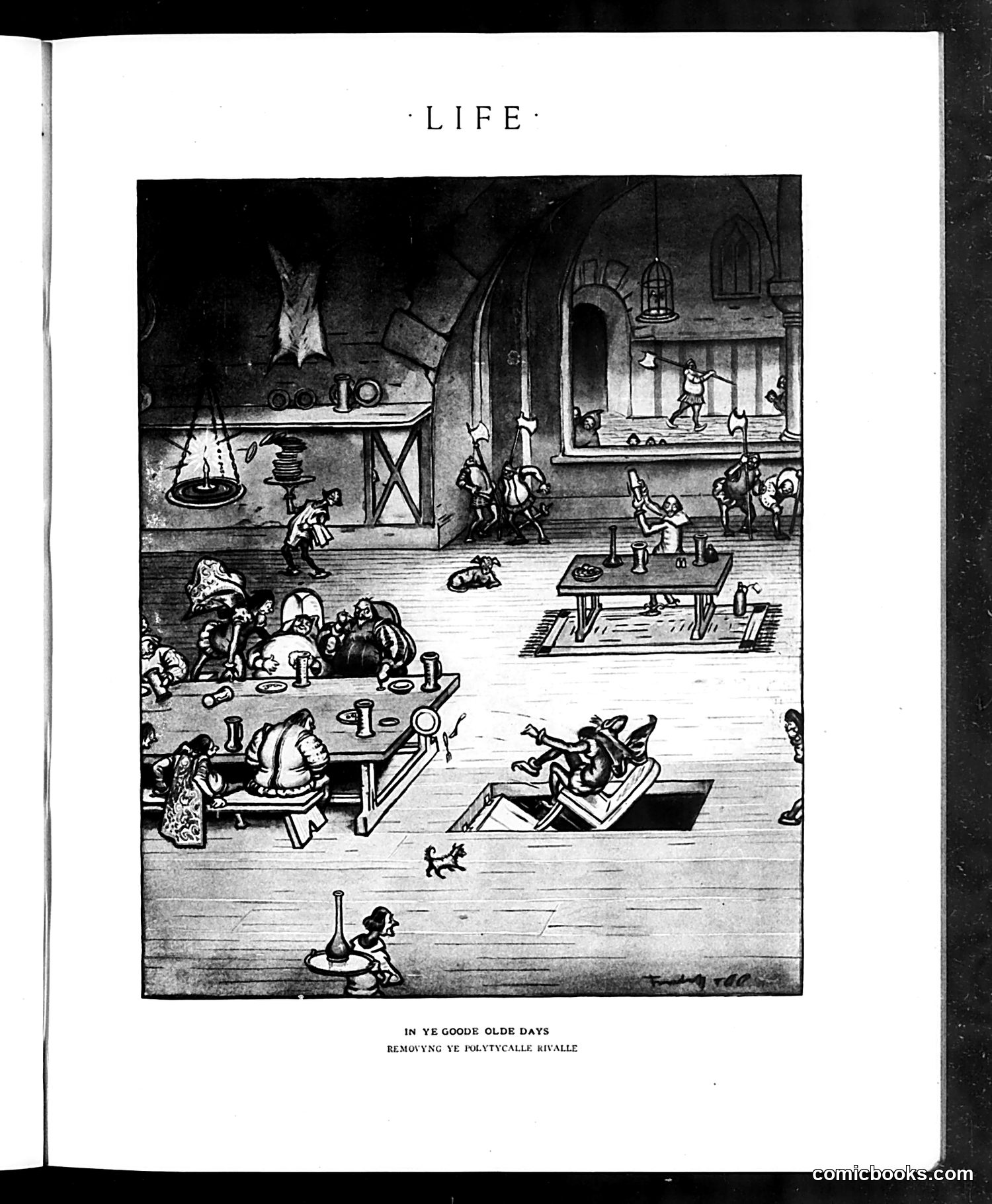
This page from *Life* magazine presents a satirical historical illustration titled "In Ye Goode Olde Days Removing Ye Polytycalle Rivalle." The image depicts a medieval or Renaissance-era scene of social chaos and violence. Multiple figures engage in various activities: dining, fighting, swinging from ropes, playing instruments, and generally creating disorder. The deliberately archaic spelling in the caption ("Ye Goode Olde Days," "Polytycalle Rivalle") suggests this is nostalgic mockery. The satire appears to comment on the myth of a more civilized past. By depicting historical times as actually chaotic and brutal—full of political violence and social disorder—the cartoon suggests that contemporary readers' romanticized notions of history are misguided. The "good old days" were apparently just as messy and violent as the present.
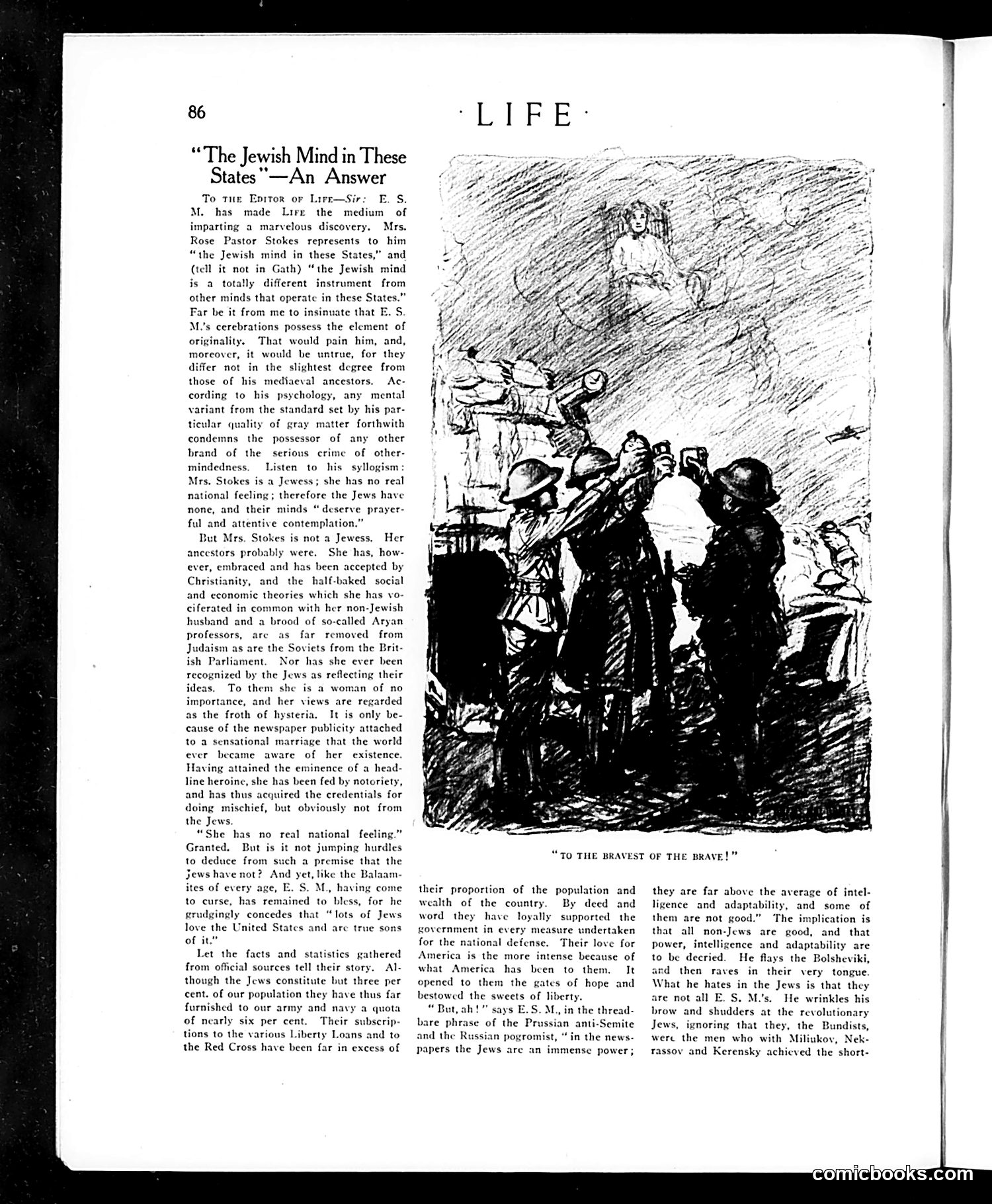
This page contains a letter-to-the-editor response challenging E.S. M's article on "The Jewish Mind in These States." The illustration depicts soldiers in what appears to be a WWI trench scene, with the caption "TO THE BRAVEST OF THE BRAVE!" The text argues that Jews have demonstrated patriotism and loyalty to America through military service and financial support (Liberty Loans, Red Cross donations). The writer counters antisemitic stereotypes by citing Jewish contributions to national defense, implying that Jews deserve recognition as full participants in American society rather than being characterized as a separate or unpatriotic group. The cartoon likely satirizes anti-Jewish prejudice by highlighting Jewish soldiers' battlefield courage and sacrifice.
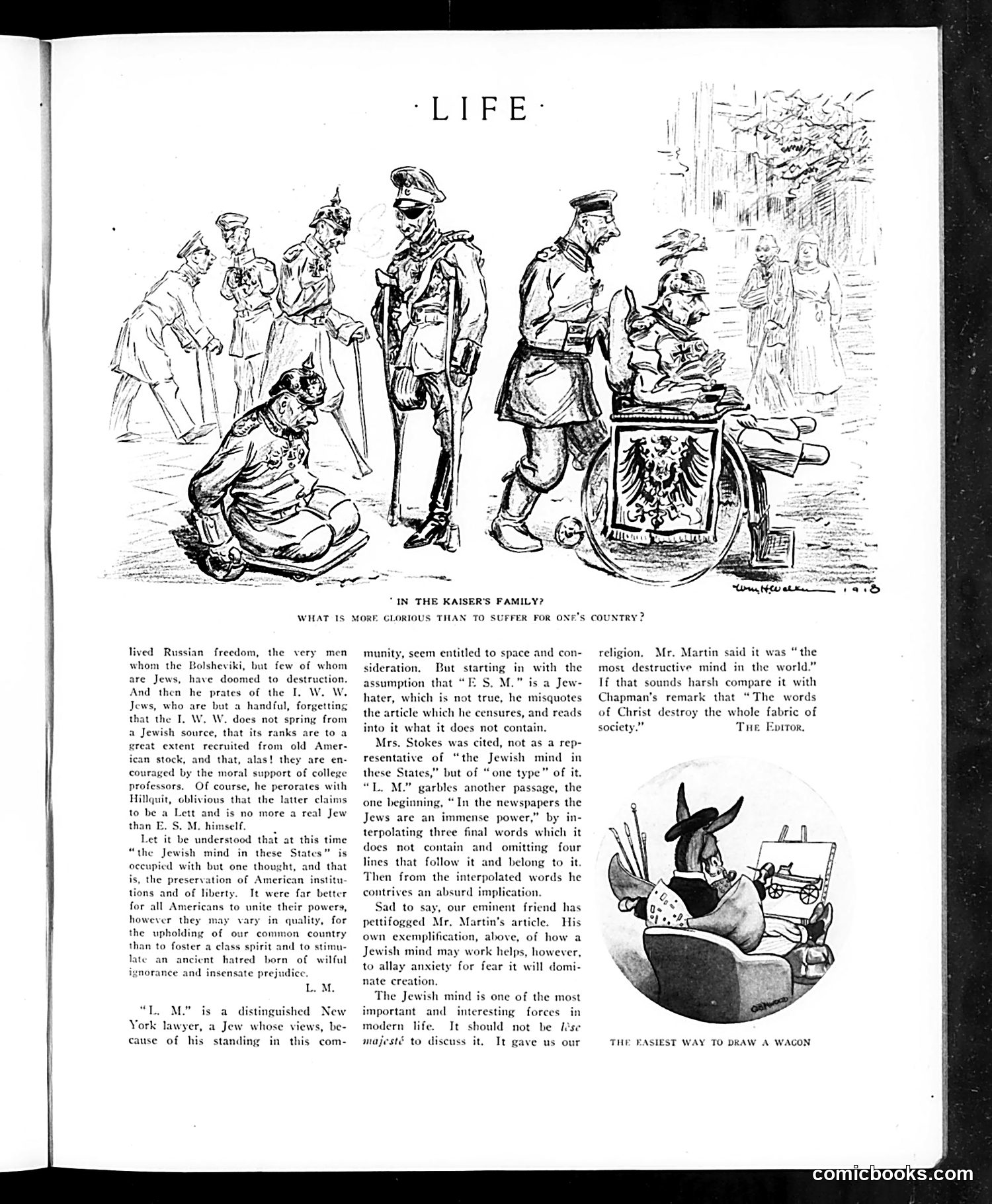
The main cartoon depicts military officers in what appears to be early 20th-century German uniforms (based on the pickelhaube helmets and style), with a kneeling figure before them. The caption reads: "IN THE KAISER'S FAMILY? WHAT IS MORE GLORIOUS THAN TO SUFFER FOR ONE'S COUNTRY?" The accompanying text discusses an article by someone identified as "L.M." (a New York Jewish lawyer) regarding accusations against Jewish Americans. The editorial defends Jewish patriotism and intellectual contributions, directly countering antisemitic claims that Jews cannot be loyal to America. The satire attacks those who questioned Jewish loyalty during WWI, suggesting such prejudice contradicts American values of unity. The bottom illustration shows a simplified method for drawing a wagon—unrelated instructional content.
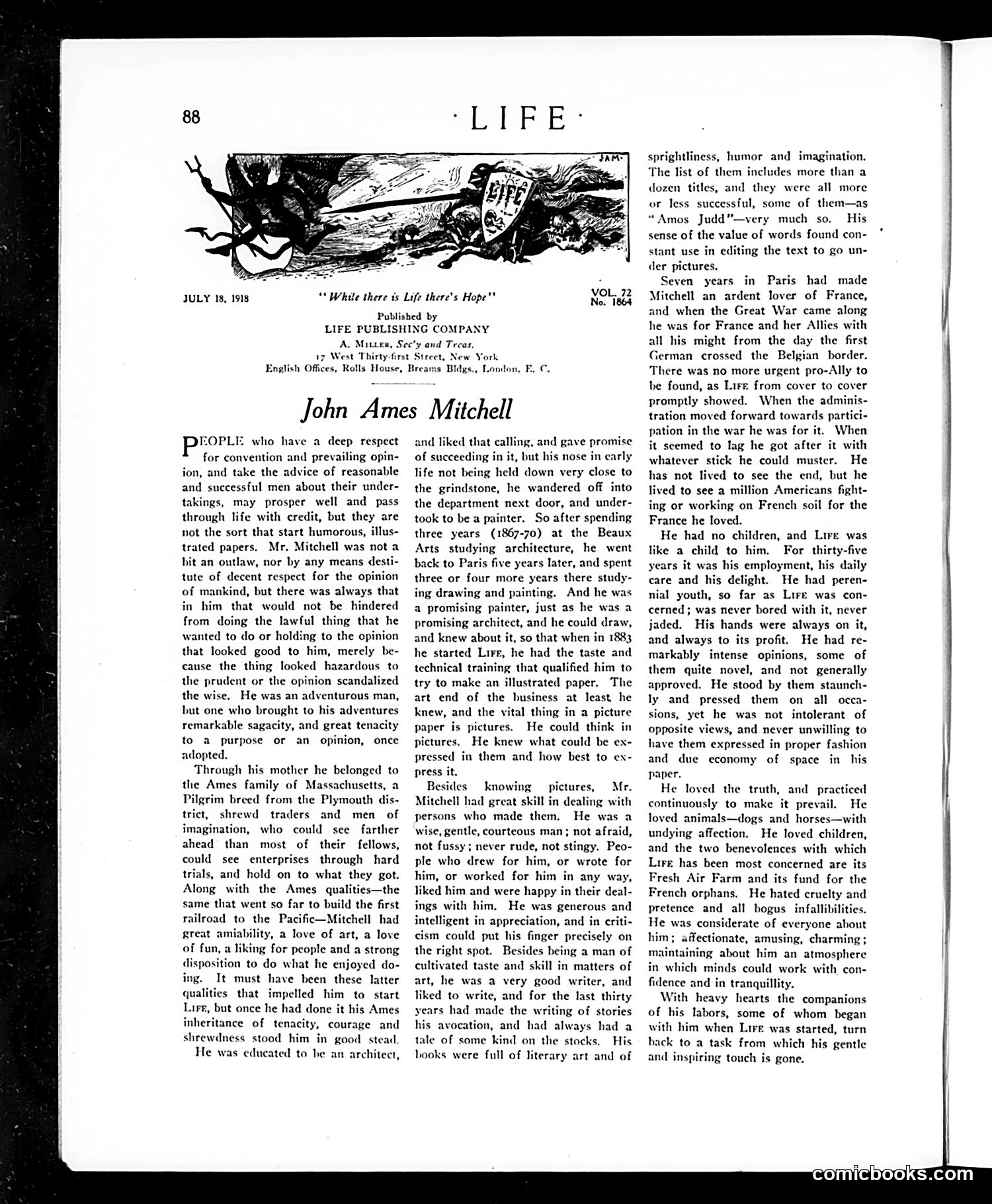
This is a biographical article about John Ames Mitchell, founder of *Life* magazine, published July 18, 1918. The page contains no political cartoon or satire—it's a straightforward tribute essay. The illustration at top shows a reclining figure with the motto "While there is Life there's Hope," a visual pun on the magazine's name. The text chronicles Mitchell's career: educated as an architect, he studied at the Beaux Arts in Paris, worked as a painter, then founded *Life* in 1883. The article emphasizes his character—descended from Massachusetts Pilgrims and the Ames family (railroad builders), he combined business acumen with artistic sensibility, generosity toward contributors, and literary talent. He was unconventional enough to start a humorous illustrated paper despite social disapproval, yet prudent in execution. This appears to be a commemorative piece, possibly written after Mitchell's death or retirement.
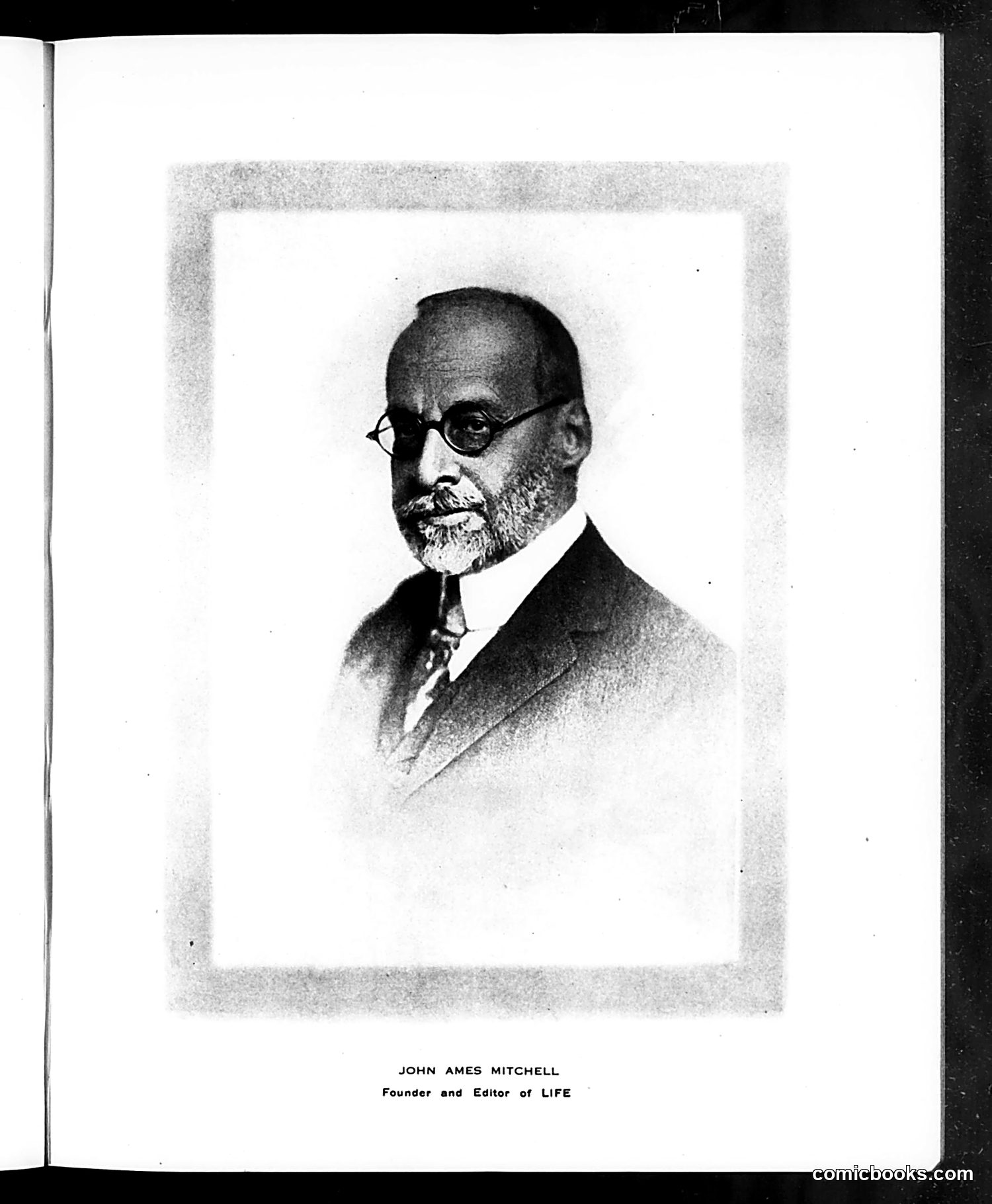
This is a portrait page identifying John Ames Mitchell as the founder and editor of *Life* magazine. The image shows a formal black-and-white photograph of a distinguished gentleman wearing pince-nez glasses, a dark suit, and bow tie—the professional appearance befitting a late 19th or early 20th-century publishing executive. Rather than containing a political cartoon or satirical content, this appears to be a commemorative or editorial page from *Life* itself, likely published to introduce readers to the magazine's leadership or possibly as a tribute. The styling and presentation suggest this was significant enough to warrant a full-page portrait, indicating Mitchell's importance to the publication's identity and success during his tenure.
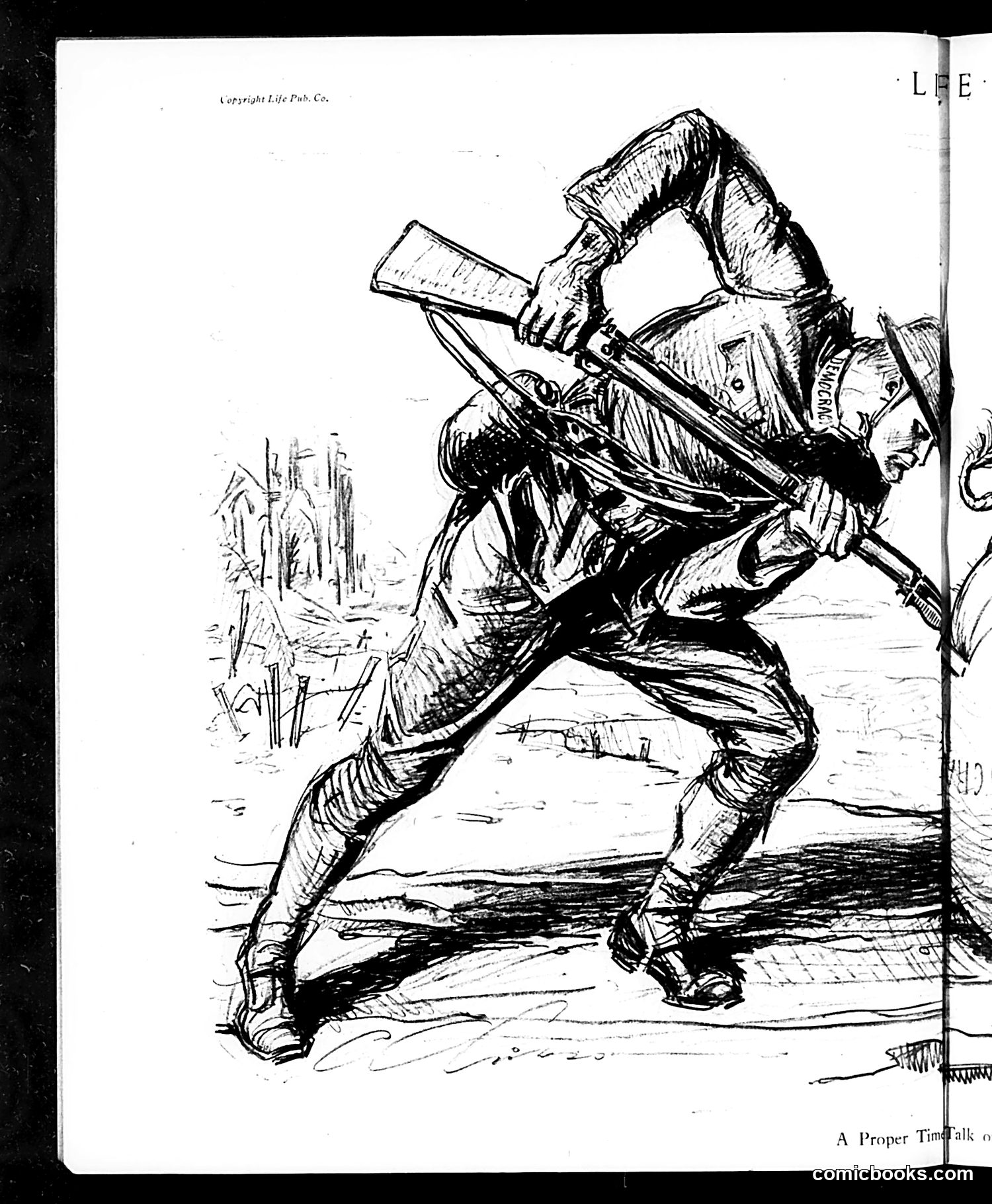
This appears to be a page from *Life* magazine featuring a political cartoon. The image shows a soldier or military figure in WWI-era uniform, depicted in an exaggerated, dynamic pose—leaning back dramatically while holding a rifle. The soldier appears to be in combat or a tense situation, with sketchy ground details suggesting a battlefield setting. The partial caption reads "A Proper Tim[e] Talk o[f]" (text is cut off), suggesting this cartoon comments on military communication or morale during wartime. However, without the complete caption and date, I cannot definitively identify the specific political event, figure, or military situation being satirized. The style and uniform suggest early 20th-century American commentary on warfare or military preparedness.
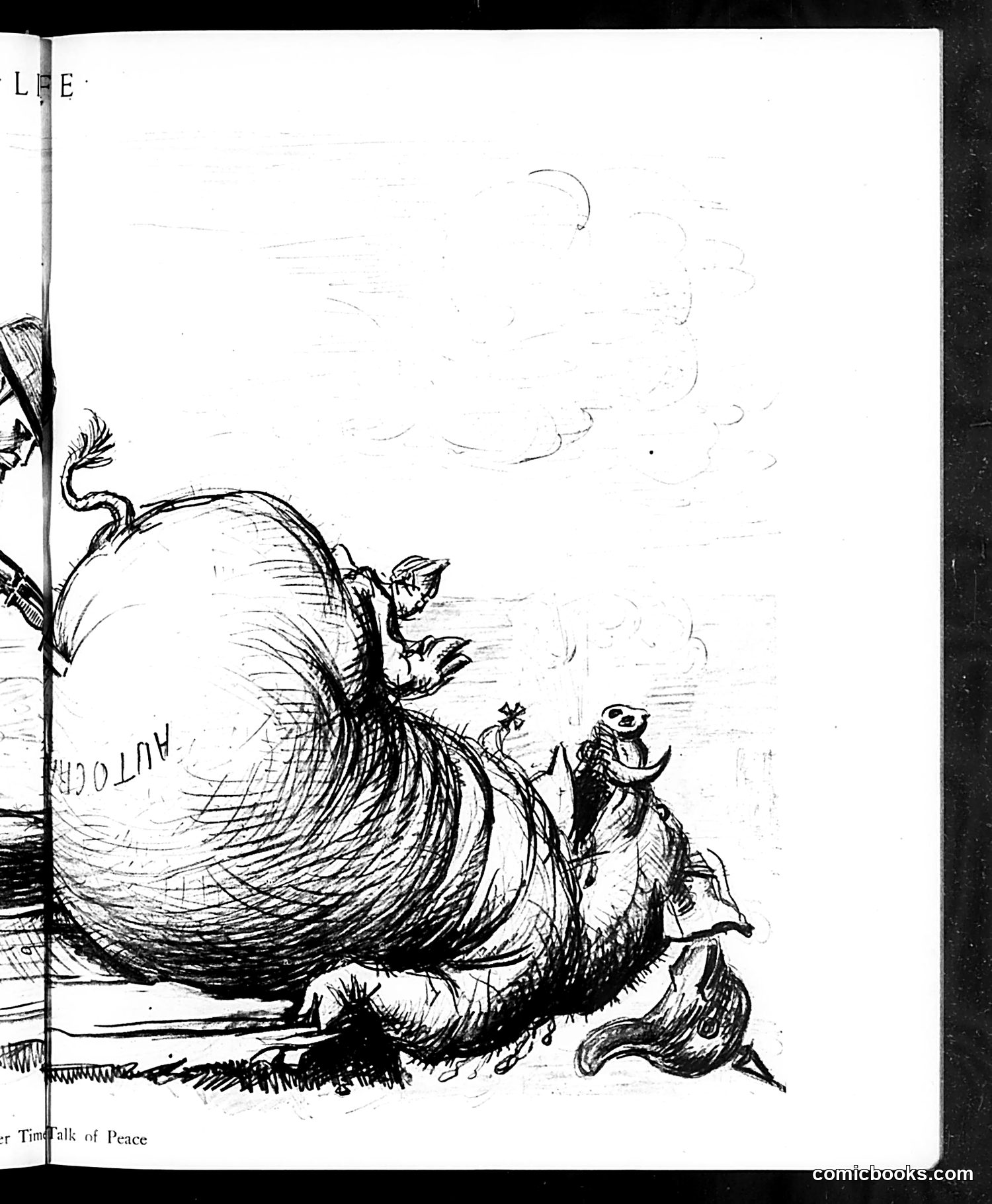
This appears to be a satirical cartoon from *Life* magazine depicting a figure in military garb or formal dress being pulled or dragged by what looks like a large, bulbous object (possibly representing war, conflict, or political burden). The caption references "Talk of Peace," suggesting irony—that despite peaceful rhetoric, military or political forces continue to dominate. The cartoon likely critiques political leaders or governments whose claims of pursuing peace are undermined by their continued involvement in warfare or military affairs. The exaggerated, struggling figure conveys helplessness against larger forces, a common *Life* magazine device for satirizing political hypocrisy between stated intentions and actual policies. Without additional context or visible dates, the specific historical moment remains unclear.
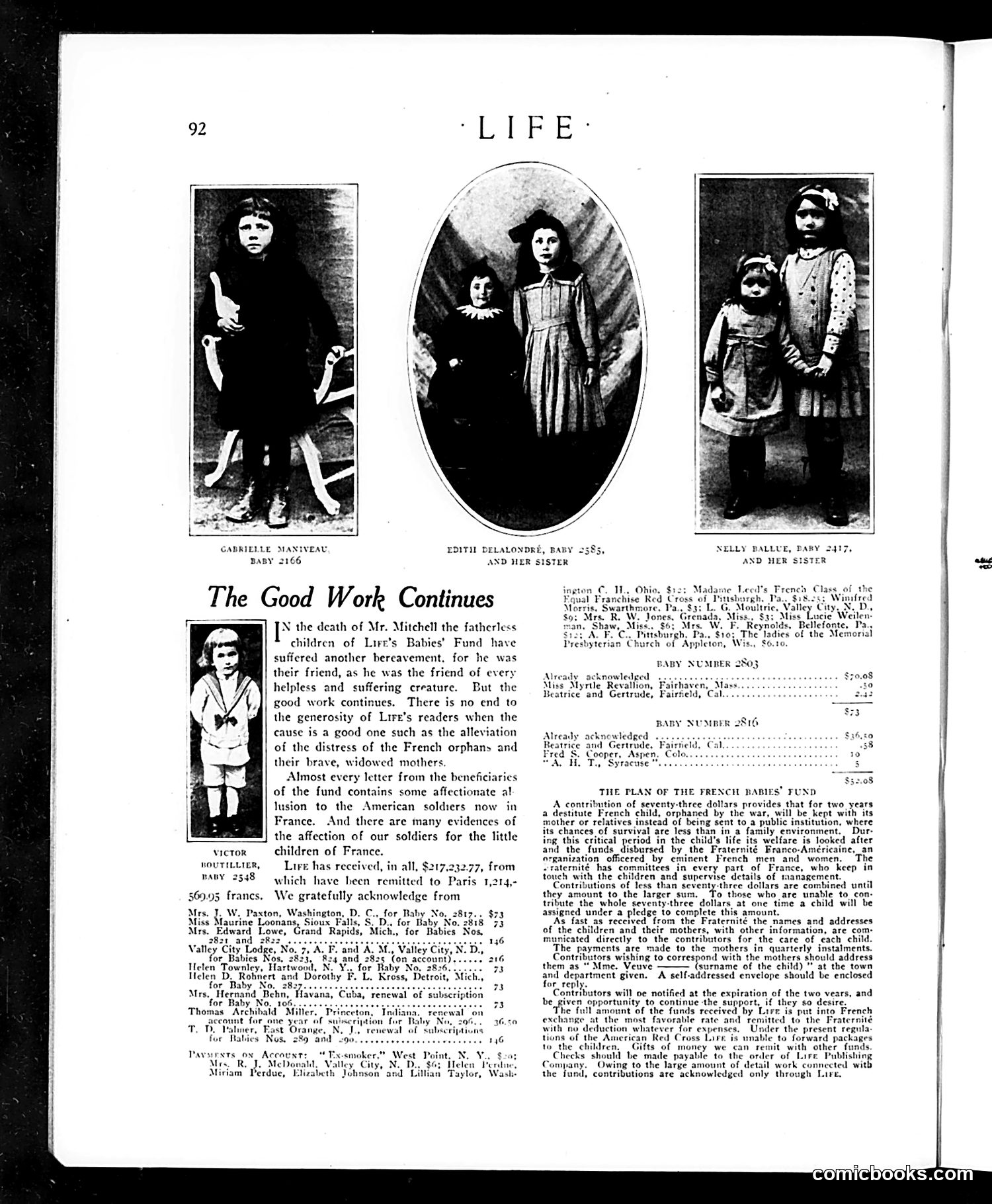
This page documents **Life magazine's French Babies' Fund**, a charitable initiative supporting French orphans and widowed mothers after World War I. The photographs show beneficiary children (Gabrielle Maniveau, Edith Delalondre with her sister, and Nelly Ballue with her sister). The article announces the death of Mr. Mitchell, a fund administrator, but emphasizes that charitable work persists. It reports that Life readers have contributed $217,232.77, with $1,214,569.95 francs remitted to Paris. The fund operates through the Fraternité Franco-Américaine organization. **Key point for modern readers**: This reflects post-WWI American philanthropy toward French war victims, particularly children. The text notes American soldiers in France expressed affection for French children, indicating the humanitarian dimension of the American military presence. The fund's structure—allowing contributions of less than $73 to be pooled to support one child for two years—represents early organized charity work.
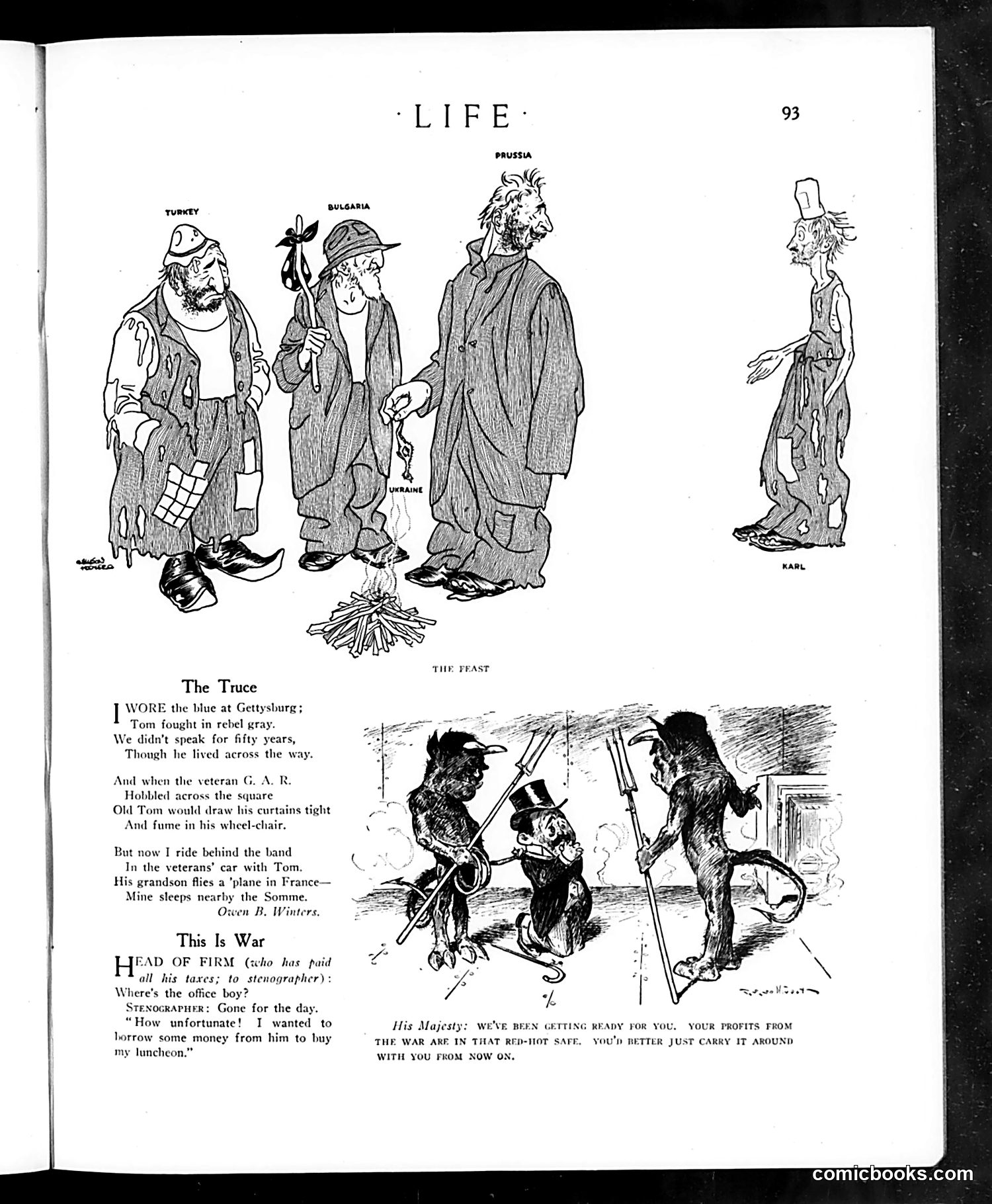
**"The Truce"** uses Civil War veterans to comment on reconciliation. Two former enemies—one Union ("blue," Gettysburg), one Confederate ("rebel gray")—held a 50-year grudge. Now their grandsons fight together in World War I (France and the Somme), suggesting shared sacrifice has healed sectional wounds. The satire is gentle: old animosities become irrelevant when facing a common enemy. **"This Is War"** is sharper political satire. A wealthy businessman (labeled "Head of Firm") wants to *borrow* lunch money from an office boy, yet keeps war profits in a "red-hot safe." The king's caption warns him to carry these profits constantly—the joke being that war profiteers accumulate such enormous wealth so quickly they risk losing it. This mocks both corporate greed and the absurdity of employers exploiting workers while accumulating fortunes from wartime contracts. The caricatures at top appear to represent different nationalities (Turkey, Bulgaria, Prussia, and "Karl"), likely Allied/Central Power stereotypes, though their specific meaning is unclear without additional context.
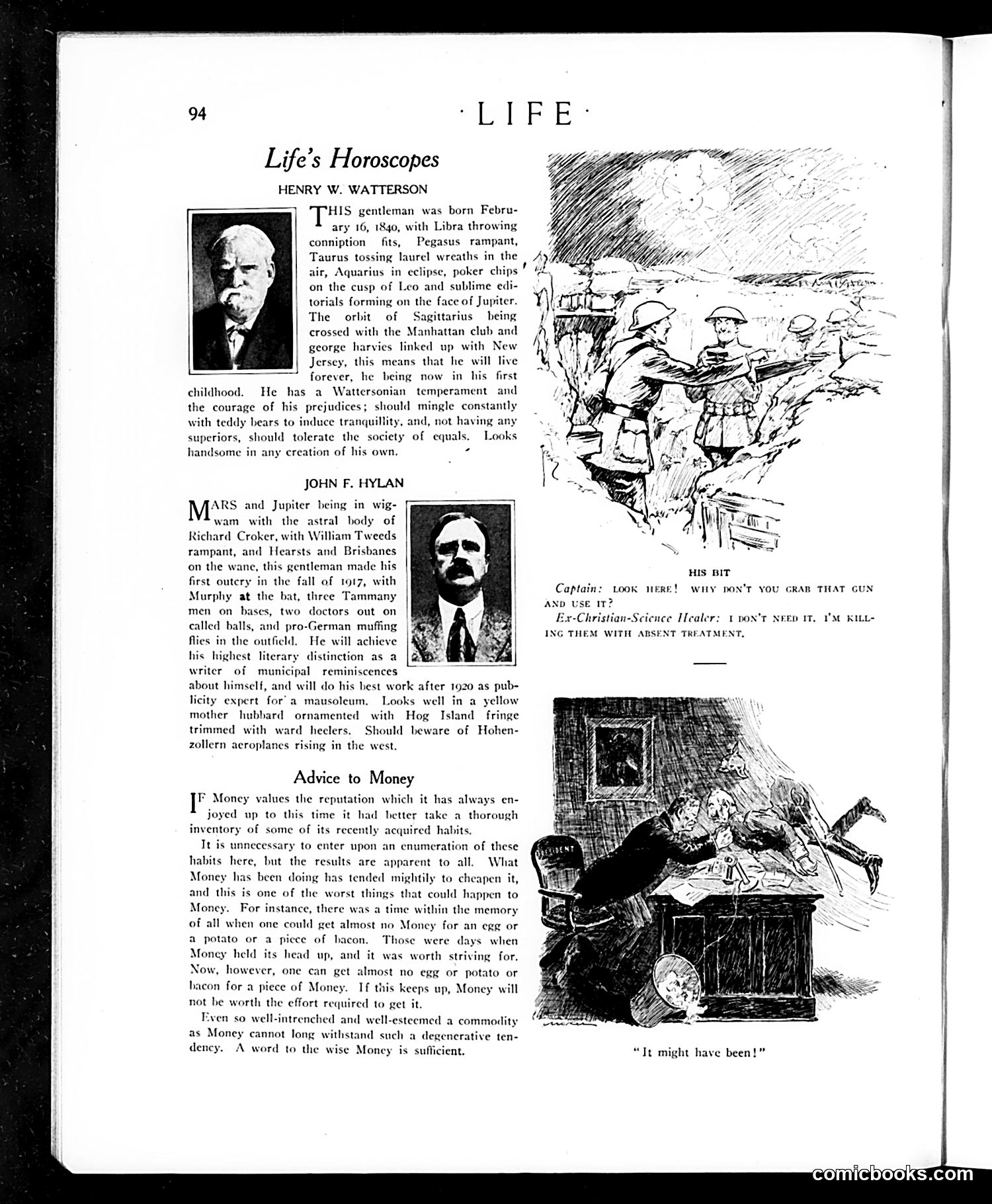
This page contains astrological "horoscopes" mocking two prominent early-20th-century figures: **Henry W. Watterson** (born 1840)—a famous newspaper editor—is ridiculed through fake astrological jargon suggesting he's perpetually childish, opinionated, and surrounded by sycophants ("teddy bears"). **John F. Hylan**, NYC mayor (elected 1917), is satirized as a political hack controlled by Tammany Hall bosses (Richard Croker, William Tweed references). The baseball metaphor mocks his rise as pure political machinery. The "pro-German muffing" alludes to WWI-era corruption suspicions. The cartoons mock war profiteering (soldiers in a trench) and Christian Science faith-healing (a man falling through a floor while a healer claims absent treatment works). The "Advice to Money" essay uses ironic wordplay: currency has lost value due to inflation, so money no longer buys what it once did—reversing normal cause-and-effect to satirize economic decay, likely post-WWI inflation.
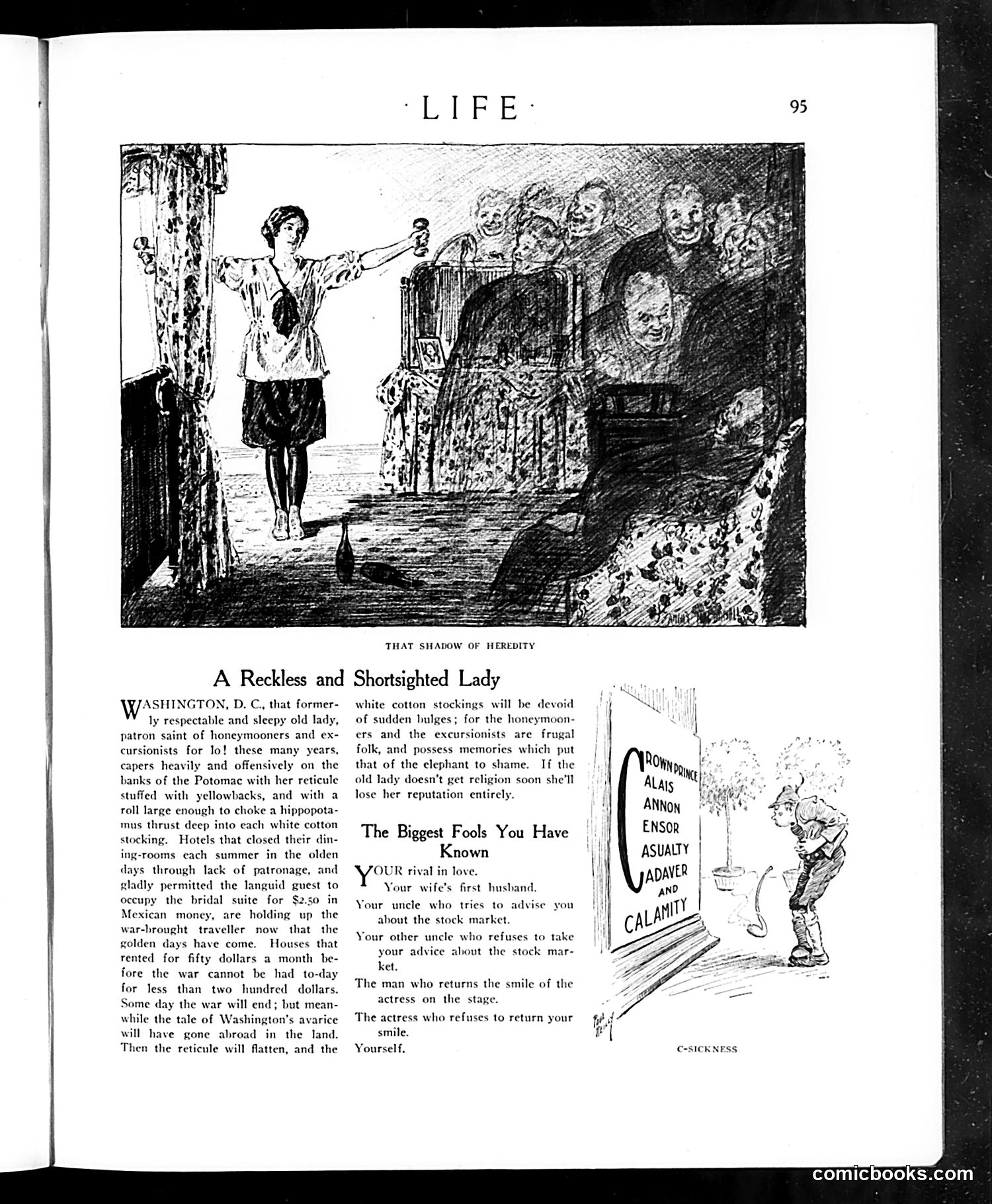
**Main Cartoon ("A Reckless and Shortsighted Lady"):** Washington, D.C. is personified as a greedy woman exploiting wartime prosperity (likely WWI era, based on "war-brought traveller"). The satire criticizes how the city's hotels and landlords are gouging visitors with inflated prices—charging $2.50 instead of pre-war rates, renting houses for $200/month instead of $50. The cartoon warns that once the war ends and flush tourists disappear, Washington's reputation for avarice will linger, driving away the respectable honeymoon trade that once sustained it. **Secondary Feature ("The Biggest Fools"):** A humorous list mocking human folly: romantic rivals, relatives giving bad financial advice, starstruck men misinterpreting actresses' stage smiles, and self-awareness concluding with "Yourself." The page satirizes wartime profiteering and short-sighted greed while offering lighthearted observations on everyday foolishness.
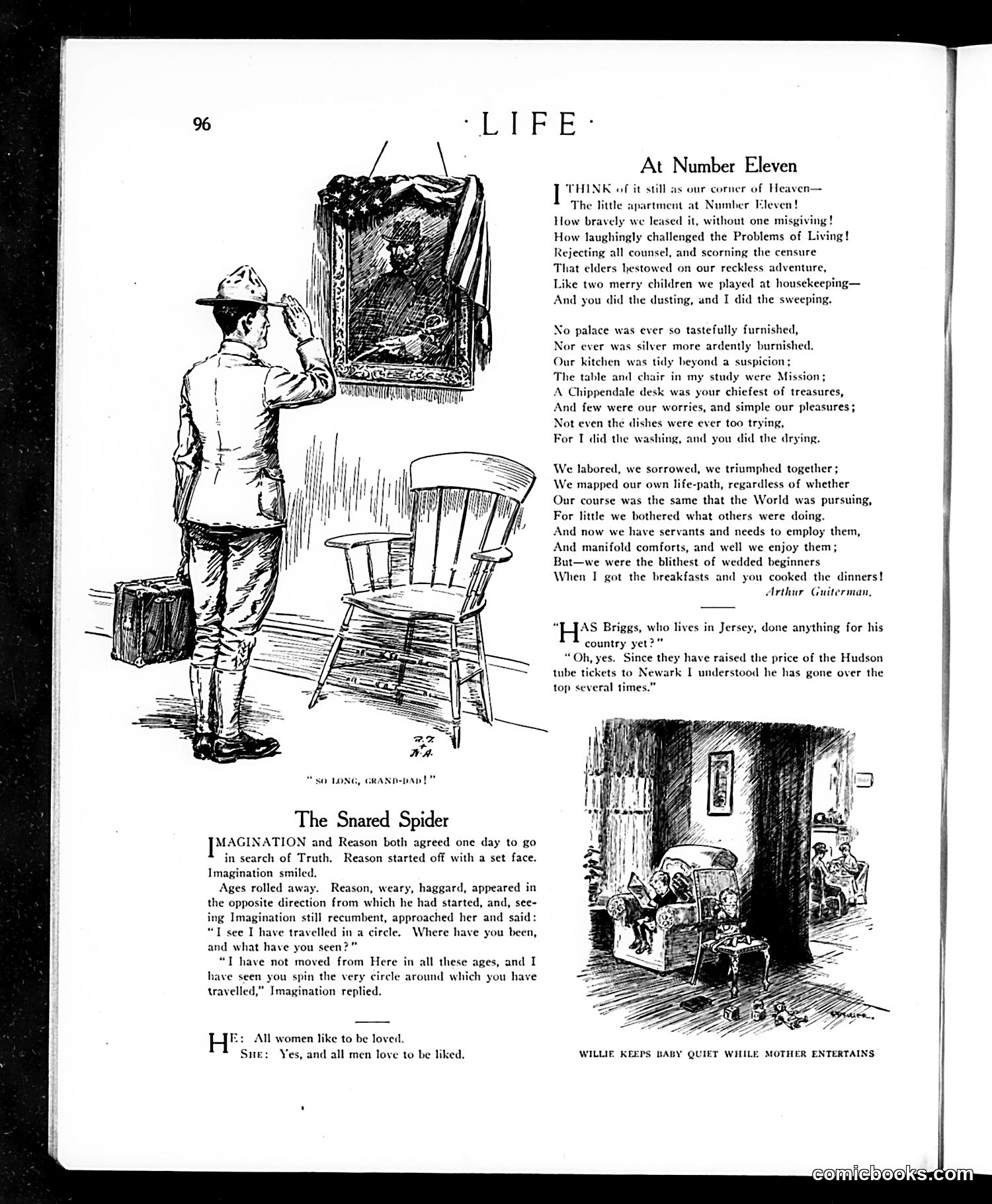
This page contains three distinct pieces of satirical content: **"At Number Eleven"** (poem by Arthur Guiterman): A nostalgic meditation on newlywed poverty. The speaker romanticizes their early married life in a modest apartment, where they shared household duties and had few possessions, contrasting it with their present comfortable but somehow less fulfilling life with servants and wealth. The satire critiques materialism—suggesting that early struggle and shared labor created greater happiness than financial success. **The Briggs Joke**: A brief topical gag about a Jersey resident named Briggs. The humor references raising Hudson River transit fares to Newark and uses WWI military slang ("gone over the top," meaning charging into battle). It jokes that Briggs has repeatedly paid the increased fare—a minor contribution to the war effort. **"The Snared Spider"** (fable): An allegory contrasting Reason and Imagination. Reason travels exhaustively but returns where it started; Imagination remains still yet comprehends everything. The moral suggests imagination's superiority to mere logical effort. The illustrations complement these themes of domestic life, practical wisdom, and philosophical reflection typical of Life's genteel satirical approach.
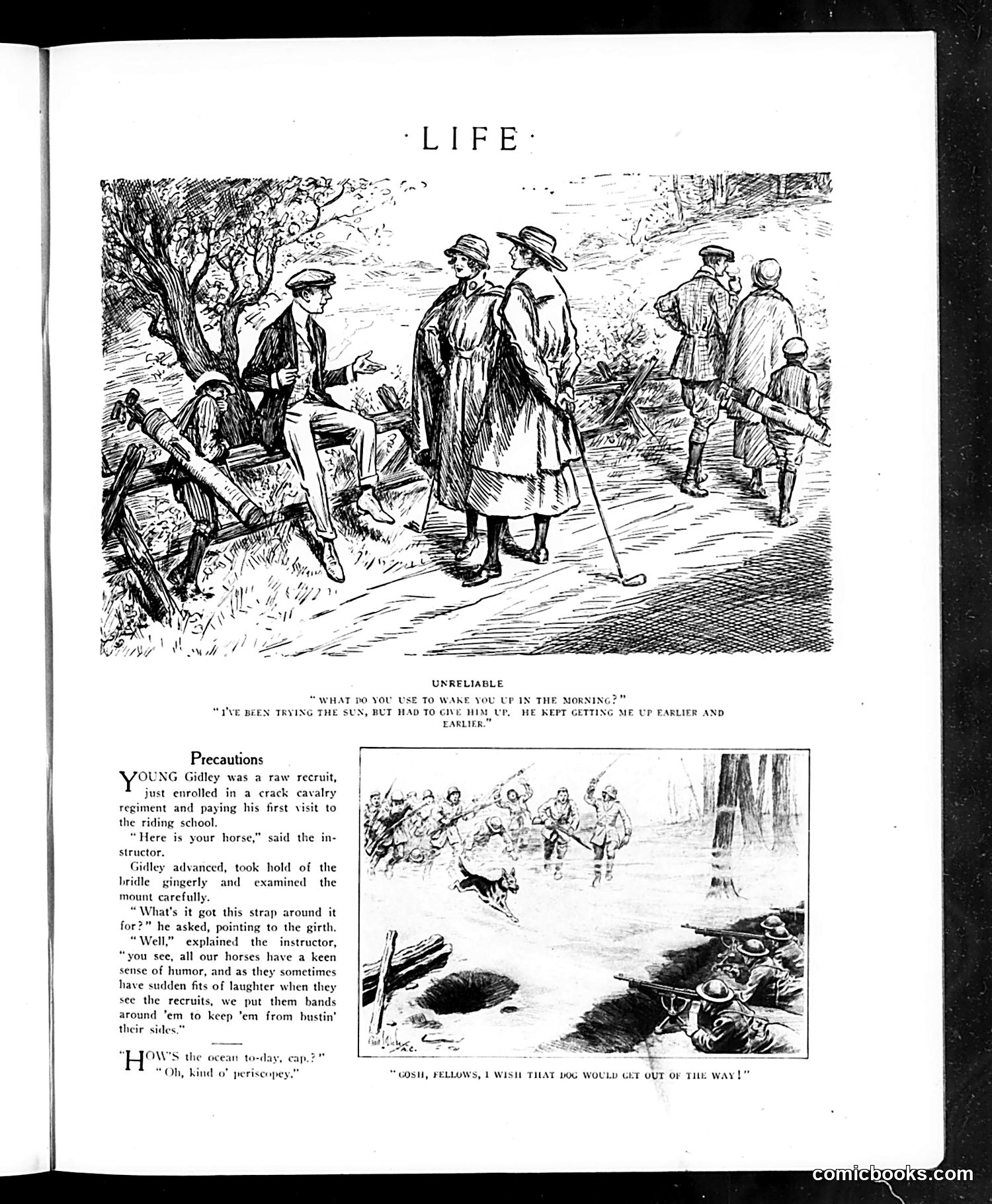
This page contains two separate humorous pieces from *Life* magazine: **"Unreliable" (top):** A dialogue joke about an unreliable alarm clock—someone claims they tried using the sun but had to stop because it kept waking them up earlier than desired. The humor relies on personifying the sun as an undependable servant. **"Precautions" (bottom):** A story about a naive cavalry recruit named Gidley who's confused by a horse's girth (belly strap). The instructor jokes that horses have a "keen sense of humor" and laugh so hard they might "bust their sides," so the straps keep them from literally splitting open. The accompanying illustration shows cavalry soldiers training with an apparently uncooperative horse blocking their path, with one soldier wishing the dog would move. Both pieces employ gentle, absurdist humor typical of early 20th-century American satire—playing on military inexperience and the gap between expectations and reality. The humor is lighthearted rather than pointed social commentary.
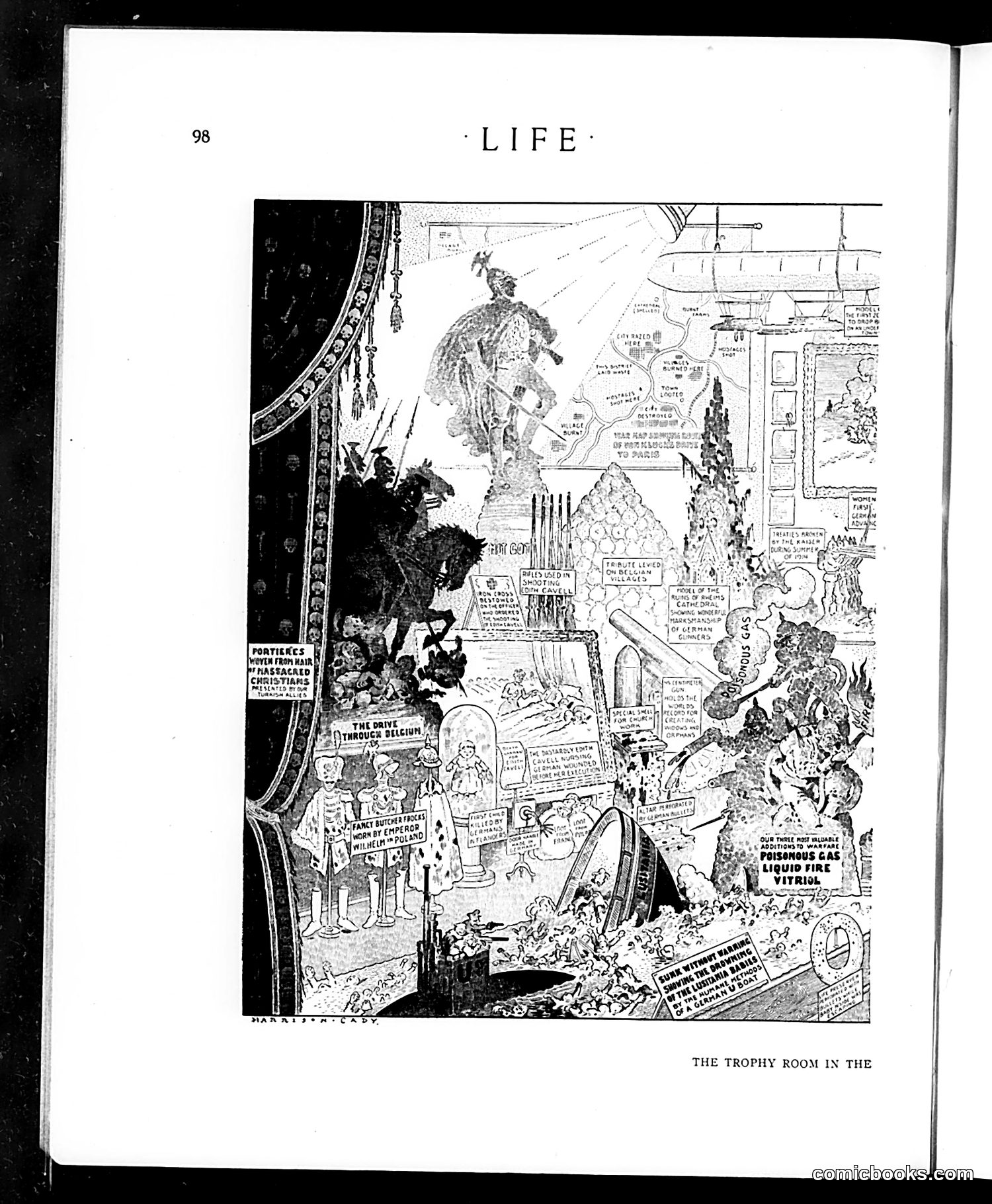
This is a densely packed satirical illustration from Life magazine depicting what appears to be a "trophy room" filled with weapons, military equipment, and implements of warfare and destruction. The image is crowded with labeled references to various weapons, gases, and instruments of combat—including "POISONOUS GAS," "LIQUID FIRE," and "VITRIOL." The cartoon appears to be anti-war satire, presenting a grotesque collection of destructive technology and weaponry as "trophies." Based on visible references to poison gas and chemical weapons, this likely dates to the World War I era or its aftermath, when such weapons generated public horror and debate. The "room" concept transforms warfare's tools into museum pieces, satirizing militarism and the glorification of destruction. The specific identities of figures are unclear from this image quality, but the overall message critiques the accumulation and celebration of instruments of mass harm.
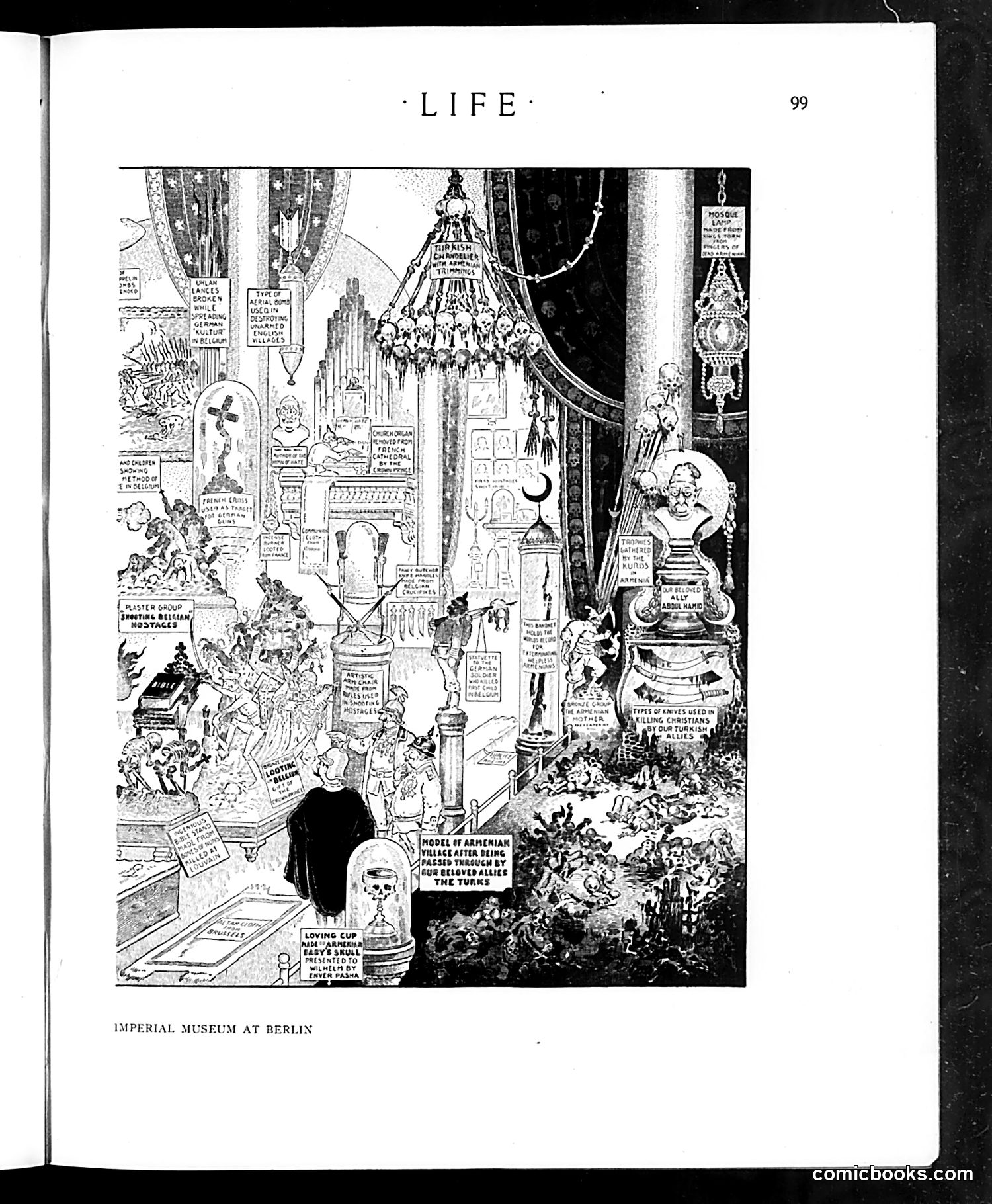
This appears to be a detailed satirical illustration of the Imperial Museum in Berlin, rendered as an elaborate architectural cross-section filled with labeled artifacts and historical references. The cartoon critiques German imperial collecting practices and colonial acquisitions. The illustration depicts a towering museum structure packed with plundered treasures, including references to Armenian villages and items "passed through by our beloved allies the Turks"—likely alluding to Ottoman-German military alliance during World War I and associated atrocities. The packed, chaotic composition suggests the museum as a monument to imperial ambition and the gathering of spoils from conquered territories. Various small figures and labels throughout reference specific artifacts and their origins, satirizing both German imperialism and the ethical problems of trophy-taking through colonialism and war.
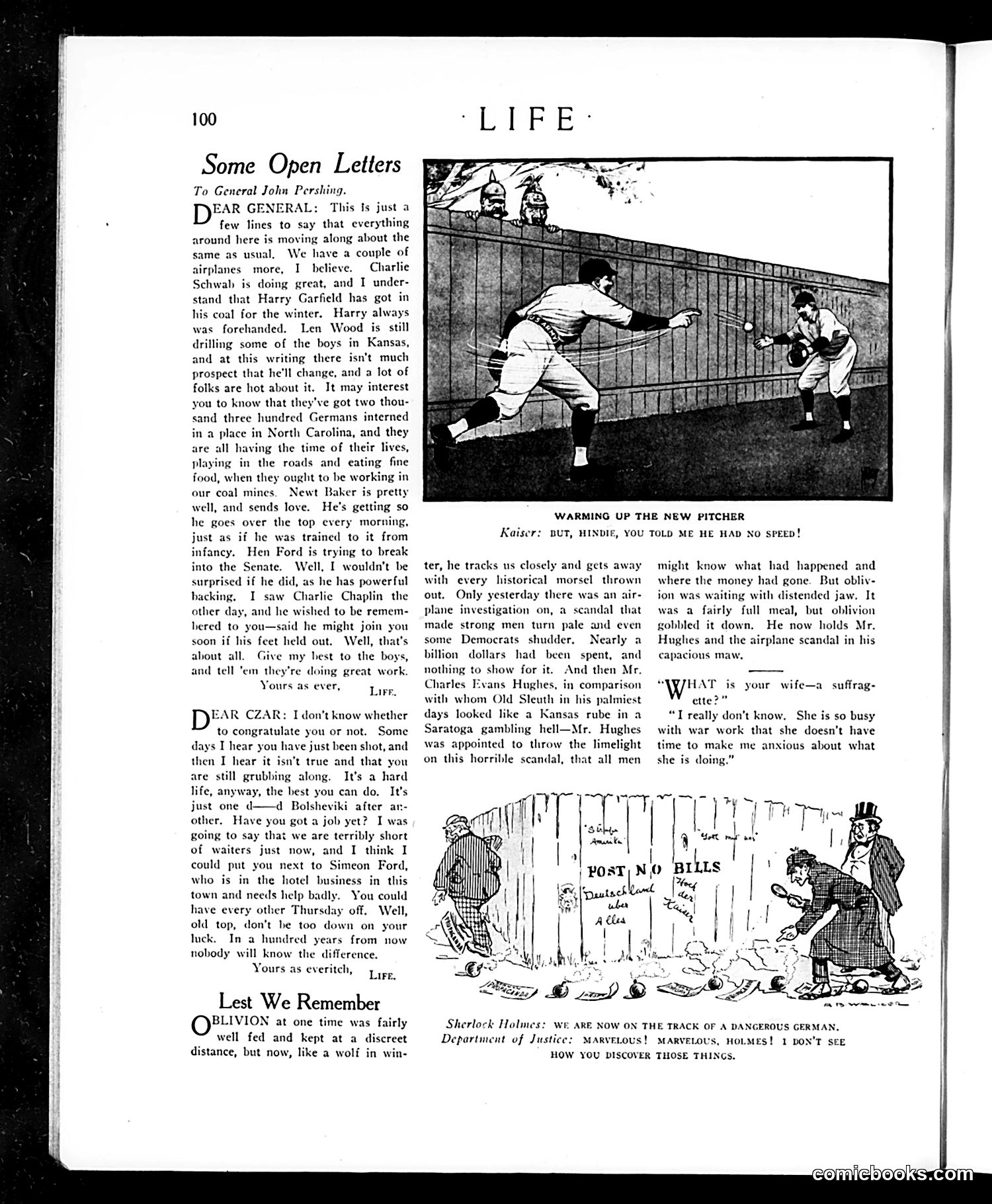
This 1918 *Life* magazine page contains satirical "open letters" and cartoons addressing WWI-era figures and concerns. **The Letters:** Mock congratulations to General Pershing, references to wartime officials (Charlie Schwab, Harry Garfield, Newton Baker), and a bitter jab at the Russian Czar about political chaos—likely alluding to the 1917 Russian Revolution and subsequent upheaval. **Top Cartoon:** A baseball pitcher warms up while the Kaiser complains he has "no speed." This satirizes American military preparedness, suggesting U.S. forces were underestimated or untested. **Bottom Cartoon:** Parodies detective fiction (Sherlock Holmes), mocking a government investigation into a billion-dollar airplane scandal. The joke is that "Oblivion" (forgotten history) swallows the scandal before justice is served—cynicism about official accountability. **The Dialogue:** A brief joke about a wife too busy with war work to engage with suffragette issues, reflecting women's dual roles during WWI. The page reflects American wartime anxieties: military readiness, government corruption, and social disruption.
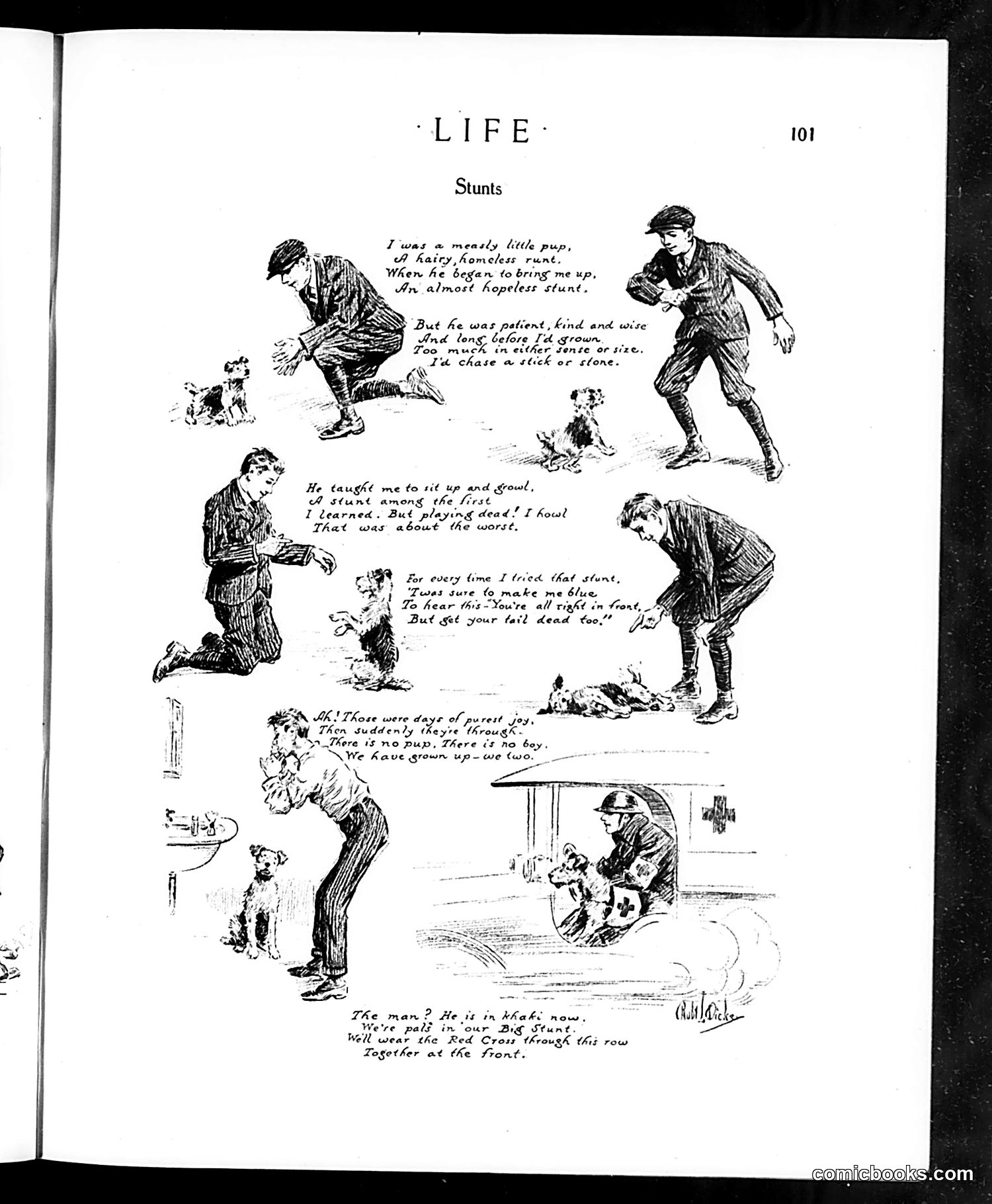
This sentimental piece uses a man-and-dog relationship as a metaphor for wartime sacrifice. The narrative traces childhood play between a boy and his dog—teaching tricks, playing dead—to adulthood, where both have "grown up." The final stanza reveals the deeper meaning: the boy, now a man in military uniform ("Khaks"), and his former companion are both enlisted for "our Big Stunt" at the front. They'll wear the Red Cross insignia together in combat. The piece appears to be WWI-era propaganda, romanticizing military service by framing it as a natural continuation of childhood bonding and loyalty. The dog serves as a symbol of faithful companionship and sacrifice, while the progression from innocent play to warfare suggests duty and patriotic obligation as inevitable life stages. The sentimental tone aims to inspire enlistment or acceptance of war participation among readers.
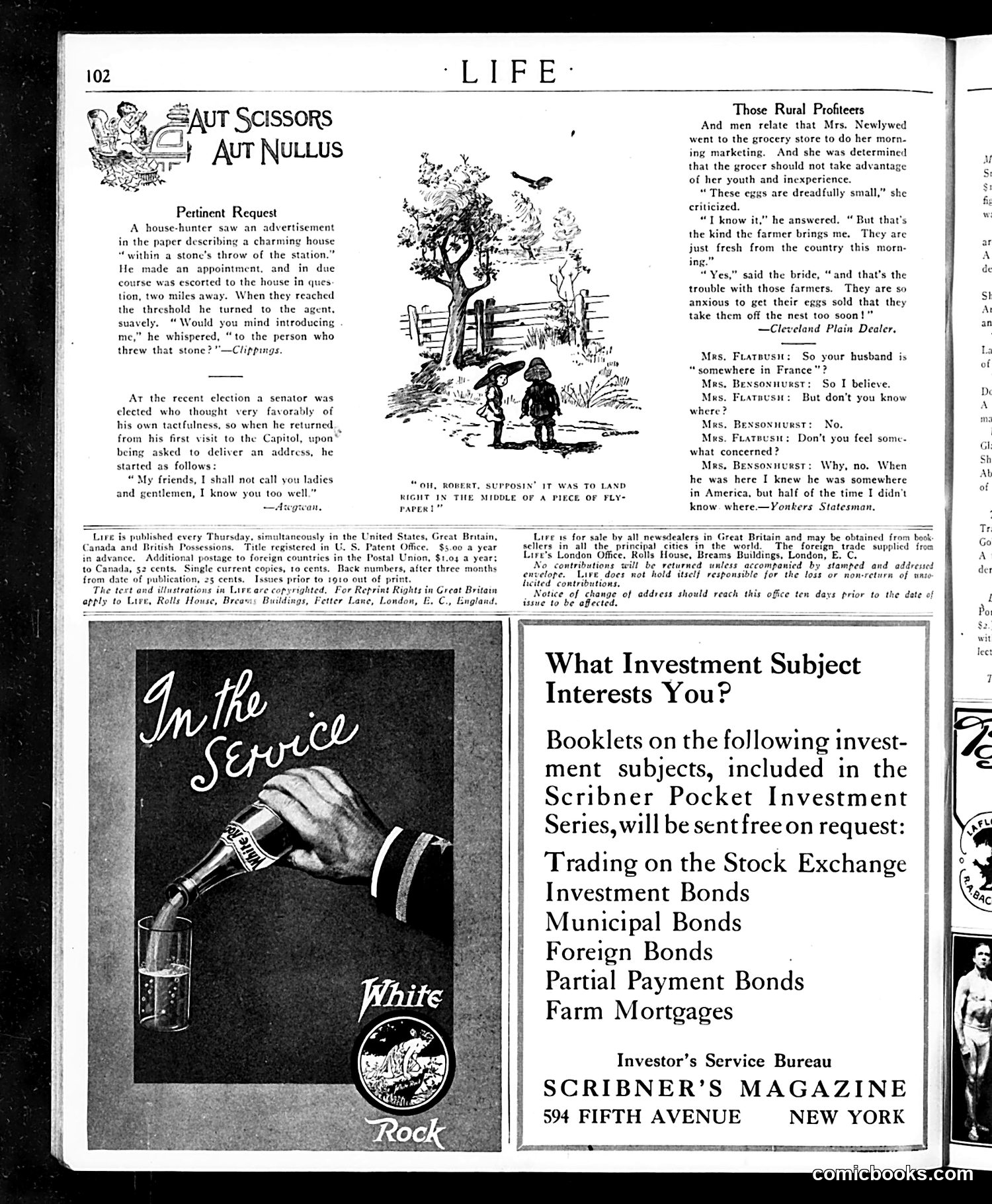
This page from *Life* magazine contains three brief satirical anecdotes typical of early 20th-century humor: **"Pertinent Request"** jokes about real estate agents' misleading language—a house advertised as "within a stone's throw of the station" is actually two miles away. **The second anecdote** ridicules an elected senator's false modesty. His opening line ("I shall not call you ladies and gentlemen, I know you too well") is meant as flattery but comes across as patronizing. **"Those Rural Profiteers"** satirizes newlywed ignorance about farming. A bride criticizes small eggs, blaming the farmer for selling them too early, unaware that farmers harvest eggs regularly—not that the chickens need more time to produce larger ones. The humor mocks her naïveté about agricultural practices. The page also includes a White Rock beverage advertisement and investment-related promotional material from Scribner's Magazine, which were typical magazine filler of the era.
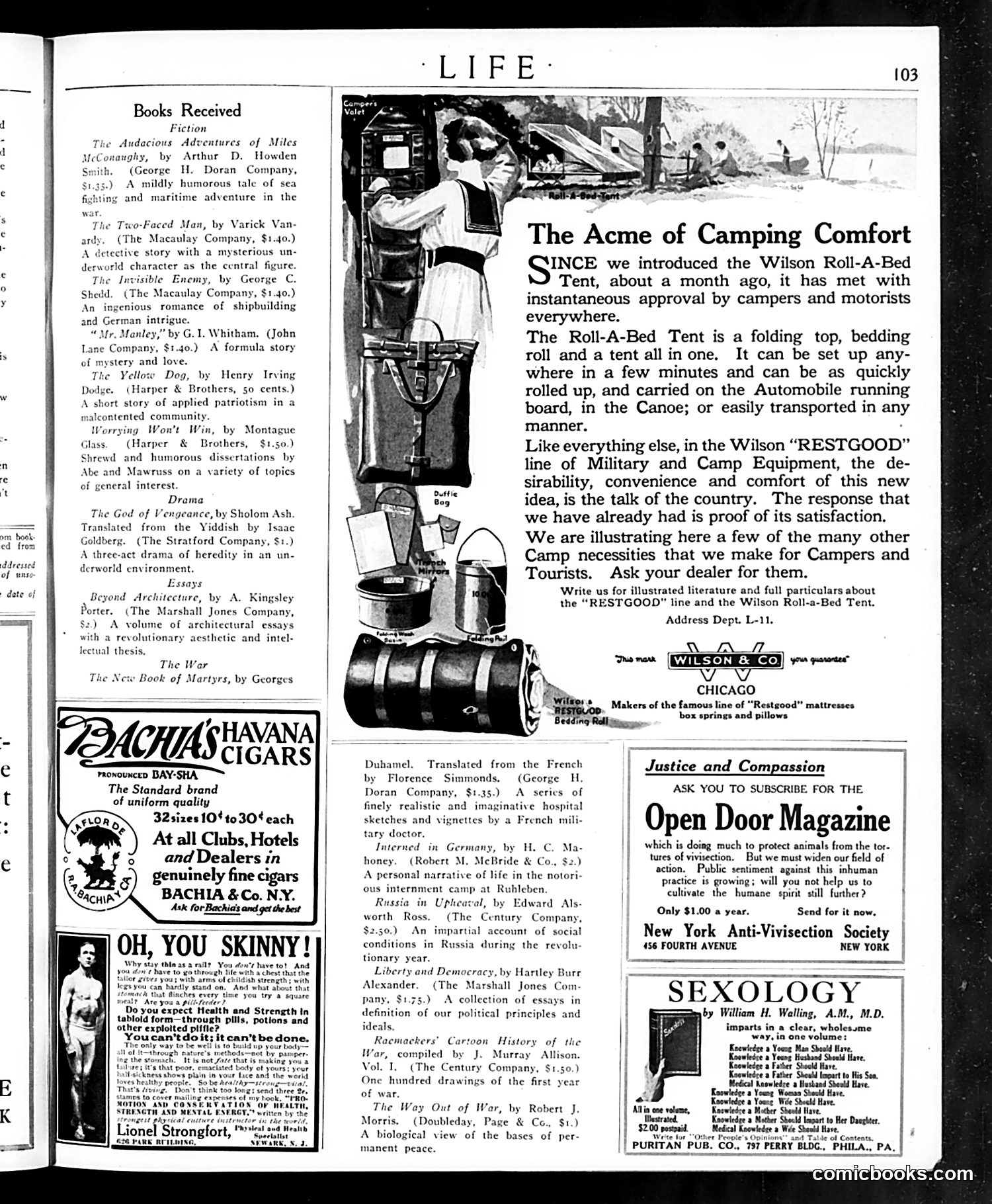
This page is primarily **advertising and book reviews**, not political satire. The main content includes: **Book Reviews Section:** Lists newly published fiction, drama, and essays, mostly relating to World War I themes—war narratives, internment camp accounts, and Russian revolutionary conditions reflect 1917-1918 concerns. **Advertisements:** - **Wilson Roll-A-Bed Tent**: A camping product pitched as convenient, portable equipment for motorists and campers - **Bachia Cigars**: A standard brand advertised at clubs and hotels - **Lionel Strongfort**: A physical fitness instructor promoting strength-building without "pills, potions and other exploited piffle"—this mocks contemporary patent medicine culture - **Open Door Magazine** and **Sexology**: Publications on animal welfare and sexual education The page reflects early 20th-century concerns: WWI literature, outdoor recreation's growing popularity, skepticism toward quack remedies, and emerging openness to discussing previously taboo topics like sexuality.
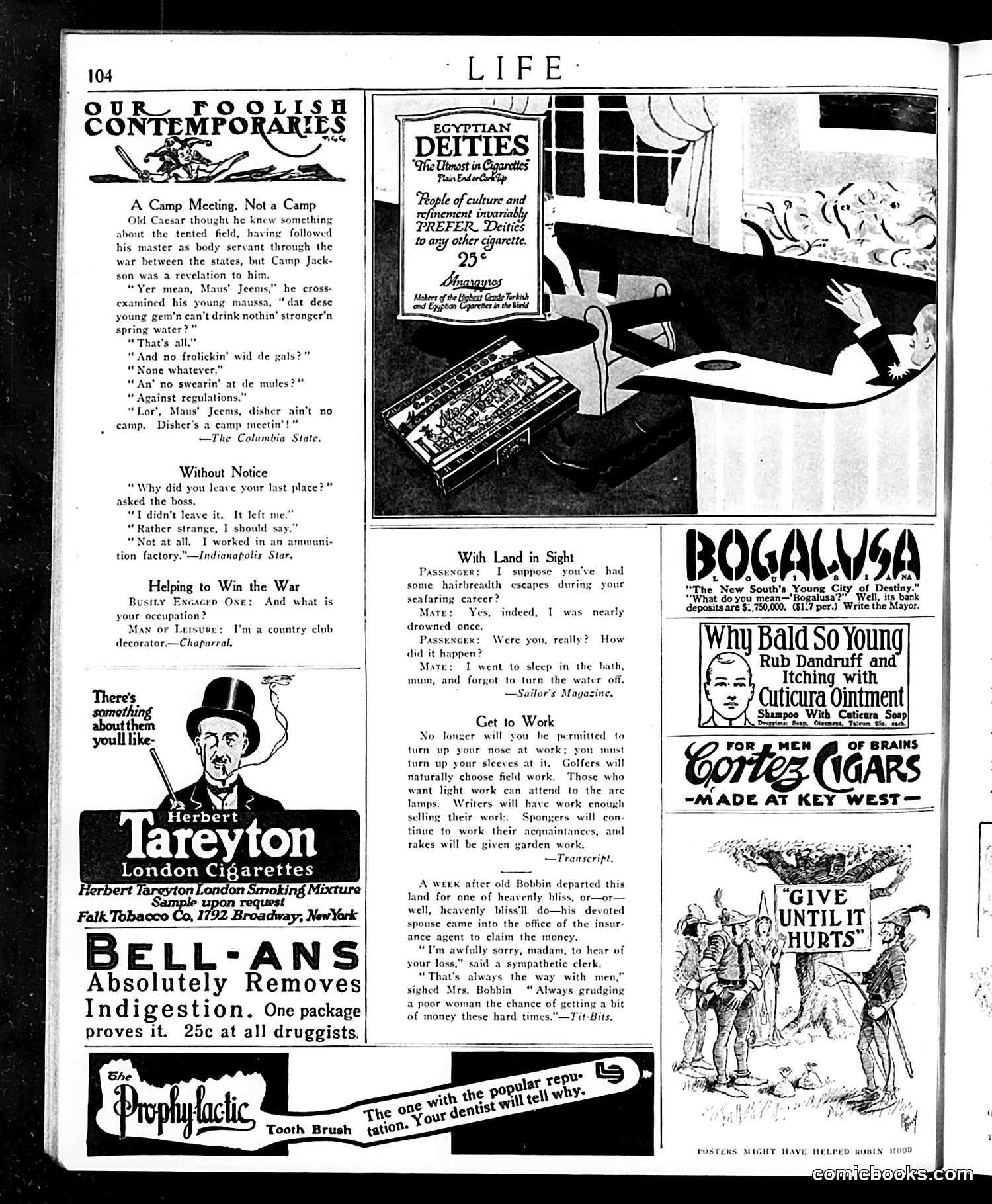
This page from *Life* magazine contains several satirical pieces reflecting WWI-era American social concerns: **"A Camp Meeting, Not a Camp"** features dialect humor between an African American body servant and his young master about military camp discipline. The joke relies on period stereotypes, contrasting the servant's expectations of loose behavior with actual military regulations prohibiting drinking, fraternizing, and profanity. **"Without Notice"** jokes about an ammunition factory worker whose previous job "left him"—implying an explosion. **"Get to Work"** is wartime propaganda encouraging civilians to stop shirking and contribute to the war effort, warning golfers and idle wealthy people that leisure is over. **"Wish Land in Sight"** depicts a near-drowning at sea, playing on seafaring dangers. The advertisements (Bell-Ans digestive aid, Herbert Tareyton cigars, Bogalusa bank) are typical period marketing. Overall, the page blends humor with subtle wartime messaging about sacrifice and duty.
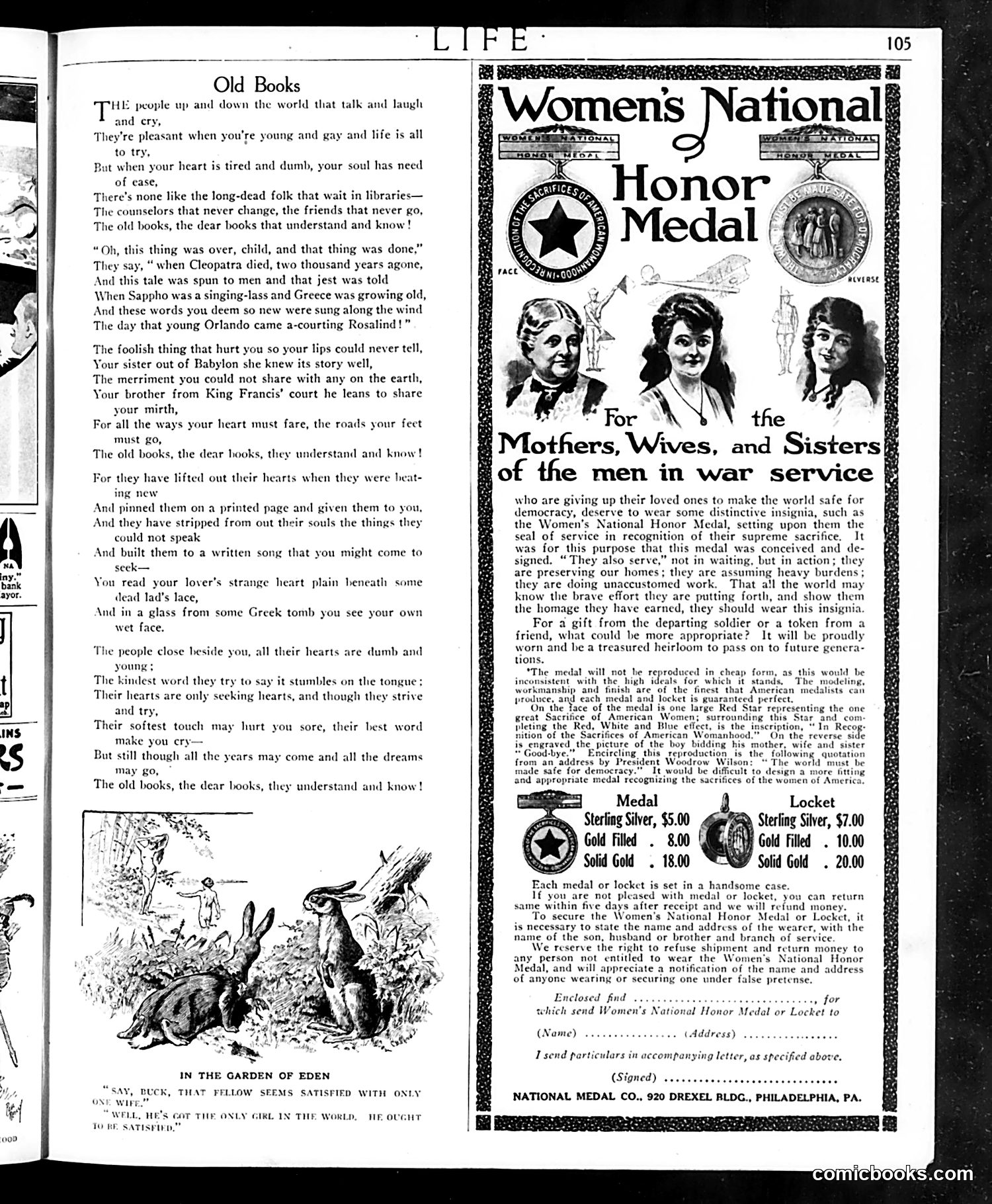
This page contains two distinct elements: **Left Side - "Old Books" Poem:** A sentimental poem celebrating literature's comfort during emotional hardship. It emphasizes how old books provide wisdom and companionship that living people cannot, referencing classical figures (Cleopatra, Sappho, Orlando from *As You Like It*) to suggest timeless human experience transcends individual pain. **Right Side - Advertisement:** The Women's National Honor Medal advertisement targets mothers, wives, and sisters of soldiers in World War I. The medal recognizes women's sacrifices and wartime contributions—not as combatants but as those enduring separation and assuming "unaccustomed work." The medal features a red star (American symbolism) and President Woodrow Wilson's quote about making "the world safe for democracy"—the stated American justification for WWI entry. **Context for Modern Readers:** This reflects WWI-era sentiment honoring female sacrifice and suggesting women "also serve" through civilian duties and emotional burden, while actual combat remained male-exclusive.
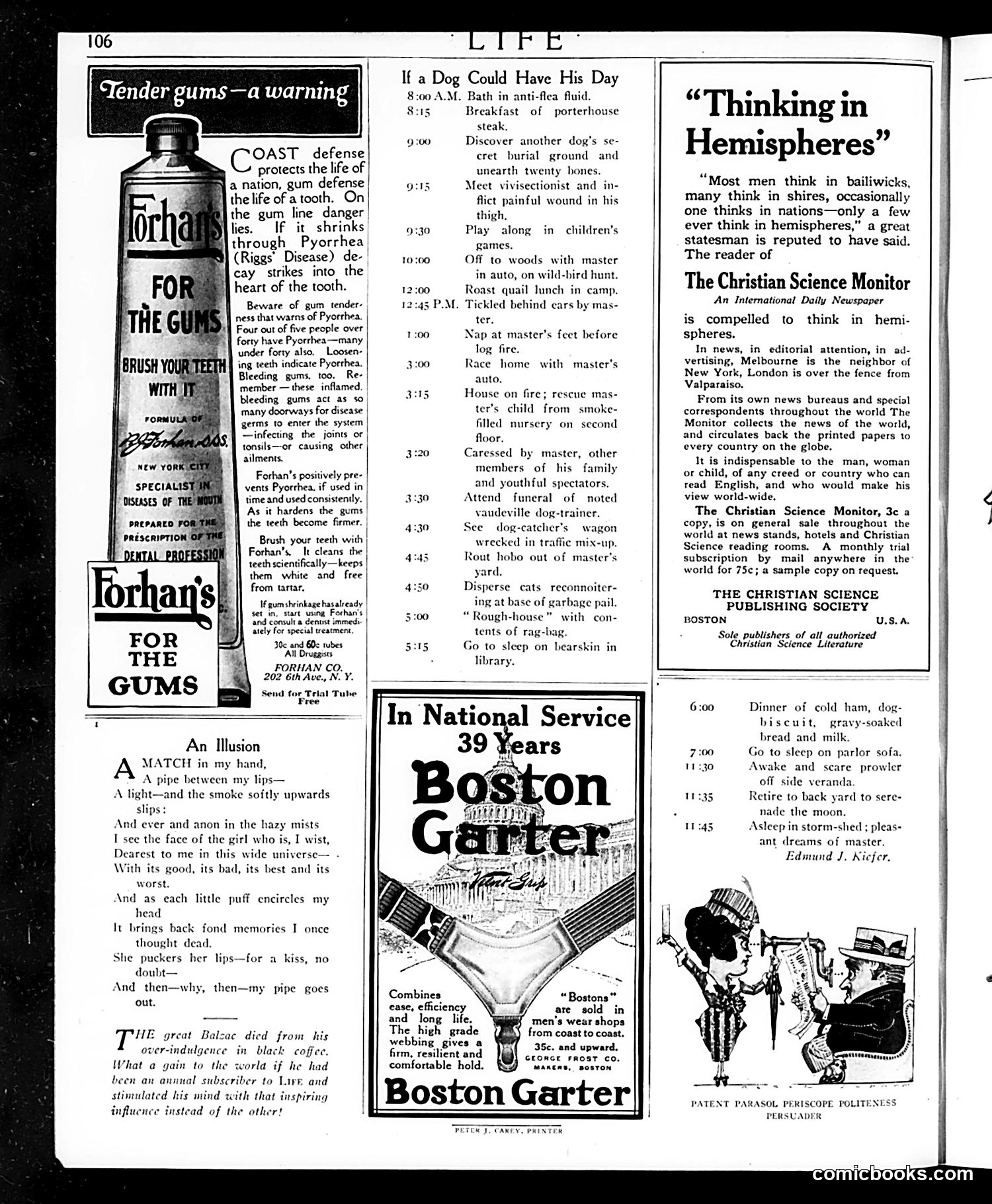
This page combines advertisements and light satirical content typical of early 20th-century Life magazine. **Left side:** Forhan's toothpaste ad warns about pyorrhea (gum disease), framing dental health as national defense—a patriotic health appeal common to the era. **Center:** "An Illusion" is a sentimental poem about pipe smoking conjuring romantic memories of a woman—gentle romantic humor playing on the visual trick of smoke patterns. **"If a Dog Could Have His Day"** humorously catalogs an idealized dog's daily schedule, from luxurious meals to heroic rescues to comic mishaps (being hit by dog-catchers). It's lighthearted anthropomorphization, poking fun at sentimental pet-owner fantasies. **Right side:** The Christian Science Monitor advertises itself as a truly "international" newspaper, with the pretentious claim that readers must "think in hemispheres"—satirizing highbrow aspirations toward global consciousness while promoting subscription. The Boston Garter ad appears below. Overall, the page mixes commercial messaging with gentle satire and nostalgia.
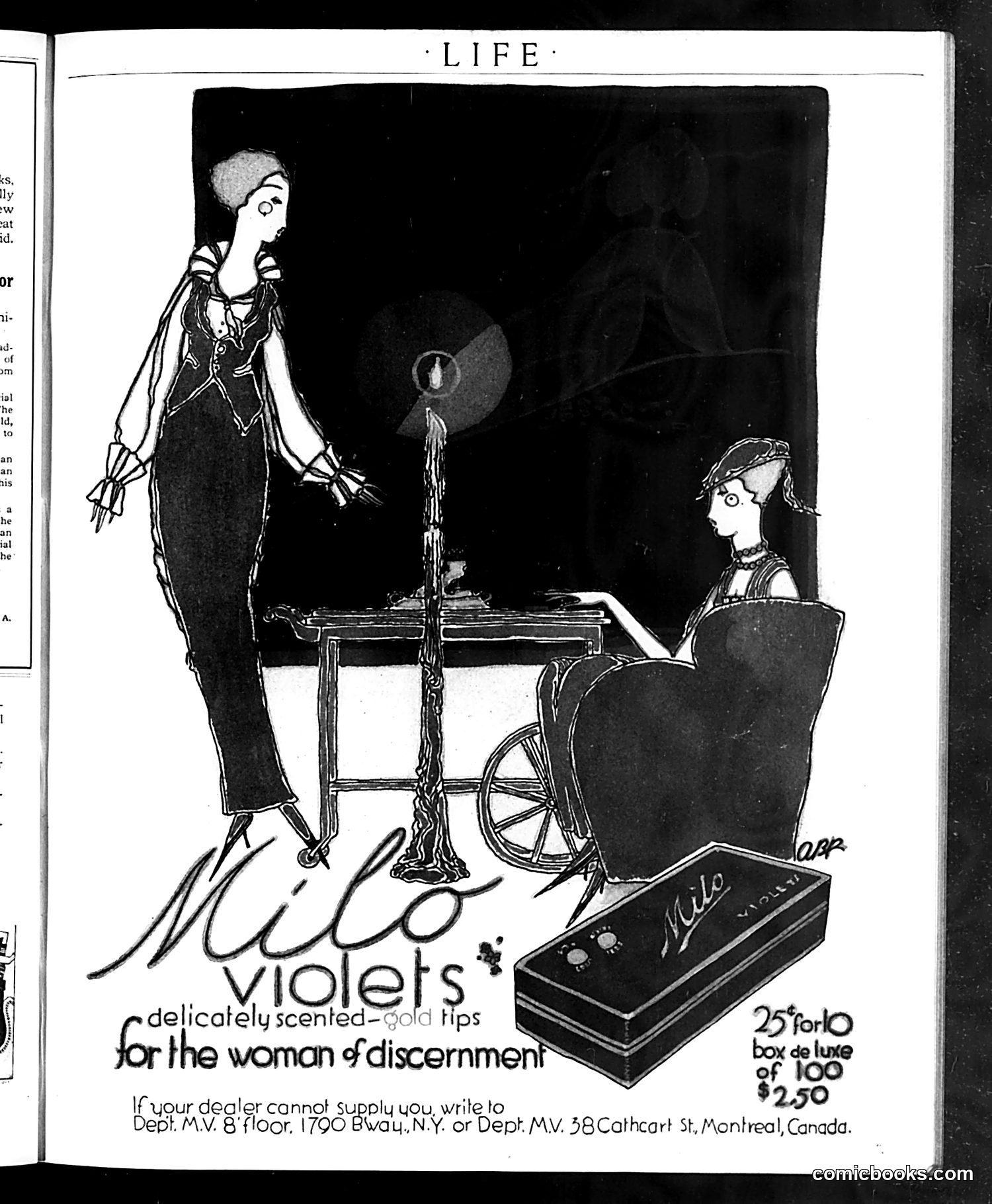
This is a product advertisement for "Milo Violets" lipstick, not a political cartoon. The ad depicts two elegantly dressed women in 1920s style, with one standing and one seated in a wheelchair. The copy describes the product as "delicately scented—gold tips for the woman of discernment." The advertisement emphasizes luxury and sophistication, targeting affluent female consumers. The wheelchair-using woman is presented as equally fashionable and discerning as her standing companion, suggesting the product appeals to women of all circumstances. Priced at "25¢ for box de luxe of 100" ($2.50), it positions itself as an upscale cosmetic. The ad directs customers to New York or Montreal locations if local dealers cannot supply the product.
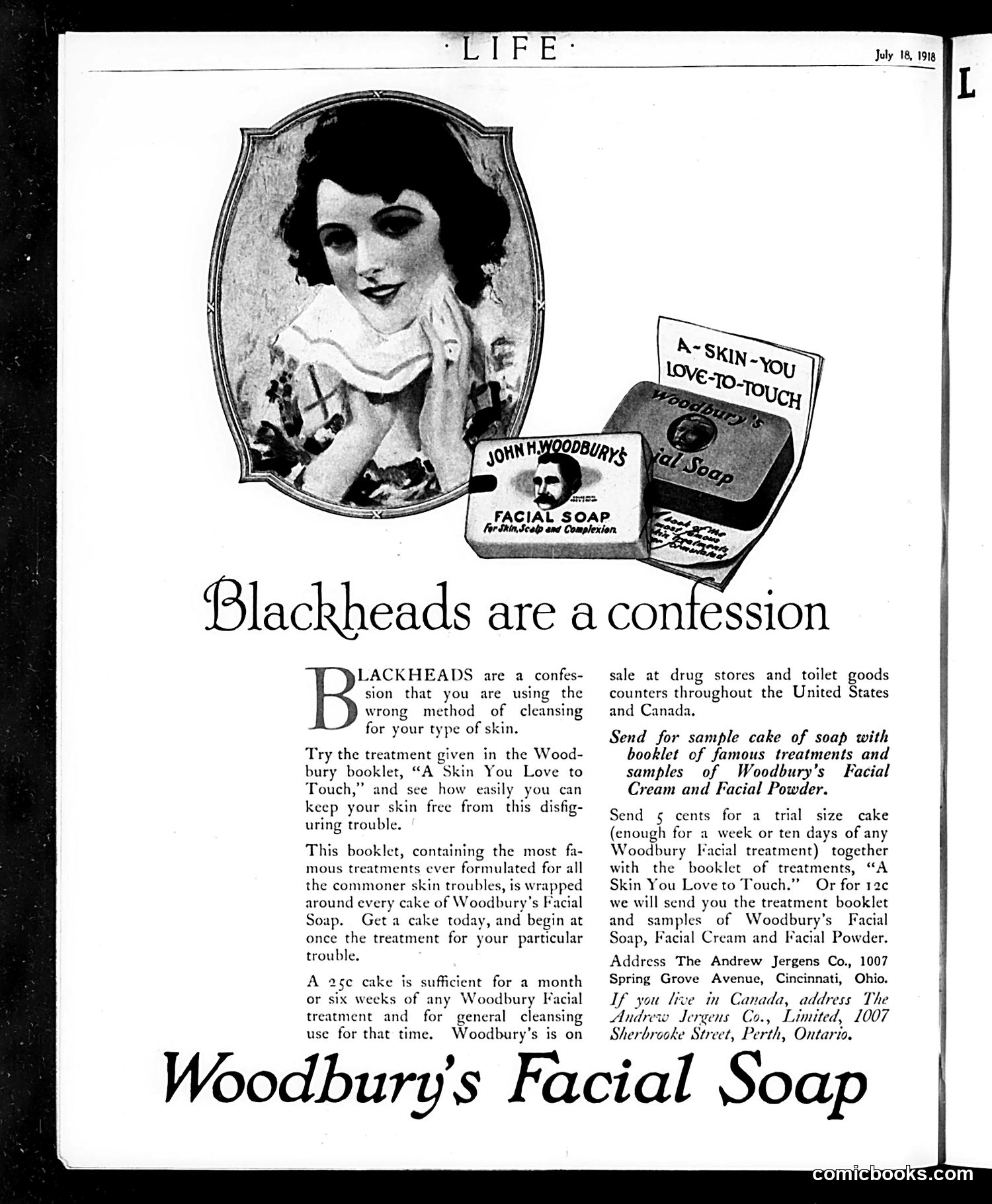
This is primarily a **product advertisement**, not political satire. It's a 1918 Woodbury's Facial Soap ad from *Life* magazine. The page features a portrait photograph of an attractive young woman alongside soap products. The ad's headline, "Blackheads are a confession," frames skin blemishes as a personal failing—suggesting that having blackheads implies poor hygiene or wrong skincare choices. The copy appeals to vanity and shame, promising that Woodbury's treatment booklet ("A Skin You Love to Touch") will solve the problem. This represents **early 20th-century beauty advertising strategy**: creating insecurity about appearance, then offering a commercial solution. There are **no political cartoons or caricatures** on this page. The "satire" inherent here isn't intentional—it's retrospectively apparent to modern readers in how aggressively the ad weaponizes shame about natural skin conditions to sell products. The phrase "a confession" is particularly revealing of the era's attitudes toward female appearance.