
Life, 1918-07-18 · page 16 of 36
Life — July 18, 1918 — page 16: what you’re looking at
What you’re looking at
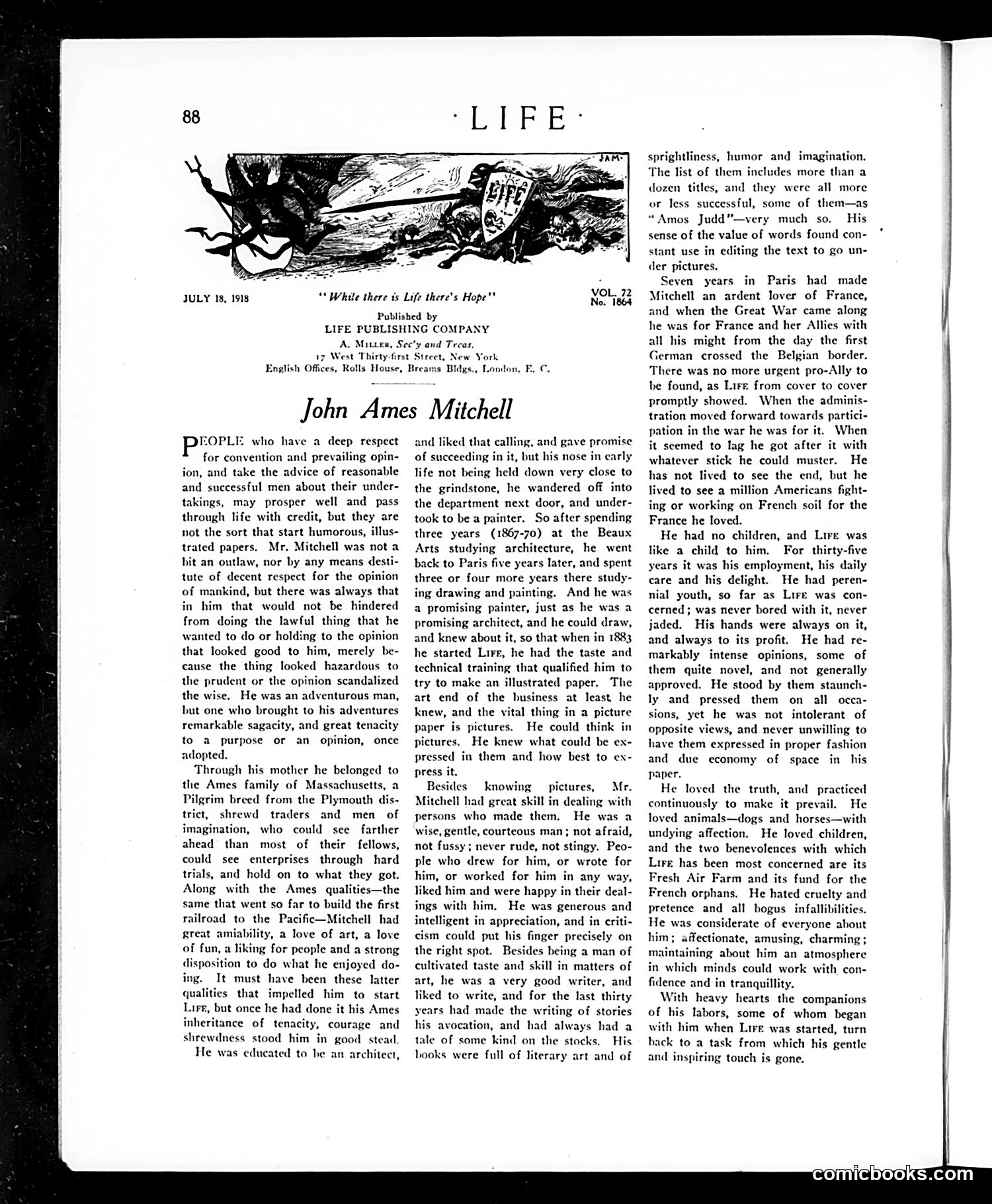
This is a biographical article about John Ames Mitchell, founder of *Life* magazine, published July 18, 1918. The page contains no political cartoon or satire—it's a straightforward tribute essay. The illustration at top shows a reclining figure with the motto "While there is Life there's Hope," a visual pun on the magazine's name. The text chronicles Mitchell's career: educated as an architect, he studied at the Beaux Arts in Paris, worked as a painter, then founded *Life* in 1883. The article emphasizes his character—descended from Massachusetts Pilgrims and the Ames family (railroad builders), he combined business acumen with artistic sensibility, generosity toward contributors, and literary talent. He was unconventional enough to start a humorous illustrated paper despite social disapproval, yet prudent in execution. This appears to be a commemorative piece, possibly written after Mitchell's death or retirement.
📄 Transcribed text from this page (OCR, searchable)
Machine-transcribed from the original scan — historical spelling and the odd misread are preserved.
JULY 18, 1918 “* White there ts Life there's Hope"* Published by LIFE PUBLISHING COMPANY A. Mitre, Sec’y and Treas, 17 West Thirty-first $ English Offices, Rolls House, Bream reet, New York Bldgs. Lon mm, B.C. John Ames Mitchell EOPLE who have a deep respect for convention and prevailing opin- ion, and take the advice of reasonable and successful men about their under- takings, may prosper well and pass through life with credit, but they are not the sort that start humorous, illus- trated papers. Mr. Mitchell was not a bit an outlaw, nor by any means dest! tute of decent respect for the opinion of mankind, but there was always that in him that would not be hindered from doing the lawful thing that he wanted to do or holding to the opinion that looked good to him, merely be- cause the thing looked hazardous to the prudent or the opinion scandalized the wise. He was an adventurous man, but one who brought to his adventures remarkable sagacity, and great tenacity to a purpose or an opinion, once adopted. Through his mother he belonged to the Ames family of Massachusetts, a Pilgrim breed from the Plymouth dis- trict, shrewd traders and men of imagination, who could see farther ahead than most of their fellows, could see enterprises through hard trials, and hold on to what they got. Along with the Ames qualities—the same that went so far to build the first railroad to the Pacific—Mitchell had great amiability, a love of art, a love of fun, a liking for people and a strong disposition to do what he enjoyed do- ing. It must have been these latter qualities that impelled him to. start Lire, but once he had done it his Ames inheritance of tenacity, courage and shrewdness stood him in good stead He was educated to he an architect, and liked that calling, and gave promise of succeeding in it, but his nose in early life not being held down very close to the grindstone, he wandered off into the department next door, and under- took to be a painter. So after spending three years (1867-70) at the Beaux Arts studying architecture, he went back to Paris five years later, and spent three or four more years there study- ing drawing and painting. And he was a promising painter, just as he was a promising architect, and he could draw, and knew about it, so that when in 1883 he started Lire, he had the taste and technical training that qualified him to try to make an illustrated paper. The art end of the business at least he new, and the vital thing in a picture paper is pictures. He could think in pictures. He knew what could be ex- pressed in them and how best to ex- press it. Besides knowing pictures, Mr. Mitchell had great skill in dealing with persons who made them. He was a wise, gentle, courteous man ; not afraid, not fussy; never rude, not stingy. Peo- ple who drew for him, or wrote for him, or worked for him any way, liked him and were happy in their deal- ings with . He was generous and intelligent in appreciation, and in crit cism could put his finger precisely on the right spot. Besides being a man of cultivated taste and skill in matters of art, he was a very good writer, and liked to write, and for the last thirty years had made the writing of stories his avocation, and had always had a tale of some kind on the stocks, His books were full of literary art and of sprightliness, humor and imagination. The list of them includes more than a dozen titles, and they were all more or less successful, some of them—as “Amos Judd"—very much so. His sense of the value of words found con- stant use in editing the text to go un- der pictures, Seven years in Paris had made Mitchell an ardent lover of France, and when the Great War came along he was for France and her Allies with all his might from the day the first Jerman crossed the Belgian border. There was no more urgent pro-Ally to be found, as Lirr from cover to cover promptly showed. When the adminis- tration moved forward towards parti pation in the war he was for it. When it seemed to lag he got after it with whatever stick he could muster. He has not lived to see the end, but he lived to see a million Americans fight- ing or working on French soil for the France he loved. He had no children, and Lire was like a child to him. For thirty-five years it was his employment, his daily care and his delight. He had peren- nial youth, so far as Lire was con- cerned ; was never bored with it, never jaded, His hands were always on it, and always to its profit. He had re- markably intense opinions, some of them quite novel, and not generally approved. He stood by them staunch- ly and pressed them on all occa- sions, yet he was not intolerant of opposite views, and never unwilling to have them expressed in proper fashion and due economy of space in his paper. He loved the truth, and practiced continuously to make it prevail. He loved animals—dogs and horses—with undying affection. He loved children, and the two benevolences with which Lire has been most concerned are its Fresh Air Farm and its fund for the French orphans. He hated cruelty and pretence and all bogus infallibilities. He was considerate of everyone about him; affectionate, amusing, charming ; maintaining about him an atmosphere in which minds could work with con- fidence and in tranquillity. With heavy hearts the companions of his labors, some of whom began with him when Lire was started, turn back to a task from which his gentle and inspiring touch is gone.