
Life, 1918-07-18 · page 32 of 36
Life — July 18, 1918 — page 32: what you’re looking at
What you’re looking at
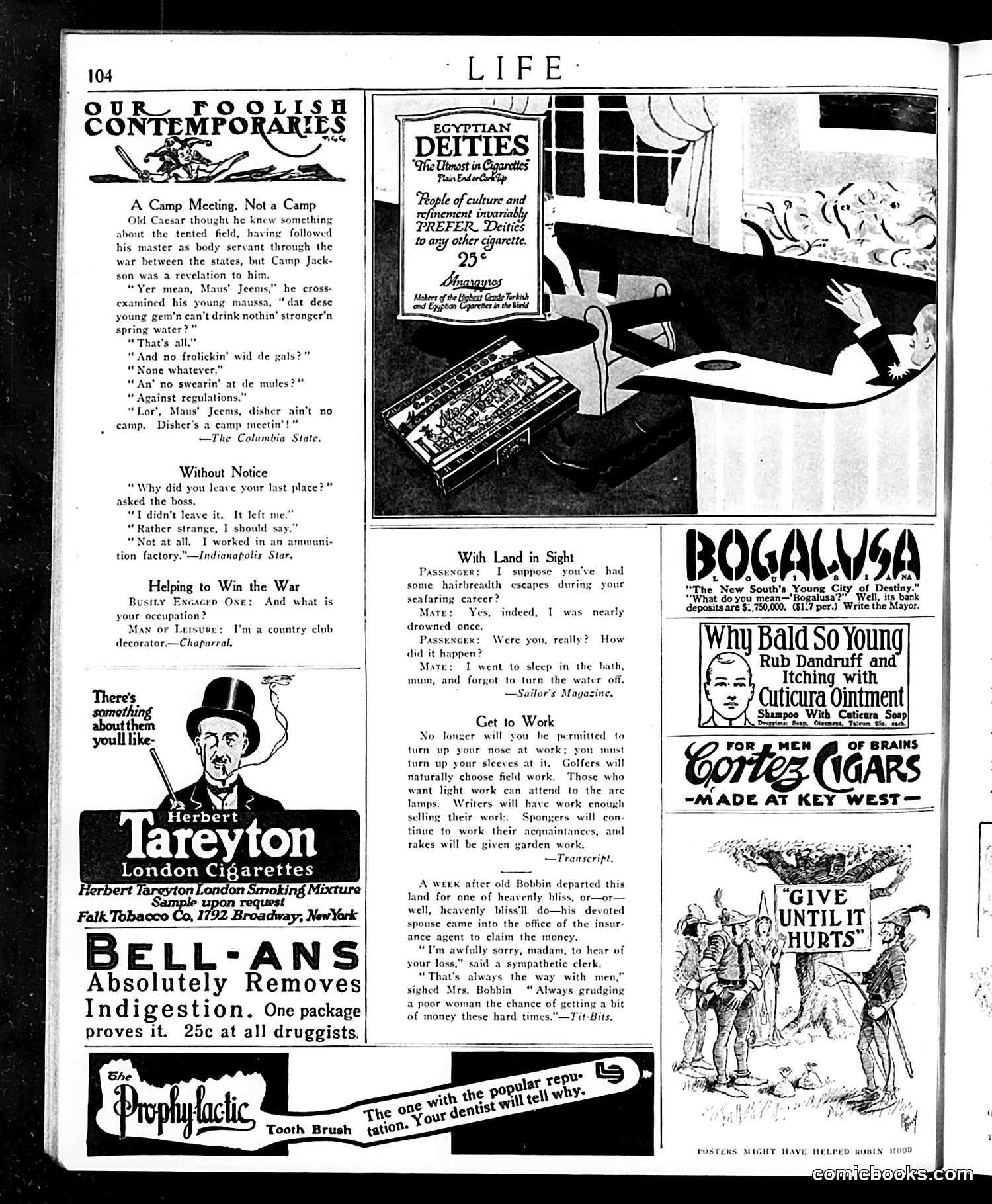
This page from *Life* magazine contains several satirical pieces reflecting WWI-era American social concerns: **"A Camp Meeting, Not a Camp"** features dialect humor between an African American body servant and his young master about military camp discipline. The joke relies on period stereotypes, contrasting the servant's expectations of loose behavior with actual military regulations prohibiting drinking, fraternizing, and profanity. **"Without Notice"** jokes about an ammunition factory worker whose previous job "left him"—implying an explosion. **"Get to Work"** is wartime propaganda encouraging civilians to stop shirking and contribute to the war effort, warning golfers and idle wealthy people that leisure is over. **"Wish Land in Sight"** depicts a near-drowning at sea, playing on seafaring dangers. The advertisements (Bell-Ans digestive aid, Herbert Tareyton cigars, Bogalusa bank) are typical period marketing. Overall, the page blends humor with subtle wartime messaging about sacrifice and duty.
📄 Transcribed text from this page (OCR, searchable)
Machine-transcribed from the original scan — historical spelling and the odd misread are preserved.
A Camp Meeting, Not a Camp bid of pounders Old Caesar thought he knew something pfinement pally about the tented field, having followed ‘h his master as body servant through the to any other cigarette. war between the states, but Camp Jack- | 25* son was a revelation to him. | “Yer mean, Mans’ Jeems,” he cross UE examined his young maussa, “dat dese ‘Mahers of ce tight Cnc Techies young gem'n can’t drink nothin’ stronger'n spring water?” “That's all.” “And no frolickin’ wid de gals?” “None whateve “ An’ no swearin’ at de mules?” “ Against regulations.” “Lor’, Maus’ Jeems, camp. Disher’s a camp meetin’ —The Columbia State. Without Notice “Why did you leave your last place asked the boss. “T didn’t leave it. It left me.” “Rather strange, I should say.” = —— “Not at all, I worked in an ammuni- tion factory."—Indianapolis Star. With Land in Sight 4 Passexcer: I suppose you've had Helping to Win the War some hairbreadth escapes during your | the ‘New Goukta Young ‘Cie fr Destiny.” Busity GAcED Oxe: And what is seafaring career? “What do you mean—‘Bogalusa’?’” Well, its bank Mate: Yes, ind 1 was nearly deposits are $.,750,000, ($1.7 per.) Write the Mayor. your occupation? May or Letsure: I'm a country club drowned once. decorator.—Chaparral, Passrxcre: Were you, really? How hy Bald SO Young did it happen? Mate: I went to sleep in the bath, ‘ Rub Dandruff and mum, and forgot to turn the water off. Itching with Sailor's Magazine. cuticura 1 Ointment Get to Work No longer will you he permitted to turn up your nose at work; you must OF GRAINS — turn up your sleeves at it, Golfers will naturally choose field work. Those who want light work can attend to the are lamps. Writers will have work enough -MADE AT au _WEST— ederes selling their work. Spongers will con- tinue to work their acquaintances, and ey rakes will be given garden work. —Transcript, London zy FON Tond A week after old Bobbin departed this ert TareytonLondon oking Mixture land for one of heavenly bliss, or—or— fer] Falk Tobaceo Co 1792 Brondway, NewYork well, heavenly bliss‘ll do—his devoted spouse came into the office of the insur- ance agent to m the money. B E L L ie A N Ss “I'm awfully sorry, madam, to hear of your loss,” said a sympathetic clerk. “That's always the way with men,” Absolutel y Removes sighed Mrs, Bobbin “Always grudging . = a poor woman the chance of ing a bit Indi ge sy ion z Oe package of moncy these hard times."—Tit-Bits, proves it. c at all druggists. me with thE ponte ‘he Of ne ith enti Tooth Brush ‘Tijon. YOU