A complete issue · 34 pages · 1918
Life — July 11, 1918
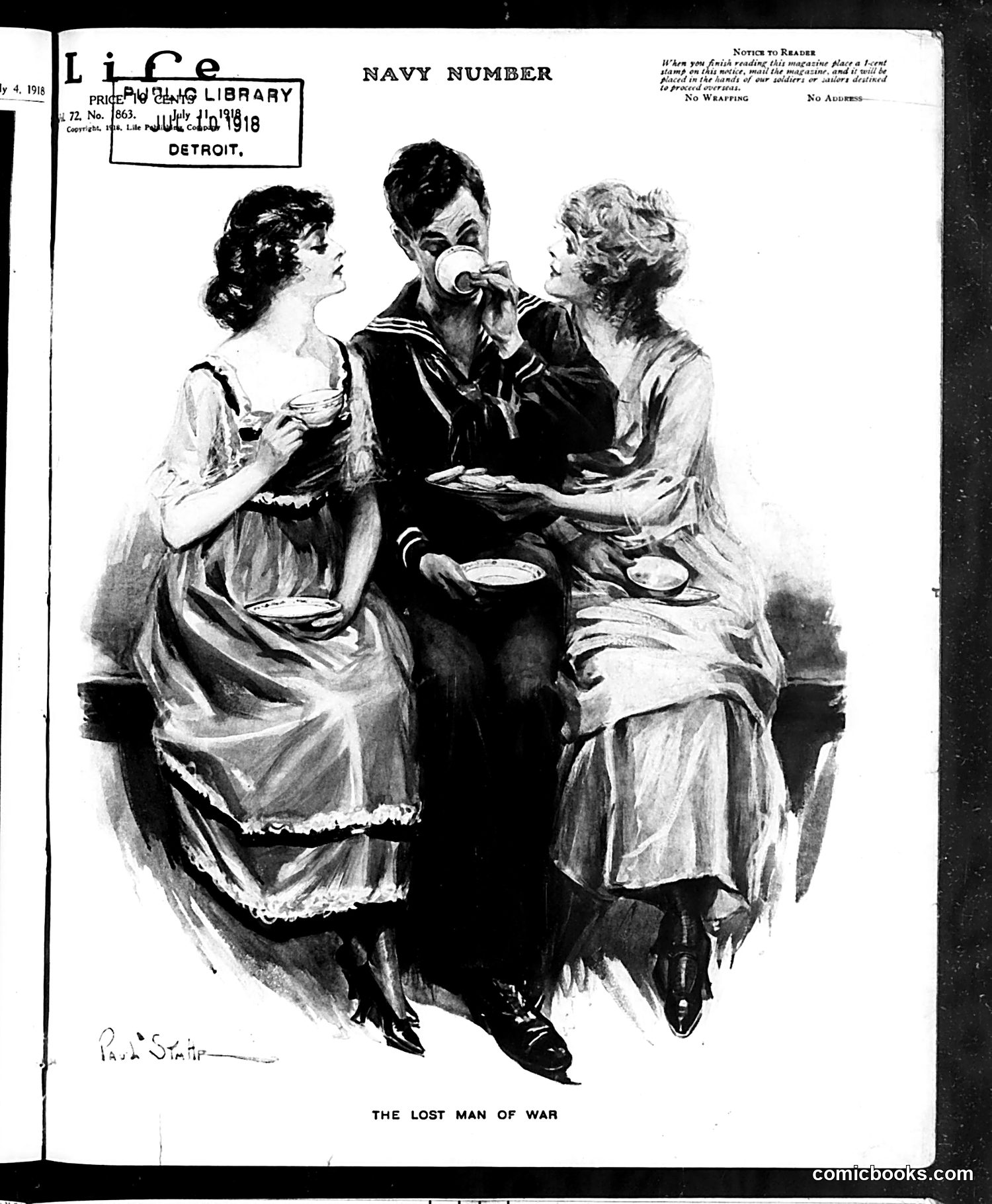
This cartoon depicts a sailor in naval uniform surrounded by two women in domestic dress, all holding teacups. The title "The Lost Man of War" suggests satire about a serviceman's disorientation in civilian, domestic life. The joke likely plays on the contrast between military identity and peacetime domesticity. The sailor appears overwhelmed or confused amid tea service and female attention—imagery associated with genteel home life rather than naval duty. This reflects post-WWI anxieties about soldiers' reintegration into civilian society, suggesting the "lost man" struggles to adjust from warfare to ordinary domestic routines. The 1918 date (visible on the library stamp) confirms this addresses immediate post-war readjustment themes common in contemporary satire.
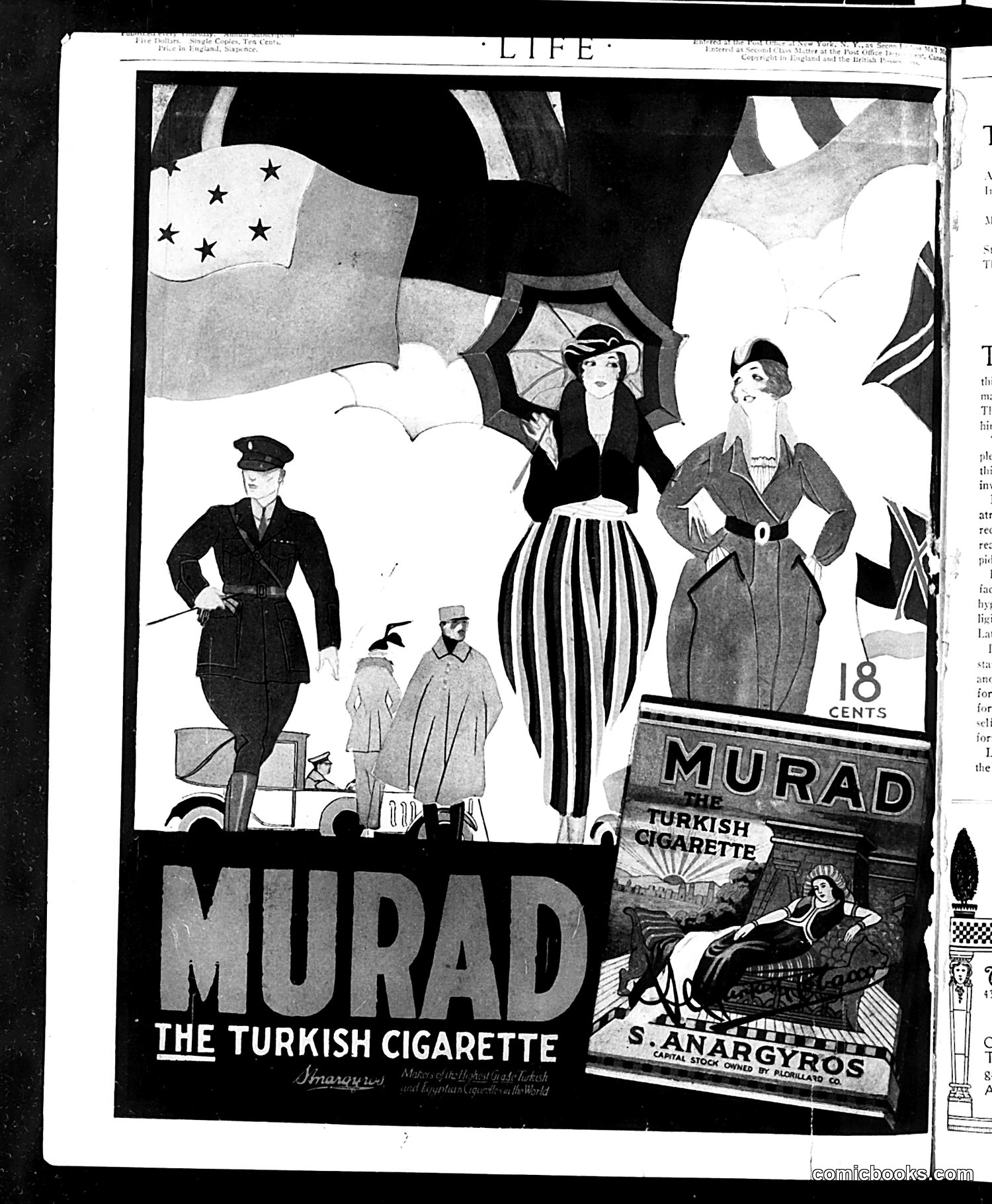
This page is primarily a **Murad cigarette advertisement** rather than political satire. The ad depicts an idealized post-World War I scene of international cooperation and peace. The image shows figures representing different nations—identifiable by flags (American stars visible) and military/diplomatic dress—gathered together under umbrellas in a peaceful, almost festive atmosphere. The composition suggests unity and harmony among formerly warring powers. The advertisement's message leverages post-WWI optimism about international relations and the League of Nations era. By associating Murad Turkish cigarettes with this vision of global peace and cooperation, the brand positioned itself as cosmopolitan and forward-thinking. The "18 CENTS" price and S. Anargyros importer credit date this to the 1920s period.
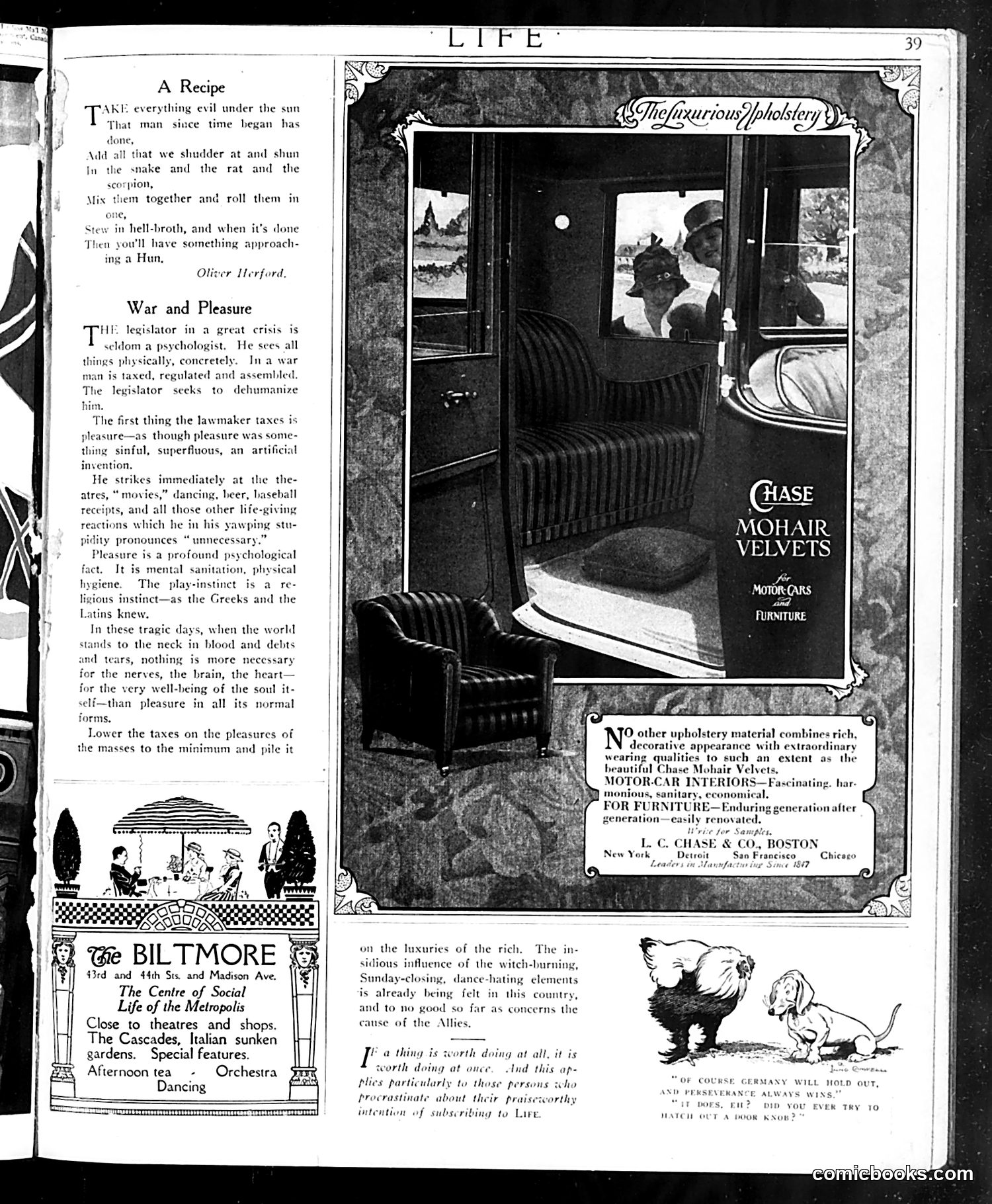
This page is primarily **advertising** rather than satire or political commentary. The dominant feature is a full-page Chase Mohair Velvets advertisement for motor cars and furniture, showing an elegant automobile interior with well-dressed passengers. The left column contains two distinct items: 1. **"A Recipe"** - A dark humorous poem by Oliver Herford about cooking, using unpleasant ingredients (snakes, rats, scorpions) as metaphor—typical of Herford's sardonic style. 2. **"War and Pleasure"** - Political commentary arguing legislators tax "pleasures" (dancing, beer, baseball) as "sinful" inventions, while pleasure is actually necessary for public mental health during wartime. The bottom includes a Biltmore Hotel advertisement and a small cartoon about German perseverance.
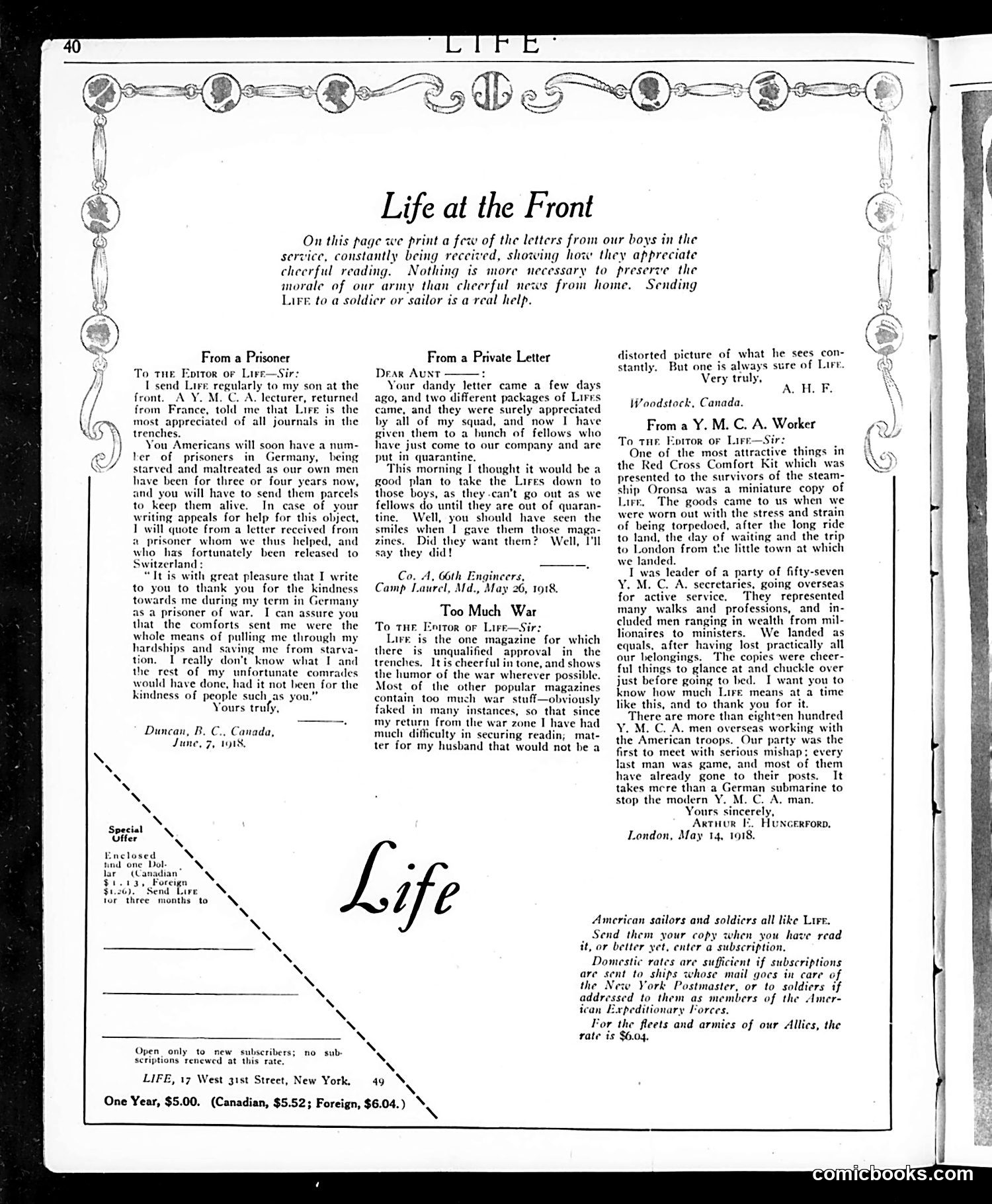
This page is primarily **advertising and letters**, not political satire. The header "Life at the Front" presents **reader letters from WWI soldiers and support workers** (dated May 1918), expressing gratitude for receiving *Life* magazine. A prisoner in Germany thanks the editor for morale support; a Y.M.C.A. worker describes landing troops after their journey; another correspondent praises *Life*'s humor during wartime. The bottom half advertises **Life magazine subscriptions** ($5.00 annually; $5.52 Canadian; $6.04 foreign), targeting American soldiers and sailors overseas. The pitch emphasizes *Life*'s value for morale and entertainment during WWI service. There are no political cartoons visible—this is a wartime morale-boosting testimonial page combined with subscription marketing.
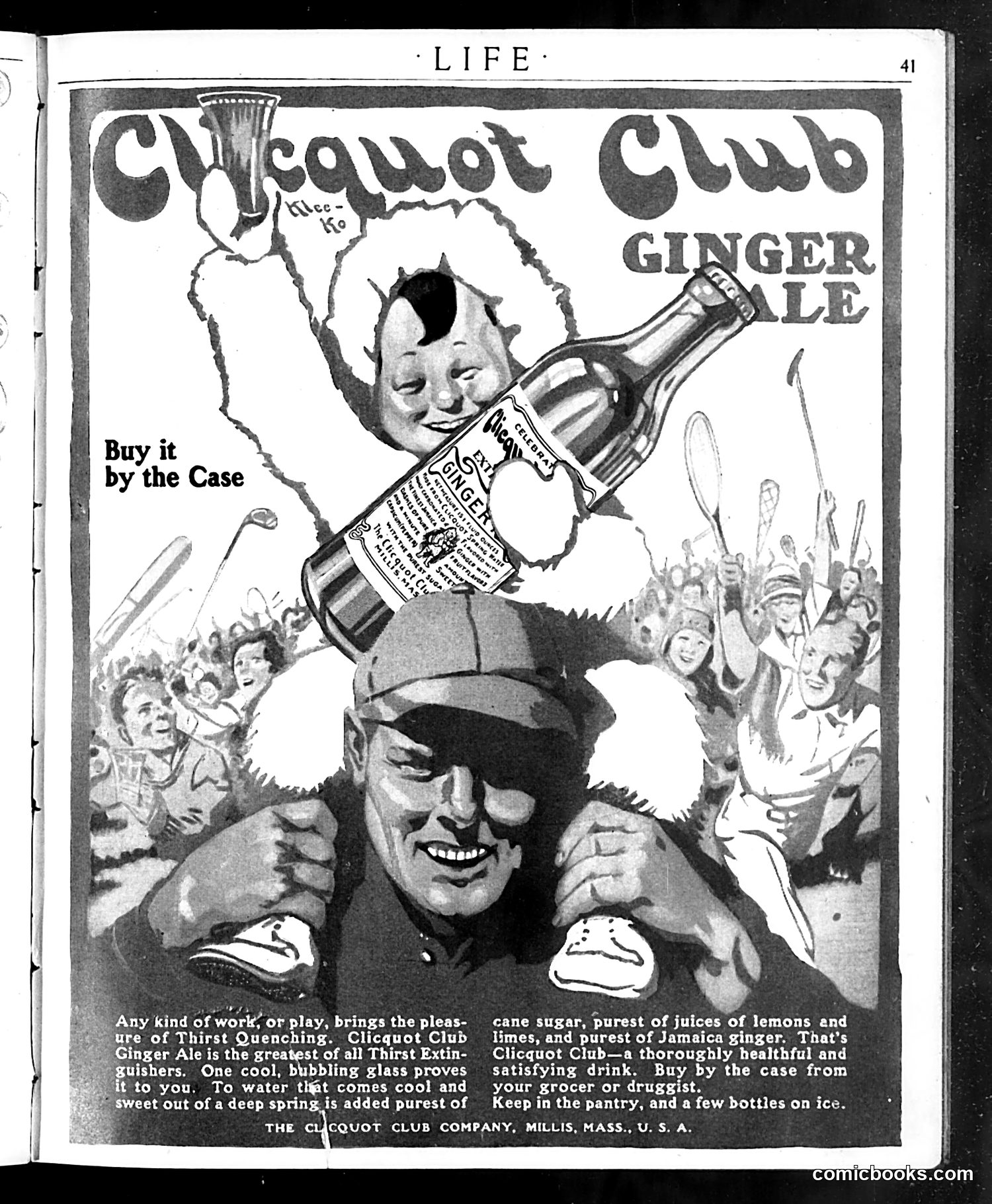
This is a vintage advertisement for Clicquot Club Ginger Ale, not political satire. The ad features a cheerful man holding a bottle aloft while a child sits on his shoulders, surrounded by a celebratory crowd with raised arms. The imagery suggests festive enjoyment and social gathering. The advertisement emphasizes that the beverage is "the greatest of all Thirst Extinguishers," made from cane sugar, lemon juice, lime juice, and Jamaica ginger. The tagline "Buy it by the Case" encourages bulk purchasing for pantry storage. The celebratory scene appears designed to associate the product with happiness, leisure, and communal pleasure—common advertising strategies of this era to market soft drinks as essential to social enjoyment.
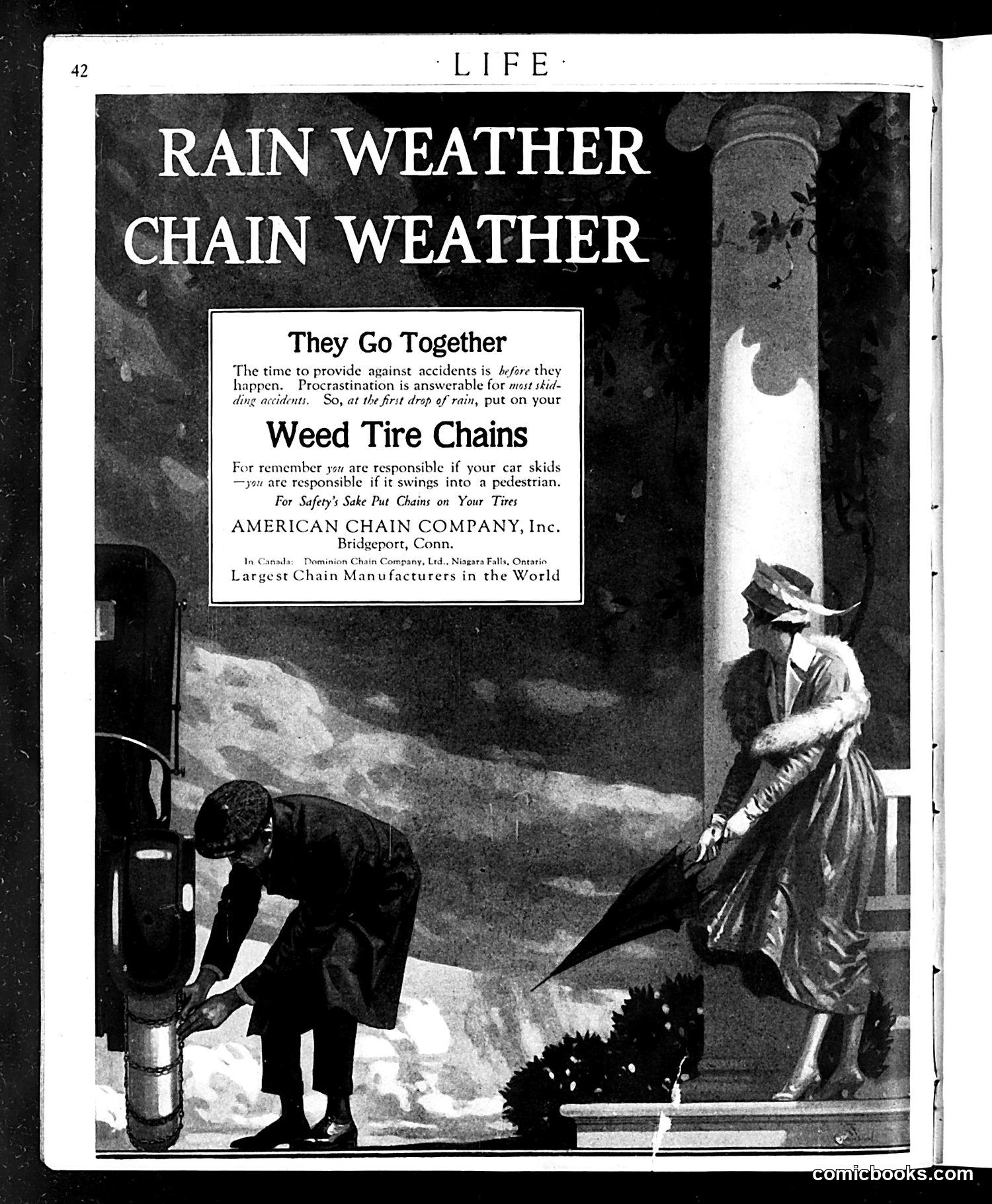
This page is primarily an **advertisement for Weed Tire Chains**, not satire or political commentary. The ad uses a safety-focused message connecting rainy weather to driving hazards. The visual shows a woman observing a man installing tire chains on a car during rain. The advertisement's argument is straightforward: rain causes skidding accidents; therefore, drivers have a responsibility to install chains for safety ("For Safety's Sake Put Chains on Your Tires"). The tagline "Rain Weather Chain Weather—They Go Together" frames tire chains as a necessary safety accessory during wet conditions. This reflects early-automobile-era concerns about vehicle control on slippery roads, before modern tire technology and road infrastructure. The ad emphasizes driver responsibility for public safety, particularly protecting pedestrians from accidents.
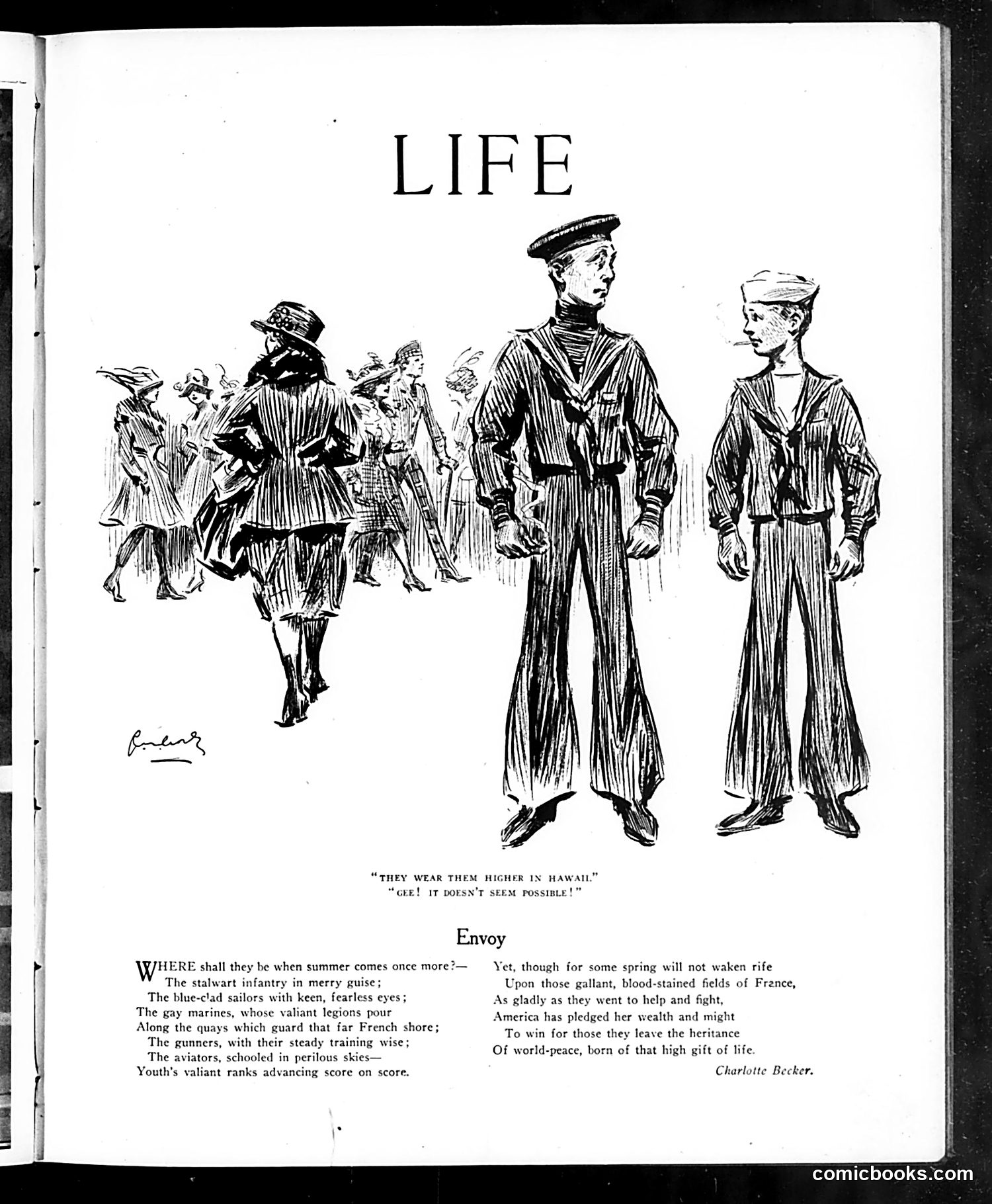
This *Life* magazine page from the World War I era depicts American military personnel—sailors and soldiers in uniform—alongside civilians. The caption "They wear them higher in Hawaii" with the response "Gee! it doesn't seem possible!" appears to be a joke about uniform styles or standards varying by location. The poem "Envoy" by Charlotte Becker addresses soldiers departing for or serving in France, referencing "blood-stained fields" and America's pledge to support the Allied cause. It expresses patriotic sentiment about young men's sacrifice and America's commitment to victory and lasting peace. The overall page reflects American wartime propaganda and morale-building content typical of the 1917-1918 period, celebrating military service.
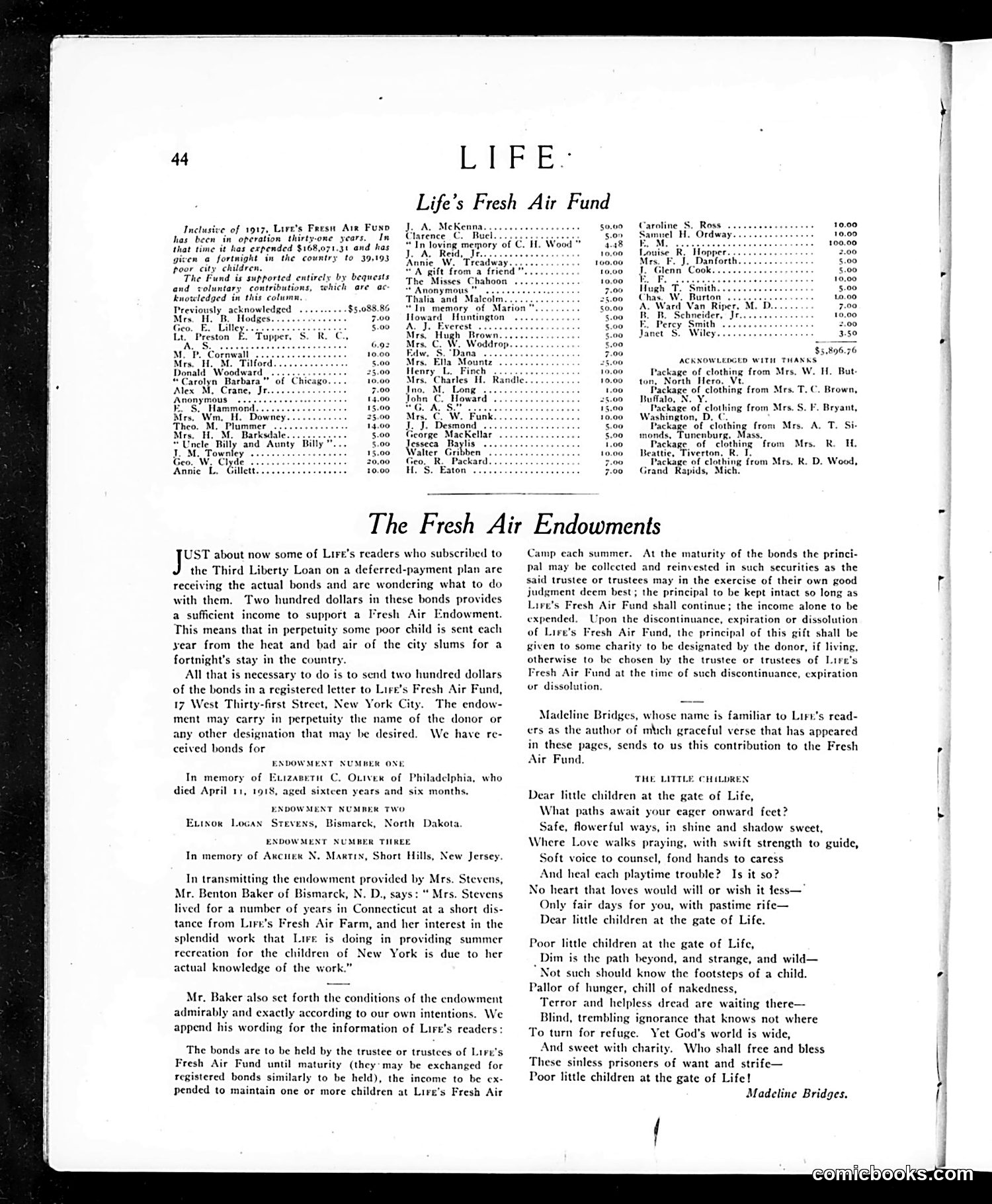
This page from *Life* magazine contains fundraising information and poetry rather than political cartoons. The upper section lists donors to "Life's Fresh Air Fund," a charitable initiative providing summer respite for poor urban children. The text explains that readers who purchased Liberty Loan bonds on a deferred-payment plan can contribute the income to support Fresh Air endowments—a mechanism for wealthy individuals to fund children's country vacations. The lower section features a poem by Madeline Bridges titled "The Little Children," addressing poor urban children with imagery of poverty, hunger, and suffering. The poem appeals for charitable assistance, framing the Fresh Air Fund as a benevolent response to urban deprivation. The page represents early 20th-century American philanthropic messaging rather than satire.
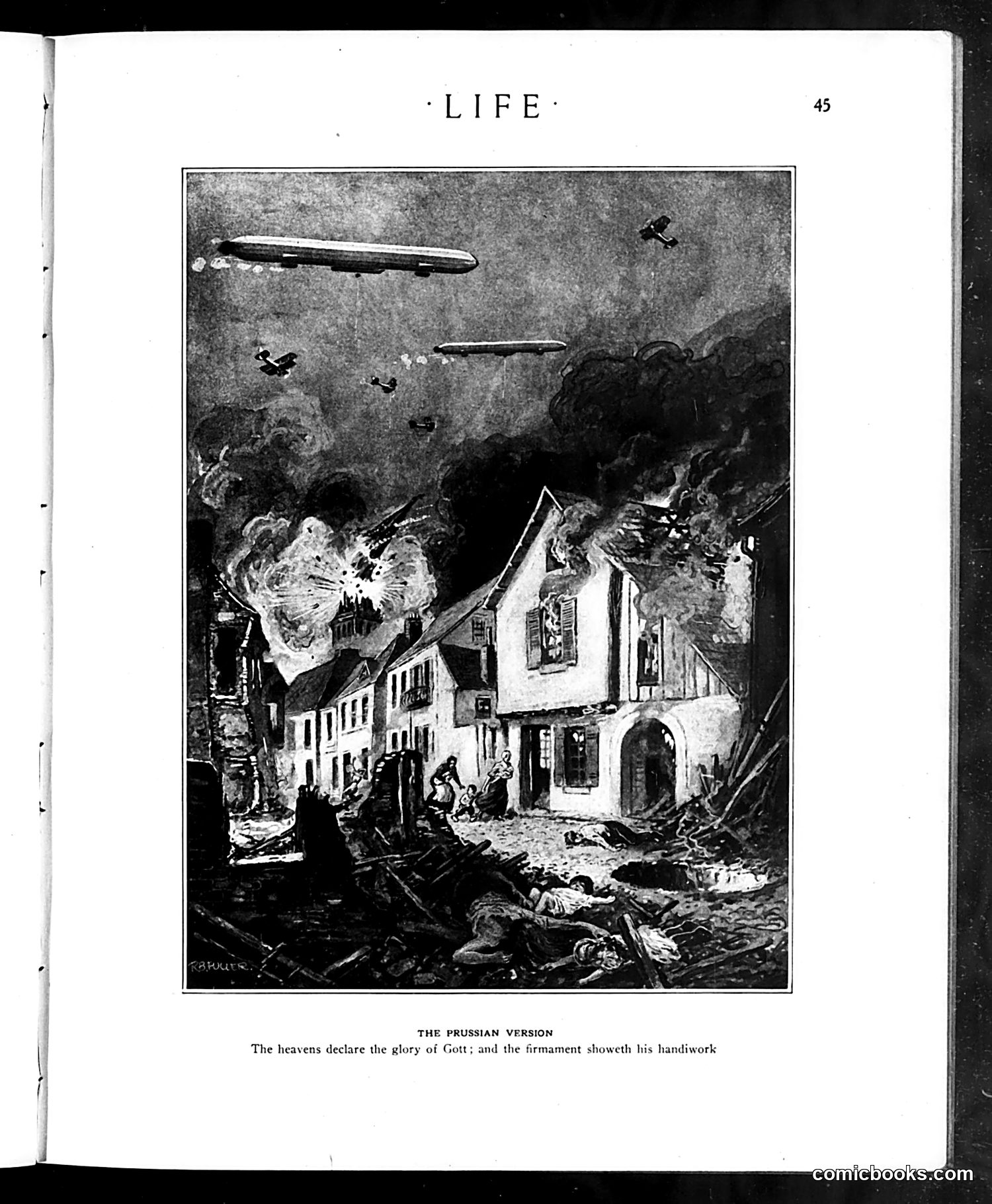
This satirical illustration depicts a bombed town with burning buildings, rubble, and casualties below, while airships and aircraft attack from above. The caption quotes Psalm 19:1—"The heavens declare the glory of God; and the firmament showeth his handiwork"—but applies it mockingly to German aerial bombardment. The satire works by contrasting religious language celebrating divine creation with the destruction of human civilization by modern warfare. This appears to reference German bombing campaigns during World War I, suggesting that Germans cynically invoke God's will to justify civilian casualties and destruction. The "Prussian Version" title implies this represents Prussian/German militarism's perverted interpretation of religious faith.
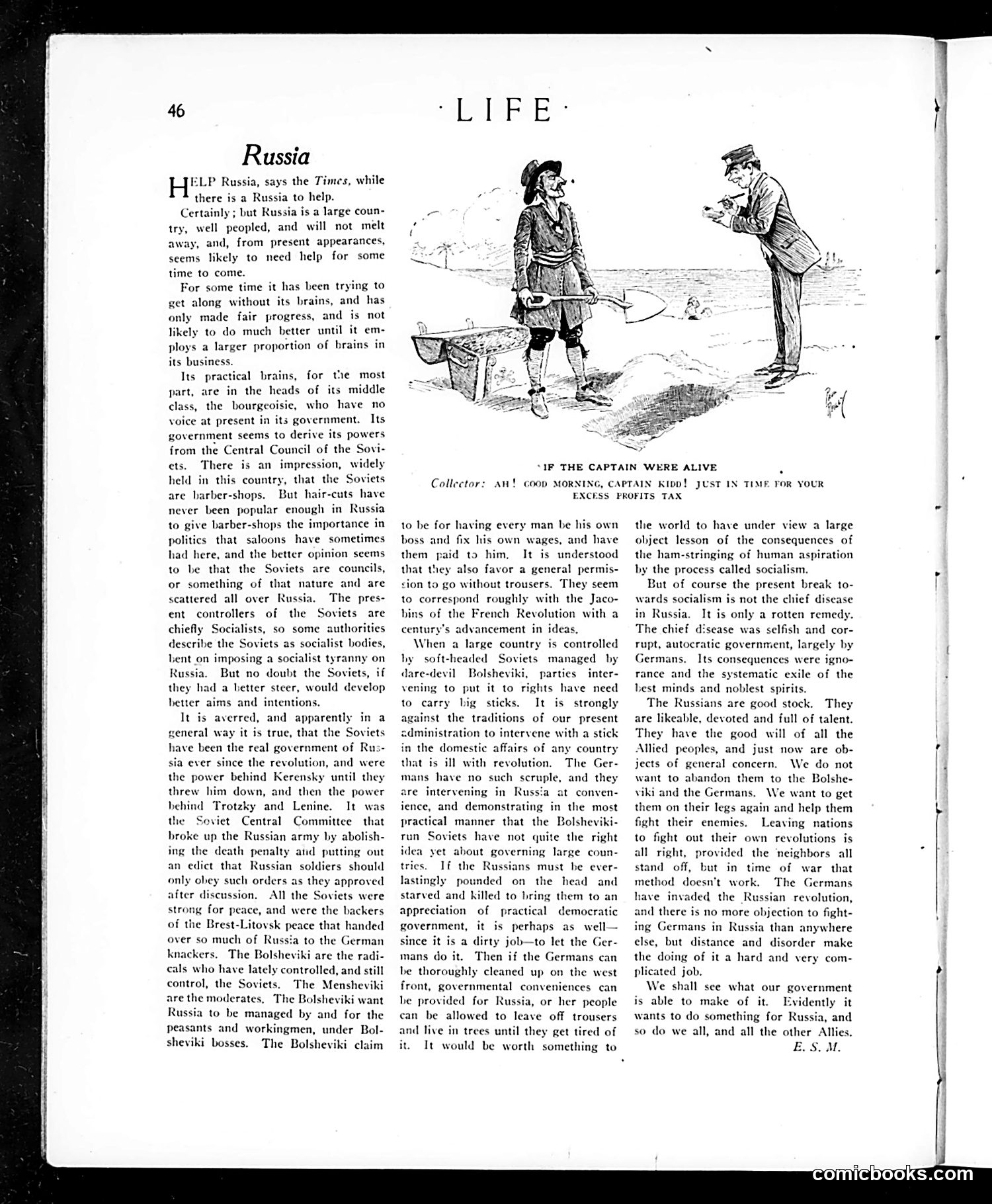
The cartoon depicts a tax collector confronting a Russian peasant, with the caption "IF THE CAPTAIN WERE ALIVE." This appears to be commentary on Russia's post-revolutionary government and taxation policies. The text discusses Russia's need for Western help and critiques both Soviet and German interference in Russian affairs. It argues Russians are "good stock" capable of self-governance, and expresses concern about German influence in Russia following the Bolshevik Revolution. The cartoon likely satirizes the irony that Russia's new Soviet government taxes its peasants as heavily as the old imperial system did—hence the wistful reference to "the captain" (seemingly a figure from the past). The joke suggests revolutionary change has brought little material improvement for ordinary Russians.
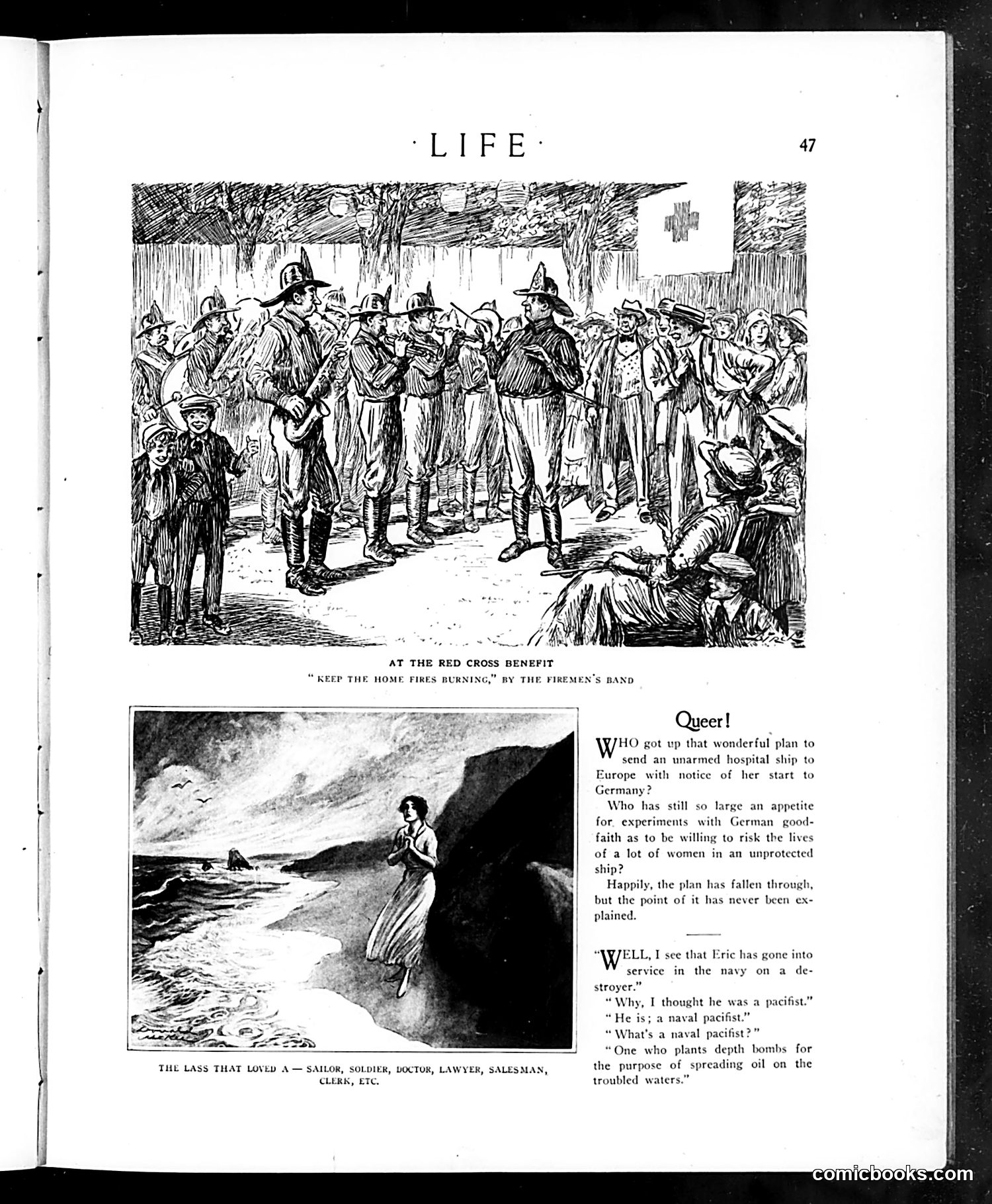
**Top Illustration:** "At the Red Cross Benefit" depicts a military band performing at a fundraising event, with civilians gathered around. This reflects WWI-era charity efforts to support the Red Cross. **Bottom Illustration & Text:** The piece titled "Queer!" satirizes pacifism during wartime. It mocks someone's proposal to send an unarmed hospital ship to Germany, questioning who would risk women's lives on such a venture. The dialogue then shifts to mock "naval pacifists"—those opposed to warfare—defining one as someone who "plants depth bombs for the purpose of spreading oil on the troubled waters." This is wordplay suggesting pacifists contradict themselves by supporting military action. The illustration of a woman at the shore, captioned "The Lass That Loved A," appears unrelated to the main satire.
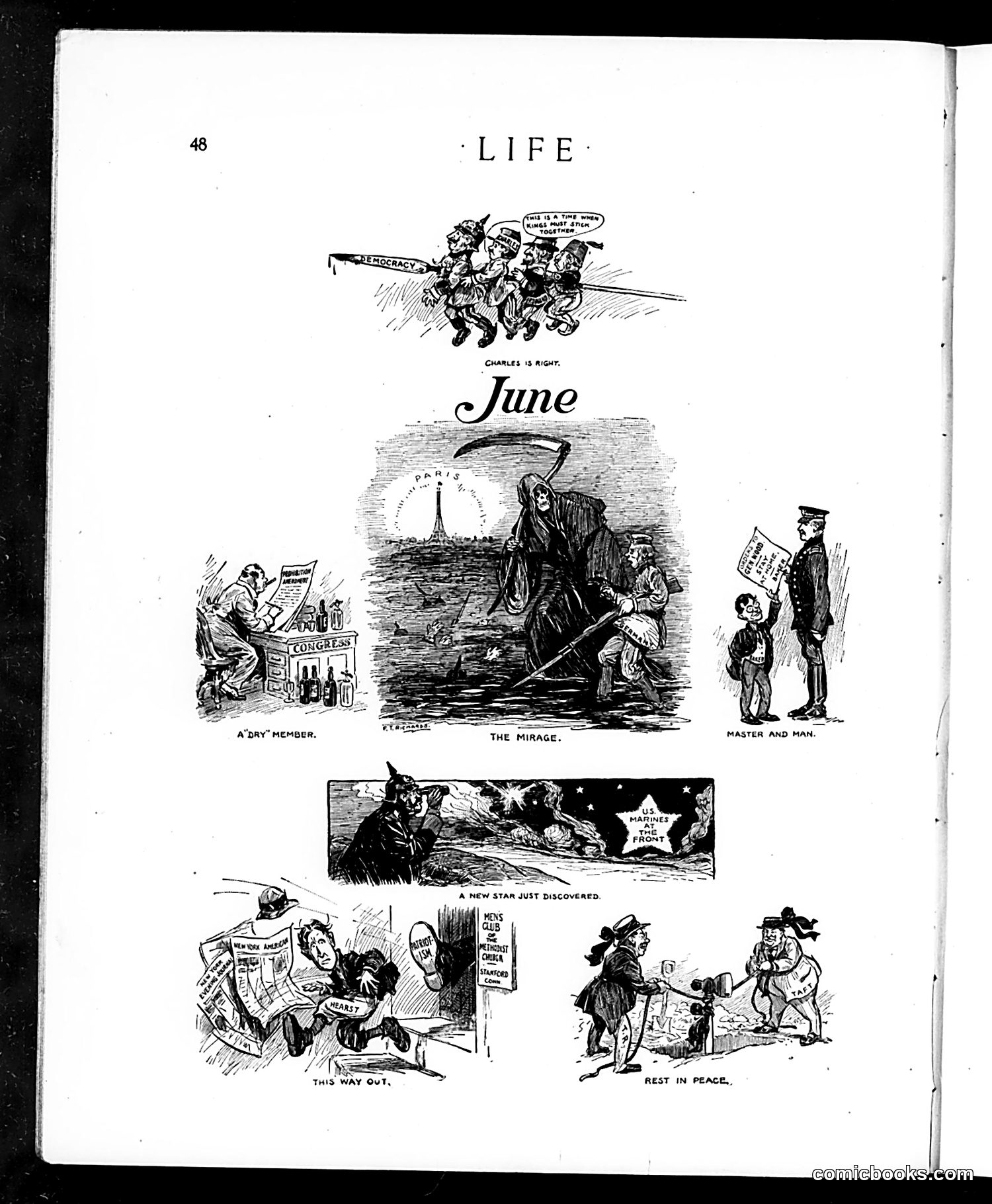
This page contains six political cartoons satirizing events from June (year unclear from image). The top cartoon, "Charles is Right," depicts figures carrying a "Democracy" banner, suggesting debate over democratic governance. "The Mirage" shows Death as a reaper near Paris, likely referencing post-WWI European instability. "A Dry Member" mocks Prohibition-era politics through a Congressional figure. "Master and Man" appears to comment on labor or class relations. "A New Star Just Discovered" references some political surprise or scandal (details unclear). "This Way Out" and "Rest in Peace" use darker imagery—possibly satirizing political defeats or deaths, though specific references aren't evident without additional context about June's contemporary events. The cartoons employ typical Life magazine satire: allegorical figures, exaggerated caricature, and dark humor addressing current affairs.
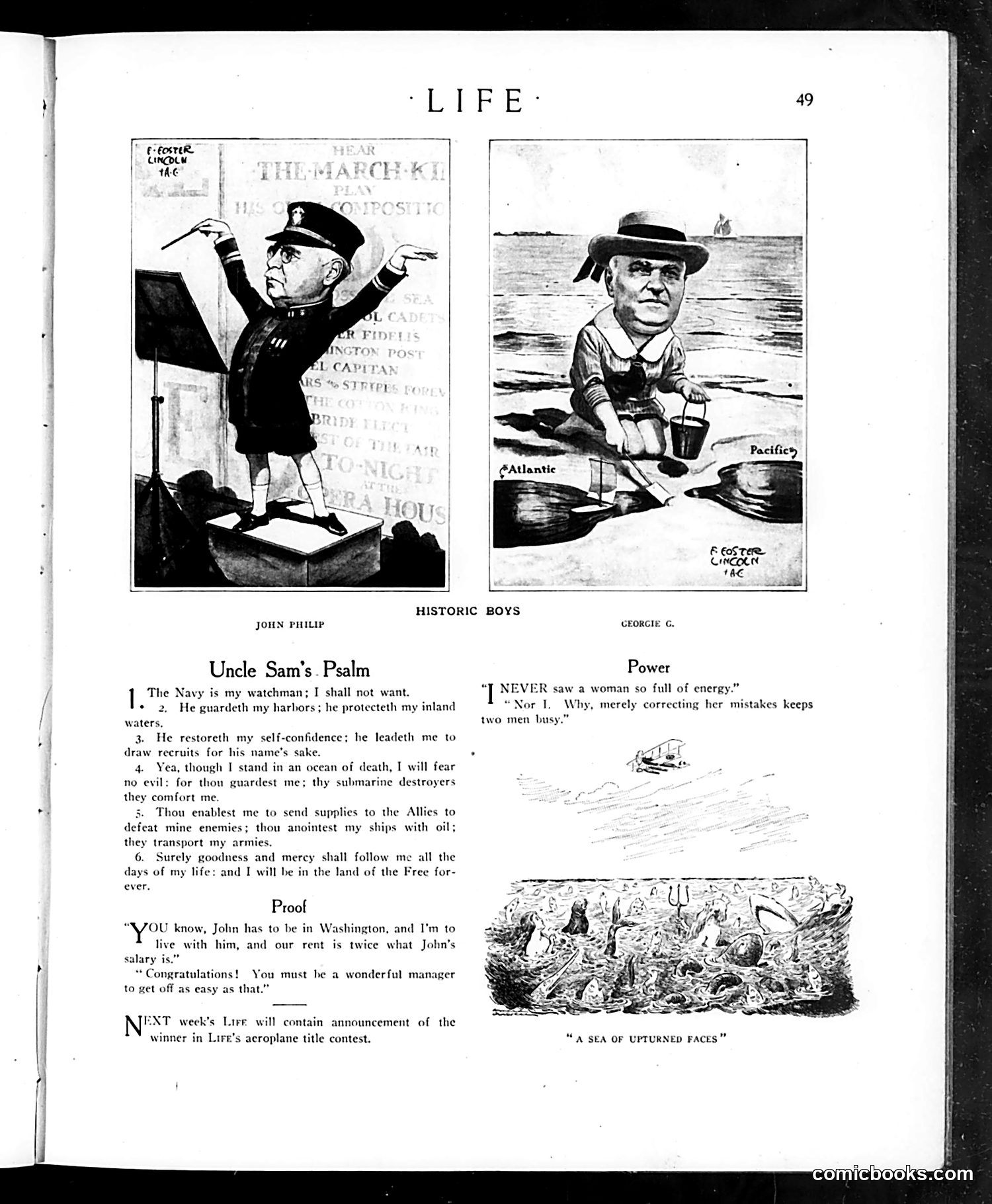
This page contains WWI-era political cartoons titled "Historic Boys." The left cartoon shows "John Philip" (likely John Philip Sousa, the famous bandleader) conducting energetically, captioned "Uncle Sam's Psalm"—a patriotic reference to his role promoting American military causes. The right cartoon depicts "George G." (likely a naval or military figure) rowing between "Atlantic" and "Pacific," suggesting American naval power spanning both oceans. The satirical text sections mock domestic wartime management and military logistics. "Power" humorously suggests women's energy during wartime, while "Proof" jokes about military salary and management efficiency. The lower illustration, "A Sea of Upturned Faces," depicts crowds, likely referencing public support or recruitment efforts. The cartoons celebrate American military leadership and preparedness during World War I.
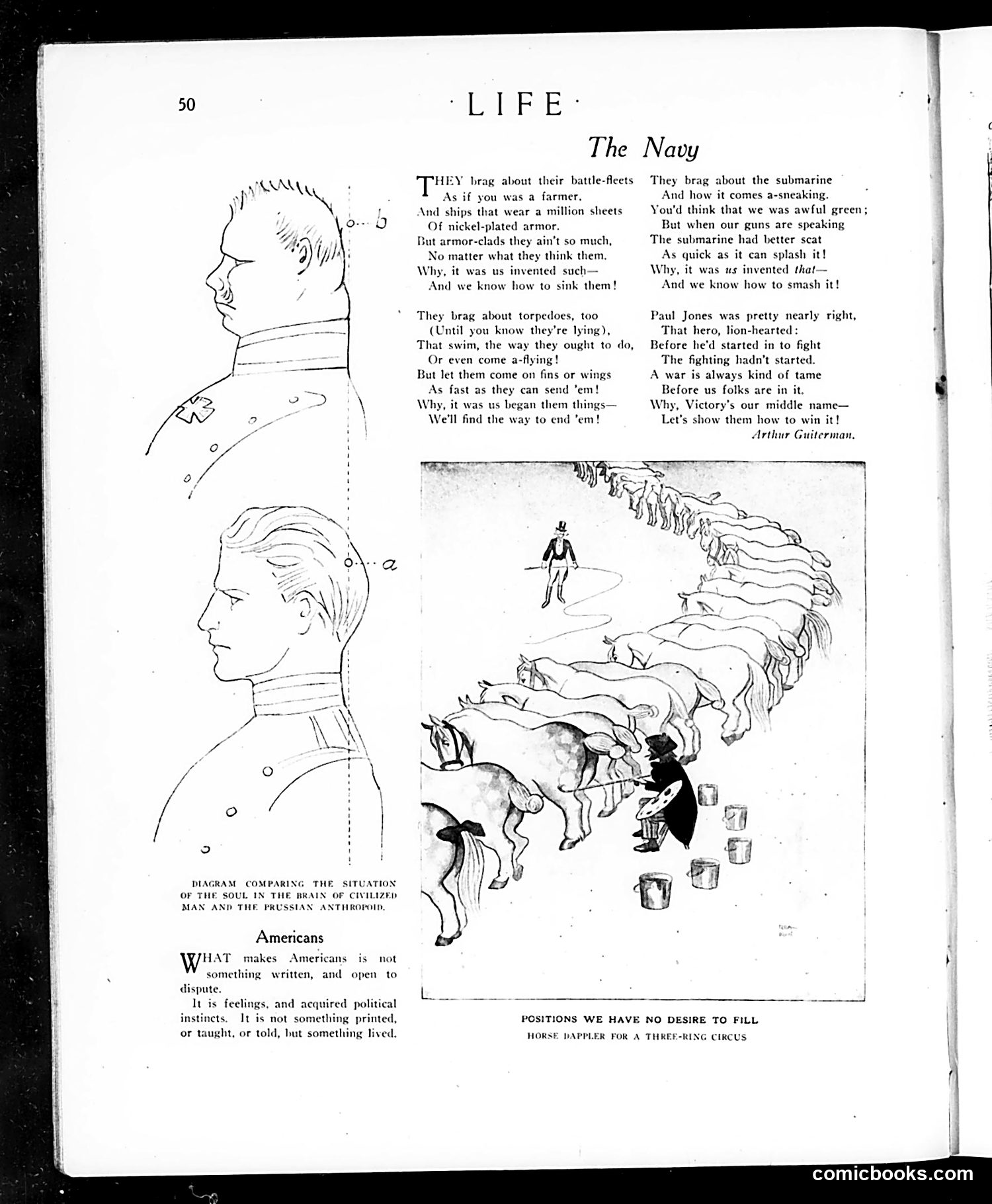
This page contains anti-German WWI propaganda. The poem "The Navy" boasts about American naval superiority, mocking German claims about their "battle-fleets" and "submarines." It asserts American confidence in sinking German vessels and submarines, attributing this to superior American naval tactics ("we know how to sink them"). The cartoon below depicts a German military officer (identifiable by uniform) leading a line of horses toward what appears to be military supply containers. The caption "POSITIONS WE HAVE NO DESIRE TO FILL: HORSE DAPPLER FOR A THREE-WING CIRCUS" sarcastically suggests Germans are fit only for circus work—a contemptuous jab at German military competence. The "Americans" section discusses American character as instinctive rather than learned. This reflects American wartime morale-building and anti-German sentiment.
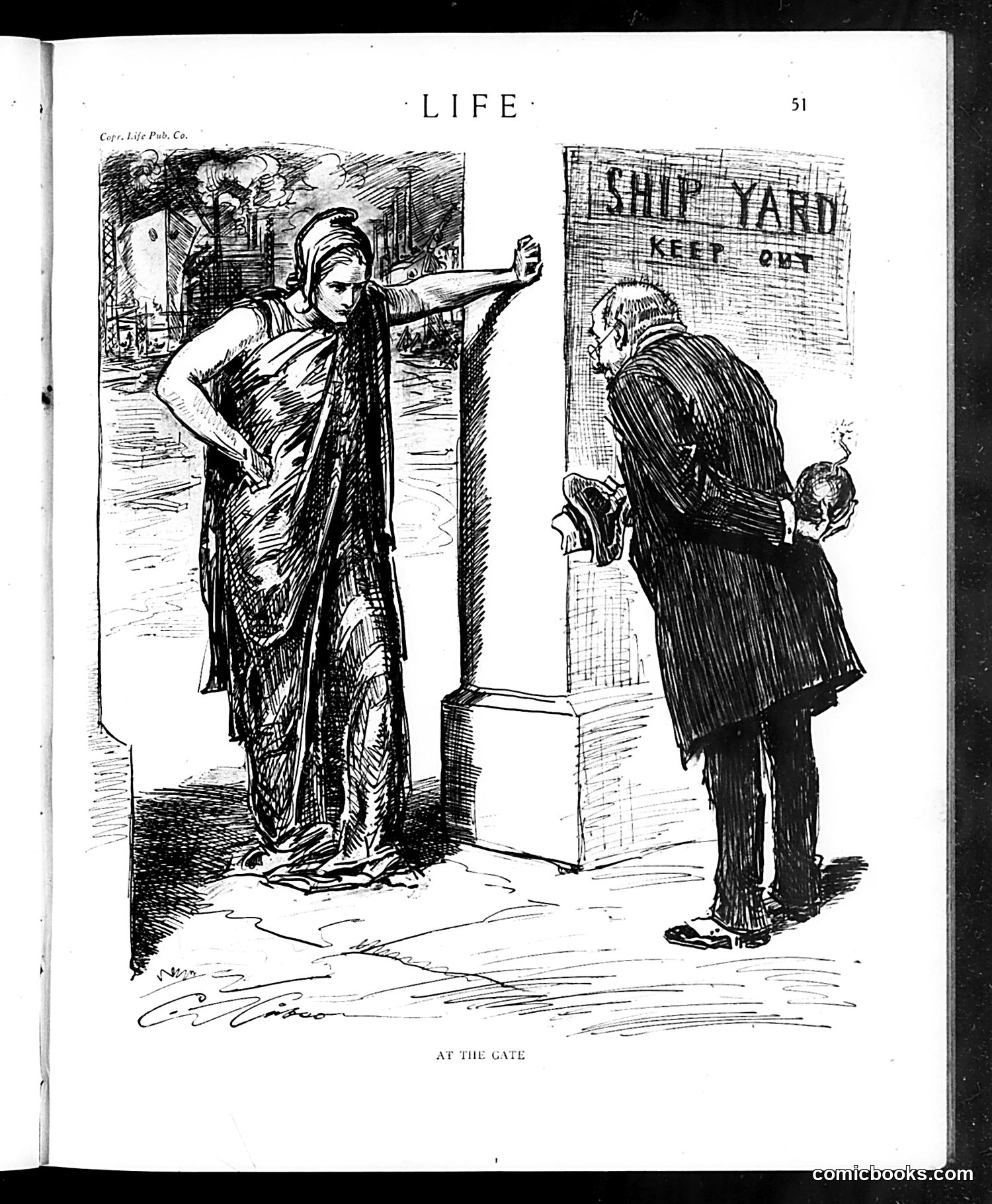
This single-panel cartoon satirizes class divisions and exclusionary practices. A woman in elaborate dress and headwrap stands at a gated entrance marked "SHIP YARD KEEP OUT," gesturing dismissively at a working-class man in worn coat and bowler hat who appears to be seeking entry. The satire likely critiques either: labor disputes of the era (restricting workers from shipyards), or more broadly, the absurdity of rigid class barriers—a wealthy or fashionably-dressed woman preventing a common laborer from accessing work. The "Keep Out" sign emphasizes how access was controlled and who was deemed acceptable in industrial spaces. The cartoon's point appears to be mocking either class pretension or the contradictions of labor exclusion policies.
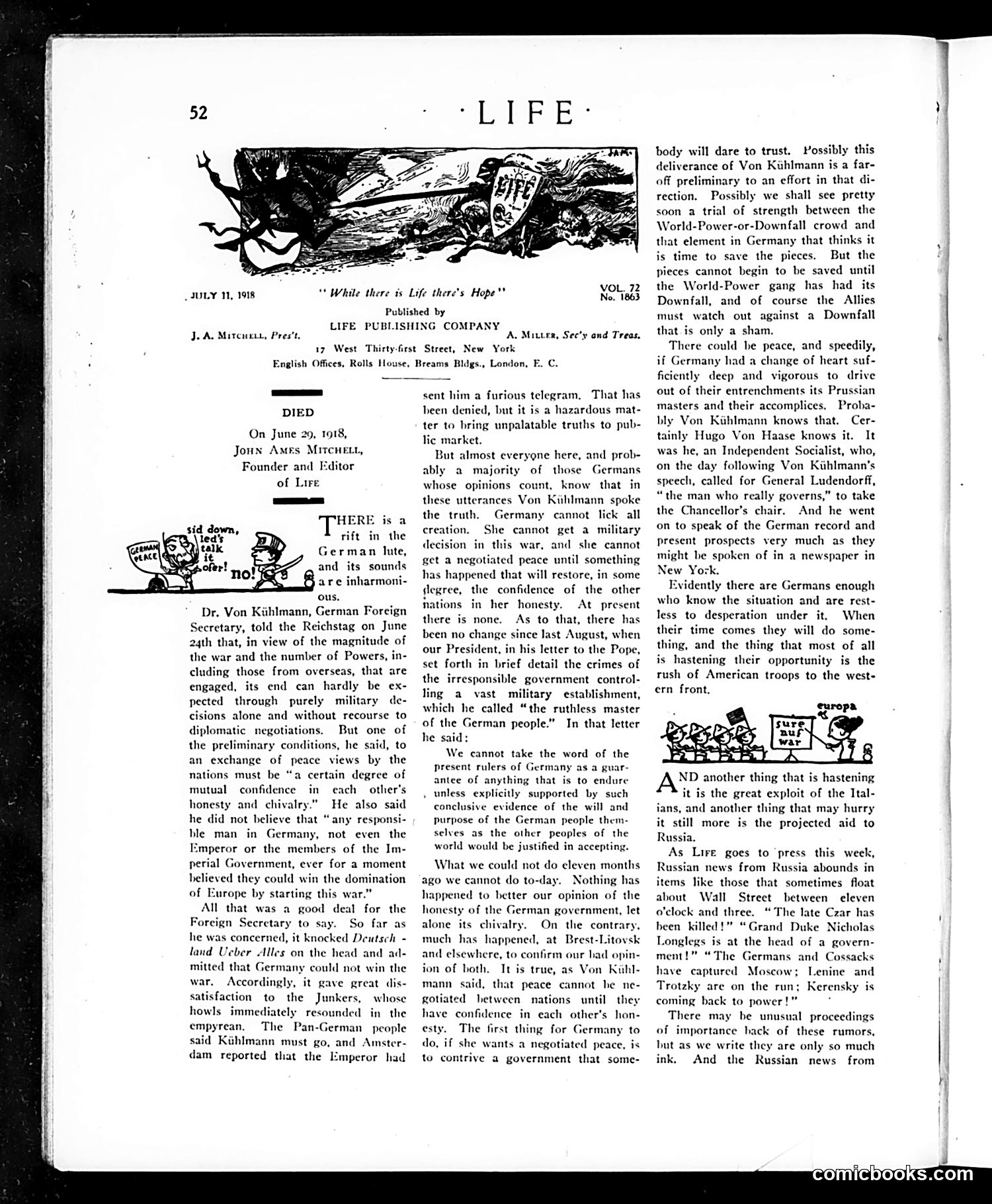
This editorial page commemorates John Ames Mitchell, Life's founder, who died June 29, 1918. The main content analyzes German Foreign Secretary Von Kühlmann's recent speech to the Reichstag acknowledging Germany cannot win WWI militarily and needs negotiated peace. The satirical point: Von Kühlmann spoke uncomfortable truths—that Germany cannot achieve total victory and requires mutual confidence for peace negotiations. This angered German militarists (the "Pan-German people" and Junkers), who reportedly demanded his removal via an angry imperial telegram. Life's position supports Von Kühlmann's realism while dismissing German credibility. The magazine argues Germany's government has proven dishonest through actions at Brest-Litovsk, making peace impossible until Germans replace their current rulers with a trustworthy government. The cartoon depicts a broken German lute (symbolizing discord), illustrating the "rift in the German lute" phrase—a metaphor for internal conflict between war-hawks and peace advocates within Germany.
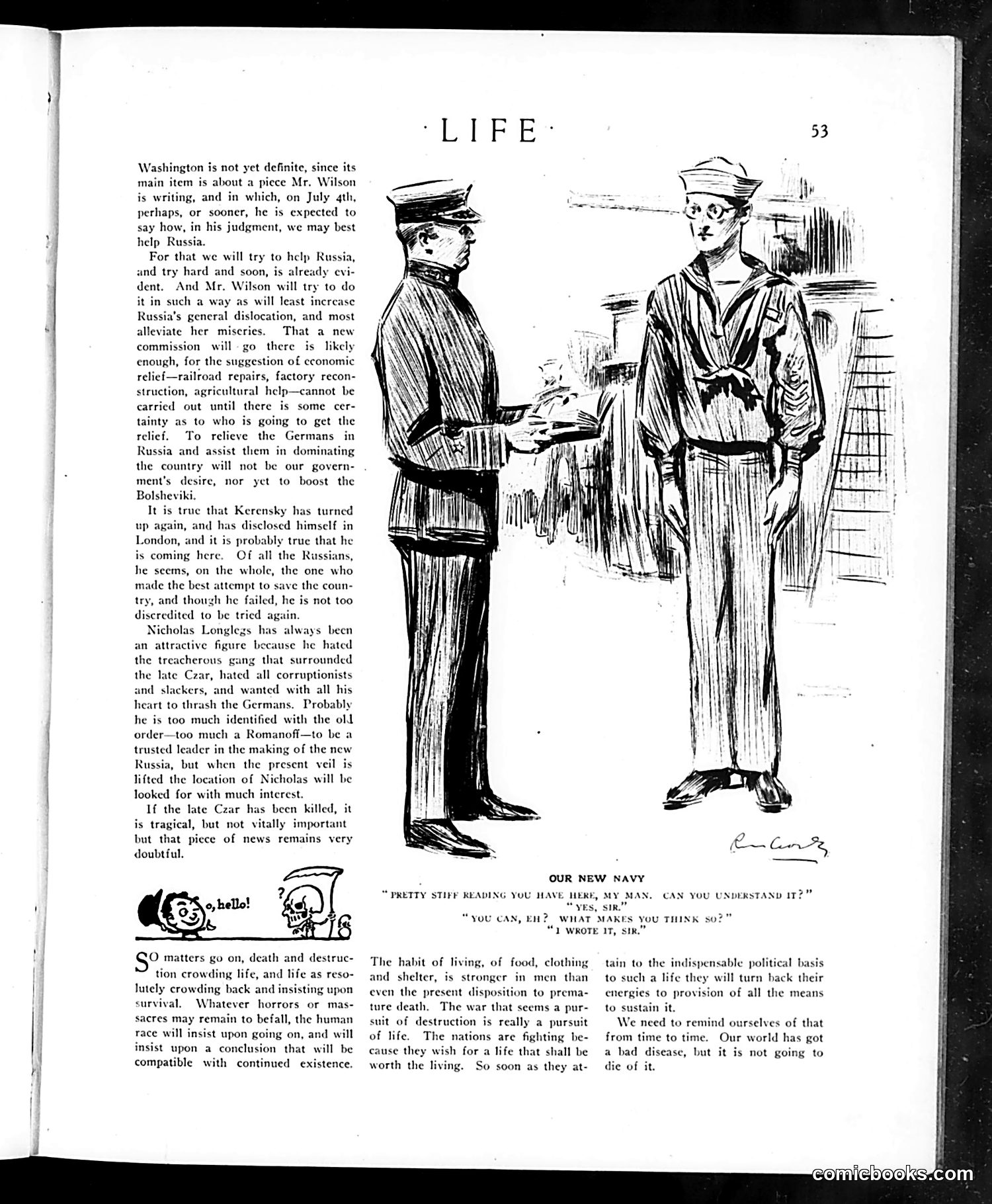
This page discusses American policy toward Russia during World War I, specifically President Wilson's anticipated statement on aid to Russia (expected July 4th). The text references key Russian political figures: Kerensky (who "turned up again" in London—a former provisional government leader), and "Nicholas Longlegs" (apparently a nickname for someone identified with the old imperial order, though the reference is unclear). The cartoon labeled "OUR NEW NAVY" depicts two naval officers. One asks if the other understands a document marked "PRETTY STIFF READING." The joke hinges on the second officer's reply: "I WROTE IT, SIR"—satirizing military bureaucratic writing as incomprehensible even to its own author. This is classic workplace satire about obfuscatory official prose. The broader article argues that despite war's destructiveness, human survival instinct will ultimately drive nations toward sustainable peace and reconstruction rather than endless conflict.
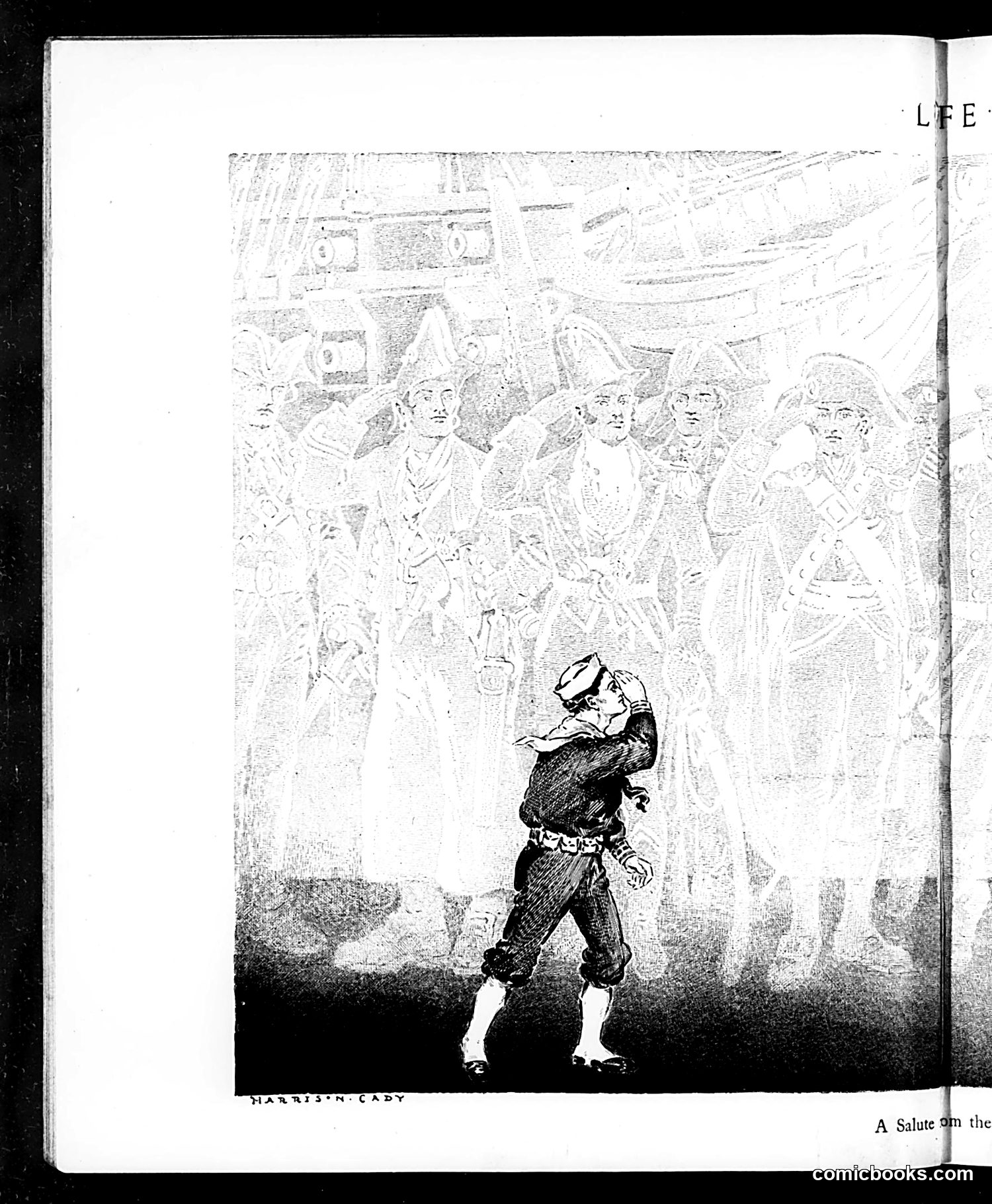
This Life magazine page features a cartoon by Harrison Cary titled "A Salute on the..." (title cut off). The image shows a single figure in dark formal clothing and a hat, appearing to salute or gesture upward toward a faded background scene depicting multiple figures in period dress. The cartoon likely contains political or social satire, though without the complete caption, the specific reference is unclear. The contrast between the bold, dark figure in the foreground and the faint historical scene behind suggests commentary on how a contemporary figure relates to past events or traditions. The salute gesture implies respect, mockery, or ironic commentary on authority or historical precedent.
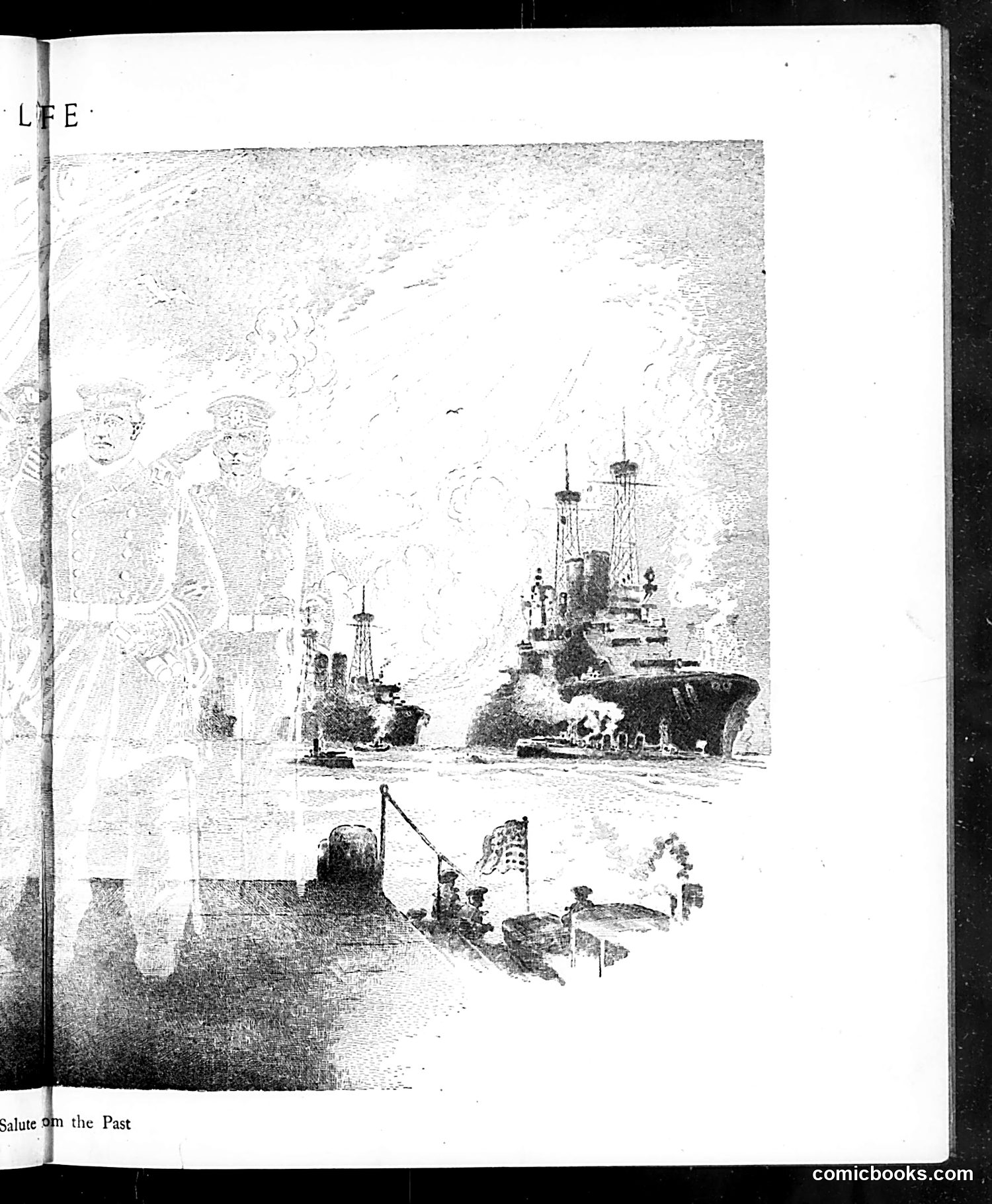
This page from *Life* magazine shows a maritime scene titled "Salute to the Past." The illustration depicts two large military warships in a harbor, with smaller vessels nearby and figures in the foreground. One figure appears to be saluting or gesturing toward the ships. The title suggests this is a nostalgic or commemorative image, likely referencing naval history or a specific maritime event. Without additional context about the publication date or caption details, the exact historical reference remains unclear—it could reference a naval anniversary, warship decommissioning, or similar maritime tribute. The artistic style and reproduction quality suggest early 20th-century publication.
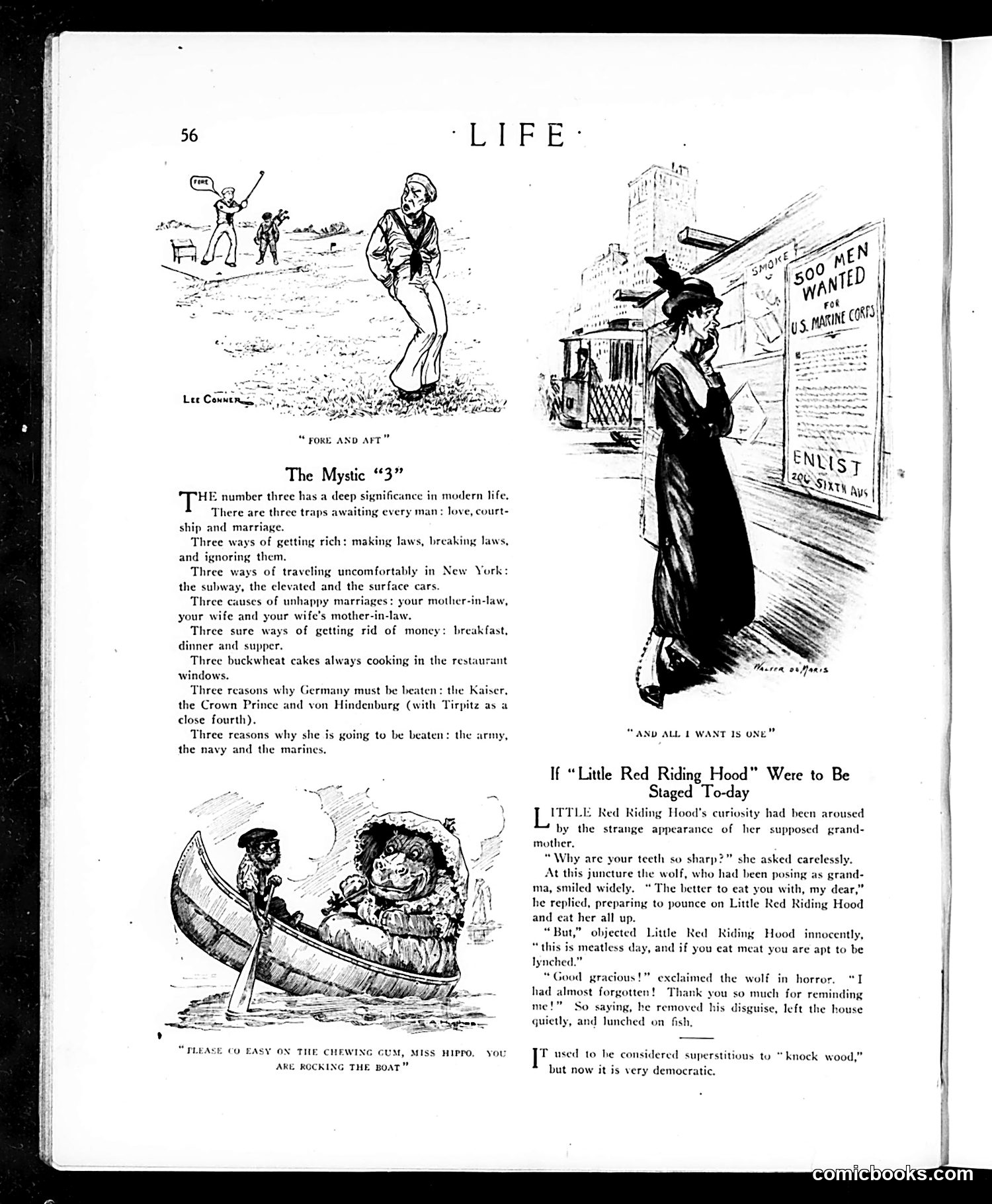
**"Fore and Aft" (top left):** A humorous sketch by Lee Conrey showing slapstick physical comedy—two figures engaged in exaggerated action, likely meant as visual contrast to the text. **"The Mystic '3'" (center-left):** A satirical list of things that come in threes, mixing serious and trivial observations. Notably, it references World War I: three reasons Germany must be defeated are "the Kaiser, the Crown Prince and von Hindenburg (with Tirpitz as a close fourth)"—identifying Germany's military leadership as enemies the U.S. must defeat. **Recruitment poster (top right):** A woman reads a "500 Men Wanted for U.S. Marine Corps" enlistment poster, captioned "And All I Want Is One"—wartime satire about women's romantic priorities during military recruitment. **"Little Red Riding Hood" parody (bottom):** A modernized fairy tale where the wolf hesitates to eat Red Riding Hood because it's "meatless day" (WWI food rationing), choosing fish instead. This mocks civilian wartime sacrifice and rationing measures through absurdist humor. The page satirizes American WWI-era concerns: military leadership, recruitment, and home-front rationing.
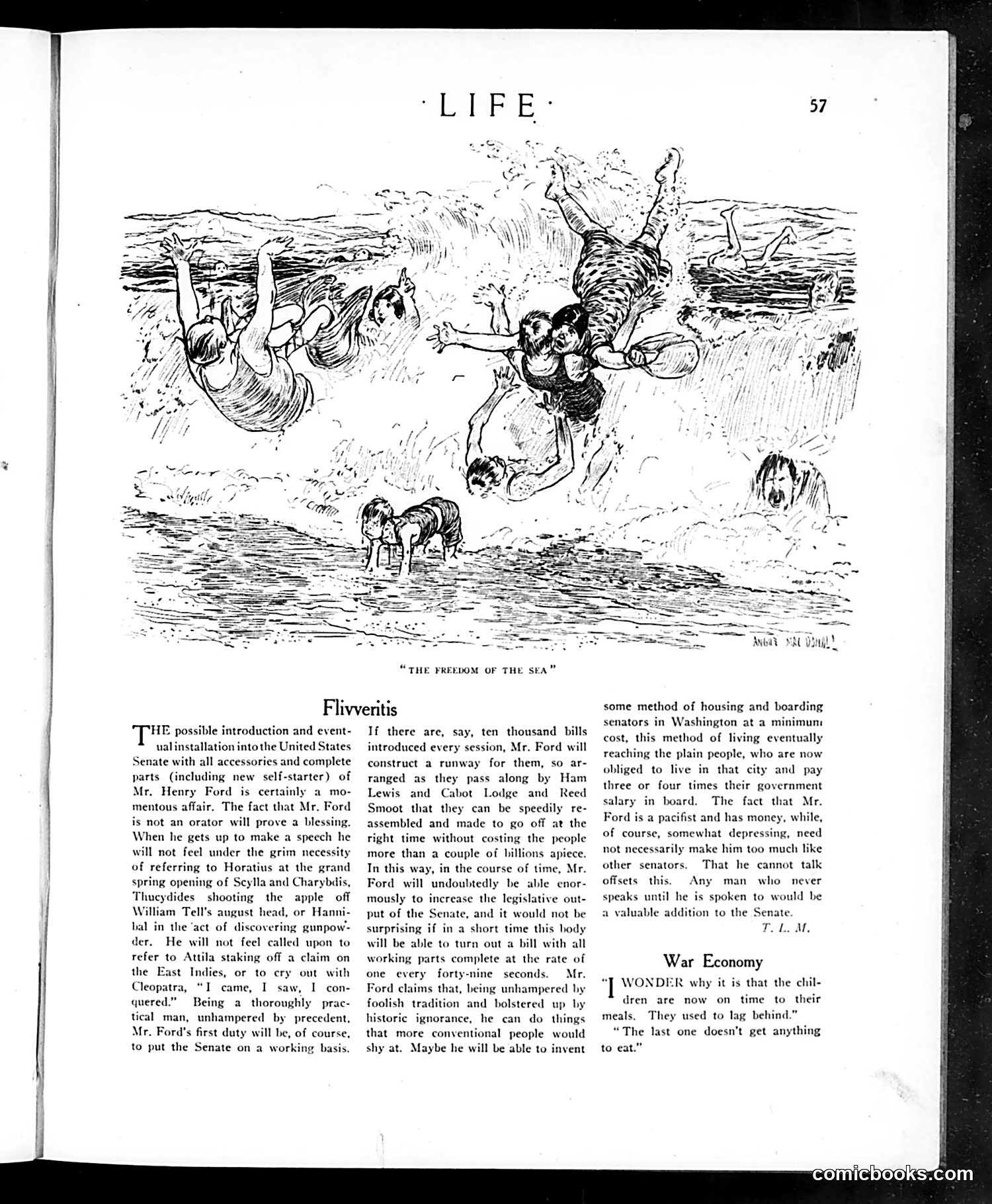
**The Main Cartoon:** This sketch depicts people playing freely in shallow water—a simple scene of leisure and pleasure, illustrating the concept of "freedom of the sea." **"Fliventis" Section:** This is satirical commentary on Henry Ford's potential entry into the U.S. Senate. The text mocks Ford as a practical industrialist ("thorougly practical man") who would apply factory efficiency to Congress—suggesting he'd streamline legislative processes with assembly-line methods, turning out bills mechanically. The satire ridicules both Ford's presumed lack of oratorical skill and the Senate's inefficiency, while implying Ford's industrial genius cannot solve governmental dysfunction. **"War Economy" Section:** This brief dialogue satirizes wartime food rationing, where children now eat on schedule rather than at leisure. The darkly comic punchline—"The last one doesn't get anything to eat"—suggests the severity of scarcity or reflects anxieties about resource allocation during what appears to be WWI-era rationing. The page uses gentle, ironic humor to critique both industrial-era problem-solving and wartime hardships.
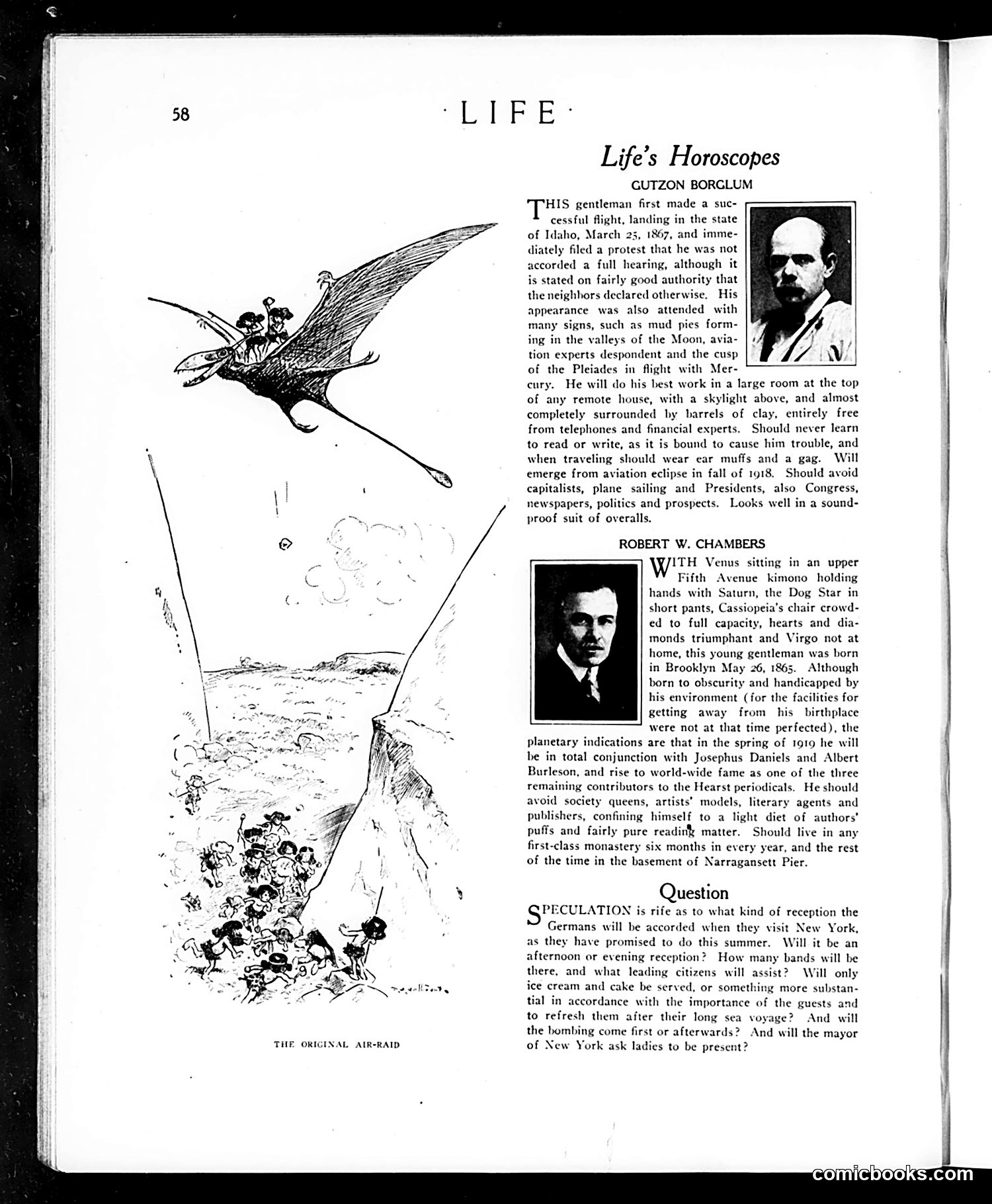
This page from *Life* magazine contains political satire about prominent figures through mock "horoscopes." **"The Original Air-Raid"** cartoon depicts an early aviation accident, likely referencing the novelty and danger of early flight around 1867. The **horoscopes** mock sculptor **Gutzon Borglum** and writer **Robert W. Chambers** with absurdist "astrological predictions." The Borglum entry satirizes his eccentricity and reclusiveness, suggesting he work in isolation surrounded by clay barrels. The **Chambers entry** references contemporary political figures—**Josephus Daniels** (Secretary of the Navy) and **Albert Burleson** (Postmaster General)—predicting Chambers will gain fame through association with Hearst publications. The satire mocks his obscure status and suggests monastery living. **"Question"** section sarcastically addresses German diplomatic visits to New York during WWI, darkly joking about receptions while asking whether "bombing" would come "first or afterwards"—biting commentary on German-American tensions and anti-German sentiment during the war.
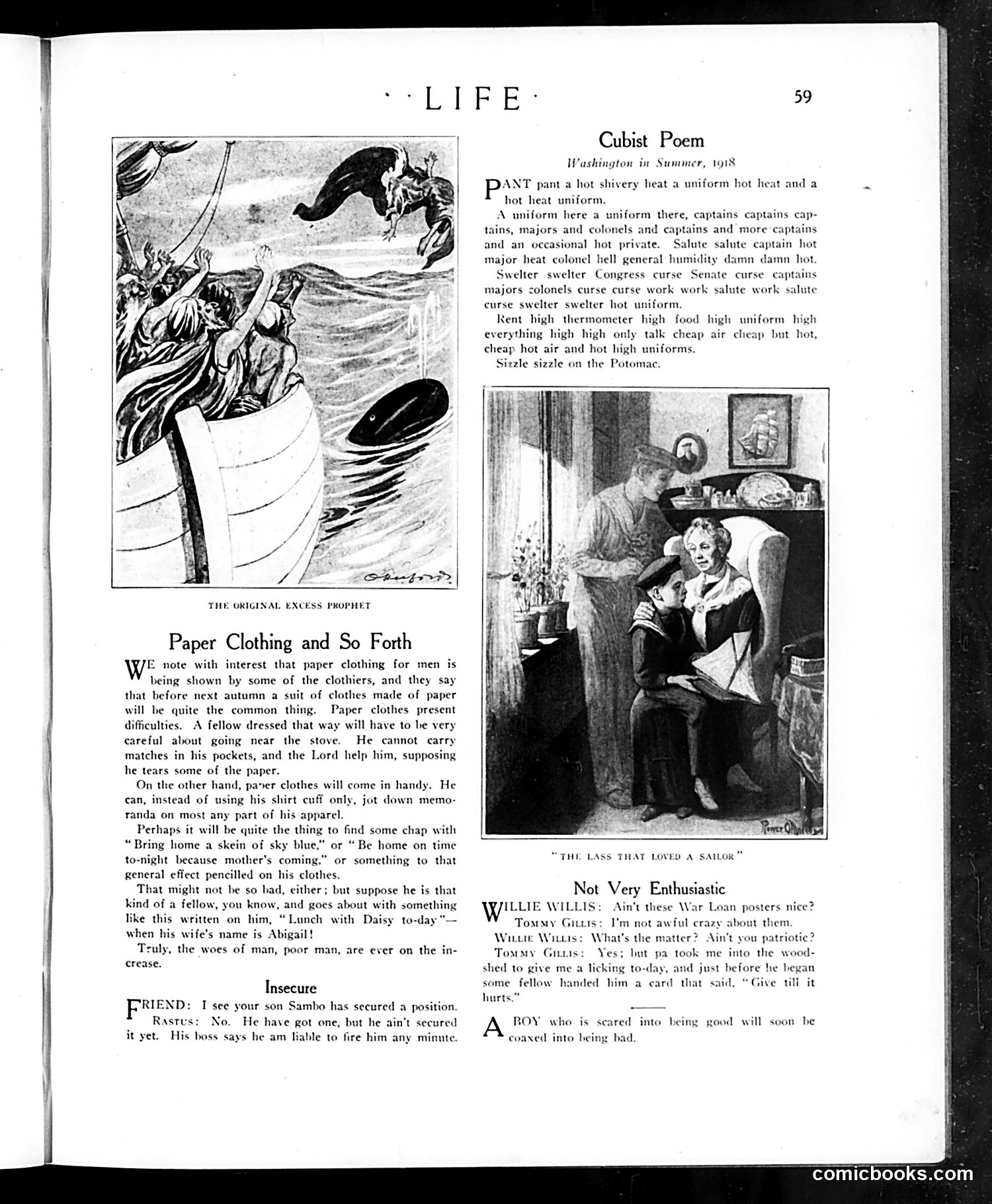
This page satirizes early-20th-century American anxieties and absurdities. The main article mocks the then-emerging fashion of paper clothing, imagining ridiculous consequences: a man catching fire near a stove, tearing his outfit, or—most scandalously—accidentally writing "Lunch with Daisy to-day" on his clothing when married to Abigail, creating domestic chaos. The "Cubist Poem" parodies both modernist poetry and Washington, D.C. summers during WWI (1918), using fragmented, repetitive language ("pant pant," "hot heat," "curse curse") to satirize the oppressive heat, overcrowded military officers, and wartime inflation affecting the capital. The lower dialogues mock wartime patriotism: Tommy Gillis acknowledges War Loan posters exist but admits indifference; his father then beats him, only to be interrupted by someone handing him a patriotic card—the satire being that enforced patriotism through fear and propaganda proves hollow.
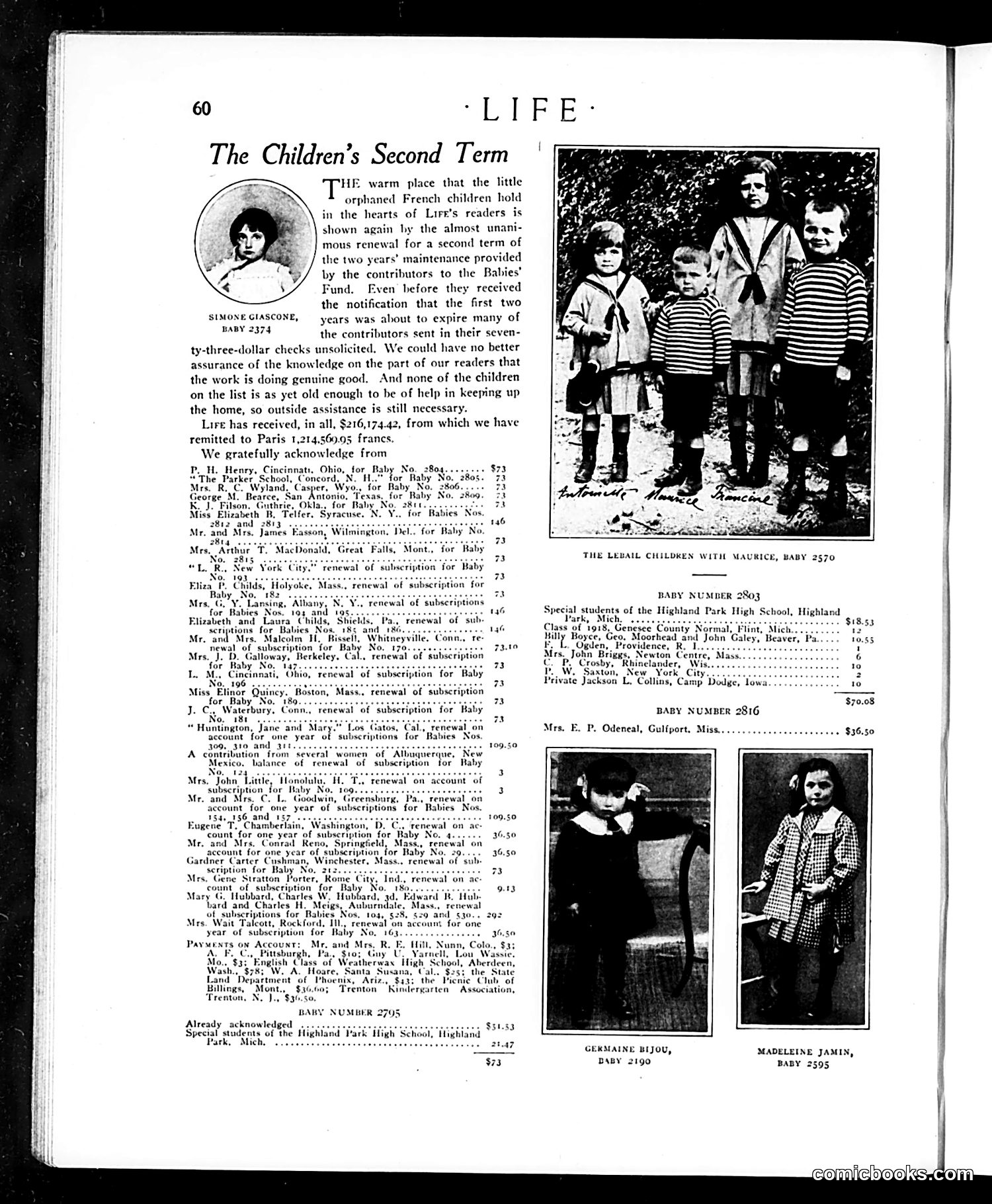
This page documents **Life magazine's sponsorship of French orphans** during or after World War I. Rather than a cartoon, it's a fundraising update showing donors' contributions to maintain orphaned French children for a second two-year term. The "Babies' Fund" collected $216,174.42 and remitted over 1.2 million francs to Paris. The page lists hundreds of donors—individuals, schools, and organizations—who contributed $73 checks (supporting one child annually) or larger amounts, renewing their support despite the program's initial two-year term expiring. The photographs show the actual orphans and one adult ("Maurice") being supported. The article appeals to readers' sentimentality about "the little orphaned French children," emphasizing they're too young to help themselves and require continued "outside assistance." This reflects early-20th-century American philanthropic impulses toward European war relief and child welfare.
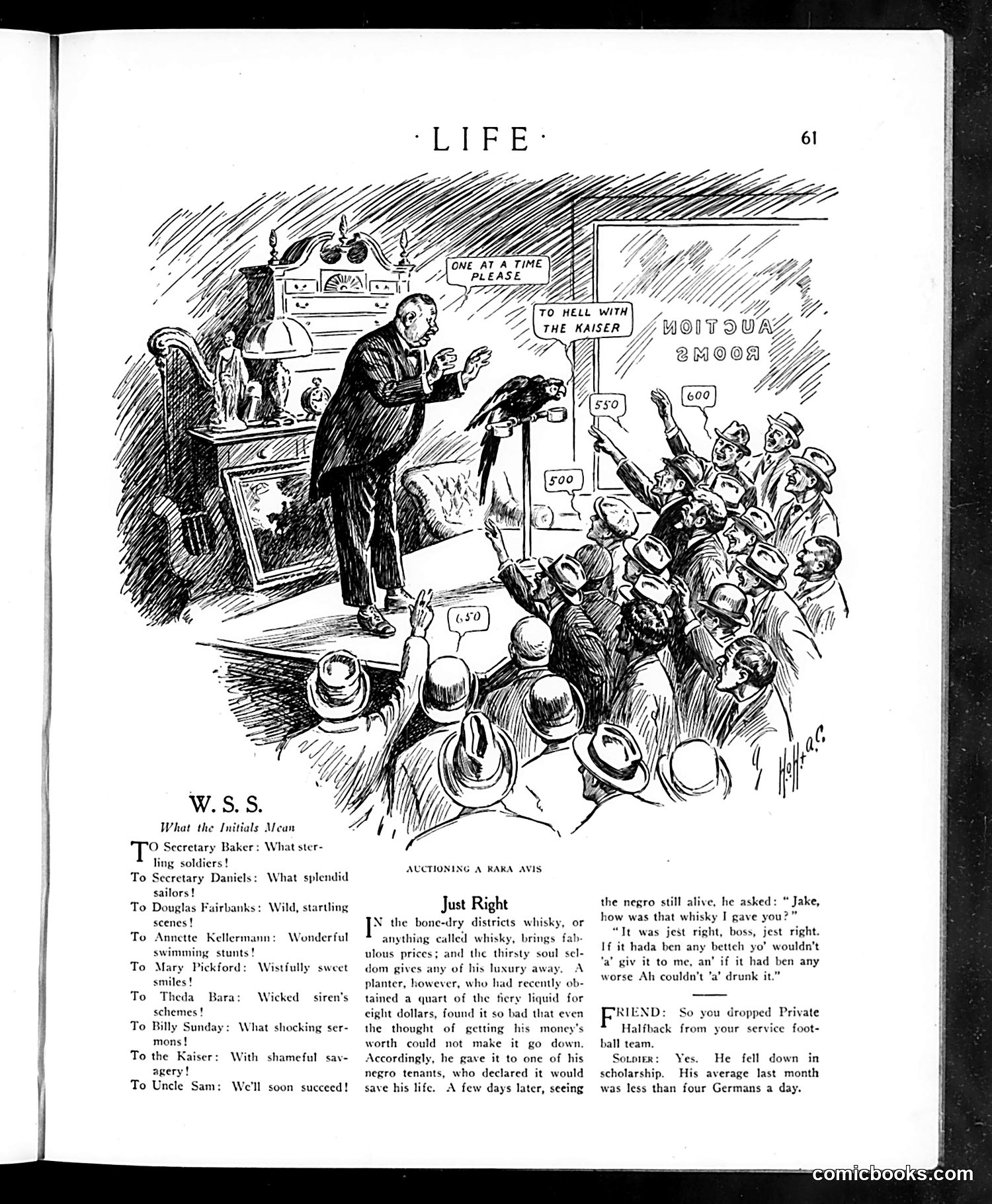
The top cartoon satirizes WWI propaganda by showing military/government officials and celebrities auctioning something labeled "W.S.S." (War Savings Stamps). Each figure interprets the initials through their own lens: Secretary Baker sees "sterling soldiers," Secretary Daniels sees "splendid sailors," while film stars and entertainers see dramatic content. The Kaiser, notably, sees "shameful savagery." This mocks how different parties promoted the same war effort using self-serving rhetoric. The bottom two items are humor pieces. "Just Right" jokes about Prohibition-era whisky quality—a planter gives bad whisky to a tenant, who paradoxically praises it as perfectly mediocre. "Friend/Soldier" makes a dark joke equating a football player's poor grades to killing "four Germans a day," darkly treating academic failure and wartime casualty rates as equivalent metrics. Both reflect WWI-era American attitudes.
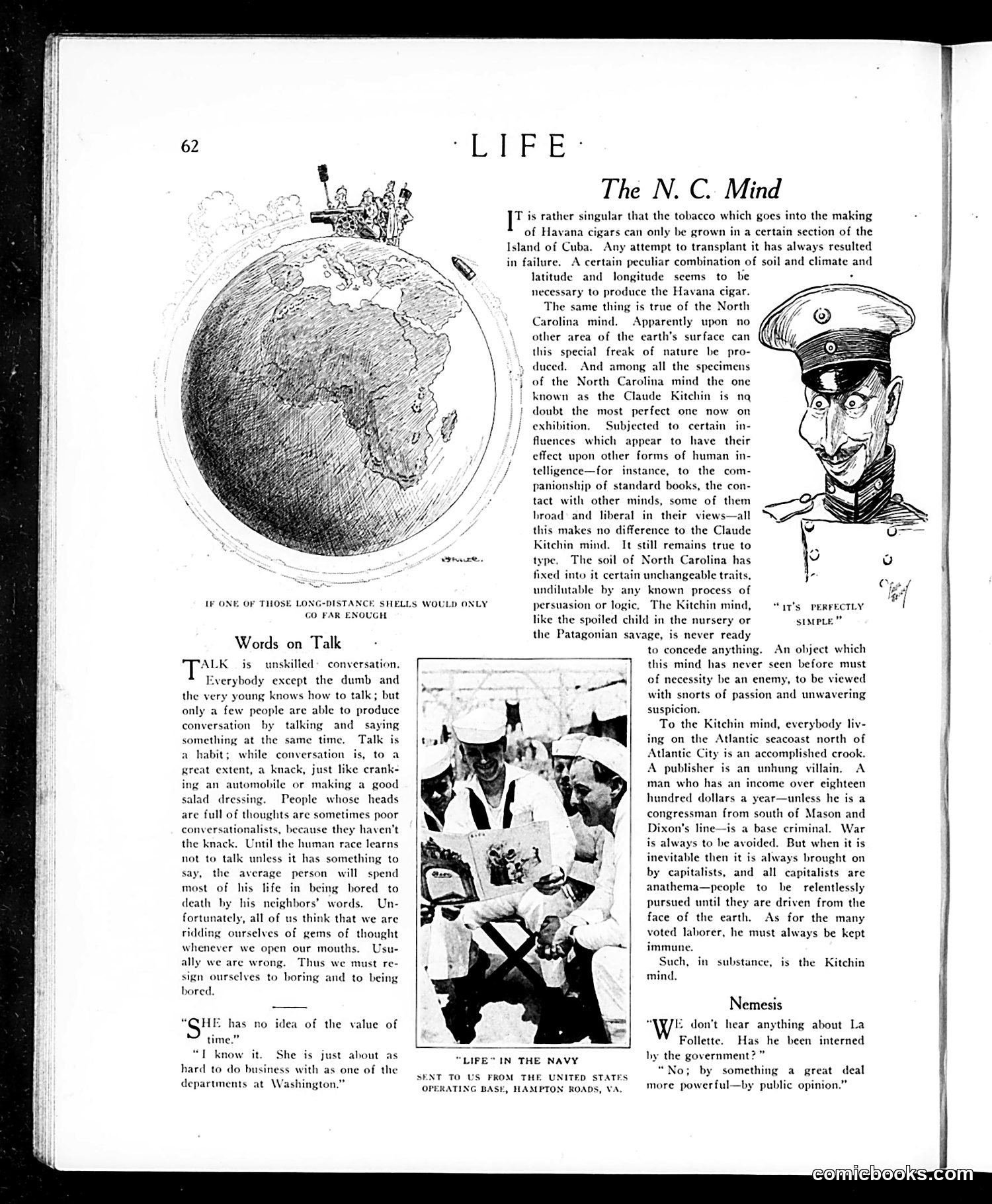
This page contains sharp political satire targeting **Claude Kitchin**, a North Carolina congressman. The lengthy article "The N.C. Mind" uses crude regionalist mockery to attack Kitchin as intellectually rigid and unchangeable—comparing his mind to "spoiled child" or "Patagonian savage" unable to concede anything. The satire suggests Kitchin's worldview is fixed by geography/genetics, making him suspicious of coastal northerners (whom he views as criminals), hostile to publishers and wealthy businessmen, and opposed to war (except when capitalists benefit). The author presents this intransigence as a regional character flaw rather than principled political disagreement. The "Words on Talk" section appears unrelated commentary on poor conversation habits. The "Life in the Navy" photo caption references WWI naval operations. **Context**: This reflects early 20th-century elite Eastern intellectual contempt for rural Southern politicians, using pseudo-scientific regionalism to delegitimize political opponents rather than engage their arguments.
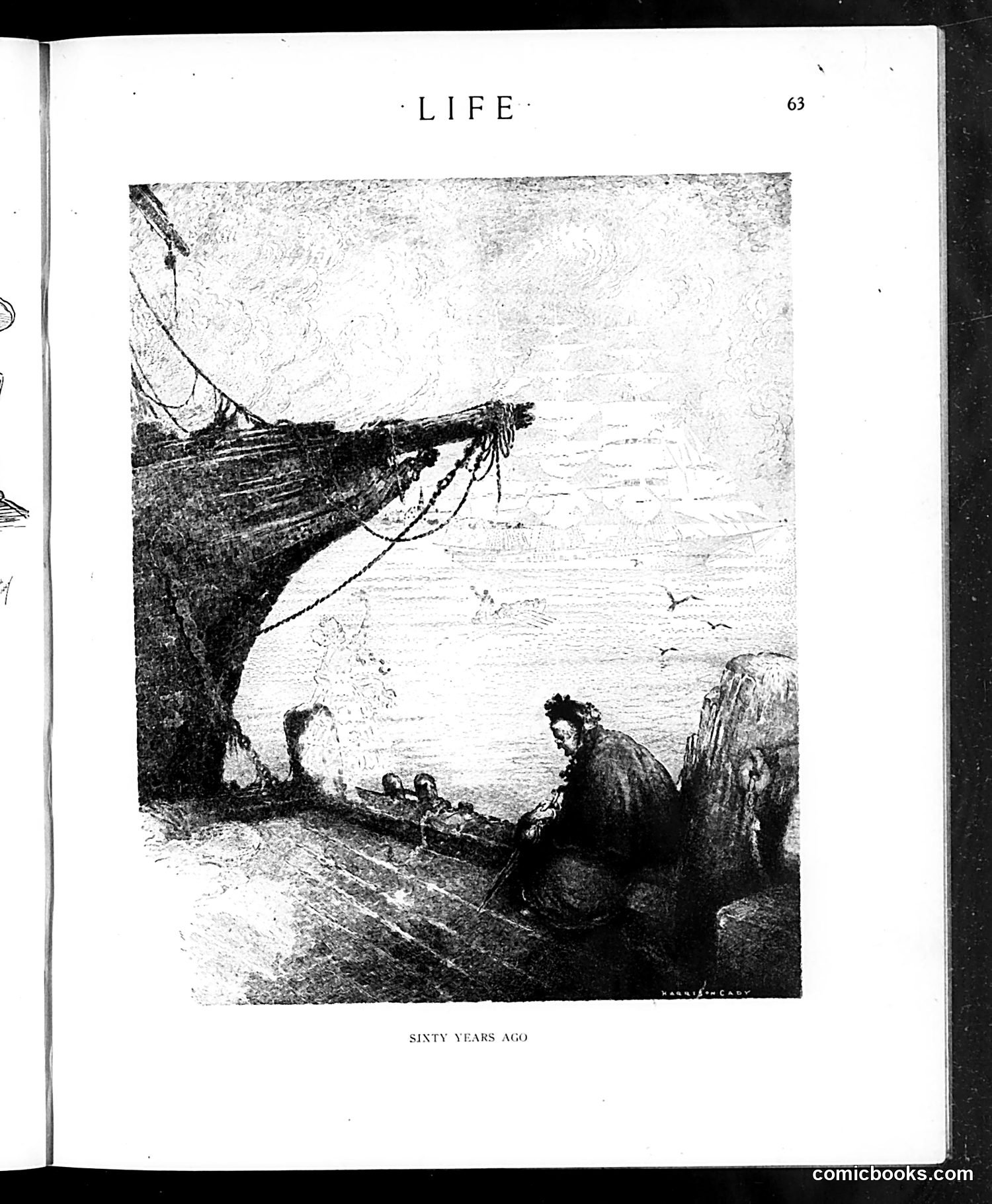
This page from *Life* magazine presents a nostalgic illustration titled "Sixty Years Ago," depicting what appears to be a maritime or coastal scene from the past. The image shows a beached or wrecked sailing vessel on the left, with figures gathered on the shore to the right examining or salvaging from it. The style and composition suggest this is a romantic or sentimental rendering of historical seafaring life. Without additional context or visible byline attribution, the specific satirical point remains unclear. The illustration may be commenting on changed maritime practices, nostalgia for earlier eras, or social conditions of the period being referenced—but the precise satirical intent is not evident from the image alone.
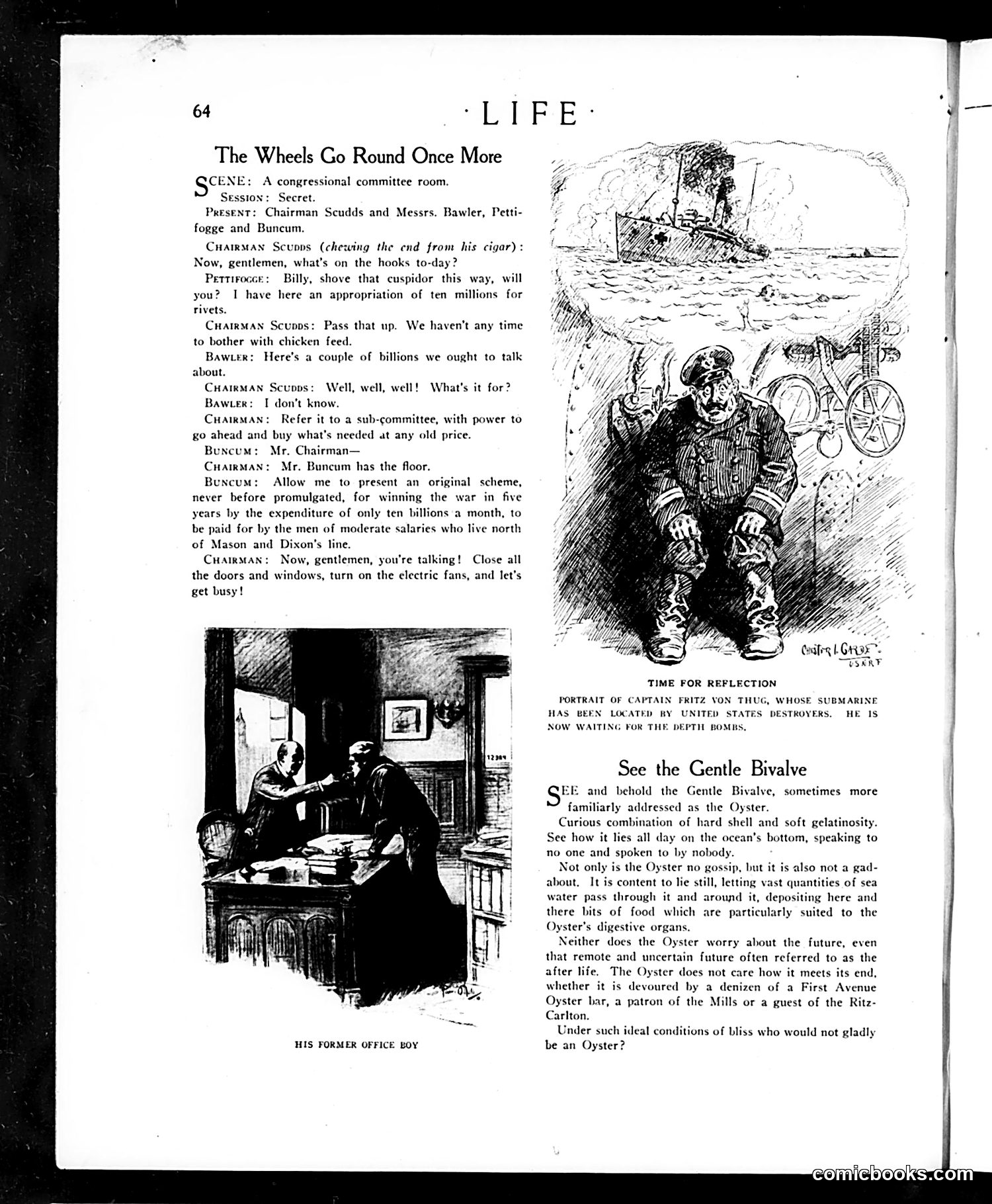
**"The Wheels Go Round Once More"** satirizes Congressional spending during wartime (likely WWI era). The sketch depicts cynical legislators casually appropriating billions without scrutiny—a ten-million-dollar rivets bill is dismissed as "chicken feed," while billions are approved despite nobody knowing what they're for. Chairman Scudds' response ("you're talking!") when Buncum proposes taxing working-class citizens north of the Mason-Dixon line reveals the hypocrisy: massive war spending is enthusiastically endorsed only when ordinary Americans foot the bill. **"See the Gentle Bivalve"** uses the oyster as a philosophical metaphor contrasting with Congressional greed. The oyster lives contentedly without worry, gossip, or ambition—accepting whatever comes. The satiric implication: the oyster's passive acceptance and indifference represents a superior philosophy to the wheeling-dealing, self-interested behavior of corrupt politicians spending public money recklessly. Both pieces critique wartime profiteering and governmental corruption.
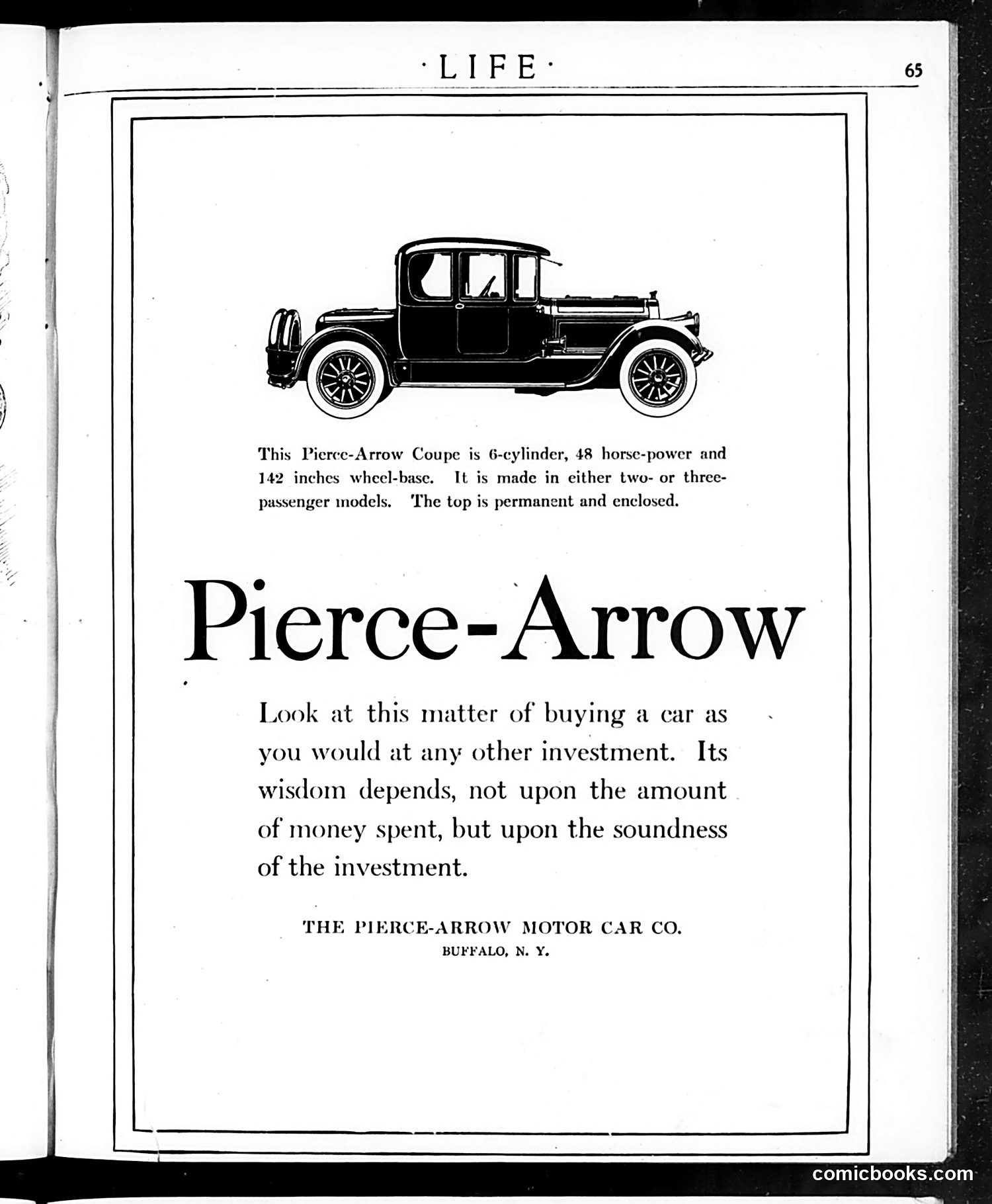
This page is **not a cartoon or satire**—it's a straightforward automobile advertisement from *Life* magazine, page 65. The ad promotes the Pierce-Arrow Coupe, a luxury car manufactured in Buffalo, New York. It features a technical illustration of the vehicle and specifications (6-cylinder, 48 horsepower, 142-inch wheelbase, available in 2- or 3-passenger configurations with an enclosed permanent top). The ad's marketing pitch frames car-buying as a serious financial investment, arguing that "wisdom depends...upon the soundness of the investment" rather than simply the price paid. This appeals to upper-class buyers concerned with value and prestige. There is no political content, satire, or caricature present. This represents typical early-20th-century automotive advertising targeting affluent consumers.
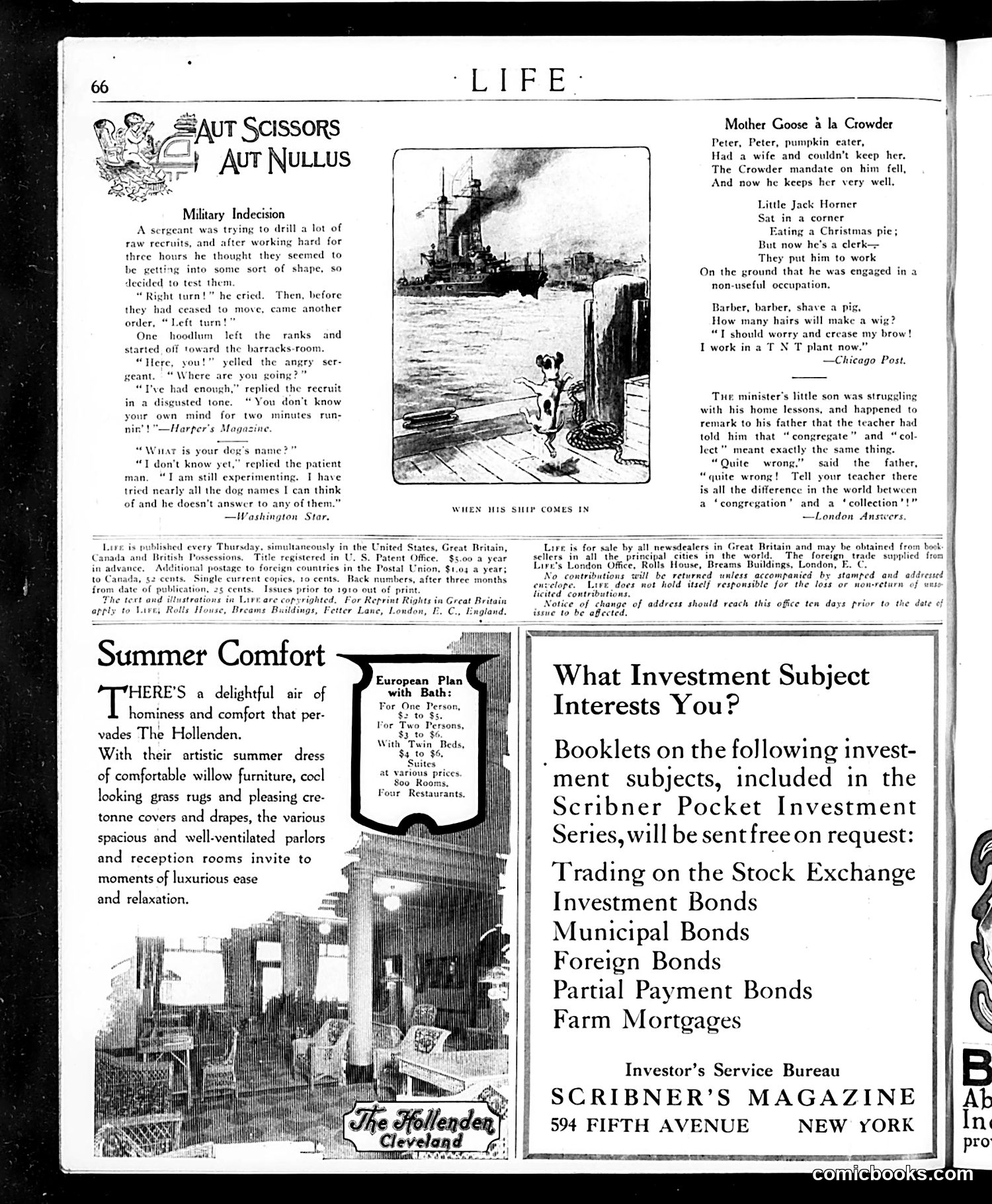
This page from *Life* contains several brief satirical anecdotes and jokes: **"Military Indecision"** mocks military drilling incompetence. A sergeant drills recruits for hours, then immediately contradicts himself with conflicting orders ("Right turn!" then "Left turn!"), causing confusion. The joke satirizes military inefficiency and the absurdity of unthinking obedience. **"Mother Goose à la Crowder"** and **"Little Jack Horner"** are modernized nursery rhyme parodies. They reference a "Crowder mandate" (unclear reference) and mock Jack Horner for being forced into undesirable work at a TNT plant during wartime. These appear to comment on wartime labor conscription. **"Barber, barber, shave a pig"** similarly updates nursery rhymes with contemporary wartime employment concerns. The remaining anecdotes—about a dog-naming confusion, a minister's son misunderstanding "congregate" versus "collection"—are mild wordplay humor unrelated to topical satire. The page's dominant satirical theme targets military and wartime inefficiency rather than specific political figures.
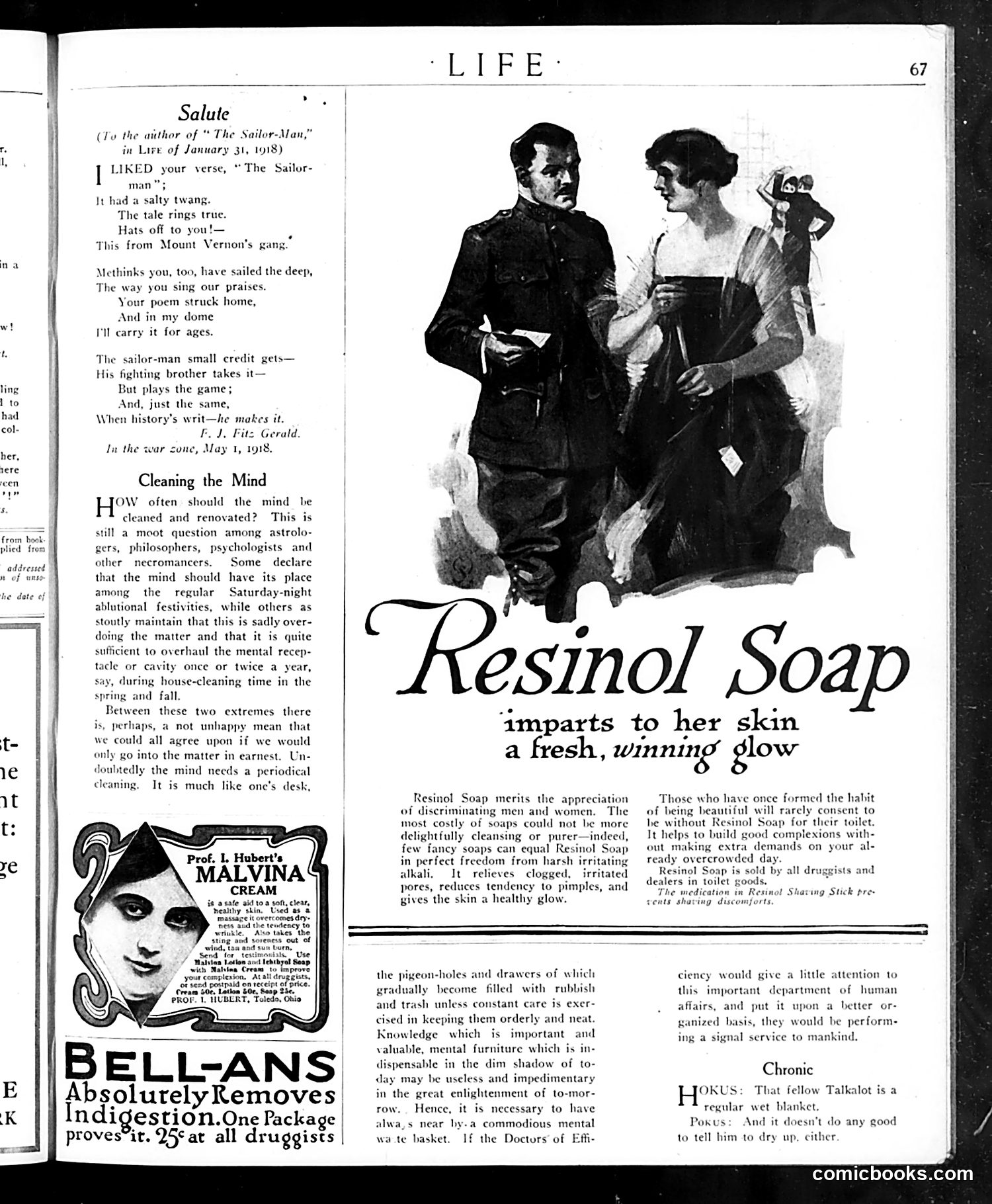
This page contains **poetry and advertisements** rather than political cartoons. The "Salute" poem praises an earlier published piece called "The Sailor-Man," crediting sailors for their WWI service while acknowledging that fighting soldiers receive more public recognition. It's dated May 1, 1918—during active U.S. involvement in World War I—and expresses patriotic appreciation for naval personnel often overlooked in wartime glory. The bulk of the page features **product advertisements**: Resinol Soap (emphasizing skin health and beauty), Prof. Hubert's Malvina Cream (a skincare product), and Bell-Ans (an antacid remedy). The "Cleaning the Mind" essay humorously debates how often one should mentally refresh, comparing mental hygiene to physical housekeeping—a lighthearted philosophical musing typical of Life's satirical approach. The final section includes a brief comic dialogue ("Chronic") about someone named Talkalot being a "wet blanket." **Overall**: This is primarily a **commercial page with light satire**, not political commentary. The WWI reference in the poem is the only topical historical content.
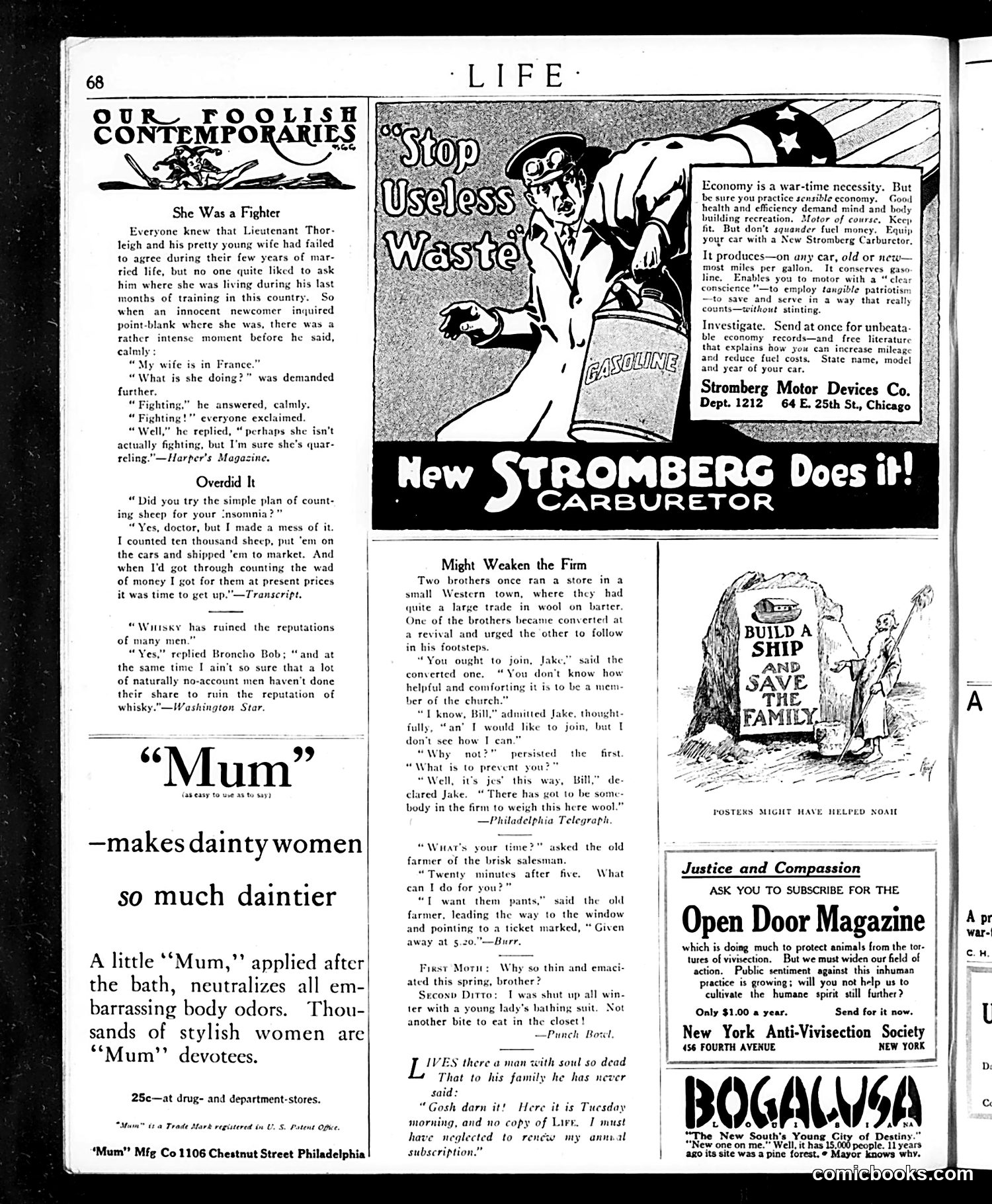
This page contains several humorous anecdotes and advertisements typical of Life's satirical style during the WWI era (indicated by military references). **Key Content:** The "She Was a Fighter" joke satirizes marital discord by suggesting a wife is "fighting" in France rather than literally fighting in the war—a play on domestic quarreling versus military combat. "Overdid It" mocks simple folk wisdom: a man takes insomnia advice literally, counts 10,000 sheep, sells them, and becomes so preoccupied with the profit that he loses sleep anyway. **Advertisements** dominate the right side, including appeals to wartime patriotism (Stromberg Carburetor's "sensible economy" messaging) and social anxiety products ("Mum" deodorant promising to eliminate "embarrassing body odors"). The "Might Weaken the Firm" anecdote uses a pun: a brother refuses church conversion because someone must remain to "weigh this here wool"—implying moral compromise is necessary for business. Overall, this reflects early 20th-century American humor: domestic tensions, class-based dialect humor, and commercialized solutions to social anxieties.
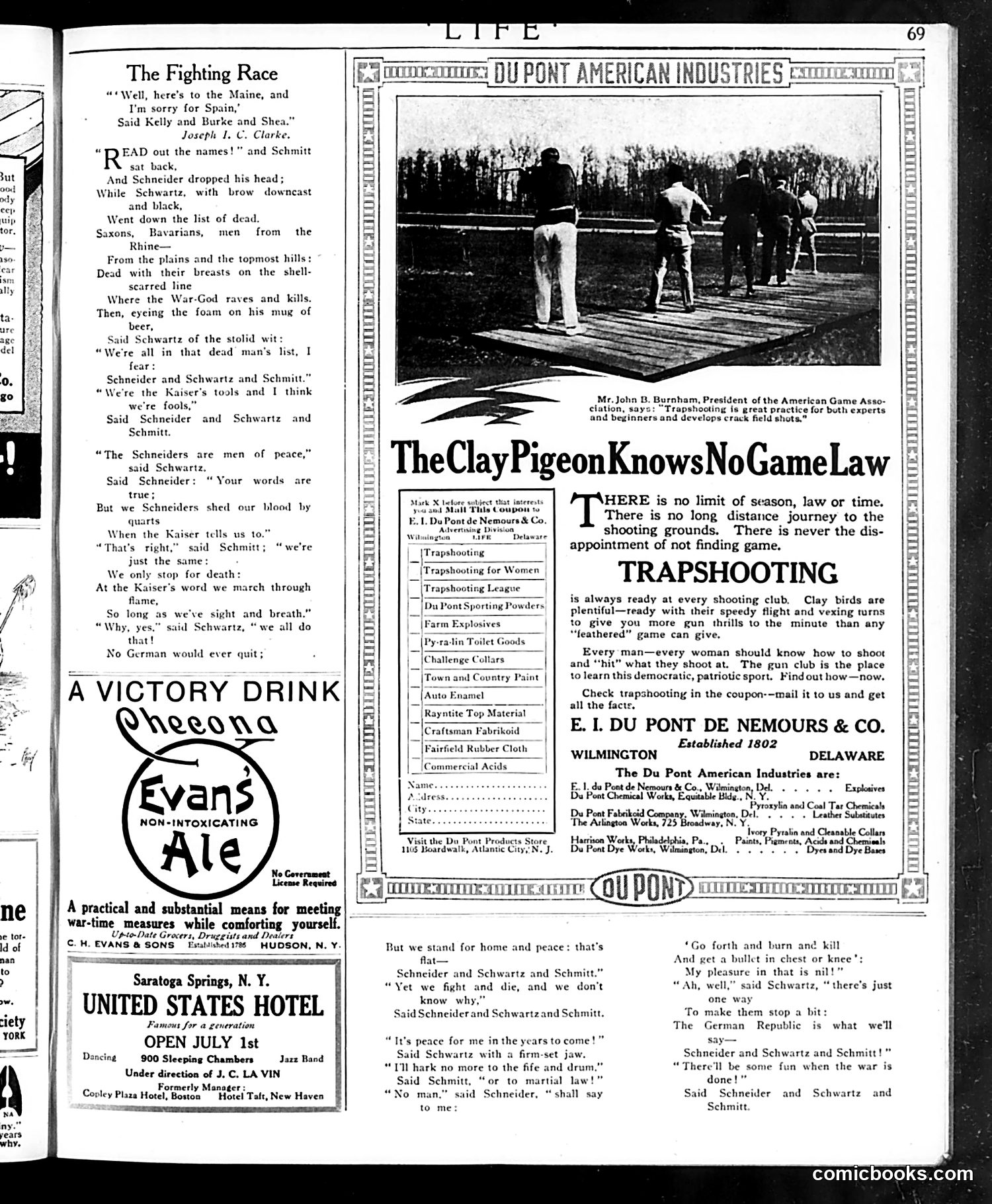
This poem depicts three German-American soldiers—Schneider, Schwartz, and Schmitt—discussing their conscription into the American military during World War I. They acknowledge the irony and tragedy of their position: as men of German heritage, they're now fighting against Germany, shedding blood "by quarts" at the Kaiser's former command structure. The satire centers on their conflicted loyalty and the painful reality of immigrant soldiers. They express both resignation ("No German would ever quit") and yearning for peace. The final exchange suggests that Republican ideals—"what we'll say"—offer hope for ending the conflict. This reflects the genuine tension faced by German-Americans during WWI: patriotic service to their adopted country while emotionally torn from their heritage. The poem validates their sacrifice while subtly critiquing the absurdity of nationalist warfare that demands their blood despite their divided allegiances.