
Life, 1918-07-11 · page 16 of 34
Life — July 11, 1918 — page 16: what you’re looking at
What you’re looking at
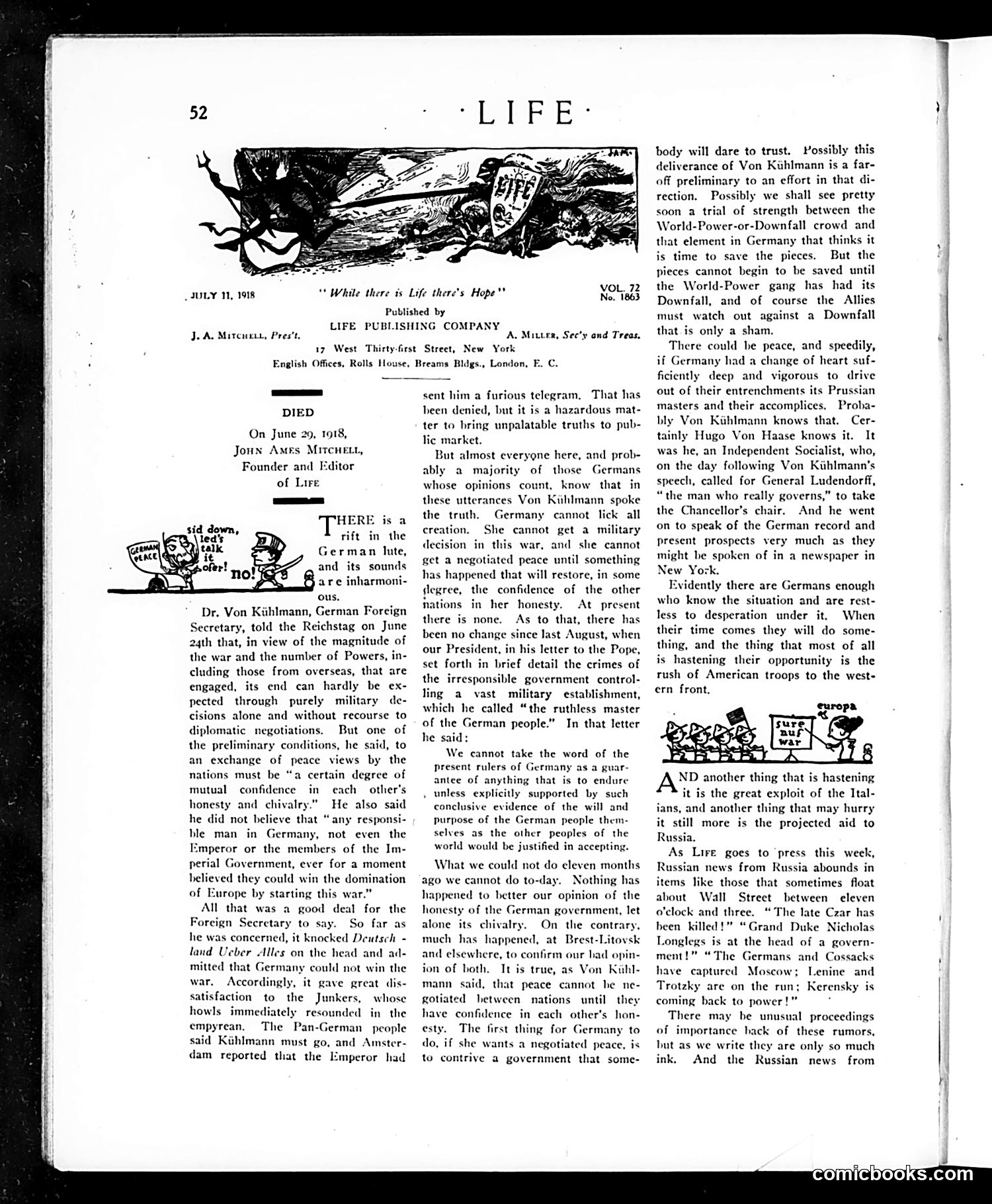
This editorial page commemorates John Ames Mitchell, Life's founder, who died June 29, 1918. The main content analyzes German Foreign Secretary Von Kühlmann's recent speech to the Reichstag acknowledging Germany cannot win WWI militarily and needs negotiated peace. The satirical point: Von Kühlmann spoke uncomfortable truths—that Germany cannot achieve total victory and requires mutual confidence for peace negotiations. This angered German militarists (the "Pan-German people" and Junkers), who reportedly demanded his removal via an angry imperial telegram. Life's position supports Von Kühlmann's realism while dismissing German credibility. The magazine argues Germany's government has proven dishonest through actions at Brest-Litovsk, making peace impossible until Germans replace their current rulers with a trustworthy government. The cartoon depicts a broken German lute (symbolizing discord), illustrating the "rift in the German lute" phrase—a metaphor for internal conflict between war-hawks and peace advocates within Germany.
📄 Transcribed text from this page (OCR, searchable)
Machine-transcribed from the original scan — historical spelling and the odd misread are preserved.
JULY 11, 1918 “While there is Life there's Hope"* VOL. 72 No, 1863 Published by LIFE PUBLISHING COMPANY J. A. Mitcueit, Pres’t, A. Mitter, Sec’y ond Treas, 17 West Thirty-first Street, New York English Offices, Rolls House, Breams Blgs., London, E. C. —— DIED On June 29, 1918, Joux Ames MitcHett, Founder and Editor of Lire = HERE rift in the German lute, and its sounds Gare inharmoni- ous. Dr. Von Kiihlmann, German Forcign Secretary, told the Reichstag on June 24th that, in view of the magnitude of the war and the number of Powers, in- cluding those from overseas, that are engaged, its end can hardly be ex- pected through purely military de- cisions alone and without recourse to diplomatic negotiations. But one of the preliminary conditions, he said, to an exchange of peace views by the nations must be “a certain degree of mutual confidence in each other's honesty and chivalry.” He also said he did not believe that “any responsi- ble man in Germany, not even the Emperor or the members of the Im- perial Government, ever for a moment believed they could win the domination of Europe by starting this war.” All that was a good deal for the Foreign Secretary to say. So far as he was concerned, it knocked Deutsch = land Ueber Alles on the head and ad- mitted that Gern could not win the war. Accordingly, it gave great dis- faction to the Junkers, whose howls immediately resounded in the empyrean. The Pan-German people said Kihlmann must go, and Amster- dam reported that the Emperor had isa sent him a furious telegram, That has heen denied, but it is a hazardous mat- ter to bring unpalatable truths to pub- lic market. But almost everyone here, and prob- ably a majority of those Germans whose opinions count, know that in these utterances Von Kuhlmann spoke the truth. Germany cannot lick all creation. She cannot get a military decision in this war, and she cannot get a negotiated peace until something has happened that will restore, in some legree, the confidence of the other fations in her honesty. At. present there is none. As to that, there has been no change since last August, when our President, in his letter to the Pope, set forth in brief detail the crimes of the irresponsible government control- ling a vast military establishment, which he called “the ruthless master of the German people.” In that letter he said: We cannot take the word of the present rulers of Germany as a guar- antee of anything that is to endure . unless explicitly supported by such conclusive evidence of the will and Purpose of the German people them- selves as the other peoples of the world would be justified in accepting. What we could not do eleven months ago we cannot do to-day. Nothing has happened to better our opinion of the honesty of the German government, let alone its chivalry. On the contrary much has happened, at Brest-Litovsk and elsewhere, to confirm our had opin- ion of both. It is true, as Von Kiihl- mann said, that peace cannot he ne- gotiated between nations until they have confidence in each other's hon- esty. The first thing for Germany to do, if she wants a negotiated peace, is to contrive a government that some- body will dare to trust. Possibly this deliverance of Von Kiihlmann is a far- off preliminary to an effort in that di- rection. Possibly we shall see pretty soon a trial of strength between the World-Power-or-Downfall crowd and that element in Germany that thinks it is time to save the pieces. But the pieces cannot begin to be saved until the World-Power gang has had its Downfall, and of course the Allies must watch out against a Downfall that is only a sham. There could he peace, and speedily, if Germany had a change of heart suf- ficiently deep and vigorous to dri out of their entrenchments its Prussian masters and their accomplices, Proba- bly Von Kuhlmann knows that. Cer- tainly Hugo Von Haase knows it. It was he, an Independent Socialist, who, on the day following Von Kiihlmann’s speech, called for General Ludendorff, “the man who really governs,” to take the Chancellor’s chair. And he went ‘on to speak of the German record and Present prospects very much as they might be spoken of in a newspaper in ew York. idently there are Germans enough who know the situation and are rest- less to desperation under it. When their time comes they will do some- thing, and the thing that most of all is hastening their opportunity is the rush of American troops to the west- ern front, ND another thing that is hastening it is the great exploit of the Ital- ians, and another thing that may hurry i more is the projected aid to As Lire goes to press this week, Russian news from Russia abounds in items like those that sometimes float about Wall Street between eleven o'clock and three. “The late Czar has been killed!” “Grand Duke Nicholas Longlegs at the head of a govern- ment!” “The Germans and Cossacks have captured Moscow; Lenine and Trotzky are on the run; Kerensky is coming back to power!” There may be unusual proceedings of importance back of these rumors, but as we write they are only so much ink, And the Russian news from