
Life, 1918-07-11 · page 21 of 34
Life — July 11, 1918 — page 21: what you’re looking at
What you’re looking at
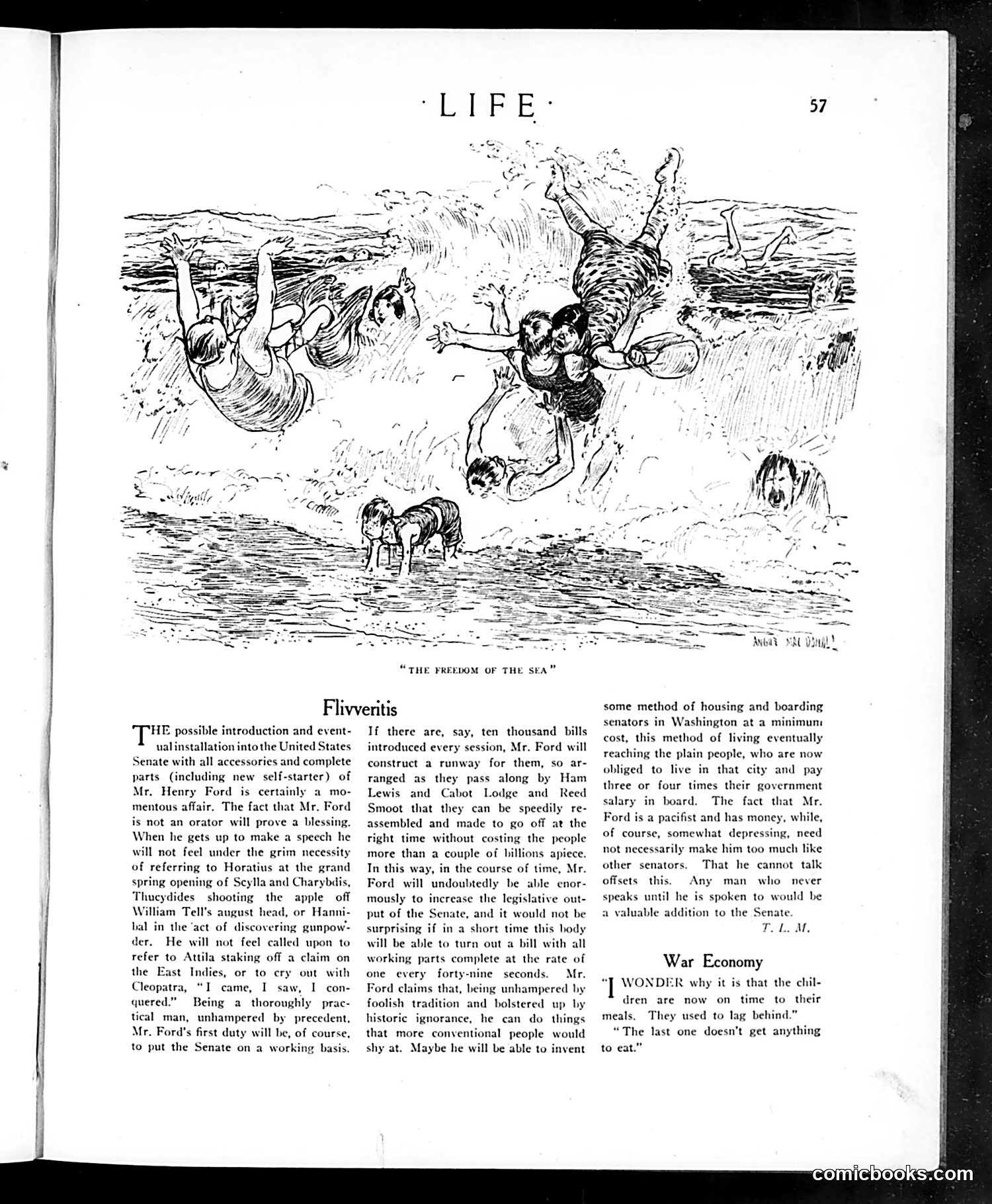
**The Main Cartoon:** This sketch depicts people playing freely in shallow water—a simple scene of leisure and pleasure, illustrating the concept of "freedom of the sea." **"Fliventis" Section:** This is satirical commentary on Henry Ford's potential entry into the U.S. Senate. The text mocks Ford as a practical industrialist ("thorougly practical man") who would apply factory efficiency to Congress—suggesting he'd streamline legislative processes with assembly-line methods, turning out bills mechanically. The satire ridicules both Ford's presumed lack of oratorical skill and the Senate's inefficiency, while implying Ford's industrial genius cannot solve governmental dysfunction. **"War Economy" Section:** This brief dialogue satirizes wartime food rationing, where children now eat on schedule rather than at leisure. The darkly comic punchline—"The last one doesn't get anything to eat"—suggests the severity of scarcity or reflects anxieties about resource allocation during what appears to be WWI-era rationing. The page uses gentle, ironic humor to critique both industrial-era problem-solving and wartime hardships.
📄 Transcribed text from this page (OCR, searchable)
Machine-transcribed from the original scan — historical spelling and the odd misread are preserved.
“THE FREEDOM OF THE SEA” Fliwenttis 'HE possible introduction and event- ualinstallation into the United States Senate with all accessories and complete parts (including new self-starter) of Mr. Henry Ford is certainly a mo- mentous affair. The fact that Mr. Ford is not an orator will prove a blessing. When he gets up to make a speech he will not feel under the grim necessity of referring to Horatius at the grand spring opening of Scylla and Charybdis, Thucydides shooting the apple off William Tell’s august head, or Hanni- bal in the ‘act of discovering gunpow- der. He will not feel called upon to refer to Attila staking off a claim on the East Indies, or to cry out with Cleopatra, “I came, I saw, I con- quered. Being a thoroughly prac- tical man, unhampered by precedent, Mr. Ford’s first duty will be, of course, to put the Senate on a working basis. If there are, say, ten thousand bills introduced every session, Mr. Ford will construct a runway for them, so ar- ranged as they pass along by Ham Lewis and Cabot Lodge and Reed Smoot that they can be speedily re- assembled and made to go off at the right time without costing the people more than a couple of billions apiece. In this way, in the course of time, Mr. Ford will undoubtedly be able enor- mously to increase the legislative out- put of the Senate, and it would not be surprising if in a short time this body will be able to turn out a bill with all working parts complete at the rate of one every forty-nine seconds. Mr. Ford claims that, being unhampered hy foolish tradition and bolstered up by historic ignorance, he can do things that more conventional people would shy at. Maybe he will be able to invent some method of housing and boarding senators in Washington at a minimum cost, this method of living eventually reaching the plain people, who are now obliged to live in that city and pay three or four times their government salary in board. The fact that Mr. Ford is a pacifist and has money, while, of course, somewhat depressing, need not necessarily make him too much like other senators, That he cannot talk offsets this. Any speaks until he is spoken to would be man who never a valuable addition to the Senate, T. LM, War Economy “IT WONDER why it is that the chil- time to their dren meals, are now on They used to lag behind.” “The last one doesn’t get anything to eat.”