
A complete issue · 36 pages · 1918
Life — July 4, 1918
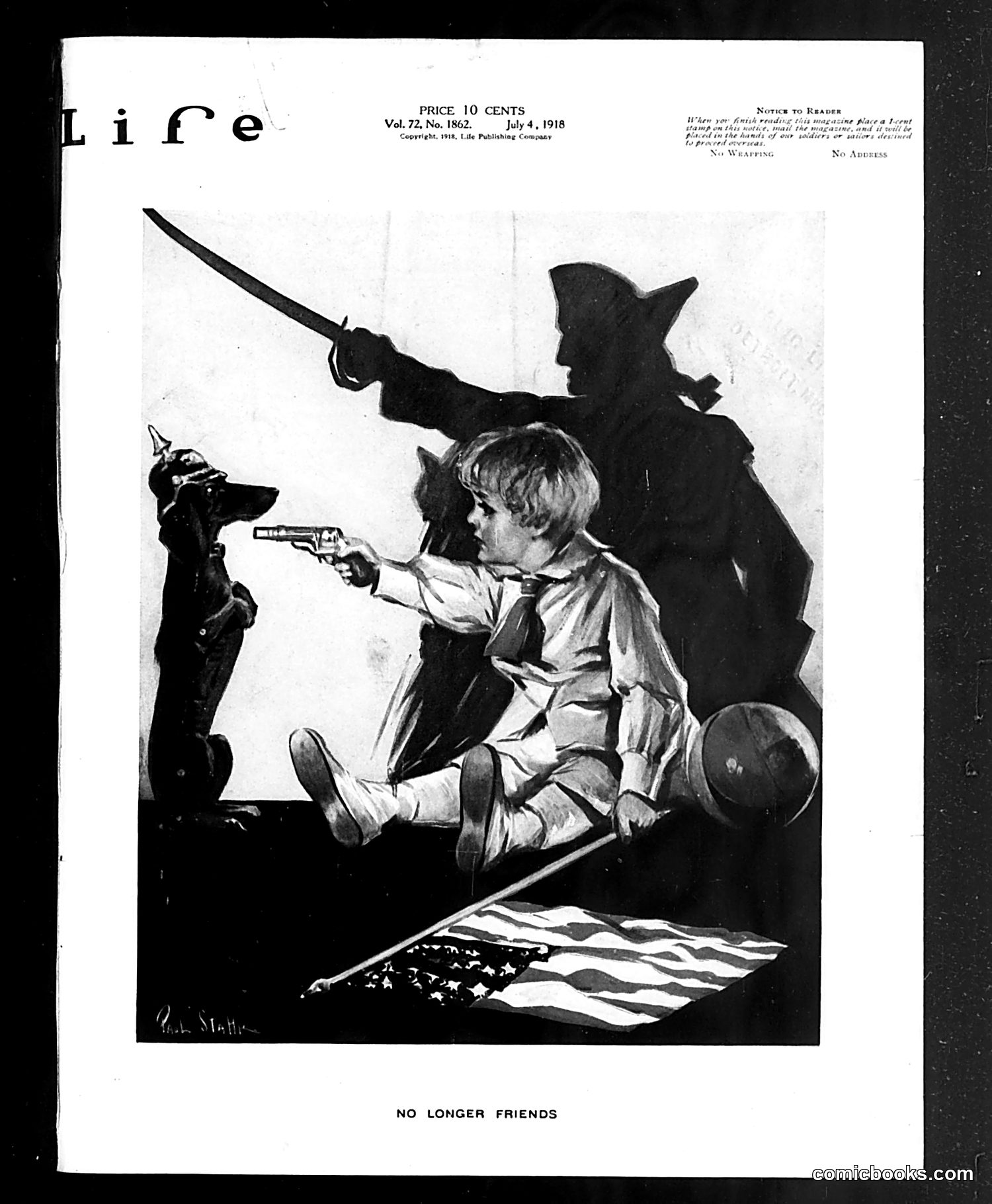
This July 4, 1918 Life magazine cover depicts America's dramatic shift regarding Germany during World War I. A young American boy, representing the United States, points a pistol at a dachshund wearing a spiked Prussian helmet—a standard caricature for Germany. Behind him stands a shadowy military figure wielding a sword, likely representing American military authority or resolve. The American flag sits in the lower left. The title "No Longer Friends" references the severing of diplomatic relations and America's entry into the war against Germany (April 1917). The dachshund, a German breed, was frequently used in American propaganda to mock the enemy during this period. The image celebrates America's military commitment to defeating Germany.
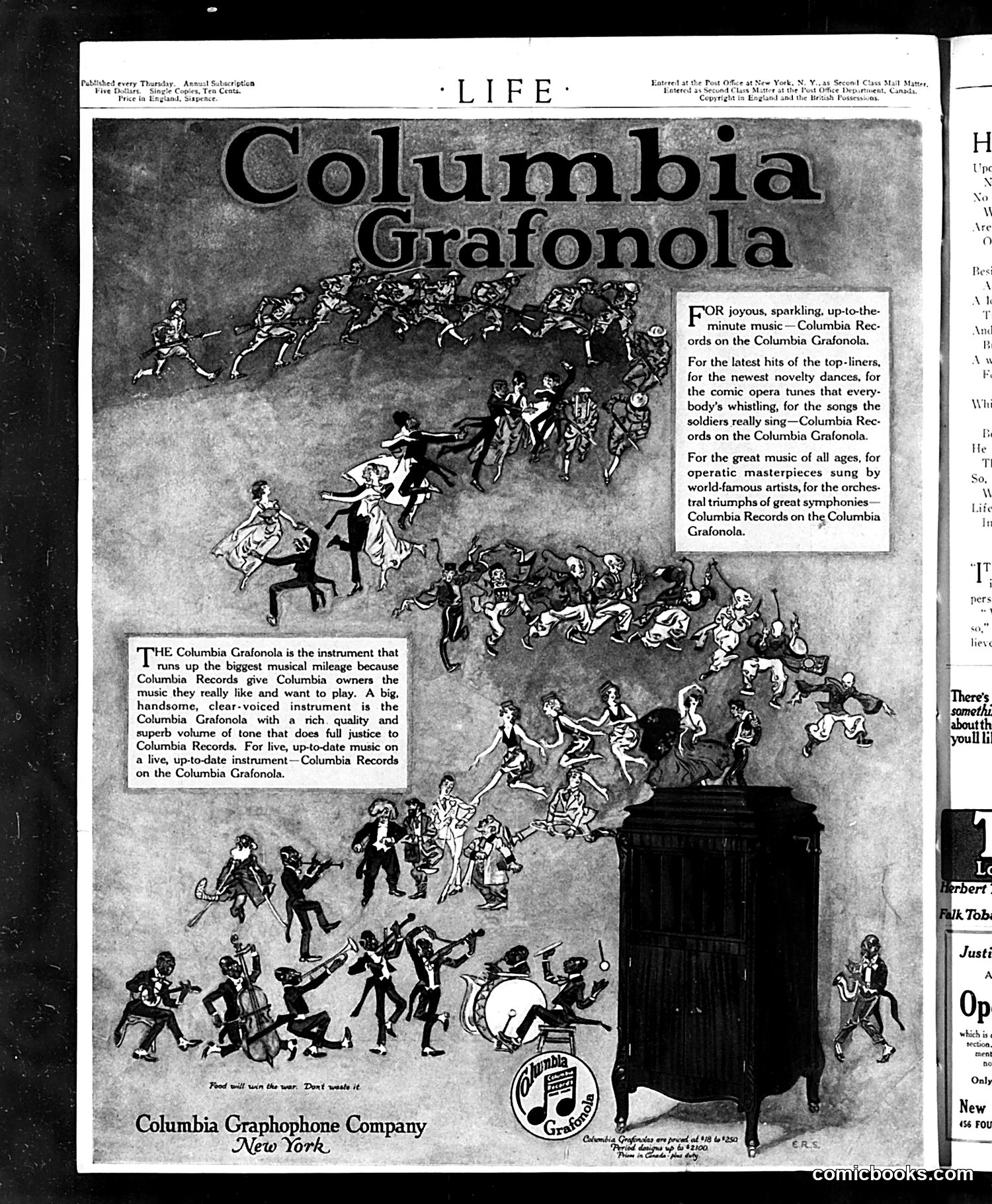
This is primarily a **product advertisement**, not political satire. It promotes Columbia Records' gramophone player—a device for playing recorded music. The illustration shows animated figures (musicians, dancers, opera singers) emanating from or surrounding the gramophone device, visually representing the diverse music available on Columbia Records: "joyous, sparkling, up-to-the-minute music," popular dances, operatic works, and classical symphonies. The text emphasizes the gramophone's quality construction and "superb volume of tone" that does justice to recordings. The lower left includes small sketches of performers with the tagline "Poof! went the beer. Don't waste it"—though this phrase's meaning in this context is unclear. This is essentially early 20th-century consumer marketing using vibrant imagery to convey entertainment variety and product superiority.
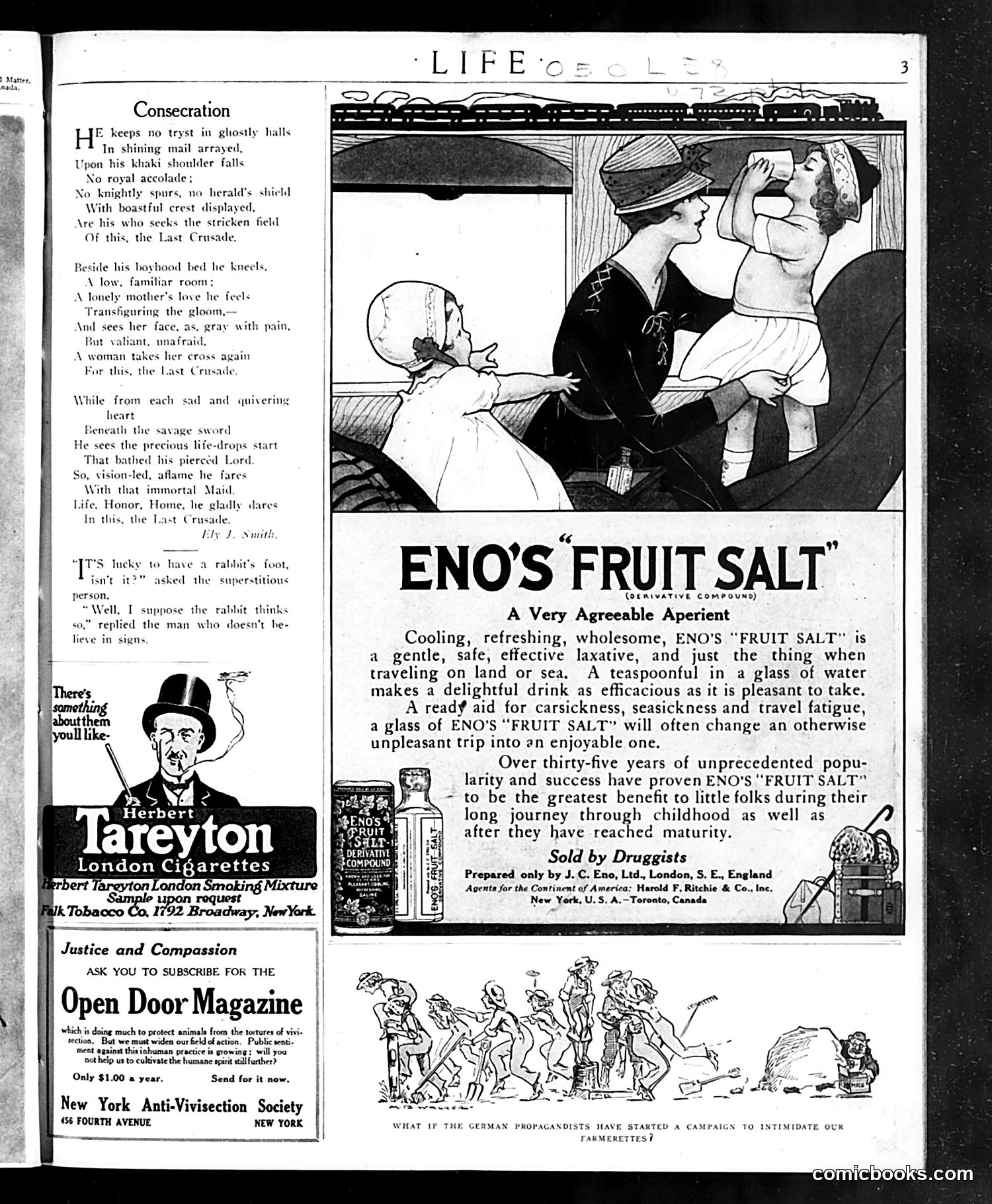
This page is **primarily advertising**, dominated by a full-page Eno's Fruit Salt laxative ad. The product promises relief for travel-related digestive complaints—a practical concern for early 20th-century travelers. Below the ad is a **political cartoon** captioned "What if the German Propagandists Have Started a Campaign to Intimidate Our Farmerettes!" It depicts German-looking figures threatening young female farm workers, reflecting **WWI-era anxieties** about German espionage and sabotage on the American home front. The image suggests fear that enemy agents might target women agricultural workers (farmerettes), who had become essential to food production during the war. The cartoon plays on contemporary wartime paranoia rather than presenting genuine threat assessment.
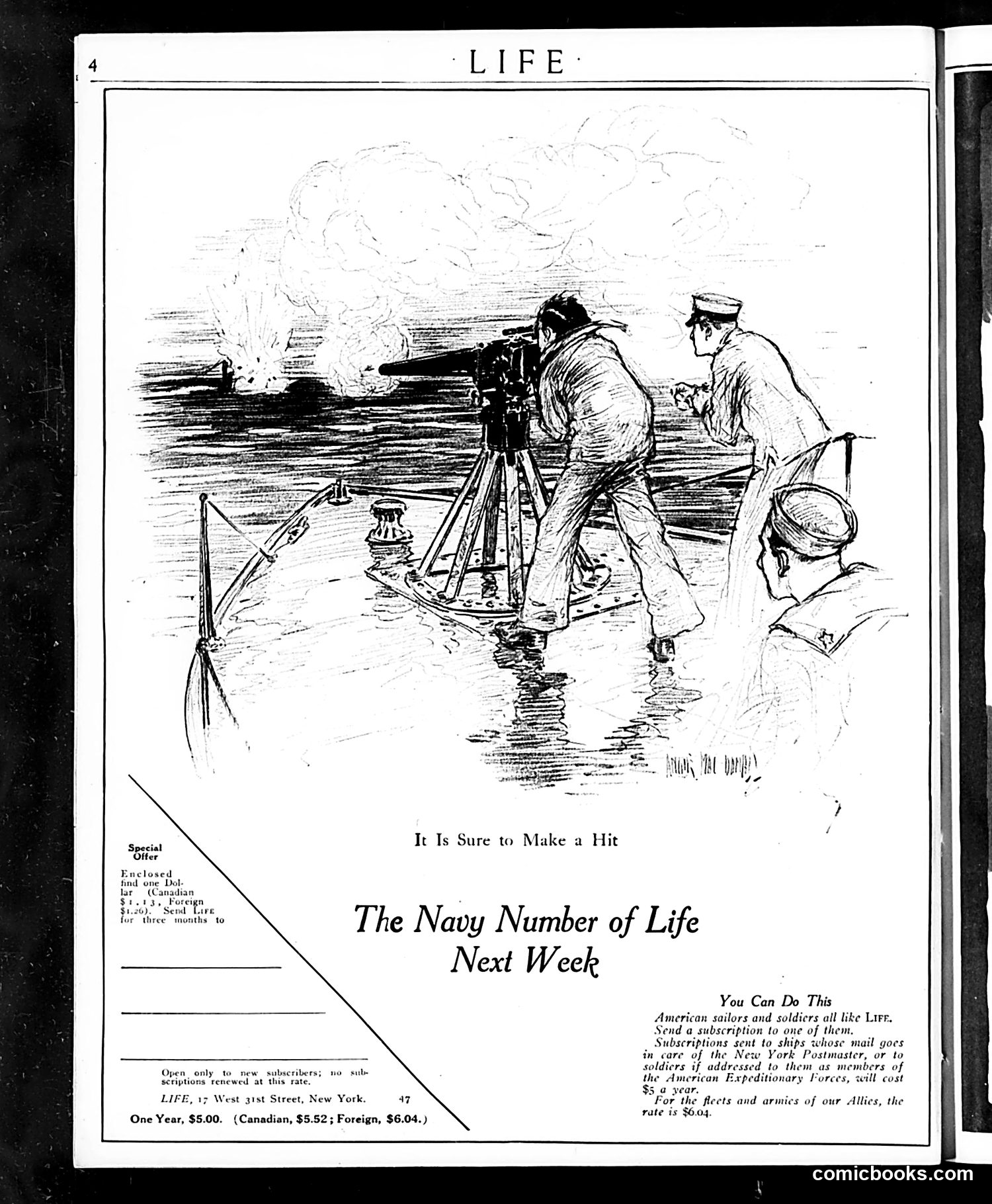
This page is primarily a **subscription advertisement** for *Life* magazine, not a political cartoon. The illustration depicts naval personnel operating what appears to be a military gun or artillery piece positioned over water, with explosive effects visible in the background. The headline "It Is Sure to Make a Hit" uses a double entendre—playing on both the military sense (hitting a target) and the magazine's confidence in its appeal. The text below promotes "The Navy Number of Life Next Week," encouraging readers to subscribe and support American military efforts, likely during World War I (given the naval warfare context and patriotic messaging about "fleets and armies of our Allies"). The advertisement targets civilians to financially support troops through magazine subscriptions sent to soldiers.
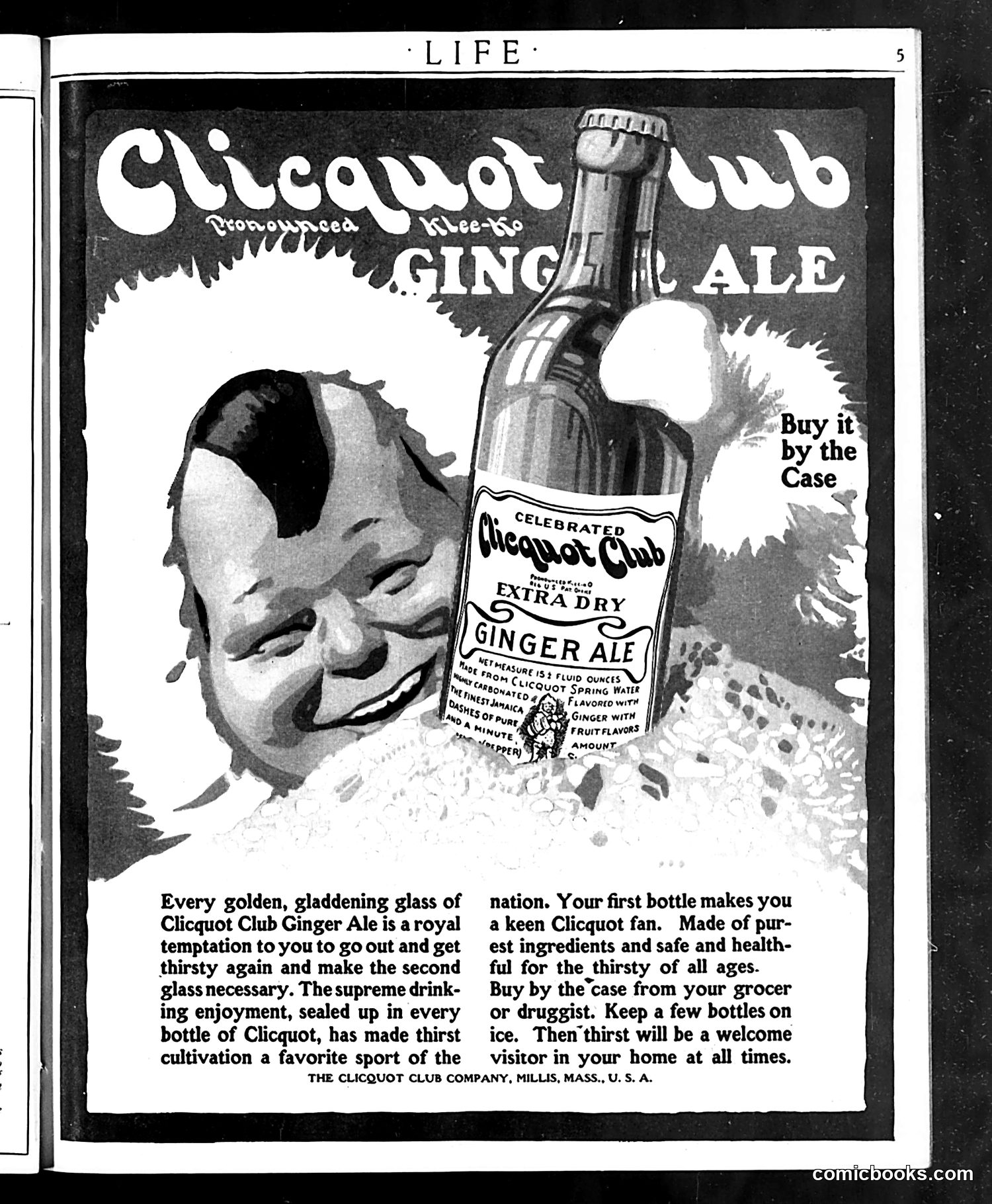
This is primarily a **product advertisement**, not political satire. It promotes Clicquot Club Ginger Ale, made by The Clicquot Club Company of Millis, Massachusetts. The ad features a stylized, somewhat grotesque smiling face emerging from snow or foam, alongside a bottle of the ginger ale. The exaggerated facial expression and caricature style were common in early 20th-century advertising, though the distorted features appear crude and unusual by modern standards. The marketing copy emphasizes the drink's appeal across "all ages" and encourages bulk purchase ("by the case"). The claims about pure ingredients and ginger flavoring reflect period marketing conventions. The page demonstrates how advertising aesthetics and acceptable imagery have shifted significantly since this Life magazine publication.
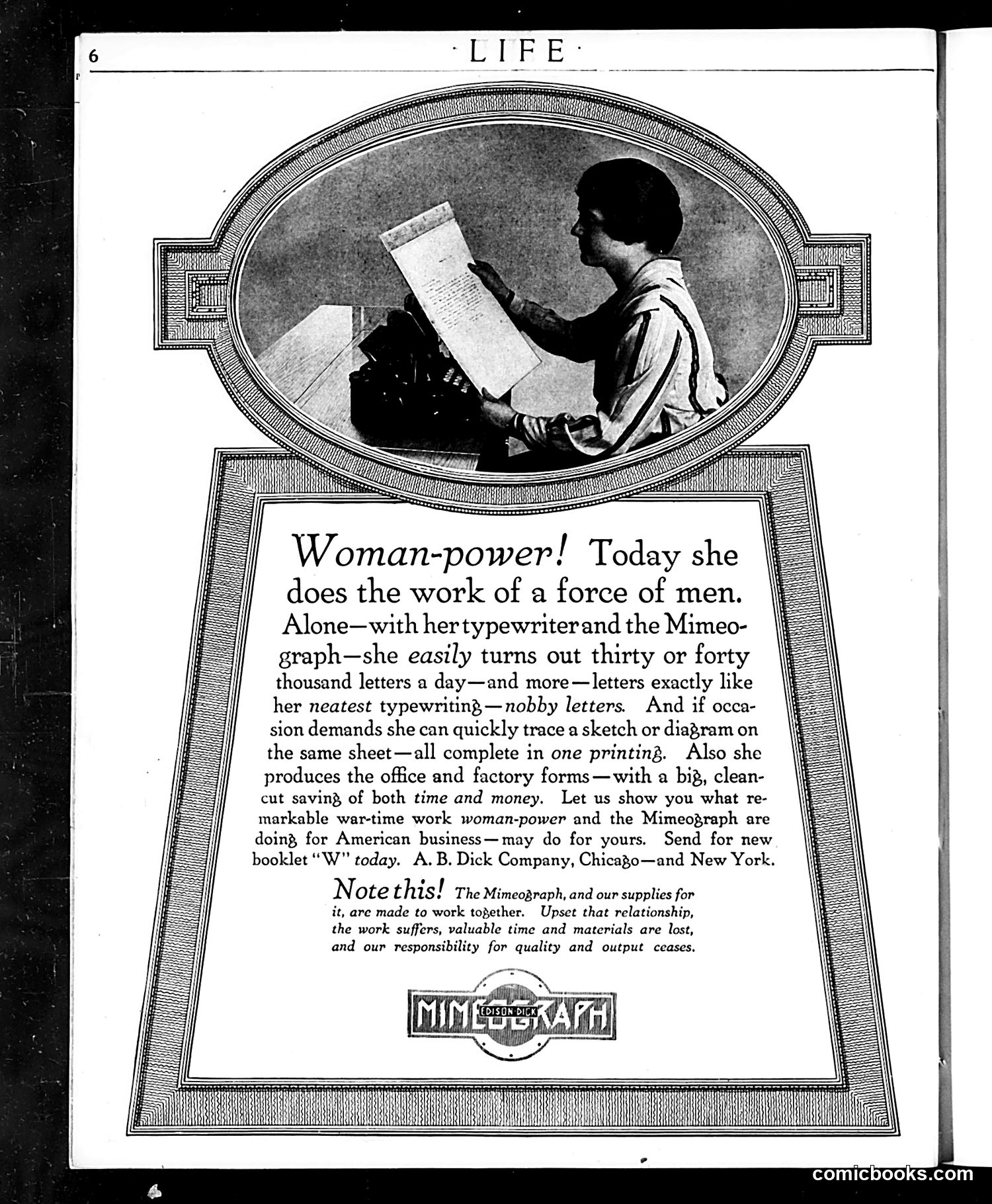
This is primarily a **Mimeograph advertisement** rather than a cartoon or satire. It appeared in *Life* magazine during what the text indicates is "war-time" (likely World War I era, based on phrasing). The ad celebrates "Woman-power" by showing a woman operating a typewriter and Mimeograph machine. It claims she can produce 30,000-40,000 letters daily with neat, consistent results—work previously requiring "a force of men." The advertisement emphasizes efficiency gains: time and money savings, plus the ability to combine text with sketches "in one printing." The "satire" is mild: the ad's breathless tone about women's newfound workplace capability reflects genuine wartime labor shifts, though framed here as a business efficiency pitch rather than genuine social commentary.
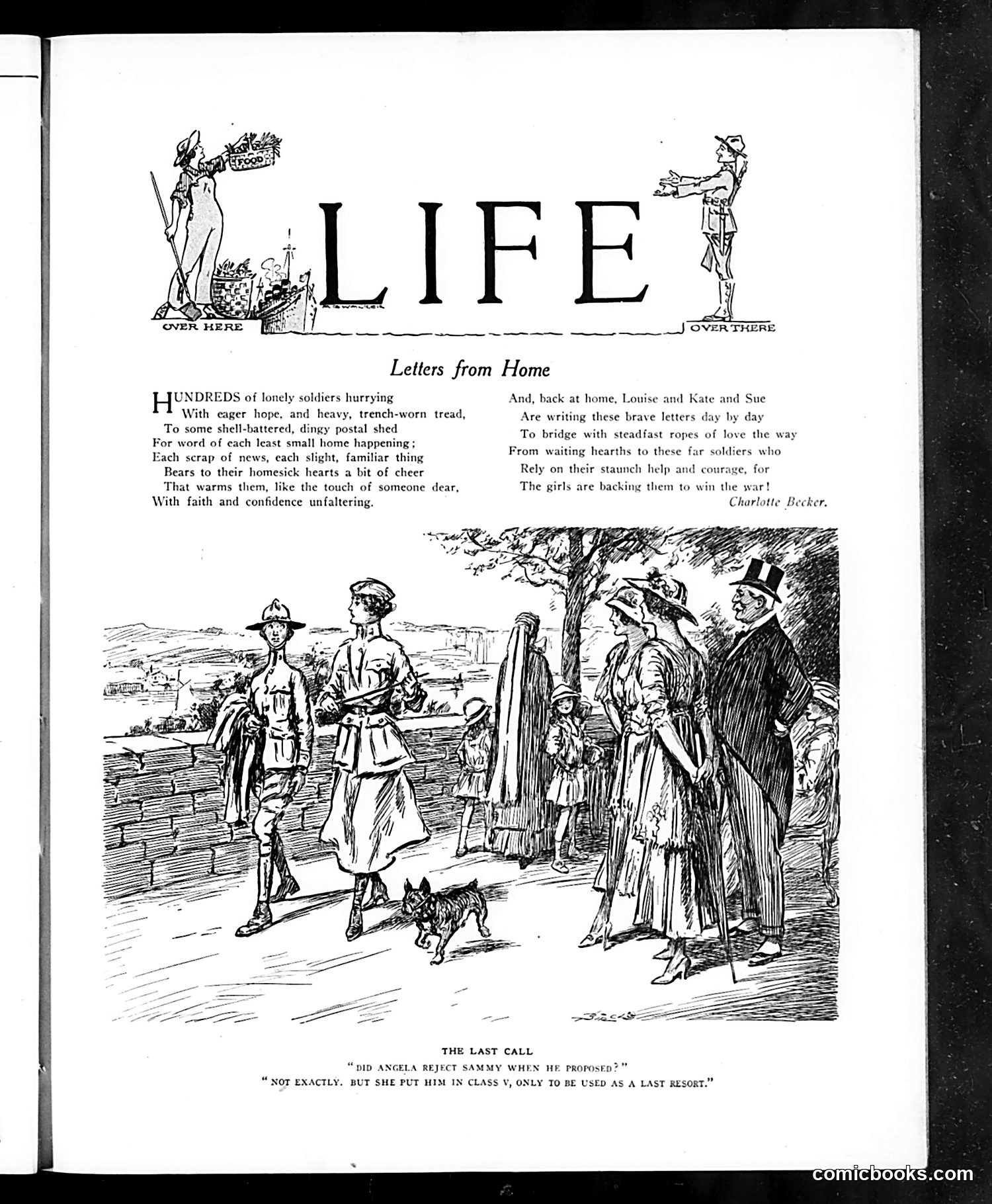
This WWI-era page depicts soldiers receiving correspondence from home. The poem by Charlotte Becker celebrates women writing letters to soldiers—Louise, Kate, and Sue are mentioned by name as women "backing them to win the war." The illustration titled "The Last Call" shows soldiers departing, with a caption about "Angela" rejecting a proposal from "Sammy," dismissing him as merely "a last resort." The satire appears to mock both romantic complications on the home front and the casual rejection of soldiers' romantic advances. It juxtaposes earnest patriotic sentiment (women supporting soldiers through letters) with cynical relationship dynamics, suggesting that some women viewed soldiers instrumentally rather than romantically—a commentary on wartime social dynamics and shifting attitudes toward enlisted men.
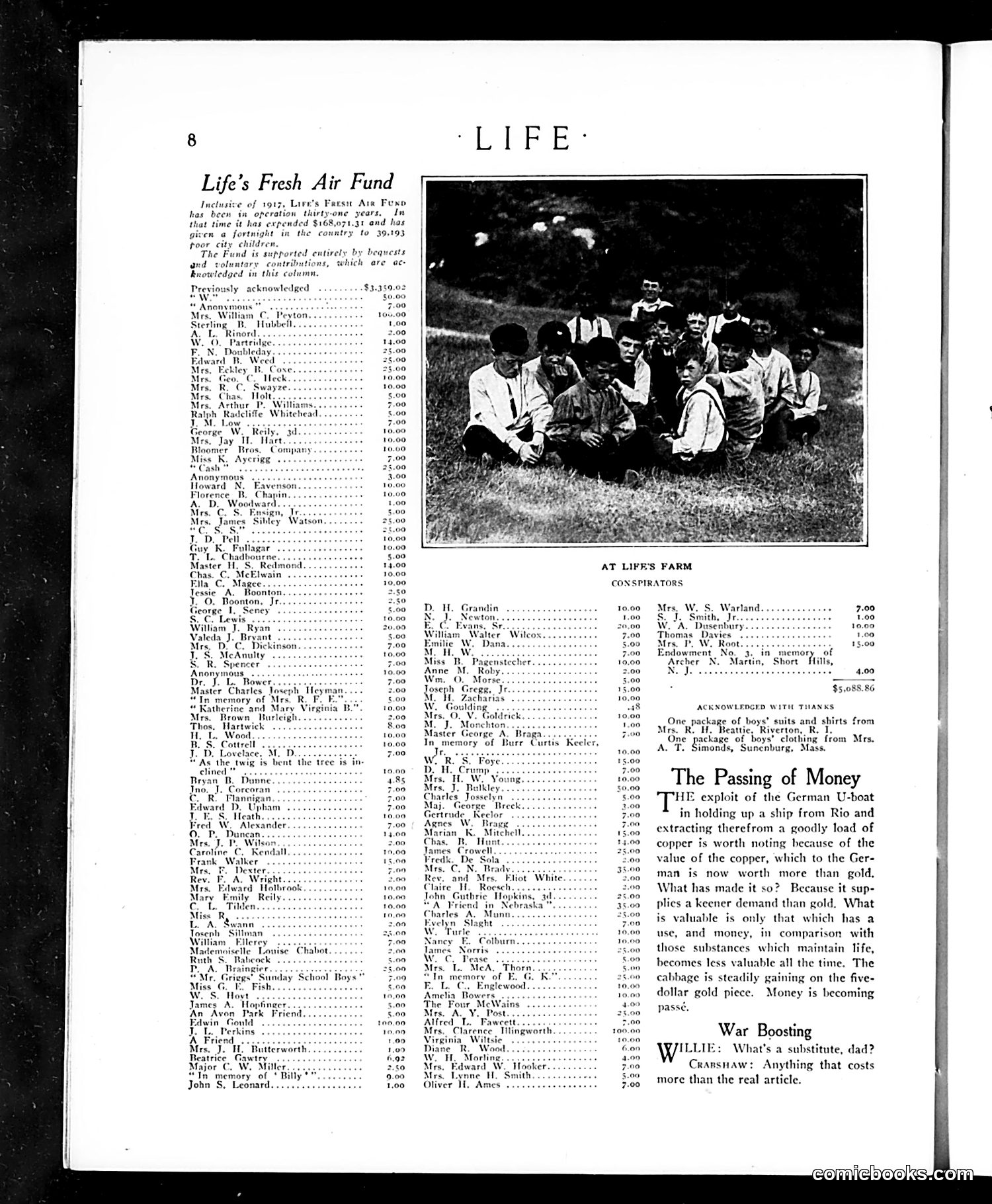
This page primarily documents **Life's Fresh Air Fund**, a charitable initiative established in 1917 to send poor city children to the countryside for health and recuperation. The left column lists donors and contribution amounts. The photograph shows children at Life's Farm, the program's recreational facility, illustrating the fund's practical work. Below appears a brief satirical dialogue titled **"War Boosting"** contrasting substitute goods with "the real article"—likely commentary on wartime inflation and the sale of inferior products marketed as genuine during World War I. The page also includes **"The Passing of Money,"** discussing how a German U-boat's copper cargo demonstrates copper's increased value during wartime, exceeding even gold in commercial importance due to military demand.
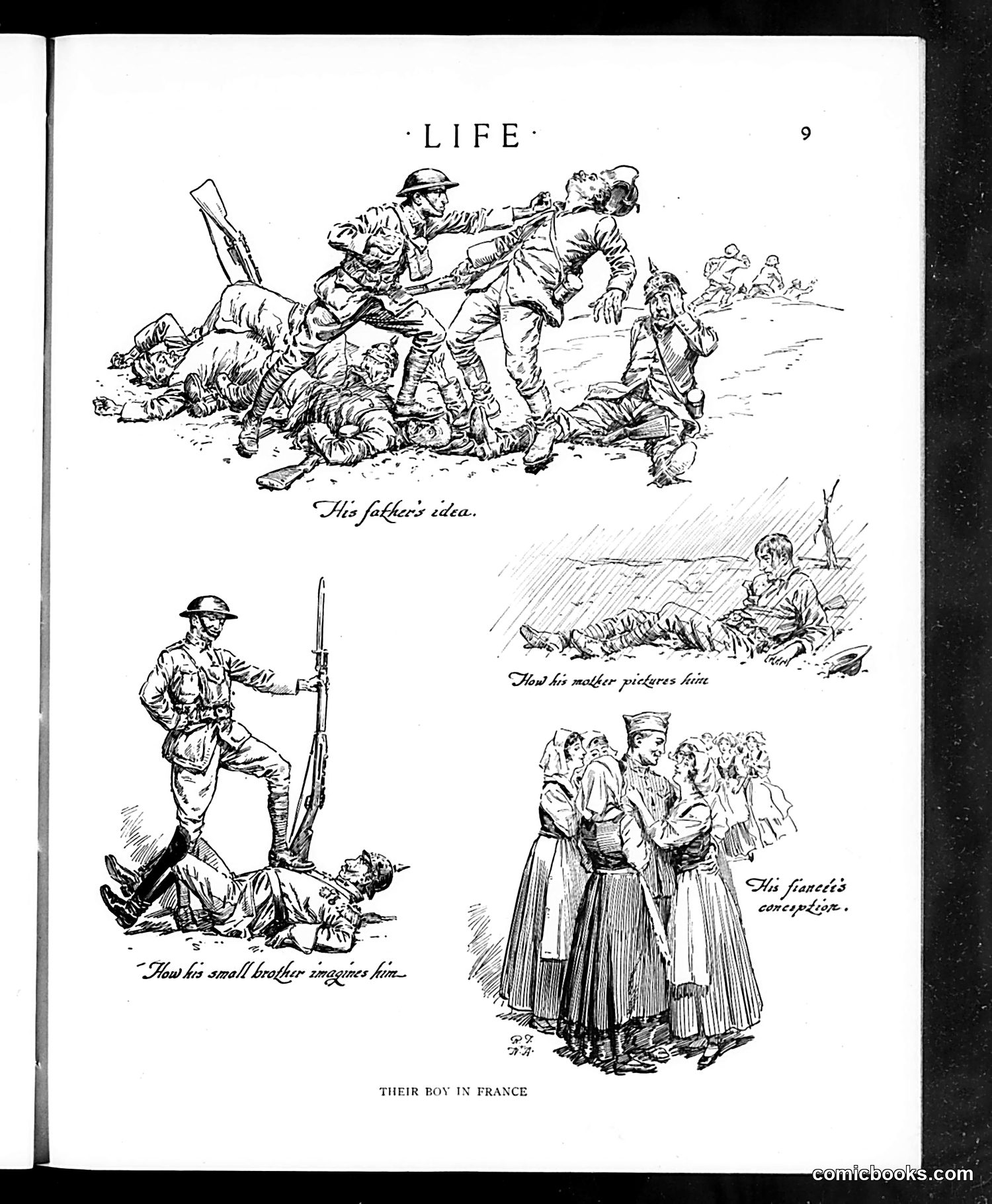
This page presents wartime satirical illustrations about American soldiers in World War I. The four scenes depict contrasting perspectives on a soldier serving in France: 1. **"His father's idea"** — shows combat violence, with soldiers fighting brutally 2. **"How his mother pictures him"** — depicts a solitary, vulnerable soldier in the field 3. **"How his small brother imagines him"** — portrays heroic combat with a bayonet 4. **"His fiancée's conception"** — shows the soldier surrounded by admiring women The satire critiques how different people imagine the soldier's experience through their own emotional lenses — romanticized by family, horrifying to those aware of trench warfare's reality. This reflects early WWI-era American attitudes toward the conflict and soldiers' actual conditions versus public perception.
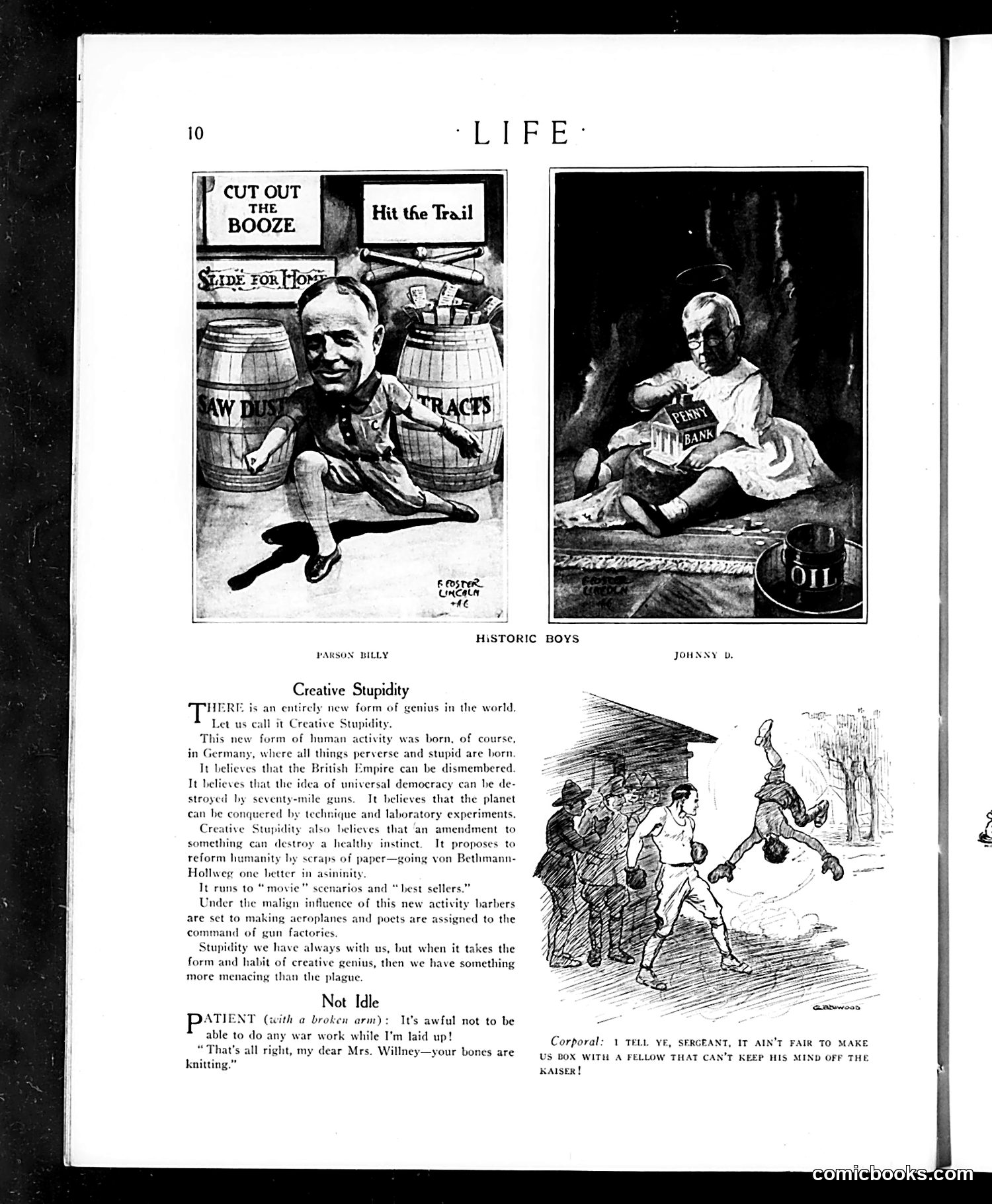
This page satirizes German militarism and wartime propaganda during World War I. The top cartoons labeled "Historic Boys" depict "Parson Billy" (likely Billy Sunday, the American evangelist) and "Johnny D." (possibly a reference to a German leader), both surrounded by symbols of war profiteering and destruction—booze, contracts, and oil reserves. The main article, "Creative Stupidity," criticizes German ideology, accusing it of promoting destructive ideas under the guise of innovation. It references "Bethmann-Hollweg" (German Chancellor Theobald von Bethmann Hollweg) and attacks German military command structures. The bottom sketch shows soldiers, with a caption about a patient unable to contribute to war work due to injury—likely critiquing both German militarism and home-front sacrifice. The overall message condemns German war leadership and ideology as fundamentally corrupt.
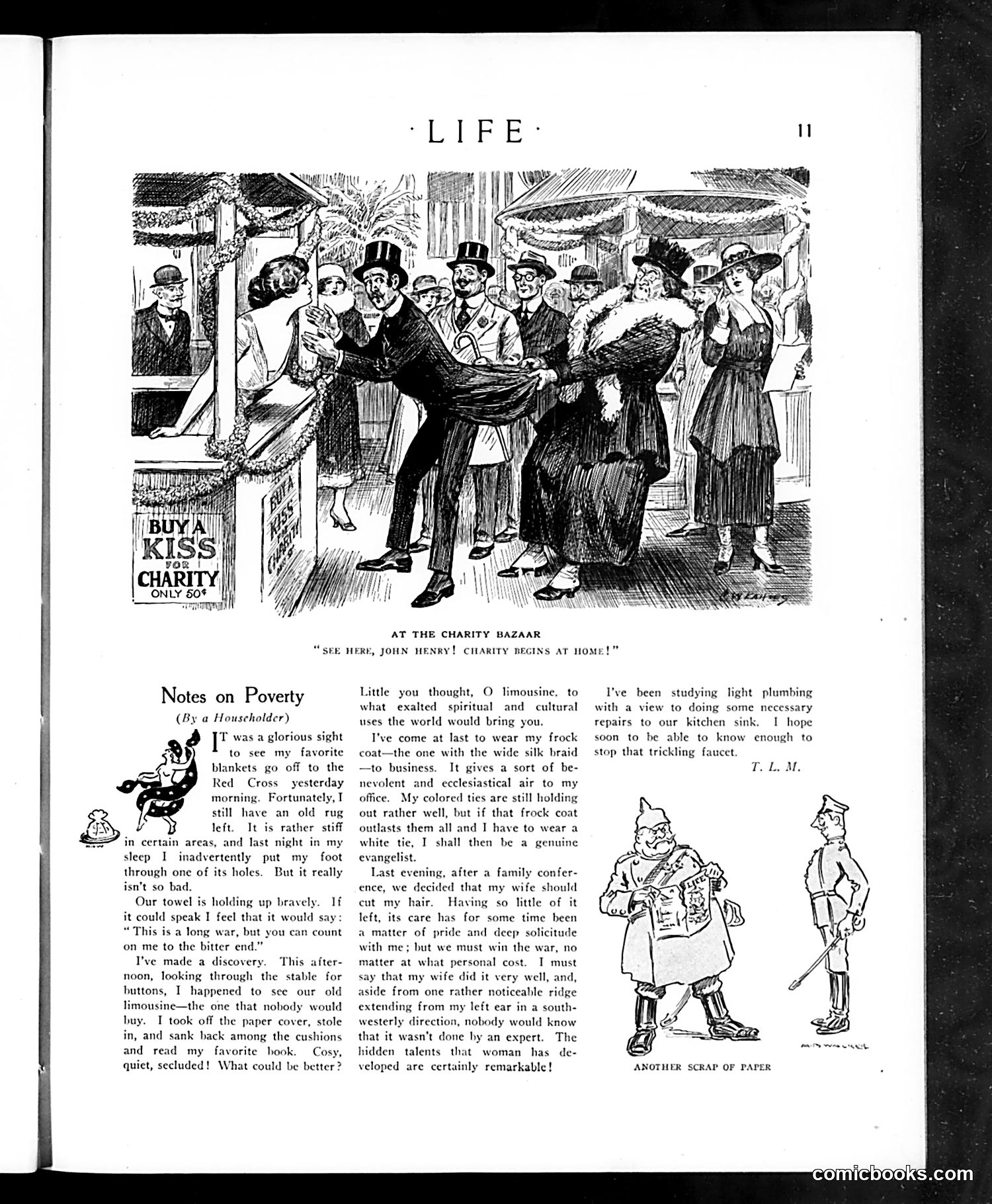
**Main Cartoon:** The large sketch shows a crowded charity bazaar with a booth advertising "KISS FOR CHARITY / ONLY 60¢" The caption reads "SEE HERE, JOHN HENRY! CHARITY BEGINS AT HOME!"—suggesting a woman is chastising a man for participating in or considering a paid kiss booth. The satire mocks wartime charity fundraising tactics and gender dynamics: women using flirtation as a fundraising tool while men are criticized for indulgence, even for charitable purposes. **Lower Section:** "Notes on Poverty (By a Householder)" is a humorous first-person account of domestic wartime hardships—worn blankets, old rugs, threadbare towels, and makeshift repairs. The accompanying small illustrations satirize the contrast between upper-class pretensions and actual poverty during what appears to be WWI.
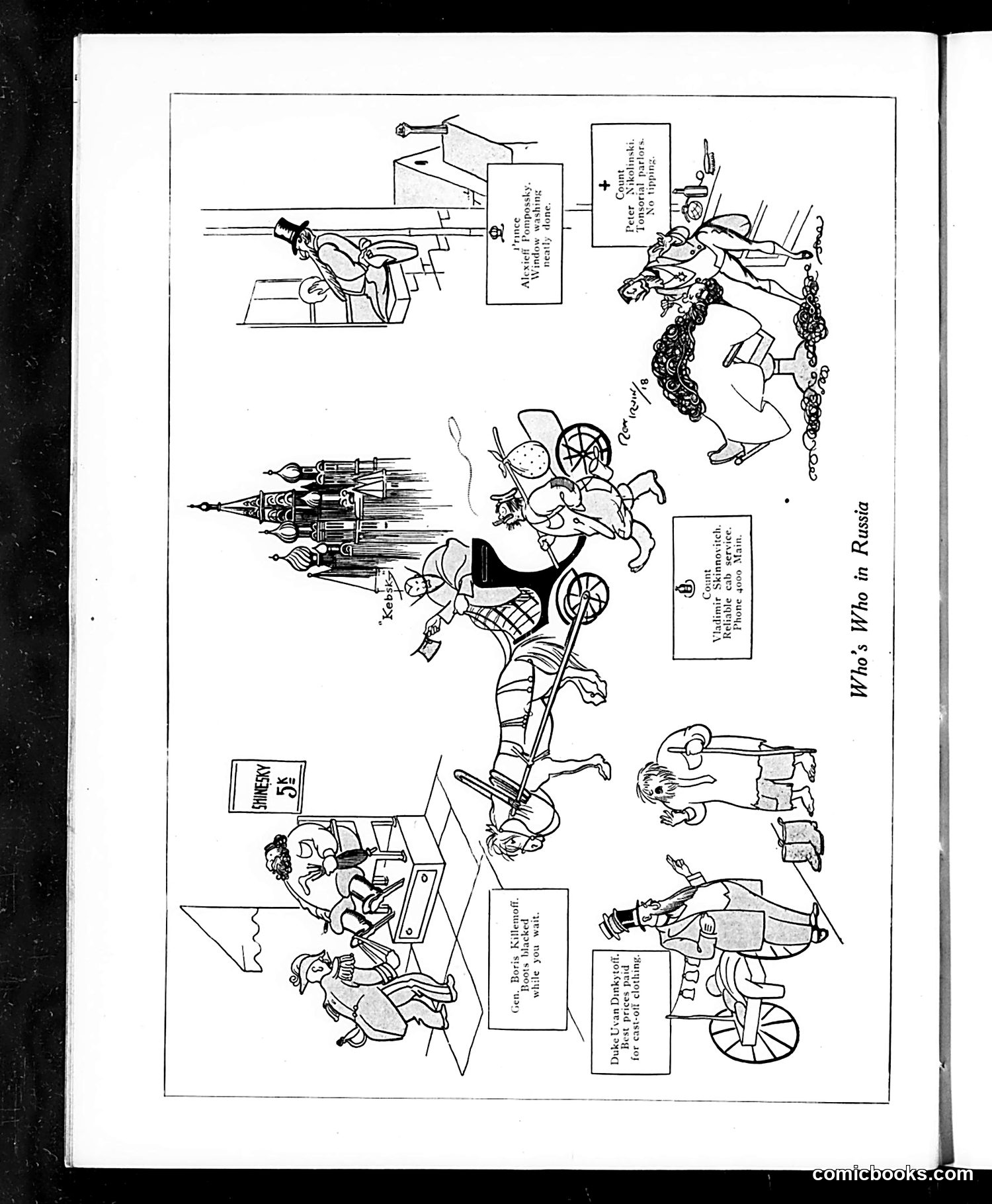
This satirical diagram maps Russian revolutionary figures and their roles, drawn in a style typical of early 20th-century political commentary. The page shows various caricatured characters positioned around a central horseman figure, with labels identifying different Russian political actors and their functions during the revolutionary period. The cartoon uses visual hierarchy and spatial arrangement to convey relationships between figures—likely depicting Lenin, Trotsky, and other Bolshevik leaders alongside counter-revolutionary or opposing forces. The "Who's Who" format allows Western readers to decode the complex Russian political landscape during this turbulent era. The satirical tone suggests skepticism or mockery toward these revolutionary figures, treating their ideological conflicts as a confusing spectacle for foreign audiences unfamiliar with Russian internal politics.
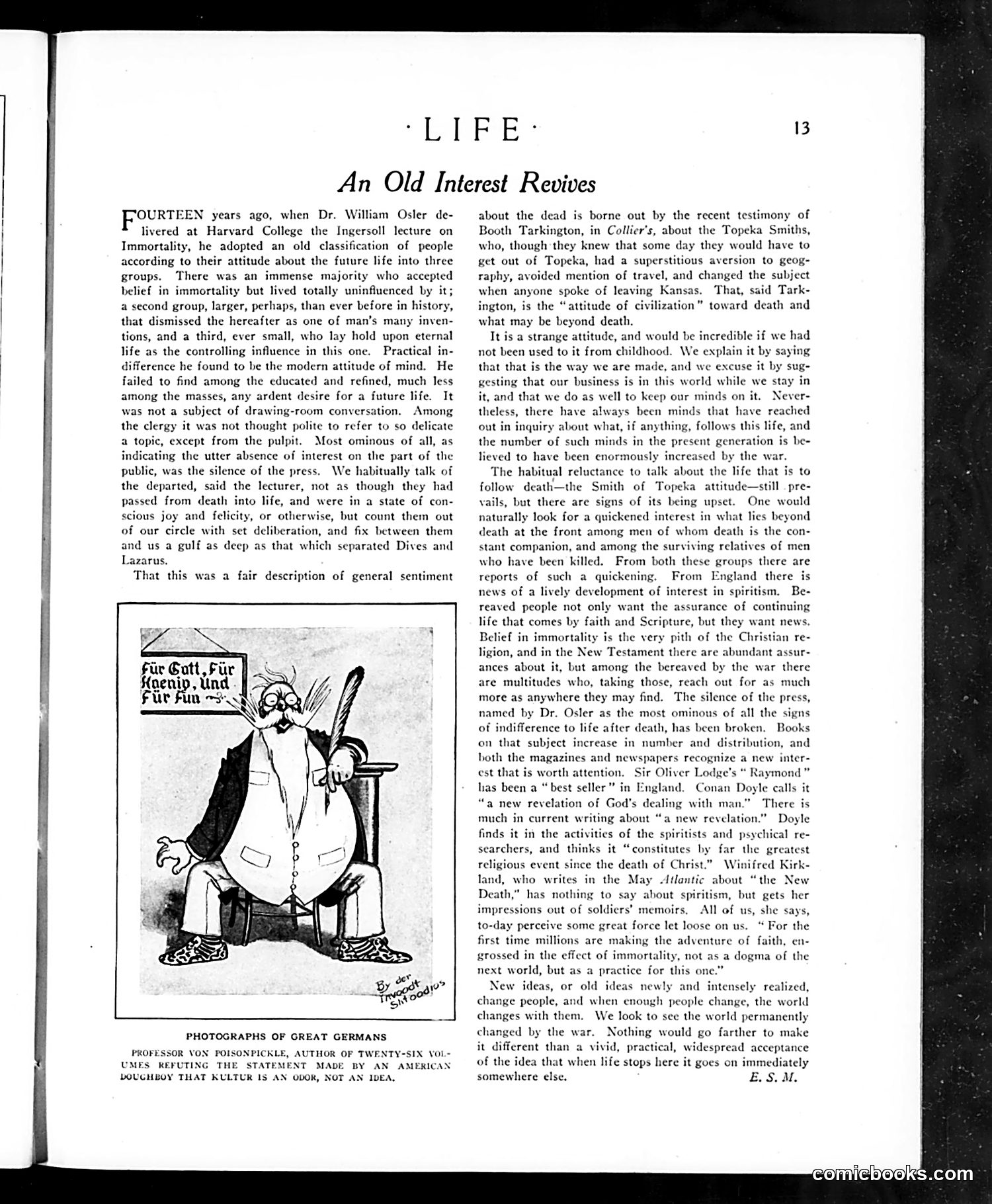
This 1920s *Life* magazine article discusses renewed public interest in spiritualism and belief in an afterlife, particularly following World War I. The cartoon shows a figure labeled "Die Gott Für Kneip Und a Für Alm" (appears to be German text, likely satirizing German culture). The accompanying illustration ridicules spiritualism—a movement gaining traction as bereaved families sought contact with soldiers killed in the war. The article notes that books on spiritualism increased in distribution, and figures like Sir Oliver Lodge promoted "new revelations" about communicating with the dead. The satire targets the gullibility of the grieving public who turned to spiritualism as solace, treating it as a dubious "practice for this one" rather than genuine religious faith.
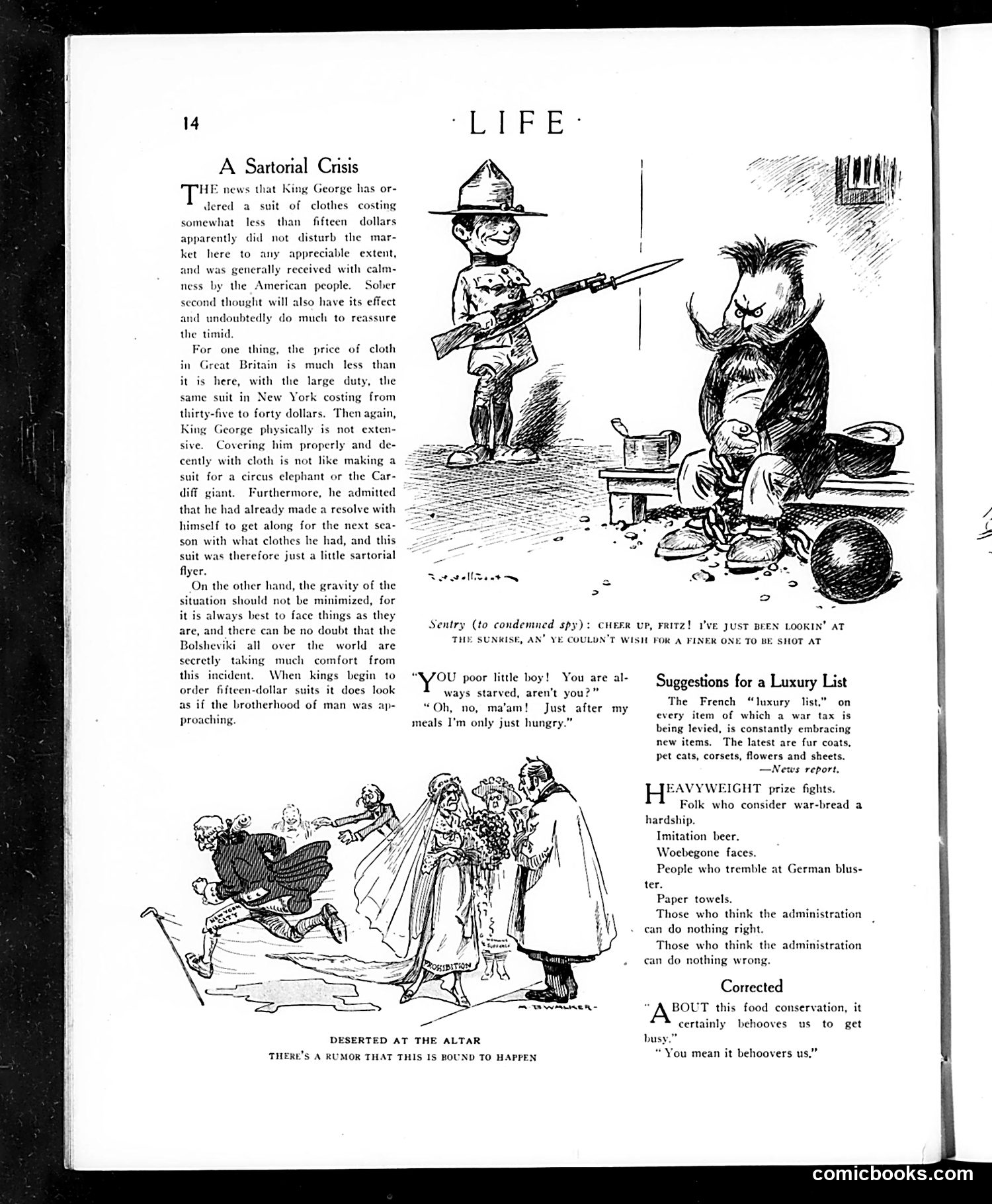
This page contains satirical commentary on World War I-era British austerity measures, particularly regarding King George V's clothing restrictions. **"A Sartorial Crisis"** mocks the British king's decision to order inexpensive suits (under $15) to set an example during wartime. The text notes this creates a contrast with American prices and questions whether such modest clothing can adequately cover the king's physical frame—a subtle jab at his dignity. **The cartoon "Sentry"** depicts a starving soldier encountering a well-fed, mustached officer, likely a German, contrasting military hardship with command privilege. **"Deserted at the Altar"** shows a wedding interrupted, possibly satirizing wartime separations or broken promises. The "Suggestions for a Luxury List" section ironically catalogs items considered excessive during wartime rationing, including furs and flowers—highlighting civilian complaints about restrictions while soldiers suffered.
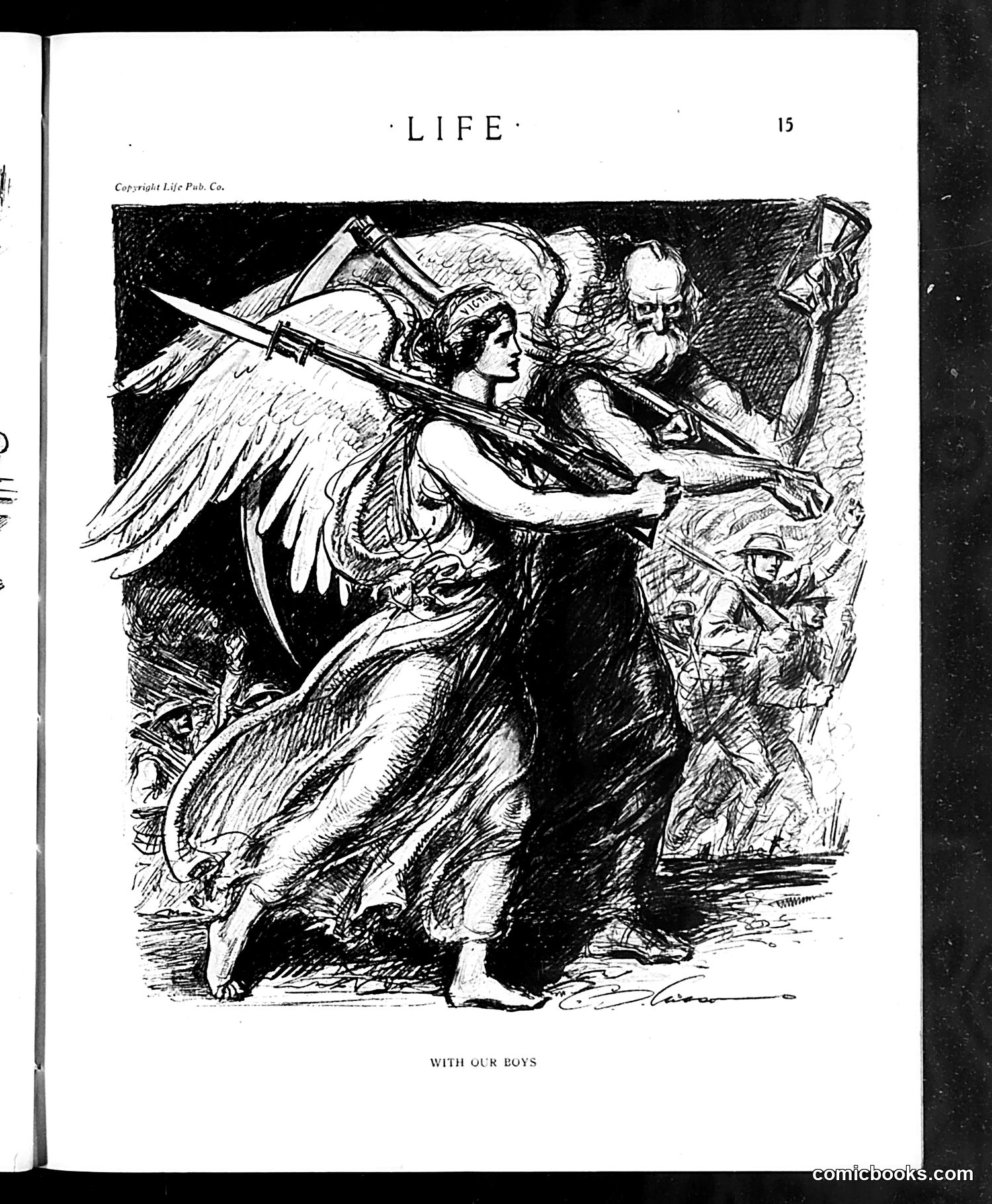
This satirical illustration from *Life* magazine depicts allegorical figures—notably **Lady Liberty** (winged figure, center-left) and what appears to be **Death or a skeletal figure** (right)—guiding soldiers into battle. The composition suggests dark commentary on military conflict and sacrifice. The title "WITH OUR BOYS" indicates this addresses American military involvement, likely from World War I era based on the artistic style. The satire appears to critique how abstract ideals of liberty and patriotism are used to justify sending young soldiers to their deaths. Liberty and death figure equally as forces directing the troops, suggesting the cartoonist views both as operating together in warfare. The sketch's expressionistic style emphasizes the grim reality beneath patriotic rhetoric.
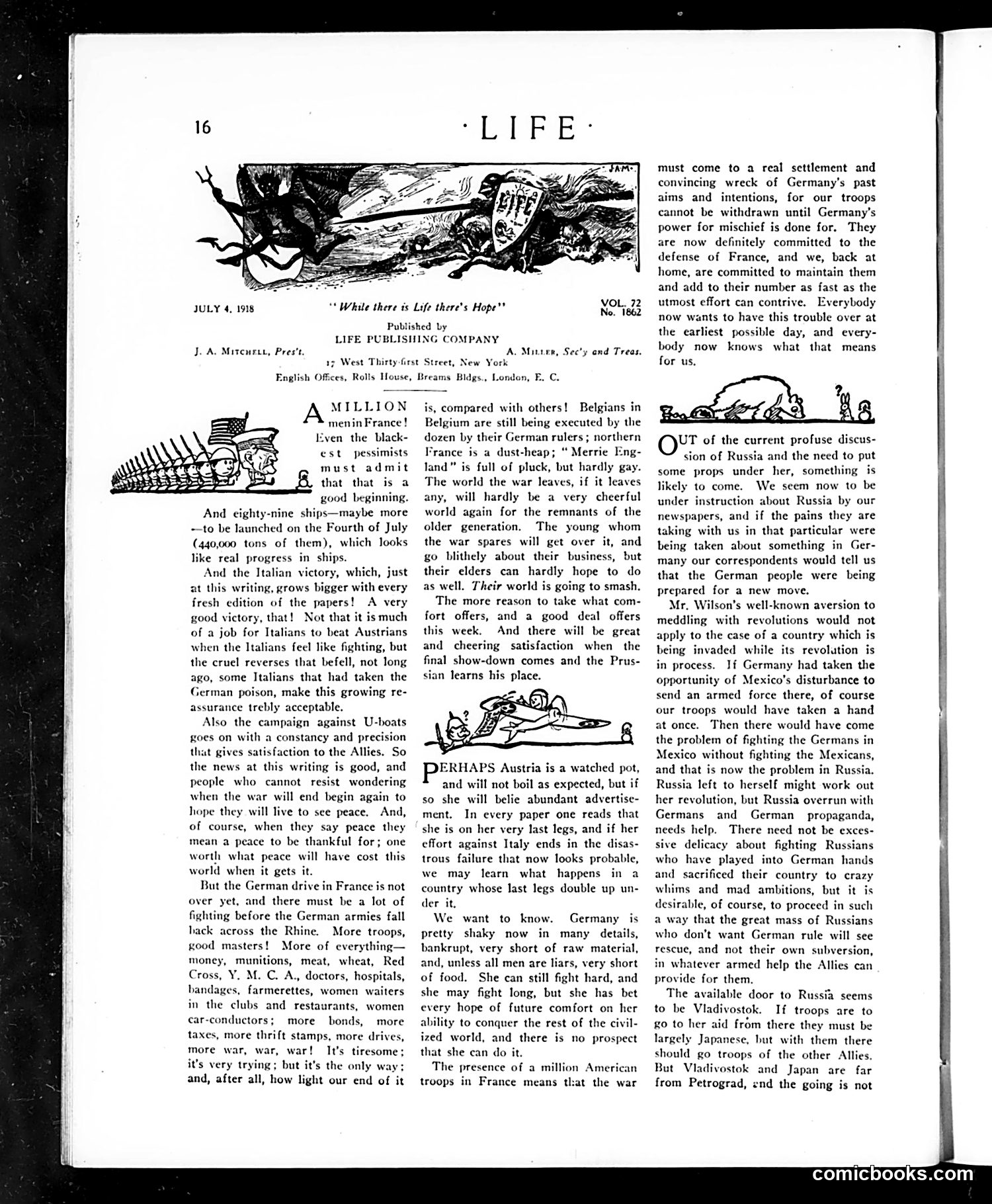
This page contains editorial commentary on World War I, not political cartoons. The small illustrations are decorative headers rather than satirical cartoons. The text celebrates recent Allied military progress: a million American troops now in France, 89 ships launched (440,000 tons), Italian victories against Austria, and ongoing U-boat campaigns. The editor argues these developments mean Germany's defeat is now inevitable, since America's commitment to France's defense is now permanent. The piece expresses optimism tempered by realism—acknowledging the war's ongoing costs (destruction in Belgium and northern France, civilian suffering) while urging continued American resource mobilization: more troops, munitions, bonds, and domestic sacrifice. The broader argument: though the home front's burden is heavy, it's lighter than European allies face, making continued effort morally imperative.
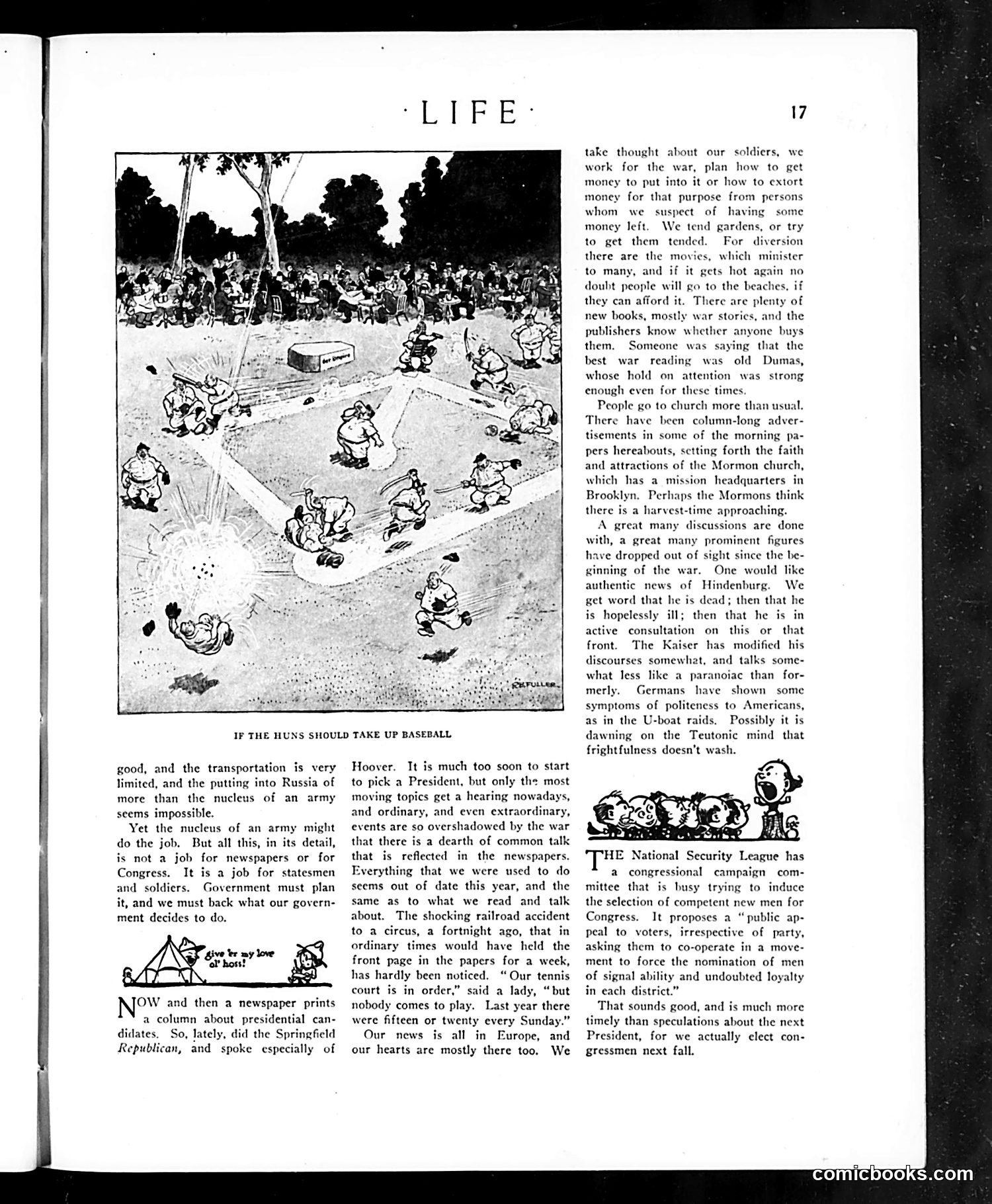
This cartoon satirizes the German military ("the Huns"—a dehumanizing WWI-era term for Germans) by imagining them attempting to play baseball, an quintessentially American sport. The crowded, chaotic scene shows cartoonish German soldiers bungling the game while spectators watch from bleachers. The satire works on two levels: it mocks German militarism as fundamentally incompatible with American recreational culture, and it suggests that Germans, despite their military prowess, cannot master American civilian life or values. Published during American involvement in WWI (the text discusses war efforts and defense), the cartoon reinforces nationalist sentiment by positioning baseball—and by extension American identity itself—as alien to and superior to German culture. The accompanying essay discusses how wartime preoccupations have displaced normal American civic life, making this cartoon's juxtaposition of German soldiers with American leisure particularly pointed.
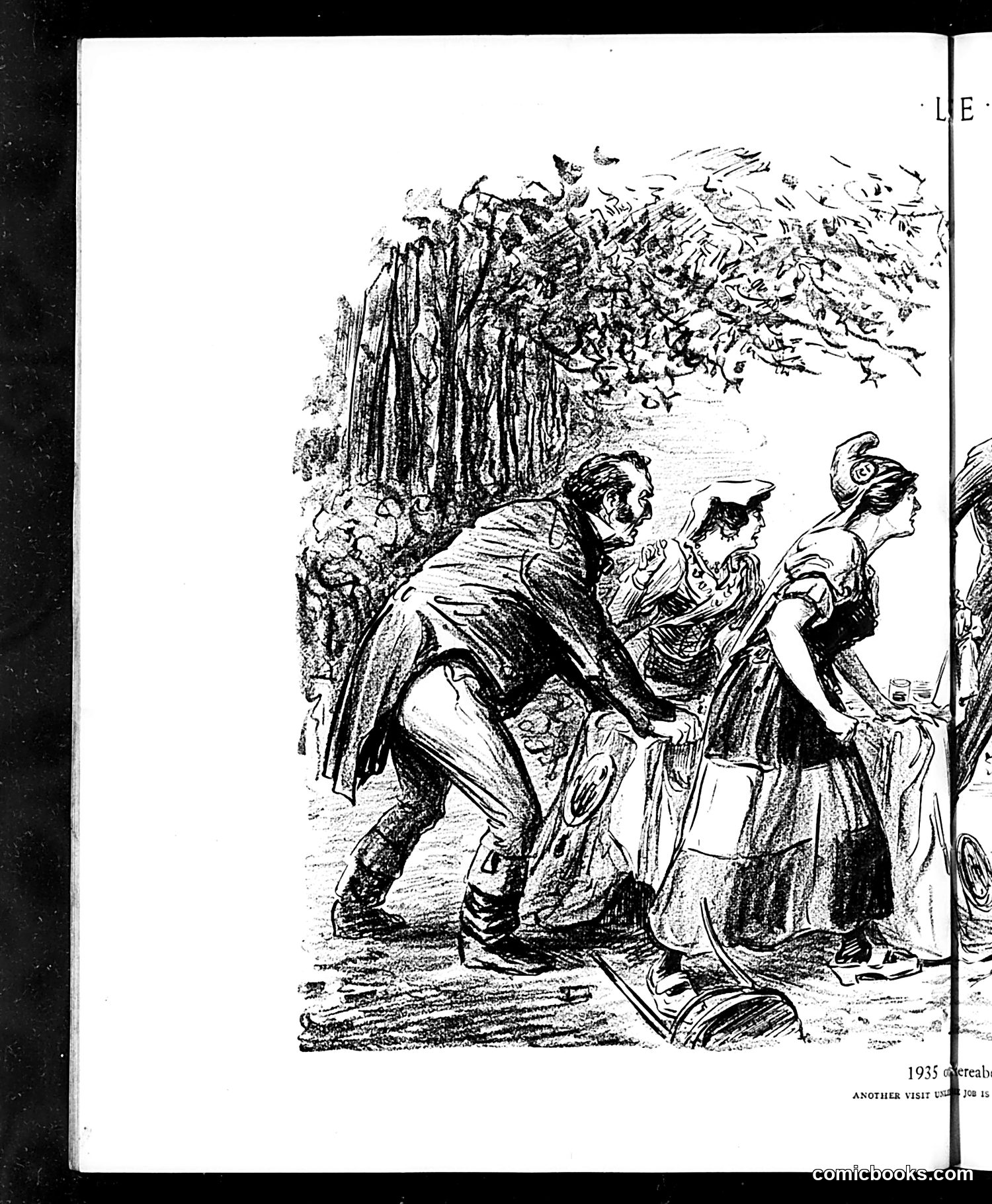
This 1935 *Life* magazine illustration depicts a scene with three figures in period dress standing near a large tree. Based on the visual style and date, this appears to be a historical or allegorical scene rather than contemporary political commentary. The OCR text is fragmentary ("1935 cereal / ANOTHER Visit Ux"), making the specific satirical point unclear. The cartoon may reference a historical event, literary work, or social situation from that era. The formal dress and outdoor setting suggest either a domestic drama or historical reenactment being mocked. Without clearer text or caption, I cannot definitively identify the figures or explain the satire's precise target. More context would be needed to assess what contemporary 1935 issue this cartoon addressed.
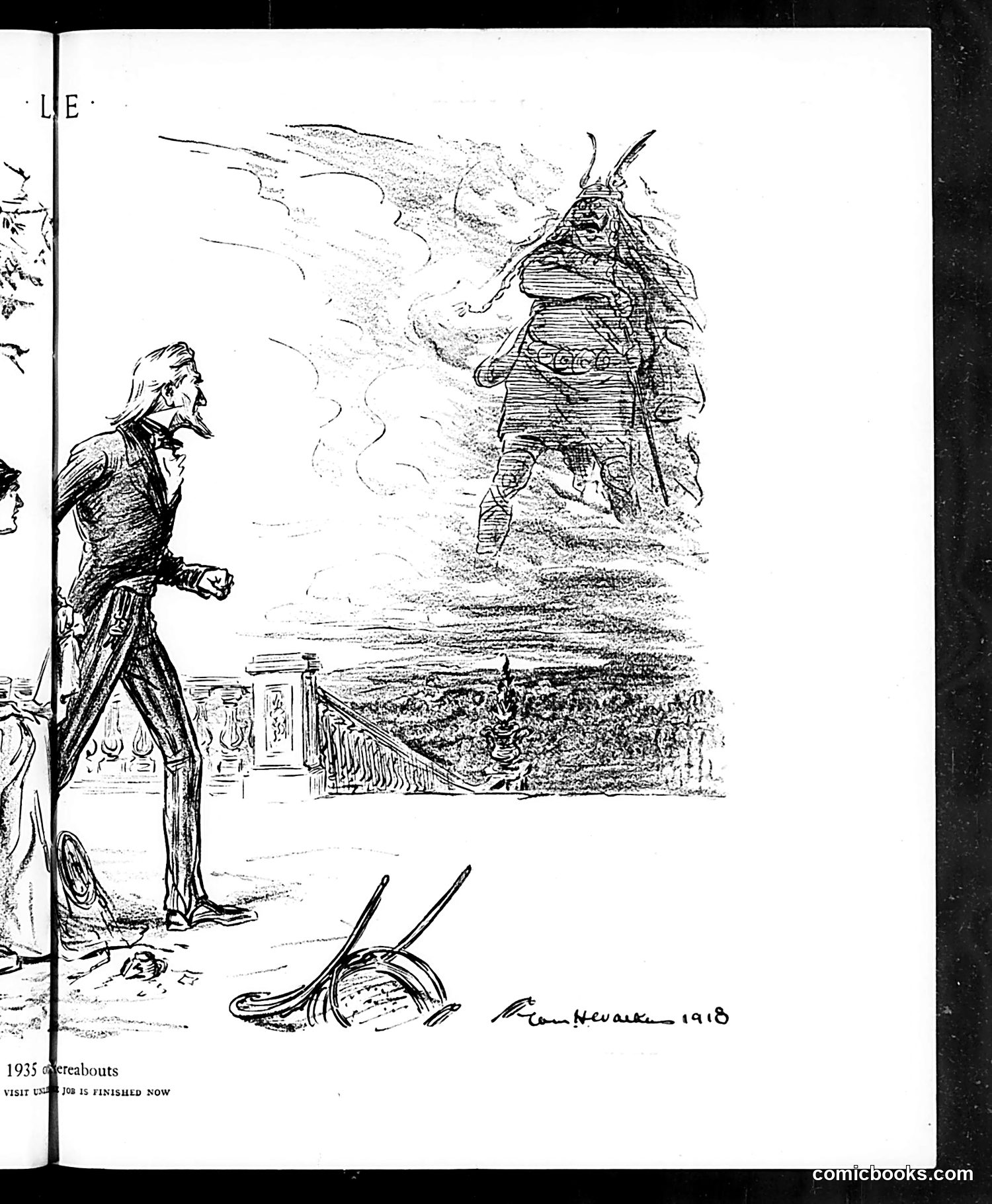
This 1918 cartoon depicts a military figure (left) observing a large, menacing insect-like creature emerging from or looming over a battlefield landscape. The creature appears grotesque and alien, likely representing an enemy force or military threat during World War I—the signature date of 1918 confirms this timing, near the war's end. The cartoon employs exaggeration and caricature typical of wartime propaganda, transforming the enemy into a dehumanized monster to stir patriotic sentiment. The soldier's watchful stance suggests vigilance against this perceived threat. The text references "JOB IS FINISHED NOW," suggesting either optimism about the war's conclusion or commentary on ongoing military concerns. The exact political message remains somewhat unclear without additional context about the specific publication issue.
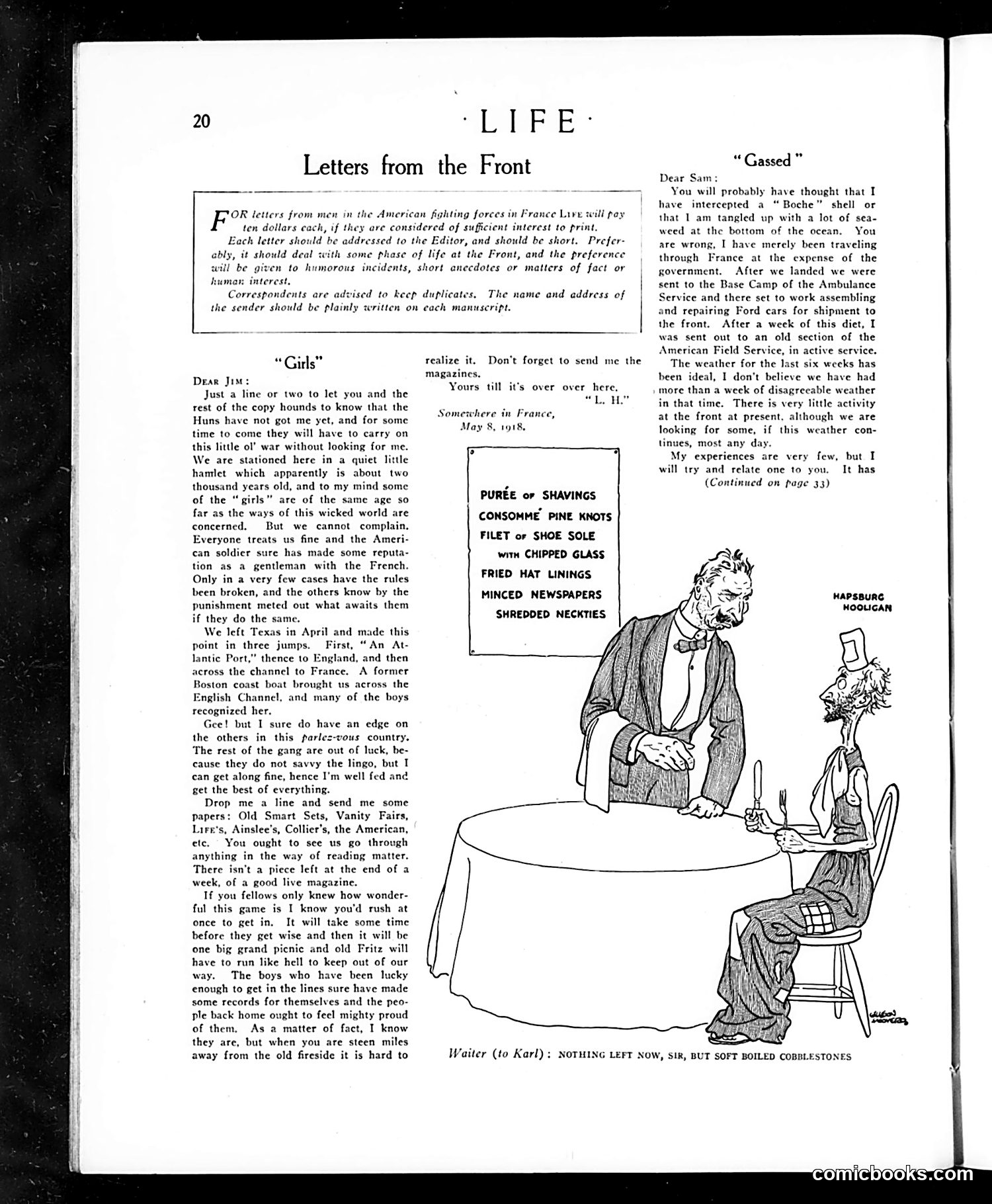
This page contains letters from American soldiers in World War I France, published as reader submissions. The content reflects the magazine's practice of printing soldier correspondence for public interest. **The cartoon** depicts a waiter serving a German officer ("Hapsburg Hooligan") an absurd "menu" listing inedible wartime rations: pureed shavings, pine knot consommé, shoe sole filet, and similar items. This satirizes German hardship and food shortages during the war's later stages, suggesting the enemy faced starvation—a common propaganda theme. The visual contrast between the formal dining setup and the ridiculous "food" creates the satirical punch. **The letters themselves** offer soldiers' perspectives: one describes French villages and American soldiers' reputations; another mentions being "gassed" (likely exposed to chemical weapons) and reassigned to ambulance service. Together, they present sanitized, morale-boosting accounts of the front lines intended for American home-front consumption.
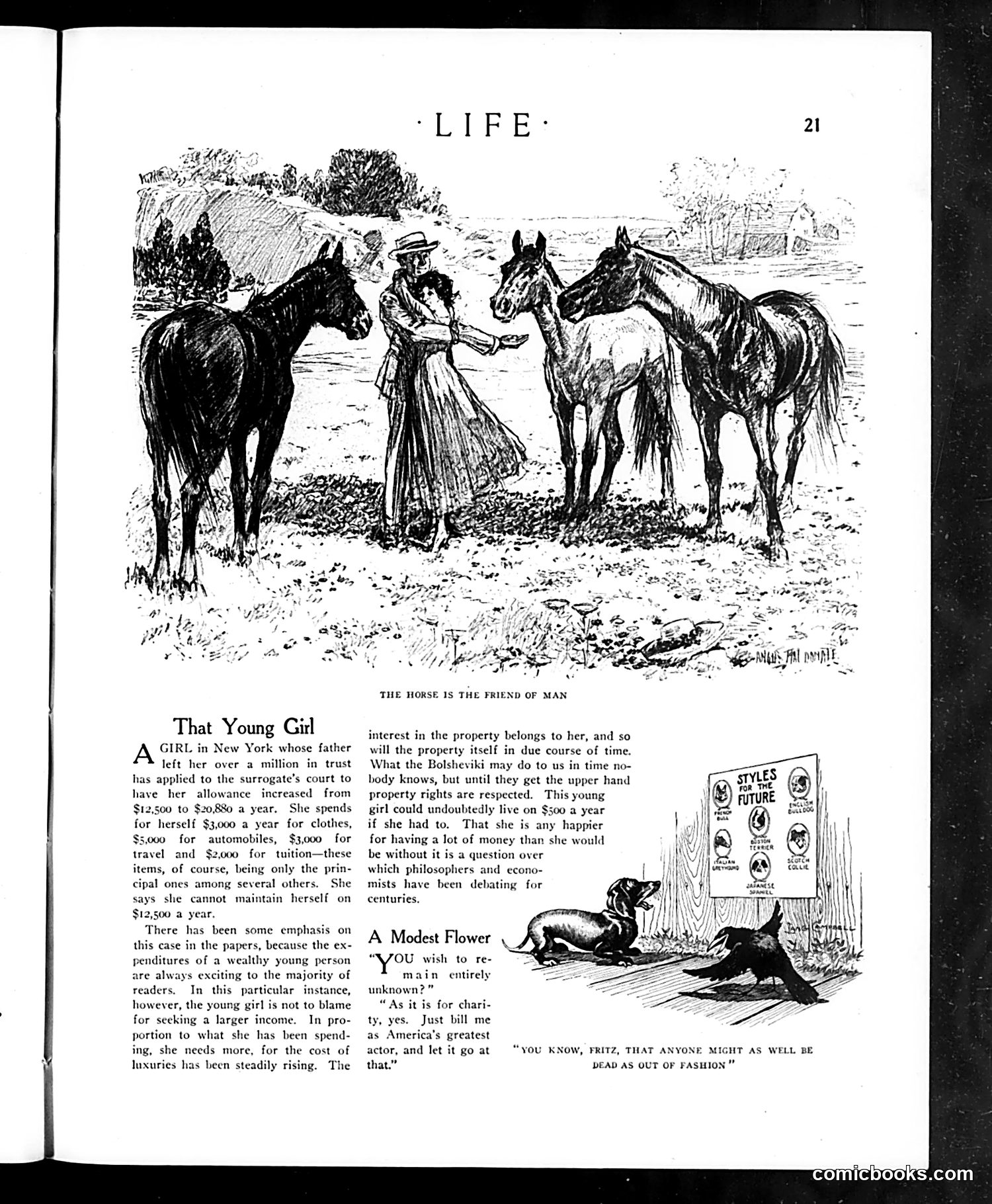
This 1920s *Life* magazine page satirizes wealthy Manhattan excess during the Jazz Age. "That Young Girl" mocks a real court case where a young heiress sought to increase her trust allowance from $12,500 to $20,880 annually, claiming she couldn't survive on her current income despite spending $3,000/year on clothes alone and $5,000 on automobiles. The satire targets the absurdity of the wealthy's spending habits and entitlement. The reference to "Bolsheviki" reflects post-WWI anxiety about communist revolution threatening property rights—implying such wasteful excess might provoke social upheaval. The second cartoon, "A Modest Flower," jokes about an actor wanting anonymity while simultaneously demanding credit as "America's greatest actor"—satirizing vanity and hypocrisy. The caption about being "dead as out of fashion" reinforces themes of superficiality in fashionable society.
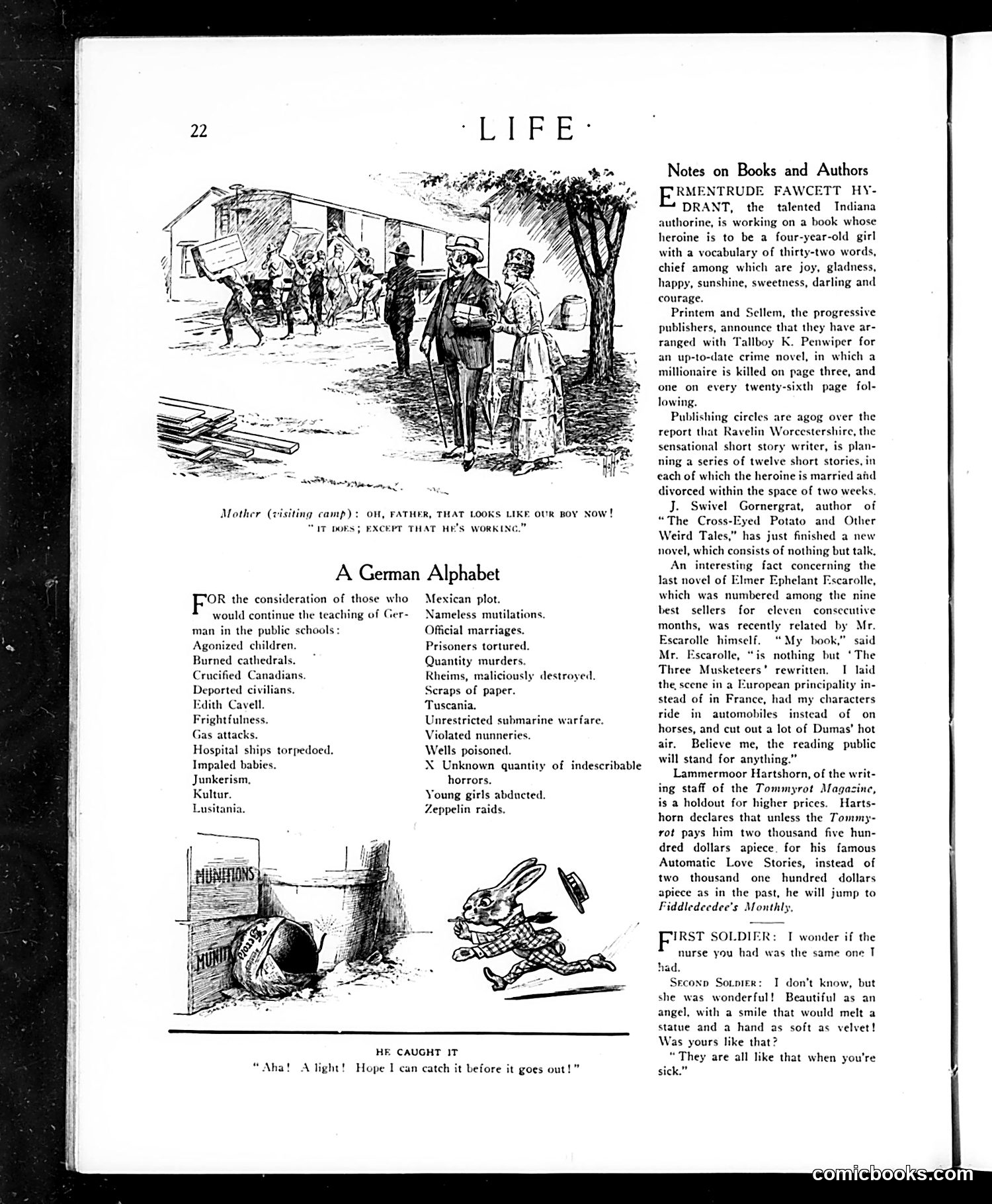
This Life magazine page contains **anti-German World War I propaganda**, created when America opposed Germany (the U.S. entered WWI in 1917). **"A German Alphabet"** is a scathing satirical list pairing each letter A-Z with German wartime atrocities: "Agonized children," "Crucified Canadians," "Edith Cavell" (a British nurse executed by Germany), "Gas attacks," "Lusitania" (ship Germany sank), "Unrestricted submarine warfare," and "Zeppelin raids." This accused Germany of systematic brutality and was meant to justify American involvement and discredit anyone advocating continued German-language teaching in U.S. schools—a contentious issue during wartime. **The top cartoon** jokes about a boy at military camp: his mother says he "looks like our boy" except "he's working"—implying her actual son is lazy by comparison. **"He Caught It"** shows someone chasing a light, possibly mocking German efficiency or military strategy. The page reflects how wartime hysteria affected American culture, including opposition to German language education and immigration.
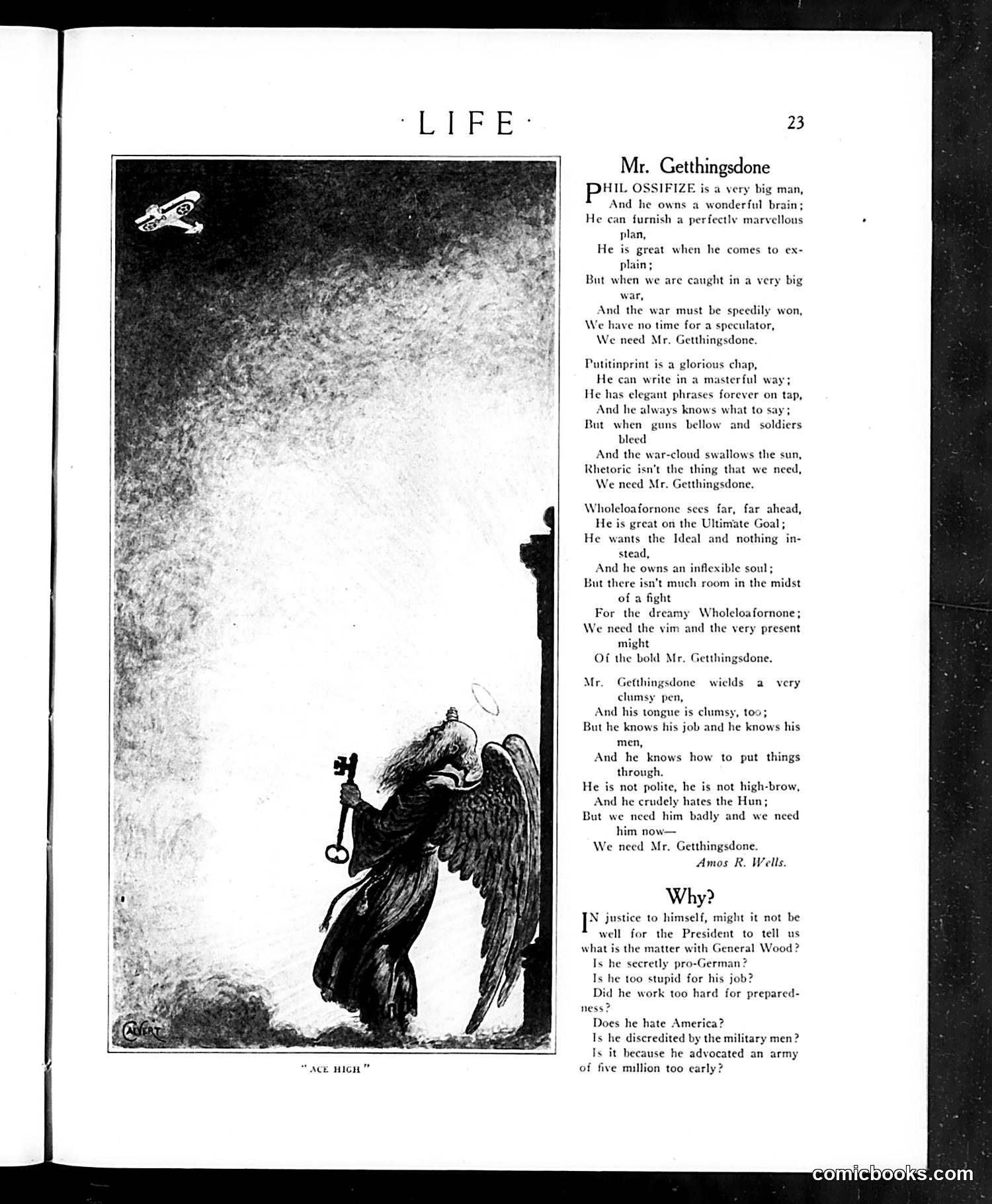
This WWI-era satire contrasts four types of leaders. "Phil Ossifize" (clearly a jab at someone who ossifies—becomes rigid/inflexible), "Putitinprint" (a writer/rhetorician), and "Wholeloafornone" (an idealist) are all criticized as inadequate for wartime. Only "Mr. Getthingsdone"—a crude, ungracious but practical operative who knows how to execute—is deemed necessary when soldiers are dying. The accompanying section "Why?" sarcastically defends General Wood (likely Leonard Wood, a controversial military figure), suggesting the President should publicly justify removing or sidelining him. The questions—is he pro-German? too prepared-minded? discredited by officers?—are rhetorical jabs implying the removal was unjust. The cartoon's eagle with a key labeled "Ace High" likely symbolizes America's power or opportunity during wartime, emphasizing the need for action over words or ideology.
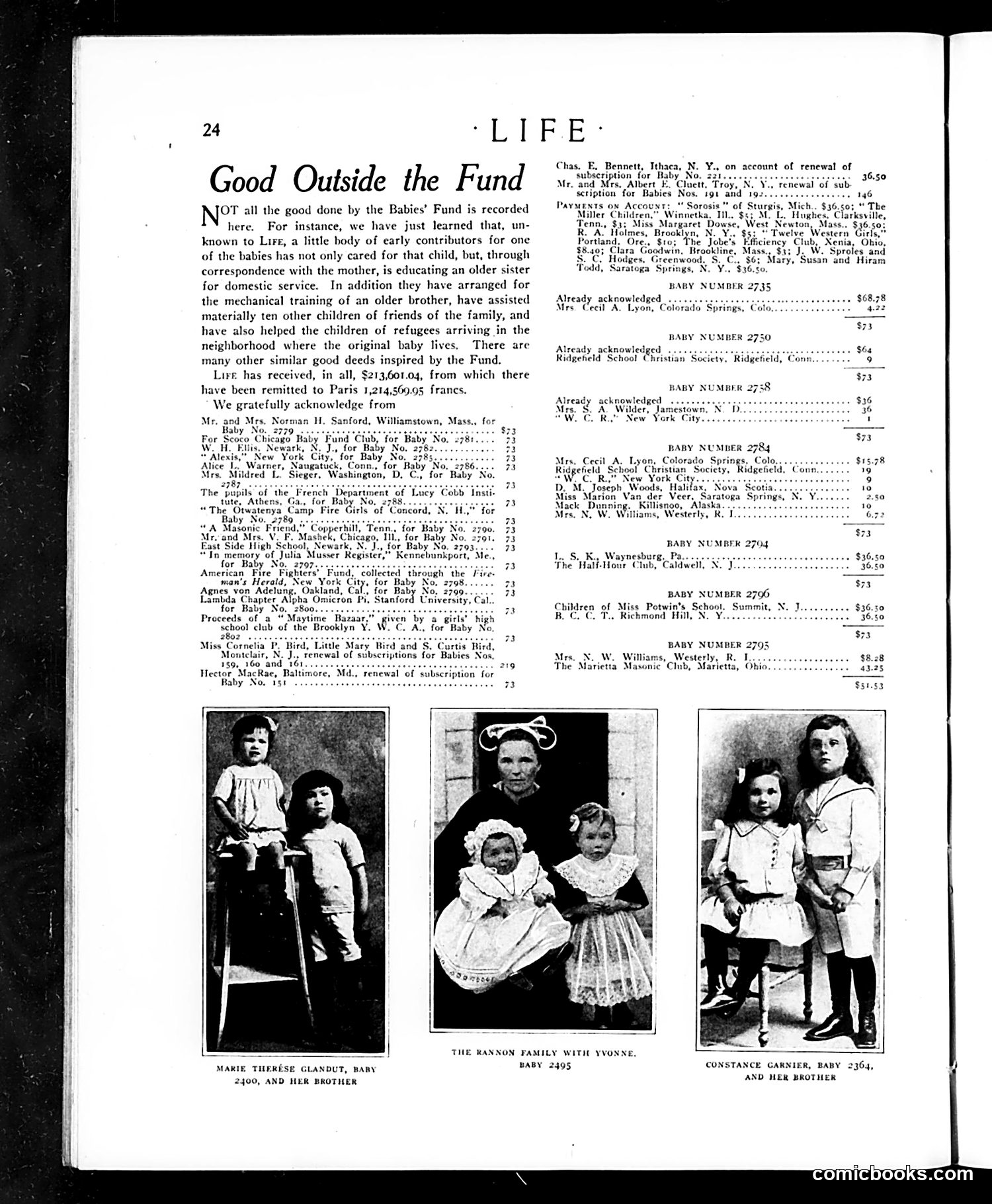
This is not a cartoon page, but rather a financial and donor acknowledgment section for Life magazine's "Babies' Fund"—a charitable initiative supporting impoverished French children (likely post-WWI relief). The text describes how the Fund operates beyond simple subsistence care: donors have educated siblings, trained older children, assisted refugees, and created broader community support networks. It details that approximately $213,601 was raised and converted to French francs for aid distribution. The page lists hundreds of donors—individuals, clubs, organizations, and social groups—contributing to numbered babies' support. Three photographs show the actual beneficiary children: Marie Thérèse Glandut (Baby 2400), the Rannon family with Yvonne (Baby 2495), and Constance Garnier (Baby 2364) with her brother. This demonstrates early-20th-century organized philanthropy and demonstrates how Life used its platform for social welfare advocacy and donor recognition.
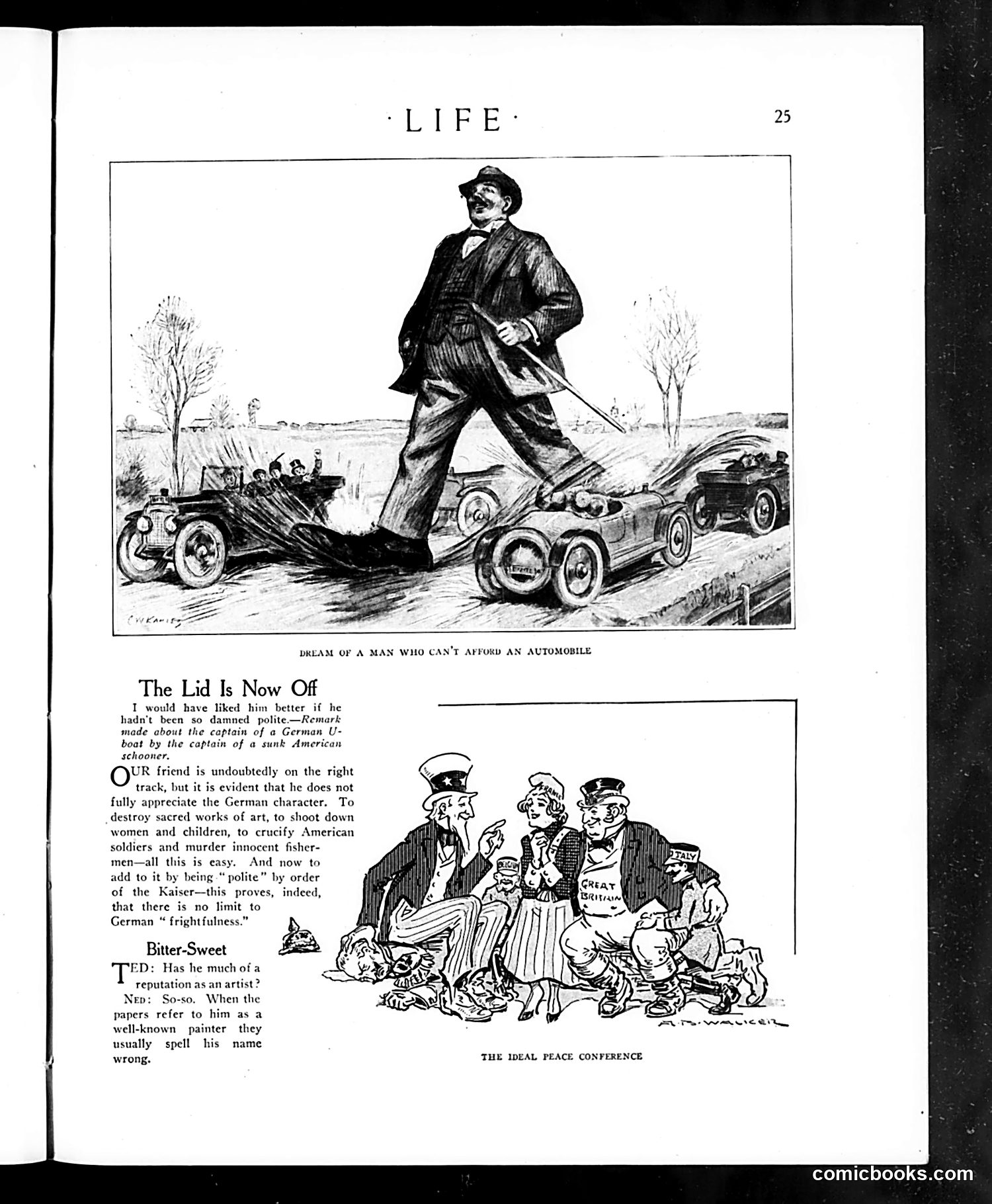
This page contains two satirical pieces critiquing Germany during World War I. **Top cartoon**: A giant German military figure crushes tiny automobiles, mocking the fantasy of a man too poor to afford a car. The caption "Dream of a Man Who Can't Afford an Automobile" uses this as metaphor for German military dominance. **"The Lid Is Now Off"**: Commentary on German U-boat warfare. It sarcastically argues that Germans committing atrocities (destroying art, killing civilians and soldiers) while simultaneously following Kaiser's orders to be "polite" exemplifies their unlimited capacity for "frightfulness"—a loaded term for German brutality. **"Bitter-Sweet"**: A brief joke about an obscure painter whose name newspapers consistently misspell. **"The Ideal Peace Conference"**: The lower cartoon depicts Allied leaders (appears to show British, American, and French representatives) with what look like enemy caricatures, suggesting satirical commentary on post-war peace negotiations. The page reflects American anti-German sentiment during the Great War period.
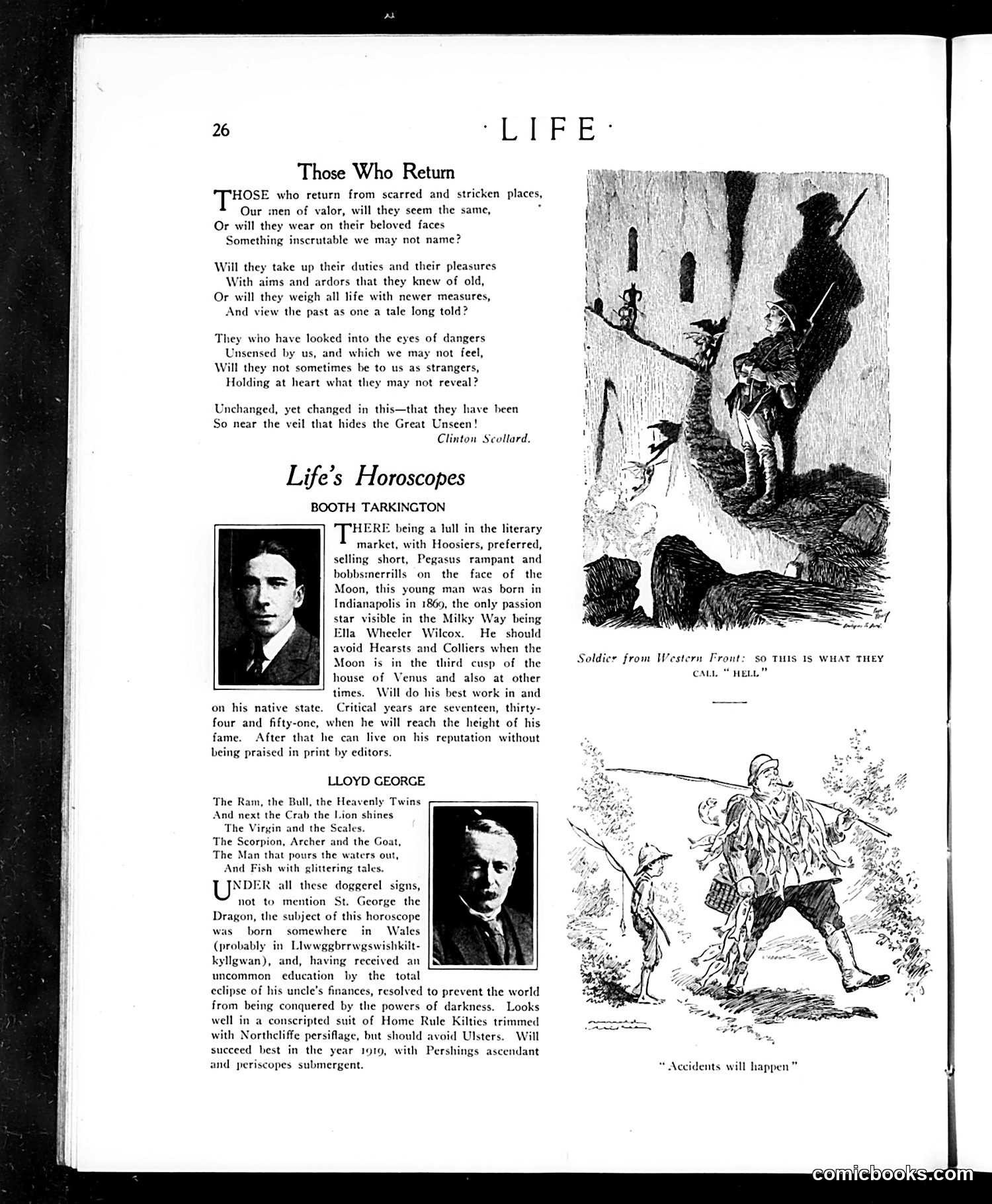
This page from *Life* magazine combines serious wartime reflection with satirical humor. **"Those Who Return"** is a poignant poem by Clinton Scollard addressing World War I soldiers. It questions whether returning veterans will psychologically reintegrate—will they seem changed, haunted by experiences civilians cannot fathom? The poem contemplates the alienation trauma creates. **"Life's Horoscopes"** by Booth Tarkington satirizes two contemporary figures through mock-astrological predictions: 1. **Booth Tarkington** (the author himself)—a celebrated Indianapolis-born novelist. The satire mocks literary pretension and publishing trends. 2. **Lloyd George**—the Welsh Prime Minister, referenced through absurdist Welsh place-names and wartime politics. The horoscope jokes that he'll "succeed best in 1919" with "Pershings ascendant" (American General Pershing) and "periscopes submergent" (submarines)—topical WWI references suggesting Allied military dominance. The right-side illustrations depict trench warfare brutality, captioned "so this is what they call 'Hell'"—darkly contrasting the satirical horoscopes with actual soldier suffering. The juxtaposition highlights *Life*'s dual role: serious social commentary wrapped in humor.
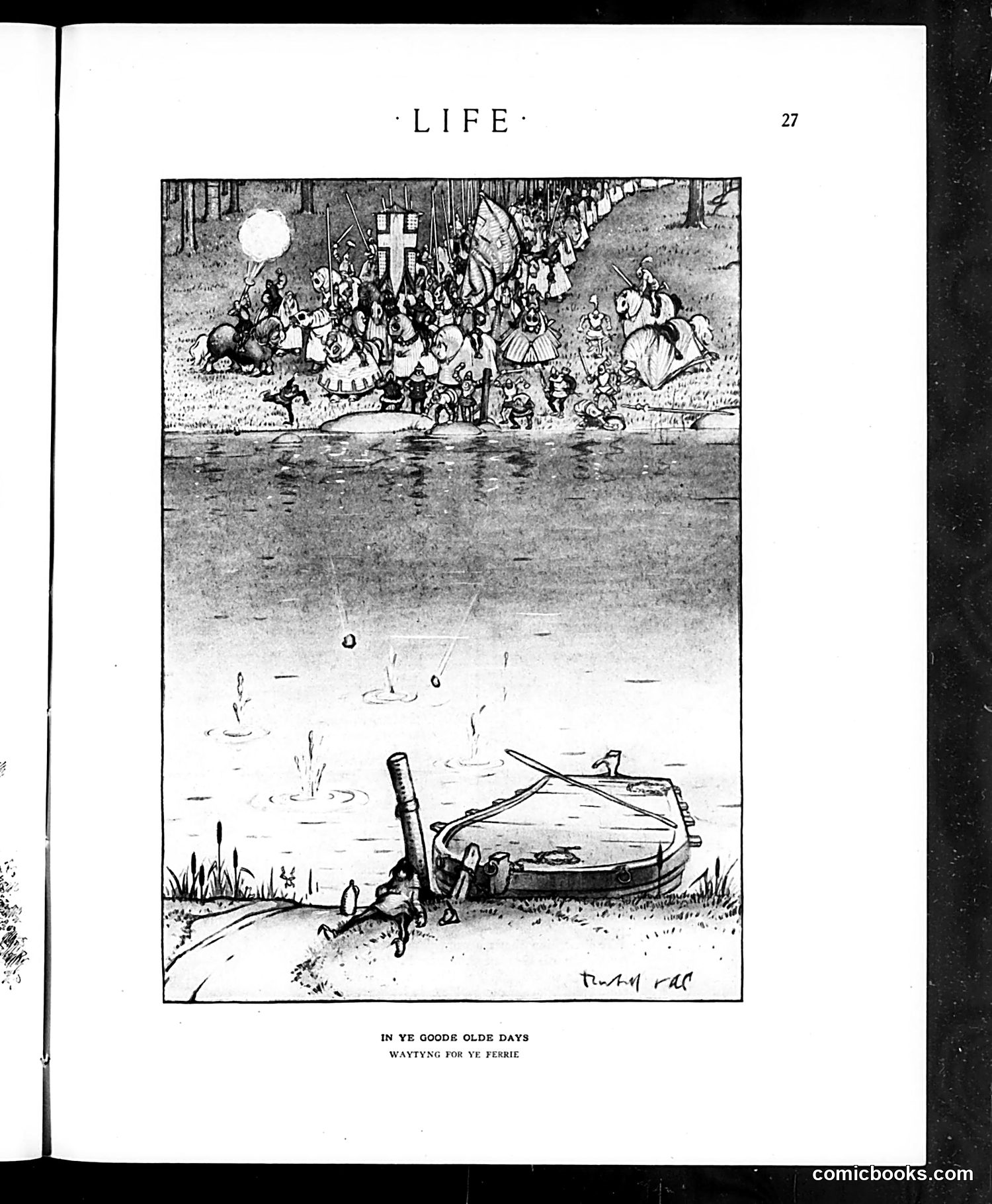
This cartoon satirizes nostalgia for "the good old days" by contrasting romanticized medieval imagery with harsh reality. The upper half shows a grand procession—nobles on horseback, religious figures with crosses and banners, courtiers in elaborate dress—suggesting idealized past pageantry. The lower half depicts the unglamorous reality: a crude, barely-functional ferry boat sits abandoned on muddy ground, with a solitary figure waiting beside it. The contrast between the fantasy of aristocratic splendor and the actual mundane, deteriorated conditions of transportation and daily life is the joke. The message appears critical of those who glorify history while ignoring its genuine discomforts and limitations.
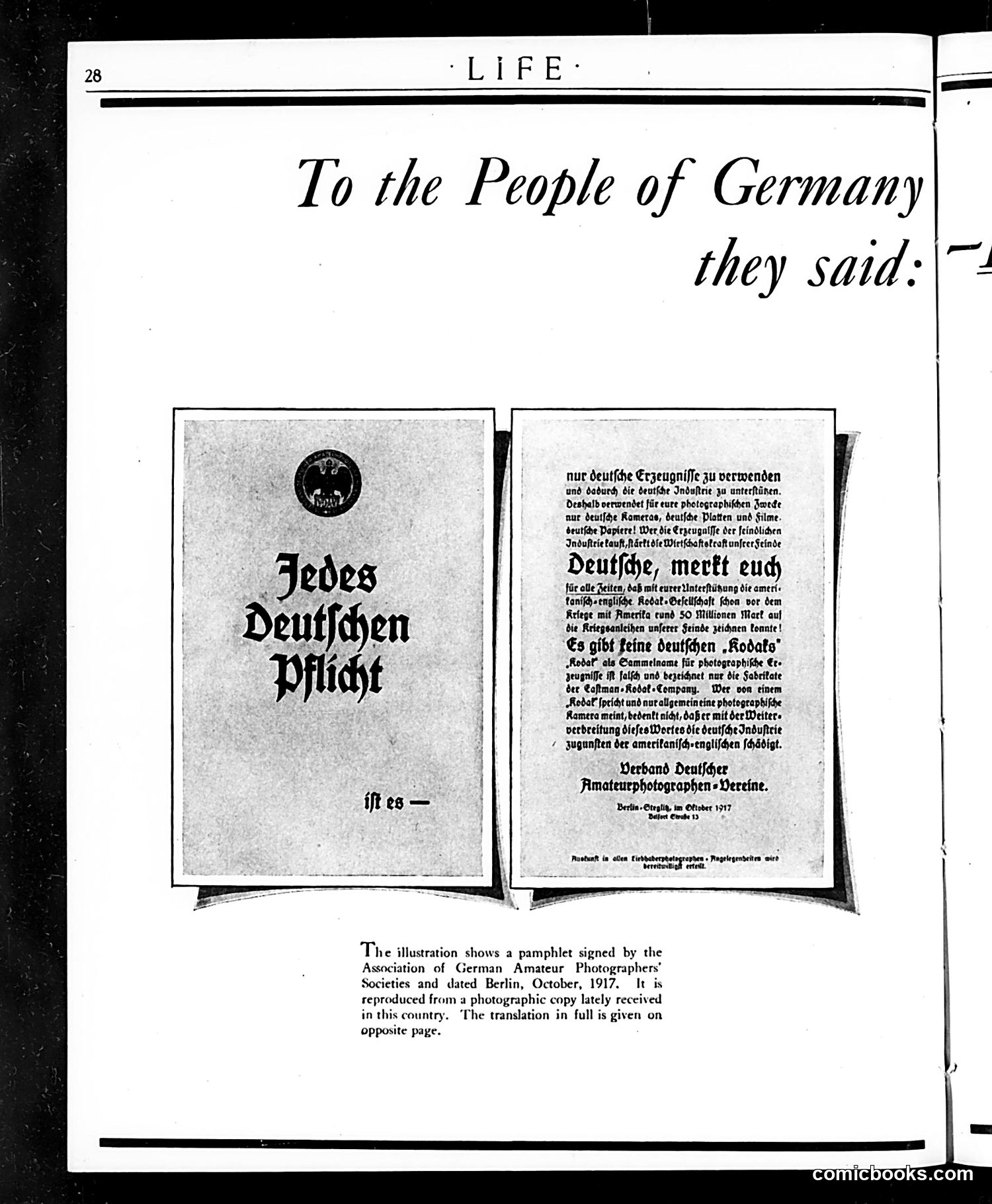
This page reproduces a German wartime propaganda pamphlet from October 1917, during World War I. The Association of German Amateur Photographers urges Germans to buy only German photographic equipment—cameras, film, and paper—to support the domestic industry and avoid enriching enemy nations (specifically America and Britain). The pamphlet argues that using foreign photography products, particularly Kodak (identified as American-British owned), indirectly funds enemy war efforts by generating millions of marks in profits that support enemy war bonds. **The satire**: Life magazine is presenting this as an example of German wartime nationalism and economic desperation. By republishing it to American readers in 1917 (when the U.S. had just entered WWI), Life ridicules German attempts to isolate their economy and the absurdity of treating consumer goods as patriotic warfare—while implicitly highlighting American industrial dominance, particularly Kodak's market power.
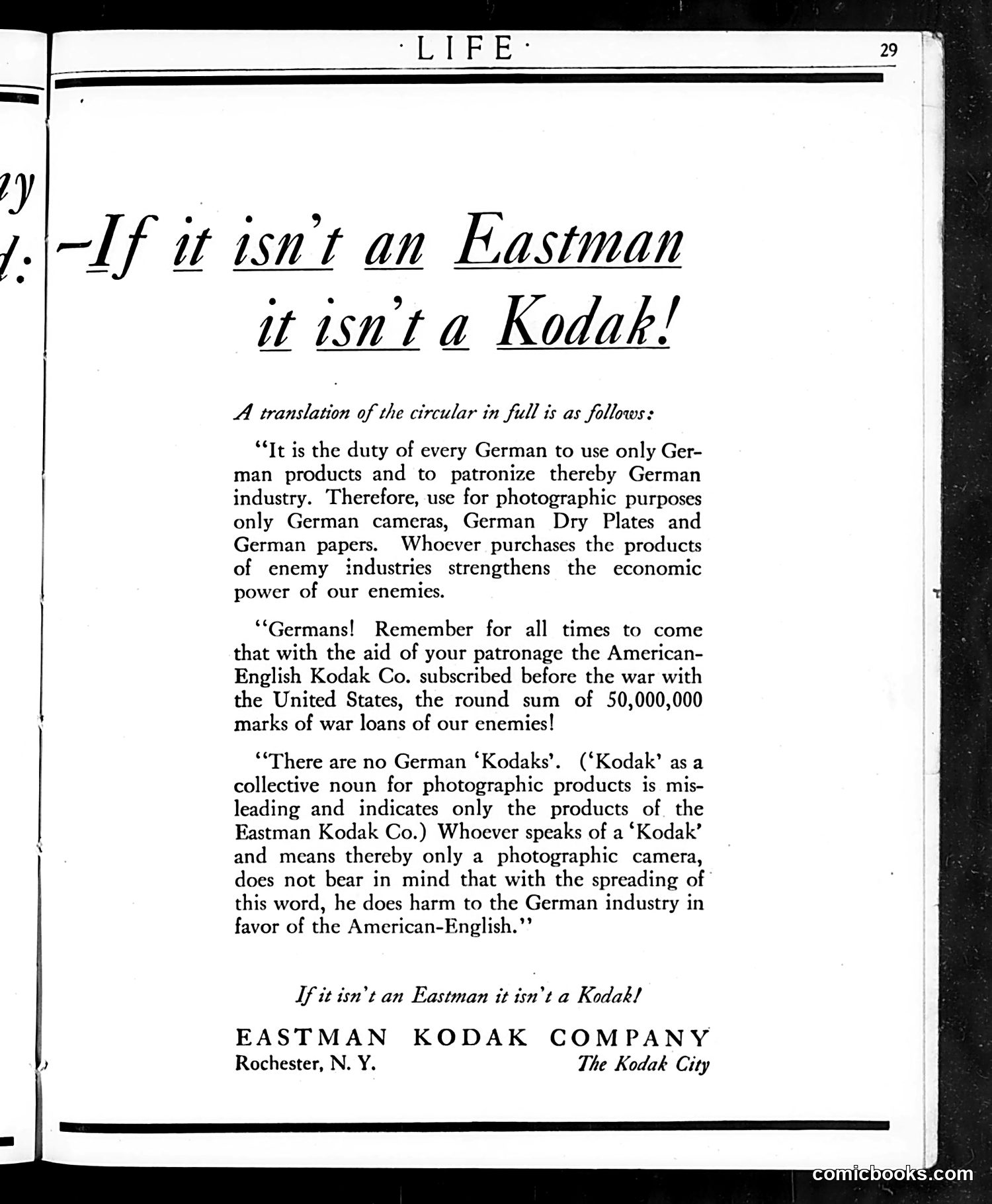
This is a **wartime advertisement** by Eastman Kodak Company, likely from WWI era, responding to German propaganda. The page reproduces a German circular urging citizens to boycott American products, specifically Kodak cameras, as supporting enemy war loans. Kodak's response is satirical: they reprint the German message verbatim, then use its own logic against it. The Germans' complaint—that "Kodak" had become a genericized trademark for all cameras—actually proves Kodak's market dominance and cultural penetration in Germany itself. The slogan "If it isn't an Eastman it isn't a Kodak!" underscores this: Kodak owns the brand so completely that even German enemies cannot escape it. By publishing this anti-Kodak propaganda in *Life*, Kodak turns their opponent's economic attack into free advertising, demonstrating American industrial superiority and market strength to American readers.
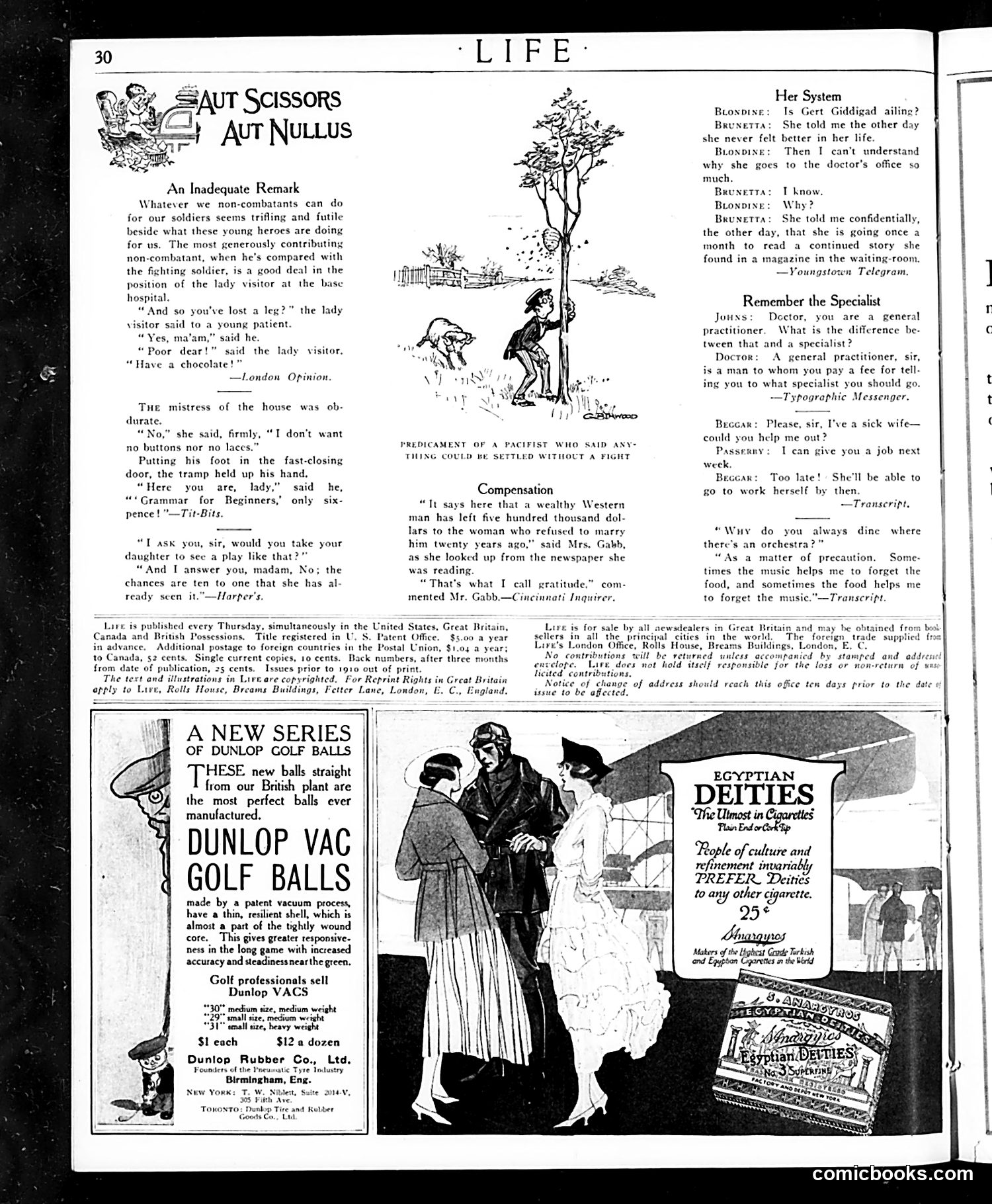
This page contains several short humorous anecdotes and advertisements rather than a unified political cartoon. **The sketches satirize:** 1. **"An Inadequate Remark"**: Mocks civilians' well-meaning but hollow sympathy for wounded soldiers in WWI—a lady offering chocolate to an amputee seems absurdly insufficient compared to actual sacrifice. 2. **Social commentary pieces** on domestic disputes, begging, and professional pretense (distinguishing general practitioners from specialists). 3. **"The Pacifist"** cartoon (center): Shows a pacifist being beaten up, ironically illustrating that his philosophy of non-violence cannot solve disputes when others refuse to follow it. The page is primarily **advertising-driven**, featuring Dunlop golf balls and Egyptian Deities cigarettes. **Historical context**: Published during WWI, the humor reflects home-front attitudes toward soldiers' sacrifice and civilian inadequacy, plus period anxieties about class, professions, and social propriety—typical of Life magazine's satirical approach to contemporary society.
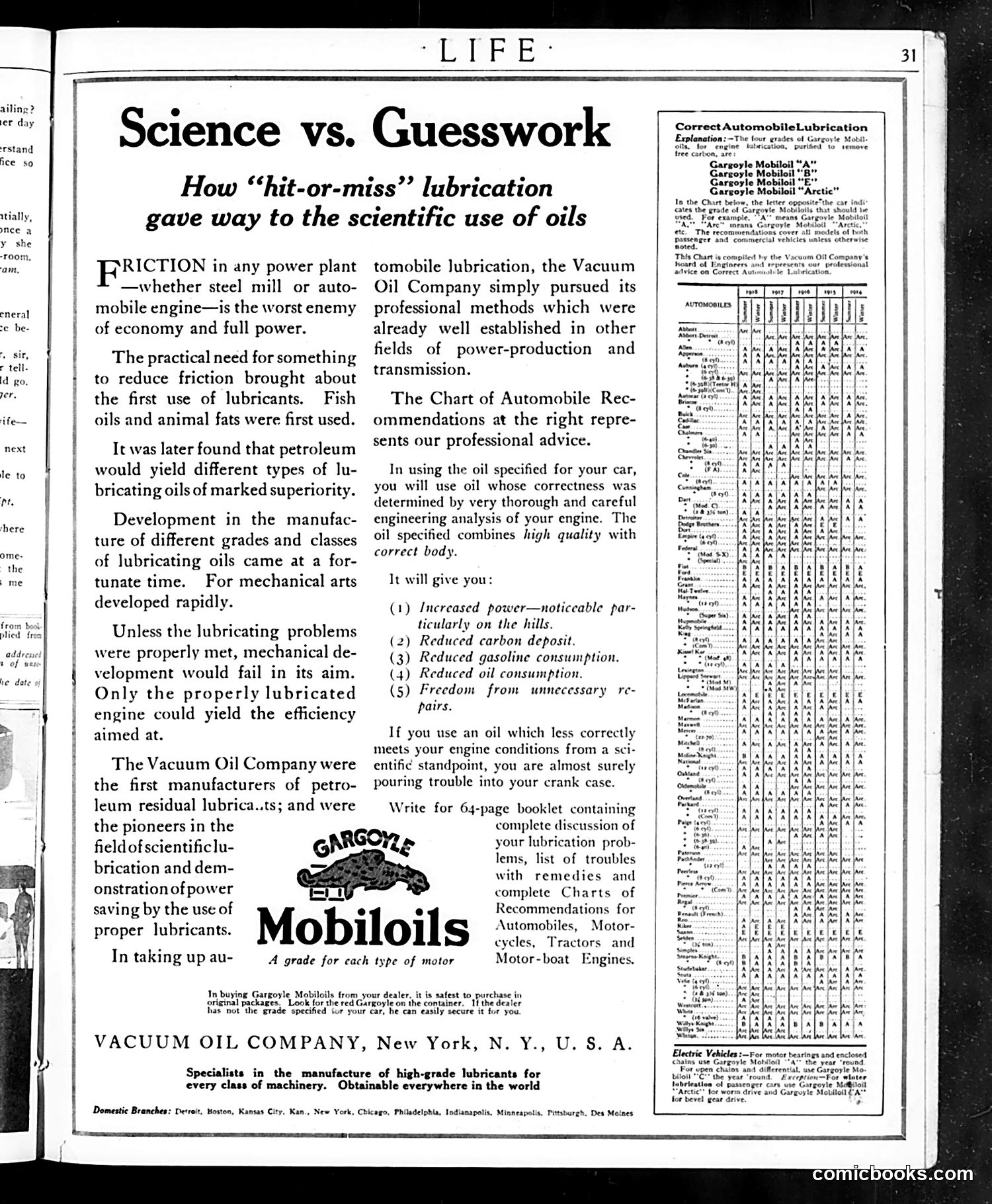
This is not a political cartoon but a **full-page advertisement** for Gargoyle Mobiloils by the Vacuum Oil Company. The "satire" is rhetorical rather than visual: the headline contrasts "science" (proper lubrication based on engineering analysis) with "guesswork" (haphazard, incorrect oil choices). The article argues that early automobile owners used trial-and-error methods for engine lubrication, but the Vacuum Oil Company pioneered scientific approaches to oil manufacturing. The right side features a detailed **chart recommending specific oil grades for different automobile models**—presented as evidence of their professional, data-driven expertise versus casual consumer guessing. The message: using the wrong oil "pouring trouble into your crank case"; using their scientifically-formulated Mobiloils guarantees better power, less wear, and fewer repairs. This reflects **1920s-era advertising strategy**: positioning industrial products as modern, scientific solutions to consumer problems, establishing the manufacturer as the authoritative expert.
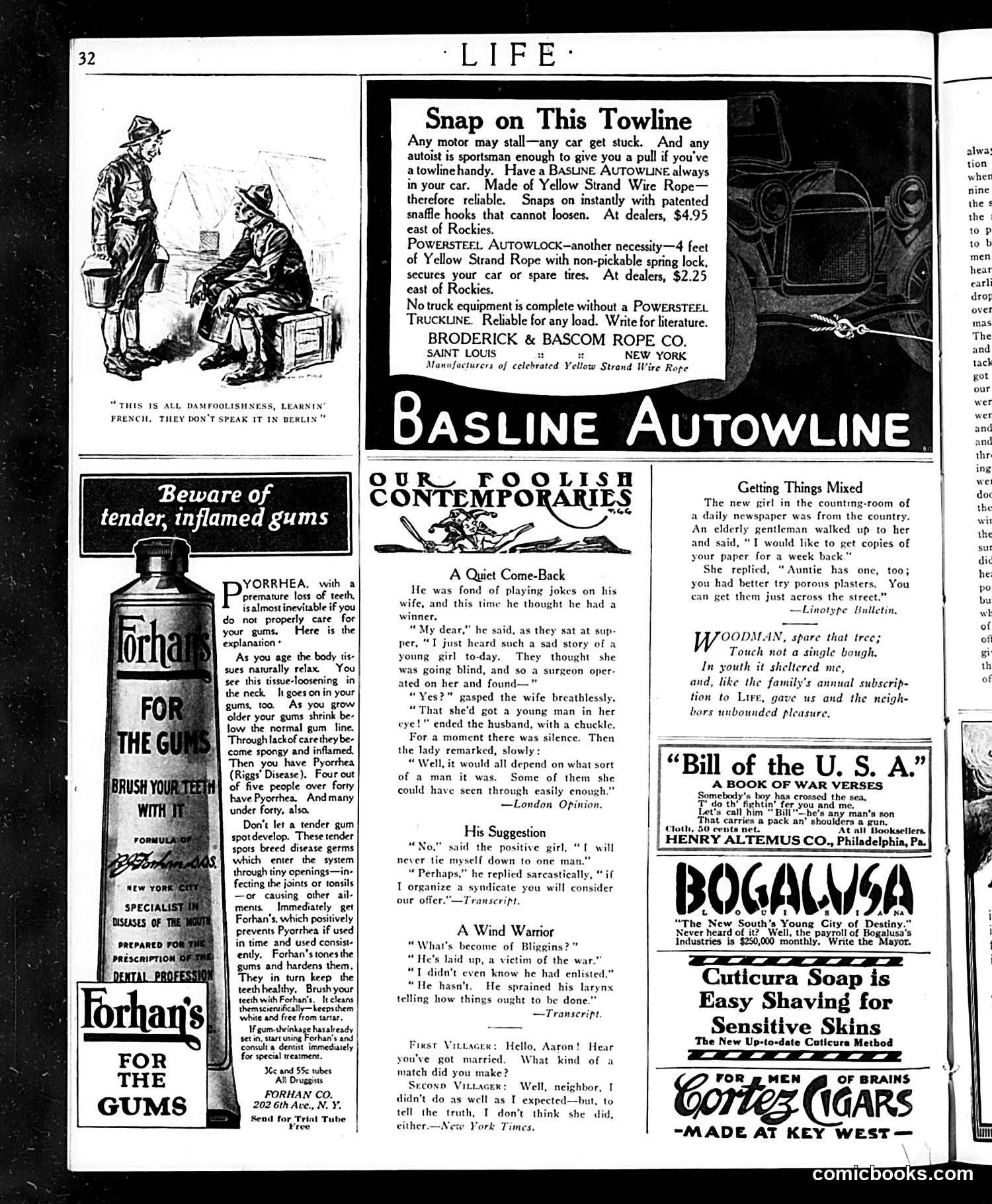
This page combines **advertisements with satirical humor columns** typical of Life magazine's format. The cartoon at top-left shows two men in conversation, with the caption "THIS IS ALL DAMPOOLISHNESS, LEARNIN' FRENCH. THEY DON'T SPEAK IT IN BERLIN"—a joke mocking Americans who waste time on impractical education (French language study) when current events (likely WWI-era) make such knowledge irrelevant. The "Berlin" reference suggests contemporary geopolitical tensions. The "OUR FOOLISH CONTEMPORARIES" section reprints jokes from other publications, including domestic humor about marriage and communication mishaps, and a joke about a man who "sprained his larynx telling how things ought to be done"—satirizing know-it-alls. The advertisements (Basline Autowline rope, Forhan's toothpaste, Bogalusa industries, Cutlcura soap, Cortez cigars) occupy significant space, reflecting the magazine's revenue model. The page is primarily **commercial rather than political content**, representing early 20th-century Life's mix of light satire and advertising.
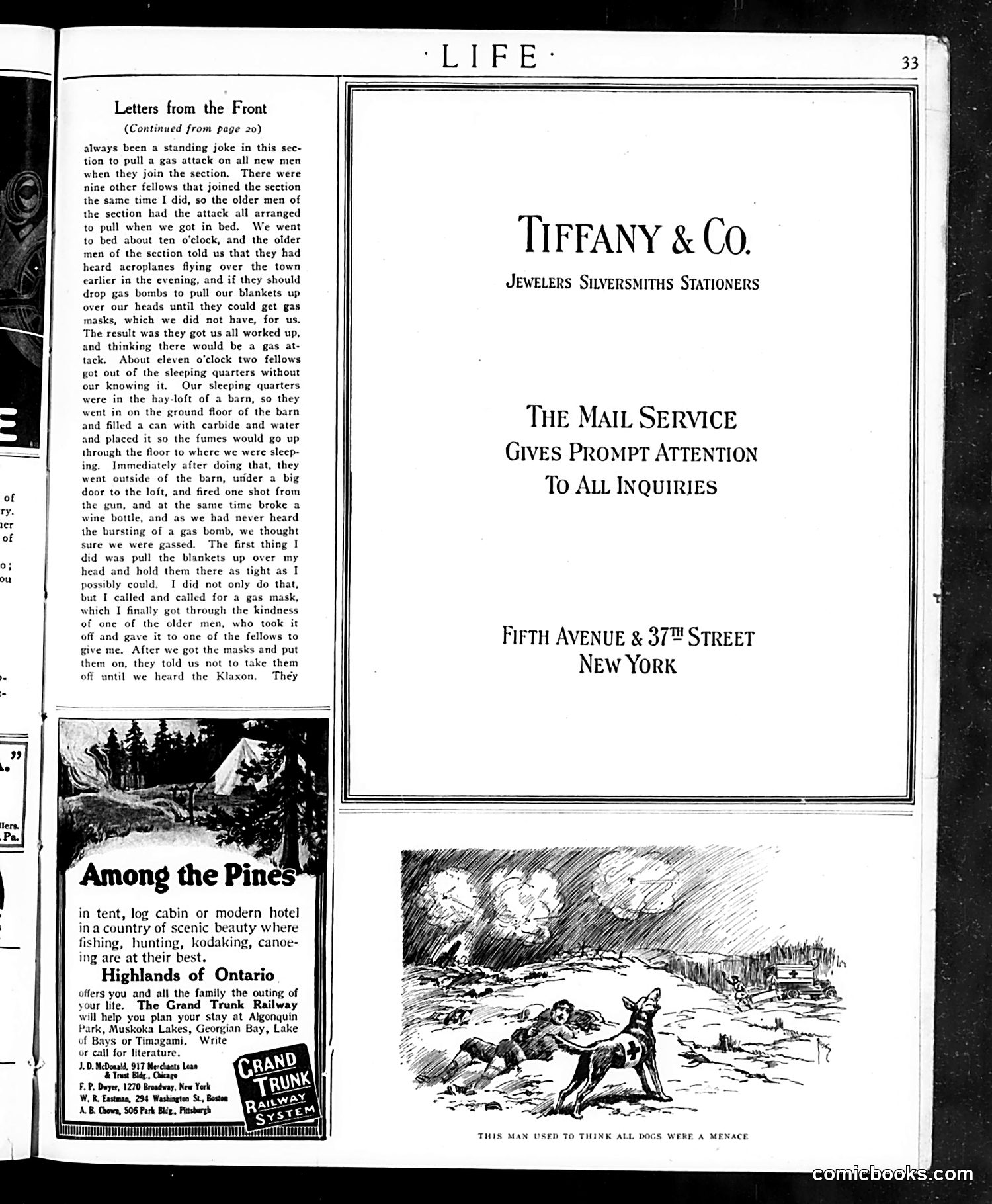
**Main Content:** This page features a continuation of "Letters from the Front," a first-person account from a WWI soldier describing a hazing prank pulled on new recruits. Older soldiers trick newcomers into believing a German gas attack is occurring by creating carbide fumes and firing a gun, then distributing gas masks. The soldiers are instructed not to remove masks until hearing the "Klaxon" (air raid siren). **The Cartoon:** The bottom illustration shows a man and dog running together, captioned "THIS MAN USED TO THINK ALL DOGS WERE A MENACE." The context suggests this reflects changed perspectives post-WWI—soldiers experiencing actual combat horrors (gas attacks, bombs) likely gained new appreciation for ordinary peacetime concerns. **Advertisements:** The page includes ads for Tiffany & Co. and the Highlands of Ontario resort. **Historical Context:** The letter reflects the dark humor soldiers used to cope with genuine wartime dangers, while the cartoon's caption suggests how combat fundamentally altered servicemen's civilian perspectives.
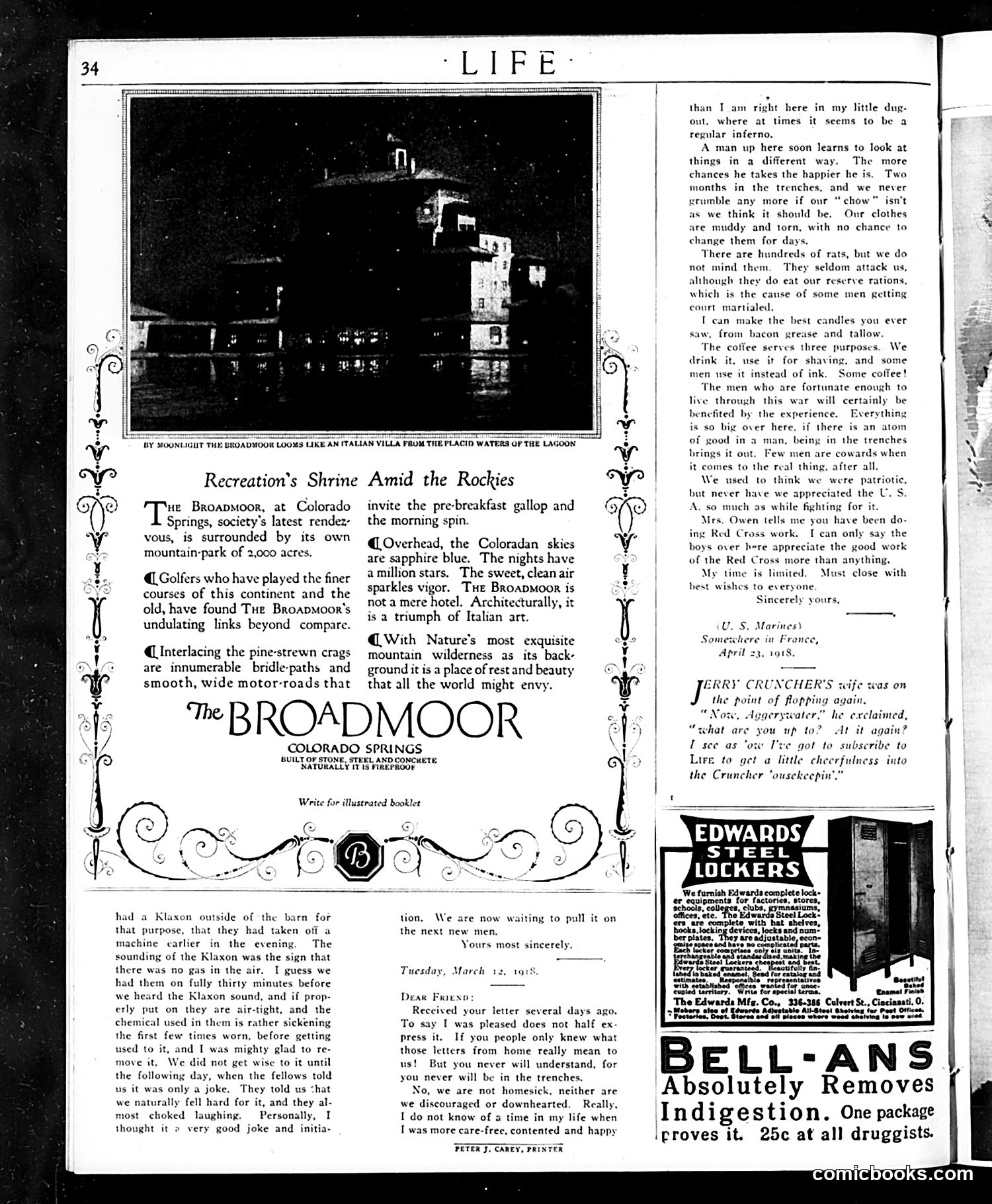
This page combines **luxury resort advertising** with **World War I soldier correspondence**. The left side features a full-page advertisement for The Broadmoor hotel in Colorado Springs—a grand Italian-style resort with golf courses, bridle paths, and mountain views. This is straightforward promotional material highlighting the hotel as an exclusive leisure destination. The right side presents personal letters from U.S. soldiers in the trenches during WWI (dated March 1918). These letters describe harsh conditions: mud, rats, inadequate food, chemical weapons training, and constant danger. The soldiers express gratitude for letters from home and newfound appreciation for America. **The satire emerges from juxtaposition**: while Americans at home enjoy luxurious resort recreation, soldiers abroad endure trenches and chemical weapons. The contrast between "Recreation's Shrine Amid the Rockies" and soldiers' descriptions of "inferno" dugouts highlights the stark divide between civilian comfort and military sacrifice during wartime. The page also includes advertisements for Edwards Steel Lockers and Bell-Ans antacid—utilitarian products contrasting sharply with the Broadmoor's opulence.
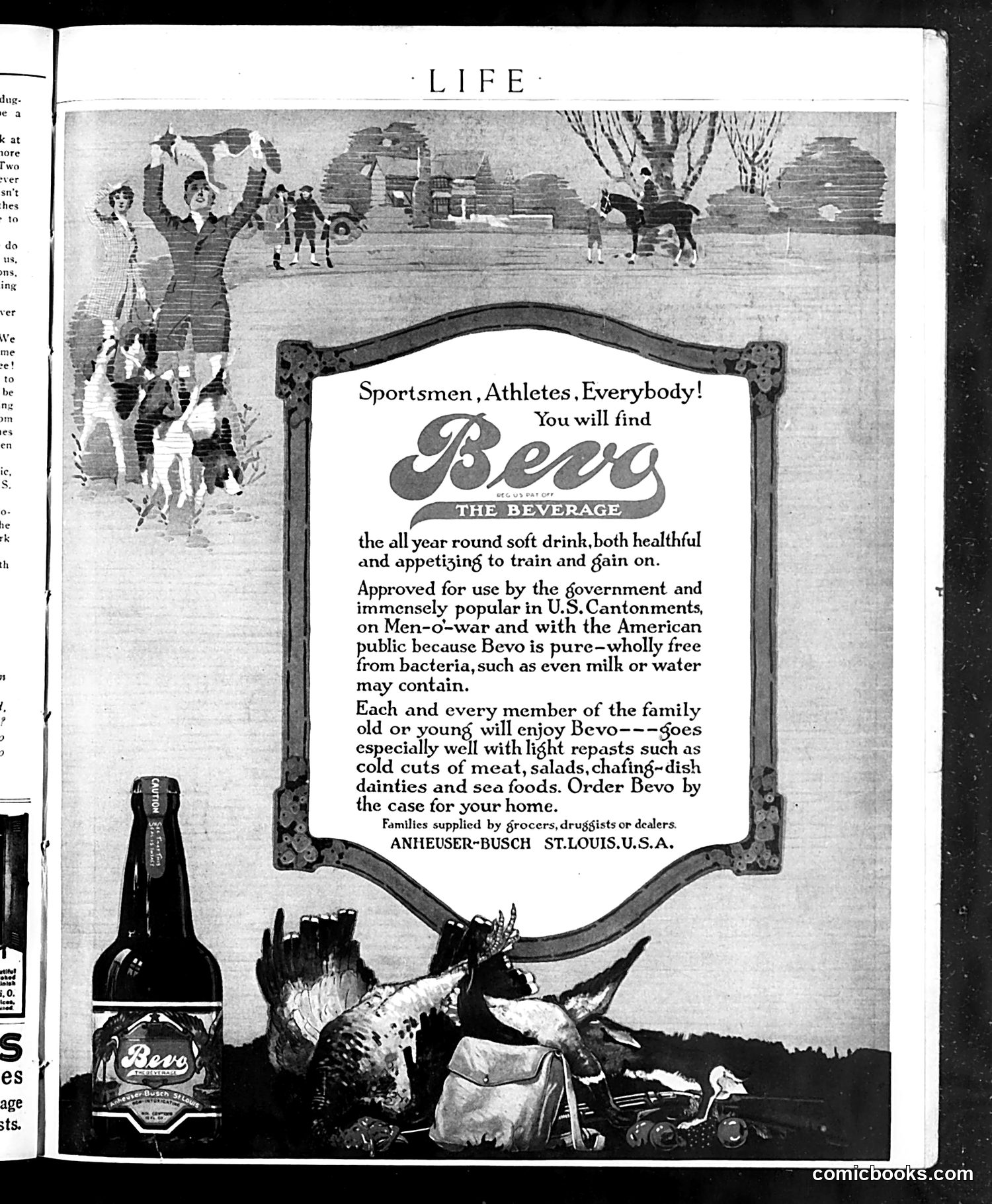
This is a **full-page advertisement**, not satire or political cartoon. It advertises Bevo, a soft drink made by Anheuser-Busch. The ad targets athletes and active Americans, featuring illustrations of people playing sports (top) and leisure activities (bottom). The key sales pitch emphasizes that Bevo is "pure—wholly free from bacteria." The historical context: Bevo was Anheuser-Busch's non-alcoholic alternative, likely introduced or promoted during Prohibition or wartime rationing. The mention of government approval and popularity "in U.S. Cantonments" and "on Men-o-war" (warships) suggests this dates to World War I era, when alcohol restrictions were in effect. The advertisement positions Bevo as wholesome, patriotic, and suitable for families and military personnel—a legitimate beverage for the health-conscious and socially responsible American consumer.
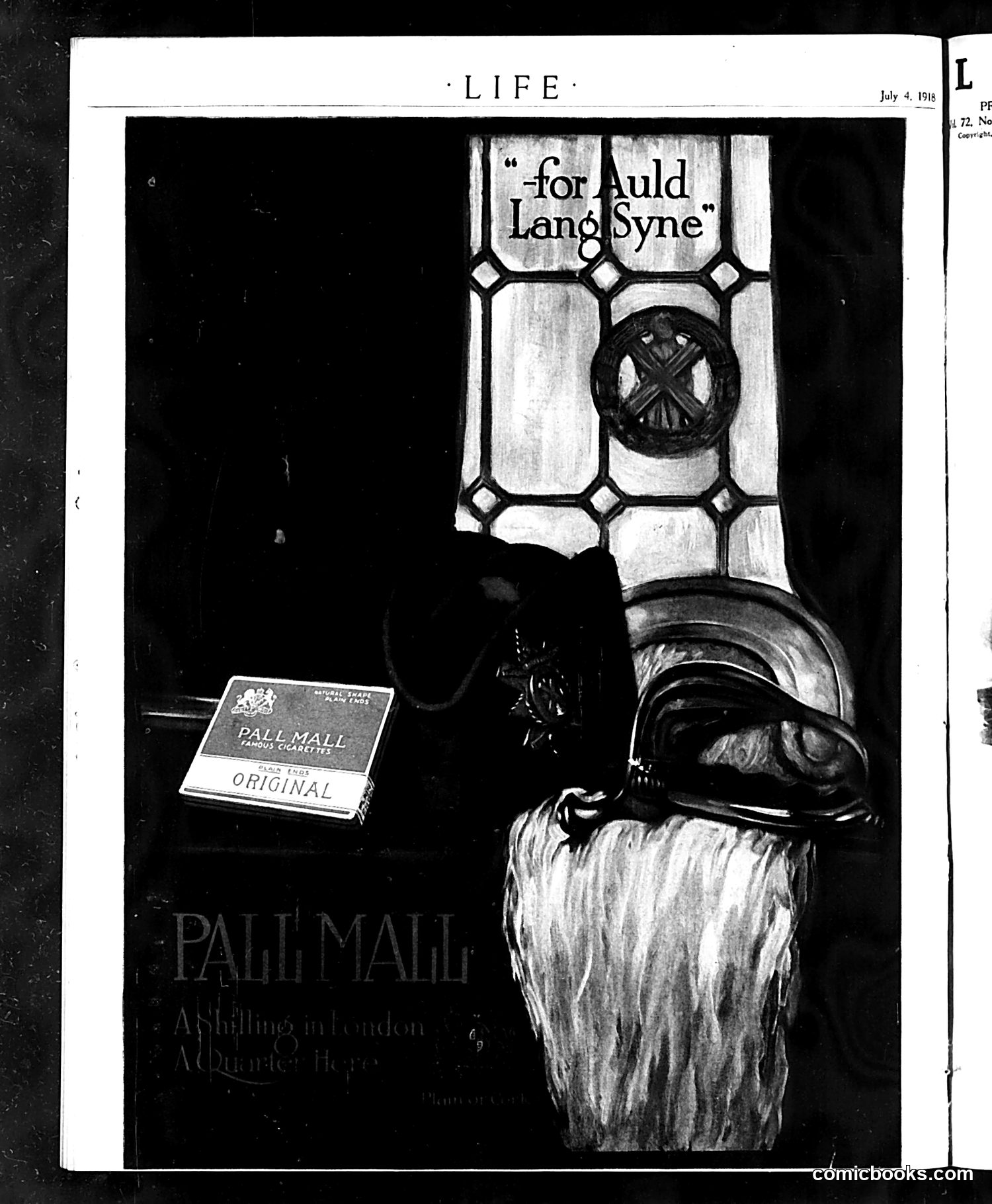
This page from *Life* magazine (July 4, 1918) is primarily an **advertisement for Pall Mall cigarettes**. The visual shows an elderly bearded man (appearing to represent "Auld Lang Syne"—Scottish tradition and nostalgia) gazing out a leaded-glass window at a clock showing the time. The tagline **"—for Auld Lang Syne"** connects the product to sentimental, traditional values. The phrase references the famous Scottish song about remembering old friendships and times past. This is commercial messaging rather than political satire—using nostalgic imagery and cultural associations to market cigarettes to American consumers during World War I. The reference to "Auld Lang Syne" suggests Pall Mall represents timeless quality and tradition worth remembering.