
Life, 1918-07-04 · page 13 of 36
Life — July 4, 1918 — page 13: what you’re looking at
What you’re looking at
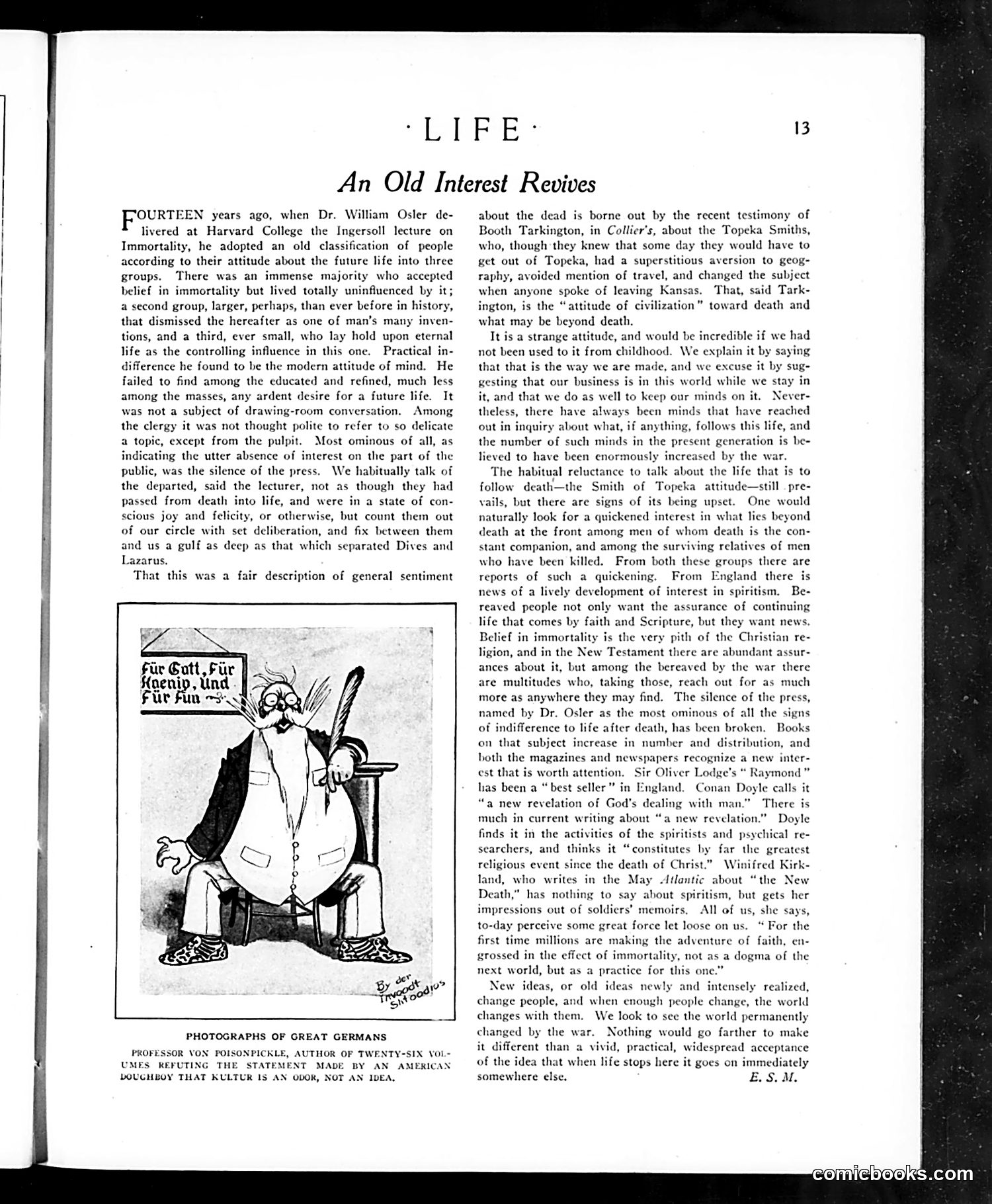
This 1920s *Life* magazine article discusses renewed public interest in spiritualism and belief in an afterlife, particularly following World War I. The cartoon shows a figure labeled "Die Gott Für Kneip Und a Für Alm" (appears to be German text, likely satirizing German culture). The accompanying illustration ridicules spiritualism—a movement gaining traction as bereaved families sought contact with soldiers killed in the war. The article notes that books on spiritualism increased in distribution, and figures like Sir Oliver Lodge promoted "new revelations" about communicating with the dead. The satire targets the gullibility of the grieving public who turned to spiritualism as solace, treating it as a dubious "practice for this one" rather than genuine religious faith.
📄 Transcribed text from this page (OCR, searchable)
Machine-transcribed from the original scan — historical spelling and the odd misread are preserved.
‘OURTEEN years ago, when Dr. William Osler de- livered at Harvard College the Ingersoll lecture on Immortality, he adopted an old classification of people according to their attitude about the future life into three groups. There was an immense majority who accepted belief in immortality but lived totally uninfluenced by it; a second group, larger, perhaps, than ever before in history, that dismissed the hereafter as one of man’s many inven- tions, and a third, ever small, who lay hold upon eternal life as the controlling influence in this one. Practical in- difference he found to be the modern attitude of mind. He failed to find among the educated and refined, much less among the masses, any ardent desire for a future life. It was not a subject of drawing-room conversation. Among the clergy it was not thought polite to refer to so delicate a topic, except from the pulpit. Most ominous of all, as indicating the utter absence of interest on the part of the public, was the silence of the press. We habitually talk of the departed, said the lecturer, not as though they had passed from death into life, and were in a state of con- scious joy and felicity, or otherwise, but count them out of our circle with set deliberation, and fix between them and us a gulf as deep as that which separated Dives and Lazarus. That this was a fair description of general si ntiment Fur Catt Fir Koenip, Und Fur Fun ms PHOTOGRAPHS OF GREAT GERMANS. PROFESSOR VON POISONPICKLE, AUTHOR OF TWENTY-SIX VOL~ UMES REFUTING THE STATEMENT MADE BY AN AMERICAN DOUGHBOY THAT KULTUR IS AN ODOR, NOT AN IDEA, “LIFE: An Old Interest Revives about the dead is borne out by the recent testimony of Booth Tarkington, in Collier's, about the Topeka Smiths, who, though they knew that some day they would have to get out of Topeka, had a superstitious aversion to geog- raphy, avoided mention of travel, and changed the subject when anyone spoke of leaving Kansas. That, said Tark- ington, is the “attitude of civilization” toward death and what may be beyond death. It is a strange attitude, and would be incredible if we had not been used to it from childhood. We explain it by saying that that is the way we are made, and we excuse it by sug- gesting that our business is in this world while we stay in it, and that we do as well to keep our minds on it. Never- theless, there have always been minds that have reached out in inquiry about what, if anything, follows this life, and the number of such minds in the present generation is be- lieved to have been enormously increased by the war. The habitual reluctance to talk about the life that is to follow death—the Smith of Topeka attitude—still _pre- vails, but there are signs of its being upset. One would naturally look for a quickened interest in what lies beyond death at the front among men of whom death is the con- stant companion, and among the surviving relatives of men who have been killed. From both these groups there are reports of such a quickening. From England there is news of a lively development of interest in spiritism. Be- reaved people not only want the assurance of continuing life that comes by faith and Scripture, but they want news. Belief in immortality is the very pith of the Christian re- ligion, and in the New Testament there are abundant assur- ances about it, but among the bereaved by the war there are multitudes who, taking those, reach out for as much more as anywhere they may find. The silence of the press, named by Dr. Osler as the most ominous of all the signs of indifference to life after death, has been broken. Books on that subject increase in number and distribution, and oth the magazines and newspapers recognize a new inter- est that is worth attention. Sir Oliver Lodge's “ Raymond” las been a “ best seller” in England. Conan Doyle calls it “a new revelation of God's dealing with man.” There is much in current writing about “a new revelation.” Doyle finds it in the activities of the spiritists and psychical ri searchers, and thinks it “constitutes by far the greatest religious event since the death of Christ.” Winifred Kir land, who writes in the May Atlantic about “the New Death,” has nothing to say about spiritism, but gets her impressions out of soldiers’ memoirs, All of us, she says, to-day perceive some great force let loose on us. “ For the first time millions are making the adventure of faith, en- grossed in the effect of immortality, not as a dogma of the next world, but as a practice for this one.” New ideas, or old ideas newly and intensely realized, change people, and when cnough people change, the world changes with them. We look to see the world permanently changed by the war. Nothing would go farther to make it different than a vivid, practical, widespread acceptance of the idea that when life stops here it goes on immediately somewhere else. E.S.M.